Japan to Delay Ocean Dumping of Contaminated Waste Water from Fukushima
To delay but not to give up. One step backward to jump two steps forward at a later time…. Typical Japanese government shrewd tactics!

by John Laforge March 3, 2023
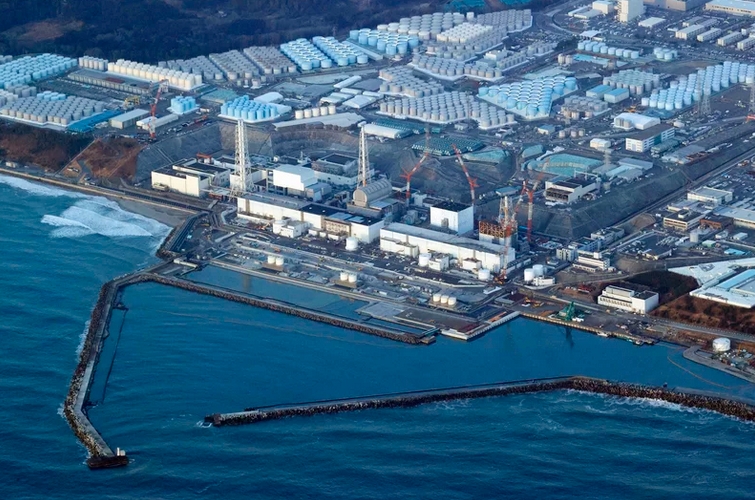
Japan’s Chief Cabinet Secretary Hirokazu Matsuno announced in January that his government would delay its plan to pump over 1.37 million tons of watery radioactive waste into the Pacific Ocean from the devastated six-reactor complex at Fukushima-Daiichi. With the country facing harsh international pressure to cancel the dumping, Matsuno acknowledged “the need to gain public support,” for the plan, the Associated Press reported January 12. The wicked water is now being collected in large tanks that were hastily built near the wrecked reactors.
Fierce criticism of the deliberate pollution scheme has come from China, South Korea, other Pacific Rim countries, scientists, environmental groups, UN human rights experts, and the Pacific Islands Forum (PIF), an alliance of 17 Pacific island nations. Japan’s Prime Minister Fumio Kishida also indicated that the government wants a postponement of the dumping operation — designed by the Tokyo Electric Power Company (Tepco) — until it is “verifiably safe to do so,” Thomas Heaton reported February 16 for Civil Beat.
The PIF, independent states where according to Reuters up to half of the world’s tuna is sourced, was crucial in forcing Japan’s apparent retreat. The PIF warned that contaminating the Pacific could harm the fishing that its economies depend on. Mary Yamaguchi reported on January 12 for the AP: “Some scientists say the impact of long-term, low-dose exposure to tritium and other radionuclides on the environment and humans is still unknown and the release plan should be delayed. They say tritium affects humans more when it is consumed in fish.” A scientific expert panel assembled by the PIF urged a reconsideration of the dumping “because it was not supported by data and more information was needed,” Ken Buesseler, with the Woods Hole Oceanographic Institution, said in January.
Japan announced in April 2021 that it would allow Tepco to pump the nearly 1.4 million tons of liquid radioactive waste into the public commons of the Pacific Ocean beginning in spring 2023. Tepco says it intends to dilute the material and pump it into the sea for the next 30 to 40 years using an underground tunnel now under construction. Media attention has focused on the tritium (radioactive hydrogen) in the wastewater which cannot be removed by Tepco’s (failed) filtering system and has generally ignored mention of the long-lived carbon-14 in the water, which likewise cannot be removed.
Often unreported about the plan is the failure of Tepco’s wastewater filer system, dubbed the “Advanced Liquid Processing System,” which has not removed the dozens of long-lived radioactive substances — including ruthenium, cobalt-60, strontium-90, cesium-137, and even plutonium – that the company said it would filter.
The water becomes radioactively contaminated (150 tons more every day) after being poured over hundreds of tons of melted, ferociously radioactive uranium — and in reactor #3 plutonium — fuel, the hot wreckage amassed deep inside the foundations of the three destroyed nuclear reactors, units 1, 2 and 3. All three suffered catastrophic meltdowns following the Great Tohoku Earthquake and tsunami of March 11, 2011. Some of the contaminated waste is groundwater that reaches the melted fuel after pouring through cracks in the reactors’ foundations caused by the earthquake. Dr. Buesseler Science magazine in 2020, “Many other isotopes are in those tanks still, and over 70 percent [of 1.37 million tons] would have to be cleaned up further before they might consider even releasing….”
Moreover, reactor 3 which was packed with “mixed oxide” fuel made of combined uranium and plutonium, suffered a huge hydrogen explosion at 11 a.m. on March 14, and Tepco announced that on March 21 and 22, in soil collected on the Fukushima site, plutonium was detected. Hydrogen explosions also caused severe damage to reactors 1 and 2, and to the waste fuel pool of reactor 4. (Three additional hydrogen explosions caused severe damage: to reactor 1 on March 11, and to reactor 2 and to the waste fuel pool of reactor 4 on March 15.)
In April 2021, Cindy Folkers, a radiation and health hazards specialist at Beyond Nuclear in Maryland, told Brett Wilkins of Common Dreams, “TEPCO data show that even twice-through filtration leaves the water 13.7 times more concentrated with hazardous tritium — radioactive hydrogen — than Japan’s allowable standard for ocean dumping, and about one million times higher than the concentration of natural tritium in Earth’s surface waters.”
Secretary Matsuno said in his January statement that the delayed dumping plan “includes enhanced efforts to ensure safety.” This vague reassurance comes from the same authorities that caused the triple meltdown and consequently the worst radioactive contamination of the Pacific Ocean in history; it follows two years of iron-clad declarations from Tepco and government regulators that contaminating the ocean will be safe. The plan to add more radioactive poisons to the Pacific in order to save money has also been approved by the U.S. government and the UN International Atomic Energy Agency.
John LaForge is a Co-director of Nukewatch, a peace and environmental justice group in Wisconsin, and edits its newsletter.
Ocean discharge of contaminated water from Fukushima nuclear power plant may be delayed from this spring to July
January 4, 2023
The Yomiuri Shimbun reported on the 4th that the start of ocean discharge of treated water from TEPCO’s Fukushima Daiichi Nuclear Power Plant is expected to be delayed from the original target of around April this year.
This delay in treated water is due to delays in installation of the discharge port attached to the tip of the undersea tunnel, etc., and TEPCO expects the completion of the discharge facility at the end of June this year, and the discharge of treated water will begin after July, after pre-use inspection. It is likely to become, the media added.
The Japanese government decided at a related ministerial meeting in April 2021 to set the time to start discharging treated water about two years later (from April 2021). Accordingly, TEPCO has set the goal of completing the discharge facility in August 2021 as April 2023.
The plan was to dig an undersea tunnel about 1km off the coast of the Fukushima nuclear power plant, and discharge treated water from the discharge port of the fleet into the sea. TEPCO started full-scale construction of the discharge facility on August 4 last year.
However, the installation of the outlet, which was scheduled for August, was delayed by about three months due to deteriorating weather conditions such as high waves, and was delayed to November 18th. Currently, it is said that the construction of filling the area around the discharge hole with concrete is in progress. TEPCO estimates that this construction alone will take about four months.
About 800m of the total length of the undersea tunnel was completed, and the remaining 200m will be excavated over 2 to 3 months after the completion of the concrete work. According to TEPCO, completion of the discharge facility is expected by the end of June this year.
According to Yomiuri, Japan’s Ministry of Economy, Trade and Industry is requesting that the construction be carried out so that emission can start as planned, but TEPCO says, “We want to shorten the construction period as much as possible with safety as the top priority.”
‘Treatment water’ is water from which most of the radioactive materials have been removed by purifying the contaminated water after cooling the melted and hardened nuclear fuel in the meltdown accident in 2011. Currently, about 1.32 million tons are stored in more than 1,000 tanks on the site of the nuclear power plant.
During the 3/11 Great East Japan Earthquake in 2011, contaminated water was generated as rain and groundwater flowed into the reactor building, where the core nuclear fuel (debris) of the decommissioned reactor melted in the Fukushima Daiichi Nuclear Power Plant accident remained.
Japan calls this contaminated water ‘treated water’ by filtering it through ALPS, but it is said that it is impossible to remove radioactive substances such as tritium (tritium) even after purification.
Source: Donga https://newsrebeat.com/world-news/132431.html
TEPCO delays Fukushima chimney demolition

December 16, 2019
The operator of the crippled Fukushima Daiichi nuclear plant says it is having difficulties reducing the height of a damaged exhaust chimney and will extend the deadline to finish the work.
The 120-meter tall exhaust stack shared by the No.1 and No.2 reactors was heavily contaminated by radioactive substances in the 2011 accident. Its steel framework was damaged by the accident.
Tokyo Electric Power Company has been working since August to halve the chimney’s height to around 60 meters to reduce the risk of collapse, but has so far only cut about nine meters.
The company says a cutter developed for the project has run into a series of problems. It says the blade of the remotely-controlled device has worn down faster than expected and become stuck.
TEPCO has suspended the demolition, and is reviewing its cutting methods and procedures. The utility says it will submit an improved plan to the Nuclear Regulation Authority.
The firm says it hopes to restart the work by the end of this month and will reschedule completion of the project from the end of March next year to mid-May.
1 This Month

of the week – Shut Down Drone Warfare!


Tell the Ukrainian Government to Drop Prosecution of Peace Activist Yurii Sheliazhenko

Petition to revoke the licensing of the Near Surface Nuclear Disposal Facility (NSDF) at Chalk River. https://www.ourcommons.ca/petitions/en/Petition/Details?Petition=e-7247
To see nuclear-related stories in greater depth and intensity – go to https://nuclearinformation.wordpress.com
-
Archives
- March 2026 (244)
- February 2026 (268)
- January 2026 (308)
- December 2025 (358)
- November 2025 (359)
- October 2025 (376)
- September 2025 (257)
- August 2025 (319)
- July 2025 (230)
- June 2025 (348)
- May 2025 (261)
- April 2025 (305)
-
Categories
- 1
- 1 NUCLEAR ISSUES
- business and costs
- climate change
- culture and arts
- ENERGY
- environment
- health
- history
- indigenous issues
- Legal
- marketing of nuclear
- media
- opposition to nuclear
- PERSONAL STORIES
- politics
- politics international
- Religion and ethics
- safety
- secrets,lies and civil liberties
- spinbuster
- technology
- Uranium
- wastes
- weapons and war
- Women
- 2 WORLD
- ACTION
- AFRICA
- Atrocities
- AUSTRALIA
- Christina's notes
- Christina's themes
- culture and arts
- Events
- Fuk 2022
- Fuk 2023
- Fukushima 2017
- Fukushima 2018
- fukushima 2019
- Fukushima 2020
- Fukushima 2021
- general
- global warming
- Humour (God we need it)
- Nuclear
- RARE EARTHS
- Reference
- resources – print
- Resources -audiovicual
- Weekly Newsletter
- World
- World Nuclear
- YouTube
-
RSS
Entries RSS
Comments RSS
 nuclear-news