Radioactive waste stuck at 830 sites with nowhere to go

March 3, 2022
Vast quantities of topsoil collected during decontamination work after the 2011 Fukushima nuclear disaster are stuck in limbo at hundreds of sites with no early prospect of being shipped to interim storage facilities ahead of a government-set deadline.
The soil is being kept “temporarily” at 830 locations in six municipalities in Fukushima Prefecture.
The city of Koriyama has 582 sites containing about 6,000 cubic meters of waste, followed by Fukushima with about 2,000 cubic meters at 200 locations.
Significant delays are expected in shipping the soil even though the government had planned to complete the operation by the end of this month as required by law.
The volume of contaminated soil and other radioactive materials awaiting shipment totals 8,460 cubic meters, which is the equivalent of 130 trucks each weighing 10 tons.
A key reason for the delay is that new houses were built on land where contaminated soil was buried as negotiations over storage sites in many communities dragged on. This accounts for about 50 percent of the cases cited by municipalities in a survey by the prefectural government last September.
About 30 percent of cases resulted from the refusal of landowners to bear the transportation costs, while about 10 percent are due to an inability by the authorities to contact the landowners.
As time passed, ownership of land tracts changed due to sales transactions and inheritance issues. Some landowners had no idea their plots contained radioactive material.
Tokyo Electric Power Co., operator of the crippled Fukushima No. 1 nuclear plant, shouldered the cost of the cleanup.
But the owners of the homes in question are obliged to pick up the tab for relocating so that the buried waste can be removed, according to the Environment Ministry.
Officials in the six local governments said the radiation levels at the 830 sites pose no health hazard as the readings were below 0.23 microsieverts per hour, the threshold for the need to decontaminate.
Decontamination work in affected communities in the prefecture wound up by March 2018.
The waste from those operations is required by law to be shipped outside the prefecture for final disposal by 2045.
Until then, the interim storage facility is all that is available.
The central government and Fukushima prefectural authorities have been locked in talks for the past 18 months on what to do with contaminated soil that cannot be moved any time soon.
The Environment Ministry called on local governments to continue managing contaminated soil that is deemed difficult to move in line with a directive issued in December 2020 that made it their responsibility.
The special measures law concerning the handling of radioactive materials stipulates that municipalities, which oversaw the cleanup, are responsible for managing the contaminated materials.
But the ministry’s directive upset local governments, which operate with limited manpower and funds.
Officials with the Fukushima and Sukagawa city governments held informal talks with the ministry last October to request that the central government collect, manage and transport the contaminated soil.
“We cannot manage these sites forever as the number of our employees is dwindling,” one official said.
Kencho Kawatsu, who chairs a committee with oversight for the environmental safety of the interim storage facility, underlined the need for the central and Fukushima prefectural governments to share in the responsibility for managing the temporary storage sites with municipalities.
“If the radioactive soil is scattered, it could fuel rumors that prove harmful to Fukushima municipalities,” said Kawatsu, a guest professor of environmental policy and radiation science at Fukushima University.
He suggested centralizing data on the issue to prevent such an occurrence.
Tohoku disaster funds spent for wining, dining company execs
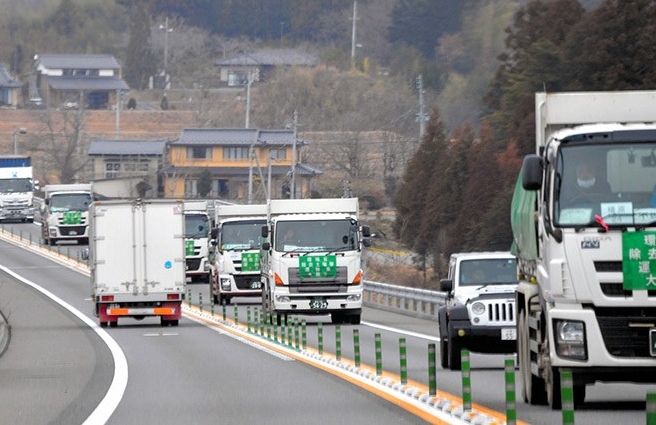 A convoy of trucks transports radioactive debris from decontamination work.
July 27, 2020
Subcontractors hired to rebuild the disaster-stricken Tohoku region created slush funds with taxpayer money to wine and dine and give cash to senior officials of four major construction companies, The Asahi Shimbun has learned.
The combined sum of the slush funds reached at least 160 million yen ($1.51 million), a result of padded bills paid for by revenue collected under a new tax levied for reconstruction projects in the region.
The four construction companies whose executives accepted the gifts from the subcontractors are Shimizu Corp., Hazama Ando Corp., Kajima Corp. and Taisei Corp. Together, they received more than 1 trillion yen worth of government contracts to rebuild the Tohoku region from the 2011 Great East Japan Earthquake, tsunami and Fukushima nuclear disaster.
The projects included disposal of the mountains of debris generated by the tsunami and rebuilding communities affected by the triple meltdown at the Fukushima No. 1 nuclear plant.
The subcontractors received orders from those four general contractors, inflated the costs of the work, and pooled the excess money into slush funds.
Cash gifts from the slush funds were presented to senior officials of those companies at their branches in the Tohoku region who had an influential say in selecting subcontractors and how the funds for the projects should be allocated.
The slush funds also covered parties at night clubs to entertain the executives and even paid for the cost of overseas trips.
The slush funds were uncovered by the Tokyo Regional Taxation Bureau, sources said.
An employee with a subcontractor said that on one occasion, the company was forced to shell out more than 1 million yen to cover the drinking expenses of a senior Kajima official at a high-end club.
The employee also said the subcontractor used the slush fund to buy an expensive watch that the Kajima official wanted to give to a hostess, and to pay for the expenses of his frequent trips to the Philippines.
The Kajima official was also given “pocket money” worth 300,000 yen to 500,000 yen per occasion, the employee said.
A Tokyo company received a contract from Shimizu to clean up Okuma, a town co-hosting the crippled nuclear plant.
Shimizu overpaid the company for the work, allowing it to build a slush fund totaling tens of millions of yen.
On 10 occasions, the subcontractor used the slush fund to give a cash gift to a senior Shimizu official who oversaw the Okuma project. It also used the fund to entertain the official over dinner.
A Hazama Ando official in a similar high-level position is believed to have taken about 10 million yen from a slush fund of a subcontractor in connection with a project to dismantle buildings in Namie, Fukushima Prefecture.
The Tokyo Regional Taxation Bureau ordered the Shimizu subcontractor and Hazama Ando to pay back taxes and penalties for tax evasion, saying payments from the slush funds to their senior officials should have been declared as earnings.
After the slush funds came to light, the gift-receiving senior officials with Shimizu and Hazama Ando left their companies.
A company in Hyogo Prefecture that sells waste-disposal machinery accumulated a slush fund totaling 44 million yen from 2014 to 2015 through business transactions with another company. The two companies were involved in the tax-funded rebuilding projects in the Tohoku region.
The Hyogo company planned to use the slush fund to give money to senior officials with Taisei and Kajima.
Taisei was in charge of waste disposal in Kesennuma, Miyagi Prefecture, while Kajima oversaw a project to build a waste-processing facility in Tomioka, Fukushima Prefecture.
Multiple subcontractors involved in a reconstruction project in Miyako, Iwate Prefecture, pooled together about 100 million yen in a slush fund to provide favors to a senior Kajima official and other officials at the site and others.
Tax authorities in Osaka and Sendai are looking into the cases.
Asked by The Asahi Shimbun about allegations he received 10 million yen from a slush fund, the former Hazama Ando official said, “I cannot say anything other than the fact that I left the company.”
The senior official with Kajima declined to comment.
Shimizu acknowledged that the senior official in the field accepted excessive entertainment from the subcontractor. It said the official’s actions caused the company to lose money that should have been reported as profit.
“The official in question paid back the money he received (to Shimizu) and quit,” a Shimizu official said.
Taisei said the company does not provide details about deals with subcontractors.
Over eight years from 2011, more than 12 trillion yen in taxpayer money was spent on infrastructure projects to construct roads, embankments and housing in the disaster-hit region. In excess of 6 trillion yen in public money has been spent on rebuilding communities from the nuclear disaster.
The bulk of these funds came from revenue from the new tax to reconstruct Tohoku.
The construction industry, which had been battered by a sharp drop in public works projects, experienced a record boom with the Tohoku-related projects.
(This story was compiled from reports by Takashi Ichida, senior staff writer, Yuta Hanano and Hiroyoshi Itabashi.)
Vietnamese trainees sue Fukushima firm over decontamination work

Foreign Trainees Used in the Cleanup of Fukushima Nuke Plant

Using underpaid Foreign Trainees for Fukushima’s Decontamination

Contractors siphoned 1.6 million yen off pay of Vietnamese trainees sent to Fukushima
Vietnamese trainee paid US$19 a day to do decontamination work near crippled Fukushima nuclear plant in Japan


Japan: Foreign ‘interns’ doing radioactive decontamination work at Fukushima

Vietnamese trainee misled into Fukushima decontamination work
Hazama Ando pair charged with padding expenses during Fukushima decontaminaton work
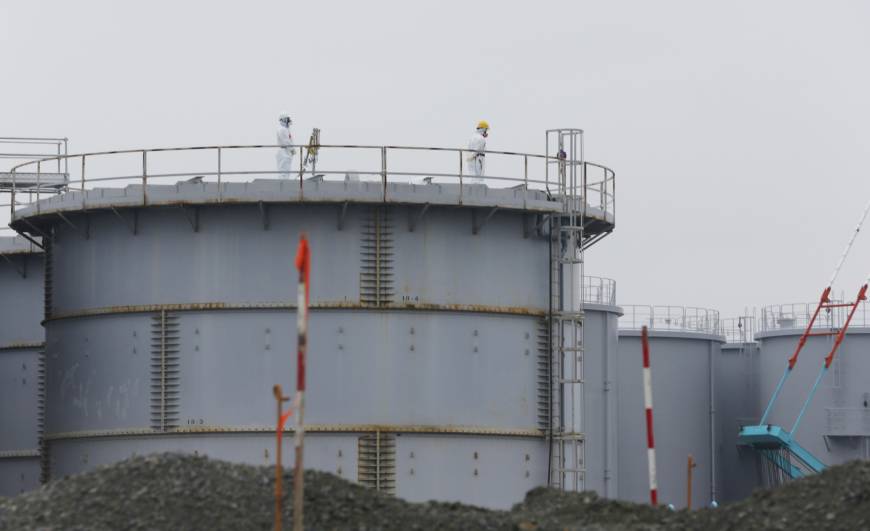 Workers stand on a water tank containing contaminated water at the Fukushima No. 1 nuclear power plant in Okuma, Fukushima Prefecture, in 2014
Two employees of general contractor Hazama Ando Corp. have been indicted without arrest for alleged fraud linked to a Fukushima radiation decontamination project.
The employees, who were indicted by the Tokyo District Public Prosecutor’s Office on Thursday, are Yuichi Yamashita, 48, and Yoshiji Moro, 50, who worked at the Tohoku branch of Tokyo Electric Power Company Holdings Inc. in Sendai. Both have admitted to the allegations, investigative sources said.
According to the indictment, the two padded the accommodation costs for workers involved in the decontamination project by ¥41 million and submitted a false report listing ¥200 million in expenses to the Tamura Municipal Government, which ordered the project, between July and August 2015. They are suspected of cheating the city out of some ¥76 million, and of supplying manipulated receipts as the supporting documents for the expense report.
Hazama Ando said in June this year that it had overstated expenses by some ¥27 million in its report to Tamura and about ¥53 million in its report to Iwaki, another city in Fukushima Prefecture. The prosecutor’s office apparently opted not to pursue the case in Iwaki.
In a statement Thursday, Hazama Ando said the indictment of the employees was a serious matter but denied the contractor had systematic involvement in the misconduct.
An official of the Tamura Municipal Government said the city will consult with the prefectural and central governments on getting back the money it paid to cover the inflated accommodation costs.
The decontamination project is part of the prefecture’s efforts to recover from the March 2011 core meltdowns at the disaster-stricken Fukushima No. 1 nuclear plant.
1 This Month

of the week – Shut Down Drone Warfare!


Tell the Ukrainian Government to Drop Prosecution of Peace Activist Yurii Sheliazhenko

Petition to revoke the licensing of the Near Surface Nuclear Disposal Facility (NSDF) at Chalk River. https://www.ourcommons.ca/petitions/en/Petition/Details?Petition=e-7247
To see nuclear-related stories in greater depth and intensity – go to https://nuclearinformation.wordpress.com
-
Archives
- April 2026 (57)
- March 2026 (251)
- February 2026 (268)
- January 2026 (308)
- December 2025 (358)
- November 2025 (359)
- October 2025 (376)
- September 2025 (257)
- August 2025 (319)
- July 2025 (230)
- June 2025 (348)
- May 2025 (261)
-
Categories
- 1
- 1 NUCLEAR ISSUES
- business and costs
- climate change
- culture and arts
- ENERGY
- environment
- health
- history
- indigenous issues
- Legal
- marketing of nuclear
- media
- opposition to nuclear
- PERSONAL STORIES
- politics
- politics international
- Religion and ethics
- safety
- secrets,lies and civil liberties
- spinbuster
- technology
- Uranium
- wastes
- weapons and war
- Women
- 2 WORLD
- ACTION
- AFRICA
- Atrocities
- AUSTRALIA
- Christina's notes
- Christina's themes
- culture and arts
- Events
- Fuk 2022
- Fuk 2023
- Fukushima 2017
- Fukushima 2018
- fukushima 2019
- Fukushima 2020
- Fukushima 2021
- general
- global warming
- Humour (God we need it)
- Nuclear
- RARE EARTHS
- Reference
- resources – print
- Resources -audiovicual
- Weekly Newsletter
- World
- World Nuclear
- YouTube
-
RSS
Entries RSS
Comments RSS
 nuclear-news