Ministry to delay trial on reusing Fukushima soil in Kanto areas

Residents in Tokyo’s Shinjuku Ward on Dec. 21 protest the Environment Ministry’s plan to reuse soil from Fukushima Prefecture at a site in Shinjuku Gyoen National Garden.
March 2, 2023
Local opposition has forced the Environment Ministry to delay the start of a trial on reusing soil that had been contaminated with radioactive fallout from the 2011 Fukushima nuclear disaster, sources said.
The ministry wanted to begin the trial within this fiscal year, which ends at the end of this month.
Under the plan, soil collected in Fukushima Prefecture during decontamination work following the triple meltdown at the Fukushima No. 1 nuclear power plant would be distributed to three sites in the Kanto region.
The government’s policy is to reuse the soil if its radioactivity level clears the safety threshold of 8,000 becquerels per kilogram to reduce the mountains of soil that will undergo final disposal.
As of the end of January, around 13.41 million cubic meters of soil had been transported to interim storage facilities in the towns of Okuma and Futaba in Fukushima Prefecture after decontamination work.
A law dictates that the soil must undergo final disposal outside Fukushima Prefecture by 2045.
Sites for the final disposal have not been decided.
The ministry decided to conduct the trial of reusing such soil on the premises of ministry-related facilities in Tokyo, Saitama Prefecture and Ibaraki Prefecture.
However, local residents expressed strong opposition to the plan at the ministry’s explanatory meetings in Tokyo’s Shinjuku Ward and Saitama Prefecture’s Tokorozawa in December.
In Tokorozawa, a neighborhood association consisting of residents living near the site of the trial adopted a resolution to oppose the plan.
The Tokorozawa mayor has also shown reluctance to accept the plan.
Asked if the ministry would go ahead with the trial despite the local opposition, an official at the ministry’s environmental restoration and resources circulation bureau said: “We will continue explaining the project by, for example, answering questions from local residents.
“We don’t plan to go through a process to gain an agreement with local residents about the project, so the ministry will make the final decision.”
Sources said the ministry has already decided to postpone the trial. It will continue holding explanatory meetings for residents in the three areas.
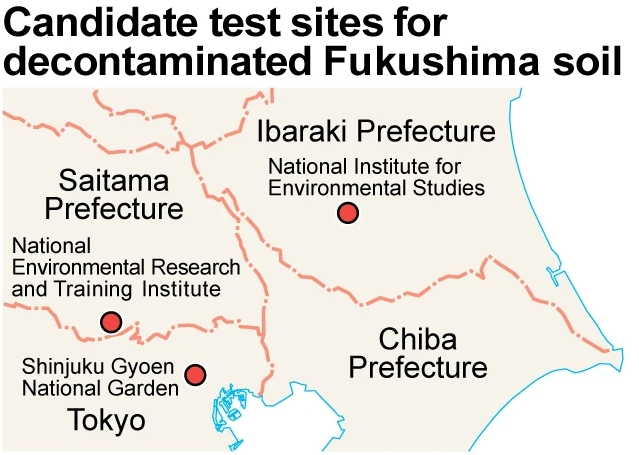
Trials to reuse decontaminated soil around Tokyo postponed

Feb. 24, 2023
Japan’s government is postponing trials in the Tokyo area to reuse soil that was decontaminated following the 2011 nuclear accident due to complaints from residents. They would have been the first of their kind outside Fukushima Prefecture.
The trials were set to start by the end of March in Tokyo’s Shinjuku Ward and Tokorozawa City in neighboring Saitama Prefecture.
But Environment Ministry officials say residents complained and raised concerns at briefing sessions in December.
They say some people questioned why their neighborhood was chosen, and that others complained about a lack of information.
The mayor of Tokorozawa has also been hesitant, as the majority of a local community group opposes the plan.
Ministry officials say they will consider when to start the trials after providing thorough explanations to the residents.
Soil exposed to radioactive fallout from the accident at the Fukushima Daiichi nuclear plant has been cleansed and stored.
The government plans to reuse it for public works projects, as long as the concentration of radioactive substances meets certain safety standards.
Tokyo, Saitama residents say ‘no’ to living near Fukushima soil

The flower bed in Shinjuku Gyoen National Garden where decontaminated soil from Fukushima Prefecture will be reused
February 25, 2023
Residents of Tokyo and Saitama are up in arms at an Environment Ministry plan to reuse decontaminated soil from Fukushima Prefecture in their midst, including a major park in the capital’s Shinjuku district.
They formally submitted requests on Feb. 24 asking to suspend the plan to distribute the soil that was formerly contaminated from radioactive fallout due to the 2011 triple meltdown at the Fukushima No. 1 nuclear power plant.
The plan, announced in December, is aimed at reducing the volume that would go to the final storage site.
One potential test site is Shinjuku Gyoen National Garden in the heart of Tokyo.
At a meeting on Feb. 24 between about 50 local residents and Environment Ministry officials, a request was submitted asking to cancel the plan as well as holding explanatory meetings about the project.
After the meeting, one of the residents, Kunikazu Hirai, 70, said, “We are angry at the danger of having soil that was once contaminated with radiation brought right next door to us.”
According to Environment Ministry officials, there were about 1.2 million visitors to Shinjuku Gyoen National Garden in fiscal 2021, although annual visitors numbered about 2 million prior to the novel coronavirus pandemic.
The two other candidate test sites are the National Institute for Environmental Studies in Tsukuba, Ibaraki Prefecture, and the National Environmental Research and Training Institute in Tokorozawa, Saitama Prefecture.
All three sites are managed by the Environment Ministry and officials believe that consent of local residents is not needed to proceed with their plan.
However, Saitama residents not only attended the Feb. 24 meeting with Environment Ministry officials but also submitted their own request to stop the project.
The unpopularity of the plan is understandable. A proposal to reuse soil in two municipalities in Fukushima Prefecture went nowhere after local residents raised strong opposition.
Only soil decontaminated to levels below 8,000 becquerels per kilogram will be used in the trial runs.
The plan for Tokyo calls for reusing the soil in a flower bed in an area of Shinjuku Gyoen National Garden that would be off-limits to the public. The flower bed would be 10 meters by 3 meters with a hole dug 1 meter deep.
A plastic sheet will be placed in the hole before about six cubic meters of decontaminated soil covers it. A 50-centimeter layer of soil will be placed on top of the decontaminated soil.
The water collected in the sheet will be moved to an adjacent tank and measured for radiation levels. If the levels are under government standards, the water would be released into the sewage system.
The Environment Ministry held an explanatory meeting on Dec. 21, but only 28 people showed up, in large part, because notification of the scheduled meeting was given at the last minute.
Shinjuku Mayor Kenichi Yoshizumi said while the project was completely in the hands of the central government, he expressed dissatisfaction at the explanation and documents presented by the Environment Ministry, which he called “difficult to understand.”
Tokorozawa residents raised objections at an explanatory meeting held in their community in January, and Mayor Masato Fujimoto said it would be difficult for the project to proceed if residents were opposed.
Kenichi Oshima, a professor of environmental economics at Ryukoku University in Kyoto, said the ministry likely wanted to conduct the trial in Tokyo to attract more attention and gain understanding.
But he added, “What has to be paid attention to is not to create a dispute between various regions by having the central government pressuring localities with comments such as, ‘Are you saying you will not cooperate to help Fukushima Prefecture?’”
Decontaminated Soil Planned for Shinjuku Gyoen, Japan “Aware of Safety” Opposition in Various Locations

Image of flower beds using decontaminated soil
February 25, 2023
On February 24, some residents of Shinjuku Gyoen (Shinjuku-ku, Tokyo), one of the candidate sites for a demonstration project by the Ministry of the Environment to reuse decontaminated soil from the decontamination process following the accident at TEPCO’s Fukushima Daiichi Nuclear Power Plant, submitted a request to the ministry to stop the project. The Ministry said, “We want as many people as possible to know the safety of the project. The gap between the two parties has not been closed.
A citizens’ group consisting of local residents handed a letter to ministry officials at the House of Councilors building (Chiyoda Ward, Tokyo), demanding the suspension of the project, a detailed explanation of the project, and the holding of a public meeting to explain the project. About 50 people attended the meeting.
According to the ministry, the number of visitors to Shinjuku Gyoen was approximately 1.2 million in FY2021, and before the Corona disaster, the number had remained at approximately 2 million.
After the offer was made, Shintaro Fujii, Assistant Counselor in charge of the Ministry’s Environmental Restoration Project Office, told the press, “We will answer questions and opinions politely and consider holding additional explanatory meetings in consultation with Shinjuku City.
Kunikazu Hirai, 70, one of the sponsors of the citizens’ group, told the press, “We are angry about the danger of radioactive soil coming to our neighborhood. The group was joined by a group that is working against the project in Tokorozawa City, Saitama Prefecture, another candidate site for the project.
Last December, the ministry announced that it was considering starting the project at three facilities under its control, including Shinjuku, Tokorozawa, and Tsukuba City in Ibaraki Prefecture. At Shinjuku Gyoen, where public access is restricted, the ministry plans to reuse decontaminated soil with a radioactivity level of less than 8,000 becquerels per kilogram to create flower beds. The start date has not yet been determined.
https://www.asahi.com/articles/ASR2S66V9R2SOXIE009.html?iref=pc_photo_gallery_bottom
Ministry to test growing veggies on cleansed soil in Fukushima
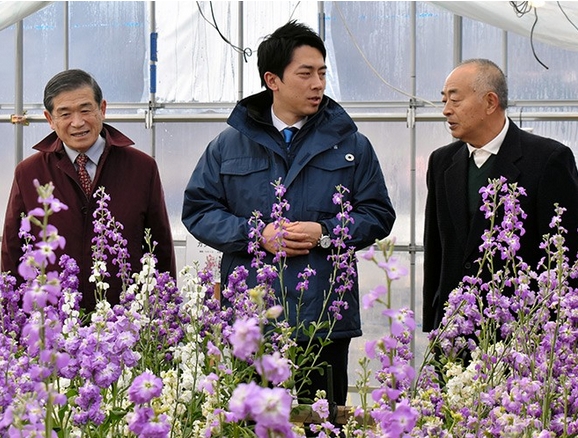 Environment Minister Shinjiro Koizumi, center, inspects a test project on reusing soil decontaminated following the 2011 nuclear accident on farmland in Iitate, Fukushima Prefecture, in February.
May 7, 2020
Despite strong public opposition to the proposal, the Environment Ministry will soon start a trial demonstration to confirm the safety of growing food crops in soil decontaminated following the 2011 nuclear accident.
The ministry received nearly 3,000 public comments about its proposal to revise an ordinance to enable the soil to be reused across Japan, most of which opposed the proposal.
Many people are opposed to reusing the soil, saying, “It will spread contamination.”
At a news conference on May 1, Environment Minister Shinjiro Koizumi acknowledged, “I strongly recognize the fact that there are people who are opposing (the reuse of decontaminated soil). We will provide detailed explanations to seek understanding for our willingness to take a step forward even if it’s just a small one.”
The project, to start by the end of May at the earliest, will be conducted in the Nagadoro district in Iitate, Fukushima Prefecture. The district is designated as a “difficult-to-return” zone, where radiation levels remain high since the triple meltdown at the Fukushima No. 1 nuclear power plant following the Great East Japan Earthquake and tsunami.
The ministry is seeking to reuse decontaminated soil for public construction work and farmland development if the radiation level of the soil is below certain standards. In the last fiscal year, which ended in March, flowers and crops used to make solid fuel for biomass power generation were grown on land using the decontaminated soil.
The ministry initially planned to revise a related ordinance in April to enable the soil to be reused, saying it obtained “results that showed the soil was safe enough (to be used for growing crops).”
However, the ministry decided to postpone the revision after hearing requests from local residents who want to grow food crops as well. The ministry must check the safety of the soil once again since such crops will be intended for human consumption. The ministry will grow vegetables including tomatoes and cucumbers during the test project.
In the Nagadoro district, there is a demonstration plot of farmland that spans about 600 square meters in total. The land comprises an 800-cubic-meter embankment of soil whose radiation level is 5,000 becquerels or lower per kilogram, and the embankment is covered with uncontaminated soil that is 50 centimeters thick.
Decontaminated soil is currently stored at interim storage facilities in Okuma and Futaba in Fukushima Prefecture. The law stipulates that the final disposal of the soil should be conducted outside the prefecture within 30 years from 2015, when the facilities began storing the soil.
The total amount of soil stored at such facilities is expected to reach about 14 million cubic meters, equivalent to 11 Tokyo Domes, located in Tokyo’s Bunkyo Ward. The ministry is considering reusing the soil to reduce the amount of soil that needs to be disposed of.
1 This Month

of the week – Shut Down Drone Warfare!


Tell the Ukrainian Government to Drop Prosecution of Peace Activist Yurii Sheliazhenko

Petition to revoke the licensing of the Near Surface Nuclear Disposal Facility (NSDF) at Chalk River. https://www.ourcommons.ca/petitions/en/Petition/Details?Petition=e-7247
To see nuclear-related stories in greater depth and intensity – go to https://nuclearinformation.wordpress.com
-
Archives
- March 2026 (244)
- February 2026 (268)
- January 2026 (308)
- December 2025 (358)
- November 2025 (359)
- October 2025 (376)
- September 2025 (257)
- August 2025 (319)
- July 2025 (230)
- June 2025 (348)
- May 2025 (261)
- April 2025 (305)
-
Categories
- 1
- 1 NUCLEAR ISSUES
- business and costs
- climate change
- culture and arts
- ENERGY
- environment
- health
- history
- indigenous issues
- Legal
- marketing of nuclear
- media
- opposition to nuclear
- PERSONAL STORIES
- politics
- politics international
- Religion and ethics
- safety
- secrets,lies and civil liberties
- spinbuster
- technology
- Uranium
- wastes
- weapons and war
- Women
- 2 WORLD
- ACTION
- AFRICA
- Atrocities
- AUSTRALIA
- Christina's notes
- Christina's themes
- culture and arts
- Events
- Fuk 2022
- Fuk 2023
- Fukushima 2017
- Fukushima 2018
- fukushima 2019
- Fukushima 2020
- Fukushima 2021
- general
- global warming
- Humour (God we need it)
- Nuclear
- RARE EARTHS
- Reference
- resources – print
- Resources -audiovicual
- Weekly Newsletter
- World
- World Nuclear
- YouTube
-
RSS
Entries RSS
Comments RSS
 nuclear-news