Tokyo Electric Power Co. (TEPCO) Holdings, Inc. is set to ask the national government for financial assistance in decommissioning the disaster-hit Fukushima No. 1 Nuclear Power Plant, company officials said.
The company will also seek consultations with the government over how it should foot the costs of paying compensation to those affected by the nuclear crisis and decontaminating areas affected by radioactive substances from the power station.
TEPCO Holdings has deemed that it cannot secure enough funds to fully cover these costs through its own efforts alone since the expenses are increasingly likely to surpass its estimates.
The utility has secured approximately 1 trillion yen to cover the expenses of decommissioning the crippled power plant and planned to raise another 1 trillion yen. However, it is expected to take the company 30 to 40 years to decommission the plant and deal with the aftermath of the crisis. Moreover, it has been pointed out that the actual decommissioning costs will far surpass 2 trillion yen.
At a news conference on July 28, Fumio Sudo, chairman of TEPCO Holdings, expressed fear that the company will face increased costs of shutting down the plant, pointing out that the decommission project is “work that nobody in the world has experienced.”
The utility currently pays compensation and covers the costs of decontamination work by borrowing money from the state through the Nuclear Damage Compensation and Decontamination Facilitation Corp.
However, the amount of compensation that the utility has so far paid has already reached 6 trillion yen, surpassing the 5.4 trillion yen initial plan. Moreover, decontamination costs are also expected to surpass 2.5 trillion yen as originally planned.
There are no prospects that operations at TEPCO’s Kashiwazaki-Kariwa Nuclear Power Plant in Niigata Prefecture, which would help increase the company’s profits, will be resumed in the foreseeable future. Moreover, TEPCO has faced intensifying competition in the electric power market as the retailing of power was fully liberalized in April. Under these circumstances, TEPCO Holdings is expected to ask the government to provide the firm with an infusion of public funds among other financial aid.
A Japanese government body has revised its plan to decommission the reactors at the Fukushima Daiichi nuclear plant in response to local opposition.
The revision ruled out the option of adopting a Chernobyl-style “sarcophagus” method that seals off disabled reactors with nuclear fuel inside.
The Nuclear Damage Compensation and Decommissioning Facilitation Corporation released the revised plan on Wednesday.
The body presented a technical report a week ago that mentioned the possibility of adopting the sarcophagus method for the first time, while saying it remained committed to removing fuel debris from the reactors.
The report faced backlash from the people in Fukushima Prefecture. Economy, Trade and Industry Minister Motoo Hayashi instructed the body to revise the plan.
The word “sarcophagus” has been deleted from the revised plan, which states that the method will not be adopted in the decommissioning process at the plant.
Shunsuke Kondo, the head of the body’s technical committee, says he regrets the body’s lack of consideration for the locals.
He said he will make sure the body communicates with the locals properly and places top priority on their thoughts.
Fukushima Governor Masao Uchibori said he wants the body to realize how shocked the Fukushima residents were with the word “sarcophagus.”
He said he wants the body to proceed with the removal of fuel debris from the reactors in a safe manner, in line with the locals’ desires.
The government-funded Nuclear Damage Compensation and Decommissioning Facilitation Corp. (NDF) eyes an option of covering the disaster stricken Fukushima No. 1 Nuclear Power Plant with concrete in the future as in the Chernobyl disaster, it has been learned.
In its first planning report drawn up on July 13, the NDF leaves room for adopting the “sarcophagus (stone coffin) method,” in which nuclear fuel debris that melted in the Fukushima crisis will be confined inside reactor buildings using concrete and other materials.
The NDF points out in the report that it will be difficult to manage such a sarcophagus safely over a long period of time, and emphasizes that it is planning to remove fuel debris from the Fukushima nuclear plant for now. However, the report also says, “It is appropriate to flexibly review the plan in accordance with the conditions inside (nuclear reactors and other parts) that will be revealed later.”
The report also states, “It is necessary to fully consider the uncertainties over passing down responsibilities for a long period of time and concerns over easy postponement from one generation to another.”
The sarcophagus method was adopted at the Chernobyl nuclear complex in the former Soviet Union in the wake of the core meltdowns there in 1986.
The government body charged with decommissioning the reactors at the Fukushima Daiichi nuclear plant says it remains committed to removing the fuel but sealing off the buildings that house them could be an option.
The Nuclear Damage Compensation and Decommissioning Facilitation Corporation issued its latest report Wednesday on its plan.
It says 2 methods will be used to remove molten fuel depending on the condition of the reactors.
One entails filling the containment vessels with water to shield workers from radiation. The second does not use water.
The new plan also introduces the option of creating a “sarcophagus” to seal off the buildings with the nuclear fuel inside.
This method was used at the Chernobyl nuclear plant in Ukraine.
The plan favors removing the nuclear fuel because of the long-term safety issues involved with a sarcophagus. It urges a flexible review of all available options.
It also notes the importance of addressing long-term public concerns about the plan.
The government and the plant operator, Tokyo Electric Power Company, plan to decide by the middle of next year how to remove the fuel from the reactors. They hope to begin work at one of them by 2021.
Reacting to the new plan, the heads of municipalities around the Fukushima Daiichi nuclear plant have urged the government to stick to its promise regarding nuclear waste disposal.
The mayor of the city of Minamisoma, Katsunobu Sakurai, said the government and TEPCO must be made to abide by their initial pledge to remove the fuel from Fukushima Prefecture. Until this is done, he said, the evacuees won’t feel that it’s safe to return home.
He warned against using the word “sarcophagus” lightly. He said its mention only points out the inadequacy of decommissioning technology.
The mayor of the town of Namie, Tamotsu Baba, said a sarcophagus should not be considered because engineers are hard at work figuring out ways to remove the fuel.
He said all they can do is to have faith that the initial pledge will be kept, even if it takes 30 or 40 years to remove the fuel.
The mayor of the town of Okuma, Toshitsuna Watanabe, also urged the government and the utility to stick to their disposal promise.
TOKYO — Energy policy was not high on the agenda in Sunday’s upper house election in Japan, in which the ruling Liberal Democratic Party consolidated its power. But Prime Minister Shinzo Abe, the Japanese people and the country’s power companies are facing a difficult question over the fate of the future of nuclear power in Japan: who will foot the costly bill for decommissioning the crippled Fukushima Daiichi nuclear power plant?
Every visit to the site, which was devastated by a magnitude-9.0 earthquake and subsequent tsunami five years ago, shows things are moving forward. A full-face mask is no longer needed in 90% of the compound. An underground ice wall is being constructed to reduce the amount of groundwater entering the basements of the reactor buildings. But what really caught my eye this time was the cream puffs.
Workers engaged in the cleanup effort can now buy the sweets at a convenience store that opened at the site in March. “Every day, we sell at least 50,” a clerk said. This represents a significant improvement in working conditions. In addition, last year, a large lounge and a cafeteria opened, providing the 6,000-plus workers with hot meals for the first time.
“Decommissioning is a project that will last 30 or 40 years, and we will have to pass the work on to future generations,” said Akira Ono, who stepped down as the plant’s manager at the end of June. “We must turn this place from a disaster site to a decommissioning site,” he added.
But the road ahead is fraught with obstacles. “We haven’t even started climbing the mountain, and we don’t even know how high it is,” said Naohiro Masuda, head of the decommissioning project and a managing executive officer of Tokyo Electric Power Co. Holdings, better known as Tepco, the plant’s operator. The most difficult task is going to be the removal of nuclear debris believed to be sitting inside the containment vessels after it melted through the reactor cores. No one precisely knows the current state of the debris.
No matter how long it takes, though, we must climb this mountain. Completing the project will require determination, technology and money. The actual cost will become more clear next year, when the company determines how it is going to remove the debris. Tepco hopes to start removal in 2021.
“The overall decommissioning is estimated to cost over 10 trillion yen ($98 billion),” a government official said. But nobody mentions who will pay the bill and how.
Currently, compensation and decontamination are being covered by the state, on Tepco’s behalf, without charging interest. Tepco and other power companies will eventually have to reimburse the government for compensation payouts through a pool of contributions. The government will recoup decontamination costs by selling the Tepco shares it owns.
Under this program, introduced immediately after the nuclear accident so that Tepco could meet all of its compensation obligations without going bankrupt, 11 power companies that operate nuclear reactors, including Tepco, together made a general contribution of 163 billion yen in the fiscal year to March. Tepco added another 70 billion yen as a special contribution. Although general contributions are meant to create a contingency fund for any future severe accidents at the country’s electric companies, they are in reality being used to cover Fukushima-related compensation claims.
Power companies must make general contributions for decades, and the cost is passed on to consumers through higher electricity bills. But with the liberalization of Japan’s retail electricity market in April, this mechanism will become increasingly difficult to maintain. Previously, dominant power suppliers, such as Tepco, could recoup the cost by assessing a fee on users within their territories. But that may no longer be possible as government-approved rates will be abolished in a few years, making way for new suppliers to step in with cheaper rates.
The Russian corporation has developed unique water treating technology.
Tokyo is interested in partnering with the Rosatom state corporation to decommission nuclear power plant installations in Japan, Rosatom Chief Executive Sergei Kirienko told Rossiya 24 on June 1.
“Our partners are showing ever greater interest in the final stage of the life cycle: decommissioning. We are currently discussing this with the Japanese partners,” Kirienko said.
Rosatom enterprises have fulfilled the order to develop unique technology for treating water at Fukushima for the Japanese partners, he added.
The company that runs the Fukushima plant sent 5 robots to ground zero and not a single one survived. Incredibly high radiations in the block causes heat levels to rise and this melts the robots’ wiring.
A tsunami, triggered by an earthquake on March 11, 2011, initiated the Fukushima Daaiichi nuclear disaster in Japan which led to the evacuation of over 200,000 people.
Even after 5 years, there is still a tremendous amount of cleanup work left at ground zero. The Tokyo Electric Power Co. (TEPCO) which runs the plant has managed to clean up one building but is still struggling to do the same with other buildings which has burnt fuel rods. These fuel rods are nothing but chunks of radioactive waste weighing hundreds of metric tonnes.
It took 2 years for TEPCO to design the robots for the job of extracting melted fuel rods and according to TEPCO’s head of decommissioning, Naohiro Masuda, the heat levels due to radiation are so extreme that it simply melts the robot’s wiring.
Japan had been trying out various methods to stop the radiations from damaging the area further. One such method was building “ice walls” to keep groundwater from reaching the reactors. A refrigerant chemical that forms an ice wall to block Fukushima’s fallout water and stop the ground water intrusion into the plant.
A million metric tonnes of irradiated water is being stored on the site and is pumped in to cool down the reactors. Disposing the radioactive water is still a challenge for TEPCO as storage tanks have already leaked some of the material into the ocean.
After TEPCO’s robots not surviving the heat levels of the radiations, it’s a place for no man or machine. Toshiba has developed new robots for picking up the fuel rods and to clean up the scene which previous robots failed to.
The entire cleanup process is expected to take around 30 to 40 years, but TEPCO is being blamed for its lukewarm response to the incident and is facing flak from the Japanese government and the people alike.
Japanese researchers map the distribution of boron compounds in a model control rod
Kyoto University
Compilation of control rod cross-sectional images, showing results of high-temperature steam oxidation.
Japanese researchers have mapped the distribution of boron compounds in a model control rod, paving the way for determining re-criticality risk within the reactor.
Decommissioning the Fukushima Daiichi Nuclear Plant just got one step closer. Japanese researchers have mapped the distribution of boron compounds in a model control rod, paving the way for determining re-criticality risk within the reactor.
To this day the precise situation inside the Fukushima Daiichi Nuclear Plant is still unclear. “Removing fuel debris from the reactor contaminant vessel is one of the top priorities for decommissioning,” says lead author Ryuta Kasada of Kyoto University.
Stainless steel tubes filled with boron carbide are used to control energy output in boiling water reactors, including at Fukushima Daiichi, as boron absorbs neutrons resulting from splitting atoms. With such control rods functioning properly, nuclear fission occurs at a steady rate. In an extreme situation, such as during the Fukushima accidents, where overheated vapors come in contact with the rods, boron reacts with surrounding materials like stainless steel to create molten debris.
“When melting happens, phenomena like relocation occur such that the boron atoms — trapped in the debris — accumulate towards the bottom of the reactor,” explains Kasada. “This can lead to a lack of control agents in the upper core structure and thus a higher risk of re-criticality in those areas.”
“It’s crucial to get a picture of how boron atoms are distributed inside the reactor, so that we know which areas have higher risk of re-criticality. It’s also important to know the chemical state of boron, as some boron compounds can affect the formation of radioactive materials released to the environment.”
Kasada and colleagues filled a model control rod with steam at 1250 degrees Celsius to imitate conditions of a severe nuclear accident. The team then mapped the distribution of molten boron debris and simultaneously determined its chemical state with a soft x-ray emission spectrometer, in which they combined a new diffraction grating with a highly-sensitive x-ray CCD camera, equipped to a type of scanning electron microscope. The boron compounds — including boron oxide, boron carbide, and iron boride — each showed different peak structures on the x-ray spectrum.
“Previously this was only possible to visualize in large synchrotron radiation facilities. We’ve shown that the same is possible with laboratory-sized equipment.”
“This finding demonstrated on a micro-scale what needs to be done in Fukushima,” says Kasada. “This can’t yet be applied in the field, but in the meantime, we plan to visualize the chemical state of other elements so as to create a sound materials base for decommissioning Fukushima.”
###
The paper “Chemical State Mapping of Degraded B4C Control Rod Investigated with Soft X-ray Emission Spectrometer in Electron Probe Micro-analysis” will appeared 10 May 2016 in Scientific Reports, with doi: 10.1038/srep25700
Kyoto University is one of Japan and Asia’s premier research institutions, founded in 1897 and responsible for producing numerous Nobel laureates and winners of other prestigious international prizes. A broad curriculum across the arts and sciences at both undergraduate and graduate levels is complemented by numerous research centers, as well as facilities and offices around Japan and the world.
Japan Gov stops Fukushima work to “reduce risk” to world leaders…. what about the Japanese who live there 24/7/365?
TOKYO: The majority of decommissioning work at the damaged Fukushima No. 1 nuclear plant will be put on hold while the Group of Seven summit takes place in Shima, Mie Prefecture, on May 26 to 27, according to the Tokyo Electric Power Co.
Satoshi Togawa, a spokesman for Tepco, told The Japan Times on Friday that the planned suspension was a precaution to reduce “risks” that could disturb the meeting of leaders from the seven major advanced nations.
Such risks could include unexpected leaks of contaminated water from tanks or airborne radioactive material monitoring alarms being triggered, Togawa said.
He added that Tepco will continue other essential operations, such as injecting water to keep melted nuclear fuel cool and processing contaminated water.
He also stressed that the suspension was not designed to reduce the risk of terrorism.
“We have made the decision without any request from the government,” he added.
A 2011 massive earthquake and ensuing tsunami knocked out critical cooling functions for three of six reactors at the plant, triggering a triple meltdown.
The decommissioning effort, which involves some 7,000 workers, is expected to take more than 40 years.
The majority of decommissioning work at the damaged Fukushima No. 1 nuclear plant will be put on hold while the Group of Seven summit takes place in Shima, Mie Prefecture, on May 26 to 27, according to Tokyo Electric Power Co.
Satoshi Togawa, a spokesman for Tepco, told The Japan Times on Friday that the planned suspension was a precaution to reduce “risks” that could disturb the meeting of leaders from the seven major advanced nations.
Such risks could include unexpected leaks of contaminated water from tanks or airborne radioactive material monitoring alarms being triggered, Togawa said.
Tepco will continue other essential operations, such as injecting water to keep melted nuclear fuel cool and processing contaminated water, Togawa said.
The spokesman said the suspension was not designed to reduce the risk of terrorism.
“We have made the decision without any request from the government,” he said.
A 2011 massive earthquake and ensuing tsunami knocked out critical cooling functions for three of six reactors at the plant, triggering a triple meltdown.
The decommissioning effort, which involves some 7,000 workers, is expected to take more than 40 years.
BERLIN – Germany may become an exporter of technologies to decommission reactors in the future given the experience gained after its phasing out of nuclear energy, German Environment Minister Barbara Hendricks said in a recent interview with Kyodo News.
Germany believes it may be able to halt all nuclear power in the country before its 2022 target year, Hendricks said Wednesday in Berlin. She also expressed hope for cooperation with other countries in reactor decommissioning.
“I cannot exclude the possibility that the last nuclear reactor will be switched off earlier than 2022; there has been a reactor which switched off earlier than it was planned, because of the costs of running it longer,” she said.
The interview was held prior to her visit to Japan to take part in the Group of Seven environment ministers’ meeting scheduled for May 15 and 16 in Toyama on the Sea of Japan coast.
After the session, she plans to travel on to Fukushima Prefecture, home to the Fukushima No. 1 nuclear power plant, which suffered a triple-meltdown triggered by a major quake and tsunami in 2011.
“I want see the situation with my eyes and see how Japan has dealt with it,” she said.
The Fukushima disaster motivated Germany to decide the same year to abandon atomic energy by 2022.
“In Germany we have begun or finished the decommissioning of nearly 20 nuclear power units and more than 30 research reactors,” she said. “We have gathered a lot of technological experiences.
“The nuclear power phase-out is an advantage, because we have begun earlier to gather experiences on how to change a nuclear power plant to a green grass or a base for another industry,” she said.
The minister added that nuclear decommissioning “will become the next export technology” for Germany.
Asked to comment on Japan’s resumption of some reactors taken offline after the nuclear accident, she said: “Every country has to decide about their energy mix. I do not want to make advice.”
Hendricks, however, expressed “surprise” that Japan has not fully made use of renewable energy sources like solar, wind and hydropower.
The environment ministers’ meeting is one of the G-7 ministerial sessions being held in Japan in the run-up to the Ise-Shima summit May 26 and 27. The G-7 groups Britain, Canada, France, Germany, Italy, Japan and the United States.
TOKYO – The Japanese government will team up with experts in the United States and France to develop brand new technologies to collect melted fuel from crippled reactors at Fukushima, an official said Monday.
Removal of the melted rods at the nuclear plant, which was wrecked by a tsunami five years ago, is one of the biggest challenges of the mammoth cleanup, a huge project expected to take up to four decades.
Scientists have long warned the technology required for the complex — and potentially dangerous — task does not yet exist, and would have to be invented.
Entombing the uranium rods in concrete and effectively abandoning the site — as was done after the meltdown at Chernobyl in 1986 — has been ruled out by the Japanese government as politically unacceptable, leaving innovation as the only possible solution.
Japan’s science and technology ministry said it would work with the US Energy Department and the French National Research Agency on the project — a key step towards eventual decommissioning, which is expected to begin in 2021.
“This is the first basic research led by the government designed to help decommission Fukushima Daiichi after TEPCO worked together with its partners overseas at the private level,” a ministry official said, referring to the operator of the plant.
Under the plan, the US side will help Japan develop equipment and technology to manage and dispose of highly-radioactive waste produced from the decommissioning work, the official said.
France will cooperate with Japan in developing remote-control technology, including robotic and image processing expertise that can withstand high-radiation environments, he said.
The Japanese government plans to finance the projects by spending part of its “Fukushima technology development budget” worth 3.0 billion yen ($26.4 million).
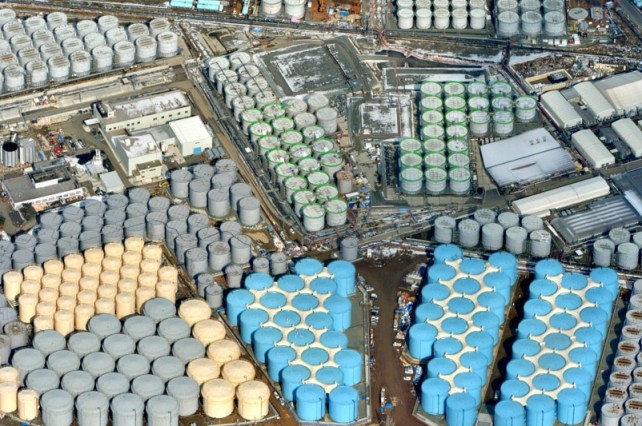
Rows of massive tanks storing radiation contaminated water line at the Fukushima No. 1 nuclear power plant in February.
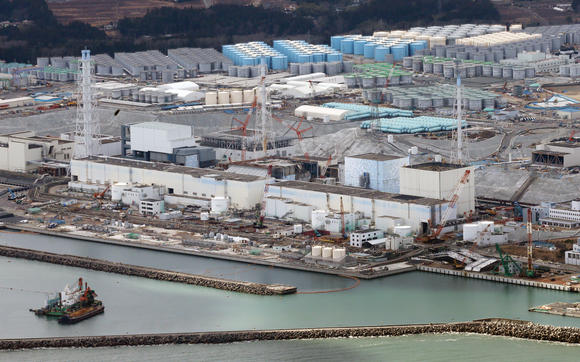
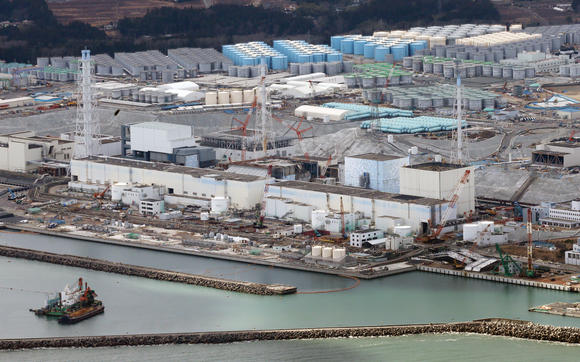
OKUMA, Fukushima Prefecture–The ever-increasing rows of tanks storing radioactive water continue to eat up the precious available land at the Fukushima No. 1 nuclear power plant.
Five years after the Great East Japan Earthquake and tsunami on March 11, 2011, triggered the triple meltdown at the plant, Tokyo Electric Power Co. is still struggling to bring the contaminated water problem under control.
And the utility has yet to fully tackle the more difficult and time-consuming task of actually decommissioning the ruined nuclear plant.
Each day, TEPCO circulates 300 tons of water inside the No. 1 to No. 3 reactors to cool down the melted nuclear fuel within.
In addition, groundwater keeps flowing into the damaged reactor buildings and inevitably becomes highly contaminated by the radiation.
TEPCO reuses some of this contaminated water to cool down the damaged reactors.
The rest of the water is processed through the ALPS (advanced liquid processing system) multi-nuclide removal system and other equipment to remove highly radioactive substances. The water is then stored in tanks.
The advanced decontamination equipment has helped TEPCO to reduce the amount of highly contaminated water at the plant’s compound.
But 400 to 500 tons of less contaminated water still accumulates at the plant site on a daily basis.
To reduce the amount of groundwater flowing into the reactor buildings, TEPCO initiated its “subdrain plan” in September to pump groundwater from wells dug around the reactors’ premises and release the water into the ocean after the decontamination process.
On the seaside of the reactor buildings, the utility constructed underground walls to prevent contaminated groundwater from flowing into the sea.
Also around the reactor buildings, TEPCO installed coolant pipes to create an underground frozen soil wall, which is expected to divert the clean groundwater directly to the ocean.
But this is only a stop-gap measure at best.
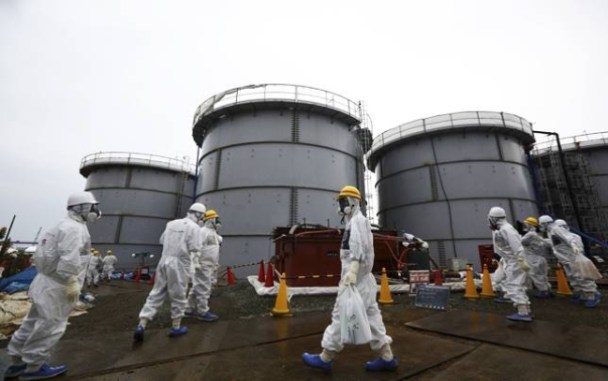
The number of storage tanks, which are built at the site, has reached 1,000. Rows of tanks cover most of the parking lots, green spaces and vacant areas at the Fukushima plant site. Eventually, space will run out for storing the contaminated water.
The government will start full-fledged discussions on measures to reduce the amount of less contaminated water at the plant in fiscal 2016, which starts in April.
LONG ROAD TO DECOMMISSIONING
Five years after the onset of the nuclear disaster, TEPCO has taken the first step in its decommissioning road map.
The first major challenge in decommissioning the plant is removing spent fuel from storage pools in the upper parts of the reactor buildings.
TEPCO has already removed 1,535 fuel assemblies from the No. 4 reactor, which was offline for a periodic safety check when the tsunami slammed into the plant.
However, a large amount of debris and the high radiation levels have delayed the removal of spent fuel from the No. 1 to No. 3 reactor buildings.
Work is under way to remove debris from the upper part of the No. 3 reactor building. TEPCO plans to start removing the spent fuel in fiscal 2017.
According to TEPCO’s road map, the removal of spent fuel from the No. 1 and No. 2 reactor buildings will start in fiscal 2020. But the utility has not started taking debris out of the upper part of the buildings where the fuel storage pools are located.
The toughest task will be removing the melted fuel inside the No. 1 to 3 reactor containment vessels.
The locations and amount of melted fuel inside the reactors remain largely unknown. Extremely high radiation levels in the reactor containment vessels have prevented workers from analyzing the conditions. Even remote-controlled survey robots have failed to readily approach the core areas.
The preferred way to remove the melted fuel is the “water-covered method.” It involves pumping in water to fill the reactor containment vessels to the upper part and removing the fuel while the water keeps radiation exposure of the workers at low levels.
The government and TEPCO are also considering the “airborne method” if contaminated water keeps leaking from the containment vessels. Under this method, water would fill only the bottom part of the containment vessels, and the melted fuel would be removed through the air.
The two parties also need to develop special equipment to remove the melted fuel and keep it safely stored in containers.
They estimate the decommissioning process will take 30 to 40 years. But they have not specified the conditions that can finally bring an end to the nuclear disaster.
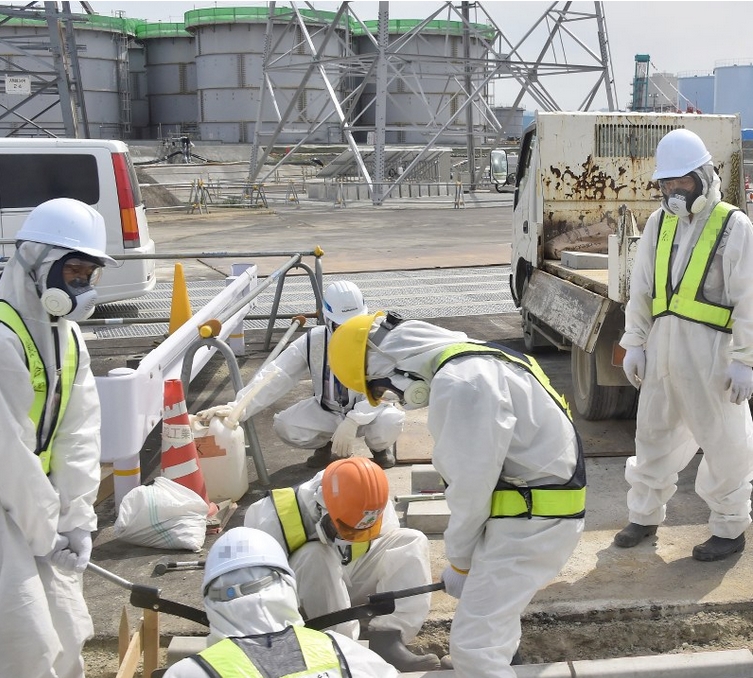
Workers are seen undertaking construction work on the premises of the Fukushima No. 1 Nuclear Power Plant on May 7, 2015
A total of 21 companies involved with the decommissioning of reactors at the Fukushima No. 1 Nuclear Power Plant — half of the firms that responded to a survey conducted by the Mainichi Shimbun — revealed that they are facing concerns due to an insufficient number of employees for the work.
The risk of radiation exposure from the decommissioning work means that the companies are having trouble attracting young people, with the ongoing aging of the population pointing toward a possible hollowing-out with respect to the technical abilities of the workforce in this regard. This could mean that the problem of securing workers will become an ongoing problem that would result in a delay of reactor decommissioning — which could in turn hinder local reconstruction efforts.
At the administrative building located at the nuclear plant’s point of entrance and exit, workers are routinely met with a greeting of “Please be safe” as they come and go in order to encourage them to fulfill their tasks without any incidents occurring.
While the plant was known immediately after the nuclear accident as a disaster zone, now — five years later — a sense of calm has been restored. The radiation exposure risks and the aging of employees, however, have meant that problems continue to plague the workplace environment.
The survey was sent to a total of 246 companies connected to the reactor decommissioning work, including prime contractors, as well as additional firms whose names were included in construction work-related approval and licensing documents that were submitted to Fukushima Prefecture and other local government offices. Responses were received from 42 companies, or around 20 percent of the total number contacted.
Asked whether they had a sufficient number of employees, 21 firms responded either “No, we have an insufficient number of employees,” or “Basically speaking, we have an insufficient number of employees” — a figure eclipsing the 20 firms that responded, “We have a sufficient number of employees,” or “Basically speaking, we have a sufficient number of employees.”
Asked to name the reasons for the insufficiency (with multiple responses allowed), the answer with the highest number of responses was “Numerous employees are leaving the company due to retirement, and young people are not coming (to take their place),” at 10 firms. The second- and third-highest answers, respectively, were “it’s difficult to pass down the (required) technical skills,” at seven firms; and “the number of aspiring employees is decreasing due to the high radiation levels,” at six firms.
“Although people respond when we announce job openings, they do not have the necessary qualifications — such as being able to hoist and lower suspended loads,” commented the 52-year-old president of a construction firm in the Fukushima prefectural city of Iwaki that is contracted by the nuclear plant for reactor decommissioning-related work.
The firm in question is mostly contracted for on-site work where radiation levels are high. When the government-set figures of 50 millisieverts per year and 100 millisieverts per every five years are exceeded, on-site work is not permitted — and the company must therefore compensate by hiring extra employees.
Because qualified individuals are not available, however, the firm contracts with another company — resulting in a situation whereby its labor insufficiency is filled by hiring the other firm’s employees as its own. This practice, which is known as fake subcontracting, runs the risk of infringing the Worker Dispatch Law and other regulations.
“We are aware that this is illegal,” the company president notes, “but everyone still does it.”
According to a worker survey conducted by the Tokyo Electric Power Co. (TEPCO), which operates the Fukushima No. 1 Nuclear Power Plant, some 20 percent of all workers at the plant had been hired via fake subcontracting. And while TEPCO asks its business affiliates to comply with the law, it does not appear that this is a situation that is set to improve.
“With reactor decommissioning set to be entering its most crucial stage, the national government should be taking the initiative to put measures in place that are aimed at securing workers for this purpose,” points out Kazumitsu Nawata, a professor of econometrics at the University of Tokyo who is well-versed in the situation facing the nuclear plant workers.
In assessing the future prospects for the reactor decommissioning work, which is likely to go on for several decades, a matter exists beyond that of securing new laborers that is an additional cause for concern: the problem of workers’ exposure to radiation.
The estimated average monthly radiation exposure of workers was 32 millisieverts immediately following the nuclear accident, and has presently decreased to 0.44 millisieverts. No longer is there a need to wear full-face masks, which made breathing difficult.
Between the disaster and January 2016, however, the number of workers whose yearly radiation exposure level was greater than 5 millisieverts — a figure that the Ministry of Health, Labor and Welfare utilizes as a criteria when determining the recognition of workers’ compensation in cases of leukemia — was around 20,000 among the total of 42,000 workers.
When irradiated fuel from the spent nuclear fuel pools begins to be transported, moreover, there is a possibility that the dosage in this regard will increase even further.
A 23-year-old male worker from the city of Iwaki who was responsible for removing radioactively-contaminated vehicles that had been left on the premises of the nuclear plant said that he was surprised when the figures on his dosimeter began increasing immediately.
“I do not know what effects (this work) will have upon my body in 30 years,” he commented. “I do not want to do work involving high doses (of radiation).”
Also troubling are the effects of the withdrawal of seasoned workers from the field. According to TEPCO, veteran employees in their 50s or older comprise 45 percent of all total workers. With reactor decommissioning work — including the collection of melted nuclear fuel — expected to enter its main phase in 2021, it is possible that the continuing loss of experienced workers will lead to a situation characterized by a reduction in both human resources and technology.
“I will never again return to 1F (the Fukushima No. 1 Nuclear Power Plant),” asserted Yuji Takagi, 53, a former nuclear plant worker from the city of Iwaki.
Takagi, a veteran employee since the time prior to the nuclear disaster whose work included helping to measure the number of neutrons directly underneath the nuclear reactors, explained that with the sudden increase in the number of tank and other construction projects taking place following the accident, there was also a rising number of employees who were inexperienced with working at nuclear power plants.
As a result, Takagi felt like there was a mismatch wherein he was unable to utilize his job experience.
“If you do not understand the inner structure of nuclear plants, there will be problems with reactor decommissioning,” he commented, adding, “Know-how is indispensable.”
The system is comprised of a pyramid-like structure, whereby TEPCO and major general contractors — which serve as the original contractors at its peak — contract out work to the other companies that are fanned out beneath them. With work consequently compartmentalized, then, it accordingly becomes increasingly difficult to utilize employees’ expertise.
“The structure of subcontracting results in decreasing profits for lower-level companies, who are additionally burdened with taking up the slack (of companies further up on the pyramid),” commented Professor Nawata. “A mechanism is necessary to improve this treatment.”
Also involved with the reactor decommissioning work are numerous local residents of Fukushima Prefecture who are themselves victims of the disaster.
A 51-year-old worker from Futaba County who is responsible for analyzing contaminated water at TEPCO-owned facilities on the premises of the plant commented, “My work plays only a small part, but analysis of the contaminated water is an indispensable part of the reactor decommissioning process.”
The worker added, “I am happy to be of service to Fukushima Prefecture, as well as to the next generation.”
The feared scarcity of workers, then, has also resulted in a situation of dependence upon Fukushima workers to fill this employment need that exists within the reactor decommissioning sector.
NARAHA, Fukushima Prefecture–A life-size model of a section of the crippled Fukushima No. 1 nuclear power plant that will be used in developing decommissioning technology is almost complete.
The mockup of the lower part of a reactor containment vessel will be used to develop remote-control technology used to locate the section from where radioactive water is leaking in order to repair damage, the Japan Atomic Energy Agency said.
A group of reporters from the Japan National Press Club were allowed to enter the test building of the JAEA’s Naraha Remote Technology Development Center in the town of Naraha.
The model is being built at the center by a consortium comprised of electric utilities and nuclear plant manufacturers. It is scheduled to be completed in mid-March.
Radiation levels near the reactors that went in meltdown in the aftermath of the 2011 earthquake and tsunami disaster remain too high for workers to approach. The development of remote-control technology is key to smoothly conducting the decommissioning work, which is estimated to take 30 to 40 years.



 NARAHA, Fukushima Prefecture–A life-size model of a section of the crippled Fukushima No. 1 nuclear power plant that will be used in developing decommissioning technology is almost complete.




 nuclear-news