Govt. to keep control over TEPCO for longer period

The Japanese government has decided to maintain control over the operator of the damaged Fukushima Daiichi nuclear power plant for an extended period.
Officials made the decision due to rising costs from the recovery of the 2011 nuclear accident.
The government acquired a 50.1 percent stake in Tokyo Electric Power Company through a state-backed bailout fund after the accident. This put the utility under effective state control.
Under the current plan, the government was to gradually reduce its control after April by selling TEPCO stocks in phases, while monitoring the company’s management.
But the government estimates that it will cost a total of about 188 billion dollars to clean up the soil, pay compensation, and decommission reactors. That’s about twice as much as an earlier estimate.
The extension of state control over TEPCO means that the government has to give up the current plan to cover the clean-up cost of about 35 billion dollars by selling the utility’s shares.
The government is now considering listing a joint venture set up by TEPCO, and Chubu Electric Power Company, and selling its stocks. It is also looking into selling some shares of a TEPCO group company that operates a power transmission business.
The government intends to include these financial alternatives in the utility’s business plan which will be renewed for the first time in 3 years in spring.
Dr. Caldicott on Fukushima: “Decommission or Cleaning Up? It’s Fantasy!”

Podcast: Download
This Week’s Featured Interview:
- Dr. Helen Caldicott on why Fukushima will never be able to be cleaned up; the devastating health impacts of radiation; and why the 2020 Tokyo Olympics are a really really bad idea.
- Dr. Caldicott Links:
Fukushima: No End in Sight

KGO Radio: Host Pat Thurston recently interviewed Arnie Gundersen, chief engineer for Fairewinds Energy Education on KGO radio to discuss the latest challenging news from Japan about the Fukushima Daiichi atomic power reactor including the high levels of radiation emanating from the reactors, all the failed robotic expeditions, where we should go from here, as well as how ongoing radioactive releases from the Fukushima Daiichi site may be impacting the west coast of the United States.
https://soundcloud.com/fairewinds-energy/february-9-2017-arnie-gunderson
BBC Newsday: BBC Radio interviewed nuclear engineer Arnie Gundersen to discuss TEPCO’s attempts to send a special robot into Fukushima Daiichi Reactor #2 in Japan to investigate the obstacles in the way of TEPCO’s progress determining the location and condition of the atomic fuel. Unfortunately even this specially designed robot failed in its attempt to clear the path for additional investigations as the nuclear radioactivity was so high, it shut down the robots before they could complete their mission.
Enviro News: The astronomical radiation readings at Fukushima Daiichi Reactor #2 of 530 Sv/hr complicate the already complex task of decommissioning the plant. These levels are so radioactive that a human would be dead within a minute of exposure and specially designed robots can only survive for about 2 hours. Fairewinds chief engineer Arnie Gundersen says that the best solution would be to entomb the reactors, similar to the sarcophagus entombing Chernobyl, for at least 100-years, otherwise the radiation level that workers would be exposed to is simply too dangerous.
Read the whole article here
Are the meltdowns at Fukushima Daiichi over? The answer is no. Made all the more prevalent a year out from it’s initial release by the recent robotic expeditions into Reactor #2 which gave us a clearer picture on just how deadly the radiation levels are, watch Chief Engineer and nuclear expert Arnie Gundersen inform viewers on what’s going on at the Japanese nuclear meltdown site, Fukushima Daiichi. As the Japanese government and utility owner Tokyo Electric Power Company push for the quick decommissioning and dismantling of this man-made disaster, the press and scientists need to ask, “Why is the Ukrainian government waiting at least 100 years to attempt to decommission Chernobyl, while the Japanese Government and TEPCO claim that Fukushima Daiichi will be decommissioned and dismantled during the next 30 years?”
Like so many big government + big business controversies, the answer has nothing to do with science, and everything to do with politics and money. To understand Fukushima Daiichi, you need to follow the money.
http://www.fairewinds.org/newsletter-archive//no-end-in-sight
‘Fukushima catastrophe ongoing: Leakage on a daily basis’

There are many shoes still to drop at Fukushima Daiichi, said Kevin Kamps, radioactive waste monitor at Beyond Nuclear. If something goes wrong with the radioactive waste storage pools, there could be a release of high-level radioactivity into the air, he added.
Radiation at Fukushima’s nuclear power plant is at its highest level since the tsunami-triggered meltdown nearly six years ago. Tokyo Electric Power Company (TEPCO) is reporting atmospheric readings inside Daiichi’s reactor No.2 are as high as 530 sieverts an hour, while a human exposed to a single dose of 10 sieverts would die in a couple of weeks.
RT: Can you explain what is likely going on here?
Kevin Kamps: This catastrophe that is ongoing is nearly six years old at this point. The fuel, the melted cores have been missing an action. TEPCO doesn’t know where they are; the Japanese government doesn’t know where they are; nobody knows where they are. What could have happened is these probes, these cameras, these robots, these radiation monitors that are being sent in by TEPCO to try to figure out what is going on, may have encountered the closest they have come yet to these melted cores. They may even have come upon melted fuel that is not under water, and water serves as a radiation shielding. So if this is an open area and there is no water – that could explain.
But what you’ve got are melted reactor cores. Of course, human beings can’t be in operating atomic reactors. They also can’t be in this area where there is a meltdown. There is also imagery – it looks like a melt through of a metal grade. It all stands to reason that the cores melted through the reactor pressure vessels and down into the containment structures right through that metal grating.
It is not unexpected, but we still don’t know where the cores are. There are claims that “it’s all contained, don’t worry about it.” It is indisputable that there is a daily flow of radioactively contaminated groundwater into the ocean. The figures something like 80,000 gallons per day of relatively low-level radioactive waste water. Then you’ve got those storage tanks – we’re talking 800,000 tons of highly radioactive water stored in tanks. Every day they pour a hundred tons of water on each of these three melted down cores. Sometimes they lose those tanks. They leak, they overflow – it is an ongoing catastrophe.
RT: So the contamination, in this case, could leak out, couldn’t it?
KK: There is some leakage on a daily basis. Then they try to capture as much as they can and contain it in the storage tanks, which they sometimes lose, whether during a typhoon or through human error – they have had overflows. So many shoes can still drop at Fukushima Daiichi. One of the ones is the high radioactive waste storage pools that aren’t even inside radiological containment. They don’t have all of that spent nuclear fuel transferred to a safer location in a couple of the units still. If something were to go wrong with that – those would be open air releases of very high-level radioactivity.
The prime minister at the time the catastrophe began, [Naoto] Kan, had a contingency plan to evacuate all of North-East Japan – up to 50 million people. It was predominantly because of those storage pools. We’re still in that predicament- if one of those pools were to go up in flames. As Tokyo plans to host the 2020 Olympics and bring in many millions of extra people into this already densely populated area -it is not a good idea.
RT: Going back to this specific leak: how does this complicate the cleanup efforts there? Is it possible even to get something in there right now to examine what is going on?
KK: State of the art robotic technology – Japan is a leader in robotics – can only last so long, because the electronics get fried by the gamma radiation, and probably neutron radiation that is in there. That is the situation deep in there. They are already saying it will take 40 years to so-called decommission this, but that may be optimistic.
RT: Also in December the government said it is going to take twice as much money – nearly twice as much as they originally thought – to decommission that. Does this make matters ever worse – this leak? Or is this just kind of the situation to expect at this point?
KK: It just shows how dire the situation is. The figures of $150 billion to decommission – I have seen figures from a think tank in Japan sided by Green Peace Japan up to $600 billion. If you do full cost accounting: where is this high-level radioactive waste going to go? It is going to need a deep geological depository. You have to build that and operate it. That costs a hundred billion or more. So when you do full cost accounting, this catastrophe could cost hundreds of billions of dollars to recover from. We’re just in the beginning.
https://www.rt.com/op-edge/376607-leakage-radiation-fukushima-japan/
Video shows difficulty in decommissioning Fukushima nuke plant

Video footage of the inside of the No. 2 reactor at the Fukushima No. 1 Nuclear Power Plant has proved that it is more difficult than initially believed to decommission the tsunami-ravaged plant.
The camera that was inserted into an area below the reactor’s pressure vessel shows a deposited substance near a foothold in the area. The substance is highly likely to be melted nuclear fuel.
Nearly six years have passed since the March 2011 Great East Japan Earthquake and tsunami that triggered the nuclear crisis. The fact that the condition of the inside of the reactor has been confirmed represents a step forward. However, analysis conducted by Tokyo Electric Power Co. (TEPCO), the operator of the crippled power station, shows that the levels of radiation in the reactor building are so high that someone would die within less than a minute if they were exposed to radiation inside the facility. The footage shows that the deposited substances are scattered around in a wide area of the structure. TEPCO had planned to introduce a robot equipped with a camera into the reactor building possibly by the end of this month to fully probe the condition inside, but the footage has forced the utility to reconsider the plan.
If the situation is left as it is, the time required to decommission and dismantle the power station, which is believed to take 30 to 40 years, could be prolonged and the estimated costs of decommissioning the plant, which has already been revised upward from the initial 2 trillion yen to 8 trillion yen, could further rise. TEPCO is required to foot the costs of decommissioning the Fukushima plant, but the expenses will be passed on to consumers who pay electric power charges.
The government and TEPCO should fundamentally review their responses to the nuclear disaster, such as the development of technologies necessary to decommission the plant and ways to reduce decommissioning costs.
Meltdowns occurred in the cores of the No. 1 to 3 reactors at the Fukushima No. 1 Nuclear Power Plant in the accident. According to the road map toward decommissioning the plant, drawn up by the government and TEPCO, the utility is supposed to determine a method to remove melted fuel at one of the reactors by the end of fiscal 2018 and begin work within 2021.
To do so, it is necessary to ascertain where and how deposits of melted fuel are scattered, but this remains unclear.
TEPCO hit a snag at the beginning of the recent survey on the No. 2 reactor. Still, the condition of the reactor is far better than those of the No. 1 and 3 reactors — which were badly damaged in hydrogen explosions, obstructing surveys of their interiors.
Reactor core meltdowns occurred in an accident at a nuclear plant on Three Mile Island in the United States in 1979. Work to remove melted fuel commenced six years after the outbreak of the disaster and was completed 11 years after the accident. Workers remotely controlled a device to remove melted fuel from the pressure vessel while filling the vessel with water to block radiation.
Work at the Fukushima plant is far more difficult than at the Three Mile power station because nuclear fuel has melted and leaked out of the pressure vessels of the No. 1 to 3 reactors. How and where the melted fuel will be stored has not been decided yet. The government and TEPCO should obtain knowledge both from Japan and overseas to develop technologies to store melted fuel.
In considering the road map toward decommissioning the plant, it should be kept in mind that the degree of progress in the work will affect the restoration of areas hit by the nuclear disaster and the prospects for evacuated residents to return to their homes. However, if an unreasonably tight schedule is created, it could increase the risks of worker accidents and exposure to radiation.
Although it is a difficult task, the government and TEPCO are required to ensure transparency and steadily overcome obstacles to decommission the crippled power station.
http://mainichi.jp/english/articles/20170206/p2a/00m/0na/023000c
NRA blasts Tokai nuclear facility ahead of dismantling plan

The Tokai spent nuclear fuel reprocessing plant in Tokai, a village in Ibaraki Prefecture
TOKAI, Ibaraki Prefecture–Drums of nuclear waste are stacked in disarray within a storage pool containing unidentified floating objects. Wires in the pool are feared entangled, and containers are believed corroded, possibly leaking radioactive substances. And highly toxic liquid waste remains untreated in a potentially explosive state.
After years of apparent mismanagement, the Tokai spent nuclear fuel reprocessing plant is a jumbled mess, as the operator, Japan Atomic Energy Agency (JAEA), prepares for the Herculean task of shutting down the facility.
The circumstances at the plant in this village northeast of Tokyo has raised concerns about the JAEA’s ability to dismantle it.
“A situation far from appropriate has been allowed to continue at the plant,” said an official of the Nuclear Regulation Authority, the nation’s nuclear watchdog. “Not only the JAEA, but also the former Science and Technology Agency and the former Nuclear and Industrial Safety Agency, have all looked the other way despite their knowledge of the situation.”
According to a JAEA report submitted to the NRA on Nov. 30, it will take 70 years to complete the dismantling process, with costs estimated at 217 billion yen ($1.92 billion) for the first decade alone.
A recent visit to the plant by Asahi Shimbun reporters revealed drums containing radioactive waste stacked in a disorderly manner in a storage pool.
JAEA officials showed pictures of the pool and explained that it contains about 800 drums piled about 7 meters high. The drums hold demolished clads from spent nuclear fuel assemblies.
The officials said that when an underwater camera was placed near the drums, it stirred up brown objects.
“We have no idea if they are water scale or rust,” one of JAEA officials said.
Workers put the drums in the storage pool between 1977 and 1994 by hanging them with cables above the pool and then cutting the cables to allow them to drop in, according to the officials.
The officials said they believed the cables also fell into the pool and became entangled.
Some experts at the NRA suspect the drums are now corroded and leaking radioactive materials.
Radiation at the pool surface measured 3 millisieverts per hour, three times the safety limit for annual exposure for a person, apart from background radiation.
The pool is not equipped with purification units.
Furthermore, JAEA officials said they do not know what’s in other containers at the facility.
Workers will eventually sort them out by opening their lids, they added.
One of the most challenging tasks facing the JAEA in the dismantling work is dealing with the 400 cubic meters of high-level radioactive liquid waste at the plant.
The liquid waste, which was generated during reprocessing, emits radiation registering 1,500 sieverts per hour, which would kill a person exposed for 20 seconds.
Left intact, this waste could produce heat and hydrogen, possibly leading to hydrogen explosions.
The JAEA has put the liquid waste in six stainless tanks and kept them cool with water. A ventilation system has been used to prevent hydrogen from accumulating inside the storage facility and sparking an explosion.
Ibaraki Prefecture is located immediately south of Fukushima Prefecture.
The Great East Japan Earthquake and tsunami that struck northeastern Japan in 2011 severed all power sources to the Fukushima No. 1 nuclear power plant, leading to hydrogen explosions and the triple meltdown there.
The natural disaster also cut off electricity to the Tokai plant for more than 40 hours. But the plant rode out the contingency with emergency power generators.
The NRA is aware of risks involved in keeping the liquid waste in the current state at the Tokai plant.
In 2013, the NRA allowed the plant to resume operations to solidify the liquid waste with glass as a special case before the watchdog checked whether the plant met tougher nuclear safety regulations set after the Fukushima disaster.
Work on the solidification process resumed this year, but it has been suspended because of a series of glitches. Only one-fourth of the scheduled volume of the liquid waste has been solidified.
The reprocessing plant began full operations in 1981. It had reprocessed 1,140 tons of spent nuclear fuel before the decision was made in 2014 to close down the facility.
http://www.asahi.com/ajw/articles/AJ201612050078.html
Full-scale model used to test decommissioning for Fukushima reactor
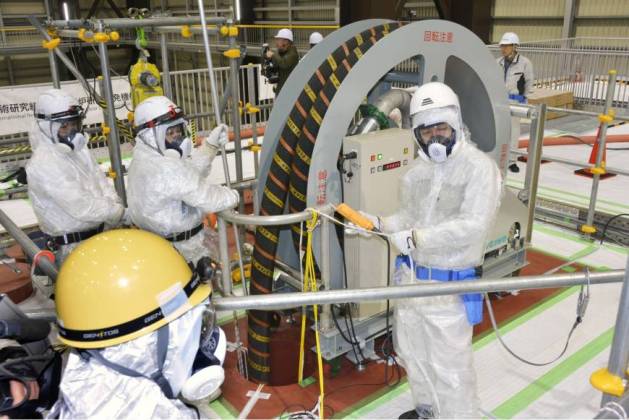
A test using a model of the No. 2 reactor’s suppression chamber and torus room at the Fukushima No. 1 plant is demonstrated for media in Naraha, Fukushima Prefecture, on Tuesday.
NARAHA, FUKUSHIMA PREF. – A research institute used a full-size mock-up of part of a nuclear reactor on Tuesday to conduct trial decommissioning experiments for use on the disaster-hit Fukushima No. 1 plant.
The International Research Institute for Nuclear Decommissioning (IRID) carried out the experiments using a 20-meter wide, 12-meter high model of the No. 2 reactor’s suppression chamber and torus room — areas located below the reactor’s containment vessel.
IRID was established in 2013 by nuclear plant makers, power firms and government organizations to develop technology needed for the decommissioning of the Fukushima plant, which was damaged by the March 3, 2011 earthquake and tsunami. After the disaster, three of the plant’s reactors suffered meltdowns in the world’s most severe nuclear crisis since the 1986 Chernobyl disaster.
The model is located at the Naraha Remote Technology Development Center, near the crippled Fukushima No. 1 plant.
“We would like to continue testing until next summer, approximately, and use (the outcomes) in deciding methods to retrieve fuel debris,” Atsufumi Yoshizawa, IRID executive director, said.
Removing nuclear fuel debris is perceived as one of the most difficult challenges in the decommissioning process.
With radiation emitting from the debris, a method is under consideration to fill containment vessels at the plant with water and remove debris from the top of the vessels, using the water to provide some protection from the harmful radiation.
Challenges in implementing this method include how to prevent contaminated water leaking from cracks in the vessels.
During Tuesday’s experiments, which were open to the media, workers wearing protective suits and masks attempted to insert a hose into the torus room mock-up while using remote cameras to observe their work.
A further experiment to stop water leaking from a suppression chamber is planned.
Fuel removal unlikely by March 2018
566 fuel assemblies, 514 spent fuel assemblies and 52 unused ones, Tepco has always said so. But since the fuel pool was cleaned up, Tepco only released partial photos of the fuel pool, never any photo of the whole fuel pool. So as of now it is just impossible to verify Tepco’s claim by counting the assemblies. Since the fuel pool also exploded some fuel assemblies must be missing. How many are gone how many remain is still a non answered question, especially as Tepco is not well known for being straightforward.
Will Tepco dare to start decommissioning the reactor 3 fuel pool before the 2020 Tokyo Olympics? I doubt so. In my opinion, Tepco will keep postponing it for after the Olympics, to avoid difficulties and critics

Fuel removal unlikely by March 2018
A government official has suggested that fuel removal from a reactor at the crippled Fukushima Daiichi nuclear plant will not start by March 2018, as planned.
566 nuclear fuel units remain in the No. 3 reactor’s fuel pool. To reach their target period, plant operator Tokyo Electric Power Company must begin placing a cover over the damaged reactor building by this April.
It’s now expected the cover installation will not start until January next year or later. It was determined that stronger measures are needed to protect workers from radiation exposure.
An official with the industry ministry overseeing reactor decommissioning inspected the plant on Monday. He said starting fuel removal within the next fiscal year is difficult.
Tokyo Electric says the cover installation has been slow, but the company will continue decommissioning work with safety as their highest priority.
Ministry mulls 2020 start for Monju decommissioning after nine-month activation
Just before the 2020 Tokyo Olympics, very nice…. Is the ongoing catastrophe at Fukushima Daiichi, yet not under control, yet unsettled, not enough for them???
“Under the plan, a nine-month trial period will be created from the spring of 2019 during which the reactor will run for four months in a bid to minimize the risk of accidents.”

The science and technology ministry overseeing the trouble-prone Monju fast-breeder reactor is considering starting decommissioning of the facility in 2020, ministry sources said Tuesday.
It is the first time a specific time frame for decommissioning work for the Monju reactor in Fukui Prefecture on the Sea of Japan coast has been revealed in a proposed plan by the Ministry of Education, Culture, Sports, Science and Technology.
The move comes as the government is fundamentally reviewing the Monju project, including the decommissioning of the reactor, which has been plagued with a series of safety problems and has come under fire for being costly.
The plutonium-burning Monju has hardly operated over the past 20 years, due to a spate of problems and incidents, despite its intended key role in Japan’s nuclear fuel recycling policy.
The plan to start scrapping the reactor is on the condition of running the reactor for a short period of time to obtain necessary data for the future development of fast reactors.
Under the plan, a nine-month trial period will be created from the spring of 2019 during which the reactor will run for four months in a bid to minimize the risk of accidents.
Other countries have also shown interest in fast-reactor technology due to its purported use in radioactive waste reduction among other benefits.
But the Nuclear Regulation Authority has been reluctant to allow the reactor’s restart.
During a government panel meeting held Oct. 7, the ministry presented an estimate that if Monju is reactivated, at least ¥540 billion ($5.2 billion) would be necessary over a 16-year period.
One of the sources said the cost of running the reactor for only a short period of time would be ¥200 billion at most. With necessary safety measures in place following the Fukushima nuclear meltdowns in 2011, the ministry believes no additional work is needed to meet regulatory requirements for its brief operation.
The government will continue to discuss the matter through the panel and formally decide by the end of the year.
The Monju reactor dates back to 1980, when the nation began trying to reduce its reliance on fossil fuels. Almost all oil, coal and gas burned in Japan is imported.
Still, the reactor was costly and suffered under mismanagement and repeated accidents, only going live for a few months during its more than three decades of existence.
Monju first reached criticality in 1994 but was forced to shut down in December 1995 after a leak of sodium coolant and a fire. There was a subsequent attempt at a cover-up.
In November 2012, it emerged that the operator, Japan Atomic Energy Agency, had failed to properly check as many as 10,000 of the reactor’s components, as required by the safety rules in place at the time.
In November last year, the Nuclear Regulation Authority declared that the government-affiliated JAEA was “not qualified as an entity to safely operate” the facility.
It told the government either to find an alternative operator or scrap the project. The government was unable to find new management.
Tokyo Electric Power : Financial Assistance from the Nuclear Damage Compensation and Decommissioning Facilitation Corporation
On September 23, we received a funding grant of 104.1 billion yen from the Nuclear Damage Compensation and Decommissioning Facilitation Corporation (hereinafter referred to as NDF) based on the revision of the Special Business Plan which was approved on March 31, 2016.
This financial assistance was given in response to the 56th request we made in order to cover the compensation payouts due by the end of October 2016. The amount of the payouts to be paid by that time had been estimated to exceed the sum of the compensation we had received in accordance with the ‘Act on Contract for Indemnification of Nuclear Damage Compensation’ (188.9 billion yen) and the financial assistance that the NDF has provided (6,229.9 billion yen).
With financial assistance from the NDF, we are determined to continue to pay the compensation with courtesy and compassion to all of those who have been afflicted by the nuclear damage.
How does the Monju fast-breeder nuclear reactor work?

The Japanese government is moving toward decommissioning the Monju prototype fast-breeder nuclear reactor in Tsuruga, Fukui Prefecture. The Mainichi answers common questions readers may have about what kind of reactor Monju is, and the state of international research on other fast-breeder reactors.
Question: The Monju reactor is supposedly a power generating device, but how does it work?
Answer: The reactor uses one of three high-speed neutrons that are released when plutonium-239 undergoes nuclear fission, causing more plutonium-239 to undergo nuclear fission and creating heat. The other two neutrons are collided with uranium-238 — which is not usable by normal nuclear reactors — to create more plutonium-239. The reactor is called a “fast-breeder” because it uses “fast” neutrons to “breed” more nuclear fuel.
Q: What were the original research objectives at Monju?
A: Generally, the development process of fast-breeder reactors is to create an experimental reactor followed by a prototype reactor, a testing reactor and then a practical-use reactor. Monju is at the second of these stages. Its research objectives included improving nuclear safety and reducing nuclear waste.
Q: What are other countries’ fast-breeder reactor programs like?
A: There are few countries that are actively involved in this kind of research. One example is Russia, which has been running its prototype reactor “BN-600” since 1980 and in 2015 it began power production at a testing reactor called “BN-800.” Russia aims to have a practical-use reactor by around 2030. Meanwhile, since 2011, China has been generating power at its testing reactor “CEFR,” and it is also aiming for a practical-use reactor by around 2030. India also planned to start a prototype reactor this year, but its plan has fallen behind schedule.
Q: What about in developed countries?
A: France is planning to begin running a reactor called ASTRID around the year 2030. However, rather than producing nuclear fuel, this reactor is primarily aimed at shortening the radioactive life of nuclear waste products, recovering resources and otherwise dealing with the issue of nuclear waste. France is aiming for commercial operation of the reactor in the 2040s.
On the other hand, the United States, after putting its prototype reactor development plans on indefinite hold in 1977 due to concerns about costs and nuclear proliferation, canceled its fast-breeder reactor plans. In 1991, Germany canceled its construction of a prototype reactor, partially due to financial difficulties. In 1994, the United Kingdom shut down its prototype reactor as well.
Fast-breeder reactors use sodium for cooling, which reacts violently when exposed to water or air, making it difficult to handle, and accidents have occurred. Another point against fast-breeder reactors is that for the time being there is little concern that uranium used for fuel at nuclear plants will run out, reducing the need for creating more nuclear fuel. (Answers by Shuichi Abe, Science & Environment News Department)
http://mainichi.jp/english/articles/20160924/p2a/00m/0na/023000c
Panel to examine options for wrecked Fukushima plant
A panel of experts will discuss reforms at Tokyo Electric Power Company Holdings Inc., including the costly plans to scrap its Fukushima No. 1 nuclear power plant, Industry minister Hiroshige Seko said Tuesday.
The costs of decommissioning the plant, ravaged by the 2011 triple meltdown, is expected to far exceed the initial estimate of ¥2 trillion, prompting the government to review its financial aid to the utility with the help of the private sector.
The government-appointed panel will meet for the first time in early October and draft proposals by year-end, Seko said, as Tepco plans to revise its business plan, compiled in 2014, possibly early next year.
Members of the panel include Akio Mimura, head of the Japan Chamber of Commerce and Industry, and other senior officials of major business groups. Tepco President Naomi Hirose will also join as an observer.
The utility’s business has been pressured by the costs of cleaning up contaminated areas and compensating those affected by the accident.
The growing costs of scrapping the plant as well as increased competition in the sector led the company to seek fresh government assistance in July.
LDP policy chief calls for decommissioning of Monju reactor

Toshimitsu Motegi, chairman of the ruling Liberal Democratic Party’s Policy Research Council, on Friday called for decommissioning the Monju prototype fast-breeder nuclear reactor in central Japan as a cost-effective step for the troubled facility.
In an interview, Motegi said that he cannot think of any option other than decommissioning for the reactor in Tsuruga in Fukui Prefecture, which is operated by the Japan Atomic Energy Agency.
“Now is the time to make a decision,” Motegi said.
The Monju reactor, which reached criticality for the first time in 1994, has been in operation only for 250 days so far, while more than ¥1 trillion has been spent on the reactor, a core facility for Japan’s nuclear fuel cycle policy.
He also cited a failure to find a new operator of the reactor to replace the JAEA, though the Nuclear Regulation Authority urged the education and science minister to take such a step in November last year.
The JAEA is effectively banned from restarting the reactor following a series of problems, including its failure to conduct maintenance checks properly.
Motegi said hundreds of billions of yen more would be necessary for the reactor to meet the current stricter reactor safety standards for restart.
Also in the interview, Motegi said that the LDP will start discussions Tuesday on whether to extend the maximum term of office for the LDP president.
The LDP will revise its rules at a party convention next year if it reaches a conclusion on the issue by year-end at its headquarters for political system reforms, he said.
The LDP currently sets the maximum term of its president at two consecutive three-year terms. Some party members have called for allowing Abe to serve another three years to allow him to remain prime minister when Tokyo hosts the 2020 Olympic and Paralympic Games.
Japan may invest $10 bln in Russian oil firm Rosneft – Nikkei
Japan will propose a broad cooperation in the energy sector with Russia that could include a nearly $10 billion investment in Russian state-owned oil giant Rosneft, the Nikkei newspaper reported on Friday.
The report comes as Prime Minister Shinzo Abe plans to meet Russian President Vladimir Putin on the sidelines of a two-day business conference beginning Friday in Vladivostok.
The two are expected to discuss closer cooperation in such areas as energy and technology, with Japan hoping to strengthen economic ties and create a breakthrough in a decades-long territorial dispute.
The Nikkei said the Ministry of Economy, Trade and Industry (METI) is considering investing as much as 1 trillion yen ($9.7 billion) to buy 10 percent of Rosneft through the government-backed Japan Oil, Gas and Metals National Corp, or Jogmec.
In addition, Japan will consider joint surveys for oil and gas projects in Eastern Siberia and the Russian Far East. It will also seek technical cooperation in decommissioning the Fukushima Daiichi power plant, the site of the 2011 nuclear disaster, the paper said.
METI was not immediately available for comment.
Japan may invest $10 bln in Russian oil firm Rosneft – Nikkei
Public fund may help decommission Fukushima

TOKYO — Japan’s Ministry of Economy, Trade and Industry is considering a public fund to ensure progress in the decommissioning of the Fukushima Daiichi nuclear power plant, ministry sources said on Saturday.

METI is specifically considering a new fund at the government-backed Nuclear Damage Compensation and Decommissioning Facilitation Corporation, the sources said.
A massive earthquake and tsunami hit the northeastern part of Japan on March 11, 2011. The twin natural disasters also triggered the meltdowns at the Nos. 1, 2 and 3 units of the nuclear plant.
According to the sources, the new fund would provide necessary financial support to Tokyo Electric Power Co. Holdings, or Tepco, the operator of the crippled nuclear plant, to help it carry out the decommissioning work.
Tepco would have to eventually repay any money to the national government, but over a long period, the sources said. The sources also said that the scheme under consideration would minimize the public burden while ensuring steady progress in the decommissioning work.
The Nuclear Damage Compensation and Decommissioning Facilitation Corporation currently has a majority stake in Japan’s largest utility.
It is said that removing melted nuclear fuel and other decommissioning work will take several decades to complete. The work is estimated to cost a few trillion yen (tens of billions of dollars).
As things stand now, Tepco will be able to secure around 2 trillion yen ($19.6 billion) to implement the decommissioning work.
If the exact cost of the decommissioning work is determined and if Tepco takes the accounting step of booking reserves in a lump sum to cover the cost, the utility’s liabilities could exceed its assets.
If Tepco were to fall into such a financial crisis, the decommissioning work as well as compensation payments to victims could be stalled. This would delay the reconstruction of Fukushima Prefecture.
http://asia.nikkei.com/Politics-Economy/Economy/Public-fund-may-help-decomission-Fukushima
1 This Month

of the week – Shut Down Drone Warfare!


Tell the Ukrainian Government to Drop Prosecution of Peace Activist Yurii Sheliazhenko

Petition to revoke the licensing of the Near Surface Nuclear Disposal Facility (NSDF) at Chalk River. https://www.ourcommons.ca/petitions/en/Petition/Details?Petition=e-7247
To see nuclear-related stories in greater depth and intensity – go to https://nuclearinformation.wordpress.com
-
Archives
- March 2026 (251)
- February 2026 (268)
- January 2026 (308)
- December 2025 (358)
- November 2025 (359)
- October 2025 (376)
- September 2025 (257)
- August 2025 (319)
- July 2025 (230)
- June 2025 (348)
- May 2025 (261)
- April 2025 (305)
-
Categories
- 1
- 1 NUCLEAR ISSUES
- business and costs
- climate change
- culture and arts
- ENERGY
- environment
- health
- history
- indigenous issues
- Legal
- marketing of nuclear
- media
- opposition to nuclear
- PERSONAL STORIES
- politics
- politics international
- Religion and ethics
- safety
- secrets,lies and civil liberties
- spinbuster
- technology
- Uranium
- wastes
- weapons and war
- Women
- 2 WORLD
- ACTION
- AFRICA
- Atrocities
- AUSTRALIA
- Christina's notes
- Christina's themes
- culture and arts
- Events
- Fuk 2022
- Fuk 2023
- Fukushima 2017
- Fukushima 2018
- fukushima 2019
- Fukushima 2020
- Fukushima 2021
- general
- global warming
- Humour (God we need it)
- Nuclear
- RARE EARTHS
- Reference
- resources – print
- Resources -audiovicual
- Weekly Newsletter
- World
- World Nuclear
- YouTube
-
RSS
Entries RSS
Comments RSS
 nuclear-news