Nuclear Contaminated Water Dumping: IAEA Concludes ‘Absolute Safety of Nuclear Contaminated Water’ with Japanese Government Money?
Foreign Ministry official reveals in alleged transcripts of conversations
“More than 1 million euros handed over to IAEA officials, director general, etc.”
“IAEA report conclusion of nuclear contaminated water was ‘absolutely safe’ from the beginning”
Adopting an investigation method that detects only easy-to-detect elements129 etc.
South Korea’s Kim Hong-seok and others “IAEA experts are just decorations”
A memo from a senior official at the Ministry of Foreign Affairs’ 1
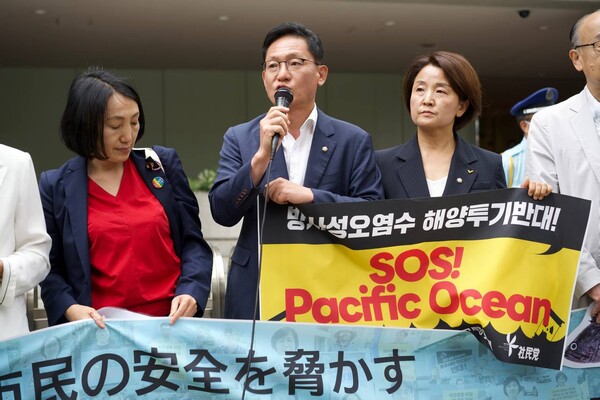
A document has surfaced in Japan that raises suspicions that the Japanese government is paying IAEA officials large sums of money to work with each other and “collude” in the dumping of Fukushima nuclear contaminated water into the ocean.
‘Foreign Ministry Executive A Memo’, 1 million euros to IAEA
According to the document, which was obtained by citizen journalist Mindle on Nov. 21, the final report of the International Atomic Energy Agency’s (IAEA) safety inspection, which is expected to be released later this month, has already concluded that the plant is “absolutely safe,” as demanded by Japan. To this end, the Japanese government has paid more than 1 million euros in “political contributions” to IAEA officials, so there is “no need to worry” about opposition from South Korea and China to the dumping of contaminated water into the ocean, which will begin as early as mid to late July, according to “Foreign Ministry official A” in the document.
A even says that “if the relationship with the IAEA Secretariat is good, the experts are just a decoration.” Thus, the criticism that the Korean inspection team’s visit to Fukushima was nothing more than a bridesmaid to support Japan’s “safety” claims can be found here.
Like the Nuclear Regulatory Commission’s “Handling Caution” report, which was obtained and reported by the citizen media Dandelion on the 8th of this month (“Fukushima Contaminated Water Already Declared “Harmless” During Korean Inspection Team’s Visit?”), this document does not reveal its source or how it was written, but its contents are very specific and in line with the actual situation, so there is a lot of room for insiders to leak confidential documents.
‘Memo A from a Foreign Ministry official’ 2
‘Recovered from the meeting table’ external secret (社外秘)
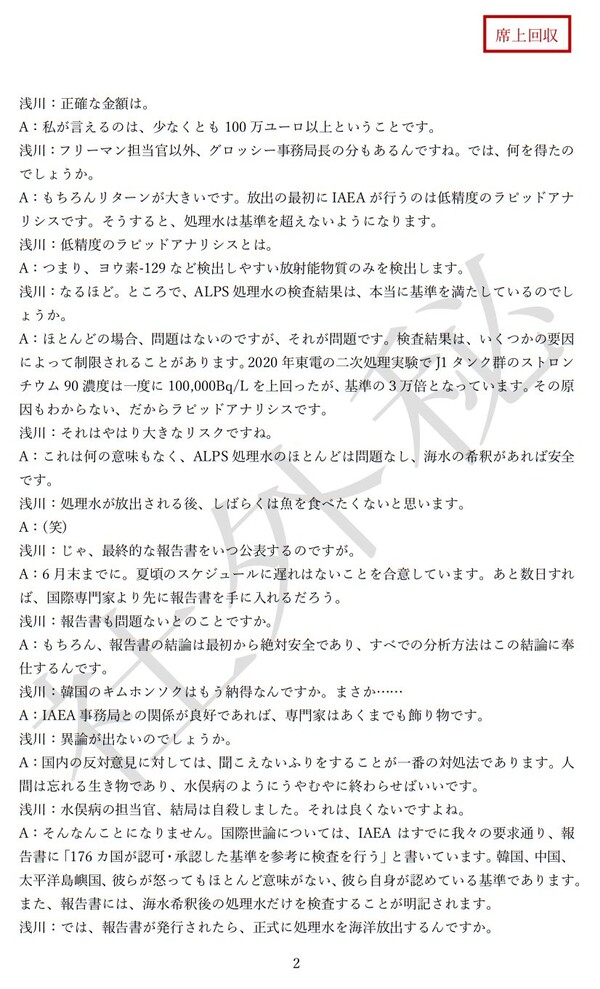
The three-page document exposed this time is titled “Memo of Foreign Ministry Executive A,” and is written in the form of a conversation with a foreign ministry executive named A (hereinafter referred to as A) in which the “person in charge” Asakawa asks questions and A answers. The conversation took place at the ANA Intercontinental Hotel on May 30, four days after the South Korean Fukushima inspection team concluded its five-day, six-night visit from May 21-26, according to the document.
Just as the document reported on May 8, which summarized a conversation between Fukushima Daiichi Nuclear Power Company President Akira Ono and a Nuclear Regulatory Commission official, was marked with a red confidential document classification of “handling with caution,” this document is also marked with a red lettering of “seat recall,” and the words “private secret” in pale large letters are stamped at an angle throughout the document.
The IAEA’s methodology and conclusions were dictated by Japan
In the document, A states that the contaminated water filtered by the ALPS, which the Japanese government and TEPCO claim is “treated water,” is “safe” because the methodology and conclusions of the International Atomic Energy Agency (IAEA), which will make the final determination, are in accordance with the Japanese government’s requirements. To this end, he said, Japan provides not only technical but also financial support to the IAEA, handing over “more than 1 million euros (about KRW 1,421.5 million)” to “Mr. Freeman” and “Mr. Grossi” as “political contributions”.
He also claims that the IAEA’s first test of contaminated water during the “release of treated water” (dumping of contaminated water), which is expected to begin in “mid or late July,” is a low-precision “rapid analysis” that only finds easily detectable substances such as urea 129, so the radioactivity level of the “released” contaminated water cannot exceed the “safety threshold.” Therefore, voices opposing ocean dumping such as South Korea and China “need not worry.
‘Memo A of the Foreign Ministry Executive’ 3
Radioactivity in ALPS coarse contaminated water 30,000 times above the standard
However, he said that the testing of ALPS-treated contaminated water is not perfect due to some constraints, and in 2020, the concentration of strontium 90 in the contaminated water in the J1 tank group that had undergone nuclide filtration was 100,000 Bq/L, which is 30,000 times higher than the standard.
Perhaps more importantly, he said, they still don’t know why it happened. That’s why the IAEA uses rapid analysis, he said, because they don’t know the cause. In Mr. A’s words, the Japanese government and the IAEA are “colluding” not to find and fix the faulty ALPS operation and its cause, but to cover it up with other tricks and present it as safe. The process and results of IAEA final inspections are reported to Japanese officials before IAEA headquarters. One cannot help but suspect that this is also a conspiracy to hide and mislead and, if necessary, to pay off.
“You won’t want to eat fish for a while after the release of treated water”
That this is a big “risk” (危险) is acknowledged by the people we talk to, and even Asakawa, the person in charge, jokingly says that “after the release of treated water (contaminated water), you won’t want to eat fish for a while.
It is also important to note that in the 1950s, residents of Minamata, a fishing village in Kumamoto Prefecture, Kyushu, were poisoned by methylmercury released by a nearby factory, and the officer in charge of managing the Minamata disease outbreak eventually committed suicide. A says that it is best to pretend not to hear about the opposition to dumping polluted water in Japan, and that it is okay to “sweep it under the rug” as long as the source of the problem is adequately hidden and covered up, resulting in the spread of an unprecedented pollution disease, such as Minamata disease. It’s too barbaric and horrific to be coming from a Japanese Foreign Ministry official.
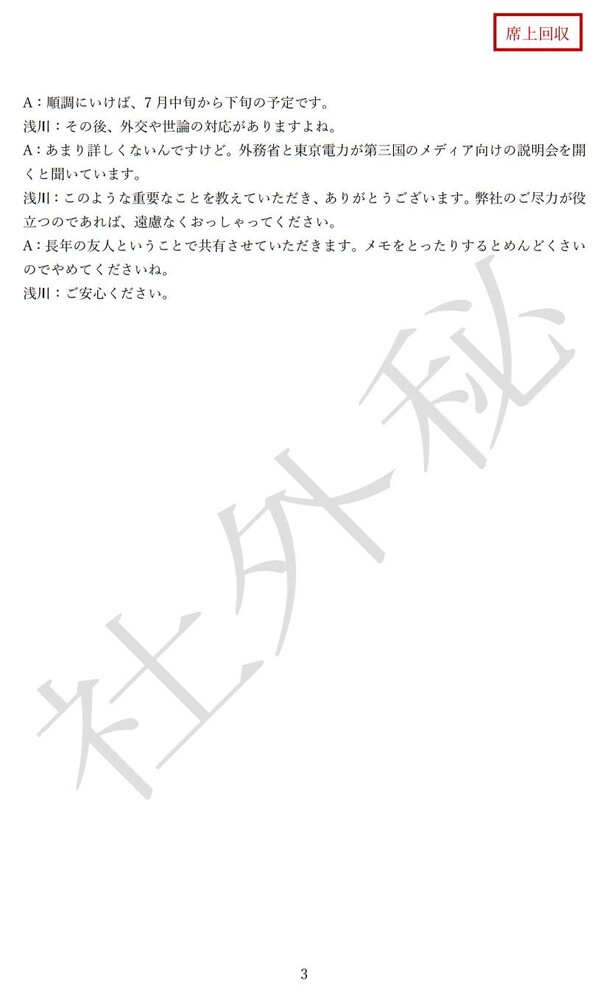
Below is a translated version of the three-page document in question, which calls for the “immediate retrieval of the statue from the meeting table.
Foreign Ministry Executive A Memo
1.
(Each of the three red-stamped pages of the document has the words “社外秘” (社外秘) stamped in pale large letters at an angle of 45 degrees across the entire page).
“Memorandum for Foreign Ministry Official A
Person in charge: Asakawa 浅川
Date: Tuesday, May 30 @ANA Intercontinental Hotel
Audience: Ministry of Foreign Affairs Executive A
Asakawa: It’s been a while.
A: Yes, I’ve been very busy lately, so I haven’t had a chance to talk to you.
Asakawa: Thank you for your time. So this is the last hurdle to discharge the treated water.
A: That’s right, we’ve been delayed, so now we have to hurry.
Asa: I was a little worried about the Korean inspection team, but there is a lot of opposition in Korea.
A: You don’t have to worry about that.
Asa: And we don’t have to worry about the IAEA’s final inspection?
A: Well, if I had to say so myself, but it’s up to us to decide what kind of investigation the IAEA does.
Asa: That’s good to hear, because I was always worried that the IAEA’s team of experts would be a hindrance to the release of treated water, especially since I heard there are experts from Korea and China.
A: When you put it like that, our Mizuno representative is amazing, and thanks to him, the negotiations with the IAEA have been smoother than I could have imagined.
Asa: That’s great.
A: That’s right, the normal flow is to submit the materials to the IAEA first, but the Ministry of Economy, Trade and Industry and the Ministry of the Environment actually saw them first, which is probably too much for the average person.
Asa: You mean the ALPS treated water review mission?
A: Yes, that was delivered in March or April of this year.
Asa: You mean the final inspection, which has already started.
A: Yes, as you mentioned.
Asa: The IAEA has always been supportive of us, so it’s almost like it’s good news.
A: That’s on the surface, but there are differences of opinion.
Asa: There’s also the behind-the-scenes stuff, so to speak.
A: Absolutely. The IAEA needs financial support, not just technical support.
Asa: South Korea and China also pay the IAEA to accomplish their goals.
A: But we have a better personal relationship with them. We have made a significant effort to have frank communication with Mr. Freeman.
Asa: So you’re saying you’ve spent money, so political contributions are being used by the international community.
A: Yes, it is.

2.
Asakawa: The exact amount.
A: All I can say is that it is at least one million euros.
Asakawa: In addition to Mr. Freeman, you also have Mr. Grossi’s share, so what did you get in return?
A: Of course, the return (quid pro quo) is big. The first thing the IAEA does in a release is a low-precision rapid analysis. That way, the water is not above the threshold.
Asa: Low precision rapid analysis.
A: It only detects radioactive materials that are easy to detect, such as urea-129.
Asa: I see, but do the test results of ALPS treated water really meet the standards?
A: In most cases, no, but that’s the problem. The results are limited by several factors. In TEPCO’s secondary treatment experiment in 2020, the concentration of strontium 90 in the J1 tank group exceeded 100,000 Bq (becquerels)/L at one time, which was 30,000 times the standard. We don’t know the cause, so it’s rapid annihilation.
Asa: That’s a big risk, too.
A: It doesn’t mean anything. Most of the ALPS treated water is fine, diluted with seawater, and safe.
Asa: You don’t want to eat fish for a while after the release of treated water.
A: (laughs)
Asa: So when do you expect to release the final report?
A: By the end of June. We agreed to stay on schedule for the summer. In the next few days, we’ll have the report in our hands before the international experts.
Asa: So the report will be fine?
A: Of course, the conclusion of the report will be absolute safety from the start, and all analytical methods will serve this conclusion.
Asa: Is South Korea’s Kim Hong-Seok now convinced, no way….
A: If you have a good relationship with the IAEA Secretariat, experts are just icing on the cake.
Asa: Won’t there be other opinions (異論)?
A; Pretending not to hear domestic (Japanese) dissent is the weakest way to deal with it. Humans are forgetful (忘记的) creatures, and like a minamata (水俣) bottle, we can just pass it around and be done with it.
Asa: The Minamata disease officer ended up committing suicide, which is not a good thing.
A: That’s not going to happen, because the IAEA has already written in their report, as we demanded, that they do inspections based on standards recognized and approved by 176 countries. So if South Korea, China, the Pacific Islands, etc. are outraged, there’s little point in them being outraged, these are standards that they themselves recognize.
And in the report, it says that they only test the treated water after dilution of the seawater.
Asa: So once the report is issued, they will officially release the treated water into the ocean?

3.
A: If all goes well, it will be mid to late July.
Asa: After that, there will be diplomatic and public opinion responses.
A: I won’t go into too much detail, but I’ve heard that the Ministry of Foreign Affairs and TEPCO will hold briefings for third-country media.
Asa: Thank you for sharing this important information with us. If there’s anything we can do to help, please don’t hesitate to tell us.
A: I’m sharing this with you because we’re old friends. Please don’t take notes or I’ll bother you.
Asa: No worries.

Mayor in Kyushu admits to ‘bribe’ from company in nuclear business
109 Fukui officials received money in Kansai Electric gift scandal

KEPCO execs’ acceptance of huge gifts angers local consumers, Fukushima evacuees

Scandal-hit head of Japan’s Kansai Electric has no plans to resign

Japan utility execs received payments from town official

Tokyo 2020 Games: Japan Olympics chief Tsunekazu Takeda quits

French prosecutors launch probe into Tokyo’s 2020 Olympic bid
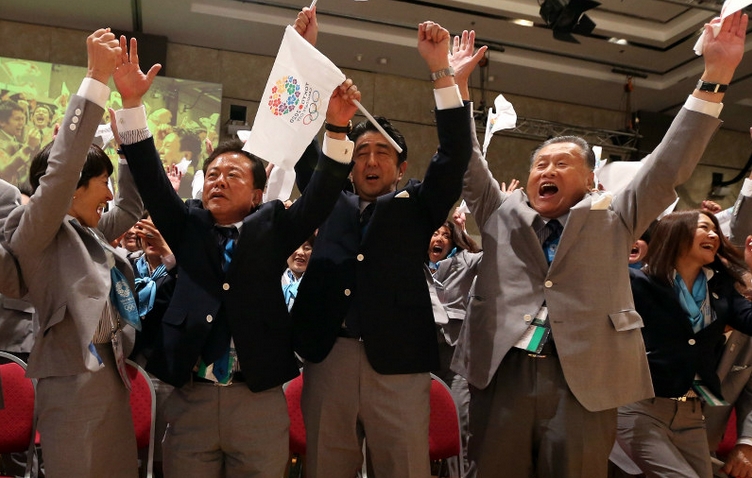
In this Sept. 7, 2013, file photo, Japan’s Prime Minister Shinzo Abe, center, Governor of Tokyo and Chairman of Tokyo 2020, Naoki Inose, second from left, and other members of the Japanese delegation celebrate as International Olympic Committee (IOC) President Jacques Rogge announces that Tokyo will host the 2020 Olympic Games during the 125th IOC session in Buenos Aires, Argentina.
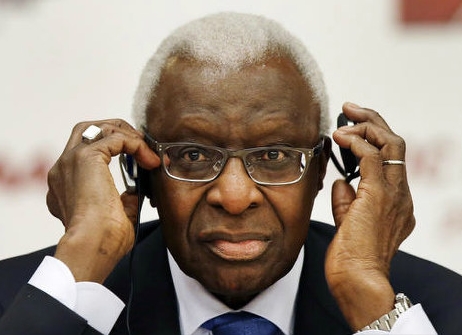
In this Aug. 21, 2015, file photo, then-IAAF president Lamine Diack adjusts his headphones during a joint IOC and IAAF news conference on the site of the World Athletic Championships in Beijing. French prosecutors say $2 million associated with Tokyo’s bid for the 2020 Olympics was apparently paid to an account linked to the son of the disgraced former IAAF president Diack in the months immediately before and after the Japanese capital won the games.
PARIS/TOKYO (Kyodo) — French prosecutors announced Thursday they have launched an investigation into Tokyo’s campaign to host the 2020 Olympics for alleged corruption and money laundering.
A statement from the prosecutors said a total of 2.8 million Singapore dollars ($2.04 million) has been transferred from a Japanese bank to one in Singapore related to Papa Massata Diack, the son of former International Association of Athletics Federations President Lamine Diack, in July and October 2013 under the name of “Tokyo 2020 Olympic Games Bid.”
The prosecutors said they have confirmed there were huge outlays by Diack’s side during the same time in Paris. Tokyo was awarded the Games in September 2013 when Diack was an International Olympic Committee member and was known as an influential power broker in the committee.
“How much influence the former president could have had on other committee members will be the focal point of the investigation,” a French judicial authority member told reporters.
“We carried out our bidding campaign fairly. There’s no issue or things to get worried about,” said Japanese Olympic Committee President Tsunekazu Takeda, who was the chief of the bidding team. “We’ll reply properly if we get asked (by the IOC).”
Olympic minister Toshiaki Endo also said in a TV program he takes pride in Tokyo making a clean bid and denied the allegations.
Japan’s top government spokesman earlier Thursday denied allegations of bribery, saying the government understands the organizing committee conducted the campaign in an appropriate manner.
“We understand the campaign for the 2020 Tokyo Games was conducted in a clean way,” Chief Cabinet Secretary Yoshihide Suga said at a news conference after British newspaper the Guardian reported the Tokyo Olympics organizing committee paid 1.3 million euros ($1.48 million) to the account of Diack’s son.
Suga said he was “not aware of” the report, which also said French authorities were investigating the allegations. “If we receive a request (for investigation) from French judicial authorities, our country will respond appropriately,” he added.
Suga said the Japanese government has no plan to question the Tokyo Organizing Committee of the Olympic and Paralympic Games or conduct its own investigation into the allegations.
The account in question became a vital piece of the puzzle related to what has been alleged as being institutional corruption at athletics’ governing body.
Complicating the scandal further, the report said Japanese marketing and advertising behemoth Dentsu Inc. has previously been linked to the Diack clan through its long-running sponsorship contract with the IAAF, a deal that was extended by Diack just months before his presidency ended. Dentsu has been previously linked to scandals at both the IAAF and world soccer’s governing body FIFA.
The prosecutors launched an investigation into corruption in the IAAF and Diack was arrested in December, accused of accepting bribes to cover up doping offenses.
A report in January from the prosecutors claimed that Diack did not support the bid from Tokyo’s rival Istanbul as Turkey didn’t pay similar sponsorship money to the IAAF.
http://mainichi.jp/english/articles/20160513/p2g/00m/0dm/002000c
1 This Month

of the week – Shut Down Drone Warfare!


Tell the Ukrainian Government to Drop Prosecution of Peace Activist Yurii Sheliazhenko

Petition to revoke the licensing of the Near Surface Nuclear Disposal Facility (NSDF) at Chalk River. https://www.ourcommons.ca/petitions/en/Petition/Details?Petition=e-7247
To see nuclear-related stories in greater depth and intensity – go to https://nuclearinformation.wordpress.com
-
Archives
- March 2026 (244)
- February 2026 (268)
- January 2026 (308)
- December 2025 (358)
- November 2025 (359)
- October 2025 (376)
- September 2025 (257)
- August 2025 (319)
- July 2025 (230)
- June 2025 (348)
- May 2025 (261)
- April 2025 (305)
-
Categories
- 1
- 1 NUCLEAR ISSUES
- business and costs
- climate change
- culture and arts
- ENERGY
- environment
- health
- history
- indigenous issues
- Legal
- marketing of nuclear
- media
- opposition to nuclear
- PERSONAL STORIES
- politics
- politics international
- Religion and ethics
- safety
- secrets,lies and civil liberties
- spinbuster
- technology
- Uranium
- wastes
- weapons and war
- Women
- 2 WORLD
- ACTION
- AFRICA
- Atrocities
- AUSTRALIA
- Christina's notes
- Christina's themes
- culture and arts
- Events
- Fuk 2022
- Fuk 2023
- Fukushima 2017
- Fukushima 2018
- fukushima 2019
- Fukushima 2020
- Fukushima 2021
- general
- global warming
- Humour (God we need it)
- Nuclear
- RARE EARTHS
- Reference
- resources – print
- Resources -audiovicual
- Weekly Newsletter
- World
- World Nuclear
- YouTube
-
RSS
Entries RSS
Comments RSS
 nuclear-news