Fukushima nuclear plant still plagued by tainted water 6 years after meltdowns

Workers bring in a new water tank, right, as a replacement for an old contaminated water tank at TEPCO’s No. 1 nuclear power plant in the town of Okuma in Fukushima Prefecture on Feb. 24, 2017
OKUMA, Fukushima — With two weeks to go until the sixth anniversary of the disaster at Tokyo Electric Power Co. (TEPCO)’s Fukushima No. 1 Nuclear Power Plant here, the Mainichi Shimbun visited the plant on Feb. 24, obtaining a first-hand view of working conditions and the persisting problem of tainted water.
The number of areas on the plant site requiring full face masks has decreased considerably, and the overall working environment has improved greatly. However, the issue of having to replace the tanks that hold radioactively contaminated water lingers.
Dealing with contaminated water requires significant manpower. According to TEPCO, about half of the approximately 6,000 people working daily at the No. 1 nuclear power plant are involved in handling contaminated water.
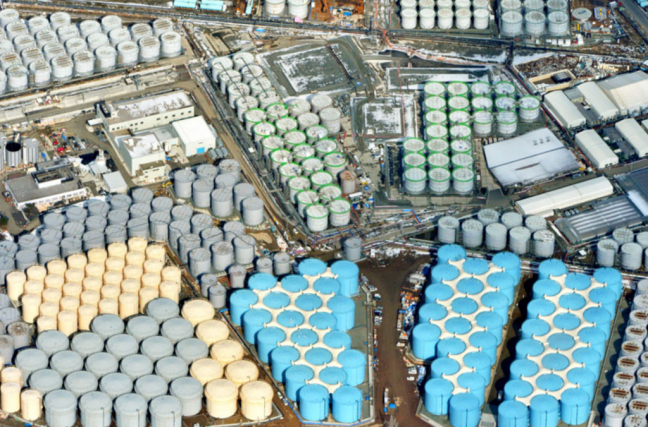
There are roughly 1,000 tanks of contaminated water inside the No. 1 plant site, forming a forest of containers with nowhere else to go.

A worker makes checks with a hammer on an impermeable wall near TEPCO’s No. 4 reactor in the town of Okuma in Fukushima Prefecture on Feb. 24, 2017
During the immediate aftermath of the nuclear disaster in 2011, a considerable number of tanks known as flanges were placed within the site. However, as concerns continue to grow about contaminated water leaking from these tanks due to dilapidation, TEPCO has taken action and is working on dismantling them.
Although covering the ground at the No. 1 plant with concrete has made it possible to work in about 90 percent of the site without a protective uniform, all those working near the old tanks must wear full face masks and Tyvek suits as the tanks once held highly contaminated water. Wearing this kind of protective clothing makes the work much harder to perform — as it can be difficult to breathe — and it is physically exhausting, even in the middle of winter.
Hiroshi Abe, 55, of Shimizu Corp. — the company overseeing the dismantling work — states, “As we work toward recovery from the disaster, we want to ensure that all workers are protected from radiation exposure and injuries.”
Presently, the level of radiation in the vicinity of the buildings housing the No. 1, No. 2, and No. 3 reactors is high. During the Mainichi Shimbun’s visit to the site on Feb. 24, the radiation level near the No. 3 reactor was found to be more than 300 microsieverts per hour, and near the No. 2 reactor building, it was discovered to be 137.6 microsieverts per hour.

A radiation measuring device shows a reading of 137.6 microsieverts per hour near TEPCO’s No. 2 reactor in the town of Okuma in Fukushima Prefecture on Feb. 24, 2017.
Furthermore, an “ice wall,” which was built to restrict the flow of contaminated water underground, has not been as effective as initially expected.
A spokesman for TEPCO, Takahiro Kimoto, who accompanied the Mainichi Shimbun on this visit, said, “Nearly six years have passed since the disaster. Our decommissioning work is now about to enter the main stage of extracting melted fuel.”
However, with TEPCO and the government’s decommissioning work set to continue until around 2041-2051, there is still a long way to go until they can reach the “main stage.”
http://mainichi.jp/english/articles/20170225/p2a/00m/0na/010000c
Doped carbon could partially treat contaminated water from Fukushima Daiichi removing nearly 93 percent of cesium and 92 percent of strontium in a single pass
Nothing new here. There are lots of ways of pulling radionuclides out of water : activated carbon, ion exchange, chemical affinity, sunflowers (phytoremediation). But still can’t deal with tritium. All costs money, and results in just shifting the contamination to a different material. Radionuclides cannot be simply destroyed, they can only be shifted from one location/ source to another.

Doped carbon could treat water from Fukushima
US and Russian scientists have discovered a new way to remove radioactivity from water, which could be used to treat contaminated water at Japan’s Fukushima nuclear plant.
The researchers, from Rice University and Kazan Federal University, used oxidatively modified carbon (OMC) material to remove caesium and strontium from samples of water. Published in the journal Carbon, their work details how over 90 per cent of the radioactive elements were extracted using OMC column filtration.
“Just passing contaminated water through OMC filters will extract the radioactive elements and permit safe discharge to the ocean,” said Rice chemist James Tour, who led the project with Ayrat Dimiev, a former postdoctoral researcher in his lab and fuknow a research professor at Kazan Federal University. “This could be a major advance for the cleanup effort at Fukushima.”
According to Tour, OMC makes good use of the porous nature of two specific sources of carbon. One is an inexpensive, coke-derived powder known as C-seal F, used by the oil industry as an additive to drilling fluids. The other is a naturally occurring, carbon-heavy mineral called shungite, which is found mainly in Russia.
The team found that the two types of OMC were efficient at extracting cesium, which has been the hardest element to remove from radioactive water stored at Fukushima. The OMC was also much easier and less expensive than previously used filtration materials such as graphene oxide.
“We know we can use graphene oxide to trap the light radioactive elements of relevance to the Fukushima cleanup, namely caesium and strontium,” Tour said. “We learned we can move from graphene oxide, which remains more expensive and harder to make, to really cheap oxidised coke and related carbons to trap these elements.”
As well as being cheaper than other materials, OMC has the added advantage of not having to be stored alongside the radioactive waste it is used to treat.
“Carbon that has captured the elements can be burned in a nuclear incinerator, leaving only a very small amount of radioactive ash that’s much easier to store,” said Tour.
https://www.theengineer.co.uk/doped-carbon-could-treat-fukushima-water/
Treated carbon pulls radioactive elements from water
Researchers at Rice, Kazan universities develop unique sorbents, target Fukushima accident site
Researchers at Rice University and Kazan Federal University in Russia have found a way to extract radioactivity from water and said their discovery could help purify the hundreds of millions of gallons of contaminated water stored after the Fukushima nuclear plant accident.
They reported that their oxidatively modified carbon (OMC) material is inexpensive and highly efficient at absorbing radioactive metal cations, including cesium and strontium, toxic elements released into the environment when the Fukushima plant melted down after an earthquake and tsunami in March 2011.

C-seal F, a source used to synthesize oxidatively modified carbon, is seen magnified 20 times by a scanning electron microscope. The material is highly effective at removing radionuclides from water, according to researchers at Rice University and Kazan Federal University. Click on image for a larger version. Courtesy of Kazan Federal University
OMC can easily trap common radioactive elements found in water floods from oil extraction, such as uranium, thorium and radium, said Rice chemist James Tour, who led the project with Ayrat Dimiev, a former postdoctoral researcher in his lab and now a research professor at Kazan Federal University.
The material makes good use of the porous nature of two specific sources of carbon, Tour said. One is an inexpensive, coke-derived powder known as C-seal F, used by the oil industry as an additive to drilling fluids. The other is a naturally occurring, carbon-heavy mineral called shungite found mainly in Russia.
The results appear this month in Carbon.
Tour and researchers at Lomonosov Moscow State University had already demonstrated a method to remove radionuclides from water using graphene oxide as a sorbent, as reported in Solvent Extraction and Ion Exchange late last year, but the new research suggests OMC is easier and far less expensive to process.
Treating the carbon particles with oxidizing chemicals increased their surface areas and “decorated” them with the oxygen molecules needed to adsorb the toxic metals. The particles were between 10 and 80 microns wide.
While graphene oxide excelled at removing strontium, Tour said, the two types of OMC were better at extracting cesium, which he said has been the hardest element to remove from water stored at Fukushima. The OMC was also much easier and less expensive to synthesize and to use in a standard filtration system, he said.
“We know we can use graphene oxide to trap the light radioactive elements of relevance to the Fukushima cleanup, namely cesium and strontium,” Tour said. “But in the second study, we learned we can move from graphene oxide, which remains more expensive and harder to make, to really cheap oxidized coke and related carbons to trap these elements.”
While other materials used for remediation of radioactive waste need to be stored with the waste they capture, carbon presents a distinct advantage, he said. “Carbon that has captured the elements can be burned in a nuclear incinerator, leaving only a very small amount of radioactive ash that’s much easier to store,” Tour said.

C-seal F, a carbon source, magnified 200 times reveals its high surface area of 12.5 square meters per grams. Processing it into oxidatively modified carbon raises its surface area to 16.9 square meters per gram while enhancing its ability to remove radioactive cesium and strontium from water, according to researchers at Rice University and Kazan Federal University. Click on image for a larger version. Courtesy of Kazan Federal University
“Just passing contaminated water through OMC filters will extract the radioactive elements and permit safe discharge to the ocean,” he said. “This could be a major advance for the cleanup effort at Fukushima.”
The two flavors of OMC particles – one from coke-derived carbon and the other from shungite — look like balls of crumpled paper, or roses with highly irregular petals. The researchers tested them by mixing the sorbents with contaminated water as well as through column filtration, a standard process in which fluid is pumped or pulled by gravity through a filter to remove contaminants.
In the mixing test, the labs dispersed nonradioactive isotopes of strontium and cesium in spring water, added OMC and stirred for two hours. After filtering out the sorbent, they measured the particles left in the water.
OMC1 (from coke) proved best at removing both cesium and strontium from contaminated water, getting significantly better as the sorbent was increased. A maximum 800 milligrams of OMC1 removed about 83 percent of cesium and 68 percent of strontium from 100 milliliters of water, they reported.
OMC2 (from shungite) in the same concentrations adsorbed 70 percent of cesium and 47 percent of strontium.
The researchers were surprised to see that plain shungite particles extracted almost as much cesium as its oxidized counterpart. “Interestingly, plain shungite was used by local people for water purification from ancient times,” Dimiev said. “But we have increased its efficiency many times, as well as revealed the factors behind its effectiveness.”
In column filtration tests, which involved flowing 1,400 milliliters of contaminated water through an OMC filter in 100-milliliter amounts, the filter removed nearly 93 percent of cesium and 92 percent of strontium in a single pass. The researchers were able to contain and isolate contaminants trapped in the filter material.
Co-authors of the paper are Artur Khannanov, Vadim Nekljudov, Bulat Gareev and Airat Kiiamov, all of Kazan Federal University. Tour is the T.T. and W.F. Chao Chair in Chemistry as well as a professor of computer science and of materials science and nanoengineering at Rice. The Russian Government Program of Competitive Growth of Kazan Federal University supported the research.
An Option Discussed For Fukushima Contaminated Water: Evaporation
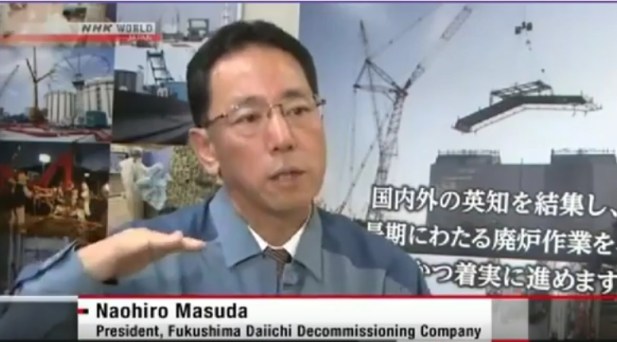
The person in charge of decommissioning the Fukushima Daiichi nuclear power plant has revealed a possible new way to deal with the radioactive water stored there: just let it evaporate.
“The amount of radioactive water at the plant continues to increase. We need to find a way to reduce it,” says Naohiro Masuda, president of the Fukushima Daiichi Decommissioning Company.
Masuda and his team of 6,000 workers have struggled with the problem of contaminated water. Workers must constantly inject water into the crippled reactors to cool molten debris and then pump it out. Groundwater flowing into the reactor buildings adds to the problem.
Executives with the plant’s operator, TEPCO, have said they will continue storing the water on site. Masuda says evaporation is one of the options being discussed.
“Diluting the contaminated water and discharging it into the ocean has been discussed. But another option is evaporating the water. This method was used following the Three Mile Island nuclear accident in the US,” he says.
Masuda says the task force of the government is discussing the methods. Masuda’s engineers and workers use purification equipment to remove most of the radioactive substance, but they can’t remove it all. Local fishermen strongly oppose releasing water directly into the ocean. The evaporation method could be an acceptable alternative for them, although some experts say its environmental consequences are unclear.
Handling contaminated water is just one aspect of the highly complex decommissioning process. Masuda believes that he’ll need to rely on the international community for support.
“We’ll be cooperating mainly with the United States, Britain, France, and Russia. We’re already getting help from people at nuclear-related facilities in these counties. We’re learning how to decommission and shut down facilities and deal with contaminated soil,” he says.
Radioactive Waste from Fukushima Plant Water Piling Up with No Final Destination

FUKUSHIMA — While contaminated water continues to accumulate at the crippled Fukushima No. 1 Nuclear Power Plant, radioactive waste retrieved from that water during purification work is becoming a serious concern for the nuclear facility.
Since there is currently no way of dealing with the waste, plant operator Tokyo Electric Power Co. (TEPCO) has stored it onsite as a temporary measure. But there are fears in Fukushima Prefecture that it may be left there for good.
Contaminated water builds up every day at the Fukushima No. 1 plant as groundwater flows into the reactor buildings where melted fuel from the Fukushima nuclear disaster lies. Since this contaminated water could flow into the sea, TEPCO processes it with several types of purification equipment, and reuses it to cool the No. 1 to 3 reactors.
Tainted water in the reactor buildings is pumped into the U.S. cesium absorption apparatus Kurion and Toshiba Corp.’s Simplified Active Water Retrieve and Recovery System (SARRY) to remove radioactive cesium and other materials. The water is then desalinated and sent through the Advanced Liquid Processing System (ALPS), which can remove 62 different types of radioactive substances.
This process, however, does not eliminate the radioactive materials themselves; they are soaked up by absorbents, such as minerals. Radioactive materials build up in these absorbents, which remain as waste emitting high levels of radiation. This type of waste is stored in metal containers that isolate the radiation. As of Nov. 10, there were 178 such containers at the SARRY processing area, 758 at Kurio and 2,179 at ALPS. The size of the containers differs depending on the area, but overall, it amounts to some 11,000 cubic meters — which would fill around 30 25-meter swimming pools. These containers of waste stand in a temporary storage area on the south side of the plant’s No. 4 reactor.
Isao Yamagishi, a group leader at the Japan Atomic Energy Agency, warns, “Waste produced during water purification work is highly radioactive, and so is the risk of just keeping it in storage.” This is because even if the tainted water goes through a desalination process, salt can remain in the waste. There is a risk of the waste containers exploding if the concentration of hydrogen in them — produced due to the effects of radiation on water — reaches a certain level. Such a phenomenon was seen at the No. 1 and 3 reactor buildings of the Fukushima No. 1 plant, which exploded due to an accumulation of hydrogen soon after the outbreak of the disaster.
Yamagishi says that salt content has a tendency to aid hydrogen production, and it is necessary to release a sufficient amount of hydrogen from the containers. It is also possible that salt could corrode the metal containers. There do not seem to be any problems with hydrogen concentration or corrosion at this stage, but Yamagishi says, “We need to research over the long term what’s going on inside the containers.”
There is additional nuclear waste at the plant, too. Soon after the outbreak of the nuclear disaster, a decontamination system provided by France’s Areva SA was put into operation, and approximately 597 cubic meters of radioactive waste produced during the water purification process with this system remains stored at the plant.
The Nuclear Regulation Authority says that if the Fukushima plant is hit by another major tsunami, this waste could end up outside the plant. It therefore needs to be dealt with quickly, but there is nowhere for it to go.
Contaminated water also poses a problem. The ALPS system cannot remove radioactive tritium from the water, so tritium-tainted water is stored in tanks. There are about 1,000 tanks holding this type of water, whose total weight amounts to some 900,000 metric tons. And as work to decommission the plant’s reactors increases, both the amount of nuclear waste and the amount of contaminated water will increase.
Shigeaki Tsunoyama, former president of the University of Aizu in Fukushima and head of the Fukushima Prefectural Center for Environmental Creation, who is familiar with the field of nuclear safety engineering, comments, “Locals are concerned that nuclear waste will be left there as it is.”
In the future, work will begin to remove melted fuel at the Fukushima No. 1 plant, but its destination remains undecided. Some locals fear that if no destination for waste designated as being in “temporary storage” at the plant is decided, then Fukushima will become the final disposal site for melted fuel in the future. Tsunoyama is calling on officials to provide a map for the future.
“I want them to analyze the long-term risks, and provide an outlook for the storage and disposal of waste,” he says.
http://mainichi.jp/english/articles/20161126/p2a/00m/0na/004000c

Accelerate water-purifying work at Fukushima plant to cut leakage risk
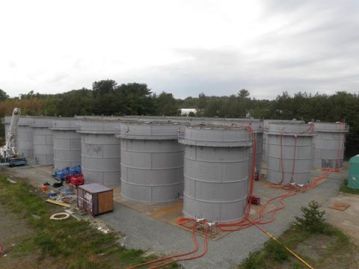
The volume of contaminated water continues to increase at Tokyo Electric Power Company Holdings Inc.’s Fukushima No. 1 nuclear power plant. Efforts to deal with this problem must be reinforced.
TEPCO has compiled a new set of measures to deal with the radioactive water. The steps are aimed at reducing to nearly zero the contaminated water inside reactor buildings, the prime source of the tainted water.
Under the new measures, the contaminated water accumulated in the basements of reactor buildings is to be purified and then transferred to storage tanks. At the same time, facilities exclusively used for purifying the tainted water are to be doubled, and the existing storage tanks will be replaced with larger ones, increasing the overall storage capacity.
Meanwhile, the volume of groundwater to be pumped up from the wells near the reactor buildings is to be increased. This is aimed at reducing the flow of underground water into the buildings, thus preventing a vicious cycle of generating more tainted water.
If all goes well, the increase in the volume of contaminated water is expected to nearly stop by 2020. We hope TEPCO will realize this goal steadily.
The measures taken so far have centered on the construction of “ice walls,” to prevent groundwater from entering the reactor buildings by freezing the underground soil around the buildings. Because this step has failed to prove effective even more than half a year after the related facilities were put into operation, TEPCO decided to shift its priority measures.
The new measures will require the approval of the Nuclear Regulation Authority. Both TEPCO and the NRA must cooperate closely so that the necessary work will not be delayed.
Consider ocean release
The reactor buildings have, in effect, turned into storage facilities for contaminated water. The volume of tainted water totals about 68,000 tons. Although the amount of radioactive material contained in the water has declined markedly when compared to the amount immediately after the nuclear accident occurred, it still remains at a high level.
The large amount of contaminated water inside the reactor buildings carries a risk of radiation exposure, posing a serious impediment to the work to decommission the plant. If highly radioactive water starts leaking underground out of the buildings and into the sea, it will create a serious situation.
Even if new measures proceed smoothly, however, tasks remain. The volume of purified water to be stored in the tanks is expected to nearly double by 2020 to about 1.2 million tons. Not only will this entail a huge maintenance cost, but there is also a danger that the water will leak if the tanks are damaged by an earthquake or other factors.
Releasing purified water that has met the existing safety criteria into the sea must be seriously considered. The discharge of purified water into the ocean has been routinely conducted at nuclear power-related facilities both at home and abroad.
It is important for both the government and TEPCO to do their utmost to explain such a plan in detail in order to win the understanding of local residents concerned. Efforts should also be made to take measures to prevent groundless rumors from adversely affecting the fisheries industry and other sectors.
It is also necessary to continuously ascertain the effect of the ice walls. Although nearly 100 percent of the walls have already been frozen, groundwater is reportedly flowing through thin gaps in the walls. Rainwater seeping through the topsoil has also increased the amount of groundwater inside the buildings.
TEPCO is proceeding with work to fill the gaps in the ice walls. If the work proves effective, the goal of reducing to zero the increase in the contaminated water will be realized two years earlier than envisaged. We hope TEPCO will strenuously work to block the flow of groundwater into the buildings.
Radioactive water leaks from storage tank at Fukushima plant
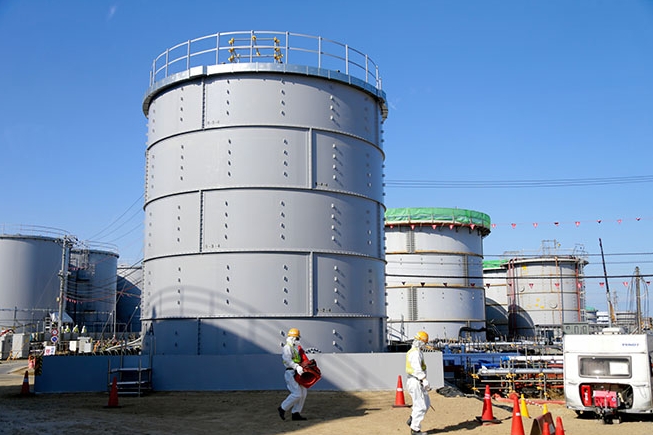
The latest contaminated water leak at the Fukushima No. 1 nuclear power plant occurred at a flange-type storage tank, whose seams are connected by bolts.
Up to 32 liters of radioactive water leaked from a storage tank at the crippled Fukushima No. 1 nuclear plant, but the contaminated liquid has been contained, Tokyo Electric Power Co. said Oct. 6.
The leaked water is currently within barriers surrounding the tank that are designed to block the flow of fluids, TEPCO, the plant’s operator, said.
The liquid contained water that had been treated to remove radioactive strontium and other substances, as well as highly contaminated water from the bottom of the tank that was stored shortly after the nuclear accident started in 2011.
A radioactivity level of 590,000 becquerels of beta ray-emitting materials was detected per liter of the leaked water.
The water seeped out of a tank with bolted seams on its sides, which are more prone to leaks than those with welded walls.
TEPCO continues to use the bolted containers despite the risk because production of welded tanks cannot keep pace with the buildup of contaminated water, mainly from groundwater entering the damaged reactor buildings, at the nuclear plant.
Storage tank leaks at Fukushima Daiichi plant
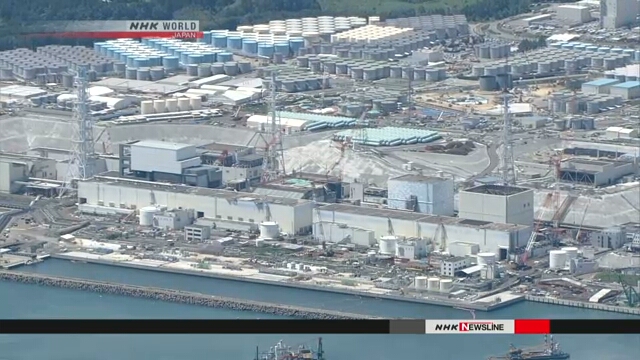
Workers at the crippled Fukushima Daiichi nuclear plant have found a leak of highly radioactive water from a waste water tank.
Its operator, Tokyo Electric Power Company, says the water likely leaked from a seam of the tank.
The leaked water was spotted on Wednesday on the side of one of an array of steel tanks holding contaminated water that is continuously generated at the site.
TEPCO’s analysis found 590,000 becquerel per liter of beta-emitting radioactive materials in the water.
Tokyo Electric estimates that 32 liters of such highly radioactive water had trickled out, mixed with rainwater, and remained within a barrier around the tank.
Workers moved water in the tank to another one to lower the water level enough to halt the leak.
The leaking cylindrical tank is made by splicing steel plates with bolts. But they have had waste water leaks in the past from seams.
The operator has been replacing these leak-prone tanks with new seamless ones. But the increasing volume of waste water makes it difficult for the utility to completely do away with the old ones.
Contaminated Water Tanks Without Fondation Bolts at Fukushima Daiichi
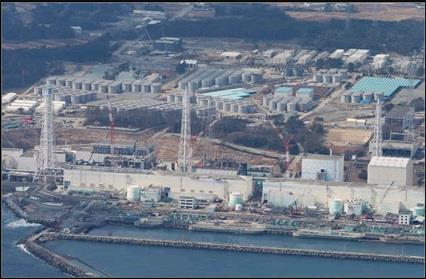
More than 1000 contaminated water tanks at Fukushima Daiichi, some do not have fondation bolts.
Even with a moderate earthquake of seismic intensity 4 there is a risk that those contaminated water tanks collapse.
The Nuclear Regulatory Commission of Japan has published on their website the seismic statement submitted by TEPCO about those tanks without fondation bolts. Their quake-resistance standard is 0.3G lower.
http://www.nsr.go.jp/data/000107385.pdf
The photograph below clearly shows the tank without fondation bolts.

Seismic intensity 4 and typhoons could cause the collapse of those contaminated water tanks. In case of tanks collapsing, a large amount of contaminated water would of course flow into the Pacific Ocean.
Tainted Water Grows at Fukushima N-Plant despite Ice Wall

Tokyo, Oct. 2 (Jiji Pres)–Six months into operation, the much-hyped underground ice wall has not yet produced the intended effects of curbing the growth of radioactive water at Tokyo Electric Power Company Holdings Inc.’s stricken Fukushima No. 1 nuclear plant.
TEPCO initially claimed that the ice wall would prove effective in about a month and half, but the amount of contaminated water at the plant has continued to increase at a pace faster than projected by the utility.
The plant in northeastern Japan faces a chronic shortage of welded-type water storage tanks, while an increasing volume of tainted water has been transferred to the reactor and turbine buildings as a makeshift measure despite a high risk of leaks.
TEPCO constructed the 1.5-kilometer-long ice wall encircling the plant’s damaged No. 1 to No. 4 reactors in an attempt to block groundwater from flowing into reactor buildings and mixing with radioactive water accumulating inside.
The government has to date spent a total of 34.5 billion yen in the construction of the structure by freezing underground soil, which is believed to be technically very difficult.
TEPCO to begin removing tainted water at Fukushima plant
Tokyo Electric Power Co. intends to begin pumping up highly contaminated water accumulating in the basements of buildings at its wrecked Fukushima No. 1 nuclear power plant by the end of March.
TEPCO disclosed its strategy Sept. 28 at a review meeting with the Nuclear Regulation Authority, the government’s nuclear watchdog.
In response, the NRA urged the utility to provide a detailed road map for the project.
Removing the huge volume of radioactive water in the reactor, turbine and other buildings has posed an urgent challenge for TEPCO.
The NRA pressed it to take action as soon as possible, pointing out that the contaminated water in the buildings’ basements is a likely reason flowing groundwater also gets polluted.
The NRA is also concerned that the contaminated water in the basements might leak into the sea if the nuclear complex is struck by another powerful tsunami.
TEPCO estimates that 68,000 tons of tainted water exists below the reactor and turbine buildings, as well as other structures.
Particularly worrisome is the estimated 2,000 tons of highly radioactive water in the condensers of the No. 1 through No. 3 turbine buildings, which accounts for 80 percent of the radioactive materials in all of the tainted water.
The contaminated water was transferred to the condensers in the immediate aftermath of the March 2011 triple meltdown.
TEPCO plans to finish transferring the water in the condensers by the first half of the next fiscal year and all of the contaminated water in the basements by 2020.
TEPCO Delays Replacing Tainted Water Tanks
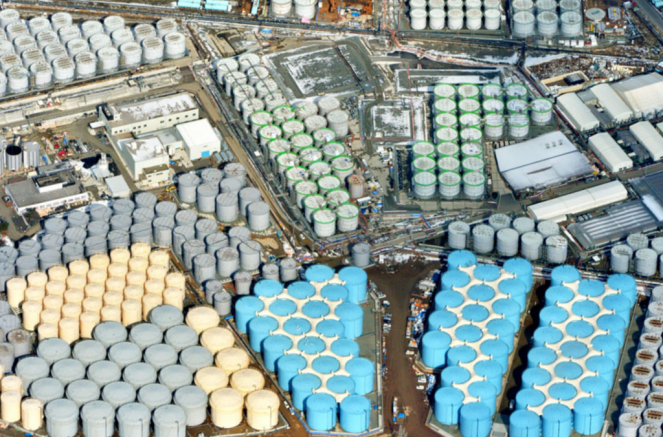
Tokyo, Sept. 28 (Jiji Press)–Tokyo Electric Power Company Holdings Inc. <9501> has effectively given up replacing tainted water storage tanks at its Fukushima No. 1 nuclear power station with safer ones at an early date, it was learned Wednesday.
It is believed to be the first time that the power firm has abandoned a deadline in its decommissioning work timetable, revised in June last year.
TEPCO now expects to finish the work in June 2018 at the earliest, according to documents submitted to a panel of the Nuclear Regulation Authority.
TEPCO initially planned to finish replacing the storage tanks with welded low-leakage ones early in the current business year through March 2017.
TEPCO remains unable to stop increases in the amount of radioactive water. The amount of contaminated water stored in the current tanks with a higher risk of leakage stood above 110,000 tons as of Thursday.
TEPCO: Groundwater Surfaced and Possibly Leaked at Fukushima Plant During Typhoon
Fukushima Daiichi Floods, Show Lack of Preparedness
News reports indicated that groundwater at Fukushima Daiichi had risen so high it broke the surface and flowed into the port as a recent typhoon passed through the area. As TEPCO prepared to close the steel sea wall and freeze the underground frozen wall, NRA stopped the process for a review of the potential for flooding within the reactor building area.
The conclusion was that TEPCO thought they could sufficiently remove excess groundwater with the sump pump subdrain system near the reactor buildings. There were also concerns of the groundwater dropping too low, allowing contaminated water to flow out of the reactor building basements.
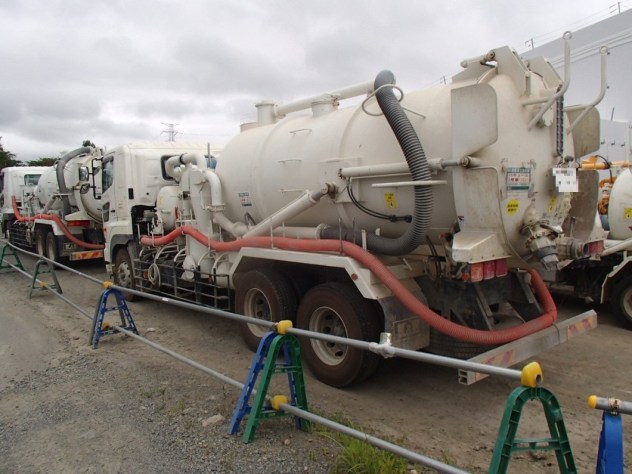
With all this review, nobody conceived a need for more water removal capacity. TEPCO ended up employing some sort of makeshift pumps and also using septic tank trucks to pump up water. This lack of anywhere for rainwater to go may have contributed to the water flowing out into the port as it built up on the surface.
Without some major changes at Daiichi this problem of groundwater rising to the surface and flowing into the port or the sea will continue to happen when significant rainfall takes place.
http://www.fukuleaks.org/web/?p=15765
Typhoon rain raises tainted Fukushima plant groundwater to surface
Heavy rain brought by Typhoon Malakas caused contaminated groundwater to rise to ground level at the radiation-hit Fukushima No. 1 nuclear plant Tuesday night, raising fears of tainted water flooding out to the plant’s port area, its operator said.
Tokyo Electric Power Company Holdings Inc. said in a press release that plant workers are doing their utmost to pump up tainted groundwater at the Fukushima compound, while trying to measure the level of radioactive substances contained in the water.
Under normal circumstances, groundwater taken from wells around the damaged reactor buildings at the Fukushima plant is filtered and stored in numerous tanks built on the compound.
Shortly before 10 p.m. Tuesday, groundwater reached the surface level at an observation well near the seawall at the power plant’s port, and at 11:30 p.m. Tuesday, groundwater stood at 3 cm above the surface level, Tepco said.
The well has a far higher wall and the ground around it is paved, the company said, playing down the possibility that any water flowed out of the well.
By 9 a.m. Wednesday, the water level had dropped to 3 cm below the surface.
Meanwhile, some rainwater may have flowed directly into the port before seeping underground, according to the company.
Tepco will continue pumping groundwater around the seawall, located near the damaged No. 1 to No. 4 reactors, and carry out close examinations of water inside the port, the company said.
In order to curb the flow of groundwater into the sea, the company has covered the seawall with water shields and carries out groundwater pumping operations.
Typhoon Malakas itself was downgraded to an extratropical depression at around 9 p.m. Tuesday as it moved along the coast of the Tokai region and swayed toward the Pacific. It was initially forecast to hit the Kanto region in the early hours of Wednesday.
The previous typhoon, Lionrock, earlier this month killed at least 17 people. Before Lionrock, two typhoons had claimed at least two lives in the northeast.
TEPCO: Possible water leak at Fukushima plant during typhoon
Tokyo Electric Power Co. said Sept. 21 it will check for radiation contamination in seawater near its crippled Fukushima nuclear plant after heavy rain from Typhoon No. 16 brought tainted groundwater to the surface.
The water reached the top of wells at the Fukushima No. 1 nuclear power plant, and there is a possibility that some of it spilled into the sea.
“We will analyze the seawater because we cannot determine whether groundwater containing radioactive materials has actually leaked,” a TEPCO official said.
The official added that the company believes most of the water that may have poured into the sea was rainwater that had not seeped into the ground.
The utility constantly monitors groundwater levels in wells around the reactor buildings at the plant to prevent overflows.
TEPCO said groundwater in wells on the seaside area of the nuclear complex reached the surface around 10 p.m. on Sept. 20 amid the heavy rain brought by the approaching typhoon. The water kept rising despite workers’ efforts to lower the level using makeshift pumps and septic tank trucks.
The groundwater level remained the same as of 7 a.m. on Sept. 21 before it finally dropped to about 3 centimeters from the surface two hours later, the company said.
According to TEPCO, about 575 millimeters of rain fell in the area of the nuclear plant from Aug. 1 to Sept. 20.
http://www.asahi.com/ajw/articles/AJ201609210047.html
Fukushima Daiichi Contaminated Groundwater Pouring into the Sea
Fukushima Daiichi Groundwater Rises from Typhoon N°16 Sept. 21, 2016
« Groundwater level rises in the aftermath of Typhoon 16, due to its heavy rain the groundwater now reaches now the surface.
It is unclear as whether or not the groundwater has been contaminated with radioactive material as it poured out into the sea, To be determined later, Tepco says. »
http://www.news24.jp/sp/articles/2016/09/21/07341567.html
Tepco pumping groundwater from Fukushima plant.
The operator of the Fukushima Daiichi nuclear power station says it is pumping groundwater from under the plant to prevent contaminated water from leaking into the adjacent port.
Tokyo Electric Power Company says the heavy rains brought by Typhoon Malakas have raised the underground water levels around the plant’s embankments.
TEPCO officials say they added pumps to prevent the groundwater from rising further. They say the water rose nearly to the surface shortly before 10 PM on Tuesday.
The officials say this has prevented rain from permeating the ground and increased the risk that the rainwater could become contaminated and flow into the port.
The utility says that while it is pumping the groundwater to prevent leakage, it will measure the radioactive substances in the water.
http://www3.nhk.or.jp/nhkworld/en/news/20160921_09/
Concern as leaky ‘ice wall’ around Fukushima nuke plant resembles ‘bamboo screen’
It has been nearly five and a half years since the meltdowns at Tokyo Electric Power Co. (TEPCO)’s Fukushima No. 1 nuclear plant, and both the utility and the Japanese government remain stymied in their efforts to control the buildup of radioactively contaminated water at the facility.
The problem is simply stated: Groundwater flows down from higher inland elevations towards the Pacific, collecting in the nuclear plant’s shattered reactor buildings and becoming contaminated. The plant grounds are packed with (occasionally leaky) storage tanks full of water pumped out of the reactor and turbine building basements, but the water does not stop.
TEPCO has attempted to stop the groundwater from getting into the buildings with a 1.5-kilomter subterranean “ice wall” (actually frozen soil) around the No. 1-No. 4 reactor buildings, but results have been inconclusive. Meanwhile, water decontaminated at the plant remains laced with radioactive tritium, and no storage site has yet been found to put this wastewater. The government is aiming to have all the radioactive water at the Fukushima plant dealt with by the end of 2020, the year Tokyo will host the Summer Olympics, but the way ahead is far from clear.
For one, the ice wall has holes in it.
“Due to heavy rain, the temperature rose above 0 degrees Celsius in two locations (along the wall),” a TEPCO public relations representative told a news conference on Sept. 1, the day after Typhoon Lionrock passed through northeastern Japan. The rainfall that came with the storm had caused a massive increase in the flow of groundwater, which then melted two holes in the ice wall, the official stated.
The freezing operation began in March this year, but part of the perimeter refused to solidify due to local geological features that caused the groundwater to flow particularly quickly. The fact that the typhoon’s rains could punch more holes in the wall revealed yet another weak point in the entire project, and experts have begun openly calling it a failure.
TEPCO decided on the ice wall in 2013, to close the spigot on the some 400 tons of radioactively contaminated water being produced daily at the Fukushima plant as groundwater came into contact with the melted fuel from the station’s reactor cores. A total of 1,568 pipes were sunk vertically 30 meters into the earth along a perimeter around the reactor buildings. Then coolant chilled to 30 degrees below zero was circulated through the pipes to freeze the surrounding soil and create an “ice dam.”
The project was treated as TEPCO’s trump card in its battle against the contaminated water problem, and the utility began the freezing operation along the plant’s seaward side in March this year. Freezing commenced on the rest of the wall in June, and TEPCO claimed that as of August, 99 percent of the seaward section and 91 percent of the landward section had been frozen successfully
However, in the five months since the operation began, there has been almost no drop in the amount of radioactive water produced. Experts at an Aug. 18 meeting of the Nuclear Regulation Authority (NRA) asked TEPCO point blank, “When will we see results?” Others commented, “TEPCO’s claim that the ice wall is highly effective at blocking the water flow is utterly bankrupt,” leaving utility officials fumbling for answers.
“The ice wall isn’t really a ‘wall’ per say, but more like a bamboo screen, which has gaps,” Nagoya University professor emeritus Akira Asaoka told the Mainichi Shimbun. “It’s obvious that the ice wall’s ability to block water is poor. A different type of wall should be considered as soon as possible.”
To complicate matters, the ice wall project is tangled up with expectations for the 2020 Tokyo Olympics. The Japanese government decided in September 2013 to commit large sums of public money to the ice wall and other contaminated water countermeasures. Four days later, Prime Minister Shinzo Abe was in Buenos Aires, telling the assembled members of the International Olympic Committee’s general session that “the situation (at the Fukushima plant) is under control.” He stated that the effects of the radioactive water had been entirely confined to the 0.3 square kilometers of the plant’s harbor. Later that day, Tokyo was announced as host of the 2020 Games.
So far, the central government has poured some 34.5 billion yen into the ice wall project. To say that the stupendously expensive initiative had failed would very likely invite scathing public criticism. Minister of Economy, Trade and Industry Hiroshige Seko told a news conference last month that “it’s true the ice wall is a difficult project, but the freezing is progressing.” And yet, no results have been forthcoming.
Solving the Fukushima No. 1 plant’s contaminated water problem by 2020 is inscribed in the reactor decommissioning schedule set by the government and TEPCO. If the ice is a failure, it would not just throw the work schedule off kilter; it would violate a publicly stated commitment to the international community.
To boost the ice wall’s effectiveness, in June TEPCO began injecting a specialized cement into parts of the perimeter that remained stubbornly unfrozen, and instituted supplementary projects to make the ground easier to freeze. TEPCO plans to freeze every side of the perimeter, but it remains to be seen if the utility will have anything to show for its work.
http://mainichi.jp/english/articles/20160907/p2a/00m/0na/011000c
Treated Fukushima Water Safe for Release, Tepco Adviser Says
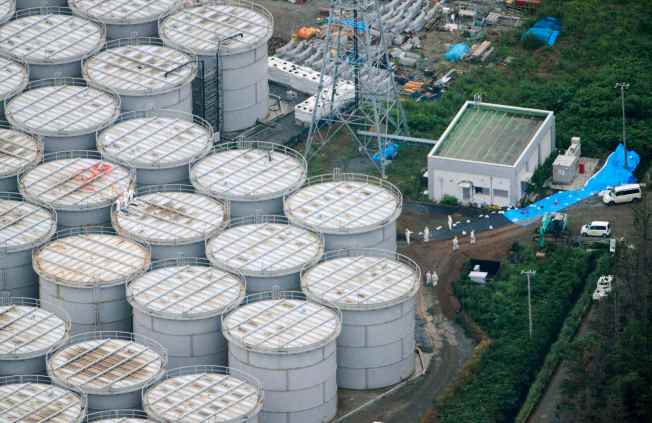
Tepco has more than 600,000 tons of treated water at site
Government has final decision on what to do with the water
Treated water from Tokyo Electric Power Co. Holdings Inc.’s wrecked Fukushima nuclear plant north of Tokyo is safe to be released under controlled circumstances into the nearby Pacific Ocean, an independent adviser to the utility said.
“It is much better to do a controlled release in my view than to have an accidental release,” Dale Klein, the adviser and a former chairman of the U.S. Nuclear Regulatory Commission, said in an interview in Tokyo. “I get nervous about just storing all that water when you have about a thousand tanks. You have all the piping, all the valves, everything that can break. ”
More than five years after the meltdowns at Fukushima, Tokyo-based Tepco continues to struggle to contain the radiation-contaminated water that inundates the plant.
About 300 metric tons of water — partly from the nearby hills — flow into Fukushima’s reactor building daily, mixing with melted fuel and becoming tainted, according to the company’s website. For perspective, that’s roughly the amount of water contained in one lane of an Olympic-sized swimming pool.
The water is currently pumped out of the buildings and purified, lowering its radioactive content with a system called Advanced Liquid Processing System, or ALPS. The treated water, which still contains a radioactive element known as tritium, is then stored in one of roughly 1,000 tanks at the site.
Water Challenges
What to do with the treated water remains a headache for Tepco. The utility was urged by the International Atomic Energy Agency in May 2015 to consider discharging the water into the ocean. In early 2014, Klein, the Tepco adviser, criticized the company’s progress in managing the water situation, saying at the time that the task distracted Tepco from other important challenges associated with the cleanup.
Tepco will cooperate with the government, local authorities, and fishermen regarding what to do with the tritium water, spokesman Tatsuhiro Yamagishi said by phone. As of July 28, Tepco stored 668,352 tons of treated water at the Fukushima plant, while 188,462 tons of untreated water was waiting in a second set of tanks to be processed by ALPS, according to Tepco’s Yamagishi.
The government agency overseeing handling of the treated water hasn’t decided whether to go ahead with an ocean release because it needs to “weigh any potential impact on society,” according to an official who asked to not be named, citing internal policy.
“I hope the government will help move towards a decision,” Klein said.
Nuclear power plants routinely and safely release dilute concentrations of tritiated water, according to the the U.S. Nuclear Regulatory Commission.
Release of the “water will not be a safety issue, but it will be an emotional issue,” Klein said. “A lot of people are not going to know what tritium is and they’re just going to perceive that the water is glowing in the dark.”
1 This Month

of the week – Shut Down Drone Warfare!


Tell the Ukrainian Government to Drop Prosecution of Peace Activist Yurii Sheliazhenko

Petition to revoke the licensing of the Near Surface Nuclear Disposal Facility (NSDF) at Chalk River. https://www.ourcommons.ca/petitions/en/Petition/Details?Petition=e-7247
To see nuclear-related stories in greater depth and intensity – go to https://nuclearinformation.wordpress.com
-
Archives
- March 2026 (251)
- February 2026 (268)
- January 2026 (308)
- December 2025 (358)
- November 2025 (359)
- October 2025 (376)
- September 2025 (257)
- August 2025 (319)
- July 2025 (230)
- June 2025 (348)
- May 2025 (261)
- April 2025 (305)
-
Categories
- 1
- 1 NUCLEAR ISSUES
- business and costs
- climate change
- culture and arts
- ENERGY
- environment
- health
- history
- indigenous issues
- Legal
- marketing of nuclear
- media
- opposition to nuclear
- PERSONAL STORIES
- politics
- politics international
- Religion and ethics
- safety
- secrets,lies and civil liberties
- spinbuster
- technology
- Uranium
- wastes
- weapons and war
- Women
- 2 WORLD
- ACTION
- AFRICA
- Atrocities
- AUSTRALIA
- Christina's notes
- Christina's themes
- culture and arts
- Events
- Fuk 2022
- Fuk 2023
- Fukushima 2017
- Fukushima 2018
- fukushima 2019
- Fukushima 2020
- Fukushima 2021
- general
- global warming
- Humour (God we need it)
- Nuclear
- RARE EARTHS
- Reference
- resources – print
- Resources -audiovicual
- Weekly Newsletter
- World
- World Nuclear
- YouTube
-
RSS
Entries RSS
Comments RSS
 nuclear-news