Fukushima Car Wash Septic Tanks Contain Highly Radioactive Sludge
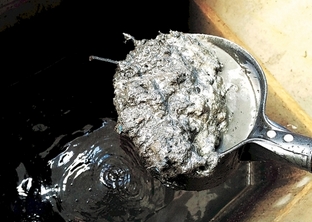
Highly radioactive sludge is turning up in septic tanks at car washes in Fukushima Prefecture, and the readings are as much as seven times higher than the government’s limit, auto industry officials say.
While the government-set limit is 8,000 becquerels per kilogram, some of the sludge is giving off 57,400 becquerels per kg, a document obtained by Kyodo News says.
The source of the radioactivity is believed to be ash and soot that stuck to vehicles shortly after the triple core meltdown at the Fukushima No. 1 nuclear power plant in March 2011, the officials said Saturday.
Fukushima Prefecture has some 1,700 auto maintenance facilities where a growing number of septic tanks are reaching capacity, they said, adding that the amount of tainted sludge accumulated from washing cars likely weighs several thousands of tons.
To the prevent the septic tanks from overflowing, some of the maintenance facilities are manually scooping up the mud, which has prompted industry groups to warn authorities about the health hazards workers face, the officials said.
The Japan Automobile Dealers Association, Japan Automobile Service Promotion Association and Japan Light Motor Vehicle and Motorcycle Association have been urging the central government and Tokyo Electric Power Co., which manages the defunct Fukushima No. 1 plant, to address the issue.
But their calls for action have not been heeded, the Environment Ministry and the utility admitted.
The issue has failed to gain attention until now in part because the decontamination law only requires that companies report on radiation levels in sewage sludge and incinerated ash, not other waste products.
Although the companies that install the septic tanks know about the radiation problem, they couldn’t go public about it for fear of losing customers.
Kunikazu Noguchi, associate professor of radiation protection studies at Nihon University in Tokyo, said all tainted sludge should have been designated as radioactive waste and disposed of by the central government, instead of being kept in septic tanks.
“The fact that the government failed to act on this problem for 5½ years shows its negligence,” Noguchi said. “To remove sludge that contains nearly 60,000 becquerels of radioactive material per kilogram, you need to do so with extra caution, in line with guidelines set by the Environment Ministry.”
1 This Month


18 March Webinar @ 1 PM EST: An Assessment of SMR Projects: The Case of Canada
register for the zoom:
https://us02web.zoom.us/webinar/register/WN_o8BIIOUvQ2ONJR1nta65DQ#/registration


of the week – STOP SMALL MODULAR REACTORS IN CANADA
To see nuclear-related stories in greater depth and intensity – go to https://nuclearinformation.wordpress.com
-
Archives
- March 2026 (138)
- February 2026 (268)
- January 2026 (308)
- December 2025 (358)
- November 2025 (359)
- October 2025 (376)
- September 2025 (258)
- August 2025 (319)
- July 2025 (230)
- June 2025 (348)
- May 2025 (261)
- April 2025 (305)
-
Categories
- 1
- 1 NUCLEAR ISSUES
- business and costs
- climate change
- culture and arts
- ENERGY
- environment
- health
- history
- indigenous issues
- Legal
- marketing of nuclear
- media
- opposition to nuclear
- PERSONAL STORIES
- politics
- politics international
- Religion and ethics
- safety
- secrets,lies and civil liberties
- spinbuster
- technology
- Uranium
- wastes
- weapons and war
- Women
- 2 WORLD
- ACTION
- AFRICA
- Atrocities
- AUSTRALIA
- Christina's notes
- Christina's themes
- culture and arts
- Events
- Fuk 2022
- Fuk 2023
- Fukushima 2017
- Fukushima 2018
- fukushima 2019
- Fukushima 2020
- Fukushima 2021
- general
- global warming
- Humour (God we need it)
- Nuclear
- RARE EARTHS
- Reference
- resources – print
- Resources -audiovicual
- Weekly Newsletter
- World
- World Nuclear
- YouTube
-
RSS
Entries RSS
Comments RSS
 nuclear-news