Finland’s nuclear plant: more delays, cost overruns
More Delays at Finnish Nuclear Plant
The New York Times. September 2, 2009, By James Kanter
AREVA a French nuclear construction company, said this week that its project to build the world’s most powerful reactor remained mired in delays and was over-budget by 2.3 billion euros, or about $3.3 billion.The price tag of the plant in Olkiluoto, Finland — the first of a fleet of so-called evolutionary power reactors that Areva foresees building in coming years — was about $4.3 billion in 2003 and costs have steadily increased.
The reactor was meant to have gone online early this summer but Areva no longer is committing to any dates for its completion. Patrice Lambert de Diesbach, an energy analyst with CM-CIC Securities in Paris, said the latest developments were “bad news” for Areva and “should be sanctioned by the market.”
The problems faced by Areva are important a time when the nuclear power industry is promising to build safer and more reliable reactors than during the last building boom in the 1960s and early 1970s. …………………………
So far there are few signs of a breakthrough in Finland.
Areva said this week that it would not begin work on the final stages of the reactor until the Finnish utility agreed to a new set of proposals and modifications.
More Delays at Finnish Nuclear Plant – Green Inc. Blog – NYTimes.com
AREVA going to court over Finland nuclear reactor runaway costs
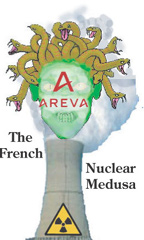 Areva’s half-year results yesterday night brought new information about the Olkiluoto-3 EPR nuclear fiasco:
Nuclear risks rise for French workers
French nuclear workers see risks as conditions worsen
* EDF subcontracts 80 percent of nuclear maintenance
* Nuclear workers say they are under mounting time pressure
* Safety margin is narrowing, expert says
* EDF denies it cuts corners, says subcontracts by choice
Forbes Reuters FEATUREBy Muriel Boselli
PIERRELATTE, France, Aug 31 (Reuters) – Worsening working conditions, inadequate pay rises, pressure to work faster and safety concerns — these are the familiar grievances of a disaffected work force.
When such complaints arise in France’s most sensitive industry — nuclear power — alarm bells start ringing.
Cyril Bouche and his colleagues at the Tricastin nuclear plant in the rolling hills of the Drome region say the state-owned utility EDF, which runs France’s 58 nuclear reactors and has been expanding into the United States and Britain, is not only cutting costs, but also cutting corners.
The 39-year old, who works for one of EDF’s many subcontracting firms, says working conditions at the plant — hit by a series of incidents that shook public trust in 2008 — have deteriorated over the past five to 10 years.
“Today France is selling reactors abroad but it should first put its own house in order,” said Bouche, the only one of 10 workers interviewed by Reuters who was prepared to be identified.
The French government has put forward state ownership of its nuclear sector as a guarantee of its safety, but former monopoly EDF subcontracts 80 percent of the maintenance at its nuclear reactors to firms such as Vinci, Areva ( ARVCF.PK – news – people ), GDF Suez or Bouygues ( BOUYF.PK – news – people )………….
Independent experts including Yves Marignac, executive director of the information agency Wise-Paris, say safety margins in French nuclear power plants are shrinking as plants age, economic pressure mounts and trained staff retire.
FEATURE-French nuclear workers see risks as conditions worsen – Forbes.com
Nuclear decommissioning – costs blow out endlessly!
Saving funds for shutdown of nuclear plants proves tricky
MISSOURIAN July 24, 2009
BY DAVE GRAM and FRANK BASS/The Associated PressVERNON, Vt. — The companies that own almost half the nation’s nuclear reactors are not setting aside enough money to dismantle them, and many may sit idle for decades and pose safety and security risks as a result, an Associated Press investigation has found……………………….At 19 nuclear plants, owners have won approval to idle reactors for as long as 60 years, presumably enough time to allow investments to recover and eventually pay for dismantling the plants and removing radioactive material.
But mothballing nuclear reactors or shutting them down inadequately presents the most severe of risks. Radioactive waste could leak from abandoned plants into ground water or be released into the air, and spent nuclear fuel rods could be stolen by terrorists.
During the past two years, estimates of dismantling costs have soared by more than $4.6 billion because rising energy and labor costs, while the investment funds that are supposed to pay for shutting plants down have lost $4.4 billion in the battered stock market………………………………
“No one at the NRC wants to acknowledge what is absolutely obvious to us, that the funds are inadequate and that the industry has bare assets,” said Arnold Gundersen, a retired nuclear engineer and decommissioning expert.
Those critics say the industry is making assumptions about their investments that do not account for another market collapse, political obstacles to getting the licenses renewed and unforeseen safety problems that could make nuclear power less palatable.
Last week, British officials reported on a 2007 leak in a cooling tank at the decommissioned Sizewell-A nuclear plant.
Saving funds for shutdown of nuclear plants proves tricky – Columbia Missourian
The costs and risks of nuclear energy
The costs and risks of nuclear energy
Gainsville.com Diane Forkel 24 July 09 “……………….Progress Energy is looking ahead to increasing energy use. Their plans are to build two new nuclear power plants. However, electric customers beware, excessive cost overruns (and defects and deficiencies) at a Finnish power plant have been reported in the New York Times. If Progress Energy experiences similar problems, utility customers should brace for a double-cost whammy in their electric bills.
Nuclear power plants carry a good deal of financial risk, so the industry is heavily backed by the government. Currently, applications are being made for billions of dollars in loan guarantees, aka government bailouts. And they could end up being just that.
A Union of Concerned Scientist website notes in 1985 Forbes magazine called the nuclear industry bailout of that era “the largest managerial disaster in business history.”……………The nuclear power plant carbon footprint (CF) is also quite large. It encompasses plant construction, plant decommissioning, and construction of a huge waste storage facility, such as Yucca Mountain, and/or other additional storage facilities. I am sure new research buildings and experimental plants for nuke waste technological breakthroughs will also add to CF………………………..
Inexperience is also blamed for Areva’s costly nuclear power plant construction problems in Finland. Yet Areva has more experience than its U.S. counterparts in building nuclear facilities.
Areva’s costly construction issues are unnerving. Structural construction problems raise safety concerns. An accident at any nuclear facility could be devastating in terms of loss of live and long-term environmental damage.
I have to wonder if this country is adequately prepared to handle radiation fallout from a nuclear accident. And the financial burden of a nuclear accident, or even just a huge bailout, could cause the country’s soaring deficit to shatter and crash.
Too hot for nuke power
Too hot for nuke power Deseret News 16 July 09
Proponents of nuclear power in Utah probably have not noticed an article in the UK Times (July 13, 2009) regarding the problems France is having with its nuclear-power plants, problems that bear on the feasibility of nuclear power in Utah.France is in the grips of another hot summer, with air temperatures in the 80s. Water temperatures have exceeded the limits under which plants cooled by river water can safely operate.As a result of the heat, France has had to reduce power generation by one-third and is now importing power from England. Much the same thing happened during the heat wave of 2003.
Reading this, I couldn’t help thinking about the nuclear plant proposed for Green River, where summer temperatures are regularly in high 90s. T
he water temperature of the Green River at Jensen on July 13, 2009, was 23.5 degrees Celsius, almost as high as the maximum allowed for water returned to rivers from France’s nuclear plants. During the drought of 1999-2005, Green River water temperatures reached 25.4 degrees.
As the earth warms, high river temperatures will become commonplace. Nuclear plants, especially those dependent on rivers, will become untenable. Utah should avoid this boondoggle now.
It’s time to stand up to the energy giants
It’s time to stand up to the energy giants Guardian UK, by John Sauven 13 July 2009 Renewable energy will never take off as long as the industry is dominated by European utilities Against the backdrop of the worldwide economic downturn, it is ironic that the area often said to have the least business certainty, the renewables sector, is one of the few success stories. Globally this industry is bucking the trends, creating millions of new green jobs, increasing countries’ energy independence and reducing climate-changing emissions…………………………Not so much the “voice of British business” as the voice of French and German energy monopolies, for too long E.ON, RWE and EDF have dictated the terms of the British energy debate. Today’s CBI report advocating that Britain scale back its renewable ambitions yet further is just the latest tactic by these utilities to shaft British business efforts in clean tech out of fear of new competition and the threat posed to their “business as usual” approach. EDF and E.ON admit they oppose ambition on renewables in case they undermine the economic case for the nuclear power stations they want to build. These arguments are now parroted verbatim by the CBI.
t is no coincidence that Germany and Spain, which have shut the door on new nuclear power, have invested most in renewables and seen their green industries rocket. Spain now generates as much as 40% of its electricity from wind power and studies show the investment in renewables has lowered wholesale electricity prices in Spain by more than the cost of the incentive they used to kickstart the industry. Germany has created almost a quarter of a million new green jobs in renewables as a whole and £8.5bn a year for its economy from wind industry sales alone.While other countries got ahead of the UK in green tech, in a textbook case of the power of special interests operating in Whitehall, energy officials in Britain lobbied together with two German energy giants and the French state-owned atomic industry to systematically undermine and sabotage UK efforts on renewables…………………………….anti-wind nimby groups with links to giant PR firms were set up to whip up anti-renewable hysteria with little transparency and much suspicion about who was really behind them, especially given that national government polling shows that 80% of people support wind power. Plans were even announced to knock down a wind farm to make way for a nuclear plant.
It’s time to stand up to the energy giants | John Sauven | Comment is free | guardian.co.uk
Don’t nuke the climate

International campaign “Don’t nuke the climate” : we need your support
Please answer before the 12th of July 2009.
Register your group
The first partners In December 2009, at the next UN Climate Change Conference in Copenhagen, it will be the world leaders’ duty to aim for an ambitious agreement regarding greenhouse gas emissions cut targets. They should also agree on a relevant budget to finance climate change mitigation and adaptation.Nuclear power has been kept outside of climate change mitigation mechanisms like CDM (Clean Development Mechanism) and JI (Joint Implementation) so far. However, some evidence shows that the nuclear lobby could be preparing its comeback at the next COP to have this dirty energy labeled as clean or carbon-free and thus benefit from new subsidies. Will our leaders let themselves be talked into financing a dangerous, costly and irrelevant technology, which would divert urgently needed money from real solutions to climate change?
This is why we now propose you to support the international campaign “Don’t nuke the climate” which will be initiated by the Réseau “Sortir du nucléaire” (French Network for Nuclear Phase-out). A campaign document will be edited at a large scale (several hundreds of thousand copies) by September 2009. It will include petition postcards to be signed by citizens, which will be gathered and then presented in Copenhagen during a media-oriented action. Beside, we will ask citizens to send us pictures to make a huge mosaic showing the face(s) of world citizens’ refusal of nuke as a solution to global warming.
We would highly appreciate to see your logo on this document and on the dedicated website, our aim being to distribute this campaign as broadly as possible, not only in France, but also in Europe and maybe further. Our last campaign on this topic, in year 2008, has already gathered 27 partners at a national level. However, the issue is global and requires international committment. We know some of you are already active on the issue of nukes and global warming, and hope this campaign could contribute in joining our efforts to allow the antinuclear voice to be heard even stronger in Copenhagen.Like already many organizations, do not hesitate to register your NGO as a partner of the campaign “Don’t nuke the climate”The writing work is in progress and your remarks will be welcomed.
Nuclear dawn delayed in Finland
Nuclear dawn delayed in Finland By Rob Broomby BBC World Service, 10 July Olkiluoto, Finland
When it is finished, Finland’s Olkiluoto 3 (OL3) nuclear reactor will be the biggest the world has ever seen, the excavation site alone is the size of 55 football fields.
It was to have been a pilot project for bigger, better, cleaner, Generation III reactors, which would lead the charge back to nuclear power in a continent which had gone cold on atomic energy after the accidents at Chernobyl and Thee Mile Island.
But hopes of an early nuclear dawn on the Baltic coast are fading – the May start up date came and went and the OL3 is now not expected to begin pumping out electricity until 2012 – three years later than planned and about $2.4bn dollars (1.7bn euros) over budget.
The soaring cranes tell the tale: this project is far from complete.
There have been a string of problems starting with the concrete, then the welding.
Now, the safety regulator is questioning the designs for the reactor’s nerve centre – the Instrumentation and Control system……………………..
Even Philippe Knoche, Areva’s chief operating officer, admits things have not been going well.
“It’s no secret that Areva is losing money on this project,” he tells me……………………………..the EPR could be struck-off the list of reactor designs approved for use in the UK, a devastating blow to the French company and the British nuclear programme.
Conflict on African continent hampers mining industries
Conflict on continent hampers mining industries Mining Weekly
By:Megan Wait 10 July 09Foreign nations’ and companies’ interests in African resources also lead to negative effects. Many foreign companies on the continent are primarily extractive. This means that the countries are seen as suppliers of raw materials, which are exported for processing to other countries. This prevents the esta- blishment of manufacturing and service industries in these countries, which inhibits job creation. The export taxes also create expenses for the country, which is chroni- cally strapped for revenue.Meanwhile, French nuclear company Areva’s subsidiary, uranium explorer UraMin, reports that the company, although at peace with the government, is concerned about its uranium-excavating project Bakouma, in the Central African Republic (CAR)……………………………….The negative perception of the political, societal and economic situation in Africa, weak leadership and poor governance, and the lack of regional coherence and identity create structural problems that continue the cycle of poverty and insecurity.
The nuclear option [Areva]
The nuclear option – AREVA
appomattox’s posterous 2 July 09 “………………………………”Though Niger is the fourth-largest producer of uranium in the world, it sees almost none of the wealth. Because of a long-standing contract, the French consortium* pays only 5.5 percent of its revenue in taxes, and most of it goes to subsidize elites in the dusty capital of Niamey. Almost three-quarters of the people cannot read, and those who survive to the age of forty-five are living on statistically borrowed time. Niger was recently named the most deprived country on earth by the United Nations, ranked dead last among the world’s sovereign nations on a comprehensive scale called the Human Development Index, which charts life expectancy, education, and standard of living…””Uranium: War, Energy, and the Rock that Shaped the World,” by Tom Zoellne……………..…………..President Nicolas Sarkozy has been active in trumpeting his country’s know-how to win French companies new business abroad…Areva needs between eight and 10 billion euros by 2012 to fund its investment program, notably to develop its third-generation EPR nuclear reactor. It also needs an estimated two billion euros to buy out Siemens’ stake in Areva NP, its reactor subsidiary.” ………………….
…………..Areva needs between eight billion and 10 billion euros (11.2 billion and 14.0 billion dollars) by 2012 to fund its investment program, notably to develop its third-generation EPR nuclear reactor. The company also needs an estimated two billion euros to buy out Siemens’ stake in Areva NP, its reactor subsidiary.
http://www.google.com/hostednews/afp/article/ALeqM5i7L4s3lyWXxYV0rTTNpBou6r7Jeg
In other words, it appears Areva is in deep financial doings, and ownership of the company is being diluted from a state-run operation to privatization – a movement that seems to annoy the French government.While financial doings are deep (albeit perhaps not troublesome, depending on the availability of investors), the climate in Africa poses some problems:
“After a visit in late March from French President Nicholas Sarkozy to Niger, residents in the uranium-exporting desert country continue questioning whether AREVA, a company primarily owned by the French government, will honour its promise to protect communities from mining hazards.” On the other side of that coin, Areva faces problems with water shortages in its mining and milling processes.
The nuclear option [Areva]: Virginia Business – News – appomattox’s posterous
‘No’ to nuclear power
SOUTHDOWN STAR Marlene Lang 30 June 09 “……………………Twenty-six plants nationwide showed shortfalls in the funds they are required by federal law to set aside for dismantling the reactors someday and cleaning up after themselves.–
Every year the Nuclear Regulatory Commission checks on the state of so-called “decommissioning funds.”
Most years there are only a handful of plants running short of having those estimated costs laid up, usually four or five one official said. Those billions set aside for close-down and clean-up don’t just pile up under a mattress, of course; the money is invested in the stock market. According to an Associated Press report, some $4.4 billion in decommissioning funds was lost in the downturn, even as the actual costs for shutting down plants has risen by $4.6 billion because of (I love this part) rising energy costs – and labor costs.–
Illinois’ Braidwood Station, Byron Station and LaSalle County Station, each with two nuclear reactors, and the Clinton Power Station are all on the NRC’s shortfall list……………………… Plans for fund-challenged nuclear power plants are to let them sit for about six decades, or however long it takes to accumulate the cash to safely dismantle those reactors and remove those nasty, hot and highly radioactive uranium fuel pellets. Sixty years, idle, is the time-frame estimate the NRC gave media earlier this month.–……………………. I didn’t need to be an engineer to wonder what happens when things get, well, rusty? But immediately I doubted my common sense; I asked if maybe we, the non-technical public, are ill-informed? Maybe even stupid? Maybe magical nuclear power plants don’t actually rust; maybe they can rest safely forever on waterfronts near our homes and always safely contain that high-level radioactive fuel.–
I tried to believe, but I lacked what the nuclear industry and U.S. government policy refer to as: Waste Confidence. This is a doctrine – and I chose that word carefully – which says that the nuclear industry can continue to function and grow even though it has the big gaping problem of what to do with the its own leftovers, being confident that a solution will be found. When common sense fails, there is always faith.– …………………………. What to do? The better question may be, what not to do. How about we listen to common sense and NOT build any more of these reactors until we have solved the great mystery of what to do with the waste, and can afford to pay for that solution?
http://www.southtownstar.com/news/lang/1644764,063009-colLANG.article
Nuclear Power has Political Meltdowns
Nuclear Power has Political Meltdowns Greentech Pastures Harry Fuller 1 July 09 There’s the on-going issue of nuclear waste, and in Ontario, at least, there’s the problem of the expense of the next generation technology.
Only Finland is currently building the latest and best in nuclear generation tech, the work being done by European firms, Areva and Siemens. The project is now far over budget and at least three years from completion. The plant construction began in 2005 and was supposed to have been completed this year. Situations like Ontario and Finland are not going to encourage other nations to go further into nuclear generation.
Fears for safety as nuclear watchdog hires staff from firms pitching to build reactors
Fears for safety as nuclear watchdog hires staff from firms pitching to build reactors The Guardian Tim Webb 26 June 2009
The Nuclear Installations Inspec
torate is recruiting more than a dozen project managers to speed up its review of new reactor designs – even though they work for the companies hoping to build them.
The Guardian has learnt that the government has approached companies including the US groups Bechtel and CH2M Hill, as well as the UK’s Amec, to fill the senior posts. The companies involved are eager to secure lucrative contracts to help build the UK’s first new reactors for decades.
Government and industry sources admitted the secondments posed potential conflict of interest problems.
It is also understood that the inspectorate has recruited technical staff from Areva,…………………………There are concerns that the potential conflicts of interest could compromise the safety of the new nuclear reactors if the companies helping the inspectorate have a vested interest in approving their design.
Olkiluoto in Finland
EPR’s problems run in the nuclear family
Greenpeace 27 June 09 “…………………………….Areva’s supposedly state-of-the-art, third-generation European Pressurized Reactor.
To recap, currently just two EPRs are being built in the world right now – one at Olkiluoto in Finland and one in Flamanville in France. Both have been beset by long-running construction problems, schedule and cost overruns, and all-round hilarious ineptitude and controversy.
The predecessor of the EPR, its parent if you like, was the Framatome N4 of which France has four. The N4 had problems of its own which sound all too familiar………………..
Design-related problems? Delays in commissioning? Cracked welding? N4 and EPR could be identical twin brothers, not father and son. Has nothing been learned? Nothing at all? We’ve heard this story before. Areva are remaking their own disaster movie.
1 This Month

of the week – Shut Down Drone Warfare!


Tell the Ukrainian Government to Drop Prosecution of Peace Activist Yurii Sheliazhenko

Petition to revoke the licensing of the Near Surface Nuclear Disposal Facility (NSDF) at Chalk River. https://www.ourcommons.ca/petitions/en/Petition/Details?Petition=e-7247
To see nuclear-related stories in greater depth and intensity – go to https://nuclearinformation.wordpress.com
-
Archives
- April 2026 (7)
- March 2026 (251)
- February 2026 (268)
- January 2026 (308)
- December 2025 (358)
- November 2025 (359)
- October 2025 (376)
- September 2025 (257)
- August 2025 (319)
- July 2025 (230)
- June 2025 (348)
- May 2025 (261)
-
Categories
- 1
- 1 NUCLEAR ISSUES
- business and costs
- climate change
- culture and arts
- ENERGY
- environment
- health
- history
- indigenous issues
- Legal
- marketing of nuclear
- media
- opposition to nuclear
- PERSONAL STORIES
- politics
- politics international
- Religion and ethics
- safety
- secrets,lies and civil liberties
- spinbuster
- technology
- Uranium
- wastes
- weapons and war
- Women
- 2 WORLD
- ACTION
- AFRICA
- Atrocities
- AUSTRALIA
- Christina's notes
- Christina's themes
- culture and arts
- Events
- Fuk 2022
- Fuk 2023
- Fukushima 2017
- Fukushima 2018
- fukushima 2019
- Fukushima 2020
- Fukushima 2021
- general
- global warming
- Humour (God we need it)
- Nuclear
- RARE EARTHS
- Reference
- resources – print
- Resources -audiovicual
- Weekly Newsletter
- World
- World Nuclear
- YouTube
-
RSS
Entries RSS
Comments RSS
 nuclear-news