IAEA Warns of Tense Military Situation Near Ukraine Nuclear Plant
Mirage News 19 May 23
The International Atomic Energy Agency (IAEA) continues to warn of the potential nuclear threat in the Ukraine conflict amid rising tensions surrounding the Zaporizhzhya Nuclear Power Plant (ZNPP).
IAEA Director General Rafael Mariano Grossi said on Friday in a statement, that a location near the town of Enerhodar, home of most of the plant’s staff, reportedly came under artillery fire earlier in the day, “in the latest incident indicating an increasingly tense military situation in the area.”
Speculation of military activity
The ZNPP, Europe’s largest nuclear power plant, is located just a few kilometres from Enerhodar.
IAEA experts present at the plant reported that it had not been affected “but the proximity once again underlined persistent nuclear safety and security dangers at a time of heightened speculation of future military operations in the region,” said Mr. Grossi…………………………………………………………… more https://www.miragenews.com/iaea-warns-of-tense-military-situation-near-1010184/
New UK sanctions on Russian energy to include Rosatom and nuclear energy
The sanctions have been announced alongside the G7 Summit, where member states will discuss further action to limit Russian economic growth.
Power Technology By Florence Jones 19 May 23
he UK has announced a new wave of sanctions against Russia, as the G7 Summit begins in Japan this weekend.
The sanctions will target companies connected to the theft of Ukrainian grain and the shipment of Russian energy, defying current sanctions. Further sanctions from G7 nations are also expected to be unveiled this weekend.
According to the UK Government, the sanctions will affect 86 individuals and entities “connected to Russia’s capacity to fund and wage the war [in Ukraine]”.
The sanctions will also affect companies connected to Russian nuclear energy company Rosatom, which supplies 20% of Russia’s energy. Rosatom also recieved sanctions from the US Government in February. The French state has also been under scrutiny for its connection with Rosatom due to a joint declaration of research cooperation signed in 2021.
According to a statement from the government, sanctions will be placed on “Matex, which produces composite materials based on carbon fibre for Rosatom that could be used for military purposes, and Triniti, whose research and development into laser physics is directly funded by the Russian Federation’s State Defence Order”.
Oleg Romanenko, a lead official at the Zaporizhzhia Nuclear Power Plant, which the UK Government suspects is colluding with the Russian Government, will also be impacted by sanctions. Sanctions will also impact 13 members of the Gazprom-Neft board of directors and five members of the Transneft board of directors.
Other sectors that will be sanctioned by the UK include metals production, transport services, defence companies and banks. ………….. https://www.power-technology.com/news/new-uk-sanctions-russian-energy-include-rosatom-nuclear-energy/
Ukrainian diplomat fears ‘terrible summer’ ahead

 | |||
| |||
https://www.rt.com/russia/576550-terrible-price-ukraine-counteroffensive/
The country’s troops may have to pay a “terrible price” in a planned counteroffensive, envoy Vadim Pristaiko said
Ukraine could suffer heavy losses during its much-anticipated counteroffensive against Russia, Vadim Pristaiko, Kiev’s ambassador to the UK, warned on Thursday.
In an interview with British broadcaster ITV, the diplomat said: “I know that it can be a very terrible summer and the price is terrible.”
Pristaiko also said Kiev’s Western backers have piled “too much pressure” on Kiev and have built up “too much expectations” about the spring campaign.
When asked to comment on why Ukraine maintains its position on not revealing its losses in the conflict, Pristaiko replied: “internally, we understand how many of us are already killed and lost.”
“We understand that it will be extremely difficult to fight with a nation that is 16 times bigger than us,” the envoy said. “But we are determined to do it and we are not going to tell Russians how painful it is – they know it is painful and we know it is painful”.
The Ukrainian ambassador also acknowledged that while US President Joe Biden and his administration have emerged as one of Kiev’s most staunch supporters, his successor might prove to be less willing to help the country.
“One of the weaknesses of democracy is the cyclical nature, and we have the same… we have to take into account this cycle in politics,” he said.
“We understand that the time might come that we won’t enjoy such great support, that is why we have to put all the pressure right now”, Pristaiko said. “That is why we are asking our friends, can you bring everything to the table? Allow us to have a decisive push this time.”
For several months, Ukraine has been speaking about a counteroffensive against Russia to reclaim territories Kiev considers as its own, but some officials have complained about a lack of ammunition, weapons, and even adverse weather conditions.
Last week, Ukrainian President Vladimir Zelensky stated that his country is basically “ready” for its launch, but “still needs a bit more time” as it waits for more Western weapons.
Last month, The New York Times reported that there are no guarantees that the Ukrainian counteroffensive will succeed, adding that an underwhelming outcome would likely prompt Kiev’s backers to press it to negotiate for peace.
Hiroshima’s nuclear history sounds an urgent warning for G-7 summit
Democracy Now, Laura Kelly, The Hill: May 19, 2023
HIROSHIMA — The cost of war is ever-present in this nuclear-scarred city, which this week is playing host to a high-stakes summit of the Group of Seven (G-7) nations amid Europe’s bloodiest conflict since WWII.
The Atomic Bomb Dome, bearing its skeleton roof and partially remaining walls from when it was irrevocably transformed at 8:15 a.m. on Aug. 6, 1945, is a haunting testament to the horror wrought by man’s determination to pursue maximum destruction.
And it serves as the backdrop for a weekend summit at a time when the use of nuclear war is once again openly threatened on the world stage — from loose Russian talk, North Korean provocations, Iran’s nuclear buildup and China’s expanding arsenal………………………………………
President Biden, attending the summit, will not be issuing an apology on behalf of the United States for using the atomic bomb, the White House said ahead of the president’s arrival in Japan…………………………………………..
Just across from the Peace Memorial Park is the museum housing the testimonies of survivors and the victims of the atomic bombing — gruesome stories of people scorched by the heat of the blast, their skin hanging off their bodies just as their clothes hung like rags. An estimated 140,000 people died as a result of the bombing.
Among the museum’s displays include a 2010 photo of then-President Obama shaking hands with then-Russian President Dmitry Medvedev following the signing of the New START treaty, a watershed moment signaling a commitment from the two leading nuclear powers to reduce their nuclear stockpiles……………………………………………………
Kishida is overseeing a massive military mobilization in Japan in response to Russia’s invasion of Ukraine. Kishida visited Ukrainian President Volodymyr Zelensky in Kyiv in March, an extraordinary show of solidarity from an Asian nation.
…………………………………………. World leaders are gathering in Hiroshima at a time in which experts warn the risk of nuclear confrontation is at its highest since the Cold War.
……………………………..reinforcing solidarity among G-7 nations to support Ukraine pushing back against Russian aggression is sure to be the primary focus, with Putin’s nuclear saber-rattling and Hiroshima’s haunted legacy front of mind. https://www.democracynow.org/2023/5/19/headlines/biden_wont_apologize_for_1945_nuclear_attacks_on_japan_as_g7_leaders_gather_in_hiroshima
Biden Won’t Apologize for 1945 Nuclear Attacks on Japan as G7 Leaders Gather in Hiroshima
As the G7 summit gets underway in Hiroshima, Japan, world leaders agreed to new sanctions against Russia over the invasion of Ukraine. Ahead of their first joint meeting today, President Biden and the other leaders paid tribute to the victims of the world’s first nuclear attack — the U.S. bombing of Hiroshima on August 6, 1945 — laying wreaths at the Hiroshima Peace Memorial and planting a tree. President Biden did not issue an apology for the attack. A group of anti-nuclear activists rallied on the streets.
Niishima: “Biden is in Hiroshima, and he’s brought along with him a button to fire a nuclear missile. I cannot forgive him for this. He needs to apologize to the people in Hiroshima.”
At least 140,000 people died in the atomic bombing of Hiroshima, which leveled the city. Three days later, the U.S. dropped an atomic bomb on Nagasaki, killing another 74,000 people. Japan’s Prime Minister Fumio Kishida’s family is from Hiroshima, and he lost relatives in the city’s bombing. Kishida has pushed for the abolition of nuclear weapons, while leading the nation’s biggest military buildup since World War II.
Meanwhile, Oxfam reports G7 countries collectively owe poor nations in the Global South more than $13 trillion in development and climate assistance. But instead, these countries are saddled with daily debt repayments of $232 million, deepening the global chasm of inequality.
How a small activist sailing ship successfully challenged the nuclear arms race

The 1958 voyage of the Golden Rule offers important strategic lessons on how to confront an overwhelming evil and win.
Waging Peace , George Lakey May 19, 2023
In today’s polarized context, progressive movements need their best strategic thinking. One source for inspiration should be the Golden Rule, a historic sailing ship that’s currently visiting ports along the Eastern U.S.
Organized by Veterans for Peace, this national tour puts the 1958 Golden Rule voyage back in the news. Nearly 65 years ago, the Golden Rule defiantly sailed toward the Pacific Ocean site where U.S. nuclear weapons were being tested, sparking a movement that forced the U.S. government to sign the Partial Nuclear Test Ban Treaty………………………………………………………………………………………………………………………………
Putting the opponent in a dilemma
The strategy deployed by the voyage of the Golden Rule — and the civil rights movement before it and the Phoenix after it — builds the kind of power more activists could be using today. It comes from a tactic I call a “dilemma demonstration,” which basically puts the opponent in a lose-lose situation.
The Montgomery city government, for example, was in a dilemma. If it allowed Rosa Parks to continue to sit wherever she pleased, it would have lost its segregated transit policy. At the same time, however, it also lost by arresting her, because it stimulated a widespread resistance movement.
Similarly, if the U.S. government allowed the Golden Rule crew to reach the nuclear testing zone and the crew members developed cancer, the government would have lost. It would publicize the growing medical evidence that the U.S. government was actively spreading cancer among American babies.
In 1958, the U.S. chose the other horn of its dilemma: arresting the gallant crew of the Golden Rule, which of course also benefitted the nuclear test ban movement. The impetus helped the movement grow large and pressure the U.S. government into signing the 1963 treaty banning nuclear weapons tests in the atmosphere.
Dilemma demonstrations have shown their power in a wide range of situations……………………………………..
We’re lucky that Veterans for Peace rebuilt — and is sailing — the Golden Rule once again. It gives all of us activists inspiration and the opportunity to think more about how to use direct action for building our movements. https://wagingnonviolence.org/2023/05/how-the-1958-golden-rule-voyage-successfully-challenged-the-nuclear-weapons-arms-race/
G7 Hiroshima summit fails to deliver progress on nuclear disarmament

The G7 has just released its “G7 Leaders’ Hiroshima Vision on Nuclear Disarmament”, a joint statement which falls far short of providing any meaningful outcomes for nuclear disarmament. After months of preparation and amid high expectations, the leaders are missing the moment to make the world safer from nuclear weapons, instead of confronting nuclear threats with a concrete, credible plan for nuclear disarmament – like the Treaty on the Prohibition of Nuclear Weapons- they are barely even paying lip service to the horrors of Hiroshima, the first city attacked by nuclear weapons.
The statement recalls the unprecedented devastation and extreme and inhumane suffering experienced by the people of Hiroshima and Nagasaki, where the atomic bombs were dropped and reconfirms the G7 leaders’ determination to realise a “world without nuclear weapons.” Yet it fails to commit to concrete measures towards that goal and even emphasises the importance of reserving the right to use nuclear weapons. The G7 are trying to sell decades-old and insufficient initiatives as a new “vision”, when at the same time they themselves are complicit in the rising nuclear risks and promoting mass murder of civilians as a legitimate form of national security policy.
ICAN’s Executive Director Daniel Hogsta responded to the statement “This is more than a missed opportunity. With the world facing the acute risk that nuclear weapons could be used for the first time since Hiroshima and Nagasaki were bombed, this is a gross failure of global leadership. Simply pointing fingers at Russia and China is insufficient. We need the G7 countries, which all either possess, host or endorse the use of nuclear weapons, to step up and engage the other nuclear powers in disarmament talks if we are to reach their professed goal of a world without nuclear weapons”
In light of Russia’s unacceptable threats nuclear threats, the G7 leaders failed to offer a progressive and credible response, effectively walking back earlier language by the G20 that clearly condemned all nuclear threats, with equivocations meant to give the nuclear armed states in the group some cover: “ In this context, we reiterate our position that threats by Russia of nuclear weapon use, let alone any use of nuclear weapons by Russia, in the context of its aggression against Ukraine are inadmissible.” This is a step back from acknowledging that all nuclear threats are inadmissible, no matter who they come from.
The statement also refers to the importance of transparency. Again, this is something where some of the G7 states must look at the example they are setting- the UK, for example, decided in 2021 to be less transparent about their arsenal.
Failure to heed the survivors’ call
The statement fails to meaningfully acknowledge the humanitarian consequences of nuclear weapons, and above all, it fails to meet the hibakusha’s demands for real action to eliminate nuclear weapons. Instead of rising to meet the urgency and weight of this moment, the G7’s inaction is an insult to the hibakusha, and the memory of those who died in Hiroshima.
Earlier in the day, the G7 leaders reportedly spent less than 30 min inside the Peace Memorial Museum before placing a wreath at the cenotaph. They also met briefly with atomic bomb survivors, but this statement shows they did not actually listen to what the Hibakusha are asking for. They intend to ignore the risks and the humanitarian consequences of nuclear weapons and to continue to be complicit in the risks they pose.
Satoshi Tanaka, survivor of the atomic bombing and Secretary General of the Liaison Conference of Hiroshima Hibakusha Organisations said: “This is not the genuine nuclear disarmament that Hibakusha are calling for. This is an evasion of their responsibility. Prime Minister Kishida has said that the Treaty on the Prohibition of Nuclear Weapons is the final passage for a nuclear weapon-free world. No, it is not a final passage. It is the entry point. PM Kishida and other G7 leaders should accept the TPNW and start the real process of eliminating nuclear weapons.”
Nuclear weapons are illegal under international law.
The next opportunity for the G7 to show that they are serious about addressing the nuclear threat is to participate in the next meeting of states parties to the Treaty on the Prohibition of Nuclear Weapons. That’s where the responsible states meet to implement a plan for global disarmament.
$3 BILLION Pentagon ‘accounting error’ means more weapons for Ukraine
What’s a lazy couple of billion in U.S. taxpayer dollars when there’s a war in Eastern Europe to fight? That question was answered Thursday when the Defense Department revealed it can send more weapons to Ukraine without Congress spending approval after the Pentagon overestimated the value of the arms it has already sent Kyiv by some $3 billion.
AP reports the error was caused when officials wrongly used valuation for new equipment, rather than for used equipment drawn from U.S. stocks, to assess the cost of weapons already despatched to the war zone.
The poor accounting methodology has been exposed as the Pentagon faces increased pressure by Congress to show accountability for the billions of dollars it has sent in weapons, ammunition, equipment, and training to Ukraine and as some lawmakers question whether that level of support is sustainable.
In many of the military aid packages, the Pentagon has opted to drain stockpiles of older, existing gear because it can get those items to Ukraine faster. Pentagon spokeswoman Sabrina Singh addressed the financial mess by saying:
During our regular oversight process of presidential drawdown packages, the Department discovered inconsistencies in equipment valuation for Ukraine.
In some cases, ‘replacement cost’ rather than ‘net book value’ was used, therefore overestimating the value of the equipment drawn down from U.S. stocks.
She added the mistake hasn’t constrained U.S. support to Ukraine or hampered the ability to send aid to the battlefield.
According to the AP report, a defense official said the Pentagon is still trying to determine exactly how much the total surplus will be.
The official, who spoke on condition of anonymity to discuss internal deliberations, said the comptroller has asked the military services to review all previous Ukraine aid packages using the proper cost figures.
The result, said the official, will be that the department will have more available funding authority to use as the Ukraine offensive nears.
The aid surplus was first reported by the Wall Street Journal.
To date the U.S. has provided Ukraine nearly $37 billion in military aid since Russia invaded in February 2022.
The rush of U.S. weapons to Ukraine has already sparked a warning that domestic military stockpiles have been pushed to “dangerously low levels” not seen for decades. https://www.breitbart.com/politics/2023/05/19/oops-3-billion-pentagon-accounting-error-means-more-arms-for-ukraine/
Nuclear Free Local Authorities condemn UK Environment Agency’s failure to protect fish in Hinkley Point C’s nuclear project
NFLAs condemn ‘craven climbdown’ by Environment Agency over Acoustic
Fish Deterrent. In response to an ongoing consultation, the UK / Ireland
Nuclear Free Local Authorities has condemned the Environment Agency for
cravenly climbing down when faced with EDF Energy’s demand that it be
excused from providing an Acoustic Fish Deterrent at the new Hinkley Point
C nuclear power project, and has urged them not to waive this requirement.
The Environment Agency’s latest recommendation represents a complete
volte-face on its previous position on the permit requirements, which was
taken after an in-depth examination by an inspection team and by
verification by the Secretary of State. NFLA England Forum Chair,
Councillor David Blackburn said: “The consequences of the Environment
Agency granting this concession will be catastrophic for the local fish
population and marine environment.
NFLA 18th May 2023
Western Weapons to Ukraine: Black Market for Terrorists “On Command”.
Global Research, May 18, 2023
For almost as long as the West supplies Ukraine with weapons to kill Russians, it is known that most of these weapons – billions of dollars and euros-worth of weapons, would never reach the front, but would instead be sold on the black-market.
The West knew that from the very beginning. BBC and CNN were reporting on this calamity already in 2022. At one point BBC was reporting that up to 70% of the weaponry supplied by the West would disappear on the black market.
Of course, in the meantime all such references have been either deleted from the internet, or “fact-checked” away. The mainstream of the mainstream may not be seen or heard to say the truth. They are paid to lie or be silent.
However, there are some who speak up, who do not mind risking their reputation – but dare bringing the truth to the people. Pulitzer Prize winner Seymour Hersh is one of them. He recently spoke to Afshin Rattansi, a British broadcaster, journalist and author who presents Going Underground which is broadcast around the world, except in the UK and EU, on television stations including the RT network.
According to his data, Hersh said, shortly after the conflict started between Kiev and Moscow in February 2022, “Poland, Romania, other countries on the border were being flooded with US and allies supplied weapons which were shipped to Ukraine to support the war against Russia.”
Hersh noted that there was concern in the West, especially about Stinger shoulder-launched missiles, as they could be used to “shoot down an airplane at considerable height.”
In other words, the West was concerned that these shoulder launchers could shoot down Western civilian planes, either by accident or, of course, also on purpose, depending in who’s hands they landed.
So the West knew from the very beginning that most of their weaponry – paid for with US, European, UK and other so-called Western allies’ taxpayer’s money – ended up on the black market, often through what is called the “Dark Net”.
Journalist Hersh also said that “CBS wrote a story about it that they were forced to retract.” When asked why the story was withdrawn, the CBS journalists said, “We are on the side of Ukraine. We all hate Russia.”
This referred most likely to a CBS documentary, “Arming Ukraine”, aired in August 2022, in which CBS claimed that only about 30% of military aid actually reached the frontline. This part was removed, as it was taken out of similar reports by BBC and CNN.
People must not know that 70% of the weapons they paid for Ukraine to kill Russians, are going to the black market, most probably ending up in hands of terrorist groups. They would be so disappointed and risked no longer supporting their governments’ anti-Russia stance.
On many occasions, Russian official warned about Western supplied arms being smuggled outside Ukraine, causing a severe security risk. Russia’s Foreign Ministry spokeswoman Maria Zakharova estimated in October 2022, the black market at $1billion per month. See this for the full interview and this 6-min video clip (below) by “CRUX” Finland, confirming Russia’s concern of western weapons via black-market feeding world terrorist gangs.
There is logic behind the fact that up to 70% of Western weaponry ends up on the Dark Net or directly on the black market being sold to all sorts of potential organizations, no questions asked. Amazing, isn’t it?
And the logic is that the Ukrainian army is far from being equipped to absorb and handle these masses of weaponry, some of them highly sophisticated, for which no Ukrainian soldiers were trained. But the West knows all that.
Ms. Donatella Rovera, a senior crisis adviser with Amnesty International, told CBS,
“There is really no information as to where they’re [the weapons] going at all. What is really worrying is that some countries that are sending weapons do not seem to think that it is their responsibility to put in place a very robust oversight mechanism.”
Likewise, a US intelligence source told CNN already in April 2022 that Washington has “almost zero” idea what happens to these arms, describing the shipments as dropping “into a big black hole” once they enter Ukraine.
Also, Canadian sources said that they have “no idea” where their weapons deliveries end up.
And so does Europol; they believe that some of these weapons have ended up in the hands of organized crime groups in the EU.
Russian government officials are afraid that many of these weapons are ending up in the Middle East.
According to Transparency International, Ukraine is consistently ranked as one of the most corrupt countries, if not the most corrupt country, in the world.
Global heating is predicted to trigger more nuclear outages in France every year.

extreme heat and droughts amid
climate change could impact nuclear plants, which use water to cool down.
EDF expects to lose 1.5% of its nuclear output, or about 5 TWh, annually
by 2050 due to the impact of global warming based on an average production
of 400 TWh, an executive said on Tuesday.
This compares with a current
average loss of nuclear power output caused by global warming of 0.3%, or
1.2 TWh, Cecile Laugier, head of environment at EDF’s nuclear branch,
told reporters. This echoes a report released in March by France’s Court
of Auditors, which said global warming could trigger three to four times
more outages than today. Increased risk of extreme heat and droughts amid
climate change could impact nuclear plants, which use water to cool down.
Montel 16th May 2023
https://www.montelnews.com/news/1499729/heat-to-cause-15-yearly-nuclear-output-loss-by-2050–edf
Energy minister Andrew Bowie in visit to Suffolk projects
Energy Minister Andrew Bowie is on a fact-finding visit to Suffolk where
he found out about the job prospects at Sizewell C – but also heard the
concerns of those opposed to the project. Mr Bowie is minister of state at
the new Department for Energy and Net Zero – responsible for maintaining
the nation’s power and moving to a greener economy.
He started his visit at
Suffolk New College in Ipswich where he visited its Net Zero Skills Centre.
He and local MP Tom Hunt met with students and got to meet with some of the
people participating in their apprenticeship program. The Net Zero Skills
Centre aims to equip and train students with knowledge and experience of
sustainable technologies.
Mr Bowie later headed up the coast where he met
groups and businesses concerned about the impact of Sizewell C on the area.
Alison Downes of Stop Sizewell C said: “We welcomed Mr Bowie to Theberton
& Eastbridge Village Hall this afternoon. “We reiterated our continued
opposition to Sizewell C and our view that the East Suffolk Council
election results amount to a rejection of his Government’s energy
policies.” The meeting included Harry Young, Chair of the Suffolk Coast
Destination Management Organisation and Nick Burfield, former Policy
Director of Suffolk Chamber of Commerce. Adam Rowlands, Suffolk Area
Manager of the RSPB, was also able to join the meeting at Stop Sizewell
C’s invitation.
East Anglian Daily Times 18th May 2023
https://www.eadt.co.uk/news/23529555.energy-minister-andrew-bowie-visit-suffolk-projects/
TODAY. Pathetic war-mongering response by G7 stuffed shirts at the historic Hiroshima nuclear-bombing site.

Look at them ! Our taxes paid for their travel, their accomodation, their fine food- and all the surrounding blah blah – as they spent the briefest possible time at the remembrance of the horrific atomic bombing, and they paid lip service to the pleas of the Hibakusha for no nuclear weapons.
No, the tone of the meeting was to castigate Russia, and prepare for more war in Ukraine.
Russian threats of using nuclear weapons were condemned (and rightly so), but not a mention of Western nations policies of first use of nuclear weapons.
The hypocrisy of it all – in the place where the only country to ever let fly a nuclear attack now poses as the saviour of peace – while making sure that all its hanger-on nations ignore the UN Treaty on the Prohibition of Nuclear Weapons.
Meanwhile – Vladimir Zelensky doing his frantic rush – first at that citadel of integrity – Saudi Arabia – to drum up further $billions of weaponry . Then to be welcomed to a pitch at the G7 in Hiroshima.
By the way – I guess that I should be following the new Western fashion of saying Volodymyr – a tactical change from the old spelling – it must have sounded too Russian. too Putinesque?
Nuclear Fusion breakthrough hits hurdles as five experiments fail

Japan Times, BY DAVID R. BAKER, BLOOMBERG 17 May 23,
The U.S. government lab that made a long-awaited breakthrough in fusion energy late last year has run five similar experiments since then without being able to replicate the results.
The milestone came in December as the the Lawrence Livermore National Laboratory near San Francisco reported achieving the first fusion reaction that produced more energy than it took to create — a threshold known as ignition. The achievement opened the possibility of power plants one day running on nuclear fusion, the same energy source as the sun.
Since then, the lab has run five similar experiments, shooting the world’s most powerful laser at small diamond capsules filled with hydrogen, said Lawrence Livermore Director Kim Budil. But so far, ignition hasn’t been achieved again…………….
Speaking at an event at the lab Monday celebrating December’s breakthrough, U.S. Energy Secretary Jennifer Granholm said the federal government would spend $45 million over the next four years to create a series of research hubs pursuing the kind of fusion achieved at Lawrence Livermore, known as inertial confinement. https://www.japantimes.co.jp/news/2023/05/09/business/nuclear-fusion-experiments-fail/
Pentagon seeks authority to transfer nuclear submarines (and costs) to Australia
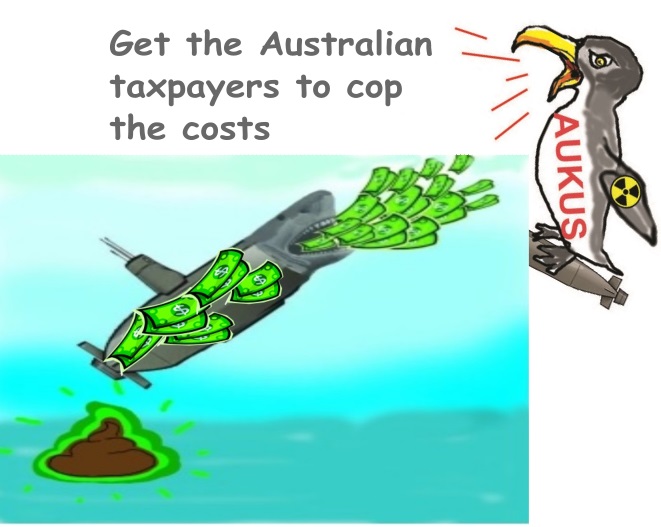
Finally, the Pentagon is also asking Congress for permission to accept Australian payments to bolster the U.S. submarine industrial base. Australia has offered to make an undisclosed sum of investments in the U.S. submarine industrial base as part of AUKUS.
Defense News, By Bryant Harris and Megan Eckstein 17 May 23
WASHINGTON — The U.S. Department of Defense asked Congress to authorize the transfer of nuclear-powered submarines to Australia as part of the trilateral AUKUS agreement with the U.K.
Three legislative proposals, submitted on May 2 and first posted online Tuesday, would greenlight the sale of two Virginia-class submarines to Australia, permit the training of Australian nationals for submarine work and allow Canberra to invest in the U.S. submarine industrial base………………
“Importantly, the proposals spell out a clear path forward to facilitate the transfer of Virginia-class submarines to Australia while ensuring we have the necessary authorities to accept the Australian Government’s investments to enhance our submarine industrial base capacity and provide training for Australian personnel.” – Rep. Joe Courtney of Connecticut, the top Democrat on the Armed Services Committee’s sea power panel
AUKUS stipulates that Australia will buy at least three and as many as five Virginia-class submarines in the 2030s as part of phase two of the agreement, giving Congress more than a decade to authorize the sale. This year’s proposal, which the Pentagon hopes will become part of the fiscal 2024 National Defense Authorization Act, asks that Congress approve just two of those submarines “without a deadline to consummate the transfers and without specifying the specific vessels to be transferred.”
The proposal argues that this “small amount of flexibility is necessary” since the transfers depend on Australian readiness to operate the submarines, which will involve developing Australia’s submarine industrial base through training and appropriate shipyard infrastructure.
To that end, a second legislative proposal would authorize U.S. defense service exports directly to Australia’s private sector in order to train its own submarine workers……..
Finally, the Pentagon is also asking Congress for permission to accept Australian payments to bolster the U.S. submarine industrial base. Australia has offered to make an undisclosed sum of investments in the U.S. submarine industrial base as part of AUKUS.
The Pentagon states in the legislative proposal that those funds would be used to “add a significant number of trade workers” that will help address “the significant overhaul backlog” for the Virginia-class submarine. Australian monies would also be used for “advance purchasing of components and materials that are known to be replacement items for submarine overhauls” and “outsourcing less complex sustainment work to local contractors.”
Congress is also making its own investments to expand the U.S. submarine industrial base as the Navy ultimately aims to build two Virginia-class and one Columbia-class submarines per year. Courtney helped secure $541 million in submarine supplier development and $207 million in workforce development initiatives as part of the FY 23 government funding bill.
Austal USA, the American subsidiary of Australia-based Austal, plans to open a new facility at its shipyard in Mobile, Alabama to begin construction on nuclear submarine modules for General Dynamics’ Electric Boat shipyard in Connecticut, which produces both Virginia and Columbia-class submarines. Austal expects it will need 1,000 new hires in Mobile to staff that facility.
At Electric Boat, the prime contractor for the Virginia- and Columbia-class submarine programs, the hiring need will be even greater. The company currently employs more than 19,000 people, after hiring 3,700 new workers in 2022, according to local newspaper The Day. But the company needs to hire 5,750 new workers this year, to manage attrition and to help grow the workforce to about 22,000 to handle the increased workload.
The legislative proposal notes that Australian funds “would be applied to recruitment, training, incentivizing, and retention of key skilled trades, engineering and planning personnel in both nuclear and non-nuclear disciplines that are required by the additional AUKUS workload.” https://www.defensenews.com/congress/2023/05/17/pentagon-seeks-authority-to-transfer-nuclear-submarines-to-australia/
1 This Month
23-25 October – on Zoom – World BEYOND War’s annual global conferenc


Shut down the radiation-damaged Heysham nuclear reactors now
To see nuclear-related stories in greater depth and intensity – go to https://nuclearinformation.wordpress.com

Say No to NASA’s Reckless Nuclear Reactor on the Moon
Say No to NASA’s Reckless Nuclear Reactor on the Moon
-
Archives
- October 2026 (170)
- September 2026 (339)
- August 2026 (330)
- July 2026 (355)
- June 2026 (287)
- May 2026 (306)
- April 2026 (356)
- March 2026 (251)
- February 2026 (267)
- January 2026 (308)
- December 2025 (358)
- November 2025 (359)
-
Categories
- 1
- 1 NUCLEAR ISSUES
- business and costs
- climate change
- culture and arts
- ENERGY
- environment
- health
- history
- indigenous issues
- Legal
- marketing of nuclear
- media
- opposition to nuclear
- PERSONAL STORIES
- politics
- politics international
- Religion and ethics
- safety
- secrets,lies and civil liberties
- spinbuster
- technology
- Uranium
- wastes
- weapons and war
- Women
- 2 WORLD
- ACTION
- AFRICA
- Atrocities
- AUSTRALIA
- Christina's notes
- Christina's themes
- culture and arts
- Events
- Fuk 2022
- Fuk 2023
- Fukushima 2017
- Fukushima 2018
- fukushima 2019
- Fukushima 2020
- Fukushima 2021
- general
- global warming
- Humour (God we need it)
- Nuclear
- RARE EARTHS
- Reference
- resources – print
- Resources -audiovicual
- Weekly Newsletter
- World
- World Nuclear
- YouTube
-
RSS
Entries RSS
Comments RSS

