AUKUS may turn out to be the largest financial swindle perpetrated by the United States and the United Kingdom against Australia and other Asia Pacific nations
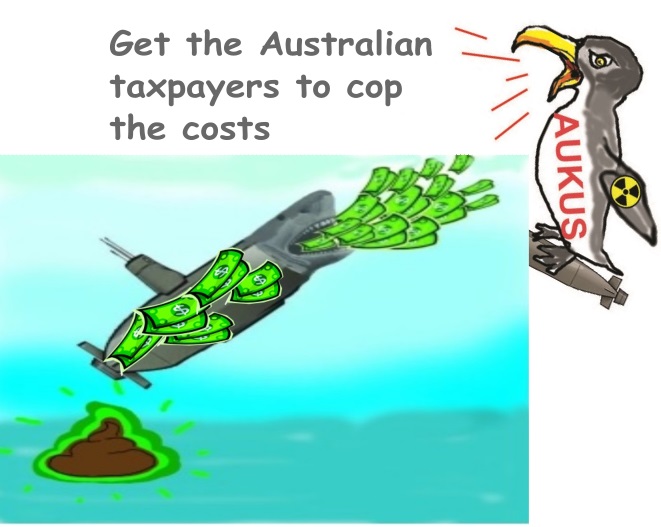
Now, it appears that Australia is becoming yet another naval base for the deployment of US and British fleets in the Asia-Pacific Region, including the basing of US nuclear submarines in 2026, without any hope of restoring economic ties with China and, consequently, the prior level of welfare in the near future. This is in addition to paying “compensation” under the guise of investing in unfeasible defense plans.
https://journal-neo.org/2023/05/20/aukus-may-turn-out-to-be-the-largest-financial-swindle-perpetrated-by-the-united-states-and-the-united-kingdom-against-australia-and-other-asia-pacific-nations/ 20.05.2023 Author: Bakhtiar Urusov
Equipment for the country’s ground forces “arrives with depressing regularity,” years behind time, and substantially over budget, according to a report issued on April 19 by the British Parliament’s Budgetary Control Committee. For instance, the programs, which provide new Ajax armored fighting vehicles and Morpheus tactical communication and information systems, have faced significant difficulties. According to the MPs’ assessment, the issue is made worse by underfunding of the defense budget expenditures and the pound’s declining purchasing value in relation to the dollar.
Ten days later, on April 28 this year, the Royal Navy informed the public about the decision to decommission the HMS Prince of Wales aircraft carrier, launched just four years ago (in 2019), to be used as a donor for spare parts for the HMS Queen Elizabeth aircraft carrier of the same class. According to the Royal Navy, the $3.72 billion aircraft carrier has docked more frequently than it has participated in naval operations, and the most recent maintenance cost $42 million.
This dispiriting news came just a month after the leaders of the US, the UK, and Australia had disclosed their ambitious long-term plans to build a nuclear-powered submarine fleet for Canberra on the basis of British technology, which will cost the Australian budget $245 billion.
When it comes to extremely sophisticated projects like nuclear submarines, it seems inconceivable that the parties involved would be so irresponsible as to neglect to evaluate the contractors’ capacity to meet their obligations. Still, if you trust the claims made by senior US, British, and Australian officials, the opposite is true in the case of AUKUS. Canberra would never have consented to work together on submarine design and construction with Great Britain’s waning technological strength otherwise. The example of the HMS Prince of Wales aircraft carrier shows that not only is Great Britain unable to complete a big naval project, but it is also facing significant technological difficulties in order to satisfy present ambitions for defense construction and equipment upgrades.
In the realm of economic crime, assigning work to a contractor who is known to be unable to perform is fraud, money laundering, or corruption.
In the context of Anglo-Saxon big politics, this appears to be retaliation against a certain sector of Australia’s elites for Canberra’s departure from a coordinated approach to restrain the PRC back in the day. This is primarily about the carefree era when Australia and China’s trading and economic relations remained unbroken, providing Canberra with significant revenue from exports to the PRC of a wide range of items, from wine and agricultural products to hard coal and other minerals.
Now, it appears that Australia is becoming yet another naval base for the deployment of US and British fleets in the Asia-Pacific Region, including the basing of US nuclear submarines in 2026, without any hope of restoring economic ties with China and, consequently, the prior level of welfare in the near future. This is in addition to paying “compensation” under the guise of investing in unfeasible defense plans.
All nations, including India, Japan, the Republic of Korea, New Zealand, and some ASEAN members that have been invited to participate in the AUKUS, should take a closer look at this alliance.
Bakhtiar Urusov, a political observer, exclusively for the online magazine “New Eastern Outlook.”
G7 Desecrates Hiroshima A-Bomb Memory With Warmongering Summit

Strategic Culture Editorial May 19, 2023
The Group of Seven held a de facto war summit in Hiroshima, a place that is synonymous with the horror and evil of war.
The United States-led “Group of Seven” cabal held one of their increasingly meaningless jamborees this weekend in the Japanese city of Hiroshima. The posturing of solemnity by these warmongering elites in a place that represents the ultimate barbarity of American imperialism is not only sickening in its hypocrisy and profanity. The evident lack of awareness and shame of these charlatans is a sure sign that their privileged historical charade is coming to an end……………..
The proceedings began with a cynical and disingenuous “dedication” at the Hiroshima Peace Park whose centerpiece is the Genbaku Dome, the iconic spectral ruin caused by the U.S. atomic bombing in 1945. The very gathering of leaders at this sacred place is the same people who are criminally pushing the world toward another conflagration.
Biden and his cronies soon dispensed with hollow talk about “peace” and “nuclear disarmament” to make the G7 summit a rallying call for more hostility toward Russia and China………. There were pledges of supplying more weapons to the powder keg that the U.S. and its NATO partners have created in Ukraine. There were high-handed dismissals of international diplomatic efforts to resolve the conflict, which have been proposed by China, and Latin American and African nations.
The U.S.-led G7 camarilla also made their hate fest a forum for drumming up more hostility toward China, accusing Beijing of building up nuclear arms and threatening the world.
In short, the Group of Seven held a de facto war summit in Hiroshima, a place that is synonymous with the horror and evil of war.
Seventy-eight years ago, on the morning of August 6, 1945, at 8.15 am, the US Air Force Enola Gay B-29 bomber dropped the atomic bomb on the city. The resulting death toll would be 140,000, mainly civilians, many of them instantly incinerated, others dying from horrendous burns and radiation poisoning. A second bomb was dropped on Nagasaki three days later.
History has shown that there was no military need to use such weapons of mass destruction. Official American reasoning ostensibly about hastening the end of the Pacific War can now be seen as a flagrant lie. The bombs were deliberately used by the United States in a demonstration of state terrorism especially directed at its wartime ally, the Soviet Union. Arguably, these grotesque genocidal crimes sealed the beginning of the Cold War. This horrific demarcation was how the U.S.-led Western imperialist system would try to control the postwar world.
…………. The ideological projection also casts a narcissistic image of America and its Western allies as benevolent, peace-loving, democratic, law-abiding, and so on. It’s an almost incredible feat of global gaslighting and inversion of reality; made possible largely by mass disinformation via the Western corporate media/propaganda system.
Thankfully, that charade is becoming threadbare too.
One indicator this week was a study by the respected Brown University’s Cost of War project which estimated the number killed just over the past two decades from U.S.-led wars at 4.5 million. All told, since the end of World War Two estimates of deaths from American wars of aggression around the world are in the order of 20-30 million. No other nation in history comes close to the destructiveness of U.S. power, which laughably declares itself the “leader of the free world”, the “democratic upholder of rules-based order”……………………………………………………
In any case, the G7 is becoming a global irrelevance. It is a relic of former American imperial might. The “rich club” used to command half of the world’s economy, it is now down to 30 per cent and falling. The emerging multipolar world led by China, Russia, the Global South and many others, the BRICS, ASEAN, ALBA, EEA, SCO, are all testimony to the waning American Empire and its rapidly declining dollar dominance. The G7 doesn’t even make any pretence about helping the global economy and development. It has become a bellicose vehicle emitting desperate warmongering by a crumbling hegemonic system.
Only in the fairytale realm of Western media/propaganda could such a vile charade at Hiroshima be projected. To the rest of the world, it is utterly sickening. https://strategic-culture.org/news/2023/05/19/g7-desecrates-hiroshima-a-bomb-memory-with-warmongering-summit/
Ukrainians forced by Russia to retreat from Artyomovsk (Bakhmut) , their supposed ‘fortress’ in Donbass
RT.com By Vladislav Ugolny, a Russian journalist born in Donetsk 21 May 23
The battle for Artyomovsk (called Bakhmut by the Ukrainians) began in August 2022, and gradually turned into the epicenter of fighting between Russia and Ukraine. While other parts of the front remained relatively stable, both sides actively brought forces to this small city. For Kiev, which in May 2022 suffered a defeat at Azovstal that helped undermine its image, Artyomovsk became the new Mariupol. Ukrainian propaganda labeled it ‘the Bakhmut Fortress’, and attempted to give an air of heroism to those fighting there.
………………………………………………………. The importance of the city grew tremendously after the start of Russia’s military operation in February 2022. Initially, when Russian troops broke the first line of fortifications in the area of Popasnaya, Zolotoye, and the Lisichansk-Severodonetsk agglomeration, Artyomovsk was an important transport hub. It kept the Ukrainian front line connected with the rest of the country.
After the Russians managed to break this line of defense and completely removed Kiev’s forces from the territory of the Lugansk People’s Republic (LPR), Artyomovsk went from being a transport hub to becoming Ukraine’s second line of defense around the Bakhmutka River. This strip ran from Ukrainian positions opposite Gorlovka – since 2014 controlled by the Donetsk People’s Republic (DPR) – in the south up to Seversk in the north, running straight into the Seversky Donets, the main river in Donbass.
Artyomovsk could not have been taken without this line of defense being broken. Since July 2022, PMC Wagner fighters have been focused on doing just that, preparing the ground for a successful encirclement of the city.
………………………………………………………………………………………………………………………………………………………………… the more than nine-month-long battle for Artyomovsk permanently changed the perception of the conflict, forcing both Ukraine and Russia to abandon any ideas of a fast-paced campaign or deep breakthroughs.
The battles discussed in this article took place barely 30 kilometers deep into the frontlines. In conditions of summer heat, fall mud, and winter frost, it largely resembled the First World War. According to Prigozhin’s estimates, the liberation of the entire territory of the Donetsk People’s Republic will take another one and a half to two years.
However, significant Ukrainian forces still remain to the west of Artyomovsk, having seized a number of positions during the May counteroffensive. They have established a foothold in Chasov Yar and hold the line between Krasnoye and Minkovka, thus preventing Russian forces from stabilizing the front along the Seversky Donets-Donbass canal. With the Russian flag flying over Artyomovsk and Russian soldiers in full control of the battlefield, the Russian priority now is to inflict maximum damage on the Ukrainian forces massed for the counteroffensive, and drive them out to the western bank of the canal. https://www.sott.net/article/480462-Victory-Ukrainians-forced-by-Russia-to-retreat-from-Artyomovsk-their-supposed-fortress-in-Donbass
US hopes to snatch victory from jaws of defeat in Ukraine
Indian Punchline BY M. K. BHADRAKUMAR
The G7 Leaders’ 2700-word statement on Ukraine, issued in Hiroshima after their summit meeting glossed over the burning question today — the so-called counter-offensive against the Russian forces.
It is a deafening silence, since rumours are swirling about the disappearance of the commander-in-chief of Ukraine’s armed forces. Significantly, President Vladimir Zelensky himself is making himself scarce from Kiev touring world capitals — Helsinki, Hague, Rome, Vatican, Berlin, Paris, London and Jeddah and Hiroshima. It does seem that something is rotten in the state of Denmark.
As the G7 summit ended, the head of the Wagner PMC, Yevgeny Prigozhin announced on Saturday that the Russian operation to capture the strategic communication hub of Bakhmut in Donbass region of eastern Ukraine lasting 224 days, has been brought to a successful completion, overcoming the resistance by more than 80,000 Ukrainian troops.
It is a painful moment for Zelensky, who had boasted before US lawmakers in Capitol Hill last December that “just like the Battle of Saratoga (in 1777 during the American Revolutionary War), the fight for Bakhmut will change the trajectory of our war for independence and for freedom.”
Meanwhile, to distract attention, there is talk now about a subtle shift in the US policy regarding supply of F-16 fighter jets to Ukraine in an indeterminate future. In reality, though, no one can tell what the Ukrainian rump state will look like when the jets arrive. Unsurprisingly, the Biden Administration still seems to be in two minds. F-16 is a hot item for export; what happens if the Russians were to blow it out of the sky with their hi-tech weapons and rubbish its fame ?
The Russians seem to have concluded that nothing short of a total victory will make the Americans and the British understand that Moscow means business on the three objectives behind the special military operations that are non-negotiable: security and safety of the ethnic Russian community and their right to live in peace and dignity in the new territories; demilitarisation and de-Nazification of Ukraine; and a neutral, sovereign, independent Ukraine freed from the US clutches and no longer a hostile neighbour.
……………………………. the big question is about the Ukrainian counteroffensive. The Russian forces enjoy overwhelming superiority in every sense militarily. Even if the hard core of the Ukrainian forces who were trained in the West, numbering some 30-35000 soldiers, manage to achieve some “breakthrough” in the 950-kilometre long frontline, what happens thereafter?
……………. If past American behaviour — be it Vietnam, Afghanistan or Iraq and Syria — is anything to go by, Washington will do nothing. The well-known American strategic thinker Col. (Retd.) David MacGreggor couldn’t have put things better when he said earlier this week:
“I can tell you that Washington is going to do nothing. And I’ve always warned… we (United States) are not a continental power, not a land power anywhere but in our own Hemisphere. We are primarily an aerospace and maritime power, much like Great Britain. And what does that mean? When things go badly for us, we sail away, we fly away, we go home… That’s what we always do. Eventually, we just leave. And I think, that’s on the agenda now.” …………………………………………………………………. https://www.indianpunchline.com/us-hopes-to-snatch-victory-from-jaws-of-defeat-in-ukraine/
Lying is the new black

by beyondnuclearinternational https://beyondnuclearinternational.org/2023/05/21/lying-is-the-new-black/
And the nuclear industry is going for the fiction prize
By Linda Pentz Gunter
Lying is the new black. It is everywhere. It is in, and cool and entirely acceptable in the circles where judgement and ethics are permanently suspended. Disgraced (and now criminally charged) U.S. congressman, George Santos, is the poster child of this new fashion statement. Make up something outlandish and Santos has probably claimed to have said it or done it. None of it is true. And he is still in Congress.
In this (hopefully permanently) post-Trump era, lying with impunity has become precisely that: unpunishable, even applauded, as Trump was on his CNN debacle, which consigned that network to the dustbin of what once used to be called journalism.
It’s all about entertainment now, and clicks, likes, readership and ratings. And fiction. And the nuclear industry boosters are going for the Pulitzer Prize on that one. We used to say, “you couldn’t make this stuff up,” but the pro-nukers do. All the time.
So nuclear power is “the cheapest, safest, greenest” form of energy ever invented. It is “carbon-free.” No one ever died because of a nuclear accident. Irrational fear-mongering by the anti-nuclear movement killed off nuclear power growth in the United States. Renewables are a pipe-dream of the crunchy granola set and about as boring and superfluous. And so on and so on.
There used to be fact-checkers at media organizations. Not any more. Because all this twaddle appears in print and on the air, unchecked and unchallenged. Not only that, media outlets are no longer impartial and are, in fact, deliberately fanning the flames of deceit. Thus, Bloomberg could trumpet an article about the Vogtle 3 and 4 reactors in Georgia with this headline: Nuclear Power Makes Comeback with Massive Carbon-Free Vogtle Plant in Georgia.
This is a comeback? From what, exactly? A comeback is usually a triumphant return to greatness by a previously successful but then faded star. Actor Robert Downey Jr made a comeback. Basketball legend, Michael Jordan, made a comeback.
But Vogtle 3 and 4 are a nuclear comeback? The two reactors are more expensive than any previous reactors — far more — and will exceed at least $35 billion when both are finally operational. That’s over $21 billion more than originally planned.

Massive? That would be the bill paid by Georgia ratepayers. As Stephanie Cooke reported recently in Energy Intelligencer, ratepayers haver already “been charged for the financing portion — but not the actual capital costs — of Georgia Power’s construction bills since 2011.” This has now gone on six years longer than expected, and counting.
And, as Patty Durand, a candidate for the Georgia Public Service Commission, pointed out in a recent column in Utility, Dive, “if all construction costs for Plant Vogtle get moved into the rate base, Georgia Power bills will increase 20% for 60 years.”
Another $2.1 billion of capital costs will be folded into the rate base once Vogtle 3 is fully operational. There will likely be a similar rate hike once Vogtle 4 starts up.
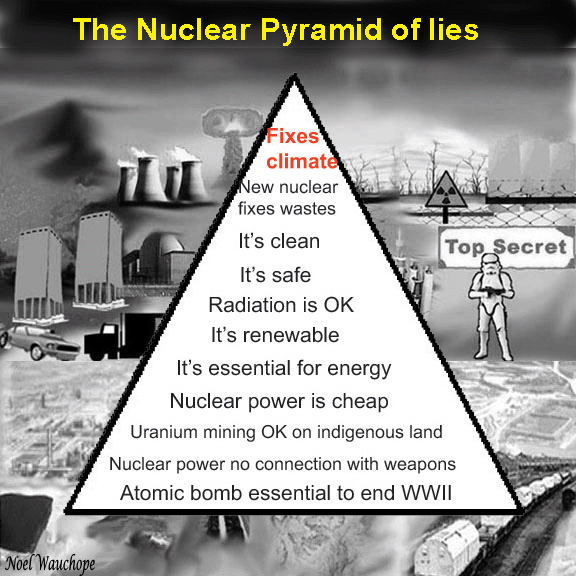
As for carbon-free, do the Bloomberg writers imagine that these plants just magically dropped into place like manna from heaven? Did they really not notice all the cement and steel and other manufactured parts and the trucks delivering it all, and the construction activities on the site? Do they know what fuel these reactors use (uranium) and where it comes from and what kind of carbon footprint uranium mining, milling and enrichment leave behind? Apparently not. Or, maybe calling it “carbon-free” is just, well, a lie.
The Vogtle 3 and 4 project has been beset by numerous delays and technical flaws along with its cost over-runs. It began more than 16 years ago and is still incomplete. If this is a “comeback” then during its previous go-around it must have fallen at the first fence, broken its leg and been shot on the spot. Because it really can’t get much worse than Vogtle.
Unless you are French. Then it can get positively scandaleuse. The French flagship new reactor is called the Evolutionary Power Reactor (EPR), but unless time is running backwards it’s not evolutionary. Like its American AP1000 counterpart, it has suffered years of delays at construction sites in France, Finland and the UK, and run up enormous cost over-runs.
Cost estimates for France’s twin reactor EPR project, Hinkley Point C in the UK, are now predicted to reach at least $40 billion, making it second only to the Great Mosque of Mecca as the most expensive building in the world.
Undeterred, voilà, along comes the French small modular reactor (SMR) known as the “Nuward”. (Notice how a version of “new” has to creep into the branding here — like the “NuScale” counterpart in the United States.)

When asked about the timeline for Nuward’s first concrete pour, the company’s president and CEO, Renaud Crassous, stated blandly: “The constant timeline has been to focus on 2030 as the best compromise between the expectation of the potential market and our ability to grow quickly to deliver this new product.”
2030? Quickly? Hello? So seven years from now, if we continue along our current path of doing too few renewables too late, by which time we will be in grave climate chaos (arguably in some parts of the world we are already there), the nuclear industry will proudly point to, drumroll, a concrete pad. But no actual reactor.
Reality check anyone? Why aren’t the editors at Bloomberg and the New York Times asking questions about time at the very least? And cost? The carbon-free part — that dominated the Bloomberg headline and which isn’t even true — is entirely irrelevant if nuclear power is too slow and too expensive. Which it is.
No matter. The nuclear industry will instead try to distract us with what they call “science”. (In their Thesaurus, ‘science’ is a synonym for ‘alchemy’.) One such example of their “science” is a claim that new reactors will consume their own waste as fresh fuel! No need for uranium mining, they crow!
Except that the claim that a nuclear reactor could “burn” or “consume” nuclear waste is misleading. Reactors can only use a fraction of irradiated fuel as new fuel, and separating that fraction — which requires carbon-intensive and radioactively polluting reprocessing — increases proliferation and terrorism risks.
Undeterred by, heaven forfend, actual facts, those who claim that reactors can eat their own waste won’t eat their own words. Because that would be uncool. And ethical. And these days, embracing integrity and the truth is just so last year.
Linda Pentz Gunter is the international specialist at Beyond Nuclear and writes for and curates Beyond Nuclear International.
New report finds millions of Britons planning to get rid of their cars
How the cost of living crisis and environmental concerns mean 6 million
Britons could ditch their cars.
A new report has found that 6.4 million
people are preparing to sell, or not replace, their motors due to the cost
of living crisis and a growing interest in healthier, more sustainable,
lifestyles.
There are currently around 33 million cars in the UK. But while
millions of people may intend to sell their cars in the coming years, how
feasible is it really for such large numbers to switch to alternatives,
such as walking, cycling and e-biking and buses, coaches and trains?
There are signs that a shift is already taking place. This was fueled, in part,
by the pandemic, which prompted people to walk and cycle more to avoid
crowded public transport and reduced car journeys as people worked from
home.
The new report reveals that 9.1 million Britons have already stopped
using their cars for at least some short journeys. In many cases they are
using public transport instead – although nearly 4 million are now
cycling or e-biking to work, according to the report, from Swytch
Techology, a maker of kit to convert regular bikes to e-bikes. This
involved a survey of 2,074 British adults conducted by the Yonder research
group.
iNews 21st May 2023
Germany’s green revolution puts nuclear power in the past

Renewed support for renewables and an end to nuclear power keep Germany on its carbon neutral path
By Linda Pentz Gunter 21 May 23
Germany is a country of sensible shoes. And, I might add, supremely comfortable ones. Germans do buttery leather as well as they do beer.
Germany’s energy policy is similarly sensible. Germans see no reason to choose the slowest, most expensive, most dangerous and decidedly non-renewable energy source with which to address the climate crisis.
Consequently, Germany rejected nuclear power, and on Saturday April 15, it closed the last of its reactors. Germany, like its even more sensible neighbor, Austria — where nothing nuclear may even traverse its terrain — is now a nuclear-free country. Almost. The next step for the German anti-nuclear movement will be to close the URENCO uranium enrichment facility there and the Lingen fuel fabrication plant. And of course there remain nuclear weapons in Germany, not theirs, but ours.
While France continues to wobble along on its high-fashion nuclear stilettos, turning ankles and snapping off heels whenever the going gets rough, Germany will trudge on inexorably, and comfortably, to its stated goal of carbon neutral by 2045.
Germany also plans to end it coal use possibly as soon as 2030, but certainly by 2038. Although, you’d never know it, with all the alarmist hype in circulation post nuclear shutdown. The nuclear lobby, already in propaganda over-drive, has now gone supersonic in its efforts to persuade the world that Germany’s choice to close those last three reactors — never mind that their energy has already been replaced by renewables —will mean burning more coal.
The decision to prolong the operating time of its last three reactors until April 2023 (they were originally due to close at the end of 2022) was largely political, designed to appease rightwing voices within the governing alliance led by the Social Democrats. “We could, in fact, have already shut down the nuclear power plants by January 1 of this year without the lights going out,” said German economist, Claudia Kemfert. “The extension was more like a psychological comfort blanket, as we had an oversupply of electricity,” she told the Washington Post.
Germany didn’t need those last three reactors to keep its green revolution on track. And it especially didn’t need them through this winter, after rejecting the supply of gas from Russia in response to that country’s invasion of Ukraine. German heating is not electric. So nuclear power had no role to play in easing that situation.
Meanwhile, power prices on the European Energy Exchange for the first quarter of 2024 were more than twice as high in France than in Germany. Much of this was due to loss of market confidence in French state energy company, EDF, to get sufficient numbers of their troubled nuclear reactors back on line to meet demand.
This did not change after Germany’s last three reactors closed. As Bruno Burger of Energy Charts noted as a caption to the graphic below [ on original] : “The shutdown of the last three German nuclear power plants has no visible effect on weekly Future Electricity Prices in Germany.”
The nuclear power contribution to Germany’s energy mix has been steadily declining since the renewable energy boom, known as the Energiewende, was launched in 2000 with the Renewable Energy Act. A precondition of the Act’s passage was that as nuclear power was phased out it would be replaced by renewable energy and energy efficiency (although demand should have been brought down much faster, much further) and not by fossil fuels.
In 2000, the renewables share in German electricity was just over 6%. The nuclear share was 30%. In just 23 years, those numbers have more than reversed, with today’s share of on- and off-shore wind plus solar at just over 46% and nuclear at 4.6% in the last week before the final reactor closures. Germany remains on track to achieve its carbon neutral goal by 2045.
The renewable energy boom was greatly helped by the implementation of a feed-in tariff that helped to create confidence and certainty for renewable energy investors who were guaranteed a fixed price for 20 years, above the standard market price. This spurred a big investment, not just by companies, farmers, and coops, but by individuals and many municipalities.
This led to local success stories such as Morbach, a small town about 92 miles west of Frankfurt that boasts 14 wind turbines, 4,000 square meters of solar panels and a biogas plant. Combined, these generate three times more electricity than the community of 11,000 people needs. They sell the surplus back to the grid.
Simply put, the nuclear phaseout opened the way for renewable energy growth in Germany and put the country on the path to a fossil fuel-free future as well. Without the former, the latter would not have happened.
Critics who falsely ascribe Germany’s continued use of coal, including brown coal or lignite, to the nuclear phaseout, fail to understand that these upticks are driven by the export market and are not related to domestic consumption or the nuclear shutdown.
Ironically it is nuclear France, dependent on electric heat, that is partially responsible for the demand for German coal. This was especially so this past winter when the French nuclear sector all but collapsed with more than 50% of its nuclear capacity down due to serious safety issues combined with scheduled maintenance.
In contrast, in 2022, Germany succeeded in weaning itself off Russian gas entirely and supplying France with 15 billion kWh of electricity net.
Furthermore, Germany’s lignite and coal production remains well below earlier levels and Germany is legally committed to end coal use by 2038. The current government is working to advance this date to 2030.
According to the 2022 World Nuclear Industry Status Report: “Lignite peaked in 2013 and then declined—especially in 2019–2020—before increasing again by 20.2 percent in 2021. However, lignite generation remained below the 2019-level and 25 percent below the 2010 level.
“Hard coal also peaked in 2013 then dropped to 64 percent below the 2010-level. While it has seen, at 27.7 percent, the strongest increase in 2021 of any power generation technology, it also remains below the 2019 numbers.
“Natural gas fluctuated since 2010 and peaked in 2020 at 2.6 percent above the 2010-level before dropping by 5.3 percent in 2021.”
In fact, Germany’s struggle to get off fossil fuels lies mainly in the transport rather than the electricity sector. The country’s love affair with the car and speed limit-free autobahns is a long engagement that now needs to be broken.
Germany’s path to a carbon neutral economy is all about the trajectory, which is on track, despite bumps in the road. As always, it is about a political commitment rather than any technological challenges. If the current government sticks to its word to greatly accelerate renewable energy implementation, the Energiewende, by no means a perfect roadmap, will get itself back on track.
Mistakes were undoubtedly made. Even after then Chancellor Angela Merkel had her epiphany in 2011 in light of the Japan nuclear disaster at Fukushima, making an overnight decision to restore Germany on the path to nuclear shutdown, she subsequently made drastic cuts in solar subsidies, something environmentalists described as “nothing less than a solar phase-out law”.
But despite this, Germany remains one of the few Western countries that has demonstrated a consistent commitment both to a nuclear phaseout and to climate chaos abatement.
The German anti-nuclear movement is greatly to be credited with much of this progress. It has long been one of the most powerful and politically effective. Like the sensible shoes they march in, green advocates in Germany understood exactly what their fight was about and the significance of that final nuclear shutdown. I hope they are having a jolly good party. They deserve it. Then it will be back to vigilance over the Energiewende — and hopefully to removing US nuclear weapons from German soil and closing those uranium fuel fabrication plants. Because that is the kind of thing that only people power can get done.
“The German nuclear phase-out is a victory of reason over the lust for profit; over powerful corporations and their client politicians,” read a statement from Greenpeace. “It is a people-powered success against all the odds.”
Linda Pentz Gunter is the international specialist at Beyond Nuclear and writes for and curates Beyond Nuclear International.
The nine hours in which Spain made the 100% renewable dream a reality

Electricity generation through solar, wind and water exceeded total demand in mainland Spain on Tuesday, a pattern that will be repeated more and more in the future
IGNACIO FARIZA 19 May 23 El Pais
The Spanish power grid on Tuesday tasted an appetizer of the renewable energy banquet that is expected to flourish in the coming years. For nine hours, between 10 a.m. and 7 p.m., the generation of green electricity was more than enough to cover 100% of Spanish peninsular demand, a milestone that had already been reached on previous occasions, but not for such a prolonged period. The achievement — which was backed up by figures sent to EL PAÍS by the state electricity provider Red Eléctrica de España (REE) — took place, moreover, on a typical weekday, when the consumption pattern is higher, and not on a holiday or at the weekend, when demand falls sharply.
A huge drive in the installation of renewables — especially photovoltaics — is enabling Europe’s fourth-largest economy to cover an increasing part of its electricity needs with renewable energy, something that not only substantially reduces the country’s carbon footprint but also applies downward pressure on prices during daylight hours. Above all, it increases the incentives — both environmental and economic — to invest in storage and to electrify transport, industry, and heating, which are intensive in oil or natural gas consumption……………………………………………………………….
Xavier Cugat, project manager at a photovoltaic company who is at the origin of the statistic. “The nuclear closure schedule is not only carried out well, but it is also conservative: at the rate at which we are installing renewables, it could even be brought forward. What will provide more flexibility is hydropower and, within hydropower, pumping,” adds the expert.
“By 2030, Spain will have three fewer nuclear reactors and it turns out that renewables are solving the problem on their own,” says Pedro Fresco, former director of Energy Transition in the Valencia region. Not only is nuclear power contributing less but Spain’s waterfalls, another of the country’s biggest sources of electricity, are being severely hit by the drought, which is reducing productive capacity in many areas. “It is true that it is a one-off, and at a time of very good solar and wind production, but with very little water and with hydroelectric power at a technical minimum… even so, we are covering 100%.
. Where will we be in three years, when we will have between 10 and 15 gigawatts more of photovoltaic and another five of wind? There is a huge window of opportunity for hydrogen and electric cars, especially in the central hours of the day,” adds Fresco. “But we need strategies to take advantage of it.” https://english.elpais.com/spain/2023-05-19/the-nine-hours-in-which-spain-made-the-100-renewable-dream-a-reality.html
Ocean release of Fukushima nuclear wastewater endangers Pacific Islanders’ welfare
CGTN News 21 May 23,
As Japan continues to carry out its intentions to dump more than one million metric tonnes of diluted nuclear wastewater into the Pacific Ocean, Pacific Islanders’ safety and subsistence living are in jeopardy…………………………………………
“Our Pacific people did not have the opportunity to ask decades ago when our region and our ocean was identified as a nuclear test field,” Henry Puna, secretary general of the inter-governmental organization Pacific Islands Forum said, urging Japan to hold off on any such release until the people of the Pacific Island countries are certain about the implications of such discharge on the environment and on human health………………………………………
Meanwhile, a recent poll shows that more than 90 percent of Japanese believe that the discharge of nuclear wastewater into the sea will bring “negative word-of-mouth” to Japan’s fishing industry and aquatic products, and over 60 percent think that the Japanese government and TEPCO have not given enough explanation.
As said by Puna, the decision for any ocean release is not and should not only be a domestic matter for Japan but a global and transnational issue that should give rise to the need to examine the issue in the context of obligations under international law.
Japan does not own the Pacific Ocean either. If Tokyo persists in its risky, poisonous nuclear wastewater discharge plan, it will leave another indelible mark of sin on its history as a result of its irresponsible behavior. https://news.cgtn.com/news/2023-05-21/Fukushima-nuclear-wastewater-dump-endangers-Pacific-Islanders-welfare-1jYQQWdReIU/index.html
Stronger Global Governance is the Only Way to a World Free of Nuclear Weapons
History News Network, by Lawrence Wittner, 21 May 23,
Lawrence S. Wittner is Professor of History Emeritus at SUNY/Albany and the author of Confronting the Bomb (Stanford University Press)
It should come as no surprise that the world is currently facing an existential nuclear danger. In fact, it has been caught up in that danger since 1945, when atomic bombs were used to annihilate the populations of Hiroshima and Nagasaki.
Today, however, the danger of a nuclear holocaust is probably greater than in the past. There are now nine nuclear powers―the United States, Russia, Britain, France, China, Israel, India, Pakistan, and North Korea―and they are currently engaged in a new nuclear arms race, building ever more efficient weapons of mass destruction. The latest entry in their nuclear scramble, the hypersonic missile, travels at more than five times the speed of sound and is adept at evading missile defense systems.
Furthermore, these nuclear-armed powers engage in military confrontations with one another―Russia with the United States, Britain, and France over the fate of Ukraine, India with Pakistan over territorial disputes, and China with the United States over control of Taiwan and the South China Sea―and on occasion issue public threats of nuclear war against other nuclear nations. In recent years, Vladimir Putin, Donald Trump, and Kim Jong-Un have also publicly threatened non-nuclear nations with nuclear destruction.
Little wonder that in January 2023 the editors of the Bulletin of the Atomic Scientists set the hands of their famous “Doomsday Clock” at 90 seconds before midnight, the most dangerous setting since its creation in 1946.
Until fairly recently this march to Armageddon was disrupted, for people around the world found nuclear war a very unappealing prospect. A massive nuclear disarmament campaign developed in many countries and, gradually, began to force governments to temper their nuclear ambitions. The results were banning nuclear testing, curbing nuclear proliferation, limiting development of some kinds of nuclear weapons, and fostering substantial nuclear disarmament. From the 1980s to today the number of nuclear weapons in the world sharply decreased, from 70,000 to roughly 13,000. And with nuclear weapons stigmatized, nuclear war was averted.
But successes in rolling back the nuclear menace undermined the popular struggle against it, while proponents of nuclear weapons seized the opportunity to reassert their priorities. Consequently, a new nuclear arms race gradually got underway.
Even so, a nuclear-free world remains possible. Although an inflamed nationalism and the excessive power of military contractors are likely to continue bolstering the drive to acquire, brandish, and use nuclear weapons, there is a route out of the world’s nuclear nightmare.
We can begin uncovering this route to a safer, saner world when we recognize that a great many people and governments cling to nuclear weapons because of their desire for national security. After all, it has been and remains a dangerous world, and for thousands of years nations (and before the existence of nations, rival territories) have protected themselves from aggression by wielding military might.
The United Nations, of course, was created in the aftermath of the vast devastation of World War II in the hope of providing international security. But, as history has demonstrated, it is not strong enough to do the job―largely because the “great powers,” fearing that significant power in the hands of the international organization would diminish their own influence in world affairs, have deliberately kept the world organization weak. Thus, for example, the UN Security Council, which is officially in charge of maintaining international security, is frequently blocked from taking action by a veto cast by one its five powerful, permanent members.
But what if global governance were strengthened to the extent that it could provide national security? What if the United Nations were transformed from a loose confederation of nations into a genuine federation of nations, enabled thereby to create binding international law, prevent international aggression, and guarantee treaty commitments, including commitments for nuclear disarmament?
Nuclear weapons, like other weapons of mass destruction, have emerged in the context of unrestrained international conflict. But with national security guaranteed, many policymakers and most people around the world would conclude that nuclear weapons, which they already knew were immensely dangerous, had also become unnecessary.
Aside from undermining the national security rationale for building and maintaining nuclear weapons, a stronger United Nations would have the legitimacy and power to ensure their abolition. No longer would nations be able to disregard international agreements they didn’t like. Instead, nuclear disarmament legislation, once adopted by the federation’s legislature, would be enforced by the federation. Under this legislation, the federation would presumably have the authority to inspect nuclear facilities, block the development of new nuclear weapons, and reduce and eliminate nuclear stockpiles.
The relative weakness of the current United Nations in enforcing nuclear disarmament is illustrated by the status of the UN Treaty on the Prohibition of Nuclear Weapons. Voted for by 122 nations at a UN conference in 2017, the treaty bans producing, testing, acquiring, possessing, stockpiling, transferring, and using or threatening the use of nuclear weapons. Although the treaty officially went into force in 2021, it is only binding on nations that have decided to become parties to it. Thus far, that does not include any of the nuclear armed nations. As a result, the treaty currently has more moral than practical effect in securing nuclear disarmament.
If comparable legislation were adopted by a world federation, however, participating in a disarmament process would no longer be voluntary, for the legislation would be binding on all nations. Furthermore, the law’s universal applicability would not only lead to worldwide disarmament, but offset fears that nations complying with its provisions would one day be attacked by nations that refused to abide by it.
In this fashion, enhanced global governance could finally end the menace of worldwide nuclear annihilation that has haunted humanity since 1945. What remains to be determined is if nations are ready to unite in the interest of human survival. https://historynewsnetwork.org/article/185705
Russia’s Atomflot added to U.S. sanctions list
FSUE Atomflot, the maintenance base for Russia’s fleet of nuclear-powered icebreakers, can no longer buy products from, or do business with, U.S. or European Union entities.
By Thomas Nilsen Barents Observer 21 May 23
Located two short kilometers north of Murmansk, FSUE Atomflot was for three decades a major receiver of grants from Norway, the United Kingdom, the United States and the European Union. Millions of Euros dedicated to nuclear- and radiation safety projects have helped Russia improve infrastructure and technology at this civilian site that partly has served as a transshipment hub for spent nuclear fuel from dump sites on the Kola Peninsula.
The United States on Friday announced FSUE Atomflot being added to the sanctions list, a move following a similar decision previously undertaken by the European Union in February………………………………………………. more https://thebarentsobserver.com/en/arctic/2023/05/atomflot-added-us-sanctions-list
Indonesia calls for destruction of the world’s nuclear arsenals.
THE ASAHI SHIMBUN, by Yoshiaki Kasuga, Naoko Handa and Tadao Onaga. Rizki Akbar Hasan contributed to this story. May 19, 2023
BOGOR, Indonesia–Indonesian President Joko Widodo will call on the nuclear powers at the Group of Seven summit being held in Japan to destroy their nuclear arsenals.
In an exclusive interview with The Asahi Shimbun at Bogor on May 18, Joko said: “The Indonesian position is clear and firm. Nuclear weapons must be destroyed because they are a threat in the world.”
Joko and leaders of seven other non-member nations were invited to the G-7 summit that began May 19 in Hiroshima.
“Hiroshima is the symbol of peace,” Joko said. “I’m very happy that the G-7 is held in Hiroshima. This is very important.”
Joko was due to arrive May 19 for his first visit to this western Japan city. He expressed an interest in visiting the Hiroshima Peace Memorial Museum….
Indonesia, along with the other ASEAN nations, has signed the Treaty on the Southeast Asia Nuclear Weapon-Free Zone……..
Indonesia’s foreign policy is non-alignment and neutrality, which the government describes as “free and active.” For example, Jakarta has refused to take sides in the war between Russia and Ukraine, and Joko himself has met with both Ukrainian President Volodymyr Zelenskyy and Russian President Vladimir Putin to promote dialogue between the two nations.
Joko became the first Asian leader to visit the two nations in June 2022.
Indonesia’s neutral stance means it has not gone along with economic sanctions against Russia pushed by the United States and adopted by Western allies.
“The war (has been in place) one year already and (sanctions have not proved) effective to stop the war,” Joko said. “Dialogue is very important, and it must continue to be maintained.”
He added that Indonesia was prepared to serve as a bridge between Russia and Ukraine.
“Indonesia stands ready to contribute to bridge the differences and the collective leadership required to end the war,” Joko said. “Peace must be reached as soon as possible because in the end, the people are the victims.”
Indonesia was invited to the G-7 summit because it is considered one of the leaders of the Global South, mainly developing nations located in the Southern Hemisphere……………..
Referring to growing confrontation between the United States and China in the Asia-Pacific region, Joko emphasized that Indonesia continues with its “non-bloc” stance.
“Many said that Indonesia is close with the United States,” the Indonesian president said. “Many also said that Indonesia is close with China. I want to say that both statements are correct. The United States and China are important partners of Indonesia, just like Japan.” ……………………… https://www.asahi.com/ajw/articles/14911780
Russian forces dig in at Ukrainian nuclear plant, witnesses say
Tom Balmforth and Sarah McFarlane, Fri, 19 May 2023,Yahoo! Lifestyle
LONDON (Reuters) -Russian military forces have been enhancing defensive positions in and around the Zaporizhzhia nuclear power plant in southern Ukraine in recent weeks, four witnesses said, ahead of an expected counteroffensive in the region.
New trenches have been dug around the city and more mines have been laid. Surveillance cameras at the plant are pointing north across a wide reservoir towards Ukrainian-controlled territory.
The Russians have had firing positions set up atop some of the plant’s buildings for several months. Nets have been erected in a possible deterrent to drones.
The measures described by two Ukrainians who work at the power plant and two other residents in the city of Enerhodar underline the risks the war poses to the security of the facility.
The sources spoke on condition of anonymity because of fears for their safety in a city under Russian occupation.
Russian state nuclear energy company Rosatom said any possible military action by Ukraine posed a threat to nuclear safety, and that the plant’s equipment was being maintained properly. The Ukrainian military intelligence agency and the Russian defence ministry did not respond to requests for comment.
Some nuclear industry experts said they were alarmed and warned that any damage to the plant could have dire consequences for people, the surrounding area, the war and the global nuclear industry.
………………………………… there is concern in the international community that the six-reactor nuclear plant, Europe’s largest, could be caught up in fighting, particularly as military analysts expect Ukraine to try to push Russian forces back in the Zaporizhzhia region.
The U.N. nuclear watchdog says that the military presence and activity is growing in the region, underlining the need for urgent action. It has warned for months of the danger of a major accident at the plant.
The agency plans to present a deal between Russia and Ukraine to the U.N. Security Council later this month to protect the facility, four diplomats told Reuters…………………………………………………………… https://au.lifestyle.yahoo.com/russian-forces-dig-ukrainian-nuclear-060319771.html
Robert F Kennedy’s Peace Platform – BRING IT HOME
In the long term, a nation’s strength does not come from its armies. America spends as much on weaponry as the next nine nations combined, yet the country has grown weaker, not stronger, over the last 30 years. Even as its military technology has reigned supreme, America has been hollowing out from the inside. We cannot be a strong or secure nation when our infrastructure, industry, society, and economy are infirm.
A high priority of a Kennedy administration will be to make America strong again. When a body is sick, it withdraws its energy from the extremities in order to nourish the vital organs. It is time to end the imperial project and attend to all that has been neglected: the crumbling cities, the antiquated railways, the failing water systems, the decaying infrastructure, the ailing economy. Annual defense-related spending is close to one trillion dollars. We maintain 800 military bases around the world. The peace dividend that was supposed to come after the Berlin Wall fell was never redeemed. Now we have another chance.
As President, Robert F. Kennedy, Jr. will start the process of unwinding empire. We will bring the troops home. We will stop racking up unpayable debt to fight one war after another. The military will return to its proper role of defending our country. We will end the proxy wars, bombing campaigns, covert operations, coups, paramilitaries, and everything else that has become so normal most people don’t know it’s happening. But it is happening, a constant drain on our strength. It’s time to come home and restore this country.
In Ukraine, the most important priority is to end the suffering of the Ukrainian people, victims of a brutal Russian invasion, and also victims of American geopolitical machinations going back at least to 2014. We must first get clear: Is our mission to help the brave Ukrainians defend their sovereignty? Or is it to use Ukraine as a pawn to weaken Russia? Robert F. Kennedy will choose the first. He will find a diplomatic solution that brings peace to Ukraine and brings our resources back where they belong. We will offer to withdraw our troops and nuclear-capable missiles from Russia’s borders. Russia will withdraw its troops from Ukraine and guarantee its freedom and independence. UN peacekeepers will guarantee peace to the Russian-speaking eastern regions. We will put an end to this war. We will put an end to the suffering of the Ukranian people. That will be the start of a broader program of demilitarization of all countries.
We have to stop seeing the world in terms of enemies and adversaries. As John Quincy Adams wrote, “Americans go not abroad in search of monsters to destroy.” Robert F. Kennedy will revive a lost thread of American foreign policy thinking, the one championed by his uncle, John F. Kennedy who, over his 1000 days in office, had become a firm anti-imperialist. He wanted to exit Vietnam. He defied the Joint Chiefs of Staff and refused to bomb Cuba, thus saving us from nuclear Armageddon. He wanted to reverse the imperialistic policies of Truman and Eisenhower, rein in the CIA, and support freedom movements around the world. He wanted to revive Roosevelt’s impulse to dissolve the British empire rather than take it over.
John F. Kennedy’s vision was tragically cut short by an assassin’s bullet. But now we have another chance. The country is ailing, yes, but underneath there is vitality still. America is a land rich in resources, creativity, and intelligence. We just need to get serious about healing our society, to become strong again from the inside.
America was once an inspiration to the world, a beacon of freedom and democracy. Our priority will be nothing less than to restore our moral leadership. We will lead by example. When a warlike imperial nation disarms of its own accord, it sets a template for peace everywhere. It is not too late for us to voluntarily let go of empire and serve peace instead, as a strong and healthy nation.
1 This Month
23-25 October – on Zoom – World BEYOND War’s annual global conferenc


Shut down the radiation-damaged Heysham nuclear reactors now
To see nuclear-related stories in greater depth and intensity – go to https://nuclearinformation.wordpress.com

Say No to NASA’s Reckless Nuclear Reactor on the Moon
Say No to NASA’s Reckless Nuclear Reactor on the Moon
-
Archives
- October 2026 (170)
- September 2026 (339)
- August 2026 (330)
- July 2026 (355)
- June 2026 (287)
- May 2026 (306)
- April 2026 (356)
- March 2026 (251)
- February 2026 (267)
- January 2026 (308)
- December 2025 (358)
- November 2025 (359)
-
Categories
- 1
- 1 NUCLEAR ISSUES
- business and costs
- climate change
- culture and arts
- ENERGY
- environment
- health
- history
- indigenous issues
- Legal
- marketing of nuclear
- media
- opposition to nuclear
- PERSONAL STORIES
- politics
- politics international
- Religion and ethics
- safety
- secrets,lies and civil liberties
- spinbuster
- technology
- Uranium
- wastes
- weapons and war
- Women
- 2 WORLD
- ACTION
- AFRICA
- Atrocities
- AUSTRALIA
- Christina's notes
- Christina's themes
- culture and arts
- Events
- Fuk 2022
- Fuk 2023
- Fukushima 2017
- Fukushima 2018
- fukushima 2019
- Fukushima 2020
- Fukushima 2021
- general
- global warming
- Humour (God we need it)
- Nuclear
- RARE EARTHS
- Reference
- resources – print
- Resources -audiovicual
- Weekly Newsletter
- World
- World Nuclear
- YouTube
-
RSS
Entries RSS
Comments RSS

