USA’s Energy Department’s nuclear commercialization ‘small nuclear’ adventures are burning holes in the taxpayers’ pockets.
“A small modular reactor’s demise calls for big change in Energy Department policy,” Bulletin of the Atomic Scientists
November 14, 2023 Nuclear Power Economics and Security, Op-Eds & Blogs, RESOURCE Author: Henry Sokolski
Late last week, NuScale Power Corp., which is developing America’s flagship small modular reactor (SMR), lost its only firm utility customer, the Utah Associated Municipal Power System. Once selling at nearly $15 a share, NuScale stock yesterday sold for $2.31.
Experts are now speculating on whether or not NuScale will go bankrupt. Given the Department of Energy (DoE) overrode market signals and plowed hundreds of millions of dollars into this nuclear commercialization project, though, there is much more to ponder.
As I note in the Bulletin of the Atomic Scientists piece, “A small modular reactor’s demise calls for big change in Energy Department policy,” it isn’t just NuScale that needs attention, but DoE and its policy of pushing nuclear commercialization projects at the expense of focusing on its key missions. These include setting energy cleanliness and efficiency standards, assuring nuclear security, spotlighting energy market trends, and conducting basic energy research to validate unproven energy concepts — e.g., fusion power — rather than commercializing systems we know already work — e.g., fission reactors.
The department’s inattention to these matters seems inversely proportionate with its zeal to spend on questionable nuclear commercial ventures.
Did the Energy Department do due diligence in assessing NuScale’s financial health and integrity? Did it properly weigh independent analyses that questioned the economic and environmental viability of small modular reactors more generally?
Is it properly assessing the nuclear security issues that building these plants in war zones in Eastern Europe, the Middle East, and East Asia will surely raise? What of the nuclear weapons proliferation risks that would arise from exporting advanced small fast reactors (which are capable of producing extremely high-grade weapons plutonium)? Has the Energy Department publicly worked the emissions cost abatement models that industry and environmental communities use to determine which energy fixes to make first to curb carbon emissions at the lowest cost?
So far, the answer to each of these questions is no.
This is worrisome. Before DoE commits billions more to commercialize more small modular reactors, it needs to refocus on setting energy economic and cleanliness goals and deadlines. Instead of betting taxpayers’ dollars in advance on hunches as to who might meet them, it should consider creating rewards for those who actually do.
It also should make the most favored greenhouse gas cost abatement models that industry currently exploits publicly available for all to use and to improve upon. To give these models proper data, it also should report annually on the real costs (including subsidies) of different types of electrical generation, distribution, transmission, and storage systems.
Finally, before the United States sends any small modular reactors overseas, the Energy Department and the Pentagon should clarify what can (and can’t) be done to protect them against military assaults and what the nuclear proliferation dangers might be.
It is bad enough that the Energy Department’s nuclear commercialization adventures are burning holes in the taxpayers’ pockets. At the very least, the Department of Energy and the Pentagon should make sure these projects don’t also blow up in our faces.
US Is Quietly Sending Israel More Ammunition, Missiles
- Supplying shells for Apache gunships, bunker-buster munitions
- Arms arrive on a ‘near-daily basis,’ Defense Department says
Bloomberg, By Anthony Capaccio,
The Pentagon has quietly ramped up military aid to Israel, delivering on requests that include more laser-guided missiles for its Apache gunship fleet, as well as 155mm shells, night-vision devices, bunker-buster munitions and new army vehicles, according to an internal Defense Department list
The military aid to Israel goes beyond the widely known provision of Iron Dome interceptors and Boeing Co. smart bombs. Despite increasing caution from Biden administration officials, advising Israel to minimize civilian casualties in the Gaza Strip, the supply of weapons continues.
The document reviewed by Bloomberg News indicates that the arms requested by Israel in its conflict with Hamas, designated as a terrorist group by the US and European Union, are either in the process of being shipped or the Defence Department is working to make them available from stockpiles in the US and Europe…………….. https://www.bloomberg.com/news/articles/2023-11-14/pentagon-is-quietly-sending-israel-ammunition-laser-guided-missiles#xj4y7vzkg
U.S. Bets on Small Nuclear Reactors – But major obstacles loom.
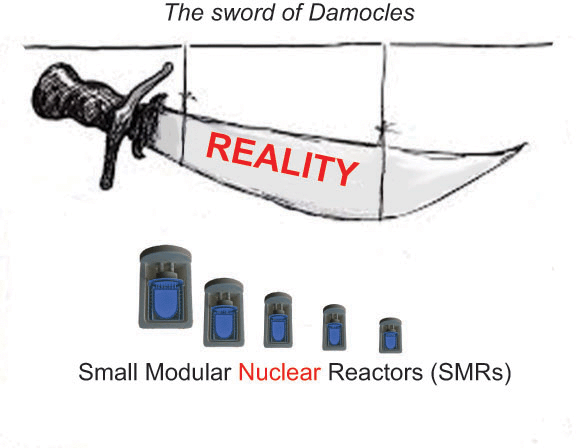
U.S. Bets on Small Nuclear Reactors to Help Fix a Huge Climate Problem.
The dream of reviving nuclear power in the U.S. rests on a new generation
of smaller reactors meant to be easier to build.
But major obstacles loom.
Nearly a dozen companies are developing reactors that are a fraction of the
size of those at Vogtle, betting that they will be quicker and cheaper to
build. As the United States looks to transition away from fossil fuels.
But the push to expand nuclear power, which today supplies 18 percent of
electricity, faces enormous hurdles. In a major setback last week, the
first serious effort to build small reactors in the United States was
abruptly cancelled amid soaring costs. While other projects are still
moving forward, the industry has consistently struggled to build plants on
time and on budget. The Nuclear Regulatory Commission, which oversees the
safety of the nation’s nuclear fleet, is less experienced with novel
reactor technologies.
And the problem remains of how to dispose of
radioactive waste. “These nuclear megaprojects had just gotten way too
complex,” said Jay Wileman, president of GE-Hitachi Nuclear Energy, which
is designing a slimmed-down version of its boiling-water reactor that is
only 300 megawatts — one-quarter the size of the 1,117-megawatt units at
Vogtle. Ontario Power Generation plans to deploy four of them in Canada,
hoping to bring down costs as it builds the same design again and again.
The Tennessee Valley Authority is considering at least one.
Other companies
are exploring radically new reactor designs that, in theory, can’t melt
down and don’t require big containment domes or other expensive
equipment. Some might be manufactured in factories and assembled on-site,
potentially lowering costs.
The approval process can be slow. To date, the
N.R.C. has certified only one small reactor design, developed by NuScale
Power. NuScale’s light-water technology is similar to existing plants,
but the company argued that smaller reactors required different safety
rules, such as smaller evacuation zones in case of accidents.
Securing approval took a decade and cost $500 million.
Last week, NuScale announced
it was cancelling plans to deploy six 77-megawatt reactors in Idaho by
2030, which would have been the nation’s first small nuclear plant. The
problem was that it couldn’t sign up enough customers. Soaring costs
didn’t help: In January, NuScale said the price of building the reactors
had jumped from $5.3 billion to $9.3 billion, citing higher interest rates
and materials costs. On a per-megawatt basis, the project had become as
expensive as Vogtle.
“The small reactors being hyped by the nuclear
industry and its allies are simply too late, too expensive, too uncertain
and too risky,” said David Schlissel, an analyst for the Institute for
Energy Economics and Financial Analysis, who has urged utilities to pursue
alternatives like solar and geothermal power. Other challenges loom. The
United States isn’t yet producing enough of the specialized fuel for
advanced reactors. There’s no long-term plan for nuclear waste. Siting
new plants can be contentious: Last year, officials in Pueblo County,
Colo., withdrew plans to replace a retiring coal plant with a reactor after
local backlash.
New York Times 12th Nov 2023
French government, EDF agree on €70 MWh for nuclear power
The French government and EDF have struck a deal on nuclear electricity prices to shield consumers from increases and enable the state-owned utility to fund new reactor construction, drawing criticism from energy-intensive businesses.
NOVEMBER 15, 2023 GWÉNAËLLE DEBOUTTE, more https://www.pv-magazine.com/2023/11/15/french-government-edf-agree-on-e70-mwh-for-nuclear-power/
The French government and utility EDF have reached an agreement on the price of nuclear energy after “long, sometimes difficult negotiations,” according to Finance Minister Bruno Le Maire. The new average price for nuclear power was set at €70 ($76.10)/MWh for a period of 15 years starting from 2026.
The new pricing scheme will replace the so-called Regulated Access to Incumbent Nuclear Electricity (ARENH) mechanism, which requires EDF to sell 100 TWh per year of nuclear production to its competitors at €42/MWh. EDF currently owns and operates most of France’s nuclear power fleet and sees the current price as two low, given current market prices for electricity.
The government and EDF determined €70/MWh by modeling prices over 15 years, considering capture and redistribution mechanisms, bilateral power purchase agreements (PPAs), and medium-term contracts. Two levels were established: if the average price surpasses €78.80/MWh, 50% of the additional income beyond this threshold goes to the state budget; exceeding €110/MWh results in a 90% capture, with surpluses returned to consumers.
“If this agreement secures EDF – the armed arm of our energy policy – over the long term, it also sets the non-negotiable conditions for electricity produced in France at a price competitive,” said Agnès Pannier-Runacher, minister of energy transition.
Yann Dolbeau, co-founder of consulting firm Enoptea, said that the mechanism would successfully disconnect the electricity price from gas prices. Consequently, there won’t be any more capping, and the portion of nuclear power in supply prices will increase, leading to lower costs.
CLEEE, the French association of energy-intensive businesses, has defined the new measure as “a big step backwards” for French companies. “The new system will guarantee EDF an expected income well above the full production cost, with a retrocession threshold to consumers equal to almost double the production cost,” said CLEEE.
CRE, the French regulator, estimated the full cost of existing nuclear power at €60/MWh between 2026 and 2030. Compared to the threshold of €110/MWh, it is almost double.
“If we share the need to give EDF the means to invest, we regret an arbitration made for budgetary reasons to the detriment of price stability and the protection of French industry. A bill must soon be tabled by the government and detractors still hope to be able to influence certain aspects of the reform,” the association stated.
Something fishy: Welsh Councils excluded from latest Hinkley Point C Consultation.
The Welsh capital of Cardiff may lie less than 20 miles as
the fish swims from the site of the huge Hinkley Point C nuclear power
station now under construction on the coast in Somerset, but French-owned
EDF is choosing not to consult with the City Council on its latest plan to
vary its Development Consent Order (DCO).
Cardiff is not the only Welsh
council excluded from the list of consultees that the operator has agreed
with the UK Government should be solicited for their views on the changes,
for in fact most of the local authorities in South Wales which border onto
the Severn Estuary – Bridgend, Newport, Port Talbot, Swansea, and the
Vale of Glamorgan – are excluded.
To the Welsh Nuclear Free Local
Authorities, the exclusion of these Councils as statutory consultees
appears illogical for one of the changes that EDF is seeking is the
‘removal of the requirement to install an acoustic fish deterrent (AFD)
system’, which many campaigners believe will have a massively detrimental
impact on the marine life of the Severn Estuary.
NFLA 13th Nov 2023
Uncharted waters: Navy navigating first-ever dismantling of nuclear-powered carrier
The challenges for the Navy to dispose of the former USS Enterprise have driven the service to stand up a new office to deal both with “The Big E” and the pipeline of Nimitz-class carriers to come.
Breaking Defense, By JUSTIN KATZon November 15, 2023
WASHINGTON — For more than a decade, the US Navy has considered the former Enterprise (CVN-65) no longer operational. In fact, since 2018, the 1,101-foot behemoth has been mostly floating pier side in Newport News, Va., awaiting final dismantlement and disposal.
Ships come and go in the Navy, but their disposal is not usually such a prolonged and complicated affair. They can be used as target practice for what the Navy calls a “SINKEX” or handed over to scrapping and salvaging companies, among other options.
But for a host of reasons, those routes are non-starters for the service’s first nuclear-powered aircraft carrier. Instead, after studying the problem for years, the service has finally settled on a path forward: enlisting commercial industry for a job it has historically done itself, and likely creating a new norm for how all nuclear-powered carriers will be disposed of going forward.
To lead that charge, Breaking Defense has learned the Navy has set up a new office just to focus on the inactivation and disposal of nuclear-powered aircraft carriers…….
Whatever the service ends up doing, both analysts and the Navy have said it will likely set precedents for future carriers facing disposal, and the clock is ticking. The longer it takes, the more likely it is the Pentagon will risk a buildup of older carriers taking up various private and public ports around the country.
Even if everything goes according to the Navy’s preliminary plans, time is not on the service’s side. Public Navy documents show that Enterprise will not begin dismantlement until 2025, and the work will continue through 2029 — meaning even if everything stays on track, the work will be ongoing when the second nuclear-powered aircraft carrier, USS Nimitz (CVN-68), is scheduled to leave the operational fleet in 2026. The USS Eisenhower (CVN-69) will follow suit not long after.
“The Navy has really had a tough time figuring out … what’s the process we’d go about dismantling this thing,” said Bryan Clark, a fellow at the Hudson Institute and retired submariner. “That’s why the Enterprise in particular has been sitting around waiting to be dismantled. And we’re going to have the same problem with the Nimitz.”…………………………………………………………………………………………………………….. more https://breakingdefense.com/2023/11/uncharted-waters-navy-navigating-first-ever-dismantling-of-nuclear-powered-carrier/
TODAY. The onslaught formally begins: the ruthless, morally bankrupt nuclear lobby moves to take over the COP 28 Climate Summit

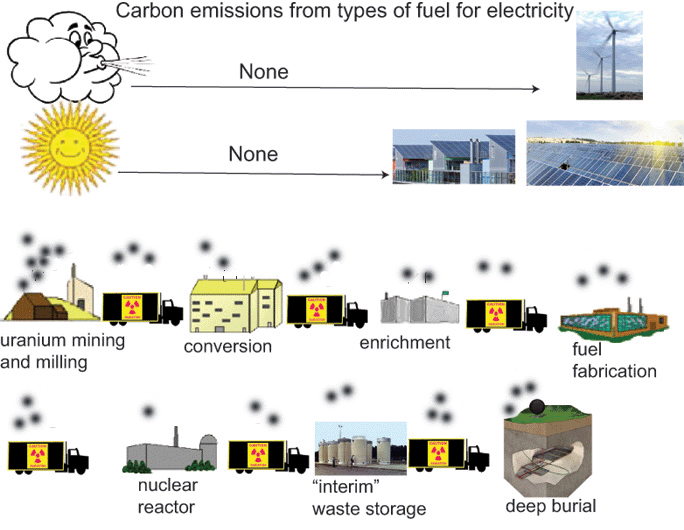
Never mind that the nuclear fuel chain emits greenhouse gases at every stage (including a minimal output from the actual reactor).

Never mind that nuclear power is itself very vulnerable to climate change – quite the opposite thing to nuclear being a fix for climate change,
As if they care about the facts, about the truth!
The nuclear industry lives on for really just one reason – the same reason for which it was started – it is essential for the nuclear weapons industry. Where it’s not directly applied to weapons-making – it still provides the “respectability” – and the training, expertise, technical developments, that provide a benign cover for its real purpose,
The current hype about nuclear as a cure for climate change is just a brilliant stroke of dishonest opportunism.
You’ve got to hand it to these well-funded lobbies, and their army of dishonest Stink Tanks, and servile media. Like their despicable mates, the fossil fuel lobbies – they’ ll be there in style sabotaging the COP 28, hypocritically flaunting their crooked wares. Not a shred of honesty. Not a shred of integrity. No shame about their crooked agenda.
US, UK to Push Pledge to Triple Nuclear Power by 2050 at COP28

Nov 14, 2023, John Ainger, Rachel Morison and Akshat Rathi, Bloomberg News
(Bloomberg) — The US will lead a push at the COP28 climate summit to triple the amount of installed nuclear power capacity globally by 2050, marking a major turnaround for the controversial technology at the climate negotiations.
The declaration will call on the World Bank and other international financial institutions to include nuclear energy in their lending policies, according to a document seen by Bloomberg News. The US will likely be joined by the UK, France, Sweden, Finland and South Korea in the pledge to be signed Dec. 1 in Dubai, according to people familiar with the matter.
That will be followed a few days later by a nuclear industry commitment to triple generation resources from 2020 levels, said one of the people, who asked not to be named because the information isn’t public.
“Nuclear is 100% part of the solution,” John Kerry, the US special presidential envoy for climate, said at the Bloomberg New Economy Forum last week. “It’s clean energy.”
The countries recognize “the key role of nuclear energy in achieving global net-zero greenhouse gas emissions/carbon neutrality by or around mid-century,” a draft of the declaration says. ……….
The declaration is the latest sign of shifting sentiment toward nuclear power, which doesn’t produce carbon dioxide emissions, but has often been criticized over the waste it generates, the cost of building plants and potential security issues. ……… The countries will also commit to new technologies, such as small modular reactors.
…… The US is discussing nuclear cooperation agreements with Kenya and Ghana, and renewing a pact with South Africa, according to Joshua Volz, the US Department of Energy’s deputy assistant secretary for Europe, Eurasia, Africa and the Middle East.
……………… The United Nations’ 28th Conference of the Parties, known as COP28, will take place in the United Arab Emirates, which is the only country in the Arabian Peninsula with a nuclear power program. It’s not clear if the hosts will sign……. https://www.bnnbloomberg.ca/us-uk-to-push-pledge-to-triple-nuclear-power-by-2050-at-cop28-1.1998524
The U.S.’s Plans to Modernize Nuclear Weapons Are Dangerous and Unnecessary

The U.S. should back away from updating its obsolescent nuclear weapons, in particular silo-launched missiles that needlessly risk catastrophe
BY THE EDITORS, https://www.scientificamerican.com/article/the-u-s-s-plans-to-modernize-nuclear-weapons-are-dangerous-and-unnecessary/ DECEMBER 1, 2023
This article is part of “The New Nuclear Age,” a special report on a $1.5-trillion effort to remake the American nuclear arsenal.
The U.S. is planning to modernize its unwanted, unneeded and unsafe nuclear triad of land-, sea- and air-based weapons. Perfectly poised to refight the cold war, these overhauled bombs will waste $1.5 trillion and threaten life on Earth for the century to come. We should rethink this miserable folly rather than once again squandering our wealth while driving a new arms race.
As detailed in this issue of Scientific American, this plan to burn money while imperiling the world has been widely criticized in nuclear policy circles. “Russia and the United States have already been through one nuclear arms race. We spent trillions of dollars and took incredible risks in a misguided quest for security,” former U.S. defense secretary William J. Perry wrote in 2016 as the plans first materialized. “There is only one way to win an arms race: refuse to run.”
Although the Biden administration canceled proposed Trump-era sea-launched missiles, the U.S. nuclear arsenal still bristles with some 3,700 weapons, around 1,700 of them deployed for military use and the rest in storage overseen by the Department of Energy. This quantity is more than enough to threaten the destruction of humanity and Earth’s biosphere—and it is only a fraction of the world’s total, leaving out Russia’s similarly large stockpile and smaller ones in China and other nations. Lowering the numbers and thus the risks of these weapons is a responsibility the U.S. and the Soviet Union first recognized at the end of the 1960s, and this goal should drive military and political decision-making now.
Instead the U.S. is sleepwalking into an ill-considered and little-discussed resurrection of its three-pronged cold war nuclear forces. Meanwhile China is expanding its own arsenal (to one-fourth the size of the U.S.’s). New submarines, missiles and planes, all designed to fit into a military strategy first conceived before the death of Joseph Stalin in 1953, will by 2050 leave the dead hand of the past steering us into another century of pointless risks. In this future, a mistake or misjudgment could exterminate humanity, as nearly happened repeatedly throughout the cold war. We are simply fortunate, nothing more, to have survived the hundreds of false alarms that rang over those decades.
At the center of the government’s proposal is a $100-billion bid to fill 450 nuclear silos in five inland states with hundreds of new nuclear missiles set to launch on hair triggers. Built before submarine-launched missiles became large, accurate and untraceable, these relics are now justified as a “nuclear sponge” to absorb a Russian attack on the U.S. Why plant a $100-billion nuclear “kick me” sign on the country’s breadbasket?
We cannot store the nuclear waste we have now, never mind the additional waste that will result from building these missiles. The so-called nuclear sponging mapped in this month’s issue [see “Sacrifice Zones”] would kill up to several million from radiation exposure, with hundreds of millions in North America being at risk of exposure to lethal fallout. Even a limited nuclear war between India and Pakistan would kill tens of millions worldwide and cause global famine—but how can the U.S. argue for other nations to disarm while burnishing its own nuclear sword in such a heedless fashion?
We aimed this Damoclean sword at ourselves during the cold war when we produced 70,000 of the plutonium “pits” that trigger thermonuclear warhead explosions. Weapons tests of these blasts have left every part of Earth’s surface contaminated with plutonium, with hotspots such as the Rocky Flats in Colorado and the Hanford sites in Washington State still requiring tens of billions of dollars for cleanup. Faltering efforts to restart pit production for the nuclear-modernization effort have cost $18 billion to $24 billion, much of it wasted, and, by the admission of weapons officials at Los Alamos National Laboratory in New Mexico, they don’t even seem to be immediately necessary.
Why are we risking so much when the lessons of the 20th century are so clear? In the words of the 1991 START Treaty that capped the cold war, “nuclear war would have devastating consequences for all humanity … it cannot be won and must never be fought.” Disregarding Russia’s inability to turn its nuclear arsenal to military advantage while being bombarded by Ukrainian drones, our political class has fumbled away hard-won wisdom about the deadly futility of the arms race. We are recapitulating the dangers the world turned away from decades ago.
Who today benefits from disinterring the arms race? Only defense-industry shareholders and military contractors near silos in North Dakota, Montana, Wyoming, Colorado and Nebraska. This, in a nation where we have just doubled child poverty out of a refusal to help lower-income families. Surely it would be cheaper, safer and smarter to build factories or universities or research labs in these places, construct low-cost housing next to new engineering or biomedical campuses there, and watch them boom, in a good way, for the next century at a fraction of the silo-overhaul price tag. The 900 nuclear missiles onboard U.S. submarines will meanwhile deter the feared nuclear first strike the obsolescent land missiles were meant to discourage at the dawn of the cold war.
“A worrisome new arms race is brewing,” United Nations secretary-general António Guterres said in September. “This is madness. We must reverse course.” We agree. The only real way to use nuclear weapons is never. They should exist only in numbers large enough to deter their use by others, which they already abundantly do, with not one warhead more.
Frozen fallout: radioactive dust from accidents and weapons testing accumulates on glaciers.
Physics World, 20 Jun 2023 James Dacey
Glacier surfaces in certain parts of the world contain concerning amounts of toxic radioactive materials, a result of weapons testing and nuclear accidents such as the Chernobyl disaster in 1986. Fallout radionuclides accumulate within cryoconite – a granular sediment found in holes on glacier surfaces – and there is a risk of this material entering local ecosystems as glaciers melt due to climate change. Glaciologists and ecologists say this poses urgent questions. What regions are at highest risk? How diluted is the nuclear material entering proglacial zones? What impact might that have on organisms?…..
Fukushima Nuclear Power Plant starts 3rd round of wastewater release, potentially impacting seafood quality in U.S.
The Daily Universe, Belle Lewis, November 14, 2023
The Fukushima-Dachii nuclear plant started its third release of nuclear wastewater on Nov. 2 as scientists warn that seafood products from the Pacific Ocean could be contaminated.
Although the International Atomic Energy Agency approved the 30-year water release plan, scientists and civilians in nations bordering the Pacific Ocean have questioned the safety of the plan, especially as it relates to seafood.
In a press release approving of the plan, the IAEA stated, “the discharges of the treated water would have a negligible radiological impact to people and the environment.”
Paul Dorfman, member of the Irish Government Environmental Protection Agency Radiation Protection Advisory Committee and chair of Nuclear Consulting Group, explained that some scientists have questioned IAEA’s approval of the water release.
“I and others are concerned by IAEA’s attitude,” Dorfman said. “Normally even low levels of radioactive pollution will find its way into local seafood, one way or another.”
In 2020, Japan exported 332,926 kilograms of frozen scallops to the U.S. Japan exports many fish products to the U.S.
Samantha Valeriano, a psychology student from Hawaii, said she eats seafood about once a week. She does not often think about where her food comes from but wants to be more cautious following the nuclear water release.
“I think I would be a little more cautious of what I ate, checking labels a little bit more,” Valeriano said. “I would be conscious of what I ate and where it came from.”
As the People’s Republic of China has imposed bans of Japanese fish exports, the U.S. has supported the Japanese market by increasing fish purchases.
In a press release, the United States Embassy and Consulate in Japan explained that military bases in Japan will carry Japanese seafood as a way to buoy up seafood markets and undermine the PRC’s ban.
“United States elected representatives and senior government officials have stood in solidarity with Japan during this baseless ban,” the statement said. “Another step to help provide additional sales to counter the ban was to start selling Japanese seafood at the U.S. military facilities in Japan, both through the commissaries and mess halls.”
According to the statement, government officials like former speaker Kevin McCarthy ate seafood from Japan as a testament to Japan’s safety standards.
However, other U.S. agencies, like the National Association of Marine Laboratories question whether accurate research was conducted by the IAEA and Japanese Government to determine safety of seafood products.
They explain that the lack of data on potential health impacts is a cause for serious concern.
“Many of the radionuclides contained in the accumulated waste cooling water have half-lives ranging from decades to centuries, and their deleterious effects range from DNA damage and cellular stress to elevated cancer risks in people who eat affected marine organisms, such as clams, oysters, crabs, lobster, shrimp and fish,” the statement reads.
Eve Nagareda, medical laboratory science major from Hawaii, shared she wants to avoid seafood from dumping grounds even if levels are considered safe.
“I think I would try to go as far as possible from it,” Nagareda said…………………………………………………………………………..
On Sep. 8, the IAEA conducted seawater sampling off the Japanese Coast. They recorded Tritium levels below the internationally mandated limit of 1,500 bequerels per liter.
Dorfman explained that below-accepted tritium levels does not mean that the ALPS is functioning properly.
“The Japan government and IAEA say that the treatment is sufficient, and levels of radiation, especially tritium, in the water releases are low.” Dorfman said. “However, others note that the treatment process has already failed once before, and may let through a series of radioisotopes, not only tritium.”
A pre-publication scientific paper found that radionucleotides from the Fukushima plant will distribute globally and penetrate into the deep ocean. The highest concentration of these particles would be along the eastern coast of Japan.
This paper contradicts assertions made by the IAEA that once the water is dumped into the Pacific Ocean, the particles will dilute.
Radiation experts often say that “dilution isn’t the solution to pollution,” according to Dorfman.
Why release the water?
After the water is released, the land the tanks occupy will be available for the Japanese government to build facilities to fully decommission the Fukushima-Daiichi Plant.
In the greater scheme of things, it has to be said that the main issue at Fukushima remains the almost impossible task of trying to extract the nearly 880 tonnes of highly radioactive nuclear fuel that have melted in three of the plant’s six reactors,” Dorfman said.
According to Dorfman, decommissioning is far off.
“We are a very very long way away from decommissioning Fukushima,” Dorfman said. “At the moment, there are no feasible plans to do so.”
What is the future of nuclear energy?
As the Fukushima nuclear water release continues its third phase and looks toward its 30-year release plan, scientists like Dorfman consider the overall effectiveness of nuclear power and its potential risks.
“The weight of evidence shows that due to the pace, scale and economics of the renewable evolution, all nuclear can do is make promises it just can’t keep,” Dorfman said.
Dorfman continued to explain how renewable energy will outstrip nuclear soon.
“Nuclear is quite simply just marginal,” Dorfman said. “In terms of cost, time, and do-ability — it’s renewable expansion in all sectors, energy efficiency and management, rapidly advancing storage technologies, grid modernization, interconnection and market innovation from supply to service provision that will power the global net-zero energy transition.”
As Nuclear wastewater disposal continues, organizations like the IAEA and NAML continue to debate the potential health impacts. https://universe.byu.edu/2023/11/14/fukushima-nuclear-power-plant-starts-third-round-of-wastewater-release-potentially-impacting-seafood-quality-in-u-s/
Patrick Lawrence: ‘The Hinge of History’- Palestine and the New World Order

What we are seeing at the moment in Palestine is the end of settler colonialism. Settler colonialism is a phenomenon of the last two centuries or so, and it is always accompanied by genocide.
November 14, 2023, By Patrick Lawrence , https://scheerpost.com/2023/11/14/patrick-lawrence-the-hinge-of-history/—
Bombing hospitals was, just a few days ago, an undeclared red line the Israel Defense Forces dared not cross without provoking international disgust and condemnation. At writing, the IDF is bombing hospitals and, I read, its soldiers are shooting patients, invalids among them, as they attempt to evacuate buildings soon to be demolished.
There is disgust and condemnation now, and they find expression not only on the streets of many cities but also in governing circles. Axios reported Monday that an internal State Department memo, signed by 100 officials at State and its aid agency, USAID, accuses President Biden of lying about Israel’s military campaign in Gaza and of complicity in war crimes. On Tuesday, The New York Times put the signatories of another letter to Biden at 400 representing 40 government departments and agencies, including the National Security Council — this in addition to an open letter to Secretary of State Blinken signed by more than 1,000 Agency for International Development employees. So far as I know, this measure of dissent in policy and governing circles is more or less unprecedented.
Beyond our purple mountains and fruited plains, the Irish Dáil will vote this week on expelling the Israeli ambassador, throwing Israel out of a European Union trade accord for breaching its human-rights clauses, and—a Sinn Féin motion—referring Israel to the International Criminal Court. Emmanuel Macron came out last weekend calling for a ceasefire, the first Western leader to do so. Given Biden’s defiant refusal even to consider asking Israel to accept a ceasefire, the French president has implicitly issued a rejection of Israeli violence and the U.S. policy supporting it.
We cannot make too much of events such as these, but we must not make too little of them, either. These are signs on the surface of much deeper movements a few meters down in our civilization’s soil. Things are gradually coming apart in consequence of Israel’s savagery and America’s abetment of it, at home in the U.S., in the Atlantic world altogether and certainly between the West and the world beyond it. Now it is time to look forward to see what we can see of the world to come.
Christopher Lydon, who produces Radio Open Source for WBUR in Boston, suggested over the weekend we have reached “a hinge in history—outcomes wildly uncertain.” He made this remark at the start of a long interview with Chas Freeman, the retired ambassador for whom I share with Lydon great admiration. Freeman agreed with the hinge-of-history thought. So do I. All is changing, changing utterly, if you will let me borrow and bend Yeats’s famous line.
Here is Chas on our moment:
This is clearly what Chancellor Scholz of Germany calls a Zeitenwende—that is, an epic-changing moment, a time of major change in a new direction in history. We’ve talked before about the fact that 500 years of global dominance by the Euro–American culture, the Atlantic culture, has come to an end.
The only exception I can think of is New Zealand, where Māori power countered the British sufficiently to preserve their culture as a separate one….What we are seeing at the moment in Palestine is the end of settler colonialism. Settler colonialism is a phenomenon of the last two centuries or so, and it is always accompanied by genocide.
It may seem unlikely that the Palestinians will do as well resisting the hegemonic West as the Māori in the 19th century, although outcomes, as Chris Lydon says, are wildly uncertain. In any case, one does not want to see a separate, even segregated Palestinian entity emerge from the Israel–Palestine catastrophe so much as a single, secular nation in which cultures of all sorts are integrated and, more than tolerant, wholly accepting of one another. So I argued recently in this space.
Consortium green lights European NuScale style (!) small nuclear reactors

Construction Europe By Mike Hayes, 15 November 2023
Industrial bodies from Romania, Italy and Belgium have formed a consortium to advance nuclear energy technology in Europe.
Romanian and Belgian nuclear research centres RATEN and SCK CEN, Italian nuclear company Ansaldo Nucleare and engineering and energy R&D agency ENEA, will take part in the initiative, in collaboration with the US-based nuclear technology company Westinghouse Electric.
The primary objective of the consortium is to develop a small modular lead-cooled fast neutron reactor (SMR-LFR…….
The proposal was reportedly to mirror the efforts of the US NuScale project – a project which has now been cancelled, following a doubling of construction costs.)………………………………https://www.construction-europe.com/news/consortium-green-lights-european-small-nuclear-reactors/8033034.article
EU’s Ukraine weapons goal ‘unattainable’ – Germany
Rt.com 14 Nov 23
Defense Minister Boris Pistorius said he had been skeptical of Brussels’ pledge all along, citing inadequate production capacities
The European Union will not be able to make good on its pledge to provide Ukraine with one million artillery rounds by next March, German Defense Minister Boris Pistorius has admitted. Ukrainian Foreign Minister Dmitry Kuleba has also echoed this assessment.
Brussels made the promise earlier this year, expecting to reach the ambitious target within 12 months by dipping into existing stocks, as well as by procuring shells from arms manufacturers. However, several media outlets have reported that the bloc is falling behind schedule.
Speaking ahead of a meeting by EU defense chiefs in Brussels on Tuesday, Pistorius said that “the one million won’t be achieved. One must proceed on this assumption.” The minister blamed the supposed shortfall on inadequate production capacities in European nations, explaining that even if the economy was switched to a wartime mode, the ammunition output would still not become prolific enough overnight.
Pistorius admitted he had been skeptical about the bloc’s target right from the start when it was set in March, fearing that it could prove unrealistically ambitious.
Commenting on a report by Bloomberg, which suggested last week that Brussels would not be able to fulfill its promise, Kuleba told local media that the report was “unfortunately” true. …………………………………………………… more https://www.rt.com/news/587258-german-defense-minister-eu-ukraine-shells-target/
Council urged to review plans that could lead to UK hosting US nuclear bombs
An attempt by the Ministry of Defence to build a dormitory that could lead
to the return of US nuclear weapons to British soil is being challenged by
the Campaign for Nuclear Disarmament (CND) because it is being attempted
without planning permission.
The campaign group has asked West Suffolk
council to intervene and insist that the planned 144-bed facility at RAF
Lakenheath be subject to an environmental impact assessment or be halted.
Work on the dormitory is due to start next year and its purpose is to house
the extra US personnel who would be needed to safeguard any return of B-61
air-launched nuclear bombs to Lakenheath for the first time since 2007.
Kate Hudson, CND’s general secretary, accused the US air force of
ploughing ahead by “purportedly relying on planning rights that assume
that the development won’t have significant environmental effects”, and
so ignoring the risks that storing nuclear weapons in Suffolk would entail.
Guardian 14th Nov 2023
1 This Month





PLEASE OPPOSE HR 8255 AND S.3639 – bills would accelerate satellite deployment, with no environmental review or safeguards – https://ncstd5li.quorum.us/campaign/169331/
To see nuclear-related stories in greater depth and intensity – go to https://nuclearinformation.wordpress.com
-
Archives
- October 2026 (81)
- September 2026 (339)
- August 2026 (330)
- July 2026 (355)
- June 2026 (287)
- May 2026 (306)
- April 2026 (356)
- March 2026 (251)
- February 2026 (267)
- January 2026 (308)
- December 2025 (358)
- November 2025 (359)
-
Categories
- 1
- 1 NUCLEAR ISSUES
- business and costs
- climate change
- culture and arts
- ENERGY
- environment
- health
- history
- indigenous issues
- Legal
- marketing of nuclear
- media
- opposition to nuclear
- PERSONAL STORIES
- politics
- politics international
- Religion and ethics
- safety
- secrets,lies and civil liberties
- spinbuster
- technology
- Uranium
- wastes
- weapons and war
- Women
- 2 WORLD
- ACTION
- AFRICA
- Atrocities
- AUSTRALIA
- Christina's notes
- Christina's themes
- culture and arts
- Events
- Fuk 2022
- Fuk 2023
- Fukushima 2017
- Fukushima 2018
- fukushima 2019
- Fukushima 2020
- Fukushima 2021
- general
- global warming
- Humour (God we need it)
- Nuclear
- RARE EARTHS
- Reference
- resources – print
- Resources -audiovicual
- Weekly Newsletter
- World
- World Nuclear
- YouTube
-
RSS
Entries RSS
Comments RSS


