What a Catholic peace studies expert thinks is the way out of war in Gaza
America, the Jesuit Review Kevin Clarke, November 17, 2023
“So how do you draw people off, to stop thinking that their only possibilities are to become martyrs, [that] it doesn’t matter if they die or they take everyone in Gaza with them? Some of their supporters have to get through to them.”
The patrons of the combatants—the United States and Germany for Israel, and Iran and Qatar for Hamas, must pressure their clients to accept a cease-fire, she said. The agony at Al-Shifa Hospital in northern Gaza, where 36 infants cling to life after the hospital lost power to run their incubators, could prove a pivotal moment when maximum leverage can be brought to bear, according to Dr. O’Connell.
Kevin Clarke, November 17, 2023
As tensions mount across the Middle East because of the continuing bloodshed in Gaza, the remnant forces of the United States in Syria and Iraq have come under fire from militant groups in sympathy with Hamas. More than 50 U.S. service members have suffered what have been described as minor injuries in the rocket attacks. On Nov. 11, U.S. aircraft conducted the third in a recent series of raids on Iran-backed militants in retaliation—this latest U.S. strike on a training facility and a safe house was perhaps the most devastating, and likely produced casualties.
Mary Ellen O’Connell, a professor of law at the University of Notre Dame and of international peace studies at the university’s Kroc Institute, believes this tit-for-tat strategy is precisely the wrong response if regional de-escalation is indeed the desire of the Biden administration. “The airstrikes in Syria and Iraq by the United States need to stop immediately,” she said, describing them as “blatant violations of international law.”
If regional containment of the conflict remains a primary objective, she said, U.S. forces should refrain from military strikes outside acknowledged armed conflict zones. And, she said, the United States needs to be clear with Israel that U.S. assistance “is premised on Israel complying with international law across the board.”
An air strike on targets in Syria is precisely the wrong response if regional de-escalation is indeed the desire of the Biden administration.
But how to restore peace in Israel and Gaza after this historic outbreak of violence and mutual suffering? Dr. O’Connell said that it will take outside pressure on both parties. Israeli leadership seems determined—at least for now—to ignore a worldwide outcry over the human suffering it is creating in response to the Hamas attack on Oct. 7. And for its part, Hamas appears to be “in suicide mode.”
“So how do you draw people off, to stop thinking that their only possibilities are to become martyrs, [that] it doesn’t matter if they die or they take everyone in Gaza with them? Some of their supporters have to get through to them.”
The patrons of the combatants—the United States and Germany for Israel, and Iran and Qatar for Hamas, must pressure their clients to accept a cease-fire, she said. The agony at Al-Shifa Hospital in northern Gaza, where 36 infants cling to life after the hospital lost power to run their incubators, could prove a pivotal moment when maximum leverage can be brought to bear, according to Dr. O’Connell.
Patients and staff have endured for days without electricity and basic medical necessities as fighting raged around the hospital compound. The spectacle provoked a surge of negotiations in Riyadh, Doha and Cairo aimed at conflict pauses and hostage exchanges. On Nov. 15, I.D.F. soldiers seized control of Al-Shifa, searching for evidence of a Hamas presence inside and beneath the facility.
What in the end puts a stop to conflict is “always a negotiation,” Dr. O’Connell said. “It’s always trusted partners who come in.”
Over the long term, however, in Gaza and other hotspots in the Middle East like northern Iraq and Syria, peace will be the outcome of processes that require time and patience. Dr. O’Connell called “good governance” the real solution to the problem of terrorism because it “builds an economy where young people have a job, [where they] have a chance for a future.”
She lays partial blame for the violations of international norms evident in the Hamas assault on southern Israel and Israeli tolerance for high numbers of noncombatant casualties in its Gaza campaign on the example set by the United States. During its prosecution of the so-called war on terror and in follow-up campaigns in Iraq and Afghanistan that effort set in motion, violations of international law in “targeted killing of all kinds” by U.S. forces became routine, she charged.
The United States has created a template for such military strikes, she said, deploying dubious appeals to international law to rationalize use of force. The strategy, she said, has been demonstrably counterproductive. “If we need to carry out this kind of warfare for 22 years, it’s obviously not effective,” Dr. O’Connell said.
Not only has the approach “not suppressed terrorism,” she said, it has “helped create a metastasizing new set of virulent organized armed groups across the north of Africa, into Somalia and other places,” including “the great catastrophe in Afghanistan.”
It has also significantly weakened esteem for the international rule of law related to human rights and war-making, according to Dr. O’Connell, connecting that decline to the utter disregard for norms demonstrated by the Russian Federation in Ukraine. “People don’t even understand anymore what the provisions of the U.N. Charter are, and they don’t take them seriously anymore because of these constant attempts at justifying [use of force] using looser and looser arguments under international law.”
The best sociological research on reversing the diminishing adherence to norms like the Geneva Conventions and international humanitarian law, according to Dr. O’Connell, calls for “a leading sovereign state modeling norm compliance.” She hopes the United States may accept that role.
Specialists on peacemaking like Dr. O’Connell could be forgiven if they grow frustrated that their expertise is only sought when conflicts turn hot or when the persisting geopolitical insistence on a “realist” use of force fails yet again. But Dr. O’Connell said she remains undeterred……………………………………………………………………………….. more https://www.americamagazine.org/politics-society/2023/11/17/hamas-israel-gaza-al-shifa-hospital-246524?utm_source=piano&utm_medium=email&utm_campaign=2928&pnespid=qrpnUCZIJrkL2.TZtDWsGJPRohi2WJ0tLvqmwrN0.kBmd2Cx.K9U3PLA_pRIgzMAF7MdqdfHEQ
Ukraine war a ‘good investment’ for US – Trump rival

“the Ukrainian army has degraded 50% of the Russian military capability without one drop of American blood. Seems to me that’s a pretty good return on investment for us, and one we should double down on,“
Chris Christie made the case for “doubling down” on funding for Kiev
Former New Jersey governor and aspiring Republican presidential candidate Chris Christie has condemned “isolationism” and urged Americans to double down on funding the Ukrainian war effort, describing it as a good “return on investment.”
Speaking at the Hudson Institute in Washington on Wednesday, Christie argued he was the only “serious” Republican presidential candidate showing “moral clarity” to the world, often praising US President Joe Biden while taking potshots at GOP frontrunner Donald Trump.
Our strategy in Ukraine is driven by a principled commitment to support Ukrainians fighting and dying for their country,” Christie said at one point. He added that he would have provided “more weapons, and sooner” than Biden…….
Christie pointed out that he has visited Kiev and met with President Vladimir Zelensky, who told him that “without American help, Ukraine would now be occupied by Russia.” Zelensky also said that Ukraine did not need any American soldiers, only weapons to win the war by itself, Christie added.
“We’ve done that, but with less than 4% of one year’s military budget. And with that, the Ukrainian army has degraded 50% of the Russian military capability without one drop of American blood. Seems to me that’s a pretty good return on investment for us, and one we should double down on,” the former governor concluded………………………………………..
Faced with the growing opposition from some Republican lawmakers to continued spending on the Ukraine conflict, the White House has recently changed its “messaging” to present it as stimulus for the American defense industry. The supposed economic benefits have yet to materialize, however……………………more https://www.rt.com/news/587448-us-ukraine-chris-christie/
Over 1,200 ‘Educators for Palestine’ Sign Open Letter Demanding Ceasefire
The letter also called for an end to the Israeli occupation and condemned recent suppression of dissent by universities.
By Chris Walker / Truthout, https://scheerpost.com/2023/11/16/over-1200-educators-for-palestine-sign-open-letter-demanding-ceasefire/
Hundreds of academics from universities and institutions of higher learning (as well as public school K-12 teachers) from across North America have signed on to a joint letter, calling on their governments to demand an Israeli ceasefire in Gaza, where the Israel Defense Force (IDF) has killed more than 11,000 Palestinians since the start of October.
As of Sunday evening, the document has more than 1,200 signatures, available to view here. The signers, calling themselves “Educators for Palestine,” are Palestinian academics and their allies who denounce Israel’s genocide of Palestinians in Gaza, as well as governments complicit in the genocide, including the United States.
The letter calls for such governments to “stop funding the genocide and instead call for a ceasefire, an end to the blockade of humanitarian aid, and restoration of access to water, electricity, and medicine in Gaza.”
“We demand that all potential war crimes be investigated,” the academic letter-writers state. “We demand an end to Israel’s military occupation and regime of apartheid, and a long-term political solution led by the Palestinian people that is based on justice, equality, and responsibility for one another’s mutual well-being.”
“We believe education can be a powerful place for this work,” Educators for Palestine add.
The letter also expresses deep concern over the ways that students and staff of universities are being silenced by their own institutions. “Forced silence through repression of dissent and retribution by powerful institutions against students, staff, and faculty have been the norm and must be loudly rejected,” the letter states, describing the actions to suppress dissent as “McCarthyian” in nature.
“In this historical moment, we reaffirm our commitments to interrogating the ways in which systems such as racism, ableism, settler colonialism, and imperialism are fundamentally intertwined with one another, both at home and abroad,” the letter adds.
Organizers of the letter spoke to Truthout about why it is critical for academics in the U.S., Canada, Mexico, and beyond to speak out against the genocide in Gaza and the widespread suppression of dissent in academia.
“We watched in horror as the attacks on Gaza unfolded and wanted to say unequivocally that we reject this collective punishment of the Palestinian people,” the signatories told Truthout.
Organizers also condemned international governments and mainstream media for downplaying Israel’s killing of Palestinian children while using the killing of Israeli children by Hamas as justification for war crimes. The IDF has killed more than 4,500 children in Gaza since October 7.
“As both Palestinian educators and non-Palestinian educators in solidarity, we were particularly concerned with the framing of only one group of children as innocent and using their innocence as justification for war crimes,” the organizers of the letter said.
The organizers explained two sets of goals: one in the short-term and one for the longer-term.
“Our immediate goal is to speak out and bear witness as educators to the horrors that the Israeli state’s assault on Gaza has unleashed, once again, on Palestinian children and their families — horrors that our politicians are actively supporting, and that the institutions where many of us work (universities and schools) are steadfastly refusing to acknowledge,” they said. “Our long term goal is to build a stronger base for solidarity with Palestinians, understanding how the movement for justice in Palestine is essentially interwoven with the movements for justice for racialized and colonized peoples across the globe.”
The organizers of the letter told Truthout that academia was being used to further apartheid and genocide.
“[The] bombs being dropped on homes and schools and hospitals and bakeries in Gaza are often devised within our STEM classrooms and university departments,” they said, adding that the “words used to distort reality within our media, as well as the forms of truth-telling and poetry that assert Palestinian dignity and self-determination, are birthed in the spaces where our students learn to write.”
Poll: Majority of Americans Support a Ceasefire in Gaza
The poll from Reuters/Ipsos is the second to show that most Americans want a ceasefire.
By Dave DeCamp / Antiwar.com https://scheerpost.com/2023/11/16/poll-majority-of-americans-support-a-ceasefire-in-gaza/
A new poll from Reuters/Ipsos found that the majority of Americans support the idea of a ceasefire in Gaza, a position that has been rejected by the Biden administration.
About 68% of respondents agreed with the statement “Israel should call a ceasefire and try to negotiate,” including three-quarters of Democrats and half of Republicans.
The poll is the second in recent weeks to show the majority of Americans support a Gaza ceasefire. A poll published by Data for Progress on October 20 found that 66% of respondents agreed with the idea of the US calling for a ceasefire and using its leverage to prevent further violence.
The Biden administration has called for “pauses” in the fighting but has refused to use the term ceasefire as it’s determined to continue backing Israel’s brutal assault, which is currently focused on Gaza’s biggest hospital.
The Reuters/Ipsos poll also showed a general decline in US public support for Israel. Just 31% of poll respondents said they supported sending Israel weapons, while 43% opposed the idea.
Only 32% of respondents said the US should support Israel, compared with 41% in a poll that was conducted in October. The plurality of Americans, 39%, support the idea of the US being a neutral mediator in the conflict.
White House, Senate, House all out of sync with electorate on Gaza
Walt Zlotow, West Suburban Peace Coalition, 17 Nov 23 Glen Ellyn IL

President Biden talks restraint and aid for besieged Palestinians, but pours in millions in weapons for Israel’s destruction and ethnic cleansing of Gaza.
Senate Majority Leader Chuck Schumer and House Speaker Mike Johnson attended the pro Israel rally in Washington D.C. Both offered total support for Israel’s war in Gaza. Schumer told the crowd “We stand with Israel. America feels your pain. We ache with you, we stand with you, and we will not rest until you get all the assistance you need.” He offered not a word a sympathy or aid to the 2.3 million Palestinians and their housing being systematically destroyed largely by US supplied weaponry.
Johnson was even crueler, responding “We stand with that” to crowd chants of “No ceasefire, no ceasefire.”
The top 3 US officials all ignore the electorate which favors immediate ceasefire. The Action for Progress and Reuters/Ipsos polls show 66% and 68% respectively favor ceasefire. The Reuters/Ipsos poll reveals support for Israel has dropped from 41% to 32% since the war started October 7. Just 31% favor US weapons for Israel compared to 43 opposed. A plurality, 39%, want the US to be a neutral mediator to end the war.
America has become a pariah worldwide thru its endless support of Israeli Apartheid, ethnic cleansing and destruction of the open-air prison Israel maintains in Gaza. It is bound by international law to protect, not destroy, the 2.3 million Palestinians imprisoned there under Israeli control. The US public is beginning to get that. The top 3 US leaders, Biden, Schumer and Johnson apparently never will.
UK nuclear lobby brainwashing young students, especially women

Science Fair connecting students to a future in nuclear, UK government 17 Nov 23
Nuclear Waste Services (NWS) and Women in Nuclear (WiN UK) hosted an event for young people to promote and showcase career opportunities in the nuclear industry
Around 150 students attended the first ever Nuclear Connection Science Fair in Oxford, hosted by NWS and Women in Nuclear (WiN UK) on 10 November.
The event was an opportunity for young people to learn more about the career prospects in the nuclear sector, and provided the opportunity to interact with successful professionals working in the industry today.
Nuclear Waste Services is part of the Nuclear Decommissioning Authority (NDA) group with a vision and mission that is vitally important to the UK today and for future generations………………………….
Students, teachers, parents and guardians from four secondary schools (Eden Girls Slough, Greyfriars, Didcot Girls and The Abbey) attended the fair in Oxsrad Sports and Leisure Centre in Headington, open to pupils from Year 9 to Sixth Form.
It was an opportunity for students to engage with presentations and have conversations to discover everything they want and need to know about nuclear science, and about the places it could take their future careers.
The event included interactive games and activities with nuclear professionals, talks by key industry figures and a student poster exhibition and prizegiving. Students participated in a poster competition that was opened ahead of the event, with the winners announced on the day. It also provided the opportunity to arrange work experience placements with significant nuclear industry players.
Louise Honeyman, Event Organiser, Co-leader for WiN UK Central England and Business Manager at NWS, said:…………………………………………………………..
The event was a great success, it was fantastic to see so many young people eagerly engaged and keen to learn about a career in the nuclear industry – and we are keen to attract them!
There are a huge range of careers on offer in the sector, looking for a variety of different skill sets. It’s an exciting, expanding and rewarding industry to work in…………………………………………………………..
NWS has an apprenticeship programme, a variety of work experience opportunities and recruits graduates through the NDA group graduate programme. ….. more https://www.gov.uk/government/news/science-fair-connecting-students-to-a-future-in-nuclear
The Latest Nuclear Boondoggle?

Congressional Budget Office (CBO) this year updated its cost of U.S. nuclear forces to $756 billion for the 2023-2032 period. That estimate is a shocking 19% above CBO’s 2021 estimate for the 2021-2030 period.
By Connor Murray, https://armscontrolcenter.org/the-latest-nuclear-boondoggle/ 17 Nov 23
The Pentagon recently announced plans to develop a new variant of the B61 nuclear gravity bomb, the B61-13. This proposed bomb would, as the name suggests, be the 13th variant of the B61 and “provide the President with additional options against certain harder and large-area military targets.”
The weapon would be delivered by strategic bombers, like the planned B-21, and have an explosive yield similar to the existing B61-7, including the guided tail kit recently debuted on the B61-12.
The B61-12, which is expensive and was a major priority for Pentagon officials over the past 13 years, seems to suddenly have taken a backseat along with the argument that the B61-12 was to cover all relevant missions with decreased collateral damage. B61-12s were designated mostly for Europe to support NATO’s nuclear sharing mission.
The need for the B61-13, as articulated, is nebulous at best. The weapon would have a significantly higher maximum yield than the B61-12 given its use of the B61-7’s warhead. The use of the tail kit may improve its earth penetration capabilities and will certainly increase its accuracy. Nothing in the Pentagon’s announcement makes it clear where the value added might be, at least not to any degree that might justify the likely multi-billion-dollar price tag that will accompany this new bomb.
Over the last two decades, U.S. planners have moved away from high-yield nuclear weapons, given improvements in accuracy and development of effective conventional alternatives. The last megaton-plus-yield weapon in the U.S. arsenal, the B83-1, was proposed for retirement in President Joe Biden’s 2022 Nuclear Posture Review (NPR) due to “increasing limitations on its capabilities and rising maintenance costs.” Importantly, the next sentence referred to the development of an “enduring capability for improved defeat of [hard and deeply buried] targets.”This final sentence was likely the hint at possible development of the B61-13. While retiring the B83-1 is certainly a worthy goal, replacing it with a brand-new weapon is not a worthwhile endeavor. Though the new weapon uses an existing warhead, it likely still would put additional stress on an already strained nuclear enterprise that regularly sees cost overruns.
Congressional Budget Office (CBO) this year updated its cost of U.S. nuclear forces to $756 billion for the 2023-2032 period. That estimate is a shocking 19% above CBO’s 2021 estimate for the 2021-2030 period. CBO updates these projections every two years. Inflation is taken into account in their estimates. However, the dramatic increase indicates struggles with existing programs, cost overruns and policy decisions that have been made since the 2021 estimate was published. Those include increased costs to the Sentinel intercontinental ballistic missile and other modernization initiatives. Further straining resources via the B61-13 spells possible disaster, delays and extreme cost.
A larger question remains unasked. The NPR states clearly that America’s nuclear weapons are for “defense and deterrence.” Despite the Pentagon’s consideration that destroying a large, hard target is defensive, the question remains how an additional capability to do so adds to “defense and deterrence” when other existing capabilities might already fill that need.
Rather than seeking to add to the mission set, the administration should work with congressional and nongovernmental experts to adapt current capabilities to fill defense and deterrence needs without expanding offensive capabilities. The United States should be looking for ways to increase efficiency in nuclear spending, not add yet another weapon at high cost with limited, if any, usefulness.
Russia Shuts Down Nuclear Plant Reactor Unit After Malfunction
Nov 16, 2023, https://www.newsweek.com/russia-shuts-down-nuclear-reactor-malfunction-1844413
Russia has reported the shutdown of a unit at a nuclear power plant after turbine blades broke.
Rosenergoatom, which runs Russia’s nuclear power stations, said it was not clear what caused the blades to malfunction at the Leningrad nuclear power plant west of St Petersburg on Sunday.
“The main thing now is to understand the reason for the destruction of the blades. This is a new phenomenon,” Alexander Shutikov, head of Rosenergoatom, told Reuters. Repairs should be completed by December 22, he said.
The unit where the malfunction occurred was built in 2018 with a next-generation VVER 1200, a pressurised water reactor, according to the news agency.
Russia is building units of this type at the Akkuyu nuclear power plant in Turkey. They are also planned for the Paks-2 plant in Hungary. Russia has already supplied such units to Belarus.
The blades that failed were part of a 1,200-megawatt high-speed steam turbine, Shutikov told Reuters.
The turbines are produced by Power Machines, owned by Russian billionaire Alexey Mordashov who was sanctioned by the U.S. and the EU following Russia’s invasion of Ukraine.
Turbines of the same type had operated without problems since 2016 at four power units, Power Machines told Reuters.
The company said it was taking steps to restart the affected unit as soon as possible and working with specialists to investigate the causes. “Based on the results, conclusions will be drawn and compensatory measures will be determined,” the company said.
Newsweek has contacted Rosenergoatom and Power Machines for further comment via email.
Earlier this week, European Commissioner for Energy Kadri Simson said Hungary needed to reduce its reliance on Russian energy because it left the country open to influence from Russia.
Speaking during Politico’s Sustainability Future Week summit on Tuesday, Simson said it was regrettable that Hungary was proceeding with construction of the Paks-2 nuclear reactor. The work is reportedly being financed with a 10-billion euro ($11.3 billion) loan from a Russian state bank.
“Our clear request to them is that like other member states, who are still using Russian technology, that nuclear fleet, they have to prepare a plan how to diversify,” Simson said.
The European Union and other Western leaders have largely shunned Russian President Vladimir Putin, but Hungarian Prime Minister Viktor Orbán held talks with him in October.
Orbán has been keen to maintain ties with Moscow—on which Hungary is highly dependant for natural gas, oil and nuclear fuel—and has been critical of Western sanctions against Russia.
The Missiles on Our Land: New Research Reveals Growing Risks of America’s Land-Based Nuclear Missiles
November 16th, 2023
What would happen to the fields of amber waves of grain in Colorado, Wyoming, Nebraska, Montana and North Dakota that feed so many, as well as the area’s
population, should a concerted nuclear attack occur in those same fields housing silos of intercontinental ballistic missiles, or ICBMs?
New research by Princeton University’s Program on Science and Global Security in collaboration with others presents the risks associated with the new U.S. Sentinel nuclear-armed land-based ICBMs. The new research is published in the December issue of Scientific American under the title, The New Nuclear Age in the December 2023 issue. https://www.scientificamerican.com/report/the-new-nuclear-age/ , https://docs.google.com/document/d/1YUnWmRRrfsQye5fv8F5x9bRUijJPvqrnOldpXN82eAc/edit
For those familiar with the Department of Energy nuclear weapons complex, or those that want to learn about it, the series provides a concise, yet multi-level review of the relationships between the military industrial complex, nuclear weapons and missile silo sites, and the potential harm from replacing 400 Minuteman III ICBMs with the new, more powerful Sentinel ICBMs. Replacing Minuteman IIIs with the Sentinels draws a larger target with larger environmental and public health consequences, including from radioactive fallout. https://missilesonourland.org/ , https://www.scientificamerican.com/article/inside-the-1-5-trillion-nuclear-weapons-program-youve-never-heard-of/ , https://www.scientificamerican.com/article/behind-the-scenes-at-a-u-s-factory-building-new-nuclear-bombs/ , https://www.scientificamerican.com/article/who-would-take-the-brunt-of-an-attack-on-u-s-nuclear-missile-silos/
Sebastien Philippe, with Princeton’s program,

described just how severe those environmental and public health consequences would be……………………………………………………………….
The multi-media format of Missiles on Our Land: Confronting the risks of America’s land-based nuclear missiles includes a five-part investigative podcast by Ella Weber, entitled “The Missiles on Our Rez,” about the only Native American tribal nation hosting nuclear weapons. Photos (credits to Nina Berman) are available at: https://drive.google.com/drive/folders/1u8S7a-dTT5FNqyzjFAvVJXU5lR6X43n3?usp=drive_link Maps (credits to (credits to Sebastien Philippe, Svitlana Lavrenchuk, Ivan Stepanov): https://drive.google.com/drive/folders/1u93cNckL5vHHbOqFXmx11YLJkD7ToXHR?usp=sharing
To learn more, visit The Missiles on Our Land: Confronting the risks of America’s land-based nuclear missiles at https://missilesonourland.org/
Who Would Take the Brunt of an Attack on U.S. Nuclear Missile Silos?
These fallout maps (on original) show the toll of a potential nuclear attack on missile silos in the U.S. heartland
Scientific American BY SÉBASTIEN PHILIPPE 1 Dec 2023, [on original – excellent maps , charts, and illustrations]
This article is part of “The New Nuclear Age,” a special report on a $1.5-trillion effort to remake the American nuclear arsenal.
Last March the U.S. Air Force released a two-volume, 3,000-plus-page report detailing the environmental impact of its plans to replace all 400 “Minuteman” land-based intercontinental ballistic missiles (ICBMs) with new “Sentinel” missiles by the mid-2030s. The program is part of a $1.5-trillion effort to modernize the U.S. nuclear arsenal and its command-and-control infrastructure. The report, required by the National Environmental Policy Act of 1970, covers the “potential effects on the human and natural environments from deployment of the Sentinel system” and from, among other things, the refurbishing of existing missile silos and the construction of new utility corridors and communications towers. But it doesn’t mention the most significant risks to surrounding communities—namely, what happens if these missiles, which are intended to serve as targets for enemy nuclear weapons, are ever attacked.
The original purpose of the land-based missile system was to deter an enemy nuclear attack by threatening prompt and devastating retaliation, but a key argument for the continued existence—and now the replenishment—of the land-based missiles is to provide a large number of fixed targets meant to exhaust the enemy’s resources.
Since 1962, when the first ICBMs were installed in the U.S. heartland, competition from other legs of the nuclear triad has forced the rationale for land-based weapons to evolve. By the 1970s, when the U.S. Navy deployed long-range submarine-launched ballistic missiles, the air force had placed 1,000 Minutemen in silos across seven states. As missile-guidance systems improved, it soon became clear that the land-based weapons were vulnerable to attack because of their fixed locations, whereas the stealthy sea-based weapons were much better protected.
The air force used the vulnerability of the land-based missiles to argue for their necessity. In 1978 General Lew Allen, Jr., then air force chief of staff, proposed that the silos offered “a great sponge” of targets in the U.S. to “absorb” incoming Soviet nuclear weapons. Destroying the missile fields would require such a massive attack that adversaries couldn’t manage it or even contemplate it. Absent the land-based missiles, the argument goes, an adversary would have far more resources available to seek out and attack other U.S. military and infrastructure targets or even cities.
Even if an adversary is rational enough to not initiate a full-scale attack, the land-based missiles greatly increase the risk of accidental nuclear war. To preclude the possibility of enemy weapons destroying the missiles in their silos, the air force maintains the fleet on high alert, ready to launch on an order from the president—within minutes of enemy missile launches being detected. This “launch on warning” posture makes land-based missiles the most destabilizing leg of the U.S. nuclear triad (which also comprises the missiles based on aerial bombers and submarines). During the cold war there were several false alarms about enemy attacks. If a similar error precipitates the launching of the ICBMs, the adversary will almost certainly retaliate by launching its own nuclear arsenal at military, industrial and demographic targets in the U.S.
Attacking a missile silo requires detonating one or two nuclear warheads, with explosive yields equivalent to 100,000 tons of TNT, close to the buried target. The resulting nuclear explosions will generate gargantuan fireballs that will vaporize everything in their surroundings and produce destructive shock waves capable of wrecking the missiles in their launch tubes. Because the warheads will detonate close to the ground, the nuclear fireballs will suck in soil and other debris and mix it with radioactive bomb effluents as they rise in the air. About 10 minutes after detonation, the mixture of debris and fission products will form miles-high radioactive mushroom clouds, which will then be dispersed by high-altitude winds, leading to fallout on downwind areas.
Studies of the projected fallout from a nuclear attack on the missile fields, published in Scientific American in 1976 and 1988, showed that radioactive particles could travel hundreds of miles downwind. A 1990 guide from the Federal Emergency Management Agency on risks and hazards from natural and nuclear calamities confirmed these assessments, adding that no locality in the U.S. was free of the risk of receiving deadly levels of radiation. Today FEMA’s publications about the effects of nuclear explosions focus on single nuclear detonations; the agency no longer publishes countrywide assessments of risks from nuclear attacks.
All these past studies relied on relatively simple fallout models and average seasonal winds. Current computational capability, along with higher resolutions in archived weather data, allows scientists to map the radiological risk from a preemptive nuclear attack on the missile silos in unprecedented detail. The results of my simulations, presented here for the first time, paint a harrowing picture of the potential consequences of living with these weapons for the foreseeable future.
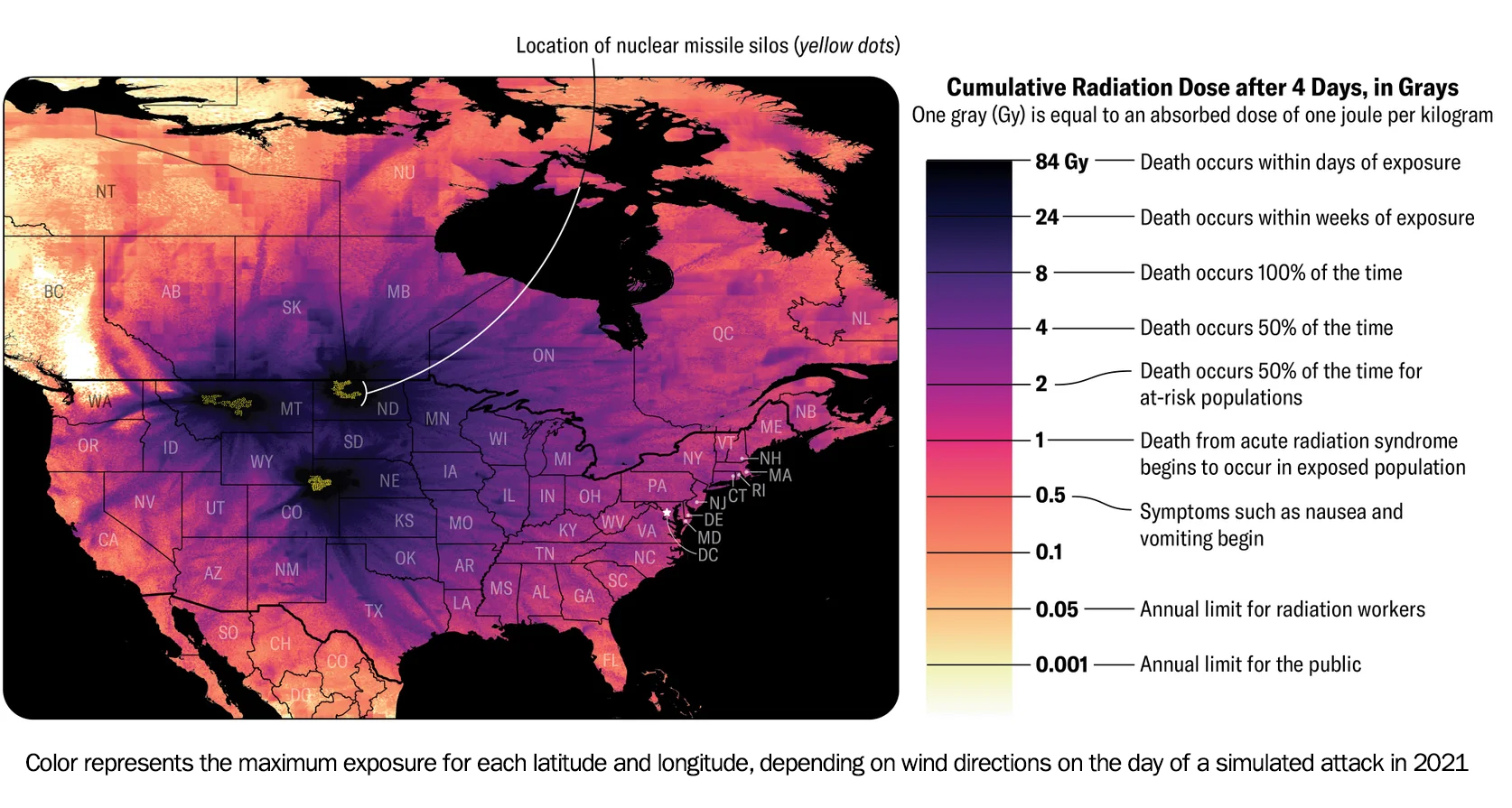
According to my models, a concerted nuclear attack on the existing U.S. silo fields—in Colorado, Wyoming, Nebraska, Montana and North Dakota—would annihilate all life in the surrounding regions and contaminate fertile agricultural land for years.
Minnesota, Iowa and Kansas would also probably face high levels of radioactive fallout. Acute radiation exposure alone would cause several million fatalities across the U.S.—if people get advance warning and can shelter in place for at least four days. Without appropriate shelter, that number could be twice as high. Because of great variability in wind directions, the entire population of the contiguous U.S. and the most populated areas of Canada, as well as the northern states of Mexico, would be at risk of lethal fallout—more than 300 million people in total. The inhabitants of the U.S. Midwest and of Alberta, Saskatchewan, Manitoba and Ontario in Canada could receive outdoor whole-body doses of radiation several times higher than the minimum known to result in certain death.
Even if there is no nuclear war, people in communities near the missile fields will continue to face serious risks that are also not discussed in the environmental impact statement. One is the accidental release of radioactive materials, such as plutonium, in the warheads by a mechanical shock, fire or explosion. A second is the accidental detonation of a warhead leading to a nuclear explosion. The history of the U.S. nuclear missile program provides several examples of silos or missiles catching fire and of missiles exploding in their launch tubes. One time, in 1964, a warhead fell from the top of its missile to the bottom of its 80-foot-deep silo. Nuclear weapon accidents are not always discussed publicly. The air force hasn’t disclosed, for example, the nature of a 2014 “mishap” that occurred while personnel were troubleshooting a Minuteman. The episode caused $1.8 million in damages to the missile, which had to be removed from its silo.
The air force needs to be far more transparent about the true risks of its land-based nuclear missile fleet so the U.S. public can make informed decisions about living with this danger for another half a century.
HOW FALLOUT AND FATALITIES SHIFT WITH THE WINDS
A concerted nuclear attack on the missile silos in the U.S. heartland would generate radioactive dust that travels with prevailing winds…………………………………………………………………………………… Depending on wind directions, a nuclear attack on the missile silos could kill several million people.
[excellent maps and charts]
……………………………………………… the average outdoor radiation dose across North America after four days of exposure. Communities living closest to the silos could receive several times more than 8 Gy, which scientists regard as lethal. Most inhabitants of Montana, North Dakota, South Dakota, Nebraska and Minnesota would get average doses greater than 1 Gy, causing fatalities from acute radiation syndrome, especially among children. The U.S. population would receive average doses greater than 0.001 Gy per year, which is the current annual limit for exposure to the public.
Fatality Count: For a simulated attack on any day of 2021, the scientists computed the resulting fatalities……………………………………………………………………………………………………………..
WHICH LOCATIONS ARE THE RISKIEST?
……………………………………………………………………………………………………………………. Communities living closest to the silos could receive several times more than 8 Gy, which scientists regard as lethal. Most inhabitants of Montana, North Dakota, South Dakota, Nebraska and Minnesota would get average doses greater than 1 Gy, causing fatalities from acute radiation syndrome, especially among children. The U.S. population would receive average doses greater than 0.001 Gy per year, which is the current annual limit for exposure to the public.
THE WORST-CASE SCENARIOS
Sifting through simulations for each day of 2021, the Princeton researchers computed the worst possible outcome at each location from a concerted nuclear attack on the missile silos. This map [on original]shows all the worst-case scenarios across North America. Not all locations would experience the worst outcome from the same attack; which areas would be impacted depends on wind patterns on the day of the attack. ……………………………………………………………. Depending on wind directions, a nuclear attack on the missile silos could kill several million people……………………………………………………………………………………………………………………….. https://www.scientificamerican.com/article/who-would-take-the-brunt-of-an-attack-on-u-s-nuclear-missile-silos/
How the United States and its NATO allies sabotaged a peace between Russia and Ukraine.

A Son of the New American Revolution, 14 November 2023 by Larry Johnson
We now know that the United States played the primary role in sabotaging the March 29, 2022 tentative peace agreement between Russia and Ukraine thanks to the recently published article by Hajo Funke and Harald Kujat, HOW THE CHANCE WAS LOST FOR A PEACE SETTLEMENT OF THE UKRAINE WAR — AND THE WEST WANTED TO CONTINUE THE WAR INSTEAD. The United States persuaded its NATO allies that pursuing the war against Russia, using Ukraine as a proxy, offered a legitimate opportunity to destroy Russia. You want a definition of evil? This is it. Instead of helping end the war between Russia and Ukraine, the United States and its NATO puppets condemned hundreds of thousands of Ukrainian soldiers to death in a war with Russia they could not win.
In the course of strong arming Ukraine’s Zelensky into rejecting the peace agreement, the West prepared and launched a propaganda campaign that claimed that Ukrainian military forces defeated the Russian forces and compelled them to retreat. It was a lie. As you will read in the timeline below, Putin ordered the withdrawal of Russian forces starting on April 1, 2022 as a good faith gesture about Russia’s seriousness in complying with the 29 March Istanbul Agreement.
Chalk this up as one more massive war crime by the United States and NATO. They are accessories to murder. I have summarized the timeline presented in the Funke/Kujat article if you do not have time to read it in its entirety. I also am republishing their piece for your convenience. All of the death and destruction experienced in Ukraine and Russia could have been avoided. But the West was intent on dethroning Putin and carving up Russia. Once you understand this point I think you will appreciate that Putin and his Generals are no longer of a mind to give the West the benefit of the doubt. Destroying NATO’s designs on Ukraine is now their chief aim in my view.
March 4, 2022 — Putin and Naftali Bennet speak via phone.
March 5, 2022 — At Putin’s invitation, former Israeli Prime Minister Bennett flew to Moscow. Putin, Bennett said, had made some substantial concessions, in particular, he had renounced his original wartime goal of demilitarizing Ukraine. … .In return, the Ukrainian president agreed to renounce joining NATO. The Ukrainians did not agree to peace because they were not allowed to. They first had to ask the Americans about everything they discussed.”
March 6, 2022 — Bennett and Scholz met in Berlin; on March 7, the United States, the United Kingdom, France, and Germany discussed the issue in a videoconference; on
March 8, 2022 — Macron and Scholz spoke on the phone; on
March 10, 2022 — Ukrainian Foreign Minister Kuleba and Russian Foreign Minister Lavrov met in Ankara; on
March 12, 2022 — Scholz and Zelensky and Scholz and Macron spoke on the phone; and on
March 14, 2022 — Scholz and Erdogan met in Ankara.
March 15-19, 2022 — Only a month after the outbreak of the war, Ukraine and Russia agreed on the broad outlines of a peace settlement. Ukraine promised not to join NATO and not to allow military bases of foreign powers on its territory, while Russia promised in return to recognize Ukraine’s territorial integrity and to withdraw all Russian occupation troops. Special arrangements were made for the Donbas and Crimea.”
March 24, 2022 — NATO decided at a special summit on March 24, 2022, not to support these peace negotiations.
March 27, 2022 — Zelensky defended the results of the Ukrainian-Russian peace negotiations in public before Russian journalists
March 28, 2022 — Putin, as a sign of goodwill and in support of the peace negotiations, declared readiness to withdraw troops from the Kharkov area and the Kiev area
29 March, 2002 — Turkiye’s President Erdogan hosted a Ukrainian-Russian peace conference in Istanbul and an armistice agreement was approved in principle.
April 1, 2022 — Putin orders Russian troops to initiate withdrawal from Kiev and Kharkiv in show of good faith in accordance with the armistice agreed to in Istanbul.
April 5, 2022 — NATO was firm in its position that continuing the war is preferred to a cease-fire and negotiated settlement: “For some in NATO, it’s better for Ukrainians to keep fighting and dying than to achieve a peace that comes too soon or at too high a price for Kiev and the rest of Europe.”
April 6, 2022 — Russia completes withdrawal from Kiev suburbs and Kharkiv.
April 9, 2022 — Boris Johnson arrived unannounced in Kiev and told the Ukrainian president that the West was not ready to end the war.
April 25, 2022 — U.S. Defense Secretary Lloyd Austin said the U.S. wants to use the opportunity to permanently weaken Russia militarily and economically in the wake of the Ukraine war.
April 26, 2022 — Meeting with defense ministers from NATO members and other countries convened by Austin in Ramstein, Rhineland-Palatinate/ Germany, the Pentagon chief declared the military victory of Ukraine as a strategic goal.
April 28, 2022 — According to Britain’s Guardian, PM Johnson “instructed” Ukrainian President Zelensky “not to make any concessions to Putin.”
HOW THE UNITED STATES AND ITS NATO ALLIES SABOTAGED PEACE BETWEEN RUSSIA AND UKRAINE
14 November 2023 by Larry Johnson 127 Comments
FacebookTwitterTelegramEmailShare

We now know that the United States played the primary role in sabotaging the March 29, 2022 tentative peace agreement between Russia and Ukraine thanks to the recently published article by Hajo Funke and Harald Kujat, HOW THE CHANCE WAS LOST FOR A PEACE SETTLEMENT OF THE UKRAINE WAR — AND THE WEST WANTED TO CONTINUE THE WAR INSTEAD. The United States persuaded its NATO allies that pursuing the war against Russia, using Ukraine as a proxy, offered a legitimate opportunity to destroy Russia. You want a definition of evil? This is it. Instead of helping end the war between Russia and Ukraine, the United States and its NATO puppets condemned hundreds of thousands of Ukrainian soldiers to death in a war with Russia they could not win.
In the course of strong arming Ukraine’s Zelensky into rejecting the peace agreement, the West prepared and launched a propaganda campaign that claimed that Ukrainian military forces defeated the Russian forces and compelled them to retreat. It was a lie. As you will read in the timeline below, Putin ordered the withdrawal of Russian forces starting on April 1, 2022 as a good faith gesture about Russia’s seriousness in complying with the 29 March Istanbul Agreement.
Chalk this up as one more massive war crime by the United States and NATO. They are accessories to murder. I have summarized the timeline presented in the Funke/Kujat article if you do not have time to read it in its entirety. I also am republishing their piece for your convenience. All of the death and destruction experienced in Ukraine and Russia could have been avoided. But the West was intent on dethroning Putin and carving up Russia. Once you understand this point I think you will appreciate that Putin and his Generals are no longer of a mind to give the West the benefit of the doubt. Destroying NATO’s designs on Ukraine is now their chief aim in my view.

March 4, 2022 — Putin and Naftali Bennet speak via phone.
March 5, 2022 — At Putin’s invitation, former Israeli Prime Minister Bennett flew to Moscow. Putin, Bennett said, had made some substantial concessions, in particular, he had renounced his original wartime goal of demilitarizing Ukraine. … .In return, the Ukrainian president agreed to renounce joining NATO. The Ukrainians did not agree to peace because they were not allowed to. They first had to ask the Americans about everything they discussed.”
March 6, 2022 — Bennett and Scholz met in Berlin; on March 7, the United States, the United Kingdom, France, and Germany discussed the issue in a videoconference; on
March 8, 2022 — Macron and Scholz spoke on the phone; on
March 10, 2022 — Ukrainian Foreign Minister Kuleba and Russian Foreign Minister Lavrov met in Ankara; on
March 12, 2022 — Scholz and Zelensky and Scholz and Macron spoke on the phone; and on
March 14, 2022 — Scholz and Erdogan met in Ankara.
March 15-19, 2022 — Only a month after the outbreak of the war, Ukraine and Russia agreed on the broad outlines of a peace settlement. Ukraine promised not to join NATO and not to allow military bases of foreign powers on its territory, while Russia promised in return to recognize Ukraine’s territorial integrity and to withdraw all Russian occupation troops. Special arrangements were made for the Donbas and Crimea.”
March 24, 2022 — NATO decided at a special summit on March 24, 2022, not to support these peace negotiations.
March 27, 2022 — Zelensky defended the results of the Ukrainian-Russian peace negotiations in public before Russian journalists
March 28, 2022 — Putin, as a sign of goodwill and in support of the peace negotiations, declared readiness to withdraw troops from the Kharkov area and the Kiev area
29 March, 2002 — Turkiye’s President Erdogan hosted a Ukrainian-Russian peace conference in Istanbul and an armistice agreement was approved in principle.
April 1, 2022 — Putin orders Russian troops to initiate withdrawal from Kiev and Kharkiv in show of good faith in accordance with the armistice agreed to in Istanbul.
April 5, 2022 — NATO was firm in its position that continuing the war is preferred to a cease-fire and negotiated settlement: “For some in NATO, it’s better for Ukrainians to keep fighting and dying than to achieve a peace that comes too soon or at too high a price for Kiev and the rest of Europe.”
April 6, 2022 — Russia completes withdrawal from Kiev suburbs and Kharkiv.
April 9, 2022 — Boris Johnson arrived unannounced in Kiev and told the Ukrainian president that the West was not ready to end the war.
April 25, 2022 — U.S. Defense Secretary Lloyd Austin said the U.S. wants to use the opportunity to permanently weaken Russia militarily and economically in the wake of the Ukraine war.
April 26, 2022 — Meeting with defense ministers from NATO members and other countries convened by Austin in Ramstein, Rhineland-Palatinate/ Germany, the Pentagon chief declared the military victory of Ukraine as a strategic goal.
April 28, 2022 — According to Britain’s Guardian, PM Johnson “instructed” Ukrainian President Zelensky “not to make any concessions to Putin.”
BEGIN FUNKE AND KUJAT ARTICLE
Berlin, October 2023
In March 2022, direct peace negotiations between Ukrainian and Russian delegations and mediation efforts by the then Israeli Prime Minster, Naftali Bennet created a genuine chance for ending the war peacefully only four to five weeks after Russia had invaded Ukraine. However, instead of ending the war through negotiations as Ukrainian President Zelensky and his government appeared to have wanted, he ultimately bowed to pressures from some Western powers to abandon a negotiated solution. Western powers wanted this war to continue in the hope to break Russia. Ukraine’s decision to abandon negotiations may been taken before the discovery of a massacre of civilians in the town of Bucha near Kiev.
In the following is an attempt of a step-by-step reconstruction of the events that led to the peace negotiations in March and their collapse in early April 2022…………………………………………………………………………………………………………………………………………………………………………………………………………………………..
CONCLUSION: MISSED OPPORTUNITY
Based on the publicly available reports and documents, it is not only plain that there was a serious willingness to negotiate on the part of both Ukraine and Russia in March 2022. Apparently, the negotiating parties even agreed on a draft treaty ad referendum. Zelensky and Putin were ready for a bilateral meeting to finalize the outcome of the negotiations. Fact is that the main results of the negotiations were based on a proposal by Ukraine, and Zelenskyy courageously supported them in an interview with Russian journalists on March 27, 2022, even after NATO decided against these peace negotiations. Zelensky had already expressed similar support beforehand in a sign that proves that the intended outcome of the Istanbul negotiations certainly corresponded to Ukrainian interests. This makes the Western intervention, which prevented an early end to the war, even more disastrous for Ukraine. Russia’s responsibility for the attack, which was contrary to international law, is not relativized by the fact that responsibility for the grave consequences that Ukraine’s Western supporters that ensued must also be attributed to the states that demanded the continuation of the war. The war has now reached a stage where further dangerous escalation and an expansion of hostilities can only be prevented by a cease-fire. It may now be the last time that a peaceful resolution through negotiations could be achieved. There are peace proposals from China, the African Union, Brazil, Mexico, Indonesia, and a proposal developed at the invitation of the Vatican as early as June 2022. On 3 October this year, we presented the German Government our own peace proposal that tried to incorporate all other peace proposals made earlier. See Ending the war by a negotiated peace – Legitimate self-defense and the quest for a just and lasting peace are not contradictory HERE.
Since the failed Istanbul negotiations The course of the war and the current extremely critical timing should be reason enough for a responsible world community and UN member states to rethink and press for a ceasefire and peace negotiations. https://sonar21.com/how-the-chance-was-lost-for-a-peace-settlement-of-the-ukraine-war/
Don’t be fooled. Biden is fully signed up to genocide in Gaza

what the Biden administration really needs is a cover story to justify the fact that it is continuing to supply the weapons and funding needed by Israel to carry out its crimes in broad daylight
The White House needs a cover story to obscure its complicity. In desperation, it is once again resurrecting the long-dead two-state solution
JONATHAN COOK, NOV 15, 2023, [First published by Middle East Eye]
The White House faces a dilemma. It has the power to stop the death and destruction in Gaza in its tracks, at any time of its choosing. But it chooses not to.
The US is determined to back its client state to the hilt, giving Israel licence to wreck the tiny coastal enclave, seemingly whatever the cost in Palestinian lives.
But the optics – and that is all that concerns Washington – are disastrous.
TV images have shown hundreds of thousands of Palestinians fleeing their destroyed homes, on a scale unseen since Israel’s earlier mass ethnic cleansing operations of 1948 and 1967.
Even the western media is struggling to obscure the veritable mountain of crushed and bleeding bodies in Gaza. The known death toll has now surpassed 11,000, with thousands more buried under rubble. Those who survive face a genocidal policy, starving them of food, water and power.
By the weekend, Israel’s declared war on Hamas had shifted into an open war on Gaza’s hospitals. Medicins San Frontieres reported that al-Shifa hospital in Gaza City had been bombed repeatedly and its power cut off, with horrific scenes of premature babies dying after their incubators had stopped functioning. Staff who tried to evacuate, as Israel had ordered them to, were shot at. Similar scenes unfolded at al-Rantisi hospital.
Western publics are growing increasingly incensed. Protest marches have attracted numbers not seen since the mass demonstrations against the Iraq war 20 years ago.
Western allies are finding it harder to obscure and justify their complicity in what are indisputable Israeli crimes against humanity. French President Emmanuel Macron broke ranks at the weekend. His message was summed up bluntly by the BBC: “Macron calls on Israel to stop killing Gaza’s women and babies.”
In private, US allies in the Middle East are pleading with the US to use its leverage to restrain Israel.
Meanwhile, Washington is only too aware of how quickly Israel’s regional opponents could get dragged in, dangerously expanding and escalating the conflict.
Its immediate response has been desperate, and preposterous, stop-gaps to ease the criticism, including from 500 administration staff who submitted a letter to Biden on Tuesday protesting the White House’s blanket support for Israel.
Those measures have included the president calling for “less intrusive action” from Israel towards the hospitals, shortly before Israeli forces were reported storming al-Shifa, and rumours that Tony Blair, the former British prime minister who joined the US attack on Iraq in 2003 in violation of international law, might serve as the West’s “humanitarian coordinator” in Gaza.
Never-ending occupation
But what the Biden administration really needs is a cover story to justify the fact that it is continuing to supply the weapons and funding needed by Israel to carry out its crimes in broad daylight.
US Secretary of State Antony Blinken set out his stall last week at the G7 summit. The goal is to shift the focus away from Israel’s genocidal policies in Gaza, and Washington’s backing for them, to a purely theoretical discussion about what might happen after the fighting ends…………………………………………………………………………………………………………………….
The no-state solution
The truth is that Washington formally abandoned the so-called two-state solution years ago, aware that Israel would never allow even the most circumscribed of Palestinian states.
Over the past three decades, Israel has gone from the pretence – maintained during the Oslo process – that it might one day concede a sham, demilitarised Palestinian state, cut off from the rest of the Middle East, to outright rejection of Palestinian statehood on any terms at all. ………………………………………………………………………………………………………………..
The goal is transparent: to expel Gaza’s population into the neighbouring Egyptian territory of Sinai. And given Israel’s previous form, the only reasonable conclusion to draw is that Gaza’s refugee families – some of them about to be exiled by Israel for a second or third time – will never be allowed to return to the ruins.
The Biden administration can pretend to be resurrecting a non-existent two-state solution. But the reality is that Israel has had just such an expulsion plan – called the Greater Gaza Plan – on the drawing board for decades.
According to reports, Washington has been signed up to the creation of a Palestinian enclave in Sinai since at least 2007…………………………………………………………………………………………………..
No eradicating Hamas
But perhaps the most fraudulent of the White House deceptions is the assumption that Hamas – and by extension, all Palestinian resistance – can be eradicated from Gaza……………………………………………………………………….
Israel’s genocidal policies – unless it intends to wipe out every Palestinian in Gaza – will not moderate that impulse for resistance. Israel will simply inflame more anger and resentment, and a stronger motive for vengeance. ……………………………………………..
Israel and the US know all this, too. History is crammed full of such lessons taught to greedy, arrogant colonisers and occupiers.
But their goal, whatever they claim, is not a solution or a resolution. It is permanent war. It is perpetuating the “cycle of violence”. It is greasing the tank treads of the West’s profitable war machine by spawning the very enemies that western publics are told they need protecting from.
Whether Palestinians are returned to the Stone Age in Gaza, as Israeli military commanders have long desired, or expelled to live in refugee camps in Sinai, they will not accept a fate in which they are treated as “human animals”.
Their fight will go on. And Israel and Washington will have to keep inventing new, ever more fanciful stories to try to persuade us that the West’s hands are clean. https://jonathancook.substack.com/p/dont-be-fooled-biden-is-fully-signed?utm_source=post-email-title&publication_id=476450&post_id=138886737&utm_campaign=email-post-title&isFreemail=true&r=ln98x&utm_medium=email
A small modular reactor’s demise calls for big change in Energy Department policy
By Henry Sokolski | November 14, 2023, https://thebulletin.org/2023/11/a-small-modular-reactors-demise-calls-for-big-change-in-energy-department-policy/
NuScale Power Corp., which is developing America’s flagship small modular reactor (SMR), has lost its only firm utility customer, the Utah Associated Municipal Power System. That utility pulled the plug last week on the project just days after Iceberg Research, a financial advisory firm, urged investors to short sell NuScale (that is, to bet the value of its shares will decrease). Shares, worth $14.87 in August, plummeted more than 85 percent, closing Monday at $2.23.

Regrettably, the US Energy Department has already given NuScale hundreds of millions in grants, and the US Export Import Bank and the US Development Finance Corporation have promised NuScale another $4 billion in financing toward a plant in Romania. NuScale’s latest loss could cast a financial pall over its parent company, the Fluor Corporation, and other Energy Department-backed SMR projects, X-Energy and Oklo.
How could this happen? Simple: The Energy Department overrode market signals, went all in with SMRs and NuScale, and stuck US taxpayers with the tab. Sadly, this is nothing new. Think Solyndra, ethanol mandates, Fisker automobiles, fast breeder reactors, and synthetic fuels.
The NuScale case, however, is worse. In the Energy Department’s zeal to sell SMRs so the country can get to net zero carbon dioxide emissions, the department failed to focus on its primary missions. These include setting energy cleanliness and efficiency standards, assuring nuclear security, spotlighting energy market trends, and conducting basic energy research to validate unproven energy concepts—e.g., fusion power—rather than commercializing systems we know already work — e.g., fission reactors. That failure of focus raises obvious questions.
Did the Energy Department do due diligence in assessing NuScale’s financial health and integrity? Did it properly weigh independent analyses that questioned the economic and environmental viability of small modular reactors more generally?Also, what of the nuclear security issues that building these plants in war zones raise?

The State and Energy departments have been pushing federal financing to export SMRs to Ukraine, its immediate neighbors, and East Asia. All of the proposed projects are within shooting distance of Russian, Chinese, and North Korean missiles. Worse, officials in Moscow, Beijing, and Pyongyang have all threatened to attack such plants.

Japan’s prime minister and Ukrainian officials have called for increased hardening and military protections for their reactors (including installing missile defenses as Belarus has at its reactor). The Energy Department, however, has yet to offer any narrative on how it might keep US-exported reactors safe against such assaults.

Then there are the nuclear weapons proliferation headaches that the exporting of small fast reactors present. One of the Energy Department’s favorite SMR projects, Bill Gates’ Natrium fast reactor, is largely a knock off of the Prism fast breeder reactor. It was designed to produce plutonium, much of which would be super weapons-grade plutonium (i.e., even easier to make into weapons than what our military uses). TerraPower, which is developing Natrium, says it plans on exporting Natrium plants. One would think the Energy Department could have explained how such reactor technology can be shared without spreading fissionable material to make nuclear bombs. So far, it has not.
Some argue that providing nuclear alternatives to Russian natural gas and preventing global warming should overshadow such proliferation concerns. Yet, most of Russia’s top gas customers are now buying elsewhere. As for fighting global warming, victory is only possible by reducing carbon dioxide emissions in the cheapest, quickest fashion. SMRs are neither quick nor cheap.
Both the nuclear industry and its critics have long favored using marginal abatement cost models to determine which energy fixes to make first to curb carbon emissions at the lowest cost. Using these models, it’s clear that making natural gas substitutions for coal-fired plants, increasing efficiencies, reducing energy demand, improving electrical transmission and storage systems, and tapping renewables all should come well before building new nuclear plants. Unfortunately, the Energy Department has yet to reference any of these models in its public statements about SMRs.
So how is the misplaced confidence in SMRs best remedied?
First, Congress should wind down the funding of Energy Department schemes to commercialize energy “winners,” nuclear or nonnuclear. Instead, the department and Congress should focus on setting energy and cleanliness goals and deadlines. To incentivize industry to meet them, the Energy Department should consider offering industry prizes.
Second, the Energy Department should make the most favored greenhouse gas cost abatement models, such as the popular McKinsey Company package, publicly available for all to use and improve. To feed better data into these models, Congress should require the Energy Department to report annually on the real costs (including subsidies) of different types of electrical generation, distribution, transmission, and storage systems.
Finally, before the United States exports any small modular reactors, the Energy Department and the Pentagon should clarify what can (and can’t) be done to protect them against military assaults and what the nuclear proliferation dangers are in the various nations that would operate them. It’s bad enough that Energy Department-backed reactors are burning holes in taxpayers’ pockets. At the very least, the Energy Department and the Pentagon should make sure that they don’t blow up in everyone’s face.
Behind the Scenes at a U.S. Factory Building New Nuclear Bombs

The workers who make pits face these risks every day
The U.S. is ramping up construction of new “plutonium pits” for nuclear weapons
Scientific American, BY SARAH SCOLES 1 Dec 23 [excellent illustrations]
This article is part of “The New Nuclear Age,” a special report on a $1.5-trillion effort to remake the American nuclear arsenal.
Within every American nuclear weapon sits a bowling-ball-size sphere of the strangest element on the planet. This sphere, called a plutonium pit, is the bomb’s central core. It’s surrounded by conventional explosives. When those explosives blow, the plutonium is compressed, and its atoms begin to split, releasing radiation and heating the material around it. The reaction ignites the sequence of events that makes nuclear weapons nuclear.
In early nuclear bombs, like the ones the U.S. dropped on Japan in World War II, the fission of plutonium or uranium and the fatal energy released were the end of the story. In modern weapons, plutonium fission ignites a second, more powerful stage in which hydrogen atoms undergo nuclear fusion, releasing even more energy. The U.S. hasn’t made these pits in a significant way since the late 1980s.
But that is changing. The country is modernizing its nuclear arsenal, making upgrades to old weapons and building new ones. The effort includes updated missiles, a new weapon design, alterations to existing designs and new pits. To accomplish the last item, the National Nuclear Security Administration has enacted a controversial plan to produce 50 new pits a year at the Savannah River Site in South Carolina and 30 pits a year at Los Alamos National Laboratory in New Mexico, the birthplace of the bomb. The first pits will be designed for a weapon called W87-1, which will tip the new intercontinental ballistic missile, called Sentinel. After that the complex will produce pits for other bomb designs.
Not everyone believes this work is necessary. Pit production foments controversy because it’s costly and potentially risky and because the existing pits might still work for a while. The physics of plutonium is complex, and no one knows when the original pits will expire. The details of how the pits are made and how they work are among America’s most closely guarded secrets. Yet in June 2023 Los Alamos officials invited a group of journalists to tour the facility for the first time in years.
We were there as the lab and the broader National Nuclear Security Administration Complex were embarking on a charm offensive to support the new plutonium work. They have to win over the tax-paying public and recruit some 2,500 new employees for the job. Some of those workers must do high-hazard work that requires expertise the country has largely let slip since the last days of the cold war. ………………………………………………………………………………………………………………..
…………………..The plutonium used for weapons exists only because people made it.
……………………………………………….. …….Plutonium’s genesis was repeated in reactors for decades. In fact, scientists made so much that no new plutonium is required for the new pits at Savannah River and Los Alamos—the current supply can be repurposed, reshaped, reborn.
None of those actions, though, will be simple because plutonium is not simple……………………………………………………………………………………….. Its most famous trick, of course, is its propensity for radioactive decay, through which it transforms itself out of existence.
This tendency is also what makes it so dangerous. Inhaled plutonium decays in the body, releasing alpha particles (helium nuclei) that can wreak havoc. The isotope plutonium 238, used as a heat and power source but not in weapons, exhibits other strange behaviors. “If you spill it in the laboratory, it will move around on its own,” Martz says. The oomph from a plutonium atom’s decay sends it shooting across a surface. “It can get everywhere,” he adds.
Plutonium’s strangeness comes from its arrangement of electrons……………………………………………………………………………………………………………………………………………………………………..
In the excitement of these early scientific discoveries, the point of the work would sometimes get lost: it was all in the service of creating a deadly superweapon. In 1945 the U.S. dropped a uranium fission bomb on Hiroshima and then sent a plutonium bomb—essentially a pit encased in explosives—to devastate Nagasaki. The bombs killed tens of thousands of people immediately and more after the fact. As Manhattan Project physicist I. I. Rabi had feared, according to a quotation in the 2005 book American Prometheus, “the culmination of three centuries of physics” was a weapon of mass destruction.
Soon after the war, production of plutonium pits migrated to a facility outside Boulder, Colo. Called Rocky Flats, it could churn out thousands of pits a year—a level of productivity perhaps enabled by its violation of environmental regulations, which in 1989 resulted in a federal raid and then a permanent shutdown. “The public wasn’t considered at the time,” says Bob Webster, deputy director of weapons at Los Alamos. ………………………………………………………………………………………………………………………………….
How aging affects a pit is the subject of contention, but some things are certain: As the plutonium atoms in a pit decay, their products damage the crystal structure of the plutonium that remains, creating voids and defects. These decays also contaminate the pit with helium, americium, uranium and neptunium, among other things. In 50 years a kilogram of plutonium will amass around 0.2 liter of helium. As pits change, their performance and safety in any conditions—including just sitting on a shelf—become questionable.
Scientists still don’t know the lifetime of a plutonium pit. …………………………………………………….. The National Nuclear Security Administration’s own studies have suggested the pits will last at least 150 years but also that their degradation could result in surprise defects. And scientists may never know exactly what those defects do or how they would affect an explosion because the ostensible point of nuclear weapons is to never use them.
So far restarting American pit production is proving challenging. Los Alamos’s efforts are at least a year behind schedule, and Savannah River’s are more like five years delayed.
The Defense Nuclear Facilities Safety Board and other critics have claimed that PF-4 isn’t resilient enough against the kind of earthquake geologists now know could occur in Los Alamos. Such significant shaking and the fires it could cause, the board alleged at a hearing last year, could result in plutonium contamination that reaches the public.
……………………… Other safety concerns have come up recently, though. In May the National Nuclear Security Administration released an investigation about four 2021 incidents: one criticality safety violation, one breach that resulted in skin contamination for three workers, and two flooding events that sent water toward fissionable materials. The agency determined that the contractor that manages Los Alamos had violated safety, procedural, management and quality-assurance rules.
………………………………………………………………………………………….. On the tour, we are forbidden from setting our notebooks down lest potential contamination stick to them. Should we drop them, a radiological control technician—who has been following us the whole time and scans our hands and feet for radioactivity anytime we leave a room—would measure each page before returning them.
…………………… In some rooms, radioactive waste is packaged and waiting to go to a storage facility, with the dosage one might receive from standing near it written on the ground. We are never allowed to forget that this is a dangerous place.
The workers who make pits face these risks every day………………………………………………………………………………
All of this effort and investment is being made in the hopes that the pits never serve their active purpose. The U.S., like all nuclear nations, stockpiles weapons in a delicate game of deterrence, the idea being that the existence of our equally or more capable weapons will stop others from using theirs. In this strategy, the pits’ true purpose is to sit idly as a threat. But for the strategy to work, the country must be willing to follow through on that threat.
……………………………………. The fear people feel when confronted with plutonium has degraded over time. But the atomic age is renewing, and we will all have to grapple afresh with the coiled terror of these powerful weapons. https://www.scientificamerican.com/article/behind-the-scenes-at-a-u-s-factory-building-new-nuclear-bombs/
The Uzbek nuclear endeavour: Boon or bane for Central Asia?

Eu Reporter, NOVEMBER 13, 2023
In the shadow of the Uzbek-Kazakh border, in a region prone to seismic tremors, Uzbekistan has unveiled plans to construct a nuclear power plant with significant help from Russia. This decision, given Russia’s current war in Ukraine and its resultant sanctions by Western nations, stirs unease and scepticism, writes Alan Kosh in International Policy Digest.
Beyond geopolitical ramifications, there are substantial concerns that this project might disrupt the environmental equilibrium and investment climate throughout Central Asia, further exacerbating regional security tensions. One of the glaring consequences of this alliance is not merely its economic implications but the potential for Uzbekistan to be ensnared in a “strategic dependency” on Russia.
In this geopolitical chessboard, Moscow, already wielding influence through avenues like labour migration, natural gas, and petrochemical products, stands to gain control over nuclear fuel production and the upkeep of the upcoming nuclear facility.
The proposed plant’s location is by Lake Tuzkan, part of the Aydar-Arnasay lake system, a mere 40 kilometres from the Uzbekistan-Kazakhstan border. Alarmingly, Tashkent, a bustling city home to three million residents, is just 140 kilometres away. Experts have voiced concerns over the plant’s positioning without proper windrose calculations and in an earthquake hotspot, where magnitudes can range from 6.0 to 6.5 and even higher.
Furthermore, Uzbekistan’s seismic activity is widespread. Several towns, including Jizzak and settlements near the proposed plant, lie in earthquake-sensitive zones, with some tremors potentially hitting a catastrophic 9 on the Richter scale.
Some posit that the mountainous terrain would shield Uzbekistan from any airborne radioactive emissions in the event of a nuclear disaster. However, the ensuing contaminated water would invariably flow towards the Kazakh plains, infiltrating deep into the earth.
Kazakh ecologist Timur Yeleusizov articulates the anxieties many share: the consequences of potential contamination of water bodies in an accident scenario. “Seismological activity in the area of the selected NPP site raises many questions. Who will be responsible for everything that happens in the event of accidents or leaks? After all, rivers and lakes, including underground streams, will also be contaminated with toxic substances.”………………………………………………………..
Rosatom’s claim regarding the VVER-1200 reactor’s safety post-Fukushima has been challenged by European nuclear safety experts, pointing to significant design and safety flaws. This, coupled with a lack of licensing in Western nations, raises red flags.
Despite public petitions against the nuclear power plant, spearheaded by Uzbek activist Akzam Akhmedbaev, the movement hasn’t gained significant traction. Anvarmirzo Khusainov, a former Uzbek minister turned environmentalist, opines on Russia’s strategic manoeuvring in Central Asia, highlighting the long-term maintenance and security implications of such plants.
…………………………… While Kazakhstan contemplates a national referendum on nuclear energy, Uzbekistan’s decision circumvented public consultation. This sidestepping is concerning, especially given the inherent risks and costs associated with nuclear power.
As the plant’s blueprint progresses, environmental concerns loom large, notably the potential drop in water levels in the Aydar-Arnasay Lake system, crucial for cooling the reactors. Yeleusizov emphasizes the region’s acute water scarcity, arguing that water concerns overshadow energy needs and thus warrant project reconsideration.
Uzbekistan’s nuclear aspirations, set against the backdrop of Central Asia’s quest for unity and peace, present a conundrum. The presence of a Russian-backed nuclear facility amidst escalating global conflicts raises alarms. Wilder Alejandro Sánchez’s contemplative piece, “Does Uzbekistan Need a Nuclear Power Plant?” mirrors these anxieties. As the world teeters on the brink of potential nuclear calamity, the urgency to address these concerns and the associated regional ramifications cannot be understated. https://www.eureporter.co/world/uzbekistan/2023/11/13/the-uzbek-nuclear-endeavor-boon-or-bane-for-central-asia/
1 This Month





PLEASE OPPOSE HR 8255 AND S.3639 – bills would accelerate satellite deployment, with no environmental review or safeguards – https://ncstd5li.quorum.us/campaign/169331/
To see nuclear-related stories in greater depth and intensity – go to https://nuclearinformation.wordpress.com
-
Archives
- October 2026 (81)
- September 2026 (339)
- August 2026 (330)
- July 2026 (355)
- June 2026 (287)
- May 2026 (306)
- April 2026 (356)
- March 2026 (251)
- February 2026 (267)
- January 2026 (308)
- December 2025 (358)
- November 2025 (359)
-
Categories
- 1
- 1 NUCLEAR ISSUES
- business and costs
- climate change
- culture and arts
- ENERGY
- environment
- health
- history
- indigenous issues
- Legal
- marketing of nuclear
- media
- opposition to nuclear
- PERSONAL STORIES
- politics
- politics international
- Religion and ethics
- safety
- secrets,lies and civil liberties
- spinbuster
- technology
- Uranium
- wastes
- weapons and war
- Women
- 2 WORLD
- ACTION
- AFRICA
- Atrocities
- AUSTRALIA
- Christina's notes
- Christina's themes
- culture and arts
- Events
- Fuk 2022
- Fuk 2023
- Fukushima 2017
- Fukushima 2018
- fukushima 2019
- Fukushima 2020
- Fukushima 2021
- general
- global warming
- Humour (God we need it)
- Nuclear
- RARE EARTHS
- Reference
- resources – print
- Resources -audiovicual
- Weekly Newsletter
- World
- World Nuclear
- YouTube
-
RSS
Entries RSS
Comments RSS