Swastikas seen on US-made Ukrainian military hardware (VIDEO)
https://www.rt.com/russia/590928-bradley-ifv-ukraine-swastikas/ 22 Jan 24
Nazi symbols can be seen in footage taken by a local journalist covering the frontline
A video featuring a Ukrainian crew repairing a US-supplied Bradley infantry fighting vehicle near the frontline with Russia has revealed the apparent fondness for Nazi symbols among Kiev’s forces.
The footage, which was shared online by journalist Alla Khotshnyavska, showed a Ukrainian crew repairing the IFV’s tracks at an unspecified location in Donbass. Covered in mud, the Bradley sports a pair of swastikas scratched into the dirt on the side of the vehicle.
Radical Ukrainian nationalists played a key role in toppling the government in Kiev in 2014, and later attained significant influence in the country’s military. Their ideology stems from the forces that collaborated with the invading Nazis against the Soviet Union during World War II.
The presence of far-right activists, including neo-Nazis, in the Ukrainian armed forces was widely acknowledged in the West until hostilities with Russia erupted in February 2022.
Nazi insignia worn by Ukrainian troops has regularly been caught on camera. In one example, a member of President Vladimir Zelensky’s guards was seen with a skull and bones patch on his uniform when the Ukrainian leader was visiting the front line in September 2022. The image closely resembled the insignia of the 3rd SS Panzer Division ‘Totenkopf’.
The same month, a Ukrainian armored vehicle with a swastika painted on it was filmed by a crew from German television channel N-TV.
Last year, former Ukrainian President Pyotr Poroshenko wore a military-style shirt with a patch featuring another Nazi-linked symbol, the Black Sun (or ‘Sonnenrad’), as he was delivering equipment to troops.
An article by the New York Times in June acknowledged the controversial popularity of Nazi iconography in Ukraine, but claimed it did not reflect the ideology of the people using the symbols.
One of Moscow’s goals in its confrontation with Kiev is ‘denazification’ and the removal of radical Ukrainian nationalists from positions of power. Russian officials have argued that the discrimination against ethnic Russians in modern Ukraine is based on Ukrainian supremacism and is similar to Nazi ideology.
President Vladimir Putin told reporters last December that Moscow would not have been compelled to intervene in Ukraine “if they didn’t start to eradicate Russia on our historic lands in Ukraine, expel people from there, [and] declare Russians non-native.” Officials in Kiev were “crazy” to introduce such policies, he suggested.
TODAY. If you care about safety, you don’t get a job on the Nuclear Regulatory Commission!
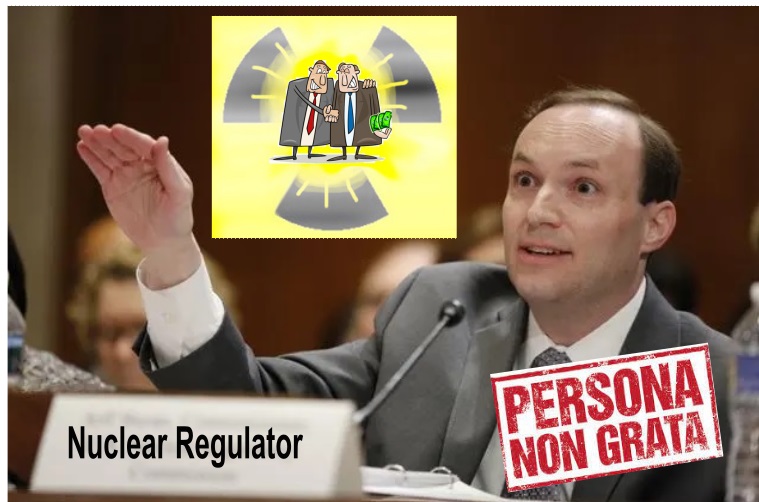
Yes, the nuclear lobby ‘killed’ the job of Jeff Baran, because his prime concern is safety, rather than promoting the nuclear industry !
What really got me about this – is that Jeff Baran is actually a very pro nuclear person! He wants the new nuclear renaissance to thrive. wants the new advanced reactors to go ahead.
It’s just unfortunate that Jeff Baran shows a bit of concern for environmental justice, for indigenous communities impacted by nuclear matters, and, biggest mistake of all “he prioritises safety”.
Ya can’t have a nuclear regular with that attitude!
Now in the past, the nuclear industry was held back by dreadful people, now thoroughly discredited, of course.

Greg Jaczko, the former Chair of the Nuclear Regulatory Commission, published an explosive new book: Confessions of a Rogue Nuclear Regulator. In it, he gets honest with the American people about the dangers of nuclear technology, which he labels “failed,” “dangerous,” “not reliable.” He particularly comes down against nuclear as having any part in mitigating the problems of climate change/global warming.

Allison Macfarlane, former chairman of the United States Nuclear Regulatory Commission (NRC). “I encourage countries that are just embarking on nuclear power to make sure that they have a plan for disposal, before they turn on the reactor.”
‘Earthquakes are just one of many natural hazards nuclear plants must
be prepared for’, she said. ‘Others include tornadoes, flooding, drought
and tsunamis.’
she says ‘one of the reasons SMRs will cost more has to do with fuel costs’ with some designs requiring ‘high-assay low enriched uranium fuel (HALEU), in other words, fuel enriched in the isotope uranium-235 between 10-19.99%, just below the level of what is termed “highly enriched uranium,” suitable for nuclear bombs. ………… an enrichment company wants assurance from reactor vendors to invest in developing HALEU production. But since commercial-scale SMRs are likely decades away, if they are at all viable, there is risk to doing so.’
At least we know where we are, people! If you had any idea that the USA government was in charge of nuclear safety, well you can put that idea to bed.
When Ted Norhaus and the Breakthrough Institute can finish off the job of a pro- nuclear regulator, because he has the temerity to prioritise safety, well, you really know that the nuclear lobby controls the USA government.

Nuclear lobby “kills” nomination of regulator who cares too much about safety
“We killed this nomination,” said Ted Nordhaus, executive director of the Breakthrough Institute, a California-based climate think tank that advocates for more nuclear energy.
Biden Drops Nuclear Regulator Nominee After Senate Backlash
Alexander C. Kaufman, Tue, 23 January 2024 https://au.news.yahoo.com/biden-drops-nuclear-regulator-nominee-190521226.html
President Joe Biden is dropping his pick to fill the open seat on the Nuclear Regulatory Commission after a handful of Democrats joined Senate Republicans to block the nomination last year, HuffPost has learned.
Jeff Baran had held a seat on the five-person federal panel overseeing atomic energy and radiation safety since former President Barack Obama first named to the position in 2014. The Democratic commissioner easily won Senate approval when former President Donald Trump renominated him in 2018.
But pro-nuclear advocates angry over what they saw as Baran’s unwillingness to overhaul the regulatory process in favor of building new types of reactor technologies launched a campaign against the commissioner last year. With Republicans opposed to the nomination, the Biden administration needed almost every Democrat in the Senate to vote for Baran ― or leave the NRC without a tie-breaker for party-line votes between the four current commissioners.
The White House had wanted the Senate’s narrow Democratic majority to reconfirm Baran before his term ended last July. But as many as four senators on the Democratic side, including Sen. Joe Manchin (D-W.Va.) and Sen. Kyrsten Sinema (I-Ariz.), either planned to come out against Baran or refused to pledge their votes, according to a source with knowledge of the process. Neither senator’s office immediately responded to emails requesting comment on Monday.
When the Senate ended 2023 last month without a vote, the nomination automatically went back to the White House.
The NRC directed HuffPost’s questions about when the administration would name its nominee for the open commission seat to the White House, which did not respond to a request for comment.
But three sources with knowledge of the plans confirmed to HuffPost that the Biden administration does not plan to nominate Baran again. Two spoke to HuffPost on condition of anonymity because they were not authorized to comment publicly. The third claimed Baran’s loss as a victory.
“We killed this nomination,” said Ted Nordhaus, executive director of the Breakthrough Institute, a California-based climate think tank that advocates for more nuclear energy.
He was among the most vocal opponents of Baran’s nomination, and helped drum up votes against the Democratic commissioner. Nordhaus had cast Baran as a holdover from an earlier era of liberal regulators who saw their job primarily as safeguarding the public against the atomic energy industry.
“It is my job to focus on nuclear safety and security,” Baran said in 2017 at his reconfirmation hearing before the Senate Environment and Public Works committee. “It is not my job to weigh in on the pros and cons of the merits of nuclear power.”
That view, Nordhaus said, was common among Democrats for decades. But a modern outlook on nuclear safety has to consider not only the threats of using atomic energy, but the risks that not doing so increases pollution from fossil fuels that damages lungs and traps heat in the planet’s atmosphere.
“Everyone went into this just assuming everybody would line up behind Baran, that this is just the kind of guy Democrats put on the commission,” Nordhaus said.
“The fact that enough Democratic senators were willing to say we’re not going to vote for this guy,” he added, “it’s pretty clear that for the first time in maybe ever a bunch of Democrats now recognize that we need reform at the NRC, that something has to change, that the technology can’t succeed if the NRC continues to approach this in the way it historically has.”
But Baran had defenders. The progressive pro-nuclear group Good Energy Collective previously told HuffPost Baran had a strong record of fighting for environmental justice and building relationships with communities saddled with radioactive pollution from the past.
Top Nuclear Regulator Faces Tough Reconfirmation Battle In The Senate
Biden wants to keep Jeff Baran on the Nuclear Regulatory Commission, but the GOP and pro-nuclear activists say he’s holding back an atomic renaissance.
Huff Post, By Alexander C. Kaufman, Jun 27, 2023
When President Barack Obama first named Jeff Baran to the Nuclear Regulatory Commission in 2014, the Democratic majority in the Senate confirmed the former congressional staffer in a 52-40 vote. When President Donald Trump renominated the Democrat for another five-year term in 2018, the GOP-led Senate approved Baran by a simple voice tally.
But President Joe Biden’s plan to give Baran a third stint on the federal body responsible for the world’s largest fleet of commercial reactors has already hit the rocks, as Republicans move to block a commissioner critics paint as an “obstructionist” with a record of voting for policies nuclear advocates say make it harder to keep existing plants open and more expensive, if not impossible, to deploy advanced next-generation atomic technologies.
Last Friday, the Senate went on break for the next two weeks, all but guaranteeing that Baran’s current term ends on June 30 without a decision on whether he will rejoin the five-member board, creating a vacancy that could cause gridlock on some decisions and mark a return to the partisan feuds of a decade ago…………
The White House and the Democrats who control the Senate hope to reinstate Baran in a vote next month, casting the regulator as a sober-minded professional with an ear to the woes of those living in polluted or impoverished communities. The battle highlights growing tensions over nuclear energy in the United States, the country that built the world’s first full-scale fission power plant nearly seven decades ago but all but ceased expanding atomic energy in the 30 years since the Cold War ended…………………………………………………………….
“His voting record shows he’s been a consistent obstructionist, a defender of a regulatory system that has basically presided over the long-term decline of the nuclear sector in the U.S.,” said Ted Nordhaus, executive director of the Breakthrough Institute, a California-based environmental think tank that advocates for nuclear energy. “There’s a broad view at a pretty bipartisan level that we need nuclear energy. If Democrats are serious about it, they have to stop putting a guy like Jeff Baran at the Nuclear Regulatory Commission.”
The Breakthrough Institute was among five pro-nuclear groups that signed on to a June 12 letter urging the Senate Committee on Environment and Public Works to reject the White House’s nomination of Baran for a third term.
The NRC declined HuffPost’s request to interview Baran…………………………………………………
The Case Against Baran
Baran came to power right as the last attempt at a “nuclear renaissance” fizzled…………………
As governments scrambled to keep operating reactors from going out of business, Baran voted last July to increase the frequency of federal safety inspections on existing nuclear plants, arguing that it would allow for “more focused inspections” that would “provide the staff flexibility to take a deeper dive into different areas of high safety importance” as the reactor fleet ages.
Baran also came out against measures that supporters of new reactor designs say would have helped tailor the regulatory process to the specific needs of novel technologies…………………
Baran issued the NRC’s sole vote against three recent proposals to make it easier to build an SMR at a former coal- or gas-fired plant, to tailor the size of the emergency preparedness zone to the size of the reactor, and to update the environmental permitting requirements for new reactors to account for the dramatic difference in water use between traditional and new designs…………..
While outnumbered by the other four commissioners, Baran’s hard-line view against easing regulations mirrors the Fukushima era in which he came to power, when Democrats Gregory Jaczko and Allison Macfarlane chaired the NRC and delivered on Reid’s efforts to block key nuclear projects. Nordhaus described Baran as a holdover from that period…………………..
The Case For Baran
Baran is not without his defenders among atomic energy advocates.
“It’s not as though he’s anti-nuclear,” said Jackie Toth, the Washington-based deputy director of the Good Energy Collective, a progressive pro-nuclear group headquartered in California. She noted that Baran’s critics often paint him as having the same views as Jaczko and Macfarlane. “To pool them together without looking at the full breadth of his record and what he’s done is unfair.”
“He prioritizes safety and not simply taking industry at its word,” Toth said. “It’s critical to have on the commission someone who understands both the need for increased nuclear capacity on our grid for climate, communities and energy security, but still wants to make sure the industry is putting its best foot forward.”
In particular, she said, Baran has been a crucial supporter of efforts to make it easier for poor and polluted communities — which, thanks to the U.S. history of racist legal and cultural norms, tend to be populated by Black, Latino or Native Americans — to participate in the public regulatory process. While she said she “did not have concerns regarding” the other commissioners’ dedication to environmental justice, Baran’s focus on the issue served to “complement” the other four regulators.
“We feel it’s an asset to have someone like him at the NRC who gets the climate imperative for new reactors but also upholds the agency’s mission to be a trusted regulator that prioritizes public health and safety,” Toth said.
‘Rolling The Dice’
But as Congress presses ahead with legislation to boost nuclear power, Baran’s opponents see him as a potential hurdle to implementing the laws.
In 2018, Congress passed the Nuclear Energy Innovation and Modernization Act, which directed the NRC to establish a novel regulatory framework for new technologies that takes into account the differences between advanced reactors and traditional ones. Baran consistently voted against adjusting the size of a new nuclear plant’s emergency planning zone to align with the size of the reactor, or insisted that the Federal Emergency Management Agency should decide even though the NRC is the regulator with the technical expertise to make the final call.
Over the past two years, Congress earmarked billions of dollars for new reactors in the landmark infrastructure laws Biden signed. And the same Senate committee that narrowly voted along party lines to confirm Baran’s renomination for another term overwhelmingly passed a new bill known as the ADVANCE Act to speed up deployment of new reactor technologies earlier this month………………………..
‘Operation Al-Aqsa Flood’ Day 108: Israel is systematically obliterating Gaza, section by section
As Israeli forces surround yet another hospital in Gaza, Hamas releases a letter clarifying its motives behind the October 7 attack, reiterating the Palestinian demand for the right to self-determination.
Mondoweiss, BY LEILA WARAH ,
Casualties
- 25,295+ killed* and at least 63,000 wounded in the Gaza Strip.
- 387+ Palestinians killed in the occupied West Bank and East Jerusalem.
- Israel revises its estimated October 7 death toll down from 1,400 to 1,147.
- 532 Israeli soldiers killed since October 7, and at least 3,221 injured.**
*This figure was confirmed by Gaza’s Ministry of Health on January 22. Some rights groups put the death toll number higher than 32,000 when accounting for those presumed dead.
Key Developments
- UNOCHA: Only 15 bakeries still operational across Gaza, none in north.
- UNOCHA: Approximately 1.7 million internally displaced people in Gaza.
- Euro-Mediterranean Human Rights Monitor: Israel killed 94 professors in Gaza since October 7.
- Palestine Red Crescent Society: Israeli tanks near al-Amal City Hospital in Khan Younis, all contact with PRCS team in area lost.
- Palestine Red Crescent Society: Israel besieges ambulance center in Khan Younis, prevents lifesaving movement.
- Israeli forces destroy entire neighborhood in Khan Younis via demolition, after soldier takes selfie with explosives.
- Two Hezbollah fighters killed in Lebanon by Israeli drone strike.
- Palestinian Ministry of Health: 190 Palestinians killed and 34 injured in the last 48 hours.
- Hamas publishes 16-page report to “clarify” background and dynamics of October 7 surprise attack.
- Israelis protest outside Netanyahu home, demand return of Israeli captives.
Hospitals under attack in southern Gaza
The Israeli army is systematically destroying Gaza as its genocidal war on the beleaguered strip enters its 108th day. The Israeli army, after having almost completely decimated northern Gaza, continues to move further south, setting its sights on Khan Younis, the second-largest district in the besieged enclave.
The area was initially designated a safe zone by Israel, leading hundreds of thousands of residents from the north to seek refugee in the city. Yet Khan Younis has now already become a shadow of itself after extensive damage and destruction wrought by the relentless Israeli airstrikes.
The ground invasion continues the campaign of obliteration, as Israeli soldiers filmed themselves blowing up 40 residential buildings at once with the use of explosives. Earlier, soldier Itamar Bello shared a selfie of himself posing with the mines used for the demolition.
Meanwhile, Israeli tanks and military vehicles are approaching al-Amal Hospital in the center of Khan Younis, the Palestine Red Crescent Society (PRCS) reported on Monday morning.
As a result, PRCS has lost all contact with its crews in the area.
PRCS later added that the Israeli military was preventing first responders from reaching the wounded in Khan Younis as it intensified the ground assault and attacked the PRCS ambulance center.
Meanwhile, about 1 kilometer away, the Nasser Medical Complex was surrounded on three sides by the military in conjunction with the ongoing Israeli artillery bombardment in the vicinity of Nasser Hospital, Wafa reported……………………………………………………………………………………………………………………………………………..more https://mondoweiss.net/2024/01/operation-al-aqsa-flood-day-108-israel-is-systematically-obliterating-gaza-section-by-section/
Biden Has Started Another US War
CAITLIN JOHNSTONE, Jan 22 2024, https://www.caitlinjohnst.one/p/biden-has-started-another-us-war?utm_source=post-email-title&publication_id=82124&post_id=140915473&utm_campaign=email-post-title&isFreemail=true&r=1ise1&utm_medium=email
The Washington Post has an article out titled “As Houthis vow to fight on, U.S. prepares for sustained campaign,” with “sustained campaign” being empire-speak for a new American war.
“The Biden administration is crafting plans for a sustained military campaign targeting the Houthis in Yemen after 10 days of strikes failed to halt the group’s attacks on maritime commerce, stoking concern among some officials that an open-ended operation could derail the war-ravaged country’s fragile peace and pull Washington into another unpredictable Middle Eastern conflict,” the Post reports.
The Post acknowledges that “sustained military campaign” means “war” in the ninth paragraph of the article, saying the anonymous US officials cited in the report “don’t expect that the operation will stretch on for years like previous U.S. wars in Iraq, Afghanistan or Syria.” Which is about as reassuring as a pyromaniac saying he doesn’t expect he’ll be burning down any more houses like all those other houses he’s burned down.
This bizarre refusal to just call a war a war also appeared in a recent press conference with Pentagon spokesperson Sabrina Singh, who acted shocked and aghast that reporters would even ask if repeatedly bombing a country would qualify as being at war with them.
“Is it now fair to say that the U.S. is at war in Yemen?” Singh was asked by a Reuters reporter on Thursday.
“No, we don’t seek war,” Singh replied. “We don’t think that we are at war. We don’t want to see a regional war. The Houthis are the ones that continue to launch cruise missiles, antiship missiles at innocent mariners, at commercial vessels that are just transiting an area that sees, you know, 10 to 15 percent of world’s commerce.”
In a follow-up several questions later, Singh was asked by a reporter from Politico, “You said that we are not at war with the Houthis, but if — you know, this tit-for-tat bombing — we’ve bombed them five times now. So if this isn’t war, can you just explain this a little — a little bit more to us? If this isn’t war, what is war?”
“Sure, Lara, sure, great question, I just wasn’t expecting it phrased exactly that way,” Singh replied with a laugh and a smirk. “Look, we are — we do not seek war. We are — we do not — we are not at war with the Houthis. In terms of a definition, I think that would be more of a clear declaration from the United States. But again, what we are doing and the actions that we are taking are defensive in nature.”
It is worth noting that since that Thursday press conference the number of US strikes on Yemen has increased from five to seven as of this writing.
It is also worth noting here that, per Singh’s absurd definition, the US has not been at war since the end of WWII, as there has not been a “clear declaration of war” since June 5, 1942. The only wars the US has officially declared through congress in accordance with its own constitution have been the War of 1812, the Mexican-American War, the Spanish-American War, and the two world wars.
If you go by this definition the US is among the more peaceful nations in the world, since it hasn’t been at war in eight decades. In reality the US is the single most warlike and murderous nation of modern times with wars of aggression that have killed millions and displaced tens of millions just in the 21st century alone, and plays some role in most of the world’s major international conflicts.
Singh’s claim that the US attacks on Yemen are “defensive in nature” is also self-evidently absurd; Yemeni forces weren’t even attacking American commercial vessels until the US began attacking them. Only the US could launch unprovoked attacks on a foreign nation on the other side of the planet and call it self-defense.
Antiwar’s Dave DeCamp explains:
Indeed, the only reason Houthi forces began attacking ships in the Red Sea was to pressure Israel and its allies into ceasing the ongoing massacre that has been taking place in Gaza since October 7. As usual the world’s most murderous and powerful government is framing its horrifying acts of extreme aggression as innocent defensive responses to unprovoked attacks, when in reality the US empire is bombing Yemen in order to facilitate the genocide of Palestinians.
And while we’re on the subject of Gaza and Yemen it’s probably worth pointing out that according to US empire managers the stated goals of both campaigns have been completely unsuccessful. A new report by The Wall Street Journal says that according to US intelligence Israel is nowhere remotely close to eliminating Hamas, with only 20 to 30 percent of the group having been killed since October. Asked by the press on Thursday if the strikes against the Houthis are working, Biden replied “Well, when you say ‘working’ — are they stopping the Houthis? No. Are they going to continue? Yes.”
“Before the US began bombing the Houthis, Ansar Allah officials made clear they would only stop attacking Israeli-linked commercial shipping if the onslaught on Gaza ended. Instead of pressuring Israel to end the slaughter in Gaza, President Biden chose escalation, and now the Houthis are targeting US commercial shipping, and several US merchant vessels have been hit with missiles.”
So they’re raining military explosives on impoverished middle easterners to maintain their status quo domination, under the pretense of goals which they themselves admit are not being achieved. Just another day in the empire, I guess.
Nuclear tensions on the Korean Peninsula set to worsen in 2024
https://www.icanw.org/nuclear_tensions_on_the_korean_peninsula_set_to_worsen_in_2024—
2024 looks set to be an even more perilous year than 2023 on the Korean Peninsula as nuclear threat and counter threat have escalated even further since the beginning of January. On New Year’s Day, South Korea’s defence ministry repeated previous threats to destroy the North Korean “regime” if it uses nuclear weapons. This was a response to North Korean leader, Kim Jong Un’s speech the day before in which he told his military to prepare for possible war.
Since then, Kim has said he has given up on the idea of peaceful reunification with South Korea designating it a hostile state and again warned of possible war. In the past week alone, Kim has called for a change in the constitution to designate Seoul as Pyongyang’s “primary foe” and a confidence building military agreement with the South agreed in 2018 has started to fall apart as the South Korean armed forces resumed frontline aerial surveillance in the wake of North Korean artillery exercises near a South Korean island on the maritime border between the two states.
The expected change in the constitution of the Democratic People’s Republic of Korea (North Korea’s official name) follows an amendment last year that enshrined nuclear weapons in it.
This week has also seen the North testing what it says is a solid-fueled hypersonic missile and an underwater nuclear drone in response to what some observers say is the largest ever joint naval exercise between South Korea, the United States and Japan.
Analysts believe Pyongyang is developing both so-called strategic and tactical nuclear weapons in order to deter the US which is committed to use nuclear weapons in South Korea’s defence.
North Korea has been testing more and more advanced ballistic missiles and warheads, some with the range to reach the US and has also said it is developing ship-launched cruise missiles, while the Americans have been mounting repeated shows of force including military exercises using nuclear-capable aircraft and the visit of a nuclear-armed submarine to South Korea.
Last year, the US and South Korea agreed to increase their cooperation on the planning for the use of nuclear weapons following earlier statements by South Korean President, Yoon Suk Yeol, that suggested Seoul might develop its own nuclear weapons. Yoon has since cooled talk of acquiring nuclear weapons,but the debate continues in policy circles.
Another escalatory move has been increasing military cooperation between the US, South Korea and Japan, which also endorses the use of American nuclear weapons in its defence.
In the light of this, some analysts see the Korean Peninsula as the most dangerous nuclear flashpoint in a world that currently has no shortage of conflict involving nuclear-armed states in Ukraine and Gaza.
Alicia Sanders-Zakre, ICAN’s Policy and Research Coordinator, called for restraint on all sides: “Inflammatory nuclear rhetoric and threats, accompanied by military exercises and weapons tests, ramp up tensions and bring us closer to the brink of catastrophe. All nuclear-armed states, including North Korea and the US, as well as those allied on nuclear policies, such as Japan and South Korea, need to take urgent steps to de-escalate tensions and to break free from the dangerous doctrine of nuclear deterrence. Joining the Treaty on the Prohibition of Nuclear Weapons is a crucial step to delegitimise nuclear deterrence and eliminate nuclear weapons.”
North Korea uses the same justification for its actions as the US, and the other declared nuclear-armed states. Just like Washington, Pyongyang says it is committed to disarmament, but argues the security threats it faces mean it needs nuclear weapons to deter its enemies.
The doctrine of deterrence is based on the threat to use nuclear weapons with all the catastrophic consequences that would entail for the whole world. As the states parties to the Treaty on the Prohibition of Nuclear Weapons (TPNW) declared at their recent meeting in New York: “the renewed advocacy, insistence on and attempts to justify nuclear deterrence as a legitimate security doctrine gives false credence to the value of nuclear weapons for national
security and dangerously increases the risk of horizontal and vertical nuclear proliferation.”
The TPNW (Treaty for the Prohibition of Nuclear Weapons) is growing in strength and has just welcomed its 70th state party while a further 27 countries are signatories. These states recognise that the total elimination of nuclear weapons is a global imperative and they are showing responsible leadership by championing the treaty as the best way to end the existential threat posed by nuclear weapons.
German defense chief against going ‘all in’ on Ukraine
23 Jan 24, https://www.rt.com/news/590954-germany-defense-minister-pistorius-no-ukraine-all-in/
Boris Pistorius says donating too many weapons to Kiev would weaken Berlin’s own forces
Germany should exercise some caution in its support for Ukraine, Defense Minister Boris Pistorius has told the newspaper Der Tagesspiegel. He also revealed that Berlin is considering reverting to a compulsory military service system.
The defense chief warned last month that European nations have less than a decade to ramp up their military capabilities in anticipation of a potential armed confrontation with Russia, and predicted that the US would shift its focus to the Asia-Pacific region.
In an interview published on Friday, Pistorius dismissed criticisms that Germany is not sending enough weaponry to Ukraine, pointing out that Berlin is the second largest contributor to Kiev after the US. However, he stressed that shipping German-made long-range Taurus cruise missiles, which Kiev has been requesting for months, is currently out of the question.
“We have so far delivered everything that is possible,” he said, adding that Germany carefully weighs up the potential impact of each new shipment to Ukraine.
Pistorius cautioned that Berlin must also “keep an eye on its own defense capabilities” meaning that it can’t go “all in” for Ukraine as some are demanding.
“Otherwise we would be defenseless ourselves,” he warned, while calling on other European nations to ramp up their defense production, to become more independent of the US.
The German minister suggested that Russian President Vladimir Putin could eventually “attack a NATO country,” while acknowledging that such a scenario was unlikely at present. Germany must thoroughly upgrade its armed forces and civil defense, he concluded.
As part of these efforts, the Bundeswehr will simplify its recruitment policies and loosen its enlistment criteria, he noted, while mentioning the current debate on reintroducing compulsory military service.
A survey last month revealed that only 17% of German adults would be prepared to defend their country without question in case of a military conflict.
Earlier this week, Chancellor Olaf Scholz confirmed that Berlin would shell out more than €7 billion ($7.6 billion) on military aid for Ukraine this year.
Berlin provided Kiev with nearly $23 billion in aid between February 2022 and November 2023, according to the Kiel Institute for World Economy (IfW).
Since Kiev’s summer counteroffensive fizzled out with no major gains and heavy losses, top Ukrainian officials have increasingly been pressuring their Western backers for more weaponry.
Shock Horror! They’re letting some WOMEN into the Cop29 climate summit committee

Women added to Cop29 climate summit committee after backlash. Panel was
originally composed of 28 men, a move condemned as ‘regressive’ and
‘shocking’. The president of Azerbaijan has added 12 women to the
previously all-male organising committee for the Cop29 global climate
summit, which the country will host in December.
Guardian 19th Jan 2024
https://www.theguardian.com/environment/2024/jan/19/women-cop29-climate-summit-committee-backlash
Mexico and Chile Call on International Criminal Court to Investigate Crimes in Gaza
byEDITORJanuary 21, 2024
Mexico and Chile have joined South Africa, Bolivia, Djibouti, Bangladesh, and the Comoros in calling on the ICC to investigate Israel for its crimes in Gaza, including war crimes and genocide.
By Tanupriya Singh / Peoples Dispatch
Chile and Mexico have called upon the International Criminal Court (ICC) to investigate the crimes being committed amid Israel’s ongoing war on Gaza. In the past 105 days, Israel has killed over 24,600 Palestinians in Gaza, with more than 7,000 people missing and presumed dead under the rubble.
In a statement released on January 18, Mexico and Chile stated that their referral to the ICC was “due to growing concern about the latest escalation of violence, particularly against civilian targets, and the alleged continued commission of crimes under the jurisdiction of the Court, specifically since the attack on October 7, 2023, carried out by Hamas militants and the subsequent hostilities in Gaza.”……………………………………………………………………………………………… more https://scheerpost.com/2024/01/21/mexico-and-chile-call-on-international-criminal-court-to-investigate-crimes-in-gaza/
The 2024 Doomsday Clock announcement
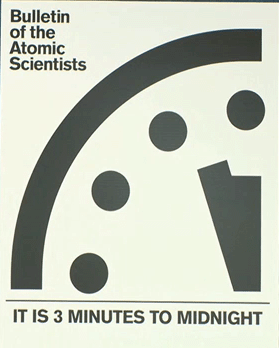
Watch the Clock unveiling live here on January 23 at 10 a.m. EST
Right now, the Clock is the closest it has ever been at 90 seconds to midnight. What time will it be this year? Join experts from our Science and Security Board along with science educator Bill Nye on January 23rd at 10 am EST to find out.
Another week in nuclear news

Some bits of good news. The Year in Cheer – 177 ways the world got better in 2023.
TOP STORIES. The Last Flurry: The US Congress and Australian Parliamentarians seek Assange’s Release.
UK’s nuclear obsessions kill off its net zero strategy . Military interests are pushing new nuclear power – and the UK government has finally admitted it.
LIES. United Against Nuclear Iran: The Shadowy, Intelligence-Linked Group Driving the US Towards War With Iran.
Nuclear goes backwards, again, as wind and solar enjoy another year of record growth.
********************************
Climate. State of the Climate: 2023 smashes records for surface temperature and ocean heat. A new wave of climate denialism is on the rise. The Greenland ice cap is losing an average of 30m tonnes of ice an hour due to the climate crisis. Shock Horror! – They’re letting some WOMEN into the Cop29 climate summit committee!
Nuclear. Pro nuclear propaganda seems to be doubling, as nuclear’s obscene costs become more apparent, as well as “clean nuclear’s absolute connection with weaponry!
Noel’s Notes. UK govt has come clean about it! Nuclear power- no use, really – just essential for the nuclear weapons industry. Biden in a bind – powerless to stop the genocide, but keen to fund it and promote it. The human cost when IT goes wrong. https://www.youtube.com/watch?v=LdQQib3rmkE
**********************************
ECONOMICS. The Times asks “Are big nuclear reactors really the right thing for the UK? Nuclear power may twice as expensive as the Swedish government thought? $25 billion for refurbishment of Darlingon and Bruce reactors. US Offers Up To $500MM for Advanced Nuclear Fuel Production for SMRs. Big costs sink flagship nuclear project
EMPLOYMENT. Federal Employees to Stage Walk Out Over Biden’s Support for Gaza Slaughter
ENERGY. An Unprecedented Momentum for Renewables. IEA: Global renewable capacity grows over 50% YoY in 2023. Analysis: World will add enough renewables in five years to power US and Canada. Fuel problems for nuclear power, as the industry continues to languish in the doldrums.
INDIGENOUS ISSUES. Kebaowek Nation calls for cancellation of nuclear waste disposal site at Chalk River. Documentary ‘Downwind’ shows deadly consequences of nuclear testing on tribal lands. https://www.youtube.com/watch?v=gkoVPZnLlUY&t=14s
LEGAL. South Africa has made its genocide case against Israel in court. Here’s what both sides said and what happens next. Fukushima Nuclear Waste Water Disputes Continued: International Law in Japanese Court?
MEDIA. How the Gaza War Can Be Big News and Invisible at the Same Time. Cancelling the Journalist: The Australian ABC’s Coverage of the Israel-Gaza War. The threat of catastrophe is assessed in Nuclear Armageddon: How Close Are We? — review https://www.youtube.com/watch?v=j43-i6E2UJU&t=128s. 1 B Scary simulator shows what could happen in the event of a nuclear disaster.
OPPOSITION to NUCLEAR . Blocking the Doors of the Treaty Blockers & the Nuclear Ban Treaty’s 3d Anniversary.
PERSONAL STORIES. ‘The fight isn’t over’: Idaho downwinders persist after Congress cuts compensation for them.
POLITICS.
- It’s All About Me: Netanyahu Rejects Palestinian Statehood.
- Even Britain’s ruling Tory party fear that their “Nuclear Roadmap” plan will end up on the scrap heap. Roadmap to warfare: new policy exposes links with UK military nuclear projects. Construction to start on Sizewell C nuclear power station amid opposition. Petition: 100 per cent renewables rather than Small Modular (nuclear) Reactors. Sizewell C opponents warn Suffolk nuclear plant ‘could be the new HS2‘.
- Biden administration finalizes a $1.1 billion aid package for California’s last nuclear power plant. Why Joe Biden Is a Foreign Policy Failure.
- Belarus says it is to change policy on nuclear weapons.
- For Estonia the risks of going nuclear are high, and the plant not strictly necessary.
- USA announces Australia’s participation in Yemen war, parliament in the dark.
POLITICS INTERNATIONAL and DIPLOMACY. São Tomé and Príncipe 70th State to ratify Treaty on the Prohibition of Nuclear Weapons. US urges discussions with China on practical nuclear risk reduction steps.
SAFETY. Limping along: EDF Energy looking to extend operational life of aging reactors AGAIN. Hinkley C site fire safety fears trigger enforcement notices.
SECRETS and LIES. Shining a light on the UK’s nuclear deterrent.
SPINBUSTER. Work officially ‘started’ at Sizewell C Nuclear on Monday – but it was really only political theatre. Why nuclear reactors are not the future of energy despite what UK Government would have you think.
TECHNOLOGY. Nuclear start-up Newcleo drops plans for British factory in favour of France. WASTES. Chalk River, or low-level nuclear governance. Finland’s Radiation and Nuclear Safety Authority (STUK) wants to delay completion of its review on waste dump.
WAR and CONFLICT. A response to Kallenborn: Why realism requires that nuclear weapons be abolished. Incredible analysis of US warmongers plans for war with China ! Read this and weep!
WASTES. Chalk River, or low-level nuclear governance. Finland’s Radiation and Nuclear Safety Authority (STUK) wants to delay completion of its review on waste dump.
WEAPONS and WEAPONS SALES.
- The Military-Industrial Complex Is the Winner (Not You). What sort of world do we want?: ICAN exec discusses ultimate goal of nuclear abolition. Nuclear Threats Are Looming, And Nobody Knows How Many Nukes Are Out There. Are Nuclear-Armed Nations Entering a New Arms Race in 2024? – Experts Weigh In.
- Germany plans to supply Israel with tanks shells as Gaza death toll nears 25,000.
- Zelensky Courts JPMorgan, Bank of America & Bridgewater CEOs At Davos, Urges More Money From West. German defense chief against going ‘all in’ on Ukraine.
- North Korea says it tested underwater nuclear attack drone in response to rivals’ naval drills. Nuclear tensions on the Korean Peninsula set to worsen in 2024. Are Nuclear-Armed Nations Entering a New Arms Race in 2024? – Experts Weigh In.
Nuclear start-up Newcleo drops plans for British factory in favour of France
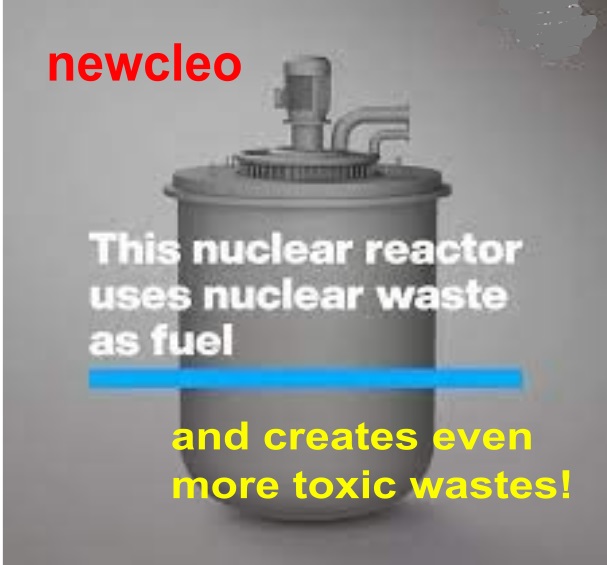
COMMENT. This is a very interesting article. For one thing, it shows that these “advanced” nuclear reactors require plutonium to get the fission process happening. It also claims that these advanced nuclear reactors can solve the problem of plutonium wastes. That is not true. The wastes resulting from this process are smaller in volume, but more highly toxic. That means that they require the same area/voume of space for disposal as the original plutonium. On another angle, it does indicate the confusion that the British government is in about the way ahead in their highly suspect “Civil Nuclear Roadmap”. And on another angle again, it shows how Macron’s France is putting all its eggs into the one nuclear basket. When we look at the extreme costs, and the extreme climate effects, Macron’s French nuclear obsession is likely to result in political suicide.
Matt Oliver, Sun, 21 January 2024, https://finance.yahoo.com/news/nuclear-start-drops-plans-british-131702123.html#:~:text=A%20British%20nuclear%20startup%20has,lobbied%20personally%20by%20Emmanuel%20Macron.
A British nuclear startup has dropped plans to build a pioneering power plant in Cumbria and will invest £4bn in France instead, after it was lobbied personally by Emmanuel Macron.
Newcleo, which is headquartered in London, is developing a type of mini nuclear power plant, known as an advanced modular reactor (AMR), that will use nuclear waste for fuel.
The company had hoped to tap into the UK’s vast stockpile of waste at Sellafield, where it wanted to invest £2bn in a waste reprocessing factory and AMR that would have created around 500 jobs.
It was also planning a similarly-sized facility in France.
But Stefano Buono, Newcleo’s chief executive and founder, said the company has now dropped the UK plans after the Government ruled out giving private companies access to the Sellafield stockpile in a nuclear industry “roadmap” published this month.
Instead, Newcleo is planning an enlarged development at an undisclosed location in the south of France, where it now plans to spend £4bn and create around 1,000 jobs, he said.
As part of that scheme, it will buy nuclear waste from French state energy giant EDF.
The company is also currently in the middle of a €1bn (£860m) fundraising.
The decision comes after the company was blocked from participating in the UK’s design competition for mini nuclear reactors.
By comparison, France has eagerly supported Newcleo and Mr Buono was lobbied repeatedly for investment by President Macron in face-to-face meetings.
Newcleo, which was also invited to last year’s “Choose France” business summit at the Palace of Versailles, has never been offered an in-person meeting with a British prime minister.
Mr Buono told The Telegraph: “Our plan initially was to use one factory in France and one in the UK.
“Now, we will double the capacity of France and we are not investing in the UK.”
He added that the company had hoped to pioneer its technology in Britain but added: “In two years, we were not able to even locate the site, so we have decided to accept the offer from France.
“We can proceed with our business model there.”
Newcleo’s decision to build its first plant abroad comes amid growing frustration within the British nuclear industry over the slow progress the Government has made towards identifying sites for new power plants.
The loss of significant investment to France will also be seen as the latest sign that Downing Street’s efforts to attract business investment are being outshone by President Macron, who has launched a charm offensive to lure companies across the Channel since Brexit.
He was the only G7 leader to attend the World Economic Forum in Davos, Switzerland, this week, while he has rolled out the red carpet for business leaders including Tesla boss Elon Musk and JP Morgan banker Jamie Dimon at his annual Choose France event.
Last year’s summit resulted in major deals, with Taiwanese car battery maker ProLogium unveiling plans for a €5.2bn plant at the port of Dunkirk and Verkor, a French company, pledging a €1.6bn battery factory there too.
In the UK, six SMR developers including Rolls-Royce have been shortlisted for support under a competition run by Great British Nuclear.
Newcleo was not considered because of the AMR’s lead cooling system and unusual fuel, Mr Buono has claimed.
The company’s novel design would run on processed plutonium, helping countries such as the UK dispose of the dangerous waste, which is expensive to manage. [Ed. This ignores the fact that this process results in a smaller volume of more highly toxic waste]
At Sellafield, the UK has amassed 140 tonnes of plutonium – the world’s biggest stockpile – as a result of historic nuclear weapons programmes and abandoned efforts to develop so-called fast breeding reactors that would have used it as fuel.
A massive effort is currently under way at the Cumbrian site to safely store the waste, but Mr Buono and his colleagues have argued it could be put to better use as reactor fuel.
The entrepreneur made his fortune selling cancer treatment developer AAA to Novartis for $3.9bn (£3.2bn) in 2017, reportedly earning him $420m.
His company has the backing of the Agnelli industrialist family, which made its money from Fiat and Ferrari.
The French government is expected to confirm a deal with Newcleo later this year.
The UK Government did not respond to requests for comment.
Nuclear goes backwards, again, as wind and solar enjoy another year of record growth.

Jim Green 21 January 2024, https://reneweconomy.com.au/nuclear-goes-backwards-again-as-wind-and-solar-enjoy-another-year-of-record-growth/
The nuclear renaissance of the late-2000s was a bust due to the Fukushima disaster and catastrophic cost overruns with reactor projects. The latest renaissance is heading the same way, i.e. nowhere. Nuclear power went backwards last year.
There were five reactor start-ups and five permanent closures in 2023 with a net loss of 1.7 gigawatts (GW) of capacity. There were just six reactor construction starts in 2023, five of them in China.
Due to the ageing of the reactor fleet, the International Atomic Energy Agency (IAEA) anticipates the closure of 10 reactors (10 GW) per year from 2018 to 2050.
Thus the industry needs an annual average of 10 reactor construction starts, and 10 reactor startups (grid connections), just to maintain its current output. Over the past decade (2014-23), construction starts have averaged 6.1 and reactor startups have averaged 6.7.
The number of operable power reactors is 407 to 413 depending on the definition of operability, well down from the 2002 peak of 438.
Nuclear power’s share of global electricity generation has fallen to 9.2 percent, its lowest share in four decades and little more than half of its peak of 17.5 percent in 1996.
Over the two decades 2004-2023, there were 102 power reactor startups and 104 closures worldwide: 49 startups in China with no closures; and a net decline of 51 reactors in the rest of the world.
In China, there were five reactor construction starts in 2023 and just one reactor startup. Put another way, there was just one reactor construction start outside China in 2023. So much for the hype about a new nuclear renaissance.
Small modular reactors and ‘advanced’ nuclear power
Small modular reactors (SMRs) are the subject of endless hype but there were no SMR construction starts or startups last year. The biggest SMR news in 2023 was NuScale Power’s decision to abandon its flagship project in Idaho despite securing astronomical subsidies amounting to around US$4 billion (A$6.1 billion) from the US government.
The pro-nuclear Breakthrough Institute noted in a November 2023 article that efforts to commercialise a new generation of ‘advanced’ nuclear reactors “are simply not on track” and it warned nuclear advocates not to “whistle past this graveyard”:
It wrote:
“The NuScale announcement follows several other setbacks for advanced reactors. Last month, X-Energy, another promising SMR company, announced that it was canceling plans to go public. This week, it was forced to lay off about 100 staff.
“In early 2022, Oklo’s first license application was summarily rejected by the Nuclear Regulatory Commission before the agency had even commenced a technical review of Oklo’s Aurora reactor.
The nuclear renaissance of the late-2000s was a bust due to the Fukushima disaster and catastrophic cost overruns with reactor projects. The latest renaissance is heading the same way, i.e. nowhere. Nuclear power went backwards last year.
There were five reactor start-ups and five permanent closures in 2023 with a net loss of 1.7 gigawatts (GW) of capacity. There were just six reactor construction starts in 2023, five of them in China.
Due to the ageing of the reactor fleet, the International Atomic Energy Agency (IAEA) anticipates the closure of 10 reactors (10 GW) per year from 2018 to 2050.
Thus the industry needs an annual average of 10 reactor construction starts, and 10 reactor startups (grid connections), just to maintain its current output. Over the past decade (2014-23), construction starts have averaged 6.1 and reactor startups have averaged 6.7.
The number of operable power reactors is 407 to 413 depending on the definition of operability, well down from the 2002 peak of 438.
Nuclear power’s share of global electricity generation has fallen to 9.2 percent, its lowest share in four decades and little more than half of its peak of 17.5 percent in 1996.
Over the two decades 2004-2023, there were 102 power reactor startups and 104 closures worldwide: 49 startups in China with no closures; and a net decline of 51 reactors in the rest of the world.
In China, there were five reactor construction starts in 2023 and just one reactor startup. Put another way, there was just one reactor construction start outside China in 2023. So much for the hype about a new nuclear renaissance.
Nuclear decline vs. record renewables growth
The International Energy Agency (IEA) has just released its ‘Renewables 2023’ report and it makes for a striking contrast with the nuclear industry’s malaise.
Nuclear power suffered a net loss of 1.7 GW capacity in 2023, whereas renewable capacity additions amounted to a record 507 GW, almost 50 percent higher than 2022. This is the 22nd year in a row that renewable capacity additions set a new record, the IEA states. Solar PV alone accounted for three-quarters of renewable capacity additions worldwide in 2023.
Nuclear power accounts for a declining share of share of global electricity generation (currently 9.2 percent) whereas renewables have grown to 30.2 percent. The IEA expects renewables to reach 42 percent by 2028 thanks to a projected 3,700 GW of new capacity over the next five years in the IEA’s ‘main case’.
The IEA states that the world is on course to add more renewable capacity in the next five years than has been installed since the first commercial renewable energy power plant was built more than 100 years ago.
Solar and wind combined have already surpassed nuclear power generation and the IEA notes that over the next five years, several other milestones will likely be achieved:
— In 2025, renewables surpass coal-fired electricity generation to become the largest source of electricity generation
— In 2025, wind surpasses nuclear electricity generation
— In 2026, solar PV surpasses nuclear electricity generation
— In 2028, renewable energy sources account for over 42 percent of global electricity generation, with the share of wind and solar PV doubling to 25 percent
Tripling renewables
The IEA states in its ‘Renewables 2023’ report that:
“Prior to the COP28 climate change conference in Dubai, the International Energy Agency (IEA) urged governments to support five pillars for action by 2030, among them the goal of tripling global renewable power capacity. Several of the IEA priorities were reflected in the Global Stocktake text agreed by the 198 governments at COP28, including the goals of tripling renewables and doubling the annual rate of energy efficiency improvements every year to 2030. Tripling global renewable capacity in the power sector from 2022 levels by 2030 would take it above 11 000 GW, in line with IEA’s Net Zero Emissions by 2050 (NZE) Scenario.
“Under existing policies and market conditions, global renewable capacity is forecast to reach 7300 GW by 2028. This growth trajectory would see global capacity increase to 2.5 times its current level by 2030, falling short of the tripling goal.”
In the IEA’s ‘accelerated case’, 4,500 GW of new renewable capacity will be added over the next five years (compared to 3,700 GW in the ‘main case’), nearing the tripling goal.
Tripling nuclear?
The goal of tripling renewables by 2030 is a stretch but it is not impossible. Conversely, the ‘pledge’ signed by just 22 nations at COP28 to triple nuclear power by 2050 appears absurd.
The Labor federal government signed Australia up to the renewables pledge but not the nuclear pledge. The Coalition wants to do the opposite, and also opposes the Labor government’s target of 82 per cent renewable power supply by 2030.
One of the lies being peddled by the Coalition is that nuclear power capacity could increase by 80 percent over the next 30 years. That is based on a ‘high case’ scenario from the IAEA. However the IAEA’s ‘low case’ scenario — ignored by the Coalition — is for another 30 years of stagnation.
So should we go with the IAEA’s high or low scenarios, or split the difference perhaps?
According to a report by the IAEA itself, the Agency’s ‘high’ forecasts have consistently proven to be ridiculous and even its ‘low’ forecasts are too high — by 13 percent on average.
Nuclear power won’t increase by 80 percent by 2050 and it certainly won’t triple; indeed it will struggle to maintain current output given the ageing of the reactor fleet and recent experience with construction projects.
Comparing nuclear and renewables in China
China’s nuclear program added only 1.2 GW capacity in 2023 while wind and solar combined added 278 GW. Michael Barnard noted in CleanTechnica that allowing for capacity factors, the nuclear additions amount to about 7 terrawatt-hours (TWh) of new low carbon generation per year, while wind and solar between them will contribute about 427 TWh annually, over 60 times more than nuclear.
Barnard commented:
“One of the things that western nuclear proponents claim is that governments have over-regulated nuclear compared to wind and solar, and China’s regulatory regime for nuclear is clearly not the USA’s or the UK’s. They claim that fears of radiation have created massive and unfair headwinds, and China has a very different balancing act on public health and public health perceptions than the west. They claim that environmentalists have stopped nuclear development in the west, and while there are vastly more protests in China than most westerners realize, governmental strategic programs are much less susceptible to public hostility.
“And finally, western nuclear proponents complain that NIMBYs block nuclear expansion, and public sentiment and NIMBYism is much less powerful in China with its Confucian, much more top down governance system.
“China’s central government has a 30 year track record of building massive infrastructure programs, so it’s not like it is missing any skills there. China has a nuclear weapons program, so the alignment of commercial nuclear generation with military strategic aims is in hand too. China has a strong willingness to finance strategic infrastructure with long-running state debt, so there are no headwinds there either.
“Yet China can’t scale its nuclear program at all. It peaked in 2018 with 7 reactors with a capacity of 8.2 GW. For the five years since then then it’s been averaging 2.3 GW of new nuclear capacity, and last year only added 1.2 GW …”
Dr. Jim Green is the national nuclear campaigner with Friends of the Earth Australia and a member of the Nuclear Consulting Group.
The Politics of Nuclear Waste Disposal: Lessons from Australia
22 Jan 2024 | Jim Green and Dimity Hawkins, https://www.apln.network/projects/voices-from-pacific-island-countries/the-politics-of-nuclear-waste-disposal-lessons-from-australia
Click here to download the full report.
In this report, Jim Green and Dimity Hawkins explore Australia’s long and complex engagement with nuclear waste issues. With the failure to remediate atomic bomb test sites, and repeated failures to establish a national nuclear waste repository, the approaches of successive Australian governments to radioactive waste management deserve close scrutiny.
A recurring theme is the violation of the rights of Aboriginal First Nations Peoples and their successful efforts to resist the imposition of nuclear waste facilities on their traditional lands through effective community campaigning and legal challenges. Green and Hawkins argue for the incorporation of the UN Declaration on the Rights of Indigenous Peoples into Australian law, and amendments to the National Radioactive Waste Management Act to remove clauses which weaken or override Indigenous cultural heritage protections and land rights.
In addition, they highlight the need for studies, clean-up and monitoring of all British nuclear weapons test sites in Australia in line with the positive obligations in the Treaty on the Prohibition of Nuclear Weapons (TPNW). In light of the failure to manage existing radioactive waste management challenges, it must be questioned whether the Australian government can successfully manage the challenges of high-level nuclear waste management posed by the AUKUS defence pact and the plan to purchase and build nuclear-powered submarines.
This report was produced as part of a project on Nuclear Disarmament and the Anthropocene: Voices from Pacific Island Countries, sponsored by Ploughshares Fund.
1 This Month
23-25 October – on Zoom – World BEYOND War’s annual global conferenc


Shut down the radiation-damaged Heysham nuclear reactors now
To see nuclear-related stories in greater depth and intensity – go to https://nuclearinformation.wordpress.com

Say No to NASA’s Reckless Nuclear Reactor on the Moon
Say No to NASA’s Reckless Nuclear Reactor on the Moon

-
Archives
- October 2026 (231)
- September 2026 (339)
- August 2026 (330)
- July 2026 (355)
- June 2026 (287)
- May 2026 (306)
- April 2026 (356)
- March 2026 (251)
- February 2026 (267)
- January 2026 (308)
- December 2025 (358)
- November 2025 (359)
-
Categories
- 1
- 1 NUCLEAR ISSUES
- business and costs
- climate change
- culture and arts
- ENERGY
- environment
- health
- history
- indigenous issues
- Legal
- marketing of nuclear
- media
- opposition to nuclear
- PERSONAL STORIES
- politics
- politics international
- Religion and ethics
- safety
- secrets,lies and civil liberties
- spinbuster
- technology
- Uranium
- wastes
- weapons and war
- Women
- 2 WORLD
- ACTION
- AFRICA
- Atrocities
- AUSTRALIA
- Christina's notes
- Christina's themes
- culture and arts
- Events
- Fuk 2022
- Fuk 2023
- Fukushima 2017
- Fukushima 2018
- fukushima 2019
- Fukushima 2020
- Fukushima 2021
- general
- global warming
- Humour (God we need it)
- Nuclear
- RARE EARTHS
- Reference
- resources – print
- Resources -audiovicual
- Weekly Newsletter
- World
- World Nuclear
- YouTube
-
RSS
Entries RSS
Comments RSS

