Assange Extradition Delayed Unless US Provides ‘Assurances’ He Won’t Be Executed for Revealing the Truth

By Diego Ramos ScheerPost, March 26, 2024, https://scheerpost.com/2024/03/26/assange-extradition-delayed-unless-us-provides-assurances/
If the U.S. fails to file assurances in three weeks, Assange will be granted permission to appeal.
The British High Court has accepted three elements of Julian Assange’s appeal against his extradition to the U.S., delaying the process for some time. Unless the U.S. provides “assurances” for Assange’s appeals, including protection against the death penalty, the WikiLeaks founder will be granted a new appeal.
Despite U.S. officials promising Assange would not be subject to capital punishment, the court ruled “nothing in the existing assurance explicitly prevents the imposition of the death penalty.”
The U.S. government has until April 16 to file these assurances and if done so, Assange will have until April 30 to respond and the U.S. is to answer back by May 14, with a hearing considering the leave to appeal on May 20. If the U.S. fails to file assurances in three weeks, Assange will be granted permission to appeal.
Judges Victoria Sharp and Jeremy Johnson of the British High Court agreed with the following points in Assange’s appeal:
- a) if extradited, the applicant might be prejudiced at his trial by reason of his nationality (contrary to section 81(b) of the 2003 Act), and
- b) as a consequence of a), but only as a consequence of a), extradition is incompatible with article 10 of the Convention. [In the European Convention on Human Rights (ECHR), article 10 protects the right to freedom of expression.]
- The applicant has established an arguable case that the Secretary of State’s decision was wrong because extradition is barred by inadequate specialty/death penalty protection.
The judges dismissed appeal of Assange’s other points including:
- The UK-US Extradition treaty (the Treaty) prohibits extradition for a political [offense] (and the [offenses] with which the applicant is charged fall within that category).
- The extradition request was made for the purpose of prosecuting the applicant on account of his political opinions (contrary to section 81(a) of the 2003 Act).
- Extradition is incompatible with article 7 of the European Convention on Human Rights (the Convention) (which provides there should be no punishment without law).
- Extradition is incompatible with article 6 of the Convention (right to a fair trial).
- Extradition is incompatible with articles 2 and 3 of the Convention (right to life, and prohibition of inhuman and degrading treatment).
The judges acknowledged that extradition for “political opinions” has been barred in English law, citing the Extradition Act 1870 and 1989. However, in examining the Extradition Act 2003, the judges separate “political [offense]” from “political opinions,” stating “[The Extradition Act 2003] says nothing, however, about preventing extradition for a political [offense]. Although there may be a degree of overlap, the two are separate concepts.”
Stella Assange, Julian Assange’s wife, spoke outside the court stating, “The Biden administration should not issue assurances. They should drop this shameful case, which should never have been brought.”
Significantly, the court also rejected “fresh evidence” from the Assange team with regards to the Yahoo News article written by Zach Dorfman, Sean D Naylor and Michael Isikoff that exposed a plot by former CIA Director Mike Pompeo and others to kidnap or assassinate Assange during his time at the Ecuadorian embassy in London.
Despite the evidence exposed by the article, the judges ruled, “Extradition would result in him being lawfully in the custody of the United States authorities, and the reasons (if they can be called that) for rendition or kidnap or assassination then fall away.”
Assange enters his fifth year of imprisonment inside Belmarsh Prison, where his physical and mental health has significantly deteriorated.
ChatGPT’s boss claims nuclear fusion is the answer to AI’s soaring energy needs. Not so fast, experts say

CNN, 26 Mar 24,
Artificial intelligence is energy-hungry and as companies race to make it bigger, smarter and more complex, its thirst for electricity will increase even further. This sets up a thorny problem for an industry pitching itself as a powerful tool to save the planet: a huge carbon footprint.
Yet according to Sam Altman, head of ChatGPT creator OpenAI, there is a clear solution to this tricky dilemma: nuclear fusion.
Altman himself has invested hundreds of millions in fusion and in recent interviews has suggested the futuristic technology, widely seen as the holy grail of clean energy, will eventually provide the enormous amounts of power demanded by next-gen AI.
“There’s no way to get there without a breakthrough, we need fusion,” alongside scaling up other renewable energy sources, Altman said in a January interview. Then in March, when podcaster and computer scientist Lex Fridman asked how to solve AI’s “energy puzzle,” Altman again pointed to fusion.
Nuclear fusion — the process that powers the sun and other stars — is likely still decades away from being mastered and commercialized on Earth. For some experts, Altman’s emphasis on a future energy breakthrough is illustrative of a wider failure of the AI industry to answer the question of how they are going to satiate AI’s soaring energy needs in the near-term.
It chimes with a general tendency toward “wishful thinking” when it comes to climate action, said Alex de Vries, a data scientist and researcher at Vrije Universiteit Amsterdam. “It would be a lot more sensible to focus on what we have at the moment, and what we can do at the moment, rather than hoping for something that might happen,” he told CNN.
A spokesperson for OpenAI did not respond to specific questions sent by CNN, only referring to Altman’s comments in January and on Fridman’s podcast.
The appeal of nuclear fusion for the AI industry is clear. Fusion involves smashing two or more atoms together to form a denser one, in a process that releases huge amounts of energy.
It doesn’t pump carbon pollution into the atmosphere and leaves no legacy of long-lived nuclear waste, offering a tantalizing vision of a clean, safe, abundant energy source.
But “recreating the conditions in the center of the sun on Earth is a huge challenge” and the technology is not likely to be ready until the latter half of the century, said Aneeqa Khan, a research fellow in nuclear fusion at the University of Manchester in the UK.
“Fusion is already too late to deal with the climate crisis,” Khan told CNN…………………………………
As well as the energy required to make chips and other hardware, AI requires large amounts of computing power to “train” models — feeding them enormous datasets —and then again to use its training to generate a response to a user query.
As the technology develops, companies are rushing to integrate it into apps and online searches, ramping up computing power requirements. An online search using AI could require at least 10 times more energy than a standard search, de Vries calculated in a recent report on AI’s energy footprint.
The dynamic is one of “bigger is better when it comes to AI,” de Vries said, pushing companies toward huge, energy-hungry models. “That is the key problem with AI, because bigger is better is just fundamentally incompatible with sustainability,” he added.
The situation is particularly stark in the US, where energy demand is shooting upward for the first time in around 15 years, said Michael Khoo, climate disinformation program director at Friends of the Earth and co-author of a report on AI and climate. “We as a country are running out of energy,” he told CNN.
In part, demand is being driven by a surge in data centers. Data center electricity consumption is expected to triple by 2030, equivalent to the amount needed to power around 40 million US homes, according to a Boston Consulting Group analysis.
“We’re going to have to make hard decisions” about who gets the energy, said Khoo, whether that’s thousands of homes, or a data center powering next-gen AI. “It can’t simply be the richest people who get the energy first,” he added…………………………………………………………………..
There has been a “tremendous” increase in AI’s efficiency, de Vries said. But, he cautioned, this doesn’t necessarily mean AI’s electricity demand will fall.
In fact, the history of technology and automation suggests it could well be the opposite, de Vries added. He pointed to cryptocurrency. “Efficiency gains have never reduced the energy consumption of cryptocurrency mining,” he said. “When we make certain goods and services more efficient, we see increases in demand.”
In the US, there is some political push to scrutinize the climate consequences of AI more closely. In February, Sen. Ed Markey introduced legislation aimed at requiring AI companies to be more transparent about their environmental impacts, including soaring data center electricity demand.
“The development of the next generation of AI tools cannot come at the expense of the health of our planet,” Markey said in a statement at the time. But few expect the bill would get the bipartisan support needed to become law…………https://edition.cnn.com/2024/03/26/climate/ai-energy-nuclear-fusion-climate-intl/index.html
Israel Remains Intent on Genocide Despite World Court Orders

After the ICJ told Israel not to commit genocide, it killed, wounded and denied aid to tens of thousands of Gazans.
By Marjorie Cohn , TRUTHOUT, 27 Mar 24
srael is continuing its genocidal campaign against the Palestinians in Gaza and hindering humanitarian relief efforts despite specific orders from the International Court of Justice (ICJ), or the World Court, to refrain from these very actions.
On January 26, in South Africa’s genocide case against Israel, the ICJ ordered the following provisional measures be taken:
- Israel shall prevent the commission of all genocidal acts, especially (a) killing Palestinians in Gaza; (b) causing serious bodily or mental harm to Palestinians in Gaza; (c) deliberately inflicting on Palestinians in Gaza conditions of life calculated to bring about their physical destruction in whole or in part; and (d) imposing measures intended to prevent Palestinian births in Gaza;
- Israel shall immediately ensure that its military does not commit any of the acts listed above;
- Israel shall punish the direct and public incitement to commit genocide;
- Israel shall immediately enable urgently needed basic services and humanitarian assistance to Palestinians in Gaza;
- Israel shall prevent the destruction and ensure the preservation of evidence; and
- Israel shall submit a report to the ICJ on all measures taken to carry out this order within one month.
Since the ICJ issued the order, Israel has consistently flouted its mandate.
Israel Continues to Kill, Wound and Deny Humanitarian Aid
Gaza’s Health Ministry reported that between January 26 and February 23, more than 3,400 Palestinians in Gaza had been killed. Israeli forces repeatedly killed and wounded civilians fleeing or taking shelter in areas the Israeli military had declared “safe zones.” As of this writing, more than 32,000 Palestinians have been killed and nearly 75,000 have been wounded in Gaza.
One month after the ICJ’s ruling, Human Rights Watch reported that, “Israel continues to obstruct the provision of basic services and the entry and distribution within Gaza of fuel and lifesaving aid, acts of collective punishment that amount to war crimes and include the use of starvation of civilians as a weapon of war. Fewer trucks have entered Gaza and fewer aid missions have been permitted to reach northern Gaza in the several weeks since the ruling than in the weeks preceding it,” citing a study by the United Nations Office of the Coordination of Humanitarian Affairs.
“The Israeli government is starving Gaza’s 2.3 million Palestinians, putting them in even more peril than before the World Court’s binding order,” said Omar Shakir, who is Israel and Palestine director at Human Rights Watch. “The Israeli government has simply ignored the court’s ruling, and in some ways even intensified its repression, including further blocking lifesaving aid.”
On March 18, the Integrated Food Security Phase Classification, the world’s leading tracker of humanitarian crises, reported that a state of famine is “imminent” in Gaza unless there is an immediate ceasefire and full access granted to protect civilians; provide food, water and medicine; and restore health, water, energy and sanitation services.
Euro-Med Human Rights Monitor found that “The ongoing Israeli massacre in Gaza City’s Al-Shifa Medical Complex and surrounding areas has left at least 100 Palestinians dead, many of whom were victims of extrajudicial executions after their arrest. The international community must intervene immediately to put an end to this atrocity.”
South Africa Asks the ICJ to Order Additional Measures……………………………………………
The Empire Slowly Suffocates Assange Like It Slowly Suffocates All Its Enemies
CAITLIN JOHNSTONE, MAR 27, 2024, https://www.caitlinjohnst.one/p/the-empire-slowly-suffocates-assange?utm_source=post-email-title&publication_id=82124&post_id=142993532&utm_campaign=email-post-title&isFreemail=true&r=1ise1&triedRedirect=true&utm_medium=email
The British High Court has ruled that WikiLeaks founder Julian Assange may potentially get a final appeal against extradition to the United States, but only within a very limited scope and only if specific conditions are met.
The court ruled that Assange may appeal only on the grounds that his freedom of speech might be restricted in the US, and that there is a possibility he could receive the death penalty. If the US provides “assurances” that neither of these things will happen, then the trial moves to another phase where Assange’s legal team may debate the merits of those assurances. If the US does not provide those assurances, then the limited appeal will move forward.
Absurdly, the court determined that Assange’s lawyers may not argue against extradition on matters as self-evidently critical as the fact that the CIA plotted to assassinate him, or on the basis that he is being politically persecuted for the crime of inconvenient journalism.
The mass media are calling this a “reprieve”, even “wonderful news”, but as Jonathan Cook explains in his latest article “Assange’s ‘reprieve’ is another lie, hiding the real goal of keeping him endlessly locked up,” that’s all a bunch of crap.
“The word ‘reprieve’ is there — just as the judges’ headline ruling that some of the grounds of his appeal have been ‘granted’ — to conceal the fact that he is prisoner to an endless legal charade every bit as much as he is a prisoner in a Belmarsh cell,” writes Cook. “In fact, today’s ruling is yet further evidence that Assange is being denied due process and his most basic legal rights — as he has been for a decade or more.”
Cook writes the following:
“The case has always been about buying time. To disappear Assange from public view. To vilify him. To smash the revolutionary publishing platform he founded to help whistleblowers expose state crimes. To send a message to other journalists that the US can reach them wherever they live should they try to hold Washington to account for its criminality.
“And worst of all, to provide a final solution for the nuisance Assange had become for the global superpower by trapping him in an endless process of incarceration and trial that, if it is allowed to drag on long enough, will most likely kill him.”
This kind of slow motion strangulation is how the empire operates all the time these days, across all spheres. Helping Israel starve Gaza while slowly pretending to work toward solutions. Drawing out a proxy war in Ukraine for as long as possible to bleed Russia. Slowly killing Assange in prison without trial under the pretense of judicial proceedings.
The US-centralized empire hunts not like a tiger, killing its prey with one fatal bite to the jugular, but more like a python: slowly suffocating the life out of its prey until it perishes. It favors the long, drawn-out, confusing strangulation of inconvenient populations and individuals, carried out under the cover of bureaucracy and propaganda spin. In today’s world it prefers sanctions, blockades and long proxy conflicts over the big Hulk-smash ground invasions we saw it carry out in places like Iraq and Vietnam.
These slow suffocations can take more time, but what they lack in efficiency they make up for in the quality of perception management. It’s bad PR to just openly invade countries and murder people, which is why the leaders of the western empire have been able to wag their fingers at Putin despite their being quantifiably far more murderous than Russia. People start snapping out of the propaganda matrix you spent so much time building for them and begin organizing against the political status quo your power is premised on.
So they opt for slow strangulation strategies where they can confuse the public about what’s happening and who’s responsible, outsourcing the blame to other parties while posing as the good guy who’s trying to bring peace and stability. It takes time, but the empire has time to burn. That’s what happens when you’re the most powerful empire in the history of civilization; you have the luxury of biding your time while orchestrating large-scale, long-term operations to advance your power agendas.
Meanwhile Gaza starves, Ukraine bleeds, and Assange languishes in prison, each needing this to end with more urgency every day.
Putin says Russia will not attack NATO, but F-16s will be shot down in Ukraine
By Reuters, March 28, 2024, https://www.reuters.com/world/europe/putin-tells-pilots-f16s-can-carry-nuclear-weapons-they-wont-change-things-2024-03-27/
- Summary
- Russia will not attack NATO, Putin says
- Putin says Russia will not attack Poland, Baltic states
- Putin says Western F-16s will be shot down in Ukraine
MOSCOW, March 28 (Reuters) – Russia has no designs on any NATO country and will not attack Poland, the Baltic states or the Czech Republic but if the West supplies F-16 fighters to Ukraine then they will be shot down by Russian forces, President Vladimir Putin said late on Wednesday.
Russia’s invasion of Ukraine in February 2022 has triggered the deepest crisis in Russia’s relations with the West since the 1962 Cuban Missile Crisis.
Speaking to Russian air force pilots, Putin said the U.S.-led military alliance had expanded eastwards towards Russia since the 1991 fall of the Soviet Union but that Moscow had no plans to attack a NATO state.
“We have no aggressive intentions towards these states,” Putin said, according to a Kremlin transcript released on Thursday.
“The idea that we will attack some other country – Poland, the Baltic States, and the Czechs are also being scared – is complete nonsense. It’s just drivel.”
The Kremlin, which accuses the U.S. of fighting against Russia by supporting Ukraine with money, weapons and intelligence, says relations with Washington have probably never been worse.
Asked about F-16 fighters which the West has promised to send to Ukraine, Putin said such aircraft would not change the situation in Ukraine.
“If they supply F-16s, and they are talking about this and are apparently training pilots, this will not change the situation on the battlefield,” Putin said.
“And we will destroy the aircraft just as we destroy today tanks, armoured vehicles and other equipment, including multiple rocket launchers.”
Putin said that F-16 could also carry nuclear weapons.
“Of course, if they will be used from airfields in third countries, they become for us legitimate targets, wherever they might be located,” Putin said.
Putin’s remarks followed comments earlier in the day by Ukrainian Foreign Minister Dmytro Kuleba that the aircraft should arrive in Ukraine in the coming months.
Ukraine, now more than two years into a full-fledged war against Russia, has sought F-16s for many months.
Belgium, Denmark, Norway and the Netherlands are among countries which have pledged to donate F-16s. A coalition of countries has promised to help train Ukrainian pilots in their use.
France will help Brazil develop nuclear-powered submarines, Macron says

President Emmanuel Macron and counterpart Luiz Inacio Lula da Silva on Wednesday celebrated the launch of Brazil’s third French-designed submarine, which will help secure the country’s immense coastline, dubbed the “Blue Amazon.”
France 24 By:NEWS WIRES|: Video by:Angela DIFFLEY 27/03/2024
The two men highlighted the importance of their countries’ defense partnership during a time of major global unrest, at a ceremony at Brazil’s ultra-modern naval base in Itaguai near Rio de Janeiro…
Despite differences, notably on the Ukraine war, Macron said “the great peaceful powers of Brazil and France” had “the same vision of the world.”…………………………………..
The construction of the submarines was outlined in a 2008 deal between Lula and former French president Nicolas Sarkozy, which also included the purchase of 50 Caracal helicopters.
The fourth submarine, the Angostura, will be launched in 2025.
France skirts around nuclear sub
Brazil is also planning to build its first nuclear-powered submarine, the Alvaro Alberto, a project that has suffered significant delays, mainly due to budget constraints.
The French naval defense manufacturer Naval Group is supporting the design and construction of the submarine, except for the nuclear boiler which is being designed by the Brazilians.
Brasilia is however trying to convince Paris to increase technology transfers to help it integrate the reactor into the submarine and sell it equipment linked to nuclear propulsion.
France has been reticent to transfer such technology due to the challenges of nuclear proliferation.
“If Brazil wants to have access to knowledge of nuclear technology, it is not to wage war. We want this knowledge to assure all countries that want peace that Brazil will be at their side,” said Lula.
Macron told Brazil “France will be at your side” during the development of the nuclear-powered submarines, without announcing specific assistance.
“I want us to open the chapter for new submarines… that we look nuclear propulsion in the face while being perfectly respectful of all non-proliferation commitments,” he said……………………… https://www.france24.com/en/americas/20240327-france-to-help-brazil-develop-nuclear-technology-for-submarines
2
Scotland’s National Party attacks £200m extra for nuclear deterrent and industry
By Kathleen Nutt, 25 Mar 24
The SNP have criticised an announcement by Prime Minister to commit a further £200m on strengthening the nuclear deterrent and boosting the nuclear industry saying the money would be better spent on improving the NHS or alleviating the cost of living crisis for households.
Martin Docherty-Hughes MP, the party’s defence spokesman, condemned the plans to “waste another £200 million” on nuclear and accused the Conservatives and Labour, which backed the plans, of focusing on “the wrong priorities”.
“Westminster has already wasted billions of taxpayer’s money on nuclear weapons and expensive nuclear energy. It is grotesque to throw another £200million down the drain when the Tories and Labour Party both claim there is no money to improve our NHS, to help families with the cost of living or to properly invest in our green energy future.
“This money would be much better spent on a raft of other priorities – not least investing in the green energy gold rush, which would ensure Scotland, with its wealth of renewable energy potential, can be a green energy powerhouse of the 21st century.
“And while the UK government wastes millions of pounds misfiring Trident missiles at Defence Secretary Grant Shapps, the urgent priority is more money for conventional defence and for our armed forces, who are underpaid and under-resourced.
“With both Rishi Sunak and Keir Starmer focused on the wrong priorities – it is only the SNP standing up for Scotland’s interests and Scotland’s values.”……………………………………………………………………………………………… https://www.heraldscotland.com/news/24208207.snp-attack-200m-extra-nuclear-deterrent-industry/
New nuclear reactor types will not solve waste and safety issues

26 March 2024 https://www.modernpowersystems.com/news/newsnew-nuclear-reactor-types-will-not-solve-waste-and-safety-issues-11634478
Novel nuclear power plant designs do not resolve the technology’s fundamental challenge of hazardous nuclear waste, a 22 March report commissioned by Germany’s Federal Office for the Safety of Nuclear Waste Management (BASE) has concluded. “None of the alternative reactor types would make a final repository redundant,” the government agency said, according to a report by online news agency Clean Energy Wire.
Despite efforts by producers of Generation IV reactors to “intensively advertise” the concept’s supposed benefits, said BASE, it “could not detect any trends that would make the construction of alternative reactor types at an industrial scale likely in the next years.” On the contrary, the disadvantages and uncertainties from a security perspective would continue to outweigh the technology’s advantages, the study led by the Institute for Applied Ecology (Öko-Institut) found.
New nuclear plant designs, such as small modular reactors (SMR), would not only perpetuate the difficult long-term question of nuclear waste disposal, but also had little to offer for solving short-term climate action problems, BASE added.
The report looked at seven novel reactor types, which according to their producers are more efficient in nuclear fuel use and run more safely and reliably, are economically viable, and cause less radioactive waste. While some of these improvements seem plausible, the report said that central questions regarding safety remain unanswered with all new concepts. “In some areas, there are even disadvantages compared to today’s light water reactors,” which remain the favoured technology in six surveyed countries (USA, Russia, China, South Korea, Poland and Belgium). Alternative reactor types still required “substantial“ research and development, and it would likely still take several decades before they can be deployed at a relevant scale, the researchers added. Promises about new concepts in nuclear technology as a potential boost for climate action therefore had to be considered “not realistic,” they concluded.
While Germany closed down its three last reactors in spring 2023 after a decades-long debate, many other countries continue to rely on nuclear technology or even plan to considerably expand it in a bid to bring down their energy-related greenhouse gas emissions. At the International Atomic Energy Agency’s (IAEA) first ever nuclear energy summit in Brussels earlier March, more than two dozen states called for a revival of the technology, including France, the Netherlands, the USA and Japan. “Without the support of nuclear power, we have no chance to reach our climate targets on time,” International Energy Agency (IEA) chief Fatih Birol said in a report carried by news agency Reuters.
Nuclear power in Europe
The role of nuclear power in Europe’s emissions reduction plans has been a contentious issue for many years, with Germany and France emerging as the main opposing forces between two groups of countries aiming to rely entirely on renewable power or to also use nuclear power in a future climate neutral energy system. While Germany has achieved a substantial expansion of its renewable power capacity and now sources more than half of its electricity that way, the country still faces challenges regarding the required grid modernisation and back-up and storage capacity to complement wind turbines and solar panels. France, on the other hand, has the largest share of nuclear power production of any country but struggles to secure funding for new projects and to comply with cost and construction time plans for existing ones.
Most Americans now disapprove of Israel’s military action in Gaza new poll reveals as tensions rise between allies.

By Ryan King, March 27, 2024, https://nypost.com/2024/03/27/us-news/most-americans-now-disapprove-of-israels-military-action-in-gaza-poll/
A majority of Americans disapprove of Israel’s military operations against the Hamas terror group in the Gaza Strip.
A Gallup survey released Wednesday found that 55% of US adults disapprove of the Jewish state’s actions in Gaza while just 36% approve — a dramatic turnaround from November, when 50% approved of Israeli action in Gaza while 45% disapproved in the immediate aftermath of Hamas’ Oct. 7 terror attack.
The poll was published as relations between the Biden administration and Israeli Prime Minister Benjamin Netanyahu hit a new low over the conduct of the nearly six-month-old war — including plans for the Israel Defense Forces to conduct operations in the densely populated southern Gaza city of Rafah.
Wednesday’s poll found that just 18% of self-identified Democrats approved of Israeli action in Gaza, down from 36% in November, while 75% disapproved.
Pro-Israel feeling has also waned among self-identified Republicans, with 64% approving of the military response (down from 71% in November) and 30% disapproving.
Fewer than three in 10 self-described independents approve of Israel’s actions, while 60% say they disapprove.
Support for Israel was higher among respondents who said they were following the war in the Middle East “very closely.”
Among that group, 43% said they approved of Israel’s action, compared with 37% approval among those tracking events “somewhat closely” and 27% who said they were “not following closely.”
Last week, Gallup revealed that Biden’s approval rating for his handling of the Middle East conflict stood at just 27%, his lowest for any major issue.
On Monday, the US allowed the United Nations Security Council to pass a resolution calling for an “immediate” cease-fire in Gaza by abstaining rather than exercising its veto. The measure notably did not condition a cease-fire on the release of an estimated 100 hostages held in Gaza since Oct. 7, along with the remains of around 30 prisoners believed to have died in captivity.
Top Israeli officials publicly lashed out at the Biden administration over the move and Netanyahu scrapped plans to dispatch a delegation to Washington to discuss the Rafah situation.
Still, Israeli Defense Minister Yoav Gallant met with Secretary of State Antony Blinken, Secretary of Defense Lloyd Austin, and national security adviser Jake Sullivan this week.
Negotiations taking place in Qatar meant to secure the release of hostages also quickly broke down after Hamas demanded Israel withdraw its troops from Gaza and approve an exchange of Palestinian prisoners.
The Gallup poll has a margin of error of plus or minus 4 percentage points and was taken from March 1 to 20 among 1,016 adults.
US, Germany Supplied 99% of Israel Weapons Import Despite Pressure: Data

JOE SABALLA, MARCH 26, 2024, https://www.thedefensepost.com/2024/03/26/us-germany-israel-weapons/
“At the end of 2023, the US rapidly delivered thousands of guided bombs and missiles to Israel,” the SIPRI report noted, adding that 61 combat aircraft from the US and four submarines from Germany are pending delivery.
SIPRI claimed that the weapons Israel imported from its allies have played a major role in its military actions against Hamas and Hezbollah.
Global Pressure
The data was released amid international calls to stop arming Israel, which has been carrying out relentless ground and aerial attacks on Gaza.
Since the war broke out between Hamas militants and the Israel Defense Forces (IDF) in October last year, more than 32,000 Palestinians, mostly women and children, have been killed.
Canada recently ordered a halt in arms exports to Jerusalem as Canadian Prime Minister Justin Trudeau weighed in on Israel’s right to defend itself and the alleged lack of action to protect civilian lives.
Eight American senators have also sent a letter to President Joe Biden urging him to stop supplying weapons to the country’s Middle Eastern ally.
They said Israeli Prime Minister Benjamin Netanyahu’s actions against humanitarian operations have prevented Washington from safely and easily delivering aid to Gaza.
Media reports have claimed that the relationship between the two leaders has been strained following Biden’s call to scale down the Israeli offensive in the Palestinian territory.
Nuclear and weapons industry propaganda to schools

NRS Dounreay and socio economic partners hosted the second FIRST® LEGO® League Challenge North Highland Tournament in March with local schools taking part.
North Highlands team headed for international robot challenge. NRS
Dounreay and socio-economic partners hosted the second FIRST® LEGO®
League Challenge North Highland Tournament in March with local schools
taking part. Each team participated in 3 short robot games and presented to
a panel of judges where they were judged on their robot design, innovation
project and core values such as team work. They are also judged throughout
the tournament and games on their ‘gracious professionalism’; their
behaviours within their own team and towards other teams.
Nuclear Restoration Services 25th March 2024
https://www.gov.uk/government/news/north-highlands-team-headed-for-international-robot-challenge
TODAY. A world run by 11 year-old boys?

They can be delightful people, full of fun, curiosity, competitiveness and inventiveness. They come up with the bright ideas, sometimes daring and a bit risky, but always interesting.
Neuroscience tells us that the part of the brain, the frontal lobe, that deals with judgement and inhibition, develops fully only later in the male , – up to nearly age 30 – compared to, in females, a lot earlier. Also the male brain is, by and large, better at focussing on one thing, as compared with the female, where the electric impulses dart around the brain – considering various aspects.
These differences must have been useful in the past, when sabretooth tigers were a big danger – the larger, less inhibited young male person being more likely to rush out and fight this predator. Less useful now, when the danger is other aggressive male persons.

Which brings me to my thought. I was looking at this picture of Sam Altman – of ChatGPT fame. He’s actually 38, but he’s got that bright-eyed 11 year-old boyish look.
In fact, I reckon that they all do – Elon Musk, Bill Gates – and the rest of the billionaire tech entrepreneurs. Gee – they’re brilliantly clever, and daring, and wow! – they do great stuff, and a lot of it brings us a lot of benefits.
And they’re a lot more fun than boring old fogies, people like Ralph Nader, who warned about automobile safety, and nuclear danger.
AND YET … AND YET ……
Sam Altman is enthused about Artificial Intelligence – needing an orgy of electricity. But no worry – nuclear fusion will solve that! (only nuclear fusion is many decades away).
They all seem to love nuclear energy, and endless AI, and rockets to Mars – and all that wow stuff. Things like nuclear waste apparently are not that important, nor are ideas like energy conservation to address global heating, nor the growth of devastating weaponry – in space as well as on Earth, nor the consequences of all this for the environment, the fragile ecosystem that supports our species, as well as all those other species such as the insects, that don’t matter.
The world’s leaders seem to hang on every word from these guys. I think they are making a big mistake.
I postulate that the tech billionaires had such fun when they were 11, that they never left that persona behind. Inside, they are still 11. The super- confidence, the risk-taking, the narrow brain focus – it’s all still there.
Meanwhile, ordinary mortals, and that includes women with their more generalised thinking, are pondering about the climate, biodiversity, the environment, wars, the heritage for our grandchildren. I think that we need to listen more to ordinary mortals, more likely to be co-operative rather than competitive, and to men like boring old Ralph Nader, who is older than 11 inside.
Chris Hedges: The Crucifixion of Julian Assange

No new hearing will allow his lawyers to focus on the war crimes and corruption that WikiLeaks exposed. No new hearing will permit Julian to mount a public-interest defense. No new hearing will discuss the political persecution of a publisher who has not committed a crime.
The court……… offered the U.S. an easy out — give the guarantees and the appeal is rejected.
If the assurances are provided, lawyers for both sides have until April 30th to make new written submissions to the court. At that point, the court will convene again on May 20 to decide if the appeal can go forward.
British courts for five years have dragged out Julian Assange’s show trial. He continues to be denied due process as his physical and mental health deteriorates. This is the point.
By Chris Hedges ScheerPost, https://scheerpost.com/2024/03/27/chris-hedges-the-crucifixion-of-julian-assange-2/
Prosecutors representing the United States, whether by design or incompetence, refused — in the two-day hearing I attended in London in February — to provide guarantees that Julian Assange would be afforded First Amendment rights and would be spared the death penalty if extradited to the U.S.
The inability to give these assurances all but guaranteed that the High Court — as it did on Tuesday — would allow Julian’s lawyers to appeal. Was this done to stall for time so that Julian would not be extradited until after the U.S. presidential election? Was it a delaying tactic to work out a plea deal? Julian’s lawyers and U.S. prosecutors are discussing this possibility. Was it careless legal work? Or was it to keep Julian locked in a high security prison until he collapses mentally and physically?
If Julian is extradited, he will stand trial for allegedly violating 17 counts of the 1917 Espionage Act, with a potential sentence of 170 years, along with another charge for “conspiracy to commit computer intrusion” carrying an additional five years.
The court will permit Julian to appeal minor technical points — his basic free speech rights must be honored, he cannot be discriminated against on the basis of his nationality and he cannot be under threat of the death penalty.
No new hearing will allow his lawyers to focus on the war crimes and corruption that WikiLeaks exposed. No new hearing will permit Julian to mount a public-interest defense. No new hearing will discuss the political persecution of a publisher who has not committed a crime.
The court, by asking the U.S. for assurances that Julian would be granted First Amendment rights in the U.S. courts and not be subject to the death penalty, offered the U.S. an easy out — give the guarantees and the appeal is rejected.
It is hard to see how the U.S. can refuse the two-judge panel, composed of Dame Victoria Sharp and Justice Jeremy Johnson, which issued on Tuesday a 66-page judgment accompanied by a three-page court order and a four-page media briefing.
The hearing in February was Julian’s last chance to request an appeal of the extradition decision made in 2022 by the then British home secretary, Priti Patel, and many of the rulings of District Judge Vanessa Baraitser in 2021.
If Julian is denied an appeal, he can request an emergency stay of execution from the European Court of Human Rights (ECtHR) under Rule 39, which is given in “exceptional circumstances” and “only where there is an imminent risk of irreparable harm.” But it is possible the British court could order Julian’s immediate extradition prior to a Rule 39 instruction, or decide to ignore a request from the ECtHR to allow Julian to have his case heard there.
Julian has been engaged in a legal battle for 15 years. It began in 2010 when WikiLeaks published classified military files from the wars in Iraq and Afghanistan — including footage showing a U.S. helicopter gunning down civilians, including two Reuters journalists, in Baghdad.
Julian took refuge in the Embassy of Ecuador in London for seven years, fearing extradition to the U.S. He was arrested in April 2019 by the Metropolitan Police, who were permitted by the Embassy to enter and seize him. He has been held for nearly five years in HM Prison Belmarsh, a high-security prison in southeast London.
The case against Julian has made a mockery of the British justice system and international law. While in the embassy, the Spanish security firm UC Global provided video recordings of meetings between Julian and his lawyers to the CIA, eviscerating attorney-client privilege.
The Ecuadorian government — led by Lenin Moreno — violated international law by rescinding Julian’s asylum status and permitting police into their embassy to carry Julian into a waiting van. The courts have denied Julian’s status as a legitimate journalist and publisher. The U.S. and Britain have ignored Article 4 of their Extradition Treaty that prohibits extradition for political offenses. The key witness for the U.S., Sigurdur Thordarson — a convicted fraudster and pedophile — admitted to fabricating the accusations he made against Julian for money.
Julian, an Australian citizen, is being charged under the U.S. Espionage Act although he did not engage in espionage and was not based in the U.S when he was sent the leaked documents.
Continue readingSpending Unlimited – The Pentagon’s Budget Follies Come at a High Price.
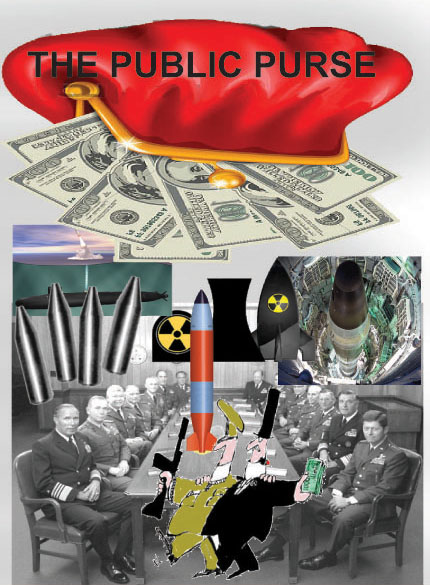
More waste, fraud, and financial abuse are inevitable as the Pentagon prepares to shovel money out the door as quickly as possible. This is no way to craft a budget or defend a country.
One way to begin reining in runaway Pentagon spending is to eliminate the ability of Congress and the president to arbitrarily increase that department’s budget. The best way to do so would be by doing away with the very concept of “emergency spending.
BY JULIA GLEDHILL AND WILLIAM D. HARTUNG, MARCH 26, 2024, https://tomdispatch.com/spending-unlimited-2/
The White House released its budget proposal for Fiscal Year 2025 on March 11th, and the news was depressingly familiar: $895 billion for the Pentagon and work on nuclear weapons at the Department of Energy. After adjusting for inflation, that’s only slightly less than last year’s proposal, but far higher than the levels reached during either the Korean or Vietnam wars or at the height of the Cold War. And that figure doesn’t even include related spending on veterans, the Department of Homeland Security, or the additional tens of billions of dollars in “emergency” military spending likely to come later this year. One thing is all too obvious: a trillion-dollar budget for the Pentagon alone is right around the corner, at the expense of urgently needed action to address climate change, epidemics of disease, economic inequality, and other issues that threaten our lives and safety at least as much as, if not more than, traditional military challenges.

Americans would be hard-pressed to find members of Congress carefully scrutinizing such vast sums of national security spending, asking tough questions, or reining in Pentagon excess — despite the fact that this country is no longer fighting any major ground wars. Just a handful of senators and members of the House do that work while many more search for ways to increase the department’s already bloated budget and steer further contracts into their own states and districts.
Congress isn’t just shirking its oversight duties: these days, it can’t even seem to pass a budget on time. Our elected representatives settled on a final national budget just last week, leaving Pentagon spending at the already generous 2023 level for nearly half of the 2024 fiscal year. Now, the department will be inundated with a flood of new money that it has to spend in about six months instead of a year. More waste, fraud, and financial abuse are inevitable as the Pentagon prepares to shovel money out the door as quickly as possible. This is no way to craft a budget or defend a country.
And while congressional dysfunction is par for the course, in this instance it offers an opportunity to reevaluate what we’re spending all this money for. The biggest driver of overspending is an unrealistic, self-indulgent, and — yes — militaristic national defense strategy. It’s designed to maintain a capacity to go almost everywhere and do almost anything, from winning wars with rival superpowers to intervening in key regions across the planet to continuing the disastrous Global War on Terror, which was launched in the wake of the 9/11 attacks and never truly ended. As long as such a “cover the globe” strategy persists, the pressure to continue spending ever more on the Pentagon will prove irresistible, no matter how delusional the rationale for doing so may be.
Defending “the Free World”?
President Biden began his recent State of the Union address by comparing the present moment to the time when the United States was preparing to enter World War II. Like President Franklin Delano Roosevelt in 1941, Joe Biden told the American people that the country now faces an “unprecedented moment in the history of the Union,” one in which freedom and democracy are “under attack” both at home and abroad. He disparaged Congress’s failure to approve his emergency supplemental bill, claiming that, without additional aid for Ukraine, Russian President Vladimir Putin will threaten not just that country but all of Europe and even the “free world.” Comparing (as he did) the challenge posed by Russia now to the threat that Hitler’s regime posed in World War II is a major exaggeration that’s of no value in developing an effective response to Moscow’s activities in Ukraine and beyond.
Engaging in such fearmongering to get the public on board with an increasingly militarized foreign policy ignores reality in service of the status quo. In truth, Russia poses no direct security threat to the United States. And while Putin may have ambitions beyond Ukraine, Russia simply doesn’t have the capability to threaten the “free world” with a military campaign. Neither does China, for that matter. But facing the facts about these powers would require a critical reassessment of the maximalist U.S. defense strategy that rules the roost. Currently, it reflects the profoundly misguided belief that, on matters of national security, U.S. military dominance takes precedence over the collective economic strength and prosperity of Americans.
As a result, the administration places more emphasis on deterring potential (if unlikely) aggression from competitors than on improving relations with them. Of course, this approach depends almost entirely on increasing the production, distribution, and stockpiling of arms. The war in Ukraine and Israel’s continuing assault on Gaza have unfortunately only solidified the administration’s dedication to the concept of military-centric deterrence.
Contractor Dysfunction: Earning More, Doing Less
Ironically, such a defense strategy depends on an industry that continually exploits the government for its own benefit and wastes staggering amounts of taxpayer dollars. The major corporations that act as military contractors pocket about half of all Pentagon outlays while ripping off the government in a multitude of ways. But what’s even more striking is how little they accomplish with the hundreds of billions of taxpayer dollars they receive year in, year out. According to the Government Accountability Office (GAO), from 2020 to 2022, the total number of major defense acquisition programs actually declined even as total costs and average delivery time for new weapons systems increase
Americans would be hard-pressed to find members of Congress carefully scrutinizing such vast sums of national security spending, asking tough questions, or reining in Pentagon excess — despite the fact that this country is no longer fighting any major ground wars. Just a handful of senators and members of the House do that work while many more search for ways to increase the department’s already bloated budget and steer further contracts into their own states and districts.
Congress isn’t just shirking its oversight duties: these days, it can’t even seem to pass a budget on time. Our elected representatives settled on a final national budget just last week, leaving Pentagon spending at the already generous 2023 level for nearly half of the 2024 fiscal year. Now, the department will be inundated with a flood of new money that it has to spend in about six months instead of a year. More waste, fraud, and financial abuse are inevitable as the Pentagon prepares to shovel money out the door as quickly as possible. This is no way to craft a budget or defend a country.
And while congressional dysfunction is par for the course, in this instance it offers an opportunity to reevaluate what we’re spending all this money for. The biggest driver of overspending is an unrealistic, self-indulgent, and — yes — militaristic national defense strategy. It’s designed to maintain a capacity to go almost everywhere and do almost anything, from winning wars with rival superpowers to intervening in key regions across the planet to continuing the disastrous Global War on Terror, which was launched in the wake of the 9/11 attacks and never truly ended. As long as such a “cover the globe” strategy persists, the pressure to continue spending ever more on the Pentagon will prove irresistible, no matter how delusional the rationale for doing so may be.
Defending “the Free World”?
President Biden began his recent State of the Union address by comparing the present moment to the time when the United States was preparing to enter World War II. Like President Franklin Delano Roosevelt in 1941, Joe Biden told the American people that the country now faces an “unprecedented moment in the history of the Union,” one in which freedom and democracy are “under attack” both at home and abroad. He disparaged Congress’s failure to approve his emergency supplemental bill, claiming that, without additional aid for Ukraine, Russian President Vladimir Putin will threaten not just that country but all of Europe and even the “free world.” Comparing (as he did) the challenge posed by Russia now to the threat that Hitler’s regime posed in World War II is a major exaggeration that’s of no value in developing an effective response to Moscow’s activities in Ukraine and beyond.
Engaging in such fearmongering to get the public on board with an increasingly militarized foreign policy ignores reality in service of the status quo. In truth, Russia poses no direct security threat to the United States. And while Putin may have ambitions beyond Ukraine, Russia simply doesn’t have the capability to threaten the “free world” with a military campaign. Neither does China, for that matter. But facing the facts about these powers would require a critical reassessment of the maximalist U.S. defense strategy that rules the roost. Currently, it reflects the profoundly misguided belief that, on matters of national security, U.S. military dominance takes precedence over the collective economic strength and prosperity of Americans.
As a result, the administration places more emphasis on deterring potential (if unlikely) aggression from competitors than on improving relations with them. Of course, this approach depends almost entirely on increasing the production, distribution, and stockpiling of arms. The war in Ukraine and Israel’s continuing assault on Gaza have unfortunately only solidified the administration’s dedication to the concept of military-centric deterrence.
Contractor Dysfunction: Earning More, Doing Less
Ironically, such a defense strategy depends on an industry that continually exploits the government for its own benefit and wastes staggering amounts of taxpayer dollars. The major corporations that act as military contractors pocket about half of all Pentagon outlays while ripping off the government in a multitude of ways. But what’s even more striking is how little they accomplish with the hundreds of billions of taxpayer dollars they receive year in, year out. According to the Government Accountability Office (GAO), from 2020 to 2022, the total number of major defense acquisition programs actually declined even as total costs and average delivery time for new weapons systems increased.
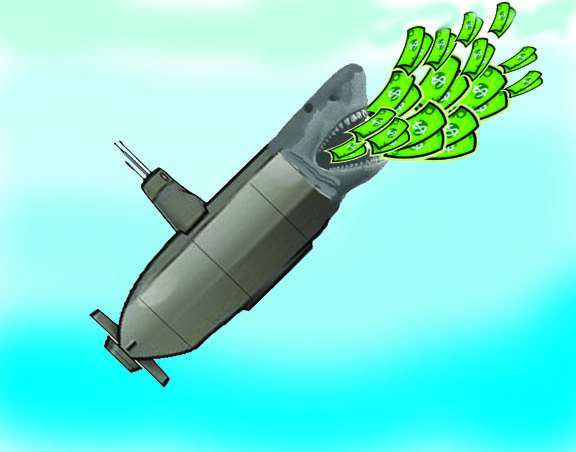
Take the Navy’s top acquisition program, for example. Earlier this month, the news broke that the Columbia-class ballistic missile submarine is already at least a year behind schedule. That sub is the sea-based part of the next-generation nuclear (air-sea-and-land) triad that the administration considers the “ultimate backstop” for global deterrence. As a key part of this country’s never-ending arms buildup, the Columbia is supposedly the Navy’s most important program, so you might wonder why the Pentagon hasn’t implemented a single one of the GAO’s six recommendations to help keep it on track.
As the GAO report made clear, the Navy proposed delivering the first Columbia-class vessel in record time — a wildly unrealistic goal — despite it being the “largest and most complex submarine” in its history.
Yet the war economy persists, even as the giant weapons corporations deliver less weaponry for more money in an ever more predictable fashion (and often way behind schedule as well). This happens in part because the Pentagon regularly advances weapons programs before design and testing are even completed, a phenomenon known as “concurrent development.” Building systems before they’re fully tested means, of course, rushing them into production at the taxpayer’s expense before the bugs are out. Not surprisingly, operations and maintenance costs account for about 70% of the money spent on any U.S. weapons program.

Lockheed Martin’s F-35 is the classic example of this enormously expensive tendency. The Pentagon just greenlit the fighter jet for full-scale production this month, 23 years (yes, that’s not a misprint!) after the program was launched. The fighter has suffered from persistent engine problems and deficient software. But the official go-ahead from the Pentagon means little, since Congress has long funded the F-35 as if it were already approved for full-scale production. At a projected cost of at least $1.7 trillion over its lifetime, America’s most expensive weapons program ever should offer a lesson in the necessity of trying before buying.

Unfortunately, this lesson is lost on those who need to learn it the most. Acquisition failures of the past never seem to financially impact the executives or shareholders of America’s biggest military contractors. On the contrary, those corporate leaders depend on Pentagon bloat and overpriced, often unnecessary weaponry. In 2023, America’s biggest military contractor, Lockheed Martin, paid its CEO John Taiclit $22.8 million. Annual compensation for the CEOs of RTX, Northrop Grumman, General Dynamics, and Boeing ranged from $14.5 and $22.5 million in the past two years. And shareholders of those weapons makers are similarly cashing in. The arms industry increased cash paid to its shareholders by 73% in the 2010s compared to the prior decade. And they did so at the expense of investing in their own businesses. Now they expect taxpayers to bail them out to ramp up weapons production for Ukraine and Israel.
Reining in the Military-Industrial Complex
One way to begin reining in runaway Pentagon spending is to eliminate the ability of Congress and the president to arbitrarily increase that department’s budget. The best way to do so would be by doing away with the very concept of “emergency spending.” Otherwise, thanks to such spending, that $895 billion Pentagon budget will undoubtedly prove to be anything but a ceiling on military spending next year. As an example, the $95 billion aid package for Ukraine, Israel, and Taiwan that passed the Senate in February is still hung up in the House, but some portion of it will eventually get through and add substantially to the Pentagon’s already enormous budget.
Meanwhile, the Pentagon has fallen back on the same kind of budgetary maneuvers it perfected at the peak of its disastrous Afghan and Iraq wars earlier in this century, adding billions to the war budget to fund items on the department’s wish list that have little to do with “defense” in our present world. That includes emergency outlays destined to expand this country’s “defense industrial base” and further supersize the military-industrial complex — an expensive loophole that Congress should simply shut down. That, however, will undoubtedly prove a tough political fight, given how many stakeholders — from Pentagon officials to those corporate executives to compromised members of Congress — benefit from such spending sprees.
Ultimately, of course, the debate about Pentagon spending should be focused on far more than the staggering sums being spent. It should be about the impact of such spending on this planet. That includes the Biden administration’s stubborn continuation of support for Israel’s campaign of mass slaughter in Gaza, which has already killed more than 31,000 people while putting many more at risk of starvation. A recent Washington Post investigation found that the U.S. has made 100 arms sales to Israel since the start of the war last October, most of them set at value thresholds just low enough to bypass any requirement to report them to Congress.
The relentless supply of military equipment to a government that the International Court of Justice has said is plausibly engaged in a genocidal campaign is a deep moral stain on the foreign-policy record of the Biden administration, as well as a blow to American credibility and influence globally. No amount of airdrops or humanitarian supplies through a makeshift port can remotely make up for the damage still being done by U.S.-supplied weapons in Gaza.
The case of Gaza may be extreme in its brutality and the sheer speed of the slaughter, but it underscores the need to thoroughly rethink both the purpose of and funding for America’s foreign and military policies. It’s hard to imagine a more devastating example than Gaza of why the use of force so often makes matters far, far worse — particularly in conflicts rooted in longstanding political and social despair. A similar point could have been made with respect to the calamitous U.S. interventions in Iraq and Afghanistan that cost untold numbers of lives, while pouring yet more money into the coffers of America’s major weapons makers. Both of those military campaigns, of course, failed disastrously in their stated objectives of promoting democracy, or at least stability, in troubled regions, even as they exacted huge costs in blood and treasure.
Before our government moves full speed ahead expanding the weapons industry and further militarizing geopolitical challenges posed by China and Russia, we should reflect on America’s disastrous performance in the costly, prolonged wars already waged in this century. After all, they did enormous damage, made the world a far more dangerous place, and only increased the significance of those weapons makers. Throwing another trillion dollars-plus at the Pentagon won’t change that.

Purgatorial Torments: Assange and the UK High Court
Australian Independent Media, March 27, 2024, by: Dr Binoy Kampmark
What is it about British justice that has a certain rankness to it, notably when it comes to dealing with political charges? The record is not good, and the ongoing sadistic carnival that is the prosecution (and persecution) of Julian Assange continues to provide meat for the table.
Those supporting the WikiLeaks publisher, who faces extradition to the United States even as he remains scandalously confined and refused bail in Belmarsh Prison, had hoped for a clear decision from the UK High Court on March 26. Either they would reject leave to appeal the totality of his case, thereby setting the wheels of extradition into motion, or permit a full review, which would provide some relief. Instead, they got a recipe for purgatorial prolongation, a tormenting midway that grants the US government a possibility to make amends in seeking their quarry.
A sinking sense of repetition was evident. In December 2021, the High Court overturned the decision of the District Court Justice Vanessa Baraitser to bar extradition on the weight of certain assurances provided by the US government. Her judgment had been brutal to Assange in all respects but one: that extradition would imperil his life in the US penal system, largely due to his demonstrated suicidal ideation and inadequate facilities to cope with that risk.
With a school child’s gullibility – or a lawyer’s biting cynicism – the High Court judges accepted assurances from the Department of Justice (DOJ) that Assange would not face the crushing conditions of detention in the notorious ADX Florence facility or suffer the gagging restrictions euphemised as Special Administrative Measures. He would also receive the appropriate medical care that would alleviate his suicide risk and face the prospect of serving the balance of any sentence back in Australia. The refusal to look behind the mutability and fickle nature of such undertakings merely passed the judges by. The March 26 judgment is much in keeping with that tradition.
The grounds for Assange’s team numbered nine in total entailing two parts. Some of these should be familiar to even the most generally acquainted reader. The first part, comprising seven grounds, argues that the decision to send the case to the Home Secretary was wrong for: ignoring the bar to extradition under the UK-US Extradition Treaty for political offences, for which Assange is being sought for; that his prosecution is for political opinions; that the extradition is incompatible with article 7 of the European Convention on Human Rights (ECHR) noting that there should be no punishment without law; that the process is incompatible with article 10 of the ECHR protecting freedom of expression; that prejudice at trial would follow by reason of his non-US nationality; that the right to a fair trial, protected by article 6 of the ECHR, was not guaranteed; and that the extradition is incompatible with articles 2 and 3 of the ECHR (right to life, and prohibiting inhuman and degrading treatment).
The second part of the application challenged the UK Home Secretary’s decision to approve the extradition, which should have been barred by the treaty between the UK and US, and on the grounds that there was “inadequate specialty/death penalty protection.”
In this gaggle of imposing, even damning arguments, the High Court was only moved by three arguments, leaving much of Baraitser’s reasons untouched. Assange’s legal team had established an arguable case that sending the case to the Home Secretary was wrong as he might be prejudiced at trial by reason of his nationality. Following from that “but only as a consequence of that”, extradition would be incompatible with free speech protections under article 10 of the ECHR. An arguable case against the Home Secretary’s decision could also be made as it was barred by inadequate specialty/death penalty protection.
What had taken place was a dramatic and savage pruning of a wholesome challenge to a political persecution garishly dressed in legal drag. On the issue of whether Assange was being prosecuted for his political opinions, the Court was happy to accept the woeful finding by Baraitser that he had not. The judge was “entitled to reach that conclusion on the evidence before her, and on the unchallenged sworn evidence of the prosecutor (which refutes the applicant’s case).” While accepting the view that Assange “acted out of political conviction”, the extradition was not being made “on account of his political views.” Again, we see the judiciary avoid the facts staring at it: that the exposure of war crimes, atrocities, torture and various misdeeds of state are supposedly not political at all.
………………………………………………………………………………………….. Of enormous, distorting significance was the refusal by the High Court to accept “fresh evidence” such as the Yahoo News article from September 2021 outlining the views of intelligence officials on the possible kidnapping and even assassination of Assange.
…………….Imaginatively, if inexplicably, the judges accepted her finding that the conduct by the CIA and UC Global regarding the Ecuadorian embassy had no link with the extradition proceedings. With jaw dropping incredulity, the judges reasoned that the murderous, brutal rationale for dealing with Assange contemplated by the US intelligence services “is removed if the applicant is extradited.” In a fit of true Orwellian reasoning, Assange’s safety would be guaranteed the moment he was placed in the custody of his would-be abductors and murderers.
The High Court was also generous enough to do the homework for the US government by reiterating the position taken by their brother judges in the 2021 decision. Concerns about Assange’s mistreatment would be alleviated by granting “assurances (that the applicant is permitted to rely on the First Amendment, that the applicant is not prejudiced at trial (including sentence) by reason of his nationality, that he is afforded the same First Amendment protection as a United States citizen, and that the death penalty not be imposed).” Such a request is absurd for presuming, not only that the prosecutors can be held to their word, but that a US court would feel inclined to accept the application of the First Amendment, let alone abide by requested sentencing requirements.
The US government has been given till April 16 to file assurances addressing the three grounds, with further written submissions in response to be filed by April 30 by Assange’s team, and May 14 by the Home Secretary. Another leave of appeal will be entertained on May 20. If the DOJ does not provide any assurances, then leave to appeal will be granted. The accretions of obscenity in the Assange saga are set to continue. more https://theaimn.com/purgatorial-torments-assange-and-the-uk-high-court/
1 This Month
23-25 October – on Zoom – World BEYOND War’s annual global conferenc


Shut down the radiation-damaged Heysham nuclear reactors now
To see nuclear-related stories in greater depth and intensity – go to https://nuclearinformation.wordpress.com

Say No to NASA’s Reckless Nuclear Reactor on the Moon
Say No to NASA’s Reckless Nuclear Reactor on the Moon

-
Archives
- October 2026 (209)
- September 2026 (339)
- August 2026 (330)
- July 2026 (355)
- June 2026 (287)
- May 2026 (306)
- April 2026 (356)
- March 2026 (251)
- February 2026 (267)
- January 2026 (308)
- December 2025 (358)
- November 2025 (359)
-
Categories
- 1
- 1 NUCLEAR ISSUES
- business and costs
- climate change
- culture and arts
- ENERGY
- environment
- health
- history
- indigenous issues
- Legal
- marketing of nuclear
- media
- opposition to nuclear
- PERSONAL STORIES
- politics
- politics international
- Religion and ethics
- safety
- secrets,lies and civil liberties
- spinbuster
- technology
- Uranium
- wastes
- weapons and war
- Women
- 2 WORLD
- ACTION
- AFRICA
- Atrocities
- AUSTRALIA
- Christina's notes
- Christina's themes
- culture and arts
- Events
- Fuk 2022
- Fuk 2023
- Fukushima 2017
- Fukushima 2018
- fukushima 2019
- Fukushima 2020
- Fukushima 2021
- general
- global warming
- Humour (God we need it)
- Nuclear
- RARE EARTHS
- Reference
- resources – print
- Resources -audiovicual
- Weekly Newsletter
- World
- World Nuclear
- YouTube
-
RSS
Entries RSS
Comments RSS

