Corporate lobbying heats up around governments’ nuclear power plans despite concerns from anti-nuclear advocates
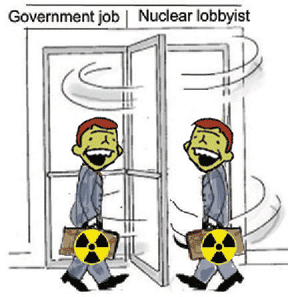
“The nuclear industry and the government are so tightly entwined that you would have difficulty finding some kind of air space in between them. You have, for example, nuclear industry people that get jobs in the government. It’s a revolving door.”
Critics say nuclear too costly and slow to build while supporters back it as a climate solution
Investigative Journalism Foundation, KATE SCHNEIDER, 6 JUNE, 24
“…………………………….. Fears of nuclear meltdowns have long stymied the expansion of nuclear power across Canada. However, with Canada newly committed to achieving net-zero emissions by 2050, the past few years have spurred a new wave of support for nuclear power development.
Yet, some opposition MPs and analysts worry that the recent embrace of nuclear power by governments in Canada has been a result of lobbying by an influential industry more intent on turning a profit than hitting climate targets.
“We’ve got a very, very powerful nuclear special-interest lobby, and we don’t have politically powerful lobbies for energy efficiency or wind or solar,” said Jack Gibbons, chair of the Ontario Clean Air Alliance and a former Toronto Hydro commissioner. “As a result, our political leaders are making bad decisions.”
Last July, the Ontario government announced the largest expansion of nuclear power in Canada in decades. It intends to add a 4,800-megawatt extension to the Bruce Nuclear Generating Station, one of the biggest nuclear power plants in the world.
The site is located on Lake Huron in the northern Ontario municipality of Kincardine — just over 200 km northwest of Toronto — and, while owned by the provincial government, is operated by private company Bruce Power.
Last week, Bruce Power registered a new lobbyist in the province to discuss the “successful refurbishment of Ontario’s nuclear fleet” as well as what it sees as overly onerous regulations, offering to help the government “identify areas for red tape reduction in several sectors.”
The lobbyist, Daniel Levitan, is currently employed by government relations firm Rubicon Strategy. Like several other nuclear industry lobbyists identified by the IJF, Levitan previously worked for the government. He worked for 10 years in external relations for Hydro One, Ontario’s largest electricity distribution utility, starting in 2013. Before that, he was a director of communications and senior policy adviser for several Ontario government departments.
Neither Bruce Power nor Daniel Levitan responded to requests for comment.
Competition for the contract for new nuclear reactors at the Bruce site has also spurred on a lobbying battle between AtkinsRéalis (formerly known as SNC-Lavalin) and Westinghouse, as reported by The Logic last month.
AtkinsRéalis employs both Jean Chrétien, the former Liberal prime minister, and Mike Harris, the former Progressive Conservative premier of Ontario, as the co-chairs for their public relations campaign.
The biggest surge in lobbying, however, has perhaps been around funding for small modular reactors (SMRs)……………..
In February last year, Natural Resources Canada launched a funding program offering $29.6 million to encourage the development of SMRs.
Companies working on the technology are eager to take advantage of federal funds. Ultra Safe Nuclear Corporation (USNC), a Seattle-based nuclear technology company, lobbied the government on eight different occasions last year seeking money for “Canada’s first small modular nuclear reactor.”
BWXT Canada Ltd., a nuclear reactor manufacturer, is also registered to lobby at the federal level, hoping to “examine new funding opportunities for nuclear energy and its operations in Canada.”BWXT Canada has lobbied key ministers and government officials this year, including Jonathan Wilkinson, minister of energy and natural resources; Mairead Lavery, president and CEO of Export Development Canada; Jean-Yves Duclos, minister of public services and procurement; and Ben Chin, one of the prime minister’s top advisers.
BWXT Canada announced in April that it was investing $80 million to expand its Cambridge, Ont. headquarters, increasing its manufacturing capacity to meet the growing demand for nuclear technologies, including SMRs.
BWXT said, “We are interested in updating all levels of government about our operations in Canada, our expansion project at our Cambridge facility and how we are supporting Ontario’s nuclear projects and Canada’s clean energy targets.” USNC did not respond to a request for comment.
“The nuclear industry and the government are so tightly entwined that you would have difficulty finding some kind of air space in between them.” – Susan O’Donnell, St. Thomas University
Industry groups such as the Canadian Nuclear Association and the Organization of Canadian Nuclear Industries have also been lobbying officials in the past year, as have several unions including the International Union of Operating Engineers. The Ontario Society of Professional Engineers is also registered to lobby in Ontario.
Reached for comment, Snigdh Baunthiyal, a spokesperson for the Canadian Nuclear Association, provided a statement to the IJF that said, “We have asked for the Federal government’s support to accelerate the deployment of strategic tools such as ITCs [investment tax credits] and CMT [corporate minimum tax] to ensure Canada retains its leadership role and meets its domestic and international climate and energy security objectives.”
None of the other organizations responded to requests for comment.
In total, four nuclear power plants currently operate across Canada, producing about 12.7 per cent of Canada’s electricity. Three plants — with 16 operational reactors — are located in Ontario, while a fourth housing a single reactor is in Lepreau, New Brunswick.
Alongside the privately operated Bruce Nuclear Generating Station, the other two Ontario-based plants in Pickering and Darlington are operated by Ontario Power Generation (OPG), a Crown corporation.
OPG has lobbied the federal government 21 times so far this year regarding “issues pertaining to federal legislation, policies and programs with respect to OPG’s existing nuclear operations or new nuclear opportunities including small modular reactors,” according to its lobbying registration.
The Darlington site is already halfway through a refurbishment costing $12.8 billion while the Ontario government recently announced plans to refurbish four of the reactors at the Pickering plant starting in 2027.
Construction of an SMR at Darlington is scheduled to be completed in 2028. Last July, the Ford government announced that this SMR would soon be followed by an additional three at the site, projected to go online by the mid-2030s.
Jennifer Stone, a spokesperson for OPG, said that these projects will help the province “meet the growing demand for clean electricity for decades to come.
“As OPG helps secure Ontario’s clean energy future, these projects also generate good jobs and drive economic growth across the province both at our facilities and through Ontario’s robust nuclear supply chain,” added Stone.
NB Power plans to build an SMR at its Lepreau site in conjunction with ARC Clean Technology Inc.
NB Power acknowledged the IJF’s request for comment, but said it would be unable to provide a response before deadline.
While Canada’s only operating nuclear plants are in Ontario and New Brunswick, the uranium used to fuel them comes entirely from Saskatchewan, largely via uranium mining giant Cameco.
Cameco engaged in a lobbying campaign in March targeting various federal government officials, including those at Natural Resources Canada and the Impact Assessment Agency of Canada. According to its most recent lobbying registration, Cameco wants to “advocate for the federal government to include nuclear energy as a major component in Canada’s greenhouse gas/carbon reduction strategy.” Cameco is also registered to lobby in Saskatchewan.
Dale Austin, Cameco’s director of government relations and one of its registered lobbyists, previously worked as a director of the policy analysis and coordination division for Natural Resources Canada as well as a director of policy coordination for the Canadian Nuclear Safety Commission.
Susan O’Donnell is an adjunct research professor at St. Thomas University and a core member of the Coalition for Responsible Energy Development in New Brunswick. O’Donnell said the influence of the industry extends beyond what appears in the official lobby registry.
“‘Do they even need to lobby?’ is what I would say. Because they’ve got all their people in the government,” said O’Donnell.
“The nuclear industry and the government are so tightly entwined that you would have difficulty finding some kind of air space in between them. You have, for example, nuclear industry people that get jobs in the government. It’s a revolving door.”
Worries over safety risks and environmental implications of nuclear power have been around for decades, embodied by incidents like the Chornobyl and Fukushima disasters.
However, the concerns expressed today by anti-nuclear advocates seem to revolve more around nuclear being too costly or excessively slow to build.
“It just doesn’t make any economic sense. And it doesn’t make any climate sense,” said Gibbons. “Wind and solar, combined with storage, can keep our lights on at less than half the cost of new nuclear reactors.”
…………………………………O’Donnell said that given Canada’s commitment to decarbonize its electricity grid by 2035, the idea that new nuclear power projects, especially SMRs, will be ready in time is simply unrealistic.
New nuclear reactors typically take 10 to 15 years to build. And besides the first Darlington SMR, no other SMRs in Canada will be operational until at least the early 2030s.
“On the other hand, we do have mature technologies, which are wind and solar, we do have [storage] technology that’s coming along tremendously,” said O’Donnell. “We’ve got the technology now if we’re serious about meeting our targets.”…………….. https://theijf.org/nuclear-power-lobbying
What’s Next for Battlefield America? Israel’s High-Tech Military Tactics Point the Way

“I did not know Israel was capturing or recording my face. [But Israel has] been watching us for years from the sky with their drones. They have been watching us gardening and going to schools and kissing our wives. I feel like I have been watched for so long.”—Mosab Abu Toha, Palestinian poet
If you want a glimpse of the next stage of America’s transformation into a police state, look no further than how Israel—a long-time recipient of hundreds of billions of dollars in foreign aid from the U.S.—uses its high-tech military tactics, surveillance and weaponry to advance its authoritarian agenda.
Military checkpoints. Wall-to-wall mass surveillance. Predictive policing. Aerial surveillance that tracks your movements wherever you go and whatever you do. AI-powered facial recognition and biometric programs carried out with the knowledge or consent of those targeted by it. Cyber-intelligence. Detention centers. Brutal interrogation tactics. Weaponized drones. Combat robots.
We’ve already seen many of these military tactics and technologies deployed on American soil and used against the populace, especially along the border regions, a testament to the heavy influence Israel’s military-industrial complex has had on U.S. policing.
Indeed, Israel has become one of the largest developers and exporters of military weapons and technologies of oppression worldwide.
Journalist Antony Loewenstein has warned that Pegasus, one of Israel’s most invasive pieces of spyware, which allows any government or military intelligence or police department to spy on someone’s phone and get all the information from that phone, has become a favorite tool of oppressive regimes around the world. The FBI and NYPD have also been recipients of the surveillance technology which promises to turn any “target’s smartphone into an intelligence gold mine.”
Yet it’s not just military weapons that Israel is exporting. They’re also helping to transform local police agencies into extensions of the military.
According to The Intercept, thousands of American law enforcement officers frequently travel for training to Israel, “one of the few countries where policing and militarism are even more deeply intertwined than they are here,” as part of an ongoing exchange program that largely flies under the radar of public scrutiny.
A 2018 investigative report concluded that imported military techniques by way of these exchange programs that allow police to study in Israel have changed American policing for the worse. “Upon their return, U.S. law enforcement delegates implement practices learned from Israel’s use of invasive surveillance, blatant racial profiling, and repressive force against dissent,” the report states. “Rather than promoting security for all, these programs facilitate an exchange of methods in state violence and control that endanger us all.”
“At the very least,” notes journalist Matthew Petti, “visits to Israel have helped American police justify more snooping on citizens and stricter secrecy. Critics also assert that Israeli training encourages excessive force.”
Petti documents how the NYPD set up a permanent liaison office in Israel in the wake of 9/11, eventually implementing “one of the first post-9/11 counterterrorism programs that explicitly followed the Israeli model. In 2002, the NYPD tasked a secret ‘Demographics Unit’ with spying on Muslim-American communities. Dedicated ‘mosque crawlers’ infiltrated local Muslim congregations and attempted to bait worshippers with talk of violent revolution.”
That was merely the start of American police forces being trained in martial law by foreign nations under the guise of national security theater. It has all been downhill from there.
As Alex Vitale, a sociology professor who has studied the rise of global policing, explains, “The focus of this training is on riot suppression, counterinsurgency, and counterterrorism—all of which are essentially irrelevant or should be irrelevant to the vast majority of police departments. They shouldn’t be suppressing protest, they shouldn’t be engaging in counterinsurgency, and almost none of them face any real threat from terrorism.”
This ongoing transformation of the American homeland into a techno-battlefield tracks unnervingly with the dystopian cinematic visions of Steven Spielberg’s Minority Report and Neill Blomkamp’s Elysium, both of which are set 30 years from now, in the year 2054.
In Minority Report, police agencies harvest intelligence from widespread surveillance, behavior prediction technologies, data mining, precognitive technology, and neighborhood and family snitch programs in order to capture would-be criminals before they can do any damage.
While Blomkamp’s Elysium acts as a vehicle to raise concerns about immigration, access to healthcare, worker’s rights, and socioeconomic stratification, what was most striking was its eerie depiction of how the government will employ technologies such as drones, tasers and biometric scanners to track, target and control the populace, especially dissidents.
With Israel in the driver’s seat and Minority Report and Elysium on the horizon, it’s not so far-fetched to imagine how the American police state will use these emerging technologies to lock down the populace, root out dissidents, and ostensibly establish an “open-air prison” with disconcerting similarities to Israel’s technological occupation of present-day Palestine.
For those who insist that such things are celluloid fantasies with no connection to the present, we offer the following as a warning of the totalitarian future at our doorsteps.
Facial Recognition
Fiction: One of the most jarring scenes in Elysium occurs towards the beginning of the film, when the protagonist Max Da Costa waits to board a bus on his way to work. While standing in line, Max is approached by two large robotic police officers, who quickly scan Max’s biometrics, cross-check his data against government files, and identify him as a former convict in need of close inspection. They demand to search his bag, a request which Max resists, insisting that there is nothing for them to see. The robotic cops respond by manhandling Max, throwing him to the ground, and breaking his arm with a police baton. After determining that Max poses no threat, they leave him on the ground and continue their patrol. Likewise, in Minority Report, police use holographic data screens, city-wide surveillance cameras, dimensional maps and database feeds to monitor the movements of its citizens and preemptively target suspects for interrogation and containment.
Fact: We now find ourselves in the unenviable position of being monitored, managed, corralled and controlled by technologies that answer to government and corporate rulers. This is exactly how Palestinian poet and New Yorker contributor Mosab Abu Toha found himself, within minutes of passing through an Israeli military checkpoint in Gaza with his wife and children in tow, asked to step out line, only to be blindfolded, handcuffed, interrogated, then imprisoned in an Israeli detention center for two days, beaten and further interrogated. Toha was finally released in what Israeli soldiers chalked up to a “mistake,” yet there was no mistaking the AI-powered facial recognition technology that was used to pull him out of line, identify him, and label him (erroneously) as a person of interest.
Drones
Fiction: In another Elysium scene, Max is hunted by four drones while attempting to elude the authorities. The drones, equipped with x-ray cameras, biometric readers, scanners and weapons, are able to scan whole neighborhoods, identify individuals from a distance—even through buildings, report their findings back to police handlers, pursue a suspect, and target them with tasers and an array of lethal weapons.
Fact: Drones, some deceptively small and yet powerful enough to capture the facial expressions of people hundreds of feet below them, have ushered in a new age of surveillance. Not even those indoors, in the privacy of their homes, will be safe from these aerial spies, which can be equipped with technology capable of peering through walls. In addition to their surveillance capabilities, drones can also be equipped with automatic weapons, grenade launchers, tear gas, and tasers.
Biometric scanners and national IDs
Fiction: Throughout Elysium, citizens are identified, sorted and dealt with by way of various scanning devices that read their biometrics—irises, DNA, etc.—as well as their national ID numbers, imprinted by a laser into their skin. In this way, citizens are tracked, counted, and classified. Likewise, in Minority Report, tiny sensory-guided spider robots converge on a suspected would-be criminal, scan his biometric data and feed it into a central government database. The end result is that there is nowhere to run and nowhere to hide to escape the government’s all-seeing eyes.
Fact: Given the vast troves of data that various world governments, including Israel and the U.S., is collecting on its citizens and non-citizens alike, we are not far from a future where there is nowhere to run and nowhere to hide. In fact, between the facial recognition technology being handed out to law enforcement, license plate readers being installed on police cruisers, local police creating DNA databases by extracting DNA from non-criminals, including the victims of crimes, and police collecting more and more biometric data such as iris scans, we are approaching the end of anonymity. It won’t be long before police officers will be able to pull up a full biography on any given person instantaneously, including their family and medical history, bank accounts, and personal peccadilloes. It’s already moving in that direction in more authoritarian regimes.
Predictive Policing
Fiction: In Minority Report, John Anderton, Chief of the Department of Pre-Crime, finds himself identified as the next would-be criminal and targeted for preemptive measures by the very technology that he relies on for his predictive policing. Consequently, Anderton finds himself not only attempting to prove his innocence but forced to take drastic measures in order to avoid capture in a surveillance state that uses biometric data and sophisticated computer networks to track its citizens.
Fact: Precrime, which aims to prevent crimes before they happen, has justified the use of widespread surveillance, behavior prediction technologies, data mining, precognitive technology, and snitch programs. As political science professor Anwar Mhajne documents, Israel has used all of these tools in its military engagements with Palestine: deploying AI surveillance and predictive policing systems in Palestinian territories; utilizing facial recognition technology to monitor and regulate the movement of Palestinians; subjecting Palestinians to facial recognition scans at checkpoints, with a color-coded mechanism to dictate who should be allowed to proceed, subjected to further questioning, or detained.
Making the Leap from Fiction to Reality
When Aldous Huxley wrote Brave New World in 1931, he was convinced that there was “still plenty of time” before his dystopian vision became a nightmare reality. It wasn’t long, however, before he realized that his prophecies were coming true far sooner than he had imagined.
Israel’s military influence on the United States, its advances in technological weaponry, and its rigid demand for compliance are pushing us towards a world in chains.
Through its oppressive use of surveillance technology, Israel has erected the world’s first open-air prison, and in the process, has made itself a model for the United States.
What we cannot afford to overlook, however, is the extent to which the American Police State is taking its cues from Israel.
As I make clear in my book Battlefield America: The War on the American People and in its fictional counterpart The Erik Blair Diaries, we may not be an occupied territory, but that does not make the electronic concentration camp being erected around us any less of a prison.
Putin warns West over Ukraine armaments, nuclear arsenal in news conference

Russia’s president reiterated that attacking NATO countries was a ‘crazy’ idea but warned against Ukraine interference.
Russian President Vladimir Putin has warned that his country would not rule out using nuclear weapons if its sovereignty or territory were threatened.
On Wednesday, Putin met in person with leaders from international news agencies, including Reuters and The Associated Press, for the first time since Russia launched its full-scale invasion of Ukraine in 2022.
He answered questions ranging from the threat of nuclear war to possible repercussions for countries that support Ukraine’s efforts to launch attacks within Russian territory.
When asked about the prospect of using Russia’s nuclear arsenal, Putin said it was not out of the question.
“For some reason, the West believes that Russia will never use it,” Putin responded, pointing towards the country’s 2020 nuclear doctrine
It authorises the Russian government to consider nuclear options if a weapon of mass destruction is used against the country or if “the very existence of the state is put under threat”.
“We have a nuclear doctrine. Look what it says. If someone’s actions threaten our sovereignty and territorial integrity, we consider it possible for us to use all means at our disposal. This should not be taken lightly, superficially.”
“You should not make Russia out to be the enemy. You’re only hurting yourself with this, you know?” Putin said at the news conference.
Article 5 of the treaty establishes that an attack against one country in the organisation is considered an attack against all members.
Putin has repeatedly dismissed the idea of launching an attack on NATO, despite tensions with its member states.
But Ukrainian President Volodymyr Zelenskyy told CBS News earlier this year that Putin’s “aggression” could reach Europe, prompting a NATO response. And in April, Germany’s top military leader said “an attack against NATO soil could be possible” in five to eight years.
Still, Putin reiterated his stance on Wednesday. “They thought that Russia wanted to attack NATO,” he said. “Have you gone completely crazy? That is as thick as this table. Who came up with this? It is just complete nonsense, you know? Total rubbish.”
Putin issues warning over Russia strikes
However, Putin also hinted at the possibility of heightened tensions – and even “asymmetrical” military steps – if Western countries like Germany and the United States were to supply Ukraine with weapons used on Russian soil.
He explained that the use of certain weapons, including the use of advanced missile technology, would be tantamount to participation in Russia’s war with Ukraine.
“That would mark their direct involvement in the war against the Russian Federation, and we reserve the right to act the same way,” he said.
“If they consider it possible to deliver such weapons to the combat zone to launch strikes on our territory and create problems for us, why don’t we have the right to supply weapons of the same type to some regions of the world where they can be used to launch strikes on sensitive facilities of the countries that do it to Russia?”
His remarks came after Germany decided in January to supply Leopard 2A6 battle tanks to Ukraine. And last month, both Germany and the US agreed to allow Ukraine to use certain missiles to hit targets inside Russia.
The Associated Press reported earlier on Wednesday that Ukraine has indeed used US weapons to strike within Russia, though Washington restricts which arms can be used.
Advanced weapons like the Army Tactical Missile System (ATACMS) and other long-range missiles remain off-limits.
Asked about the prospect of a wider range of Western missiles being approved for Ukraine’s use in Russia, Putin was defiant: “We will improve our air defence systems and destroy them.”
No nuke waste down under: Nuclear Free Local Authorities spokesperson receives assurance MOD still committed to decommissioning British nuclear subs at home
Nuclear Free Local Authorities, 4 June 24
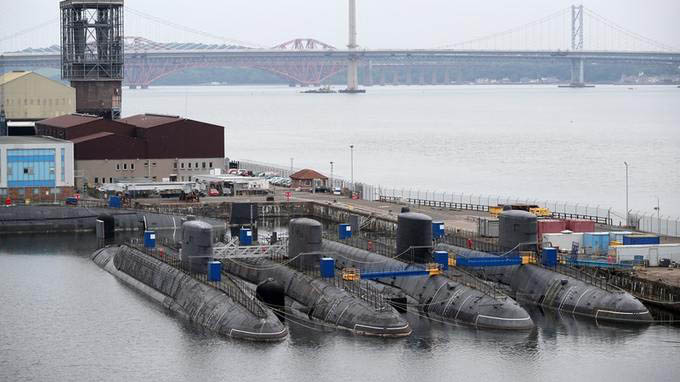
Defence chiefs have written to the NFLA Spokesperson on Nuclear Submarine Decommissioning reassuring him that ‘the Ministry of Defence remains committed to disposing its decommissioned submarines, including the waste they produce, within the UK’.
Councillor Brian Goodall, who represents the Rosyth Ward in Scotland where decommissioning is currently taking place, wrote to the outgoing Defence and Foreign Secretaries on 17 May seeking their assurance that redundant British nuclear submarines will not be sent to Australia for disposal.
In Australia, in relation to the AUKUS defence pact, legislators have proposed a new Naval Nuclear Power Safety Bill 2024, which appears to provide under Clauses 7 and 12 of the Bill for the disposal of high level radioactive waste from British and American submarines on Australian soil, and also for the storage of such materials in Australia from ‘a submarine that is not complete (for example, because it is being constructed or disposed of)’.
Councillor Goodall is concerned that this could theoretically mean the British Government ‘permitting towing redundant UK boats from Rosyth and Devonport down under for disposal’. Councillor Goodall fears that, were this to become practice and not just theory, local expertise and the jobs of his constituents could be lost.
In their response, defence officials say they continue to work on completing the decommissioning of the submarine Swiftsure at Rosyth by 2026 ‘by adopting a unique approach that will maximise the amount of the submarine that can be recycled and minimise the amount of waste that needs to be disposed of’. Radioactive waste will be taken to Capenhurst, Cheshire for interim storage until a Geological Disposal Facility is completed for its eventual disposal. This includes the reactor from each dismantled submarine.
Knowledge acquired as a result of the submarine decommissioning work will be shared by the MOD with Australia.
The letter sent to Lord Cameron and Grant Shapps on 17 May read:……………………………………………………… more https://www.nuclearpolicy.info/news/no-nuke-waste-down-under-nflas-spokesperson-receives-assurance-mod-still-committed-to-decommissioning-british-nuclear-subs-at-home/
Famine risk increases as Israel makes Gaza aid response virtually impossible – Oxfam

June 5, 2024: The AIM Network https://theaimn.com/famine-risk-increases-as-israel-makes-gaza-aid-response-virtually-impossible-oxfam/
Oxfam Australia Media Release
Two-thirds of population now squeezed into less than a fifth of the Gaza Strip
Israel’s relentless air and land bombardment and deliberate obstruction of the humanitarian response is making it virtually impossible for aid agencies to reach trapped, starved civilians in Gaza, Oxfam said today, as the latest ceasefire deal negotiations continue
A lethal combination of closed border crossings, ongoing airstrikes, reduced logistical capacity due to evacuation notices and a failing Israeli permission process that debilitates humanitarian movement within Gaza, have created an impossible environment for aid agencies to operate effectively.
With the Rafah Crossing closed since 6 May, Kerem Shalom is the only crossing that thousands of humanitarian aid trucks queued at Rafah could be re-routed to use, but inside is an active combat zone and extremely dangerous. Long delays in Israeli approval to collect and move any aid that enters, means that missions often have to be aborted.
Over one million people have fled Rafah into Al Mawasi, Deir al-Balah and Khan Younis. 1.7 million people, more than two-thirds of Gaza’s population, are now estimated to be crammed into an area of 69 km2 – less than a fifth of the Strip. Despite Israeli assurances that full support would be provided for people fleeing, most of Gaza has been deprived of humanitarian aid, as famine inches closer. Last week, Israeli attacks killed dozens of civilians in tents in areas it had declared “safe zones”.
As the humanitarian situation within Gaza deteriorates even further and more children die of starvation and disease, Oxfam said that:
- A food survey by aid agencies in May found that 85 per cent of children did not eat for a whole day at least once in the three days before the survey was conducted, with dietary diversity worsening.
- Living conditions are so appalling that in Al-Mawasi, there are just 121 latrines for over 500,000 people – or 4,130 people having to share each toilet.
- Just 19 per cent of the 400,000 litres of fuel a day needed to run the humanitarian operation in Gaza – including transportation, the provision of clean water and sewage removal – is being allowed in and is not delivered every day.
- According to the UN, aid deliveries have dropped by two-thirds since Israel’s invasion of Rafah. Since 6 May, just 216 trucks of humanitarian aid entered via Kerem Shalom and were able to be collected – an average of eight a day
It’s estimated that hundreds of commercial food trucks are entering daily via the Kerem Shalom crossing. Although important for increasing food availability in Gaza, the consignments include items like non-nutritious energy drinks, chocolate and cookies, and food is often sold at inflated prices that people cannot afford. Lack of dietary diversity is one of the key drivers of acute malnutrition and has been assessed as ‘extremely critical’ in Gaza
People are paying nearly $700 for the most basic tents and there is so little space left, that some have been forced to set up tents in the cemetery at Deir al-Balah
Sally Abi Khalil, Oxfam’s Middle East and North Africa Director said: “By the time a famine is declared, it will be too late. When hunger claims many more lives, nobody will be able to deny the horrifying impact of Israel’s deliberate, illegal and cruel obstruction of aid. Obstructing tonnes of food for a malnourished population while waving through caffeine-laced drinks and chocolate is sickening.
“Israel claimed weeks ago that it would provide full humanitarian support and medical assistance to civilians it had told to move. Not only is this not happening, its ongoing impunity, bombardment and deliberate obstruction have created unprecedented and impossibly dangerous conditions for humanitarian agencies to operate.”
-ADVERTISEMENT-
As the occupying power, Israel is legally obligated not to restrict or delay the entry of goods required to meet the basic needs of Gaza’s residents, and must actively guarantee the continuous and uninterrupted supply of all aid.
Meera, an Oxfam staff member in Al-Mawasi who has been displaced seven times since October said “This area was designated a humanitarian zone, but there is nothing humanitarian about the situation here. The conditions are unbearable, there is no access to clean water, people are forced to rely on the sea.
A Detectable Subservience – Australia’s ill-fated nuclear submarine deal?

All of this leaves one wondering about just what due diligence was done before Morrison, and the 24-hour copycat decision-maker Albanese, committed us to the folly of paying $A368 billion to purchase a subservient position embedded within the US war machine by means of a soon-to-be fully detectable and therefore likely to be destroyed fleet of nuclear-powered submarines.
June 6, 2024 by: The AIM Network, By Michael Willis, https://theaimn.com/a-detectable-subservience/
The first operational outcome of the Pillar 2 AUKUS arrangement between the US, UK and Australia has just been announced.
The three countries will share data from their submarine-hunting PA-8 Poseidon aircraft, manufactured by the troubled Boeing Corporation.
This was announced on May 29 in an “exclusive interview” given to US online website Breaking Defense by Michael Horowitz, whose office serves as the Pentagon’s day-to-day lead on AUKUS issues.
(In a deliciously ironic slip, the website referred to the United Kingdom as the “Untied Kingdom”, true of the political cohesion of both the UK and the US at this time.)
All three AUKUS nations:
“… operate the Boeing-made maritime surveillance aircraft; the US operates 120, Australia 12, and the United Kingdom nine. A key part of the P-8 is its collection of sonobuoys, which are dropped into the water to hunt down submarines. (“Sonobuoys” is the preferred US-spelling of the English language “sonar buoys”.)
According to Horowitz, the Pentagon’s Deputy Assistant Secretary of Defense for Force Development and Emerging Capabilities, a new “trilateral algorithm” will allow them to share information from P-8 sonar buoys between each other.
According to Breaking Defense, the trilateral algorithm requires a high level of trust between the three countries.
“Even among Five Eyes partners,” it says, “sonobuoy information is highly sensitive, as sharing that data not only makes clear what each country has the ability to gather and where those buoys are deployed, but because it clearly reveals what and where each country is tracking.”
Pillar 2 arrangements build on those of Pillar 1 which are solely concerned with Australia’s acquisition of the hugely expensive nuclear-powered submarines.
At a cost averaged out at $A33 million a day over 35 years, we are promised a fleet of 8 submarines with the apparent advantages of extended range and endurance, higher speed, increased payload capacity, and reduced refuelling needs.
But given our own use of sonar buoys and knowing that our own all-but-at-war with “enemy”, China, has the same or superior detection technologies, it is the claim that SSNs (nuclear-powered submarines) have greater stealth and reduced detectability that is the major sales pitch justifying our $368 billion spend.
SSNs are claimed to have reduced noise and to be able to operate at greater depths, thus making them harder to detect.
Reduced noise will affect passive sonar buoys which listen for sounds generated by submarines. These sounds can include engine noise, propeller cavitation, or other mechanical noises.
Greater depth will affect active sonar buoys, those that send out a sound wave which then bounces off the submarine, allowing the buoy to detect the “ping” that travels back to the buoy. That ping is weaker the greater distance it has to travel.
Former Senator and submariner Rex Patrick was critical of the AUKUS decision for Australia to begin its SSN acquisition with the purchase of three second-hand Virginia Class SSNs from the US.
“The first highly noticeable issue with the Virginia class is a problem that has surfaced with the submarine’s acoustic coating that’s designed to reduce the ‘target strength’ of the submarine (how much sound energy from an enemy active sonar bounces off the submarine, back to the enemy),” he said.
“The coating is prone to peeling off at high-speed leaving loose cladding that slaps against the hull, making dangerous noise, and causes turbulent water flow, which also causes dangerous hull resonance (where the hull sings at its resonant frequency, like a tuning fork) and extra propulsion noise. I know a bit about this as a former underwater acoustics specialist.”
Magnetic Anomaly Detection (MAD) is another method of detection. MAD detects disturbances in the Earth’s magnetic field caused by the metal hull of a submarine. MAD sensors are typically deployed on aircraft and can detect submarines at relatively close ranges. The signals weaken with distance.
However, the Chinese are developing the ability to detect extremely low frequency (ELF) electromagnetic signal produced by speeding subs.
Researchers from the Chinese Academy of Sciences’ Fujian Institute of Research on the Structure of Matter found an ultra-sensitive magnetic detector could pick up traces of the most advanced submarine from long distances away.
The researchers calculated that the extremely low frequency (ELF) signal produced by a submarine’s bubbles could be stronger than the sensitivities of advanced magnetic anomaly detectors by three to six orders of magnitude.
The bubbles are an inevitable consequence of the submarine’s cruising speed, which causes the water flowing around the hull to move faster as its kinetic energy increases and its potential energy – expressed as pressure – decreases. When the pressure decreases sufficiently, small bubbles form on the surface of the hull as some of the water vaporises. This process causes turbulence and can produce an electromagnetic signature, in a phenomenon known as the magnetohydrodynamic (MHD) effect.
Though faint, ELF signals can travel great distances, thanks to their ability to penetrate the water and reach the ionosphere, where they are reflected back to the Earth’s surface.
Detection by ELF turns the advantage of an SSNs higher speed into its opposite, namely the disadvantage of higher detectability.
This ability of science to increase the detection of SSNs led even the pro-US Australian Strategic Policy Institute (ASPI) to publish a warning that “the oceans of tomorrow may become ‘transparent’. The submarine era could follow the battleship era and fade into history.”
It titled its article on a study of submarine detection by Australian scientists and academics “Advances in detection technology could render AUKUS submarines useless by 2050.”
According to the authors:
“The results should ring alarm bells for the AUKUS program to equip Australia with nuclear-powered submarines. Our assessment suggests that there will only be a brief window of time between the deployment of the first SSN AUKUS boats and the onset of transparent oceans.”
However, it is the expanding frontier of quantum computing that may be the ultimate nail in the AUKUS submarines coffin.
Quantum computing is the sexy new kid on the block – witness the Australian government’s investment of almost a billion dollars in a bid to build the world’s first commercially useful quantum computer in Brisbane. It’s bound to make the shareholders of US company PsiQuantum very happy, including notorious corporate investors such as Black Rock.
In July 2016, the Australia government awarded a contract to local company Q-CTRL to develop a quantum navigation system can use the motions of a single atom to precisely determine the course and position of a submarine and maintain accuracy to a remarkable degree. This overcomes two disadvantages of navigation by GPS: GPS is vulnerable to jamming by an adversary, and its signals cannot penetrate sea water to any appreciable depth.
That’s the good news story.
The bad news is that China has already funded its multi-billion-dollar National Quantum Laboratories to develop quantum-based technology applications for “immediate use to the Chinese armed forces”, possibly including targeting stealthy submarines.
According to Zhu Jin in The Conversation:
“New quantum sensing systems offer more sensitive detection and measurement of the physical environment. Existing stealth systems, including the latest generation of warplanes and ultra-quiet nuclear submarines, may no longer be so hard to spot.”
Using devices that measure and analyse the gravitational pull exercised by the mass of a submarine on the movement of sub-atomic particles in a sensor would overcome the disadvantages of sonar buoys and magnetometers, rendering any otherwise undetectable object with mass detectable.
The other area in which China is more advanced than its competitors is the use of quantum computing for encryption and decryption of communications.
In a 2022 paper on Quantum Computing and Cryptography, the authors that:
“China has set the pace for creating secure quantum communications that cannot be intercepted or manipulated. Further advances in Chinese quantum communication networks, especially networks designed for military use, will put the Navy at increased risk when deployed to the Indo-Pacific. If Chinese communications are virtually unbreakable and U.S. Navy communications can be exploited by Chinese quantum code-breaking technology, it will quickly lose its ability to safely operate among PLAN forces.”
All of this leaves one wondering about just what due diligence was done before Morrison, and the 24-hour copycat decision-maker Albanese, committed us to the folly of paying $A368 billion to purchase a subservient position embedded within the US war machine by means of a soon-to-be fully detectable and therefore likely to be destroyed fleet of nuclear-powered submarines.
Michael Williss is a member of the Australian Anti-AUKUS Coalition (AAAC) and the Independent and Peaceful Australia Network (IPAN).
China: US nuclear weapons in South Korea would undermine its security
VOA, WASHINGTON — June 04, 2024 By Christy Lee. 4 June 24
China said it opposes a deployment of nuclear weapons to South Korea as it would pose danger to regional countries. Beijing was reacting to a report suggesting the United States should take such a measure to enhance deterrence against threats from North Korea.
“If the U.S. deploys tactical nuclear weapons in Asia-Pacific region, it will be a dangerous move that will seriously threaten the security of regional countries and undermine regional peace and stability,” said Liu Pengyu, a spokesperson for the Chinese Embassy in Washington.
“We will continue to handle Korean Peninsula affairs based on their merits and our own position,” he said in a statement sent to VOA on Monday. The embassy spokesperson described China’s position on the Korean Peninsula as ensuring peace and stability and advancing political settlement that suits the common interests of all parties.
The remarks were made in response to a report released May 29 by U.S. Senator Roger Wicker, the highest-ranking Republican on the Senate Armed Services Committee, calling for a major boost to U.S. military buildup and readiness against countries such as North Korea and China………………………………………………………………………………… more https://www.voanews.com/a/china-us-nuclear-weapons-in-south-korea-would-undermine-its-security-/7643297.html
TODAY. Nuclear weapons? I am so tired of the silly little boys inside the “important” men who risk all our lives.

I can’t see any difference. It’s all the same preoccupation – “Mine Is Bigger Than Yours”. We wouldn’t think of letting small boys with undeveloped frontal lobes take silly risks with our lives.
But, when those mentally and morally undeveloped brains are now inside important-looking big men in suits, it is not really apparent – how silly they actually are.
It is well and truly time to “take the toys from the boys”.
What prompted me today, was the proud claim from UK Labour leader Sir Keir Starmer.
He claimed “his party has left behind Jeremy Corbyn’s opposition to the Trident nuclear weapons system. If elected, Sir Keir said he would increase defence spending and update the UK’s nuclear arsenal………….. and push for the UK to assume a “leading” role in Nato.”
So UK Labour has expelled that wimp previous Labour leader, Jeremy Corbyn. I mean – Jeremy Corbyn-
supported the Treaty for the Prohibition of Nuclear Weapons,
criticised Israel for its treatment of Palestinians,
was a strong advocate for environmentalism,
campaigned for animal rights,
campaigner against apartheid in South Africa………….

Obviously a sissy little wimp. With a properly developed frontal lobe
Obviously a sissy little wimp. With a properly developed frontal lobe
But wait a minute. If we can’t have the “weaker sex” really in charge of anything (they’re not to be trusted) – then maybe it’s time to give these wimpy-frontal-lobe men a go.
Before it’s too late.
The Military-Industrial Complex Is Killing Us All
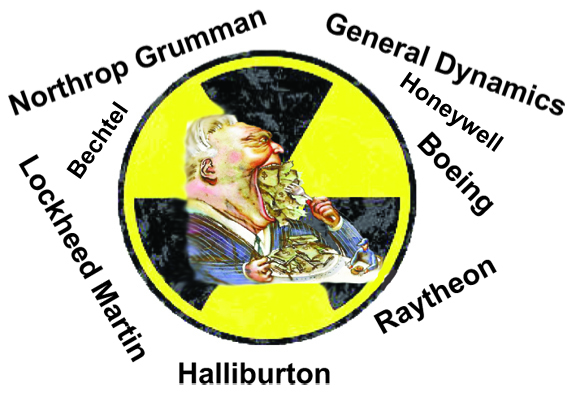
The bulk of our taxpayer dollars are seized by a relatively small group of corporate war profiteers led by the five biggest companies profiting off the war industry: Lockheed Martin, Northrop Grumman, Raytheon (RTX), Boeing, and General Dynamics.
The basic system works like this: First, Congress takes exorbitant sums of money from us taxpayers every year and gives it to the Pentagon. Second, the Pentagon, at Congress’s direction, turns huge chunks of that money over to weapons makers and other corporations via all too lucrative contracts, gifting them tens of billions of dollars in profits. Third, those contractors then use a portion of the profits to lobby Congress for yet more Pentagon contracts, which Congress is generally thrilled to provide, perpetuating a seemingly endless cycle.
Freeing Ourselves from the Monster Destroying Our Planet and Our Futures
TomDispatch, BY DAVID VINE AND THERESA (ISA) ARRIOLA, 2 June 24
We need to talk about what bombs do in war. Bombs shred flesh. Bombs shatter bones. Bombs dismember. Bombs cause brains, lungs, and other organs to shake so violently they bleed, rupture, and cease functioning. Bombs injure. Bombs kill. Bombs destroy.
Bombs also make people rich.
When a bomb explodes, someone profits. And when someone profits, bombs claim more unseen victims. Every dollar spent on a bomb is a dollar not spent saving a life from a preventable death, a dollar not spent curing cancer, a dollar not spent educating children. That’s why, so long ago, retired five-star general and President Dwight D. Eisenhower rightly called spending on bombs and all things military a “theft.”
The perpetrator of that theft is perhaps the world’s most overlooked destructive force. It looms unnoticed behind so many major problems in the United States and the world today. Eisenhower famously warned Americans about it in his 1961 farewell address, calling it for the first time “the military-industrial complex,” or the MIC.
Start with the fact that, thanks to the MIC’s ability to hijack the federal budget, total annual military spending is far larger than most people realize: around $1,500,000,000,000 ($1.5 trillion). Contrary to what the MIC scares us into believing, that incomprehensibly large figure is monstrously out of proportion to the few military threats facing the United States. One-and-a-half trillion dollars is about double what Congress spends annually on all non-military purposes combined.
Calling this massive transfer of wealth a “theft” is no exaggeration, since it’s taken from pressing needs like ending hunger and homelessness, offering free college and pre-K, providing universal health care, and building a green energy infrastructure to save ourselves from climate change. Virtually every major problem touched by federal resources could be ameliorated or solved with fractions of the cash claimed by the MIC. The money is there.
The bulk of our taxpayer dollars are seized by a relatively small group of corporate war profiteers led by the five biggest companies profiting off the war industry: Lockheed Martin, Northrop Grumman, Raytheon (RTX), Boeing, and General Dynamics. As those companies have profited, the MIC has sowed incomprehensible destruction globally, keeping the United States locked in endless wars that, since 2001, have killed an estimated 4.5 million people, injured tens of millions more, and displaced at least 38 million, according to Brown University’s Costs of War Project.
The MIC’s hidden domination of our lives must end, which means we must dismantle it. That may sound totally unrealistic, even fantastical. It is not. And by the way, we’re talking about dismantling the MIC, not the military itself. (Most members of the military are, in fact, among that the MIC’s victims.)
While profit has long been part of war, the MIC is a relatively new, post-World War II phenomenon that formed thanks to a series of choices made over time. Like other processes, like other choices, they can be reversed and the MIC can be dismantled.
The question, of course, is how?
The Emergence of a Monster
To face what it would take to dismantle the MIC, it’s first necessary to understand how it was born and what it looks like today. Given its startling size and intricacy, we and a team of colleagues created a series of graphics to help visualize the MIC and the harm it inflicts, which we’re sharing publicly for the first time.
The MIC was born after World War II from, as Eisenhower explained, the “conjunction of an immense military establishment” — the Pentagon, the armed forces, intelligence agencies, and others — “and a large arms industry.” Those two forces, the military and the industrial, united with Congress to form an unholy “Iron Triangle” or what some scholars believe Eisenhower initially and more accurately called the military-industrial–congressional complex. To this day those three have remained the heart of the MIC, locked in a self-perpetuating cycle of legalized corruption (that also features all too many illegalities).
The basic system works like this: First, Congress takes exorbitant sums of money from us taxpayers every year and gives it to the Pentagon. Second, the Pentagon, at Congress’s direction, turns huge chunks of that money over to weapons makers and other corporations via all too lucrative contracts, gifting them tens of billions of dollars in profits. Third, those contractors then use a portion of the profits to lobby Congress for yet more Pentagon contracts, which Congress is generally thrilled to provide, perpetuating a seemingly endless cycle.
But the MIC is more complicated and insidious than that. In what’s effectively a system of legalized bribery, campaign donations regularly help boost Pentagon budgets and ensure the awarding of yet more lucrative contracts, often benefiting a small number of contractors in a congressional district or state. Such contractors make their case with the help of a virtual army of more than 900 Washington-based lobbyists. Many of them are former Pentagon officials, or former members of Congress or congressional staffers, hired through a “revolving door” that takes advantage of their ability to lobby former colleagues. Such contractors also donate to think tanks and university centers willing to support increased Pentagon spending, weapons programs, and a hyper-militarized foreign policy. Ads are another way to push weapons programs on elected officials.
Such weapons makers also spread their manufacturing among as many Congressional districts as possible, allowing senators and representatives to claim credit for jobs created. MIC jobs, in turn, often create cycles of dependency in low-income communities that have few other economic drivers, effectively buying the support of locals.
For their part, contractors regularly engage in legalized price gouging, overcharging taxpayers for all manner of weapons and equipment. In other cases, contractor fraud literally steals taxpayer money. The Pentagon is the only government agency that has never passed an audit — meaning it literally can’t keep track of its money and assets — yet it still receives more from Congress than every other government agency combined.
As a system, the MIC ensures that Pentagon spending and military policy are driven by contractors’ search for ever-higher profits and the reelection desires of members of Congress, not by any assessment of how to best defend the country. The resulting military is unsurprisingly shoddy, especially given the money spent. Americans should pray it never actually has to defend the United States.
No other industry — not even Big Pharma or Big Oil — can match the power of the MIC in shaping national policy and dominating spending. ……………………………
Endless Wars, Endless Death, Endless Destruction…………………………………………………………………………..
The Environmental Toll…………………………………………..
Endless Wars at Home
As the MIC has fueled wars abroad, so it has fueled militarization domestically. Why, for example, have domestic police forces become so militarized? At least part of the answer: since 1990, Congress has allowed the Pentagon to transfer its “excess” weaponry and equipment (including tanks and drones) to local law enforcement agencies…………………………………..
An Existential Threat…………………………………………………………………….. members of the MIC are increasingly encouraging direct confrontations with Russia and China, aided by Putin’s war and China’s own provocations. In the “Indo-Pacific” (as the military calls it), the MIC is continuing to cash in as the Pentagon builds up bases and forces surrounding China in Australia, Guam, the Federated States of Micronesia, Japan, the Marshall Islands, the Northern Mariana Islands, Palau, Papua New Guinea, and the Philippines……………………………………………
The Urgency of Dismantling
The urgency of dismantling the military-industrial complex should be clear. The future of the species and planet depends on it.
…………………………………………………….In short, we’re working on the answers. With the diverse group of experts who helped produce this article’s graphics, we’re exploring, among other ideas, divestment campaigns and lawsuits; banning war profiteering; regulating or nationalizing weapons manufacturers; and converting parts of the military into an unarmed disaster relief, public health, and infrastructure force……………………………………………………… we must take on the MIC to build a world focused on making human lives rich (in every sense) rather than one focused on bombs and other weaponry that brings wealth to a select few who benefit from death. https://tomdispatch.com/the-military-industrial-complex-is-killing-us-all/—
Energy buffs give small modular reactors a gigantic reality check
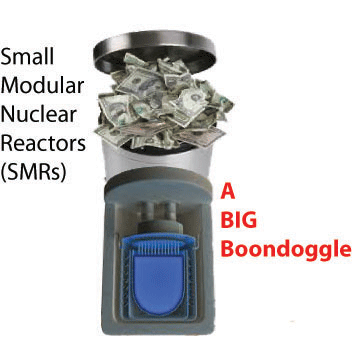
John Ketchum, CEO of nuclear power firm NextEra, has even said SMRs were nothing but “an opportunity to lose money in smaller batches”
Before signing any contract for an SMR, just get a fixed price in writing. If a developer won’t agree to it, they probably don’t have faith in their own estimates.
Too expensive, slow, and risky for investors, and they’re taking focus off renewables, say IEEFA experts
Brandon Vigliarolo, Mon 3 Jun 2024 , https://www.theregister.com/2024/06/03/small_modular_reactor_criticism/
Miniature nuclear reactors promise a future filled with local, clean, safe zero-carbon energy, but those promises quickly melt when confronted with reality, say a pair of researchers.
Known as small modular reactors, or SMRs, miniaturized atomic power plants have been touted as a way to ensure the world meets climate change mitigation goals as fossil fuels are phased out in favor of renewables and nuclear sources.
With a few SMR projects built and operational at this point, and more plants under development, the Institute for Energy Economics and Financial Analysis (IEEFA) concludes in a report that SMRs are “still too expensive, too slow to build, and too risky to play a significant role in transitioning away from fossil fuels.”
IEEFA doesn’t have many data points to pull from, with only three SMRs actually online around the world – one in China and two in Russia. A fourth, in Argentina, is still under construction and perfectly illustrates the point IEEFA researchers try to make: It’s running far over cost and is facing budget constraints that could affect its future.
The other three SMRs have run into similar issues. They’ve all been way more expensive than initially agreed upon, and proposals for SMRs in the US face related issues, the report finds.
Per-kilowatt hour costs for SMRs proposed in the US by NuScale, the first company to receive US regulatory approval for SMRs, have more than doubled since 2015. Costs projected by X-Energy and GE-Hitachi for their SMRs have similarly risen since initial proposals.
In most cases, these costs are rising before the US Nuclear Regulatory Commission has even given its approval, IEEFA notes.
Pick none: Fast, good, low risk
If the cost of an SMR were high but the risk low, or if construction were quick, it might be worth considering further development. The report finds that SMRs are neither cheap, quick, nor reliable.
Along with those costs, IEEFA research points out that none of the SMRs built so far have come anywhere close to meeting proposed construction timelines. The two Russian units were supposed to be built in three years, but both took 13. The Shidao Bay SMR in China was estimated as a four-year project but took 12, while the ongoing CAREM 25 in Argentina was also proposed as a four-year development but has so far taken 13.
Similarly optimistic construction estimates have consistently shown up in US SMR project development presentations,” the report notes. Without speed or value to rely on, one would hope that an SMR project was at least low risk, but that doesn’t appear to be the case either.
Leaders at two nuclear power companies whose quotes are carried in the report “endorsed nuclear power in the abstract” as a way to transition away from fossil fuels, but both expressed concern over the investment risk.
John Ketchum, CEO of nuclear power firm NextEra, has even said SMRs were nothing but “an opportunity to lose money in smaller batches” at this point in time, which was cited in the report. Chris Womack, CEO at Southern Company, which recently finished building the first new US nuclear reactor this century, similarly expressed concerns about expanding his company’s nuclear portfolio.
Quit hogging the energy transition spotlight
The report’s data makes it seem like there’s not a lot going for SMRs, but “loud and persistent” advocates for the technology have managed to capture the spotlight anyway, say report authors David Schlissel, IEEFA director of resource planning analysis, and Dennis Wamsted, IEEFA energy analyst.
“A key argument from SMR proponents is that the new reactors will be economically competitive,” said Schlissel. “But the on-the-ground experience with the initial SMRs that have been built or that are currently under construction shows that this simply is not true.”
Meanwhile, all the time, energy, and money spent constructing SMRs is taking resources away from renewables that work, and would work now, the duo said. It’s also likely that, even though SMR operators intend their reactors to be complementary to other power sources on the grid, they’re far more likely to do the opposite, the report concludes – especially given the rise in construction costs and the need to break even.
“Developers bringing multibillion-dollar SMRs onto the electric grid would have every incentive to run them as much as possible,” the report surmises. “The less they run, the more their per megawatt-hour costs rise and the harder it will be for them to compete in the market.”
“Having invested billions, it is unlikely developers will willingly cycle their plants to accommodate renewables,” the report adds.
While some have predicted it might take a decade to get SMR technology to the point where it’s reliable, Schlissel and Wamsted believe the mini-reactors will continue to be too expensive, slow, and risky to play a reliable role in fossil fuel transition in the next 15 years. That said, developers are still going to push for the projects, so the pair reckon there’s a few things prospective buyers and investors should ensure – like crafting restrictions into contracts that prevent delays and risking costs from being pushed onto ratepayers.
Schlissel and Wamsted make several more recommendations for how to keep SMR projects from becoming too costly or blocking renewables, but the best one is the simplest: Before signing any contract for an SMR, just get a fixed price in writing. If a developer won’t agree to it, they probably don’t have faith in their own estimates.
Wamsted appears to have little faith SMR developers would agree to those terms.
“The comparison between building new SMRs and building renewable energy couldn’t be clearer,” Wamsted said of the pair’s recommendations. “Regulators, utilities, investors, and government officials should acknowledge this and embrace the available reality: Renewables are the near-term solution.”
UK Labour talks up nuclear weapons to banish Corbyn’s shadow

Keir Starmer says he would be prepared to use nuclear weapons, unlike his predecessor.
JUNE 3, 2024 BY ANDREW MCDONALD, https://www.politico.eu/article/uk-labour-talks-nukes-escape-jeremy-corbyn-shadow/—
LONDON — Want to show you’ve moved on from your far-left predecessor? Try a nuclear strike.
Labour leader Keir Starmer on Monday told reporters he would push the button on Britain’s nuclear deterrent if necessary, as the party aims for election victory on July 4 and tries to demonstrate it’s moved on from the tenure of former party chief Jeremy Corbyn.
“On the nuclear deterrent, it is fundamental, it is a vital part of our defense — and of course that means we have to be prepared to use it,” Starmer said.
In keeping with Western nuclear doctrine, Starmer did not set out the circumstances in which he would actually use the U.K.’s nuclear arsenal — at the center of which is the Trident program of nuclear submarines based in Scotland.
But the commitment alone was an eye-opening moment in the campaign — and an important one for Starmer, who has sought to define himself in contrast to Corbyn, the NATO skeptic and lifelong opponent of nuclear weapons who shifted Labour to the left from 2015 to 2019.
Distance from Corbyn
Corbyn was a long-time supporter of the anti-nukes Campaign for Nuclear Disarmament and voted against renewing Trident in 2016, after giving his MPs a free vote on the issue. Despite his own views, however, he did not shift his party’s overall position on the nuclear deterrent, and Labour manifestos under Corbyn did not commit to scrapping Trident.
But Corbyn did come under fire when, in one of his first interviews as Labour leader in 2015, he said he would instruct the U.K.’s defense chiefs never to use nuclear weapons if he became prime minister. “I am opposed to the use of nuclear weapons,” he said at the time. “I am opposed to the holding of nuclear weapons. I want to see a nuclear-free world. I believe it is possible.”
Starmer, who served under Corbyn as a shadow minister, has tried to distance himself from his former boss since becoming leader — despite initially talking up the policies of his “friend” while running for the party leadership in 2020. Corbyn has since been expelled from the party.
Speaking Monday, Starmer sought to hammer home the party’s new direction under his leadership.
With my changed Labour Party, national security will always come first,” Starmer said.
The Labour leader also stressed that his top team is fully behind him in supporting the nuclear deterrent — even though his Shadow Foreign Secretary David Lammy and Deputy Leader Angela Rayner joined Corbyn to vote against the renewal of Trident in 2016.
“I lead this party, I’ve changed this party … and I’ve got my whole shadow cabinet behind me,” Starmer said.
UK Labour leader Starmer says he is prepared to use nuclear weapons

COMMENT. When I contemplate the situation where I am incinerated, along with millions of others, by a nuclear weapon, ….
I get no satisfaction at all, from thinking that in Russia, millions of civilians, just like me, are getting incinerated in return.
No satisfaction at all. What have we become? Labour is useless

BBC News, Sam Francis, Political Reporter, 3 June 24
Sir Keir Starmer has said he would be prepared to use nuclear weapons if needed to defend the UK as he set out Labour’s defence plans.
The Labour leader said “security will always come first” under his leadership and claimed his party has left behind Jeremy Corbyn’s opposition to the Trident nuclear weapons system.
If elected, Sir Keir said he would increase defence spending and update the UK’s nuclear arsenal.
Conservative defence secretary Grant Shapps said Labour represented a “danger to our national security”………………………..
The Labour party was split when the House of Commons last voted to renew the UK’s Trident nuclear weapons system, with 140 of the party’s 230 MPs defying leader Mr Corbyn to back the motion.
But Sir Keir – who did vote to renew Trident – claimed he had his “whole shadow cabinet behind me” on plans to maintain the nuclear deterrent.
“This is a changed Labour party and the most important thing is I voted in favour of a nuclear deterrent,” he said.
“I lead from the front, I’ve always lad from the front.”
Asked by BBC Political Editor Chris Mason, if he would authorise the firing of nuclear weapons if he was prime minister, Sir Keir said: “We have to be prepared to use it…………………..
He committed Labour to a “nuclear triple lock”: continuing to build four new nuclear submarines in Barrow-in-Furness, maintaining Britain’s at-sea deterrent, and delivering all future upgrades for submarine patrols.
The Trident system, based near the Firth of Clyde, includes four nuclear-powered Vanguard-class submarines, missiles and warheads.
Each submarine is designed to carry 16 Trident missiles, capable of delivering multiple warheads – but in recent years, they have carried eight missiles each, with a maximum of 40 warheads per boat.
The UK is already in the process of building four new nuclear submarines in Barrow in-Furness at a cost of £31bn over the lifetime of the programme. The country maintains a continuous at sea nuclear deterrent with its existing fleet.
The Conservatives have also commitment to continue this polices as well as delivering future upgrades.
SNP Spokesman Martin Docherty-Hughes said: “In the middle of a cost-of-living crisis, it is objectively wrong that Keir Starmer would funnel billions of pounds of public money into keeping weapons of mass destruction on our doorstep in Scotland, while families are still living in poverty after 14 years of Tory austerity, and our budget from the UK government keeps getting slashed.
“Nuclear weapons have no place in Scotland, and only a vote for the SNP in July will protect Scotland’s interest against the Labour and Tories – neither of whom will do what the people in Scotland want and scrap Trident nuclear weapons for good.”
In another break from Mr Corbyn’s leadership, Sir Keir used his speech to push for the UK to assume a “leading” role in Nato.
Sir Keir’s predecessor criticised Nato’s role and expansion, particularly in conflicts he found unjust – though did not push for the UK to leave.
These positions led to accusations from its opponents that Labour was weak on national security during Mr Corbyn’s tenure.………………………………………………… more https://www.bbc.com/news/articles/czvvy0ppdxko—
UN offers nuclear inspection deal to Iran’s new leadership
IAEA’s Rafael Grossi wants to resume talks delayed by death of Iran’s president and foreign minister
MENA Tim Stickings, Jun 03, 2024
The UN’s atomic watchdog says it is willing to make a deal on inspections with Iran‘s new leadership that could renew nuclear diplomacy with Tehran.
Rafael Grossi, the head of the International Atomic Energy Agency, has spoken to Iran’s acting chief diplomat since a helicopter crash killed president Ebrahim Raisi and foreign minister Hossein Amirabdollahian on May 19.
Mr Grossi told the IAEA‘s ruling board on Monday that Iran had agreed to resume talks postponed by a mourning period.
Under an agreement, the IAEA could be given wider access to nuclear centres in Iran, which is increasing its stockpile of enriched uranium.
Britain, France and Germany have submitted a wide-ranging draft resolution against Iran to the UN nuclear watchdog’s 35-nation board of governors to be voted on this week, Reuters reported later on Monday.
The European powers are pushing for the resolution despite US concerns that the move could lead Iran to respond by escalating its nuclear activities.
Although Iran denies seeking a nuclear weapon, the IAEA says it cannot confirm its intentions are peaceful while its monitoring is incomplete.
Alarm bells have been rung at the IAEA’s Vienna headquarters by a recent Iranian warning that its nuclear doctrine could change if it is threatened by Israel.
Iran has also indicated that it will respond if the US and European powers push a new resolution through the IAEA’s board condemning Tehran’s activities.
Mr Grossi said that any wider resumption of talks, such as a new version of the 2015 deal that lifted sanctions on Iran, would need the IAEA to have full oversight.
Iran has openly stopped complying with limits on its nuclear activity since the US pulled out of the Joint Comprehensive Plan of Action in 2018……………………………………………. https://www.thenationalnews.com/news/mena/2024/06/03/un-offers-nuclear-inspection-deal-to-irans-new-leadership/
“In Ukraine, a war for memory.”

In defense of what is remembered. At Savur–Mohila hill, Horlivka province. (Guy Mettan.) Report from Donbas, Part 2.
The Floutist, JUN 03, 2024
To destroy the shared past of a people is to go some way toward destroying a people—the coherence and solidity of their identity, their ability to think and act collectively, their collective confidence in themselves, altogether their place in the world.…………………….
Guy Mettan
It is now two years and several months since the Russian military began its intervention in Ukraine. And between Russia and the West, between the Ukrainians in Kiev and the former Ukrainians who have become Russians again, the battle is not just a military struggle. It is also a struggle in defence of memory against those who would obliterate it.
In the West, the 80th anniversary of the D–Day landings on 6 June will be commemorated without the Russians. This is an official if symbolic denial that the victory over Nazi Germany was first and foremost a Soviet victory and that Operation Overlord could not have succeeded without the Red Army’s Operation Bagration in the east, to hold off German tank divisions.
Attempts to erase the past in this manner are not at all new. One finds cases of it throughout history. But in the lands to Europe’s east and the Russian Federation’s west it has greatly intensified since 2014, a decade back, when, some months after the U.S.–cultivated coup in Kiev, the Western powers marked the 70th anniversary of the D–Day landings and refused to invite Russians to the ceremonies held on the Normandy beaches—this while inviting representatives of the former enemy, among them German Chancellor Angela Merkel.
Across Eastern Europe, the Baltic states, and in Ukraine in particular, history is being turned upside down. Historical statues and war memorials honouring those who defeated the Reich in the Second World War are being demolished to erect steles, inscribed stone pillars, that commemorate not the Soviet’s hard-won victory but the victims of the Soviets. These monuments are also intended to mark the glory of the nationalists who fought alongside the Nazis and massacred Jews, such as Stepan Bandera, Yaroslav Stetsko, and Roman Shukhevich.
Every day, monuments are taken down and others erected in their place—on the sly, in the silence of the Western media. We seem to forget, to take but one example of many, that the Treblinka death camp was run by a group of some 20 German SS troops and that the exterminations were carried out by a hundred Ukrainian and Lithuanian guards.
This rewriting of history amounts to a war on the past of a people. And if it is waged not on battlefields but at sites of memory, the outcome of this struggle is comparably important. To destroy the collective memories of a people is to destroy their common identity. In this way it also destroys their understanding of their place in the world and their ability to act effectively—and so their ability to go forward. If you have no past you have no future, it has been said: This is the ultimate objective of those who attack the shared memories of others.
None of this has gone unnoticed by the people of Donbas. And, true to their motto, “Never forget, never forgive,” they are in response redoubling their commemorative faith and monuments to fallen heroes……………………………………………………………………………………………………………………….
It is estimated that 75,000 to 102,000 people were massacred at 4/4–bis from the end of 1941 to September 1943, two or three times as many as at the better documented massacre in 1941 at the ravine in Kiev known as Babi Yar. The entire Jewish community of Donetsk (called Stalino at the time) was thrown into the pit, along with tens of thousands of others. …………………………………………………….
A visit to No. 4/4–bis is all it takes to understand why the people of Donbas rose up against Kiev in April 2014, when the regime that emerged from the U.S.–backed Maidan coup wanted officially to ban their language while sending the heirs of their forebears’ executioners to suppress them. This region has a strong tradition of resistance to any kind of invaders, from German Nazis to west–Ukrainian ultranationalists in Nazi–style uniforms. If No. 4/4–bis is about remembering, it is also about determination.
You can destroy monuments, but not memories.
Seventy kilometres northeast of Donetsk, in the direction of Bakhmut, in the province of Horlivka, the monumental Savur–Mohila cenotaph is another testimony to the battles of the last century. It is erected at the top of the highest hill in the Donbas, on the site of one of the great clashes of the Second World War. That took place in July–August 1943, at the same time as the famous tank battle of Kursk, which was to break the Wehrmacht……………………………………………………………………………….
This battle to preserve memory against its destruction is probably most intense in Lugansk. I’m welcomed there by Anna Soroka, a historian who has been fighting in the republic’s regiments since 2014.
The first monument she shows me commemorates the 67 children killed by Ukrainian militias from the Kraken and Aïdar battalions, both of them neo–Nazi, who tried to take the city in 2014, failed, and then proceeded to shell it until the Russian intervention in 2022. It was built in the middle of a park that serves today as a kindergarten. Several kids were killed there by targeted Ukrainian shelling—targeted, surely, as the surrounding buildings were not hit.
Children are the objects of an unrelenting information war on both sides. The Ukrainians have filed war crimes charges against the Russians, and the International Criminal Court has indicted Vladimir Putin and the head of Russia’s children’s affairs agency, Maria Lvova–Belova, for allegedly kidnapping Ukrainian children. Western propaganda repeats these accusations over and over, in media and in the cinema: A full-length documentary, 20 Days in Mariupol, directed by Mstyslav Chernov, Michelle Mizner, and Raney Aronson–Rath, featured these allegations and has just won this year’s Oscar for best documentary.
Western media reports naturally fail to pass on the point of view of the inhabitants of the Donbas—who say it is the Ukrainians who are taking children hostage. There is, in fact, a volunteer organization in Ukraine called the White Angels, modelled on the infamous Syrian White Helmets, who, as you will recall, were far from the neutral rescue workers they posed as and, in fact, were covertly funded by Western intelligence and acted in behalf of jihadist groups.
These White Angel detachments were formed in February 2022 by a certain Rustam Lukomsky. The Western (or Western-backed) press has mentioned them on several occasions. The Kyiv Independent (24 March 2024), Le Monde (7 February 2023), the BBC (30 January 2024) are among the media that have reported on this group. “Amid the thud of explosions and rattle of gunfire,” a typical report reads, “a special police unit called the White Angels goes door-to-door helping evacuate the town’s remaining civilians.” Lukomsky, whose background remains unclear, is portrayed invariably as a hero of these operations.
For those in Donbas, the White Angels are something very different. The group’s aim, residents here say, is to force parents in front-line areas to separate from their children under the pretext of protecting them. The children are thus isolated and “taken to safety” in the rear, where they are used as a means of blackmail against their families.
These families are in this way torn between two equally unbearable choices: Either they abandon their homes to join their children, or they remain near the front and are forced to collaborate with the Ukrainian army, which invites them to denounce or sabotage the movements of the Russian army………………………………
The second Lugansk monument is located in a wood just outside the city. Like Donetsk’s Mine No. 4/4–bis, it does not appear on our search-engine result pages. And like Donetsk’s Mine No. 4/4–bis, it commemorates the site of the massacre of Lugansk’s Jewish community. About 3,000 mainly Jewish women and children and 8,000 adults of various faiths were executed here by the Nazis during the Wehrmacht’s occupation of the city.
“We can’t understand why, today, Kiev is honouring the descendants of those who killed so many of our people during the Second World War,” Anna Soroka, the historian and soldier, tells me as we tour the site. It has been abandoned to brambles since 1991, when Luhansk Oblast, which was previously part of the USSR, became part of Ukraine following the referendum on independence. The new authorities of the republic decided recently to cut the bushes and to restore it.
A little further along, on the other side of the road, the republic’s authorities have erected a vast memorial honouring the combatants and civilians killed in the 2014–2022 war. Nearly 400 graves are lined up on either side of a walkway that leads from a Rodin-inspired statue near the entrance to a column and a small chapel at the centre of the site.
Anna personally knew most of the people buried here………………………………………………………………..
On our way back into Lugansk we pass a large monument to the Soviet soldiers who liberated the city in 1943. And then, after a few more miles, we come upon a Ukrainian tank decorated with flowers and set on a concrete base beside the freeway: Local inhabitants put it there as a reminder that this tank bombed their homes 10 years ago. Below, there is a field still littered with mines where people are strongly advised against walking.
The last monuments on this mournful tour of the city are perhaps the most emblematic of the tragic fate of Donbas over the last hundred years. These comprise the Hostra Mohyla memorial, which is set on a small hill southeast of the city…………………………………………………………………………….
The largest of these memorials, which crowns the top of the complex, holds the key to the psychology of the region’s inhabitants. I studied it carefully.
It features four giant statues of soldiers, heroes-in-arms of the four wars that mark the collective consciousness of Donbas: There is a bronze fighter from the Civil War of 1917–1921, a Soviet soldier from the Great Patriotic War, a militant from the anti–Kiev resistance of 2014–2018, and, finally, a fighter from the war of liberation of the oblast that began in 2022 and continues to the present day. Again, the past lives on and informs the present.
More erasure: For the Hostra Mohyla site, as for others, there is absolutely no information to be found on Western search engines despite its popularity with the locals. Google and Wikipedia ignore or have banned these sites from their directories. Only the German Stiftung Denkmal für die ermordeten Juden Europas, the Foundation Memorial to the Murdered Jews in Europe, provides any information on the Jewish victims……………………. https://thefloutist.substack.com/p/in-ukraine-a-war-for-memory?utm_source=post-email-title&publication_id=112164&post_id=144941821&utm_campaign=email-post-title&isFreemail=true&r=ln98x&triedRedirect=true&utm_medium=email
Peace talks without Russia ‘laughable’ – John Mearsheimer
https://www.rt.com/russia/598638-mearsheimer-zelensky-peace-talks/ 3 June 24
Vladimir Zelensky’s Swiss ‘peace conference’ will achieve nothing without Moscow’s involvement, the professor argues.
Vladimir Zelensky’s so-called ‘peace conference’ in Switzerland is “not serious” – only face-to-face talks between Moscow and Kiev will settle the Ukraine conflict, American political scientist John Mearsheimer has said.
The Ukrainian leader’s summit is scheduled to take place on June 15-16 at the Burgenstock Resort near Lucerne. Russia has not been invited to the conference, China has declined to attend and US President Joe Biden is reportedly skipping the event to attend a fundraising gala with George Clooney in Hollywood.
“This is not serious,” Mearsheimer told American podcast host Daniel Davis this week. “If you’re going to have a meaningful set of peace negotiations where you’re going to try and settle this war, it’s going to have to involve the Ukrainians directly negotiating with the Russians.”
Since the conflict began in 2022, Mearsheimer noted that only two peace initiatives have made “substantial progress” – Turkish-brokered talks in Istanbul that March, and separate back-channel negotiations mediated by then-Israeli Prime Minister Naftali Bennett.
Under preliminary terms agreed in Istanbul, Ukraine would have become a neutral state with a restricted military in exchange for international security guarantees. However, then-British Prime Minister Boris Johnson convinced Kiev to withdraw from the talks, according to multiple media reports and an admission by David Arakhamia, who headed the Ukrainian delegation.
Bennett has also claimed that any chance at peace in 2022 was torpedoed by the US and its allies, which ordered Ukraine to “keep striking [Russian President Vladimir] Putin” and “blocked” the Istanbul agreement.
Zelensky will likely use this month’s conference to promote his proposed roadmap for ending the conflict with Russia. The ten-point document demands a complete withdrawal of Russian forces from all territories Ukraine considers its own, for Moscow to pay reparations, and for Russian officials to present themselves to war crimes tribunals.
Russia has dismissed the plan as “detached from reality.” Speaking to journalists last month, President Vladimir Putin stated that while Moscow is ready for serious talks, Kiev plans to “gather as many nations as possible, convince everyone that the best proposal is the terms of the Ukrainian side, and then send it to us in the form of an ultimatum.”
“This conference is completely without prospects… because getting together and seriously discussing the Ukraine conflict without [Russia’s] participation is absurd,” Kremlin spokesman Dmitry Peskov told RT on Tuesday.
“The Ukrainians and the Russians have to be face to face talking about what will be an acceptable deal to both sides,” Mearsheimer told Davis. “The idea that you can have peace negotiations in Switzerland without the Russians is laughable.”
A professor of political science at the University of Chicago, Mearsheimer has drawn intense criticism in the West for arguing that NATO’s post-Cold War expansion was the primary cause of the Ukraine conflict. Mearsheimer has argued since 2014 that “encouraging the Ukrainians to play tough with the Russians” would end in their country getting “wrecked.”
1 This Month
26 September – International Day for the Total Elimination of Nuclear Weapons





PLEASE OPPOSE HR 8255 AND S.3639 – bills would accelerate satellite deployment, with no environmental review or safeguards – https://ncstd5li.quorum.us/campaign/169331/
To see nuclear-related stories in greater depth and intensity – go to https://nuclearinformation.wordpress.com
-
Archives
- September 2026 (313)
- August 2026 (330)
- July 2026 (355)
- June 2026 (287)
- May 2026 (306)
- April 2026 (356)
- March 2026 (251)
- February 2026 (267)
- January 2026 (308)
- December 2025 (358)
- November 2025 (359)
- October 2025 (375)
-
Categories
- 1
- 1 NUCLEAR ISSUES
- business and costs
- climate change
- culture and arts
- ENERGY
- environment
- health
- history
- indigenous issues
- Legal
- marketing of nuclear
- media
- opposition to nuclear
- PERSONAL STORIES
- politics
- politics international
- Religion and ethics
- safety
- secrets,lies and civil liberties
- spinbuster
- technology
- Uranium
- wastes
- weapons and war
- Women
- 2 WORLD
- ACTION
- AFRICA
- Atrocities
- AUSTRALIA
- Christina's notes
- Christina's themes
- culture and arts
- Events
- Fuk 2022
- Fuk 2023
- Fukushima 2017
- Fukushima 2018
- fukushima 2019
- Fukushima 2020
- Fukushima 2021
- general
- global warming
- Humour (God we need it)
- Nuclear
- RARE EARTHS
- Reference
- resources – print
- Resources -audiovicual
- Weekly Newsletter
- World
- World Nuclear
- YouTube
-
RSS
Entries RSS
Comments RSS

