EDF pulls out of competition to build mini-nuclear reactors in Britain

Sat, 13th July 2024, https://www.lse.co.uk/news/edf-pulls-out-of-competition-to-build-mini-nuclear-reactors-in-britain-yipcxoiuz1s67eu.html
Alliance News) – Paris-based energy firm EDF has withdrawn from a competition to construct mini-nuclear reactors in Britain, the company said on Tuesday.
EDF was one of six firms shortlisted in October last year for government support to deliver a new wave of nuclear reactors to provide cheaper and cleaner energy.
Two designs for small modular reactors (SMRs) from those submitted by GE-Hitachi, Holtec Britain, NuScale Power Corp, Rolls-Royce Holdings PLC and Westinghouse Electric Corp will be chosen by the end of the year.
The Conservative government which lost last week’s general election set up the competition as part of its aim to derive up to a quarter of all UK electricity from nuclear power by mid-century…………..
Labour, which won the election, has promised to extend the lifetime of existing nuclear plants, including the much-delayed and over-budget Hinkley Point C in southwest England.
EDF said in January that project could be delayed by four years, and cost as much as GBP8 billion more than planned.
It had been due to become operational in June 2027 but that has now been pushed back to between 2029 and 2031, it added.
Labour also made developing SMRs part of its election pitch to the country, saying nuclear would help Britain achieve energy security and its aims of decarbonising the power grid by 2030.
source: AFP
US war games in Pacific seek global participation in imperialist maneuvers

Hawaiian activists call on nations who condemn the genocide in Gaza to withdraw from Rim of the Pacific War Games organized by the US military and illegally hosted on Hawaiian land.
July 13, 2024 by Kawenaʻulaokalā Kapahua, Joy Lehuanani Enomoto, https://gpja.org.nz/2024/07/14/us-war-games-in-pacific-seek-global-participation-in-imperialist-maneuvers/
Every two years, the Indo-Pacific Command Center of the United States convenes the largest maritime war exercises on the planet. With over 35,000 troops participating, 29 nations, 46 naval surface ships, 4 nuclear submarines, and a multitude of air and ground forces, the Rim of the Pacific military exercises, or RIMPAC, is one of the most destructive training events globally.
Through these exercises, the US consolidates its control of the Pacific. RIMPAC began as an annual training exercise in 1971 and became bi-annual in 1974. Since it began, some of the historically worst human rights abusers like the US, Australia, Canada, and Israel have participated in the exercise. The US has a long history of using the Hawaiian islands for target practice. In 1965, the US Navy detonated a bomb on the Kaho’olawe the equivalent of 500 tons of dynamite, breaking the island’s water table and carpeting the island with unexploded ordinances.
Hawaiʻi was illegally seized by American sugar planters in 1893 who were supported by the US military and sought the Hawaiian harbor of Puʻuloa (Pearl Harbor) for a coaling station. In 1898, the US Congress, which had actually lost the treaty of annexation, illegally took Hawaiʻi by joint resolution. Hawaiʻi has remained under illegal occupation by the US and its military since then.
US militarism destroys our land through RIMPAC
RIMPAC as a symptom of the US empire has immense environmental and cultural ramifications. Geopolitically, the exercises are used to control trade routes, train genocidal regimes, and posture against China. Since Obama’s “Pivot to Asia” strategy, the US has shifted from cold war tactics of diplomacy and arms procurement to hot war tactics of aggressive invasion and unchecked military build-up. RIMPAC is used to test weapons and military technology for weapons manufacturers.
The US military’s largest base in our islands is Pōhakuloa, a sacred region of Hawaiʻi Island, thousands of acres utilized as a firing range to train militaries in the tactics of warfare, suppression, and invasion. Mākua Valley was a former civilian town turned into a firing range between World War II and 2004, which filled the valley with unexploded ordinances, white phosphorus, and other forever chemicals. The US Marine base at Mōkapu is built upon one of the most ancient villages in Hawaiʻi where residents were expelled to make room for the base. In addition to the massive pollution and raw sewage spills the base puts out into the surrounding ocean, it is also a sacred burial site where many iwi kūpuna (ancestral bones) are buried near the coast.
RIMPAC also threatens vulnerable and delicate ecosystems and our vast oceanic nature reserves which are restricted conservation zones except for the military. The US Navy has faced multiple lawsuits for the death of whales from mass beachings to escape naval sonar, multiple helicopters and planes have crashed onto our beaches and ocean, and sea turtles lose access to their traditional nesting grounds due to the practice of amphibious assaults on our beaches. The US military is the largest driver of the climate crisis and RIMPAC’s environmental impact only adds to this catastrophe by risking the livelihood of ocean nations through repeated missiles, explosions, and heavy metal waste being driven into the Pacific as a result of these exercises. Therefore, RIMPAC is in direct violation of its own Marine Species Awareness Training (MSAT) and its own Protective Measures and Assessment Protocols (PMAP) which require that the Navy be in compliance with the Marine Mammal Protection Act and the Endangered Species and ensure mitigation to prevent any injury, behavioral change, or death. Each year RIMPAC is planned, the US Navy Indo-Pacific Command requests exemption to these laws from NOAA and the Department of Defense, with extraordinary requests to allow incidental “takes” (deaths) of marine mammals in the millions. There is also no limit to the number of marine birds it can take during the exercises. RIMPAC threatens no less than 12 endangered species.
RIMPAC: Exporting violence
Besides its obscene show of environmental destruction, RIMPAC supports the repression of Indigenous cultures throughout the world by actively training regimes that are currently inflicting genocide or other human rights violations on its Indigenous peoples. RIMPAC plays out various “future scenarios of potential terrorists.” In 2022, RIMPAC enacted a pretend invasion of North Korea, going house to house executing a regime change operation with houses decorated with pictures of Kim Jong Un. Prior to that, in 2016, RIMPAC used the Hawaiian Islands to play out a scenario of imaginary so-called “enemy states” seeking to expand power that played counter to Western influences. And of course, there is the constant saber-rattling and escalation against China which is used as a scapegoat by the new US Cold War.
RIMPAC also brings with it a significant increase in gender-based violence. Studies have shown a significant leap in human trafficking and sexual exploitation, especially of young Native Hawaiian girls every year. In 2022, a former US Naval petty officer was sentenced to 20 years in prison for the sex trafficking of Native Hawaiian girls. The influx of more than 25,000 international military personnel into Hawaiʻi ensures a constant market for the exploitation of women and gender non-conforming people.
RIMPAC exposes enduring US military dominance
This year’s exercises are notable given the current geopolitical context. RIMPAC is taking place amid the ninth month of Israel’s genocidal war in Gaza. This war has isolated the US and its junior partner Israel and united much of the world in the demand for a ceasefire and in opposition to the West’s murderous violence against Palestinians and oppressed people across the world.
However, some of the voices that have been strongest on the world stage in condemning Israel and the US today have sent their Armed Forces to participate alongside the US and Israel in RIMPAC. Countries such as Colombia, Brazil, Chile, Ecuador, Mexico, and Indonesia, are participating, and have either closed their Israeli embassies or publicly renounced Israel for its ongoing genocide of the Palestinian people. While the mood in the Global South is one of challenging Western dominance and hypocrisy, challenging US military supremacy as its bloc leads spending at 74.3 percent, proves to be harder.
Yet, these war games are not mere pastimes and excursions, they are a declaration of national values and a statement of political intention. The strategies and tactics, weapons and technologies practiced and mastered at RIMPAC are utilized by participant nations for weaponization at home. Be it for the worst form of atrocities such as genocide or repression of any form of resistance to the state, or to control “free trade” routes to ensure capital continues to move for the benefit of the international capitalist elite. In other words, RIMPAC trains governments that have a long history of developing repressive techniques to control their colonies and are now deploying those same techniques on its citizens. As with all imperialist activities, it is up to the social and people’s movements of the respective impacted nations to take a stand and reject this continuous arming and military expansion of our collective oppressors.
The Hawaiian people stand arm in arm with the peoples of the world to demand an end to these war games and to sharpen our fight against US imperialism and colonialism, which today is the biggest threat to the survival of our planet—especially those of us from island nations in the “strategic” Pacific. It is people’s movements who will mobilize to remind the governments of those participating nations that they must withdraw from this exercise, end their collaboration with the Israeli Occupation Forces, and stand firm upon their declarations at the United Nations and other various forums. Together we can build a better world.
Kawenaʻulaokalā Kapahua is a community organizer with Hui Aloha ʻĀina, Honolulu branch, a leading Hawaiian independence organization. He is based out of Honolulu, Hawaiʻi, is a PhD student of Political Science at the University of Hawaiʻi and is also a labor organizer.
Joy Lehuanani Enomoto is a community organizer, Pacific Islands Studies scholar, and artist who lives in Honolulu, HI. She is currently the Executive Director of the demilitarization organization, Hawaiʻi Peace & Justice, and the vice president of the Hawaiian sovereignty organization, Hui Aloha ʻĀina o Honolulu.
Radiation levels assessed for on-site burial plan at old nuclear power station
Demolition and disposal is due to start in 2030
Andrew Forgrave, 14 July 2024 https://www.dailypost.co.uk/news/north-wales-news/radiation-levels-assessed-site-burial-29523489
Potential radiation levels arising from the next-stage decommissioning of a former nuclear power station have been assessed as within safety thresholds. Magnox, owner of the Trawsfynydd site in Gwynedd, is aiming to demolish and infill the site’s ponds complex before capping it with concrete.
In two scenarios – for future site occupiers and for some local wildlife – the UK’s Nuclear Restoration Services (NRS) said dosages could exceed safe levels. But the company said its own assessments were cautious and under criteria set by Natural Resources Wales (NRW) all safety thresholds were met.
Trawsfynydd stopped generating electricity in 1991 after operating for 26 years. Years of demolition and on-site disposal are planned. The reactor buildings are scheduled for completion by 2055 with final site clearance activities ending by 2070. The site will then be released from radioactive substances regulation “some time after that”.
First to be tackled will be the ponds complex – a set of buildings running alongside the site’s two reactor buildings. This is due for demolition in 2030 and this could take up to two years.
For this Magnox needs to amend its environmental permit and has applied to NRW for permission. A four-week public consultation was launched this week.
Martin Cox, NRW’s head of operations for northwest Wales, said: “We understand this permit variation is of particular interest to the public and local community. As the regulator for this application we are committed to keeping the community and environment healthy.
We must be satisfied the proposed demolition, disposal, and capping is done in ways that are safe and meet our standards for the protection of people and the environment while allowing the site to be released from radioactive substances regulation in the future.”
The ponds complex contains concrete pools formerly used to cool and store used nuclear fuel before it was sent to Sellafield in Cumbria for reprocessing. This process ended in 1997 and 99.9% of all radioactive waste has been removed from the site.
Below the ponds and storage vaults are box-like structures capable of storing about 5,000 cubic metres of material, which is twice the volume of an Olympic-sized swimming pool. The plan is to fill these with “slightly radioactive” broken concrete from the demolished structures above them.
Magnox has submitted a “site-wide environmental safety case”, supported by more than 30 technical reports, to NRW. One includes radioactivity estimates by NRS for the ponds complex spanning four scenarios: natural evolution, human intrusion, site occupancy, and environmental impact.
Dosage levels for “inadvertent” human intrusion were found to meet safety thresholds “in all credible scenarios”. Screening criteria was also met for wildlife and plants in the surrounding area apart from the uppermost stretch of Afon Tafarn-helyg, a tributary of the Afon Dwyryd. Magnox noted its criteria was stricter that NRW’s under which the threshold would be met.
For site occupiers Magnox said a few features, just below ground, might breach its safety guidelines but not NRW’s. It added: “This exceedance is for a configuration that cautiously assumes a 0.15 m (minimum) cap thickness. Moreover such worst-case dose rates would be expected to drop below 0.017 mSv/year after around 100 years beyond the assumed end-state date (2083) and the probability of receiving such a dose is expected to be low.”
In any case radioactivity estimates are expected to decrease prior to demolition as further decommissioning continues. Additional borehole investigations are being conducted this year beneath the ponds complex to get a better understanding of groundwater flows. NRS added: “In short, the proposed disposals will be safe while they are being implemented, for the decades while the site remains under regulatory control, and then afterwards into the indefinite future.”
When considering Magnox’s bid for a permit variation to allow on-site disposal at Trawsfynydd NRW will be consulting with experts in Public Health Wales and the Office of Nuclear Regulation. The process is expected to be “lengthy”.
You can take part in the consultation, and view related documents, here.
The Corporate News Media at Work

Oh dear. It seems that free WordPress blog sites now no longer permit me to put Youtube videos into my blogs.
As I run this website on no funding at all, I will now just have to supply the links to Youtube and other videos.
Jonathan Cook – New Media Talk – Festival of Whistleblowing, Dissent & Accountability – https://www.youtube.com/watch?v=YOfLsj_qh4w&t=107s
JULY 14, 2024, By Jonathan Cook
Large numbers of Palestinians and Ukrainians were killed in missile strikes days apart, writes Jonathan Cook. The differing coverage of these comparable events is the clue to the media’s true function.
When all we have to rely on in understanding our relationship to the news media is the media’s self-proclaimed assessment of its own role, maybe it is no surprise that most of us assume the West’s “free press” is a force for good: the bedrock of democracy, the touchstone of a superior western civilisation.
The more idealistic among us think of the news media as something akin to a public service. The more cynical of us think of it as a competitive marketplace in information and commentary, one in which ugly agendas are often in evidence but truth ultimately prevails.
Both views are fanciful. The reality is far, far darker – and I speak as someone who worked for many years in The Guardian and Observer newsrooms, widely seen as the West’s most progressive newspapers.
As readers, we don’t, as we imagine, “consume” news. Rather, the news consumes us. Or put another way, the media uses the news to groom us, its audience. Properly understood, the relationship is one of abuser and abused.
Sounds like a paranoid conspiracy theory?
In fact, just such an argument was set out many years ago — in more academic fashion — in Noam Chomsky and Ed Herman’s book Manufacturing Consent.
If you have never heard of the book, there may be a reason. The media don’t want you reading it.
When I worked at The Guardian, there was no figure more reviled in the newsroom by senior editors than Noam Chomsky. As young journalists, we were warned off reading him. How might we react were we to start thinking more deeply about the role of the media, or begin testing the limits of what we were allowed to report and say?
Chomsky and Herman’s Propaganda Model explains in detail how Western publics are “brainwashed under freedom” by a media driven by hidden corporate and state interests. Those interests can be concealed only because the media decides what counts as news and frames how we understand events.
Its chief tools are misdirection and omission — and, in extremis, outright deception.
Tribal Camps
The Propaganda Model acknowledges that competition is permitted in the news media. But only of a narrow, superficial kind, meant to divide us more usefully into tribal, ideological camps – defined as the left and the right………………………………………………….
To survive, the Western power establishment has to engineer two related kinds of popular endorsement.
First, we must consent to the idea that the West has an inalienable right to control the Earth’s resources, even at the cost of committing terrible crimes both against the rest of humanity, such as the current genocide in Gaza, and against other species, as we wreck the natural world in our pursuit of impossible, endless economic growth on a finite planet.
And second, we must consent to the idea that the richest and most powerful elites in the West have an inalienable right to cream off most of the profits from this industrialised rape of our only home.
The media rarely identifies this wasteful, greed system, so normalised has it become. But when given a name, it is called capitalism. It emerges from the shadows only when the media need to confront and ridicule a bogeyman caricature of its main ideological rival, socialism.
Immersed in Propaganda
The news media have been fantastically successful at making a system of suicidal resource extraction designed to enrich a tiny number of billionaires seem entirely normal to their audiences.
Which is why those same billionaires are as keen to own the news media as they are to own politicians. In fact, gain ownership of the media, and you own the political class too. It is the ultimate two-for-one offer.
No politician can afford to take on key state-corporate interests, or the media that veils those interests — as Jeremy Corbyn soon found out in the U.K. a few years back……………………………………………………………………………………………………………………………………………………….
Different Narratives
But rarely do we have examples of propaganda so flagrant from our “free press” that it is hard for readers not to notice them. The state-corporate media just made my job a little easier.
Earlier this month, it reported on two closely comparable events that it framed in entirely different ways. Ways that all too clearly serve state-corporate interests.
The first such event was an Israeli air strike on July 6 on a school in Gaza, where Palestinian civilians, including children, had been sheltering from months of a rampaging Israeli military that has slaughtered many tens of thousands of Palestinians and destroyed most of the enclave’s homes and infrastructure……………………………………………………………………………………………………………………..
The pattern to this skewing of news priorities, the constant distorted framing of events is the clue to how we should decipher what the media is trying to achieve, what it is there to do.
BBC news coverage all too often looks like it is exploiting any opportunity to highlight violence by Russia, in strict accordance with British foreign policy objectives. Equally, it all too often looks like the BBC is engineering pretexts to ignore or downplay violence by Israel, again in strict accordance with British foreign policy objectives.
Ukraine is a key battleground for the West in its battle for global “full-spectrum dominance”, Washington’s central foreign policy strategy in which it positions itself so that no other great power, such as Russia and China, can challenge its control over the planet’s resources. The U.S. and its Western allies are ready to risk an entirely unnecessary nuclear war, it seems, to win that battle……………………………………………….
The truth is the BBC, The Guardian and the rest are nothing more than conduits of state-corporate propaganda, masquerading as news outlets.
Until we grasp that, they will continue grooming us. https://consortiumnews.com/2024/07/13/the-corporate-news-media-at-work/
TODAY. The NATO statement – absurdity and collective suicide?

I know that I am sounding callous, but I can’t help noticing that Trump’s close shave with an assassination attempt has been a boon for the mainstream media – taking attention away from the foolish and disastrous farce of the NATO summit in Washington
There they all were, the over-paid stuffed shirts in their suits, dutifully agreeing, as required, to a plan, led by Joe Biden who said in a recent interview “I’m running the world. “
I don’t think that Biden has dementia. That whole interview showed him to be rational and well-informed. But it also showed his determination to be the one. (Very much the same determination as Trump’s.)
And all the stuffed shirts fell in gladly. Much easier than thinking.
Some things are just too hard to think about, when you’re keeping your focus firmly on your well-paid, prestigious job, and how important you are.
Things like mindless unquestioning agreement to the Washington Summit Declaration, which was totally obsessed with continuing and winning the war in Ukraine according to Biden’s current policy — and at a time and on terms set by Ukraine and its allies, not by Russia.
All wars end with some kind of a negotiation. However, in 1945, world War 11 ended with the unconditional surrender of Germany, after the absolute crushing of Berlin, and suicide of the Nazi leadership, – and then the unconditional surrender of Japan, after two nuclear bombs had been dropped on two Japanese cities.
Is that what Biden wants for the ending of the Ukraine war? Russia’s unconditional surrender?
Most wars end in a negotiation between the two sides – and not after that kind of devastating WW11 victory. And in those negotiations, both sides get a say. Russia has made several offers to negotiate, but no way will the USA countenance any such talks. The NATO Summit was not allowed to consider any negotiations – and not one voice was raised to question this attitude!
The NATO Summit ignored real threats to world peace and stability, the genocide in Gaza, (depicted as Israeli self-defence) – and just a bare nod to the heating climate and its effects.
The big thing seemed to be to idolise the ever-attention-seeking Zelensky in his military attire, and not to give a thought to the continuing bloodbath – as Russia loses many thousands of troops, but Ukraine with its smaller population, loses proportionately more troops and lacks the capacity to regenerate losses .
Our taxes pay these men (and the odd token woman) to strut the NATO stage, and to all happily, zombie-like, agree to the extraordinarily unwise plans of the Washington Summit Declaration
Things like:
- Ukraine’s “irreversible path” to de jure NATO Membership
- Military assistance to €40 billion annually to Ukraine. Minimum baseline funding of €40 billion within the next year, and to provide sustainable levels of security assistance for Ukraine to prevail (- Russia’s unconditional surrender?)
- transfer of NATO F-16 fighter jets from Denmark and the Netherlands to Ukraine,
- approval for F-16s to attack inside Russian territory.
- Pledge of Long-Term Security Assistance for Ukraine
- Investing in our Chemical, Biological, Radiological and Nuclear defence capabilities required to effectively operate in all environments.
Russia’s “red line” has long been the inclusion of Ukraine in NATO. Putin has warned against attacks on sites within Russia, and has threatened the use of “tactical nuclear weapons”. Zelensky has previously supported negotiation plans with Russia, but the USA wouldn’t let this happen.
If you look at the map, you can see that on its Western side , Russia is pretty well surrounded by NATO countries, where of course, there can be military bases aimed at Russia. One of the largest is Ukraine – so of course, Russia does not want a NATO military base there – with weapons, possibly nuclear, aimed at Russia.
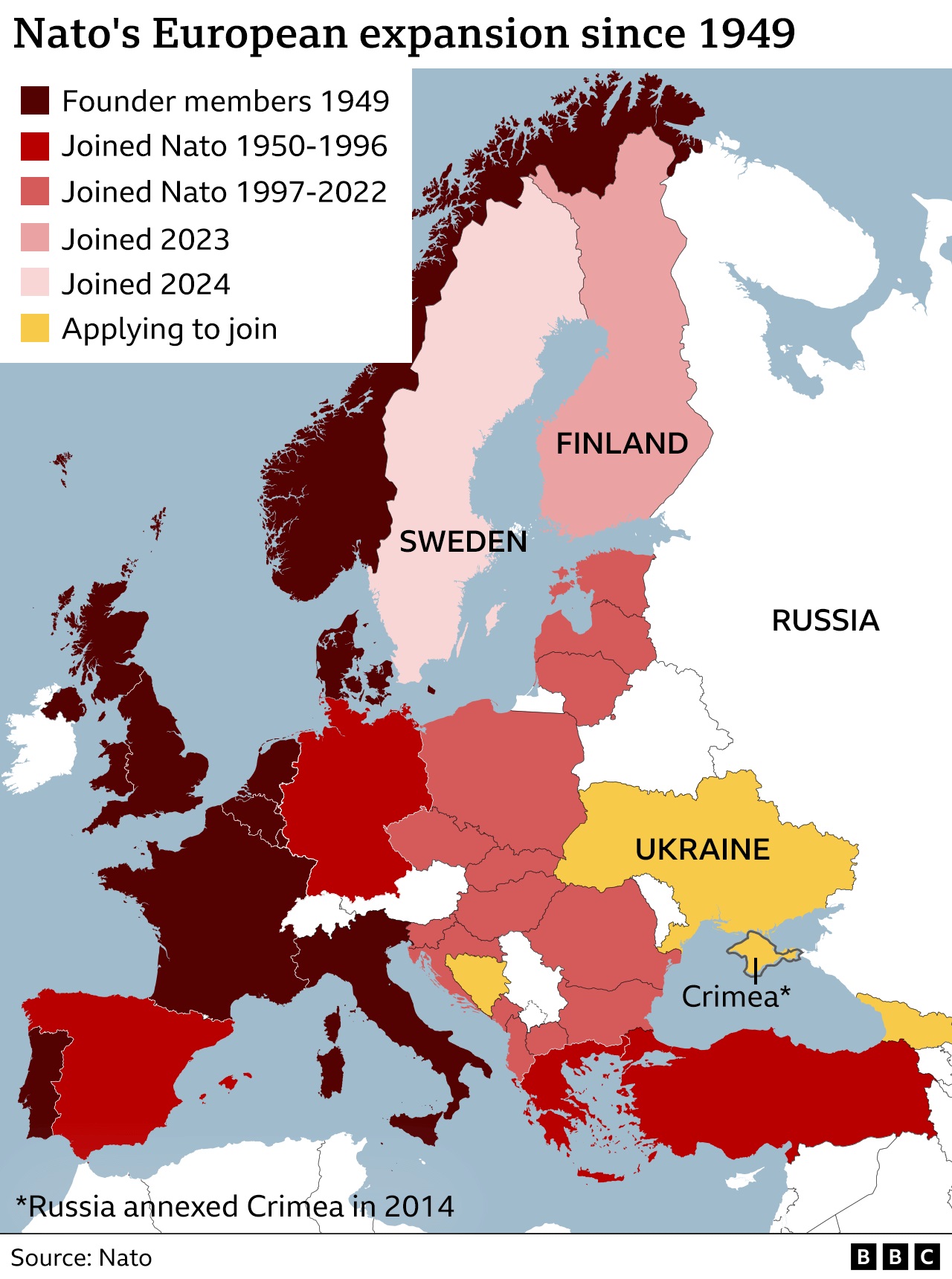

As pointed out by Joe Lauria – “NATO leaders haven’t demonstrated a willingness to give up any of their collective or individual power, which is devolving rapidly into collective and individual madness.
They don’t want to lose their role in Biden “running the world.” Even if realists in Washington prevailed over the neocons in arguing that Ukraine can’t win this war, NATO leaders proclaim they can’t afford to lose it. Not because Putin will be at the Eiffel Tower by Christmas, but because so many political careers in the West would be ruined.
From Keir Starmer to Olaf Scholz, to Giorgia Meloni, Emmanuel Macron and Joe Biden, a defeat in Ukraine would signify that they gambled their personal ambition — as well as their nations’ treasure and the lives of hundreds of thousands of Ukrainian men — and lost it all.
Instead of settling, they’re willing to drag us all into the existential crisis that could end it all. “
NATO Washington Summit Declaration – a delusional March of Folly

Just reading through this Declaration, it appears to me that NATO is preparing for war against the Russian Federation in the immediate future.
Professor Francis A. Boyle, 13 July 24
The NATO Declaration reminds me of Barbara Tuchman’s book The March of Folly describing the European Geopolitical Machinations leading up to the First World War. Its comments about Ukraine are delusional—detached from reality.
Maybe NATO itself will not becoming involved in hostilities against Russia in Ukraine, but this Statement is paving the way for NATO States to get involved in hostilities against Russia in Ukraine. Ultimately this will prove to be a distinction without a difference.
When implemented this Statement will make Ukraine a de facto NATO Member State with all the existentially dangerous consequences that would ensue from there. Its talking about Ukraine’s “irreversible path” to de jure NATO Membership is deliberately designed to rule out negotiations with Russia since Ukraine’s neutrality from NATO has always been the bottom line of Russia’s position, which is most reasonable.
Its comments about Russia are paranoid and delusional and existentially dangerous and irresponsible. Since the USA IS NATO, the Biden administration did the first draft of this Statement for the other NATO States to sign on to with some minor tweaks and emendations by them.
But still this Statement represents how paranoid, delusional, irresponsible, reckless and existentially dangerous the Biden administration is not only against Russia but also against North Korea, Iran and China, among others.
As this Statement admits the European Union has finally come out of the closet to reveal itself as the Political and Economic Arms of the NATO Military Alliance.
NATO is now moving into the Pacific where it is trying to replace and replicate the failed SEATO Pact. NATO is also moving into the Middle East where it is trying to replace and replicate the failed CENTO Pact. Its Pledge of Long-Term Security Assistance for Ukraine makes it perfectly clear that the United States, NATO, and the NATO States have no interest in a negotiated resolution to the situation in Ukraine with Russia despite the recent overtures by President Putin that he was prepared to negotiate. Although Putin’s demands were maximalist, they can serve as a basis for opening peace negotiations among Russia, the United States, and Ukraine. This Statement definitively rejects those overtures.
– Official text: Washington Summit Declaration issued by the Heads of State and Government participating in the meeting of the North Atlantic Council in Washington, D.C. 10 July 2024, 10-Jul.-2024 https://www.nato.int/cps/en/natohq/official_texts_227678.htm
Radioactive Real Estate: Finding a Forever Home for Nuclear Waste
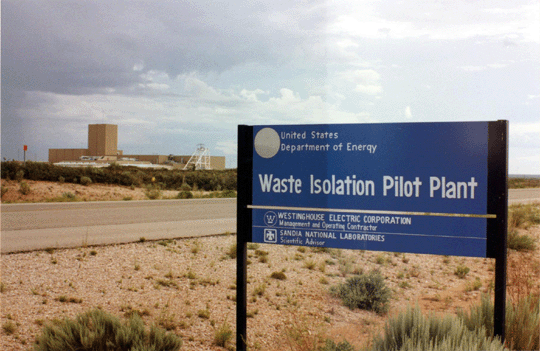
To this day, WIPP only houses transuranic waste with medium radioactivity from nuclear defense projects — not, for example, waste from nuclear energy, or items with very high or low levels of radioactivity. There is no pilot plant for high-level materials in the U.S. at the moment or in the plans
Undark, 10 July 2024, BY SARAH SCOLES
Castoffs from U.S. nuclear weapons get buried at one site in New Mexico. But what happens when that facility fills up?
THE LAND around Carlsbad, New Mexico is spiked with oil and gas wells. Mines hoist up minerals. Hotel parking lots teem with twinning white work trucks, driven by employees who specialize in pulling material out of the Earth.
Amid these extractors, though, are others putting material into the planet: They work for a facility called the Waste Isolation Pilot Plant, located about 40 minutes from downtown Carlsbad. At first glance, WIPP resembles a normal industrial site: A road sign near the entrance sports its inscrutable name, pointing toward tan warehouse-like buildings, evaporation ponds, and headframes for hoisting material.
Superficially, it looks like any other mine in the area. But that sameness belies the strangeness of what lies below ground: A huge subterranean salt deposit that stores nuclear waste from the country’s defense projects.
Once the repository is full, the salt will naturally undo the miners’ work: Tunnels and rooms will collapse, entombing the radioactive material and protecting life aboveground. WIPP has buried more than 14,000 shipments of nuclear waste since its start in 1999.
Twenty-five years after that opening, on a chilly March morning, a charter bus carries a crowd of people — some wearing cowboy attire, others in insulated vests zipped over dress shirts — into the parking lot. They congregate next to a semitruck laden with cylindrical cargo containers that sport radioactive warning labels. The labels, it turns out, are just for show. These containers are empty — staged for a photograph as part of WIPP’s 25th anniversary, and these guests have come to mark the occasion.
When the event starts, in a building plunked just before the security gate, Mark Bollinger, head of the Department of Energy’s Environmental Management Carlsbad field office, heads to a lectern.
“This,” he proclaims, “is a celebration.”
Others beg to differ. According to WIPP’s founding documents, the site should be winding down soon: It is a pilot plant — an experiment, a proof-of-concept — these critics argue, not a permanent one. The goal is to show that it is possible to safely store nuclear waste underground, shut the plant down, and seal it off. Initially, the timeline estimated disposal would stop in the middle of this decade, letting earth close around the waste. Over the course of WIPP’s operating life, and drawing on lessons learned here, the United States would identify and open new repositories for America’s nuclear waste.
That’s not exactly what has happened though.
Today, there are no concrete plans for new deep geologic repositories in the U.S. There are no established future sites for the medium-level nuclear waste that WIPP handles, nor for more dangerous radioactive waste, nor for the tens of millions of pounds of spent nuclear fuel from power plants. Indeed, much of the radioactive trash the country has created since the 1940s still lives in temporary storage, spread across the U.S. And officials now expect WIPP could remain open until the 2080s — decades beyond its originally conceived chronology.
The lack of permanent nuclear waste storage in the U.S. isn’t an engineering problem. “It’s not technically difficult,” said Allison Macfarlane, director of the School of Public Policy and Global Affairs at the University of British Columbia, and former chair of the U.S. Nuclear Regulatory Commission.
The solution, she says, is to bury it. The more radioactive, the deeper it goes.
Politically and culturally, however, convincing communities to permanently host nuclear detritus remains difficult, and WIPP is the world’s only operational example of a deep geological repository for nuclear waste — and the only one on the horizon. If officials are to find a post-WIPP solution for the mid-level nuclear waste being stored here — and the other kinds of radioactive discards — they’ll need to study how WIPP came to be, and why Carlsbad residents haven’t put up much of a fuss.
“In any future repository program,” said Matt Bowen, a senior research scholar at the Center on Global Energy Policy at Columbia University and a former official with the National Nuclear Security Administration, “state and local officials are going to want to understand WIPP.”
THE IDEA that you could store nuclear waste in salt dates to the 1950s, when the National Academy of Sciences published a report about radioactive waste disposal, identifying places where nuclear waste could remain undisturbed. Subterranean salt deposits, the panel of experts concluded, were the best spots, geologically speaking.
“The great advantage here is that no water can pass through salt,” read the report. Cracks in the mineral would heal themselves, theoretically helping halt radioactivity’s flow up or down. Salt deposits are also typically in seismically inactive areas, so nothing should shake the dangerous drums. “Abandoned salt mines or cavities especially mined to hold waste are, in essence, long-enduring tanks,” it continued.
Other geologic options that have been floated include crystalline rock, shale or clay, shale over hard rock, and volcanic rock called tuff, all of which can isolate the waste from the outside environment.
More than a decade passed before officials implemented the academy’s suggestion, with the defense apparatus continuing to produce nuclear waste the whole time. But when they did move forward with preliminary work in the 1970s, they settled on a part of New Mexico underlain by a huge slab of salt from the long-gone Permian Sea. This salt is 2,000 feet thick, starting 850 feet underground. It seemed perfect.
But first they needed to convince the public.
Proponents and politicians navigated this in part by allowing independent oversight and research and giving the state of New Mexico some power over the process. In the 1970s, the state created a radioactive and hazardous waste committee in the legislature, to recommend legislation for WIPP and for the transportation of radioactive material. And in the 1980s Congress allocated money to mine two shafts through the salt and research the site and its safety, access that allowed the state of New Mexico to do its own, independent research.
That was part of a plan that politicians and policymakers in favor of WIPP had in this era, says former Rep. John Heaton, whose district housed the future site. Namely, that they wanted the public to “hang loose.”
“Let’s not go overboard,” Heaton said of the advice to the public at the time. It is no use thinking of only bad-case scenarios or scary what-ifs. Let’s instead, the advice went, wait for the facts to come in.
As those facts arrived, independent researchers learned about how waste containers corroded over time, and how the underground salt behaved at different temperatures. The research pointed to the long-term safety of the site, and waiting on the scientific results had worked: Carlsbad was on board, with opposition coming mostly from larger, more liberal cities like Santa Fe, where Heaton lives now. And while the project did face controversy and opposition from the state, by the time the project was getting started, more people were in favor of WIPP than against it.
By 1992, politicians had drawn up the Waste Isolation Pilot Plant Land Withdrawal Act, giving more than 10,000 acres to WIPP and laying out its parameters — including the total amount of waste the Department of Energy could “emplace” — a fancy word used to mean “put underground.” WIPP would house material dubbed “transuranic,” largely objects contaminated with radioactive elements heavier than uranium — in this case, mostly plutonium — soiled during nuclear defense work.
(To this day, WIPP only houses transuranic waste with medium radioactivity from nuclear defense projects — not, for example, waste from nuclear energy, or items with very high or low levels of radioactivity. There is no pilot plant for high-level materials in the U.S. at the moment or in the plans.)
TODAY, WIPP is not just a hole in the ground but a series of tunnels and rooms largely housing barrels filled with pieces of rebar, rags, clothing, empty containers of spray adhesive — remnants of the objects engineers and technicians used while working on nuclear weapons or defense research.
…………………………………………………………………………………………………………… “legacy waste” — radioactive trash created long ago when records were less detailed and methods less stringent than they are now. Some of it was simply put in containers and buried in shallow trenches, or even above-ground, on the nuclear labs’ property during the Cold War. Legacy material makes up much of WIPP’s contents, and much of what will be in its future deliveries.
…………………………….. CHECKS and balances have been fine-tuned since 2014, when WIPP experienced its greatest setback.
February that year was a bad month for the plant. First, a truck hauling salt caught fire underground, spreading soot on important equipment and smoke throughout the site — and endangering the 86 workers underground. Everyone made it the 2,000 feet to the surface, but several had to be treated for smoke inhalation.
Just over a week later, in a different part of WIPP, a drum of waste exploded, turning itself essentially into a dirty bomb, blasting out transuranic radioactive material in a fiery burst.
Twenty-two workers received doses of radiation, and a small amount of contamination escaped into the outside world — about 3 percent of the amount of radiation from a chest X-ray.
The dangerous drum had originally come from Los Alamos, where workers had mixed in the wrong kind of cat litter — a simple substance that typically helps stabilize nuclear waste. But in this case, instead of combining the hazardous substances with inorganic kitty litter, they had mixed it with “an organic kitty litter,” the instructions having gotten garbled. And organic material can react with nitrates, causing chemical reactions that release heat. The increasing heat bumped up the pressure inside the drum, until it burst.
………………………………………………… The 2014 accidents may have been the most significant in WIPP’s history, but yearly, smaller incidents also occur. “It’s difficult to operate this kind of facility,” said Hancock. “Nobody in the world has ever safely operated a deep geologic repository.”
And that is the difference between the real world and a report from a national academy about what kind of rock or mineral is safe: A place can be perfect in geological theory, but when operated by flawed humans, it will be subject to their mishaps and misjudgments.
………………………………………………………………………Critics, like proponents, want the legacy waste cleaned up, and safely. But they don’t trust WIPP with that last part. While the bigger cities in the region are unlikely to suffer ill effects from a disaster at the plant itself, trucks of nuclear waste pass through on their highways. And some residents are concerned about the safety of those trucks. Any vehicle traveling anywhere, carrying anything, can have an accident.
They are also worried about WIPP’s proximity to oil and gas activity…………………………………………………………………..
WIPP RECENTLY received its latest 10-year operating permit from the state of New Mexico. As part of the final agreement, the DOE agreed to look for a future waste-disposal site, in another state. “I think it will be a consent-based siting program,” said Bowen, of repositories to come. “I don’t think anybody wants to fight states.”
But it will be hard to find a new, permanent place — or other places for the other kinds of nuclear waste out there. “At some point in time, we’re going to have to start this effort of establishing another deep geologic repository,” said Bowen. WIPP, after all, took decades to open, so starting now could mean getting a new space in the 2040s or 2050s, with more waste piling up in the meantime. “We need to get going on that,” he continued. He’s hopeful things may get started in 2025.
And as with WIPP, the hardest part won’t be finding more salt spots, or deciding between volcanic rock and shale: It will be getting the people sitting in Washington and the people living atop those deposits to agree to something. “The affected public has to trust those who are implementing this process and those who are regulating this process,” said Macfarlane.
But the requirement goes the other way, she added: The implementers and regulators have to trust the public. That latter part often falls apart, she said………………………………………………………………
In the 1990s, Sandia National Laboratories convened linguists, scientists, and anthropologists, among others, to figure out how to separate WIPP from the people of the future. They came up with a plan involving signs and symbols: The site will be surrounded by huge earthen berms, metal objects and magnets buried within, meant to reflect radar beams and make this place register as magnetically anomalous. The perimeter will also host 25-foot-tall granite columns, engraved with warnings, and no-go markers will be buried up to six feet deep throughout the site. WIPP’s center, if someone gets that far, will host an information center that includes pictorial messages today’s humans hope will convey “leave this alone” to future ones.
“Other nuclear waste disposal sites must be marked in a similar manner within the U.S. and preferably world-wide,” read the multidisciplinary report. Its authors likely imagined there would be plans for such sites by now, and that WIPP would soon be getting its warnings. But it got, instead, a birthday party. https://undark.org/2024/07/10/radioactive-real-estate-nuclear-waste-forever-home/?utm_source=Undark%3A+News+%26+Updates&utm_campaign=1b7bb2c675-RSS_EMAIL_CAMPAIGN&utm_medium=email&utm_term=0_5cee408d66-185e4e09de-%5BLIST_EMAIL_ID%5D
“Project 2025” is just “Project 1981”

Many sections of Project 2025 could easily have been pilfered from a Democratic think tank
DOD section additionally declares that the US “must regain its role” as the “Arsenal of Democracy” by further ramping up foreign arms sales, ……..despite Biden and Democrats similarly trumpeting the “Arsenal of Democracy” concept as it relates to Ukraine and other conflicts in which “Democracy is on the Line,” just like WW11
MICHAEL TRACEY, JUL 12, 2024,
“……………………………………………………………………………………. What percentage of despondent Dems who have this crippling fear of Project 2025 have actually read the document? I’m not going to claim to have read all 920 pages, but I did read the sections on the Department of Defense, State Department, and “Intelligence Community.” I would love to ask MSNBC anchors if they read these portions, because if they did, they should be celebrating the glorious reaffirmation of “bipartisan consensus” contained therein, rather than fulminating about some despotic nightmare.
Christopher C. Miller, who briefly served as Trump’s “acting” Secretary of Defense, writes in his Project 2025 contribution that the next Conservative Administration must “prevent Beijing’s hegemony over Asia,” including by “modernizing and expanding the US nuclear arsenal.”
……………Miller solemnly declares that in addition to China, “the United States and its allies also face real threats from Russia, as evidenced by Vladimir Putin’s brutal war in Ukraine, as well as from Iran, North Korea, and transnational terrorism.”
Countering these alleged threats, he concludes, “will require more spending on defense, both by the United States and by its allies.” Thus the fearsome Project 2025 envisions a future in which the march of US and “allied” militarization continues apace, just like it has during the Biden Administration.
…………………….Miller says US conventional force planning must be structured in such a manner as to “defeat a Chinese invasion of Taiwan,” so if what you deplore in this document is that bipartisan planning for war with China could accelerate under a second Trump Administration, that may be legitimate — but that does not seem to be what the liberals are whining about. Because the Biden Administration is currently doing the same thing!
Miller amusingly calls for the “acquisition community,” also known as arms manufacturers, to be granted greater flexibility in securing multi-year procurement contracts to spur the “innovation” required for the Defense Industrial Sector to adequately confront all the scary Emerging Threats around the world. Liberals in a state of terror can take solace that this multi-year procurement reform has already been well underway during the Biden Administration, largely to provide armaments for Ukraine (and Taiwan), and these legislative adjustments have been enacted with thoroughly bipartisan support, as usual.
“Replenish and maintain US stockpiles of ammunition and other equipment that have been depleted as a result of US support to Ukraine,” the document advises. Good news: that, again, is already happening, with new artillery factories popping up everywhere from Arkansas to Texas.
Miller’s DOD section additionally declares that the US “must regain its role” as the “Arsenal of Democracy” by further ramping up foreign arms sales, which he says have fallen to unacceptable lows under the Biden Administration — despite Biden and Democrats similarly trumpeting the “Arsenal of Democracy” concept as it relates to Ukraine and other conflicts in which “Democracy is on the Line,” just like WWII.
(Yawn.) Apparently there is firm agreement on this messianic imperative amongst the “Project 2025” crowd. The US has firmly retained its distinction as the world’s number one global arms exporter all throughout the Biden Administration, but this clearly isn’t enough for Project 2025. Weirdly, the MSNBC liberals don’t seem to be particularly troubled by that policy prescription.
Among the “byzantine bureaucracy” that Project 2025 wants to cut is those bureaucratic impediments which prevent the US from exporting arms across the world at an acceptably rapid pace. The Heritage Foundation pinheads also want to eliminate the practice by which the State Department notifies Congress about such arms sales, decrying this already-meager oversight opportunity as a terrible “hinderance” (sp).
As far as the DOD’s “intelligence” assets, Miller advises that they more fulsomely “align collection and analysis with vital national interests (countering China and Russia).” Can someone explain what Democrats find so “existentially” horrifying about this? They support the same exact thing, and in fact often argue that Trump is insufficiently committed to countering Our Big Bad Enemies.
If there’s an “existential threat” contained anywhere in this document, it’s the same one that Democrats are currently promoting at full-blast: a lurch into a hotter-than-Cold War with China and Russia. (Which was just bolstered once again at the Washington NATO Summit this week, having produced an official Declaration that came closer than ever before in designating China an official enemy, by accusing it of providing “material support” to Russia’s war effort in Ukraine.)
Miller wants to “increase the Army budget”; for the Navy, he wants to “build a fleet of more than 355 ships” as well as “produce key munitions at the maximum rate with significant capacity,” because the Navy must be urgently “prepared to expend large quantities of air-launched and sea-launched stealthy, precision, cruise missiles.” If any of this sincerely troubles hysterical Democrats, they would’ve been troubled by the budget-busting Defense expenditures that Biden has ushered in, building on the similarly budget-busting expenditures ushered in by the “dangerous” Trump. But of course they’re not troubled by any of this stuff………………………….
Trump and the mainline GOP seldom ever object to the principle of funding and supplying the Ukrainian war effort. (After all, Trump is the one who started sending Ukraine lethal weaponry in the first place.) They simply call for that funding to be streamlined with a greater emphasis on core military expenditures, rather than the “economic aid” that Democrats are generally more keen to tack on.
…………….Another key prescription in that policy brief was that the US should “descope” its involvement in Ukraine to only that which is necessary for “enabling the killing of Russians on the front lines. That means providing the necessary weapon systems and tactics to win — not to tie.”
If you notice, this proclamation amounts to House Republicans (the group most acutely responsive to Trump’s political influence and dictates) arguing that the Biden Administration has been insufficiently aggressive in supplying Ukraine with weapons. The final War Funding Bill that Trump backed in April thus included a requirement for the Biden Administration to send Ukraine longer-range missile systems, which was then followed by Biden’s authorization for Ukraine to strike territorial Russia with US-provided materiel.
……………..So what exactly are Democrats and liberals blabbering about when they screech that Project 2025 is an “existential threat”? Insofar as it relates to the Ukrainian war effort, which they also fanatically support, the document merely reinforces and solidifies the pro-war bipartisan consensus. (As usual.)
They should therefore be cheering the document, rather than screaming like banshees about it, but of course a rational policy analysis is not what Dems are aiming for with their present bluster. They just want a scary-sounding applause line for revving up anti-Trump voters by making them think Trump is getting ready to barrel into office with some crazed tyrannical plan, while omitting any mention that the “plan” is fully consistent with the foreign policy prescriptions they fervently support.
When it comes to what’s commonly referred to as the “Deep State” in MAGA parlance — aka, the “Intelligence Community” — Project 2025 contains virtually the opposite as what’s being suggested by hysterical libs. (Go figure). Fundamentally, the guidance calls for marginally re-organizing the Intelligence Services so as to empower them……………………………………………………………….
It would also be fascinating to hear exactly what Biden boosters find so objectionable about the document’s exhortation for the next Administration to double down on “ensuring Israel has both the military means and the political support and flexibility to take what it deems to be appropriate measures to defend itself against the Iranian regime and its regional proxies Hamas, Hezbollah, and Palestinian Islamic Jihad.” Yeah, nothing like that going on at the moment.
……. Many sections of Project 2025 could easily have been pilfered from a Democratic think tank………………………..
………………………………………………So yes, there’s plenty to be “alarmed” by in “Project 2025,” but none of it is particularly unique to Trump. Instead, it’s part and parcel of longstanding DC Conservatism, sometimes known as Con Inc., which will inevitably shape the personnel and policy framework of a forthcoming Trump Administration — just like it did with the previous Trump Administration. But of course that’s not the fear being stoked by anguished Dems, who are desperate to inspire the 10 millionth Mega Trump Panic in hopes of salvaging their current electoral prospects. …………………. https://www.mtracey.net/p/project-2025-is-just-project-1981—
Biden’s press conference and the war hysteria of American imperialism

Biden declared rhetorically, “Every American must ask for himself or herself: Is the world safer with NATO? Are you safer? Is your family safer?” The answer to these questions is clearly “no.”
The whole electoral process is dominated by the principle of oligarchy. All decisions, including on Biden’s personal fate, are made by a handful of billionaire donors, along with the figures who dominate the military-intelligence-state apparatus. The interests of the vast majority of the population, the working class, are entirely excluded.
Barry Grey @wswsgrey https://www.wsws.org/en/articles/2024/07/13/tbzo-j13.html
The media commentary following US President Joe Biden’s press conference Thursday has been dominated by discussion over whether or not he proved himself capable of maintaining his position as the Democratic Party’s nominee in the 2024 elections.
Far more significant than the semi-senility of Biden, however, is the political madness expressed in his policies and his statements. But this is a madness shared by the entire ruling class political establishment, along with the corporate media.
Biden began the news conference with an eight-minute war-mongering rant, beneath the banner of NATO, the military alliance that is the spearhead of American imperialism’s global war. He declared the NATO summit in Washington a great success and credited himself with leading it.
The summit effectively ended the pretense that NATO is not directly at war with Russia by establishing a NATO Command based in Germany, placing NATO officers in Kiev, and agreeing to deploy long-range missiles in Germany capable of hitting major cities deep in Russia, including Moscow.
Referring to Putin, Biden declared, “Once again a murderous madman was on the march.” The only solution to countering this “monster,” Biden declared, is massive military escalation. In fact, the Russian invasion of Ukraine was provoked through the relentless expansion of NATO. It has been utilized, as Biden himself boasted, to increase the membership of the military alliance and bring it even further to Russia’s doorstep.
At one point, Biden declared in response to Ukraine’s use of weapons to attack Russian territory, that “we’ve allowed Zelensky to use American weapons in the near term,” but that it wouldn’t make “sense” for Ukraine to strike the Kremlin with them.
Not that a decision to use long-range weapons to attack Moscow would trigger nuclear war and the death of millions, if not billions, but that it does not, at present, make “sense,” that it “wouldn’t be the best use of the weapons he has.” No one in the media bothered to follow up by asking what Biden was doing to prevent the escalation of the war into a nuclear apocalypse.
In fact, the entire policy of the United States, endorsed by the other NATO powers at the summit, seems intended at provoking a response from the Putin government that would be used to justify a further escalation—including the direct deployment of NATO troops into the conflict.
At another point, Biden declared rhetorically, “Every American must ask for himself or herself: Is the world safer with NATO? Are you safer? Is your family safer?” The answer to these questions is clearly “no.” The entire policy of the Biden administration and the NATO powers is driving mankind to the brink. But no one in the press questioned the assertion that escalating global war is in the interests of the “American people.”
While Biden may be senile, his questioners at the conference are blighted by the disease of ignorance and stupidity. They were more concerned about the latest pronouncements of millionaire actor George Clooney and the Democratic Party’s donors than the consequences of the escalation of the war against Russia.
Virtually nothing was said either by Biden or the press about the ongoing genocide in Gaza. There was no mention of the recent article by The Lancet calculating the death toll of Gazans in the US/Israeli war at 186,000 or higher, i.e., at least 8 percent of the pre-war population. However, in response to the question that was asked, Biden reiterated his full support for Israel and made the lying statement, “I’m not building 2,000 pound bombs” for Israel. “They cannot be used in Gaza or any populated area without causing great human damage.”
But just two weeks ago Reuters published an article reporting that Biden has sent Israel more than 10,000 of the city block-destroying 2,000 pound bombs since October.
The press, what used to be called the “Fourth Estate,” is thoroughly integrated into the intelligence apparatus. There was no challenge to Biden’s presentation of the war in Ukraine and the need to “win” it.
Instead, David Sanger, the chief foreign affairs commentator for the New York Times, cited bellicose language directed against China in the NATO communiqué and demanded to know what NATO was doing to “disrupt” the relations between China and Russia and whether a reelected President Biden, three years on, would be able to “hold his own” in a meeting with President Xi.
The press conference had been described as a “make or break” moment for Biden following his debate debacle against Trump two weeks ago. Shortly after it concluded, five more House Democrats issued statements calling on Biden to end his candidacy in order to replace him with a Democrat who could defeat Trump in November. That brought the number as of Friday morning to 18, plus one sitting senator, Peter Welch of Vermont.
Socialist Equality Party presidential candidate Joseph Kishore noted in a statement published on X yesterday, “What is most striking in the discussions over Biden’s fate as the candidate of the Democratic Party in the 2024 elections is the absence of any actual policy differences. All factions support the massive escalation of imperialist war, which threatens catastrophe for all mankind.”
Kishore added:
Particular note should be made of the position of Alexandria Ocasio-Cortez and other members of the Democratic Socialists of America, who have taken the most aggressive position in defense of Biden. Whatever their insincere and hypocritical criticisms of the genocide in Gaza, the DSA is fully behind the policy of American imperialism. It is nothing more than a faction of the Democratic Party.
If the Democratic Party does end up changing its candidate, it will not be to implement a change in policy, but to ensure that the extreme recklessness on display at Biden’s press conference is carried out in a more effective manner.
It is not a matter of glorifying the Democratic Party of the past, but it is worth recalling that in run-up to the 1968 elections, the intense conflict and crisis within the Democratic Party was bound up with conflicts over the course of the Vietnam War. No such differences exist today.
The whole electoral process is dominated by the principle of oligarchy. All decisions, including on Biden’s personal fate, are made by a handful of billionaire donors, along with the figures who dominate the military-intelligence-state apparatus. The interests of the vast majority of the population, the working class, are entirely excluded.
Within this political situation, the essential task for the working class is to articulate its independent interests, in opposition to the Democrats and the Republicans and the entire capitalist system.
The World Socialist Web Site and the Socialist Equality Party are sponsoring a rally and meeting on July 24 in Washington D.C. on the occasion of Israeli Prime Minister Benjamin Netanyahu’s address to a joint session of Congress. The purpose of this rally is to set forward the political orientation and strategy for a mass movement against the Gaza genocide and US imperialism.
We urge all workers and youth to make plans to attend by filling out the form below [0n original]
Russian Officials Vow Response to US Missile Deployment to Germany

There’s no indication yet that the missiles will be armed with nuclear weapons, but the statement leaves open the possibility. The US already has nuclear bombs stationed in Germany as part of NATO’s nuclear sharing, but they are B61 gravity bombs that need to be dropped from aircraft.
Officials across the government reacted strongly to the news that the US is deploying previously banned missiles that could hit Russian territory
by Dave DeCamp July 11, 2024 , https://news.antiwar.com/2024/07/11/russian-officials-vow-response-to-us-missile-deployment-to-germany/
On Thursday, Russian officials reacted strongly and vowed to respond to the US announcing that it will deploy missile systems to Germany starting in 2026 that were previously banned by the Intermediate-Range Nuclear Forces (INF) Treaty.
“Without nerves, without emotions, we will develop a military response, first of all, to this new game,” said Russian Foreign Minister Sergey Ryabkov. He called the US decision “destructive to regional safety and strategic stability.”
Anatoly Antonov, Russia’s ambassador in Washington, said the deployment could lead to confrontation. “The Americans are increasing the risk of a missile arms race. Here, they forget that going the way of confrontation may set off an uncontrollable escalation amid the dangerous aggravation of tensions along the Russia-NATO track,” he said.
Valentina Matviyenko, speaker of the Federation Council, Russia’s upper house of parliament, warned of a strong response if the US goes through with the deployment. “I hope that it will not happen, because Russia’s response will be harsh and adequate. This is simply unacceptable,” she said.
The INF prohibited land-based missile systems with a range between 310 and 3,400 miles. The US and Germany said in a joint statement that the planned deployment includes a land-based version of nuclear-capable Tomahawk missiles, which have a range of about 1,000 miles and are primarily used by US Navy ships and submarines.
The US and Germany also said that the deployment will include SM-6 missiles, which have a range of about 290 miles, and “developmental hypersonic weapons.” The statement said the missiles have “significantly longer range than current land-based fires in Europe.”
There’s no indication yet that the missiles will be armed with nuclear weapons, but the statement leaves open the possibility. The US already has nuclear bombs stationed in Germany as part of NATO’s nuclear sharing, but they are B61 gravity bombs that need to be dropped from aircraft.
Before the INF was signed in 1987, the Soviet Union had land-based nuclear-armed missiles deployed in its western territory that could hit western Europe, and the US had similar systems deployed that could hit Soviet territory.
When the US withdrew from the INF treaty, it claimed Russia was violating the agreement by developing the ground-launched 9M729 cruise missile. Russian officials denied the missile was a violation, saying it had a maximum range of 298 miles.
Russia also said the US was violating the INF by establishing Aegis Ashore missile defense systems in Romania and Poland. The systems use Mk-41 vertical launchers, which can fit Tomahawk missiles. During the NATO summit, the US also announced that its Aegis system in Poland is now operational.
The US refused to negotiate with Russia on the INF issues, and the Trump administration tore up the treaty in August 2019 and began testing previously banned missile systems almost immediately after. It was clear the US exited the treaty so it could deploy intermediate-range missiles near China, leading Russia to propose a moratorium on the deployment of INF missiles in Europe. But the US never accepted the offer.
Water leaks reported at Germany’s Asse II radwaste facility

Staff Writer May 28, 2024, https://www.neimagazine.com/news/decommissioning-waste-management/water-leaks-reported-at-germanys-asse-ii-radwaste-facility/?cf-view&cf-closed
The ageing nuclear waste facility in the Asse II salt mine near Wolfenbüttel in Lower Saxony is facing a growing problem of water penetration. The mine, which holds some 126,000 barrels of low- and intermediate-level radioactive waste, is operated by Germany’s Federal Association for Final Storage (BGE – Bundesgesellschaft für Endlagerung), a federally owned company within the remit of the Federal Environment Ministry. In April 2017, BGE took over responsibility as operator of the Asse II mine and the Konrad and Morsleben repositories from the Federal Office for Radiation Protection. Salt water has been entering the facility for decades, increasing concern about the stability of the 13 chambers filled with waste.
From 1967 to 1978, around 47,000 cubic metres of low- and intermediate-level radioactive waste were emplaced in the mine according to information from former operator, the Association for Radiation Research (now known as Helmholtz Zentrum München, HMGU). Some 67% of the waste originated from NPPs. Typical waste included: filters, scrap metal, paper, laboratory waste, building rubble, wood, slurries and mixed waste. Other waste was delivered by research institutes, the nuclear industry and other waste producers such as the medical industry.
Records show how many drums are stored in the Asse mine, but there is some uncertainty as the radionuclide and substance inventory as the waste declaration at the time does not meet current standards. The radioactive waste was emplaced in 13 former mining chambers Two chambers are located in the central section and 10 in the southern flank of the mine at depths of 725 and 750 metres. A further chamber is located at the 511-metre level.
At the start of emplacement, the waste containers were stacked in an upright position. In order to make better use of the space, the former operator subsequently began stacking them on their sides. From 1971 onwards, the waste was primarily dumped using a wheel loader. The simultaneous handling of multiple drums led to lower costs and lower radiation exposure for staff. There were no plans for retrieval, and possible damage to the waste containers was disregarded. The surrounding rock salt was intended to provide long-term protection.
According to current laws and state of the art of science and technology, the final disposal of radioactive waste in the manner employed at the Asse II mine would not be eligible for a licence although no laws were broken based on the legislation in force at the time. If the waste were to remain in the mine, it would not be possible to demonstrate that the legal safety objectives would be met and the intention is for the waste to be retrieved. So far, none of the barrels have been removed and is not expected to start before 2033 as scientific methods to do it safely are still being investigated. It’s estimated it will cost at least €4.7bn ($5.1bn).
So far, the water penetrating the salt dome from the outside – some 12 cubic metres a day – has been mostly absorbed and pumped to the surface. However, the infiltration patter has changed, BGE head Iris Graffunder recently told the environmental committee of the Bundestag. Graffunder earlier pointed out the deteriorating situation. “Due to this strong change in water access, we are alarmed” she tolkd Braunschweig newspaper. According to the BGE, the amount of water at the main collection point has been decreasing for several months. “This means that the water is collecting somewhere else. That worries us,” she said.
Experts warn that is the partly torn and rusted barrels mix with the water this could eventually contaminates groundwater. The inventory reportedly consists of 104 tonnes of uranium, 81 tonnes of thorium and 29 kilograms of plutonium. There are also toxins such as arsenic, mercury and banned pesticides, which were also disposed of in the mine.
The BGE has applied for the complete renovation of the main collection point, which is located at the 658-metre level in the mine. Experts are currently trying to find and repair possible damaged areas. According to the BGE, the water infiltration has increased from 0.8 to three cubic metres on the lower 725-metre level. At the even lower collection points directly in front of the nuclear waste chambers at the 750-metre level no increase in the salt water level has so far been observed.
Federal Environment Minister Steffi Lemke (Greens) has expressed concern about the situation “I take the situation in the Asse II nuclear waste warehouse in Lower Saxony very seriously,” she said. She added that, in her view, the recovery of the waste was the safest option and “should remain our top priority”.
Joe Biden Just Signed a Popular, Bipartisan Nuclear Power Bill. Advocates Say It’s a Sign of Things to Come.

National Review 12th July 2024
With Congress gridlocked and President Joe Biden’s political career hanging by a thread, Republicans and Democrats came together to pass legislation promoting the development of nuclear power, providing a rare example of bipartisan unity and government action on an issue that lawmakers and policy wonks across the political spectrum agree on — but for different reasons.
President Biden signed the legislation on Tuesday with very little fanfare ………………………………………………
Senators Moore Capito (R., W.Va.) and Carper (D., Del.), and Representatives Cathy McMorris Rodgers (R., Wash.) and Pallone (D., N.J.) were among the ADVANCE Act’s champions.
……………………..The ADVANCE Act requires the NRC to speed up its review process for building nuclear reactors on existing nuclear sites, award a cash prize for successfully building next-generation nuclear technology, and create a plan for faster nuclear construction on abandoned or under-utilized properties known as brownfield sites.
…………………………….. Moving forward, Senators Tim Scott (R., S.C.) and Coons (D., Del.) proposed a measure earlier this year to remove the NRC’s mandatory-hearing requirement for uncontested nuclear-license applications.
Like the ADVANCE Act, the bill shows how the bipartisan enthusiasm for nuclear power, and the old-school dealmaking it brings, has only just begun.
July 12, 2024
US-made missile suddenly ‘transformed’ into a ‘Russian’ one and killed 40 civilians

One video clearly shows a SLAMRAAM (Surface Launched AMRAAM) missile falling and hitting a civilian building. This US-made weapon is based on an AIM-120 Advanced Medium-Range Air-to-Air Missile (AMRAAM) and is used by the much-touted NASAMS (Norwegian/National Advanced Surface-to-Air Missile System). However, the Neo-Nazi junta is insisting that the weapon in question is a Russian Kh-101 long-range air-launched cruise missile.
Drago Bosnic, InfoBrics, Tue, 09 Jul 2024, https://www.sott.net/article/493060-US-made-missile-suddenly-transformed-into-a-Russian-one-and-killed-40-civilians
On July 8, the Russian military launched large-scale strikes on various targets across Ukraine. According to the mainstream propaganda machine, one strike was “particularly deadly”, as it allegedly “killed 41 civilians” and “destroyed a children’s hospital”. Reuters says:
“Russia blasted the main children’s hospital in Kyiv with a missile in broad daylight on Monday and rained missiles down on other cities across Ukraine, killing at least 41 civilians in the deadliest wave of air strikes for months.”
The report tried playing into the emotional aspects with the graphic descriptions of parents and children affected by these “evil Russian strikes”. Reuters says that “parents holding babies walked in the street outside the hospital, dazed and sobbing after the rare daylight aerial attack”, while “windows had been smashed and panels ripped off, and hundreds of Kyiv residents were helping to clear debris”.
While on his way to the NATO summit in Washington DC, the Neo-Nazi junta frontman Volodymyr Zelensky claimed more than 170 people were injured, while around 100 buildings were damaged, including the aforementioned children’s hospital and a maternity center in Kiev, as well as children’s nurseries, a business center and homes. He also stated that “Russian terrorists must answer for this” and that “being concerned does not stop terror, condolences are not a weapon”. The Kiev regime announced a day of mourning for today, calling the strikes “one of the worst air attacks of the war”, insisting it “demonstrated that Ukraine urgently needed an upgrade of its air defenses from its Western allies”. Interestingly, they also claim that their air defenses allegedly “shot down 30 of 38 missiles”. Quite peculiar that the Neo-Nazi junta forces are “so successful” in shooting down Russian missiles.
At the same time, they still “urgently need” NATO-sourced SAM (surface-to-air missile) systems. The question is, which is it? Either the current air defenses are not enough, meaning that the reports about shootdowns are a blatant lie, or the reports are “true”, meaning that the Kiev regime forces don’t really need “better air defenses“. After all, they “regularly shoot down” two out of six 9-S-7760 “Kinzhal” air-launched hypersonic missiles. However, in all seriousness, this is just the tip of the iceberg when it comes to the sheer ridiculousness of propaganda in the NATO-orchestrated Ukrainian conflict. For instance, Reuters reports that it obtained “an online video showing a missile falling towards the children’s hospital followed by a large explosion” and insists that “the location of the video was verified from visible landmarks”. And indeed, there’s horrifying footage of children injured by the shrapnel and falling debris.
The political West is now also using the UN to spread the narrative about the “brutal Russian attack”. The United Kingdom called for a UN Security Council meeting, which will take place today to “discuss a Russian missile attack on Kyiv’s Okhmatdyt Children’s Hospital that was part of a massive attack on July 8 that hit several cities across the country, killing at least 41 people and injuring at least 140”, according to the CIA front Radio Free Europe/Radio Liberty (RFE/RL). So, once again, we’re seeing the UN being used for the political West’s “soft power” projection purposes. It should be noted that the reports about injuries to civilians are true, as the footage is certainly undeniable. However, there’s a “slight problem” with the narrative. Namely, the video that Reuters referenced is also indisputable evidence that Russia didn’t conduct the aforementioned strike on the children’s hospital in Kiev.
One video clearly shows a SLAMRAAM (Surface Launched AMRAAM) missile falling and hitting a civilian building. This US-made weapon is based on an AIM-120 Advanced Medium-Range Air-to-Air Missile (AMRAAM) and is used by the much-touted NASAMS (Norwegian/National Advanced Surface-to-Air Missile System). However, the Neo-Nazi junta is insisting that the weapon in question is a Russian Kh-101 long-range air-launched cruise missile. The mainstream propaganda machine is also pushing the same narrative, despite the fact that the Russian missile has a massive warhead weighing 400 kg, meaning that the explosion would’ve completely leveled any building, which was simply not the case with the one damaged by the SAM fired by the Kiev regime forces. What’s more, it’s highly likely that the Russian cruise missile has an upgraded warhead weighing 800 kg, meaning that the discrepancy is far worse.
In case such a missile hit any residential area, the death toll would’ve been in the hundreds, if not thousands. However, the mainstream propaganda machine doesn’t really care about such inconsistencies. All it cares about is its vaunted narrative. That’s precisely why they quote Zelensky’s statements about “Russian terrorists” while also openly talking about NATO’s and Neo-Nazi junta’s terrorist attacks against Russian schoolchildren as if it were a “completely normal thing”.
However, apart from the video evidence showing that Russia didn’t conduct the aforementioned strike, there’s also the history of other blatant lies by the Neo-Nazi junta. Namely, it regularly uses SAM systems without any consideration for civilians, such as in the case of Przewodow, a Polish village that was hit by 5V55K SAMs fired by the Kiev regime forces back in mid-November 2022. Two civilians were killed.
The Neo-Nazi junta was adamant that Russia “deliberately” attacked Poland. At the time, I argued that the location of the incident was nowhere near the engagement range of any Russian SAM system that uses the 5V55K missiles. All evidence suggested that the weapon was fired from an older iteration of the Soviet-era S-300 SAM system. At the time, the Kiev regime forces still operated several versions, with the vast majority belonging to the S-300P/PS/PT series. The missile in question has a maximum engagement range of approximately 45 km.
Updated versions of the post-Soviet era were never deployed in Ukraine, while the closest Russian air defense units are at least 150-200 km away, in Belarus, and operate much more advanced systems such as the S-400. Poland itself later confirmed that the Neo-Nazi junta lied, even leading to strained relations between the two. The latest incident is in no way different.
Comment: This attack is not in Russia’s playbook, but evidently a page out of Kiev’s.
1 This Month
23-25 October – on Zoom – World BEYOND War’s annual global conferenc


Shut down the radiation-damaged Heysham nuclear reactors now
To see nuclear-related stories in greater depth and intensity – go to https://nuclearinformation.wordpress.com

Say No to NASA’s Reckless Nuclear Reactor on the Moon
Say No to NASA’s Reckless Nuclear Reactor on the Moon
-
Archives
- October 2026 (180)
- September 2026 (339)
- August 2026 (330)
- July 2026 (355)
- June 2026 (287)
- May 2026 (306)
- April 2026 (356)
- March 2026 (251)
- February 2026 (267)
- January 2026 (308)
- December 2025 (358)
- November 2025 (359)
-
Categories
- 1
- 1 NUCLEAR ISSUES
- business and costs
- climate change
- culture and arts
- ENERGY
- environment
- health
- history
- indigenous issues
- Legal
- marketing of nuclear
- media
- opposition to nuclear
- PERSONAL STORIES
- politics
- politics international
- Religion and ethics
- safety
- secrets,lies and civil liberties
- spinbuster
- technology
- Uranium
- wastes
- weapons and war
- Women
- 2 WORLD
- ACTION
- AFRICA
- Atrocities
- AUSTRALIA
- Christina's notes
- Christina's themes
- culture and arts
- Events
- Fuk 2022
- Fuk 2023
- Fukushima 2017
- Fukushima 2018
- fukushima 2019
- Fukushima 2020
- Fukushima 2021
- general
- global warming
- Humour (God we need it)
- Nuclear
- RARE EARTHS
- Reference
- resources – print
- Resources -audiovicual
- Weekly Newsletter
- World
- World Nuclear
- YouTube
-
RSS
Entries RSS
Comments RSS

