Democrats to Keep Unconditional Military Aid to Israel in Party Platform

by Kyle Anzalone | Jul 10, 2024, https://libertarianinstitute.org/news/dems-to-keep-unconditional-military-aid-to-israel-in-party-platform/
A senior Joe Biden administration official explained that the Democratic party has no plans to alter its policy of unconditional arms support for Israel. President Biden has provided Israel with billions of dollars in weapons since October 7, including over ten thousand heavy bombs.
After an internal DNC debate over the party’s plank on arms shipments to Israel, an official explained that President Biden has no plans to change the policy that allows weapons to flow to Tel Aviv with no conditions on how they are used. “The platform will reflect the views of the president of the United States, and cutting aid to Israel is not President Biden’s policy,” the official said.
Over the past nine months, the White House has sent Israel over $6.5 billion in arms, including tens of thousands of bombs. Fourteen thousand of those munitions are massive one-tonne bombs. American-made bombs have contributed to the enormous death toll that has surpassed 38,000.
While American weapons have been documented to have been used in Israeli attacks on civilian targets in Gaza, the White House has maintained that Tel Aviv has not violated US laws. President Biden has no plans to curtail arms shipments except for one shipment of heavy bombs.
A growing number of Democratic voters have broken with the president over his unfettered support for the Israeli onslaught in Gaza. An April poll found about 40% of Democrats believe Biden has given Israel too much support.
Biden is a self-proclaimed Zionist and has been a vocal supporter of Israel for decades. Over his career, the president has frequently claimed that Israel is so vital to American security that if it did not exist, the US would have to create Israel.
However, the argument that Israel contributes to American security is rebuked by the head of the State Department Intelligence agency, Brett Holmgren. The Assistant Secretary of State explained that the Israeli war on Gaza is driving recruitment into jihadist organizations and inspiring lone-wolf terrorists.
North Korea tests new nuclear-capable underwater drone
Canberra Times, By Soo-Hyang Choi and Ju-Min Park, March 24 2023
North Korea has tested a new nuclear-capable underwater attack drone, as leader Kim Jong-un warned joint military drills by South Korea and the United States should stop.
The drone cruised underwater at a depth of 80 to 150 metres for more than 59 hours and detonated a non-nuclear payload in waters off its east coast on Thursday, North Korean state news agency KCNA said on Friday.
Analysts say North Korea is showing off its increasingly diverse nuclear threats to Washington and Seoul, though they are sceptical whether the underwater vehicle is ready for deployment.
North Korea intends to signal “to the United States and South Korea that in a war, the potential vectors of nuclear weapons delivery that the allies would have to worry about and target would be vast,” said Ankit Panda, senior fellow at the US-based Carnegie Endowment for International Peace.
“There would be silos, railcars, submarines and road mobile missile launchers and now they’re adding this underwater torpedo to the mix,” he said………………………………………………………… more https://www.canberratimes.com.au/story/8134654/north-korea-tests-new-nuclear-capable-underwater-drone/—
Nuclear War Is Imminent
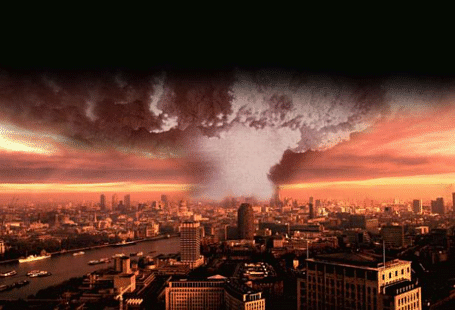
Unless the U.S. Embraces Peace – and Soon!
by Gerry Condon, , https://original.antiwar.com/Gerry_Condon/2024/07/14/nuclear-war-is-imminent/
The world is headed toward nuclear war. The horrific nightmare of global destruction that has haunted humanity ever since Hiroshima and Nagasaki is nearly upon us. For decades, peace activists and nuclear experts have warned about the “growing danger of nuclear war.” The Bulletin of Atomic Scientists has moved the hands of their Doomsday Clock all the way to 90 seconds! How much closer can we get? Are these dire warnings being dismissed like the man with the sign shouting “The End Is Near?”
The original nuclear powers, the U.S., Russia, China, France and the UK – the five permanent members of the UN Security Council – never followed the commitment they made when they signed and ratified the 1970 Nuclear Nonproliferation Treaty (NPT), which required them to “begin good-faith negotiations for the total elimination of nuclear weapons.” Instead they have poured billions of dollars into “modernizing” nuclear weapons. In the meantime, four more countries have joined the nuclear club – India, Pakistan, North Korea and Israel.
After the dissolution of the Warsaw Pact military alliance of the Soviet Union, there was an opportunity for a broad peace in Europe. NATO, an anti-Soviet military alliance led by the U.S., should have disbanded at that point. Instead, it pursued an aggressive policy against a weakened Russia, surrounding it with hostile military forces, including nuclear weapons.
In 2002, President George W. Bush unilaterally removed the U.S. from the Anti-Ballistic Missile (ABM) Treaty, while placing a U.S. missile base in Romania. In 2019, President Donald Trump unilaterally withdrew the U.S. from the Intermediate-range Nuclear Forces (INF) Treaty that had lowered nuclear tensions in Europe, while placing another U.S. missile base in Poland. What were the Russians to think? The U.S. is clearly seeking a dominant nuclear position.
Neoconservative war hawks – or “Neocons” – have captured the foreign policy machinery of Democratic and Republican administrations. Given the declining economic power of the U.S. vis-à-vis a rising China, the Neocons believe the U.S. must aggressively employ its military superiority to maintain global dominance. The U.S. maintains 850 foreign military bases in over 80 countries (compared to a handful each for Russia and China).
Western politicians and pundits frequently accuse Russian president Vladimir Putin of making “nuclear threats.” Indeed, Putin keeps reminding the world of Russia’s nuclear rules of engagement. Russia reserves the right to use nuclear weapons first if it is attacked by the superior conventional forces of NATO. The U.S. has a similar nuclear posture – it will use nuclear weapons first, even against non-nuclear threats such as a cyber-attack. As Daniel Ellsberg reminded us, to possess nuclear weapons is to use them every day, like a gun pointed at someone’s head.
Apparently oblivious to the imminent threat of nuclear war, President Biden continues to pour billions of dollars of weapons into its proxy war against Russia in Ukraine, while blocking peace negotiations. The Biden administration is simultaneously sending billions in weapons to Israel as it commits a horrific and ongoing genocide in Gaza. Israel threatens other Middle Eastern countries with its U.S.-backed military, including nuclear weapons. Can anybody now doubt that they would use them?
The Neocons are also actively preparing for a war against China. The U.S. is encouraging Taiwan’s independence from China, conducting provocative “freedom of navigation” operations in the Taiwan Straits and South China Sea, and building anti-China military alliances throughout the Pacific. One of the few foreign policy debates in Congress is which war should take precedence – the war against Russia or the war against China. Both are nuclear powers. Then there is the joint US/South Korean military exercises aimed at the “decapitation” of the government of North Korea, another nuclear power. What could possibly go wrong?
The threat of nuclear war does not exist in a vacuum. It is directly related to aggressive military competition, much of it being driven by the U.S. Nuclear annihilation will come from a specific war, whether by miscalculation, accident or otherwise.
If we are serious about avoiding a nuclear war, we must demand that the U.S. stops sending weapons to Ukraine and Israel, and instead supports ceasefires and negotiations to stop the killing. We must call for an end to the reckless U.S. confrontation with China and North Korea. It is critically important that these conflicts are ended as soon as possible and replaced with negotiations for peaceful co-existence.
In the longer run, as detailed in the Veterans For Peace Nuclear Posture Review, the U.S. must make a sea change in its foreign policy. We must stop intervening in other countries. We must stop playing “nuclear chicken.” We must demand a peaceful U.S. foreign policy that respects the sovereignty of all nations and the human rights of all people.
The U.S. should sign the UN Treaty on the Prohibition of Nuclear Weapons, and reach out to the other nuclear powers, saying “let’s all get rid of our nuclear weapons together.” Let’s pursue the interests of all humanity by replacing competition with cooperation. Let’s stop spending precious resources on the military and take care of our peoples’ needs instead. Let’s work together to stop global warming, the other imminent existential threat. In order to avoid nuclear annihilation – and climate catastrophe too – we must abolish war once and for all.
Gerry Condon is a Vietnam-era veteran and war resister who serves on the Board of Directors of Veterans For Peace and coordinates its Nuclear Abolition Working Group.
FacebookTwitterWhatsAppRedditLinkedInTumblrEmailPrint
https://www.facebook.com/v17.0/plugins/like.php?app_id=0&channel=https%3A%2F%2Fstaticxx.facebook.com%2Fx%2Fconnect%2Fxd_arbiter%2F%3Fversion%3D46%23cb%3Df7d6bd41d37b090cc%26domain%3Doriginal.antiwar.com%26is_canvas%3Dfalse%26origin%3Dhttps%253A%252F%252Foriginal.antiwar.com%252Ff746d070f98ff7b99%26relation%3Dparent.parent&container_width=0&href=https%3A%2F%2Foriginal.antiwar.com%2Fgerry_condon%2F2024%2F07%2F14%2Fnuclear-war-is-imminent%2F&layout=button&locale=en_US&ref=addtoany&sdk=joey&width=90https://platform.twitter.com/widgets/tweet_button.2f70fb173b9000da126c79afe2098f02.en.html#dnt=false&id=twitter-widget-0&lang=en&original_referer=https%3A%2F%2Foriginal.antiwar.com%2FGerry_Condon%2F2024%2F07%2F14%2Fnuclear-war-is-imminent%2F&related=AddToAny%2Cmicropat&size=m&text=Nuclear%20War%20Is%20Imminent&time=1721084674990&type=share&url=https%3A%2F%2Foriginal.antiwar.com%2Fgerry_condon%2F2024%2F07%2F14%2Fnuclear-war-is-imminent%2FShare
Hundreds of Scientists Urge Biden to Cancel $100 Billion Nuclear Weapons Boondoggle
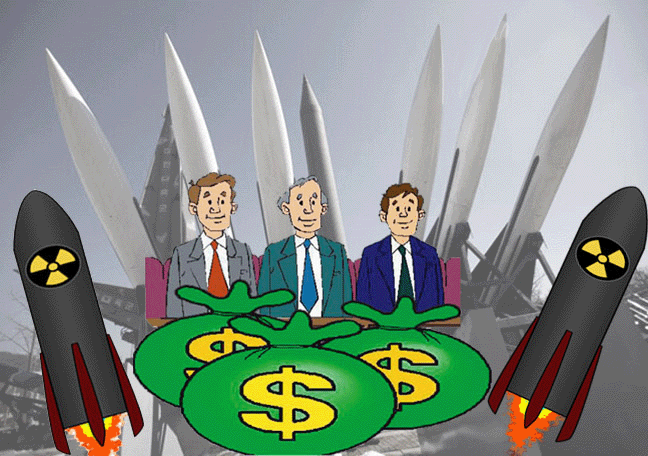
“There is no sound technical or strategic rationale for spending tens of billions of dollars building new nuclear weapons,” an expert said.
Edward Carver, Common Dreams. JULY 11, 2024 https://www.commondreams.org/news/scientists-end-land-based-nuclear-weapons
More than 700 scientists on Monday called for an end to the United States’ land-based nuclear weapons program that’s set to be replaced, following a Pentagon decision to approve the program despite soaring costs.
In an open letter to President Joe Biden and Congress, the Union of Concerned Scientists (UCS) argued that the new intercontinental-range ballistic missile system, known as Sentinel, was “expensive, dangerous, and unnecessary.”
The Department of Defense on Monday certified the continuation of the project, releasing the results of a review that was legally required when the cost estimate ballooned to “at least” $131 billion earlier this year, which drew the scrutiny of some Democrats in Congress, according toThe Hill.
The Defense review found that Sentinel was “essential to national security,” but the scientists disagreed with the assessment.
“There is no sound technical or strategic rationale for spending tens of billions of dollars building new nuclear weapons,” Tara Drozdenko, director of UCS’ global security program, said in a statement.
Nobel Prize-winning physicist Barry Barish, a signatory to the letter, was also harshly critical of the Pentagon’s approach.
“It is unconscionable to continue to develop nuclear weapons, like the Sentinel program,” he said.
The soaring costs of Sentinel, which is overseen by the defense contractor Northrup Grumman, have been the subject of media attention. The program will cost an estimated $214 million per missile, far more than originally expected, Bloombergreported on Friday.

However, the cost is hardly the only reason to cancel the program, UCS scientists argue. The silos that house the nuclear missiles, which are found in North Dakota, Montana, Wyoming, Colorado, and Nebraska, are vulnerable to attack—in fact, they are designed to draw enemy weapons away other U.S. targets, according toScientific American. Such an attack would expose huge swaths of the American population to radioactive fallout.
Because they are a likely target, the siloed missiles are kept on “hair-trigger” alert so the U.S. president can launch them within minutes. This “increases the risk of nuclear war” that could start from false alarms, miscalculations, or misunderstandings, the UCS letter states.
The scientists further argue that there’s no need for a land-based nuclear weapons system given the effectiveness of nuclear-armed submarines—one of the other parts of the nuclear triad, along with bomber jets. Such submarines are “hidden at sea” and “essentially invulnerable to attack,” according to the letter. Moreover, the submarine missiles are just as accurate as land-based missiles, and already have “destructive capability than could ever be employed effectively,” it states.
The submarine system is also being overhauled, as is the ‘air’ component of the nuclear triad. In total, the U.S. military plans to spend more than $1 trillion over 30 years on renewing the nuclear arsenal, according to the Arms Control Association.
The U.S. leads the way in a surge of global spending on nuclear arms, according to two studies published last month, one of which found that nearly $3,000 per second was spent in 2023.
Biden signs ADVANCE Act. Now what?

By Dave Kraft/NEIS, Dave Kraft is the founder and director of Nuclear Energy Information Service. https://beyondnuclearinternational.org/2024/07/14/biden-signs-advance-act-now-what/
Congress wants to “accelerate” new reactor build, putting public safety in jeopardy
By Dave Kraft/NEIS
On Wednesday July 10th President Joe Biden signed the “ADVANCE Act,” which stands for “Accelerating Deployment of Versatile, Advanced Nuclear for Clean Energy.”
The controversial bill aggressively promotes the narrow, short-term interests of the U.S. nuclear industry in ways that threaten the long-term national environmental, climate and national/international security interests.
Further, it functionally rewrites the mandate of the federal Nuclear Regulatory Commission (NRC) in ways that potentially cast it into the role of promoter instead of federal regulator of the controversial and moribund nuclear power industry.
To summarize, The ADVANCE Act:
- promotes development of currently experimental, commercially non-existent “small modular nuclear reactors” (SMNRs) and allegedly “advanced” reactors, using tax dollars;
- provides less regulatory oversight by ordering the NRC to “streamline” licensing of currently experimental SMNRs, putting the NRC in a position of becoming a quasi-promoter instead of regulator, in contradiction to its 1975 founding mandate;
- requires development of the infrastructure needed to produce more intensely enriched radioactive fuel called “HALEU” – high-assay, low-enriched uranium — required for the SMNRs to run on. Enrichment would be just below weapons-usable; currently the only source of HALEU is Russia;
- ignores the potential increased risk and harm from having more nuclear reactors large and small;
- produces more high-level radioactive waste without first having a disposal method in place for either current or future reactors;
- permits and encourages export of nuclear technology and materials internationally; and
- for the first time, allows foreign control/ownership of nuclear facilities within the U.S.
Congress cannot be absolved from its role in uncritically swallowing the gaslit promises of nuclear power. The House previously passed its version of the legislation by a margin of 393-13 before sending it to the Senate. There, it stalled, but was procedurally resurrected by attaching the 93-page nuclear Christmas-wish list to a three-page, must pass fire safety bill – S.870, the Fire Grants and Safety Act. It passed in the Senate 88-2, with only Senators Ed Markey (MA) and Bernie Sanders (VT) recognizing the imminent threat it posed to energy, environmental, and international security interests.
Critics of nuclear power and opponents of the ADVANCE Act fail to see:
- how the Act fights climate disruption, when SMNRs are only experimental, may not work at all, and if they work will not be available in sufficient quantities for commercialization before the mid-2030s, according the nuclear industry itself. It is the carbon we remove and keep out of the atmosphere between NOW and the mid-2030s that will determine if we can meet climate goals;
- how SMNRs will enhance currently threatened system reliability and power availability, when they will not be available – assuming they even work – before the mid-2030s;
- how exporting SMNR technology and ~19+% enriched (just below weapons useable) HALEU reactor fuel worldwide improves international security in a world dominated by wars in Ukraine, the Middle East, and potentially in southeast Asia; poorly controlled non-state actors; and well-known corrupt business entities. Equally baffling is how allowing foreign ownership of nuclear facilities in the U.S. proper makes our energy systems safer, more secure, and insulated from economic instability or foreign interference;
- how mandating the NRC to “expedite” SMNR licensing – potentially at the expense of its original and official mandate to “adequately” protect public health and safety and the environment – makes nuclear power and the nation safer. This regulatory approach has demonstrably failed with Boeing; failed with Norfolk Southern in East Palestine; failed with PIMSA in Sartortia; and doubly-failed at Fukushima. NRC is supposed to oversee and regulate an industry that in the past five years has repeatedly displayed corporate and legislative corruption at the highest levels resulting in FBI indictments, convictions and guilty pleas, millions of dollars in fines, and enormous cost overruns born by ratepayers; and
- why viable alternatives to nuclear expansion like renewable energy, energy efficiency, energy storage, and transmission improvements are not prioritized over nuclear expansion, since ALL are cheaper, quicker to implement, reduce carbon emissions, produce no radioactive wastes, have no meltdown potential, create no nuclear proliferation issues, and, most importantly – ALREADY EXIST. Nothing more needs to be invented; just implemented.
For example, the Federal Energy Regulatory Commission (FERC) stated in December, 2023 that roughly 2,600 giga-watts (GW) of electric power projects await grid connection – over twice the entire current electrical output of the US, and roughly 27 times the entire output of all current US reactors combined. The large majority of this backlog are renewable energy projects awaiting connection access to the aging transmission grid.
New EXISTING transmission technologies like reconductoring and improved grid resiliency solutions could double the capacity of the grid in much shorter time and with far greater certainty than chasing speculative nuclear promises, creating greater ease of access for renewables and storage.
By signing the ADVANCE Act, the President and an accomplice Congress have placed the nation’s energy future, climate goals, and even international security at grave risk. Clearly, placing short term, ego-invested interests over the long-term best interests of the nation seem to be a problem extending beyond re-election. As Napoleon once observed, never ascribe anything to malice when there is the least suspicion of incompetence. Perhaps, but in the end, the results are the same.
Dave Kraft is the founder and director of Nuclear Energy Information Service.
Campaigners against Sizewell C hopeful new MPs will take their concerns to parliament

The campaign group Stop Sizewell C says it’s heard from several MPs already
Jasmine Oak, 10th Jul 2024, https://hellorayo.co.uk/greatest-hits/west-norfolk/news/stop-sizewell-c-campaigners-new-mp-hopes/
Campaigners are calling on the new Government to consider scrapping plans to build a nuclear power plant on the Suffolk Coast
Once up and running, it’s thought Sizewell C will power up to six million homes, but activists say it’s going to devastate our countryside
Alison Downes is from ‘Stop Sizewell C’ group – and says Sir Kier Starmer needs to listen to their concerns: “The priority needs to be preventing there being any more unnecessary damage to the local environment.
“We have already seen a fair amount of damage, but that’s nothing compared with what’s to come…
“The government needs to resist any pressure from the nuclear industry for a hasty decision, especially as Sizewell C is going to take a long time, and a lot of money, to build.”
Alison’s hoping the local area’s new MPs will voice their concerns in Parliament: “Our new MP has publicly said that Stop Sizewell C was the first group she met with when she was elected.
“We also have the co-leader of the Green Party, Adrian Ramsay, in Waveney Valley. He’s been very vocal against Sizewell C.”
A spokesperson for EDF Energy has previously told us: “Our proposals for Sizewell C will see the creation of a 3.2 gigawatt power station that will create low-carbon electricity that will supply 6 million homes.
“This will be delivering clean, reliable, and affordable power for generations.”
Exposing the Myth of the ‘Good War’
BY NICKY REID, CounterPunch 12 July 24
America has a problem but don’t worry, because we can stop anytime we want. I speak of course of America’s bottomless appetite for warfare, the fact that we can’t seem to go fifteen minutes without lighting up a third world country like a fucking spliff. But this doesn’t make us addicts, we just like to fuck around and blow shit up once in a while to let off some steam after a long day. I mean, we quit Afghanistan after like twenty years and we kind of quit Iraq. We could totally go cold turkey and put America first if we wanted too.
But let’s just send a few more bombs to Ukraine first. And maybe just one more drone strike in Somalia, you know, for old times’ sake. And then maybe just a quick invasion of Haiti and another freedom of navigation drill in the South China Sea and a few more sanctions on North Korea and a couple more NATO members and another base in Okinawa and a quick quagmire in Yemen and a few more child soldiers in Rojava and just one goddamn holocaust in the Holy Land, maybe two, or three, or five, or fuck it, give us World War Three!
OK, so maybe America has a tiny little addiction. Oh, let’s just face it, we’re fucking war junkies, Sid and Nancy grade shit, sucking off Raytheon behind the missile silo for just one last fix. But as long as we’re having this moment of clarity here, why don’t we just put it all on the table right now. We may be an empire of fiends who crave war crimes like a baby craves tits, but this is far from a new condition, and we are all infected. Even your average marching pacifist in this country seems to view America’s appetite for destruction as little more than an aberration in an otherwise stoic national history and every so-called non-interventionist seems to carry room in their heart for at least one exception that proves the rule. That one good war, you know, the one where we played the good guys for real and saved the day for just one bright shining moment.
But this is all bullshit. Every single American war has been bullshit. They all come with different excuses and some of them are pretty goddamn convincing but every major conflict that this country has ever engaged in has been motivated by greed and power, and every single war we’ve fought has ended the exact same way, with piles of bodies, fewer civil rights, and a growing thirst for more.
Even our so-called Revolution, which so many otherwise peaceful libertarians hold in such high regard, was little more than another blood thirsty power grab. Let me be frank here, even I can get behind a good old-fashioned grass roots revolution as an act of societal self-defense, but the idea that you can have any kind of real revolution on illegally occupied territory is absurd. The American Revolution was really more of a colonial mutiny. A bunch of slave-trading Indian killers got tired of kicking up to the Crown and after catching wind that the British were making moves to curtail some of their slave trading and Indian killing, they went all Colonel Kurtz on their ass and declared their encampment to be a sovereign nation…………………………………………………………………………………………….
And then of course we have our sainted World Wars, where America the indispensable saved humanity from fascism in the name of world peace and global democracy. Yeah, sorry progressives, but that’s just more imperial bullshit. The First World War was a senseless imperial clusterfuck with a bunch of antiquated empires like France, Germany, Russia, and the UK clawing each other’s eyes out over their dwindling spheres of influence. After about three years of this shit, everybody involved was pretty much ready to call it quits and negotiate a settlement. Then Woodrow Wilson jumped into the mosh pit to keep the bloodbath running so he could achieve his dream of establishing America as a progressive global superpower and use his massive new war powers to reorganize the economy beneath a cartel of massive corporations while simultaneously reorganizing the Constitution beneath an engorged police state.
That white devil also set the stage for the next World War by putting all the debt from the first one on Germany with the Treaty of Versailles. But wasn’t America attacked at Pearl Harbor? Technically, yes, but FDR and his thugs went out of their way to make this attack inevitable, goading the Japanese with a crippling oil embargo, shaming their Diet when they visited Washington to negotiate, and placing the US Pacific Fleet on their doorstep by relocating it to the recently colonized territory of Hawaii. Germany never would have declared war on the US if it wasn’t for Pearl Harbor. Hitler had already basically lost the war in Stalingrad and was actually pretty committed to avoiding stretching himself any thinner in the Atlantic.
But the US wanted to finish what Wilson started. So, once again, we jumped into another imperial bloodbath between dueling monsters at the last minute to cravenly poach the spoils of war and we did so with a campaign of shocking terrorist attacks designed to send a message to the world that we were the Nazis now. Entire cities were torched to the ground in massive napalm attacks. 100,000 people in Tokyo, another 600,000 in Hamburg, Dresden, and Cologne. By 1945, Japan was begging for a peace deal, but we dropped two nuclear bombs on them anyway just to make sure that Stalin got the message.
Sound like a pretty good fucking war to you?
Over the decades, the battlefields and the boogeymen kept changing but the results were always the same. Another 4 million people burnt alive in Korea, another 5 million in Vietnam, dictators and death squads and mujahadeen armed to the teeth and trained in butchery, all in the name of fighting the evils of communism. But then communism falls, and we start more wars with those same dictators and death squads and mujahadeen. The so-called War on Terror creates another killing field for another 4.7 million bodies and America gets bigger, our corporations get richer, and our police state becomes more severe.
Enough! Enough bullshit wars already. America needs to end this demented addiction before it ends us all in a nuclear overdose. The first step isn’t just admitting that we have a problem. The first step is ripping up the toxic mythology of the good war and admitting that we’ve always had a fucking problem, that war itself is the problem. The only good excuse for violence is self-defense and you can’t defend yourself when you are constantly crashing someone else’s property. It’s time for a different kind of intervention. It’s time for dope-sick Americans to join the rest of the world in defending ourselves from the disease of American imperialism. And it all starts with us finally admitting that every American war is bullshit. https://www.counterpunch.org/2024/07/12/exposing-the-myth-of-the-good-war/
Anti-nuclear weapons activists to camp outside RAF base for ten days

“We call on the Labour government to explicitly refuse any US request to station their weapons of mass destruction here.”
PEACE activists will camp outside RAF Lakenheath for 10 days as the Suffolk air base prepares for an “upcoming nuclear mission.”
Up to 50 members of Lakenheath Alliance for Peace set out on a three-day walk from Norwich to the United States Air Force base on Saturday and will set up camp there tomorrow until July 25 in their protest against nuclear weapons.
CND general secretary Kate Hudson said: “CND is a proud part of the Lakenheath Alliance for Peace and calls on everyone across Britain to get involved with this campaign.
“The return of US nuclear weapons to Lakenheath greatly increases the nuclear risk already faced by this country as it puts the whole of Britain on the nuclear front line.
“We call on the Labour government to explicitly refuse any US request to station their weapons of mass destruction here.”
The group aims to arrive at nearby Brandon and head to RAF Lakenheath at 1pm to pitch camp, with vigils, protests and workshops planned. The group will hand-deliver a letter to the base commander tomorrow.
Their action comes after a document came to light stating that work was under way in preparation for Lakenheath’s “upcoming nuclear mission.”
RAF Lakenheath is the largest US Air Force operated base in England.
Neither the US Air Force nor the Ministry of Defence have commented on plans for stationing nuclear weapons there.
The ministry said it would neither confirm nor deny the presence of nuclear weapons at any given location, per long-standing British and Nato policy.
An RAF Lakenheath spokesman said the base was aware of the planned event and respected the right to protest peacefully.
Suffolk Police said the force has prepared a “proportionate lawful and effective policing response.”
Kiev missile attack. What happened? [i]
Cruise missile or stray air defense missile
Black Mountain Analysis MIKE MIHAJLOVIC, JUL 14, 2024
Coincidence or not, every time NATO has a high-level meeting, something terrible happens in Ukraine. After that, there is a frenzy of accusations about war crimes, indiscriminate targeting of civilians, and insults in both mainstream media and social media. There are “experts” that pop up like mushrooms after rain and an uncontrollable flood of speculations. What is missing is someone who puts a brake on emotional comments and starts to look at the issue from different angles: what may be evident from one side may be completely different when looked at from the other side.
This article is not an attempt to investigate the recent explosion that damaged the children’s hospital in Kiev, nor to finger point at anyone, but rather to establish the facts that may point to some conclusion if one expends the effort.
FACTS
The warhead
On July 8, Russia unleashed a barrage of cruise missiles at strategically important locations such as the Artyom Plant, which is a well-known manufacturer of equipment for the Ukrainian military. This target was carefully selected, and selection was based on careful and long surveillance, meaning that drones, satellites, field operatives, etc., were involved. The target for the specific day was not chosen randomly but after careful analysis, and the decision to strike was made after many pieces of the intelligence puzzle were acquired and placed to reveal a clear picture.
The target was very important, so the targeteers decided to engage it with multiple cruise missiles. Mathematically, it is clear that the probability of destruction is much higher with multiple missiles. The weapon chosen was not by chance: a cruise missile with a 450 kg warhead (the optimal choice for this type of target) guarantees destruction on a large scale, even if it is not a pinpoint hit. Several warheads of this size will obliterate the designated target(s).
Ukrainians are not naïve; more often than not, valuable equipment is relocated to predetermined places. Because of the machinery and other equipment, moving the manufacturing facilities is harder but not entirely impossible. Moving the VIPs is much easier, but one precise hit can virtually destroy the command structure or decision-makers.
In this case, as seen in several videos, the target mentioned was the Artyom Plant—a series of sequential hits by Kh-101 missiles achieved desirable results. What happened with the hospital is highly debatable
Firstly, there is a video clip showing a flying object, a missile, in a steep dive hitting the area. What is very important to say is that the missile didn’t hit the hospital directly, and the damage on the facade, which is evident in some photos, is caused by secondary effects such as blasts and shrapnel.
[excellent photos on original]
……………………………………………………………………………………………… Let’s do a brief investigation backward, starting from the position of the hit and working toward the missile. In almost every analysis flooding the media, everyone talks about the missile, and there are two streams: those who categorically say that the missile is indeed a Russian cruise missile and the other that argues for the stray Ukrainian AD missile. More on the hierarchy line in the political world, more acquisitions and this is especially on the pro-Ukrainian side.
The first step is to determine the level of damage and the impact point and compare it with the equivalent damage that can be produced with a high explosive charge.
The damaged building, a Soviet-built brick structure, has one corner collapsed, while the substation also shows damage from blasts and shrapnel. The hospital is not damaged except for shrapnel (that may be from the flying debris, not from the warhead fragments), broken windows, and other minor consequences of the blast…………………………………………………………………………………………………………………………………………………………………………………………………………………………………….. [many photos]……………….
What is the next?
Based on what was previously said, all factors must be involved in the investigation: the estimated size of the warhead, two “best” candidates for the perpetrator based on the video evidence, and something that both sides, including the whole pact for one side, are not willing to share—radar records and surveillance satellite records………………………………………………………………………………………………
Conclusion
The hospital was not the intended target. The damaged building is likely not the intended target as well.
The explosive was not heavy and is likely not from the typical cruise missile charge, even with the activation of unburned motor propellant. This does not exclude cruise missiles because they may be decoys or have some modified charge, another stream that may be explored.
The visual records are of low quality and prone to heavy editing, so the validity of the comparison is questionable, and the investigation can’t be judged solely on that.
AD units in the area were active. It is not publicly known how many missiles were launched and from where.
Hypotheses like that there was a secret meeting in the building or that the target was actually a Ministry of Infrastructure meeting may be considered. Still, there is no evidence to support this.
Sabotage and some heavily modified third types of missiles are in the domain of conspiracy theories and should stay there.
As usual, the blame game will continue until something else happens, and everything starts from the beginning.
In any case, the reader should conduct further research and, if possible, try to stay unbiased if that is possible.
I. Balagansky: Damaging Effects of Weapons and Ammunition, 3.5 Evaluation of the Damaging Effect of Shock Waves on Various Objects.
Ibid
High Explosive-Fragmentation
[i] Edited by Piquet (editPiquet@gmail.com) https://bmanalysis.substack.com/p/kiev-missile-attack-what-happened?utm_source=post-email-title&publication_id=1105422&post_id=146522183&utm_campaign=email-post-title&isFreemail=true&r=1ise1&triedRedirect=true&utm_medium=email—
Nuclear news – week to 15 July

Some bits of good news – Ancient conservation practice restoring the Middle East. Restoration of Maple River offers hope for future conservation initiatives. China cleans up its air and water.
TOP STORIES
NATO SUMMIT: Collectively Losing Their Minds. For 75 Years, NATO Has Been Terrorizing the Globe. German Parliamentarian in Washington Says No to NATO – Yes to Peace.
The Atlas Network and the Council for National Policy: America’s global revolution. The Atlas Network’s transnational revolution. https://johnmenadue.com/the-atlas-networks-transnational-revolution/ https://www.youtube.com/watch?v=bZ_AG6irJ_g
Climate. Temperatures 1.5C above pre-industrial era average for 12 months, data show.
Noel’s notes. The NATO statement – absurdity and collective suicide? The insanity of rampant mindless new technology.
****************************************************
AUSTRALIA.
- Experts argue for an Australian ban on nuclear weapons ahead of UN Summit.
- Book – “Nuked” on Aukus ‘fiasco’ says decision to embrace pact will ‘haunt’ Labor for years.
- South Australia’s renewable triumph is stunning proof that Dutton’s nuclear plans are a folly. No room for nuclear: AGL Energy, Australia’s biggest supplier of AGL baseload power, says flexibility is key as it plans to dump coal for renewables in a decade.
- Aboriginal supporter of right-wing racism, Warren Mundine’s interests in mining uranium -not doing too well.
- The Institute of Public Affairs (IPA) just exploded their argument that the “Atlas Network” is tinfoil hat conspiracy.
- Don’t make my home a nuclear power hub– nuclear reactors in Latrobe Valley unsafe and unrealistic ALSO AT https://antinuclear.net/2024/07/12/2-a-dont-make-my-home-a-nuclear-power-hub-nuclear-reactors-in-latrobe-valley-unsafe-and-unrealistic/
- Decoded: Defence Department’s deadly deceits.
- Power-hungry data centres are booming in Australia. Can the grid cope?
- Game of Mates. The Australian War Memorial and its military industrial conflicts of interest.
- More Australian nuclear news at https://antinuclear.net/2024/07/09/nuclear-and-associated-news-to-16-july
NUCLEAR ITEMS
| ATROCITIES. The Lancet study estimates death toll in Gaza 186,000 or even more. Counting the dead inGaza: difficult but essential. ‘Horrific Massacre’: Israel Bombs Gaza School Used as Refugee Camp, Killing Dozens. | CLIMATE. Texas Nuclear Power Plant Hit By Hurricane Beryl. | ECONOMICS.Analyst Says Nuclear Industry Is ‘Totally Irrelevant’ in the Market for New Power Capacity.New Brunswick’s nuclear-powered rate hikes.New nuclear is ‘too expensive’ for UK zero-carbon energy target.EDF pulls out of competition to build mini-nuclear reactors in Britain.€130 Billion Nuclear Dream in Europe Meets Financial Reality. |
| EMPLOYMENT. With global race to decarbonize electricity sector, demand for skilled nuclear workers heats up.https://nuclear-news.net/2024/07/09/2-b-with-global-race-to-decarbonize-electricity-sector-demand-for-skilled-nuclear-workers-heats-up/ | ENERGY.“The Sun has won”: exponentially growing solar destroys nuclear, fossil fuels on price.Solar power will lead globally- says Rocky Mountain Institute (RMI). South Australia locks in federal funds to become first grid in world to reach 100 per cent net wind and solar. U.S. Solar and Wind Power Generation Tops Nuclear for First Time. | ENVIRONMENT. NATO’s nuclear bases have poisoned water and fish. |
| ETHICS and RELIGION. The false equivalency of nuclear disarmament and nuclear abolition. | EVENTS. 13 – 25th July PROTEST ACTION AT LAKENHEATH -Stop nuclear weapons returning to Lakenheath UK –sign on at https://lakenheathallianceforpeace.org.uk/sign-up/ 24 July. Rally – Washington – Stop the Gaza Genocide | HISTORY.July 16 – New Mexico anniversaries – of first nuclear weapons test, and of Church Rock radioactive waste disaster. The dirty history of ‘Nukey Poo’, the reactor that soiled the Antarctic. ALSO AT https://antinuclear.net/2024/07/12/2-a-the-dirty-history-of-nukey-poo-the-reactor-that-soiled-the-antarctic/ |
| LEGAL. First Nation challenges nuclear waste decision in federal court. | MEDIA. The Corporate News Media at Work, Julian Assange And The Criminalization of Journalism: A Story Of Moral Injury And Moral Courage. Book “Nuked” , on Aukus ‘fiasco’ says decision to embrace pact will ‘haunt’ Australia’s Labor for years. NATO member to fight ‘pro-war propaganda’ – official. 16 July marks 79 years since the Trinity test. | OPPOSITION to NUCLEAR . Anti-nuclear protestors to march from Norwich to Lakenheath. First Nations and allies resist proposed radioactive waste repository. Hundreds of Scientists Urge Biden to Cancel $100 Billion Nuclear Weapons Boondoggle. |
| POLITICS.Biden’s press conference and the war hysteria of American imperialismUS Mayors for Peace Call for Dialogue in a Time of Nuclear Danger. Tracking Dissent: US Officials Who Have Resigned Over The War on Gaza.Newly Signed Bill Will Boost Nuclear Reactor Deployment in the United States. Joe Biden Just Signed a Popular, Bipartisan Nuclear Power Bill. Advocates Say It’s a Sign of Things to Come. Biden signs ADVANCE Act. Now what?Scottish Nuclear Free Local Authorities Convenor seeks ‘respect’ for Scotland’s stance on nuclear power | POLITICS INTERNATIONAL and DIPLOMACY.NATO Washington Summit Declaration – a delusional March of Folly.NATO: From Cold War Defensive Coalition to Global Military Behemoth- https://www.youtube.com/watch?v=1vDfxo653cY NATO at 75: obsolete but still risking nuclear war, seeking dragons to slay.Medea Benjamin DISMANTLES Biden NATO Reelect Pitch. https://www.youtube.com/watch?v=sJDvmAWcuUIInside the NATO Summit in Washington, D.C. Serbia’s Nuclear Energy Quest Opens Geopolitical Flash Point For China, Russia, And The West. |
| SAFETY. US bases in Europe on high alert for possible terrorist attack: US Department of Defense. | SECRETS and LIES. US-made missile suddenly ‘transformed’ into a ‘Russian’ one and killed 40 civilians. Sellafield bosses ignored and punished this whistleblower. | SPINBUSTER. Kiev missile attack. What happened? [i] |
| TECHNOLOGY. Hinkley Point C, the £46 billion mega-project digging tunnels under the sea Blow to Miliband’s nuclear ambitions as top mini-nuke lab faces closure. Point Lepreau nuclear power plant has a generator ‘issue,‘ says NB Power. Utility doesn’t know how long it will take to fix. | WASTES. Radioactive Real Estate: Finding a Forever Home for Nuclear Waste. Ignace, Ontario, betrayed by Council, on nuclear waste decision, Radioactive Waste: Symposium Primer -Samuel Lawrence Foundation – https://www.youtube.com/watch?v=l4c28c3jLY0 Water leaks reported at Germany’s Asse II radwaste facility. Decommissioning. Radiation levels assessed for on-site burial plan at old nuclear power station |
| WAR and CONFLICT. Gaza deal must allow Israel to keep fighting -Netanyahu. How Netanyahu Has Systematically Foiled Talks to Release Hostages From Hamas Captivity. US war games in Pacific seek global participation in imperialist maneuvers. | WEAPONS and WEAPONS SALES. Pentagon keeps commitment to Sentinel nuclear missile as costs balloon. Wall Street Journal finally admits high-tech Western weapons ‘useless’ in Ukraine conflict. Russian Officials Vow Response to US Missile Deployment to Germany. |
For 75 Years, NATO Has Been Terrorizing the Globe
Ukraine Breathes New Life into NATO
Most recently, NATO has performed its familiar war-mongering role in Ukraine, where it has trained Ukrainian troops, including members of the neo-Nazi-led Azov Battalion.
The latter began attacking the people of eastern Ukraine after the 2014 U.S.-backed coup that triggered the devastating ongoing conflict.
This conflict was provoked in part by U.S. efforts to extend NATO membership to Ukraine, which CIA Director William Burns had warned was a red line that should not be crossed.[14]
In late March 2022, thanks to peace talks mediated by Turkey, Russia was ready to withdraw from all the territory it had captured if Ukraine agreed to give up any commitment to join NATO or allow NATO military bases or missiles to be stationed on its territory.
The deal was scuttled when British Prime Minister Boris Johnson flew to Kyiv to tell Ukrainian Prime Minister Volodymyr Zelensky that the “collective West” would not support it.
By Jeremy Kuzmarov, July 13, 2024, https://covertactionmagazine.com/2024/07/13/for-75-years-nato-has-been-terrorizing-the-globe/
Will a formidable peace movement ever emerge that can succeed in stopping it?
This past week, the North Atlantic Treaty Organization (NATO) celebrated its 75th anniversary by hosting a summit in Washington, D.C., where its founding treaty was signed.
A declaration issued at the summit made clear NATO’s intent to continuously confront Russia in Ukraine, and to further expand its operations in Southeast Asia and the Middle East.[1]
The Biden administration announced that: a) they are going to start stationing long-range nuclear and other missiles (including hypersonic missiles, that the U.S. doesn’t even have yet) in Germany, within easy striking-distance of Moscow; b) nuclear-capable F-16 fighter jets will be arriving in Ukraine any day now, and will go into service “during the summer”; and that c) Ukraine is on an “irreversible path” to join NATO.
A commemorative documentary featured now on NATO’s website celebrates NATO’s role in facilitating the Western victory in the Cold War and in allegedly ending ethnic cleansing and genocide in the Balkans in the 1990s, curtailing terrorism from Afghanistan after 9/11, and helping to protect the world from Russian aggression.
NATO’s formation in April 1949 is depicted as being vital in preventing the U.S. from having fallen into dreaded isolationism as it had after World War I, and in protecting European security in the face of the Soviet threat.
Colonel Richard Williams, Deputy Director of NATO’s Defense Investment Division, 1997-2011, states that “NATO is the only organization that offers hope that peace can become a real possibility.”
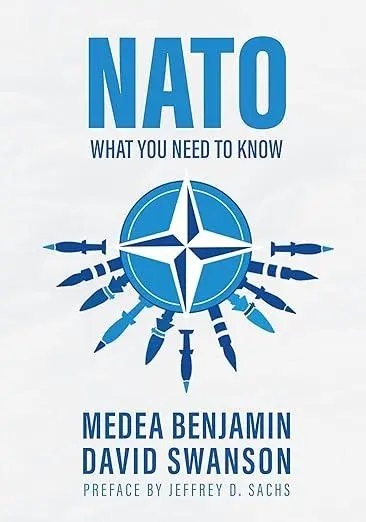
George Orwell would surely be proud of these latter comments in light of NATO’s long record of war-making. The true, venal history is exposed in a short book by peace activists Medea Benjamin and David Swanson, NATO: What You Need to Know, whose publication was timed to encourage protests at the 75th NATO anniversary summit.
Danger to World Peace
In the preface, Columbia University Professor Jeffrey Sachs wrote that “NATO is a clear and present danger to world peace, a war machine run amok that operates beyond the democratic control of the citizenry of the NATO countries.” Sachs continued: “The war machine lines the pockets of the arms contractors at the core of NATO, U.S. companies like Lockheed Martin and Northrop Grumman and Europe’s arms manufacturers…NATO also sucks one nation after another into the vortex of war, instability, displacement, and poverty. During the past 30 years, NATO has fomented a vast arc of violence stretching from Libya to Afghanistan and with many victims in between.”[2]
Benjamin and Swanson emphasize in their introduction that NATO has repeatedly violated the UN Charter outlawing military aggression and the UN’s 1970 Treaty on the Non-Proliferation of Nuclear Weapons and the Treaty on the Prohibition of Nuclear Weapons because of the placement of U.S. nuclear weapons in five European NATO nations.
NATO’s formation in 1949 as a military defense alliance against the Soviet Union was predicated on rampant propaganda that grossly exaggerated the Soviet threat, and on the ouster of peace-oriented politicians such as Henry Wallace, Franklin Roosevelt’s Vice President.
Wallace had proposed a continuation of Roosevelt’s policy of cooperation with the Soviets and was consequently removed in a coup d’état at the Democratic Party convention in Chicago in 1944 and then fired by Harry S. Truman as Commerce Secretary.
Under the direction of Truman’s advisers, including Joe Biden’s political mentor W. Averell Harriman, NATO established private clandestine armies among fascist elements throughout Western Europe who carried out black-flag terrorist activities as part of a strategy to inculcate fear in local populations and to discredit the political left.
In Italy, NATO operatives bombed a Bologna rail station and then planted evidence in the home of a left-wing journalist to make it look like he was the culprit.[3]
Rather than supporting democracy in Western Europe, NATO has a record of empowering reactionary forces. After World War II, it helped destroy popular movements of the left that had led the fight against fascism and were intent on redistributing wealth.
Greece was accepted as a NATO member only after its “ruthless Western-backed government killed or jailed the last of the partisans who had liberated it from the Nazis.”[4]
Turkey’s membership in NATO gave NATO military control of the Bosporus Strait—the only navigational waterway between the Mediterranean and Black Seas and a choke point for the Soviet ports of Odessa and Sevastapol.[5]
Within a decade of joining the Alliance, both Turkey and Greece were toppled in right-wing coups, which did not affect NATO membership. NATO further accepted Portugal as a member when it was ruled by a fascist dictator, Antonio Salazar, who provided the U.S. with a military base in the Azores.
NATO backed Portugal’s brutal suppression of anti-colonial movements in its African colonies (i.e., Angola and Mozambique), supported France’s colonial war in Algeria and the U.S. aggression in Korea, which resulted in the killing of 20% of North Korea’s population.
At an Asian-African conference in Bandung in 1955, Indian Prime Minister Jawaharlal Nehru called NATO “the most powerful protector of colonialism” and said that Morocco, Algeria and Tunisia “would probably have been independent if it had not been for NATO.”[6]
Upholding Unipolar U.S. Power
The U.S. has long been a driving force behind NATO because NATO “provides a vehicle for imposing U.S. leadership over Western nations,” according to Benjamin and Swanson. It has “tied Europe to U.S. military, geopolitical, and economic interests, made Europeans dependent on U.S. military power, and helped fortify U.S. global economic interests.”[7]
After the end of the Cold War, U.S. weapons companies helped lobby for NATO’s expansion. A lobby group called U.S. Committee to Expand NATO was run by the Vice President of Lockheed Martin.[8]
The father of the Cold War containment strategy, George F. Kennan, warned that NATO expansion in the 1990s would be a disastrous folly that would antagonize the Russians and trigger a new Cold War, but to no avail.
Beholden in part to the Polish-American and other Eastern European lobbies alongside the weapons lobbyists, the Clinton administration expanded NATO to three Eastern European countries (Poland, Hungary and Czech Republic)—in violation of a pledge made by the George H.W. Bush administration to the Russians that NATO would not be expanded “one inch to the East.”
George W. Bush followed Clinton by expanding NATO to seven additional countries—Bulgaria, Estonia, Latvia, Lithuania, Romania, Slovakia and Slovenia. Later, NATO was expanded to Montenegro and to Sweden and Finland.
Sowing Methodical Devastation
In 1994, NATO launched its first-ever combat operations in Bosnia, conducting hundreds of air strikes, which contributed to the dismemberment of the former Yugoslavia and transformed Bosnia into what Swanson and Benjamin call a “dysfunctional ward of NATO and the West.”[9]
In 1999, NATO carried out an illegal bombing campaign that dropped 23,000 bombs on Serbia, which killed thousands of civilians. This was followed by the U.S.-NATO invasion and occupation of the Serbian province of Kosovo, resulting in the empowerment of the terrorist Kosovo Liberation Army (KLA), which established Kosovo as a mafia state.
As a spoil of victory, the U.S. acquired the 955-acre Camp Bondsteel in southeastern Kosovo, which became a secret CIA black site for illegal detention and torture. (Europe’s Human Rights Commissioner Álvaro Gil-Robles called Camp Bondsteel a “smaller version of Guantanamo.”[10])
NATO caused more mayhem and bloodshed in the catastrophic 20-year military occupation of Afghanistan. During that time, U.S. and NATO forces dropped 85,000 bombs and missiles and conducted tens of thousands of “kill or capture” night raids, largely targeting innocent civilians, in a futile attempt to destroy the Taliban.
In Iraq, NATO soldiers from Canada, Hungary, Italy, Norway and the Netherlands trained senior military officers who carried out massive human rights crimes in sustaining the illegal U.S. military occupation.[11]
NATO played a further instrumental role in the 2011 regime-change operation targeting Libyan ruler Muammar Gaddafi who had given Libya the fifth-highest GDP per capita in Africa and the highest human development rating there.
Before the start of bombing operations, NATO secretly deployed CIA officers and British, French, Canadian and Qatari Special Forces to organize and lead Libyan jihadist forces intent on toppling the secular nationalist Qaddafi.[12]
NATO took full command of all aspects of the Libyan air war, with warships from 12 NATO countries sent to enforce a critical naval blockade.
Benjamin and Swanson wrote that, “after taking the capital, Tripoli, NATO and its allies cut off food, water, and electricity to the people of Sirte and Bani Walid as they bombarded them for weeks. The combination of aerial, naval, and artillery bombardment, starvation and rebel atrocities on these civilian populations made a final, savage mockery of the UN Security Council’s mandate to protect civilians.”[13]
Ukraine Breathes New Life into NATO
Most recently, NATO has performed its familiar war-mongering role in Ukraine, where it has trained Ukrainian troops, including members of the neo-Nazi-led Azov Battalion.
The latter began attacking the people of eastern Ukraine after the 2014 U.S.-backed coup that triggered the devastating ongoing conflict.
This conflict was provoked in part by U.S. efforts to extend NATO membership to Ukraine, which CIA Director William Burns had warned was a red line that should not be crossed.[14]
In late March 2022, thanks to peace talks mediated by Turkey, Russia was ready to withdraw from all the territory it had captured if Ukraine agreed to give up any commitment to join NATO or allow NATO military bases or missiles to be stationed on its territory. The deal was scuttled when British Prime Minister Boris Johnson flew to Kyiv to tell Ukrainian Prime Minister Volodymyr Zelensky that the “collective West” would not support it.
This ensured that the war would go on—at the cost of the flower of Ukraine’s youth who have been sacrificed in another unwinnable war.
Hope for the Future?
NATO’s dubious role in triggering the ongoing bloodbath in Ukraine is sadly characteristic of a 75-year history of provoking warfare and terrorizing civilians—in the service of U.S. and Western global hegemony.
At the end of their book, Swanson and Benjamin note that people around the world increasingly see the U.S. as the greatest threat to world peace.
Americans themselves remain divided about NATO: 47% want to see the U.S. keep its current commitment, and 28% want to either decrease it or withdraw entirely.
In a reflection of the rising hawkishness of the Democratic Party base and its susceptibility to government propaganda, only 14% of Democrats want no or less participation in NATO compared to 42% of Republicans.[15]
These data, while potentially discouraging, do reflect the fact that a significant percentage of Americans—including many living in the conservative heartland—are weary of foreign military intervention and NATO and represent a significant potential organizing base.
Given the high percentage of support for NATO among liberal Democrats, an urgent task should be for peace activists to embark on a vigorous campaign of public education targeting liberals that focuses on NATO’s horrifying history.
Benjamin and Swanson’s book is a perfect resource for that campaign and should be widely distributed to better inform the U.S. public about the evil ways their tax dollars are being spent.
References…………………………
Hinkley Point C, the £46 billion mega-project digging tunnels under the sea

As engineers finish 30m-deep tunnels that will provide water for the £46
billion power station, Labour must decide whether to back new nuclear
plants.
Deep beneath the Bristol Channel, the latest phase of the Hinkley
Point C nuclear power station is nearing completion. Three tunnels
extending miles under the seabed are being fine-tuned by engineers in
bright orange overalls. When the plant is operational, two of these
tunnels, 6m wide and 3.5km long, will be flooded with seawater that will be
used to cool the plant. A third tunnel will return it to the sea.
Constructing all this has required some fiddly design. Each tunnel is
connected to 44m-long metal “water heads” that have been designed to
suck in water but not fish. There is also a “fish return pipe” to help
any unlucky sprat get back to the ocean. The complexity of these tunnels
speaks to the engineering challenge of building Britain’s first new
nuclear power station in 30 years. Overruns and delays mean that Hinkley
Point C is now likely to cost £46 billion by the time the first of its two
reactors is switched on in 2029.
Hinkley is just over halfway built, and
its delivery will fall to the new Labour government. The party is
pro-nuclear but it will soon have to decide whether to give the green light
to an identical plant, Sizewell C in Suffolk, and a new breed of smaller
reactors.
Does it have the political will — and the financial firepower
— to back this new nuclear age? EDF hit out at British regulators for
ordering 7,000 changes to the design of its reactors, which were not
required in other countries where they have been built. These changes
include the fish return pipe and a requirement that Hinkley’s critical
systems have an “offline” back-up to protect them against cyberattack.
Some industry sources counter that EDF should bear most of the blame.
“They hadn’t done the proper engineering design and construction
planning before they started work,” said one senior figure. Hinkley’s
Crooks blames stringent measures imposed by the Environment Agency for some
of the delays. “The processes in the agency are very, very, very
challenging, and very long. And everything is subject to legal challenge,
which goes on for ever,” he said.
EDF’s current spat with the agency
concerns the company’s plan to ditch underwater speakers that were
supposed to deter fish from swimming near the site. Both parties have
agreed these speakers won’t work, but are now wrangling over what EDF
should do instead. Until the row is resolved, Hinkley won’t have a
licence to operate.
Ironing out these problems is especially important
because EDF plans to replicate Hinkley’s design at Sizewell. It insists
that project will benefit from the lessons learnt at Hinkley. Crooks said:
“I’m highly confident Sizewell will be quicker and a lot cheaper than
this one.”
The UK government is still looking for private investors to
back Sizewell; a final investment decision was due before the election, but
never came. The project is now sitting at the top of energy secretary Ed
Miliband’s in-tray. He is expected to give it close scrutiny, as
electricity bill-payers will be on the hook for the bulk of the cost.
Miliband must also decide how much the UK wants to spend on a newer breed
of smaller modular reactors. Steve Thomas, emeritus professor of energy
policy at Greenwich University, notes that the reactor model being used at
Hinkley has run into problems and delays wherever it has been built — in
China, Finland and France. “Going forward with Sizewell C would be a
costly and risky venture and would draw resources away from the options
that would allow us to meet our climate-change goals quicker, more cheaply
and more reliably,” he said.
There are even more immediate concerns. CGN
has refused to put any more money into Hinkley to cover the overruns. EDF
won’t give a number, but industry sources suggest the project is facing a
funding gap of up to £5 billion. “We are actively looking for investors
to mitigate this cash requirement,” said Crooks. Under the terms of its
contract, EDF — or, more precisely, the French government — will have
to pick up the tab.
Times 13th July 2024
NATO at 75: obsolete but still risking nuclear war, seeking dragons to slay.

NATO officially became obsolete December 26, 1991 when the Soviet Union officially dissolved. In response to that dissolution and allowing Germany to reunify, the US promised not to expand NATO eastward toward Russia. But in among the worst and duplicitous foreign policy mistakes in American history, the US reneged, doubling NATO from 16 at the USSR collapse, to 32 today.
Walt Zlotow, West Suburban Peace Coalition, Glen Ellyn IL, 14 July 24
President Biden basked in glory hosting the NATO Summit in D.C on its 75th anniversary last week.
He boasted that America is the world’s only indispensable nation leading the strong bulwark of NATO to preserve democracy, freedom and security around the world.
The opposite is true. NATO represents the greatest threat to peace in the 21st century. Its unhinged 17 yearlong effort to bring Ukraine into NATO would allow NATO nukes on Russia’s border to keep Russia out of the European political economy.
But instead of negotiating a ceasefire that will protect the security interests of both countries, NATO’ s 75th brought more determination to make the war a zero sum game of NATO wins, Russia loses. That requires flinging hundreds of billions in military and economic aid to Kyiv, including long range US missiles and F-16 fighters that could make this local war spin out of control and go nuclear.
Not satisfied with provoking Russia, NATO continued its 4 yearlong pivot to Asia, ramping up its relations with US allies there to counter China. NATO blasted China for expanding its military and other assistance to Russia to help its war in Ukraine. Apparently, what’s good for the goose NATO, is not good for the gander China.
NATO officially became obsolete December 26, 1991 when the Soviet Union officially dissolved. In response to that dissolution and allowing Germany to reunify, the US promised not to expand NATO eastward toward Russia. But in among the worst and duplicitous foreign policy mistakes in American history, the US reneged, doubling NATO from 16 at the USSR collapse, to 32 today.
The Russian Bear, in waiting 31 years to push back against US/NATO duplicity, exercised infinitely greater patience to an existential threat to its national security than Uncle Sam ever would.
And Cold Warrior Biden, who recklessly keeps the nuclear pot boiling with NATO‘s proxy war against Russia in Ukraine and threatening behavior toward China, remains clueless of the danger NATO poses to peoplekind.
While we should all hope NATO never sees another birthday, let’s further hope it’s not because NATO triggered nuclear Armageddon.
NATO’s nuclear bases have poisoned water and fish

A German Brown Trout caught downstream from Büchel Air Base, Germany contained massive levels of carcinogenic PFAS.
Fish from Pahlbach Stream which drains Büchel Air Base, Germany are dangerously contaminated with PFAS, according to the German government.
Nuclear deterrence has a nasty side effect.
Military Poisons, By Pat Elder, July 13, 2024
Nuclear armed air bases at Kleine Brogel in Belgium, Büchel in Germany, Aviano and Ghedi in Italy, and Volkel in the Netherlands have poisoned the environment with PFAS.
Massive fires were intentionally lit in large fire pits at these bases and extinguished with cancer-causing fire-fighting foams during routine training exercises dating back 40 years or longer. Afterward, the foam residue was typically allowed to run off or drain into the soil. The “forever chemicals” pollute the soil, sewers, sediment, surface water, groundwater, and the air. NATO (North Atlantic Treaty Organization) bases regularly tested sprinkler systems in hangars to create a carcinogenic foam layer to coat the expensive aircraft. The sprinkler systems often malfunctioned. The foams were sent to sewers or deposited in groundwater or surface water.
The PFAS-laden foams work miraculously well in putting out super-hot petroleum-based fires, but remarkable technologies may escape our control and imperil humanity.
Two astonishing inventions in 1938 are like Daedalus’ fastening of wings to wax: the splitting of the uranium atom by German scientists and the discovery of per – and poly fluoroalkyl substances, (PFAS) by Dupont chemists in New Jersey. It’s not a stretch. Both nuclear weaponry and PFAS chemicals are existential threats to humanity. Their development and use are inextricably linked.
Wherever nuclear weapons are found, huge quantities of PFAS foams are ready to be used to snuff out a fire that may cause unimaginable destruction.
Like Pandora’s nightmare, once PFAS is let loose we can’t get it back in the box. We can’t get rid of it. We can’t bury it. We can’t incinerate it. We don’t know what to do with it. Notions of ”cleaning up” PFAS from these practices are largely misguided, propagandistic ploys promulgated by the U.S. military.
The Fish at Büchel Air Base
The base is located in the Rhineland-Palatinate region of western Germany, about 60 km from the border with Belgium and Luxembourg. A German Brown Trout caught in the Pahlbach, downstream from Büchel Air Base, contained
769 μg/kg of PFOS, a particularly deadly type of PFAS.
769 ug/kg = 769 micrograms per kilogram.
769 micrograms per kilogram = 769 parts per billion.
769 parts per billion = 769,000 parts per trillion (ppt).
People eat these fish.
The US EPA, meanwhile, is enforcing a limit of 4 ppt for PFOS in drinking water. Throughout most of the world municipal water providers are removing the majority of PFAS from drinking water supplies while governments largely ignore the threat of poisoned food, especially the fish. Regular ingestion of just 1 part per trillion is associated with a higher risk of developing cancer.
The European Environment Agency’s Drinking Water Directive limits total PFAS in drinking water to 500 ppt and levels for 20 individual PFAS (including PFOS) to 100 ppt. Meanwhile Germans are free to eat the fish containing PFOS 7,690 times more than the standard for drinking water.
The European Environment Agency has also set a a largely unenforced Environmental Quality Standard, (EQS) level for fish at 9,100 ppt. Scientists have scoffed at this ridiculously high level since it was promulgated. The agency has proposed to update the EQS for fish from 9,100 ppt to 77 ppt. This limit will apply to a sum of 24 PFAS, according to a “potency factor.”
We only know the results in the Brown Trout for one compound – PFOS. Often, fish may contain more than a dozen compounds and sometimes, the levels of these chemicals surpass that of the PFOS. If the EU actually passes and enforces the new regulation, eating fish throughout large areas of the continent with be “verboten.”
The Water at Büchel Air Base
Surface water on Büchel Air Base was reported at 1,866.32 ppt. In 2016 PFOS was detected at 3,200 ppt in the surrounding bodies of water and in the rainwater retention basins of Buchel Airbase…………………………………………………………………………………………………………….
Nuclear Bases
Büchel Air Base, known in Germany as Der Fliegerhorst Büchel, is the home of approximately 15 US thermonuclear weapons, carried by the German Luftwaffe’s Panavia Tornado fighter jets. F-35’s are scheduled to replace the Tornadoes. The Luftwaffe is working to upgrade the runway for the arrival of the Lockheed Martin F-35 Lightning II Joint Strike Fighter later this decade.
Each bomb can deliver a blast 22 times greater than Hiroshima.
German pilots will take off with these weapons if the order comes from President Biden. The squadron of fighter jets directly supports the North Atlantic Treaty Organization’s (NATO) contingency and wartime operations and its strike mission.
The German Tornadoes are fitted with B61 nuclear bombs. The B61 features a “dial-a-yield” capability with a yield of 0.3 to 340 kilotons. The Hiroshima bomb contained 15 kilotons, the same as 15,000 tons of TNT.
These “scalable” nuclear devices may be programmed enroute, allowing for a variety of tactical responses. A yield of .3 kilotons is 2% of the blast of Hiroshima’s Little Boy. This enables NATO to annihilate neighborhoods or advancing tanks rather than entire cities. This option lowers the threshold, the proclivity to use these weapons.
About 100 B61’s are stored at six bases: Kleine Brogel in Belgium, Büchel Air Base in Germany, Aviano and Ghedi Air Base in Italy, Volkel Air Base in the Netherlands and Incirlik in Turkey.
Let’s briefly examine the PFAS contamination at these facilities, courtesy of the data gathered by LeMonde’s Forever Pollution Project.
Kleine-Brogel Airbase, Belgium
Kleine-Brogel Airbase in Peer, Belgium was found to have 416,000 ppt of PFAS in soil. This total includes 360,000 ppt of PFOS, 7,300 ppt of PFOA, 2,500 ppt of PFNA, and 5,400 ppt of PFHxS. Buchel Air Base reported 100,000 ppt of PFOS in soil, so Kleine-Brogel appears to be substantially more contaminated than Buchel, based on the limited data……………….
LeMonde – ‘Forever pollution’: The map of Europe’s PFAS contamination
Examine LeMonde’s map to see how Belgium is fantastically contaminated with PFAS from military and industrial sources. (Map on original)…………………………………………………………………………….
Ghedi Air Base, Italy
Surface water contained 1,659 ppt of total PFAS about two miles south of the runway at Ghedi Air Base, Italy. Note the 1,000 ppt of PFBS in surface water. The compound has been used as a replacement for PFOS in firefighting foams. Ample evidence confirms the toxicity effects PFBS has on several organ systems, including cardiac, immune, hepatic, and reproductive systems. PFBS bioaccumulates in fish, although few seem to know or care.
Those who treat people who are sick and dying of disease and cancer are rightfully today’s heroes, but those who attempt to pinpoint the source of these diseases are enemies of the state.
Incirlik Air Base, Turkey
NATO
On July 10 NATO released the following statement after its Washington Summit: “We are further accelerating the modernisation of our collective defence and are investing in our Chemical, Biological, Radiological and Nuclear defence capabilities required to effectively operate in all environments.” Notice how they capitalize the powerful gods of our age.
NATO’s bases contaminate the continent. Chemical, biological, radiological, and nuclear agents don’t just terrorize the enemy, they also endanger people at home.
Buchel Shrine, Peace Camp, and jailed resisters
There’s a Catholic shrine in the Peace Camp adjacent to Büchel Air Base. It is just 200 meters from the main gate and it is seen by 2,000 soldiers and civilians as they enter the base every day. The shrine depicts Jesus breaking a gun in two. It says, “Think – Atomic weapons are a crime against God and Humanity.”……………………………………………………………………………………………….. more https://www.militarypoisons.org/latest-news/natos-nuclear-bases-have-poisoned-water-and-fish
Solar power will lead globally- says Rocky Mountain Institute (RMI)

‘Solar will very shortly overtake every other type of electricity generation and together with batteries, will electrify everything, everywhere’ says the Colorado-based Rocky Mountain Institute (RMI) in a new report on the cleantech revolution. Certainly renewables generation is now very cheap and solar PV deployment is doubling every 2-3 years, while battery storage, for backup, is doubling every year. Wind is also doing well around the world, with offshore wind leading in some locations, as I reported in an earlier post, and some new major projects going ahead.
Overall, RMI say that ‘clean technologies will continue to follow S-curves, cascading across sectors and geographies,’ with China, the world’s largest energy consumer, in the lead. It explains that ‘China, lacks oil and gas, and cleantech is a path to leadership, clean air, and zero emissions’. And so it will ‘continue to deploy cleantech rapidly’. So it sees China as ‘the pivot nation in the transition away from fossil fuels, and most areas of demand have clearly peaked there’. Also ‘peaks are showing up across the Global South, from S. America to South Africa & Thailand’.
It’s very optimistic stuff, reflecting the approach of RMI’s founder Dr Amory Lovins. Away with the old, in with the new- and fast. It says ‘S-curves imply that by 2030 solar and wind generation will triple to over 12,000 TWh and EVs will be two-thirds of car sales,’ pushing fossil use even further out. Taking a broad view , RMI claims that ‘New fossil electricity capacity peaked in 2010, oil and gas capex in 2014, and internal combustion engine car sales in 2017. Fossil demand peaked for industry in 2014, for buildings in 2018, most likely for electricity in 2023, and will shortly peak in transport’, and it says that this will continue, since ‘the drivers of growth are more powerful than the barriers. Falling cleantech costs, the energy security of eternal renewables, Chinese leadership, and a race to the top will continue to overwhelm a fragile fossil fuel system which wastes two-thirds of its primary energy and fails to pay for its externality costs’.
Well maybe, and China does have some very large solar PV projects, but it is not exactly a bastion of freedom! And in the short term at least there is still a lot of fossil fuel being used there, and elsewhere, as a new study from the UK Energy Institute (EI) and co-authors KPMG and Kearney notes. But it also notes that global renewable generation, excluding hydro, was up 13% to a record global high of 4,748TWh in 2023, due almost entirely by wind and solar expansion, led by China, which added 55% of all renewable generation additions in 2023.
Meantime, nuclear is still in the game, including in China. Indeed, the US Energy Information Administration says that ‘China continues rapid growth of nuclear power capacity’, although the chart it uses to support this assertion says it shows ‘annual installed’ net capacity, whereas, in fact it shows total capacity and growth in that has actually been slowing.
It’s 58GW now, only making a small overall power contribution in China- EIA says 5% in 2023. By contrast, as noted above, renewables are roaring ahead in China- growing 4 times faster than in the G7 countries overall, with wind and solar adding almost 300GW last year. And it is on track reach 1,200GW of wind and solar total capacity by end of 2024 – 6 years ahead of target.
Ever hopeful though, the nuclear lobby globally still looks to new technology, like Small Modular Reactors, to improve things, even if so far that doesn’t look too promising, with, as a Reuters article reports, there being project failures and high costs. But, SMR apologists say, it is early days yet- first designs often have problems and it takes time to get costs down. However, it would require some very radical cost reductions to compete with renewables, now at all time low costs, especially since they are likely to continue to getting cheaper. ………………………………………………………………………………..
Good thing we still have the free fusion reactor in the sky….with Ember reporting that global use of solar PV has expanded by 23% last year, and wind power by 10%, with renewables overall now supplying around 30% of global power and wind and solar projected to supply nearly 70% of global electricity by 2050. Moreover, some studies have suggested that renewables overall could supply around 100% of all power, or even all energy, by then, with solar playing a major role. https://renewextraweekly.blogspot.com/2024/07/solar-power-will-lead-globally-says-rmi.html
1 This Month
23-25 October – on Zoom – World BEYOND War’s annual global conferenc


Shut down the radiation-damaged Heysham nuclear reactors now
To see nuclear-related stories in greater depth and intensity – go to https://nuclearinformation.wordpress.com

Say No to NASA’s Reckless Nuclear Reactor on the Moon
Say No to NASA’s Reckless Nuclear Reactor on the Moon
-
Archives
- October 2026 (180)
- September 2026 (339)
- August 2026 (330)
- July 2026 (355)
- June 2026 (287)
- May 2026 (306)
- April 2026 (356)
- March 2026 (251)
- February 2026 (267)
- January 2026 (308)
- December 2025 (358)
- November 2025 (359)
-
Categories
- 1
- 1 NUCLEAR ISSUES
- business and costs
- climate change
- culture and arts
- ENERGY
- environment
- health
- history
- indigenous issues
- Legal
- marketing of nuclear
- media
- opposition to nuclear
- PERSONAL STORIES
- politics
- politics international
- Religion and ethics
- safety
- secrets,lies and civil liberties
- spinbuster
- technology
- Uranium
- wastes
- weapons and war
- Women
- 2 WORLD
- ACTION
- AFRICA
- Atrocities
- AUSTRALIA
- Christina's notes
- Christina's themes
- culture and arts
- Events
- Fuk 2022
- Fuk 2023
- Fukushima 2017
- Fukushima 2018
- fukushima 2019
- Fukushima 2020
- Fukushima 2021
- general
- global warming
- Humour (God we need it)
- Nuclear
- RARE EARTHS
- Reference
- resources – print
- Resources -audiovicual
- Weekly Newsletter
- World
- World Nuclear
- YouTube
-
RSS
Entries RSS
Comments RSS

