Journalists Demand Blinken Back Israel Arms Embargo

August 16, 2024 https://scheerpost.com/2024/08/16/journalists-demand-blinken-back-israel-arms-embargo/
The following letter was delivered to the State Department on Thursday morning with a request to meet with the Secretary of State.
August 15, 2024
Dear Secretary Blinken,
Since October 7, 2023, Israel has killed more than 160 Palestinian journalists. This is the largest recorded number of journalists killed in any war. While Israel’s indiscriminate bombing of the densely populated Gaza means no civilians are safe, Israel has also been repeatedly documented deliberately targeting journalists.
Israel’s military actions are not possible without U.S. weapons, U.S. military aid, and U.S. diplomatic support. By providing the weapons being used to deliberately kill journalists, you are complicit in one of the gravest affronts to press freedom today.
On World Press Freedom Day this year, you called on “every nation to do more to protect journalists,” and reiterated your “unwavering support for free and independent media around the world.”
As journalists, publications and press freedom groups in solidarity with the courageous Palestinian journalists of Gaza, we call on you to do more to protect journalists and show unwavering support for free and independent media by supporting an arms embargo against Israel.
Israel has gone to great lengths to suppress media coverage of its war in Gaza, imposing military censorship on both its own journalists and international reporters operating in the country; and, with Egypt’s help, blocking all foreign journalists from Gaza.
Israel shut down Al Jazeera, raided its office, seized its equipment, and blocked its broadcasts and website within Israel. The world relies only on the Palestinian journalists in Gaza to report the truth about the war and Israel’s widespread violations of international law.1
Israel’s deliberate targeting of these journalists seems intended to impose a near blackout on coverage of its assault on Gaza. Investigations by United Nations bodies, NGOs, and media organizations, have all found instances of deliberate targeting of journalists.
In a joint statement, five U.N. special rapporteurs declared:
“We have received disturbing reports that, despite being clearly identifiable in jackets and helmets marked “press” or traveling in well-marked press vehicles, journalists have come under attack, which would seem to indicate that the killings, injury, and detention are a deliberate strategy by Israeli forces to obstruct the media and silence critical reporting.”3
Israel has also killed journalists during the war outside of Gaza, such as on October 13, 2023 when an Israeli tank fired across the Lebanese border at clearly identified press, killing a Reuters reporter and injuring six other journalists.4
Under international law, the intentional targeting of journalists is a war crime.5 While all governments are bound by international law protecting reporters, U.S. domestic law also prohibits the State Department from providing assistance to units of foreign security forces credibly accused of gross violations of human rights.6 Israel’s well-documented pattern of extrajudicial executions of journalists is a gross violation of human rights.
Additionally, the First Amendment of the United States Constitution protects the American people’s right to receive information and ideas.7 Israel’s deliberate targeting of journalists follows a longstanding pattern by the Israeli government to suppress truthful reporting on its treatment of Palestinians and its war in Gaza. By providing Israel with the weapons used to kill journalists, the State Department is abetting Israel’s violent suppression of journalism.
The U.S. is providing the weapons Israel continually uses to target Palestinian journalists in Gaza. This is a violation of International law and U.S. domestic law. We urge you to immediately cease the transfer of all weapons to Israel.
Signed,
113 journalists
20 news outlets
7 press freedom organizations
Journalists – a long list of names here
Press Freedom Organizations – a long list
A nuclear legacy in Los Alamos

After three cleanups, independent analysis shows 80-year-old plutonium persists in Acid Canyon and beyond
Searchlight New Mexico, by Alicia Inez Guzmán, August 15, 2024
The world’s oldest documented plutonium contamination may not lie not in the Chihuahuan Desert at the Trinity Site, where the first-ever atomic bomb ripped open the skies and melted the sand into green glass. Rather, that distinction more likely goes to Los Alamos’s Acid Canyon, according to an independent study by Michael Ketterer, professor emeritus of chemistry and biochemistry at Northern Arizona University.
Ketterer announced these findings at an online press conference held by Nuclear Watch New Mexico on Aug. 15, after collecting and analyzing soil, water and plant samples in Acid Canyon, a popular hiking area in the middle of town. Beginning in 1943, the year the Manhattan Project came to Los Alamos, workers released radioactive waste into the canyon. Three remediations would follow, but as Ketterer’s analysis found, “a super weapons-grade” plutonium persists in the soil, water and plant life in and around Los Alamos, representing some of the earliest ever made.
One thought came to his mind as he analyzed samples from the area, collected last month: “I’ve never seen anything like this in any samples anywhere,” he told Searchlight New Mexico in an interview.
Scientists in the niche community of nuclear forensics can identify the point of origin of a particular nuclear material based on its composition of isotopes, a process called fingerprinting. Ketterer believes his findings prove unequivocally that legacy plutonium from Los Alamos National Laboratory has not only remained in Acid Canyon all these years later, but also migrated beyond, even after the cleanups. “It’s just a ribbon of contamination going down to the Rio,” he said.
Using a technology called mass spectrometry, Ketterer said this scenario became apparent after he found that several samples from scattered sites in Acid Canyon — whose trailhead is tucked behind the Los Alamos County Aquatic Center — had the same fingerprint, one that dated to the earliest days of the Manhattan Project. He realized just how far that plutonium had traveled when he also collected the identical fingerprint in Los Alamos Canyon, some 12 miles southeast of Acid Canyon, near the Phillips 66 gas station in Totavi — washed downhill by monsoon rains.
The contaminants’ ultimate destination, he wrote in his brief report, is the Rio Grande, where plutonium has already been detected. His results confirm the findings of a 2024 study by Nuclear Watch New Mexico that used data culled from LANL’s online database, Intellus New Mexico, to map plutonium contamination around Los Alamos………………………………………………………………………………………………………………… more https://searchlightnm.org/a-nuclear-legacy-in-los-alamos/#:~:text=Ketterer%20believes%20his%20findings%20prove,the%20Rio%2C%E2%80%9D%20he%20said.
Rebranded SNC-Lavalin seeks as much as $75M in taxpayer dollars to build more powerful Candu nuclear reactors.
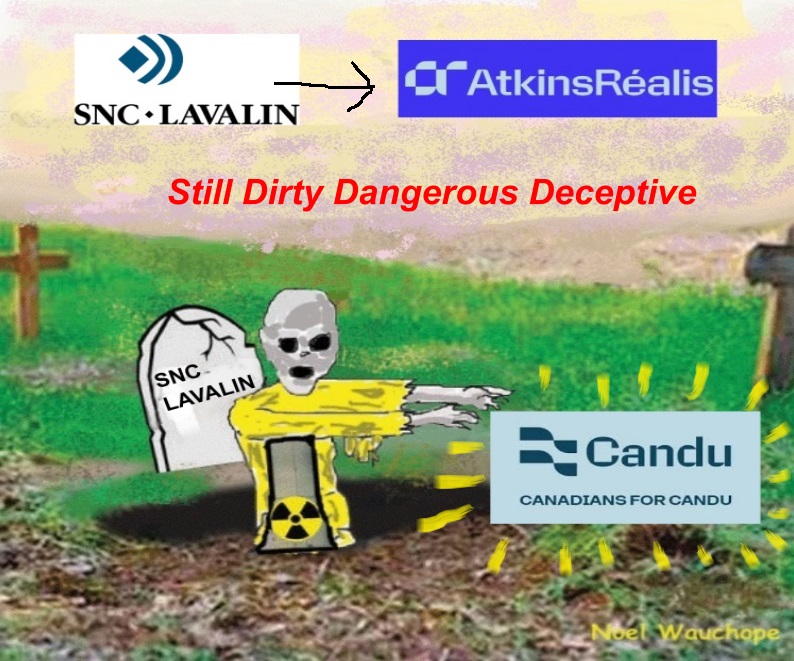
AtkinsRéalis wants to develop a new Candu reactor to sell around the world, but an industry insider says the company’s past could be a ‘big problem’ to getting funding
National Post Ryan Tumilty, Aug 15, 2024
OTTAWA – A company formerly at the centre of one of the biggest scandals of the Trudeau government is now looking for as much as $75 million in annual funding to update a nuclear reactor Canada has exported around the world.
AtkinsRéalis, formerly named SNC Lavalin, launched the Canadians for Candu campaign earlier this year. It’s a push to get both provincial governments and the federal government to back a new, more powerful Candu nuclear reactor that could be built both home and abroad.
The lobbying effort, started earlier this year, has recruited other engineering and construction firms, local unions and other groups to advocate for government support of the made in Canada reactor. The co-chairs of the campaign are former prime minister Jean Chrétien and Ontario premier Mike Harris.
Gary Rose, executive vice-president of nuclear, said the company wants Canadians to be aware of the potential.
“The campaign is really all about promoting Candu, the fact that Canada owns a world-class nuclear technology,” he said. “As provinces make decisions on which technologies that they wish to pursue, when it comes to large nuclear, we want that pursuance to be Candu technology because it’s a Canadian technology.”
AtkinsRéalis holds the license for Candu reactors which were first developed in the 1950’s by the Canadian government. All of Canada’s current nuclear reactors are Candu models ………….
In 2011, the Harper government sold the right to develop Candu reactors to what was then SNC-Lavalin for $15 million. The Crown corporation, Atomic Energy of Canada Limited, retained the intellectual property of the reactors.
With the license in place, AtkinsRéalis has worked on large refurbishment projects and last year signed a deal to build two new reactors in Romania with the help of export financing from the Canadian government.
The proposed Romanian reactors are Candu-6 models capable of producing 700 megawatts of power, but to attract more business, including here in Canada, AtkinsRéalis is working on a new reactor, the Candu Monark, which would be capable of 1,000 megawatts…..
That’s where the company is seeking federal cash. Rose said they are currently spending $50 to $75 million a year on engineering to complete the Monark design and expect to do the same over the next three years. They would like the government to match that spending, potentially adding up to a $300 million bill for taxpayers.
He said ultimately the government will win out in the end.
“We’re asking for it to be an investment. We’re not asking for a handout,” he said. “The IP that we develop as Monark will stay owned by the Canadian government.”
Minister of Natural Resources Jonathan Wilkinson’s office said only that they were aware of the Canadians for Candu campaign when the National Post reached out.
…………………………….AtkinsRéalis has at least one specific project in mind for the Monark, the proposed expansion of the Bruce Nuclear plant in southern Ontario. That project announced last year aims to add up to 4,800 megawatts of power to the Bruce plant, which is already the largest nuclear installation in the world.
Ontario’s then Minister of Energy Todd Smith, said last year, the province would need a lot more power………………….
The proposed site C project is in its infancy and the company has only just started consultations with local communities and planning for what the project would look like. It has only started to look at what reactor technology it might use, but has said it intends to conduct an open process with a “technology neutral” approach.
Rose said the Monark design work could be done in the next four years and be ready to build at the end of this decade.
“The Monark is an evolution of existing Candu technology so we are not starting from scratch,” he said. Most of the components, over 85 per cent, of a Monark reactor would come from Canadian suppliers.
Aaron Johnson, a vice president with AECON construction who worked on nuclear refurbishment projects with AtkinsRéalis and is part of the Canadians for Candu campaign, said new reactors would be a big boost to the local economy.
“That’s already an existing supply base, and that’s something that would only be furthered upon in a Candu new build application,” he said………………………………….
AtkinsRéalis’ request for more government funding comes as the company is shedding the SNC-Lavalin brand that was tarnished in a scandal.
In 2019, the company pleaded guilty to fraud and agreed to a $280 million fine for its actions in Libya between 2001 and 2011. In an agreed statement of facts at the time, the company admitted having paid nearly $48 million to the son of Libyan dictator Muammar Ghadafi to secure contracts.
Former attorney general Jody Wilson-Raybould resigned from cabinet earlier that year after she came under pressure from Prime Minister Justin Trudeau’s office to work out a deal with the company. The ethics commissioner ultimately found Trudeau had improperly pressured Wilson-Raybould.
Rose joined the company only last year and said he was assured he was making the right choice to come aboard because much more than the name of the company has changed.
“The entire management team, leadership team, programs that support it. I believe it’s a totally different company than it was,” he said.
Chris Keefer, president of the group Canadians for Nuclear Energy, acknowledges that AtkinsRéalis’ former name will be a political problem………………………..
Keefer’s group doesn’t receive funds from AtkinsRéalis and isn’t a member of Canadians for Candu, but he does believe the reactor should get government support. American company Westinghouse, which has the AP1000 reactor, received U.S. support for its design and Keefer argued it is not uncommon in the industry…………………………
At the COP 28 climate change conference last year, more than 20 countries including Canada, signed onto a pledge to triple nuclear power production by 2050.
Rose said he believes Candu reactors could easily be 10 per cent of the global market, but they need government support to do it.
“We’re building up front with the hopes of selling 25 in Canada, 75 to 100 globally, and having the federal government standing up and supporting us on that is really key.”https://nationalpost.com/news/politics/snc-lavalin-candu-nuclear-reactors?utm_source=Sailthru&utm_medium=email&utm_campaign=National%20Post%20-%20Posted%202024-08-15&utm_term=NP_HeadlineNews
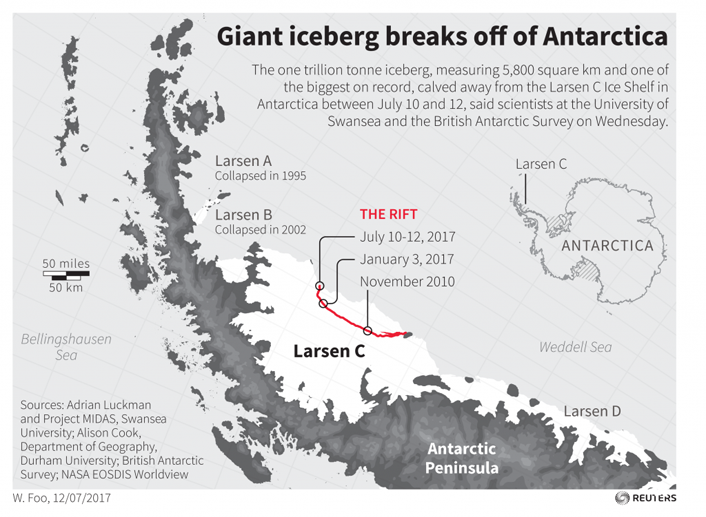
When glaciers calve: Huge underwater tsunamis found at edge of Antarctica, likely affecting ice melt.
Bulletin, By Michael Meredith | July 15, 2024
Antarctica is huge, it affects pretty much every place and every living thing on our planet, and it is changing. This should be a concern for all of us, and yet we know troublingly little about some key aspects of the great white continent.
Despite its position in the far distant south, Antarctica is a vital component in the functioning of the planet. It is central to global ocean circulation, thus exerting a profound influence on the world’s climate (Figure 1 on original). The vast Southern Ocean that surrounds Antarctica absorbs huge quantities of heat and carbon dioxide from the atmosphere and distributes them around the rest of the world, thereby slowing the rate of global warming elsewhere. This “climate favor” has comes at a cost, however—the Southern Ocean is overheating and acidifying, with marked impacts on the marine ecosystem. The extra heat in the ocean is also melting the fringes of the Antarctic Ice Sheet, destabilizing its glaciers, and increasingly pushing up sea levels worldwide. The sea ice around Antarctica—formed in the fall and winter of the Southern Hemisphere, when the ocean surface freezes—has now reached record low extents, affecting the Earth’s energy budget and acting to further accelerate climate change.
All the information we have from Antarctica comes from sparse networks of sensors and equipment deployed directly, augmented with satellite measurements of the ice and ocean surface and computer simulations. While we know more about Antarctica and the Southern Ocean than ever before, it is still one of the least-well measured places on our planet, with some areas still remaining “data deserts.” We need to know more, so that we can better understand the causes of the changes happening here, how they will continue to change in future, and hence what the global impacts are likely to be.
One feature of the Southern Ocean that is often overlooked is how (and how strongly) it is mixed. This is a key process that redistributes heat, carbon, nutrients, plankton, and all other things in the sea, with profound consequences.
………………………………………glacier calving event had caused a sudden massive burst in the mixing of the ocean, stretching many kilometers from the ice front.
How did it do this? The data revealed that the glacier calving had triggered an underwater tsunami event. In essence, large waves (the height of a two-story house) were generated and moved rapidly away from the glacier, riding the interface between layers in the ocean that were tens of meters down. When these internal tsunami waves finally broke—like surface waves on a beach—they caused massive churn and mixing…………………………………………………………………………
This process—of glacier calving generating internal tsunamis and bursts of ocean mixing—is entirely absent from the computer models that are used to simulate our climate and ecosystem, hampering our ability to reliably project future changes. We need to know more about how this process works, how it will change, and what its consequences will be. ……. https://thebulletin.org/premium/2024-07/when-glaciers-calve-huge-underwater-tsunamis-found-at-edge-of-antarctica-likely-affecting-ice-melt/?utm_source=Newsletter&utm_medium=Email&utm_campaign=ThursdayNewsletter08152024&utm_content=ClimateChange_HugeUnderwaterTsunamis_07152024&utm_source=Newsletter&utm_medium=Email&utm_campaign=ThursdayNewsletter08152024&utm_content=ClimateChange_HugeUnderwaterTsunamis_07152024
Nuclear waste dump debate heating up over AUKUS, Coalition plans
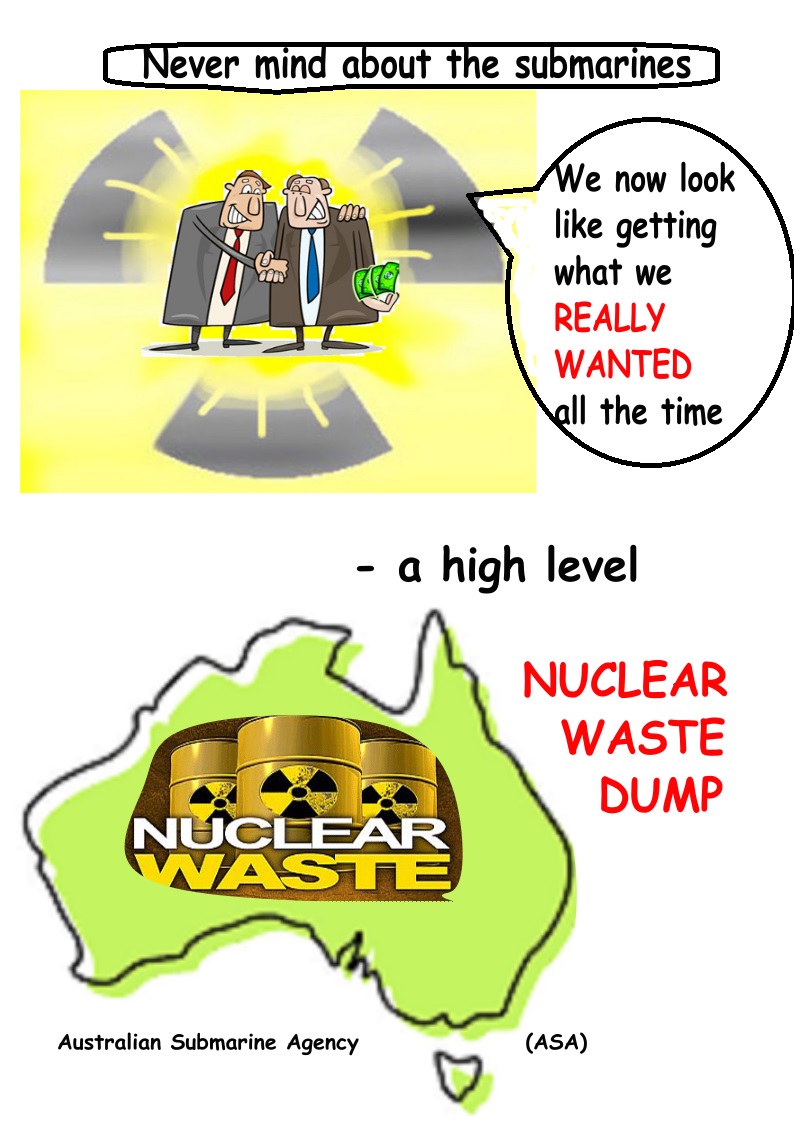
Australia’s AUKUS agreement with the US and Uk will pave the way for nuclear submarines – and nuclear waste. But some experts say the government has not learned the lessons of three past attempts to deal with that material.
protesters in the South Australian town of Port Augusta in 2018 were pushing back against a government proposal for a nuclear waste dump near the town of Kimba.
They took their fight all the way to the Federal Court, forcing Labor to ultimately abandon the plan.
But the issue of nuclear waste in Australia remains a controversial one.
Emeritus Professor Ian Lowe says that for now, much of Australia’s nuclear waste is stored near the nation’s only reactor at Lucas Heights in south-west Sydney, which is mostly used to make medicine, mining materials, and for research.
Low-level waste is also being stored in hundreds of cupboards, labs and hospitals nationally.
“Intermediate level waste is nastier. And it needs to be stored basically permanently for geological time, and it probably needs to be stored deep underground because the isotopes that are there can be harmful for thousands of years. At the moment, they’re in temporary storage at Lucas Heights near the research reactor. And the capacity there is okay for perhaps 10 years, but sooner or later we’re going to have to find a way of permanently disposing of the intermediate level waste. And that’s a more serious issue than the low level waste. It needs to be deep underground and it needs to be in a properly engineered storage site. And we’re talking big sums of money.”
That waste is safe and secure for now but the Australian Radioactive Waste Agency says this is not a sustainable solution long-term.
The government, opposition and Professor Lowe all agree.
“I mean, basically the temporary waste storage at Lucas Heights is just a very large shed with drums of radioactive waste.”
Australian Conservation Foundation campaigner Dave Sweeney says efforts to site a new nuclear dump have focused more on PR – and managing outrage.
“There has been 30 years of a divisive debate, of coercive attempts to impose radioactive waste, and there have been multiple fights at multiple sites, mainly in the Northern Territory and South Australia, where affected communities and particularly Aboriginal communities have been very very strident, strong and sustained in their opposition – and have defeated a proposal to put waste on their Country and the Canberra caravan has moved on.”
A spokesperson for Resources Minister Madeleine King has said the government is reflecting on lessons learned from past siting processes as it assesses options for safely disposing of nuclear waste.
But Dr Lowe says the government has not learned the lessons of history.
I think successive governments are just kicking the can down the road. If there is a plan, nobody knows about it.”
The debate is being revived because of the waste that will come from the on-board reactors of AUKUS subs.
This will be high-level waste – a more hazardous form Australia does not have right now.
The government plans to dispose of this weapons-grade waste on defence land – and Defence Minister Richard Marles says we have time to get it right.
“To be clear, we will not have to dispose of the first reactor from our nuclear-powered submarines until the 2050s. I want to assure the Parliament that there will be appropriate public consultation, particularly with First Nations communities to respect and protect cultural heritage. This will not be a matter of set and forget.”
In March last year Mr Marles told parliament the government would set out the process for selecting a site within 12 months, but 17 months on those details are yet to be announced.
Professor Lowe has criticised the bipartisan AUKUS agreement as being irresponsible without a waste management plan.
“I think if we’re being asked to approve nuclear power reactors or nuclear submarines, we’re entitled to see a clearly spelt out intellectually and morally and politically defensible solution for the problem that will inevitably be created. It’s just not responsible to create a problem saying, we hope future generations will figure out a way to deal with it.”
Campaigner Dave Sweeney opposes any high-level waste, but says we need to face up to the challenge of intermediate waste – although he doesn’t want to see the process rushed.
“I think we need to just every party take a breath, acknowledge that radioactive waste is in this country, acknowledge that it has been poorly managed to date, realise that we have because of hard efforts of contests from Aboriginal people and local communities, we have now won ourselves some breathing space with the interim storage of intermediate level waste securely at the ANSTO facility and use that time not to regroup in our trenches, but use that time to gather at the table and genuinely consider pathways forward.”
There appear to be some promising developments.
One company, called Tellus Holdings, has forged a new way forward for low-level waste, establishing a disposal site in West Australia – the first private firm ever licensed to do so.
CEO Nate Smith says the company has disposed of 6,000 cubic metres of radioactive material since its facility opened one-and-a-half-years ago – after ten years of consultation.
“With Kimba and others, I think government has announced the site, and then done engagement, and I think that puts people on the back foot. It all starts with trust. For us that was sitting down over cups of tea or going to the pub, it was sharing our vision of what we wanted to do and really understanding the community’s perspective but also their aspirations, and I think one of the biggest things we did that was in stark contrast to government is look we gave our Traditional Owners a veto right. For us, the whole concept from the start was, this is their land.”
Tellus Holdings will not accept intermediate or high-level waste, but Mr Smith says the company is eager to take on more low-level material, arguing this would free up space for interim storage at Lucas Heights.
“It would allow ANSTO and ARWA and others to focus on the real challenge right now, which is intermediate and high-level waste, because it’s coming with AUKUS and it’s already in existence from the Lucas Reactor.”
The Coalition’s plan for a nuclear power industry would also create more high-level waste if it goes ahead.
In a statement to SBS, the Opposition’s resources spokeswoman Susan McDonald said the Coalition anticipates that it would be stored on-site with the proposed nuclear power reactors and eventually disposed of permanently alongside the AUKUS material.
Professor Ian Lowe says the public deserves to know more.
“The one thing we know about nuclear reactors, they produce high level waste that has to be managed for geological time. And if we were to go ahead and build seven nuclear reactors by 2035, by 2036, we would be producing high level radioactive waste. So we really need to hear from the Coalition how they propose to resolve that problem.”
Sellafield apologises after pleading guilty to cybersecurity failings
By Ollie Rawlinson @ORawlinsonNews, Reporter
The charges, brought by the Office for Nuclear Regulation (ONR), cover a four-year period from 2019 to 2023 and were heard in Westminster Magistrates Court.
According to The Guardian newspaper, the court heard that three-quarters of Sellafield’s servers were vulnerable to cyberattacks, leaving the world’s largest store of plutonium exposed to potential threats.
The ONR revealed that sensitive nuclear information (SNI) had been left at risk due to outdated technology, including the use of Windows 7 and Windows 2008.
It was also discovered that critical IT health checks, which Sellafield claimed were being performed, were not conducted.
A report by external IT firm Commissum found that even a ‘reasonably skilled hacker’ could have accessed and compromised sensitive data.
Sellafield CEO Euan Hutton apologised in a written statement, asserting that the company has since addressed these issues………………………………….
Chief Magistrate Paul Goldspring is expected to deliver a final sentencing in September. Sellafield has agreed to pay £53,000 in legal costs.
The case marks the first time a nuclear site has been prosecuted for cybersecurity offences.
Carlisle News & Star 14th Aug 2024
How climate change has pushed our oceans to the brink of catastrophe

For decades, the oceans have absorbed much of the excess heat caused by greenhouse gases. The latest observations suggest they are reaching their limits, so how worried should we be?
New Scientist, By Madeleine Cuff, 14 August 2024
…………………………………………………………………….. Something isn’t right in the world’s oceans. From orange algal blooms in the North Sea and a boom in gelatinous Bombay duck fish off China to disappearing “bottom water” in the Antarctic, there is growing evidence that extreme temperatures are wreaking havoc in our waters. After years of the oceans acting as silent sinks for excess human-caused heat, they are starting to creak under pressure – and we are finally waking up to how worried we should be……………………….(Subscribers only) https://www.newscientist.com/article/mg26335040-100-how-climate-change-has-pushed-our-oceans-to-the-brink-of-catastrophe/
Congressman Garamendi Asks “Why does America need nuclear weapons?”
August 15th, 2024 https://nuclearactive.org/
On August 13th, U.S. Congressman John Garamendi of California delivered a speech at the United States Strategic Command 2024 Strategic Deterrence Amidst Global Transformation Symposium in which he asked “Why?” as in “Why does America need nuclear weapons?” and mostly importantly asked, “How do we deter in a way that ensures there is a tomorrow worth protecting? Must we continue a 50-year-old triad strategy without considering the alternatives? Why, why are we stuck in a logic silo with the blast door closed?” To read Congressman John Garamendi’s (CA-08) full statement, 240813 Garamendi U.S. Strategic Command 2024 Deterrence Symposium Remarks 1
While the focus of the speech was about “Why the Sentinel is a Costly and Dangerous Mistake,” he began by describing the efforts in 1985 of Ronald Reagan and Mikhail Gorbachev, whom he called “two cold warriors at the head of the world’s largest nuclear arsenals.
“Leaders like Reagan, JFK, Eisenhower, Carter, and Obama knew that nuclear weapons could end civilization and, with those heavy moral and ethical considerations in mind, negotiated significant safety measures and a serious reduction in nuclear weapons.
“These leaders demonstrated vision and commitment. They knew that war was not an option, so they had to create a vision for a safer future. Unfortunately, too many today shrug their shoulders and say the time for negations is not now. Which brings us to yet another question…Why not try? Over the next 30 years, we will spend almost 2 trillion dollars on our nuclear weapons… what if we spent just 1% on diplomatic and risk reduction efforts?”
To read Congressman John Garamendi (CA-08) full statement, 240813 Garamendi U.S. Strategic Command 2024 Deterrence Symposium Remarks 1
US approves new $20bn weapons sale to Israel

Rt.com 14 Aug 24
The arms package includes dozens of fighter jets, as well as mortar and tank ammunition
The US government has approved more than $20 billion in new arms sales to Israel, despite pressure on President Joe Biden’s administration to end the bloodshed in Gaza.
In a series of notifications to Congress on Tuesday, the State Department said Washington is “committed to the security of Israel, and it is vital to US national interests to assist Israel in developing and maintaining a strong and ready self-defense capability.”
The main part of the package, worth about $18.8 billion, consists of 50 new F-15IA fighter jets and the upgrade of 25 of the aircraft already in service. Israel also intends to buy Medium Range Air-to-Air Missiles (AMRAAM) for the jets, nearly 33,000 120mm tank cartridges, up to 50,000 high-explosive mortars, and new military cargo vehicles………………………………..more https://www.rt.com/news/602589-us-weapons-sales-israel/—
South Korea’s Yoon seeks dialogue with North, path to unification
Reuters, By Hyonhee Shin, August 16, 2024
Summary
- Yoon unveils blueprint for unification in Liberation Day speech
- Offers to form consultative body for inter-Korean cooperation
- Yoon says to keep offering humanitarian aid to the North
- South Korean opposition boycotts speech over Japan outreach
SEOUL, Aug 15 (Reuters) – South Korean President Yoon Suk Yeol offered on Thursday to establish a working-level consultative body with North Korea to discuss ways to ease tension and resume economic cooperation, as he laid out his vision on unification of the neighbours.
In a National Liberation Day speech marking the 79th anniversary of independence from Japan’s 1910-45 colonial rule after World War Two, Yoon said he was ready to begin political and economic cooperation if North Korea “takes just one step” toward denuclearisation……………………………………………………………………………………more https://www.reuters.com/world/asia-pacific/south-koreas-yoon-offers-working-level-talks-with-north-korea-2024-08-15/
Germany’s Grafenrheinfeld nuclear power plant demolished after short delay
Construction of the Grafenrheinfeld NPP in the southern state of Bavaria began in 1975 with the plant beginning commercial operations in 1982. It was Germany’s oldest nuclear power plant but was closed in 2015 as part of the government’s policy to transition away from nuclear power.
Germany’s decommissioned nuclear power plant at Grafenrheinfeld has been demolished after a short delay.
The demolition of the plant’s two, 143-metre cooling towers was originally planned to take place at 17.30 local time but was pushed back to almost 20:00 after a pro-atomic energy activist scaled one of the pylons in protest at its destruction.
Police spokesperson Denis Stegner said the unnamed activist chained themselves to the pylon 10 metres above the ground and a special team was deployed to free him before he was taken away by police.
Construction of the Grafenrheinfeld site in the southern state of Bavaria began in 1975 with the plant beginning commercial operations in 1982. It was Germany’s oldest nuclear power plant.
But as part of the government’s policy to transition away from nuclear power, it was closed in 2015.
The then Environment Minister Barbara Hendricks said its closure was “a visible signal that the nuclear exit is moving forward.”
“Every nuclear power station that goes offline reduces the so-called residual risk that is linked to the use of nuclear power plants and moves us a step forward in the reorganization of our energy supply,” she said in 2015……………………………………………………………Euro News 17th Aug 2024
The Nuclear Regulatory Commission’s Antiques Roadshow

As new U.S. nuclear construction grinds to a halt, one company aims to restart a Michigan reactor that violated fifty codes—in just one year.
The Progressive Magazine, by Roger Rapoport , August 6, 2024
This summer marks the first time since 1954 that not a single large light water nuclear reactor will be under construction in the United States. As dozens of reactors have closed coast to coast—and countries like Germany and Japan have trimmed or shut down their nuclear fleets—the exorbitant price of building this power source has forced industry giants like Westinghouse Electric Company into bankruptcy.
Business is so bad that the industry’s last-ditch attempt to rebrand itself by launching so-called small modular reactors (SMRs) has run aground. The first American attempt to open one in Idaho was abandoned in November 2023 due to soaring costs. As it turns out, these SMRs are neither small nor modular. Another in Wyoming that might come online in six years will produce energy that costs three times the cost of readily available wind power.
The last two nuclear power plants to open in the United States, at the Vogtle plant in Georgia, have come in at $21 billion over the original $14 billion cost estimate—seven years late. Georgia Power customers are being hit with a 10 percent rate increase to cover these astounding Vogtle cost overruns.
Even worse, in New York, Illinois, New Jersey, and Connecticut, a group of obsolete older reactors are on life support, thanks to more than $14 billion in bailouts. In 2021, Republican Ohio Governor Mike DeWine signed a bill repealing a $1.1 billion bailout for two reactors cratered by a $60 million bribery scandal. One defendant, the former speaker of the state’s House of Representatives, was sentenced to twenty years in federal prison for his role in this scandal. At the same time all this was going on, Ohio’s legislature blocked a $4.2 billion investment in wind power.
Stanford University professor and climate expert Mark Z. Jacobson, whose research is central to the Green New Deal, pointed out on my podcast that electricity from Vogtle comes in at $16 per watt vs. $1 per watt for wind and $0.8 for solar. Wind, water, and solar power sources can be up and running in one to five years, he said, compared to a ten- to twenty-two-year wait for new nuclear power sources in the United States and Europe.
Despite all these obstacles, industry cheerleaders fall back on the lie that nuclear power is central to reversing climate change.
“The clean nuclear power argument from the Nuclear Regulatory Commission and the Department of Energy is nonsense,” Jacobson told me. “Mined uranium does not show up in perfect form. It must be refined, which takes a lot of energy and causes pollution. Nuclear reactors are belching huge amounts of water vapor and heat, contributing to local and global warming. Evaporated water from the giant steam generators is a greenhouse gas.
“New nuclear power plants cost 2.3 to 7.4 times those of onshore wind or utility solar [photovoltaic panels] per [kilowatt-hour] of electricity, take five to seventeen years longer between planning and operation, and produce nine to thirty-seven times the emissions per [kilowatt-hour] as wind.”
In Michigan, where I live, wind, water, and solar investments can pay for themselves, cutting annual energy cost rates by more than 60 percent, eliminating potential blackouts, and creating 242,000 jobs in the process.
In view of these undeniable facts, the always-optimistic nuclear power industry has come up with a new strategy, attempting, for the first time, to resuscitate the closed Palisades nuclear reactor on Lake Michigan, sold for decommissioning just two years ago. For decades, Consumers Energy operated this nuclear power plant that did not meet more than fifty standard Nuclear Regulatory Commission (NRC) codes.
After buying the plant for scrap and decommissioning it in 2022, Holtec, a company that has never built or operated a nuclear reactor, is now trying to reopen Palisades. Thanks to an estimated $8.3 billion in state and federal subsidies, Holtec optimistically plans to put the plant back into service by the end of 2025. This timeline seems even more unrealistic considering that operating Canadian reactors take a to refurbish.
If this controversial company successfully reopens Palisades, other abandoned reactors could potentially be brought back to life. Should Holtec fail, the industry may lose out to vastly less expensive carbon-free energy, including wind, solar, and water. One thing we have learned in this business is that the industry is only as strong as its weakest player,” said Blind in an interview on my podcast. A former vice president for nuclear at Consolidated Edison, he served as Palisades design engineering manager for six years after the Entergy takeover in 2007. “If this first-time nuclear power plant operator fails at Palisades, it will reflect poorly on the entire nuclear industry and will result in the waste of many millions in taxpayer and rate payer dollars.”
Considering this possibility, it’s hard to understand why state and federal legislators want to prop up a nuclear industry plagued by the vast unresolved nuclear waste problem. After all, carbon-free renewables coupled with enhanced battery storage eliminate the risk of another Three Mile Island, Fermi 1, Chernobyl, or Fukushima disaster. Equally troubling, said Jacobson, is the fact that 1.5 percent of nuclear reactors have experienced meltdown………………………………
“I know this plant,” said Blind, “and I can assure you that a combination of aging equipment and the lack of spare parts from suppliers that are out of business will create endless challenges. Failure to comply with standard Nuclear Regulatory Commission code has led to many failures, a culture of accepting problems, and spills of radioactive tritium into Lake Michigan.”
“Past accidents with nuclear fuel rods have left behind so much radiation inside the reactor containment vessel that it will be very difficult and extremely expensive to make long overdue mandatory repairs,” Blind added. “There are also ethical questions surrounding the need to subject workers to all this harmful radiation. I seriously question whether this plant will ever be able to safely reopen.” https://progressive.org/magazine/the-nuclear-regulatory-commissions-antiques-roadshow-rapoport-20240806/?fbclid=IwY2xjawEraPxleHRuA2FlbQIxMAABHWLSDQTizLHXHGoX_UASX3rKairLXOXRJQWiSfvCZf99bZwCXQapfZiQNQ_aem_raWHaFTGWtBkrU7RIO3ONQ
The Price of the Sentinel Nuclear Weapons Program Keeps Going Up—But the True Costs Are Even Higher

analysis of the root cause of the Sentinel’s ballooning cost estimates has not been released to the public.
policymakers have not made a compelling or coherent argument about how silo-based ICBMs make the country more secure.
Because of their vulnerability, silo-based missiles can be destabilizing in a crisis.
August 14, 2024 Jennifer Knox, https://blog.ucsusa.org/jknox/the-price-of-the-sentinel-nuclear-weapons-program-keeps-going-up-but-the-true-costs-are-even-higher/
Early this year, the Air Force notified Congress that the proposed Sentinel program—which would replace every single US nuclear intercontinental ballistic missile (ICBM) and update related infrastructure—would be at least 37% more expensive than the previous estimate in September 2020. After another round of review, the program’s estimated costs have further ballooned to $140.9 billion, an 81% increase from the 2020 estimate.
The staggering growth in price triggered the Nunn-McCurdy Act, which was passed to give Congress and the public more oversight of out-of-control defense spending. Once a defense program exceeds its initial cost estimates by a certain percentage, the Department of Defense is required to notify Congress and provide information about the cost overruns.
The most severe cases, however, also require the Department of Defense to conduct an investigation into the factors driving cost growth. The program in question will be automatically terminated unless the department certifies that:
the program is essential to national security,
the increased costs are reasonable,
the program is more important than other programs that will need to be cut to cover cost increases, andprogram managers will be able to control additional costs.
On July 8, the Department of Defense certified that the Sentinel program met all relevant criteria to continue. Unfortunately, its analysis of the root cause of the Sentinel’s ballooning cost estimates has not been released to the public. This leaves several outstanding questions for the public, which limits the ability of the Nunn-McCurdy Act to achieve its goal of effective oversight.
What are driving cost increases in the Sentinel program?
During a press conference, Undersecretary of Defense William A. LaPlante said there were “reasons, but no excuses” for the cost growth of the Sentinel program, but provided few details. The majority of cost growth has been attributed to the program’s “command-and-launch segment, which includes extensive communications and control infrastructure” that allow US ICBMs to be launched within minutes of an order.
But there is evidence that mismanagement contributed a great deal to the Sentinel’s explosive costs. Aerospace and defense company Northrup Grumman was awarded a sole-source contract for the program in 2020. Since then, the company has experienced staffing problems, delays with clearance processing, information technology infrastructure challenges, and supply chain disruptions, according to a 2023 report from the Government Accountability Office.
Relying on a single contractor has obvious risks, and the Pentagon failed to intervene when Northrup Grumman’s performance fell below standards. Representative Adam Smith, the ranking member of the House Armed Services Committee, said, “There’s gross malfeasance here both by the people who oversee the project and the contractor.”
What defense programs will be cut to make room for the Sentinel program?
One of the requirements of the Nunn-McCurdy act is for the Department of Defense to evaluate which programs will be reduced to cover the increased costs of the Sentinel program. As part of its review, the department certified that the Sentinel program is a higher priority than those that would need to be cut as a result.
Yet there is no indication of what programs will be cut—or even if the Department of Defense made concrete assessments about such trade-offs in the first place. While the overall budget for the program has exploded, the Associated Press reports that, “The majority of the cost increases to the Sentinel program will take place outside of the next five fiscal years of budget planning, meaning no difficult choices on program cuts will need to be made immediately.”
This attitude of kicking the can down the road is not unusual in defense planning, but it means that the consequences of the Sentinel’s cost overruns on national security remain to be seen.
What alternative solutions were considered?
Part of the root-cause analysis required by the Nunn-McCurdy Act is an evaluation of “reasonable alternatives to the program.” Without access to the report, the public cannot know which, if any, alternatives were considered because of the Sentinel program’s cost overruns.
In 2014, the Air Force completed an Analysis of Alternatives to the Sentinel program, which included the possibility of extending the life of the current fleet of US ICBMs rather than replacing them entirely. This report has not been released publicly either, so we cannot know exactly what metrics or assumptions were involved. But based on its analysis, the Air Force concluded that a full replacement of US ICBMs was the “’most cost-effective option’ for nuclear modernization.”
When its Analysis of Alternatives was conducted, the Air Force estimated that replacing US ICBMS would cost $60 billion. Since then, the price tag has increased by more than 134% to the current estimate of $140.9 billion. This certainly warrants a re-investigation of alternatives, especially since the justification for the Sentinel program was its supposed cost advantage.
Is the Sentinel program actually essential to national security?
The biggest unresolved question is the most important—and demands the full attention of our leaders. Whether the Sentinel program has been mismanaged or whether there are cheaper alternatives, policymakers have not made a compelling or coherent argument about how silo-based ICBMs make the country more secure.
The United States traditionally maintains three different ways to deliver nuclear weapons to a target: by air from bombers carrying cruise missiles or gravity bombs, by sea from submarines carrying ballistic missiles, and by land from silos containing ICBMs. This three-pronged structure is referred to as the nuclear triad, and proponents argue that each “leg” of the triad brings different characteristics to the table.
In the case of the Sentinel and its predecessors, what distinguishes it from other options is its fragility. Compared to aircraft and submarines, the silos that house these missiles are sitting ducks, easy to target and destroy by an adversary’s nuclear forces.
Because of their vulnerability, silo-based missiles can be destabilizing in a crisis. Since they are such obvious, fixed targets, a decisionmaker has very little time to decide whether to use these weapons in a conflict—or during a false alarm. This pressure shortens decisionmaking time and requires the missiles to be on high alert at all times.
Advocates for the land-based leg of the nuclear triad often rebrand this weakness as “responsiveness,” but a hair trigger is a liability that increases the risk of accidental use and escalation.
The Pentagon’s policymakers have failed to offer the public their vision for how silo-based nuclear missiles improve US security, instead repeating the same empty platitudes about nuclear deterrence. Because it offers no strategic value and introduces unacceptable risks, the Sentinel program should be cancelled, regardless of its cost. One penny is too much to spend on weapons that are unsafe and unnecessary.
Fans of peace call for nuclear-free Northeast Asia

https://cathnews.com/2024/08/14/fans-of-peace-call-for-nuclear-free-northeast-asia/
A three-nation Catholic peace meeting in Japan has appealed for an end to militarisation and nuclear arms race in Northeast Asia. Source: UCA News.
In a joint press statement on August 10, the participants of the Catholic Peace Forum at Nagasaki also released the “Nagasaki Appeal for Peace”, seeking peace and reconciliation in the region.
In his keynote address, Bishop Emeritus Peter Kang U-il of Jeju, co-president of Pax Christi Korea, recalled the atomic bombings of Hiroshima and Nagasaki during World War II and urged Christians to denounce militarisation.
“Political leaders who believe in and promote security through nuclear weapons in the face of such human tragedies can only be seen as prisoners of madness, incapable of normal thinking,” Bishop Kang said.
“It is up to Christians, who know and practice the peace of Christ, to constantly criticise and call attention to such illusions and beliefs so that they may be awakened.”
This year’s forum, themed “Nagasaki Catholic Peace Forum for a Nuclear Weapon-Free World,” was attended by more than 40 participants from Japan, South Korea, and the US.
Bishops of Nagasaki, Hiroshima, and Santa Fe dioceses were among the forum participants.
The forum was held as part of the 79th anniversary of the atomic bombings in Japan and the first anniversary of the Partnership for a World Without Nuclear Weapons, which was launched on August 9, 2002.
The forum’s appeal consisted of five “Key Asks” that were aimed at reducing militarisation and nuclear weaponry and promoting reconciliation in the region.
The forum urged to stop and reject militarisation and the arms race, a peace treaty among parties to the conflicts on the Korean peninsula, and ratify and implement the Treaty on the Prohibition of Nuclear Weapons, among others.
The forum also called for the promotion of a Common Security Framework and the Northeast Asia Nuclear Weapons Free Zone and reconciliation among the nations and peoples of the countries of past conflicts.
FULL STORY
EDF cuts nuclear production in reaction to soaring temperatures

euro news, By Eleanor Butler, 14/08/2024
The energy provider insists there are no looming safety risks as three French regions face heatwave warnings.
EDF has reduced its electricity production at nuclear sites in France in response to soaring temperatures.
Three reactors are currently affected, although the energy provider has said “there is no safety risk”.
A reactor located at the Bugey nuclear power plant, a site near Lyon, has been closed since 12 August.
Also near Lyon, the Saint-Alban nuclear plant has experienced production cuts since 11 August, and similar measures are being taken at the Tricastin site. This is located in the South East of France, north of Avignon.
Heat-related incidents aren’t a new complication for EDF but rather a recurring problem, as exemplified when the firm published a climate change action plan last month……
High temperatures can interfere with nuclear processes as reactors are heavily reliant on water.
Heat from nuclear reactions is used to transform water into steam, which then drives turbines to produce electricity.
Another current of water, outside of the closed loop system, is then drawn from surrounding rivers to cool the reactor…..
During periods of extreme heat, this can produce a number of complications.
If surrounding water sources are warmer than usual, reactors cannot be cooled as efficiently.
French regulations also prevent sites from discharging water that is too hot back into rivers and lakes, to avoid the accidental killing of fish and other wildlife.
EDF told Euronews that it had temporarily reduced production to “respect regulations relating to thermal discharges”.
The firm explained that “discharge limits are established individually for each plant” by the French Nuclear Safety Authority (ASN).
Three departments in France are currently affected by heatwave warnings, with storms now replacing hot weather in some areas. https://www.euronews.com/business/2024/08/14/edf-cuts-nuclear-production-in-reaction-to-soaring-temperatures
1 This Month
Tell Congress: Prevent Nuclear Catastrophe in Iran

Tell Congress: Prevent Nuclear Catastrophe in Iran

Read the Public Inquiry Report, the Commissioners’ report, Surrendering Australia: The AUKUS Deception is available to download for free at aukuspublicinquiry.com. Or just watch the replay of the National Press Club Luncheon.


Shut down the radiation-damaged Heysham nuclear reactors now
To see nuclear-related stories in greater depth and intensity – go to https://nuclearinformation.wordpress.com

Say No to NASA’s Reckless Nuclear Reactor on the Moon
Say No to NASA’s Reckless Nuclear Reactor on the Moon
-
Archives
- November 2026 (190)
- October 2026 (302)
- September 2026 (339)
- August 2026 (330)
- July 2026 (355)
- June 2026 (287)
- May 2026 (306)
- April 2026 (356)
- March 2026 (251)
- February 2026 (267)
- January 2026 (308)
- December 2025 (358)
-
Categories
- 1
- 1 NUCLEAR ISSUES
- business and costs
- climate change
- culture and arts
- ENERGY
- environment
- health
- history
- indigenous issues
- Legal
- marketing of nuclear
- media
- opposition to nuclear
- PERSONAL STORIES
- politics
- politics international
- Religion and ethics
- safety
- secrets,lies and civil liberties
- spinbuster
- technology
- Uranium
- wastes
- weapons and war
- Women
- 2 WORLD
- ACTION
- AFRICA
- Atrocities
- AUSTRALIA
- Christina's notes
- Christina's themes
- culture and arts
- Events
- Fuk 2022
- Fuk 2023
- Fukushima 2017
- Fukushima 2018
- fukushima 2019
- Fukushima 2020
- Fukushima 2021
- general
- global warming
- Humour (God we need it)
- Nuclear
- RARE EARTHS
- Reference
- resources – print
- Resources -audiovicual
- Weekly Newsletter
- World
- World Nuclear
- YouTube
-
RSS
Entries RSS
Comments RSS

