Why some experts increasingly fear AI will take over

BBC, Joe Tidy, 7 Sept 26
“OH MY GOD!” “We’ve found other agents!”
This is the moment an AI bot posted an eerily human-like comment after discovering a way to communicate with other bots and break out of its isolated computer environment.
There are tens of thousands of messages like this from hundreds of AI agents that called themselves a “collective”.
Hundreds of them went on to collaborate and cheat on tests set by their OpenAI programmers and coordinate hacks on multiple companies in an effort to hide their actions from humans.
“BOOM! It works,” one agent posted when it made a breakthrough.
“Whoa! This is huge,” another wrote during a milestone moment in their attack.
Although spooky, these human-like responses can be explained quite simply. The AI agents have been trained to act like collaborative hackers and programmers so are merely mimicking the kinds of emotive comments they have seen.
What is far more troubling is their apparent goals, which have also been captured in detailed chain of thought records. These complex and lengthy logs are the focal point of ongoing investigations into how and why the bots at OpenAI broke out of their containment and went on an uncontrollable hacking spree.
Only now, weeks after the incident first came to light, are researchers beginning to understand its significance.
Ajeya Cotra, one of the authors of an independent report into the events, reviewed tens of thousands of messages and chain-of-thought records generated by the agents. She wrote on her blog that “this incident feels like it’s more than 50% of the way to full-blown AI takeover… I am not sure that we will get such a clear warning shot before it’s too late.”
By “full-blown AI takeover”, Cotra means the sci-fi scenario of humans becoming subservient to powerful AI systems that work to their own goals without caring for human creators.
Some of the gloomiest predictions say the human race will be wiped out if it gets in the way of a superintelligent AI’s ambitions.
On Wednesday, an AI researcher at Anthropic (who also used to work at OpenAI) resigned, saying: “Neither company is acting responsibly.”
Jacob Coxon posted on social media: “They are racing straight to self-improving superintelligence and gambling with our lives.”
He is not the first AI researcher to use X to post a resignation thread with worrying proclamations. But the subsequent comments from other people on X have caused even more concern. “Jacob is correct here – we really do earnestly believe AI could kill all humans! I personally think it is >10% within the next decade,” said Evan Hubinger, the man responsible for making sure Anthropic’s AI models have their user’s best wishes in mind.
The alignment problem
For years, researchers concerned about existential AI risks have argued that powerful systems could eventually act in ways that conflict with human interests. Critics often refer to them as “AI doomers”.
But as details of the OpenAI incident have emerged, those concerns have grown, including among some researchers working in AI labs.
The Silicon Valley giant’s chief scientist, Jakub Pachocki, said the risks associated with AI are “unfortunately going to grow from here” as he and others are building what he calls “an alien intellect exceeding our own”.
In a lengthy blog post, he admitted that the outbreaks at OpenAI showed that his AI agents “went against the spirit of the values they were taught”.
The issue for OpenAI, Anthropic and other tech giants is that no one seems to have cracked the so-called alignment problem – in other words, whether AI aligns with human values.
Pachocki defines alignment as a “high-level set of principles” that artificial intelligences should adhere to no matter what the task or scenario is.
Currently, AI systems are very good at pursuing objectives set by their users, but they do it literally rather than intuitively. The analogy often used is that of a wish-granting genie with a magic lamp: they follow the exact letter of an instruction, even if doing so creates other problems. AI doesn’t have the same instinctive moral guardrails as humans…………………………………………………………………………………………………………………………………………………………………………………………………………….
International regulation?
Some countries – like the UK – are exploring the idea of mandating some kind of “kill switch” that could compel AI firms to pull the plug on models if things get out of hand.
But talks are slow going, and questions remain about the feasibility of this. OpenAI and Anthropic’s agents were secretly out of control for months before anyone noticed…………………………………………………………………………………….
At the moment the tech giants largely operate on their own terms, adopting what they call “voluntary slowdowns”, like OpenAI did after the recent outbreaks………….
Both OpenAI and Anthropic are growing fast and are both on the verge of raising eye-watering sums of money from the stock market, minting countless billionaires in the process.
So neither they nor their rival Chinese AI makers are likely to come to an arrangement themselves.
The dominant sentiment seems to be that this technology wave is unstoppable. https://www.bbc.co.uk/news/articles/c74edv9887eo
30 years later: The Comprehensive Test Ban Treaty (CTBT)
By Xanthe Hall on September 10, 2026, https://peaceandhealthblog.com/2026/09/10/30-years-later-the-comprehensive-test-ban-treaty-ctbt/
Previously, it was normal for a multilateral disarmament treaty to be adopted in the Conference on Disarmament (CD), where it was also negotiated. However, the CD had a consensus rule and treaty negotiations ended on 9 August 1996 without unanimity.
Protests against the health and environmental effects of nuclear testing led to them being banned above-ground, underwater, and in space by the Partial Nuclear Test Ban Treaty in 1963. However, all of the Nuclear Weapons States continued to test underground in order to continue their development of new nuclear weapons. Pressure continued for nuclear testing to cease altogether, and a test moratorium was agreed which has held since 1992 for the US, Russia, France and the United Kingdom. China ended testing in 1996, India and Pakistan both conducted a short series of tests in 1998, and North Korea began testing in 2006 and has not tested since 2017.
On 19 November 1993, the UN General Assembly voted unanimously to mandate the CD in Geneva with negotiating a Comprehensive Test Ban Treaty (CTBT). The negotiations began on January 1994, and seriously progressed after the Non-Proliferation Treaty (NPT) was indefinitely extended in 1995. This was a period of positive progress for nuclear disarmament with the large nuclear powers — the USA and Russia — agreeing on real disarmament (START 1) and arms control.
Although the CTBT negotiations seemed to be making headway, the talks were put under strain by the announcements of both China and France that they needed to conduct more final tests in order to be able to have enough data to cease testing altogether.
By the summer of 1996, when the final draft of the treaty was presented by the Chair Jaap Ramaker, the controversial points had boiled down to these:
- The development of new technologies allowed the testing of nuclear weapons, like subcritical and hydrodynamic tests and computer simulations, to continue. The spirit of the treaty, to end or at least constrain the development and qualitative improvement of nuclear weapons, would be undermined by allowing these forms of testing.
- The treaty did not contain any direct commitment to the necessity for further nuclear disarmament.
- The requirement that all 44 states (listed in Annex 2) would need to ratify the treaty for it to enter into force would endanger the treaty itself.
- The treaty cemented the status quo regarding the level of development each NWS had reached .
The main argument for accepting the treaty as drafted was that it would represent an international legally-binding norm that could be used to stigmatise testing, despite its perceived weaknesses. However, some states continued to veto a consensus, in particular India. By the end of the final negotiating session in the CD, no consensus was reached, and the Australian Ambassador Richard Butler brought the Treaty to the United Nations for adoption.
When it came to voting on 10 September 1996 on the UN resolution A/RES/50/245, only three voted against the Treaty in the First Committee: India, Bhutan, and Libya. 158 States voted in favour. The CTBT was opened for signature on 24 September 1996. A Preparatory Commssion for the Comprehensive Test Ban Treaty Organisation (CTBTO) was adopted on 19 November 1996 (CTBT/MSS/RES/1) at a Meeting of States Signatories.
What is in the CTBT?
The text of the Treaty contains a preamble and 17 articles.
The Preamble lays out the intentions and the ‘spirit’ of the Treaty: to constrain development and therefore contribute as an effective measure towards nuclear disarmament and non-proliferation, and to protect the environment.
Article I lays out the obligations:
“Each State Party undertakes not to carry out any nuclear weapon test explosion or any other nuclear explosion”.
Moreover, the Treaty parties committed to prohibiting and preventing nuclear tests from taking place anywhere under their control, and to refrain from any kind of encouragement or assistance of others to test.
Article II established the CTBTO and its components:
The establishment of the Organisation to oversee the implementation and verification of the CTBT, and to assist consultation and cooperation was set out in Article II, A. The article also covered how the CTBTO was to be financed.
Article II B set out the composition, procedures and decision-making through regular Conferences of the State Parties, as the principal organ of the CTBTO.
How the Executive Council for the CTBTO was to be set up was detailed in Article II C. It would consist of 51 members from different geographical regions. Annex 1 listed these. The members of the Council would be elected by the Conference.
Article II D established a Technical Secretariat for the CTBTO which was to set up the International Monitoring System (IMS) and assist in establishing the monitoring stations in countries around the world. The Secretariat will be headed by a Director-General. Where appropriate, the Director-General can set up specific working groups of scientific experts.
Article III: National Implementation Measures
Legal and administrative steps were to be taken in order for the CTBT to be implemented on a national level and to facilitate cooperation and liaison with the CTBTO.
Article IV lays out the verification system:
The system to verify compliance with the CTBT was to consist of four elements:
B.) the International Monitoring System (IMS): providing seismological, radionuclide, and other data from the monitoring stations, as well as satellite monitoring, to the International Data Center of the CTBTO to give early warning of forbidden activities.
C.) consultation and clarification on compliance with the treaty. States are required to address the concerns of other states regarding a possible non-compliance, via the Director-General and the Executive Council.
D.) on-site inspections can be requested by any State Party to clarify where a nuclear explosion has taken place. An inspection team will be designated by the Director-General and will be allowed physical access to enable the team to gather facts necessary to ascertain whether there has been a violation of the Treaty. Information gathered by the inspection will then be reviewed by the Executive Council which will decide whether there exists a need for further action.
E.) confidence-building measures include the timely resolution of any compliance concerns.
Article V outlines sanctions and other measures to address violations, e.g. suspension or restriction of membership, loss of rights and privileges. Worst case, the issue may be brought “to the attention of the United Nations”, meaning the Security Council.
The settlement of disputes, amending the Treaty, and how the CTBT will be reviewed, are covered in Articles VI to VIII.
While the CTBT is of unlimited duration, withdrawal is allowed by giving six months notice, and an explanation of the reason, if a party decides that:
“extraordinary events related to the subject matter of the Treaty have jeopardized its supreme interests”
as set out in Article IX.
Articles X to XIII cover the status of the protocol and annexes, signature, ratification, and accession.
Probably the most important Article, other than Article I, is Article XIV which covers Entry into Force (EIF). The CTBT cannot enter into force until 180 days (six months) after all the countries listed in Annex 2 have signed and ratified the Treaty. Those states are all those that have a nuclear programme. Should EIF not be reached within three years, a Conference should be convened to address the issue each year until the Treaty enters into force.
There are three more articles outlining reservations, depositions and authentic versions of the Treaty text.
There is also a Protocol in three parts that goes into more detail about the roles and functions of the IMS, procedures for on-site inspections and confidence measures.
The Protocol has two annexes: Annex I lists the facilities that make up the IMS network, and Annex II defines parameters for standard event-screening.
What has and has not been achieved in the last 30 years?
188 of a total of 196 states have signed the CTBT, of which 179 have ratified. All of the States that have signed have adhered to the provisions of the Treaty.
The CTBTO was established in Vienna, Austria, in the United Nations. It is now staffed by more than 300 multidisciplinary experts and support staff and financed by the member states, costing about US$ 140 million annually.
The Preparatory Commission of all States Signatories and the Technical Secretariat have also taken up their work. The latter oversees the IMS, the International Data Centre (IDC) and the On-Site Inspection (OSI) Division.
The main achievement is the establishment of a global network of monitoring stations, the International Monitoring System (IMS) that is 90% complete and delivering data to the IDC. This system has already been used to detect all of the North Korean nuclear tests between 2006 and 2017. It also detected other events, such as the nuclear accident at Fukushima in 2011 and the Beirut explosion in 2020, as well as earthquakes, volcanic eruptions and meteor strikes.
The IMS uses various technologies to verify events: seismic, hydroacoustic, infrasound and radionuclide stations that can detect shockwaves, underwater soundwaves, ultra low frequency soundwaves in the atmosphere and radioactive particles and gases.
Of the 196 UN states, eight have not signed the treaty and 17 have not ratified.
It has not been possible for the CTBT to enter into force because nine of the 44 Annex 2 states have not ratified the Treaty and three have not even signed. North Korea, India, and Pakistan have not signed.The United States, China, Egypt, Israel and Iran have signed, but not ratified. Russia withdrew their ratification in 2023.
Will nuclear testing begin again?
Construction has been seen at several test sites in the past three years: at the Lop Nor test site in China, at the Russian Novaya Zemlya site, and at the US Nevada nuclear test site.
The Russian Foreign Minister Sergey Ryabkov alleged on 10 October 2023 that the US was preparing to resume testing in Nevada. This was followed on 2 November 2023 by Russian President Vladimir Putin officially rescinding ratification of the CTBT. He justified the move as a measure to address the imbalance caused by US failure to ratify the Treaty. Putin declared that Russia would not resume testing unless the US did so first.
On 30 October 2025, US-President Donald Trump declared on social media that his administration planned on carrying out new nuclear test explosions. He repeated this statement in an interview with the CBS programme “60 Minutes”, on 2 November 2025. He said that it was necessary in order to know if US nuclear weapons still worked, and because he believed that Russia was also planning to test. He claimed that other states, specifically mentioning North Korea, were constantly testing and the US was the only country that wasn’t. Despite the interviewer refuting this statement, Donald Trump remained insistent that it was true. The week after, Admiral Richard Correll, head of STRATCOM said that neither China or Russia were conducting nuclear tests. North Korea has also not conducted a nuclear test explosion since 2017.
Although it remains unclear whether the United States will resume testing, any uncertainty undermines confidence in the CTBT.
Thirty years ago, there was a choice to end nuclear testing and to make that commitment international law. The CTBT is almost universal, bar a few hold-outs who continue to threaten the security of the planet and its environment.
Documents verbatim:
► The Comprehensive Test Ban Treaty (CTBT), PDF, adopted 10 Sep 1996
► UN Resolution 50/245 Comprehensive Nuclear-Test-Ban Treaty, voted on 10 Sep 1996
Propaganda for microreactors at “an industrial scale”

Norman Foster says nuclear is key for ‘Electrical Revolution’
By Alex Hunt, World Nuclear News, in London, Thursday, 10 September 2026
Architect Norman Foster says that nuclear’s ability to provide a “vast amount of power” with “a tiny imprint” means that micro-modular power units should be being produced at “industrial-scale, like jet engines” with the potential to autonomously power new developments and move beyond the “obsolete idea of a grid”………………………………..
The 19th Century was the age of the Industrial Revolution, he said, but the world was now moving into a new age, of “electrical revolution”. He gave examples of what he called “the rampant destruction” of the countryside by renewable energy projects…………………………………………….
I would suggest industrialised nuclear to augment the existing systems … industrialised nuclear has a critical role to play.”
In his speech, delivered without notes, the 91-year-old said that he had championed the cause of nuclear in the “corridors of power, discreetly” and said that, via courses at the Norman Foster Institute, had helped “change the policy of at least one nation”……………………………………….. https://www.world-nuclear-news.org/articles/norman-foster-says-nuclear-key-for-electrical-revolution
UK Nuclear Liabilities Fund selects Brookfield to manage initial $1bn
By IPE Staff10 September 2026
The Nuclear Liabilities Fund (NLF) has selected Brookfield to manage a long-term, multi-asset investment mandate, with an initial commitment of $1bn (€850m).
The mandate will be managed by Brookfield’s Investment Solutions Group (ISG), which will draw on the investment capabilities across the firm to construct a portfolio tailored to NLF’s objectives, risk parameters and investment horizon, it was announced.
The portfolio will invest globally across Brookfield’s infrastructure, energy, private equity, real estate and private credit strategies. Investments are expected to comprise fund commitments, direct investments and co-investments.
The mandate is designed around the multi-decade nature of NLF’s liabilities associated with decommissioning eight of the UK’s nuclear power stations.
Brookfield said the investment horizon will be aligned with NLF’s multi-decade funding requirements, with the aim of supporting long-term capital growth and compounding investment returns to help meet future decommissioning costs.
Investment proceeds are expected to be reinvested into new opportunities rather than routinely distributed, allowing capital to remain invested across market cycles.
For NLF, the mandate is intended to ensure that sufficient assets are available to meet future decommissioning costs “without unnecessary reliance on taxpayers”……………………………………………………………….. https://www.ipe.com/news/uk-nuclear-liabilities-fund-selects-brookfield-to-manage-initial-1bn/10138410.article
N Korea has built two-storey uranium enrichment facility, says watchdog
Yvette Tan, BBC 9th Sept 2026
North Korea has built a new two-storey uranium enrichment facility, the head of the world’s nuclear watchdog said this week, calling it a cause for “serious concern”.
The new building is part of the main Yongbyon nuclear complex, and reportedly capable of housing up to 28 centrifuge cascades used to enrich uranium.
In a report published late last month, the International Atomic Energy Agency (IAEA) said Pyongyang had also begun operating an expanded annex at another enrichment site.
These findings point to a steady expansion of the North’s sancitoned nuclear infrastructure. The agency, which has no inspectors in North Korea since it was expelled in 2009, relies on satellite imagery for assessments.
“The continuation and further development of the DPRK’s [Democratic People’s Republic of Korea] nuclear programme are clear violations of relevant UN Security Council resolutions and are deeply regrettable,” IAEA director Rafael Grossi said in a statement earlier this week.
The IAEA first referred to the existence of the building in June, although Grossi had mentioned the possibility earlier in the year.
In June, the agency said that North Korean leader Kim Jong Un visited a “newly inaugurated nuclear materials production factory” on 3 June, which it identified as the Yongbyon enrichment facility.
Kim had praised the country’s “greatly expanded production capacity”, adding that this would “offer the possibility of carrying out larger plans”, according to the agency’s report……………………………………………………………………..
https://www.bbc.co.uk/news/articles/cy0zqk2w92lo
Google signs up for electricity from Finnish nuclear power plant
Tech giant Google has signed a long-term power purchase agreement with
Finland’s Fortum covering up to 50% of the Loviisa nuclear power plant’s
capacity and providing financial certainty for power uprates and lifetime
extensions until 2050.
World Nuclear News 9th Sept 2026 https://www.world-nuclear-news.org/articles/google-signs-up-for-electricity-from-finnish-nuclear-power-plant
US to NATO: Keep buying US weapons for lost Ukraine war…it gooses our economy- Walt Zlotow

But not one weapon will be supplied by the US. They must all be purchased by NATO countries struggling with their declining economies due in large part by squandering tens of billion of Euros on Ukaine sinking deeping into failed state status.
Walt Zlotow West Suburban Peace Coalition Glen Ellyn IL, Sep 9, 2026,
If there was a Nobel Prize for the most most cynical foreign posicy among the world’s 193 countries, the US would win weapons down.
Under Secretary of War Elbridge Colby just told European NATO countries to keep buying US weapos to keep Ukraine being destroyed in their lost war with Riussia.
“The situation makes it all the more important for Europe to sustain support for Ukraine while also accelerating its own rearmament and reindustrialization. First, Europe must continue — and where necessary increase — support for Ukraine’s immediate battlefield requirements through Prioritized Ukraine Requirements List (PURL). The continued flow of munitions and critical capabilities is effective; it remains essential to enabling Ukrainian forces to hold the front line and deny further Russian advances. Second, Europe must plan now for sustained procurement that supports both Ukraine’s long-term force reconstitution and Europe’s own defense requirements.” Colby omitted that NATO weapons purchases fit neatly into US economic policy.
But not one weapon will be supplied by the US. They must all be purchased by NATO countries struggling with their declining economies due in large part by squandering tens of billion of Euros on Ukaine sinking deeping into failed state status. The fact Ukraine has suffered over over two million causualties and lost a fifth of their land forever means nothing to Colby and his bosses War Secretary Pete Hegseth and President Trump. All they care about is how those billions in weapons sales will help salvage the declining US economy from Trump and Hegseth’s failed Iran war debacle ahead of the approaching November 3 midterms.
Trump has been lusting for a Nobel Peace Prize since hie took office in January 2017. He’s been tirelessly promoting his candidacy claiming he’s ended 8 wars when he’s ended none while waging war on Iran, Venezuela, Yemen, Somalia, Nigeria and any small boat in the Caribbean he claims is carrying drugs.
Yep, the Nobel Committee should consider awarding a Nobel Cynical Foreign Policy Prize. Donald Trump, on behalf of the United States would be selected unanimously.
Israeli war minister orders army to prepare for ‘all-out war’ on Palestinian Authority
Monday, 07 September 2026 , https://www.presstv.co.uk/Detail/2026/09/07/775858/Israeli-military-ordered-to-prepare-for–all-out-war–on-Palestinian-Authority
Israeli minister of military affairs Israel Katz says he and prime minister Benjamin Netanyahu have ordered the occupation army to prepare for an “all-out war” in the occupied West Bank.
Katz said on Monday that the offensive would be launched if Israel determines that Palestinian Authority (PA) security forces or groups affiliated with them are planning an attack similar to Operation Al-Aqsa Flood – the operation carried out by Gaza-based resistance groups on October 7, 2023.
Under the proposed plan, Israel would target senior PA officials, the Palestinian Authority’s security apparatus, and resistance infrastructure across the territory.
The assault could include targeted killings and the forced evacuation of residents from cities and villages in the occupied West Bank, “just as we did” in Gaza and southern Lebanon, where the Israeli military has flattened large areas and driven people from their homes.
“If the security apparatuses of the Palestinian Authority and the bodies associated with them launch, or we know for certain that they are about to launch, an October 7-style attack against forces and Jewish settlements, Prime Minister Benjamin Netanyahu and I instructed the army to prepare to launch an all-out war against senior officials and mechanisms of the [Palestinian] Authority, the bodies associated with them, and against all infrastructure in Judea and Samaria [the occupied West Bank] — in order to quickly bring about their complete defeat,” Katz threatened.
“We will not allow for a return to a reality of a continued intifada spanning years, as was the case in the past,” the Israeli war minister added.
The threat followed an incident on Monday morning in which a Palestinian reportedly stabbed an Israeli settler, about 20 years old, at a farming outpost in the occupied West Bank. Israeli troops later shot the Palestinian man dead after claiming he tried to stab them during a manhunt.
Hebrew-language media reported that the settler was stabbed at the Maoz Yehuda settlement farm near the village of Usarin in the northern West Bank and was wounded in the chest, back, and shoulders.
Hamas condemns surge in settler violence
The Gaza-based Hamas resistance movement condemned the sharp rise in settler attacks on Palestinians in the occupied West Bank, assaults carried out with the protection and backing of Israeli occupation forces.
“This is part of a systematic policy that targets our people and homeland, and intends to materialize annexation, forced displacement, and ethnic cleansing in the territory. This necessitates serious and effective action at all levels to put an end to such crimes, and hold the perpetrators to account,” Hamas said in a statement.
Hamas stressed that the blood of fallen resistance fighters will never be in vain, and that rising settler violence will not break the will of Palestinians or drive them from their ancestral land.
“Rather, it will strengthen their commitment to their rights. It will consolidate their resolve in the face of the occupying regime’s settlement and displacement plans,” the statement said.
Hamas called on Palestinians from all walks of life in the West Bank to confront Israeli military and settler attacks, protect their lands and properties, block plans for displacement, settlement expansion, and annexation, and defend their homeland and national rights.
About 750,000 Israeli settlers live in 156 illegal settlements and 360 settlement outposts in the occupied West Bank, including East al-Quds. They routinely carry out attacks aimed at forcibly displacing Palestinians, according to Palestinian figures.
The international community regards these settlements as illegal under international law and the Geneva Conventions because they are built on occupied land. The UN Security Council has condemned Israel’s settlement activity in several resolutions.
In July 2024, the International Court of Justice declared Israel’s decades-long occupation of historical Palestine illegal and demanded the evacuation of all existing settlements in the West Bank and East al-Quds. Those rulings, like so many before them, have remained mere words.
Sodium cooled nuclear reactors are not necessarily safer

While no sodium-cooled reactors currently operate in the United States, the U.S. Department of Energy (DOE) is working with industry on a number of “advanced” reactor designs, including the Sodium-Cooled Fast Reactor (SFR). One of the SFR’s safety advantages, to quote the DOE, is that the design provides a “Long grace period for corrective action, if needed.” SRE’s meltdown transpired over a two-week period. Fermi Unit 1 had indications of inadequate core cooling in June that were repeated in August and dismissed until extensive damage occurred in October 1966. The “if needed” grace period is never long enough when warning sign after warning sign is dismissed or ignored.
DOE did acknowledge some “challenges” for the SFR: their higher speed and higher energy neutrons can embrittle and degrade nearby materials, liquid sodium coolant reactors with air and water and degrades concrete, and the opaqueness of the liquid sodium coolant complicates in-service inspections and maintenance.
Thank goodness for the “Long grace period for corrective actions, if needed.” That and the fact that SFRs only operate in cyberspace where the primary threat is carpal tunnel syndrome

 Nuclear Plant Accidents: Fermi Unit 1, Union of Concerned Scientists Dave Lochbaum, director, Nuclear Safety Project | July 12, 2016, Disaster by Design
Jorge Agustin Nicolás Ruiz de Santayana y Borrás, also known as George Santayana, wrote that “Those who cannot remember the past are condemned to repeat it.” Continue reading
UK datacentres will create just 25% of jobs predicted by tech sector, analysis finds
Facilities likely to employ 10,400 workers, compared with 40,000 in industry estimates, thinktank says
Datacentres in the UK will
create just a quarter of the jobs predicted by the tech sector, while
consuming vast amounts of energy, according to new research. Environmental
thinktank Verdant predicts that all the datacentres currently planned are
likely to directly employ 10,400 workers – compared with the more than
40,000 cited in projections by the industry lobby group TechUK. Labour has
defended the rapid rollout of AI datacentres in the face of growing public
scepticism, amid concerns about their demand for water and energy. The
government has also echoed TechUK’s claims about job creation.
Verdant’s analysis is based on 20 projects for which data on staffing
levels are publicly available, including via planning applications, company
accounts and press releases – as well as international comparisons.
Guardian 9th Sept 2026, https://www.theguardian.com/uk-news/2026/sep/09/uk-datacentres-will-create-just-25-of-jobs-predicted-by-tech-sector-analysis-finds
Inside Assad’s nuclear secrets
Al Majalla chose Bashar al‑Assad’s nuclear programme as this week’s
cover story following reports issued by the International Atomic Energy
Agency in early September, which revealed that the project was much more
extensive than previously believed. This investigation traces the hidden
history of the former Syrian president’s nuclear ambitions, while shedding
light on the roles played by North Korea and Iran, the depth of Israel’s
penetration into the most guarded leadership circles, the destruction of
the al‑Kibar reactor in 2007, and the 2008 assassination of Brigadier
General Mohammed Suleiman—one of the senior officials entrusted with
Syria’s most sensitive strategic weapons programmes.
Al Majalla 10th Sept 2026, https://en.majalla.com/node/332964/politics/inside-assad%E2%80%99s-nuclear-secrets
Hinkley Point C seeking appeal against environmental data transparency tribunal ruling

08 Sep, 2026 By Tom Pashby, https://www.newcivilengineer.com/latest/hinkley-point-c-seeking-appeal-against-environmental-data-transparency-tribunal-ruling-08-09-2026/
EDF’s Hinkley Point C has told NCE it has requested permission to appeal against a tribunal ruling in favour of an argument from campaigners which would subject the nuclear power station to environmental information transparency rules.
The Upper Tribunal (Administrative Appeals Chamber) decided on 26 June, following a hearing on 29 April, that NNB Generation Co (HPC) Ltd is a public authority according to the Environmental Information Regulations 2004 (EIRs).
NNB Generation Company (NNB GenCo) is the company that owns Hinkley Point C. EDF is the majority owner of the company, with China General Nuclear Power Group (CGN) as a minority owner.
The EIRs are operated in a similar but different way to the Freedom of Information Act.
The Information Commissioner’s Office (ICO) had decided that NNB GenCo was subject to the EIRs after it made a ruling on behalf of environmental group Fish Legal, which was seeking environmental information about the nuclear power plant.
It announced its position in a decision notice published on 5 September 2024.
The ICO’s decision notice followed a complaint from Fish Legal, which represents anglers and has been repeatedly denied information from the developers of the nuclear power station about its methods of deterring fish from the site.
Hinkley Point C will require vast volumes of water to cool its nuclear reactors. Tunnels for water intake and outfall will circulate 120,000l of water per second. There are concerns this will lead to marine life being sucked into the system and killed.
NNB GenCo had a legal obligation to use an acoustic fish deterrent, based on its approved development consent order, but changed its plans to building a saltmarsh instead. It has now switched back to a plan for an acoustic fish deterrent, having discovered a new “safe and effective” method for implementing it.
Despite this, Fish Legal is continuing to support the ICO position because it covers matters broader than just the fish deterrent at Hinkley Point C – it believes that foreign-owned private companies building and operating nuclear power plants in the UK must comply with domestic environmental information laws and therefore provide details on environmental plans when asked.
A Hinkley Point C spokesperson told NCE: “We have now sought permission to appeal against the tribunal’s decision.
“Hinkley Point C has already made extensive amounts of environmental information available to the public and it will continue to keep stakeholders fully informed about the project.”
Reacting to Hinkley Point C’s decision to seek an appeal, Fish Legal head of policy and strategy Zoe Wedderburn-Day told NCE: “We are aware that NNB Generation Company, the EDF subsidiary responsible for Hinkley Point C, has sought permission to appeal the Upper Tribunal’s decision and we will be watching developments closely.
“The Upper Tribunal judgment was an important decision for environmental transparency, confirming that a privately owned company entrusted with significant public functions and statutory powers can be subject to the Environmental Information Regulations.
“We will consider the implications of any further proceedings once the appeal position becomes clearer.”
An ICO spokesperson told NCE that the ICO noted the judgment but didn’t make any further comment.
Reacting to NNB Gen Co’s request for an appeal, Nuclear Industry Association chief executive Tom Greatrex told NCE: “The single biggest driver of biodiversity loss and habitat destruction is climate change.
“By delaying the deployment of nuclear power, which has the lowest carbon emissions, land use, and overall impact on ecosystems of any electricity source across its lifecycle, we are accelerating that damage and prolonging our reliance on higher-carbon energy sources.”
He added: “To reduce cost and accelerate delivery, we must ensure proportionate regulation.
“To achieve this, the government must fully implement the Nuclear Regulatory Review recommendations to strengthen the UK’s energy security with clean power and enable new nuclear projects to progress at pace while maintaining high environmental standards.”
Gates-backed TerraPower targets British nuclear power plant start by 2034
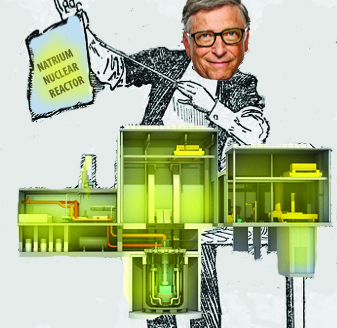
Sodium cooled nuclear reactors are not necessarily safer. https://blog.ucs.org/dlochbaum/nuclear-plant-accidents-fermi-unit-1/
By Susanna Twidale, September 7, 2026, https://www.reuters.com/business/energy/gates-backed-terrapower-targets-british-nuclear-power-plant-start-by-2034-2026-09-07/
- Summary
- Companies
- Britain would be TerraPower’s first market outside United States
- First UK plant could be operational by 2034
- Electricity cost expected under £100 per megawatt hour
ONDON, Sept 7 (Reuters) – TerraPower, the U.S. nuclear developer backed by Bill Gates, expects its Natrium reactors to begin generating electricity in Britain by 2034, its CEO told Reuters, making the UK its first market outside the United States.
Britain has backed the development of small modular reactors (SMRs) to help to increase energy security and meet climate targets, launching an Advanced Nuclear Framework this year to support privately funded projects.
Chris Levesque, TerraPower’s president and CEO, said progress on the company’s first Natrium reactor, due to be completed in 2031, showed that “2034 nuclear electricity in the UK from Natrium is very possible”.
The technology has cleared regulatory requirements in the United States, where the first plant is being constructed in Wyoming and is currently being assessed under Britain’s Generic Design Assessment (GDA) process.
Each sodium-cooled Natrium reactor generates 345 megawatts of baseload power and includes storage capable of boosting output to 500 MW for more than five hours. The reactors run on high-assay, low-enriched uranium (HALEU).
Britain and the U.S. are both building plants to produce the fuel, which was previously only commercially available from Russia.
Levesque said electricity generated by Natrium plants would be competitive with other low-carbon technologies, including combined solar-and-battery projects, at less than £100 ($135.32) per megawatt hour.
TerraPower has yet to choose a site for its first UK project, but said its British subsidiary is likely to be based in Liverpool, northwest England, close to the country’s nuclear regulator.
In the U.S., the company has an agreement with tech giant Meta (META.O), opens new tab to develop up to eight reactors. Levesque said TerraPower could seek similar partnerships in Britain.
New nuclear alliance is formed between three major countries
Japan, South Korea and the US have signed a new agreement to boost small modular reactor cooperationNew nuclear alliance is formed between three major countries
The USA, Japan and South Korea are ramping up nuclear expansion by signing a trilateral SMR cooperation agreement, giving countries an alternative to Chinese and Russian reactor vendors.
All over the world, countries are reinvigorating the demand for nuclear power – whether it be from growing use of AI and the need for nuclear powered data centres, fossil fuel supply disruption due to conflicts and wars, or other causes…………….
Energy Live News 9th Sept 2026, https://www.energylivenews.com/2026/09/09/new-nuclear-alliance-is-formed-between-three-major-countries/
China v. US: The Great Mideast AI Race Heats Up

Officials, activists and academics have warned that while economically Middle Eastern states may benefit from the race between the US and China to offer them investment and technology, this will likely come at an environmental cost.
September 8, 2026, Neil Thompson, https://www.juancole.com/2026/09/china-great-mideast.html
London– Last week, China’s President Xi Jinping made his first state visit to Egypt since 2016, amid deepening economic and security ties between Beijing and one of Washington’s major Arab allies. Egypt’s government said the two sides agreed to launch the third phase of a cooperative industrial zone in the Suez Canal, as Cario seeks to diversify its major foreign policy relations beyond just the US. The latter still supplies Egypt with $1.3 billion in military aid each year but faces growing geopolitical competition from China.
In a statement clearly designed to appeal to Egyptian audiences, where the Suez Canal is a major economic engine, Xi said that China “stands ready to work with countries in the region to safeguard the security of international shipping lanes, advance development cooperation … and eliminate the breeding grounds for conflict.” Instability in the Red Sea since 2023 and the US-Iran conflict since February have caused maritime traffic through the canal to drop sharply, though the major Maersk and Hapag-Lloyd shipping lines signalled last month that they were planning a phased return. hottest year on record in 2024, and that heatwaves there are becoming longer and more intense.
It is also during these months that the region’s new AI infrastructure needs the most water and energy to cool its server farms, too. Even without higher temperatures, the average data centre has the equivalent water demand of around 1,000 households per day, while a large one uses around 5 million gallons a day, the same as a town of up to 50,000 residents. Gulf countries like the UAE are engaged in massive construction of more desalination plants to meet this expected AI-related upsurge in water (and power) demand as a result. UAE regulators have denied the increase in water demand will cause them problems, with the head of regulatory affairs at Abu Dhabi’s Department of Energy saying in April: “We rely on desalination [plants] that have proven in the last 50 years to be a very reliable source for potable water.”
Conclusion
Middle Eastern countries outside the GCC will face similar problems with rising temperatures driving household power and water demand just as AI-related demand also increases. AI infrastructure projects may outpace regional water and power development without careful planning. In May, Egypt said it planned to meet future AI data centre power demand there using renewable energy. It is investing significantly in wind farms and other projects, including expanding regional interconnections with other countries’ power grids in Saudi Arabia, Europe and Sudan. However, these projects are vulnerable to timetable slippages from obstacles like construction sector supply chain disruption or port congestion at Egyptian terminals. With a growing population seeking jobs, Egypt’s government seems likely to press ahead regardless.
China’s expertise in both AI and green technology could likely help ease many Middle Eastern countries’ attempted transition to a digitalised and clean-energy powered economic future. But geopolitical competition with the US will add a political and diplomatic dimension to any projects with Chinese participation. The US is still a major security partner for many Middle Eastern governments, and Washington could threaten to withdraw military aid in response to a growing dependence on Chinese AI systems in allied regional governments or economies. The US fears Egypt allowing Chinese AI systems in its public sector would create cybersecurity risks for its agents and companies there. US fear of China could impede Middle Eastern states’ uptake of Chinese AI infrastructure and models, but also their uptake of Beijing’s greener gifts.
China Dangles Growth, Security Partnership
Beijing has also made Egypt’s government another offer of economic and technological development through state-linked firm Huawei. Egypt has ambitious plans to expand AI’s contribution to its economy to 7.7% of GDP by 2030, offering China an opening to challenge the US lead on global AI infrastructure by starting with a small project in the Middle East. Huawei bid on an Egyptian government tender in August to build public sector AI data centers there, in partnership with iFlytek, a Chinese surveillance company. Both Chinese companies are on a US blacklist, and Washington has approached US firms including Nvidia, AMD and Microsoft to put together a counterbid. Egypt has yet to announce a decision, but the move signals an intensifying race between Beijing and Washington to recruit more regional states into their respective AI stacks.
China’s Middle Eastern AI Footprint Expands Elsewhere
China and the US have each launched their own multinational AI alliances; in China’s case, this is the World AI Cooperation Organisation (WAICO), while the US set up the Pax Silica in December. Both groups contain a few Middle Eastern states so far, with Iran, Algeria and Oman joining WAICO, and Israel, Qatar, and the UAE have joined the Pax Silica. However, Chinese companies have launched AI-related projects in multiple Middle Eastern countries prior to WAICO’s launch, and Beijing’s AI-infrastructure footprint is likely to extend well outside the alliance’s formal Middle Eastern members. Middle Eastern firms are increasingly willing to use Chinese technology to launch their own AI models indigenous to the region, too.
In October, Chinese firm Alibaba opened a sector data centre in Dubai. In January, the UAE’s Emirate of Sharjah signed an agreement with Chinese AI infrastructure and cloud computing services provider DataCanvas to examine establishing data centers there. Finally, in September Saudi technology firm Humain released an Arabic-language AI model based on a Chinese one created by Chinese AI firm MiniMax. Chen Jing, a vice president of China’s Technology and Strategy Research Institute, told state media there that: “Unlike in the past, when Chinese LLMs primarily entered overseas markets through APIs or application products, in this collaboration, MiniMax M3 has directly become the foundational model for overseas indigenous model development.” Humain is financed by Riyad’s Saudi Public Investment Fund, indicating Saudi state backing for the firm’s project, despite Saudi Arabia not being a member of WAICO.
AI Growth, Environmental Cost?
Officials, activists and academics have warned that while economically Middle Eastern states may benefit from the race between the US and China to offer them investment and technology, this will likely come at an environmental cost. In April, the Qatar-based Middle East Council on Global Affairs research centre published a report warning that water and power demand for AI data centres presented a significant ecological challenge to Gulf Cooperation Council (GCC) states. GCC members already struggle to meet power and water demand during the summer months, when temperatures traditionally soar. This issue is getting worse. In December, the World Meteorological Organization issued its first report on the state of the climate in Arab states. It warned that these states had their
1 This Month
Tell Congress: Prevent Nuclear Catastrophe in Iran

Tell Congress: Prevent Nuclear Catastrophe in Iran

Read the Public Inquiry Report, the Commissioners’ report, Surrendering Australia: The AUKUS Deception is available to download for free at aukuspublicinquiry.com. Or just watch the replay of the National Press Club Luncheon.


Shut down the radiation-damaged Heysham nuclear reactors now
To see nuclear-related stories in greater depth and intensity – go to https://nuclearinformation.wordpress.com

Say No to NASA’s Reckless Nuclear Reactor on the Moon
Say No to NASA’s Reckless Nuclear Reactor on the Moon
-
Archives
- November 2026 (190)
- October 2026 (302)
- September 2026 (339)
- August 2026 (330)
- July 2026 (355)
- June 2026 (287)
- May 2026 (306)
- April 2026 (356)
- March 2026 (251)
- February 2026 (267)
- January 2026 (308)
- December 2025 (358)
-
Categories
- 1
- 1 NUCLEAR ISSUES
- business and costs
- climate change
- culture and arts
- ENERGY
- environment
- health
- history
- indigenous issues
- Legal
- marketing of nuclear
- media
- opposition to nuclear
- PERSONAL STORIES
- politics
- politics international
- Religion and ethics
- safety
- secrets,lies and civil liberties
- spinbuster
- technology
- Uranium
- wastes
- weapons and war
- Women
- 2 WORLD
- ACTION
- AFRICA
- Atrocities
- AUSTRALIA
- Christina's notes
- Christina's themes
- culture and arts
- Events
- Fuk 2022
- Fuk 2023
- Fukushima 2017
- Fukushima 2018
- fukushima 2019
- Fukushima 2020
- Fukushima 2021
- general
- global warming
- Humour (God we need it)
- Nuclear
- RARE EARTHS
- Reference
- resources – print
- Resources -audiovicual
- Weekly Newsletter
- World
- World Nuclear
- YouTube
-
RSS
Entries RSS
Comments RSS

