On lost Iran war Trump mimicking Hitler at end of WWII

Walt Zlotow West Suburban Peace Coalition Glen Ellyn IL 26 Mar 26
Listening to President Trump on his Iran war achievements brought to mind the ravings of Hitler hunkered down in his Berlin bunker as the Soviets closed in. He demanded his generals move imaginary armies to crush the invaders to stave off defeat and achieve victory.
Trump lost his war on Iran in the first week when the 90 million Iranians did not overthrow their Islamic government in capitation to the US, Israeli attackers. Dropping thousands of bombs on them had the opposite effect…they coalesced around their leaders to support a ferocious counteroffensive. US bases in the region are being decimated along with Israel from an endless supply of missiles and drones stockpiled for years in preparation for inevitable criminal war from America and Israel.
Trump declared on war day 25 Tuesday “We’ve won this. This war has been won.” He also said Iranian leaders have given him “a very significant prize related to the Strait of Hormuz.” Speculation is that Iran’s ‘prize’ was simply letting one Iraqi oil tanker pass thru the closed Strait of Hormuz. But that rumor Trump trumpeted has not been confirmed and likely never occurred. A third bizarre Trump statement is that Iran called him to negotiate the war’s end…presumably on Trump’s terms.
One has to go back 81 years to Hitler’s Berlin bunker ravings to hear such delusional statements from a world leader trying to imagine away his loss in a war only an unhinged leader would have started.
Where is the 25th Amendment when we desperately need it?
‘We Won’t Die for Israel’: Military Members Seek a Way Out as U.S. War Expands

March 25, 2026, https://scheerpost.com/2026/03/25/we-wont-die-for-israel-military-members-seek-a-way-out-as-u-s-war-expands/
In recent interviews on Clearing the FOG, Margaret Flowers highlights a sharp rise in military personnel seeking conscientious objector status, speaking with Mike Prysner of the Center on Conscience and War and revisiting an earlier conversation with James Branum of the Military Law Task Force on legal alternatives available to active-duty troops. The interviews point to growing concern inside the ranks as the Trump administration deepens confrontation with Iran and expands military deployments across the region.
As the Trump administration deepens U.S. military involvement in the expanding war around Iran—with troop deployments growing, Marine Expeditionary Units moving toward the region, and military families bracing for escalation—another story is unfolding inside the ranks: more service members are actively searching for ways not to participate.
In this episode Prysner who says requests for conscientious objector assistance have surged dramatically since the latest attacks began. According to Prysner, many of those reaching out are not motivated by fear for their own safety, but by refusal to be tied to another war they view as unlawful, catastrophic, and morally indefensible.
The conversation also revisits legal guidance from James Branum of the National Lawyers Guild’s Military Law Task Force, who outlines what active-duty troops can legally do when confronted with potentially unlawful orders, including the right to question commands, seek counsel, and in some cases refuse participation.
Taken together, the interviews reveal something often hidden beneath official war messaging: beneath patriotic rhetoric and televised escalation, dissent is growing within the military itself. For soldiers, sailors, Marines, and their families, the question is no longer abstract—whether this conflict expands further may determine whether conscience becomes a battlefield of its own.
At the center of the interviews is a striking reality rarely acknowledged in official coverage: the resistance is not hypothetical. Prysner says the Center on Conscience and War has seen a more than thousand-percent increase in military personnel seeking information about conscientious objector status since the war expanded, with inquiries coming from across branches and ranks—including combat units, intelligence personnel, officers, reservists and active-duty troops already positioned near the conflict zone. Many, he notes, describe the killing of civilians, bombed hospitals, and the prospect of participating in another open-ended regional war as the breaking point that forced them to confront what military service now demands of them. Branum adds that troops ordered into volatile deployments face serious legal and moral dilemmas, especially when commands intersect with actions many believe may violate both constitutional protections and international law. Together, the interviews expose a deep fracture beneath Washington’s war posture: while political leaders speak in the language of deterrence and force, growing numbers inside the military are quietly asking how far obedience can go before conscience refuses to follow.
What emerges from both conversations is a picture of an administration escalating militarily while confronting uncertainty not only abroad, but within the very institution expected to carry out its orders. As troop movements continue and naval assets expand across the region, Prysner warns that many service members are already discussing refusal, discharge options, and legal avenues long before receiving direct deployment orders—an early sign that this conflict may generate internal resistance faster than previous wars. Branum, meanwhile, underscores that military law still recognizes limits: orders are not automatically lawful simply because they are given, and service members retain rights even inside a rigid command structure. That tension—between command authority and personal conscience—has historically surfaced only after wars become prolonged disasters. In this case, it is appearing at the opening stage, suggesting that memories of Iraq War and War in Afghanistan remain close enough that many inside uniform no longer accept official justifications at face value.
If history offers any lesson, it is that wars begin to unravel politically when dissent crosses the line between civilian protest and internal refusal. The significance of what Prysner and Branum describe is not simply that individual troops are questioning orders, but that a wider moral fracture is becoming visible between official war policy and those expected to enforce it. From legal hotlines to conscientious objector filings, from families contacting advocacy groups to veterans publicly warning against another catastrophic escalation, the infrastructure of refusal is already taking shape before this conflict has fully matured. For the antiwar movement, that matters profoundly: public opposition gains force when it is echoed by those in uniform who understand firsthand what escalation means—not in speeches, but in bodies, cities, and generations marked by war. Whether that dissent remains scattered or grows into something larger may help determine whether another regional catastrophe proceeds unchecked or encounters resistance strong enough to alter its course.
‘Worst case scenario’: Wall St craters, oil surges as nuclear sites hit.

Wall St is imploding and oil is surging again as experts warn of a “worst case scenario” over frightening new strikes on nuclear facilities.
Ben Graham, March 28, 2026, https://www.news.com.au/finance/economy/world-economy/worst-case-scenario-wall-st-craters-oil-surges-as-nuclear-sites-hit/news-story/c19242591d70011f0f733addaf27be51
Wall Street sunk to its lowest level since September 2025 as oil prices soared again overnight as investors mash the panic button amid strikes on Iranian nuclear sites.
The Nasdaq Composite slumped 2.2 per cent in New York, the S&P 500 fell by 1.67 per cent following on from heavy losses in recent weeks, while oil shot up 4.2 per cent to $112.57 a barrel.
The drop came after US President Donald Trump extended a deadline for Tehran to open the Strait of Hormuz or face the destruction of its energy grid, pushing it from Friday to April 6.
The 10-day extension was his second since last week’s threat to destroy the infrastructure if Tehran didn’t reopen the critical waterway, a chokepoint that’s become increasingly urgent with global energy and commodity shortages mounting.
But with Iran maintaining a hold on the strait and intense hostilities continuing, Mr Trump’s announcement failed to lift the mood on markets.
Nuclear sites struck
One of the key reasons for the latest sell-offs of global stocks is due to a concerning escalation in the war as Israel’s military says it struck a heavy water reactor and a uranium processing plant in Iran.
“A short while ago, the Israeli Air Force… struck the heavy water plant in Arak, central Iran,” the military said in a statement, describing the site as a “key plutonium production site for nuclear weapons”.
Iranian media had earlier reported that US-Israeli strikes hit the Khondab heavy water complex, saying they caused no casualties or radiation leak from the site.
NEW FILM – Orwell, Trump and the persistence of fascism: ‘He was giving us a warning’
Raoul Peck, director of a new film about the author, tells Dorian Lynskey that the dystopia of Nineteen Eighty-Four was drawn from lived experience, not prophecy
Dorian Lynskey, The Nerve, Mar 28, 2026
Raoul Peck did not consider himself an expert on George Orwell until fellow documentary-maker Alex Gibney approached him with the opportunity to make a film approved by the Orwell estate, with full access to its vast archive. Working on Orwell: 2+2=5 transformed Peck’s sense of who Orwell was and how his work continues to illuminate our understanding of power and oppression 76 years after his death.
He presents Orwell as an endlessly curious international figure – born (as Eric Blair) in India, a colonial policeman in Burma, an anti-fascist volunteer in Spain – who spent the last year or so of his life confined to hospital beds with tuberculosis while finishing his final novel, Nineteen Eighty-Four. Orwell’s piercing words, read by Damian Lewis, are illustrated by a startling array of images culled from movies, news reports, documentaries, cameraphone footage and even AI, spanning numerous countries over more than a century.
Peck identifies with the ambition Orwell expressed in his 1946 essay Why I Write: “What I have most wanted to do … is to make political writing into an art.” He is also an internationalist: born in Haiti in 1953, he was educated in Kinshasa, New York, Orléans and Berlin. He worked as a journalist, photographer and taxi driver while making his first short films in the early 1980s. He has since directed seven feature films, including biopics of Karl Marx and the Congolese politician Patrice Lumumba, and 10 documentaries. I Am Not Your Negro, his innovative 2016 study of his personal hero, James Baldwin, won a César and was nominated for an Oscar, while his 2021 HBO series about colonial genocide, Exterminate All the Brutes, earned him a Peabody. Between 1996 and 1997 he was Haiti’s minister of culture.
I made my own investigation of Orwell’s life and legacy in my 2019 book The Ministry of Truth: A Biography of George Orwell’s Nineteen Eighty-Four, so I spoke to Peck for an onstage Q&A after a screening of his film at the Curzon cinema in Bloomsbury earlier this week. This is an edited version of that conversation.
“………………………………………………………………………………………………………………………………………………………………………………………………………………………………………………. That’s the thing. People talk about him being prophetic but actually I think the message is that it’s the continuity. He’s not predicting things. He’s observing things that were happening in the 1930s and the 1940s. We’re still doing the same things, we have the same problems – they’re just new iterations.
Yes, it’s the same capitalist society. The rules are the same. The way for capitalists to continue are the same, from crisis to crisis. It’s always the same cycle and it’s becoming even more dangerous because it can explode the whole planet. Orwell was analysing his own society. That’s the mistake we make about Orwell, to think that it’s his imagination. No, he was writing about stuff that he went through. He has to deal with it: that craziness, the lies, the abuses. It’s a warning he’s giving to us. [The working title] of Nineteen Eighty-Four was The Last Man in Europe. That was a warning to his own people, to say, yes, we can have fascism in the UK.
…………………….Don’t tell me that what I’m seeing is not what I’m seeing. That scene in The Crystal Spirit, talking to his son, where he says there will be people who try to make you believe that 2+2=5, and they are called governments, and they will torture you and they will kill you – I think the whole Orwell essence is in that dialogue.
……………………….Orwell: 2+2=5 is in cinemas now.
Dorian Lynskey is the Nerve’s theatre critic. He co-hosts the politics podcast Origin Story (and previously co-presented Remainiacs). His 2019 book The Ministry of Truth: A Biography of George Orwell’s 1984 was longlisted for both the Baillie Gifford and Orwell Prize. https://www.thenerve.news/p/raoul-peck-interview-film-orwell-2-2-5-dorian-lynskey?utm_source=www.thenerve.news&utm_medium=newsletter&utm_campaign=weekend-edition-stewart-lee-orwell-s-warnings-robyn&_bhlid=3ec476febb6669b3cd1441aa6da251aee0c07b0c
The Deafening Abdication of Four Ex-Presidents on Trump.

By Ralph Nader
March 27, 2026
What should the American people, especially the hundreds of millions of their voters, expect Presidents Bill Clinton, George W. Bush, Barack Obama, and Joe Biden to do against the vicious, serial law-violating, violent, corrupt, agency-dismantling Donald Trump and the crony Trumpsters who are wrecking our government and our economy?
These former Presidents should mobilize the citizenry from the grassroots to the Capitol and take on the unpopular Tyrant Trump. Having sworn to uphold the Constitution and “…take Care that the Laws be faithfully executed,” they should strongly uphold their patriotic duty to resist tyranny and save our Republic and our besieged democratic institutions, and stop the assault on our civil liberties and civil rights.
Our former presidents all get along with each other. They have the stature to: (1) get mass media; (2) raise immediately large amounts of funds for strong IMPEACH TRUMP citizen groups in every Congressional district to increase and expand the present majority of Americans wanting to FIRE TRUMP; (3) stay the course as Trump keeps worsening his criminal dictatorship and destruction of our democracy; and (4) highlight the many programs they initiated that Trump has illegally destroyed or is dismantling.
Instead, they are living luxurious lives and are largely AWOL from connecting with the existing but overwhelmed civic opposition to Trump. Bush is painting landscapes as Trump has destroyed his AIDS program in Africa, and the Bush wing of the Republican Party. Obama has campaigned for Abigail Spanberger and Mikie Sherrill as governors of Virginia and New Jersey, satirizing Trump in some of his speeches. His present passion, however, is the March Madness basketball championships. Clinton has left it up to Hillary, who wrote a guarded New York Times op-ed back on March 28, 2025, taking Trump to task for jeopardizing our national security and not “preparing for real fights with America’s adversaries.”
Then there is Joe Biden, who received then President-elect Trump and Melania on the morning of January 20, 2025, with the gracious “welcome home.” In return, Biden got that afternoon and every day since hundreds of foul epithets from Trump, scapegoating him for almost everything he could fabricate, including solar energy and wind power projects. Delaware Joe managed a few critical replies at a Democratic Party dinner in Nebraska on November 7, 2025. “Trump has taken a wrecking ball not only to the people’s house but to the Constitution, to the rule of law, to our very democracy.” Unfortunately, Biden has mostly been silent.
Credit these retired Presidents with knowing the historic dangers and existing damages of the TRUMP DUMP in Washington and around the country. They also know their supporters would be very receptive to their organized, persistent leadership from them to send Trump back to Mar-a-Lago. Why are they AWOL?
First, they fear Trump’s retaliation, upsetting their comfortable lives. Trump is now deep in the QUICKSAND of the Middle East. He is being pilloried by a million stickers at gas pumps picturing Trump pointing to the booming price per gallon and saying, “I did that.” He is openly declaring there should be no elections in November and continues to send or keep his stormtroopers in America’s cities. An expanding police state is not exactly a credible perch for effective profanity. Show a modest bit of moxie!
A second excuse is that they have done some of what Trump is doing:
*Bush’s mass murder in the illegal war on Iraq.*Clinton’s distracting raids abroad against innocents and his womanizing.
*Obama’s “signature strikes,” killing over three thousand mostly young men in places like Yemen.
*Biden’s illegal co-belligerence with Netanyahu’s genocide in Gaza, which has taken over 600,000 civilian lives.
True enough. But people live in the present and are most worried about what Dangerous Donald is doing NOW to their livelihoods, freedoms, health and safety, and the consequences in casualties and their tax dollars of another endless war.
Our former Presidents have no excuses. They simply lack a modicum of courage. Remember Aristotle declared, “Courage is the first of human qualities because it is the quality which guarantees the others.”
The current political climate demands the powerful emergence of the four previous presidents of our country. The federal district courts are ruling heavily against Trump’s “Injustice Department,” though Trump retains a slightly weakening claim on six Supreme Court Injustices. People of all backgrounds are marching and demonstrating in huge numbers. This weekend, the “No Kings” rallies (he’s already a dictator) anticipate 10 million people nationwide.
The business community, particularly small businesses, are feeling serious harm from Trump’s tariffs, wars, cancelled contracts, and inflationary policies. The labor unions have never been under such attack (notably the federal employees’ union members whose contracts he has torn up), and they are simmering with anger. The universities are also under His illegal, shakedown attacks.
What explains the mainstream media’s virtual ignoring of this ABDICATION by these ex-presidents? The reporters mostly despise Trump, who has slandered them (calling them “deranged and demented” for starters) and has extortionately sued news organizations and journalists for millions of dollars and coerced settlements.
The media have reported that some ex-agency officials under the former presidents have excoriated Trump, such as Samantha Power, for closing the major lifesaving Agency for International Development. The formidable Rohit Chopra, who directed the Consumer Financial Protection Bureau under Biden, is not reticent to verbally defend his nearly closed-down agency, which had saved consumers many billions of dollars.
However, they are not covering the abdication by BIG GUYS – our former Presidents. I have tried in vain to find out why by calling reporters and editors. Maybe you’ll have better luck. Try calling these numbers: The Washington Post: 202-334-6000; The New York Times: 800-698-4637; Associated Press: 212-621-1500; NPR: 202-513-2000; The Wall Street Journal: 212-416-2000.
Republican Lawmakers Led By Nancy Mace Begin To Break With Trump On Iran War: ‘We Were Misled’
by Tyler Durden, Mar 27, 2026, https://www.zerohedge.com/political/republican-lawmakers-led-nancy-mace-begin-break-trump-iran-war-we-were-misled
Republican lawmakers are belatedly starting to wake up to the potential for the United States to once again get bogged down in yet another Middle East quagmire, but this time with a country double the size of Iraq (both in geography and population).
GOP Rep. Nancy Mace has led the charge this week, blasting any potential Trump admin move to put American boots on the ground, warning she will vehemently oppose new war funding if American troops are deployed in Iran. “I’ll be voting against the funding if we’re putting troops on the ground,” Mace told a reporter outside the Capitol earlier in the week. “I’m not going to fund that.”
The comments came after the Pentagon days prior unveiled a massive $200 billion supplemental request in order to fund the war, which was at first previewed by White House officials as lasting a mere ‘days’ or a few ‘weeks’ and not months (or years).
Mace soon followed her verbal comments with a Tuesday post on X pushing back against getting sucked into a ground war. “If a single boot of a single American soldier sets foot on Iranian soil, I will vote against this,” Mace wrote. “I will not vote to fund sending South Carolina’s sons and daughters to die in a ground war in Iran.”
War Secretary Pete Hegseth had framed the supplemental request as essential given it “takes money to kill the bad guys” – as he said, echoing a view that President Trump has been supportive of while claiming “we won”.
Axios is newly reporting on Thursday that Mace is not going to back down if another War Powers resolution is pushed before the House:
Rep. Nancy Mace (R-S.C.) told Axios she will “most likely” vote for House Democrats’ resolution to constrain President Trump from waging war with Iran the next time it comes up for a vote.
Why it matters: The vote is symbolic — even if the measure passed both chambers, Trump could veto it — but Mace’s support puts the House one step closer to a major rebuke of the administration’s Middle East operations.
At the moment there’s some 7,000 US ground forces en route to the Middle East – including from the Army’s 82nd Airborne Division and the Marines, amid speculation Trump could be eyeing some kind of high risk Kharg Island operation, in order to force open the Strait of Hormuz.
This particular ‘final blow’ plan – which would be contingent on putting boots on the ground in a Kharg takeover – has really gotten Republicans’ attention. Daily Mail on Thursday reports that “Furious Republicans stormed out of a classified briefing on Iran on Wednesday amid fears the US is preparing to invade the country as Tehran refuses Donald Trump’s peace overtures.”
According to more details in the report:
Nancy Mace walked out early, venting that ‘we were misled,’ while pro-Trump committee chair Mike Rogers warned ‘we’re not getting answers’ as Pentagon chiefs briefed the House Armed Services Committee, sparking fireworks on Capitol Hill.
Now, a Daily Mail source inside the room has revealed stark new details, including a new set of objectives which may suggest that America is moving toward boots on the ground as Iran continues to strangle the Strait of Hormuz.
The lawmaker, speaking on condition of anonymity, said members were presented with three military objectives: Kharg Island, Iran’s crucial oil export hub; its nuclear material; and regime change. It marks a stark shift from the four goals the White House has publicly stated: destroying Iran’s missiles, navy, armed proxies, and nuclear capabilities.
The lawmaker said that the White House must answer for its plans, particularly regarding Kharg Island and troops on the ground. The answers are ‘jaw-dropping’ and ‘will blow your brains out,’ the lawmaker said.
Quagmire by midterms? Some MAGA influencers have increasingly said they are tired about hearing Israel-centric justifications for Trump’s newest war of choice.
GOP members are getting much more vocal alongside Democrats:
House Armed Services Committee Chairman Mike Rogers was uncharacteristically agitated after leaving the briefing, stating that he had few details about the direction the war is heading.
‘We want to know more about what’s going on,’ Rogers, an Alabama Republican, said. ‘We’re just not getting enough answers.’ Senate Armed Services Committee Chairman Roger Wicker of Mississippi felt the same after his own briefing. ‘I can see why he might have said that,’ Wicker told Politico of Rogers’ comments.
A week ago Responsible Statecraft began documenting fissures among the generally war-supporting GOP, and it’s been more than just the expected Libertarian firebrands Rand Paul and Thomas Massie. For example, Rep. Lauren Boebert of Colorado has told reporters: “I am so tired of spending money elsewhere. I’m tired of the Industrial War Complex getting our hard-earned tax dollars. I’ve got folks in Colorado who can’t afford to live. We need America First policies right now.”
Titanic misconceptions that things will be OK
Last night I watched a terrific programme on SBS world television. It was all about the sinking of the Titanic, covering so many aspects never shown on TV before. I was struck by the atmosphere on the ship, in the early hours of the sinking, with many people, particularly the rich upper-class passengers, taking the whole process as something not really serious, rather fun even. Of course, not all of them saw it that way. But enough of them – to be able to have quite a good party on the upper deck lounge, and to regard the messenger calling them up on deck as rather a nuisance, an ignorant lower-class person. And indeed, some people just refused to leave their (temporarily comfortable) beds, on such a cold night.
And here was I, trying to get my mind away form the rather scary world news. I suppose I’d have been better watching some “reality” show, or that good old Australian standby – sport.
Anyway, the thing was – the Titanic story showed how people are inclined not to take a critical event seriously, not to worry about it, until it’s too late.
And lo and behold, the same sort of thing is happening now. Today DW reports Iran war: Israel hits Iranian heavy water nuclear reactor. The good old news.com.au writes ‘Worst case scenario’: Wall St craters, oil surges as nuclear sites hit’. The fascinating part of this coverage, as shown by that last headline, is that the financial aspect is the first priority.. Yeah, I know that the world economy is important, and it’s not a good thing to have Wall St stocks going down, and investors “mashing the panic button”. I’m not saying that this is a trivial matter. It’s just that drone or missile strikes on a nuclear facility could be a helluva lot more serious than a drop on the stock exchange.
We don’t need an actual nuclear bombing to create a massive environmental and health catastrophe, a drone strike can do that job.
Both articles focus on this economic crisis, paying barely lip service to the fearful physical danger of a nuclear site being exploded, or even just damaged. Israeli air strikes hit a nuclear research reactor in Iran’s Khondab region, and a uranium processing plant in Yazd in Central Iran. The reports hastened to tell us there was no release of radioactive material. How reassuring! We can focus on the main issue – the share prices.
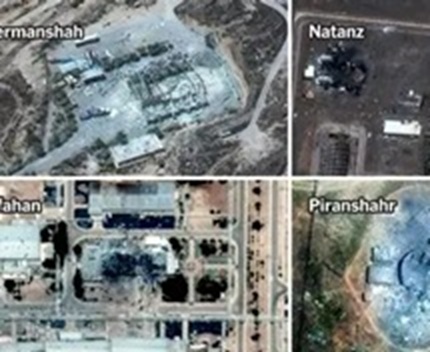
Questions come to mind. Will Iran retaliate by striking Israel’s Dimona reactor and other nuclear sites? How come it’s so terrible for Iran to have legally permitted nuclear research facilities, but apparently OK for Israel to have nuclear weapons. Estimates of Israel’s nuclear warheads range from 90 to 200, but Israel “does not confirm or deny” its nuclear weaponry numbers. So that’s apparently OK.
Yes, we’re all anxious about our petrol and diesel prices, and naturally so. But the possible ramifications of these Israeli strikes on nuclear facilities add up to something more horrendous. I don’t want to rave on here about the health, environmental, social toll that will ensue, if the warring states decide to use this very convenient weaponry – no need to have your own expensive nuclear bomb, just send a few cheap drones to attack your enemy’s nuclear sites.
As with those rich passengers on the Titanic, it’s time that world leaders woke up.
Greenpeace warns Trump’s threat to bomb Iran’s power grid risks humanitarian and nuclear disaster

Greenpeace International, 23 Mar 26, https://www.greenpeace.org/international/story/82295/trump-threat-bomb-iran-power-grid-risks-humanitarian-nuclear-disaster/
Amsterdam – Greenpeace International has condemned threats by Donald Trump to target Iran’s electricity infrastructure, warning it could trigger a humanitarian catastrophe, trigger a blackout over a large part of the country and risk nuclear disaster escalating into a wider regional crisis.
Greenpeace warns that attacks on the grid could have a knock-on effect that increases the danger of a nuclear emergency at the Bushehr Nuclear Power Plant, with potential consequences across the region.[1]
“Bombing civilian electricity infrastructure is illegal under international law. The electricity grid is essential for hospitals, clean water, desalination and the operation of nuclear facilities. Cutting it off puts millions of lives at risk,” said Jan Vande Putte, senior nuclear and radiation protection expert with Greenpeace International.[2]
“A blackout could force the Bushehr nuclear facility into depending completely on backup diesel generators, causing a heightened risk of overheating, which can lead to a Fukushima-like disaster.”[3]
Iran’s grid is already under strain due to war, climate change and sanctions leading to underinvestment.[4]
“If Trump carries through with this reckless threat to knock out critical infrastructure, it could lead to cascading failures, from blackouts to nuclear danger far beyond national borders, with the potential to escalate into a wider regional crisis,” says Vande Putte.
The US, Israel and Iran have all targeted energy infrastructure, and several attacks in Iran and Israel already appear to have come close to hitting nuclear facilities. Iran is also threatening to target water and energy infrastructure in neighbouring countries.[5] Greenpeace is urging all parties to step back from escalation and pursue a diplomatic solution now, warning that further escalation will only deepen human suffering and increase global instability.
The Bushehr nuclear plant was built and is operated by Iran’s nuclear enabler, Rosatom, the Russian state nuclear corporation.
Oceans take in a lot of heat as Earth’s energy imbalance hits record.
The Earth’s energy imbalance reached record levels last year, as the
rate of solar radiation that entered the planet exceeded the amount leaving
the system at a faster rate, the World Meteorological Organization said.
The measure was included for the first time in the UN agency’s State of
the Climate annual report, as the rate had more than doubled in the past 20
years while greenhouse gases continued to accumulate. Under a balanced
system, incoming heat from the sun is about the same as outgoing energy.
The levels are measured by satellite data, collected since 2000, as well as
a host of land, ice and sea monitors used since 1960. The oceans had
absorbed most of the excess heat, storing about 91 per cent of the energy.
Another 5 per cent had warmed the land, 3 per cent heated the ice and 1 per
cent warmed the air, the report said. The 2015-2025 period was the warmest
11 years since observations started, with ocean heat and acidification at
record levels, and continuing rises in sea levels and the retreat of
glaciers.
FT 23rd March 2026 https://www.ft.com/content/e8390d64-63d3-4d27-9c73-6a59dda2045b
Donald Trump’s ‘new’ 15‑point plan is the biggest sign yet that Washington fears it is losing this war
Iran.. does not need military victory. It only needs to endure, impose costs, and outlast its adversaries. This is the logic of asymmetric conflict: the weaker power wins by not losing, while the stronger one loses when the costs of continuing become unsustainable.
March 26, 2026, Bamo Nouri, Honorary Research Fellow, Department of International Politics, City St George’s, University of London, Inderjeet Parmar, Professor in International Politics, City St George’s, University of London. https://theconversation.com/donald-trumps-new-15-point-plan-is-the-biggest-sign-yet-that-washington-fears-it-is-losing-this-war-279001?utm_medium=email&utm_campaign=The%20Weekender%20-%2028%20March%202026&utm_content=The%20Weekender%20-%2028%20March%202026+CID_09f9907cac66b0e5c3e3ca794f0c8c0c&utm_source=campaign_monitor&utm_term=Donald%20Trumps%20new%2015-point%20plan%20is%20the%20biggest%20sign%20yet%20that%20Washington%20fears%20it%20is%20losing%20this%20war
The language of power often reveals more than it intends. In a rare moment of candour on March 7, the US president, Donald Trump, described the confrontation with Iran as “a big chess game at a very high level … I’m dealing with very smart players … high-level intellect. High, very high-IQ people.”
If Iran is, by Trump’s own admission, a “high-level” opponent, then the sudden revival of a 15-point plan previously rejected by Iran a year ago suggests a disconnect between how the adversary is understood and how it is being approached. It’s a plan already examined in negotiation by Iran and dismissed as unrealistic and coercive. Despite this, the Trump administration is once again framing the “roadmap” as a pathway to de-escalation. Tehran has once again dismissed the gambit as Washington “negotiating with itself” – reinforcing the perception that the US is attempting to impose terms rather than negotiate them.
The US president is right about one thing – Iran is not an opponent that can be easily dismissed or overwhelmed. Trump’s own description is a tacit acknowledgement that this is a far more capable and complex adversary than those the US has faced in past Middle Eastern wars, such as Iraq. And that is why the odds are increasingly stacked against the United States and Israel.
This conflict reflects a familiar but flawed imperial assumption: that overwhelming military force can compensate for strategic misunderstanding. The US and Israel appear to have misjudged not only Iran’s capabilities, but the political, economic and historical terrain on which this war is being fought.
Unlike Iraq, Iran is a deeply embedded and adaptable regional power. It has resilient institutions, networks of influence, and the capacity to impose asymmetric costs across multiple theatres. It knows how to manage maximum pressure.
The most immediate problem is lack of legitimacy. This war has authorisation from neither the United Nations or, in the case of America, the US Congress. Further, US intelligence assessments indicate Iran was not rebuilding its nuclear programme following earlier strikes – contradicting one of Washington’s justifications for war. The resignation of Joe Kent as head of the National Counterterrorism Center on March 17, was even more revealing. In his resignation letter Kent insisted that Iran posed no imminent threat.
This effectively collapses one of the original narratives underpinning the US decision to start the war – a further blow to legitimacy.
A majority of Americans oppose the war, reflecting deep fatigue after Iraq and Afghanistan – hardly ideal conditions for what increasingly looks like another “forever war” in the Middle East. Current polling shows Trump’s Republicans trailing the Democrats ahead of the all-important midterm elections in November.
The war is both militarily uncertain and politically unsustainable. International allied support is also eroding. The United Kingdom — often trumpeted as Washington’s closest partner — has limited itself to defensive coordination, while Germany and France have distanced themselves from offensive operations. European allies also declined a US request to deploy naval forces to secure the strait of Hormuz. This reflects not just disagreement, but a deeper loss of trust in US leadership and strategic judgement.
US influence has long depended on legitimacy as much as force. That reservoir is now rapidly draining. Global confidence is falling, while images of civilian casualties — including over 160 schoolchildren killed in an airstrike on the first day of the war – have shocked international onlookers. Rather than reinforcing leadership, this war is accelerating its erosion.
Israel faces a parallel crisis of legitimacy – one that began in Gaza and has now deepened. The war in Gaza severely damaged its global standing, with sustained civilian casualties and humanitarian devastation drawing unprecedented criticism, even among traditional allies. This confrontation with Iran compounds that decline.
Striking Iran during active negotiations — for the second time — reinforces the perception that escalation is preferred over diplomacy. The issue is no longer just conduct, but credibility.
Strategic failure, narrative defeat
The conduct of the war compounds the problem. The assassinations of Iranian leaders, framed as tactical victories, are strategic failures. They have unified rather than destabilised Iran. Mass pro-regime demonstrations illustrate how external aggression can consolidate internal legitimacy.
The issue is no longer just the conduct of the war, but the credibility of the conflict itself. Regardless of how impressive the US and Israeli military are, it doesn’t compensate for reputational collapse. When building support for a conflict like this – domestically and internationally – legitimacy is a strategic asset. Once eroded across multiple conflicts, it is extraordinarily difficult to rebuild.
Rather than stabilising the system, US actions are fragmenting it. Allies are distancing themselves, adversaries are adapting, and neutral states are hedging.
The most decisive factor may be economic. The war is already destabilising global markets – driving up oil prices, inflation, and volatility at levels that combine the effects of 1970s and Ukraine war oil shocks.
This is a war that cannot be contained geographically nor economically. The deployment of 2,500 US marines to the Middle East (and reports that up to another 3,000 paratroopers will also be sent), reportedly with plans to secure Kharg Island – and with it Iran’s most important oil infrastructure – would be a dangerous escalation.
For Gulf states, the assumption that the US can guarantee security is increasingly questioned. Some states are reportedly now looking to diversify their partnerships and turning toward China and Russia, mirroring post-Iraq shifts, when US failure opened space for alternative powers.
Iran holds the cards
Wars are not won by destroying capabilities alone, but by securing sustainable and legitimate political outcomes. On both counts, the US and Israel are falling short.
Iran, by contrast, does not need military victory. It only needs to endure, impose costs, and outlast its adversaries. This is the logic of asymmetric conflict: the weaker power wins by not losing, while the stronger one loses when the costs of continuing become unsustainable.
This dynamic is already visible. Having escalated rapidly, Trump now appears to be searching for an off-ramp — reviving proposals and signalling openness to negotiation. But he is doing so from a position of diminishing leverage. In contrast, Iran’s ability to threaten energy flows, absorb pressure, and shape the tempo of escalation means it increasingly holds key strategic cards. The longer the war continues, the more that balance tilts.
Empires rarely recognise when they begin to lose. They escalate, double down, and insist victory is near. But by the time the costs become undeniable – economic crisis, political fragmentation, global isolation – it is already too late. The US and Israel may win battles. But they may be losing the war that matters: legitimacy, stability and long-term influence.
And, as history suggests, that loss may not only define the limits of their power, but mark a broader shift in how power itself is judged, constrained, and resisted.
Fox News’ united front in support of Trump’s Iran war may be breaking down.
Host Laura Ingraham warns escalation could produce “cascading problems for the region,” political turmoil for the GOP
by Matt Gertz, MEDIA MATTERS 03/26/26
Four weeks after President Donald Trump launched a poorly conceived war of choice against Iran, the lockstep support for the conflict that has characterized coverage from Fox News’ star hosts is beginning to fray. The power struggle is significant — it is not an exaggeration to suggest the course of the war might hinge on which Fox shows the president is watching.
Trump is clearly approaching a decision point over whether to further escalate the war. U.S. and Israeli forces have done a lot of damage to Iranian military targets, but its regime is intact, still controls its stockpiles of enriched uranium, and has closed the Strait of Hormuz, threatening the global trade in oil, natural gas, and fertilizer. The Pentagon is sending thousands of troops to the region and reportedly prepping options for a “final blow” — some of which would involve deploying U.S. forces on Iranian soil.
When Trump is considering policy options, he often takes guidance from his loyal propagandists at Fox. This Fox-Trump feedback loop has in recent months played a role in the president’s decisions to send White House border czar Tom Homan to oversee immigration enforcement in Minnesota; prioritize the SAVE Act over all other legislation; order the deployment of ICE agents to airports; and start the war against Iran.
Against that backdrop, Fox News host Laura Ingraham warned on Wednesday’s show that further U.S. action could produce devastating unintended consequences and suggested that Trump should refocus his attention on the domestic economy and political situation.
“Iran knows it cannot win militarily, so it’s using the leverage it has by prolonging the conflict,” she said during her monologue at the top of the show. “Now, what do they want to do? They want to inflict maximum economic pain on the region, on the U.S., [on] the global economy as much as possible until they think Trump relents. But the White House doesn’t seem to be blinking.”
The host then aired a clip of White House press secretary Karoline Leavitt warning at her press briefing that day that “President Trump does not bluff, and he is prepared to unleash hell” against Iran.
Ingraham did not seem impressed by Leavitt’s rhetoric.
“Well, the problem is obviously unleashing hell means destroying infrastructure, which itself causes a series of cascading problems for the region, including maybe outside the region — political problems for the president in a midterm election year,” she said.
Her air of skepticism continued throughout the show.
While interviewing Sen. Josh Hawley (R-MO), she noted Pentagon reports of thousands of successful missions but commented, “I mean, this is a devastating blow, yet you know, we’re still there.”
“It’s not even a month old, obviously,” she continued, before asking, “But are you concerned about the public and people? Again, very short attention spans, very impatient for victory, as is President Trump, I might add. But in an election year, it’s easy to say politics don’t matter, but at some point politics do come into play.”
And in a third segment, she highlighted the disastrous polling on the Iran war, commenting, “It looks like people are pretty impatient. The American people are sending a message to President Trump that it’s time to put the focus back on the home front.”
Ingraham is inching toward the type of dissent that has been virtually absent from Fox’s coverage of the war, even as the broader right-wing media has split. Her colleagues have played key roles in convincing Trump to attack in the first place and are pushing for risky escalations. Ingraham herself briefly quibbled with Trump’s handling of an apparent U.S. strike that leveled an Iranian school, killing scores of children, but had supported the war itself, which she declared three weeks ago that Trump had already won.
But if Ingraham is getting cold feet and trying to convince Trump not to escalate a war the public has soured on, she remains an outlier at the network. Indeed, if the president tuned in for the two hours following Ingraham’s program, he saw her prime-time colleagues Jesse Watters and Sean Hannity argue not only that the war is going well and that Trump will inevitably lead the U.S. to victory, but that anyone who disagrees must want America to lose the war because they hate the president.
Watters began his show with a 10-minute monologue whose thesis was that “the Iranian regime is losing leverage fast as we continue to carry out thousands of sorties over enemy airspace.” After detailing various tactical victories, he touted a potential escalation………………………………………………. https://www.mediamatters.org/us-iran-relations/fox-news-united-front-support-trumps-iran-war-may-be-breaking-down
Sure, killing kids is fine, just don’t put American boots on the ground!
LBC has a report titled “Republicans ‘storm out’ of Iran briefing as they claim US ‘war machine’ is trying to put boots on ground” about MAGA lawmakers whining that Trump’s war looks set to turn into a land invasion.
LBC reports:
A number of usually loyal MAGA Republicans left the Iran briefing early — including US congresswoman Nancy Mace, who told the waiting media “we were misled” about the war after walking out of a Pentagon briefing.
Mace, a widely controversial lawmaker, was seen to urge President Trump to remove Lindsey Graham from the Situation Room — the White House’s round-the-clock command centre — as tensions rose.
The lawmaker claims Graham “brags about” advising the president and his aggressive war strategy
It comes as the US is reportedly considering a massive troop deployment that would include ‘infantry and armoured vehicles,’ according to the Wall Street Journal.
Tensions continue to rise from within Trump’s own party amid plans to put troops on the ground in Iran, as peace talks continue amid the constantly changing situation.
I get so tired of all this American hand-wringing about “boots on the ground”. It’s a symptom of a wildly sick dystopia that these people are fine with raining military explosives on a densely populated city but draw the line at putting American troops in the line of fire.
Sure, killing kids is fine, just don’t put boots on the ground!
Sure you can rain hellfire on hospitals, homes and schools for weeks, just make sure you do all your massacring from the sky where nobody can return fire.
Killing is okie dokie, so long as our troops aren’t the ones getting killed
These people have no compassion. No morality. No empathy. American conservatives are constantly wagging their fingers and bloviating puritanically about immorality and degeneracy, but they’re the least moral people in the country. Their positions aren’t driven by care for human life, no matter how hard they try to pretend otherwise. They are driven by blind loyalty to the empire and the groveling adoration of power.
If you only oppose mass military slaughter if it is carried out in a way that puts your own countrymen at risk, that makes you a piece of shit.
People should oppose the evil wars inflicted by their government and its allies because the wars are evil, not because they might impact someone you know. The people being murdered in Iran are no less human than Americans, and their lives don’t matter any less.
I want to live in a healthy world where self-evident statements like this don’t even need to be made. Instead I live in a world where the war on Iran is barely receiving any meaningful domestic opposition from the populations of the primary aggressor nations.
Nuclear decommissioning in the UK
Corporate report: The NDA group Technical Baseline Review
This report provides a high-level overview of the processes and associated technologies used or planned to be used to deliver our mission.
NDA 26th March 2026 Nuclear Decommissioning Authority NDA group Technology Baseline Review 2026
PDF, 4.76 MB, 67 pages
The UK’s nuclear energy programme, dating from the post-war years, has left a challenging decommissioning legacy to the country: numerous prototype reactors, fuel-manufacturing plants, research centres, reprocessing plants and 11 power stations. The Sellafield site in west Cumbria houses more than 200 nuclear facilities and 1,000 buildings, making it one of the world’s most complex environmental decommissioning challenges. Across the UK many ‘never-done-before’ decommissioning projects will need to be completed. The Nuclear Decommissioning Authority (NDA) was established under the Energy Act (2004) to ensure that the UK’s nuclear legacy sites are decommissioned and cleaned up safely, securely, cost-effectively and in ways that protect people and the environment.
This document provides a high-level overview of the current technology landscape across the NDA group. It outlines the NDA group technology baseline, current technologies being deployed, and the technology opportunities requiring development or adoption to underpin the delivery of our decommissioning mission……………
https://www.gov.uk/government/publications/nuclear-decommissioning-authority-rd-technical-baseline
Israel launches strikes on nuclear sites as Iran warns of retaliation
Uranium facility, steel plants and heavy water complex among targets hit as IRGC warns of escalation.
By Al Jazeera Staff, AFP, Reuters and The Associated Press, 27 Mar 2026
Israel has struck a uranium processing facility in the central Iranian city of Yazd, the Israeli military confirmed, in an escalatory move that comes as regional diplomats have been attempting to broker an agreement to halt the joint US-Israeli war on Iran.
The Israeli Air Force said it hit a plant used to extract raw materials essential to the uranium enrichment process, describing it as a “unique facility” in Iran’s nuclear infrastructure. Iran’s Atomic Energy Organization confirmed the strike, but said there were no casualties or radiation leaks.
A projectile also hit near the Bushehr Nuclear Power Plant, Iran’s Atomic Energy Organisation said. The attack caused “no casualties, financial, or technical damage,” the organisation said.
Friday marked day 28 of the conflict, and the assault by the Israeli army was part of a broad wave of attacks on sites across the country.
Strikes also hit areas in and around Tehran, the city of Kashan and Ahwaz, while 18 people were killed in Qom.
More than 1,900 people have been killed in US-Israeli attacks on Iran since the war began on February 28.
Iranian officials said US-Israeli strikes have damaged at least 120 museums and historical sites across the country since hostilities began.
Negar Mortazavi, a senior non-resident fellow at the Center for International Policy, told Al Jazeera that even Iranians who had been critical of their own government increasingly view the war as an assault on the Iranian people rather than its leadership, saying the targeting of water, electricity, gas, cultural heritage, schools and hospitals was “unacceptable.”
Israeli Defence Minister Israel Katz said Israel would “intensify” its campaign and expand the range of sites it targets, accusing Tehran of deliberately directing missiles at Israeli civilians.
IRGC Aerospace Commander Seyed Majid Moosavi warned that the conflict was entering new territory, saying “the equation will no longer be an eye for an eye.” He urged employees of US and Israeli-linked industrial companies across the region to immediately vacate their workplaces.
Al Jazeera’s Ali Hashem, reporting from Tehran, noted that the strikes on two major Iranian nuclear facilities could prompt the IRGC to target Dimona again, Israel’s nuclear site, as it did last week.
Prior to Friday’s strikes, US President Donald Trump said Thursday he had pushed back planned attacks on Iran’s energy infrastructure by 10 days, to April 6, saying negotiations to end the war were “going very well”.
Iranian officials flatly rejected that characterisation, describing Washington’s proposal to end the war as “one-sided and unfair” and outlining their own list of conditions, which include war reparations and the recognition of Iranian control of the Strait of Hormuz.
On Friday, an an Iranian official said the ongoing strikes, while simultaneously discussing talks, were “intolerable”……………………………………………………………………………………… https://www.aljazeera.com/news/2026/3/27/israel-launches-strikes-on-iran-nuclear-sites-as-war-enters-fifth-week
Nuclear Power Equals Trump Profits

Karl Grossman – Harvey Wasserman, CounterPunch, March 27, 2026
Nuclear power is inseparable from Donald Trump. If you support atomic energy, you are also supporting the financial fortunes of the Trump family.
Trump is a major investor in the nuclear industry. He has invested heavily in the development of fusion power and stands to massively profit from its proliferation.

He also controls the obliteration of the regulatory apparatus designed to guarantee its safety in the United States. Trump’s war in Iran has vastly escalated the potential threat of potentially apocalyptic drone strikes on atomic reactors, now a factor in Vladimir Putin’s war on Ukraine.
Team Trump has made a very public and effective show of tangibly attacking nuclear power’s primary replacements, wind turbines and solar panels, along with geothermal and battery backup.
He has also heavily assaulted electric vehicles, which threaten the business of his fossil fuel backers.
But neither he nor the major media have talked much about Trump’s direct financial interests in killing them off. Or about his destruction of the Nuclear Regulatory Commission and other agencies directly and indirectly promoting atomic power, from which he profits, while at the same time obliterating any reasonable assurance of public safety from the inevitable upcoming reactor disasters.
The Trump family’s money-losing Truth Social company has recently become part-owner of a major fusion nuclear power endeavor.
Among much more, the investments mean the Trump family stands to profit directly from White House attacks on wind, solar and other inexpensive, clean renewable energies, which for decades have been driving fusion, fission and fossil fuels toward economic oblivion.
“A Trump-sponsored business is once again betting on an industry that the president has championed, further entwining his personal fortunes in sectors that his administration is both supporting and overseeing,” reported an article on the front page of the business section of the New York Times last month. “This one is in the nuclear power sector. TAE Technologies, which is developing fusion energy, said…that it planned to merge with Trump Media & Technology Group. President Trump is the largest shareholder of the money-losing social media and crypto investment firm that bears his name, and he will remain a major investor in the combined company.”
The headline of the piece: “Trump’s Push Into Nuclear Is Raising Questions.”
Primary issues have to do with economic conflicts of interest and public safety.
“The deal,” the article continued, “would put Mr. Trump in competition with other energy companies over which his administration holds financial and regulatory sway. Already, the president has sought to gut safety oversight of nuclear power plants and lower thresholds for human radiation exposure.”
CNN ran an article headlined: “A $6 billion nuclear deal has Trump’s name all over it. It’s raising serious ethics questions.”
CNN reported: “Nuclear fusion companies are regulated by the federal government and will likely need Uncle Sam’s deep research and even deeper pockets to become commercially viable. The merger needs to be approved by federal regulators — some of whom were nominated by Trump.”
CNN quoted Richard Painter, chief White House ethics lawyer under President George W. Bush, as saying: “There is a clear conflict of interest here. Every other president since the Civil War has divested from business interests that would conflict with official duties. President Trump has done the opposite.” Painter is now a professor at the University of Minnesota Law School.
“Having the president and his family have a large stake in a particular energy source is very problematic,” said Peter Bradford, who previously served on the Nuclear Regulatory Commission, in the Times article. The NRC, which Trump and Elon Musk’s DOGE have now gutted, was once meant to oversee the safety of the nuclear industry in the United States.
It went on that “Trump’s stake in Trump Media, recently valued at $1.6 billion, is held in a trust managed by Donald Trump Jr., his eldest son. Trump Media is the parent company of Truth Social, the struggling social-media platform. The merger would set Trump Media in a new strategic direction, while giving TAE a stock market listing as it continues to develop its nuclear fusion technology.”
The Guardian quoted the CEO of Trump Media, Devin Nunes, the arch-conservative former member of the House of Representatives from California and close to Trump, who is currently chair of the President’s Intelligence Advisory Board, saying Trump Media has “built un-cancellable infrastructure to secure free expression online for Americans. And now we’re taking a big step forward toward a revolutionary technology that will cement America’s global energy dominance for generations.” Nunes is the would-be co-CEO of the merged company.
A current member of the US House, Don Beyer, a Democrat from Virginia, said in a statement quoted in Politico that the deal raises “significant concerns” about conflicts of interest and avenues for potential corruption. “The President has consistently used both government powers and taxpayer money to benefit his own financial interests and those of his family and political allies. This merger will necessitate congressional oversight to ensure that the U.S. government and public funds are properly directed towards fusion research and development in ways that benefit the American people, as opposed to the Trump family and their corporate holdings.”
By federal law (the Price-Anderson Act of 1957), the US commercial atomic power industry has been shielded from liability in the event of major accidents it might cause. The “Nuclear Clause” in every US homeowner’s insurance policy explicitly denies coverage for losses or damages caused, directly or indirectly, by a nuclear reactor accident.
As his company fuses with the atomic industry, Trump acquires a direct financial interest in gutting atomic oversight — which he has already been busy doing. In June, Trump fired Nuclear Regulatory Commission Chairman Christopher T. Hanson. No other president has ever fired an NRC Commissioner.
Earlier, more than 100 Nuclear Regulatory Commission (NRC) staff were purged by Elon Musk’s DOGE operation. There has been a stream of Trump executive orders calling for a sharp reduction in radiation standards, expedited approval by the NRC of nuclear plant license applications and a demand to quadruple nuclear power in the United States — from the current 100 gigawatts to 400 gigawatts in 2050. Such a move would require huge federal subsidies and the virtual obliteration of safety regulations. Trump has essentially ordered the NRC to “rubber-stamp” all requests from the nuclear industry in which he is now directly invested.
Trump’s Truth Social fusion ownership stake removes all doubt about any regulatory neutrality. No presently operating or proposed US atomic reactor can be considered certifiably safe.
Trump’s fusion investments are also bound to escalate Trump’s war against renewable energy and battery storage, the primary competitors facing the billionaire fossil/nuke army in which the Trump family is now formally enlisting. That membership blows to zero the credibility of any claim nuclear reactor backers might make that atomic energy can officially be considered safe.
The NRC has long served as a lapdog to the atomic power industry. The acronym NRC has often been said to stand for “No Real Chance” or “Nobody Really Cares.” The commission has been forever infamous for granting the industry whatever it might want, no matter the risk to public safety. It has employed some highly competent technical staff, lending some gravitas to the industry’s marginal claims to even a modicum of competence.
But the NRC is well known for trashing even its established staff. Most notable may be the case of Dr. Michael Peck, a long-standing site inspector at California’s Diablo Canyon twin-reactor nuclear power plant. In an extensive report, Peck warned that Diablo might be unable to withstand a likely earthquake. The NRC trashed his findings. Now he’s gone from the agency altogether. His warnings have been ignored at a reactor site surrounded by more than a dozen confirmed seismic faults.
The splitting of the atom, fission, is the way the atomic bomb and nuclear power plants work up to now. Fusion involves fusing light atoms. It’s how the hydrogen bomb works, and it comes with many extremely complex health, safety, economic and ecological demands.

In an article in the Bulletin of the Atomic Scientists, Daniel Jassby, principal research physicist at the Princeton Plasma Physics Lab, working on fusion energy research and development for 25 years, concluded that fusion power “is something to be shunned.”
His piece was titled “Fusion reactors: Not what they’re cracked up to be.”…………………………………………………………………………………………………………………………………………………………………………………………………………………………………….. any fusion reactor will face outsized operating costs,” he wrote. “To sum up, fusion reactors face some unique problems: a lack of a natural fuel supply (tritium), and large and irreducible electrical energy drains….These impediments — together with the colossal capital outlay and several additional disadvantages shared with fission reactors — will make fusion reactors more demanding to construct and operate, or reach economic practicality, than any other type of electrical energy generator.”
“The harsh realities of fusion belie the claims of proponents like Trump of ‘unlimited, clean, safe and cheap energy.’ Terrestrial fusion energy is not the ideal energy source extolled by its boosters,” declared the scientist.
Of course, for Trump, whether it has to do with tariffs, health care, affordability, the democratic process … and on and on, reality is not a concern, especially when it involves public safety or legitimate profit.
Trump’s war on Iran has also vastly escalated the danger of drone attacks on atomic reactors, an apocalyptic threat now being used by Russia’s Putin against nuclear power plants in Ukraine. Any atomic reactor (there are 94 now licensed in the US) is vulnerable to a major disaster perpetrated by a single drone strike, as would be any future fusion plants completed by Truth Social.
Amidst his escalating attacks on renewable energy and atomic safety, the Trump family’s investments in nuclear fusion live under a bad cloud that threatens us all.
Harvey Wasserman wrote the books Solartopia! Our Green-Powered Earth and The Peoples Spiral of US History. He helped coin the phrase “No Nukes.” He co-convenes the Grassroots Emergency Election Protection Coalition at www.electionprotection2024.org Karl Grossman is the author of Cover Up: What You Are Not Supposed to Know About Nuclear Power and Power Crazy. He the host of the nationally-aired TV program Enviro Close-Up with Karl Grossman (www.envirovideo.com) https://www.counterpunch.org/2026/03/27/nuclear-power-equals-trump-profits/
1 This Month

of the week – Shut Down Drone Warfare!


Tell the Ukrainian Government to Drop Prosecution of Peace Activist Yurii Sheliazhenko

Petition to revoke the licensing of the Near Surface Nuclear Disposal Facility (NSDF) at Chalk River. https://www.ourcommons.ca/petitions/en/Petition/Details?Petition=e-7247
To see nuclear-related stories in greater depth and intensity – go to https://nuclearinformation.wordpress.com
-
Archives
- April 2026 (44)
- March 2026 (251)
- February 2026 (268)
- January 2026 (308)
- December 2025 (358)
- November 2025 (359)
- October 2025 (376)
- September 2025 (257)
- August 2025 (319)
- July 2025 (230)
- June 2025 (348)
- May 2025 (261)
-
Categories
- 1
- 1 NUCLEAR ISSUES
- business and costs
- climate change
- culture and arts
- ENERGY
- environment
- health
- history
- indigenous issues
- Legal
- marketing of nuclear
- media
- opposition to nuclear
- PERSONAL STORIES
- politics
- politics international
- Religion and ethics
- safety
- secrets,lies and civil liberties
- spinbuster
- technology
- Uranium
- wastes
- weapons and war
- Women
- 2 WORLD
- ACTION
- AFRICA
- Atrocities
- AUSTRALIA
- Christina's notes
- Christina's themes
- culture and arts
- Events
- Fuk 2022
- Fuk 2023
- Fukushima 2017
- Fukushima 2018
- fukushima 2019
- Fukushima 2020
- Fukushima 2021
- general
- global warming
- Humour (God we need it)
- Nuclear
- RARE EARTHS
- Reference
- resources – print
- Resources -audiovicual
- Weekly Newsletter
- World
- World Nuclear
- YouTube
-
RSS
Entries RSS
Comments RSS
 nuclear-news