Takaichi, the Three Non-Nuclear Principles, and a Strained US Nuclear Umbrella

Takaichi herself raised the underlying issue well before becoming prime minister. In a 2024 book, she revealed that, as a Cabinet minister in 2022, she had objected to language in the National Security Strategy stating that Japan’s basic policy of adhering to the Three Non-Nuclear Principles would remain unchanged
For Japan, the most immediate question is not whether to pursue nuclear weapons itself, but whether to allow its ally’s nuclear-capable assets on Japanese soil.
By Takahashi Kosuke, August 12, 2026
Eighty-one years after the atomic bombings of Hiroshima on August 6, 1945, and Nagasaki on August 9, Japan is confronting an increasingly difficult contradiction: how to uphold its identity as the only country to have suffered atomic attack in wartime while strengthening deterrence against an increasingly formidable group of nuclear-armed neighbors.
The dilemma came into sharper focus during this year’s Hiroshima and Nagasaki commemorations. Prime Minister Takaichi Sanae stated that Japan “maintains” its Three Non-Nuclear Principles and reaffirmed Tokyo’s commitment to pursuing a world free of nuclear weapons. Yet when asked whether the principles would continue to be explicitly affirmed in the three strategic documents her government plans to revise by the end of the year, Takaichi declined to prejudge the wording.
That ambiguity matters. Japan’s Three Non-Nuclear Principles – not possessing, not producing, and not permitting the introduction of nuclear weapons into Japanese territory – trace back to former Prime Minister Sato Eisaku’s 1967 declaration and have long stood as a symbol of Japan’s postwar identity.
The tension was particularly visible in Nagasaki on August 9. Mayor Suzuki Shiro described nuclear weapons as an “absolute evil,” warned of the dangers of relying on nuclear deterrence, and urged the government to uphold the Three Non-Nuclear Principles. Takaichi, by contrast, reiterated Japan’s current adherence to the principles while emphasizing a “realistic and practical” approach toward achieving a world without nuclear weapons…………………………………………………………………………………………………
Takaichi herself raised the underlying issue well before becoming prime minister. In a 2024 book, she revealed that, as a Cabinet minister in 2022, she had objected to language in the National Security Strategy stating that Japan’s basic policy of adhering to the Three Non-Nuclear Principles would remain unchanged…………………………………………………………..
Abandoning the Three Non-Nuclear Principles hastily would carry substantial political and diplomatic costs. They remain closely tied to Hiroshima and Nagasaki and underpin Japan’s credibility in advocating global nuclear disarmament…………………….
For Japan, the choice is not simply whether to pursue nuclear armament or nuclear pacifism. The more immediate question is whether the third principle specifically – “not permitting the introduction” of nuclear weapons – can remain unchanged while Japan simultaneously asks the United States to strengthen extended nuclear deterrence. https://thediplomat.com/2026/08/takaichi-the-three-non-nuclear-principles-and-a-strained-us-nuclear-umbrella/
Hungary’s government plans interventions on Danube River to keep nuclear plant running
By ASSOCIATED PRESS, 13 August 2026 ,
https://www.dailymail.com/wires/ap/article-16047513/Hungarys-government-plans-interventions-Danube-River-nuclear-plant-running.html
BUDAPEST, Hungary (AP) – Authorities in Hungary will begin taking steps to raise the level of the Danube River this week in order to ensure the country’s only nuclear power plant can continue operating, Prime Minister Péter Magyar said on Wednesday.
Persistent drought and successive extreme heat waves in recent months have deprived one of Europe´s largest rivers of water, bringing Danube levels to record lows and pushing the Paks nuclear power plant to the brink of shutting down for the first time in its 44-year history.
The Soviet-built plant, which uses water from the Danube to cool its four reactors, is currently operating at little more than 10% of its 2,000 megawatt capacity due to low water levels. It supplies Hungary with around a third of its electricity.
In a video posted to Facebook on Wednesday, Magyar said authorities would begin building a bed sill – a low concrete or stone structure built into the riverbed to slow the current and raise upstream water levels – on Thursday on a section of the Danube just upriver from the plant.
Delivery of some 145,000 cubic meters of rocks used in its construction would begin on Wednesday evening, Magyar said, adding that the intervention could raise the level of the Danube by up to a meter (3 feet).
Meanwhile, two 80-meter (262-foot) barges will be transported to the site near Paks and may be sunk in order to raise the Danube up to a further 20 centimeters (8 inches) at the plant’s cooling pumps. A decision on whether to sink them will be made on Friday, Magyar said.
“We can no longer consider this extraordinary situation as a one-time natural extreme,” he said, adding that the work must be carried out quickly to avoid a full Paks shutdown.
Magyar referred to the construction of the bed sill as a “long-term” solution which could ensure that water levels never fall below the threshold at which reactors at Paks must be powered down.
He said that after a recent temporary rise in water levels, they were expected to begin falling again in coming days which, without external intervention, could lead to the complete shutdown of the Paks plant.
“The Danube has given us days, not months,” he said.
Similar measures were taken in Romania last week when authorities sank four barges laden with rock into the Danube in an attempt to redirect water downstream toward the Cernavoda nuclear plant, which had already shut down one of its two reactors due to low water levels.
On Wednesday, Magyar said the Paks plant operating at its current output is costing Hungary’s economy up to 50 billion forints ($158 million) per month. By contrast, he said the planned interventions on the Danube will cost around 6 billion forints ($19 million).
Trump: Iran is broke (or is the U.S. the broken nation?)
August 14, 2026, https://space4peace.blogspot.com/2026/08/trump-iran-is-broke-or-is-it-us-is.html
Former Mossad chief was just handed full control of one of the biggest U.S. defense tech companies. David Barnea completed his term as Mossad director on June 2, 2026. On August 3 he was appointed Global President and Chairman of Ondas Defense Ltd., the defense division of Nasdaq-listed U.S. firm Ondas Inc., which develops autonomous systems, drones, counter-UAS, and AI-enabled multi-domain defense platforms.
The U.S. military has lost at least 45 MQ-9 Reaper reconnaissance-strike drones since the start of the war with Yemen and Iran. The cost of the lost aircraft may exceed $1.3 billion. Before the conflict began, the U.S. Armed Forces had approximately 185 such drones.
Yemen military: Yemen appreciates Russia’s stance in the UN Security Council in condemning the strikes on Sanaa Airport by Saudi Arabia, as it called for lifting the complete siege on Yemen by Al Saud.
By Jonathan Cook @ Consortium News: We are on the brink of a series of catastrophes of our own making that humankind will be exceptionally lucky to survive. There is a path ahead, but being able to see it and where it leads will require — at least from most Westerners — a difficult feat of imagination. We will need to cast aside many of the things we have been taught to most closely identify with. It will demand of us a realisation that our most cherished values are actually harmful. The West has only been superficially democratic — in the sense that everyone gets a vote — for the last century or so. Even then, democracy has been highly restricted and controlled: the public usually gets a choice between two capitalist parties, one more extreme than the other, following a lifetime of exposure to opinions crafted for them by the ultimate beneficiaries of capitalism — the billionaires who own the mass media. The ruling class understands the tide is turning. The world’s resources are finite and running out. Capitalism’s model of mass consumption can only hasten the end. Consumption pollutes the planet. It fuels climate chaos. It decimates other species that sustain a living planet. If individualism is shown to bring only ruin, we are likely to prefer collective ideologies. If greed brings only death, we are likely to prefer cooperation and solidarity. Hope of salvation resides not in iPhones and jeans but in the resurrection of the commons — of public good, of shared wealth.
By Nate Bear The Elaborate Fairy-Tales Justifying The War In Ukraine: It appears that a significant number of people who support the Ukraine war understand that in every other part of the world the US is a self-interested empire using its military power and hegemonic status to assert its influence for geostrategic and political ends. But in Ukraine, apparently, this isn’t the case. In Ukraine the US has shed its imperial ambitions and is merely helping a scrappy little upstart in a fight against its big bully neighbour. In this telling of events, it is Russia which is the imperial power, with the US playing the role of good global citizen. This to me is incomprehensibly fractured logic resting on a seemingly sincere belief that the US can pursue selfless policy in one part of the world because it is a benign empire, but pursues selfish war in another part of the world because it is a malign empire. A truly baffling and incoherent analysis. In 2008, in a conversation with John McCain, Joe Lieberman and Lindsey Graham, Tony Blair said western strategy “should be to make Russia a little desperate with our activities in areas bordering on what Russia considers its sphere of interest and along its actual borders.” This meeting came just 10 days before the 2008 Budapest summit where the west affirmed that Ukraine and Georgia “will become” NATO members. Those who support this war until the last Ukrainian are the elites in Ukraine, Europe and the US whose husbands, fathers, sons and brothers are not being sent to die an ignominious death. Those who indulge in double-standards, false equivalences and fairy-tale narratives do so to avoid the painful unravelling of their cognitive dissonance. And those who make peace impossible make war inevitable.
SpaceNews: The Pentagon’s push to replenish missile inventories is creating an opening for a new class of manufacturers that say the problem isn’t simply a shortage of factory space. It is how those factories are built. Startups such as Machina, Hadrian and Freeform are applying software, robotics and highly automated production techniques to aerospace and defense manufacturing, challenging a model that has long relied on dedicated machinery, specialized tooling and skilled labor to make relatively small numbers of complex parts. Lockheed is also an investor in Machina through Lockheed Martin Ventures.
- It would be wise to recall that during the 2003 ‘Shock & Awe’ US attack on Iraq, then Naval War College instructor Thomas Barnett’s new book ‘Pentagon’s New Map’ was published stating that ‘America’s role in the world will be security export’. He said we won’t make cars, TVs, shoes, etc. Our role will be to make weapons and wage endless war to secure the parts of the world not yet under US-NATO control. He called it the ‘non-integrating gap’. Iran, Yemen, Palestine, Iraq, Southern Lebanon, Venezuela, Cuba, Russia, China and the African continent all fit these days into that plan. He stated these wars would enable corporate globalization of the world economy. We are still in that place today.
- Historic Foreign Policy Speech at American University in Washington DC on June 10, 1963 by President John F. Kennedy: JFK was killed in Dallas, Texas on November 22, 1963. Compare JFK’s words with those of Donald Trump these days.
Britain races against the world to unlock energy’s holy grail

“Most British people don’t know that their Government has started a
Manhattan Project,” says Michael Cole, a plasma physicist and author of a
history of fusion energy. “It is an engineering project on the same
scale.
” I’ve come to see it for myself, but as my train slows to a halt
at what feels like a branch-line station that Richard Beeching forgot to
close, it’s hard to believe. Culham railway station is as quiet as the
Adlestrop of Edward Thomas’s melancholy poem, in which there’s nothing
but “willow-herb … and all the birds of Oxfordshire”.
But just behind
the hedges is Britain’s Los Alamos: the Centre for Fusion Energy. Spread
across a sprawling industrial park more than 160 acres, it is home to some
2,600 scientists and engineers busy trying to tame atoms. The project, some
believe, is as ambitious as Robert Oppenheimer’s in New Mexico.
“There’s enough energy potential in a glass of seawater to light up a
city,” says Mark Thomas, the chief executive of First Light Fusion.
But unlocking it requires a dramatic, violent process called nuclear fusion.
Every star, including our own sun, is a giant natural fusion reactor, and
here in the Oxfordshire countryside, they are making machines that operate
on the same principles of physics. Temperatures inside the machines have
reached 10 times hotter than the sun’s core, easily the hottest ever
recorded in the solar system.
After decades of demonstrations and
experiments, the UK has decided it’s time to commit to building the
world’s first commercial prototype fusion power plant. The programme is
known as Spherical Tokamak for Energy Production, or Step.
Telegraph 14th Aug 2026,
https://www.telegraph.co.uk/business/2026/08/14/britain-races-against-the-world-to-unlock-energy-holy-grail/
Sizewell no-show halts holiday park expansion bid
Joao Santos, Local Democracy Reporting Service, 14 Aug 26, https://www.bbc.co.uk/news/articles/cre4pnd179xo
A decision whether a holiday park can be expanded to house workers for Sizewell C has been delayed after no-one from the project showed up to a planning meeting.
Britannia Jinkey Jersey Ltd, which owns Pontins Pakefield, near Lowestoft, wants to develop an additional 340 caravan pitches at the site.
At an East Suffolk Council planning meeting, Conservative councillor Paul Ashdown criticised Sizewell C for not being “bothered to come and sit with us” and moved to defer the decision to allow for a site visit.
A Sizewell C spokesperson said: “We worked closely with local partners to help develop and submit this application. We will continue to work with all parties involved to support the next steps.”
The proposals sought permission for the new pitches alongside amenity buildings, including toilets, 36 communal showers, laundry and dishwashing facilities.
Members of the planning committee urged for a representative from Sizewell C to be present when the authority meets again.
The plans were recommended for approval by officers, but councillors said questions remained unanswered.
Gisleham and Kessingland parish councils both agreed with the officer’s recommendation of approval but raised concerns, particularly around the impact on traffic and road safety.
Lowestoft Town Council recommended “total refusal” over concerns around infrastructure capacity and the long-term sustainability of public transport.
The planning application will now be heard at a meeting in the future.
Major nuclear power station shut down by millions of invading jellyfish
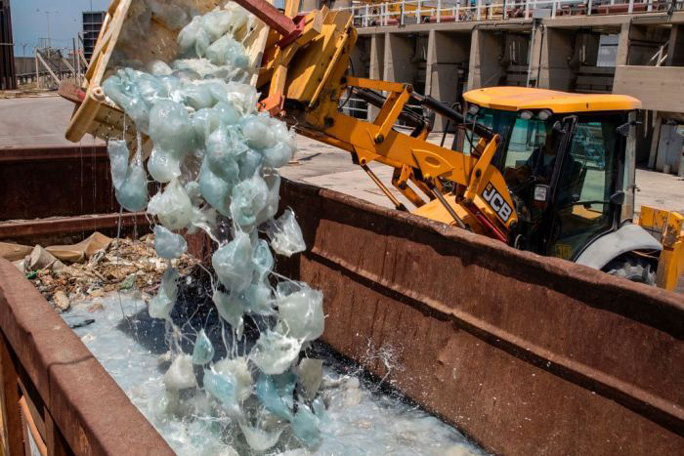
The massive Gravelines nuclear power plant just 30 miles from Britain has been forced to close down in order to avoid disaster after a swarm of jellyfish got sucked into the cooling system on Monday
Joe Smith News Reporter, 11 Aug 2026, https://www.mirror.co.uk/news/uk-news/nuclear-plant-millions-invading-jellyfish-37540444
Western Europe’s biggest nuclear power station has been shut down after it was invaded by millions of jellyfish.
EDF’s Gravelines plant near Dunkirk, just 30 miles from Britain, was forced to shut down in order to avoid disaster on Monday as the sea creatures swarmed into the plant.
EDF revealed how the jellyfish had been filter drums at the seawater pumping stations, used to cool the giant nuclear reactors at the heart of the plant.
The company was forced to take emergency measures, with reactors two, three and four taken offline, while output from reactor one was halved.
“This situation has no impact on the safety of the facilities, the safety of our personnel, or the environment,” a statement from EDF said.
Only reactor six was operating at full power on Tuesday, with reactor five previously taken offline for scheduled works.
The jellyfish invasion comes exactly a year after another swarm of the creatures took the French nuclear site offline for two days.
An invasive species of jellyfish, called the Asian Moon Jellyfish, have been making themselves at home in the English Channel and North Sea in 2020.
The species, usually native to the Pacific, is thought to have been brought here in the ballast tanks of supertankers and dumped into the seas around France and Britain.
Nuclear plants in China, Japan and India, which also rely of seawater for cooling, have previously been thrown into chaos by the slimy sea creatures. And last year power production at Gravelines came to a standstill after the jellies caused chaos.
The plant installed cameras monitoring the seawater intake and filters after last year’s fiasco and set up a warning system to give advanced notice of swarms heading their way.
The system saw fishing boats sent out of saturday with trawler nets in an attempt to thin the numbers of the invasive jellyfish. This helped to limit the latest invasion, the engineer said.
Meanwhile vacuum trucks are sucking out the jellyfish already trapped inside the plant. The engineer said that since no new jellies are arriving the plant will hopefully be back on line soon.
Reactors shut down in Romania were of the Candu design, already notorious for high tritium release when in operation.
Susan O’Donnell. 16 Aug 26
The reactor shutdown in Romania has been reported clearly identifiying the reactors as CANDU design. They are similar or identical to the Point Lepreau reactor operating in New Brunswick and the Gentilly2 reactor in Quebec that was shut down in 2012. Two years ago the Canadian government provided a $3 billion export financing loan to build two more CANDU reactors at the same nuclear site in Romania.
That work has been ongoing with most of the funding coming back to AtkinsRealis. The Canadian government has been pointing to the new build in Romania in its ongoing efforts to sell more CANDU reactors abroad. CANDU exports are central to Canada‘s new nuclear energy strategy. It will be very interesting to see how this latest development impacts rolling out the strategy.

David Geary, – Canada has had trouble marketing CANDUs in Europe (and in the U.S) because these reactors emit way more tritium during routine operations than other reactor designs … and the E.U. has a much stricter regulatory body than Canada has in that regard.
Whereas former Soviet republics, like Romania, have more lax regulatory standards, as well as more shady / sketchy / bribery-driven business practices. .
A quote from a CleanGreenSask factsheet: ” …the E.U. allows up to 100 Bq/L of tritium in drinking water, the U.S. allows 740 Bq/L, but the Canadian Nuclear Safety Commission (CNSC) allows up to 7,000 Bq/L ” This is but one example showing how the CNSC is clearly compromised by the Canadian CANDU reactor
MICROREACTORS – the Next Big Little Nuclear THING!

Noel Wauchope, 15 August 2026, https://theaimn.net/microreactors-the-next-big-little-nuclear-thing/
Forget about Small Modular Nuclear Reactors – they’re not cool anymore!
What the world needs now is MICROREACTORS – so saith the global nuclear lobby. And we know they must be right, because they’ve already explained how the world needs a NUCLEAR RENAISSANCE to solve climate change, energy shortage, world peace etc…
Now there are substantial differences between microreactors and small modular nuclear reactors (SMRs) , even though at first glance microreactors might seem to be just teeny weeny versions of SMRs. Whereas an SMR produces up to 300 MWe , a microreactor produces anything from 1 MWe up to 50MWe
There are fuel differences . SMRs can use LEU – Low Enriched Uranium or the more powerful HALEU – High-Assay Low-Enriched Uranium . Microreactors can, in theory, use LEU fuel, but that could not work out to be economic. The fuel must be the more powerful HALEU – High-Assay Low-Enriched Uranium. And in fact, Most microreactor plans use the more complex TRISO Fuel (Tri-Structural Isotropic), in which the tiny kernels of HALEU are coated with multiple layers of ceramic and carbon. That makes TRISO very safe, but very expensive.
Really, the most important difference is in – Who Pays For Microreactors?
Well, you do, if you’re a tax-payer. The only economically viable way to fund microreactors is to make them military installations, government funded. SMRs are supposedly economically viable, and were touted to become a private enterprise success. That’s until the NuSCale SMR financial fiasco
The beloved ever-about -to-happen nuclear renaissance needs a new theme, and that new funding source. The old theme was ENERGY– the new theme is DEFENCE.
For quite a while now, it has been obvious, and indeed a boast of the nuclear lobby, that new small reactors would support the defence sector, and nuclear weaponry, by providing the trained staff that are so badly needed, as the old nuclear boffins retire,
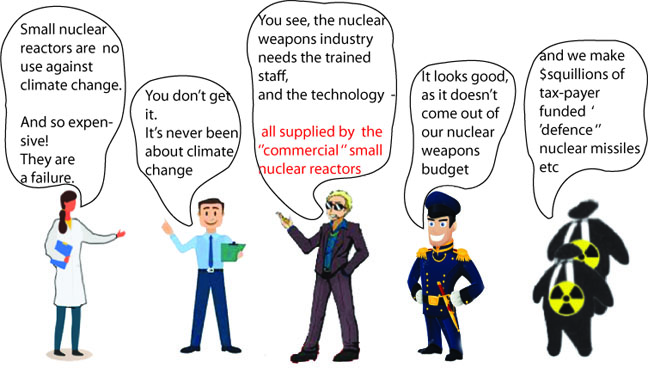
But times have changed, and also the nuke lobby is getting desperate. With all the international political drama going on, obviously the top priority now is war. (Did I hear someone say, what about diplomacy, negotiation? Look, that’s time-consuming, takes high mental ability, and there’s no money in it) Yes, what we and the nuke industry need now is war preparation.
So the nuclear industry is regalvanised, with a spate joyous media articles, mostly – worded like this one – Antares Raises $470M to Field Military-Focused Microreactors. Optimistic statements abound:
Power up: Antares and their nuclear startup frenemies moving so fast is good news for the Pentagon, which is where that 2028 number comes into play in a few places.
In May 2025, President Trump signed a series of executive orders to accelerate the Department of Energy’s “Manhattan Project 2.0.” -notably Executive Order 14299, “Deploying Advanced Nuclear Reactor Technologies for National Security,” Then came Executive Order 14300, “Ordering the Reform of the Nuclear Regulatory Commission,”- getting rid of, or watering down public safety, radiation and environmental standards. The full import of this has been documented by Kristen Thomason in her superb article – “If you’re already afraid, just wait until you hear about Manhattan Project 2.0″

A lot of hype about microreactor energy for data farms, with Silicon Valley tech billionaires all on board, – and the craze is for so many “start-ups “

I had every intention of going through all the hazards, impediments to these microreactors ever becoming a commercial reality. But guess what ? OKLO, probably the leader of the pack, has done it for me. After the usual hypy article, glorifying their new microreactor, OKLO makes this revealing statement at the end:
As a result of a number of known and unknown risks and uncertainties, the actual results or performance of Oklo may be materially different from those expressed or implied by these forward-looking statements. The following important risk factors could affect Oklo’s future results and cause those results or other outcomes to differ materially from those expressed or implied in the forward-looking statements: risks related to the development and deployment of Oklo’s powerhouses, fuel fabrication and fuel recycling facilities, and radioisotope production activities; the risk that Oklo is pursuing an emerging market with no commercial project operating and regulatory uncertainties; risks related to acquisitions, divestitures, or joint ventures we may engage in; the need for financing to construct plants, which remain subject to market, financial, political, and legal conditions; risks related to an inability to raise additional capital to support our business and sustain our growth on favorable terms; the effects of competition; risks related to accessing high-assay low-enriched uranium, plutonium, and other fuels (including recycled fuels) at acceptable costs and under acceptable timelines; risks related to our supply chain; risks related to power purchase agreements; risks related to human capital; risks related to our intellectual property; risks related to cybersecurity and data privacy; changes in applicable laws or regulations, including tariffs; the outcome of any government and regulatory proceedings and investigations and inquiries; and the other factors set forth in our documents we have filed with the U.S. Securities and Exchange Commission (the “SEC”).
The foregoing list of factors is not exhaustive.
I was going to try and list all those factors – to throw some cold water on the microreactor parade – and that leading microreactor developer has done it for me!
As I tried to research all those factors to consider about micoreactors, I made the discovery that amongst the pro nuclear experts themselves, there are the gold nuggets of the truth. Not only has OKLO raised those contentious questions, but in a lengthy video – Nick Touran, a nuclear engineer and manager at TerraPower, unearths the sobering realities of micro nuclear reactors:
It’s long – but he spells it all out, if you can take the time:
Chapters:
00:00 Visions for microreactors 03:49 Defining microreactors 11:56 The problem of radiation shielding 18:48 Original microreactor projects 24:29 Niche applications 30:32 The problem of neutron economy 40:08 The problem of fuel 53:03 The problem of operations and maintenance 1:00:17 The problem of commercialization 1:05:42 The problem of spent fuel 1:09:27 The problem of scaling 1:12:36 The problem of licensing
Nick Touran and OKLO might be hopeful for microreactor success some time in the future. But they – pro nuclear people, are well aware of the obstacles and especially of the financial costs.
So, if they can take the microreactor hype with a grain of salt, the rest of us, who are not part of the development process, should be taking that hype with a bucketful .
Walt Zlotow – Israel mimicking Nazis at end of WWII…destroying evidence of genocide

Walt Zlotow West Suburban Peace Coalition Glen Ellyn IL, 13 August 26
As the Nazis were collapsing in the spring of 1945, they furiously tried to cover up their massive genocide of Jews and other undesirables they engaged in during WWII.
Eighty-one years on we’re learning that Israel appears to be practising a similar cover up of its genocide of Palestinians in Gaza that, astonishingly, is still going on ten months after the Trump brokered ceasefire that he trumpeted to end it.
Once the massive bombing stopped, the World Court issued an order for Israel to preserve evidence of genocidal acts committed in Gaza. But in a new report by the Geneva-based Euro-Mediterranean Human Rights Monitor said that Israeli forces and contractors “are conducting a wide and organized operation to process and clear the rubble from neighborhoods and facilities they have destroyed in the Gaza Strip and relocate it from areas under their military control to outside the strip. This is occurring without any official record of the quantities removed or independent oversight, and before international and local investigative committees have had the chance to survey, examine, and document the sites. This risks destroying crucial evidence of genocide and the remains of victims still unaccounted for under the rubble. The systematic removal of rubble at this pace conceals the evidence of appalling crimes Israel committed in Gaza, especially those related to genocide, including summary executions and killing unarmed civilians.”
What did the Israeli genocide in Gaza look like?
In April the World Bank, UN and EU jointly published a report that estimated around 68 million tons of rubble from over 200,000 buildings are spread across Gaza’s 141 square miles after relentless bombing that left more than 250,000 Palestinians dead, injured or missing and up to 2 million forcibly displaced, starved or sickened. That’s the entire Palestinian population.
The Euro-Med report says at least 10 million tons of rubble “have been removed, crushed, or moved from their original sites within the areas under Israel’s unlawful military control, which encompass about 66% of the Gaza Strip by approximately 400 heavy pieces of excavation, demolition, crushing, and transport machinery, operated by Israeli civilian companies under military protection, that are active across eastern and southern Gaza.”
While it’s impossible to understand why any nation, be it Hitler’s Germany or Netanyahu’s Israel, would commit genocide, it’s certainly understandable why both would feverishly seek to cover it up.
At UN Security Council, Officials Say Israeli Settler Violence Has Brought West Bank to ‘Breaking Point’
“Settler violence has reached unprecedented levels,” said a coordinator for the Middle East peace process. “Many incidents occurred in the presence of Israeli forces.”
August 12, 2026, Julia Conley Common Dreams, https://www.commondreams.org/news/israeli-settler-violence-west-bank
“Settler violence has reached unprecedented levels,” said a coordinator for the Middle East peace process. “Many incidents occurred in the presence of Israeli forces.”
That violence exemplified what the Israeli human rights group B’Tselem called an escalating “ethnic cleansing” operation that Israel’s military allows.
As B’Tselem said Wednesday, settlers had established an illegal outpost in the yards of two Palestinian families’ homes, “forcing the families out and taking over their homes,” and the US-backed Israel Defense Forces (IDF) had done nothing to protect the Palestinian residents.
“Israeli ethnic cleansing in the West Bank is accelerating and expanding in full view of everyone,” Yuli Novak, president of B’Tselem, told Anadolu Agency, adding that the settlers’ seizure of the Palestinian homes was “not an isolated incident.”
Home demolitions by Israeli forces; attacks on healthcare infrastructure, homes, and schools; mass displacement of Palestinians; and the expansion of illegal settlements across the West Bank have brought the occupied Palestinian territory to “the breaking point,” said a top humanitarian official at the United Nations Security Council Tuesday, calling for a “coordinated international effort” to end the violent Israeli occupation.
At a meeting on the situation in the territory, Ramiz Alakbarov, the UN special coordinator for the Middle East peace process, addressed the council as families in the town of Qusra, northern Nablus, were facing days of attacks by Israeli settlers.
That violence exemplified what the Israeli human rights group B’Tselem called an escalating “ethnic cleansing” operation that Israel’s military allows.
As B’Tselem said Wednesday, settlers had established an illegal outpost in the yards of two Palestinian families’ homes, “forcing the families out and taking over their homes,” and the US-backed Israel Defense Forces (IDF) had done nothing to protect the Palestinian residents.
“Israeli ethnic cleansing in the West Bank is accelerating and expanding in full view of everyone,” Yuli Novak, president of B’Tselem, told Anadolu Agency, adding that the settlers’ seizure of the Palestinian homes was “not an isolated incident.”
Breaking the Silence, an organization run by former IDF members who oppose the occupation, explained how settlers, with the backing of the military, essentially blockade individual homes as a method of driving Palestinians out.
“Violent settlers may do the ‘dirty work’ of daily terror against Palestinian men, women, and children, but neither this terror nor ethnic cleansing would be possible without the army’s support,” said the group. “Village after village, house after house. It keeps happening because it is policy.”
At the Security Council meeting, Alakbarov said Israeli forces have killed 76 Palestinians, including 18 children, in the West Bank in 2026 so far, while children make up nearly half of the 3,800 Palestinians who have been displaced by settler attacks, demolitions, and evictions.
“One hundred and twenty-seven Palestinian communities have experienced full or partial displacement since January 2023, including 47 that have been entirely displaced, affecting more than 6,390 Palestinians,” said Alakbarov. “Settler violence has reached unprecedented levels. So far this year the UN has documented more than 1,430 incidents involving Israeli settlers that resulted in casualties, property damage, or both, affecting approximately 260 Palestinian communities. Many incidents occurred in the presence of Israeli forces.”
As Alakbarov spoke Tuesday, the World Health Organization warned that the West Bank has also seen an uptick in violence against healthcare infrastructure, with Israeli carrying out 83 attacks on healthcare transport such as ambulances and 11 attacks on medical centers and facilities, injuring at least 33 people and killing four. July saw a surge in healthcare attacks—a hallmark of Israel’s assault on Gaza that began in 2023—with 37 strikes on infrastructure.
Settler attacks were once mainly concentrated in Area C, which comprises about 60% of the West Bank and is under Israeli control.
But Alakbarov said settlers are increasingly waging violence against Palestinians in Areas A and B, which are under the administration of the Palestinian Authority.
“The future of the region is at stake,” the UN permanent observer for the state of Palestine, Riyad Mansour, told the Security Council. “International will cannot bow before the colonial whims of the Israeli government.”
Israeli officials in recent months have advanced and approved about 12,360 housing units in settlements across the West Bank this year, with the Security Cabinet signing off on 13 new settlements in the central part of the territory last month. The move further isolates East Jerusalem, which Palestinians consider the capital of a future Palestinian state, from the rest of the West Bank.
Last year Prime Minister Benjamin Netanyahu also signed an agreement to develop 3,400 new units in the E1 settlement, which would also cut off access to East Jerusalem. The prime minister said as he approved the deal, “There will be no Palestinian state.”
The approvals of more settlement housing this year and the escalation in IDF-sanctioned violence against Palestinian communities across the West Bank “are interconnected steps, not isolated developments,” Alakbarov said Tuesday.
“The situation in the West Bank must be treated as an emergency requiring urgent action,” he said. “The concern is not only the continued expansion of settlements, but the speed and systematic manner in which new facts are being created on the ground. New outposts are established, often with state support, and can be retroactively authorized or incorporated into the wider settlement system. From these outposts, settler violence and intimidation have driven the displacement of Palestinian communities.”
He added that the spread of settler outposts in agricultural and grazing areas is “deeply troubling.”
“Requiring only a small number of settlers, they enable control over vast areas of land,” said Alakbarov. “Israeli monitoring organizations report that agricultural and pastoral outposts now exercise effective control over close to 20% of the West Bank.”
Israeli forces also arrested 23 Palestinians on Tuesday, including two children, days after a large-scale operation at Qalandia refugee camp resulted in the detentions of more than 60 people.
Hannah Sulieman, deputy executive director of the UN Children’s Fund (UNICEF), emphasized that 355 Palestinian children are currently being detained in Israeli military prisons—“the highest number in eight years.”
The arrests and the violence mean that for children and their families in the West Bank, “the fundamental spaces of childhood—the home, the classroom, the street, the community—are becoming increasingly unsafe,” said Sulieman.
“Children in the West Bank have the same rights as children everywhere,” she said. “To live, to learn, to be protected, and to imagine a future beyond violence and fear.”
Syria agrees to surrender Assad-era nuclear material to IAEA
Matthew Hoare Absi Smeisem, Damascus, 11 August, 2026
Syria has agreed to surrender its remaining stockpile of nuclear material to the UN’s atomic watchdog, but the breakthrough is unlikely to bring Damascus and Israel any closer to a security agreement, a senior Syria analyst told The New Arab, as negotiations remain stalled over Israeli occupation and withdrawal demands.
“The legacy reactor residue unlocks none of that,” Nanar Hawach, senior Syria analyst at the International Crisis Group, told TNA, saying the nuclear file was largely separate from the disputes that have frustrated US attempts to broker an agreement between the two countries.
The assessment comes after US and Israeli officials told Axios that Syria had agreed to hand the material over to the International Atomic Energy Agency (IAEA) under a US-brokered deal reached several weeks ago, following weeks of Israeli threats to bomb Syrian facilities.
The Trump administration and the IAEA had raced to secure the material amid concerns that the issue could provoke a new crisis involving Israel, Syria and potentially Turkey.
The stockpile is a remnant of a secret nuclear programme pursued under the Assad regime more than two decades ago. The material was reportedly connected to the Al-Kibar nuclear reactor in Deir Ezzor governorate, which Israel destroyed in 2007, although several storage and research and development sites remained intact.
A US official said the material included powdered uranium ore known as yellowcake, which can be enriched as part of the process of producing nuclear fuel or weapons and could also potentially be used in a “dirty bomb”.
Six months after Bashar al-Assad’s overthrow, Syria’s new government agreed to give the IAEA unrestricted access to the facility and several other sites connected to the former government’s nuclear programme.
But Israeli officials later said they had detected possible attempts by Syria’s new authorities to access material at a facility known as Site 99 and suspected they were receiving assistance from Turkey………………………………………………………………………..https://www.newarab.com/news/syria-agrees-surrender-assad-era-nuclear-material-iaea
Heat, water shortages, jellyfish: nuclear energy is becoming uncontrollable

while a reactor needs water to dissipate its heat, it cannot turn rivers into scalding baths.
What technological advancements are needed to secure water supplies when a river runs dry ?
What will the state of the Danube be in 2050, 2070, or even 2100 ?
Heatwaves, droughts, rivers that are too hot or too low: since June, European nuclear power plants have been experiencing numerous power reductions and shutdowns. One question is becoming increasingly difficult to avoid: is nuclear power still manageable in a warming world ?
By
Laure Noualhat, August 14, 2026 , https://reporterre.net/Le-climat-met-le-nucleaire-europeen-a-sec-Le-nucleaire-rattrape-par-la-question-du
On August 12, shortly before 10 a.m., a fifth of France’s nuclear power plants were offline. Exactly 20.4 % of their production capacity was unavailable due to ”
environmental constraints “ or ” external environmental causes , “ a record since 2015, calculated by AFP using data from EDF .
Thirteen reactors were affected: eight completely shut down, and five operating at reduced capacity. On one hand, rivers were either too hot or too low after five heat waves ; on the other, at Gravelines (Nord), several tons of jellyfish had clogged the water intakes of Western Europe’s largest nuclear power plant. Nuclear power can be controlled, certainly, but it still needs to be cooled.
In Golfech, on the banks of a sweltering Garonne River, the situation has taken on the air of a summer ritual. On August 8, at 9 p.m.,
EDF once again shut down reactor number 2. The Garonne threatened to reach 28°C the following day, the threshold beyond which the power plant must reduce its production or shut down to comply with environmental regulations and avoid harming aquatic life. Since reactor number 1 was already undergoing maintenance, the plant was no longer producing any electricity. The same scenario, to varying degrees, played out at Bugey (Ain), Saint-Alban (Isère), and Tricastin (Drôme), where the Rhône River’s waters, having become too warm, led EDF to adjust its production.
Because while a reactor needs water to dissipate its heat, it cannot turn rivers into scalding baths. Discharges from power plants are regulated by the Nuclear Safety and Radiation Protection Authority (
ASNR ), which sets, for each site, limits on the temperature increase of the watercourse between upstream and downstream, as well as a maximum temperature that must not be exceeded.
What uses will be prioritized as droughts occur ?
This summer, the Bugey nuclear power plant
was the only French plant to request a temporary modification of its thermal regulations , the ASNR ( French Nuclear Safety Authority) told Reporterre . The Rhône River was already very hot upstream, while RTE (the Frenchelectricity transmission network operator) demanded that a minimum power output be maintained to guarantee grid security. The Authority therefore agreed to temporarily raise certain limits, but only between July
10 and 20. This compromise aptly summarizes the dilemma ahead: protecting a river already suffering from the heatwave while preventing the electrical grid from overheating as well.
In Chooz, in the Ardennes region, the problem isn’t the temperature but the amount of water. The Meuse River’s flow rate dropped drastically at the beginning of August. The two reactors were shut down, not because there wasn’t enough water to safely cool the facilities, but to comply with the Franco-Belgian agreement guaranteeing a minimum flow for the various river users. Thus, nuclear power is confronted with a question already familiar to farmers, industrialists, and river conservationists: who has the right to water when it becomes scarce ? Which uses will be prioritized as droughts continue to occur ?
Controllable… but not climate-insensitive
Taken separately, each of these episodes seems almost commonplace.
EDF has long adjusted its power plants’ output during heat waves. In 2003, the utility even sprayed the Fessenheim reactor building with water jets!
But their repetition, and especially their simultaneity, changes the landscape. Up to 7.3 gigawatts of French nuclear power were unavailable on August 12 or constrained by the heat and low flow rates. ” This is a record peak in environmental unavailability ,
“ according to AFP . At the same time, there was a lack of wind in Germany, and air conditioners were running more frequently, which drove up electricity prices.
However, it would be wrong to claim that the nuclear fleet is faltering; it’s simply overheating. It’s actually producing significantly more than during the major crisis of 2022 when 32 reactors were unavailable due to stress corrosion cracking. The real issue lies elsewhere. A nuclear power plant is an enormous thermal machine that must dissipate some of its heat. It can produce electricity without wind or sun, but not without cold water. And this resource, too, is caught up in the whirlwind of climate change.
The Danube is offering a much more stark demonstration this summer. In Hungary, the Paks power plant, which supplies nearly half of the country’s electricity, saw
its production plummet in early August due to the river’s exceptionally low water level.
“A temporary rise in water levels then allowed for the recovery of some production, but the government has announced its intention to re-examine the cooling requirements of the Paks
II project ,” explains András Kéri of the climate policy institute Energiaklub. ”
A power plant built today will only be operating at full capacity in the second half of this century…
“ What will the state of the Danube be in 2050, 2070, or even 2100 ?
It’s difficult to say.
Further downstream, Romania faces an even more critical situation. The country will shut down its only nuclear power plant on August 13th, for the first time since the 2003 drought, as the Danube’s flow has dropped too low. As early as July 28th, the operator of the Cernavodă site shut down Unit 1 due to a Danube level described as ” very low and unprecedented” .
The intake canal had to be dredged and the riprap blasted to redirect the flow. When the river needs to be reshaped locally to maintain electricity production, climate adaptation is no longer just a chapter in an annual report. Switzerland also experienced this very real future firsthand by reducing the two reactors at Beznau to 50% of their capacity when the Aare River reached the critical temperature of 25°C.
In France and Switzerland, most of these power reductions do not signal a loss of safety and are precisely intended to comply with environmental regulations. In Hungary and Romania, the extreme low water level of the Danube more directly impacts operating conditions. But for the electrical grid, the result is comparable: megawatts considered readily available on demand become slightly less so at the very moment when heat increases certain needs.
And as the Anthropocene knows how to keep things interesting, the Gravelines nuclear power plant has added jellyfish to the mix. On August 10, their massive arrival in the water intakes triggered the automatic shutdown of 3 of the 6 reactors. EDF insisted there was no safety issue . And besides, is this becoming a regular occurrence ? A similar incident had already happened in August 2025 .
European nuclear power is therefore not collapsing under the heatwave. But this summer is challenging a simplistic way of speaking: ” controllable “ nuclear power does not mean ” insensitive to climate . “ It depends on it, like everything else.
What about EPR2s
The issue becomes considerably more serious when we look at the reactors currently in the design phase. EDF asserts that it has sized the future EPR2 reactors ” with regard to heatwave risks “ by taking into account the IPCC climate scenarios for 2070 and 2100, ASNR told Reporterre . EDF has allocated €8.7 billion by 2040 to adapt its nuclear, hydroelectric, and island activities to climate change , notably through the Adapt project, which aims to assess, plant by plant, their vulnerability to rising temperatures, droughts, and changes in water resources.
In 2023, the Court of Auditors still estimated investments directly attributable to climate adaptation of the nuclear fleet at around €600 million for the following fifteen years. Going from €600 million to €8.7 billion in three years is a gigantic leap !
The ASNR (French National Agency for Radioactive Waste Management) emphasizes the need to maintain ” margins , “ as tomorrow’s climate may diverge fromprojections. Every ten years,” safety standards must therefore be reassessed,
“ and facilities may need to be adapted to higher temperatures. But how, specifically ?
What technological advancements are needed to secure water supplies when a river runs dry ?
No one is saying.
To date, nuclear power plants evaporate 833 million cubic meters
of fresh water per year. While this water is reintroduced into the water cycle, it remains unavailable for other needs (domestic consumption, agriculture, industry, etc.). With the future EPR2 reactors —particularly those located along rivers—this will increase the amount of water drawn from rivers to
1,232 million cubic meters per year and from the seas to 575 million cubic meters
per year, according to figures from Global Chance.
France’s Power Prices Jump 22% as Heatwave Trims Nuclear Output


By Michael Kern – Aug 11, 2026,
https://oilprice.com/Latest-Energy-News/World-News/Frances-Power-Prices-Jump-22-as-Heatwave-Trims-Nuclear-Output.html
The new heatwave in France is curbing nuclear power generation in Europe’s biggest nuclear electricity supplier and leading to spiking day-ahead power prices.
France’s day-ahead power prices soared by as much as 21.8% to $164.39 (142.5 euros) per megawatt hour (MWh) on Tuesday morning local time, per LSEG data cited by Reuters, as nuclear power generation is expected to be curbed at the mid-day peak on Wednesday.
Data by nuclear power plants operator EDF showed that France would see its nuclear generation cut by 7.3 gigawatts (GW) on Wednesday, equal to 12% of the total capacity, amid this week’s heatwave which is at least the fifth extremely hot wave to grip the country since June.
Power prices in France, where nuclear energy accounts for about 70% of the electricity mix, are now being pressured upwards by reduced nuclear output as water levels in rivers used for cooling reactors are low and/or very warm.
Additional upward pressure comes from the increase in power consumption during these heatwaves.
France has already had to resort to curbing nuclear power generation amid the prolonged and intense heatwaves this summer.
In the middle of last month, France’s nuclear power generation was slashed by 6.4 GW amid a prolonged and intense heatwave that hiked river temperatures and limited the ability of the power plants to use the water to cool reactors.
The heatwaves have also affected nuclear power output in central and eastern Europe, where Hungary and Romania this month were forced to shut down reactors at their respective only nuclear power plants, due to the lowest water level of the Danube river in 90 years.
Hungary saw one of the turbines at the Paks nuclear resume electricity production on Monday as the Danube water level inched up thanks to rainfall in Austria.
Romania, for its part, last week blasted a rock formation and sank barges filled with rocks to deviate the Danube’s flow and secure enough water for cooling the reactors of its only nuclear power plant at Cernavoda.
Once secret report on atomic weapons production released as greens fight plans in SC.
The State, By Sammy Fretwell August 14 , 2026
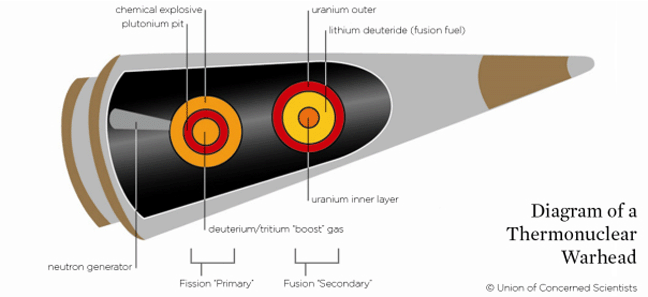
A nuclear safety watchdog group says it has obtained formerly hidden information that bolsters arguments against building atomic weapons plants in New Mexico and South Carolina — but a key federal agency doesn’t see it that way. The federal government has released sections of a report, sought by environmental groups opposed to spending billions of dollars on new factories to produce plutonium pits, key ingredients in atomic bombs.
Environmentalists have said the report could contain information showing that pits are not aging as fast as the government contends, so there is no need for factories to replenish the stockpile. Important sections of the report had not been released until last week, nuclear safety watchdogs say. The unredacted report summary, developed by a team of consulting scientists and released under an open records request, says pits are beginning to age but that they remain adequate for use in nuclear weapons, as environmentalists have argued. Despite that, the report — known as a JASON study — recommends continuing with plans to produce pits for use in weapons.
Jay Coghlan, who heads Nuclear Watch New Mexico, said the report makes his case against building the pit production facilities, which are expected to cost the government more than $30 billion. If the current stock of pits is in good shape and aging slowly, there is no need to move forward with production of factories in South Carolina and New Mexico, he and others contend. “It looks like this plutonium aging excuse doesn’t really hold water,’’ he said in a news release.
His organization, as well as South Carolina’s Savannah River Site Watch and other environmental groups say they are worried that new pit production could crank up a nuclear arms race, while also leading to dangerous testing for new weapons that would rely on the new pits. Highly toxic nuclear material could leak from an underground test sites, Coghlan said. The pits contain plutonium, one of the most deadly atomic materials. Environmentalists also say it isn’t worth spending more than $30 billion for the project, as is projected.
“There are both environmental concerns and there are very serious proliferation concerns,’’ Coghlan said. “The existing stockpile is highly reliable.’’ The National Nuclear Security Administration, a division of the U.S. Department of Energy, interprets the report differently…………………..
Read more at: https://www.thestate.com/news/local/environment/article316871213.html#storylink=cpy
Why the FBI is working with China and Russia, despite everything
An unexpected turn is reshaping global security beyond the old rivalriesPublished 11 Aug, 2026 An unexpected turn is reshaping global security beyond the old rivalries
11 Aug, 2026 , RT.com Ladislav Zemánek
In an era defined by fierce geopolitical competition, FBI Director Kash Patel has charted a course that prioritizes pragmatism and results.
By building selective yet substantive law-enforcement partnerships with China and Russia, the bureau is demonstrating that great powers can set aside deeper differences to confront transnational crime that endangers citizens everywhere. This development deserves recognition as a mature, interest-based approach, showing that effective governance in a multipolar world requires the capacity to cooperate wherever it delivers concrete gains.
Breaking the ice with Beijing
Patel’s engagement with his Chinese counterparts marks a clear departure from years of a near-total freeze in high-level law-enforcement contacts. In November 2025, he became the first FBI director to visit China since 2016, meeting Vice Minister of Public Security Xu Datong. He returned in July 2026 for discussions with State Councillor and Minister of Public Security Wang Xiaohong.
Chinese officials have called for deepening constructive dialogue grounded in mutual respect. According to Patel, the results were made possible by direct engagement under the Trump administration’s leadership. The relationship did not emerge overnight; it followed President Donald Trump’s May 2025 visit to China and subsequent high-level understandings on fentanyl precursors. What matters is that both sides chose to institutionalize the opening rather than allow it to remain a one-off diplomatic gesture.
Institutionalizing daily cooperation
Four dedicated working groups now operate on cyber fraud, violent crimes against children, counternarcotics, and a fugitive task force. Chinese Ministry of Public Security officers travel to FBI facilities in the US on a monthly rotating basis; FBI personnel make reciprocal trips to China. Officials on both sides report near-daily communication – an intensity of contact that had not existed for years.
This steady exchange has already produced operational results. One notable joint action, Operation Sand Dollar, brought together the FBI, China’s Ministry of Public Security, and Dubai police against a major cyber-scam center. The effort yielded roughly 300 arrests, the seizure of approximately $300 million, and the liberation of thousands of trafficked workers. Such outcomes illustrate the practical value of treating certain criminal networks as shared problems rather than exclusive domains of competition.
Patel has been explicit about the philosophy guiding this work. He has noted that the decision to pursue cooperation with China despite widespread advice against it proves what is possible with almost any counterpart: “The fact that we did it with China when everyone said, ‘Don’t do it,’ and, ‘You can’t do it,’ shows what we can do with almost anyone.” The partnerships are deliberately limited to specific categories of transnational crime; they do not pretend to resolve broader strategic disagreements. That clarity of scope makes them sustainable under the current circumstances.
Opening a channel to Moscow
The same pragmatic approach is being applied to Russia. Patel is preparing a visit to Moscow and St. Peterburg, tentatively scheduled for mid-October, with the Russian Federal Security Service (FSB) expected to serve as host. The last sitting FBI director known to have traveled to Russia was Robert Mueller in 2013. Patel’s planned trip builds on quieter collaboration already underway for more than a year against violent criminal networks.
This outreach occurs against the backdrop of Trump’s broader effort to reduce tensions with Moscow. Special envoy Steve Witkoff and Jared Kushner have made repeated visits, including meetings with Russian President Vladimir Putin, and further contacts are anticipated. Putin’s special envoy on foreign investment and economic cooperation, Kirill Dmitriev, has publicly welcomed the emerging China-Russia-US intelligence and law-enforcement cooperation, signaling that Moscow sees value in the channel.
Complementary signals across government
Patel’s initiative does not stand alone. Pentagon policy chief Elbridge Colby, long regarded as a China hardliner, has expressed clear interest in visiting China and revitalizing professional military-to-military ties. Colby’s willingness to explore direct engagement signals an important evolution: Even those most focused on strategic competition now recognize that sustained channels of communication and cooperation on discrete issues can reduce miscalculation risks and open space for practical problem-solving………………………………………………… https://www.rt.com/news/644113-fbi-china-russia-cooperation/
1 This Month





PLEASE OPPOSE HR 8255 AND S.3639 – bills would accelerate satellite deployment, with no environmental review or safeguards – https://ncstd5li.quorum.us/campaign/169331/
To see nuclear-related stories in greater depth and intensity – go to https://nuclearinformation.wordpress.com
-
Archives
- October 2026 (58)
- September 2026 (339)
- August 2026 (330)
- July 2026 (355)
- June 2026 (287)
- May 2026 (306)
- April 2026 (356)
- March 2026 (251)
- February 2026 (267)
- January 2026 (308)
- December 2025 (358)
- November 2025 (359)
-
Categories
- 1
- 1 NUCLEAR ISSUES
- business and costs
- climate change
- culture and arts
- ENERGY
- environment
- health
- history
- indigenous issues
- Legal
- marketing of nuclear
- media
- opposition to nuclear
- PERSONAL STORIES
- politics
- politics international
- Religion and ethics
- safety
- secrets,lies and civil liberties
- spinbuster
- technology
- Uranium
- wastes
- weapons and war
- Women
- 2 WORLD
- ACTION
- AFRICA
- Atrocities
- AUSTRALIA
- Christina's notes
- Christina's themes
- culture and arts
- Events
- Fuk 2022
- Fuk 2023
- Fukushima 2017
- Fukushima 2018
- fukushima 2019
- Fukushima 2020
- Fukushima 2021
- general
- global warming
- Humour (God we need it)
- Nuclear
- RARE EARTHS
- Reference
- resources – print
- Resources -audiovicual
- Weekly Newsletter
- World
- World Nuclear
- YouTube
-
RSS
Entries RSS
Comments RSS

