Staging for a Strike? US Quietly Moves Bombers as Israel Prepares to Hit Iran

In April, Donald Trump remarked that Israel would “lead” any such operation. That comment was interpreted by many as a nod of support, if not a green light, from Washington. Israeli Prime Minister Benjamin Netanyahu, for his part, has repeatedly warned that his government will not allow Iran to become a nuclear weapons state.
a growing consensus across Washington’s think tank circuit: that Tehran is vulnerable, and now is the moment to strike.
By Robert Inlakesh / MintPress News, 24 May 25, https://www.mintpressnews.com/us-deploys-bombers-israel-iran-strike/289846/
As threats of an Israeli strike on Iran grow louder, the United States is making quiet but unmistakable moves of its own. Over the past month, Washington has quietly repositioned strategic bombers and fighter squadrons to Diego Garcia, a remote U.S. military outpost in the Indian Ocean, squarely within striking distance of Tehran.
The official rationale is force protection. But the scale and nature of the deployments have sparked speculation that Washington is laying the groundwork for potential military involvement in an Israeli-led operation, or, at the very least, sending a message to Tehran that it won’t stand in the way.
Roughly a month ago, the U.S. Air Force deployed six B-2 Spirit bombers to Diego Garcia, a third of its active fleet of nuclear-capable stealth aircraft. These bombers, capable of flying directly from the U.S. to targets across the globe, don’t require forward deployment to be effective. Which is why their presence on a remote island in the Indian Ocean is raising eyebrows.
The B-2s have reportedly been used in prior strikes against Ansar Allah targets in Yemen, though with limited strategic effect. Following the declared conclusion of U.S. operations in Yemen, at least some of the B-2s were replaced by four B-52 strategic bombers, another long-range platform associated with show-of-force missions.
But then, additional firepower arrived. An entire squadron of F-15E Strike Eagle fighter jets was flown to the base. While these jets have strike capabilities, open-source intelligence analysts suggest they were likely deployed for base defense. That assessment, if correct, underscores that the Pentagon sees Diego Garcia not just as a staging ground, but as a potential target in a broader escalation.
Meanwhile, intelligence signals point to real movement on the Israeli side. A CNN report this Tuesday cited intercepted communications and activity on the ground indicating that Israel is preparing to strike Iranian nuclear facilities. U.S. officials reportedly believe the plans are active and serious.
In April, Donald Trump remarked that Israel would “lead” any such operation. That comment was interpreted by many as a nod of support, if not a green light, from Washington. Israeli Prime Minister Benjamin Netanyahu, for his part, has repeatedly warned that his government will not allow Iran to become a nuclear weapons state.
Yet even as diplomatic channels remained open, the introduction of new U.S. “red lines” appears to have derailed progress. U.S. Middle East envoy Steve Witkoff recently declared that Iran must halt all uranium enrichment, a demand not included in the original 2015 nuclear agreement, the Joint Comprehensive Plan of Action (JCPOA).
Iranian officials rejected the move outright. Foreign Minister Abbas Araghchi reiterated that enrichment is a sovereign right and a non-negotiable issue. Ayatollah Seyyed Ali Khamenei dismissed the new U.S. conditions as “nonsense.”
And on May 22, Araghchi issued a sharper warning: Iran, he said, would take “special measures to defend its nuclear facilities” if Israeli threats continued. The statement was deliberately vague, but left little doubt that Tehran is preparing for contingencies.
In Washington, meanwhile, influential think tanks are ratcheting up pressure for a hardline approach. The Washington Institute for Near East Policy (WINEP) has called for the complete dismantling of Iran’s enrichment infrastructure. The Foundation for Defense of Democracies (FDD) has urged more sanctions. The Atlantic Council argues the U.S. must avoid “reviving Obama’s Iran deal.”
Simultaneously, Dana Stroul, a former Biden official now at WINEP, has argued that Iran’s current weakness presents an opportunity for military action. Her view echoes a growing consensus across Washington’s think tank circuit: that Tehran is vulnerable, and now is the moment to strike.
These are the same voices that helped shape past U.S. interventions in the region. Their resurgence now, alongside tactical military deployments and rhetorical escalations, suggests a familiar pattern.
What’s missing from the conversation is any real public debate about the consequences. Not just for Iran, but for U.S. interests, regional stability, and the American public. A confrontation with Iran would carry significant consequences, yet few in Washington have publicly questioned whether such a conflict serves America’s national interest, save for outliers like Rep. Thomas Massie, who has drawn fire from powerful lobbies simply for asking whether this is our fight to begin with.
The buildup at Diego Garcia may be interpreted as precaution. But it’s also a reminder of how quickly precaution becomes policy, and policy becomes war, especially when shaped by proxies, pressure groups, and allies with very different interests.
Wars don’t always begin with votes. In fact, they often begin with quiet deployments far from view, and even farther from the American people they will ultimately affect.
Experts Warn Trump Attack on Nuclear Regulator Raises Disaster Risk

“Simply put,” said one critic, “the U.S. nuclear industry will fail if safety is not made a priority.”
Brett Wilkins, 24 May 25, https://www.commondreams.org/news/nuclear-regulatory-commission-trump
U.S. President Donald Trump on Friday signed a series of executive orders that will overhaul the independent federal agency that regulates the nation’s nuclear power plants in order to speed the construction of new fissile reactors—a move that experts warned will increase safety risks.
According to a White House statement, Trump’s directives “will usher in a nuclear energy renaissance,” in part by allowing Department of Energy laboratories to conduct nuclear reactor design testing, green-lighting reactor construction on federal lands, and lifting regulatory barriers “by requiring the Nuclear Regulatory Commission (NRC) to issue timely licensing decisions.”
The Trump administration is seeking to shorten the yearslong NRC process of approving new licenses for nuclear power plants and reactors to withinf 18 months.
“If you aren’t independent of political and industry influence, then you are at risk of an accident.”
White House Office of Science and Technology Director Michael Kratsios said Friday that “over the last 30 years, we stopped building nuclear reactors in America—that ends now.”
“We are restoring a strong American nuclear industrial base, rebuilding a secure and sovereign domestic nuclear fuel supply chain, and leading the world towards a future fueled by American nuclear energy,” he added.
However, the Union of Concerned Scientists (UCS) warned that the executive orders will result in “all but nullifying” the NRC’s regulatory process, “undermining the independent federal agency’s ability to develop and enforce safety and security requirements for commercial nuclear facilities.”
“This push by the Trump administration to usurp much of the agency’s autonomy as they seek to fast-ttrack the construction of nuclear plants will weaken critical, independent oversight of the U.S. nuclear industry and poses significant safety and security risks to the public,” UCS added.
Edwin Lyman, director of nuclear power safety at the UCS, said, “Simply put, the U.S. nuclear industry will fail if safety is not made a priority.”
“By fatally compromising the independence and integrity of the NRC, and by encouraging pathways for nuclear deployment that bypass the regulator entirely, the Trump administration is virtually guaranteeing that this country will see a serious accident or other radiological release that will affect the health, safety, and livelihoods of millions,” Lyman added. “Such a disaster will destroy public trust in nuclear power and cause other nations to reject U.S. nuclear technology for decades to come.”
Friday’s executive orders follow reporting earlier this month by NPR that revealed the Trump administration has tightened control over the NRC, in part by compelling the agency to send proposed reactor safety rules to the White House for review and possible editing.
Allison Macfarlane, who was nominated to head the NRC during the Obama administration, called the move “the end of independence of the agency.”
“If you aren’t independent of political and industry influence, then you are at risk of an accident,” Macfarlane warned.
On the first day of his second term, Trump also signed executive orders declaring a dubious “national energy emergency” and directing federal agencies to find ways to reduce regulatory roadblocks to “unleashing American energy,” including by boosting fossil fuels and nuclear power.
The rapid advancement and adoption of artificial intelligence systems is creating a tremendous need for energy that proponents say can be met by nuclear power. The Three Mile Island nuclear plant—the site of the worst nuclear accident in U.S. history—is being revived with funding from Microsoft, while Google parent company Alphabet, online retail giant Amazon, and Facebook owner Meta are among the competitors also investing in nuclear energy.
“Do we really want to create more radioactive waste to power the often dubious and questionable uses of AI?” Johanna Neumann, Environment America Research & Policy Center’s senior director of the Campaign for 100% Renewable Energy, asked in December.
“Big Tech should recommit to solutions that not only work but pose less risk to our environment and health,” Neumann added.
More Renewables – or more nuclear?
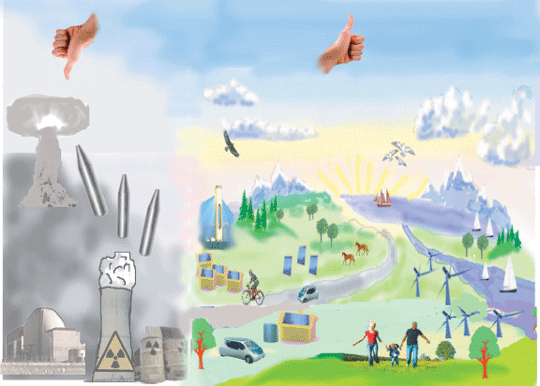
May 24, 2025, https://renewextraweekly.blogspot.com/2025/05/more-renewables-or-more-nuclear.html
In my last post, I looked at how, despite renewable expansion, emissions were still rising. I focussed mainly on coal, but clearly it’s wider than that: multi-billion fossil fuel investment continues. In this post I will look at what is arguably another big issue- the attempt, to rebrand nuclear as a solution. Certainly some people in the UK and elsewhere think that there is a case for nuclear as part of a low carbon answer to climate change, although others do not agree. Even leaving aside the safety, security and waste issues, they say it’s too expensive and takes too long to build compared with renewables.
That debate continues, but in terms of what’s actually happening on the ground, the battle has arguably been won by renewables – they are expanding very rapidly around the world, leaving nuclear mostly stalled. Even China’s nuclear programme, currently at around 60 GW, is tiny compared with its renewables capacity, which hit 1.82 TW last year and is still expanding fast.
However, nuclear is still in the game in some locations, with, for example, Russia trying to export its nuclear technology and fuel services. And more generally, while the nuclear industry may mostly have to accept a lesser role globally, as renewables expand to high percentages of overall power, that in fact may be seen by them as a new opportunity- on the argument that nuclear will be needed to back up variable renewables.
The latest example seems to be Denmark, famed for its anti-nuclear ‘Atomkraft Nein Danke’ stance, with renewables now supplying over 80% of its power and aiming to get to 100% of all energy by 2050. That will require new grid balancing capacity, the most obvious being storage- with excess renewable output being stored in batteries or converted to hydrogen for use when there is renewable supply lull or a peak in demand. But evidently there is also now government interest in nuclear- and the idea of small modular reactors (SMR). It’s hard to see how this would be viable for occasional backup. Large conventional nuclear plants are expensive to build and inflexible to run, and current designs for SMRs are no better – and trying to make them flexible is likely add even more to the cost. So it seems very odd.
Spain also has a high renewable percentage, Portugal too, though, unlike Denmark and Portugal, Spain does have some nuclear plants. But it is planning to phase them out. Certainly they were no use in avoiding the recent large-scale total Iberian blackout- Spain’s nuclear plants evidently can’t run competitively when renewables are at peak. So, as it seems happens regularly, they were throttled back- most of the power was coming from wind and solar. We still don’t know what exactly went wrong, but it does seem that the remaining nuclear plants tripped out due to a grid overload signal, and PV solar also cut out for some reason. Perhaps a bit prematurely, the Spanish prime minister said that ‘there is no empirical evidence that the incident was caused by a surplus of renewables or a lack of nuclear power plants in Spain.’
He added ‘we are not going to deviate a single millimetre from the energy road map we have planned since 2018. Not only are renewables our country’s energy future, they are our only and best option. They are the only way to re-industrialise Spain.’
It may turn out have been a simple line fault, but it’s also possible that it was due to lack of synchronous inertia on the grid system. Large conventional fossil fuel fired or nuclear plants have large heavy spinning turbo-generators that help balance short-term output perturbations. PV solar has none, wind turbines only a small amount. But it would be crazy to build large expensive fossil or nuclear plants to provide rotational inertia for usually rare events.
There has been talk in the past of using just the turbo-generator sets of old closed plants, unpowered except for grid power, to provide ‘spinning reserve’ rotational inertia. However, if its needed, there may be easier and cheaper ways to do this electronically, via fast response storage and inverter systems- virtual synchronous inertia. Tidal lagoons and barrages are another option- they offer large scale energy storage capacity along with significant rotational inertia. So too do hydro projects. So inertia issues are not necessarily a major problem.
Needless to say though, despite there being no poof as to what actually happened as yet, there was a rush to early judgement and speculation by some of the media – along the lines that ‘you can’t rely on renewables’ and ‘this is what you get with net zero’! So far though, most of this invective has bounced off. Anti-nuclear Germany, currently gets around 63% of its power from renewables, and aims to get to net zero carbon with no nuclear. Occasionally there has ben some pressure to go back to nuclear but it has been resisted and certainly the ‘baseload for grid balancing’ case for nuclear seems very weak.
Meanwhile, the UK is getting 50% of its power from renewables, but is struggling to fund its proposed new nuclear plant at Sizewell: EdF evidently is no longer able to help out- it has enough financial and operational problems with its troubled EPR programme in France. It has also halted its initial SMR programme. The UK however is still keen to promote SMRs, although Westinghouse has pulled out of the race. The basic problem with nuclear technology, old or new, small or large, is cost – renewables like wind and solar are far cheaper, and storage backup is also now getting cheap.
The UK does need to get moving on hydrogen storage for the longer term, and also heat storage, which some see as better than heat pumps in some locations, possibly with green AD biogas as a storable energy source. Tidal lagoon power, though still a bit too costly, is also beginning to be talked up again. All of these are arguably a lot more promising for balancing than new nuclear.
So what’s likely to happen? There’s no question that the nuclear lobby has been pushing hard to get back in the game after the 2011 Fukushima disaster in Japan, which had led to nuclear programme reversals around the world, but in Asia especially. There were huge public demonstrations of opposition. But, in time, the phase out or cut back programmes planned by some Asian governments (including Japan, Taiwan and Thailand) faded away and nuclear is back in favour- although renewables are now seen as the main energy supply options in most cases. Not least since, even there, though lower than in the West, the constructions costs and investment risks of new nuclear are high, compared with solar and wind.
However, some also see carbon removal and biomass carbon capture playing a carbon negative role, especially in countries where there are a lot of agricultural carbon emissions- and also land. But as I noted in my last post, although there may be some exceptions, the economic and ecological viability of that approach on a large scale is debatable- expanding renewables even faster looks like a better bet. Though, as with nuclear, the debate continues…
Trump’s Golden Dome Is a Combover

By David Swanson, World BEYOND War, May 21, 2025, https://worldbeyondwar.org/trumps-golden-dome-is-a-combover/
According to world-leading war-profiteer Lockheed Martin, its Golden Dome, marketed for it by Donald Trump, “stands as a layered defense shield, safeguarding the American homeland with unwavering precision, ensuring the security and resilience of our nation.” But it doesn’t exactly “stand” anywhere in the present day or what some of us like to call “reality.” Rather, it’s one of those scientific research projects Trump loves to defund if they might succeed or do anyone any good. In the words of Lockheed Martin, the Golden Dome will try to “develop game-changing tech – like space-based interceptors and hypersonic defenses.” In case you’ve been in a daze since Ronald Reagan was pushing non-functioning space-based interceptors, Ronald Reagan was pushing this same madness, and it’s never gone away.
The Golden Dome is guaranteed to waste vast resources desperately needed by people.
The Golden Dome is guaranteed to do tremendous environmental damage in production, testing, and accidents — and especially if ever used.
The Golden Dome is guaranteed to kick start a crazed race to weaponize space by a number of governments, all but one of which have long been trying to ban space weaponization by treaty. It will also fuel arms races to develop new weapons to evade defenses, and to duplicate and out-do the Golden Dome.
The Golden Dome is highly unlikely to actually ever protect anyone from anything.
The Golden Dome is definitely going to be perceived as an aggressive threat by most of the world — already by China, no matter how many times the word “defense” is uttered. It will therefore be a blow to disarmament, cooperation, and the rule of law.
The Golden Dome is the belief in militarism taken to its logical extreme, so it’s very interesting that most of the militarists don’t like it any more than I do.
Here’s the BBC doing its level best to report on this insanity with a straight face:
“An initial sum of $25bn (£18.7bn) has been earmarked in a new budget bill – although the government has estimated it could end up costing 20 times that over decades. There are also doubts about whether the US will be able to deliver a comprehensive defence system for such a huge land mass. Officials warn that existing systems have not kept pace with increasingly sophisticated weapons possessed by potential adversaries. A briefing document recently released by the Defense Intelligence Agency noted that missile threats ‘will expand in scale and sophistication’, with China and Russia actively designing systems ‘to exploit gaps’ in US defences. . . . ‘Israel’s missile defence challenge is a lot easier than one in the United States,’ Marion Messmer, a senior research fellow at London-based Chatham House, told the New York Times. ‘The geography is much smaller and the angles and directions and the types of missiles are more limited.’ Shashank Joshi, defence editor at the Economist, told the BBC the Golden Dome would probably work by using thousands of satellites to spot and track missiles and then use interceptors in orbit to fire at the missiles as they take off and take them out. He said the US military would take the plan very seriously but it was unrealistic to think it would be completed during Trump’s term, and the huge cost would suck up a large chunk of the US defence budget.”
Here’s The Independent not even trying:
“[T]he Golden Dome is overly ambitious in a way that is typical of Trump. Like his infamously unfinished and useless wall along the Mexican border, it is supposedly ‘visionary’, but is, in reality, flawed and vastly expensive. There is no reason why the relatively small Iron Dome system, designed to frustrate short to medium-range missiles, could be scaled up in anything like the way necessary to withstand a sustained attack from intercontinental ballistic missiles or rockets from space itself. Even if it could be made to work, it may not be 100 per cent effective, as is the case with Israel’s Iron Dome – and you wouldn’t want to be in a position where you’d need to find out. By that point, you’d have spent far in excess of Trump’s optimistic costing of $175bn finding out. Maybe he should ask his now strangely absent friend Elon Musk about whether the Golden Dome is a good use of American taxpayers’ money. This brings us to the next typically Trumpian problem: it’s not very well thought through. When Reagan proposed his Strategic Defence Initiative (SDI) in 1983, it was obvious who he had in mind – the Russians. Yet now Trump wants to befriend them and partner up with Putin, and maybe even Presidents Xi, Kim and others in a global strongman alliance. If Golden Dome is protecting America, who is it protecting it from? As yet unknown and unforeseen enemies would be a rational answer, but not if Trump wants to make friends with them all.”
That last argument would be stronger if Trump and his supposed allies were disarming, rather than rapidly building up weapons to slaughter each other’s people and the rest of humanity. Unfortunately, the Golden Dome is a giant declaration that the United States will never be part of global cooperation and disarmament.
Coalition urges Carney to drop nuclear from energy plan

by Abdul Matin Sarfraz, National Observer, May 23, 2025
A coalition of First Nations, physicians and environmental organizations is ramping up pressure on Prime Minister Mark Carney to drop nuclear energy from his “energy superpower” strategy, warning it comes with high costs, long delays and long-term risks.
In an open letter, dozens of organizations urge the federal government to halt funding for nuclear development and instead prioritize renewables, energy efficiency and storage. The letter warns that new nuclear projects are likely to increase electricity costs while delaying meaningful climate action.
“We are concerned that you may be unduly influenced by the nuclear and fossil industry lobbies,” reads the letter.
During the federal election campaign, Carney pledged to make Canada “the world’s leading energy superpower,” focusing on clean and conventional energy. His platform promised faster project approvals and a national clean electricity grid, among other energy promises. The coalition sent their letter in an effort to ensure Carney does not invest more significantly in nuclear energy, as he prepares to set his government’s agenda and ministers’ mandates.
While Carney’s plan doesn’t mention nuclear energy, he praised it during the first leaders’ debate and referenced two companies in the sector he previously worked with at Brookfield Asset Management…………………………………………..
In an open letter, dozens of organizations urge the federal government to halt funding for nuclear development and instead prioritize renewables, energy efficiency and storage.
The federal government — through the Canada Infrastructure Bank — has committed $970 million in low-cost financing to Ontario’s Darlington New Nuclear Project, which aims to build Canada’s first grid-scale small modular reactor.
The federal government also invested millions in Moltex Clean Energy, a New Brunswick-based company developing a technology called Waste to Stable Salt, which aims to recycle nuclear waste into new energy.
Jean-Pierre Finet, spokesperson for le Regroupement des organismes environnementaux en énergie, one of the organizations that signed the open letter, said he worries about the long-term future of any nuclear plants built today without a plan for their waste.
“We object to our federal taxpayer dollars being spent on developing more nuclear reactors that could be abandoned in place, ultimately transforming communities into radioactively contaminated sites and nuclear waste dumps that will require more federal dollars to clean up,” Finet said.
Gordon Edwards, president of the Canadian Coalition for Nuclear Responsibility and a longtime nuclear critic, says the federal government is backing the slowest and most expensive energy option on the table.
“In a climate emergency, you have to invest in things that are faster and cheaper,” Edwards said. “Canada hasn’t built new reactors in decades. There’s no practical experience left, and what’s being proposed now is largely speculative.”
“We’re very concerned about a misappropriation of public money and investment in what we see as a losing strategy,” Edwards said, stressing that the coalition is not asking private companies to stop building plants — but rather asking the federal government to stop subsidizing them.
International concerns echo at home
Much of the current controversy focuses on Ontario’s Darlington New Nuclear Project, as growing skepticism around the cost of small modular reactors mirrors global concerns.
In the US, two nuclear reactors in South Carolina were abandoned after $12.5 billion (CAD) had already been spent, triggering the bankruptcy of Westinghouse Nuclear — now owned by Canadian firms Brookfield and Cameco. Meanwhile, two completed Vogtle reactors in Georgia came in at $48 billion, more than double the original $19-billion estimate, making them among the most expensive infrastructure projects in US history.
In the UK and Europe, new nuclear power project efforts are facing delays, budget overruns, or outright cancellations.
………………………………ome energy experts say the small modular reactor path is out of sync with climate timelines and economic realities. “Nuclear is a very high-cost and high-risk option,” said Mark Winfield, professor at York University and co-chair of its Sustainable Energy Initiative. “These subsidies divert resources from much less costly and lower-risk options for decarbonizing energy systems. The focus on nuclear can delay more substantive climate action.”
Winfield calls small modular reactors “a distraction and likely a dead end,” warning that the technology carries catastrophic accident, safety, security and weapons proliferation risks not found in any other form of energy production.
Winfield said Canada lacks a significant comparative advantage in energy production beyond its legacy hydro assets, and remains a relatively high-cost fossil fuel producer.
“There is no reason to believe that we would be better at other energy production technologies (nuclear, renewables) than anyone else,” Winfield added in an email. ome energy experts say the small modular reactor path is out of sync with climate timelines and economic realities. “Nuclear is a very high-cost and high-risk option,” said Mark Winfield, professor at York University and co-chair of its Sustainable Energy Initiative. “These subsidies divert resources from much less costly and lower-risk options for decarbonizing energy systems. The focus on nuclear can delay more substantive climate action.”
Winfield calls small modular reactors “a distraction and likely a dead end,” warning that the technology carries catastrophic accident, safety, security and weapons proliferation risks not found in any other form of energy production.
Winfield said Canada lacks a significant comparative advantage in energy production beyond its legacy hydro assets, and remains a relatively high-cost fossil fuel producer.
“There is no reason to believe that we would be better at other energy production technologies (nuclear, renewables) than anyone else,” Winfield added in an email.ome energy experts say the small modular reactor path is out of sync with climate timelines and economic realities. “Nuclear is a very high-cost and high-risk option,” said Mark Winfield, professor at York University and co-chair of its Sustainable Energy Initiative. “These subsidies divert resources from much less costly and lower-risk options for decarbonizing energy systems. The focus on nuclear can delay more substantive climate action.”
Winfield calls small modular reactors “a distraction and likely a dead end,” warning that the technology carries catastrophic accident, safety, security and weapons proliferation risks not found in any other form of energy production.
Winfield said Canada lacks a significant comparative advantage in energy production beyond its legacy hydro assets, and remains a relatively high-cost fossil fuel producer.
“There is no reason to believe that we would be better at other energy production technologies (nuclear, renewables) than anyone else,” Winfield added in an email.ome energy experts say the small modular reactor path is out of sync with climate timelines and economic realities. “Nuclear is a very high-cost and high-risk option,” said Mark Winfield, professor at York University and co-chair of its Sustainable Energy Initiative. “These subsidies divert resources from much less costly and lower-risk options for decarbonizing energy systems. The focus on nuclear can delay more substantive climate action.”
Winfield calls small modular reactors “a distraction and likely a dead end,” warning that the technology carries catastrophic accident, safety, security and weapons proliferation risks not found in any other form of energy production.
Winfield said Canada lacks a significant comparative advantage in energy production beyond its legacy hydro assets, and remains a relatively high-cost fossil fuel producer.
“There is no reason to believe that we would be better at other energy production technologies (nuclear, renewables) than anyone else,” Winfield added in an email.ome energy experts say the small modular reactor path is out of sync with climate timelines and economic realities. “Nuclear is a very high-cost and high-risk option,” said Mark Winfield, professor at York University and co-chair of its Sustainable Energy Initiative. “These subsidies divert resources from much less costly and lower-risk options for decarbonizing energy systems. The focus on nuclear can delay more substantive climate action.”
Winfield calls small modular reactors “a distraction and likely a dead end,” warning that the technology carries catastrophic accident, safety, security and weapons proliferation risks not found in any other form of energy production.
Winfield said Canada lacks a significant comparative advantage in energy production beyond its legacy hydro assets, and remains a relatively high-cost fossil fuel producer.
“There is no reason to believe that we would be better at other energy production technologies (nuclear, renewables) than anyone else,” Winfield added in an email. https://www.nationalobserver.com/2025/05/23/news/civil-society-first-nations-groups-carney-nuclear-energy-plan?nih=cCuxV9ZjIGLlEj3vVOQpRJBIfmNu0W4xzKEBn8bDrx8&utm_source=National+Observer&utm_campaign=d2c908330f-EMAIL_CAMPAIGN_2025_05_23_02_10&utm_medium=email&utm_term=0_cacd0f141f-d2c908330f-277064766
Trump’s ‘Golden Dome’ Is Impossible—and It’ll Make Defense Companies a Ton of Money.

A new study detailed all the problems with plans to shoot a missile out of the sky.
By Matthew Gault Gizmodo, April 6, 2025
The Pentagon is expected to deliver plans for a “Golden Dome” to Trump this week. In the crudest sense, the Golden Dome is a missile defense system that would shoot nukes, missiles, and drones that threaten the U.S. out of the sky. A scientific study published earlier this month detailed the scientific impossibility of the scheme
America has tried to build a missile defense system since before Ronald Reagan was president. Reagan wanted to put satellites into space that would use lasers to blast Soviet nukes out of the sky. What we built was somewhat more pedestrian. It also probably won’t work. But defense contractors made a lot of money.
“When engineers have been under intense political pressure to deploy a system, the United States has repeatedly initiated costly programs that proved unable to deal with key technical challenges and were eventually abandoned as their inadequacies became apparent,” explained a new study from the American Physical Society Panel on Public Affairs.
Under Trump, we’re going to do it again.
Trump signed an executive order on January 27 that called on the Pentagon to come up with a plan for an “Iron Dome for America,” which the President and others have taken to calling a “Golden Dome.” According to the EO, Trump wants a plan that’ll keep the homeland safe from “ballistic, hypersonic, advanced cruise missiles, and other next-generation aerial attacks from peer, near-peer, and rogue adversaries.”
The dream of the Golden Dome is simple: shoot missiles out of the sky before they can do any damage. “It’s important to not simply think of Golden Dome as the next iteration of the ground-based missile defense system or solely a missile defense system because it’s a broader mission than that,” Jonathan Moneymaker, the CEO of BlueHalo, a defense company working on Golden Dome adjacent tech, told Gizmodo.
Moneymaker was clear-eyed about the challenges of building Golden Dome. “Everyone looks at it as a replication of Israel’s Iron Dome, but we have to appreciate that Israel’s the size of New Jersey,” he said.
Israel’s Iron Dome has done a great job shooting down Hamas rockets and Iranian missiles. It’s also covering a small territory and shooting down projectiles that aren’t moving as fast as a nuclear weapon or a Russian Kh-47M2 Kinzhal ballistic missile might. The pitch of the Golden Dome is that it would keep the whole of the continental U.S. safe. That’s a massive amount of territory to cover and the system would need to identify, track, and destroy nuclear weapons, drones, and other objects moving at high speed.
That’s like trying to shoot a bullet out of the sky with a bullet. The missile defense study, published on March 3, detailed a few of the challenges facing a potential Golden Dome-style system.
Trump’s executive order is vague and covers a lot of potential threats. “We focus on the fundamental question of whether current and proposed systems intended to defend the United States against nuclear-armed [intercontinental ballistic missile] now effective, or could in the near future be made effective in preventing the death and destruction that a successful attack by North Korea on the United States using such ICBMs would produce.”
Stopping a nuke is the primary promise of a missile system. And if one of these systems can’t stop a nuke then of what use is it?
The study isn’t positive. “This is the most comprehensive, independent scientific study in decades on the feasibility of national ballistic missile defense. Its findings may shock Americans who have not paid much attention to these programs,” Joseph Cirincione told Gimzodo.
Cirincione is the retired president of the Ploughshares Fund and a former Congressional staffer. He investigated missile defense systems and nukes for the House Armed Services Committee. “We have no chance of stopping a determined ballistic missile attack on the United States despite four decades of trying and over $400 billion spent. This is the mother of all scandals,” he said………………………………………………………………………………………………..
So we’re talking about ringing the planet in thousands of munitions-armed satellites. And remember that this is just to handle one nuke launched by North Korea. Imagine scaling up a similar defense shield to guard against all the nukes in Russia and you’ll begin to see the size of the problem………………………………. https://gizmodo.com/trumps-golden-dome-is-impossible-and-itll-make-defense-companies-a-ton-of-money-2000584372
The Western Media Brought Gaza To This Point
Caitlin Johnstone, May 22, 2025, https://www.caitlinjohnst.one/p/the-western-media-brought-gaza-to?utm_source=post-email-title&publication_id=82124&post_id=164129601&utm_campaign=email-post-title&isFreemail=true&token=eyJ1c2VyX2lkIjoyNTU2MjE3LCJwb3N0X2lkIjoxNjQxMjk2MDEsImlhdCI6MTc0Nzg3OTg5NywiZXhwIjoxNzUwNDcxODk3LCJpc3MiOiJwdWItODIxMjQiLCJzdWIiOiJwb3N0LXJlYWN0aW9uIn0.1yOnX9gkFtJ60ygxFyWvcUWnljfPG0wyJfU6MjZ5nLU&r=1ise1&triedRedirect=true&utm_medium=email
Benjamin Netanyahu is now explicitly saying that the complete ethnic cleansing of Gaza is a precondition to ending the slaughter in the besieged Palestinian territory.
“Responding to those who are pushing for an end to war in Gaza, Netanyahu says he ‘is ready to end the war, under clear conditions that will ensure the safety of Israel — all the hostages come home, Hamas lays down its arms, steps down from power, its leadership is exiled from the Strip… Gaza is totally disarmed, and we carry out the Trump plan. A plan that is so correct and so revolutionary.’
“This represents the first time the US president’s plan for moving Gaza civilians out of the Strip has been presented as an Israeli demand for ending the war.”
Trump’s stated plan for Gaza is to remove “all” Palestinians from the enclave and never allow them to return. Netanyahu is here saying that the ethnic cleansing of Gaza is Israel’s ultimate military objective.
Which has been obvious from the very beginning. On the 20th of October 2023, a mere 13 days after October 7, I myself posted the following:
“Israel’s being so obvious about wanting to do another land grab. The solution to every problem is to move Gazans off the land they’re on to somewhere else. It’s like a guy at a nightclub pushing you and pushing you to drink a drink he handed you; at a certain point you realize he’s probably not really interested in making sure you have enough to drink.”
It’s been so transparently obvious this entire time that Israel’s entire objective is to remove Palestinians from a Palestinian territory so their land can be used for Israel’s own purposes — but you’d never have known it from looking at the western press.
For the last year and a half the western media have been brazenly lying to the public by framing this as a “war with Hamas” instead of the naked ethnic cleansing operation it clearly is. They’ve been manufacturing consent for this murderous land grab by babbling about hostages, terrorism and October 7 when Israel’s mass atrocity in Gaza has never, ever been about any of those things. It has only ever been about taking Palestinian land away from Palestinians — an agenda Israel has been pursuing for decades.
If the western press had been doing actual journalism, Israel would never have been able to bring Gaza to this point. Because the western press have instead been administering propaganda this entire time, Gaza is now an uninhabitable pile of rubble full of desperate, starving people, allowing Israel and the Trump administration to argue that the humanitarian thing to do is to evacuate them all immediately.
The western media’s refusal to acknowledge this — combined with a year and a half of wildly biased headlines, indisputably slanted coverage, and extensively documented top-down pressure in mass media institutions to cover Israel’s onslaught in a positive light — stifled much of the public opposition to this genocidal land grab that we would likely have seen otherwise. This journalistic malpractice allowed Israel’s western backers to support this mass atrocity with impunity, which in turn allowed Israel to act with impunity.
None of this would be possible if the west had an actual free press whose job is to create an informed populace. But we do not have an actual free press whose job is to create an informed populace — we have imperial propaganda services disguised as news.
Now that Israel has pulled back the curtain and acknowledged what we are looking at here, some in the western press have begun pivoting to wag their fingers at Netanyahu in order to preserve their image. And fine, whatever, we need as much help as we can get. But never forget what these monsters did to help create this nightmare in Gaza.
Canada wants to join Golden Dome missile-defence program, Trump says
Ottawa confirms it’s talking to U.S. about major multi-year program
Alexander Panetta · CBC News ·May 20, 2025, https://www.cbc.ca/news/world/golden-dome-trump-us-missile-defence-canada-1.7539390
Donald Trump says Canada has asked to join the missile-defence program his administration is building, adding a new chapter to a long-running cross-border saga.
The U.S. president dropped that news in the Oval Office on Tuesday as he unveiled the initial plans for a three-year, $175 billion US project to build a multi-purpose missile shield he’s calling the Golden Dome.
“Canada has called us and they want to be a part of it,” Trump said. “They want to hook in and they want to be a part of it.”
Canada will pay its “fair share,” he added. “We’ll work with them on pricing.”
Ottawa confirmed it’s talking to the U.S. about this but added a caveat. In a statement, the federal government cast missile-defence discussions as unresolved and as part of the overall trade and security negotiations Prime Minister Mark Carney is having with Trump.
What this means is still extremely murky. It’s unclear what, exactly, Canada would contribute; what its responsibilities would include; what it would pay; and how different this arrangement would be from what Canada already does under the Canada-U.S. NORAD system.
Refused to join
Canada has long participated in tracking North American skies through NORAD, and feeds that data into the U.S. missile-defence program.
But Canada never officially joined the U.S. missile program, which was a source of controversy in Ottawa in the early 2000s when Prime Minister Paul Martin’s government refused to join.
That previous refusal means Canadians can monitor the skies but not participate in any decision about when to launch a hypothetical strike against incoming objects.
New developments have forced the long-dormant issue back onto the agenda.
For starters, the U.S. is creating a new system to track various types of missiles — one more sophisticated and multi-layered than Israel’s Iron Dome, intended to detect intercontinental, hypersonic and shorter-range cruise weapons.
And this happens to be occurring as Canada’s sensors in the Arctic are aging out of use. Canada has committed to refurbishing those sensors.
Rumblings of Canada’s interest started months ago
The first public indication that these combined factors were fuelling a policy shift in Canada came in public comments made earlier this year in Washington.
One U.S. senator said, in February, that he’d heard interest in the missile program from a Canadian colleague, then-defence minister Bill Blair.
Blair publicly acknowledged the interest, saying that, given the upgrades being planned by both the U.S. and Canada, the partnership “makes sense.”
But the form of Canadian participation is, again, unclear. The U.S. commander for NORAD appeared recently to suggest that Canada’s participation will be limited to tracking threats.
One missile-defence analyst says it sounds like an extension of existing Canada-U.S. co-operation through NORAD. Still, says Wes Rumbaugh, it’s interesting that Trump chose to draw attention to it. Trump mentioned Canada’s role several times, unprompted, during his announcement Tuesday.
As for the president’s three-year timeframe, Rumbaugh calls it a long shot. He predicts that only part of the system could be built in that period, and that it will take more years, and more funding, to complete.
It could take much, much more funding. The Congressional Budget Office estimates this project could cost hundreds of billions more than the $175 billion US figure cited by the president.
“This is still a significant challenge,” said Rumbaugh, a fellow in the missile defence project at the Center for Strategic and International Studies think-tank in Washington.
“We’re talking about sort of a next-generation and a widely enhanced missile-defence system. We’re talking about a step-change evolution in American air and missile defence systems that will require significant investment over potentially a long time period.”
Canada confirms Golden Dome discussions
Nearly three hours after Trump’s announcement, Ottawa confirmed the discussions are happening. An evening statement from Carney’s office said Canadians gave the prime minister an electoral mandate to negotiate a comprehensive new security and economic relationship with the U.S.
“To that end, the prime minister and his ministers are having wide-ranging and constructive discussions with their American counterparts,” said the statement.
“These discussions naturally include strengthening NORAD and related initiatives such as the Golden Dome.”
A Canadian cabinet minister involved in similar discussions in the early 2000s says it’s high time the conversation resumed.
“I see this as a positive,” said David Pratt, a Liberal defence minister in the first Martin cabinet.
He favoured Canada’s participation in a North American missile defence system back then but says the government blanched out of fear of political blowback, with its minority government fragile.
He said the refusal to join came with a cost. In part, NORAD lost part of its potential vocation, as missile interception became a U.S.-only activity, and related research and manufacturing opportunities flowed to the U.S., he said.
The specific U.S. ask of Canada was never fully defined back then, he said. Pratt recalls negotiations having just gotten underway about what role Canada would play and whether it would merely host sensors or also interceptors on its soil.
I’m hoping we’ll see NORAD assume what should have been its rightful role,” he told CBC News.
I wrote a speech for Trump’s Golden Dome defense. Get ready to feel something.
Golden comes first, of course, because the entire thing will be made of gold, which everyone knows is the strongest of all the metals. That’s why I use it in all my properties.
Rex Huppke, https://www.usatoday.com/story/opinion/columnist/2025/05/22/trump-golden-dome-missile-defense/83776830007/
After watching President Donald Trump announce plans for a $175 billion “Golden Dome” missile-defense system, I took the liberty of preparing him a speech to better introduce the country to this sure-to-be fabulous and best-ever multilayered space-weapon extravaganza. He says it will be “fully operational before the end of my term,” so it seems a strong sales pitch is in order.
Here goes:
Hello America, it’s me, your favorite president of all time, currently polling higher than any president in history, except for in a few FAKE polls. In keeping with my promise to protect all Americans, except for the few I might accidentally deport or imprison because they say mean things about me — nobody will miss them, and it will all be totally legal and totally cool — I’m excited to give you some more details about our big, beautiful, totally golden Golden Dome, a super-impenetrable anti-missile — it’s so anti-missile you won’t believe it — defense system.
Let’s look at these two beautiful words: golden and dome. Golden comes first, of course, because the entire thing will be made of gold, which everyone knows is the strongest of all the metals. That’s why I use it in all my properties. Tough stuff. I had a big contractor come up to me one time — a huge, tough guy, tears in his eyes — and he said, “Mr. President, you’re the only one smart enough to use gold this much. Nobody else gets it like you do.” It’s so true.
The second word is DOME. I love domes. They’re like a ball, only half. The best half, of course, that being the one on top. Ask any basketball player and they’ll tell you the top half of the ball — what they call the dome — is the best. So many baskets.
Now this dome, aside from being made of gold, will be a slightly different shape than most domes. Not a lot of people know this, but America is not round. I pointed this out to some of my people the other day, and they said, “Sir, that’s such a good point. We never thought of that.”
So I came up with the fact that America is not round. If you look at a map, it’s more kind of a rectangle. And of course it’s flat. Completely flat. They say the earth is round — although some very smart people don’t agree with that — but it’s clear from any map that America, at least, is completely flat.
So you have this big, flat rectangle, and we’re going to protect it from missiles using a Golden Dome that will be more of a rectangle-ish-shaped dome. It could also be a series of domes, I suppose. But like a bunch of domes forming a giant, flat rectangle. We’ll see.
But as I said, it will be impenetrable, and that will be thanks to space and lasers and other things that very smart people like myself totally understand. It’s going to be so fantastic, really. Our Golden Dome will be the best roughly rectangular dome anyone has ever seen.
Now, some losers out there are already complaining about this perfect plan. A Chinese foreign ministry spokeswoman named Mao Ning said our beautiful, perfect flat-and-rectangular dome of gold “heightens the risk of space becoming a battlefield.”
Well, I’ve got news for you, Mao. I’m pretty sure space is already a battlefield. Love is a battlefield — I’ve heard many say that — and that means space is definitely a battlefield too. And it’s a battlefield we’re going to win with our precious, precious gold and tough lasers.
Some in the fake news have whined like little losers about the cost. We have $25 billion in the big, beautiful tax bill that is currently moving through Congress. And the cost of the whole thing — and can you really put a cost on gold or domes? — will be easily covered by cuts to services that for far too long have been going to ungrateful poor people who have no gold.
Many of those poor people are supporters of mine, of course, and I love them dearly, and they love me. But they’ll understand if we make a few little — or possibly very large, because large is good, we love large — cuts to Medicaid and Medicare while also adding trillions to the debt Republicans used to care about. They’ll understand that’s a perfect decision when they look into the sky and see those giant sheets of beautiful gold protecting us from missiles, and they’ll know their hunger is worth it for our protection. Trust me, they will. Those people will believe anything.
As everyone knows, everything I’ve ever built is perfect and infallible. And that will be the case with our amazing, patriotic Golden Dome. You can now purchase scale models of the dome — gold-plated and of the very highest quality — on my website, and 1% of all sales will go to building the dome or to dome marketing.
MAKE AMERICA DOME AGAIN!
Two stories: Denmark’s soaring renewable success and global nuclear construction disaster
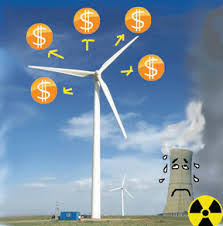
Denmark will soon achieve 100% electricity from wind and solar; but across the world nuclear power construction cost overruns soar
David Toke, May 22, 2025, https://davidtoke.substack.com/p/two-stories-denmarks-soaring-renewable
Two stories emerged on May 19th giving diametrically opposed results; one is very positive news for the booming deployment of renewable energy but the other is crushingly bad for nuclear power prospects. Renewables will make up more than of Danish 100% electricity in a couple of years time and just wind and solar not long after that. On the other hand a new study concludes that, around the world, nuclear power projects have cost overruns that are over 100%. Solar and wind have very low, if any cost overruns.
Danish renewables to reach 100 per cent of electricity
You can see the shares of electricity generation for Denmark in 2024 in Figure 1. Wind and solar already make up 69 per cent of generation and together with bioenergy they made up 87 per cent of electricity generation. But wind and solar generation is increasing rapidly. The different shares of power production can be seen in Figure 1.
Denmark blazed the trail for wind power starting in the 1970s as farmers and wind cooperatives put up their own wind turbines. Initially the turbines were only 20 kW in peak output. But the latest planned offshore windfarm will have turbines of 20 MW in size – a thousand times bigger! The early start for wind power in Denmark boosted its industry tremendously. Today Denmark also hosts Vestas, the largest wind generator manufacturer in the world.
There are still a trickle of onshore wind turbines being built. However, these days most of the new wind capacity is coming from offshore wind. The 1.08GW Thor windfarm that is currently being built will be fully operational in 2027. [on original]…………………………………………………………………………
Academic study reveals enormous average nuclear cost overruns around the world
Meanwhile, on the same day as the announcement of the forthcoming auction for the Danish offshore windfarms, an academic paper was announced which showed truly awful results for the nuclear industry. The study scoured the world for details on as many energy infrastructure projects that coud reliably be found – 662 in all – including 204 nuclear power plant constructions.
The researchers found that the average cost overrun for nuclear power plant was a staggering 102.5 per cent. That means that the construction costs were more than double the cost that was originally estimated before the construction started. What makes this figure all the more remarkable is that this was an average across the whole of the world.
The study includes Eastern countries like China. In these states there is still the specialist industrial skills (and more relaxed health and safety at work regulations) required to deliver nuclear power stations at anywhere near their projected construction time. Yet, in western countries, the construction cost overruns are much worse. Essentially, in western conditions, it has become impossible to deliver nuclear power plant at anything below astonomical costs.
I should add that there is an incredible amount of nonsense being spouted at the moment about how ‘small modular reactors’ are some way of saving nuclear power. Apart from occasioning a small amount of ultra-expensive nuclear capacity they are nothing of the sort. They are much worse in economic terms than even conventional reactors. See my discussion ‘Why small modular reactors do not exist – history gives the answer’. See HERE.
It is a completely different matter for renewable energy projects of course, where cost overruns are very low. But, from the press coverage, you would not guess all of this!
Conclusion
As we can see from this post Denmark is, within a few years, about to be the first country in the world with a net surplus of wind and solar power. Interestingly this is the country that turned its head against nuclear power forty years ago, although it never bult any nuclear power plant before then. I have heard an incredible amount of what could be described as nonsensical disinformation in the mainstream press about how nuclear power is accelerating around the world and even that is some sort of way renewables are in crisis. The reality is the exact opposite as the information in this post demonstrates.
Nuclear has highest investment risk; solar shows lowest, say US researchers
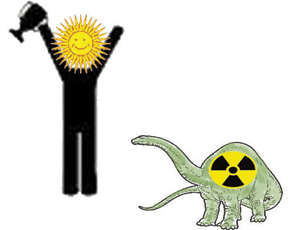
Nuclear power plants exceed construction budgets by an average of 102.5%, costing $1.56 billion more than planned, according to a study by Boston University’s Institute for Global Sustainability.
May 21, 2025 Pilar Sánchez Molina, https://www.pv-magazine.com/2025/05/21/nuclear-power-carries-highest-investment-risk-solar-shows-lowest-say-us-researchers/
A new study by the Institute for Global Sustainability at Boston University found that energy infrastructure projects exceeded planned construction costs in more than 60% of cases. Researchers analyzed data from 662 projects across 83 countries, spanning builds from 1936 to 2024 and totaling $1.358 trillion in investment.
The study covered a wide range of project types. These included thermoelectric power plants fueled by coal, oil or natural gas, as well as nuclear reactors, hydroelectric facilities and wind farms. It also examined large-scale PV and concentrated solar installations, high-voltage transmission lines, bioenergy and geothermal plants, hydrogen production sites, and carbon capture and storage systems
Researchers modeled projects with minimum thresholds: power plants with more than 1 MW of installed capacity, transmission lines over 10 km, and carbon capture systems processing more than 1,000 tons of CO₂ per year.
In the study, “Beyond economies of scale: Learning from construction cost overrun risks and time delays in global energy infrastructure projects,” published in Energy Research & Social Science, the authors found that energy infrastructure construction takes 40% longer than planned – on average, a delay of roughly two years.
Nuclear power plants had the highest cost overruns and delays, with average construction costs exceeding estimates by 102.5%, or $1.56 billion. Hydroelectric projects followed at 36.7%, then geothermal (20.7%), carbon capture (14.9%), and bioenergy (10.7%). Wind projects averaged a 5.2% cost increase, while hydrogen projects came in at 6.4%.
By contrast, PV plants and transmission infrastructure recorded cost underruns of 2.2% and 3.6%, respectively.
Construction delays also varied by technology. Nuclear, hydro, and geothermal projects experienced average delays of 35, 27, and 11 months, respectively. PV and transmission builds had the best performance, typically completing ahead of schedule or with only minimal delays – averaging one month if delayed at all.
The study concluded that projects exceeding 1,561 MW in capacity face significantly higher cost escalation risks, while smaller, modular renewable builds may lower financial exposure and improve forecasting. Once construction delays surpassed 87.5%, cost increases rose sharply.
A tale of two dodgy domes.
24 May 25 https://theaimn.net/a-tale-of-two-dodgy-domes/
Reuters on May 21st 2025 outlined Donald Trump’s plan for a Golen Dome missile defense shield:
The aim is for Golden Dome to leverage a network of hundreds of satellites circling the globe with sophisticated sensors and interceptors to knock out incoming enemy missiles after they lift off from countries like China, Iran, North Korea or Russia.
A network to knock out intercontinental ballistic missiles during the “boost phase” just after lift-off – Once the missile has been detected, Golden Dome will either shoot it down before it enters space with an interceptor or a laser, or further along its path of travel in space with an existing missile defense system that uses land-based interceptors stationed in California and Alaska.
Beneath the space intercept layer, the system will have another defensive layer based in or around the U.S.
Reuters names several companies that will build this system, with Elon Musk’s Space X as a frontrunner, but does not give details on the costs – estimates go from $175 billion upwards.
There is much scepticism about this plan.
I particularly enjoyed Rex Huppke ‘s sarcastic offering “I wrote a speech for Trump’s Golden Dome defense. Get ready to feel something”.
Huppke ‘s speech extols Trump’s popularity, and his promise that the system will be up an running in less than 4 years.
Huppke then studies “Golden” and “Dome’. He advises as much gold as possible to be used in the new structures, in keeping with Trump’s previous buildings. But suggests that the dome should be an unusually shaped dome – a flat-rectangular -shaped dome to fit in with the shape of America.
It’s all easy to fund, by simply cutting services to ungrateful Americans – “large is good, we love large” — cuts to Medicaid and Medicare while also adding trillions to the debt – “they’ll know their hunger is worth it for our protection.” As everyone knows, everything I’ve ever built is perfect and infallible.
Huppke does sum it up beautifully. Other commentators have questioned the extreme cost, the impracticality, the weapons proliferation risks of the Golden Dome project. Based on Israel’s “Iron Dome” this project has to cover an area 490 times the size of Israel.
So – it’s a dodgy dome that is attracting a lot of questions and criticism.
Now for that other dodgy dome that has attracted even more questions, and over many years. Yes, it’s Donald Trump’s own ever-evolving personal dome at the top of his head.
The hair has always been important to Trump. Like the spray-on tan, it goes to portray his image young, virile, strong, can conquer anything. Seth Rogan reported recently, comparing Donald Trump to Samson:
“He felt as though his power rested in his hair” https://www.youtube.com/watch?v=kvs0MAkJY-Q
Trump’s hair has been a source of wonder for many years. He’s been reported as having taken hair regrowth drug Propecia (finasteride) and had flap procedures. In flap procedures small areas of bald scalp are removed and patches of hair-covered skin are used to replace the bald areas, requiring careful combing over of bald patches. Trump’s scalp reductions were even mentioned by Ivana Trump in their 1990 divorce. A scalp reduction involves removing areas of bald patches and stretching hair-covered skin over them.
Dr. Gary Linkov, a plastic surgeon and hair loss expert, told the Daily Mail in August that he guesses Trump has had five hair transplants thus far in his lifetime.
I think, in its latest iteration, Trump’s hair is a metaphor for his dome idea, and whatever else is going on in his head. Past versions have appeared with his hair thick, combed in various ways, dyed in various shades of brown and gold. Now it’s described as ghostly white, a fluffy white cloud – with a lot of scalp peeking out.
The hair is looking thin, wispy, without real substance. It’s doubtful if he can keep up that strong confident appearance, as the head of the world that he’s supposed to be.
This White Dome sits atop the strange brain that has just conjured up the Golden Dome – neither of them are really to be trusted.
Civil society says nuclear deserves no place in Prime Minister Carney’s “Energy Superpower” project.

Gordon Edwards, May 21, 2025
Today 131 civil society and Indigenous groups representing many thousands of members across Canada reminded Prime Minister Mark Carney that climate action requires renewable – not nuclear – energy.
In an open letter to Prime Minister Carney, available HERE, representatives from the civil society and Indigenous groups wrote that building more nuclear reactors is not a cost-effective, clean or smart climate option. The government’s “Energy Superpower” project should include renewable energy and exclude nuclear reactor development from public subsidies.
The groups reminded the Prime Minister that, as an economist, he must appreciate that energy efficiency, renewables and energy storage are the best investments for energy supply, requiring less capital investment and providing the best return on the dollar for energy production, job creation, and rapid greenhouse gas reduction.
New nuclear projects are already far more expensive than proven renewable energy sources and there is no guarantee that new nuclear reactor designs will ever generate electricity safely and affordably. Spending on nuclear development is wasting time that must be spent urgently on genuine climate action.
“The nuclear industry, led by American corporations and start-ups, has failed to convince us that new reactor designs will address the climate crisis and overcome the exorbitant cost, toxic radioactive waste and threats of nuclear disasters that have plagued the nuclear industry for decades,” said Dr. Gordon Edwards, president of the Canadian Coalition for Nuclear Responsibility (CCNR).
“Quebec has rejected nuclear power. We object to our federal taxpayer dollars being spent on developing more nuclear reactors that could be abandoned in place, ultimately transforming communities into radioactively contaminated sites and nuclear waste dumps that will require more federal dollars to clean up,” said Jean-Pierre Finet, spokesperson for le Regroupement des organismes environnementaux en énergie (ROEÉ).
The groups are asking for a meeting with Prime Minister Carney to discuss Canada’s energy future.
Read the letter HERE with the list of 131 signatory groups.
Solar Power Set to Surpass Nuclear Generation This Summer
By Tsvetana Paraskova – May 21, 2025, https://oilprice.com/Latest-Energy-News/World-News/Solar-Power-Set-to-Surpass-Nuclear-Generation-This-Summer.html
This summer, solar power generation globally could exceed electricity from nuclear power plants for the first time ever, as solar capacity soars and sunlight and daylight hours are long in the northern hemisphere.
Global solar power generation jumped by 34% in the first quarter of 2025 from the same period in 2024, according to data from Ember cited by Reuters columnist Gavin Maguire.
If the pace of growth is sustained though June, July, and August, solar output is set to top 260 terawatt hours (TWh) in the summer months. This would beat the average 223 TWh of global nuclear power generation from 2024, Maguire notes.
Last year, record growth in renewables led by solar helped push clean power above 40% of global electricity in 2024, Ember said in its Global Electricity Review 2025 last month. However, heatwave-related demand spikes led to a small increase in fossil generation, too, the clean energy think tank said.
“Solar generation has maintained its high growth rate, doubling in the last three years, and adding more electricity than any other source over that period,” Ember’s analysts wrote in the report.
More than half, or 53%, of the increase in solar generation in 2024 was in China, with China’s clean generation growth meeting 81% of its demand increase in 2024, according to Ember.
China and Europe are driving solar power’s global surge, but in Europe, the solar boom has led to negative power prices more frequently.
At the end of April, for example, a sunny weekend in northwest Europe plunged power prices in the region to hundreds of euros below zero as solar generation soared.
Negative power prices, while beneficial for some consumers in some countries, generally discourage investments in new capacity as renewable power generators don’t profit from below-zero prices.
The more frequent occurrences of negative prices amid soaring solar output aren’t conducive to increased investment in generation only, and highlight the need of energy storage solutions to store the excess power and discharge it at evenings when it’s most needed.
US House seeks to create another Ukraine disaster in Georgia
Walt Zlotow, West Suburban Peace Coalition, Glen Ellyn IL, 22 May 25
Not satisfied with destroying Ukraine to weaken Russia, the US House passed a deranged bill to set the stage for a Ukraine redo, this time in tiny former Soviet republic Georgia.
It overwhelmingly passed the Mobilizing and Enhancing Georgia’s Options for Building Accountability, Resilience, and Independence Act (MEGOBARI Act) by a vote of 349 to 42.
MEGOBARI may be the stupidest acronym ever. But its intent is even stupider.
The bill is simply a Ukraine style regime change ploy to kick Russia out of its neighbor Georgia’s polity so Georgia can join NATO and the EU.
MEGOBARI doesn’t mince niceties” “[T}he consolidation of democracy in Georgia is critical for regional stability and United States national interests… (so it is) the policy of the United States to support the constitutionally stated aspirations of Georgia to become a member of the European Union and NATO,” to “continue supporting the capacity of the Government of Georgia to protect its sovereignty and territorial integrity… (and) to combat Russian aggression, including through sanctions on trade with Russia and the implementation and enforcement of worldwide sanctions on Russia.”
The US regime change party, including all but 34 Republican and 8 Democrats, can’t tolerate the duly elected Russian aligned Georgian Dream Party ruling Georgia. Claiming this tiny spec of a country with just 3.8 million souls and a miniscule $35 billion GEP is essential to US national security interests is preposterous.
Georgia has suffered thru senseless US intervention for 22 years beginning with the 2003 CIA aided Rose Revolution that eventually installed pro US puppet Mikheil Saakashviili as president, ousting pro Russian
Eduard Shevardnadze. Hear echoes of Ukraine there?
Five years later, goaded by the US, Saakashvili tried to reclaim 2 breakaway Georgian provinces aligned with Russia. Big mistake. His attack provoked a Russian pushback that crushed the Georgian intervention. At the start, premier US war lover Sen. John McCain shouted “Today we are all Georgians.” When Georgia caved so did McCain, likely channeling SNL’s Roseanne Roseannadanna’s ‘Oh, never mind.’
But here we are 17 years on and US war lovers are at it again in the ‘Weaken Russia’ game with patsy Georgia. MEGOBARI even includes the ominous directive that allows Congress “…in consultation with the Secretary of Defense… to expand military co-operation with Georgia, including by providing further security and defense equipment ideally suited for territorial defense against Russian aggression and related training, maintenance, and operations support elements.”
Might be time for all 349 clueless congresspersons supporting MEGOBARI to be flown to Ukraine’s eastern war front to see just how glorious their ‘Weaken Russia’ campaign is going with our hapless Ukrainian proxies.
1 This Month





PLEASE OPPOSE HR 8255 AND S.3639 – bills would accelerate satellite deployment, with no environmental review or safeguards – https://ncstd5li.quorum.us/campaign/169331/
To see nuclear-related stories in greater depth and intensity – go to https://nuclearinformation.wordpress.com
-
Archives
- October 2026 (81)
- September 2026 (339)
- August 2026 (330)
- July 2026 (355)
- June 2026 (287)
- May 2026 (306)
- April 2026 (356)
- March 2026 (251)
- February 2026 (267)
- January 2026 (308)
- December 2025 (358)
- November 2025 (359)
-
Categories
- 1
- 1 NUCLEAR ISSUES
- business and costs
- climate change
- culture and arts
- ENERGY
- environment
- health
- history
- indigenous issues
- Legal
- marketing of nuclear
- media
- opposition to nuclear
- PERSONAL STORIES
- politics
- politics international
- Religion and ethics
- safety
- secrets,lies and civil liberties
- spinbuster
- technology
- Uranium
- wastes
- weapons and war
- Women
- 2 WORLD
- ACTION
- AFRICA
- Atrocities
- AUSTRALIA
- Christina's notes
- Christina's themes
- culture and arts
- Events
- Fuk 2022
- Fuk 2023
- Fukushima 2017
- Fukushima 2018
- fukushima 2019
- Fukushima 2020
- Fukushima 2021
- general
- global warming
- Humour (God we need it)
- Nuclear
- RARE EARTHS
- Reference
- resources – print
- Resources -audiovicual
- Weekly Newsletter
- World
- World Nuclear
- YouTube
-
RSS
Entries RSS
Comments RSS

