UN spotlights nuclear weapon states’ refusal to ratify test ban treaty at divisive time
Daily Mail, By ASSOCIATED PRESS, 1 September 2026
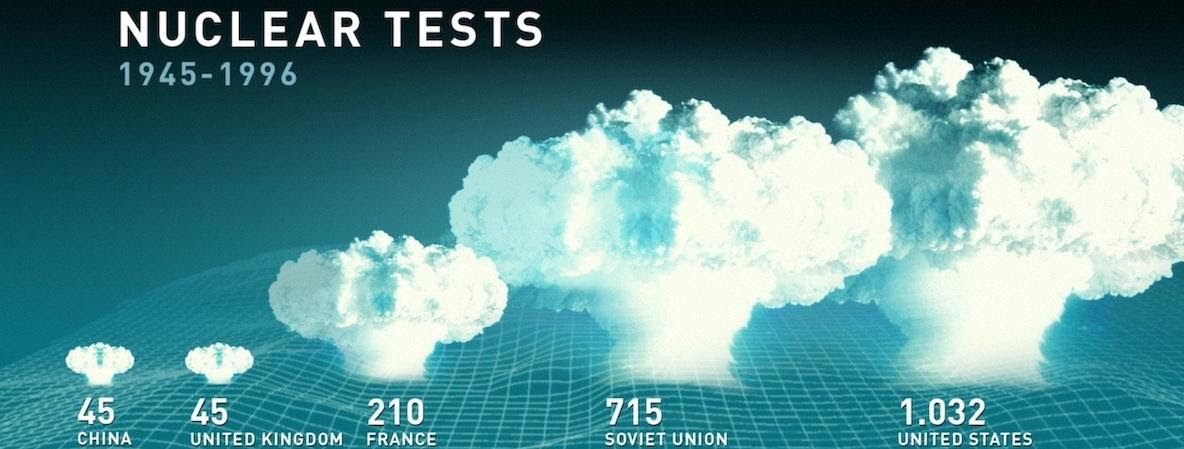
UNITED NATIONS (AP) – With the U.S., Russia, China and other countries that have nuclear weapons refusing to ratify the treaty that bans atomic testing, the United Nations warned on Monday that any new test could trigger another arms race.
U.N. disarmament chief Izumi Nakamitsu told the U.N. General Assembly that it was meeting to mark International Day against Nuclear Tests at a time of “deep geopolitical tension, growing division and diminishing trust,” as well as concern about the possible resumption of testing.
Late last year, the United States and Russia, which have the world´s largest nuclear arsenals, threatened to resume nuclear testing, setting off global alarm bells. President Donald Trump accused Russia and China of conducting tests, which they deny………………………………………………………………………………………https://www.dailymail.com/wires/ap/article-16094507/UN-spotlights-nuclear-weapon-states-refusal-ratify-test-ban-treaty-divisive-time.html
‘Bloodthirsty Psychopath’ Ben-Gvir Touts 2 Viewing Booths at Gallows for Palestinians

. The legislation changes the rules governing Israeli military courts in the illegally occupied West Bank so that the death penalty effectively applies only to Palestinians who kill Israelis.
Far-right Knesset members, including Ben-Gvir, wore noose-shaped lapel pins to show their support for the legislation. Ben-Gvir also handed out sweets to Knesset colleagues after the bill passed its first reading.
The vice president of the European Parliament condemned what she described as “a horrific spectacle that turns the death penalty into a show.”
by Brett Wilkins | Aug 21, 2026
Still drawing international censure for his genocidal call to kill dozens of Gazans daily, Israeli National Security Minister Itamar Ben-Gvir faced fresh condemnation Thursday after visiting the construction site of a gallows where Palestinians convicted of killing Israelis are set to be hanged to death, with select Israelis gathering as spectators.
Ben-Gvir, leader of the far-right Jewish Power party, posted a video to social media in which he gloats about the construction of gallows, which is being built in an undisclosed location in central Israel.
“I promised to worsen the conditions of terrorists in prisons – we kept it,” Ben-Gvir says in the video. “I promised to pass the Death Penalty for Terrorists law – we did. And now the death row and hanging facility are also starting to take shape.”
The law to which Ben-Gvir referred was passed in March by the Knesset – Israel’s parliament – and took effect the following month. The legislation changes the rules governing Israeli military courts in the illegally occupied West Bank so that the death penalty effectively applies only to Palestinians who kill Israelis.
Far-right Knesset members, including Ben-Gvir, wore noose-shaped lapel pins to show their support for the legislation. Ben-Gvir also handed out sweets to Knesset colleagues after the bill passed its first reading.
Ben-Gvir said the execution site would include viewing booths where victims’ families could watch executions, describing this as something customary in various countries and specifically citing the United States as an example.
“Terrorists deserve only one thing – death by hanging,” said Ben-Gvir, who in 2007 was convicted by an Israeli court of inciting racism and supporting a terrorist organization, whose leader he has openly honored.
Abdullah al-Zaghari, head of the Palestinian Prisoner Society, urged “effective international action” in response to Ben-Gvir’s comments. Al-Zaghari told Anadolu that the minister’s visit to the gallows site was part of the “continued determination of the Israeli occupation system” to codify incitement against Palestinians.
Leftist Israeli Knesset lawmaker Ofer Cassif excoriated Ben-Gvir’s actions.
“This criminal thug – a sympathizer of murderers of Palestinians, a supporter of terror, and a pathological racist – is also hopelessly infantile,” Cassif told The New Arab on Wednesday. “Soon we will oust him from the government, and next, throw him behind bars.”
European Parliament Vice President Pina Picierno accused Ben-Gvir of staging “a horrific spectacle that turns the death penalty into a show.”
The liberal US pro-Israel group J Street asked on X, “Are we supposed to believe, as some in the Jewish establishment would like us to, that Ben-Gvir’s words somehow tell us nothing about the country he helps govern?”
“He is Israel’s national security minister, and he is now celebrating a facility built to execute Palestinians while Jewish extremists are excluded from the law,” the group added. “As the old saying goes: When someone tells you who they are, believe them. When a government gives someone this much power, we have to reckon honestly with the agenda they are pushing.”
Ben-Gvir – who is under sanctions and banned from countries including Australia, Canada, New Zealand, Norway, and the United Kingdom for inciting violence against Palestinians in the West Bank – was still being denounced on Wednesday for advocating the daily mass killing of Palestinians, including civilians, in Gaza amid a nearly three-year war that United Nations experts, human rights groups, a South Africa-led case currently before the International Court of Justice, and many others call a genocide.
Stéphane Dujarric, spokesperson for United Nations Secretary-General António Guterres, said Wednesday – which was World Humanitarian Day – that Ben-Gvir’s “remarks are appalling, they’re outrageous, they’re dehumanizing, they’re dangerous, and we condemn them unequivocally.”
A spokesperson for German Chancellor Friedrich Merz said Wednesday in Berlin that Merz “strongly condemns Minister Ben-Gvir’s inhumane statements, which violate international law – they are unacceptable.”
“As the occupying power, Israel must treat Palestinians with dignity, protect their property, and ensure public administration and humanitarian aid,” the spokesperson added.
French Foreign Minister Jean-Noël Barrot called Ben-Gvir’s remarks “unbearable and inhumane,” adding that “further sanctions could be imposed, and all options are on the table.”
In the United States, actor and activist Mark Ruffalo said Thursday on Bluesky that “Ben-Gvir is a bloodthirsty psychopath, war criminal, and one of Israel’s beloved genocidal leaders.”
“America and the world should be sanctioning, divesting, and boycotting Israel in every way until this apartheid regime falls,” he added.
The law to which Ben-Gvir referred was passed in March by the Knesset – Israel’s parliament – and took effect the following month. The legislation changes the rules governing Israeli military courts in the illegally occupied West Bank so that the death penalty effectivelyapplies only to Palestinianswho kill Israelis.
Far-right Knesset members, including Ben-Gvir, wore noose-shaped lapel pins to show their support for the legislation. Ben-Gvir also handed out sweets to Knesset colleagues after the bill passed its first reading.
Ben-Gvir said the execution site would include viewing boothswhere victims’ families could watch executions, describing this as something customary in various countries and specifically citing the United States as an example.
“Terrorists deserve only one thing – death by hanging,” said Ben-Gvir, who in 2007 wasconvictedby an Israeli court of inciting racism and supporting a terrorist organization, whose leader he has openly honored.
Abdullah al-Zaghari, head of the Palestinian Prisoner Society, urged “effective international action” in response to Ben-Gvir’s comments. Al-Zaghari told Anadolu that the minister’s visit to the gallows site was part of the “continued determination of the Israeli occupation system” to codify incitement against Palestinians.
Leftist Israeli Knesset lawmaker Ofer Cassif excoriated Ben-Gvir’s actions. Cassif toldThe New Arab on Wednesday:
Walt Zlotow -Trump first president in America’s 251 years to preside over 2 lost wars

Walt Zlotow West Suburban Peace Coalition Glen Ellyn IL .30 Aug 26
President Trump loves to brag he ended 8 wars. The truth is a tad darker. He’s presiding over the lost US proxy war in Ukraine to destroy Russia. At the same time he’s presiding over the lost war to destroy Iran in the Middle East on behalf of Israel.
Trump didn’t start the Ukraine war. He correctly blamed predecessor Joe Biden for provoking it on his watch in February 2022. Said it wouldn’t have occurred if Biden hadn’t stolen the 2020 election from him. That’s a wild claim as Trump spent the preceding term arming Ukraine to smash the Ukrainian separatists in Donbas and promoting NATO membership for Ukraine. Both actions were instrumental in Russia’s eventual invasion under Biden.
When reelected in 2024, Trump boasted he’d end the war on day one of his second term. Five hundred, eighty days on, Ukraine is a mere rump state largely land locked and near collapse. Trump has done nothing to end Ukraine’s impending defeat. Just the opposite. He’s still supporting Ukraine with intelligence to fire missiles and drones into Russia having no strategic value promoting victory whatsoever. He’s still selling weapons to NATO to gift Ukraine in their futile effort to stay in the fight.
Trump’s impending defeat in the Iran war is even more catastrophic. This war is all on Trump. He made the biggest foreign policy blunder in US history by believing Israeli war whisperer Benjamin Netanyahu that Iran would collapse within a couple of days if only Trump would assassinate Iran’s supreme leader Ali Khamenei.
That two day victory expectation has turned into a six month catastrophe, not only for the US military, but possibly also for the world economy unless Trump admits defeat and settles on Iran’s sensible terms.
Two wars, one Trump helped facilitate in his first term, then prolonged in his second term into certain defeat. The second he started all by his demented self whose dire consequences have yet to be sorted out.
Trump’s two lost wars in term two…a dubious presidential achievement, unprecedented and likely never to be repeated or topped in US history.
Autonomous Weapons and Killer Robots: New Warnings, Old Habits
1 September 2026 Dr Binoy Kampmark AIM Extra , https://theaimn.net/autonomous-weapons-and-killer-robots-new-warnings-old-habits/
Another bleak warning, another round of Cassandra calls about humanity’s immaculate sense of destructive self. This month, the UN Secretary-General António Guterres and the head of the International Committee of the Red Cross and Red Crescent (ICRC) Mirjana Spoljaric Egger issued a joint appeal stating that, “We are now dangerously close to crossing a moral red line: the autonomous targeting of humans by machines.” Both insist that two types of autonomous weapons – unpredictable autonomous weapons and anti-personnel weapons – be prohibited.
In Geneva, the chief of disarmament affairs at UN Geneva, Mélanie Régimbal, held up the fort by reiterating the position taken by the UN that systems selecting or engaging targets and taking human lives in the absence of control and judgment “are politically unacceptable, morally repugnant and should be prohibited under international law.”
Laurent Gisel, head of the arms and the conduct of hostilities division at the ICRC, also spoke from Geneva, describing conflict as “not a story of precision, distinction and restraints” but one “of civilians killed, families displaced, hospitals, schools and homes destroyed at ever greater speed and scale.” In the thick fog of conflict, many variables could come into play. “A combatant can surrender or be wounded and therefore be protected from attack; civilians can enter the area of operations of the autonomous weapons systems; the weapons may encounter a situation that would not have been anticipated.” The dangers of unpredictability in such autonomous systems was hugely problematic. “If it’s not possible to predict it, then how is it possible to limit it?”
These are not remarkable warnings. The UN and ICRC had issued a joint appeal on the subject in 2023, calling upon States to negotiate a legally binding document by 2026. At the level of civil society, the Stop Killer Robots coalition was formed in October 2012 and publicly launched in 2013. The campaign, according to the group, focuses on fostering a world where “we respect each other’s inherent dignity”; take responsibility for choices regarding technology and how it alters the relationships between humans; develop technology to promote peace, justice, human rights, equality and respect for law; and where people work as activists “to build a society and overcome inequalities and systems of oppression.” This is fairly airy stuff, but central is the goal of developing and fortifying “social norms that reject autonomous killing by machine [sic] in warfare, policing, border control and other circumstances.” Control, responsibility, accountability are fundamental features.
That campaign has not made much meaningful progress of late. The faith placed by the military establishment in murderous machines remains an unshakeable one, with the idea of human control over decision making increasingly thinned in favour of the uncritical human consumer of data. That faith has effectively displaced the scrupulous, incredulous decision maker when it comes to acquiring and hitting targets. Within the first few weeks of the Gaza War, beginning on October 7, 2023, the Israeli Defense Forces (IDF) was making generous use of Lavender, an AI decision-support system (DSS) to generate 37,000 individual targets on a crude rating scale of significance depending on affiliations with armed groups. Other systems used in battle included The Gospel (Habsora), which generates target lists and Where’s Daddy?, a platform tracking the locations of individuals ahead of the strike. The resulting slaughter to scale tallied. Far from suggesting a seamless integration of human and machine, the IDF’s conduct suggests a misplaced optimism, and laziness, in deferring to the merits of a killing system.
The disagreement between the artificial intelligence firm Anthropic and the US Department of Defense over the dangerous limits of autonomous systems in war is another case in point. The falling out between the two players in the thanatotic economy was serious enough to see a concerted attempt by the Pentagon to blacklist the firm as a “supply-chain risk.” (This was found on August 27 by the US District Court of the Northern District of California to be an “unlawful retaliation” in violation of the First Amendment and a denial of due process as protected by the Fifth Amendment.) That falling out, however, is not necessarily a boon for those favouring limits on killer robots or fully autonomous military platforms.
In a February 2026 statement, Dario Amodei, the company’s co-founder, conceded that the Pentagon, “not private companies”, made military decisions. “We have never raised objections to particular military operations nor attempted to limit our technology in an ad hoc manner.” Amodei, however, considers himself a politically sentient being, which begs the question as to why he is at the vanguard of denuding humanity’s role in making decisions, notably through encouraging Large Language Models (LLMs) that remove initiative, industry and inventiveness. AI, he claims, can “undermine” democracy, a goal he seems to be pursuing himself. Of personal concern was the use of the company’s technology for mass domestic surveillance, which presented “serious, novel risks to our fundamental liberties” and the use of fully autonomous weapons “that take humans out of the loop entirely and automate selecting and engaging targets.” But even here, his quibbles are brittle, given an admission that fully autonomous systems “may prove critical for our national defense.” The concern, it would seem, lay in the reliability of the systems available and whether they would harm American personnel. “We will not knowingly provide a product that puts America’s warfighters and civilians at risk.”
Two days after Amodei’s statement, the pre-emptive, joint illegal attack on Iran by the US and Israel commenced, seeing yet another gluttonous use of AI DSS. Targets were generated at speed by the US military’s resort to Palantir’s Maven Smart System, which integrates Anthropic’s Claude AI to assess surveillance data, generate lists of targets and prioritise them. “Many of the targets hit in Iran,” writes Noor Hammad of the International Institute for Strategic Studies (IISS), “have been civilian, including a school and healthcare and residential facilities, illustrating the risks of rapid target generation.” Think tankers can always be relied upon to offer the understatement and euphemism in equal measure.
Gisel has told reporters that there is, as things stand, no “confirmed evidence that autonomous weapons have been used to directly target human beings in the battlefield.” This is a distinction with little difference, given the deferential attitudes shown by the technology fetishists in the IDF, the Pentagon and other militaries. If the system says so, it must be right. There is also a risk that these calls for restraint and a legal system of control will simply fatten the detritus of worry without effect. Ahead of the seventh Review Conference of the Convention on Certain Conventional Weapons (CCW) taking place in November, the human species is unlikely to take a pathway that does not first imperil it before seeking, irretrievably, to bottle the escaped genie. From the creation of atomic weapons to the threats of climate change, the worst will always come before any touted panacea. And that panacea, when it appears, is likely to be a mere palliative.
Inquiry into AUKUS – final public hearing today

3 September 2026 AIMN Editorial, https://theaimn.net/inquiry-into-aukus-final-public-hearing-today/
Australia’s independent, crowdfunded Public Inquiry into AUKUS concludes its public hearings today in Canberra, with presentations from Andrew Wilkie, the Hon Kim Beazley AC, Dr Michael Keating, Jon Stanford and Dr Emma Shortis amongst many others.
A huge number of Australians – including a Prime Minister, Foreign Affairs and Defence Ministers, senior academics and military experts, community groups and citizens – have presented to the Inquiry across 10 day-long hearings in 8 cities around Australia over the last 12 weeks.
Up to 1,500 people a day have watched the live-streams of proceedings.
Over 800 written submissions have been received.
$200,000 has been raised by crowdfunding, from other individual donors and from civil society organisations, in order to hold the inquiry.
AUKUS Public Inquiry Lead Commissioner Peter Garrett said today that the public hearings have been an extraordinary exercise in real world democracy.
“Everyone associated with the Inquiry has found this process of community outreach and participatory democracy genuinely inspiring.
“It has been many years since Australia has seen something like this.
“The inquiry has asked many questions that the public desperately need answers to, particularly the most pressing one: will AUKUS actually keep us safe and at what cost?”
The Commissioners will draft a comprehensive report which will be presented at the National Press Club in early November.
Livestream of today’s proceeding here
Thank Trump for This: He Has Exposed the Leaking Guts of the War Machine

Every child in the US has a story of this sort, a rendezvous with military propaganda (disguised as amusement)
American warfare since Vietnam has aspired to be fought by gadgets that attack civilians from the sky.
Vietnam exposed a quiet ambivalence in public opinion—the American people have no stomach for massive body counts of US soldiers, and yet poll after poll reveals an atavistic longing for military strength.
There is, however, a new and sudden trickle of hope—Trump’s ham-fisted version of imperialism allows for the public to witness the unflattering inner machinery, the leaking guts of the wounded military organism. The ongoing war in Iran offers something brand new—a nation with a $9 billion military budget has just thrashed a country with a trillion dollar war budget.
As Trump’s approval ratings crater due to his war on Iran, there may never have been a time in US history so ripe for an attack on military spending and militarism.
Phil Wilson, Aug 28, 2026, Common Dreams, https://www.commondreams.org/opinion/trump-exposes-war-machine
Forget about Ancient Sparta, Attila the Hun, Hernán Cortés, Julius Ceasar, Alexander the Great, Adolf Hitler, and all of the conquerors that terrified the world with colonial aspirations and a psychopathic lust for blood. None of these ever imagined a $1.5 trillion military budget. President Donald Trump requested that grotesque figure, but don’t give him the kudos—our “fois gras” military machine is a US tradition that predates us all.
The US war machine has scaled Orwellian heights to achieve a virtual blank check to spend on death. For we, stateside, have built a culture entirely at the service of warfare, with myths, stories, and platitudes hardwired into the brains of 349 million people extolling war, not as a necessity, but as ritual, as cleansing, as meditation, and as redemption. We are bombing schools and hospitals to secure the rapture, for the war industry in the apocalyptic end times has been tasked with the creation of biblical events. A recent Huffpost piece by Brandi Buchman quotes US soldiers’ allegations of lunatic fringe Evangelical propaganda from haranguing superiors:
They (US soldiers) are promised a 200-mile-long river that is four-and-a-half feet deep filled with nothing but the blood that their weaponized version of Jesus will spill at the Battle of Armageddon.
Thus, war in the Middle East has morphed from the sterile narrative of fighting for freedom and democracy, to the more spectacular notion that US military force has been mobilized to serve Christian prophecy. A military budget cannot achieve the pinnacle of a trillion dollars without a highly evolved story telling industry to prime the population to either enthusiastically back each aggressive nationalistic paroxysm of violence, or to (at the very least) passively capitulate. Think of the advent of apocalyptic biblical warfare as a means of addictive escalation—the nation has gone from coffee and cigarettes to cocaine and crystal meth.
No other era has been forced to see war with the unflinching clarity that this moment demands.
The war propaganda machine in the US is a ceaseless, multifaceted contraption that includes legacy media, the educational system, and the entertainment industry. A nation does not eviscerate tens of millions of “enemy” civilians without first laying a meticulous foundation of brainwashing. I can run the tapes backward to a moment in my own childhood, riveted to the black and white TV absorbing the 1955 Disneyfied tale of Davey Crockett at “The Alamo.” There is Davey outsmarting a gambler, beating up an “Indian,” and bringing both along as conscripts to fight for an Independent Texas. Crockett met his end at the Alamo, but the manner of his death will never be resolved. Did he surrender to Mexican forces (and face execution) or did he die fighting to the death, wielding his exhausted rifle like a club, and falling from a bullet while standing on a hill comprised of Mexican corpses? Of course, the Disney version has Davey Crockett swinging his rifle madly against a vast onslaught of faceless Mexican soldiers as the background song plays out:
The story books say they were all cut low.
But the truth of it is that this just ain’t so,
The spirits will live and their legends grow,
so long as we remember the Alamo.
The film ends with the inscription: “March, 6, 1836, Liberty and Independence Forever.”
Regarding the Alamo, Raul Ramos wrote (in the context of the 2019 effort to remove confederate monuments):
It’s not that the Spanish-built presidio should be demolished or stashed away in some remote museum. The story of the Alamo should be widely studied—but it should be the real history, the one that intersects with and embodies the nation’s history of enforcing a racial order through violence, and the campaigns of white supremacy and slavery that accompanied America’s expansion. The Alamo’s history and myth belong to a war that was inspired, in part, by the drive for slavery, and by a belief in the superiority of whites and their divine right to conquer lands. The Alamo is where the campaign of southern slavery and Native American genocide migrated west and expressed itself in the demonization of Mexicans. It came to symbolize belonging, or, more accurately, defining who belongs and who doesn’t. Rather than being remembered for its historical context, the Alamo represents a litmus test for entry into participation and membership in civic society: Accept the dominant myth, or be marginalized.
The Alamo became a rallying cry, a foundational component of the emerging concept of “manifest destiny”—the ideological core of the most expansive colonial settler state in all of history. But for me it is personal—Davey Crocket at The Alamo inducted me into US war culture at the age of 7. I had my faux coon skin cap, my “smoke gun” that emitted a loud crack and a puff of smoke. The cocking mechanism on this “toy” sometimes snapped shut violently, and many children endured a trip to the ER to have a few stitches to repair a bloody thumb. I remember that well 71 years later.
Every child in the US has a story of this sort, a rendezvous with military propaganda (disguised as amusement) at a defenseless early age. War is implanted into our fragile subconscious at the very dawn of our awareness. But we are not largely destined to embrace warrior culture in the sense of the mythical Davey Crockett, but, rather, we have been trained to get out of the way. American warfare since Vietnam has aspired to be fought by gadgets that attack civilians from the sky. For most of us military patriotism means politely deferring to veterans with a muttered, “Thank you for your service.” We who do not enlist balance personal fear with the idea that war participation manifests the purest virtue.
Vietnam exposed a quiet ambivalence in public opinion—the American people have no stomach for massive body counts of US soldiers, and yet poll after poll reveals an atavistic longing for military strength. . A Gallup poll taken last February showed that 64% of respondents felt that it was important for the US to have the most powerful military on Earth. While the US military budget is larger than the combined military budgets of the next nine highest spending nations, Gallup polling seldom shows more than a third of people complaining that spending is too high.
The public is little more than a shadow of the media culture. In 2014 William A. Galston lamented about President Barack Obama’s minor military funding cuts in a piece posted on The Brookings Institute (a centrist, Democratic Party-adjacent think tank) website. Sen. Bernie Sanders’ (I-Vt.) recent proposal to cut military spending by a token 10% fell 88-11 in a Senate vote in which both parties reflexively succumbed to orthodox US jingoism. War is not a partisan issue. We all come together to praise and feed the military. US political performance art might be seen as a slavish competition to grovel before the war industry.
There is, however, a new and sudden trickle of hope—Trump’s ham-fisted version of imperialism allows for the public to witness the unflattering inner machinery, the leaking guts of the wounded military organism. The ongoing war in Iran offers something brand new—a nation with a $9 billion military budget has just thrashed a country with a trillion dollar war budget. The US defeat at the hands of Iran is unprecedented—while the US hasn’t won a significant war in 80 years, we have never suffered a defeat with comparable financial consequences. The Iran war, according to Reuters, has a disapproval rating of a staggering 63% of the electorate. The economic fallout from the bungled attack on Iran threatens to escalate to the point of financial collapse in future months. We all live within walking distance of a filling station offering $6 diesel—and that runaway price will almost certainly expand and double, threatening to strangle the US commercial transport system. Mass hunger looms.
We also have American Israel Public Affairs Committee approval ratings at an all-time low and Trump’s approval ratings at catastrophic and utter decline—ostensibly due to his war in Iran. There may never have been a time in US history so ripe for an attack on military spending and militarism.
War once had such an esteemed role in human progress that even the peaceful transcendentalist, Ralph Waldo Emerson, could not wholly dismiss its virtues:
The student of history acquiesces the more readily in this copious bloodshed of the early annals, bloodshed in God’s name too, when be learns that it is a temporary and preparatory state, and does actively forward the culture of man. War educates the senses, calls into action the will, perfects the physical constitution, brings men into such swift and close collision in critical moments that man measures man. On its own scale, on the virtues it loves, it endures no counterfeit, but shakes the whole society, until every atom falls into the place its specific gravity assigns it.
Emerson believed that war would become obsolete, but I doubt that anyone from the mid 19th century could have imagined that war would one day be the cornerstone of societal and biological collapse. No other era has been forced to see war with the unflinching clarity that this moment demands.
War elevates the need for oil and oil demands war. The oil industry, the military-industrial complex, Big Tech, and mass media have all been structurally conjoined at the intersection of war. War is where capitalist profits interface with mass psychology.
But the gig is up. Public opinion has shifted as Trump and his goons have driven the war machine off of a cliff.
Climate sustainability abides no compromise with war. We are on the cusp of extinction, and war is the primary driver. The US, under Trump, has taken war out of the closet and decoupled it from its patriotic slogans and jingoistic habits. It’s all about the oil, stupid. War has followed the magnet of fossil fuels unerringly to the Middle East. And to compound the predicament, war is environmentally filthy, annually burning more fossil fuels in aggregate than most nations. The US military coughs as much CO2 into the atmosphere yearly as the nation of Portugal. War is also the gauge of our fossil fuel addiction, for US leaders have spent decades murdering millions to procure it.
We all have our psychological histories, our childhood encounters with Disney’s Alamo, with the domino theory, with Saddam Hussein’s invisible weapons of mass destruction. We have reverentially gawked at our father’s and grandfather’s WWII uniforms hanging in the attic, but we all need to thank Trump for creating history’s most transparent war machine. The US military needs to be gutted, cut out like a metastasizing lesion. The patient heaves at death’s door. Do we merely watch?
The Transnational Technocratic Machine: Class War Behind The Flags
One Supply Chain, Multiple Flags
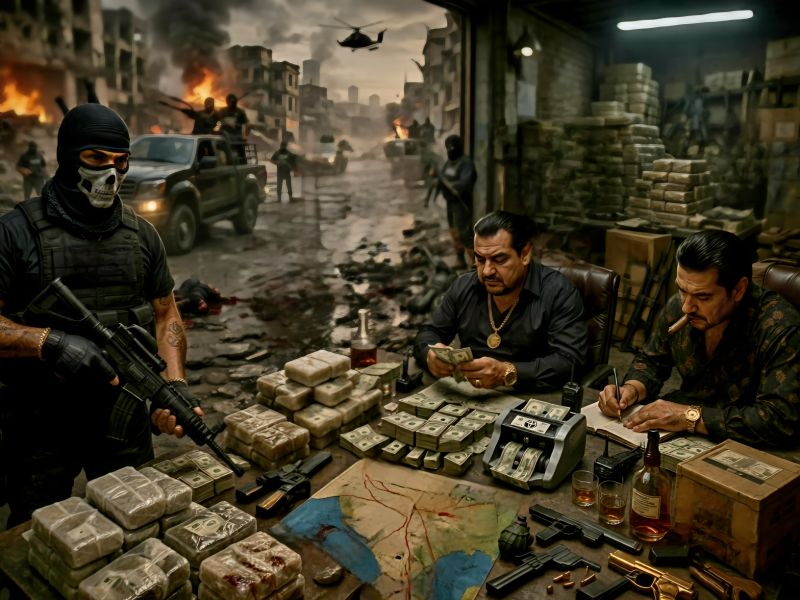
Military budgets in 2026 remain enormous. The U.S. national-defense request approached or exceeded $1 trillion when reconciliation and related measures are included (with the formal DoD request at roughly $961.6 billion). China’s official 2026 defense budget stands at approximately 1.94 trillion yuan, with central-government expenditure of roughly 1.91 trillion yuan—about a 7% increase. Russia’s 2026 military expenditure is budgeted at approximately 14.9 trillion rubles, equal to about 6.3% of GDP, according to SIPRI analysis of the wartime economy. Iran operates with a fraction of those resources but invests heavily in relatively inexpensive drones, missiles, and asymmetric systems.
These numbers are presented as national strength. In practice they recycle capital through the same commercial layers…….. The originating firm often never sees the final military end-user. The profit has already been taken at the commercial stage.
The technocratic class that designs the chips, owns the foundries, finances the distributors, and staffs the regulatory bodies benefits whether the final buyer is a Western defense prime, a Chinese state-linked enterprise, a Russian wartime manufacturer, or an Iranian procurement network.
Gloria Guillo, Tortilla con Sal., August 31, 2026, https://www.tortillaconsal.com/bitacora/node/10200
How a Shared Global Technology Supply Chain Serves Transnational Elites Against Workers Everywhere
The story sold to populations is that the United States, China, Russia, and Iran are locked in geopolitical rivalry, each building separate military-industrial systems to confront the others. That narrative conceals the deeper structure. The weapons carry national markings. The technological base that makes them possible does not. Semiconductors, sensors, power electronics, microcontrollers, RF components, machine tools, and industrial equipment move through the same global commercial networks. Components pass through distributors, brokers, front companies, and third countries before they appear in missiles, drones, radar, or electronic-warfare systems on every side.
What looks like interstate competition is better understood as a transnational class project. A layer of technocrats—executives in semiconductor firms, private-equity and defense-finance networks, logistics conglomerates, and the political managers who write export rules and sanction lists—operates across borders. Their interest is not the security of any particular population. It is the continuous expansion of high-margin dual-use technology markets, the extraction of surplus from workers who fabricate and assemble the components, and the management of scarcity and conflict that keeps demand high. Workers in Taiwanese fabrication plants, Chinese assembly lines, American distribution warehouses, Russian military factories, and Iranian workshops are all inputs to the same circuit. The impoverished in every country pay the taxes, endure the austerity, and absorb the destruction when those circuits feed actual shooting wars.
One Supply Chain, Multiple Flags
Military budgets in 2026 remain enormous. The U.S. national-defense request approached or exceeded $1 trillion when reconciliation and related measures are included (with the formal DoD request at roughly $961.6 billion). China’s official 2026 defense budget stands at approximately 1.94 trillion yuan, with central-government expenditure of roughly 1.91 trillion yuan—about a 7% increase. Russia’s 2026 military expenditure is budgeted at approximately 14.9 trillion rubles, equal to about 6.3% of GDP, according to SIPRI analysis of the wartime economy. Iran operates with a fraction of those resources but invests heavily in relatively inexpensive drones, missiles, and asymmetric systems.
These numbers are presented as national strength. In practice they recycle capital through the same commercial layers. A processor or power-management chip does not know whether it will end in a consumer device or a guidance package. The same is true of sensors, memory, connectors, and machine tools. Once a component leaves the factory, layers of intermediaries can move it across sanctioned and non-sanctioned jurisdictions. Documented cases show U.S.-origin electronics reaching Iranian UAV and missile programs through Chinese and Hong Kong fronts (DOJ indictment of Chinese nationals), with parallel patterns for Russian systems and repeated Treasury designations of procurement networks involving China, Hong Kong, and other transit points. The originating firm often never sees the final military end-user. The profit has already been taken at the commercial stage.
This is not a conspiracy of one secret corporation. It is the ordinary functioning of a globalized production system in which dual-use technology is the most valuable commodity. The technocratic class that designs the chips, owns the foundries, finances the distributors, and staffs the regulatory bodies benefits whether the final buyer is a Western defense prime, a Chinese state-linked enterprise, a Russian wartime manufacturer, or an Iranian procurement network. National flags provide the political cover; class interest provides the continuity.
Workers as the Common Exploited Base
The labor that produces these components is performed by workers whose wages, conditions, and political power are systematically subordinated. Fabrication, packaging, testing, and logistics are concentrated in locations chosen for cost and control. The U.S. Government Accountability Office has documented that the Department of Defense relies on more than 200,000 suppliers and cannot fully identify where all of the microelectronics in the products it purchases are manufactured. According to Defense Department estimates cited by GAO, approximately 88% of microelectronics production and 98% of semiconductor assembly, packaging and testing occur overseas, primarily in Taiwan, South Korea, and China.
That overseas dependence is not an accidental vulnerability; it is a feature that allows capital to discipline labor by threatening relocation or by pitting workforces against one another under the banner of national competition. When governments announce new defense spending, the immediate beneficiaries are the contractors and their financiers. The money then flows downward into subcontractors, component makers, chemical suppliers, and logistics firms—extracting value at every step while the social costs of militarization (debt, inflation, environmental damage, and eventual battlefield casualties) fall on broader working populations.
Sanctions and export controls are presented as tools of national security. In practice they function as instruments of selective scarcity. They raise the price of dual-use goods, create rents for those who can navigate the gray markets, and force poorer states or sanctioned populations into more precarious procurement channels. The same networks that move restricted electronics also move the profits upward. Workers in the sanctioned economies face shortages and intensified exploitation; workers in the sanctioning economies face higher taxes and the ideological demand to identify with “their” military-industrial complex. The technocratic layer remains insulated.
Opacity as Class Power
Supply-chain visibility is weak even inside the largest military systems. The inability of major defense bureaucracies to map every microelectronic origin is not merely bureaucratic failure. Opacity protects the circulation of dual-use technology and the intermediaries who profit from it. When diversion occurs through shell companies and false end-user declarations, the system continues to function for capital while the political narrative of “adversaries” is maintained for domestic audiences. The real common denominator is not shared nationality but shared dependence on a commercial technology base controlled by a narrow transnational stratum.
Disrupting the Machine Means Disrupting Class Power
If the shared technological substrate is what enables large-scale militarization across rival states, then genuine disruption of war requires breaking the class monopoly over that substrate. Nationalist solutions—more sanctions, more domestic production under the same ownership structures, more spending funneled to the same contractors—reproduce the circuit. They merely rearrange which faction of capital captures the rents.
A class-oriented approach starts from the opposite premise: the workers who design, fabricate, assemble, transport, and maintain the dual-use base have no objective interest in feeding any military-industrial system. Their interest lies in converting that productive capacity toward social needs and in denying its conversion into instruments of destruction. That requires transparency forced from below, refusal of dual-use labor discipline, international coordination that ignores official enemy lines, and collective control over the lower tiers of the technological pyramid—the machine tools, specialized materials, and distribution nodes that currently serve capital’s ability to arm multiple sides.
The flags will continue to wave. The budgets will continue to be justified in the language of national survival. But the underlying circuit is class power operating through technology. As long as a transnational technocratic layer can move dual-use components across borders while workers on every side remain divided by nationality and subordinated by wage discipline, the capacity for industrialized war remains intact. Breaking that capacity means treating the supply chain not as a national security problem but as a site of global class conflict—technocrats and their state managers on one side, the workers who actually produce the material basis of modern warfare on the other.
Why the clean energy transition needs information integrity

by Juan Pablo Medina Bickel, Dido Gompertz, Sebastian Kiecker, 25 Aug 2026,
https://www.e3g.org/news/why-the-clean-energy-transition-needs-information-integrity/
The energy transition is accelerating, with renewable energy generation continuing to break records. Yet this is taking place in an increasingly contested information environment – one in which information manipulation can shape public perceptions, political discourses and ultimately the conditions for climate action.
This matters because climate and energy policy are politically sensitive. They are particularly vulnerable to attempts to influence public opinion, as it runs counter to the interests of political and economic incumbents benefiting from the fossil fuel economy. Rapid advances in generative AI and increasingly sophisticated digital tools are also lowering the cost and increasing the scale and speed at which misleading content can be produced and distributed.
Climate disinformation deliberately seeks to obstruct or delay climate action. At a time when the cost of living dominates headlines and public concerns, climate disinformation spreads misleading narratives or falsehoods about the affordability and reliability of renewable energy, from technical claims about inefficient infrastructure design and deployment to macroeconomic arguments about excessive state support and related fiscal burdens. The influence of these claims often relies on emotional manipulation that aligns with personal beliefs. As a common tactic, disinformation seeks to erode trust in scientific climate consensus to discredit climate policy itself.
Information integrity as a key solution
Beyond countering individual pieces of mis-or dis-information we need an information environment where civil society businesses and policymakers can access, understand and trust the information they need to make decisions about the energy transition. Information integrity enables access to reliable information about climate change and action. It also aims to protect scientific consensus by strengthening communication strategies and information channels that expose and counter information manipulation.
Despite the complex challenges that climate-related information integrity faces in today’s global political environment, the agenda is increasingly moving from the margins to the mainstream.
Turning global discussion into actions
At the international level, Brazil, the United Nations and UNESCO launched the Global Initiative for Information Integrity on Climate Change at the G20 Leaders’ Summit in Rio de Janeiro in 2024. The initiative aims to strengthen research and action addressing climate disinformation and to support more reliable information environments.
At COP30 in Belem, the Declaration on Information Integrity on Climate Change was launched, establishing shared commitments to address climate disinformation and promote accurate, evidence-based information. The UNFCCC has subsequently described information integrity as central to effective climate action, highlighting the importance of reliable, science-based nformation for public trust, civic engagement and informed decision-making.
This is an important shift. Alongside its impact on communications in general, information integrity is increasingly recognised as part of the enabling infrastructure for climate action.
The economics of the transition are changing the information landscape
One of the most powerful ways to strengthen the information environment is also one of the simplest: ensuring public conversation reflects the rapidly changing reality of the energy system. Clean energy is now widely recognised as the most cost-effective power source in most of the world, playing a key role in bolstering national energy security amid volatile oil and gas markets. Despite growing political and economic headwinds against renewables, the strong deployment of renewable energy provides factual arguments to counter affordability and energy-security disinformation campaigns.
This does not mean that every renewable project is cheap, that deployment is frictionless, or that legitimate concerns about grids, permitting, supply chains and financing can be dismissed. In fact, acknowledging these challenges is essential to maintaining trust. But it does mean that political discussions about the transition need to keep pace with the underlying economics
Businesses are already responding to this changing landscape, including US investors. In a recent global business leader poll, 91% of executives say renewables-powered electrification would improve energy security, while 79% say geopolitical instability has made their own business shift to electrification more urgent.
Civil society at the heart of the solution
Academics, think-tanks, and NGOs have become key partners to governments, corporates, and multilateral organisations to leverage information integrity for climate change and action.
They play a key role in monitoring and exposing falsehoods through campaigns to counter viral climate disinformation. Their work also seeks to bridge public perception gaps and serve as a preventive measure before people encounter disinformation. These include underscoring the robust scientific consensus on human-induced climate change (97%) and the often-overlooked global public support (89%) for governments to take stronger climate action.
Actions also include strategic communication, which covers the promotion of trusted messengers to bring accessible and comprehensible science to different audiences across platforms. Advertisement campaigns also provide diverse frameworks and methodologies to expose corporate greenwashing, as well as support communities in overcoming climate misinformation and endorse renewable energy projects.
Ensuring the agenda takes hold
Despite the growing momentum behind the global information integrity agenda, it is key to extend its reach beyond experts so that a resilient information environment with accessible and comprehensive scientific information guides public and political discussions. For this, information integrity should be widely recognised as a key component of the critical infrastructure supporting the clean energy transition.
Recent spaces like COP30 and the Climate Summit during the UN General Assembly High-Level Week 2025, and civil society platforms such as London Climate Action Week in 2026, have brought information integrity to the centre of the clean energy transition agenda. More of these are needed.
Advancing the information integrity and climate action agenda depends on coalitions of diplomats, policymakers, industry leaders, and civil society progressing evidence-based discussions. Such collaborations enable mutual learning and strategic partnerships to build a secure and expansive information ecosystem that supports a rapid and ambitious transition to renewables.
US Army to spend $2 bln on nuclear microreactors for bases

The Army program uses the military’s “deep pockets to provide a hidden subsidy” to nuclear companies that can’t find private-sector customers for their hypothetical and uneconomical reactors
DW Sean Sinico with AP, Reuters, August 27, 2026
The US Army has announced a plan to install what it calls nuclear microreactors at five of its bases across the country. The move would ensure the facilities’ energy independence from the rest of the electric grid.
The United States Army said Wednesday that it will award $2.2 billion (€1.7 billion) in contracts to five companies to build and operate small nuclear reactors on military bases. The program set a goal of deploying the first such reactor by the end of September 2028.
Called microreactors, developers say each of the nuclear plants would be easy to transport and provide up to 20 megawatts of power.
The reactors will adhere to all environmental and safety regulations that apply to commercial reactors, but an Army spokesperson said the reactors will be regulated by the Army rather than the US Nuclear Regulatory Commission, which regulates commercial reactors.
“The whole idea here is that at the back end of this we want a commercial product,” said Jeff Waksman, principal deputy assistant secretary of the Army for Installations, Energy and Environment.
Army Secretary Dan Driscoll said the awards will speed up the military’s ability “to deliver safe, reliable baseload power directly to our installations.”
“We are building the energy resilience necessary to project combat power globally, without relying on potentially vulnerable external grids,” he added………………………………………………………………………
‘Hidden subsidy’ for expensive reactors, critics say
Critics of microreactors say they will be expensive compared to conventional reactors. Safety advocates point out that nuclear technology carries significant risks that other low-carbon energy sources don’t, such as the danger of accidents or targeted attacks.
The Army program uses the military’s “deep pockets to provide a hidden subsidy” to nuclear companies that can’t find private-sector customers for their hypothetical and uneconomical reactors, Alan J. Kuperman, associate professor at the Lyndon B. Johnson School of Public Affairs at the University of Texas at Austin and coordinator of the Nuclear Proliferation Prevention Project, told the AP news agency.
The Army’s Waksman said nobody thinks that microreactors will be lower in cost than conventional plants.
“What we are trying to do here with Janus … is to flesh out how can we get those prices down,” he said.
What will happen with the radioactive waste?
Waksman said the microreactors would safely shut down in case of a failure and that the Army wouldn’t add them to installations without being certain they are safe.
He added that the Army is working on a deal with the Energy Department to remove radioactive waste, and there won’t be any long-term storage on these installations.
Last month, five states offered to accept nuclear waste in exchange for federal support in developing nuclear energy facilities.
Trump pushing nuclear power in US
Executive orders signed by US President Donald Trump in May 2025 aimed to accelerate the development of nuclear power. Trump has called for the US to quadruple its nuclear energy production — just two new large reactors have been built from scratch in the United States in nearly 50 years. Those two reactors were completed years late and at least $17 billion over budget, AP reported.
The nation’s 94 nuclear reactors supply about 19% of U.S. electricity, compared to about 60% for fossil fuels and 21% for renewables, according to the US Energy Information Administration. https://www.dw.com/en/us-army-to-spend-2-billion-on-nuclear-microreactors-for-bases/a-78518374
Nuclear regulator prepares to abandon a decades-old radiation safety rule
August 27, 2026, Geoff Brumfiel, NPR
The Nuclear Regulatory Commission is preparing to change a foundational rule designed to minimize radiation exposure. The update is part of President Trump’s expansive changes to nuclear oversight, as his administration seeks to revive nuclear energy to power data centers for artificial intelligence.
Under a new proposed rule, the agency is eliminating a 50-year-old standard known as “As Low As Reasonably Achievable” (ALARA), which requires the nuclear industry to drive radiation exposure for workers and the public below the stated limits where possible. The new rule also creates a carveout for some workers to get higher exposures to radiation in special circumstances.
For some, the elimination of ALARA is overdue. “Keeping doses as low as reasonably achievable was a fair idea,” said Emily Caffrey, a radiation health physicist at the University of Alabama at Birmingham. But in practice, the standard forced companies to take increasingly stringent radiation protection measures. It also created ambiguity, Caffrey said, “because what’s ‘reasonable’ to one person isn’t reasonable to another person.”
But others warn that the change could lay the groundwork for higher radiation exposures.
For some, the elimination of ALARA is overdue. “Keeping doses as low as reasonably achievable was a fair idea,” said Emily Caffrey, a radiation health physicist at the University of Alabama at Birmingham. But in practice, the standard forced companies to take increasingly stringent radiation protection measures. It also created ambiguity, Caffrey said, “because what’s ‘reasonable’ to one person isn’t reasonable to another person.”
But others warn that the change could lay the groundwork for higher radiation exposures.
Since shortly after the dawn of the nuclear age, scientists have been aware of the risks of radiation exposure, and decades of data makes it clear.
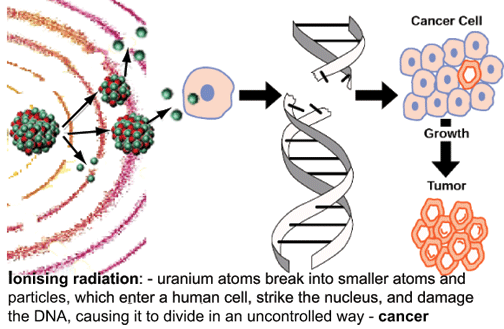
“At high radiation doses, nobody’s really arguing: radiation causes cancer,” said David Brenner, director of the Center for Radiological Research at Columbia University. High doses of radiation damage DNA and can cause mutations that lead to cancer. But when the dose is low, it’s much harder to determine risk because about 40% of the U.S. population develops cancer at some point in their lifetime.
“As you go down in dose, what you’re looking for is a very small increase in cancer risk over a very large background,” Brenner said. “That’s what makes it really, really hard.”
For the past 50 years or so, the Nuclear Regulatory Commission has dealt with this uncertainty by requiring that the nuclear industry adhere to ALARA and keep radiation exposure as low as possible.
Then last May, President Trump signed an executive order calling for a wholesale overhaul of nuclear regulations. The order specifically called out ALARA, claiming the principle was a “flawed” understanding of radiation risks.
The NRC decided not to change its scientific model of radiation risk, known as the Linear No Threshold model, but it has proposed eliminating ALARA.
Speaking this week on the Federal News Network, NRC Chairman Ho Nieh said that ALARA is no longer working…………………………………………………
“Loosey-goosey” rules
The NRC will instead use the existing current threshold of 5 rem for a worker and 0.1 rem for the public as the upper limit for radiation exposure. A whole body CT scan is about 1 rem, according to the EPA…………………………………
The proposed NRC rule doesn’t change its other regulatory limits, but it does create some carve-outs. In particular, the industry would now be able to ask for a “planned occupational dose limit extension,” which would allow workers to receive 10 rem instead of 5 in any given year, providing their overall exposure doesn’t pass 25 rem in a five-year period………………………………
But Lyman, with the Union of Concerned Scientists, thinks that ALARA should stay. He said while it may be imperfect, its net effect has been to reduce radiation exposure to very low levels. The harms of low-dose radiation exposure are difficult to see, but Lyman says NRC’s own models suggest those harms exist.
In his opinion, the revised rule ignores that risk and is designed to desensitize the public to the dangers of radiation. “It’s trying to devalue and deemphasize the harm of ionizing radiation exposure,” he warned. https://www.npr.org/2026/08/27/nx-s1-5920368/nrc-nuclear-radiation-safety-rules-alara-update
Evacuees from Fukushima nuclear meltdown reach settlement with Tepco

Aug 26, 2026, https://www.japantimes.co.jp/news/2026/08/26/japan/crime-legal/tepco-fukushima-settlement/
SAPPORO – A total of 176 people who fled Fukushima Prefecture following the March 2011 nuclear disaster have reached a settlement with Tokyo Electric Power Company Holdings in their damages lawsuit filed against the firm and the government.
The settlement was reached on Aug. 18 at the Sapporo High Court, according to lawyers for the plaintiffs.
All the plaintiffs withdrew their damages claims against the government. The decision came on the heels of the Supreme Court’s June 2022 ruling, and a series of similar court decisions that followed, that the government was not liable for the nuclear accident.
The plaintiffs evacuated from Fukushima Prefecture to Hokkaido in the wake of the triple meltdown at the tsunami-stricken Fukushima No. 1 plant.
Under the settlement, Tepco apologized for the irreparable damage the plaintiffs suffered because of the accident.
The settlement amount was not disclosed. The plaintiffs’ lawyers said the sum was “not sufficient but took into account their claims to a certain extent.”
Seiichi Nakate, head of the plaintiffs, and his family evacuated from the city of Fukushima to Sapporo in 2012.
“The settlement is far from enough to make up for our indescribable suffering, but we decided (to accept it) because we cannot endure any more exhaustion,” he said.
In its March 2020 ruling, the Sapporo District Court ordered the government and Tepco to pay about ¥53 million in total to some of the plaintiffs, finding both liable for the accident. The plaintiffs, Tepco and the government all appealed the ruling.
Ukraine’s Maidan Regime, Army, and People Are Not on the Same Page
Gordonhahn August 31, 2026
The recent two-day delay by Ukraine in extending state of martial law was largely the result of the need to adopt a reform of the Kiev’s brutal forced mobilization of men to fight in the beleaguered Ukrainian armed forces.
On April 27th the Rada passed an extension of martial law and military mobilization until August 2nd on the basis of the standard three-month term, and Zelenskiy signed the law the next day. But without redressing the population’s increasing alienation from the war effort and the regime as a result of coerced mobilization of men to fight at the front, some deputies were unprepared to pass the martial law resolution.
The violent recruitment process has included the killing and maiming of captured draft evaders, mass resistance against the mobilizers’ attempts to seize evaders, and even the use of firearms by both mobilizers and evaders resisting capture.
This has raised a firestorm of criticism, resentment, and anger teetering on the edge of open revolt among the public, forcing Ukrainian leader Volodomyr Zelenskiy, the government, and the Verkhovna Rada deputies to at least feign an attempt to right the situation. Even the police are now hated by the public for failing to protect citizens against the mobilizers’ violent methods and often siding with the latter. Many are asking why can not the Rada deputies, government ministers, their sons, the 120,000 police, and 100,000 mobilization center press gangs be subjected to the draft…………(Subscribers only) https://gordonhahn.substack.com/p/ukraines-maidan-regime-army-and-people
Experts: How Putin’s nuclear sub could decimate Britain
Daily Mail, By FRED KELLY, FEATURE WRITER, 28 August 2026
It weighs over 10,000 tons, it is 135 metres long, and it carries half a dozen two-megaton ‘Domesday’ torpedoes capable of triggering a radioactive tsunami large enough to ‘plunge Britain to the depths of the ocean’. No wonder the world held its breath last week as Russia’s latest nuclear-armed submarine departed Severodvinsk Port to begin trials in the White Sea, 140 miles from the Finnish border.
Named after Russian explorer Yerofey Khabarov, the Khabarovsk will now undergo rigorous testing before being considered fit for active service.
The 100-strong crew as well as a team of onshore engineers will stress-test everything from mooring protocols to propulsion, steering and diving capabilities, as well as the integration of sonar and onboard computing systems. The vessel is eventually expected to travel east to join Russia’s Pacific Fleet, which itself launched a series of missile tests last week from the disputed archipelago of islands north of Japan – triggering a major diplomatic incident.
So what would the Khabarovsk role be in a future conflict? Why is Russia spending a rumoured billion dollars on this vessel when its navy already boasts at least 60 active submarines?
And it is not the only one, it is just one of a mooted trio of new nuclear-armed subs that could be unleashed on the West.
While the design of the Khabarovsk is based on Russia’s Borei-A class nuclear ballistic missile submarines that are a cornerstone of Moscow’s nuclear deterrent, it is, in fact, a bespoke ‘special purpose’ vessel in a class of its own.
Khabarovsk is the first submarine designed with a widened bow to accommodate six Poseidon nuclear torpedoes, each measuring 20 metres in length, two metres in diameter and weighing 110 tonnes each. The only other submarine capable of launching these ‘Domesday’ weapons is the RFS Belgorod, which can carry three Poseidon torpedoes, half the number of the Khabarovsk.
Russia’s ‘Unstoppable’ Torpedo Threatens Britain
Unlike traditional surface-to-air missiles which risk being intercepted in the sky, Poseidon warheads travel underwater at speeds of roughly 70 knots, 1000 metres below the waves. And thanks to an onboard nuclear reactor that propels them, they have an essentially unlimited range. They aren’t just missiles but autonomous, manoeuvrable vessels in their own right.
The idea for Poseidon torpedoes was first conceived by Soviet engineers as far back as the 1950s, though the plans were scrapped as the technology did not exist to fit the weapons with their own propulsion system.
Unlike traditional weapons, the torpedoes are designed to self-detonate before reaching their target. It is not the blast itself that is the danger, but the subsequent tsunami of radioactive water triggered by the two-megaton bombs – more than one hundred times the strength of the Little Boy bomb dropped on Hiroshima.
And while countless thousands would no doubt be drowned in the initial surge or killed by collapsing buildings, the after-effects of the radioactive flooding would render any land within two hundred miles uninhabitable for generations and result in the deaths of millions.
No surprise then that the Kremlin believes Poseidon torpedoes are the future of its nuclear deterrent. Indeed, Dr Richard Connolly, a military expert on Russia and associate fellow at the Royal United Services Institute, describes Poseidon as a ‘boutique capability’ that has been designed only for the ‘very worst of scenarios’…………………………………………………………………………………………………………………….https://www.dailymail.com/vertical-galleries/article-16087311/Experts-Putins-nuclear-sub-decimate-Britain.html
1 This Month





PLEASE OPPOSE HR 8255 AND S.3639 – bills would accelerate satellite deployment, with no environmental review or safeguards – https://ncstd5li.quorum.us/campaign/169331/
To see nuclear-related stories in greater depth and intensity – go to https://nuclearinformation.wordpress.com
-
Archives
- October 2026 (67)
- September 2026 (339)
- August 2026 (330)
- July 2026 (355)
- June 2026 (287)
- May 2026 (306)
- April 2026 (356)
- March 2026 (251)
- February 2026 (267)
- January 2026 (308)
- December 2025 (358)
- November 2025 (359)
-
Categories
- 1
- 1 NUCLEAR ISSUES
- business and costs
- climate change
- culture and arts
- ENERGY
- environment
- health
- history
- indigenous issues
- Legal
- marketing of nuclear
- media
- opposition to nuclear
- PERSONAL STORIES
- politics
- politics international
- Religion and ethics
- safety
- secrets,lies and civil liberties
- spinbuster
- technology
- Uranium
- wastes
- weapons and war
- Women
- 2 WORLD
- ACTION
- AFRICA
- Atrocities
- AUSTRALIA
- Christina's notes
- Christina's themes
- culture and arts
- Events
- Fuk 2022
- Fuk 2023
- Fukushima 2017
- Fukushima 2018
- fukushima 2019
- Fukushima 2020
- Fukushima 2021
- general
- global warming
- Humour (God we need it)
- Nuclear
- RARE EARTHS
- Reference
- resources – print
- Resources -audiovicual
- Weekly Newsletter
- World
- World Nuclear
- YouTube
-
RSS
Entries RSS
Comments RSS

