Prawns, sneakers and spices: What we know about Indonesia’s radioactive exports
Thu 27 Nov, https://www.abc.net.au/news/2025-11-27/indonesia-radiation-contamination-explained/106057730
Indonesian authorities are conducting a criminal investigation into the cause of radioactive contamination in a number of its exports.
It comes amid growing concern from the country’s trading partners, after traces of radiation were found in items such as prawns, spices and even sneakers.
So how does a radioactive element end up in such a variety of items?
Here’s what we know.
What has been affected?
Concerns about contamination first surfaced after Dutch authorities detected radiation in shipping containers from Indonesia earlier this year.
A report stated that several boxes of sneakers were found to be contaminated.
That was followed by a safety alert from the US Food and Drug Administration (FDA) in August, urging consumers not to eat certain imported frozen prawns from a company known as PT Bahari Makmur Sejati.
The FDA later found the same radioactive compound in a sample of cloves from PT Natural Java Spice.
In all three cases, the products were recalled.
The FDA also banned products from the two Indonesian companies until they were able to demonstrate they had resolved issues that allowed the contamination to occur.
What has been detected?
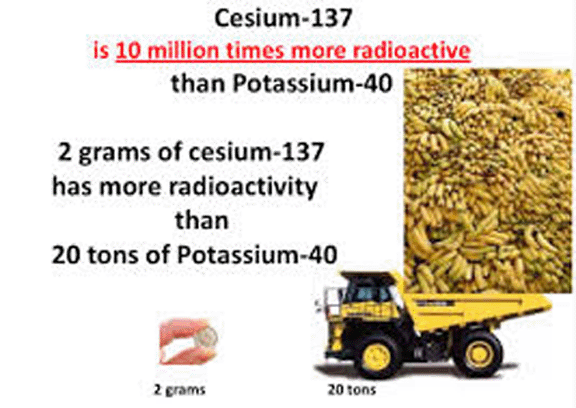
Both Dutch and American authorities say they found a radioactive element known as caesium-137.
The US Federal Drug Administration says long-term, repeated low-dose exposure to caesium-137 increases health risks.
But the agency adds that the levels detected in the Indonesian products posed no acute risk to health.
The radioactive isotope, which is created via nuclear reactions, is used in a variety of industrial, medical and research applications.
What is the source of radioactive contamination?
Investigations have so far centred on a metal-processing factory at the Cikande Industrial Estate, in Banten province on the island of Java.
The smelting company, called PT Peter Metal Technology, is believed to be China-owned, according to investigators.
Around 20 factories linked to the Cikande industrial estate are affected, including facilities that process shrimp and make footwear, authorities say.
Nine employees working on the industrial estate were detected to have been exposed to caesium-137. They have been treated at a government hospital in Jakarta and all contaminated facilities in the industrial area have been decontaminated.
In August, Indonesian authorities said the government would impose a restriction on scrap metal imports, which were reportedly a source of the contamination.
What is being done about it?
Indonesia’s nuclear agency last month said the sprawling industrial estate would be decontaminated.
On Wednesday, Indonesian authorities scaled up their probe into the suspected source of the contamination.
“The police have launched the criminal investigation,” said Bara Hasibuan, a spokesperson for the investigating task force.
Indonesian authorities have had difficulty conducting investigations as the management of PT Peter Metal Technology — which produces steel rods from scrap metal — has returned to China, Setia Diarta, director general of the Metal, Machinery, Transportation Equipment, and Electronics at Indonesia’s Ministry of Industry, told a hearing with politicians earlier this month.
In addition, Indonesian authorities say they are preventing goods contaminated with caesium-137 from entering Indonesia.
At one port, authorities said they detected and stopped eight containers of zinc powder from Angola that were contaminated with caesium-137.
After being re-exported, containers of the mineral were last month reported as being stranded off the Philippine coast amid a stoush between Jakarta and Manila over what to do with them.
International Uranium Film Festival 2025

IUFF 2025, Las Vegas, NV, NORTH AMERICAN TOUR 2025
November 26, 2025, https://beyondnuclear.org/10009-2/
LAS VEGAS, NEVADA, USA, NOVEMBER 21, 22, AND 23, 2025–The International Uranium Film Festival (IUFF) is proud to announce the highly anticipated North American Tour 2025 taking place November 21, 22 & 23 at the Downtown Cinemas in Las Vegas. Showcasing an array of compelling films and exploring the detrimental impacts of nuclear weapons testing, the festival promises to captivate audiences with its thought-provoking narratives and powerful storytelling. “You can’t hug your children with nuclear arms,” said Ian Zabarte, Secretary of NCAC.
Organizers of the IUFF Las Vegas, the Native Community Action Council (NCAC) composed of Shoshone and Paiute peoples believe these films are a necessary part of the ongoing awareness, witness and resistance to nuclear war, human health and a livable Mother Earth.
HIGHLIGHTS: “TO USE A MOUNTAIN” ● “WAYS OF KNOWING” ● “SILENT WAR” ● “UNDER THE CLOUD” are among the films addressing uranium, the fuel for both nuclear weapons and nuclear energy. As 2025 marks the 80th anniversary of the first atomic bombings at the Trinity Site, Hiroshima, and Nagasaki, the world faces a new Manhattan Project that includes nuclear modernization of weapons and the fast-tracking of uranium mining for nuclear-powered AI (artificial intelligence) data centers. The IUFF recognizes all radiation victims. Downwinders of nuclear weapons test sites and nuclear energy facilities are all impacted by environmental contamination that creates undue health risks that produce cascading health effects to future generations. The IUFF is a space for everyone who supports a nuclear-free future! We invite all to come together to view original films and to meet with affected community members, organizations and activists working toward protection from radiation risks, protection of our lands and water, and protection of all Peoples worldwide.
“The Shoshone Nation still bears the deadly legacy of nuclear testing on our unceded lands, an act that violates our treaty, our land and our lives.” said Laura Piffero of the NCAC.HIGHLIGHTS: “TO USE A MOUNTAIN” ● “WAYS OF KNOWING” ● “SILENT WAR” ● “UNDER THE CLOUD” are among the films addressing uranium, the fuel for both nuclear weapons and nuclear energy. As 2025 marks the 80th anniversary of the first atomic bombings at the Trinity Site, Hiroshima, and Nagasaki, the world faces a new Manhattan Project that includes nuclear modernization of weapons and the fast-tracking of uranium mining for nuclear-powered AI (artificial intelligence) data centers. The IUFF recognizes all radiation victims. Downwinders of nuclear weapons test sites and nuclear energy facilities are all impacted by environmental contamination that creates undue health risks that produce cascading health effects to future generations. The IUFF is a space for everyone who supports a nuclear-free future! We invite all to come together to view original films and to meet with affected community members, organizations and activists working toward protection from radiation risks, protection of our lands and water, and protection of all Peoples worldwide.
“The Shoshone Nation still bears the deadly legacy of nuclear testing on our unceded lands, an act that violates our treaty, our land and our lives.” said Laura Piffero of the NCAC.
FOR MORE INFORMATION:
Uraniumfilmfestival.org
Nativecommunityactioncouncil.org
Ontario’s Nuclear Announcement Locks Us Into a High-cost, High-risk Energy Path
Statement by Mike Marcolongo, Associate Director, Environmental Defence, November 26, 2025, https://environmentaldefence.ca/2025/11/26/ontarios-nuclear-announcement-locks-us-into-a-high-cost-high-risk-energy-path/
Toronto | Traditional territories of the Mississaugas of the Credit, the Anishinaabeg, the Haudenosaunee, and the Wendat – The Ontario government’s decision today to approve a $26.8-billion refurbishment of Pickering Nuclear Generating Station Units 5–8 is a costly and high-risk choice that will push electricity bills higher, increase pollution, and sideline the clean-energy solutions Ontario urgently needs.
Nuclear power already dominates Ontario’s grid today and, under the government’s plan, would expand to 75 per cent of all electricity generation by 2050. Because nuclear is inflexible and cannot ramp up or down with demand, the entire system must be engineered around it, limiting its ability to integrate wind and solar. This design leaves Ontario relying more on fossil gas plants to balance the grid, driving up both emissions and costs.
Committing to refurbish Pickering—already one of the oldest nuclear stations in North America—adds more risk to an already risky strategy. And because Pickering’s reactors will be offline for most of the next decade before returning to service in the mid-2030s, the government plans to burn significantly more gas in the meantime—driving electricity-sector emissions from a near-zero low of 2.5 megatonnes to 20 megatonnes by 2030, wiping out most of the gains Ontario made in phasing out coal.
The government claims the refurbishment will create nearly 37,000 jobs, but this does not change the fundamental reality: nuclear is one of the most expensive sources of electricity. Wind and solar are now the lowest-cost sources of new power worldwide, including here in Ontario. Meanwhile, nuclear remains a key driver of the recent 29 per cent increase in electricity rates. The government is masking the true cost by shifting expenses onto the tax base—but taxpayers and ratepayers are the same people, and they will ultimately cover the bill.
At the same time, Ontario is planning for fewer renewables in 2050 than we will have in the 2030s. This flies in the face of global trends, where clean energy is being deployed at record scale because it is affordable, flexible, and fast to build. Pairing wind and solar with hydro power and battery storage has become the backbone of clean-energy systems worldwide—yet Ontario’s nuclear-heavy strategy sidelines these solutions for decades.
Ontario does not need to choose a pathway that locks in higher costs and higher emissions. There is still time to shift course toward a modern electricity system that prioritizes renewables, energy efficiency, storage, and reliability—without saddling Ontarians with decades of unnecessary nuclear expansion and increased gas burning.
ABOUT ENVIRONMENTAL DEFENCE (environmentaldefence.ca): Environmental Defence is a leading Canadian environmental advocacy organization that works with government, industry and individuals to defend clean water, a safe climate and healthy communities.
British military trained in Israel amid Gaza genocide
Armed forces personnel have ‘studied on educational staff courses’ since October 2023, Ministry of Defence discloses
JOHN McEVOY, DECLASSIFIED UK, 26 November 2025
British military personnel trained in Israel amid the Gaza genocide, Declassified can reveal.
The information comes in response to a parliamentary question tabled by Zarah Sultana MP.
On 18 November, Sultana asked the Ministry of Defence “whether any British armed forces officers have studied or trained at Israeli military colleges since October 2023”.
Defence minister Al Carns responded earlier today, saying: “Fewer than five British Armed Forces personnel have studied on educational staff courses in Israel since October 2023”.
It remains unclear where the troops studied or which branches of the military they came from.
But the revelation exposes a new layer of British military collaboration with Israel amid what the UN commission of inquiry has described as a genocide.
Charlie Herbert, a retired British army general, told Declassified: “It is absolutely extraordinary to think that UK military personnel have been undertaking military education or training courses in Israel over the past two years.
“Given the credible allegations of war crimes against the political and military leadership of the IDF, all such exchanges should have immediately ceased.
“It does our armed forces a huge disservice to be associated with the IDF, given the conduct of the IDF in Gaza since late 2023 and to think that we are training in Israel only adds to the accusations of UK complicity in this genocide”…………………….
Military training
The disclosure about British military officers training in Israel comes after Declassified revealed how Israeli soldiers have trained in Britain over the past two years…………………………………………………………………….. https://www.declassifieduk.org/british-military-trained-in-israel-amid-gaza-genocide/
Iranian nuclear scientists sell products with Croydon-made parts.
Iranian military scientists that the US accuses of leading research that
could be applicable to nuclear weapons say their products incorporate
UK-made radiation-detection equipment from a company based in the south London borough of Croydon, a Financial Times investigation has found.
A Tehran-based nuclear-testing and diagnostics company run by senior figures in Iran’s Organisation of Defensive Innovation and Research (SPND), which is subject to US sanctions, and the Revolutionary Guards advertises that it uses radiation-detection tubes made by Centronic in equipment it offers for sale.
FT 25th Nov 2025. https://www.ft.com/content/47acd6de-df7a-420a-b8f4-587008bfe7ef
Torness Power Station welcomes female school pupils.

25th November, by Cameron Ritchie, https://www.eastlothiancourier.com/news/25636675.torness-power-station-welcomes-female-school-pupils/
MORE than 60 female pupils from East Lothian’s secondary schools have been given a unique insight into the world of engineering.
The youngsters were given a tour of Torness Power Station while also enjoying a series of interactive workshops designed to showcase the variety of careers available in science, technology, engineering and maths (STEM).
Students from nearby Dunbar Grammar School were joined by counterparts from Wallyford’s Rosehill High School; Musselburgh Grammar School; Ross High School, Tranent; Preston Lodge High School, Prestonpans; Knox Academy, Haddington; and North Berwick High School.
The day was opened by Kiran Basra-Steele, EDF’s safety and assurance director, and Samaneh Nouraei, an inspector with the Office for Nuclear Regulation (ONR), who shared their career journeys and experiences of working in STEM industries.
Kiran said: “The number of women working in STEM is increasing, but we still face a significant skills gap.
“We need to ensure everyone has the opportunity to learn about the careers available and feels empowered to pursue them.
“My hope is that one day we won’t need to run female-focused STEM days because the gender balance will have been achieved.
“There are huge opportunities within the existing nuclear fleet and exciting prospects ahead with new nuclear developments in the UK.”
During the visit, the pupils carried out activities, including dismantling flanges to test their ability to follow work instructions and building droids using mobile phones and circuits.
They also heard first-hand from female apprentices, technicians and engineers currently working at the station.
The event forms part of the nuclear power station’s ongoing efforts to encourage more women to apply for its apprenticeship programme.
The four-year scheme begins with two years at the National College for Nuclear in Somerset, where apprentices learn core engineering skills before specialising in their chosen trade.
The programme also includes opportunities to travel within the UK and abroad as part of its ‘life skills’ element, before returning to Torness for the final two years of training.
According to Equate Scotland, the national expert in equality, diversity and inclusion in the STEM sector, it is estimated that only 25 per cent of the STEM sector are women.
Paul Forrest, station director, said: “This is the second year we’ve run the event, and it’s been fantastic to see the enthusiasm from everyone involved.
“We hope we’ve given these students something to think about when considering their future career choices.”
Applications will be open for EDF’s apprenticeship programme from January 26 to February 20 next year, with an open day being held in Dunbar’s Harbour Chapel on January 30.
UK ‘most expensive’ in the world for nuclear projects due to complex regulation, taskforce finds.

“However, it is absolutely critical that we do not pursue cost reduction at the expense of health and safety standards”
The UK has become the “most expensive” nation in the world to
construct new nuclear projects and an overhaul to planning is needed to
remedy this, according to a new report published by the Nuclear Regulatory
Taskforce.
Examples of the delays and cost overruns are apparent in the
UK’s current nuclear construction projects, Hinkley Point C and Sizewell
C. Namely, the construction of Hinkley Point C has faced several issues
including health and safety concerns, structural faults, as well as
significant cost overruns and delays.
Financially, the project’s
estimated costs have risen to between £31bn and £34bn, up from an initial
£25bn to £26bn in 2015 prices. These cost increases are attributed to
civil engineering price hikes and delays in the electromechanical phase.
Consequently, the operational date for Unit 1 has been pushed back, with
scenarios suggesting completion between 2029 and 2031, partly due to
slower-than-anticipated civil construction, inflation, labour, and material
shortages, as well as disruptions from Covid-19 and Brexit.
The government’s Office for Value for Money (OVfM) noted that these cost
overruns and delays at Hinkley Point C complicated the development of the
Sizewell C project. While the huge costs involved with nuclear projects in
the UK are apparent, law firm Browne Jacobson has argued that, with time
and efficiencies being realised in their construction, costs will start to
go down. Browne Jacobson partner Zoe Stollard said: “Whilst the current
costs of nuclear power station construction in the UK may appear
substantial, it’s important to recognise that these figures will likely
decrease as efficiencies are realised in future projects.
“However, it is absolutely critical that we do not pursue cost reduction at the expense of health and safety standards. Maintaining the highest levels of nuclear safety, security, and safety culture are imperative. “Investing wisely in these projects now is essential to reduce the potential for significant
incidents further down the line. The upfront investment in robust safety
measures and regulatory compliance is not merely a cost, it is a necessary
safeguard for public welfare and long-term operational success.”
New Civil Engineer 25th Nov 2025
Were The Brits Behind Bloomberg’s Russian-US Leaks?
Andrew Korybko Nov 26, 2025, https://korybko.substack.com/p/were-the-brits-behind-bloombergs
Russia’s Foreign Intelligence Service warned earlier the same day as Bloomberg’s report that the Brits are hellbent on discrediting Trump in order to undermine his latest peace efforts for resolving the conflict from which they profit.
Bloomberg shared what it claimed to be the transcripts of calls between Trump’s Special Envoy Steve Witkoff and Putin’s top foreign policy aide Yury Ushakov as well as between Ushakov and Putin’s other advisor Kirill Dmitriev about the Ukrainian peace process. The gist of the Witkoff-Ushakov call was Witkoff’s proposal to have Putin suggest a Gaza-like 20-point peace deal for Ukraine during an upcoming call with Trump while the Ushakov-Dmitriev one implied that the leaked draft was Russian-influenced.
Ushakov declined to comment on his talks with Witkoff but said that “Somebody tapped, somebody leaked, but not us” whereas Dmitriev flat-out described his purported call with Ushakov as “fake”. For his part, Trump defended Witkoff’s alleged “coaching” of Ushakov on how Putin should deal with him by reminding everyone “That’s what a dealmaker does. You got to say, ‘Look, they want this – you got to convince them with this.’ That’s a very standard form of negotiations.”
As regards the possibility that the draft framework was Russian-influenced, the notion of which has been pushed by the legacy media to discredit the proposed mutual compromises therein, that was already debunked. Secretary of State Marco Rubio, who also serves as National Security Advisor, said that “The peace proposal was authored by the U.S. It is offered as a strong framework for ongoing negotiations It is based on input from the Russian side. But it is also based on previous and ongoing input from Ukraine.”
Therefore, neither transcript is scandalous even if their contents were accurately reported, yet the question arises of who might have tapped and leaked these calls. Intriguingly, earlier the same day that Bloomberg later published their report, Russia’s Foreign Intelligence Service warned that the UK “aims to undermine Trump’s efforts to resolve the conflict by discrediting him.” Readers will recall the UK’s role in Russiagate, which they conspired with the CIA, FBI, and the Clinton camp to cook up to against him.
Seeing as how they can no longer collude in this way with their three prior conspirators, the UK might therefore have resorted to leaking those two calls with Ushakov that they might have tapped (possibly among many others) as a last-ditch attempt to discredit the latest unprecedented progress towards peace. This provocation might also have been meant to make Trump panic and fire Witkoff out of fear of another Russiagate 2.0 investigation if this scandal helps the Democrats flip Congress next year.Firing Witkoff, who’s been central to the recent progress towards peace, could ruin the process right at its most pivotal moment as Zelensky is reportedly considering meeting with Trump very soon to finalize the details of the US-mediated peace framework with Russia. By holding firm, Trump is therefore obstructing efforts to ruin everything that he’s achieved thus far on a Russian-Ukrainian peace deal and consequently revive the Russiagate hoax for helping the Democrats during next year’s midterms.
Accordingly, Bloomberg’ Russian-US leaks can be considered a British intelligence operation for derailing the peace process and perpetuating the conflict from which the UK profits, not to mention meddling in the midterms by giving a fake news-driven boost to the Democrats. Trump revealed that Witkoff will meet with Putin on Monday and might even be joined by his son-in-law Jared Kushner, who helped negotiate the Gaza deal, so more British provocations are expected out of desperation to ruin their talks.
Officials make alarming discovery outside of shutdown nuclear facility: ‘Significant’
“A legacy of industrial practices.”
by Veronica Booth, November 26, 2025
A dangerous fragment of radioactive debris was found outside of a
decommissioned nuclear facility in Scotland. The BBC reported that a
radioactive fragment categorized as “significant” was discovered around the Dounreay nuclear facility on April 7.
Radioactive particles can be
classified as minor, relevant, or significant. This is the first
“significant” particle found near Thurso since March 2022. The Dounreay
facility was an experimental nuclear site until particles of irradiated
nuclear fuel contaminated the drainage system. Now, the shores and seabed around Dounreay are heavily contaminated. According to the BBC, the decontamination of the site is expected to be complete by 2333.
The significant fragment serves as a poignant reminder of the importance of responsible radioactive waste management. According to the BBC, these
radioactive particles and fragments around Dounreay are not a threat to
people. Highly contaminated areas are not used by the public. Nearby public beaches have not contained any significant or large particles that would cause concern for people. In this instance, the U.K. government’s Nuclear Restoration Services and other entities are taking proper action to
decontaminate the site.
TCD 26th Nov 2025, https://www.thecooldown.com/green-business/dounreay-nuclear-facility-scotland-radioactive-waste/
Confronting The Media’s Gaza Group-Think
None of this would be so significant, of course, if our celebrated “free press” was, in fact, as free it claims. If it really served as a watchdog on power. If it really held the feet of the political class to the fire. If it really served as a Fourth Estate. Then the politicians would have no place to hide.
But that is not what the corporate media do. Instead, they echo and amplify the political establishment’s priorities. They are, in fact, the media wing of the establishment.
The western media’s failure to report the reality of Gaza didn’t start on 7 October 2023. It’s always been like this. Here’s why journalists won’t tell you the truth about Palestine/
Breaking free of media group-think is a scary, lonely journey. I know. I was forced to do it

16 November 2025
An audio reading of this article can be found here.]
The past two years have seen a catastrophic failure by western journalists to report properly what amounts to an undoubted genocide in Gaza. This has been a low point even by the dismal standards set by our profession, and further reason why audiences continue to distrust us in ever greater numbers.
There is a comforting argument – comforting especially for those journalists who have failed so scandalously during this period – that seeks to explain, and excuse, this failure. Israel’s exclusion of western reporters, so the claim goes, has made it impossible to determine exactly what is occurring on the ground in Gaza.
There are several obvious rejoinders to this.
First, why would any journalist give Israel the benefit of the doubt in Gaza – as we have been doing – when it is the party keeping out reporters? The media’s working assumption must be that Israel has excluded us because it has plenty to hide. The obligation must be on Israel to demonstrate that it is acting out of military necessity and proportionately. That cannot be the starting point, as it has been, of western media coverage.
When one party, Israel, denies journalists the chance to report, our default responsibility is to adopt a posture of extreme scepticism towards its claims. It is to subject those claims to intense scrutiny – all the more so when the world’s highest court has ruled that that Israel’s very presence in Gaza is as an illegal occupier, one that should have left the Palestinian territories long ago.
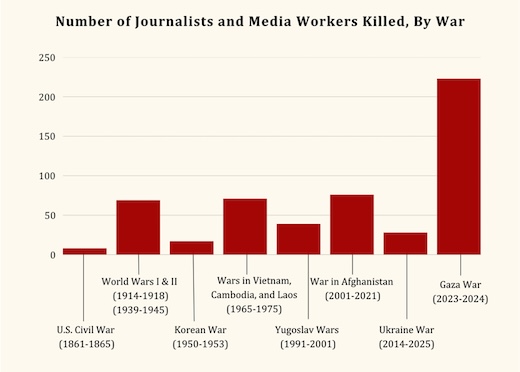
Second, and just as self-evidently, this explanation arrogantly discounts the work of hundreds of Palestinian journalists who have risked their lives to show us precisely what is happening in Gaza. It is to view their contribution, even as they are being slaughtered by Israel in unprecedented numbers, as, at best, worthless and as, at worst, Hamas propaganda. It is to breathe life into Israel’s self-serving rationalisations for murdering our colleagues – and thereby sets a precedent that normalises the targeting of journalists in the future.
It is also to treat these Palestinian journalists with the same colonial contempt demonstrated by British aristocrats a century ago, when they promised away the Palestinians’ homeland to European Jews, as if Palestine was a possession Britain was entitled to dispose of as it saw fit.
And third – and this is the issue I want to grapple with tonight – the presence of western journalists in Gaza would not have made any dramatic difference to the way the slaughter of Palestinians was presented. Audiences would still have received a sanitised version of the genocide. Failure is baked into western media coverage of Israel and Palestine. I know this firsthand from 20 years of reporting from the region.
Career suicide
When it comes to the festering wound in what was once historic Palestine, the job of western journalists is to obfuscate, equivocate, distort and excuse. It always has been. I will get to the reasons why a little later. [If you prefer, you can skip direct to that section under the subhead “Why so craven?”]
Israel has been able to get away with genocide in Gaza precisely because, for the preceding decades, the western media refused to report on – or hold Israel accountable for – its well-documented ethnic cleansing operations against Palestinians, and its brutal apartheid rule over them.
A few of our most principled journalists tried to report these things in real time. But they publicly paid a high price for doing so. Any colleagues who might have thought of following in their footsteps learnt the necessary lesson: that emulating these journalists would be career suicide.
Let me briefly document a couple of distinguished foreign correspondents in Jerusalem who were made examples of, and then provide more recent illustrations of my own run-ins with western editors………………………………………………………………………………………………….
Becoming an outcast
I only learnt of these distinguished reporters’ troubles some time after I had similar experiences covering the region as a freelance – something I did for 20 years. In my early years, I repeatedly came up against the same editorial pressures and resistance faced by Adams and Neff more than quarter of a century earlier. I felt similarly isolated, besieged, outcast – and eventually abandoned any hope of continuing to report for major western media outlets.
I submitted stories to both the Guardian – where I had previously been a staff journalist for many years – and the International Herald Tribune, now refashioned as the International New York Times.
Let me quickly illustrate an example I had with each…………………………………………………………………………………………………………………………………..
Why so craven?
The big question is why. Here is an outline of the various pressures, some practical and others structural, that keep the western media so craven towards Israel.
Partisan reporters: Historically, most publications – especially US outlets – have put Jewish reporters in charge of their Jerusalem bureaux, based on the probably correct assumption that, given Israel’s tribal political ideology of Zionism, Jewish reporters will have better access to Israeli officials. Which, in turn, tells us that these papers are chiefly interested in what Israeli sources have to say, not what Palestinians say. In truth, western media aren’t watchdogs. They don’t challenge the existing power imbalance, they reproduce it.
Many of these Jewish reporters have not hidden their deep attachment and partisanship towards Israel.
Many years ago, a Jewish journalist friend based in Jerusalem wrote to me after I first made this point public, stating: “I can think of a dozen foreign bureau chiefs, responsible for covering both Israel and the Palestinians, who have served in the Israeli army, and another dozen who like [the New York Times’ then bureau chief Ethan] Bronner have kids in the Israeli army.”
Imagine if you can, the New York Times employing a Palestinian as their Jerusalem correspondent – I know, it’s inconceivable. But not just that: employing them while the correspondent had a child working for the Palestinian Authority, or, even more fittingly, one fighting in a Fatah military brigade.
Meanwhile, the BBC openly backs its Middle East online editor, Raffi Berg, even though its own whistleblowing staff have accused him of skewing the corporation’s coverage of Israel and Palestine. Berg has not been shy in admitting his own tribal affiliation to Israel. In an interview about his “insider” book on Israel’s spy agency Mossad, Berg states that “as a Jewish person and admirer of the state of Israel” he gets “goosebumps” of pride hearing about Mossad operations.
Berg has a framed letter from Benjamin Netanyahu and a photo of himself with the former Israeli ambassador to the UK hanging on his wall at home. He counts a former senior Mossad official as a close friend. And when the journalist Owen Jones wrote a piece revealing the near-revolt of BBC staff at Berg’s role, Berg’s first thought was to seek legal help from Mark Lewis, the former head of UK Lawyers for Israel, well-known for using lawfare as a way to bully and silence critics of Israel.
Can we imagine the BBC appointing a Palestinian or Arab to that same hyper-sensitive post and then supporting them when it emerged that they had a framed letter from the assassinated Hamas political leader Ismail Haniyeh and a photo with Yasser Arafat hanging on their wall at home?
Partisan bureau staff: It is considered entirely normal for western media to employ partisan Israeli Jews as support staff. As Neff noted, they exert subtle and sometimes not so subtle pressures on correspondents to be more sympathetic towards Israeli narratives.
An investigation by Alison Weir of If Americans Knew found, for example, that in 2004 Israeli staff at the AP news agency’s bureau in Jerusalem had refused either to use or return video footage sent in by a Palestinian cameraman that showed Israeli soldiers shooting an unarmed youth in the abdomen. Instead, they destroyed the tape.
Media lobby groups: Camera and Honest Reporting operate as a pair of media sheepdogs, aggressively herding journalists into line. As I found, they can make your life very hard indeed: they can mobilise large numbers of fanatical Israel supporters to bombard publications with complaints, they can damage your credibility with your own editors, and they can alert Israeli officials to put you on a media blacklist. Most reporters see them as very dangerous organisations to cross.
Access: A general flaw in journalism’s claim to be a watchdog on power – remember, we call ourselves the Fourth Estate – is that reporters invariably need access to high-level officials, whether for stories, steers or comments. A journalist with such a source is seen by editors as far more useful, and reliable, than one without. This is true whether one’s beat is crime, politics, sport or entertainment.
However, access inevitably comes at a price – of independence. ………………………………….
Pressures from head office: Notice too that media head offices in the US and Europe are subject to another layer of lobby pressure – this time through the lobby’s association of criticism of Israel with antisemitism. Groups like the Anti-Defamation League or the Board of British Deputies are there claiming to represent local Jewish communities, who they report to be “upset”, “frightened”, “bullied” or “anxious” every time Israel is criticised.
……………………………………..The result is that the bar set for publication, if a story is critical of Israel, is far higher than it is for other regions. Just think of how readily journalists attribute atrocities in Ukraine to Russia, compared to how reticent journalists – sometime the same ones – are to identify worse crimes in Gaza as atrocities and name Israel as the responsible party.
Israeli government censorship: It is often not understood that Israel operates a military censorship system that limits what journalists can say. This is especially important given that much of what is written by Jerusalem correspondents relates to Israel’s illegal military occupation.
In its severest form, that means Israel simply refuses journalists access to certain areas, as it has done for two years in Gaza. Or it can require them to embed with the Israeli military, as the BBC has done on several occasions during the Gaza genocide. Or it can demand that journalists don’t tell important facts about what is going on.
……………………………………….Israeli government control: Israel licenses foreign correspondents by issuing them a Government Press Office card. For the past 20 years, Israel has issued the cards only to journalists formally working for a news organisation it regards as “accredited”. ………
……………………………………..Rebuilding our worldview
These practical pressures gain much of their force because journalists and editors have historically been afraid of being accused of antisemitism by Israel. It is tempting to overestimate this pressure. I suspect it is better viewed as a cover story, rationalising the failure of journalists to do their job properly – as illustrated by their reluctance to identify the Gaza genocide as a genocide.
But beyond these practical pressures, there is a deeper reason for why the western media avoid serious criticism of Israel.
Israel is integral to a continuing western colonial system of power projection into the oil-rich Middle East. Israel is the West’s ultimate client state. Western establishments need Israel protected.
None of this would be so significant, of course, if our celebrated “free press” was, in fact, as free it claims. If it really served as a watchdog on power. If it really held the feet of the political class to the fire. If it really served as a Fourth Estate. Then the politicians would have no place to hide.
But that is not what the corporate media do. Instead, they echo and amplify the political establishment’s priorities. They are, in fact, the media wing of the establishment………………………………………………………………………………………………………………………………….. https://www.jonathan-cook.net/blog/2025-11-16/media-group-scary-journey/
Sir Keir Starmer to create commission with power to overrule environmental regulators through environmental red tape.

Matt Oliver, Industry Editor, 24 November 2025
Environmental quangos that object to nuclear power stations could have
their concerns overruled under Sir Keir Starmer’s plans to unleash a golden
age of nuclear. Under new proposals submitted to the Prime Minister, a new
commission would be created with the power to reconsider “novel or
contentious decisions” – overruling individual regulators if necessary.
In the report, the nuclear regulatory taskforce accused Natural England and
the Environment Agency of adding “disproportionate” costs to projects
by demanding design changes aimed at protecting nature.
Instead of addressing individual environmental concerns, developers could also be allowed to pay a large sum of money into a nature restoration fund. It comes after Sir Keir pledged to usher in a “golden age” of nuclear power following a major agreement between Britain and the US during Donald Trump’s state visit in September.
Telegraph 24th Nov 2025, https://www.telegraph.co.uk/business/2025/11/24/nuclear-power-boom-forced-through-environmental-red-tape/
Minnesota’s aging nukes pose national threat
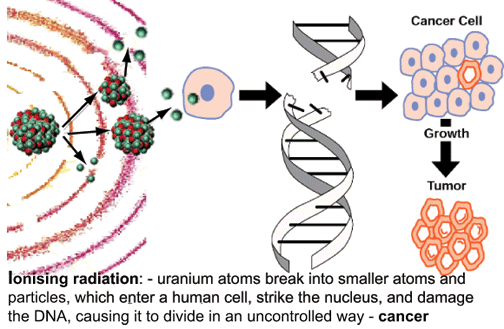
In a review of published studies of 136 nuclear reactor sites in the European Journal of Cancer Care in 2007, elevated leukemia disease rates in children were documented in the US, UK, France, Germany, Spain, Japan, and Canada. This is not a new story.
by beyondnuclearinternational, https://beyondnuclearinternational.org/2025/11/23/minnesotas-aging-nukes-pose-national-threat/
More than electricity, the reactors supply a steady dose of radioactive tritium in drinking water, writes Susu Jeffrey
“Sometimes before I give a speech, I ask the audience to stand up if they or someone in their family has had cancer,” says John LaForge of Nukewatch. “Eighty percent of the audience gets up.”
The Monticello nuclear power reactor is on the Mississippi River about 35-miles northwest of Minneapolis. Xcel’s twin Prairie Island reactors, plus about 50 giant dry casks storing waste reactor fuel, are all in the floodplain of the Mississippi. This waste is sited 44 to 51 miles southeast of Minneapolis and St. Paul.
There are no plans to move the waste off-island because there is no alternative destination. In fact, 34 more concrete encased steel casks are planned. There is no national hot radioactive waste repository. Think of these waste container sites as permanent radioactive waste dumps.
The greater Twin Cities’ 3.7 million people are in the nuclear “shadow” (within 50 miles) of all three nukes. The Mississippi River serves 20 million people with drinking water, way beyond the Minnesota state population of 5.7 million. Minnesota’s aging nukes are a national threat. For approximately the next six generations, radioactive tritium will be a part of the drinking water wherever those molecules wander.
The Monticello nuke was licensed in 1970 for 40 years, and went online in 1971, a year it had two radioactive cesium spills. In 2010, the license was renewed for another 20 years until 2030. Xcel Energy has even been granted an extension for another 20 years until 2050. It is a corporate financial security move not yet approved by the Minnesota Public Utilities Commission which holds the final consent. Paperwork is one thing, pipes are another.
In November 2022, a 50-year-old underground pipe leaked 829,000 gallons of tritium-contaminated wastewater that reached the Mississippi River, according to the Nuclear Regulatory Commission. Xcel failed to make public the radioactive spill for four months. After a May 15, 2024 public hearing in Monticello where citizens testified “We don’t trust you. You lie,” an NRC executive “clarified” Xcel’s “miscommunication.”
Senior Environmental Project Manager, Stephen J. Koenick admitted some tritium had been measured in the Mississippi. Tritium bonds with water and cannot be separated out. Water obeys gravity running downhill, in the case of Monticello, from the reactor to the Mississippi. The runaway tritium will persist in the environment for ten half-lives or about 123 years.
No telling where Xcel’s radioactive molecules will land. Men have a one in two chance of being diagnosed with cancer during their lifetimes; for women the chance is one in three (National Cancer Institute, 2/9/2022). There is tremendous popular, fear-driven support for the oncology industry.
The good news is that while cancer numbers are up so is the cancer survival rate. However, at nuke weapons, nuke reactors, and the virtually forever waste sites, “accidents” happen along with on-going radioactive decay. Radioactivity cannot be contained. When I was a newspaper reporter in Brevard County, Florida, where Cape Canaveral is located, I learned that nuclear waste cannot be rocketed off into space because it’s too hot, too heavy, and the rockets too faulty.
Nuclear Safety Regulations Changing
Among President Trump’s cost-cutting moves is a weakening of the Nuclear Regulatory Commission’s exposure standards. Staff would be cut and regulations “revised” virtually cutting off the commission’s independent status. The Monticello nuke was licensed for 40 years and was rubber stamped to work for 80. Octogenarian nukes are considered “safe enough” now by the nuclear/government consortium.
Piecemeal fix-it parts for geriatric machinery or people are a lucrative business. Locating a leaking tritium pipe underground, between buildings, removing and replacing it is a non-negotiable emergency at nuclear reactors with miles and miles of piping. Upkeep expenses figure in utility rate hikes.
Joseph Mangano and Ernest Sternglass did a study of eight downwind US communities in the two years after a nuclear reactor closure. A remarkable 17.4 percent drop in infant mortality was found. “We finally have peer-reviewed accurate data attaching nuclear power reactors to death and injury in the host communities,” New York State Assemblyman Richard Brodsky said of the 2002 report in the Archives of Environmental Health.
Monopoly capitalism or public service?
Clearly the Monticello reactor was designed to make money. In November 2024, Minnesota Attorney General Keith Ellison wrote that Xcel has “aggressively” pursued multi-year rate hikes while earning large profits. In 2024 Xcel reported $1.94-billion net earnings, a profit margin up 14% from 2023.
According to Xcel propaganda, the nuke is “the biggest employer and largest local taxpayer” in Monticello, MN, and generates an estimated $550 million in economic activity each year in the region. And like profits, cancer rates are up notably among people under 50 and rising faster among women than men the American Cancer Society reports.
Repeatedly, the Xcel corporation wins its rate hike and re-licensing “asks.” These asks get rewritten and resubmitted until a “compromise” is reached. In 2025, residential customers will pay $5.39 more per month, down from the original ask of $9.89, according to Minnesota Public Radio, which also noted that greater increases are on the horizon for EVs and data center capital improvements.
Cancer
St. Jude’s Children’s Hospital advertises heavily with videos of big-eyed, bald children cancer patients. In a review of published studies of 136 nuclear reactor sites in the European Journal of Cancer Care in 2007, elevated leukemia disease rates in children were documented in the US, UK, France, Germany, Spain, Japan, and Canada. This is not a new story.
The danger of mental retardation of fetuses exposed in the womb was reported in The New York Times (page A1 on 12/20/1989). Tritium crosses the placenta. In addition to the health costs of breathing and ingesting exhausts from nuclear power reactors, there is the problem of what to do with and how to contain its long-lived waste. The nuclear profit god is a once and future terrorist.
The Coalition for a Nuclear-Free Mississippi River is working for the immediate decommissioning of the Monticello nuclear reactor by educating the public on dangers of the nuclear power reactors and safe alternatives. To learn more, visit our website. See our Monticello report “Serial Killers on the Loose: Cancer Death Rates Rising in Reactor Host Communities”.
Does ‘fish disco’ show we’re dancing to the wrong tune on regulations?
“confected outrage about a fish disco”.
Hinkley Point C’s fish protections have been criticised as a
waste of money but environmental charities said the outrage was
manufactured.
For the twaite shad of the Bristol Channel, it has been a
strange few months. Ordinarily, few people bother with shad. Smallish,
silverish, a little like a less charismatic herring, generally they are
left alone. Not this year. Starting in May they have been tracked. They
have been chipped. They have been played some really odd sounds. And now, as they somewhat bemusedly navigate what has become known as the Hinkley Point C fish disco, they have been presented to the prime minister as an exemplar of all that is wrong with our nuclear regulations.
The Fingleton report on nuclear regulation is long and considered. Its 162 pages take in capital financing, nuclear risks and decommissioning obligations. But it was just a few paragraphs about fish that ended up catching the headlines.
“Hinkley Point C will have more fish protection measures than any other
power station in the world,” wrote John Fingleton, commissioned by the
government to find ways to make nuclear cheaper. “It has spent £700
million on their design and implementation,” he said. The outcome on
protected fish? “These measures would save 0.083 salmon per year, along
with 0.028 sea trout, 6 river lamprey, 18 allis shad, and 528 twaite
shad.”
“The government’s propaganda machine is working overtime to
perpetuate the false narrative that nature blocks development,” Joan
Edwards, from the Wildlife Trusts, said. It is, she said, “confected
outrage about a fish disco”. Every second it is running, Hinkley Point C,
which is still under construction, will suck in 134 cubic metres of
seawater. From three kilometres out, in the murky estuary, the water will
rush along pipes towards the reactor. There, the cold waters of the Bristol
Channel will meet the superheated waters of a steam turbine………………………………………………………………………………………….
Times 25th Nov 2025, https://www.thetimes.com/uk/politics/article/does-fish-disco-show-were-dancing-to-the-wrong-tune-on-regulations-99v2tsnvs
Millions of fish killed this winter at Bruce Power nuclear plant


By Scott Miller, March 21, 2025,
https://www.ctvnews.ca/london/article/millions-of-fish-killed-this-winter-at-bruce-power-nuclear-plant/
Millions of fish have been killed after getting trapped in Bruce Power’s water intake system.
The Saugeen Ojibway Nation (SON) estimates between 3.5 and 4.5 million ‘gizzard shad’ were trapped and died after being attracted to the warm water from the nuclear plant’s discharge channels.
In a statement, the Saugeen Ojibway Nation’s Environment Office said, “this event raises concerns about the artificial environment for aquatic life at the Bruce site.”
Bruce Power acknowledges that a ‘large number’ of fish have died after getting trapped in their intake system since mid-January. It was so concerning the company shut down one of their nuclear reactors for a week and half last month. Bruce Power said the fish have been removed and Unit 2 is back in service.
The company said they’re still trying to determine exactly what led to the fish die-off but say they’re not alone.
“Gizzard Shad have been reported along the shoreline as far north as the Sauble River and as far south as Goderich indicating this could be a population level event. Large numbers of Gizzard Shad have been observed in Lake Huron including around Bruce Power; this is likely due to their high rate of reproduction and warmer lake water temperatures in the last couple of years,” said a Bruce Power news release.
Gizzard Shad are naturally sensitive to cold water temperatures and can experience mass die-off in the wild.
Both Bruce Power and the Saugeen Ojibway Nation say they are working with federal authorities to try and get to the root of the fishkill – and prevent it from happening again.
Both Bruce Power and SON also report a number of dead birds just north of the nuclear plant in Baie-du-Dor. The company said the birds have been sent away for testing, “to check for conditions including botulism or avian flu.”
Bruce Power said the Ministry of Environment Canadian Nuclear Safety Commission and Ministry of Natural Resources are aware and are part of the investigation into what led to the dead fish and waterfowl.
New Mexico Environment Department Requires Los Alamos National Laboratory to Stop All Injection Operations into Regional Drinking Water Aquifer.
Concerned Citizens for Nuclear Safety, 26 Nov 25
In a protective move, on Friday, November 18th, the New Mexico Environment Department required the Department of Energy (DOE) to cease all injection operations of treated waters back into the sole source regional drinking water aquifer shared by Pueblo de San Ildefonso, Los Alamos National Laboratory (LANL) and others. 2025-11-18-WPD-GWQB-NMED-Withdrawal-of-Temporary-Authorization-for-DP-1835-Final and EMID-704003_EMLA-26-BF028-2-1_Resp_DP-1835_Temp_Auth_WD_112125
In October, hexavalent chromium contamination was found beneath Pueblo de San Ildefonso while LANL was drilling a new well on the Pueblo, called San Ildefonso Regional Monitoring Well 3, or SIMR-3, in Mortandad Canyon. The Pueblo and LANL share borders in the area of Mortandad Canyon.
In Friday’s letter, the Environment Department wrote to LANL that “[S]ince 2021, DOE has neither complied with [the Environment Department’s] regulatory directives nor made substantial progress towards ensuring the protection of the regional aquifer. The latest sampling results from SIMR-3 prove that DOE’s refusal to take appropriate steps to ensure that contamiantion does not migrate further in the regional aquifer or offsite has created the harm to the environment that [the Environment Department] sought to prevent.”
1 This Month





PLEASE OPPOSE HR 8255 AND S.3639 – bills would accelerate satellite deployment, with no environmental review or safeguards – https://ncstd5li.quorum.us/campaign/169331/
To see nuclear-related stories in greater depth and intensity – go to https://nuclearinformation.wordpress.com
-
Archives
- October 2026 (49)
- September 2026 (339)
- August 2026 (330)
- July 2026 (355)
- June 2026 (287)
- May 2026 (306)
- April 2026 (356)
- March 2026 (251)
- February 2026 (267)
- January 2026 (308)
- December 2025 (358)
- November 2025 (359)
-
Categories
- 1
- 1 NUCLEAR ISSUES
- business and costs
- climate change
- culture and arts
- ENERGY
- environment
- health
- history
- indigenous issues
- Legal
- marketing of nuclear
- media
- opposition to nuclear
- PERSONAL STORIES
- politics
- politics international
- Religion and ethics
- safety
- secrets,lies and civil liberties
- spinbuster
- technology
- Uranium
- wastes
- weapons and war
- Women
- 2 WORLD
- ACTION
- AFRICA
- Atrocities
- AUSTRALIA
- Christina's notes
- Christina's themes
- culture and arts
- Events
- Fuk 2022
- Fuk 2023
- Fukushima 2017
- Fukushima 2018
- fukushima 2019
- Fukushima 2020
- Fukushima 2021
- general
- global warming
- Humour (God we need it)
- Nuclear
- RARE EARTHS
- Reference
- resources – print
- Resources -audiovicual
- Weekly Newsletter
- World
- World Nuclear
- YouTube
-
RSS
Entries RSS
Comments RSS

