Nuclear Proliferation’s Next Iteration
Henry Sokolski, May 2025, https://npolicy.org/nuclear-proliferations-next-iteration/
The world is about to experience the second iteration of nuclear proliferation. The first era began in 1949 with Russia’s first nuclear weapons test. It ended in 2002 when North Korea set off its own first device. Nuclear weapons spread, but slowly. Most would-be bomb-makers – South Africa, Argentina, Brazil, Iraq, Taiwan, South Korea, Libya, Ukraine, Kazakhstan, Sweden, Italy, Romania, Australia, and Syria – gave up their weapons projects. Only nine completed and kept them (the United States, Russia, the United Kingdom, France, China, Israel, India, Pakistan and North Korea).
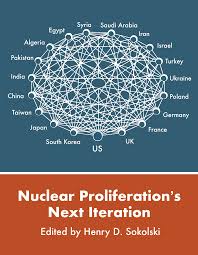
It’s unclear if we’ll be as lucky with nuclear proliferation’s next iteration. Poland, Germany, Turkey, Saudi Arabia, South Korea and Japan will tell the tale. If any go nuclear, others — Egypt, Algeria, the UAE, Vietnam, Australia, Ukraine—will surely be tempted.
Two other headaches compound these concerns. The first is the prospect that states will target reactors in war and release dangerous amounts of radiation. The war in Ukraine serves as a poster child. Recent Chinese, North Korean, and Israeli threats to bomb their neighbors’ nuclear plants suggest Kyiv’s predicament is not a one-off.
The second concern is increased interest in nuclear weapons sharing. NATO states, Ukraine, South Korea, Japan, and Russia have all expressed an interest in either hosting or placing weapons on other nation’s soil. This practice, which was so popular during the 1950s and 1960s, will stress U.S. friendships and alliances if renewed.
There are several factors behind these developments. One is the erosion of American security guarantees and the augmentation of Chinese, Russian and North Korean nuclear arsenals. Yet another is the emergence of precision guided munitions and their use against civilian infrastructure in Ukraine. Finally, nuclear supplier nations are pushing the wholesale export of “peaceful” nuclear reactors, all of which are potentially bomb program building blocks. The key markets include the world’s most war-torn regions (e.g., Eastern Europe, the Middle East, South and East Asia).
All of this should raise concerns. Instead, governments have either ignored or denied these developments.
States have used nuclear plants to make bombs and targeted them in war. Nuclear power advocates downplay these worries. New, smaller reactors, they insist, will be extremely safe and proliferation resistant. However, some of their favorite reactor designs use or produce materials helpful to make bombs. China, Ukraine, Taiwan and Japan have publicly fretted about the military vulnerability of their plants. The U.S. and most other governments, though, are quite silent.
Then, there’s nuclear sharing. The United States largely got out of this business. It pulled thousands of U.S.nuclear weapons from South Korea, Taiwan, the Philippines, Okinawa, and most of NATO. But in 2023, Russia went the other way: To intimidate NATO and Ukraine, Moscow re-deployed nuclear weapons to Belarus.
Polish officials took notice and asked the United States and France to forward deploy nuclear weapons on Polish soil. South Korea’s hawkish political party leadership made similar demands, as did Japan’s former prime minister, Shinzo Abe. All of these requests reflect a deeper, not-so-secret desire to acquire bombs of their own. The latest public U.S. response to these allied requests, however, has been to dismiss them.
And what might unfold if these nations go nuclear?
We may soon find out. Saudi Arabia’s Crown Prince Mohammed Bin Salman and his lieutenants have warned that the Kingdom must go nuclear if Iran gets a bomb. With any bad luck, Tehran and Riyadh could be the first of several new Middle Eastern nuclear dominos to fall.
One could imagine other new nuclear entrants. Australia once had a nuclear weapons program. So did Taiwan, Brazil, Argentina, South Africa, and Iraq. It’s also conceivable that Vietnam, the Philippines, and Bangladesh, which are all developing peaceful nuclear energy programs of their own, might exploit their civil programs to get bombs.
Why should one care? The short answer is the world may go off the rails. As Henry Kissinger explained:
“If one imagines a world of tens of nations with nuclear weapons and major powers trying to balance their own deterrent equations, plus the deterrent equations of the subsystems, deterrence calculation would become impossibly complicated. To assume that, in such a world, nuclear catastrophe could be avoided would be unrealistic.”
This volume peeks at this not-so-brave world.
NPEC designed and hosted two nuclear games. The volume features their after-action reports. The first game has China goading North Korea to get South Korean proxies to attack reactors and spent fuel ponds at South Korea’s Kori nuclear plant. These assaults prompt radiological releases and massive South Korean and Japanese evacuations. They also make military sense: They tie down and distract the United States, Japan, and South Korea from fending off a Chinese military assault against Taiwan. Beijing is pleased.
NPEC’s second scenario answers a more dire question — how might a nuclear-armed Israel and Iran face off in a crisis? Both have waged massive aerial wars against one another (twice in 2024). Some of these strikes targeted nuclear facilities. Would Israel ever use its nuclear weapons against Iran? Might Iran retaliate in kind? The game concluded the answer is yes.
The volume also features detailed analysis of what Russia’s military has gained from targeting Ukraine’s nuclear plants and supporting electrical supply system. This analysis also examines the military advantages of temporarily disabling such facilities rather than damaging them and releasing significant radiation.
It also explores five additional questions. What does international law and military science recommend to discourage dangerous assaults against nuclear plants? What does the history of Israel’s nuclear weapons acquisition and modernization tell us about these weapons’ possible use? What legal sanctions might their use trigger? What does unclassified modeling reveal about the radiation nuclear plants might release if attacked? How effective might nuclear strikes be against nuclear plants and materials?
This volume tries to tease out the answers. Its purpose is to prompt others to weigh in.
To read the full book, click here. To purchase a hard copy, click here.
No comments yet.
1 This Month




PLEASE OPPOSE HR 8255 AND S.3639 – bills would accelerate satellite deployment, with no environmental review or safeguards – https://ncstd5li.quorum.us/campaign/169331/
To see nuclear-related stories in greater depth and intensity – go to https://nuclearinformation.wordpress.com
-
Archives
- September 2026 (339)
- August 2026 (330)
- July 2026 (355)
- June 2026 (287)
- May 2026 (306)
- April 2026 (356)
- March 2026 (251)
- February 2026 (267)
- January 2026 (308)
- December 2025 (358)
- November 2025 (359)
- October 2025 (375)
-
Categories
- 1
- 1 NUCLEAR ISSUES
- business and costs
- climate change
- culture and arts
- ENERGY
- environment
- health
- history
- indigenous issues
- Legal
- marketing of nuclear
- media
- opposition to nuclear
- PERSONAL STORIES
- politics
- politics international
- Religion and ethics
- safety
- secrets,lies and civil liberties
- spinbuster
- technology
- Uranium
- wastes
- weapons and war
- Women
- 2 WORLD
- ACTION
- AFRICA
- Atrocities
- AUSTRALIA
- Christina's notes
- Christina's themes
- culture and arts
- Events
- Fuk 2022
- Fuk 2023
- Fukushima 2017
- Fukushima 2018
- fukushima 2019
- Fukushima 2020
- Fukushima 2021
- general
- global warming
- Humour (God we need it)
- Nuclear
- RARE EARTHS
- Reference
- resources – print
- Resources -audiovicual
- Weekly Newsletter
- World
- World Nuclear
- YouTube
-
RSS
Entries RSS
Comments RSS


Leave a comment