Bribery scandal haunts Exelon – casts doubt on future of Exelon’s Illinois Nuclear Plants
 ComEd Bribery Scandal Clouds Picture for Exelon’s Illinois Nuclear Plants Exelon wants state legislation to keep its Illinois nuclear plants open. Subsidiary ComEd’s involvement in a bribery scandal is not helping politically. GreenTech Media, JEFF ST. JOHN AUGUST 04, 2020 Exelon may be forced to close its Illinois nuclear plants if state legislation is not passed to bolster their eroding financial prospects. But subsidiary utility Commonwealth Edison’s involvement in a bribery scandal has complicated this and other key policy efforts in its home state.CEO Chris Crane outlined these challenges during the Chicago-based utility’s second-quarter earnings conference call on Tuesday. Last month, ComEd agreed to pay a $200 million fine as part of a deferred prosecution agreement with federal prosecutors to avoid criminal liability in an alleged bribery scheme involving Illinois House Speaker Michael Madigan. ……. Exelon owns the country’s largest nuclear generating fleet and other generation assets; it operates utilities in Illinois, Maryland, Delaware and Washington, D.C. …… Exelon’s nuclear plants hang in the balanceA December decision from the Federal Energy Regulatory Commission is forcing mid-Atlantic grid operator PJM to impose minimum prices on a wide array of state-supported grid resources. That rule is expected to include Exelon’s Clinton and Quad Cities nuclear power plants, which receive hundreds of millions of dollars per year in zero-emissions credits created by Illinois’ Future Energy Jobs Act. Exelon is seeking to extend the zero-emissions credits to its Braidwood, Byron and Dresden nuclear plants, which failed to clear PJM’s last capacity auction in 2018 and could face early retirement without additional financial support. While FERC has not approved PJM’s plan to comply with its order, and PJM has not yet set a date to resume its long-delayed capacity auction, “there’s a strong sense…that some of the nuclear units will not be picked up in that auction” when it occurs, Crane said. “Some are uneconomic right now, and some may become uneconomic.” …….. the bribery scandal has driven a wedge between the utility and state lawmakers, while the COVID-19 pandemic forced the legislature to curtail much of its work this spring and focus on responses to the public health crisis. The Clean Energy Jobs Act failed to move ahead during an emergency session in May, as did an alternative, less ambitious clean energy bill called Path to 100. llinois Governor JB Pritzker suspended the Energy Working Group involved in crafting the Clean Energy Jobs Act after the deferred prosecution agreement was announced, saying through a spokesperson that future legislation “will not be written by utility companies.” …….Absent a legislative solution to Exelon’s nuclear plants’ challenges in Illinois, Crane said, “If we can’t find…a path to profitability, we will have to shut them down.” But Exelon “will not allow the balance sheet to be further deteriorated by operating noneconomic assets,” he said. Exelon has successfully won zero-carbon credits in New York and New Jersey, but it has also laid plans to shut down its Three Mile Island nuclear plant in Pennsylvania if that state does not create similar supports. Formula rate extension and Chicago grid takeover both remain uncertain ComEd also faces an uphill battle in efforts to win an extension of a plan in place since 2011 that allows it to file its capital expansion plans under formula rate updates, rather than through a traditional rate-making process with the Illinois Commerce Commission. A bill that would have extended the formula rate structure past its 2022 expiration failed to pass the legislature this year
………. the utility’s $9.53 billion capital plan for 2020 through 2023, which will take effect under the formula rate structure, will add more than $5 billion to its capital rate base and lead to price hikes for customers in future years. ……. https://www.greentechmedia.com/articles/read/comed-bribery-scandal-affects-exelons-illinois-nuclear-plants-ratemaking-policy
|
|
|
Utah Taxpayers – NuScam nuclear power project costly and public kept in the dark
 New Information Disclosed in Meeting Closed to Public Points to Major Budget Commitments, Delay Risks in UAMPS Power Project https://utahtaxpayers.org/new-information-disclosed-in-meeting-closed-to-public-points-to-major-budget-commitments-delay-risks-in-uamps-nuclear-power-project/
by Tax Watchdog | Aug 4, 2020 “We Need Public Hearings and We Need Public Votes”: UTA Calls for Full Transparency and Accountability Ahead of September 14th Deadline; Parallels Seen to Ohio, Illinois and South Carolina Nuclear Controversies Where Public Was Kept in the Dark.
SALT LAKE CITY – August 4, 2020 – Utah Associated Municipal Power Systems (UAMPS) and NuScale Power held an “online town hall meeting” on July 21st, but there was just one problem: due to a quirk in Utah’s open meeting laws, the town was not invited. Not only did UAMPS/NuScale fail to be transparent in terms of the meeting about their controversial small modular nuclear reactor plans, but they also failed to disclose new and troubling information that emerged during the behind-closed-doors virtual session, according to the nonprofit Utah Taxpayers Association (UTA). UTA and Peter Bradford, a former U.S. Nuclear Regulatory Commission (NRC) member, warned that potentially higher costs, project delays, and other risks could be costly for UAMPS members and ratepayers.
A total of 34 municipalities in Utah, Idaho, New Mexico and California (see full list below) are participating in the UAMPS small modular nuclear project. Ratepayers will be locked into more than $100 million in commitments by a September 14th deadline and billions of dollars of risks later on if UAMPS members do not opt out of the project. The need for openness is particularly important while the nuclear industry is currently facing major credibility problems with scandals in Ohio, Illinois, and South Carolina.
On July 21st, UAMPS and NuScale held a so-called “online town hall meeting,” which was not made open to the media under a special Utah exemption for UAMPS for open meeting requirements. A video copy of the UAMPS/NuScale event was acquired after the fact. (The timecodes shown below refer to various points in the video.)
Rusty Cannon, Vice President, Utah Taxpayers Association, said: “The UAMPS project will lock in 27 municipalities in Utah and several in surrounding states for a share of billions of dollars in costs and unclear risk in the pursuit of a cluster of small modular reactors (SMRs) touted by Oregon-based NuScale Power, which repeatedly has delayed timelines and increased costs associated with its SMRs.”
Cannon added: “This risky project with massive cost escalations is being conducted largely out of the public eye. Most recently the public was barred from a late July online ‘town hall meeting,’ the content of which has since come to light and which raises serious concerns about what has not been disclosed to the general public. The Utah Taxpayers Association urges elected officials involved with UAMPS to disclose all relevant information to the public so decisions can be made in the open and city officials can be held accountable. We are urging city councils in Utah that are subscribed to the project to vote in a public meeting before the September deadline to withdraw from the project.”
Also speaking at today’s news event was Peter Bradford, a former member of the U.S. Nuclear Regulatory Commission who served as chair of both the New York Public Service Commission and the Maine Public Utilities Commission. He has been an expert witness in many cases involving nuclear power economics, and he has taught Nuclear Power and Public Policy at the Vermont Law School as well as Energy Policy and Environmental Protection at the Yale School of the Environment.
Peter Bradford said: “There is the very real possibility of large rate increases to the customers in these communities due to inadequate safeguards in this project. It is difficult to understand the case for taking on this risk given the certainty of cheaper clean energy alternatives as clearly shown by recent purchases of firm combinations of renewables, energy efficiency plus storage elsewhere in the West. The cost of lack of transparency plus unwise and secretive deals has resulted in the nuclear energy industry becomingembroiled in multiple debacles. UAMPS members and ratepayers should take heed and avoid making the same mistakes.”
Just what is UAMPS and NuScale failing to disclose to the public?
- RAPIDLY ESCALATING CONSTRUCTION COSTS. NuScale’s website currently explains to the public: “The estimated construction cost for the first NuScale 684 MWe (net) plant is about $3 billion.” However, during the July 2020 “town hall,” UAMPS contractor Bob Squires (MPR Associates) calls the project a “roughly $5 billion nuclear power plant development project with first of a kind technology.” (3:47:24) Even worse: NuScale’s 2020 Amended Budget & Plan of Finance projects a total cost of approximately $6.1 billion.
- MAJOR MISSED DEADLINES. In 2008, NuScale explained: “With timely application for a combined construction and operating license (COL), a NuScale plant could be producing electricity by 2015-16.” In 2019, UAMPS publicly announced that the NuScale nuclear power plant would begin construction in 2023, “with the first 60 MW module becoming operational in 2026 [and] [o]ther modules would come on-line soon thereafter.” However, during the non-public July “town hall,” Glenn Neises, nuclear director, Burns & McDonnell, announced for the first time that completion is now projected for June 2030, and the first module is not expected to become operational until June 2029. (3:22:25) And things could get even worse. Warning of possible new delays, Neises said: “I’d also like to stress that this is the current schedule and expect it to change as we see changes in funding, engineering moves forward, and as licensing advances.” (3:22:25)
-
- LOW-BALLED ENERGY PRICE. Doug Hunter, UAMPS CEO, said an undisclosed Economic Competitiveness Test (ECT) determined the UAMPS project power that could be generated would cost $55/MWh in 2018 dollars. (24:30) The UAMPS/NuScale estimate contrasts sharply with other independent utility projections (PacifiCorp’s estimate of $95/MWh and Idaho Power’s estimate of $125/MWh). Doug Hunter confirms this in answering a question as to why large investor-owned utilities are not pursuing this project: “Right now they’re still relying on existing capacity, most of them, to fill in energy with renewables because that happens to be the lowest IRP.” (2:28:20)
- DEPENDENCE ON UNPREDICTABLE FEDERAL SUBSIDIES. Mason Baker, UAMPS chief legal officer, admitted during the “town hall” that project organizers are now banking on a “massive increase” in the federal government’s contribution to UAMPS, a jump from $60 million to $1.4 billion. (48:30) UAMPS now acknowledges taxpayer subsidies are necessary to achieve the $55 per MW/h price point. (53:50) In effect, U.S. taxpayers are being asked to subsidize roughly 25 percent of the UAMPS SMR project to artificially hold down energy costs. However, taxpayer subsidies of this sort are both objectionable on their merits, entirely unpredictable as to passage, and subject to being withdrawn at any time.
- The Utah Taxpayers Association also noted that no town or city of more than 100,000 has opted into the UAMPS SMR project, which has not been successful in securing investments in it by investor-owned utilities. It is not apparent that any UAMPS member so far opting into the SMR project has been able to afford to do its own independent financial evaluation of the project, and, instead, may be over relying on assurances from the promoter, NuScale. Committing a municipal government to a long-term contract of this magnitude could result in massive sunk costs and higher rates and taxes on citizens.
- The following are the UAMPS members currently subscribed to the SMR project: Utah (Beaver City, Blanding, Bountiful, Brigham City, Enterprise, Ephraim City, Fairview City, Fillmore City, Heber City Light & Power, Holden Town, Hurricane City, Hyrum City, Kanosh Town, Kaysville City, Lehi, Logan City, Monroe City, Morgan City, Mt. Pleasant City, Murray City, Oak City, Paragonah Town, Parowan, Payson City, Santa Clara City, South Utah Valley Electric Service District, Spring City, Washington City, and Weber Basin Conservancy District); Idaho (Idaho Falls Power and Salmon River Electric Cooperative, Inc.); California (Lassen Municipal Utility District and Plumas-Sierra Rural Electric Cooperative); and New Mexico (Los Alamos County). The total size of the subscriptions is 160.4 megawatts, with 133.4 megawatts going to the state of Utah.
The Utah Taxpayers Association is a non-profit 501(c)(4) organization that works to limit state and local taxes, making Utah an attractive place to live and do business. www.utahtaxpayers.org
Important note: The Utah Taxpayers Association has no position on nuclear energy. The Association’s interest in this matter is limited to the extent to which public business of interest to ratepayers/taxpayers is conducted in an open and transparent manner in order to ensure maximum accountability to the public.
Grim financial news for weapons maker Magnox/Babcock
Times 5th Aug 2020, One of Britain’s main defence contractors has delivered more grim news
for investors after axing its dividend for last year. Babcock said that it
was cancelling the payout for the financial year that ended in March in an
attempt to preserve cash.
In June the company suspended the final dividend
until it had “greater certainty” on the impact of the pandemic.
Yesterday it laid bare the cost of the Covid-19 slump, revealing that
underlying revenues in the three months to the end of June had fallen by 11
per cent.
Underlying operating profit for the first quarter fell by 40 per
cent from last year’s level. Babcock attributed half of the lost profits
to a slide in productivity as the coronavirus outbreak forced it to change
working practices. The remainder was down to the loss of a contract with
Britain’s Nuclear Decommissioning Authority to clean up 12 Magnox reactor
sites and weakness in South Africa and at its land division. Shares in
Babcock fell by 29p, or 10 per cent, to 260p last night.
https://www.thetimes.co.uk/edition/business/dividend-sunk-by-babcocks-profit-woes-dz6qc872f
Killing Democracy in America, by William Astore — Rise Up Times

This country’s ‘forever wars’ have become a kind of global pandemic all their own and, like a cytokine* storm, are strangling the vital organs of democracy. *Scientists believe these cytokines are evidence of an immune response called a cytokine storm, where the body starts to attack its own cells and tissues rather than just fighting off the […]
via Killing Democracy in America, by William Astore — Rise Up Times
On this day 75 years ago – Hiroshima —

Video by Bo Jacobs from Hiroshima, August 6, 2020 On this day 75 years ago the first nuclear bomb was dropped. It was dropped on Hiroshima. This is not something that happened in the past – it continues today – this was the beginning of the use of nuclear weapons. The US was testing nuclear […]
Racism in nuclear bomb testing, bombing of Japanese people, and nuclear waste dumping

Langston Hughes voiced the opinion that until racial injustice on home ground in the United States ceases, “it is going to be very hard for some Americans not to think the easiest way to settle the problems of Asia is simply dropping an atom bomb on colored heads there.”[25] While his statement was made in 1953, near the eighth anniversary of the Hiroshima and Nagasaki bombings, it remains equally relevant today, as we approach the 75th anniversary
Memorial Days: the racial underpinnings of the Hiroshima and Nagasaki bombings , Bulletin of the Atomic Scientists, Elaine Scarry, Elaine Scarry is the author of Thermonuclear Monarchy: Choosing between Democracy and Doom and The Body in Pain: the Making and Unmaking of the World. She is Cabot Profess… By Elaine Scarry, August 3, 2020
This past Memorial Day, a Minneapolis police officer knelt on the throat of an African-American, George Floyd, for 8 minutes and 46 seconds. Seventy-five years ago, an American pilot dropped an atomic bomb on the civilian population of Hiroshima. Worlds apart in time, space, and scale, the two events share three key features. Each was an act of state violence. Each was an act carried out against a defenseless opponent. Each was an act of naked racism. ……….
Self-defense was not an option for any one of the 300,000 civilian inhabitants of the city of Hiroshima, nor for any one of the 250,000 civilians in Nagasaki three days later. We know from John Hersey’s classic Hiroshima that as day dawned on that August morning, the city was full of courageous undertakings meant to increase the town’s collective capacity for self-defense against conventional warfare, such as the clearing of fire lanes by hundreds of young school girls, many of whom would instantly vanish in the 6,000° C temperature of the initial flash, and others of whom, more distant from the center, would retain their lives but lose their faces.[2] The bombing of Hiroshima and Nagasaki initiated an era in which—for the first time on Earth and now continuing for seven and a half decades—humankind collectively and summarily lost the right self-defense. No one on Earth—or almost no one on Earth[3]—has the means to outlive a blast that is four times the heat of the sun or withstand the hurricane winds and raging fires that follow………
Centuries of political philosophers have asked, “What kind of political arrangements will create a noble and generous people?” Surely such arrangements cannot be ones where a handful of men control the means for destroying at will everyone on Earth from whom the means of self-defense have been eliminated……..
When Americans first learned that the people of Hiroshima and Nagasaki had been collectively vaporized in less time than it takes for the heart to beat, many cheered. But not all. Black poet Langston Hughes at once recognized the moral depravity of executing 100,000 people and discerned racism as the phenomenon that had licensed the depravity: “How come we did not try them [atomic bombs] on Germany… . They just did not want to use them on white folks.”[4] Although the building of the weapon was completed only after Germany surrendered on May 7, 1945, Japan had been designated the target on September 18, 1944, and training for the mission had already been initiated in that same month.[5] Black journalist George Schuyler wrote: “The atom bomb puts the Anglo-Saxons definitely on top where they will remain for decades”; the country, in its “racial arrogance,” has “achieved the supreme triumph of being able to slaughter whole cities at a time.”[6]
Still within the first year (and still before John Hersey had begun to awaken Americans to the horrible aversiveness of the injuries), novelist and anthropologist Zora Neale Hurston denounced the US president as a “butcher” and scorned the public’s silent compliance, asking, “Is it that we are so devoted to a ‘good Massa’ that we feel we ought not to even protest such crimes?”[7] Silence—whether practiced by whites or people of color—was, she saw, a cowardly act of moral enslavement to a white supremacist. Continue reading
The nuclear bombing of Hiroshima and Nagasaki did NOT save lives and shorten World War 2

This article disputes the “Stimson narrative”, – the story that the atomic bombing was necessary, and therefore acceptable.
What Europeans believe about Hiroshima and Nagasaki—and why it matters , Bulletin of the Atomic Scientists Benoît Pelopidas Benoît Pelopidas is the founder of the Nuclear Knowledges program at the Center for International Studies at Sciences Po in Paris (formerly chair of excellence in security studies). Kjølv Egeland, Kjølv Egeland is Marie Skłodowska-Curie Postdoctoral Fellow in Security Studies at Sciences Po, focusing on strategic narratives and global nuclear order.
By Benoît Pelopidas, Kjølv Egeland, August 3, 2020 Did the atomic bombings of Hiroshima and Nagasaki shorten the war, and were they necessary to force the Japanese surrender? Many people believe the answer to both questions is yes: In dropping the Bomb, America chose the lesser of two evils.
Although historians have long challenged this narrative as wrong or misleading, a significant number of Europeans still believe it. That is the primary result of a recent survey of European views on nuclear affairs generally and the atomic bombings of Japan specifically. The survey, carried out in October 2019, involved approximately 7,000 respondents aged 18 and upward, carefully selected to ensure representative samples from Belgium, France, Germany, Italy, the Netherlands, Poland, Sweden, Turkey, and the United Kingdom.
The survey also shows that those who believe the bombings were necessary and effective at significantly shortening the war are more likely to harbor skepticism toward nuclear disarmament than those who do not. That being said, European publics remain on the whole staunch in their support for the elimination of nuclear weapons. Even in nuclear-armed France and the United Kingdom, large majorities reject the idea that nuclear weapons could ever be used morally. Although others across the world may hold similar views, to date there has been no broad survey posing these questions in the United States or elsewhere. Future surveys could investigate whether the same pattern exists beyond Europe…………
it does not appear that the US executive spent much time deliberating whether atomic weapons should be used or not. Discussions instead focused on how, when, and where they would be employed. ………….
According to declassified documents, the US military estimated in June 1945 that a full-scale invasion of the Japanese home islands, in the worst-case scenario, could be expected to incur up to 220,000 casualties—quite far from Stimson’s “over a million.” Moreover, of the 220,000 casualties, only 46,000 were projected as fatalities. The number of people killed in Hiroshima and Nagasaki, on the other hand, was probably at least twice as high as the “over a hundred thousand Japanese” reported by Stimson in 1947………
the idea that the US government was faced with only two options in August 1945—full invasion or atomic bombing of Japanese population centers—has little basis in reality. Alternative courses of action, not mutually exclusive, would have included negotiations, a demonstration of the atomic bomb in an uninhabited area, continued strategic bombing short of the use of atomic weapons, continued economic blockade, and waiting for the Soviets to declare war against the Japanese empire.
it is not clear that the atomic bombs were in fact responsible for the Japanese surrender. The Japanese war cabinet had over an extended period of time been divided between a “peace party,” which argued that Japan should seek an end to the war as quickly as possible, and a “war party,” which argued the war should be continued as Japan sought good offices from the Soviet Union to negotiate a peace deal with the United States and Britain. In the view of the acclaimed historian Tsuyoshi Hasegawa, who consulted primary sources in Japanese, it was the Soviet Union’s breach of the Soviet–Japanese Neutrality Pact and attack against Japan on August 9, 1945 that tipped the scale and forced the emperor’s decision to surrender the very next day (the final decision was formalized a few days later, following discussions within the Japanese executive). In the absence of the Soviet invasion, Hasegawa concludes, the two atomic bombs would “most likely not have prompted the Japanese to surrender, so long as they still had hope that Moscow would mediate.”
The historian John Dower concurs: The Soviet entry into war was more important than the atomic bombing in producing Japanese surrender. Once the Soviets intervened, the Japanese appear to have favored surrendering to Washington over allowing Moscow to conquer their country. At the same time, from the perspective of the Japanese government, the atomic bombings provided an opportunity to frame the Japanese military’s shattering defeat as a result not of its own incompetence, but as an outcome of the introduction of a new and revolutionary weapon by the enemy. In Dower’s words, the atomic bombings allowed the Japanese emperor to spin the capitulation as “nothing less than a magnanimous act that might save humanity itself from annihilation by an atrocious adversary.”
In fact, according to the US Air Force’s own review, finalized not long after the end of the war, Japan would likely have surrendered that same autumn even in the absence of atomic bombings or an invasion. Similarly, the Joint Chiefs of Staff expressed skepticism about the use of atomic bombs both before and after the fact.
In summary, many of the central claims on which the official story about Hiroshima and Nagasaki is founded—that the atomic bombings were necessary to end the war, that they ended a conflict that otherwise would have slogged on, and that they saved a large number of American soldiers’ lives—appear to rest on shaky ground. While certain aspects of the story stand up to scrutiny, others have been proven plain wrong, and others remain contested by scholarship. But have people caught up with the historiography?
European views on the atomic bombings of Japan. Asked to note their agreement or disagreement with the statement that “the atomic bombings of Japan in World War II shortened the war significantly,” 23 percent of respondents to the October 2019 survey “strongly” agreed, 29 percent “somewhat” agreed, 31 percent reported no opinion, 9 percent “somewhat” disagreed, and 8 percent “strongly” disagreed. In other words, while 52 percent of respondents expressed support for the idea that the war was significantly shortened by the atomic bombings, only 17 percent pushed back against that idea.
Regarding the question of whether “the atomic bombings of Japan in World War II were necessary to bring Japan to surrender,” the survey results were more balanced. 12 percent of respondents “strongly” agreed, 19 percent “somewhat” agreed, 33 percent reported no opinion, 15 percent “somewhat” disagreed, and 21 percent “strongly” disagreed.
On the statement, “The atomic bombings of Japan in World War II saved American soldiers’ lives,” 14 percent of respondents expressed that they “strongly” agreed, 25 percent that they “somewhat” agreed, 38 percent reported no opinion, 11 percent expressed that they “somewhat” disagreed, and 13 percent expressed that they “strongly” disagreed.
Finally, asked to note their agreement or disagreement with the statement that “the atomic bombings of Japan in World War II killed innocent civilians,” 71 percent of respondents to the 2019 survey “strongly” agreed, 14 percent “somewhat” agreed, 12 percent expressed no opinion, and less than 5 percent “strongly” or “somewhat” disagreed.
The results suggest that the Stimson narrative still holds sway among Europeans, but that support might be weakening over time. On each statement, older respondents were slightly more likely than younger respondents to express agreement with Stimson’s interpretation of the atomic bombings.
Finally, it bears mentioning that British respondents stand out among the nine European populations sampled as the greatest believers in the Stimson narrative. The results unfortunately do not give further insight into the causes of this tendency, but three mutually reinforcing hypotheses are plausible. First, the shared language of the United States and the United Kingdom allows narratives and talking points to travel relatively frictionless across borders. Second, the United Kingdom was directly involved in the building of the atomic bomb through the Manhattan Project and, by extension, partly responsible for the fates of the people of Hiroshima and Nagasaki……..
Attitudes toward nuclear disarmament. European publics have long offered strong support for arms control and the elimination of nuclear weapons. This pattern is further corroborated by the survey data, which show consistent support for nuclear disarmament. ……..
The support for disarmament is robust and consistent: 81 percent of respondents who strongly agreed with the goal of eliminating nuclear weapons within 25 years also offered strong support for an agreement to eliminate nuclear weapons. …….
However, there is clear relationship between degree of faith in the Stimson narrative and support for the abolition of nuclear weapons. Respondents who said the atomic bombings shortened the war significantly, were necessary to bring about the Japanese surrender, or saved American soldiers’ lives were significantly more likely to believe that the abolition of nuclear weapons would “make the world less safe” compared to those who did not express such views. ………..
However, there is clear relationship between degree of faith in the Stimson narrative and support for the abolition of nuclear weapons. Respondents who said the atomic bombings shortened the war significantly, were necessary to bring about the Japanese surrender, or saved American soldiers’ lives were significantly more likely to believe that the abolition of nuclear weapons would “make the world less safe” compared to those who did not express such views. ……….
It is the responsibility of scholars and educators to work against such epistemic vulnerability to expose citizens to the latest advances of knowledge so that they can independently form their political views. https://thebulletin.org/2020/08/what-europeans-believe-about-hiroshima-and-nagasaki-and-why-it-matters/?utm_source=Newsletter&utm_medium=Email&utm_campaign=MondayNewsletter08032020&utm_content=NuclearRisk_WhatEuropeansBelieve_08032020#
Joe Biden’s pro nuclear plan ignores the nuclear waste question
|
Biden’s Clean Energy Plan Will Fix Everything and Nothing https://www.realclearenergy.org/articles/2020/07/31/bidens_clean_energy_plan_will_fix_everything_and_nothing_500581.html. By Oliver McPherson-Smith, July 31, 2020
The year 2020 has been one of upheaval and change, but the American love for the outdoors has remained constant. Unsurprisingly, climate change and protecting the environment are two key issues in this year’s election cycle. To pitch his vision for the future, former vice president Joe Biden has unveiled his revamped plan “to build a modern, sustainable infrastructure and an equitable clean energy future.” However, for a plan that takes aim at greenhouse emissions, the manifesto is filled with an excessive amount of hot air. Flashy spending targets and en vogue nomenclature are an unsustainable alternative to detailed policy.
The 7,000-word plan draws from the Democratic nominee’s initial climate plan, albeit renovated in light of the Coronavirus pandemic and the suggestions of Bernie Sanders and John Kerry. At the cost of $2 trillion, this new and improved version roams from rebuilding infrastructure to restoring wetlands, while constructing 1.5 million energy efficient homes and public housing units en route. It also sets the target of creating millions upon millions of jobs in industries as diverse as auto manufacturing and “climate-smart agriculture.”
The problem with these lofty ambitions is that they are often vague, and sometimes outright misleading. For example, the plan calls for the creation of an ”Environmental and Climate Justice Division” within the Department of Justice (DOJ). The plan doesn’t, however, detail why the lawyers and regulators in the DOJ, Environmental Protection Agency, and Department of Energy are so beyond reform that taxpayers need to hire more bureaucrats. Rather than marshalling a platoon of Erin Brockoviches, this eco-vanity department with no clear rationale risks emulating the seriousness and legal rigor of Greta Thunberg.
Even the clearest promises are short on details. Take the aim to convert “all 500,000 school buses in our country — including diesel — to zero emissions.” In principle, clean school transportation from door to desk is an easy sell for most Americans, but who is going to convert the buses and how much of the $2 trillion budget will be eaten up by it? Detailing the practical implementation of these ambitions would take them from fantasy to fact.
In its most egregious moments, Biden’s Clean Energy plan plays dirty with reality. One of the plan’s ambitious objectives is to make the American power sector “carbon pollution-free” by 2035. To achieve this, the plan carves out a role for greater nuclear power, offering reliable, emissions-free energy for consumers.
But the plan conveniently omits how a Biden administration would manage the nuclear waste created in the process. The former vice president has been a long-time critic of the perpetually beleaguered Yucca Mountain nuclear repository, and some have credited him with axing the project during the Obama administration. So where will the waste be stored? Which community gets to host America’s inaugural “carbon pollution-free” nuclear dumping ground?
In its most egregious moments, Biden’s Clean Energy plan plays dirty with reality. One of the plan’s ambitious objectives is to make the American power sector “carbon pollution-free” by 2035. To achieve this, the plan carves out a role for greater nuclear power, offering reliable, emissions-free energy for consumers. But the plan conveniently omits how a Biden administration would manage the nuclear waste created in the process. The former vice president has been a long-time critic of the perpetually beleaguered Yucca Mountain nuclear repository, and some have credited him with axing the project during the Obama administration. So where will the waste be stored? Which community gets to host America’s inaugural “carbon pollution-free” nuclear dumping ground?
|
|
|
|||||||

Flamanville -the costly bloated shoddy leaky white elephant in France’s nuclear room
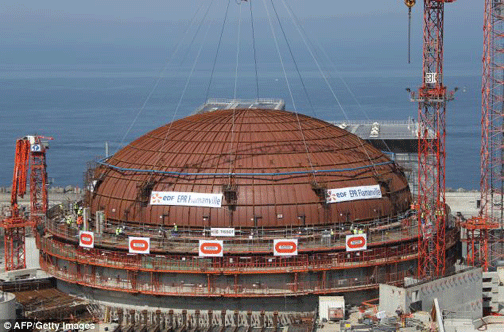
France’s Revolutionary Nuclear Reactor Is a Leaky, Expensive Mess
With a bloated budget, endless delays, and shoddy construction, EPR looks like a big mistake. BY CAROLINE DELBERT, AUG 3, 2020
- A revolutionary French reactor design is 10 years overdue and nearly four times over budget.
- Taking big technology swings requires risk, but this huge miscalculation looks bad.
- The reactor uses less uranium and aims to replace a decommissioned reactor at an existing plant.
France’s new energy minister has called a major French nuclear project “a mess” in public interviews. The European pressurized reactor (EPR) that was commissioned for the Flamanville nuclear power plant, where it joins two existing pressurized water reactors, has been delayed and plagued by problems. The latest extension takes the project timeline from 13 years to 17 at least.
The goal with the EPR design was to continue to kit out the world’s highest-output nuclear plants, with individual reactors that were more powerful and safer. The EPR uses less uranium because its chemical design is more efficient. And it’s not any kind of major technological leap; instead, it’s an iteration on a previous design that’s just a little bit better.
The engineers are so eager to keep iterating that they already have an EPR 2 design in the works. This sounds pretty straightforward … right?
That puts Flamanville 10 years past its original due date. One of the more alarming causes for delay is a break in the “main secondary system penetration welds,” which has contributed to a budget that’s bloated from a planned $3.9 billion to $14.6 billion.
Barbara Pompili was just appointed France’s minister of ecological transition, which is the department that includes energy as well as environmental issues like biodiversity. Pompili is publicly and avowedly anti-nuclear, even for civilian energy. With a new spotlight on her office, she told a French radio station, “We have made a commitment to reduce the share of nuclear power to 50 [percent] by 2035.”
Pompili said the critiques of Flamanville’s overdue EPR reflect broad industry consensus from different reports, not her own anti-nuclear views.
Nuclear waste – how to warn people for 10,000 years
 How to build a nuclear warning for 10,000 years’ time, The nuclear waste buried far beneath the earth will be toxic for thousands of years. How do you build a warning now that can be understood in the far future?, BBC Future, 3 Aug 20
“This place is not a place of honor,” reads the text. “No highly esteemed dead is commemorated here… nothing valued is here. What is here was dangerous and repulsive to us. This message is a warning about danger.”
It sounds like the kind of curse that you half-expect to find at the entrance to an ancient burial mound. But this message is intended to help mark the site of the Waste Isolation Pilot Project (WIPP) that has been built over 2,000 feet (610m) down through stable rocks beneath the desert of New Mexico. The huge complex of tunnels and caverns is designed to contain the US military’s most dangerous nuclear waste.
This waste will remain lethal longer than the 300,000 years Homo sapiens has walked across the surface of the planet. WIPP is currently the only licensed deep geological disposal repository in operation in the world. A similar facility should also open in Finland in the mid-2020s.
When the facility is full sometime in the next 10 to 20 years, the caverns will be collapsed and sealed with concrete and soil. The sprawling complex of buildings that currently mark the site will be erased. In its place will be “our society’s largest conscious attempt to communicate across the abyss of deep time”.
vThe plan calls for huge 25ft (7.6m) tall granite columns marking the four-sq-mile (10 sq km) outer boundary of the entire site. Inside this perimeter, there is an earth berm 33ft (10m) tall and 100ft (30m) wide marking the repository’s actual footprint. Then inside the berm will be another square of granite columns.
At the centre of this monumental “Do Not Enter” sign will be a room containing information about the site. In case the information becomes unreadable, there will be another buried 20ft below, and another buried in the earth barrier itself. Detailed information about the WIPP will be stored in many archives around the world on special paper stamped with the instruction that it must be kept for 10,000 years, the rather arbitrary length of the site’s license.
The plan calls for huge 25ft (7.6m) tall granite columns marking the four-sq-mile (10 sq km) outer boundary of the entire site. Inside this perimeter, there is an earth berm 33ft (10m) tall and 100ft (30m) wide marking the repository’s actual footprint. Then inside the berm will be another square of granite columns.
Welcome to the world of nuclear semiotics. The vast landscape proposed for the WIPP is partly influenced by science fiction. Nuclear physicists, engineers, anthropologists, sci-fi writers, artists and others have come together in the very broad, esoteric field of research into the way that future humans – and anything that comes after us – might be warned of our deadly legacy
Sadly, the idea to cover the site with a forest of massive concrete thorns was not taken up, nor the idea to create a self-perpetuating atomic priesthood who would use legend and ritual to create a sense of fear around the site for generations. Linguist Thomas Sebok first used the phrase “nuclear priesthood” in 1981. ……. https://www.bbc.com/future/article/20200731-how-to-build-a-nuclear-warning-for-10000-years-time
Arms control, the new arms race, and some reasons for optimism

|
“The end of arms control as we know it”
The last agreement limiting America’s and Russia’s nuclear arsenals is months away from expiring. Vox, By Alex Ward@AlexWardVoxalex.ward@vox.com Aug 3, 2020, In December 2019, a secretive group of elite Americans and Russians gathered around a large square table. It was chilly outside, as Dayton, Ohio, can get in the winter, but the mood inside was just as frosty.
The 147th meeting of the Dartmouth Conference, a biannual gathering of citizens from both nations to improve ties between Washington and Moscow, had convened. Former ambassadors and military generals, journalists, business leaders, and other experts came together to discuss the core challenges to the two countries’ delicate relationship, as members had since 1960. In recent years, that has included everything from election interference to the war in Ukraine. But now the prospect of an old danger worried them most, just as it had the group’s quiet supporters President Dwight Eisenhower and Soviet Chairman Nikita Khrushchev decades before: nuclear catastrophe. Proceedings typically start with a lengthy summary of the relationship, touching on security, medical, societal, political, and religious issues up for discussion. This time, the synopsis was unnervingly short. “We went right into the nuclear issue,” said a conference member, speaking on condition of anonymity because they were not authorized to speak openly about the event. “There was a belief we were in serious danger because it’s the end of arms control as we know it.” “It was dramatic and sobering,” the member added. The US and Russia were then barely over a year away from losing the last major arms control agreement between them: New START, short for the Strategic Arms Reduction Treaty. That agreement limits the size of the two countries’ nuclear arsenals, which together account for 93 percent of all nuclear warheads on earth. The deal expires on February 5, 2021, and those sitting around the table feared its demise. The trepidation inspired the group’s four co-chairs to do something the Dartmouth Conference hadn’t done in its 60-year existence: release a statement. “Given the deep concerns we share about the security of our peoples, for the first time in our history we are compelled by the urgency of the situation to issue this public appeal to our governments,” they wrote, calling for the US and Russia to invoke the treaty’s five-year extension. Today, roughly half a year before New START stops, the group’s members continue to stress the consequences. “We’re at a decisive point,” said retired US Army Brig. Gen. Peter Zwack, who was at the December meetings. “The entire arms control regime of the past 50 years is about to pass.” Seventy-five years ago this week, the US dropped atomic bombs on Hiroshima and Nagasaki in Japan, unleashing a weapon of mass destruction on the world. Decades of painstaking diplomacy between the world’s two greatest nuclear powers, the US and Russia, helped keep both nations from unleashing that destructive power on each other ever since. But now the US and Russia are mere months from throwing it all away. New START may soon join other defunct arms control agreements, including one prohibiting ground-based intermediate-range missiles scrapped in 2019 and another allowing overflights of nuclear facilities likely to end this year. One reason for all of this: President Donald Trump wants to put his own stamp on arms control history, one way or another…….. “The president has directed us to think more broadly than the current arms control construct and pursue an agreement that reflects current geopolitical dynamics and includes both Russia and China,” a senior administration official told me on the condition of anonymity. “We’re continuing to evaluate whether New START can be used to achieve that objective.” That evaluation has turned into a delicate process with Russia, with high-level and working-level meetings taking place in Vienna to see if New START can be salvaged. Officials from both countries met again at the end of July in Austria’s capital, while China — which the US wants involved to discuss limiting its nuclear and missile capabilities, even though it isn’t a party to New START — didn’t show up……… If New START ends, then, the general animosity between the US and Russia could lead to a nuclear arms race and prompt China to keep building up its forces — a situation unlike anything we’ve seen since the Cold War. “We’re creating the greater threat of a conflict that could literally destroy each country and perhaps even our planet,” Leon Panetta, the former CIA director and defense secretary, told me. The following account of the looming death of US-Russia arms control is based on conversations with over 20 current and former US officials, lawmakers, and experts on three continents. It traces the story of arms control from its origins to its possible end in the coming years, and what that end could mean for all of us. The long and dangerous road to arms control……………..Trump takes control, and trashes arms controlNuclear war is a threat Donald Trump has often talked about over the years, and he has sometimes seemed genuinely concerned about it…….. When Trump took office on January 20, 2017, three major arms control-related agreements were in force: the INF Treaty, a confidence-building measure known as Open Skies, and New START, the agreement Obama had negotiated just a few years earlier. Yet, rather than continue the progress his predecessors made toward making the world safer from the threat of nuclear war, Trump decided to tear it all down, while pursuing an exit from the Iran nuclear deal and ineffective nuclear diplomacy with North Korea. Of those three US-Russia agreements, one is gone, another is almost gone, and the last, it seems, is on the way out. That’s not all bad, some experts say, as Russia did cheat on some of the agreements and the US showed those actions would have consequences. But most experts I spoke to are concerned that Trump is tearing down an artifice with no new blueprints to make it better, or even rebuild what exists. “The whole arms control regime is under considerable stress,” former Energy Secretary Ernest Moniz, who now leads the Nuclear Threat Initiative, told me. “It’s badly frayed.” Let’s take each deal in turn. The INF Treaty The Intermediate-Range Nuclear Forces (INF) Treaty was signed by President Ronald Reagan and Soviet leader Mikhail Gorbachev in December 1987. It prohibited Washington and Moscow from fielding ground-launched cruise missiles that could fly between 310 and 3,400 miles.Both countries signed the deal as a way to improve relations toward the end of the Cold War. However, the two nations still could — and since have — built up cruise missiles that can be fired from the air or sea……… Ultimately….. “the president made the decision to leave” the deal. That officially happened in August 2019. Open SkiesOriginally an idea by Eisenhower and made a reality in 2002, the Open Skies Treaty allows nations to conduct unarmed flights over another country’s military installations and other areas of concern. Entering into effect 10 years later, it has since helped the 34 North American and European signatories, including the US and Russia, gain confidence that others weren’t developing advanced weapons in secret or planning big attacks…….. In May 2020, Trump decided America would withdraw from the Open Skies Treaty, kicking off a six-month clock before the US could officially leave the deal. …………. New STARTAs a reminder, the New START arms control deal became effective in 2011 during the Obama administration. The treaty’s goal, essentially, is to limit the size of the American and Russian nuclear arsenals, the two largest in the world. To ensure those limits are met and kept, the treaty also allows Washington and Moscow to keep tabs on the other’s nuclear programs through stringent inspections and data sharing, thereby curbing mistrust about each other’s nuclear and military plans. At the time, it was heralded as a major achievement and is still considered such by top lawmakers………… As of mid-July 2020, the two nations had exchanged more than 20,400 total notifications about the state of their arsenals. Rose Gottemoeller, who led the New START negotiations for the US at the State Department, told me all that goes away if Trump decides not to stay in the agreement. “The Russians won’t allow for verifications and inspections without a legal basis,” she said. And without the ability to get deep insight into Russia’s nuclear forces, trust would surely erode. “The exact thing which gives us an excellent understanding of Russian strategic forces is all going to break down,” said Gottemoeller, who in 2019 stepped down as NATO’s deputy secretary. “Unless you have access to verify what’s going on with the warheads on missiles or submarines, you don’t really understand what’s going on.” Putin, Russia’s president, says he sees value in the deal. “Russia is not interested in starting an arms race and deploying missiles where they are not present now,” he told Russian officials in December. “Russia is ready to immediately, as soon as possible, by the end of this year, without any preconditions, extend the START Treaty so that there would be no further double or triple interpretation of our position.” Trump hasn’t taken up Putin on his offer yet, even though those two could extend the agreement for up to five years without anyone else’s input………….. So why get out of a deal that almost everyone says is vital to keeping US-Russia relations stable? The answer is China…….. In July, top US arms control negotiator Marshall Billingslea extended an “open invitation” to Chinese officials to join the US and Russia in Austria for New START talks, even though Beijing has long said it won’t sign on to New START since its arsenal is so much smaller than Washington’s and Moscow’s. …………… The new arms race“Arms control creates an additional layer of insurance between states not getting along well and a possible hot war,” Samuel Charap, who served as a senior adviser to Gottemoeller after New START entered into force, told me. “If you remove the failsafe, you create more risk.” Without the longstanding architecture in place, Washington and Moscow would enter a dangerous arms control hiatus and could see already poor relations spiral out of control. The US and Russia have many nuclear-tipped missiles already pointed at each other, but it would be even worse if both sides try to one-up their adversary by creating more deadly and usable weapons. That, unfortunately, is exactly what’s happening. Welcome to the new arms race. ……………….. A review conference for the treaty was supposed to take place in April but was postponed due to the coronavirus. Whenever it meets, the lack of US-Russia arms control commitment could make it the testiest gathering in decades. Some may seriously push for the NPT to be dissolved. And if that’s the case, what’s to stop nations like Iran, Saudi Arabia, or others from sprinting toward the bomb? Second, the end of an important era in global security fades away with nothing to replace or build on it. “The good old days when arms control was going hand-in-hand with a cooperative security relationship — which basically ties my security to your security — those days are gone, and I don’t see them coming back,” said the University of Hamburg’s Kühn. The only chance of a return to that time, he added, would likely be after Trump, Putin, and Chinese President Xi Jinping leave their offices………………. There are reasons for optimism. Washington and Moscow are having conversations now, including a working-level meeting in July in Vienna. Even though the administration is skeptical of arms control, and Billingslea is not a fan of the concept, Trump’s team at least hasn’t outright rejected negotiations. However unlikely now, the two powers could come to an agreement before New START’s expiration on February 5. If they don’t, a newly elected Joe Biden could quickly reach a deal with Putin before the deadline, though he’d have limited time since his term would start in late January. “The election in November will be a major inflection point for New START specifically,” Moniz, the former energy secretary who helped strike the Iran nuclear deal, told me. “If Biden wins, I can’t imagine that he wouldn’t extend New START.”……… https://www.vox.com/world/21131449/trump-putin-nuclear-usa-russia-arms-control-new-start |
|
Glaciers in New Zealand – extreme melting due to global heating

|
Human-induced climate change is causing ‘extreme’ melting in New Zealand glaciers, The study is only the second to draw a direct link between glacier melt and human-induced climate change. SBS NEWS 4 AUG 20 BY BIWA KWAN New analysis of data and photo records of melting glaciers in New Zealand has found human-induced climate change increased the likelihood of mass ice melt. The new modelling techniques were applied to 10 glaciers in New Zealand to reveal a more detailed picture of what is driving the accelerating rates of ice melt in the region. Lead researcher Lauren Vargo said the analysis compared ice melt under pre-industrial greenhouse gas emissions and current-day emissions to uncover “a quite extreme result”. “Some of the glaciers were at least six times more likely to have experienced that high mass loss because of humans,” said Dr Vargo, who is based at the Victoria University of Wellington. “We’re really confident with that number because that is the low end. The high end is 350 times more likely. “But with the high ice mass loss event we saw [in 2018], it would not have happened at all without humans.” The first study to make a direct link between human-induced climate change and glacier melt focused on glaciers in the Northern Hemisphere where more robust data records exist. The study – published in the journal Science in 2014 – looked at records between 1851 and 2010 using a running mean over 20-year periods. Dr Vargo said the rate of ice melt has resulted in the loss of a quarter of New Zealand’s glaciers since the 1970s. Rapid melt events in 2011 and 2018 prompted the study. …… The study accounted for years like 2013 when some glaciers in New Zealand actually gained mass, but not at a rate to combat the overall decline. ……. HTTPS://WWW.SBS.COM.AU/NEWS/HUMAN-INDUCED-CLIMATE-CHANGE-IS-CAUSING-EXTREME-MELTING-IN-NEW-ZEALAND-GLACIERS |
|
Florida’s nuclear power stations could be at risk in hurricane times
|
Hurricane Isaias projected to strafe eastern side of Florida over the weekend, S and P Global
HIGHLIGHTSUncertainty over where it may make landfall
Utilities and energy companies to keep close eye Houston — In a late July 31 advisory, the National Oceanic and Atmospheric Administration’s National Hurricane Center said heavy rains associated with Hurricane Isaias could begin to affect south and east central Florida late Friday night and the eastern Carolinas by early next week, potentially resulting in isolated flash flooding. NOAA said the Category 1 hurricane was expected to reach the east coast of Florida on Saturday morning. It said that storm surge along the northeastern Florida coast could come late in the weekend, and spread northward along the remainder of the US East Coast through early next week. Florida Power & Light said July 31 it had a restoration workforce of more than 10,000 “ready to respond to Hurricane Isaias amid the global COVID-19 pandemic.” It said it will bring in crews from sister company Gulf Power and has secured more than 2,000 additional restoration personnel from nearly 10 states. “We are committed to restoring service in between bands of severe weather, as long as winds are below 35 MPH,” the company said. FPL owns the two-reactor, 1,600-MW Turkey Point Nuclear Generating Station located two miles east of Homestead, Florida, and about 25 miles south of Miami. According to preliminary mapping of Isaias’ path, the Turkey Point facility may escape the storm’s more severe western rain bands on Saturday. FPL’s 1,880-MW St. Lucie Nuclear facility located further up the Florida coast on Hutchinson Island, may not be so lucky. The center of the storm eye could pass offshore of the St. Lucie facility early on Sunday morning. In a statement, Duke Energy Florida said it believed its customers in central and eastern Florida may experience weather-related outages. …… https://www.spglobal.com/platts/en/market-insights/latest-news/natural-gas/073120-hurricane-isaias-projected-to-strafe-eastern-side-of-florida-over-the-weekend |
|
How the Ohio nuclear bribery scandal developed. And what’s next

 Nuclear bailout in Ohio tied to bribery scandal was years in making Nuclear plants nationwide were warning four years ago that their aging reactors were in need of financial help, because they couldn’t compete with cheaper natural gas-fired plants. The New Indian Express, By PTI 3 Aug 20,
TOLEDO: A $1 billion bailout for Ohio’s two nuclear plants that’s now entangled in a state bribery scandal had little support when the idea came up three years ago. It was all but dead until the spring of last year, when the new leader of the Ohio House stepped up with a last-ditch attempt to give the plants a financial lifeline. But that’s all on shaky ground again after federal authorities accused the powerful Republican Ohio House speaker and four associates of orchestrating a $60 million bribery scheme involving corporate money secretly funneled to them in exchange for passing the bailout. The question for state lawmakers who are under pressure to repeal the bailout is whether they’re willing to face another divisive debate — this time under the shadow of scandal — in order to find a new way to prop up the financially strapped nuclear plants. Here is a look at how the bailout came about and its prospects going forward. DIM OUTLOOK …….. GLIMMER OF HOPE Just months after taking over the GOP-controlled Ohio House, Speaker Larry Householder in early 2019 unveiled a plan to save the nuclear plants and eliminate incentives promoting wind and solar power. It would steer the state in the right direction, he said. …….. BEHIND THE SCENES t was no secret that millions were being spent to persuade lawmakers to support the bill and keep a repeal effort off the statewide ballot last year. But it wasn’t until just two weeks ago that federal authorities said it involved illegal activity that began in 2017. Householder’s strategy, according to a federal complaint, was to pick freshman legislators he’d help elect to sponsor the bill, create a new subcommittee comprised mostly of his supporters who would push the legislation forward, and engage in an expensive media blitz to pressure public officials to back it. Federal prosecutors allege Householder then used “pressure tactics” to get the bill passed, strong-arming his own House members and senators to vote in favor. In exchange, investigators said a dark money group Householder controlled received $60 million from a unidentified company, which the complaint makes clear is FirstEnergy and its affiliates. Householder and his attorney have not commented since his arrest. FirstEnergy’s CEO has said he and the company did not do anything wrong. WHAT’s NEXT? Ohio’s governor is calling on the Legislature to repeal the bailout and replace it, saying he still believes the nuclear plants are an important part of the state’s energy future. Fellow Republican Bob Cupp, a veteran lawmaker from Lima who was chosen this past week to become the new House speaker after lawmakers booted Householder from the job, said one of his first priorities will be to do away with the legislation and start anew. But some lawmakers, including those who voted for the bailout last time around, want nothing to do with it again…….. https://www.newindianexpress.com/world/2020/aug/03/nuclear-bailout-in-ohio-tied-to-bribery-scandal-was-years-in-making-2178602.html |
|
Fire at the Belleville nuclear power plant reveals the disorganization of EDF
  Le Journal de l’Energie 30th July 2020 A fire at the Belleville nuclear power plant reveals the disorganization of EDF. A fire broke out at the Belleville-sur-Loire (Cher) nuclear power plant in April 2020 during a routine maintenance operation carried out by subcontractors, which should not have been left unattended. An incident that was largely avoidable if EDF had followed basic safety rules. An
inspection by the Nuclear Safety Authority (ASN), after the incident, identified “many deviations”. Although the incident did not have an impact on the operation of the plant, it calls into question the safety culture of EDF, the world’s leading nuclear operator. https://journaldelenergie.com/nucleaire/incendie-centrale-nucleaire-belleville-desorganisation-edf/ |
|
1 This Month


Tell Congress: Prevent Nuclear Catastrophe in Iran

Tell Congress: Prevent Nuclear Catastrophe in Iran

Read the Public Inquiry Report, the Commissioners’ report, Surrendering Australia: The AUKUS Deception is available to download for free at aukuspublicinquiry.com. Or just watch the replay of the National Press Club Luncheon.
To see nuclear-related stories in greater depth and intensity – go to https://nuclearinformation.wordpress.com
Say No to NASA’s Reckless Nuclear Reactor on the Moon
-
Archives
- November 2026 (284)
- October 2026 (302)
- September 2026 (339)
- August 2026 (330)
- July 2026 (355)
- June 2026 (287)
- May 2026 (306)
- April 2026 (356)
- March 2026 (251)
- February 2026 (267)
- January 2026 (308)
- December 2025 (358)
-
Categories
- 1
- 1 NUCLEAR ISSUES
- business and costs
- climate change
- culture and arts
- ENERGY
- environment
- health
- history
- indigenous issues
- Legal
- marketing of nuclear
- media
- opposition to nuclear
- PERSONAL STORIES
- politics
- politics international
- Religion and ethics
- safety
- secrets,lies and civil liberties
- spinbuster
- technology
- Uranium
- wastes
- weapons and war
- Women
- 2 WORLD
- ACTION
- AFRICA
- Atrocities
- AUSTRALIA
- Christina's notes
- Christina's themes
- culture and arts
- Events
- Fuk 2022
- Fuk 2023
- Fukushima 2017
- Fukushima 2018
- fukushima 2019
- Fukushima 2020
- Fukushima 2021
- general
- global warming
- Humour (God we need it)
- Nuclear
- RARE EARTHS
- Reference
- resources – print
- Resources -audiovicual
- Weekly Newsletter
- World
- World Nuclear
- YouTube
-
RSS
Entries RSS
Comments RSS

