Bill McKibben not sure that Kamala Harris will be strong on addressing climate change
|
We’re in the Kamala Harris era now, and so far, so good. Of the four people on the major-party Presidential tickets, she appears to be the most energetic and normal………. Listening to Joe Biden speak, I feel a constant mild apprehension about what may emerge; Harris relaxes me.
Given the very real possibility that she’ll be at or near the pinnacle of our politics for somewhere between four and sixteen years, it’s worth asking how she will handle the gravest crisis that looms over our planet. That’s not the same as asking if she should be elected, because, on climate issues, a shrink-wrapped pallet of frozen Ore-Ida French fries would be a vast improvement on the incumbent. But it’s going to take an unflinching, unrelenting effort to transform America’s energy system and lead a similar process globally. Is she committed to that?
Her defenders point to a number of powerful statements that she made over the course of her Presidential primary campaign. She’d eliminate the filibuster to pass a Green New Deal. She’d tell the Department of Justice to investigate oil and gas companies. ………
Harris has been particularly outspoken about environmental injustice: just six days before she got the V.P. nod, she joined Alexandria Ocasio-Cortez to introduce the Climate Equity Act, which, as the Times explained, “would create a dedicated Office of Climate and Environmental Justice Accountability within the White House and require the federal government to rate the effect that every environmental legislation or regulation would have on low-income communities.”
If there’s a rub, it’s that, to date, she hasn’t been that eager to really stand up to power on this issue. ……. What will she do if she becomes Vice-President? I imagine that her courage will depend on the climate movement’s success in eroding the political power of the oil companies. The weaker the fossil-fuel conglomerates become, the less scary they are. (Oil barons understand this, which is why they’re spending large sums to reëlect Trump). My guess is that Harris is a run-of-the mill politician, who will go where the footing is easiest. ………. (Note to Joe Biden.) The Sunrise Movement—the group of under-thirties who organized the sit-in at House Speaker Nancy Pelosi’s office that served as a coming-out party for the Green New Deal—produced a YouTube video for Markey last week, which may be my favorite political ad of all time. (Watch till the end for one of the best knife twists in campaign history). If Markey wins, he will go back to the Senate a national progressive hero; more to the point, he will have demonstrated that truly taking on climate change can pay off politically. That lesson won’t be lost on anyone, Harris included. ………. Obvious but important: a new study from Climate Central found that as temperatures rise, so does demand for air-conditioning. It projects that, by 2050, demand for air-conditioning will rise in the United States by fifty-nine per cent—and far more than that around the world. That is why we need highly efficient air-source heat pumps, which also cool air, and why we need enormous amounts of renewable electricity to power it all. …… Scoreboard ⬇️ Big number on the board this week: a hundred and thirty degrees Fahrenheit (54.4 degrees Celsius), which is the highest reliably recorded temperature ever on planet Earth. It happened over the weekend, in California’s Death Valley, which is also the place where the nominal Earth temperature record of a hundred and thirty-four degrees Fahrenheit was set, in 1931. That number, though, has been disputed ever since, and the great weather historian Christopher Burt published a lengthy investigation, in 2016, proving it could not have happened. For now, a hundred and thirty degrees is the mark—but don’t expect it to last. ……..Extraordinarily bad fire news from across the planet. In the Amazon, fires are burning at a rate not seen for a decade. In Siberia, fires may be burning at a rate we’ve never previously seen—and the heating, drying region may be on the verge of moving into a new and extreme “fire regime.” In Colorado and elsewhere in the American West, this year’s fire season has begun in earnest. The forests surrounding Hanging Lake—one of the state’s premier tourist sites—almost burned. The fourteen-year-old climate activist Haven Coleman reports via Twitter: “Even inside my house it’s hazy. . . . Feels like I’m being cornered, trapped. Stuck home since there’s covid everywhere, but NOW my home is becoming unbreathable. Everything sucks. Ugh.” Indeed. By midweek, evacuations were under way in California, where fires were threatening the city of Vacaville and other parts of Napa and Sonoma. …….The two-thousands were, officially, the hottest decade on record, up 0.39 degrees Celsius from the previous decade, which is a huge change in ten years’ time. It’s an urgent reminder that the next decade may be our final chance to take serious climate action A new study in Nature confirms that the effect of the pandemic on the planet’s temperature was negligible—greenhouse-gas emissions fell, but much of the smog that tends to cool the planet also disappeared. “These results highlight that without underlying long-term system-wide decarbonization of economies, even massive shifts in behaviour, only lead to modest reductions in the rate of warming,” the authors wrote. They also, however, noted some good news: “Pursuing a green stimulus recovery out of the post-covid-19 economic crisis can set the world on track for keeping the long-term temperature goal of the Paris Agreement within sight.” |
|


NuScam’s not so small nuclear reactors need $1.4 billion subsidy, and might not be so safe
 Smaller, cheaper [?] reactor aims to revive nuclear industry, but design problems raise safety concerns, Science, By Adrian Cho, Aug. 18, 2020 Engineers at NuScale Power believe they can revive the moribund U.S. nuclear industry by thinking small. Spun out of Oregon State University in 2007, the company is striving to win approval from the U.S. Nuclear Regulatory Commission (NRC) for the design of a new factory-built, modular fission reactor meant to be smaller, safer, and cheaper than the gigawatt behemoths operating today. But even as that 4-year process culminates, reviewers have unearthed design problems, including one that critics say undermines NuScale’s claim that in an emergency, its small modular reactor (SMR) would shut itself down without operator intervention.The issues are typical of the snags new reactor designs run into on the road to approval, says Michael Corradini, a nuclear engineer at the University of Wisconsin, Madison. “I don’t think these things are show-stoppers.” However, M. V. Ramana, a physicist who studies public policy at the University of British Columbia, Vancouver, and has been critical of NuScale, says the problems show the company has oversold the claim that its SMRs are “walk-away safe.” “They have given you the standard by which to evaluate them and they’re failing,” Ramana says.
Passive safety?
Normally, convection circulates water—laced with boron to tune the nuclear reaction—through the core of NuScale’s reactor (left). If the reactor overheats, it shuts down and valves release steam into the containment vessel, where it conducts heat to a surrounding pool and condenses (center). The water flows back into the core, keeping it safely submerged (right). But the condensed water can be low in boron, and reviewers worried it could cause the reactor to spring back to life………..
NuScale’s likely first customer, Utah Associated Municipal Power Systems (UAMPS), has delayed plans to build a NuScale plant, which would include a dozen of the reactors, at the Department of Energy’s (DOE’s) Idaho National Laboratory. The $6.1 billion plant would now be completed by 2030, 3 years later than previously planned, says UAMPS spokesperson LaVarr Webb. ……… The delay will give UAMPS more time to develop its application for an NRC license to build and operate the plant, Webb says. The deal depends on DOE contributing $1.4 billion to the cost of the plant, he adds.
……… A NuScale reactor—which would be less than 25 meters high, hold about one-eighth as much fuel as a large power reactor, and generate less than one-tenth as much electric power—would rely on natural convection to circulate the water
……….. In March, however, a panel of independent experts found a potential flaw in that scheme. To help control the chain reaction, the reactor’s cooling water contains boron, which, unlike water, absorbs neutrons. But the steam leaves the boron behind, so the element will be missing from the water condensing in the reactor and containment vessel, the NRC’s Advisory Committee on Reactor Safeguards (ACRS) noted. When the boron-poor water re-enters the core, it could conceivably revive the chain reaction and possibly melt the core, ACRS concluded in a report on its 5–6 March meeting.https://www.sciencemag.org/news/2020/08/smaller-cheaper-reactor-aims-revive-nuclear-industry-design-problems-raise-safety
Greta Thunberg on the global inaction on climate change
Greta Thunberg: the world is still in a state of climate crisis denial https://www.theguardian.com/environment/2020/aug/19/another-two-years-lost-to-climate-inaction-says-greta-thunberg, Damian Carrington Environment editor @dpcarrington, Wed 19 Aug 2020 Two years on from Greta Thunberg’s first solo school strike for the climate, she says the world has wasted the time by failing to take the necessary action on the crisis.
Thunberg’s strike inspired a global movement, and on Thursday she and other leading school strikers will meet Angela Merkel, the chancellor of Germany, which holds the rotating presidency of the European council. They will demand a halt to all fossil fuel investments and subsidies and the establishment of annual, binding carbon budgets based on the best science.
“Looking back [over two years], a lot has happened. Many millions have taken to the streets … and on 28 November 2019, the European parliament declared a climate and environmental emergency,” Thunberg said in an article for the Guardian with fellow strikers Luisa Neubauer, Anuna de Wever and Adélaïde Charlier.
“But over these last two years, the world has also emitted over 80bn tonnes of CO2. We have seen continuous natural disasters taking place across the globe. Many lives and livelihoods have been lost, and this is only the very beginning.”
They said leaders were speaking of an “existential crisis”, yet “when it comes to action, we are still in a state of denial. The gap between what we need to do and what’s actually being done is widening by the minute. Effectively, we have lost another two crucial years to political inaction.”
Thunberg and her colleagues said fighting the climate emergency must involve rich nations stopping some of their polluting activities.
- “However, it’s a fact which most people refuse to accept. Just the thought of being in a crisis that we cannot buy, build or invest our way out of seems to create some kind of collective mental short-circuit. This mix of ignorance, denial and unawareness is the very heart of the problem,” they said.
The trillions of dollars being spent by governments in response to the coronavirus pandemic are seen as a once-in-a-lifetime opportunity to put the world on course to halt global heating, with economists, scientists and health experts all saying the benefits would outweigh the costs.
However, G20 governments’ rescue packages are giving significantly more support to fossil fuels than to low-carbon energy. Germany’s recovery plan includes €40bn for climate measures such as electric vehicles, public transport and energy efficiency, and has been praised by green groups. But elsewhere, too little is being done, Thunberg and colleagues said.
“Even a child can see that the policies of today are incompatible with the current best available science,” they said.
- Scientists calculate that global carbon emissions must be cut by half by the end of this decade if humanity is to have a reasonable chance of keeping temperature rises to below 1.5C, the limit set in the Paris climate deal. Drops in emissions during coronavirus lockdowns are only a small blip in a long-term rising trend and will have a “negligible” effect on the climate crisis, researchers say.
“We understand the world is complicated and that what we are asking for may not be easy or seem unrealistic,” said the school strikers. “But it is much more unrealistic to believe that our societies would be able to survive the global heating we’re heading for. We are inevitably going to have to fundamentally change, one way or another. The question is: will the changes be on our terms, or on nature’s terms?”
Biggest bribery and money-laundering bust in Ohio history, but the crooked pro nuclear law still stands!
 Opinion: How bad nuclear plant bailout legislation got passed

Now the law is forcing Ohio taxpayers to cough up $1.3 billion in subsidies to prop up two aging nuclear plants – quashing cheaper natural gas and zero-emissions renewables like wind and solar. It also memorialized taxpayer subsidies for ailing coal plants – including, because Householder and his alleged co-conspirators were apparently feeling neighborly, for a coal plant across the border in Indiana.
But let’s not lose sight of FirstEnergy. The opaque electric utility had already long shirked accountability for its actions, cloaking itself in expendable subsidiaries and opposing virtually any measure to improve Ohio’s air and water, which the utility has long been responsible for befouling. This time, to protect its toxic nuclear and coal assets, the company apparently happily engaged in what even the scheme’s conspirators allegedly openly referred to as “pay to play,” buying Ohio lawmakers for a song compared to the $1.3 billion the utility now stands to skim from Ohioans’ pockets.
We have yet to see how many more dominoes fall. There’s Sam “The Randazzler” Randazzo, the supposed ex-lobbyist and current public utilities commission chair, who seems to have much to answer for in the scheme. And FirstEnergy, it appears, didn’t stop at allegedly buying Ohio politicians. Even after the law passed, it spent another $38 million in an apparent dark-money campaign to make sure it’d stopped Ohio’s vital transition to a clean energy economy – the prospect of thousands of new clean jobs, not to mention saving the Earth, apparently not enough when compared to FirstEnergy profit margins and executives’ Christmas bonuses
Even as the feds continue following the money, we know what must happen: Gov. DeWine, who unenthusiastically signed the bill, is now calling for its repeal – a crucial first step toward righting this eye-popping wrong. As we now know, courtesy of the FBI and Justice Department, supporting these ailing power plants was nothing more than a successful bid to line executives’ pockets – and, it seems, buy the house speaker a vacation home in Florida. As we continue to learn who knew what when, erasing this law will clear the way for cleaner, far cheaper, truly market-competitive resources like natural gas and renewables to power our homes and businesses.
Ohioans deserve better – more honest politicians, truly transparent electricity providers, cleaner air and water. Repealing this law, and holding our officials to account, is the way to get there.
Jigar Shah is president of Generate Capital, a San Francisco-based finance company that builds, owns and operates renewable energy infrastructure.
High financial risks in nuclear power – from global heating
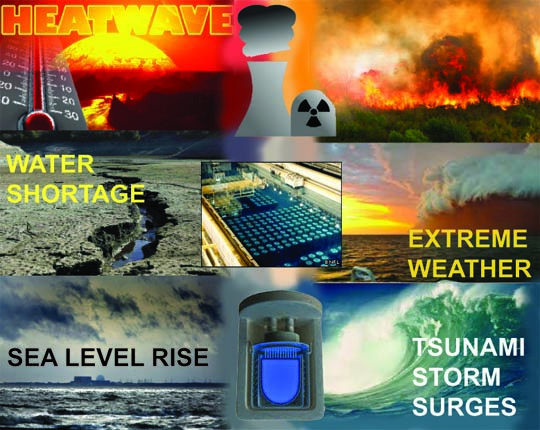 Climate change poses high credit risks for nuclear power plants, Moody’s says, https://www.reuters.com/article/us-moody-s-powerplants/climate-change-poses-high-credit-risks-for-nuclear-power-plants-moodys-says-idUSKCN25E2A5 (Reuters) Reporting by Diptendu Lahiri in Bengaluru; Editing by Steve Orlofsky, 19 Aug 20
– Credit risks associated with climate change for nuclear power plant operators in the United States will rise over the next 10 to 20 years, Moody’s Investor Service said on Tuesday.Climate change can affect every aspect of nuclear plant operations like fuel handling, power and steam generation, maintenance, safety systems and waste processing, the credit rating agency said.
However, the ultimate credit impact will depend upon the ability of plant operators to invest in mitigating measures to manage these risks, it added.
Close proximity to large water bodies increase the risk of damage to plant equipment that helps ensure safe operation, the agency said in a note.
Moody’s noted that about 37 gigawatts (GW) of U.S. nuclear capacity is expected to have elevated exposure to flood risk and 48 GW elevated exposure to combined rising heat and water stress caused by climate change.
Nuclear plants seeking to extend their operations by 20, or even 40 years, beyond their existing 40-year licenses face this climate hazard and may require capital investment adjustments, Moody’s said.
“Some of these investments will help prepare for the increasing severity and frequency of extreme weather events.”
Book Review- Tempting Fate
LESSONS FROM CONFLICTS BETWEEN NUCLEAR AND NON-NUCLEAR STATES. War on the Rocks ALEXANDER LANOSZKA, AUGUST 19, 2020
Paul Avey, Tempting Fate: Why Nonnuclear States Confront Nuclear Opponents (Ithaca, NY: Cornell University Press, 2019)
With Tempting Fate, Paul C. Avey makes an invaluable contribution to our understanding of nuclear politics. Written in clear and accessible prose, Avey explains why some non-nuclear weapons states have challenged and resisted nuclear weapons states despite the existential risks involved. …………..
Is the £20 billion Sizewell C project right for the region and country?
 East Anglia’s nuclear option – is the £20 billion Sizewell C project right for the region and country? ANGLIA
The electricity company EDF plans to build a new nuclear power station on the Suffolk coast, but what will that mean for our region?
How will it impact local people and the environment? And what role does nuclear power play in the East as the country moves towards zero carbon emissions by 2050?
-
- EDF proposes building a twin nuclear reactor at a cost of £20 billion pounds. .
- ………………..It’s expected to operate for 60 years.
- The whole project will take around 10-12 years to build with a construction site covering 620 acres.
-
also a fear that it will come at a cost to existing businesses – especially the tourism industry.
One of those concerned is local brewery Adnams.
Andy Wood from Adnams said: “The tourism industry employs nearly 100,000 people, the value of tourism in Norfolk and Suffolk is about £5.4 billion, and all of these things are going to be impacted by a large construction infrastructure project.”
The impact on wildlife is also raising concerns.
At RSPB Minsmere – an internationally important wildlife reserve – there are serious concerns about how noise and pollution would irrevocably damage rare wildlife habitats and species.
Adam Rowlands, from RSPB Suffolk, said: “We’re concerned about the direct impact, so the noise, the visual disturbance, in essence that could change the patterns of the birds and the other species that use the area.”
…… People have until September 30 to give their views before a decision is made.
U.S. Air Force mulls getting hypersonic nuclear weapons
US Air Force may have accidentally revealed interest in hypersonic nuke, Defense News By: Valerie Insinna 19 Aug 20, WASHINGTON — The U.S. Air Force has issued, and quietly revoked, a solicitation to industry seeking technologies that would support a hypersonic glide vehicle capable of traversing intercontinental ranges, potentially signaling the military’s interest in a hypersonic nuclear weapon.
According to an Aug. 12 request for information first reported by Aviation Week, the Air Force Nuclear Weapons Center sought ideas for potential upgrades to intercontinental ballistic missiles, including a “thermal protection system that can support [a] hypersonic glide to ICBM ranges.”
The items listed as potential ICBM upgrades were all marked “unclassified/for official use only,” which notes information that — while not secret — is not normally released to the public. The RFI was then withdrawn after Aviation Week began inquiring about it, the report noted.
Asked about the RFI on Wednesday, Lt. Gen. Richard Clark, the Air Force’s deputy chief of staff for strategic deterrence and nuclear integration, said the service’s next-generation ICBMs — known as the Ground Based Strategic Deterrent — will not be available as a hypersonic variant when it is fielded in the late 2020s…………
As the sole bidder in the GBSD competition, Northrop Grumman is expected to win an estimated $85 billion over the life of the program. A contract award is slated to occur by September, although Northrop CEO Kathy Warden said in April that she expected a decision this month. https://www.defensenews.com/smr/nuclear-arsenal/2020/08/19/the-air-force-might-be-eyeing-a-hypersonic-nuclear-weapon/
Greenland’s meltdown taking flight

This century is shaping up to be designated an inflection point of radical change with solid evidence of trouble down the line found most recently in a rapid meltdown phase of the Greenland Ice Sheet, a target way too big to miss. It’s melting fast and faster beyond the scope of climate models, which, for reasons not fully explained, cannot keep up with the cascading ice mass.Starting with this decade, Greenland’s meltdown took flight. This is indisputable as its acceleration has a familiar ring found amongst all major ecosystems, planet-wide. In short, climate change acceleration is universal. It’s a horrifyingly dangerous threat to the integrity of life-sourcing ecosystems, like the Great Barrier Reef, three massive unprecedented bleaching events in only five years; all the result of rising ocean temperatures driven by global heat, up to 90% mortality in some locations. (Source: Australian Academy of Sciences).
Greenland represents 23 feet of sea level encased in ice up to two miles thick and will likely require hundreds or thousands of years to completely melt-down, but for current purposes that doesn’t count! What counts are the upcoming years on the way to 23 feet. And, that’s a dicey proposition when consideration is given to how far off scientists’ models have been. It’ best to brace for the worst.
After all, there is no chance that emissions will be curbed. In today’s real world, it is simply not on the docket. Greenhouse gases have been accelerating ever since China decided to mix a cocktail of High-end Capitalism and the Communist Party of China; thereafter, building a brand spanking new coal-burning power plant every week like clockwork to meet capitalistic demands for cheaper products for America and the world, starting in the late 1970s.
Not only China but also Japan plans to build 20 new coal-powered plants and India is planning numerous new coal-powered plants. And, that’s only half of today’s fossil-fuel renaissance, looking ahead thru this decade, oil barons, like Saudi Arabia and the U.S., intend to increase oil and gas production by up to 130% by 2030, meaning substantially higher CO2 emissions leading to hotter temperatures leading to higher sea levels leading to increased flooding of coastal cities.
Where’s the IPCC when it’s really needed or is it hopelessly feckless?
In truth, the underlying Greenland message is not subtle; it’s simply build seawalls, thus protecting hundreds of millions of people, businesses, and urban environments from massive flooding, and soil contamination and aquifer spoilage via salt water. Coastal cities across the world need to start constructing enormous seawalls, in some cases extending for miles beyond the city’s limits, possibly as far as an entire coastline, as rising waters find voids in structures.
China feels India’s nuclear weapons programme driven by prestige: US report
China feels India’s nuclear weapons programme driven by prestige: US reportThe Carnegie report stressed China’s views on the issue are largely unknown
The Chinese state-run media continues to play up deployment of new artillery and other weapon systems near the border with India. However, despite the tension, references to nuclear weapons have been subdued in both nations.
A US think tank, the Carnegie Endowment for International Peace, on August 19 published a report on the Chinese perspective on nuclear weapons in the context of ties with India.
The Carnegies report noted while India’s perspectives on nuclear weapons are “relatively well documented,” China’s views on the issue are largely unknown.
The Carnegie report is based on interviews with “dozen Chinese academics, researchers, and military officers who work either on South Asia or on nuclear policy” and review of Chinese literature published in the last decade……..
Nukes for prestige?
On the issue of India’s nuclear weapons, the Chinese experts interviewed in the Carnegie report felt the systems are “for general deterrence and not for actual employment”……….
The experts interviewed in the Carnegie study felt a border conflict between India and China was unlikely to escalate into a nuclear exchange. Both India and China have declared ‘no first use’ of nuclear weapons.
………. The US factor
A point of concern expressed by the Chinese analysts was the possibility of India and the US strengthening strategic ties.
“While Chinese analysts largely dismiss India’s homegrown development of new military capabilities, they express concern about the prospect of US-India collaboration on defence projects. Chinese experts are particularly wary of US-India missile defence cooperation and the possibility that it could create a networked system. If such a system was to emerge, they would see India as a de facto security ally of the United States,” the Carnegie report noted. https://www.theweek.in/news/world/2020/08/19/china-feels-indias-nuclear-weapons-programme-driven-by-prestige-us-report.html
Hitachi waiting for tax-payer funding, to start nuclear projects in UK
 Horizon waiting for chance to restart new-build projects, WNN 19 August 2020 Horizon Nuclear Power has been holding “detailed conversations” with the UK government in recent weeks to persuade ministers that the proposed Wylfa Newydd plant on Anglesey could be quickly re-mobilised if they can produce a new financing model for large nuclear power plants in Britain, according to an article in the Financial Times on 16 August. A decision on Wylfa’s planning application is expected by the end of next month.Horizon announced the suspension of its new-build projects in January 2019. The UK subsidiary of Japan’s Hitachi said it had made substantial progress with its plans to provide at least 5.4 GWe of new capacity across two sites – Wylfa Newydd, in north Wales, and Oldbury-on-Severn, in southwest England – by deploying Hitachi-GE UK advanced boiling reactors.
The UK government is currently considering the Regulated Asset Base (RAB) model for new nuclear projects. This would allow investors to start making a pre-determined return as they invested, but any new policy would require primary legislation and the whole process of developing and then enacting a new policy would likely take a minimum of 18 months……. https://www.world-nuclear-news.org/Articles/Horizon-waiting-for-chance-to-restart-new-build-pr
Supporting the UN Treaty Banning Nuclear Weapons — Rise Up Times

By Steve McKeown Nukewatch Summer 2020 This coming August the National Veterans for Peace (VFP) Convention was to be held in Albuquerque, New Mexico, to commemorate the 75th anniversary of the dropping of atomic bombs on Hiroshima and Nagasaki, and the Trinity bomb test in New Mexico. The theme of the convention was to […]
Supporting the UN Treaty Banning Nuclear Weapons — Rise Up Times
Waste ‘a danger into eternity’ —

“when the Coal Mine plan comes before Cumbria County Council on the 20th August Copeland councillors on that committee should remember that the CEO of West Cumbria Mining is tasked with delivery of a GDF and that Egremont and the Irish Sea (and Ennerdale) are in the frame for the worst kind of littering that […]
Waste ‘a danger into eternity’ —
International Lawyers Make Urgent Appeal to British Government- not to extradite Julian Assange

|
ASSANGE EXTRADITION: International Lawyers Make Urgent Appeal to British Government Consortium News August 16, 2020, An array of international lawyers have written to the British prime minister, foreign secretary, secretary of state for justice and home secretary outlining his illegal treatment and demanding Julian Assange’s release. LAWYERS FOR ASSANGE Independent international legal observers of
the proceedings in the case of Julian Assange Open Letter to the UK Prime Minister Mr Boris Johnson, the Lord Chancellor and Secretary of State for Justice Robert Buckland QC, the Secretary of State for Foreign Affairs Dominic Raab and UK Home Secretary Priti Patel.Dear Prime Minister,
Dear Lord Chancellor and Secretary of State for Justice, Dear Secretary of State for Foreign Affairs, Dear Home Secretary, We write to you as legal practitioners and legal academics to express our collective concerns about the violations of Mr. Julian Assange’s fundamental human, civil and political rights and the precedent his persecution is setting. We call on you to act in accordance with national and international law, human rights and the rule of law by bringing an end to the ongoing extradition proceedings and granting Mr. Assange his long overdue freedom – freedom from torture, arbitrary detention and deprivation of liberty, and political persecution. A) ILLEGALITY OF POTENTIAL EXTRADITION TO THE UNITED STATES Extradition of Mr. Assange from the UK to the U.S. would be illegal on the following grounds: 1. Risk of being subjected to an unfair trial in the U.S. Extradition would be unlawful owing to failure to ensure the protection of Mr. Assange’s fundamental trial rights in the U.S. Mr. Assange faces show trial at the infamous “Espionage court” of the Eastern District of Virginia, before which no national security defendant has ever succeeded. Here, he faces secret proceedings before a jury picked from a population in which most of the individuals eligible for jury selection work for, or are connected to, the CIA, NSA, DoD or DoS.[i]Furthermore, Mr. Assange’s legal privilege, a right enshrined in Art. 8 European Convention on Human Rights (ECHR) and long recognised under English common law, was grossly violated through constant and criminal video and audio surveillance at the Ecuadorian embassy carried out by the Spanish security firm, UC Global. This surveillance was, according to witness testimony, ordered by the CIA and has triggered an investigation into the owner of UC Global, David Morales, by Spain’s High Court, the Audiencia Nacional.[ii] The surveillance resulted in all of Mr. Assange’s meetings and conversations being recorded, including those with his lawyers. …………… The UN Model Treaty on Extradition prohibits extradition if the person has not received, or would not receive, the minimum guarantees in criminal proceedings, as enshrined in Art. 14 of the International Covenant on Civil and Political Rights (ICCPR).[v] 2. The political nature of the offence prohibits extradition. The U.S. superseding indictment issued against Mr. Assange on the 24 June 2020 charges him with 18 counts all related solely to the 2010 publications of U.S. government documents. The publications, comprising information about the wars in Iraq and Afghanistan, U.S. diplomatic cables and Guantanamo Bay, revealed evidence of war crimes, corruption and governmental malfeasance.[vi]Charges 1-17 are brought under the Espionage Act 1917, which, in name alone, reveals the political and antiquated nature of the charges…………. several U.S. government officials have at various times ascribed motives “hostile” to the U.S. to Mr. Assange, an Australian citizen.[viii]. The UK-U.S. Extradition Treaty, which provides the very basis of the extradition request, specifically prohibits extradition for political offences in Art. 4(1). ……….. Furthermore, there is broad international consensus that political offences should not be the basis of extradition.[ix] …………. 3. Risk of torture or other cruel, inhuman or degrading treatment or punishment in the U.S. The United Nations Special Rapporteur on Torture and Other Cruel, Inhuman or Degrading Treatment or Punishment (“the UN Rapporteur on Torture”), Professor Nils Melzer, has expressed with certainty that, if extradited to the U.S., Mr. Assange will be exposed to torture or other cruel, inhuman or degrading treatment or punishment. Similar concerns have also been raised by the UN Working Group on Arbitrary Detention, and Amnesty International has recently restated its concerns in relation to the unacceptable risk of mistreatment.[x] The detention conditions, and the draconian punishment of 175 years, in a maximum security prison, which Mr. Assange faces under the U.S. indictment, would constitute torture or other cruel, inhuman or degrading treatment or punishment, according to the current UN Rapporteur on Torture and according to the consistently expressed opinion of his predecessor, as well as of NGOs and legal authorities.[xi]…………….. Under the principle of non-refoulement, it is not permissible to extradite a person to a country in which there are substantial grounds forbelieving that they would be subjected to torture. This principle is enshrined in the 1951 UN Convention Relating to the Status of Refugees, specifically Art. 33(1) from which no derogations are permitted. Also relevant are Art. 3(1) UN Declaration on Territorial Asylum 1967, Art. 3 of the Convention against Torture and Other Cruel, Inhuman or Degrading Treatment or Punishment (CAT), and Art. 2 of the Resolution on Asylum to Persons in Danger of Persecution,………… B) VIOLATIONS OF THE FREEDOM OF THE PRESS AND THE RIGHT TO KNOW Counts 1-17 of the indictment under the Espionage Act violate the right to freedom of expression, the right to freedom of the press and the right to know………………
The UN Rapporteur on Torture has reported, and continues to report, on the treatment of Mr. Assange as part of his United Nations mandate. On 9 and 10 May 2019, Prof. Melzer and two medical experts specialised in examining potential victims of torture and other ill-treatment visited Mr. Assange in Her Majesty’s Prison Belmarsh (“HMP Belmarsh”). The group’s visit and assessment revealed that Mr. Assange showed “all symptoms typical for prolonged exposure to psychological torture, including extreme stress, chronic anxiety and intense psychological trauma.”[xxiv] The UN Rapporteur on Torture concluded “Mr. Assange has been deliberately exposed, for a period of several years, to persistent and progressively severe forms of cruel, inhuman or degrading treatment or punishment, the cumulative effects of which can only be described as psychological torture”………………. We call on the UK government to take immediate action to cease the torture being inflicted upon Mr. Assange, to end his arbitrary and unlawful detention, and to permit his access to independent medical diagnosis and treatment in an appropriate hospital setting. That doctors, their previous concerns having been ignored, should have to call on governments to ‘End torture and medical neglect of Julian Assange’ in The Lancet is extremely worrying.[xxxvii] D) VIOLATIONS OF THE RIGHT TO A FAIR TRIAL We condemn the denial of Mr. Assange’s right to a fair trial before the UK courts. This right has been denied as follows. 1. Judicial Conflicts of Interest Senior District Judge (Magistrates’ Courts) Emma Arbuthnot, who as Chief Magistrate oversees Mr. Assange’s extradition proceedings, has been shown to have financial links to institutions and individuals whose wrongdoings have been exposed by WikiLeaks, the organisation which Mr. Assange founded.[xxxviii] This seemingly clear conflict of interest was, however, not disclosed by the District Judge. District Judge Arbuthnot did not recuse herself and was permitted to make rulings to Mr. Assange’s detriment, despite the perceived lack of judicial impartiality and independence. District Judge (Magistrates’ Courts) Michael Snow has further exhibited bias and unprofessionalism by participating in the defamation of Mr. Assange’s character, labelling the multi-award-winning public interest publisher and Nobel Peace Prize Nominee a “narcissist who cannot get beyond his own selfish interests” in response, ironically, to Mr. Assange’s legal team raising what were patently legitimate concerns regarding bias in the proceedings.[xxxix] 2. Inequality of Arms Mr. Assange has been denied time and facilities to prepare his defence in violation of the principle of equality of arms which is inherent to the presumption of innocence and the rule of law…………… 3. Denial of the defendant’s ability to properly follow proceedings and direct his legal team Mr. Assange and his lawyers have repeatedly informed the Court of his inability to properly follow proceedings, to consult with his lawyers confidentially and to properly instruct them in the presentation of his defence due to his being prevented from sitting with them and being confined to a bulletproof glass box. The arrangement has forced Mr. Assange to resort to waving to get the attention of the judge or the people sitting in the public gallery, in order to alert his lawyers who are seated in the courtroom with their backs to him…………. 4. Refusal to address mistreatment of the defendant Mr. Assange’s lawyers informed the Court that during a single day, on 22 February, prison authorities handcuffed him 11 times, placed him in 5 different cells, strip-searched him twice, and confiscated his privileged legal documents. Overseeing the proceedings, District Judge Vanessa Baraitser explicitly refused to intervene with prison authorities claiming that she has no jurisdiction over his prison conditions…………… We remind the UK government that the right to a fair trial is a cornerstone of democracy and the rule of law. It is a basic human right enshrined in Art. 10 UDHR, Art. 14 ICCPR, Art. 6 ECHR and Art. 6 HRA. These provisions, along with long-standing common law principles, demand a fair and public hearing before an independent and impartial tribunal, the presumption of innocence until proven guilty, the right to be informed promptly and in detail of the nature and cause of the charges, the right to be provided with adequate time and facilities for the preparation of one’s defence, and the right to have the ability to communicate with one’s counsel. For all these reasons we respectfully request that the UK government bring an end to the U.S. extradition proceedings against Mr. Assange and ensure his immediate release from custody. Yours sincerely, Lawyers for Assange ………… (15 collective signatories – international legal organisations) Individual signatories 1555 https://consortiumnews.com/2020/08/16/assange-extradition-international-lawyers-make-urgent-appeal-to-british-government/?fbclid=IwAR0oFpG84PRDIyQ-OOgQmPj3iye_UsgOIro8-VYn2_Z6HQdkrB8ERQvV4KY |
|
Joe Biden will ,be just as pro nuclear as Trump- maybe worse?

|
Nuclear proponent James Conca, writing in that generally pro nuclear publication, Forbes, is jubilant that the Democrats, under Joe Biden , will be staunchly pro nuclear : “The idea that Republican Administrations are pro-nuclear and Democratic ones are anti-nuclear is one of those enduring myths……. nuclear has no real constituency.
……. That said, there has been some recent political and legislative movement on nuclear energy, including passage of the Nuclear Energy Leadership Act, Lifting of the Prohibition on Nuclear Funding, adoption of the Democrat’s America’s Newest Climate Plan that includes nuclear, and DOE’s funding of the Advancing Nuclear Research initiative and the Advanced Reactor Demonstration Project.
The [ Biden] Plan calls for “leveraging the carbon-pollution free energy provided by existing sources like nuclear and hydropower.” The Plan also calls to “Create a Advanced Research Projects Agency on Climate, a new, cross-agency ARPA-C to target affordable, game-changing technologies to help America achieve our 100% clean energy target, including… advanced nuclear reactors …..
Many are questioning how much Biden’s VP choice, Kamala Harris, supports his plan for nuclear. In one of the few insights into her thoughts on the subject, when she was asked d “Do you support the use of nuclear energy?” she answered, “Yes, temporarily while we increase investment into cleaner renewable alternatives.”
Not the most ringing endorsement, but now that she is hooked up with the ticket, it’s likely she will endorse Biden’s plan. The Democratic Party Platform, still in draft form, also calls for a technology-neutral approach, including new and existing nuclear, so again, she is likely to adopt that as well. ….. So expect an up-turn in nuclear energy in a Biden-Harris Administration. https://www.forbes.com/sites/jamesconca/2020/08/17/what-will-a-biden-harris-administration-do-for-nuclear-energy/#1ca07b4a1dd9 |
|
1 This Month


Tell Congress: Prevent Nuclear Catastrophe in Iran

Tell Congress: Prevent Nuclear Catastrophe in Iran

Read the Public Inquiry Report, the Commissioners’ report, Surrendering Australia: The AUKUS Deception is available to download for free at aukuspublicinquiry.com. Or just watch the replay of the National Press Club Luncheon.
To see nuclear-related stories in greater depth and intensity – go to https://nuclearinformation.wordpress.com
Say No to NASA’s Reckless Nuclear Reactor on the Moon
-
Archives
- November 2026 (284)
- October 2026 (302)
- September 2026 (339)
- August 2026 (330)
- July 2026 (355)
- June 2026 (287)
- May 2026 (306)
- April 2026 (356)
- March 2026 (251)
- February 2026 (267)
- January 2026 (308)
- December 2025 (358)
-
Categories
- 1
- 1 NUCLEAR ISSUES
- business and costs
- climate change
- culture and arts
- ENERGY
- environment
- health
- history
- indigenous issues
- Legal
- marketing of nuclear
- media
- opposition to nuclear
- PERSONAL STORIES
- politics
- politics international
- Religion and ethics
- safety
- secrets,lies and civil liberties
- spinbuster
- technology
- Uranium
- wastes
- weapons and war
- Women
- 2 WORLD
- ACTION
- AFRICA
- Atrocities
- AUSTRALIA
- Christina's notes
- Christina's themes
- culture and arts
- Events
- Fuk 2022
- Fuk 2023
- Fukushima 2017
- Fukushima 2018
- fukushima 2019
- Fukushima 2020
- Fukushima 2021
- general
- global warming
- Humour (God we need it)
- Nuclear
- RARE EARTHS
- Reference
- resources – print
- Resources -audiovicual
- Weekly Newsletter
- World
- World Nuclear
- YouTube
-
RSS
Entries RSS
Comments RSS

