Arctic pollution is worse than expected – tree rings studies reveal this
 Tree rings show scale of Arctic pollution is worse than previously thought, EUREKALERT, UNIVERSITY OF CAMBRIDGE, Research News 28 Sept 20, The largest-ever study of tree rings from Norilsk in the Russian Arctic has shown that the direct and indirect effects of industrial pollution in the region and beyond are far worse than previously thought.An international team of researchers, led by the University of Cambridge, has combined ring width and wood chemistry measurements from living and dead trees with soil characteristics and computer modelling to show that the damage done by decades of nickel and copper mining has not only devastated local environments, but also affected the global carbon cycle. The extent of damage done to the boreal forest, the largest land biome on Earth, can be seen in the annual growth rings of trees near Norilsk where die off has spread up to 100 kilometres. The results are reported in the journal Ecology Letters. Norilsk, in northern Siberia, is the world’s northernmost city with more than 100,000 people, and one of the most polluted places on Earth. Since the 1930s, intensive mining of the area’s massive nickel, copper and palladium deposits, combined with few environmental regulations, has led to severe pollution levels. A massive oil spill in May 2020 has added to the extreme level of environmental damage in the area. Not only are the high level of airborne emissions from the Norilsk industrial complex responsible for the direct destruction of around 24,000 square kilometres of boreal forest since the 1960s, surviving trees across much of the high-northern latitudes are suffering as well. The high pollution levels cause declining tree growth, which in turn have an effect of the amount of carbon that can be sequestered in the boreal forest……. The researchers used a process-based forward model of boreal tree growth, with and without surface irradiance forcing as a proxy for pollutants, to show that Arctic dimming since the 1970s has substantially reduced tree growth. Arctic dimming is a phenomenon caused by increased particulates in the Earth’s atmosphere, whether from pollution, dust or volcanic eruptions. The phenomenon partially blocks out sunlight, slowing the process of evaporation and interfering with the hydrological cycle. Global warming should be expected to increase the rate of boreal tree growth, but the researchers found that as the pollution levels peaked, the rate of tree growth in northern Siberia slowed. They found that the pollution levels in the atmosphere diminished the trees’ ability to turn sunlight into energy through photosynthesis, and so they were not able to grow as quickly or as strong as they would in areas with lower pollution levels. “What surprised us is just how widespread the effects of industrial pollution are – the scale of the damage shows just how vulnerable and sensitive the boreal forest is,” said Büntgen. “Given the ecological importance of this biome, the pollution levels across the high-northern latitudes could have an enormous impact on the entire global carbon cycle.” https://www.eurekalert.org/pub_releases/2020-09/uoc-trs092420.php |
|
Nebraska becomes an even more definite nuclear target, with a new generation of intercontinental ballistic missiles (ICBMs)
 New generation of ICBMs means Nebraska will continue to be ‘nuclear sponge,’ warn nuke skeptics, Omaha World Herald, Steve Liewer-25 Sept 20,
In the unhappy event that the world’s nuclear powers cut loose with their atomic weapons, Nebraska would become an especially hellish place.
That’s because the Cornhusker State is one of a handful in the West and Midwest whose role in Armageddon is to soak up an unfathomable first strike of Russian bombs.
Under the weird logic of mutually assured destruction, the 450 Minuteman III missile silos containing 400 nuclear-tipped intercontinental ballistic missiles in Montana, North Dakota, Wyoming, Colorado and western Nebraska are meant to be sitting ducks for any first strike by Russia, or any other potential adversary.
“The specific mission of the ICBMs is to be a nuclear sponge,” said Tom Z. Collina, director of policy for the Ploughshares Fund, a group dedicated to eliminating nuclear weapons. “They’re sitting in their silos. Their only purpose is to be a target.”
In addition, the New START arms control agreement, signed by the U.S. and Russia in 2010, expires in February. Negotiations to extend the agreement started late and have not gone far, leading to fears of a renewed nuclear arms race.
The modernization of the nuclear arsenal includes construction of the new Columbia-class ballistic missile submarines (replacing the Ohio-class boats), B-21 strategic bombers (replacing the B-1, B-2 and some B-52s), and the new “ground-based strategic deterrent (GBSD),” an ICBM to replace the Minuteman III.
Cost estimates exceed $300 billion. In Congress, the modernization has wide support in both political parties. Just this month, the Pentagon awarded defense contractor Northrop Grumman $13.3 billion to start work on the GBSD, a down payment on a $100 billion project.
The silos are underground and heavily reinforced — sturdy, but not invulnerable to a nuclear strike. They’re spaced far enough apart that it would take an enormous number of bombs to wipe them out.
“I’ve always wondered why the Midwest states don’t raise more of a ruckus,” Collina said. “You’re the states that have a target on your back.”
He and others have raised the possibility of scrapping the ICBM leg of the nuclear triad and doing away with the “nuclear sponge.”
Of course, the basic idea of nuclear deterrence is that the missiles’ presence means that they will never be used.
“ICBMs would only be used in world-ending situations,” said Matt Korda, a researcher with the Federation of American Scientists’ Nuclear Information Project. “If they don’t have any purpose in post-Cold War nuclear strategy, then what is the cost of keeping them?”…………………
Collina and others say the ICBMs have outlived their usefulness. The nuclear sponge, they say, is too dangerous and expensive to maintain. The air- and sea-based legs of the triad offer more than enough firepower to destroy any enemy that would dare to attack the U.S.
He and Korda fear an accidental nuclear war because of the speed with which a president must launch the missiles if sensors detect an incoming strike.
“The president would have only a couple of minutes to decide before they are destroyed,” Korda said. “The risk of miscalculation is very high.”
“The point of deterrence is if you attack us, we will devastate your country,” Collina said. “That invites the nightmare: that we might start a nuclear war by mistake.”
There were several close calls during the Cold War. But Yeaw said StratCom’s network of sensors — in the air, on land, at sea, even in outer space — is so vast and so much better now that an incoming attack would be unmistakable………….. https://omaha.com/news/state-and-regional/new-generation-of-icbms-means-nebraska-will-continue-to-be-nuclear-sponge-warn-nuke-skeptics/article_2f8f686b-05a5-5411-86f3-cad7de1a44e0.html
Wind and solar power, energy efficiency – THAT’s where the jobs are!

As fossil fuel jobs falter, renewables come to the rescue, BY JEFF BERARDELLI CBS News, SEPTEMBER 25, 2020 “…………. Professor Jay Johnson runs the Wind Energy Technician Program at Lake Region State College in eastern North Dakota, and recently he’s seen a big increase in demand. “Wind energy development has been on a tear the last few years as wind turbines have become unbelievably efficient,” he said.
According to Logan Goldie-Scot, the head of clean power research at Bloomberg New Energy Finance (BNEF), combined solar and wind power capacity has quadrupled since 2010. And in that time, installed wind capacity has increased by 260%, from 41 gigawatts to 106. BNEF expects another 60 gigawatts of wind power to be added in just the next five years.
“The amount of money being invested in wind is staggering, and people don’t realize it, but there is a 100% renewable revolution going on right underneath our feet,” says Johnson, “This all means the cost of wind-generated electricity to homeowners and businesses is the low-cost solution.”
Prices of renewable energy have indeed fallen dramatically. According to BNEF, the cost of generating power from solar photovoltaic (PV) modules has fallen by 90% since 2010, and the price of wind power has been cut in half. In fact, the prices of onshore wind and solar are now even with gas and cheaper than coal and nuclear.
Professor Jeffrey Sachs, a world-renowned economist and sustainable development expert at Columbia University, says clean energy now has several advantages over traditional fuels.
“Renewable energy now is at what is called grid parity. That means it is no more expensive to put up a solar field than it is to put up a coal plant,” explains Sachs. “The only difference is the coal plant will pollute the air, kill the people nearby and create incredible climate damage, while the solar will enable clean air and a safe and stable environment and actually put a lot more people to work.”
Recent figures show renewable energy employs about 850,000 people in the U.S. (not including some 2.3 million jobs in energy efficiency), as compared to a little more than 1 million in traditional oil, gas and coal. But most of the future job growth is projected to come from clean energy sources.
In fact, the fastest growing occupation in the U.S., according to the U.S. Bureau of Labor Statistics, is wind turbine service technician, with a median salary of about $53,000 per year. In total, the wind industry employs 120,000 U.S. workers. Solar installer is the third fastest growing occupation on the list, with a median salary of nearly $45,000.
The growth in renewable energy jobs can be explained by the fact that it is a newer, expanding industry and requires more workers per unit of energy than fossil fuels. Research shows that job creation is inherent in the transition required to combat climate change. “Such episodes of ‘creative destruction’ are often associated with innovation, job creation and growth,” as one study put it. A report by the UK Energy Research Centre concluded that for the same amount of energy produced, renewables required two to five times as many workers as compared to fossil fuels.
A poll released this week by Climate Nexus, conducted by Yale and George Mason University, finds that a large majority of registered voters in the U.S. believe combating climate change would be good for the economy. About 7 in 10 people surveyed expressed the view that government action on climate change would bolster renewable energy, create jobs and help the economy. Only about one-third thought government action on climate would impose burdensome regulations, weakening the economy and job creation.
CBS News asked Goldie-Scot how much the outcome of the 2020 presidential election would matter for the future of renewables. He says that while the industry would undoubtedly benefit more from a Democratic administration due to Joe Biden’s pledge to invest $2 trillion in clean energy and related infrastructure, “the fundamental advantages of renewables will persist despite politics. Renewables are the lowest [cost] form of generation in much of the country and renewables are popular in a number of Republican, and windy, states.”
As just one example, the typically red state of Texas is the clear leader in wind energy, generating three times as much as its nearest competitor. Sachs agrees that Republican-leaning states have the most to gain from the surge in renewables. “They could be the leaders in building the new green economy,” he said. “This is exactly a heartland issue for the United States.”
And back in the heartland, as Johnson sees more and more trainees walking through his door, he says the renewable revolution is well underway. “That’s where the jobs are, that’s where the wind energy is. It’s just free money flying across the sky.” https://www.cbsnews.com/news/renewable-energy-jobs-replacing-fossil-fuel-jobs-oil-wind/?fbclid=IwAR1aPeyOQTnh5UlpQKkRvonfkMOxT4cFwLn7uYMO-T1ckd-ldGCkOGlNNeU
Amy Coney Barrett as judge on the USA Supreme Court is not likely to help the environment
 SUPREME COURT. Could Barrett ‘shut the courthouse doors’ on enviros? Pamela King, E&E News reporter, September 26, 2020 President Trump today selected Amy Coney Barrett to fill the seat of the late Justice Ruth Bader Ginsburg on the nation’s highest bench.
If confirmed, Barrett, 48, will become the Supreme Court’s sixth Republican-appointed justice, replacing one of the court’s most liberal members and deepening a conservative majority on the bench that could affect the outcome of environmental litigation for decades.
“The courts in general and the Supreme Court in particular are not going to be much help on confronting the major environmental challenges we face,” Vermont Law School professor Pat Parenteau wrote in an email.
Barrett accepted the nomination at the White House this afternoon, highlighting Ginsburg’s achievements on the high court.
“She not only broke glass ceilings,” Barrett said of Ginsburg. “She smashed them.”
Barrett’s record on environmental and energy issues is largely undeveloped, but several environmental groups voiced concern about Barrett’s narrow view of public interest groups’ power to sue in opinions she wrote as a judge for the 7th U.S. Circuit Court of Appeals, where she has served since 2017.
In a ruling this summer, Barrett blocked an effort by a park preservation group and Chicago residents to stop construction of the Obama Presidential Center in the city’s Jackson Park.
The challengers’ lack of standing “pulls the rug out from under their arguments,” Barrett wrote.
She also signed on to a 2018 decision that asked the Army Corps of Engineers to revisit its decision that placed 13 acres of Illinois wetlands off-limits to a housing developer.
“Her slim judicial record shows that she’s hostile to the environment and will slam shut the courthouse doors to public interest advocates, to the delight of corporate polluters,” Brett Hartl, government affairs director at the Center for Biological Diversity, said in a statement yesterday.
Ginsburg, on the other hand, penned the Supreme Court’s opinion in the oft-cited 2000 case Friends of the Earth v. Laidlaw Environmental Services, which took a broad view of environmentalists’ standing to bring lawsuits (Greenwire, Sept. 19).
If Barrett is confirmed, the bench’s three remaining liberal justices — Stephen Breyer, Elena Kagan and Sonia Sotomayor — will need the support of their conservative colleagues to grant any petition, potentially making it much more difficult for environmental groups to challenge Trump administration rules at the high court. The court requires that four justices agree to take up a case and accepts fewer than 1% of cases.
Chief Justice John Roberts has become known for siding with the liberal justices in decisions with impact for environmental rulemaking, but his power as a swing voter would be diluted if a sixth conservative justice were added to the bench. Observers have pointed to Trump’s two other appointees — Justices Neil Gorsuch and Brett Kavanaugh — as the court’s new potential center.
“I would expect that it will be tougher for EPA to act as aggressively with an Amy Coney Barrett on the Supreme Court than it was with a Ruth Bader Ginsburg,” said Tom Lorenzen, head of the environment and natural resources practice at Crowell & Moring LLP…….https://www.eenews.net/stories/1063714781
When looking at impact of coronavirus, we can’t forget the long-term health effects
 the emergence of symptoms down the track is a reminder of why it’s important to take precautions
ABC Health & Wellbeing, By health reporter Olivia Willis-28 Sept 20, It can be tempting to think of COVID-19 patients as falling into one of two categories.
Category 1: young, otherwise healthy individuals who experience mild symptoms and recover at home.
Category 2: older people and people with pre-existing health conditions who become seriously ill and go to hospital.
While it’s true that there is a spectrum of risk when it comes to severity of disease, it’s become increasingly clear that not everyone fits neatly into one of these categories.
For many people, the labels of “mild” or “severe”, “sick” or “recovered” are blurred by their experience of ongoing, sometimes debilitating symptoms weeks or months after they first were infected.
Both anecdotal reports and a growing body of research suggest persistent fatigue, breathlessness, “brain fog” and muscle aches, among other symptoms, are plaguing people some time after their infection has cleared.
So what do we know about the lingering health effects of coronavirus, and how concerned should we be?
Health effects can linger for months
It is difficult to say what proportion of people with COVID-19 face medium- to long-term health impacts given how new the virus still is, said Kirsty Short, a virologist at the University of Queensland.
“It’s definitely happening, I just don’t think we have a grip on how common it is,” Dr Short said.
In July, researchers in Italy found almost 90 per cent of patients with acute infections were still experiencing symptoms two months later.
Research from the US and UK, following a much broader group of people affected by COVID-19, suggests symptoms persist in about 10 to 15 per cent of cases.
In the same way the virus can sometimes cause serious illness in young, otherwise healthy individuals, lingering symptoms appear to affect people of all ages, including those with no underlying health conditions.
Lasting effects are also not restricted to those who experience severe illness when they’re first infected.
People who are asymptomatic or have a mild case of COVID-19 can also face prolonged illness. Sometimes, these symptoms take weeks or months to appear.
The virus affects multiple organs
SARS-CoV-2 is primarily thought of as a respiratory virus, but the damage caused by COVID-19 is not always restricted to the lungs.
The virus binds to the body’s ACE2 receptors, which are found in large numbers in the respiratory tract, but also in the heart, blood vessels, kidneys, liver and gastrointestinal tract.
In some cases, it may be that the virus itself is causing damage to the body’s organs.
But researchers suspect it’s high levels of inflammation in the body — triggered by the immune system trying to get rid of the virus — that’s wreaking havoc, even after the infection has cleared.
“Most likely, they’ve had this overwhelming inflammatory response — which we know happens in COVID-19 patients — and then that’s had knock-on effects.”
COVID-19 can damage multiple organ systems, including:
- Lungs: Lungs can be damaged when the virus enters the cells of the airways. It can cause scarred, stiff tissue that makes it difficult for the lungs to do their job of oxygenating the blood — leaving people breathless.
- Heart: The virus can cause inflammation of the heart muscle or heart failure when the organ doesn’t pump blood as well as it should. The heart can also fail from lack of oxygen.
- Brain: If the virus enters the brain, it can cause a sudden and severe infection. Neurological symptoms may also be a result of inflammation in the brain or strokes caused by blood clots……………..
A timely reminder
There are multiple studies now underway to investigate whether COVID-19 leaves a lasting health impact, and if so, to what extent.
Dr Short said without long-term studies, it’s difficult to know how concerned we should be about COVID-19 in contrast to other existing viral infections.
“The question is: If you took a virus of similar severity and similar duration, would you also see long-term complications?” she said.
“It’s very possible that we’re just seeing this with SARS-COV-2 because of the sheer numbers of people being infected.”
Even still, the emergence of symptoms down the track is a reminder of why it’s important to take precautions………. https://www.abc.net.au/news/health/2020-09-26/coronavirus-covid-health-effects-can-linger/12705022
Americans deserve a nuclear-free future
Americans deserve a nuclear-free future, https://www.heraldnews.com/opinion/20200923/opinion-americans-deserve-nuclear-free-future Maryellen Kurkulos, 23 Sept 20, This Saturday, Sept. 26, marks the United Nations’ International Day for Total Elimination of Nuclear Weapons. This year’s commemoration is of particular importance given the precarious states of our economy, public health, environment and democracy.
Conditions in our country were dire even before the pandemic with 40% of Americans living from paycheck to paycheck. Homelessness, food and housing insecurity as well as deteriorating living standards for much of the middle class had become the norm. Now we are contending with a soaring COVID-19 death-toll, Depression-era unemployment, and millions teetering on the brink of eviction.
Yet there are serious problems that loom even larger. People are finally acknowledging the ominous reality of a rapidly warming planet. In recent weeks “apocalyptic” fires along the West coast and extreme flooding in the South, both directly linked to global warming, have decimated entire towns and displaced hundreds of thousands.
But Americans must also confront the threat presented by nuclear weapons that could be launched accidentally or on purpose. Unless mitigated, irreversible damage to human civilization and our ecosystem from global warming will take decades; a nuclear war could wipe out everything that sustains life on Earth in an instant.
Until recently, a global architecture of nuclear treaties provided a measure of security from that happening, although too many accidents and close calls still happened. But President Donald Trump has demolished these treaties and agreements, undoing decades of painstaking work. His provocations against China and Russia, both nuclear powers, have stoked a new arms race. He has already deployed one of the new, more easily used “low-yield” atomic warheads and is committed to a needless $2 trillion, 30-year nuclear weapons modernization program.
Consequently each year President Trump has been in office experts at the Bulletin of the Atomic Scientists have moved the hands of the iconic Doomsday clock closer to midnight. Last January, they set the second hand at 100 seconds – closer than ever before – indicating the alarmingly heightened risk of a nuclear launch.
Even without a Trump second-term, reconstructing these treaties and repairing our damaged international relationships will be a formidable feat. Yet, there is hope for progress if Americans confront and correct the warped priorities in our federal budget. For two decades, Congress has been allocating over half of those funds – our tax dollars – to the Pentagon at the expense of many programs that include healthcare, housing and education. In 2018, over $22 billion went to nuclear weapons programs alone. The amount paid by Fall River taxpayers was $2.26 million, enough money to provide COVID-19 testing for most of the city or to hire 22 additional public school teachers that we now need for the smaller classes required in this era of social distancing.
Forty years ago during the Cold War between the U.S. and the Soviet Union a global movement of millions successfully pressured the leaders of the two nuclear superpowers to meet and negotiate a nuclear freeze. Today, movements led by young people and people of color all across the U.S. are rising up demanding racial, economic and environmental justice. They might be in the streets, but they also are organizing in their communities, lobbying elected officials and working to elect candidates at all levels of government who will deliver the transformative change our collective future is dependent on. Americans absolutely deserve quality healthcare, stable, affordable housing, debt-free education, and good-paying jobs. Above all we deserve a safe, sustainable and nuclear-free future.
Reduced water level poses a problem for North Korea’s nuclear reactor, if it’s restarted
|
Reservoir dam near N. Korea’s nuclear complex breached: think tank https://en.yna.co.kr/view/AEN20200926002900320
September 26, 2020 SEOUL, Sept. 26 (Yonhap) — A reservoir dam near North Korea’s Yongbyon nuclear complex has been breached, a U.S. think tank has said, citing recent satellite imagery.
The reduced water level has left the two pump houses servicing the reactors “high and dry,” with the water level above the dam down significantly and the intake cisterns exposed, said 38 North, which specializes in North Korea. “The inability to maintain a stable reservoir level … poses a potential problem for continuous reactor operations” if the 5-megawatt nuclear reactor is restarted or the Experimental Light Water Reactor is brought online, 38 North said, citing satellite imagery of Yongbyon complex on Sept. 21. The complex is home to the 5-megawatt nuclear reactor that was the source of weapons-grade plutonium for North Korea. Pyongyang can harvest one nuclear bomb worth of plutonium by reprocessing spent fuel rods from the reactor. The U.S. website said there are no observable indications that the 5-megawatt nuclear reactor is operating or that the Experimental Light Water Reactor has been started. |
|
A Sellafield nuclear disaster would spread across Cumbria – new map shows
|
Sellafield nuclear disaster would spread across Cumbria – new map shows, The Mail, By Staff Reporter 27 Sept 20, THE majority of south Cumbria could be affected if there was a major nuclear incident at Sellafield, a new report has revealed…….
Part of the new strategy means Outline Planning Zone’s must be put in place. These are areas outside of the immediate vacinity which could be affected by a disaster. A report from Steve Healey, the chief fire officer for Cumbria, revealed the affected area covers a 50-kilometre circular zone from an epicentre at Sellafield. The area includes as far south as Walney, east as Bowness and north almost to the Scottish border. Cumbria County Council has accepted the report at a meeting of the cabinet, which was chaired by Cllr Stewart Young….. This new concept of an Outlying Planning Zone is new. The zone is determined by kilometres from the centre of the Sellafield site. It takes you way beyond the boundaries of Copeland, showing that other areas of Cumbria would also be affected by a serious incident. “It includes BAE and the docks at Barrow. So, the implications of an accident are so significant for the whole county. It is a responsibility that sits then with Cumbria County Council as well as Barrow, Copeland and Allerdale. This is an important piece of work.” The new regulations allow for a transitional period of 12 months and all changes required to have been made by this May. The authority was on track to meet the deadlines until resources were diverted to respond to Covid-19. A plan has been agreed with the Office for Nuclear Regulation allowing the council to prepare the plans before November 21 this year. The report said Sellafield’s OPZ was the largest in the United Kingdom and whilst only outline planning is required there is a substantial amount of work being undertaken to identify vulnerable premises and infrastructure in the zone. ……… https://www.nwemail.co.uk/news/18752191.sellafield-nuclear-disaster-spread-across-cumbria—new-map-shows/ |
|
Satellite imagery shows North Korea’s Yongbyon Nuclear Center is drying off after breaching of overflow dam
 North Korea’s Yongbyon Nuclear Center: Drying Off, 38 NORTH BY: PETER MAKOWSKY, FRANK PABIAN, JACK LIU AND JENNY TOWN, SEPTEMBER 25, 2020 EXCELLENT SATELLITE IMAGERY
Commercial satellite imagery of the Yongbyon Nuclear Scientific Research Center from September 21 reveals minimal damage to the buildings throughout the complex, but notable damage along the river. Moreover, the breaching of the overflow dam, which regulates the water level of the river adjacent to the reactor area, raises a more serious concern about the ability to maintain a steady reservoir of water for the reactors when they may be operating in the future.
Additionally, substantial grain drying activities are observed throughout the complex and nearby town. While this is a common occurrence during the harvest season, the scale of what is taking place is well beyond what has been observed in previous years.
Reactor Area
There are no observable indications that the 5 MWe reactor is operating or that the Experimental Light Water Reactor (ELWR) has been started. Some vehicles are present around the 5 MWe reactor area, but this has become fairly common over the past year.
The typhoons, which recently impacted North Korea’s west coast, have once again shown the vulnerability of the reactors to seasonal flooding. This is despite the numerous measures taken to protect the site, including dredging along the riverbank to build up the embankments.
The eastern end of the reservoir dam has been breached, resulting in a dramatically lower water level behind the dam, a sharp contrast with the previously reported flooding. The reduced water level has left the two pumphouses servicing the reactors “high and dry,” with the water level above the dam down significantly and the intake cisterns exposed.
The inability to maintain a stable reservoir level, regardless of weather conditions, poses a potential problem for continuous reactor operations if the 5 MWe reactor is restarted or the ELWR is brought online.
Uranium Enrichment Plant (UEP)
At the Uranium Enrichment Plant, what appeared to be work on the cooling units in July to repair, replace or remove old units seems to have been suspended as post-typhoon clean up and repairs and harvest-related activities are currently underway.
Construction and clean-up on the nearby causeway and bridge continues. It appears that sections of the two man-made islands and channels that were damaged from previous flooding are undergoing repairs……. https://www.38north.org/2020/09/yongbyon092520/
Trump might abandon NEW START arms treaty, U.S. allies fear
 U.S. Allies Worry Trump Administration Might Let Key Nuclear Treaty With Russia Die
Internal documents acknowledge concern among allies about the expiration of the Obama-era New START accord, but U.S. negotiators are still playing hardball. Foreign Policy, BY JACK DETSCH, ROBBIE GRAMER SEPTEMBER 24, 2020, S. ALLIES ARE CONCERNED ABOUT THE REPERCUSSIONS OF THE LOOMING EXPIRATION OF THE OBAMA-ERA NEW START ARMS CONTROL TREATY BETWEEN THE UNITED STATES AND RUSSIA, ACCORDING TO AN INTERNAL ADMINISTRATION REPORT OBTAINED BY FOREIGN POLICY. MEANWHILE, FORMER OFFICIALS AND ARMS CONTROL EXPERTS WORRY THE ADMINISTRATION MAY BE SEEKING TO SLOW-WALK THE ACCORD TO DEATH BY MAKING IMPOSSIBLE DEMANDS OF RUSSIA JUST MONTHS BEFORE THE TREATY IS SLATED TO END.
The Trump administration faces a tight deadline to renew the 2010 New START Treaty, which slaps limits on the number of strategic launchers, such as intercontinental and submarine-launched ballistic missiles and heavy bombers that both nations can deploy. Unless both sides reach an agreement on an extension, it will end in February 2021, leaving no meaningful treaty to stave off the threat of an arms race. Top U.S. arms negotiator Marshall Billingslea appears to have temporarily set aside one condition already broadly dismissed as a nonstarter—adding China to the bilateral accord.
Still, he has insisted Beijing will have to be part of any agreement that would replace New START. “The next treaty will have to be multilateral, it will have to include China, and the framework that we are articulating together as two great powers, us and the Russians, will be the framework going forward that China will be expected to join,” Billingslea told reporters in a briefing last month.
In the meantime, U.S. officials have added other conditions: predicating a short-term extension of New START on expanded restrictions on Russia’s growing arsenal of tactical nuclear weapons.
So far, Russia hasn’t shown any inclination to go along with such preconditions for negotiating an extension of the treaty. As the clock winds down, U.S. allies in Europe and arms control experts fear New START might not be renewed.
In an internal State Department report for Congress, the Trump administration acknowledged that the United States’ closest allies are hoping to constrain Russia’s and China’s weapons programs. But the report also notes that allies are growing unnerved by the prospect of talks falling apart as Washington is distracted by a contested presidential election. ……..
Though Billingslea has tried to push the Russians to accept more weapons inspections, there is concern among experts that the United States would also lose vital intelligence into Russian nuclear modernization if the deal lapses. ……. https://foreignpolicy.com/2020/09/24/trump-putin-russia-new-start-nuclear-arms-control-u-s-allies-worry-trump-administration-might-let-key-nuclear-treaty-with-russia-die/
French taxpayers don’t want to pay for Sizewell nuclear station, neither do British.
 France’s EDF demands clarity on British nuclear power plans Times John Collingridge 27 Sept 20, French energy giant EDF is set for a showdown with the Treasury over state funding for nuclear power stations as Britain’s atomic future faces a make-or-break moment.Jean-Bernard Lévy, chairman and chief executive of Électricité de France, will speak to chancellor Rishi Sunak via video link on Wednesday to demand clarity over Britain’s plans for funding nuclear power.
The industry was left reeling this month when Japan’s Hitachi quit its Horizon project to build a £20bn plant on Anglesey.
That shock retreat, after years of prevarication by Westminster over state support for nuclear power and turmoil in the Japanese nuclear industry, left only EDF and China General Nuclear with plans for atomic power stations in the UK.
EDF and China are building the delayed and over-budget £22.5bn Hinkley Point C power station in Somerset, but Paris has balked at
the prospect of French taxpayers funding the next nuclear project in Britain.
Instead, EDF, which is 84% owned by the French state, wants British taxpayers to underwrite a new plant at Sizewell in Suffolk. A
proposed new financial structure, the regulated asset base, would levy a tax on UK household energy bills to help pay for the project.
Other options include the British government taking a stake — although that has worried the Treasury, which is anxious about adding to its debt mountain.
EDF declined to comment. With most of Britain’s ageing reactors due to close by the end of the decade, Sunak and Boris Johnson face the dilemma of whether to fund more big nuclear plants, or rely on wind, solar, gas, small reactors and imported power to keep the lights on.
The American government has warned Hitachi against selling the Anglesey site to China, and is understood to be considering bankrolling US companies to take it over. Westinghouse, which makes the AP1000 nuclear plant, and NuScale Power,
which is developing small, modular reactors, are both believed to be
exploring options for the site. South Korea’s Kepco is also understood to
be interested, as is EDF.
Former UK Energy Minister Sir Ed Davey says new Sizewell nuclear station is too expensive
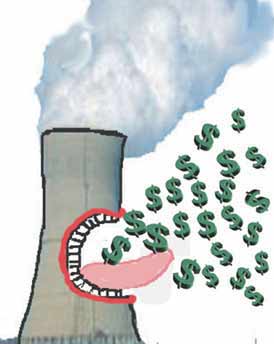 Suffolk’s Sizewell C too expensive, says Sir Ed Davey, BBC, By Vikki Irwin & Chris Bond
28 Sept 20, Former energy secretary Sir Ed Davey has said building a new nuclear power station at Sizewell is “too expensive”.
Suffolk businesses oppose the building of Sizewell nuclear power station
 More than 100 rural Suffolk businesses have written to the Government to
oppose the building of a twin reactor nuclear power station. The letter,
which was addressed to Prime Minister and the Secretary of State for
Business, Energy and Industrial Strategy Alok Sharma amongst others, raised
concerns about the site.
It has attracted signatures from almost 150
individual businesses, farms and landowners in the area. In the letter they
describe the nuclear power station as a “threat” which had been hanging
over their heads for at least eight years. “This would be tolerable if
the Sizewell C project was for the ‘greater good’,” read the letter.
“But we have concluded that it is not necessary to meet the UK’s
commitment to net zero, and would be a slow, risky and expensive waste of
taxpayers’ money that removes opportunities to make use of alternative,
green, deliverable and cost-effective energy solutions. “Meanwhile, many
of our plans are on hold at a time when farming faces the biggest changes
to the policy framework governing our industry in over 50 years.” The
letter also raised concerns about the impact on farm production which
owners say could “render productive land commercially and logistically
unviable”.
https://www.eadt.co.uk/news/sizewell-c-construction-opposed-by-suffolk-businesses-1-685656
As fossil fuel jobs falter, renewables come to the rescue
 As fossil fuel jobs falter, renewables come to the rescue, BY JEFF BERARDELLI CBS News, SEPTEMBER 25, 2020 In 2011, Don Williams made the long trip from Michigan to North Dakota hoping to capitalize on the Bakken oil boom — to, as he says, “chase oil and make quick cash.” It paid off; for years Williams worked in operations on the oil fields, watching over production and maintaining pump jacks.
To say that Williams worked hard would be an understatement. Putting in 12-hour days, 7 days a week — 84-hour work-weeks were typical. And the work was lucrative. The money flowed as fast as the oil did — until it didn’t. In May, Williams was laid off, along with most of the Bakken workforce, when boom went bust.
But within a week, he made a huge career leap — 300 feet up, to be exact — ascending from the firm grounds of the Bakken Oil Fields to the top of a giant wind turbine to take part in a 12-week training course to become a wind energy technician. In his words, he no longer wanted to “ride the oil waves, the highs and lows,” anymore.
While the jobs are on opposite ends of the energy spectrum — from dirty to clean and from old to new — the mechanical skills Williams gained from his time working in oil helped him navigate the career transition. And lately, many ex-oil workers are taking that same leap in hopes of finding long-term stability — something that is becoming scarcer in fossil fuels.
In the past year, two seismic shocks — a price war between Russia and Saudi Arabia, followed by global pandemic lockdowns — tanked oil demand and prices too, devastating oil and gas production in the Bakken Formation.
From June 2019 through June 2020, U.S. crude oil production fell 38% and natural gas production fell 31%. The unemployment rate in North Dakota rose to 11.3% in June. For the month of August, continued claims of unemployment in North Dakota were nearly 100,000, and about a quarter of those were tied directly to mining, quarrying and oil & gas extraction — the highest unemployment of any sector in the state.
But as luck would have it, fossil fuels aren’t the only energy source North Dakota is rich in. With an average wind speed of 20 mph 300 feet above the ground where the wind turbines churn, North Dakota is prime real estate for wind power. It ranks 10th in wind production in the U.S. with more than 3,000 megawatts (MW) of installed capacity.
Williams says he sees evidence of a renewable revolution right in his backyard, with wind turbines popping up all around his community.
He received his wind technician training at Lake Region State College, a couple hours’ drive east from the Bakken oil fields. To earn a one-year college credit certificate, the cost of the course is about $5,000. Less than a month out of the training program, Williams has already landed a wind technician job at Gemini Energy Services.
Although he says the starting salary does not quite measure up to what the oil fields paid, the trade-off of more time with his family and more stability is well worth it to him. Besides, he’s optimistic about his future financial prospects because he says the industry offers a lot of upward mobility and areas to specialize in…….. https://www.cbsnews.com/news/renewable-energy-jobs-replacing-fossil-fuel-jobs-oil-wind/?fbclid=IwAR1aPeyOQTnh5UlpQKkRvonfkMOxT4cFwLn7uYMO-T1ckd-ldGCkOGlNNeU
Russia’s nuclear-powered ice-breakers lead towards military domination of the Arctic
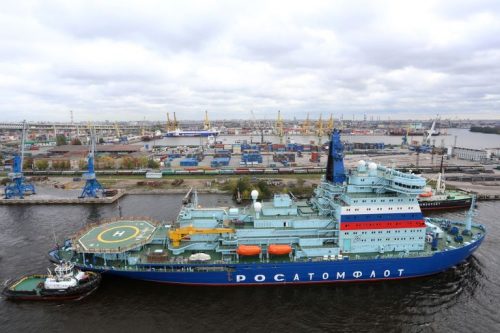
Russia’s Nuclear-Powered Icebreaker Is a Step Toward Military Domination
The country is fast becoming an icebreaking superpower. BY KYLE MIZOKAMI, SEP 24, 2020 Russia’s newest icebreaker, the nuclear-powered Arktika, is headed to its new homeport in St. Petersburg, Russia. The ship, painted in the colors of the Russian state flag, will operate north of the Arctic Circle in anticipation of a year-round shipping route across the icy far north. Arktika is part of Moscow’s emerging policy of exploiting a warming arctic region—and protecting its stake in the region from competitors.
- Russia’s first new nuclear-powered icebreaker in decades, Arktika, is joining the country’s large fleet of icebreaking ships.
- Arktika is capable of smashing through ice that’s nearly 10 feet thick.<
- Millions of Russians live above the Arctic Circle, and warming ocean temperatures could create ice-free shortcuts between Asia and Europe.Russia’s newest icebreaker, the nuclear-powered Arktika, is headed to its new homeport in St. Petersburg, Russia. The ship, painted in the colors of the Russian state flag, will operate north of the Arctic Circle in anticipation of a year-round shipping route across the icy far north. Arktika is part of Moscow’s emerging policy of exploiting a warming arctic region—and protecting its stake in the region from competitors.
<Arktika is the first of a new class of nuclear-powered icebreakers. Construction began at the Baltic Shipyards in St. Petersburg in 2012 with a scheduled launch in 2017, but delays pushed the completion back to 2020. This past February, a short circuit damaged one of the ship’s three 300-ton electric motors, disabling one of the three propellers. Russian authorities ordered the ship to continue, however, and the ship is currently moving on just two propellers.
In 2019, Russian President Vladimir Putin announced the country would ultimately have a fleet of 13 icebreakers, the majority of them nuclear-powered. …………..
Iceabreakers like Arktika could also allow Russia to militarily dominate the Northern Sea Route, smashing a route for Russian warships and transports full of Russian Marines. Warming temperatures will mean other countries, such as Canada and the U.S., will likely move to unlock natural resources previously trapped under sheets of sea ice, and Russia will be in a position to threaten oil, gas, and mineral exploration and exploitation…………. https://www.popularmechanics.com/military/navy-ships/a34128219/russia-nuclear-powered-icebreaker-arktika/
1 This Month

Tell Congress: Prevent Nuclear Catastrophe in Iran

Tell Congress: Prevent Nuclear Catastrophe in Iran

Read the Public Inquiry Report, the Commissioners’ report, Surrendering Australia: The AUKUS Deception is available to download for free at aukuspublicinquiry.com. Or just watch the replay of the National Press Club Luncheon.


Shut down the radiation-damaged Heysham nuclear reactors now
To see nuclear-related stories in greater depth and intensity – go to https://nuclearinformation.wordpress.com

Say No to NASA’s Reckless Nuclear Reactor on the Moon
Say No to NASA’s Reckless Nuclear Reactor on the Moon
-
Archives
- November 2026 (269)
- October 2026 (302)
- September 2026 (339)
- August 2026 (330)
- July 2026 (355)
- June 2026 (287)
- May 2026 (306)
- April 2026 (356)
- March 2026 (251)
- February 2026 (267)
- January 2026 (308)
- December 2025 (358)
-
Categories
- 1
- 1 NUCLEAR ISSUES
- business and costs
- climate change
- culture and arts
- ENERGY
- environment
- health
- history
- indigenous issues
- Legal
- marketing of nuclear
- media
- opposition to nuclear
- PERSONAL STORIES
- politics
- politics international
- Religion and ethics
- safety
- secrets,lies and civil liberties
- spinbuster
- technology
- Uranium
- wastes
- weapons and war
- Women
- 2 WORLD
- ACTION
- AFRICA
- Atrocities
- AUSTRALIA
- Christina's notes
- Christina's themes
- culture and arts
- Events
- Fuk 2022
- Fuk 2023
- Fukushima 2017
- Fukushima 2018
- fukushima 2019
- Fukushima 2020
- Fukushima 2021
- general
- global warming
- Humour (God we need it)
- Nuclear
- RARE EARTHS
- Reference
- resources – print
- Resources -audiovicual
- Weekly Newsletter
- World
- World Nuclear
- YouTube
-
RSS
Entries RSS
Comments RSS

