UK to return high-level nuclear waste to Germany
|
UK to return high-level nuclear waste to Germany https://www.energylivenews.com/2020/09/28/uk-to-return-high-level-nuclear-waste-to-germany/
28 Sept 20, Preparations are underway for the first of the three shipments in late 2020, The UK will be returning high-level nuclear waste in the form of vitrified residues to Germany over the coming years.The waste results from the reprocessing and recycling of spent nuclear fuel at the Sellafield site in West Cumbria, which had previously been used to produce electricity by utilities in Germany. Preparations are underway for the first shipment in late 2020 under the Vitrified Residue Returns programme, which is a key component of the UK’s Nuclear Decommissioning Authority (NDA) strategy to repatriate high-level waste from the UK. A total of three shipments will be made to storage facilities in Germany, with the returns involving Sellafield Ltd working with International Nuclear Services (INS), a subsidiary of the NDA. INS will transport the waste by sea on a specialised vessel to a German port, followed by rail to the final destinations. Daher Nuclear Technologies has been contracted to safely manage the overland transport in Germany. |
|
Heightened risk of nuclear confrontation between the US and China
|
‘Needs to be carefully monitored’: Heightened risk of nuclear confrontation between the US and China, SMH, By Anthony Galloway, September 29, 2020, The risk of a nuclear confrontation between the United States and China is growing, as Beijing acquires new weapons allowing it to potentially strike its adversaries first.As both countries enter into a new period of intense strategic competition, there is a small risk of deliberate nuclear use and a bigger risk of either the US or China inadvertently using nuclear weapons against the other.
This could occur if one of the countries degrades the other’s nuclear arsenal using conventional weapons, whether by accident or collateral damage, causing that nation to respond with nuclear weapons. A new report by the United States Studies Centre says a US conventional strike or cyber attack disabling China’s ability to launch conventional ballistic missiles could accidentally damage its nuclear missiles. Beijing could then see this attack as a prelude to disarming its nuclear weapons, and choose to use them first before they were further degraded. Alternatively, China could launch a space attack against US satellites, or a cyber attack, to interfere with US missile defences, sparking a US nuclear counter-attack. China’s nuclear strategy over recent decades has focused on deterring nuclear threats, but it has been acquiring new capabilities – such as launchers for its DF-26 intermediate-range ballistic missile – that could enable a shift to a nuclear “first-use” strategy. The new report by the centre’s non-resident fellow Fiona Cunningham has called for Australia and other countries to urge the US and China back to arms control talks. ………. “China’s nuclear strategy still looks quite different from countries that explicitly threaten first-use like Pakistan, or don’t rule out the option of using nuclear weapons first, like the United States.”…….. The lower stakes for the United States and China in a South China Sea confrontation, and low intensity with which a conflict could start, would give both countries more opportunities to end a confrontation before it got to the point of nuclear threats or use.” https://www.smh.com.au/politics/federal/needs-to-be-carefully-monitored-heightened-risk-of-nuclear-confrontation-between-the-us-and-china-20200928-p55zwp.html |
|
|
Germany launches new search for permanent nuclear waste disposal site
|
Germany has named 90 locations that could safely house containers of radioactive nuclear waste permanently. The controversy over what to do with waste from the country’s nuclear power plants has been long and divisive. Germany formally launched its new search for a permanent nuclear waste disposal site on Monday. BGE, the nation’s waste management organization, named 90 areas around the country as possible candidates for the permanent waste disposal. It said in a long-awaited report that a location needs to be found by 2031. The aim is to start storing containers of radioactive waste at the site by 2050. Germany is seeking a safe place to store 1,900 containers of waste. The containers make up only 5% of the country’s nuclear waste but 99% of its radioactivity, according to BGE chairman Stefan Studt. Regions in Bavaria and Baden-Württemberg in southern Germany, as well as Lower Saxony and states in eastern Germany, are among the potential waste disposal sites. The locations suggested “favorable geological conditions for the safe disposal of radioactive waste,” the BGE said. The sites will now be vetted to account for other factors, including population density. Gorleben ruled outNot on the list of possible storage sites is Gorleben, a small settlement in Lower Saxony of 650 residents, and the location of a salt mine which had been earmarked as a site for nuclear waste disposal almost forty years ago. The dispute that led to so much bitterness in Germany over the years began on 22 February 1977: the State Premier of Lower Saxony, the conservative Ernst Albrecht, father of the current European Commission President Ursula von der Leyen, made an announcement: Gorleben, near the border to what was then East Germany, was to be the site of Germany’s facility for permanent nuclear waste storage. Locals never accepted the decision, arguing that the salt in the ground cold weaken containment structures and cause radioactive leaks. Gorleben became the focus of Germany’s anti-nuclear movement. Protestors staged sit-ins at the building site and rallied round the farming community in the region. In subsequent years, every transport of nuclear waste to Gorleben was accompanied by major demonstrations. Despite these massive protests, construction work on a new mine began there, in which the salt dome’s geological characteristics were to be explored. This mine alone, which never produced a grain of salt or any other natural resource, has already cost the German tax-payer 1.6 billion euros ($1.9 bn.) So much money has been spent conducting research there that the announcement by Kanitz that the salt dome’s surface cover is not intact and that the chemical composition of the ground water is unsuitable, amounts to a political bombshell. This is exactly what opponents of nuclear power have been saying for years. The debate is almost certain to keep reverberating. But Monday’s announcement in Berlin by Stefan Kanitz, managing director of the state “Federal Society for Permanent Nuclear Waste Storage” still marks a milestone: “Gorleben is not the best possible location,” he said. Following decades of debate which, above all, fueled the rise of the anti-nuclear Green Party, the German government decided after the reactor disaster at Fukushima in Japan in 2011 to permanently phase out nuclear power. Of the roughly 20 nuclear power plants once built, many have already been disconnected from the grid. Currently, six are still in use. They are all scheduled to be decommissioned by the end of 2022. Germany is likely to run into resistance from local politicians at whichever waste disposal site it chooses. Bavaria’s state government has already insisted that it is unsuited for permanent waste disposal. The plan now is to discuss things step by step with the local communities in the 90 regions shortlisted. That is one reason why the process is scheduled to take so long. Construction is to begin on a new permanent storage facility for nuclear waste in 2031. ……… https://www.dw.com/en/germany-launches-new-search-for-permanent-nuclear-waste-disposal-site/a-55077967 |
|

‘The Bomb’ Presents A ‘Secret History’ Of Nuclear War Planning In America
Heard on Fresh Air
DAVE DAVIES, Author Fred Kaplan reveals how U.S. presidents, their advisers and generals have thought about, planned for — and sometimes narrowly avoided — nuclear war. Originally broadcast Jan. 27, 2020.(SOUNDBITE OF ARCHIVED NPR BROADCAST)
DAVE DAVIES, HOST:
Kaplan read thousands of declassified documents and interviewed former military leaders and government officials. The result is his new book about how American presidents and their advisers and generals have thought about, planned for and sometimes narrowly avoided nuclear war over the past 70 years. Fred Kaplan is a national security columnist for Slate and the author of five previous books. His latest is “The Bomb: Presidents, Generals, And The Secret History Of Nuclear War.”
‘Nuclear power is now the most expensive form of generation, except for gas peaking plants’
‘Nuclear power is now the most expensive form of generation, except for gas peaking plants’
The latest edition of the World Nuclear Industry Status Report indicates the stagnation of the sector continues. Just 2.4 GW of new nuclear generation capacity came online last year, compared to 98 GW of solar. The world’s operational nuclear power capacity had declined by 2.1%, to 362 GW, at the end of June.
SEPTEMBER 25, 2020 EMILIANO BELLINI PV MAGAZINE AUSTRALIA The levelized cost of energy (LCOE) from nuclear power rose from around $117/MWh in 2015 to $155 at the end of last year, according to the latest edition of the World Nuclear Industry Status Report, published annually by French nuclear consultant Mycle Schneider.
By contrast, the LCOE from solar power decreased from $65/MWh to approximately $49 and that of wind from $55 to $41.
“What is remarkable about these trends, is that the costs of renewables continue to fall due to incremental manufacturing and installation improvements while nuclear, despite over half a century of industrial experience, continues to see costs rising,” stated the report, citing a recent study from financial advisory and asset management firm Lazard. “Nuclear power is now the most expensive form of generation, except for gas peaking plants,” added the study, which did not provide an LCOE for gas peaker generation.
The cost difference is having a huge impact in new generation capacity deployment, with just 2.4 GW of new nuclear plants installed last year, compared to 98 GW of solar and 59.2 GW of wind, according to the report. The world’s operational nuclear capacity fell 2.1% to 362 GW by the end of June. “The number of operating reactors in the world has dropped … to 408 as of mid-2020, that is below the level already reached in 1988 and 30 units below the historic peak of 438 in 2002,” the study reported.
Six nuclear reactors were grid-connected last year: three in Russia, two in China and one in South Korea. At the same time, five nuclear plants closed last year and three more were shuttered in the first half of this year, with no nuclear facilities added from January to June. An additional eight facilities, which had ceased operations, were decommissioned in 2019………. https://www.pv-magazine-australia.com/2020/09/25/nuclear-power-is-now-the-most-expensive-form-of-generation-except-for-gas-peaking-plants/
Sizewell nuclear project: deadline for being ”interested parties” is due soon
East Anglian Daily Times 27th Sept 2020, The deadline is nearing for people who want to apply to become
“interested parties” who will have their say on the examination of the
application to build Sizewell C. The deadline is nearing for people who
want to apply to become “interested parties” who will have their say on
the examination of the application to build Sizewell C.
https://www.eadt.co.uk/news/sizewell-c-interested-parties-deadline-nears-1-6858029
‘Reverse course’ towards full nuclear disarmament – UN chief
|
‘Reverse course’ towards full nuclear disarmament – UN chief, https://news.un.org/en/story/2020/09/1073832
25 September 2020, Peace and Security
On the International Day for the Total Elimination of Nuclear Weapons marked on Saturday, the UN chief has underscored the need to “reverse course and return to a common path to nuclear disarmament”. Almost 75 years since the adoption of the first General Assembly resolution in 1946, which committed the UN to the goal of ridding the planet of nuclear weapons, “the world continues to live in the shadow of nuclear catastrophe”, Secretary-General António Guterres said in his message commemorating the day. Relationships between States possessing nuclear weapons are characterized by “division, distrust and an absence of dialogue”, he warned, noting that as they increasingly choose to pursue strategic competition over cooperation, “the dangers posed by nuclear weapons are becoming more acute”. According to the UN chief, all States have a responsibility to ensure that such deadly armaments “eliminated completely” from national arsenals. COVID in the mixDrawing attention to the wide range of global fragilities brought about by COVID-19 – from pandemic readiness and inequality to climate change to lawlessness in cyberspace – the top UN official called “preparedness to address the threat of nuclear weapons” one of those vulnerabilities. “We need a strengthened, inclusive and renewed multilateralism built on trust and based on international law that can guide us to our shared goal of a world free of nuclear weapons”, he said. Pressurize nuclear powers The UN has long upheld that the onus to lead disarmament is on the States that possess nuclear weapons. Mr. Guterres concurred that those nations must “return to real, good-faith dialogue to restore trust and confidence, reduce nuclear risk and take tangible steps in nuclear disarmament”. He also stressed that they reaffirm the shared understanding that “a nuclear war cannot be won and must not be fought” and take steps to implement the commitments they have made. A gloomy pictureYet, according to Stockholm International Peace Research Institute (SIPRI), some 13,400 nuclear weapons remain today. Moreover, the countries possessing these weapons have well-funded, long-term plans to modernize their nuclear arsenals. And while the number of deployed nuclear weapons has significantly decreased since the height of the Cold War, SIPRI attests that not one nuclear weapon had been physically destroyed pursuant to a treaty. Additionally, no meaningful nuclear disarmament negotiations are currently underway. Mr. Guterres emphasized that the death, suffering and destruction caused by the atomic bombing in Hiroshima and Nagasaki “must not be repeated”. “The only guarantee against the use of these abhorrent weapons is their total elimination”, spelled out the Secretary-General, adding that the UN “stands ready to work with all States to achieve this shared goal”.
|
|

Do Ohio nuclear stations really need a bailout ? Where’s the evidence?
 Where’s the proof that nuclear power plants need a bailout? This Week in the CLE, By Laura Johnston, cleveland.com 28 Sept 20, CLEVELAND, Ohio — How do Ohioans know Energy Harbor’s nuclear power plants need a $1.3 billion bailout? Cleveland.com
The company hasn’t said, and we’re talking about the lack of disclosure on This Week in the CLE…….
Here are the questions we’re answering today:
Lessons from Lesotho — Beyond Nuclear International

Tiny country was instrumental in getting nuclear weapons ban treaty
Lessons from Lesotho — Beyond Nuclear International
Tilman Ruff: the Ban Treaty has fundamentally changed the game — IPPNW peace and health blog

On September 22, IPPNW co-president Tilman Ruff spoke with Jonathan Kolieb of RMIT University in Melbourne as part of the Australian interview series “Better Place.” The elimination of nuclear weapons, Dr. Ruff said, “depends crucially and fundamentally on those states that own them deciding to get rid of them. The current reality, regrettably, is that […]
Tilman Ruff: the Ban Treaty has fundamentally changed the game — IPPNW peace and health blog
Nuclear, climate, news to 28 September
Coronavirus, climate change and weather disasters: 2020 has been a hell of a year, so far. Some world leaders at this week’s annual United Nations meeting are taking the long view, warning: If COVID-19 doesn’t kill us, climate change will.
On the nuclear scene, well, really, nothing much is happening. Except for the propaganda. Covid-19 is making the nuclear industry’s problems even worse, so their marketing propaganda is intensifying. Last week it was all about small nuclear reactors. This week, it’s still that, but as an extra push, it’s all about thorium.
Julian Assange dragged from embassy “on the orders of the president”. Medical experts testify to court on Julian Assange’s precarious mental health. Australia’s media disgrace – the deliberate neglect of the Julian Assange extradition hearing. The media ignores Julian Assange and the Media ‘Trial of Century’.
Some bits of good news – Over 12 million children, caregivers and teachers reached by UNICEF and Millicom (TIGO) to strengthen child rights across Latin America during COVID 19. The Aahwahan Foundation in India works towards the eradication of poverty, while also focussing on maintaining a sustainable environment.
When looking at impact of coronavirus, we can’t forget the long-term health effects.
45 nations have now ratified the U.N. Treaty on the Prohibition of Nuclear Weapons.
Latest World Nuclear Industry Status Report shows high levelised cost of nuclear power. Small Nuclear Reactors look good – on paper!.
Radiation exposure on the moon is nearly three times that on the International Space Station.
Solar and battery ads blocked by Twitter and Facebook move against “political content” . Recharge’s ”must read” news of the week on the energy transition.
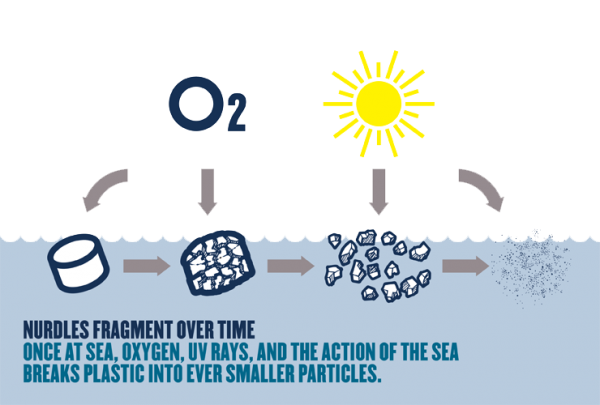
Nurdle alert – plastic pollution the next eco calamity for decades.
ARCTIC. The Arctic Has Entered A New Climate State. Russia’s nuclear-powered ice-breakers lead towards military domination of the Arctic. Arctic pollution is worse than expected – tree rings studies reveal this.
USA.
- After 4 decades of Plowshares Actions, It’s Nuclear Warfare that Should Be on Trial — Not Activists Americans deserve a nuclear-free future. Trump might abandon NEW START arms treaty, U.S. allies fear. USA Government Accountabilty Office calls for assessment of costs for planned new nuclear warheads. Nebraska becomes an even more definite nuclear target, with a new generation of intercontinental ballistic missiles (ICBMs).
- The U.S. media’s resposibility to question Trump and Biden on nuclear arms control and nonproliferation. Northampton shuns business with companies involved in creating nuclear weapons.
- Lawsuit: Ohio Attorney General sues to stop nuclear bailout money, and break up dark money groups. Amid debate over repealing House Bill 6, Energy Harbor still won’t say whether its nuclear plants are profitable.
- Economic distress for Exelon’s 4 nuclear plants in Illinois. Iowa’s last nuclear power station to close – 60 years at least to decommission it. Dirty and devilishly dangerous – the aging Diablo Canyon nuclear station.
- USA.Federal Bill to promote nuclear waste borehole system, and the dubious plan for reprocessing. New Mexico is strongly objecting to licensing of Holtec’s multibillion-dollar nuclear waste dump plan. Transport of nuclear wastes – a Pandora’s Box of problems for North Texans. Will Bears Ears Become the World’s Radioactive Waste Dump
- Compensation for some nuclear workers with mesothelioma .
- Amy Coney Barrett as judge on the USA Supreme Court is not likely to help the environment. Trump Appoints Pair of Climate Science Deniers to National Oceanic and Atmospheric Administration (NOAA) While Climate-Fueled Fires and Storms Rage.
- As fossil fuel jobs falter, renewables come to the rescue.
UK. Britain’s nuclear power dreams melting away – with soaring costs, and political problems. EDF wants cash-strapped UK government to subsidise costly Sizewell nuclear plan. Former UK Energy Minister Sir Ed Davey says new Sizewell nuclear station is too expensive. Suffolk businesses oppose the building of Sizewell nuclear power station.
FRANCE. French taxpayers don’t want to pay for Sizewell nuclear station, neither do British..
CHINA. It’s important to dispel three persistent myths about China’s nuclear weapons.
EUROPE. Bosnia and Herzegovina call for a safer location for Croatia’s nuclear waste dump plan
JAPAN. Japanese government dangles financial carrot to persuade reluctant communities to take nuclear wastess. Japan’s nuclear regulator approves restart of Kashiwazaki-Kariwa plant, but still hurdles to overcome.
Fukushima. The Fukushima Nuclear Disaster Recovery That Wasn’t. 9 1/2 years after meltdowns, no end in sight for Fukushima nuke plant decommissioning. 16-meter seawall planned for Fukushima Daiichi. Lifting Fukushima evacuation orders without decontamination should be limited. Don’t criticize government or TEPCO, guides in Fukushima told. Fukushima criticism for unauthorized use of radiation exposure data-Interim report on Date City.
SOUTH KOREA. S. Korea renews concerns over possible release of tainted Fukushima water.
NORTH KOREA. Satellite imagery shows North Korea’s Yongbyon Nuclear Center is drying off after breaching of oveerflow dam. Reduced water level poses a problem for North Korea’s nuclear reactor, if it’s restarted.
CANADA. David Suzuki on nuclear power as a climate change solution ”I want to puke.” The climate crisis is still a massive threat — even in the middle of a pandemic. Small modular nuclear reactors for Canada? – useless, expensive, untested, and a wasteful distraction. Canada to splurge $billions on non-existent small nuclear reactors, ineffective and no use against climate change.
IRAN. Iran will not renegotiate nuclear deal if Biden wins US presidency, Zarif says.
INDIA. Tsunami risk for nuclear reactors on coastlines of India and Pakistan.
RUSSIA. Russia rejects USA’ s terms for extending the New START arms control treaty. Power hungry Russia foisting nuclear power on Egypt – Africa – where it is not needed. Importing of increased amounts of uranium hexafluoride to Russia – illegal and dangerous.
INDONESIA. Indonesia: strong objections to nuclear and “new” fossil fuel technologies being called ”green” energy.
MARSHALL ISLANDS. Marshall Islands in danger of being overcome by rising sea levels.
UKRAINE. False report of a nuclear disaster in Ukraine.
SAUDI ARABIA. Saudi Arabia may be able to produce its own nuclear fuel – with its uranium reserves.
AUSTRALIA. Dr Helen Caldicott and Independent Australia bust the media spin on ‘small nuclear reactors’.
The Arctic Has Entered A New Climate State


The Arctic Has Entered A New Climate State, Radio Ecoshock 25 Sept 20 Ice is rapidly disappearing from both Poles. Two polar ice experts report latest science. From the U.S. National Center For Atmospheric Research in Colorado, Arctic scientist Laura Landrum: in 2020, the Arctic has reached a new climate state. Thomas Slater from Leeds University UK reports ice loss from glaciers has surpassed the worst case scenarios. Manhattan-size chunks falling away, other ice shelves shatter in unnatural heat and warmed-up seas.
Listen to or download this Radio Ecoshock show ………..
The new water added to the ocean runs away to every country with a sea coast. It runs up estuaries, eats away coastlines, and piles up in every hurricane, high tide and storm. Slater agrees with NASA that in some cases, there is no way to stop these mountains of ice from becoming sea water. This massive change has happened. The tipping point for a grand melting of the world’s second biggest pile of ice, Greenland, was 20 years ago. Like light from the stars, rising seas just take a while to reach us.
Hot in the cold news, this: the Arctic’s largest remaining ice shelf lost a very large chunk of ice, like the volume of mountains, broken away in North Eastern Greenland – floating off into the Atlantic are new melting ice islands twice the size of Manhattan. I won’t try to pronounce the complicated Nordic name. Scientists also call it “79N”. According to satellite images, a portion of the shelf about 110 square kilometers – that’s 42 square miles of thick glacier – just shattered. It fell apart this summer.
This follows absolute record hot summers in the Arctic in 2019 and 2020, on top of the whole region warming around 3 degrees C since 1980. The far north has already gone past 3 degrees C of warming, way beyond the supposed safe line of 1.5 or even 2 degrees C. demanded by the Intergovernmental Panel on Climate Change, and agreed by most governments under the Paris Accord of 2015. The Arctic is already soaring into dangerous warming, and the ice is responding at rates older scientists would never have believed possible. ………….
the change in sea ice cover is, Dr. Laura Landrum, scientist NCAR says, the single largest driver of big climate changes not just in the Arctic, but around the world. Of course our emissions are forcing that change in sea ice cover, by warming not just the atmosphere, but the seas as well.
Now in the Arctic, the traditional expectations for the seasons no longer work. Aboriginal people can no longer hunt at the same times, and animals are confused or spending energy adapting as they can. Plant life will shift. So will insects.
Plus: changes in the Arctic will alter teleconnections to cycles, weather and variability further south. The “new Arctic climate” does not stay in the Arctic. Already we have observations, from Jennifer Francis at Rutgers, that reduction of Arctic sea ice and dramatic changes to the behavior of the Jet Stream further south may be linked. Dr. Landrum agrees. Another scientist on Radio Ecoshock, Dr. Ivana Cvijanovic found evidence of a teleconnection between changes in the Arctic and rainfall in California. …….
There is no going back to the old Arctic. Summer sea ice will not return to levels seen in the 1950’s, when a crossing of the Northwest passage was a major newsworthy expedition requiring ice-breakers. Now individuals in yachts travel across the Canadian Arctic by themselves, while tankers and freighters move in the Arctic Ocean above Siberia, significantly shortening the route from China to Europe. From shipping to hope for more oil and gas, big business is betting the new Arctic climate is here to stay.
Will the growing season in the Tundra, formerly about 60 days, get longer? Could the Boreal forests begin to extend into the Arctic? In Siberia, Northwest Canada, and Alaska the treeline extends into the Arctic Circle, (about 66 degrees North). Also, if winters get shorter, that could mean an increase in Arctic wildfires. Even “more” rain does not necessarily mean more rain in the fire season. Rain may not stop wildfires, especially as Mike Flannigan told us that thin northern soils can dry out and be ready to burn just 3 sunny days after a rainfall. ……
THOMAS SLATER – GLACIER MELT HIGHER THAN WORST CASE SCENARIO, Dr. Thomas Slater, University of Leeds We are trying to look forward in time, to see what the force of rising seas will do. For me, one of the clearest examples comes with higher storm surges, like the dramatic flooding of lower Manhattan during Hurricane Sandy in October of 2012. Are we already at a point where Polar ice loss is bringing more intense disasters?
Discussing an article in Nature published August 13, Grace Palmer in scitechdaily quotes scientist Marco Tedesco saying the percentage contribution of Greenland to sea level rise could increase from 20 to 25 percent now, to 30 or 40 percent by the end of the century.
We begin our state-of-the-glaciers talk with the sad example of the Okjökull Glacier (simple known as Ok) in Iceland. It is the first world glacier declared “dead” due to climate change. On that site is a plaque reading:
A letter to the future
Ok is the first Icelandic glacier to lose its status as a glacier.
In the next 200 years all our glaciers are expected to follow the same path.
This monument is to acknowledge that we know
what is happening and what needs to be done.
Only you know if we did it.
……….. , our climate situation is even worse than the best scientists thought. NASA has a mas balance graphic showing Greenland Ice Loss 2002-2016. That graphic reveals a steady staircase down in the balance of Greenland ice.
THE BIG TWO ON SEA LEVEL RISEWhen it comes to sea level rise, two key points:
1. more sea level rise is now coming from glacial meltwater than thermal expansion of warming seas
2. about 60% of that added sea level is coming from Greenland – more than from Antarctica……. https://www.ecoshock.org/2020/09/the-arctic-has-entered-a-new-climate-state.html
Dr Helen Caldicott busts the media spin on ‘small nuclear reactors’
HELEN CALDICOTT: Small modular reactors — the next big thing?
 https://independentaustralia.net/environment/environment-display/helen-caldicott-small-modular-reactors–the-next-big-thing,14342#disqus_thread By Helen Caldicott | 27 September 2020 Politicians debating nuclear power as an energy source, know little of the facts that make small modular reactors a bad idea, writes Dr Caldicott. AUSTRALIAN politicians are contemplating developing nuclear power for this country. In their ignorance, they are mooting “small modular reactors” (SMRs) about which they clearly know little.
The so-called “nuclear renaissance” died following the Fukushima catastrophe when one-sixth of the world’s nuclear reactors closed. However, global nuclear corporations – Toshiba, NuScale, Babcock & Wilcox, GE Hitachi, General Atomics and the Tennessee Valley Authority – did not accept defeat.
Their new strategy has been to develop small modular nuclear reactors without the dangers inherent in large reactors — safety, cost, proliferation risks and radioactive waste. But these claims are fallacious for the reasons outlined below.
Basically, there are three types of SMRs which generate less than 300 megawatts of electricity compared with current day 1000 megawatt reactors.
Light water reactors designs
These will be smaller versions of present-day pressurized water reactors using water as the moderator and coolant, but with the same attendant problems as Fukushima and Three Mile Island. Built underground, they will be difficult to access in the event of an accident or malfunction.
Mass-produced (turnkey production) large numbers must be sold yearly to make a profit. This is an unlikely prospect because major markets – China and India – will not buy U.S. reactors when they can make their own.
If safety problems arise – as in General Motors cars – they all must be shut down which will interfere substantially with electricity supply.
SMRs will be expensive because the cost per unit capacity increases with a decrease in reactor size. Billions of dollars of government subsidies will be required because Wall Street is allergic to nuclear power. To alleviate costs, it is suggested that safety rules be relaxed, including reducing security requirements and a reduction in the 10-mile emergency planning zone to 1,000 feet.
Non-light water designs
These are high-temperature gas-cooled reactors (HTGR) or pebble bed reactors. Five billion tiny fuel kernels consisting of high-enriched uranium or plutonium will be encased in tennis-ball-sized graphite spheres which must be made without cracks or imperfections — or they could lead to an accident. A total of 450,000 such spheres will slowly and continuously be released from a fuel silo – passing through the reactor core – and then be re-circulated ten times. These reactors will be cooled by helium gas operating at very high temperatures (900 degrees Celsius).
A reactor complex consisting of four HTGR modules will be located underground, to be run by just two operators in a central control room. Claims are that HTGRs will be so safe that a containment building will be unnecessary and operators can even leave the site – “walk away safe” reactors.
However, should temperatures unexpectedly exceed 1,600 degrees Celsius, the carbon coating will release dangerous radioactive isotopes into the helium gas and at 2,000 degrees Celsius the carbon would ignite creating a fierce graphite Chernobyl-type fire.
If a crack develops in the piping or building, radioactive helium would escape and air would rush in, also igniting the graphite.
Although HTGRs produce small amounts of low-level waste they create larger volumes of high-level waste than conventional reactors.
Despite these obvious safety problems and despite the fact that South Africa has abandoned plans for HTGRs, the U.S. Department of Energy has unwisely chosen the HTGR as the “Next Generation Nuclear Plant”.
 Liquid metal fast reactors (PRISM)
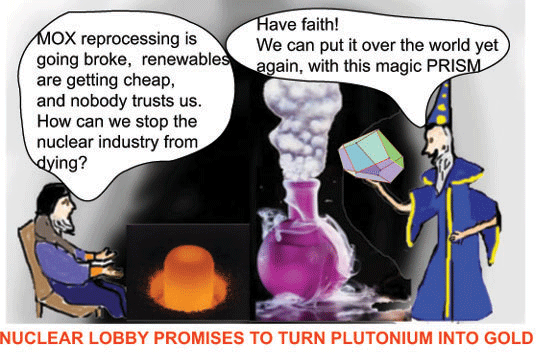
It is claimed by proponents that fast reactors will be safe, economically competitive, proliferation-resistant and sustainable.
They will be fueled by plutonium or highly enriched uranium and cooled by either liquid sodium or a lead-bismuth molten coolant. Liquid sodium burns or explodes when exposed to air or water and lead-bismuth is extremely corrosive producing very volatile radioactive elements when irradiated.
Should a crack occur in the reactor complex, liquid sodium would escape, burning or exploding. Without coolant, the plutonium fuel could reach critical mass, triggering a massive nuclear explosion scattering plutonium to the four winds. One-millionth of a gram of plutonium induces cancer and it lasts for 500,000 years. Extraordinarily, claims are made that fast reactors will be so safe they will require no emergency sirens and emergency planning zones can be decreased from ten miles to 1,300 feet.
There are two types of fast reactors: a simple plutonium fueled reactor and a “breeder” in which the plutonium reactor core is surrounded by a blanket of uranium 238 which captures neutrons and converts to plutonium.
The plutonium fuel, obtained from spent reactor fuel will be fissioned and converted to shorter-lived isotopes — caesium and strontium which last 600 years instead of 500,000. Called “transmutation”, the industry claims that this is an excellent way to get rid of plutonium waste. But this is fallacious because only ten per cent fissions, leaving 90 per cent of the plutonium for bomb-making etc.
Three small plutonium fast reactors will be grouped together to form a module and three of these modules will be buried underground. All nine reactors will then be connected to a fully automated central control room operated by only three operators. Potentially then, one operator could simultaneously face a catastrophic situation triggered by the loss of off-site power to one unit at full power, in another shut down for refuelling and in one in start-up mode. There are to be no emergency core cooling systems.
Fast reactors require a massive infrastructure including a reprocessing plant to dissolve radioactive waste fuel rods in nitric acid, chemically removing the plutonium and a fuel fabrication facility to create new fuel rods. A total of 10,160 kilos of plutonium is required to operate a fuel cycle at a fast reactor and just 2.5 kilos is fuel for a nuclear weapon.
Thus fast reactors and breeders will provide extraordinary long-term medical dangers and the perfect situation for nuclear weapons proliferation. Despite this, the industry is clearly trying to market them to many countries including, it seems, Australia.
You can follow Dr Caldicott on Twitter @DrHCaldicott. Click here for Dr Caldicott’s complete curriculum vitae.
After 4 decades of Plowshares Actions, It’s Nuclear Warfare that Should Be on Trial — Not Activists
 Most of the Kings Bay Plowshares still await sentencing. Mom was sentenced to time served by video conference in June — a surreal and dislocating experience that is now more and more common in our criminal justice system. Her co-defendants opted to postpone sentencing in hopes that it could be in person, but it is unclear if that will happen.
After 4 decades of Plowshares Actions, It’s Nuclear Warfare that Should Be on Trial — Not Activists, Forty years ago, the Plowshares Eight sparked a movement of nuclear disarmers that continues to take responsibility for weapons of mass destruction.
Before him were eight activists, including two priests and a nun. As Judge Salus tried to preside over the government’s prosecution of them for their trespass onto — and destruction of — private property, the eight were trying to put nuclear warfare, nuclear weapons, nuclear policy and U.S. exceptionalism on trial.
That was 40 years ago this week — ancient history by some measures. And no one reading this will be surprised to find that the eight were found guilty and the human family is still threatened by almost 15,000 nuclear warheads. So, four decades later, why isn’t nuclear warfare on trial?
They are the crime responsible for the deaths of hundreds of thousands of Japanese civilians 75 years ago. They have littered the landscape with radioactive waste. They have cost the United States more than $5 trillion from the public coffers. They are the apocalyptic nightmare on hair-trigger alert that haunt our children’s dreams.
On September 9, 1980, my father, Philip Berrigan, along with his brother Daniel, John Schuchardt, Dean Hammer, Elmer Maas, Molly Rush, Sister Anne Montgomery, and Father Carl Kabat, gained entry into the General Electric plant in King of Prussia, Pennsylvania. Once inside the complex, they poured blood over two nuclear weapons’ nose cones, and used household hammers to dent the metal. They came to be known as The Plowshares Eight. Continue reading
Nurdle alert – plastic pollution the next eco calamity for decades

|
Our plastic planet https://www.ehn.org/our-plastic-planet-2647824733.html?rebelltitem=1#rebelltitem1 While climate change remains environmental issue #1, the worries over plastic in our water, soil, food, and bodies continue to grow. Peter Dykstra 28 Sept 20, ”………
It’s hard to ignore the looming mountain of plastics problems. Plastic pollution has been hiding in plain sight as the next eco-calamity for decades. With climate change teed up as the major global environmental challenge, let’s take stock of another modern crisis. Nurdle alert! My first encounter with nurdles was on what should have been a pristine Costa Rican beach in 1986. The lentil-sized, grayish pellets spread the sands for miles, along with a stunning number of shoes. I never figured out the source of the shoe spill, but nurdles eventually became a headline-maker in the oceans world. Nurdles are the feedstock for much of the world’s production of plastics products. If plastic things were pancakes, nurdles would be the batter. They’re spilled from trucks, boxcars, and in the case of the Costa Rican beach, apparently a container ship. There are no firm statistics on how many spills there have been, or how many hundred of billions of virtually indestructible nurdles litter our beaches and seafloors. One example: in 2017, 600 volunteers scoured 279 U.K. beaches, reporting that two-thirds of them were “littered” with nurdles. We do know that nurdle pollution is the tip of the plastic pollution sh*tberg. Let’s talk recycling. For years, much of what we think of as recycled plastic was collected in communities and eventually shipped to Asia. In 2018, the People’s Republic of China formally announced that they’d officially had it. Imports of recyclable plastic had choked China’s landfills beyond reason. Early, rudimentary successes with recycled goods had run their course. But we reached Peak Flip-Flop, and China’s National Sword initiative slammed the door, barring plastic waste imports from the U.S. and about two dozen industrialized nations. Most of our plastic goes to the landfill. In 1960 the U.S. sent roughly 390 tons of plastic waste to landfills, according to the U.S. Environmental Protection Agency. In 2017, the most recent year there is data for, that number shot to 26,820 tons, which is about nine times more than was recycled. Yikes. Part of this is driven by the market to make plastics: the U.S. fracking boom caused an abundance of cheap natural gas and oil. By mid-2019, it was cheaper to make new plastic than it was to recycle the old stuff. Here are some other quick facts to put a damper on your day:
We know the problem has been building for years, and the paths to solutions are often blocked by the fossil fuel industry, which sees salvation in plastics production as its other marquee products fade. While we all rightly call for leaders to address, and in some cases just acknowledge, the climate crisis, let’s also remember to skip the straws and question those that keep |
|
1 This Month

Tell Congress: Prevent Nuclear Catastrophe in Iran

Tell Congress: Prevent Nuclear Catastrophe in Iran

Read the Public Inquiry Report, the Commissioners’ report, Surrendering Australia: The AUKUS Deception is available to download for free at aukuspublicinquiry.com. Or just watch the replay of the National Press Club Luncheon.


Shut down the radiation-damaged Heysham nuclear reactors now
To see nuclear-related stories in greater depth and intensity – go to https://nuclearinformation.wordpress.com

Say No to NASA’s Reckless Nuclear Reactor on the Moon
Say No to NASA’s Reckless Nuclear Reactor on the Moon
-
Archives
- November 2026 (269)
- October 2026 (302)
- September 2026 (339)
- August 2026 (330)
- July 2026 (355)
- June 2026 (287)
- May 2026 (306)
- April 2026 (356)
- March 2026 (251)
- February 2026 (267)
- January 2026 (308)
- December 2025 (358)
-
Categories
- 1
- 1 NUCLEAR ISSUES
- business and costs
- climate change
- culture and arts
- ENERGY
- environment
- health
- history
- indigenous issues
- Legal
- marketing of nuclear
- media
- opposition to nuclear
- PERSONAL STORIES
- politics
- politics international
- Religion and ethics
- safety
- secrets,lies and civil liberties
- spinbuster
- technology
- Uranium
- wastes
- weapons and war
- Women
- 2 WORLD
- ACTION
- AFRICA
- Atrocities
- AUSTRALIA
- Christina's notes
- Christina's themes
- culture and arts
- Events
- Fuk 2022
- Fuk 2023
- Fukushima 2017
- Fukushima 2018
- fukushima 2019
- Fukushima 2020
- Fukushima 2021
- general
- global warming
- Humour (God we need it)
- Nuclear
- RARE EARTHS
- Reference
- resources – print
- Resources -audiovicual
- Weekly Newsletter
- World
- World Nuclear
- YouTube
-
RSS
Entries RSS
Comments RSS

