A rapidly globalizing world needs strengthened global governance — IPPNW peace and health blog

Given the increasingly dysfunctional nature of individual nations on the world stage, isn’t it time to consider strengthening global governance? In the midst of the multiple crises that beset today’s world, the gathering obsolescence of the nation in addressing global issues suggests the need to take another look at strengthening global governance and at what it might accomplish.
A rapidly globalizing world needs strengthened global governance — IPPNW peace and health blog
The week in nuclear news – to March 1
 Like most people, I have not been able to keep up with the pandemic news. Figures on the incidence of Covid-19, and on deaths, seem to fluctuate. Amidst the uncertainties about types of vaccines, new virus strains, and the anti-vaxxer movement, still there is an atmosphere of optimism. Vaccine acceptance is rising in many countries, and health workers and many volunteers are putting in the efforts to administer vaccines , and care for those who are ill.
David Attenborough warns the U.N. Security Council – the world risks ‘collapse of everything’ without strong climate action.
A bit of good news – Pollution in the Mississippi River Has Plummeted Since The 1980s
The role of the Churches in promoting the U.N. Nuclear Weapons Ban Treaty. Nuclear-weapons treaty the right way forward.
The media revels in rockets to Mars, ignores the horrible risk of plutonium pollution.
Why is the media fawning over nuclear businessman Bill Gates? Nuclear power-not clean, not renewable – Bill Gates is wrong.
Dr Helen Caldicott on Independent Australia tells The Truth About Nuclear Power.
JAPAN. Investigative journalism – Fukushima nuclear containment system failed: this kind of disaster will happen again. Fukushima nuclear station seismometers not functioning when latest earthquake happened. Fukushima nuclear mess 2021 – the tasks ahead. Fukushima evacuees on return visits find radiation signs confusing. The Fukushima nuclear catastrophe – far from over, 10 years later.
CANADA. What would go into the Chalk River Mound? Opposition to nuclear dump plan for upstream at Chalk River. Ways in which Near Surface Radioactive Waste Disposal would leak.
FRANCE. France’s nuclear reactors’ lives to be extended beyond 40 years. France slow to leave nuclear power, (cheaper to extend lives of reactors).
IRAN. IAEA and Iran strike three-month deal over nuclear inspections. Iran lawmakers call for president’s prosecution over IAEA deal. Iran talks ‘avert’ impact of nuclear inspection deadline. Some Iranians and Israelis in full agreement on wanting to stop Iran nuclear deal.
USA.
- New leader of USA’s Department of Energy gives clearly pro nuclear answers. Jennifer Granholm becomes U.S. Energy Secretary: the nuclear lobby is pleased. but not certain. Jennifer Granholm seems more muted in her support for nuclear, compared to previous Energy Secretaries.
- Is it wise for the Biden administration to fund Small Nuclear Reactors?
- Ohio House and Senate wrestle with Bills about the nuclear bailout law.
- Yakama Nation, state of Washington and environmental groups call on Jennifer Granholm to reconsider nuclear waste rule. USA’s continuing nuclear waste debacle blamed on government contractors. Lawsuit to prevent dangerous dismantling of San Onofre nuclear power station.
UK. Assange’s partner exposes ongoing denial of his legal and democratic rights, Jeremy Corbyn – Britain Should Join Nuclear Ban Treaty and Scrap Nukes. Labour’s nuclear weapons stance needs a rethink. RSPB petition on Sizewell C with over 105,000 signatures shows the depth of public concern with this development – highlighted in upcoming NFLA meeting.
INDIA. Influence of Biden administration brings peaceful push between India, China, Pakistan.
SOUTH AFRICA. New nuclear build would face legal stumbling blocks.
EUROPE. Radioactive dust over Europe – from France’s nuclear bomb tests in the Sahara! Luxembourg’s continued fight against nuclear power in Europe.
ISRAEL. Israel should come clean about the expansion at its secret nuclear weapons plant.
AUSTRALIA. Australian federal and state governments keeping laws banning nuclear power, despite Murdoch pro nuclear propaganda. Legislation banning nuclear power in Australia should be retained.
Fukushima nuclear containment system failed. This kind of disaster will happen again

The supposedly failsafe containment system at Fukushima Dai-ichi Unit Three failed and released massive amounts of radioactivity into the local environment and the worldwide atmosphere. Such an enormous human tragedy will happen again at an atomic power reactor somewhere in the world.
Think about that. No nuke in the world can withstand a supersonic shockwave, and here is the evidence on international TV and across the Internet that it occurred in 2011, as Fairewinds said.
Japan’s Fukushima Meltdowns (New Video): Much Still Unknown 10 Years Later, https://www.fairewinds.org/demystify/japans-fukushima-meltdowns-10-years-later-new-video-shows-much-still-unknown February 17, 2021 By The Fairewinds Crew
As we approach the 10th commemoration of Japan’s March 11, 2011, Fukushima Dai-ichi triple meltdowns, organizations around the globe, including environmental groups, nonprofits (like Fairewinds Energy Education), engineering and pronuclear organizations, and media organizations like Japan’s Nippon TV, will release new information.
Some of this information is really new and recently uncovered. Other media events will bring people together to share and discuss what these major meltdowns meant to the people of Japan and communities worldwide. And sometimes, these media events are just a corporation or an agency marketing new nukes by putting their positive spin on nuclear power rather than acknowledging its dangers. For example, nuclear zealots continue to claim that atomic power reactors are safer for workers than working at Toys R Us, and reactors cannot meltdown and certainly will never blow up. The Fukushima disaster proved them wrong, but yet they persist!
As Fukushima Daichi Units One, Two, and Three were melting down, Nippon TV, the largest and flagship station of the Nippon Television Network System, dispatched television film crews to monitor the events as they unfolded. No one in the world has ever captured the core melting down, but Nippon TV captured two meltdown-induced explosions on film.
Now, Nippon TV has just released a new digital copy of the Fukushima Dai-ichi Unit One and Unit Three explosions (see video below ). Fukushima Centralt TV/NipponTv
At Fairewinds, we congratulate Nippon for the excellent work they did to create the original initial explosion footage in 2011 and on this essential remastered copy just completed in 2021. Nippon’s newly released digital footage is important historically and technically.
That said, the new video footage and Nippon’s ensuing interview with Tokyo Electric Company (TEPCO), the atomic power corporation that owns all six Fukushima Dai-ichi nuclear power plants, contain three glaring technical errors.
- First, Fairewinds continues to have significant concerns about TEPCO’s technical interpretations of these explosions’ cause.
- Second, TEPCO is blaming newly uncovered lethal radioactivity sitting at the top of the containment structure on the supersonic shockwave.
- Third, TEPCO does not discuss that there likely was a second explosion that occurred 3 seconds after the first.
Understanding the mechanics behind explosions is critical to understanding what happened at Fukushima and what such a danger means to nuclear power anywhere in the world.
- There are two explosion methods: a deflagration shock wave, which happened at Fukushima Unit One and Three Mile Island in Middletown, Pennsylvania, in the United States. While still destructive, a deflagration shockwave travels at subsonic speeds (less than 760 miles an hour, the speed of sound).
-
- The second type of explosion is called a detonation shockwave. It is much more destructive because it travels at supersonic speeds.
In 2011, with Geoff Sutton’s assistance from the United Kingdom, Fairewinds clearly showed that the Unit Three explosion was the more destructive detonation shockwave while Unit One’s was a deflagration.
Does it matter whether or not an explosion at Fukushima was a detonation or a deflagration? Absolutely! Hydrogen gas at room (atmospheric) pressure cannot create a supersonic shockwave. Fairewinds’s 2011 findings that a detonation shockwave occurred should have changed the scientific and nuclear engineering analyses of such events worldwide.
No nuclear power radioactive release containment system built anywhere in the world will withstand a detonation shockwave!
The fact that a detonation shockwave did occur is something the nuclear industry has ignored since Fairewinds’ Arnie Gundersen and Geoff Sutton identified it did happen at Fukushima Unit Three in 2011.
The nuke industry and its regulatory handlers do not believe that a supersonic shockwave explosion will ever happen in a nuclear power plant. If they admitted that an atomic reactor containment system would fail by detonation, the nuke industry would also have to acknowledge that nuke plants’ containment systems are not failsafe. Nuclear power containment systems will fail when there is a supersonic shockwave explosion.
The supposedly failsafe containment system at Fukushima Dai-ichi Unit Three failed and released massive amounts of radioactivity into the local environment and the worldwide atmosphere. Such an enormous human tragedy will happen again at an atomic power reactor somewhere in the world.
Think about that. No nuke in the world can withstand a supersonic shockwave, and here is the evidence on international TV and across the Internet that it occurred in 2011, as Fairewinds said.
- The second type of explosion is called a detonation shockwave. It is much more destructive because it travels at supersonic speeds.
- Fairewinds second area of concern about TEPCO’s analysis on this latest NIPPON video is the linkage of recently discovered lethal radiation levels at the top of the containment to the supersonic detonation. Ten years ago, immediately following the three meltdowns at Fukushima in 2011, Fairewinds identified superheated highly radioactive gases escaping from this same area that TEPCO suddenly claims it has just uncovered in 2021. The containment was leaking before the explosion and continued to spread radioactivity after the blast. Still, no nuclear engineer or scientist is surprised that significant contamination continues to leak from the damaged containment system. The containment was breached, which allowed this radiation to leak! However, there is no evidence to suggest that the explosion is the cause of that leak since the containment was leaking before the supersonic shockwave.
- Finally, Nippon’s remastered video vividly shows Fairewinds’ third concern. The eye is drawn to the detonation’s sudden flash and the ensuing upward-moving black cloud of rubble. Now, look again. About three seconds after the initial vertical blast, a white cloud suddenly moves horizontally at ground level to the north. (see picture on original -comparing the first and second plumes)
- Community-volunteer citizen-scientists Arnie met while collecting radioactive samples in Fukushima prefecture say they heard more than one explosion. They said it sounded like the snapping of bamboo burning in a fire. This new video shows that there were at least two explosions, one vertically and one horizontally. As more data becomes available, Fairewinds Energy Education will put forward the reasons why, but as of now, the entire explosion sequence at Fukushima Unit Three is something the nuclear industry zealots want to ignore. They continue to hope that history will not repeat itself while they continue to build and operate more lethally radioactive and highly risky atomic reactors.
- Throughout the Nippon video, the announcer reverentially refers to TEPCO and the Japanese Regulators as “the authorities” and “officials”. This kind of public propaganda occurs because TEPCO, the Japanese Government and its regulators, and the International Atomic Energy Agency (IAEA) have successfully captured the Japanese media.
What was called for in 2011 and is still desperately required in 2021 are independent experts. These would be people from outside TEPCO, its captive regulators, or its allies embedded in the nuclear industry. Once again, Fairewinds calls for an independent consortium of experts who would be able to give a frank assessment of the magnitude and extent of the problems that lie ahead for the failed Fukushima cleanup.
Did you know that in 2013, Fairewinds and 16 other international experts coauthored a letter to the United Nations (UN) asking it to establish this independent panel? The UN never had the courtesy even to acknowledge that it received these serious requests and recommendations. Such machinations by TEPCO, the Japanese Government, and the international nuclear industry are indeed a human rights and environmental injustice issue!
Ten years have passed, yet Japan’s citizens still wait for independent oversight of the Fukushima disaster. The people of Japan deserve better than the authorities covering up the truth and lying to them.
Nuclear power-not clean, not renewable – Bill Gates is wrong
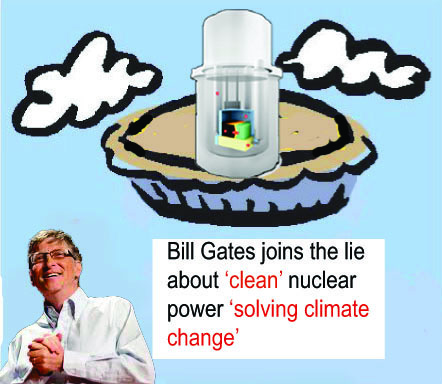
Bill Gates is wrong about nuclear power http://english.hani.co.kr/arti/english_edition/english_editorials/984773.html
By Cho Chun-ho, professor of atmospheric sciences at Kyung Hee University Feb.28,2021 To prevent the climate crisis, we need to reorient our energy grids from fossil fuels to solar and wind power. Some argue we should also expand nuclear power, since nuclear plants don’t emit carbon dioxide.
Automobile accidents cause many fatalities, but people keep driving cars because of social inertia. But an accident at a nuclear plant would create damage on a scale that would exceed whatever benefits we derive from nuclear power.
As of 2018, cleanup from the disaster at the Fukushima nuclear plant had cost 236 trillion won (US$213.37 billion). But even that wasn’t enough to deal with the radioactive wastewater that Japan now intends to dump into the ocean. Most of that cost is being borne not by the company operating the nuclear plant but by taxpayers.
 There’s not a government on earth that can deal competently with an accident at a nuclear plant. Even Japan’s meticulously designed safety net was helpless before such an accident.
 Furthermore, the cost of generating nuclear power has gone up 26% in the past ten years. Part of that price hike results from the need to prevent previously unconsidered risks, such as the Fukushima accident. Another issue is that demand for nuclear reactors has been recently falling around the world, pushing nuclear power out of the market.
In the book “How to Avoid a Climate Disaster: The Solutions We Have and the Breakthroughs We Need,” Bill Gates argues that nuclear power is ideal for responding to climate disaster because it’s the only emissions-free source of energy that can be supplied continuously around the clock.
In 2020, a team of researchers led by Benjamin Sovacool, a professor at the University of Sussex, published a paper in the journal Nature Energy analyzing renewable energy and nuclear energy’s impact on reducing carbon dioxide emissions. The relationship between renewable energy and nuclear power is mutually exclusive: one tends to crowd out the other.
Over the past ten years, the cost of solar and wind power has fallen by 89% and 70%, respectively. That’s because renewables have been the focus of technological innovation, which has entailed a huge amount of investment.
In 2020, the International Energy Agency declared that solar power was the cheapest source of electricity. In countries that have focused investment on renewables, renewable energy holds an advantage in the market even when governments reduce or totally eliminate subsidies.
Solar and wind power accounted for 72% of power capacity added around the globe in 2019. As renewables’ share of the energy mix increases, nuclear power — which is inflexible because output cannot be adjusted — has become a headache for the energy regime.
Multinational firms such as Apple, Google and Microsoft are pushing their suppliers to provide parts that are completely made with renewable energy — which doesn’t include nuclear power.
Nuclear power may be a low-carbon source of energy, but it’s not renewable because of the nuclear waste it produces. We can’t have both nuclear power and renewable energy because they rely on different paradigms. So which one are we going to choose?
USA’s continuing nuclear waste debacle blamed on government contractors
 Steven Chu Blames Government Contractors For Ongoing Nuclear Waste Debacle, https://www.forbes.com/sites/jeffmcmahon/2021/02/28/steven-chu-blames-government-contractors-for-ongoing-nuclear-waste-debacle/?sh=4ec11b8131eb Jeff McMahonSenior ContributorThe United States continues to struggle with legacy military nuclear waste, former Energy Secretary Steven Chu said, because the contractors making billions from it have opposed a better solution. “If you had a small R&D program that could find a much better, cost-effective way of doing it wouldn’t it be worth it?” Chu asked during a Stanford University webinar last month. “Okay, $6 billion—What’s a good R&D program? Ten percent? Five percent? “It was being nibbled down to $100,000,” he said of his effort to fund R&D during his tenure as Obama’s first energy secretary. “It’s like in the third or fourth decimal place because the contractors who had these huge grants didn’t want better ways, and they just wanted the billion per year coming to the State of Washington, going into Tennessee, going to South Carolina, literally, because it greased the economy.” Chu doesn’t identify the contractors by name, but major contractors in those states include Bechtel, managing the Hanford Nuclear Site in Washington; UCOR, managing cleanup at the Oak Ridge Reservation in Tennessee; and Areva, which absorbed the company that during Chu’s tenure pursued the Mixed Oxide Fuel Fabrication Facility (MFFF) designed to process waste in South Carolina. Bechtel, Areva and UCOR’s parent company, Amentum—have extensive lobbying activities recorded in disclosure forms. I was able to reach representatives from Bechtel and Areva, but they were unable to offer comment on the weekend.
Chu is a professor of physics and molecular and cellular physiology at Stanford University and was president in 2020 of the American Association for the Advancement of Science. He won the 1997 Nobel Prize in physics and is credited by President Obama with designing on a napkin the technology that capped the Deepwater Horizon oil spill. |
|
|
Influence of Biden administration brings peaceful push between India, China, Pakistan
 India’s sudden peace push with nuclear rivals China, Pak shows Biden impact, Business Standard, 27 Feb 21, The detente in South Asia shows all three countries responding to initiatives from the Biden administration After a year of some of the worst fighting on India’s frontiers with Pakistan and China, all three countries are suddenly talking peace as they wait to see how President Joe Biden will shift policy in the region.
India and China’s top diplomats on Thursday discussed plans to disengage troops from their Himalayan border, which last year saw the deadliest clashes since the 1970s. The phone call between Subrahmanyam Jaishankar and his Chinese counterpart Wang Yi, which stretched for more than an hour, came shortly after India and Pakistan released a rare joint statement by senior army officials announcing a halt in operations along their border.
The moves reduce tensions in one of Asia’s top flashpoints, where three nuclear-armed countries regularly challenge each other’s territorial claims. While India and Pakistan have fought three wars since Britain left the subcontinent and barely have any trade, tensions between New Delhi and Beijing escalated last year to the point where Prime Minister Narendra Modi banned hundreds of Chinese apps and slowed investment approvals.
The Biden administration welcomed the announcement on reimplementing the 2003 ceasefire agreement, which it had advocated. “When it comes to the US role, we continue to support direct dialogue between India and Pakistan on Kashmir and other issues of concern,” US State Department spokesman Ned Price told reporters.
Previous moves toward peace between India and Pakistan, including a statement in May 2018 after an escalation of cross-border shelling, have dissipated quickly. Whether they can actually build on this and move toward a more permanent peace remains an open question, but at least for the moment the shifting geopolitical winds are providing a seemingly rare opportunity to talk instead of fight.
“It eases the pressure,” Najmuddin Shaikh, Pakistan’s former foreign secretary and ambassador to nations including the U.S., said by phone when asked about the ceasefire. “Essentially what needs to come ahead is what has been proposed — that there be a resumption of dialogue.” https://www.business-standard.com/article/current-affairs/india-s-sudden-peace-push-with-nuclear-rivals-china-pak-shows-biden-impact-121022600628_1.html
Labour’s nuclear weapons stance needs a rethink
Labour’s nuclear weapons stance needs a rethink, Guardian, Richard Norton-Taylor
London 28 Feb 21,
Readers respond to the shadow defence secretary’s announcement that his party’s commitment to Trident is ‘non-negotiable’
You report (Labour to state ‘non-negotiable’ support for UK’s nuclear weapons, 25 February) that the shadow defence secretary, John Healey, says his party’s commitment to nuclear weapons is “non-negotiable”, seemingly taking a harder line even than successive Conservative governments, which have at least supported talks on multilateral nuclear disarmament.
The new Labour leadership in its rhetoric seems more frightened of being accused at home of being weak on defence than a nuclear attack by a foreign power. For years, Whitehall analysts have considered a pandemic more likely than any real threat of a nuclear attack. Yet for years, ministers and opposition frontbenchers ignored the former while exaggerating the latter. Trade union leaders, meanwhile, back a new Trident missile programme and spending more than £200bn on unusable weapons, citing the need to preserve highly skilled jobs. Yet Britain has had to bank on French engineers for civil nuclear power stations of which Britain now appears to be in dire need. https://www.theguardian.com/world/2021/feb/28/labours-nuclear-weapons-stance-needs-a-rethink
Jeremy Corbyn – Britain Should Join Nuclear Ban Treaty and Scrap Nukes.
 Jeremy Corbyn – Britain Should Join Nuclear Ban Treaty & Scrap Nukes. https://labouroutlook.org/2021/02/27/jeremy-corbyn-britain-should-join-nuclear-ban-treaty-scrap-nukes/, 27th February 2021 “From coronavirus to environmental destruction to economic inequality, we face threats that the war machine cannot fix, & can only worsen.”
Jeremy Corbyn used a speech at the Stop the War Coalition AGM today to make the case for the labour movement taking a stand against nuclear weapons and US-led wars of intervention.
Speaking to Labour Outlook he said, “The public consensus is changing. One hundred and twenty countries have signed the Treaty on the Prevention of Nuclear Weapons at the UN this year.”
In his speech at the AGM, Jeremy pointed out how three out of five people in the UK think we should join them, and four out of five people support a total ban on all nuclear weapons globally.
Jeremy added, “Something else has happened. People have begun to understand where the real threats to our security are.
From coronavirus to environmental destruction to economic inequality, we face threats that the war machine cannot fix, and can only worsen.”
Yesterday saw Labour members across the country oppose the Party’s leadership decision to say support for nuclear weapons was not negotiable, including Emma Dent Coad and Diane Abbott MP in interviews with this publication.
Making Waves — Beyond Nuclear International

The original peace boat sets sail again
Making Waves — Beyond Nuclear International
8% of Japanese consumers still hesitate to buy Fukushima food products
At their own risk and peril. There is no acceptable safe threshold when it comes to radioactive contamination.
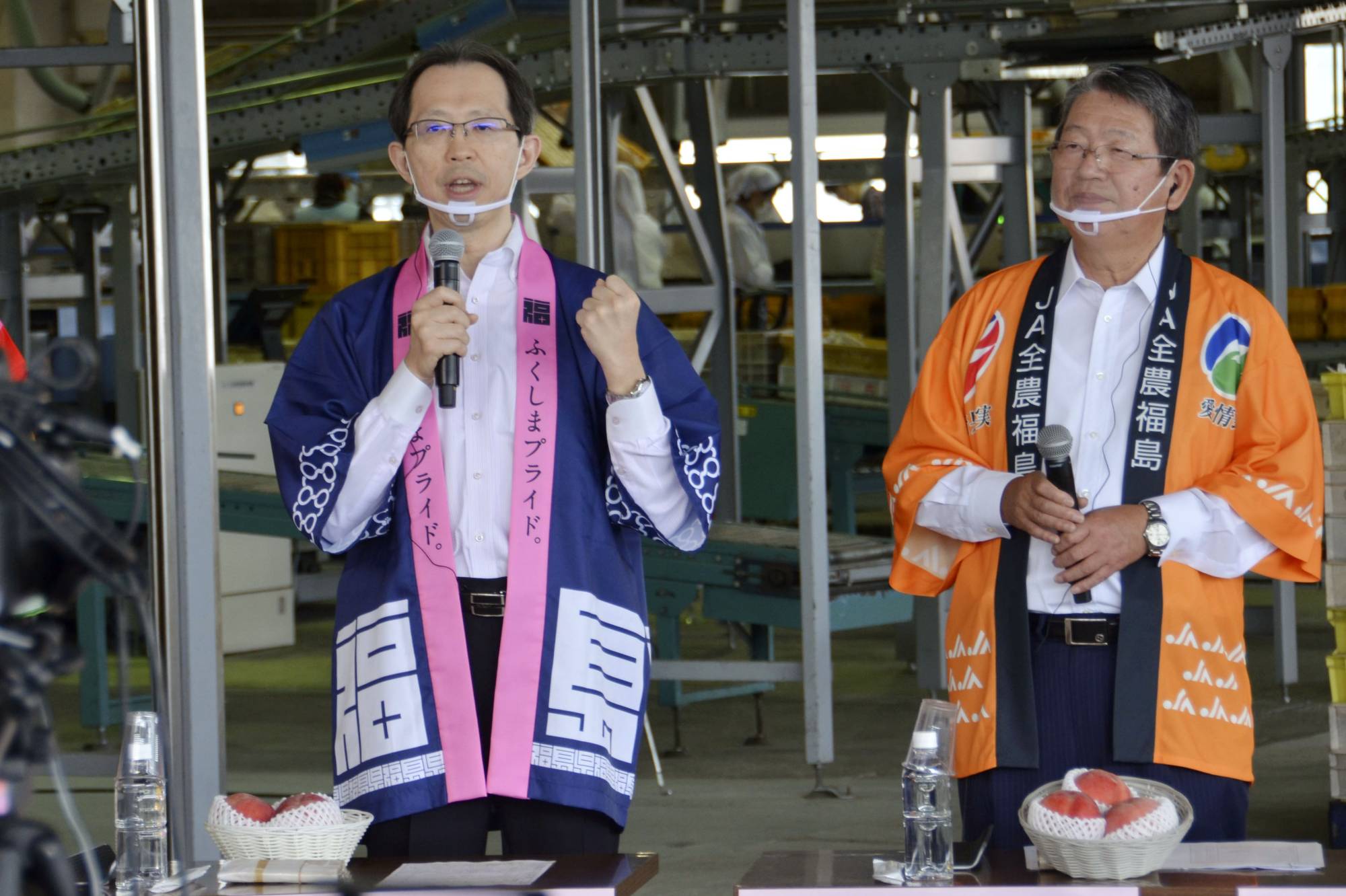
Fukushima Gov. Masao Uchibori (left) promotes peaches from the prefecture in the city of Fukushima in July.
Feb 28, 2021
About 8.1% of consumers in Japan still hesitate to buy food products from Fukushima Prefecture almost 10 years after the March 2011 nuclear disaster, a survey by the Consumer Affairs Agency has shown.
Although the figure is the lowest since the survey started in February 2013, the finding is “very regrettable,” Shinji Inoue, minister for consumer affairs and food safety, said after the survey was released Friday. “Safety has been secured” for produce from Fukushima, he added.
The latest survey, the 14th of its kind, was carried out online on Jan. 15-19, with answers received from 5,176 people in their 20s to 60s mainly in the Tokyo metropolitan area.
The share of respondents who hesitate to buy food products from Fukushima has been on the decline since hitting 19.6% in the August 2014 survey, and fell below 10% for the first time in the latest survey.
Fukushima is home to Tokyo Electric Power Company Holdings Inc.’s Fukushima No. 1 plant, the site of the triple meltdown disaster triggered by the Great East Japan Earthquake and tsunami.
According to the survey, the share of respondents who hesitate to buy food products from Iwate, Miyagi or Fukushima prefectures dropped to a record low of 6.1%, down from 6.4% in the previous poll in February 2020. The three prefectures were hit hardest in the disaster.
A record high 62.1% of respondents said they do not know that checks for radioactive substances have been conducted on food products from disaster areas. The figure has been rising since standing at 22.4% in the first survey.
An official said the agency will continue efforts to not only boost the share of people who are aware of radiation checks but also offer all of the information available about radioactive substances in food products.https://www.japantimes.co.jp/news/2021/02/28/national/fukushima-products-survey/
Tepco finishes nuclear fuel removal from Fukushima reactor pool
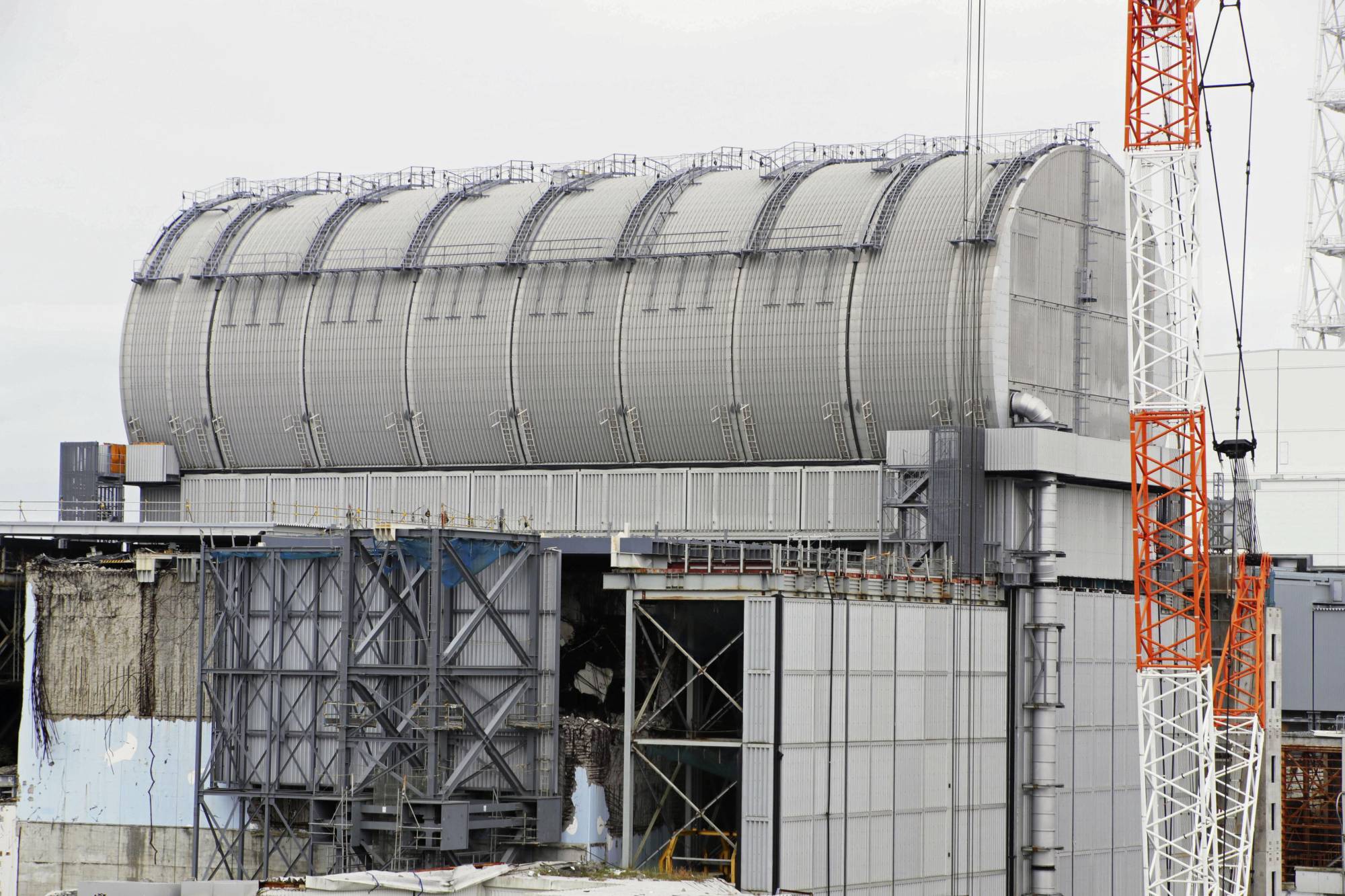
The Fukushima No. 1 nuclear plant’s No. 3 reactor
Feb 28, 2021
Tokyo Electric Power Company Holdings Inc. said Sunday it has removed all 566 nuclear fuel assemblies from the spent fuel pool of the No. 3 reactor at its Fukushima No. 1 plant.
It is the first time that fuel removal has been completed for any of the three reactors that suffered meltdowns in the March 2011 accident at the plant in Fukushima Prefecture.
The fuel removal operation at the No. 3 reactor began in April 2019.
On Sunday, the company using remote control devices moved the last six assemblies to a common storage facility within the plant premises. A large covering was placed over the upper part of the No. 3 reactor building to prevent radioactive substances from being scattered.
Tepco planned to start the fuel removal from the No. 3 reactor building as early as late 2014, but delayed the schedule repeatedly as it faced difficulty getting rid of debris left by the explosion in the building.
The operation also took more time than expected due to machinery malfunction issues.
The removal of 1,533 fuel assemblies from the No. 4 reactor building was completed in December 2014.
Tepco aims to finish pulling all fuel assemblies out of other reactor buildings by the end of 2031, including the No. 1 building, where a lot of debris is scattered about, and the No. 2 building, where radiation levels are particularly high.https://www.japantimes.co.jp/news/2021/02/28/national/tepco-fukushima-no-1-radiation-3-11-tsunami-earthquakes-fukushima/
All spent fuel finally removed from reactor at Fukushima plant

Steel frames remain exposed on the wall facing north at the No. 3 reactor building at the Fukushima No. 1 nuclear plant, showing the impact from a hydrogen explosion in March 2011.
February 28, 2021
Hazardous work to remove all spent nuclear fuel from a reactor storage pool at the crippled Fukushima No. 1 nuclear plant was finally completed Feb. 28, Tokyo Electric Power Co. said.
It marked the first time for any of the storage pools at the three stricken reactors to be emptied out, and came less than two weeks before the 10th anniversary of the triple meltdown at the nuclear complex in Fukushima Prefecture northeast of Tokyo.
The two-year effort involved the removal of all the 566 spent fuel units left in the pool in the No. 3 reactor’s building.
Completion of the removal work at the No. 3 reactor building, severely damaged by a hydrogen explosion during the meltdown, eased concerns about the overall safety of the embattled plant.

The No. 3 reactor’s storage pool is situated on an upper floor of the building, posing a danger due to fears of another powerful earthquake damaging the structure and jeopardizing TEPCO’s ability to cool them.
Spent fuel needs to be kept cool as it emits high levels of radiation and decaying heat.
The utility planned to move the spent fuel from the No. 3 reactor’s pool to a shared pool for storage on the grounds of the plant to ensure the spent fuel can be safely managed.
The removal work got under way in April 2019 after rubble and other debris were cleared away. A special crane with a robotic arm was used to lift the spent fuel.
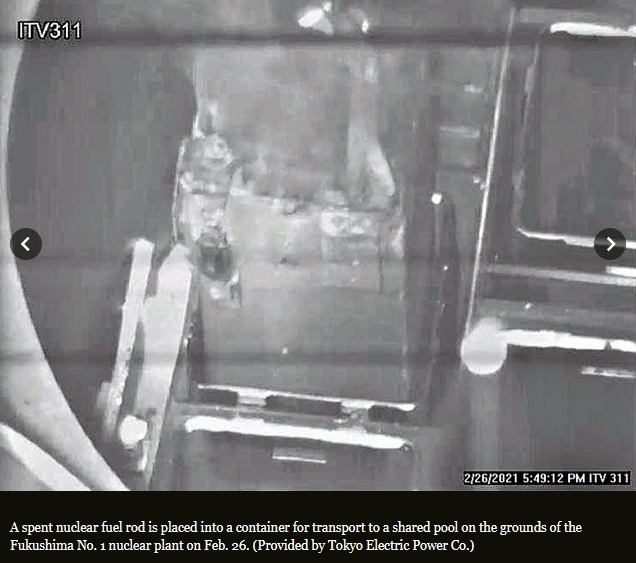
Operators worked remotely during the removal process from an operational center 500 meters away because of high radiation readings inside the reactor building.
The work was marred by a flurry of malfunctions in the equipment and the crane soon after the project got started.
The challenge was further complicated by rubble and debris in the pool that distorted the handles of some of the spent fuel units.
During the last stretch of the removal work, operators picked up the pace by working in shifts around the clock.
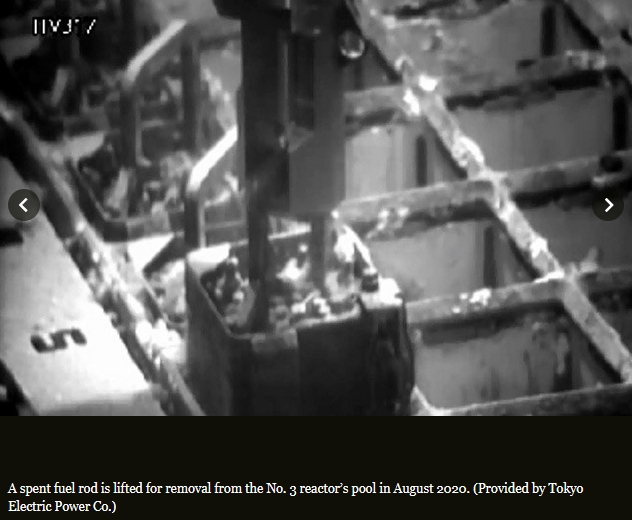
The remaining six units were transferred to the shared pool on Feb. 28. The development came roughly three years after the government and TEPCO announced an initial roadmap for the work in December 2011.
The removal of spent fuel from the No. 4 reactor building was completed in late 2014. The No. 4 reactor had been shut down for maintenance prior to the disaster triggered by the Great East Japan Earthquake and tsunami in 2011.
With regard to the No. 1 and No. 2 reactors, which went in meltdown after the quake and tsunami disaster knocked out cooling systems, a combined 1,000 spent fuel units remain in their storage pools.
TEPCO is aiming at starting the removal work at the two reactors in fiscal 2024 or beyond.
Apart from the spent fuel, 800 to 900 tons of melted nuclear fuel remain in the No. 1 through No. 3 reactors.
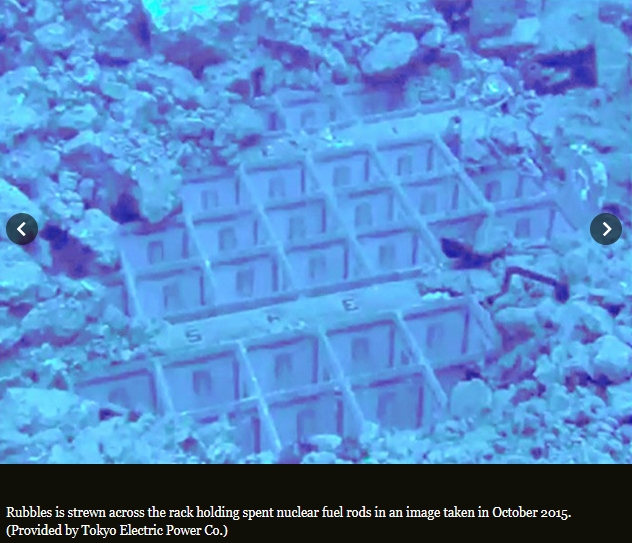
INTERVIEW: Kan Had Not Assumed Nuclear Accident before 2011

Februay 27, 2021 Tokyo, Feb. 27 (Jiji Press)–Looking back at the March 2011 nuclear accident, former Japanese Prime Minister Naoto Kan said he had thought that a nuclear accident would never occur in Japan and admitted that he was wrong in the assumption.
“Before the disaster, I had thought that a nuclear accident would not take place, but I was wrong,” Kan, a lawmaker of the main opposition Constitutional Democratic Party of Japan, told Jiji Press in a recent interview. “(Japan) should scrap all nuclear plants,” he said.
“I feel grave responsibility for the death of many elderly people and people suffering illnesses when they took refuge in the early stages of the accident,” said Kan, who was prime minister at the time of the triple meltdown accident at Tokyo Electric Power Company Holdings Inc.’s <9501> Fukushima No. 1 plant, stricken by the March 2011 earthquake and tsunami.
“The biggest problem” that the government faced in addressing the nuclear accident was that “correct information did not come” from TEPCO, the former Nuclear and Industrial Safety Agency or the former Nuclear Safety Commission.
On his much-criticized visit to the stricken plant in Fukushima Prefecture, northeastern Japan, on the day after the accident, Kan said he made the visit as he thought that he would not be able to capture the situation at the plant. https://jen.jiji.com/jc/eng?g=eco&k=2021022700560
Fukushima disaster: Is TEPCO nuclear plant still a safety risk?
Ten years after the Fukushima nuclear disaster, the Tokyo Electric Power Co. has been criticized for failing to learn safety lessons.

A seismograph at the Fukushima Daiichi plant malfunctioned during a recent earthquake
Februay 26, 2021
Tokyo Electric Power Company (TEPCO), the operator of the Fukushima Dai-ichi nuclear power plant, is facing renewed criticism that it has failed to learn the lessons of the 2011 disaster there.
Next month marks the 10-year anniversary of the massive earthquake and tsunami that caused meltdowns in three nuclear reactors.
Opponents of nuclear power and other civic groups are calling for greater transparency in TEPCO’s operations. They cite a number of issues as evidence that TEPCO is still falling short of its responsibilities, including a significant security breach recently at one of the company’s plants.
It was discovered in early February that an employee at TEPCO’s Kashiwazaki-Kariwa nuclear plant in northern Japan had used a colleague’s identity card to enter the central control room after misplacing his own pass.
The incident, which happened five months earlier, was not reported to the Nuclear Regulation Authority (NRA) until a quarterly meeting in late January on the grounds that it was not considered a major breach of security.
The NRA disagreed and concluded that the unauthorized entry by the worker into the nerve center of the plant “affected security.” TEPCO was ordered to make improvements.
Fukushima’s earthquake problem
The fallout from that incident was worsened after a serious earthquake on February 13 shook northeast Japan, including the Fukushima nuclear plant.
Seismologists said the magnitude 7.3 tremor was the largest to strike Japan since April 2011 and was actually the latest aftershock from the Great East Japan Earthquake nearly a decade ago.
TEPCO admitted a short while later that seismometers installed in two of the reactor buildings broke down last year and had not been repaired.
In addition, a report to the NRA confirmed that the earthquake caused radioactive water to slosh over the edges of containment tanks at the site, while the water level around two of the reactors has fallen.
That could indicate that the tremor enlarged existing fissures in the surrounding concrete or created new ones, enabling the escape of water that is needed to keep the reactors cool and prevent the release of more radioactivity into the atmosphere.
A hard-hitting editorial in the Asahi newspaper after the security breach at the Niigata plant said the incident “raised doubts” about TEPCO’s “fitness to operate nuclear power plants.”
“The utility must thoroughly reexamine every conceivable issue and raise its workers’ safety awareness to prevent missteps, once and for all,” it added.
In a statement issued to DW, TEPCO said it was “addressing” the issue of the malfunctioning seismometers, which may have failed in July due to heavy rain.
“We are now working to restore the system as soon as we can,” the company said.
TEPCO excuses ‘not acceptable’
Hajime Matsukubo, secretary general of the Tokyo-based Citizens’ Nuclear Information Centre, said the excuses of a company charged with decommissioning four damaged reactors that caused the second-worst nuclear disaster in history are “not acceptable.”
“The way that the company is managing things suggests to me that they have not learned their lessons from the March 2011 disaster,” he said.
This 2011 TV image shows the aftermath of an explosion at the plant
“TEPCO says it is ready, for example, to resume operations at the Kashiwazaki-Kariwa plant, but now we have this very serious security breach,” he added.
“I agree that the company has made great strides with the technology that is being developed to contain the situation at the Fukushima plant and to decommission those damaged reactors, but there are too many human errors creeping into their operations,” said Matsukubo.
“They cannot fully manage these sites and, I would say, they do not have the capabilities to manage nuclear facilities.”
Azby Brown, lead researcher for the nuclear monitoring organization Safecast Japan, agrees that the company has made progress in the decommissioning work, but says that errors keep cropping up.
“A lot of things they are doing very well, because this is a hugely challenging operation, so we have to give them credit for that, but there are still some gaping holes that management really needs to plug if they want to begin to rebuild public trust,” he said.
“They have all the appropriate security regulations in place, but then we see things like this happening,” he said. “It’s almost as if there is an institutional allergy to transparency and informing the regulators immediately a problem occurs and then addressing that problem. And that is not helping their reputation at all.”
Increase in radiation
The company’s errors have immediate implications, he says, as monitoring equipment installed at sea off the plant detected a small increase in highly radioactive caesium in the days after the earthquake, indicating that water had indeed escaped from the site and was dispersing into the ocean.
And that coincided with the announcement that a black rockfish caught off the prefecture by a fishermen’s collective had caesium levels five times above the government’s permitted levels.
Local fishermen, whose livelihoods were devastated by the nuclear accident, have been carrying out limited test fishing since June 2012 and had been hoping this year to resume small-scale shipments of fish to market if they were able to prove to inspectors that all the fish being caught were safe to consume.
The revelations surrounding TEPCO’s latest problems is unlikely to reassure the public that produce from much of northeast Japan is safe to buy.
https://www.dw.com/en/fukushima-disaster-is-tepco-nuclear-plant-still-a-safety-risk/a-56713519
Last 6 assemblies Stored in Containers; Nuclear Fuel Removal from Unit 3 Pool at Fukushima Daiichi Nuclear Power Plant to End

Nuclear fuel being lifted by a fuel handling machine. A monitor screen shows a lot of small debris in the pool, at Tokyo Electric Power Co.’s Fukushima Daiichi Nuclear Power Plant in Okuma, Fukushima Prefecture, April 15, 2019.
February 26, 2021
The Tokyo Electric Power Company (TEPCO) stored the last six nuclear fuels in special containers in the spent fuel pool at the Unit 3 reactor of the Fukushima Daiichi Nuclear Power Plant on April 26. Although the work began in April 2019, it will be completed earlier than the target of the end of March 2021. A total of 566 nuclear fuels, 514 spent and 52 unused, were stored in the pool. (Shinichi Ogawa)
This is the second reactor to have nuclear fuel removed from its spent fuel pool, following the Unit 4 reactor (1,535 nuclear fuels) which finished in December 2014. This is the first time for Units 1-3, which suffered a core meltdown (meltdown).
The initial plan was to start removing the nuclear fuel from the Unit 3 reactor by the end of 2002, but the high radiation dose became a barrier to the work. A dome-shaped cover was installed on top of the building to prevent radioactive materials from spreading outside. TEPCO had indicated plans to start removing the radioactive materials in November 2006, but due to a series of problems with cranes and other equipment, the work was postponed for inspection and replacement of parts.
According to the plan presented by the government and TEPCO, the removal of nuclear fuel from the pool is scheduled to start in FY2015-28 for Unit 1 (392 nuclear fuels) and in FY2012-26 for Unit 2 (615 nuclear fuels).
1 This Month

Tell Congress: Prevent Nuclear Catastrophe in Iran

Tell Congress: Prevent Nuclear Catastrophe in Iran

Read the Public Inquiry Report, the Commissioners’ report, Surrendering Australia: The AUKUS Deception is available to download for free at aukuspublicinquiry.com. Or just watch the replay of the National Press Club Luncheon.


Shut down the radiation-damaged Heysham nuclear reactors now
To see nuclear-related stories in greater depth and intensity – go to https://nuclearinformation.wordpress.com

Say No to NASA’s Reckless Nuclear Reactor on the Moon
Say No to NASA’s Reckless Nuclear Reactor on the Moon
-
Archives
- November 2026 (255)
- October 2026 (302)
- September 2026 (339)
- August 2026 (330)
- July 2026 (355)
- June 2026 (287)
- May 2026 (306)
- April 2026 (356)
- March 2026 (251)
- February 2026 (267)
- January 2026 (308)
- December 2025 (358)
-
Categories
- 1
- 1 NUCLEAR ISSUES
- business and costs
- climate change
- culture and arts
- ENERGY
- environment
- health
- history
- indigenous issues
- Legal
- marketing of nuclear
- media
- opposition to nuclear
- PERSONAL STORIES
- politics
- politics international
- Religion and ethics
- safety
- secrets,lies and civil liberties
- spinbuster
- technology
- Uranium
- wastes
- weapons and war
- Women
- 2 WORLD
- ACTION
- AFRICA
- Atrocities
- AUSTRALIA
- Christina's notes
- Christina's themes
- culture and arts
- Events
- Fuk 2022
- Fuk 2023
- Fukushima 2017
- Fukushima 2018
- fukushima 2019
- Fukushima 2020
- Fukushima 2021
- general
- global warming
- Humour (God we need it)
- Nuclear
- RARE EARTHS
- Reference
- resources – print
- Resources -audiovicual
- Weekly Newsletter
- World
- World Nuclear
- YouTube
-
RSS
Entries RSS
Comments RSS

