Iran says IAEA access to nuclear sites images has ended
Iran says IAEA access to nuclear sites images has ended
Iran says IAEA access to nuclear sites images has ended https://www.aljazeera.com/news/2021/5/23/iran-says-iaea-access-to-nuclear-sites-images-has-ended
Three-month monitoring deal between Tehran and the UN nuclear watchdog expires, raising questions over talks.3 May 2021
The speaker of Iran’s parliament said a three-month monitoring deal between Tehran and the UN nuclear watchdog has expired and that its access to images from inside some Iranian nuclear sites would cease.
The announcement on Sunday raised further questions about the future of indirect talks under way between the United States and Iran on reviving the 2015 Iran nuclear deal.
“From May 22 and with the end of the three-month agreement, the (IAEA) agency will have no access to data collected by cameras inside the nuclear facilities agreed under the agreement,” state TV quoted parliament speaker Mohammad Baqer Ghalibaf as saying.
The International Atomic Energy Agency and Tehran struck the three-month monitoring agreement in February to cushion the blow of Iran reducing its cooperation with the agency, and it allowed monitoring of some activities that would otherwise have been axed to continue.
IAEA chief Rafael Grossi is in talks with Iran about extending the agreement.
European diplomats said last week that a failure to agree upon an extension would plunge the wider, indirect talks between Washington and Tehran on reviving the 2015 deal into crisis. Those talks are due to resume in Vienna this week.Play Video
The IAEA had planned for Grossi to hold a news conference on Sunday but it said he was still “consulting with Tehran” and that his news conference had been postponed until Monday morning.
An unnamed Iranian official was quoted as saying the agreement between the IAEA and Tehran could be extended “conditionally” for a month.
“If extended for a month and if during this period major powers … accept Iran’s legal demands, then the data will be handed over to the agency. Otherwise, the images will be deleted forever,” according to the member of Iran’s Supreme National Security Council.
Without commenting on the parliament speaker’s earlier announcement, Iran’s president, Hassan Rouhani, said on Sunday that Tehran would continue the talks in Vienna “until reaching a final agreement”.
He also repeated an earlier statement that “Washington has agreed to lift sanctions” on Iran, according to Iranian state media.
US says unclear if Iran ready to return to pact.
Iran and global powers have held several rounds of negotiations since April in Vienna, Austria, working on steps that Tehran and Washington must take, on sanctions and nuclear activities, to return to full compliance with the nuclear pact.
Iran began gradually breaching terms of the 2015 pact with world powers after former President Donald Trump withdrew the United States from the deal in 2018 and re-imposed sanctions.
On Sunday, US Secretary of State Antony Blinken said that it remains unclear whether Iran is “ready and willing” to take the necessary steps to return to compliance with the multination nuclear agreement.
European External Action Service (EEAS) Deputy Secretary-General Enrique Mora and Iranian Deputy at Ministry of Foreign Affairs Abbas Araghchi during a meeting of the JCPOA Joint Commission in Vienna, Austria [File: EU Delegation in Vienna/Handout/Reuters]Speaking before a fifth round of talks in Vienna on rescuing that deal, Blinken was asked about Iranian reports that Washington had already agreed to lift some of the sanctions that have crippled the Iranian economy.
“We know what sanctions would need to be lifted if they’re inconsistent with the nuclear agreement,” he said on ABC’s This Week.
He added that more importantly, “Iran, I think, knows what it needs to do to come back into compliance on the nuclear side, and what we haven’t yet seen is whether Iran is ready and willing to make a decision.
Dalgety Bay – 20,000 tonnes of radioactive material from the area to screen, – clean-up begins at last.

Scotsman 23rd May 2021, 30 years on, Scotland’s radioactive beach clean-up begins at last. It’s not a scene which might usually be welcome, but locals in the Fife town of Dalgety Bay have been waiting decades for this – ever since highly dangerous radioactive material was detected on the shoreline more than 30 years ago. Contamination was first identified there in 1990, but the source – luminous paint used on aircraft navigation dials – dates back to theSecond World War.
The area was once home to Donibristle military airfield,
where a large number of planes were dismantled after the end of the
conflict in 1945 and the debris burned and buried. Part of the foreshore at
Dalgety Bay has been off limits to the public since 2011 due to the health
risks posed by radioactive debris.
Radium was used to coat instrument
panels so they could be seen in the dark, but it is radioactive and toxic
to human health, with a half life of 1,600 years. Work to clean up
potentially deadly radioactive contamination has got under way at Dalgety
Bay in Fife, caused by debris from aircraft used during the Second World
War.
David Barratt, Fife councillor for Inverkeithing and Dalgety Bay, has
welcomed the work finally getting started. He said: “It has taken over 30
years and significant pressure from the community to get to this point.
“I’m delighted that works are now under way and grateful to Sepa for
all their effort in ensuring it will be done right, providing a permanent
solution.
“It should send a clear message that it doesn’t matter how much
time passes, the polluter should always pay. “Time will tell if its
smooth sailing from here and whether a 2022 completion date is possible.
They have around 20,000 tonnes of material from the area to screen and the
more contamination they find, the longer it will take, but at least now we
know it will be safe, however long it takes.”
Changes to Waste Isolation Pilot Plant could hide plan to expand this nuclear waste facility.
New Mexico weighs changes to permit for nuclear waste dump CARLBAD, N.M. (AP) 23 May 21, — U.S. officials are pushing state regulators to clear the way for a new ventilation shaft to be built at the federal government’s nuclear waste repository in southern New Mexico, but watchdog groups say modifying the Waste Isolation Pilot Plant’s permit to allow for the construction could open the door to expansion.
The state Environment Department’s Hazardous Waste Bureau held a virtual hearing over the past week to gather comments on the proposed permit change. A final decision is anticipated in mid-October.
Ventilation has been an issue since 2014, when a radiation release contaminated parts of the underground facility and forced an expensive, nearly three-year closure, delayed the federal government’s cleanup program and prompted policy changes at national laboratories and defense-related sites across the U.S.
Officials with the U.S. Energy Department have said the new shaft is needed to repair a “crippled” ventilation system, the Carlsbad Current-Argus newspaper reported………
The proposal is supported by leaders from the nearby city of Carlsbad, where many of the plant’s employees live.
……………… Cynthia Weehler, a Santa Fe resident and representative of activist group Stop Forever WIPP, argued the utility shaft was indicative of the Energy Department gradually expanding the repository using individual projects rather than proposing the overall goal of altering the facility’s mission to extend its lifetime.
She said that if New Mexico approves the permit, it would seem to be “colluding” with the Energy Department “to relabel a new mission and a future expansion.”
“It will lead us to an operation we didn’t consent to,” Weehler said. https://apnews.com/article/nm-state-wire-new-mexico-nuclear-waste-business-science-171b011df1d62d4a433b78f8c03e1760
Australian govt plan for nuclear waste dump ignores transport dangers

Looking back to the 2016 shonky South Australian Nuclear Fuel Cycle Royal Commission, – the same problems apply to the present Federal Government plan . Friends of the Earth Australia examined these- in Arguments against turning SA into the world’s nuclear waste dump.
The Royal Commission’report claimed that ”no accident involving a breach of the package and the release of its contents has occurred. The same record applies to international transport of high and intermediate level waste.”
”That claim is incorrect and is refuted by documented evidence provided to ‒ and ignored by ‒ the Royal Commission. For example a whistleblower sparked a major controversy over frequent excessive radioactive contamination of waste containers, rail cars, and trucks in France and Germany. International transport regulations for spent fuel shipments were constantly over a period of many years and this was done knowingly. Another example concerns the derailment of a train wagon carrying spent fuel in December 2013, 3 km from Paris, with testing by AREVA revealing a hotspot on the rail car.
Numerous other train derailments involving nuclear materials transport have been documented. It is unsettling to consider the multiple derailments on the Ghan train line in Australia in the relatively short period of time it has been in operation.
Transport incidents and accidents are routine in countries with significant nuclear industries. The case of the UK is pertinent. A UK government database contains information on 1018 events from 1958 to 2011 (an average of 19 incidents each year).
There were 187 events during the shipment of irradiated nuclear fuel flasks from 1958−2004 in the UK (an average of four per year):
- 33% involved excess contamination on the surface of the flask;
- 24% involved collisions and low speed derailments of the conveyance;
- 16% involved flask preparation faults, and loading/unloading faults;
- 13% involved excess contamination of conveyance;
- 11% involved faults with the conveyance; and
- the remainder included three cases involving fire on a locomotive with no damage to flasks.
The French nuclear safety agency IRSN produced a report summarising radioactive transport accidents and incidents from 1999−2007. The database lists 901 events from 1999−2007 − on average 100 events annually or about two each week. The IRSN report notes that events where there is contamination of packages and means of transport were still frequent in 2007.
Potential costs of transport accidents: Spent fuel / high level nuclear waste transport accidents have the potential to be extraordinarily expensive. Dr. Marvin Resnikoff and Matt Lamb from Radioactive Waste Management Associates in New York City calculated 355−431 latent cancer fatalities attributable to a “maximum” hypothetical rail cask accident, compared to the US Department of Energy’s estimate of 31 fatalities. Using the Department of Energy’s model, they calculated that a severe truck cask accident could result in US$20 billion to US$36 billion in clean-up costs for an accident in an urban area, and a severe rail accident in an urban area could result in costs from US$145 billion to US$270 billion.
Transport and nuclear security: Nuclear engineer Dr John Large writes: “Movement of nuclear materials is inherently risky both in terms of severe accident and terrorist attack. Not all accident scenarios and accident severities can be foreseen; it is only possible to maintain a limited security cordon around the flask and its consignment; … terrorists are able to seek out and exploit vulnerabilities in the transport arrangements and localities on the route; and emergency planning is difficult to maintain over the entire route.”
A number of nuclear transport security incidents are listed in the body of this submission (section 3.8).
Security and proliferation risks…….”Arguments against turning SA into the world’s nuclear waste dump https://nuclear.foe.org.au/waste-import-arguments/?fbclid=IwAR1yajKABFYLvMp3gFjM_DuYJFFMu4nnuc3LXxLFEBLpI7Da9-OjSv0IHrk#_ftnref4
Journey to the Safest Place on Earth —

Journey to the Safest Place on Earth – a “must watch” film for Cumbrians…. Members of the Copeland and Allerdale “Working Groups” are a few self selected people who have put their faith in the nuclear industry’s promises, they do not speak for Cumbria – or even for Copeland and Allerdale although the Borough Councils’ […]
Journey to the Safest Place on Earth —
A world based on 100% renewable energy by 2035 is technically and economically feasible

Renew Extra 22nd May 2021, Dave Elliott: 100% renewable energy ‘is possible by 2035’. A world based on 100% renewable energy is possible, and we are able to transform the energy system fast enough to avoid the climate catastrophe!’ So says the Joint declaration of the global 100% renewable energy strategy group.
Set up initially by a core of 7 leading climate and energy scientists, including Prof. Mark Jacobson from Stanford in the USA, and Prof Christopher Breyer from LUT in Finland, and then backed by 40 other scientists, it claims that ‘a 100% renewable electricity supply is possible by 2030, and with substantial political will around the world, 100% renewable energy is also technically and economically feasible across all other sectors by 2035.
A 100% RE system will be more cost effective than will a future system based primarily on fossil and nuclear power. The
transformation to 100% renewables will boost the global economy, create millions more jobs than lost, and substantially reduce health problems and mortality due to pollution’.
https://renewextraweekly.blogspot.com/2021/05/100-renewable-energy-is-possible-by-2035.html
Anxieties on the impact of pandemic on the Hinkley Point C nuclear power project, -major delays could result

Telegraph 23rd May 2021, EDF has warned that the coronavirus pandemic could cause major delays to its £23bn Hinkley Point C nuclear power plant. Talks are continuing between the French state-owned power business and British officials about potential hold-ups caused by the Covid crisis. Hinkley’s start date has already been pushed back to June 2026 due to a six-month delay caused by the pandemic. It was originally due to come online in 2025 when it was given the go-ahead in 2016. EDF first raised concerns over the possible delays at the start of the pandemic with the Low Carbon Contracts Company (LCCC), the government-owned company that acts as counterparty on clean energy subsidy contracts. Under its subsidy contract, Hinkley Point C is guaranteed £92.50 per MwH for 35 years. The Somerset site – eing built by EDF and its Chinese partner CGN – will become the UK’s first nuclear power plant in decades. However, the length of this 35-year term will be cut if Hinkley is not generating by May 2029 – reducing the guaranteed income for EDF. It can be cancelled altogether if the plant is not operational by October 2033. EDF said it has not applied to the LCCC for a specific extension to those deadlines, but that on principle it may be entitled to an extension because Covid is a “force majeure” event – an unforeseen event that affects a company’s ability to deliver on its contract. It stressed that the June 2026 schedule for Hinkley Point C to start generating, which was announced in January, remains unchanged and the project is making good progress. “We anticipate that it may take some time to establish the true impact of Covid-19 on complex construction projects such as Hinkley Point, as it is still unknown when Covid-19 restrictions will cease.” https://www.telegraph.co.uk/business/2021/05/23/edf-warns-delays-hinkley-due-pandemic/ |
May 23 Energy News — geoharvey

Opinion: ¶ “How Wolves And Other Wildlife Help Us Fight For The Climate” • Amid the buzz over better stewardship of our planet’s greenery, a growing body of scientific research is examining another piece of the carbon puzzle: wildlife. It is increasingly clear that biodiversity is not an optional luxury, but integral to natural life […]
May 23 Energy News — geoharvey
Are “Advanced” Nuclear Reactors Actually Better?

A Critical Examination of the Safety, Security, and Environmental Risks of Non-Light-Water Technologies
RSVP Required
Wed., May 26, 2021 | 2:00pm – 3:30pm
Online Series Project on Managing the Atom Seminar Series
A Project on Managing the Atom (MTA) seminar with Edwin Lyman, Director of Nuclear Power Safety at the Union of Concerned Scientists.
Please RSVP to receive the Zoom link.
RSVP Required
Wed., May 26, 2021 | 2:00pm – 3:30pm
Online Series Project on Managing the Atom Seminar Series
A Project on Managing the Atom (MTA) seminar with Edwin Lyman, Director of Nuclear Power Safety at the Union of Concerned Scientists.
Please RSVP to receive the Zoom link. https://harvard.zoom.us/meeting/register/tJUucOCtqzIoGdG9KSqzSafFkDd8PCnt2z-S
ABOUT
If nuclear power is to play an expanded role in mitigating climate change, newly built reactors should be demonstrably safer and more secure than current-generation reactors. Today, many US companies and the Department of Energy are making significant investments in the development of nuclear reactors that use coolants other than water, such as liquid sodium, helium gas, and molten salt. These are fundamentally different from today’s water-cooled reactors. But is different actually better? A recent study by the Union of Concerned Scientists (UCS) finds the answer is “no” for most designs in terms of safety and security, sustainability, and the risks of nuclear proliferation and nuclear terrorism. The report recommends that policymakers and private investors fully vet the risks and benefits of these technologies before committing the vast resources needed to safely commercialize them.
Edwin Lyman is the Director of Nuclear Power Safety at the Union of Concerned Scientists in Washington, DC. He earned a doctorate in physics from Cornell University in 1992. From 1992 to 1995, he was a postdoctoral research associate at Princeton University’s Center for Energy and Environmental Studies (now the Science and Global Security Program). From 1995 to 2003, he worked for the Nuclear Control Institute. His research focuses on nuclear power safety and security. He is a co-author (with David Lochbaum and Susan Q. Stranahan) of the book Fukushima: The Story of a Nuclear Disaster (The New Press, 2014). In 2018 he received the Leo Szilard Lectureship Award from the American Physical Society.
Source link (need to keep retrying as link is slow and fails regularly)
Discharging Fukushima radioactive waste water to the ocean would violate Japan’s legal and environmental obligations
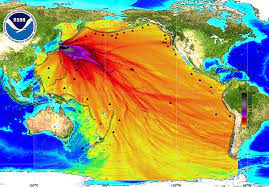
The Legal Case Against Japan’s Fukushima Wastewater Decision, https://thediplomat.com/2021/05/the-legal-case-against-japans-fukushima-wastewater-decision/
The proposed discharge of wastewater from the Fukushima nuclear plant into the Pacific Ocean would violate Japan’s legal and environmental obligations. By Xiuxiu Zhang, Jeffrey Thaler, and Danning Zhu, May 21, 2021
Since the devastating March 2011 Japanese earthquake and tsunami, which damaged the Fukushima Daiichi nuclear power plant, 1.25 million tons of seawater have been pumped through the damaged nuclear units to prevent the melted fuel rods in three damaged reactors from overheating. The contaminated water has been stored in more than 1,000 steel tanks on site. But in April 2021, the Japanese government announced that it would, beginning in 2023 and for decades thereafter, discharge all of the treated wastewater into the Pacific Ocean as part of the plant’s decommissioning process.
Many countries that share a sea border with Japan (especially China, South Korea, and Russia), as well as domestic fishing and export interests, have raised a variety of objections and concerns. Yet with little fanfare in American media, the United States – which has both Alaska and Hawaii at risk – has supported Japan’s plan. The ecological and human risks at stake are potentially huge: The seawater may contain radioactive tritium, strontium-90, and C-14 (the latter known to bioaccumulate in marine ecosystems). Yet international political positioning seems to be playing a greater role than environmental concerns in national responses. Could that change before 2023?
A variety of international treaties, conventions, and agreements, as well as fundamental environmental protection principles, are relevant to the discharge of wastewater from Fukushima.
In 1958, the first United Nations Conference on the Law of Sea adopted the Convention on the High Seas in Geneva, which became effective on September 30, 1962. Pursuant to Article 25 of the Convention, “Every State shall take measures to prevent pollution of the seas from the dumping of radioactive waste, taking into account any standards and regulations which may be formulated by the competent international organizations.” Also in 1958, the Resolution on Pollution of the High Seas by Radioactive Materials was adopted by the first United Nations Conference on the Law of Sea. One of its recommendations was that the International Atomic Energy Agency (IAEA), in consultation with existing groups and established organs having acknowledged competence in the field of radiological protection, should pursue whatever studies and take whatever action is necessary to assist states in controlling the discharge or release of radioactive materials to the sea, in promulgating standards, and in drawing up internationally acceptable regulations to prevent pollution of the sea by radioactive materials in amounts that would adversely affect people and marine resources.
The 1996 London Protocol, signed by many nations, prohibited the dumping of all wastes and other materials is prohibited except certain non-toxic materials that do not contain levels of radioactivity greater than de minimis (exempt) concentrations as defined by the IAEA. In 1999, the IAEA defined “de minimis” risk levels in terms of those of “no regulatory concern” and based on practices and sources that are “inherently safe.”
Last and not least, the United Nations Convention on the Law of the Sea (UNCLOS) is an international treaty ratified by over 160 countries, including China, South Korea, and Japan – but not the United States. UNCLOS stipulates that the ocean is the common heritage of mankind. Pursuant to Article 192, all states have the obligation to protect and preserve the marine environment. UNCLOS also established a complete legal framework that regulates all marine areas, the use of the ocean, and marine resources, as well as the protection and maintenance of the marine environment, marine scientific research, and the development and transfer of marine technology.
Moreover, Article 194 of UNCLOS requires that member countries must: 1) take, individually or jointly as appropriate, all practicable measures necessary to prevent, reduce and control pollution of the marine environment from any source; and 2) take all measures necessary to ensure that activities under their jurisdiction or control are so conducted as not to cause damage by pollution to other states and their environment, and that pollution arising from incidents or activities under their jurisdiction or control does not spread beyond the areas where they exercise sovereign rights in accordance with this Convention. Last, UNCLOS Article 195 specifies that countries shall act so as not to transfer, directly or indirectly, damage or hazards from one area to another or transform one type of pollution into another.
In light of the very clear obligations set forth in UNCLOS and the other conventions, how is the potential Fukushima nuclear wastewater discharging being viewed by neighboring countries?
Both the United States and the IAEA have voiced support for Japan’s announced plans for the Fukushima discharge plan. The IAEA said it would provide technical support for what it deemed to be a feasible means of disposal of the contaminated seawater. A week later the Biden administration voiced its support for what it said was a plan meeting international safety standard.
However, many others did not share those views, both within and outside of Japan. Domestic fishing, environmental, public health, and export interests objected both to the process leading up to the announcement and to the plan itself. They viewed the risks as being too great, and the added pollutant burden to the Pacific Ocean to be too much and with far-ranging scope affecting more than just Asia.
Indeed, calculations by Germany’s Geomar Helmholtz Center for Ocean Research predict that once the wastewater from the Fukushima nuclear power plant is discharged into the sea, radioactive materials will spread to most of the Pacific’s marine life and ecology within 57 days.
Neighboring countries such as China, South Korea, and Russia all voiced vigorous concerns, and warned that imports of Japanese seafood and agricultural products could be restricted – and that consumer confidence in purchasing such goods would be damaged. South Korea has threatened to take the issue to international judicial tribunals for review. How the dispute would be resolved pursuant either to the International Court of Justice, or to one of the various Conventions, remains to be seen. But in the meantime, there are some fundamental environmental protection principles and agreements that the United States in particular seems to be overlooking.
First, the treatment of Fukushima nuclear wastewater should give priority to the alternatives that have the least impact on the marine environment. The precautionary principle is the first principle of environmental law all over the world. Environmental policies and environmental laws should not just be after-the-damage-happens responses, but also should prevent hazards and harms to the environment and human organisms before they occur.
Under the precautionary principle, pollution avoidance is superior to pollution reduction. Avoiding the discharge of Fukushima nuclear wastewater should be superior to behaviors that comply with certain standards but can still cause environmental damage. Although the Fukushima wastewater is treated, the environmental impact of treated wastewater on marine life and ecological environment should be evaluated by marine, biological, and nuclear experts from various countries bordering the Pacific Ocean. In addition, the discharge of Fukushima nuclear wastewater is unprecedentedly huge, and the half-life of some of the radioactive elements means they will continue to pose a threat to the marine environment and marine life for decades. The materials are neither de minimis, nor “inherently safe.” Radioactive materials will also be transferred to the terrestrial environment and humans through marine life and other channels.
A second environmental principle is that of environmental hazard prevention or mitigation. It is akin to a precept to “do no harm” to the health of people, wildlife, fisheries, and natural resources. The ultimate goal is to ensure the protection of existing environmental quality and the possibility of future improvement. The environment must not be further deteriorated, and if pollution damage has occurred, it must be restored. Given that the Fukushima wastewater still exceeds Japanese discharge standards, it is impossible to say that in just two years the discharge will not cause damage to sea life of the Pacific Ocean.
Third, the principle of equity is formed by the concept of ecological compromise, which is concerned primarily with considering the interests of all potentially impacted parties and resources – both international and domestic. The principle of equity is essentially a balancing of interests, which extends to international environmental protection issues and is closely related to the principle of cooperation articulated in UNCLOS and other agreements. Japan’s discharge of nuclear wastewater is not only related to the life and health of its residents and the safety of its ecological environment, but also to the global marine environment. It will impact neighboring countries and even the global ecological environment and people’s rights to life and health. In essence, Japan is placing the costs of its nuclear waste upon other peoples, and upon the Pacific marine life, which has no voice of its own.
UNCLOS stipulates that the ocean is the common heritage of humanity, and that all countries have the obligation to protect and preserve the marine environment. Japan has an international obligation to ensure that the activities under its jurisdiction or control do not cause pollution damage to other countries and their environment, and to ensure that the pollution caused by events or activities within its jurisdiction or control does not extend beyond the area where it exercises sovereign rights in accordance with this Convention. Other countries may pursue remedies through either the International Tribunal for the Law of the Sea, the International Court of Justice, an arbitration tribunal organized in accordance with Annex VII of the Maritime Convention, or a special arbitration tribunal organized in accordance with Annex VIII of the Maritime Convention.
Even the United States, which is not a signatory to UNCLOS, might have some recourse should it change its political position. For example, in mid-2018 the U.S. Environmental Protection Agency and the Japan Atomic Energy Agency executed a Letter of Intent to cooperate “in the field of radiation protection.” As part of that agreement, the two agencies were to share radiation risk assessment models and related data. But, interestingly, the two countries also agreed to share “information on the uncertainty of radiation risk assessment, including the sharing of a report by the EPA on the uncertainty of EPA radionuclide cancer risk coefficients.” Given such acknowledged uncertainty, it would seem at least premature for the U.S. to be opining that the discharge of over 1 million gallons of heavily contaminated nuclear-radiated seawater is safe and poses no risks to human or other life. Indeed, back in 1975 the Japanese and American governments signed an Agreement “on cooperation in the field of environmental protection” in which both countries acknowledged “the responsibilities of each Government for the protection and improvement of the global environment.”
That “global environment” extends beyond Japan’s territorial waters, and any unilateral decision by Japan to discharge pollutants that could materially harm the environment across a significant part of non-Japanese waters would seem to be at odds with its responsibilities agreed to the international agreements we have summarized herein, as well as with the fundamental principles of and duties imposed by environmental protection for current and future generations of human and non-human life on our planet.
The dark legacy of a nuclear meltdown – The Santa Susana Field Laboratory.
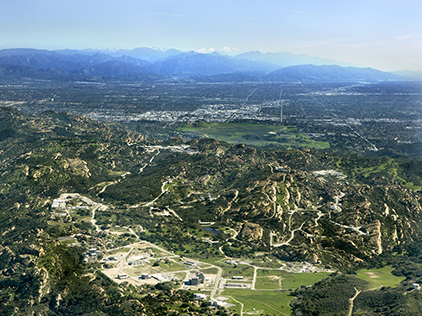
Newsletter: The dark legacy of a nuclear meltdown, and what it means for climate change L.A. Times, By SAMMY ROTH. STAFF WRITER MAY 20, 2021
”………………The Santa Susana Field Laboratory.
Despite growing up in Los Angeles, until recently I knew next to nothing about Santa Susana, which is nestled in the Simi Hills west of the San Fernando Valley. As my L.A. Times colleagues have chronicled, it was a nuclear reactor and rocket engine test facility for decades, and the site of a partial nuclear meltdown in 1959. Today more than 700,000 people live within 10 miles.
Santa Susana is an incredibly toxic site.
And the parties responsible for the long legacy of radioactive waste and other contaminants — namely Boeing, NASA and the federal Department of Energy — have done hardly anything to clean it up.
“That work was supposed to be completed by 2017. Yet much of it has not even started,” columnist Michael Hiltzik wrote last year.
Santa Susana is also the subject of a new documentary, “In the Dark of the Valley,” which is making the rounds on the film festival circuit. It’s a gut-wrenching story about children living near the field lab who have been diagnosed with cancer, and whose mothers have banded together to demand a full cleanup, in hopes that other families won’t suffer like theirs have.
The film focuses on Melissa Bumstead, whose daughter Grace Ellen was diagnosed with a rare and aggressive form of leukemia at age 4. Bumstead started a Change.org petition that has garnered more than 700,000 signatures, calling on politicians including Gov. Gavin Newsom to compel Boeing and the federal agencies to live up to their long-unfulfilled promises.
“I’m not going to stop. So we’ll just have to find out who has more endurance, me or them,” she says in the film’s closing moments. “The thing that’s heartbreaking is that it’s just going to continue. But it’s the kids who have to suffer, and it’s the parents who have to bury them.”
…. there’s been research suggesting that Santa Susana may pose a serious health risk to people nearby.
In 1997, UCLA scientists reported that field lab workers exposed to higher doses of radiation from 1950 through 1993 were more likely to die of cancer. A decade later, University of Michigan researchers found that people living within two miles of the site had been diagnosed with thyroid, bladder and other cancers at a 60% higher rate than people living more than five miles away.
The scope of the contamination far exceeds a single meltdown more than 60 years ago.
Daniel Hirsch — a retired UCLA and UC Santa Cruz lecturer whose students originally uncovered the meltdown, which was hidden from public view for two decades — says there were several accidents at the field lab, worsened by a lack of containment domes for the nuclear reactors. There were shockingly unsafe waste disposal practices too. For years, workers used rifles to shoot barrels of toxic chemicals to make them ignite or explode. Radioactive waste was also routinely burned in open-air pits, Hirsch said.
This was completely illegal. They weren’t supposed to be doing it,” he said
Hirsch runs the anti-nuclear group Committee to Bridge the Gap, and he’s been trying to get Santa Susana cleaned up for more than 40 years. His concerns include the continued presence of cancer-causing chemicals that can seep into groundwater, or be flushed down into the San Fernando and Simi valleys during rainstorms — or become airborne during a wind-driven wildfire.
That was a major worry during the 2018 Woolsey fire, which was ignited by a Southern California Edison electrical line at the field lab. State officials said the wildfire smoke wasn’t any more dangerous to breathe than usual, but Hirsch had a hard time believing that.
“They set up the air monitor two days after the fire,” he said.
……….. Hirsch and many local residents say Boeing and the federal government have repeatedly tried to weasel out of their commitments. And the Department of Toxic Substances Control hasn’t put up much of a fight, critics say. In January, for instance, the agency agreed to confidential talks with Boeing to resolve a dispute over the extent of the cleanup.
Another wrinkle is NASA’s recent decision to nominate the entire field lab for inclusion in the National Register of Historic Places, citing its Native American cave drawings and archaeological relics. Critics fear the historic designation is a thinly veiled attempt by NASA to shirk some of its cleanup obligations, a charge the space agency denies, as my colleague Louis Sahagún reported.
…… I was definitely jarred by Hirsch’s response when I told him I had hiked in the Simi Hills, within a few miles of the Santa Susana Field Lab, and asked whether he would feel safe doing the same. He didn’t hedge. He told me he would not.
“Every area around the site has been found to have contamination,” he said. https://www.latimes.com/environment/newsletter/2021-05-20/long-legacy-nuclear-meltdown-climate-change-boiling-point
Scientists turn a blind eye to the fraud that is the ITER nuclear fusion project

ITER Is a Suicidal Plan That Would Discredit Nuclear Fusion, Scientist Says, Again, New Energy Times, By Steven B. Krivit, Dec. 5, 2020 A retired plasma physicist has given New Energy Times permission to republish critical letters he wrote about the ITER fusion reactor project many years ago. He has done this despite risks associated with publicly criticizing the international project.
Ernesto Mazzucato spent his entire career — from 1965 to 2014 — working at the Princeton Plasma Physics Laboratory, a U.S. Department of Energy national laboratory. Mazzucato continues to work on his own fusion concepts.He told us about pressure from some of his peers from 1996 to 2006 when he openly criticized the ITER project, but he asked us to withhold those details for fear that it would interfere with his present access to resources and the ability to publish in peer-reviewed journals.
Mazzucato is the second retired fusion physicist from the Princeton laboratory with whom New Energy Times has spoken who is critical of ITER. The first was Mazzucato’s colleague, Daniel Jassby, who has been publishing critical articles about ITER on the Bulletin of Atomic Scientists Web site.Jassby was the first scientist to provide New Energy Times with clear values for the ITER reactor power requirements, following our attempts to obtain this information directly from the ITER organization.
Mazzucato told New Energy Times that he “suffered dearly” shortly after Science magazine published his first critical comments in 1996.
I knew that speaking out was risky, but I had to say what was on my mind,” Mazzucato said. “I thought that ITER would ruin fusion, and I had spent all my life working on fusion. ITER was the wrong track.”Mazzucato told New Energy Times that, decades earlier, at the beginning of the discussions about the ITER concept, the conversation was purely about physics. The conversation soon shifted to the bait-and-switch scheme, as Nobel laureate Masatoshi Koshiba called it.
“The scientists were not talking about power production,” Mazzucato said, “but then slowly, the bureaucrats were put in charge of this project, and they started talking about a power gain, that ITER would produce 10 times more power than it would use.“But none of the scientists said anything. We all knew that the power values only applied to the particles, not the overall reactor.”These are the three letters Mazzucato provided.
1996 Mazzucato Letter to Science
In his first letter, Mazzucato responded to an article published in Science magazine by Andrew Lawler about the ITER projec
For the United States to concentrate its efforts on the construction of ITER, which by my estimates would require at least twice the $8 billion cited by Lawler, [Andrew Lawler, “U.S. Power Outage Won’t Dim ITER,” Science, Jan. 19, 1996, p. 282] would halt significant progress in domestic thermonuclear research.It is tantamount to a suicidal plan that would discredit nuclear fusion as an economically viable form of energy production………….
The construction of ITER, by absorbing all the available funds, would inevitably prevent development in these critical areas. From Lawler’s article, it appears that ITER finds its strongest support in a “wealthy and influential association of major corporations…..” This sounds like an ominous repetition of history, as our problems today with nuclear fission power plants originated when the nuclear industry decided to bring to prominence the first fission reactor concept that appeared to work. Similarly, the adoption of this probably faulty device would have catastrophic consequences for the development of nuclear fusion energy……………..
Turning a Blind Eye
Mazzucato is the first fusion scientist I know who a) noticed the discrepancy between ITER’s planned power values and the publicized power values and b) openly objected to the false claims its promoters were making about the promised power gain of the reactor. Nobel Prize winner Masatoshi Koshiba had also sounded the alarm sometime between 2001 and 2004, calling the ITER project a bait-and-switch trick.
Mazzucato told me that all of his colleagues knew that the bureaucrats in charge of the project were tricking the public. Assuming he’s right, then there are thousands of fusion experts who saw what was going on and did and said nothing about it. It’s not the first time in history that something terrible was happening in a community and was known as an open secret within that community. But it is the first time in modern history that something like this, on this scale, has happened in science.
By 2003, the deception was firmly established, as evident by Robert Stern’s statement in the New York Times on Jan. 31, 2003: “ITER would provide a record 500 megawatts of fusion power for at least 500 seconds, a little more than eight minutes, during each experiment. That would meet the power needs of about 140,000 homes.”
In reality, a fusion reactor designed with the parameters of ITER, if configured to convert its thermal output to electricity, wouldn’t be able to power a single light bulb.
Public statements like Stern’s, published without the authors’ knowledge that they were false, were the norm for more than two decades. Either no fusion scientists except Mazzucato and Koshiba read news accounts about ITER and realized what was happening, or the majority of fusion scientists saw that the “mistakes” significantly favored their field, and they turned — and continue to turn — a blind eye to what has now developed into the largest science fraud in modern history.
By 2003, the deception was firmly established, as evident by Robert Stern’s statement in the New York Times on Jan. 31, 2003: “ITER would provide a record 500 megawatts of fusion power for at least 500 seconds, a little more than eight minutes, during each experiment. That would meet the power needs of about 140,000 homes.”
Public statements like Stern’s, published without the authors’ knowledge that they were false, were the norm for more than two decades. Either no fusion scientists except Mazzucato and Koshiba read news accounts about ITER and realized what was happening, or the majority of fusion scientists saw that the “mistakes” significantly favored their field, and they turned — and continue to turn — a blind eye to what has now developed into the largest science fraud in modern history. https://news.newenergytimes.net/2020/12/05/iter-is-a-suicidal-plan-that-would-discredit-nuclear-fusion/?fbclid=IwAR3p1jpgpyN7_un8Y7OrnCUTzC9p1lOIVFA5MyMKS67lUBEIlC2g4DeIY-0
“You can forget about the protection of area of outstanding natural beauty because if Sizewell C nuclear goes ahead nowhere is safe”

Sizewell C: Bill Turnbull says nuclear plant will cause ‘devastation’ Presenter Bill Turnbull has told a Planning Inspectorate hearing the Sizewell C nuclear power station would cause “awful devastation”. BBC , 21 May 21,
The former BBC Breakfast anchor was speaking on the last day of a four-day public hearing into the proposed plant on the Suffolk coast.
He said he was speaking on behalf of “those who have no voice – the rare and abundant wildlife around Sizewell”.
Turnbull, who is now a presenter on Classic FM, spoke in the final session of the hearing, saying it was “in sorrow, because [Sizewell C] will be awful devastation”.
He said he lived about two and a half miles away from the proposed power plant, where “the wildlife is extraordinary”.
He expressed concern over the impact on local birds including nightingales, cuckoos and owls and called the proposed link road to the plant a “highway of destruction”.
Turnbull questioned building the plant next to RSPB Minsmere, asking the Planning Inspectorate “has the world gone that mad?”.
The 65 year old asked if the power plant was approved, “what message would it send?”
“You can forget about the protection of area of outstanding natural beauty because if Sizewell C goes ahead nowhere is safe,” he said.
The Planning Inspectorate also heard from actress Diana Quick, who said she had “became convinced nuclear was a dubious option” for energy generation.
Quick, who received a Bafta nomination for her role in Brideshead Revisited, said she was “very concerned about the pollution, from many sources, such as light, dust, and traffic fumes”.
She also said her home village, Theberton, had been flooded “with mud and water” and this could increase with the building of the power plant.
William Kendall, a farmer, food and drink entrepreneur and chairman of soft drinks manufacturer Cawston Press, also spoke at the hearing.
He said as a “lifelong environmentalist” he used to support Sizewell C, but subsequently saw “several neighbours and friends upset” by the plans.
Mr Kendall, who is also president of Suffolk Wildlife Trust, said he now believed there was an “overwhelming case against” the plant.
He said it would “leave our local tourism industry millions of pounds worse off”.
Mr Kendall said he had also spoken to politicians who were against Sizewell C, saying: “If you turn down this application no tears will be shed here or in Whitehall.”………..
A decision on the power plant is not expected until later this year. https://www.bbc.com/news/uk-england-suffolk-57202548
Senator Bernie Sanders unveils Bill to force Pentagon to pass audit, citing “fraud” and “waste”
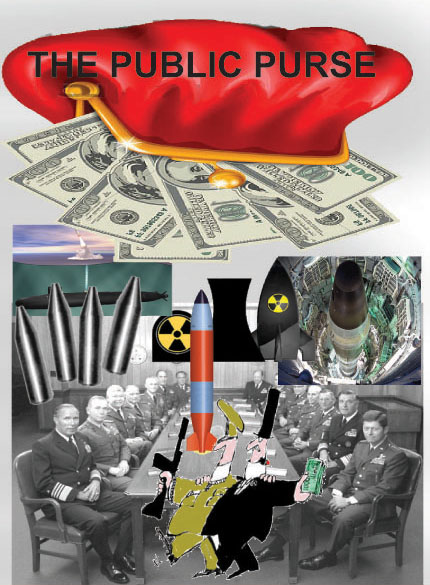
Sanders Unveils Bill to Force Pentagon to Pass Audit, Citing “Fraud” and “Waste” BY Sharon Zhang, Truthout 21 May 21,
Sen. Bernie Sanders (I-Vermont) has introduced a bipartisan bill that would require the Pentagon to pass audits beginning in fiscal year 2022 — or face fines. The Pentagon has never passed an audit.
The bill would impose a 1 percent fine on any military and Department of Defense agencies that fail to pass their audits. Sanders introduced the Audit the Pentagon Act of 2021 with Democratic Sen. Ron Wyden of Oregon and Republican Senators Chuck Grassley of Iowa and Mike Lee of Utah on Wednesday.
“The Pentagon and the military industrial complex have been plagued by a massive amount of waste, fraud, and financial mismanagement for decades. That is absolutely unacceptable,” Sanders said in a statement. The bill comes just after a Budget Committee hearing that Sanders held last week on the subject of the Pentagon’s budget “abuse.”
……… In 1990, Congress began requiring all government agencies to be audited by the Government Accountability Office. Since 2013, every other agency has been able to pass their audits — except, indeed, the Pentagon.
“The Defense Department remains the only federal agency in the United States that has been unable to pass an independent audit, despite the fact that the Pentagon consumes more than half of the nation’s discretionary budget and controls assets in excess of $3.1 trillion, or roughly 78 percent of the entire federal government,” reads the Sanders press release on the new bill.
The Defense Department was subject to its first ever agency-wide audit in 2018. It failed that audit, and the subsequent two audits it faced. Senator Grassley, at the time of the agency’s first audit, sharply criticized it for “26 years of hard-core foot-dragging [that] shows that internal resistance to auditing the books runs deep.”………….. https://truthout.org/articles/sanders-unveils-bill-to-force-pentagon-to-pass-audit-citing-fraud-and-waste/?eType=EmailBlastContent&eId=38e75c75-15fe-4ef5-9150-0ebccd5fbf3a
Poor outlook for the nuclear industry in Europe
Nuclear Power in the European Union, Heinrich Boll Stiftung, 26 April 2021 by Mycle Schneider Analysis
The issue of nuclear power has been with the European Union since the very beginning of the nuclear age. Where are operating nuclear power plants in the world? Who is building new reactors? What happened in the European region after Chernobyl and the Fall of the Berlin Wall?
26 April 2021 by Mycle SchneiderThis analysis is part of our dossier “Nuclear Power in Europe: 35 Years After the Chernobyl Disaster“.
The issue of nuclear power has been with the European Union since the very beginning of the nuclear age. French and British scientists were involved in the Manhattan Project, the development of the first nuclear weapons in the United States, and were able to share their new scientific knowledge with their colleagues at home after the Second World War. France and Britain rapidly developed their own nuclear weapons programs, and many European countries had their own military nuclear ambitions including—quite surprisingly—countries like Belgium, Germany, Italy, Sweden and Switzerland.
The Euratom Treaty, signed in 1957, established the European Atomic Energy Community with the purpose of “the speedy establishment and growth of nuclear industries”. It did not go as fast and as successfully as imagined. But in 1979, while the United Kingdom had 33 operating units, there were only a total of 58 reactors connected to the grid in what today are the EU27 Member States. By the end of the 1980s the fleet reached already its historic all-time high with 136 units in operation (see Figure 1). Only 106—30 less than in 1989—were left as of the end of 2020, about one quarter of the world total, with more than half (56) operated in just one country, France, while the remaining 50 units are located in 12 other Member States. The vast majority of the plants, 87 units or over 80 percent, are located in seven of the western countries, and only 19 are operating in the six newer Member States.
The region has not seen any significant nuclear
building-activity since the 1980s. While only 14 reactors were started up over the past 30 years, a total of 39 units ceased operation in the EU27, a net negative balance of 25 reactors. The decline of the industry has started decades ago.
Nuclear Construction – Little and Late
Since the Chernobyl disaster started unfolding 35 years ago, there have been only four construction starts in the western part of the EU27, two of which are still under construction, Olkiluoto-3 in Finland since 2005 and Flamanville-3 in France since 2007. Only two reactors were connected to the EU27-grid over the past 20 years, both in Eastern Europe with one unit each in the Czech Republic and Romania, none since Cernavoda-2 started up in 2007. Two reactors are still under construction in Slovakia (Mochovce-3 and -4), where construction started in… 1985. Maybe the first one will finally be connected to the grid in 2021.
The Finnish and French construction sites were meant to be the industrial demonstration of superior technology and engineering capacities leading to the first European Pressurized Water Reactors (EPR) ever built. Olkiluoto-3 (OL3) was meant to start generating power in 2009, followed by Flamanville-3 (FL3) in 2012. Instead, the projects turned into an industrial disaster and a financial fiasco – EPR seems to stand for European Problem Reactor. The projects have encountered numerous technical issues, from concreting to welding, with repeated quality-control problems. The EPR development was originally triggered by the Chernobyl accident, but 35 years later not a single EPR is operating in Europe (two have started up in China). The EPR case is also illustrating the very long lead times in the industry.
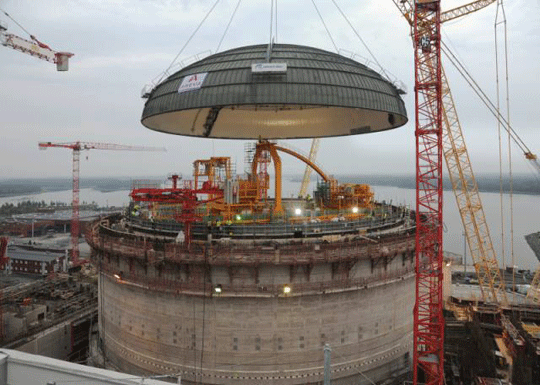
OL3 is currently scheduled to begin electricity generation by the end of 2021, with a 12-year delay, 16 years after construction start. The Finnish government had counted on OL3 as a low-carbon power source and had to substitute by other means of power generation, electricity imports, or the purchase of certificates to meet its climate obligations.
FL3 will be connected to the grid in 2023, at the earliest, if ever. The builders are still struggling with conceptual issues, non-conformities in the fabrication of parts, and inappropriate execution of specific tasks. The French Court of Accounts has estimated that total project costs would reach €19 billion. However, that estimate did not take into account the latest series of mishaps. When the decision was made to build the plant, almost 20 years ago, it was supposed to cost €2.5 billion………………………….
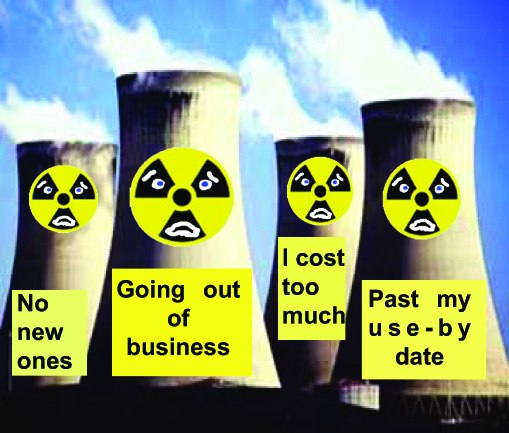
Old Machines – Expensive and Unreliable
As a consequence of the lack of construction, the average age of the EU’s nuclear fleet has been increasing constantly and stands now at over 35 years on average. The age distribution shows that the vast majority—89 of 106—of the EU’s nuclear reactors have been in operation for 31 years and beyond. The ageing atomic fission machines become increasingly unreliable. In Belgium, with seven units now the second largest fleet in the EU, the average real output in 2018 dropped to less than half of what would have been expected at nominal capacity. In fact, on an average 180 days the reactors did not generate power at all, not a single kilowatt-hour. The EU’s largest nuclear generator, France, has its own problems with maintenance outages that become impossible to forecast. In 2019, the country counted 5,580 reactor-days with zero production. That was 1,700 reactor-days with no output more than planned. In 2020, nuclear generation dropped by another 12 percent to a 27-year low. The world’s largest nuclear operator, the state-controlled Électricité de France (EDF), has lost control over outage durations.
In 2020, nuclear plants have generated just over 700 Terawatt-hours (billion kilowatt-hours or TWh) in the EU27, a spectacular drop of almost 80 TWh or 11 percent compared to the previous year, while all renewable energy technologies increased their output by a combined 80 TWh. At the same time, electricity consumption dropped by over 100 TWh, in particular due to the COVID-19 pandemic and fossil-fuel-based power plants reduced generation by over 110 TWh. As a consequence, for the first time the share of renewable power generation including hydro (39 percent) outperformed fossil fuels (36 percent) according to Eurostat estimates, which indicate that the carbon footprint of the power sector dropped by 14 percent. While the figures are not yet available, it is already certain that non-hydro renewables generated more power than nuclear plants in 2020. Less consumption, less fossil fuels, less nuclear, more renewables and lower emissions in the end. Remains to be seen whether proactive climate-protection policy will be able to make up for the effects of the global pandemic………….https://eu.boell.org/en/2021/04/26/nuclear-power-european-union?dimension1=lisa2021
1 This Month
Tell Congress: Prevent Nuclear Catastrophe in Iran

Tell Congress: Prevent Nuclear Catastrophe in Iran

Read the Public Inquiry Report, the Commissioners’ report, Surrendering Australia: The AUKUS Deception is available to download for free at aukuspublicinquiry.com. Or just watch the replay of the National Press Club Luncheon.


Shut down the radiation-damaged Heysham nuclear reactors now
To see nuclear-related stories in greater depth and intensity – go to https://nuclearinformation.wordpress.com

Say No to NASA’s Reckless Nuclear Reactor on the Moon
Say No to NASA’s Reckless Nuclear Reactor on the Moon
-
Archives
- November 2026 (246)
- October 2026 (302)
- September 2026 (339)
- August 2026 (330)
- July 2026 (355)
- June 2026 (287)
- May 2026 (306)
- April 2026 (356)
- March 2026 (251)
- February 2026 (267)
- January 2026 (308)
- December 2025 (358)
-
Categories
- 1
- 1 NUCLEAR ISSUES
- business and costs
- climate change
- culture and arts
- ENERGY
- environment
- health
- history
- indigenous issues
- Legal
- marketing of nuclear
- media
- opposition to nuclear
- PERSONAL STORIES
- politics
- politics international
- Religion and ethics
- safety
- secrets,lies and civil liberties
- spinbuster
- technology
- Uranium
- wastes
- weapons and war
- Women
- 2 WORLD
- ACTION
- AFRICA
- Atrocities
- AUSTRALIA
- Christina's notes
- Christina's themes
- culture and arts
- Events
- Fuk 2022
- Fuk 2023
- Fukushima 2017
- Fukushima 2018
- fukushima 2019
- Fukushima 2020
- Fukushima 2021
- general
- global warming
- Humour (God we need it)
- Nuclear
- RARE EARTHS
- Reference
- resources – print
- Resources -audiovicual
- Weekly Newsletter
- World
- World Nuclear
- YouTube
-
RSS
Entries RSS
Comments RSS

