The ”Think Tanks” that get funding from nuclear weapons makers

The countries, companies and think tanks that support the deadly nuclear arms trade, From ICAN 8 Aug 21, ”’……………Think tank reported income from nuclear weapon producers
Atlantic Council: $835,000 – $1,724,998
Brookings Institution: $275,000 – $549,998
Carnegie Endowment for International Peace: $50,000 – 199,998
Center for New American Security: $1,085,000 – $1,874,991
Center for Strategic and International Studies: $1,530,000 – $2,794,997
Fondation pour la recherche stratégique (FRS): amount not specified
French Institute of International Relations: amount not specified
Hudson Institute: $170,000 – $350,000
International Institute of Strategic Studies: $800,640 – $1,146,744
Observer Research Foundation: $71,539
Royal United Services Institute: $610,210 – $1,445,581
Stimson Center: $50,500
Total $5 – 10 million
Headline photo: “Nuclear Nightmare – Open Your Eyes And Awake !” by Daniel Arrhakis is licensed under CC BY-NC 2.0 https://wordpress.com/read/feeds/72759838/posts/3488978062
more https://wordpress.com/read/feeds/72759838/posts/3488978062
Stockton Professor: Nuclear Power is “Terrible Neighbor
Stockton Professor: Nuclear Power is “Terrible Neighbor” https://ocnjdaily.com/stockton-professor-nuclear-power-terrible-neighbor/ By MediaWize – August 8, 2021 By DR. JOHN AITKEN Ph.D., Adjunct Professor of Physics, Stockton University
Opponents of the Ocean Wind turbine project spoke in favor of using nuclear power as an alternative to the wind power at the July 27 Michael Shellenberger presentation sponsored by Save Our Shores in Ocean City.
The speaker stated that that while climate change is indeed real, the only solution to reducing carbon emissions is nuclear power, contrary to the position of many environmental organizations.
His proposals to pursue solely nuclear power did not mention its disadvantages and costs. Nuclear power operates carbon free as do solar and wind power, but unlike them, nuclear generates large quantities of dangerous waste that are difficult to dispose of and costly to manage.
Nuclear power can supply an unlimited amount of power but creates an unlimited amount of hazardous nuclear waste requiring storage for at least 300 years. Nuclear power may be a useful servant but it is a terrible neighbor.
Take the example of the Oyster Creek nuclear plant 35 miles north of Atlantic City. After approximately 50 years of service it is being decommissioned due to its inability to compete with cheaper natural gas.
In the 1960s, Lacey Township signed up to host the plant. What they did not realize at the time was that they had signed a deal with devil. The town had traded its own long-term safety for the benefits of good paying jobs and reduced property taxes.
Due to environmental and transportation concerns, nuclear waste storage sites in Nevada or Washington state promised by the federal government never materialized, leaving local plants on their own to store their nuclear waste on site for decades if not centuries.
The costs associated with decommissioning the nuclear site, estimated between $800 million and $1.4 billion, are another legacy left by the plant. The original owner/operator of the plant, Exelon, sold the plant to another company who will execute the decommissioning plan. For the rest of this article I will refer to this decommissioning company as DC.
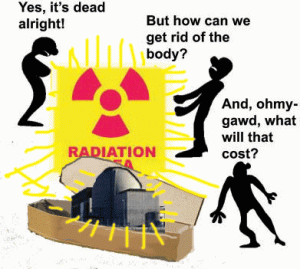
While the project is supported by a decommissioning fund, likely cost overruns will be paid by future generations through their utility bills. The costs cover the removal and deactivation of spent nuclear fuel, control rods, the reactor and associated buildings, which themselves have become radioactive from exposure to radiation.
But now, with decommissioning approaching, the township is paying the piper dearly for the good years. Oyster Creek Nuclear Plant has been shut down. The spent nuclear fuel and radioactive debris from the reactor and the associated buildings will be stored in 68 cylindrical casks, each 22 feet high and 11 feet in diameter, emitting low levels of radiation on the now-defunct site. The casks must remain intact for at least 300 years to allow the radioactivity of the waste inside to decay to handleable levels.
DC is now in charge of the decommissioning project. DC makes no commitment as to how long, decades or even centuries, these casks will have to remain on the Lacey Township site in close proximity to homes and schools.
Nor is there a guarantee that the casks, manufactured by DC, will remain intact during the 300-year storage period. Lacey Township at first sued DC to prevent the storage of these casks on the site. After a long legal battle, Lacey settled the lawsuit with them, acquiescing to the onsite storage on the condition that DC would build and assign another cask for emergency use by the township.
The Lacey Township decision shows it is a virtual prisoner of DC, which now owns the nuclear waste but is also the town’s only hope of restoring the site to radiation-free conditions.
Operating nuclear plants are also a continual hazard to the communities where they are sited. Nuclear plants do not pose a threat of nuclear explosion. Their Achilles heel is the plumbing, which brings water in and out of the reactor vessels.
The water pipes, degraded by the nuclear reactions, develop cracks and eventually leak water with radioactive contaminants. This water can leak into the local water supply and cause cancer or DNA damage to people who drink it.
As shown by the Oyster Creek experience, nuclear power is costly, dangerous and unmanageable. Those in favor of nuclear power should be ready to accept nuclear power stations in their own backyards and relive the Lacey Township experience. Nuclear power makes a terrible neighbor.
Bribing politicians pays off for weapons companies

The countries, companies and think tanks that support the deadly nuclear arms trade, From ICAN 8 Aug 21,
” ………….Company defence contract awards and defence lobby spending in 2020
Aerojet Rocketdyne: Awarded: $132 million Spent lobbying: $2.3 million
Airbus: Awarded: $170 million Spent lobbying: $6.1 million
BAE Systems: Awarded: $10.8 billion ($72.5 million for nuclear weapons) Spent lobbying: $5.6 million
Bechtel: Awarded: $2.9 billion Spent lobbying: $990,000
Boeing: Awarded: $50 billion ($105 million for nuclear weapons) Spent lobbying: $15.6 million
Constructions Industrielles de la Méditerranée (CNIM): Awarded: $39.1 million Spent lobbying: $17,226
Charles Stark Draper Laboratory: Awarded: $443.5 million ($342.3 million for nuclear weapons) Spent lobbying: $120,000
Fluor: Awarded: $3.9 billion Spent lobbying: $5.1 million
General Dynamics: Awarded: $39.4 billion ($10.8 billion for nuclear weapons) Spent lobbying: $13.9 million
Honeywell International: Awarded: $14 billion ($41.6 million for nuclear weapons) Spent lobbying: $7.4 million
Huntington Ingalls Industries: Awarded: $7.4 billion ($53 million for nuclear weapons); Spent lobbying: $5.2 million
Jacobs Engineering: Awarded: $2.6 billion Spent lobbying: $900,000
L3 Harris Technologies: Awarded: $5.6 billion ($60 million for nuclear weapons) Spent lobbying: $200,000
Leidos: Awarded: $10.8 billion Spent lobbying: $2.4 million
Leonardo: Awarded: $728.8 million Spent lobbying: $86,644
Lockheed Martin: Awarded: $124.5 billion ($2.1 billion for nuclear weapons) Spent lobbying: $15 million
Northrop Grumman: Awarded: 29.1 billion ($13.7 billion for nuclear weapons) Spent lobbying: $13.3 million
Raytheon Technologies Corporation: Awarded: $27.5 billion ($450 million for nuclear weapons) Spent lobbying: $15.2 million
Safran: Awarded: $12.3 million Spent lobbying: $382,211
Serco: Awarded: $896 million Spent lobbying: $420,000
Textron: Awarded: $1.8 billion ($3.2 million for nuclear weapons) Spent lobbying: $5.1 million
Total: Awarded: $332 billion ($27.7 billion for nuclear weapons) Spent lobbying: $117 million………
more https://wordpress.com/read/feeds/72759838/posts/3488978062
EU optimistic on nuclear deal despite Iran leadership change
EU optimistic on nuclear deal despite Iran leadership change
Agreement is “most likely scenario” says senior official Politico BY JACOPO BARIGAZZI, August 7, 2021 European Union negotiators are optimistic on the chances of reviving the nuclear deal with Iran, despite the election of hardliner Ebrahim Raisi as the country’s new president, a senior EU official said Saturday.
“We still think that the most likely scenario is an agreement. What I cannot tell you is when and [under] what conditions” said the senior official.
International negotiators have held six rounds of talks in Vienna to restore full compliance with the 2015 nuclear deal which has been on life support since the Trump administration’s decision to pull out in 2018. The deal curbed Tehran’s nuclear ambitions in exchange for sanctions relief.
Negotiations were paused following the election of Raisi in June. He was sworn in this week to replace the more moderate Hassan Rouhani.
Contacts this week with Iranian officials on the sidelines of Raisi’s inauguration have not clarified when talks on the nuclear deal will resume or who will be in Tehran’s negotiating team, said the EU official, who spoke on condition of anonymity due to the sensitivity of the talks……………….. https://www.politico.eu/article/eu-iran-nuclear-deal-leadership-vienna/
Towards a clean and sustainable energy system: 26 criteria nuclear power does not meet

Towards a clean and sustainable energy system: 26 criteria nuclear power does not meet https://eu.boell.org/en/2021/04/22/towards-clean-and-sustainable-energy-system-26-criteria-nuclear-power-does-not-meet
By Jan HaverkampRead our dossier “Nuclear Power in Europe: 35 Years After the Chernobyl Disaster“. Nuclear energy has been brought back into the European energy debate due to populist power. Currently, a complex debate is taking place within the EU about whether nuclear power should be part of the Taxonomy for Sustainable Activities. Nuclear energy does not meet a number of basic criteria that should be a requirement of technologies in a sustainable energy policy. It only became clear slowly after the introduction of the first nuclear power plants that nuclear energy does not meet these criteria. In the 1970s, however, this crystallised in a thorough nuclear energy critique on a technical, economic, social and political level. Over the last 50 years, the nuclear industry has not been able to overcome these problems. Certain ways of approaching them have changed, however: some risks have been counteracted by dint of expensive safety and security measures, so that the problem has shifted partly, but still not sufficiently, from risk to costs.
It is currently argued that we should keep existing nuclear power plants open longer to prevent a further exacerbation of the climate problem. It is also argued that we need to build new nuclear power plants to reduce greenhouse gas emissions. Work is currently underway on a few dozen new nuclear power plant designs that, according to protagonists of nuclear energy, should meet the criteria for a sustainable energy supply. However, these designs have not yet proven their worth in practice.
To determine whether nuclear energy can, or even should, play a role in future energy policy, it must fulfil basic criteria of sustainability.
Product detailsDate of Publication April 2021Publisher Heinrich-Böll-Stiftung European UnionNumber of Pages 34Licence CC-BY-NC-ND 4.0Language of publication EnglishTable of contents
Introduction
Sustainability criteria that nuclear energy does not meet
A. Technical criteria
B. Economic criteria
C. Social and political criteria
Delay in demolition of Three Mile Island Nuclear Station
Three Mile Island Nuclear Plant Demolition Delayed
WKOK Staff | August 8, 2021 MIDDLETOWN – Stateimpact Pennsylvania is reporting…The company responsible for decommissioning the Unit 2 reactor at the Three Mile Island nuclear plant is delaying demolition of the reactor’s two cooling towers, the project director said Wednesday. Frank Helin told the TMI-2 Community Advisory Panel that the towers will come down in 2022 instead of this fall.The decommissioner, TMI-2 Solutions, is a subsidiary of EnergySolutions, a Utah-based company that tries to turn a profit by dismantling inactive nuclear sites under budget. TMI-2 Solutions acquired the reactor’s license from FirstEnergy in December. The company plans to start removing what remains of TMI-2’s damaged core by mid-2022. It expects to complete the entire clean-up process by 2037. EnergySolutions spokesman Mark Walker said the delay in taking down the cooling towers does not affect the rest of the process…………
Eric Epstein, chair of the watchdog group Three Mile Island Alert, said that while he is not concerned about the cooling towers, he believes the reactor building may have more radioactive material than the company is prepared to deal with.
“Our concern is making sure that the plant is finally cleaned up 42 years later,” he said. “We don’t believe the company that owns TMI-2 has the technology, the expertise, or the resources to clean the plant up.” On its website, TMI-2 Solutions says it anticipates the project will cost $1.06 billion. It says the trust fund dedicated to the reactor’s decommissioning contains about $877 million, but that fund growth over time will provide enough money to cover the costs. https://www.wkok.com/three-mile-island-nuclear-plant-demolition-delayed/
Apocalyptic scenes hit Greece, as Athens besieged by fire
Little had prepared any of us on the Athens-bound flight for the sight of
the great fire-induced clouds that swept either side of the plane as it
made its descent on Friday. News of the extreme heat engulfing Greece had
spread beyond its borders all week, packaged in increasingly desperate
language.
Temperatures were breaking records few had ever imagined. If
Monday was bad, then Tuesday was worse. In some parts of the country, the
mercury had hit 47C (117F), with thermal cameras on drones recording the
ground temperature in downtown Athens at 55C.
By Wednesday, we were hearing
that entire tracts of suburban forest on the Greek capital’s northern
fringes had gone up in flames. Infernos seemingly redolent of Dante’s
hell had incinerated everything in their path; friends had lost homes;
thousands had been evacuated with residents and tourists fleeing blighted
zones by any means possible. Terraces, an Athenian’s respite against the
blazing heat, had been transformed into ash-laden no-go zones.
Guardian 7th Aug 2021
The world is getting “dangerously close” to running out of time to avert catastrophic climate change

The world is getting “dangerously close” to running out of time to avert catastrophic climate change, Cop26 President Alok Sharma has said. Mr Sharma – who is tasked with making a success of the upcoming climate talks in Glasgow – said failing to limit warming to 1.5C would be “catastrophic”.
In an interview with the Guardian, Mr Sharma said a report by the Intergovernmental Panel on Climate Change, due to be published on Monday, would be the “starkest warning yet” about what the future could hold. “You’re seeing on a daily basis what is happening across the world. Last year was the hottest on record, the last decade the hottest decade on record,” he said. He said Cop26 “has to be the moment we get this right”, adding: “We can’t afford to wait two years, five years, 10 years – this is the moment.”
Telegraph 8th Aug 2021
Global average temperature rise of 1.5c likely to be reached 10 years early

The planet is odds-on to hit 1.5C of global warming within 20 years, the world’s leading climate scientists will warn in a milestone report tomorrow. The paper, produced by the UN’s Intergovernmental Panel on Climate Change (IPCC), is the starkest warning yet about the speed and scale of warming. Experts said the report would paint a “devastating”
picture.
The document is predicted to trigger a “turning point” in the run-up to the Cop26 climate conference in Glasgow in November. Tomorrow’s report, produced by 200 scientists from 60 countries, is the first comprehensive assessment of the physical science of climate change since 2013. An interim report, published in 2018, said global warming was likely
to reach 1.5C between 2030 and 2052.
According to insiders who have seen the final document, the report brings this window forward by a decade to between 2021 and 2040. The report is expected to detail the risk of “tipping points”, in which climate change becomes hard to reverse. The melting of glaciers and ice sheets, for example, may create “feedback
loops” in which global warming spirals out of control. “That sensitivity means you can be too late,” Rivett-Carnac said.
“A lukewarm agreement [at Glasgow] that kicks the can down the road and solves some problems, has become, in a way, as much something to be avoided as not reaching the outcome you want.”
Times 8th Aug 2021
https://www.thetimes.co.uk/article/rise-of-1-5c-likely-to-be-reached-ten-years-early-l99rx5cmm
Whistleblower Exposes Sellafield Bullying – has Claim thrown out by Judge — RADIATION FREE LAKELAND

Many thanks to whistleblower Alison McDermott. Her brave actions in taking on Sellafield has exposed the decades long culture of bullying within the nuclear industry and within Sellafield.
Whistleblower Exposes Sellafield Bullying – has Claim thrown out by Judge — RADIATION FREE LAKELAND
August 8 Energy News — geoharvey

Opinion: ¶ “Five Key Things To Watch For In The UN Climate Report” • Filled with detail and tracing multiple future scenarios, the IPCC report is likely to run hundreds or even thousands of pages. New research, computer modeling, and data collection will make this report the most comprehensive yet. Here are five key things […]
August 8 Energy News — geoharvey
Human Life is Incompatible With Nuclear Weapons: Peace Wave in Ukraine — limitless life
From: Yurii Sheliazhenko Date: Sat, Aug 7, 2021 at 9:02 AM Subject: [no-to-nato] Human Life is Incompatible With Nuclear Weapons: Peace Wave in Ukraine To: No to NATO No to war Human Life is Incompatible With Nuclear Weapons: Peace Wave in Ukraine On August 6, 1945, an atomic bomb killed tens of thousands of people […]
Human Life is Incompatible With Nuclear Weapons: Peace Wave in Ukraine — limitless life
Accelerated radiocesium leaching from forest floor litter by heavy rainfall

Radioactive materials including 137Cs (cesium-137, half-life: 30.1 years) were released into the environment following the accident at Fukushima Daiichi Nuclear Power Plant. It has been about 10 years since the accident, but 137Cs remains in the environment, especially in forests. Many researchers have been studying the dynamics and transport processes of radioactive materials in the environment. It has been found that radioactive materials are carried along with the transfer of water and sediment. With the focus on the forested headwaters where radioactive materials remain in large quantities, it has been reported that the concentration of dissolved radiocesium in stream water increases during heavy rainfall.
Since rainwater does not contain radioactive cesium, the research group led by Assistant Professor Koichi Sakakibara of Shinshu University’s Faculty of Science was curious why the concentration of radioactive cesium in stream water increased during heavy rainfall without becoming diluted. The research team thought that radioactive cesium might have leached out from the forest litter and conducted leaching tests. They found that a large amount of radioactive cesium leached from such forest litter.
The next step was to ask the question, “Why does more radioactive cesium leach out of forest litter during heavy rainfall, when forest litter is still on the forest floor when it is not raining? (Background information: Most of the rainwater that falls on forests infiltrates into the subsurface area. The main reason for the increase in stream water volume during rainfall in forests is the discharge of groundwater. The groundwater contains almost no radioactive cesium.) So the research group set out to solve the mystery, “How is litter-derived radiocesium added to stream water during rainstorm?”
In contrast to the rainfall-runoff process, which is often focused only on rainfall and runoff, this study focused on the conversion process from rainfall to runoff, such as the variation of groundwater table level, the generation of saturated surface area at the bottom of the valley, and the variation of water quality and water age during rainfall. As a result, the answer to the problem to be solved in this study is that the main factor is the expansion of the contact area between water and litter due to the expansion of the saturated surface area caused by the rise of the groundwater table level in the forested headwater. Although previous research tended to focus only on the cause (rainfall) and the effect (runoff), Assistant Professor Sakakibara states, “we showed that the breakthrough to solve the unexplained reason lies in why the cause (rainfall) is converted into the effect (runoff).”
Uncertainty of results is inevitable when researching in the natural environment. How do results differ when the study is conducted at different times and places? How much error is there in the results due to the heterogeneity of the acquired samples from the environment? These are some of the questions that need to be answered. In the present study, the following questions were asked in-depth: 1) whether the same conclusions can be drawn for forests other than the target forest, 2) whether the samples collected for the study are representative of the Fukushima region, and 3) whether the results are affected by differences in the timing of litter falling from the trees and the degree of decomposition. Sakakibara says, “the most difficult part was to come up with a clear answer or idea to these uncertainties.”
Assistant Professor Sakakibara says, “the state and transport of radioactive materials in the environment are complex and need to be studied long-term. The half-life of 137Cs is 30 years. The results of this study only partly clarified this issue. Rivers that discharge from the forest area flow downstream to the ocean. We would like to clarify the whole picture of the pathway and process of radioactive materials originating from forests in the hydrological process from the headwater to the ocean. We believe that these findings are essential for creating a safe and secure environment and sustainable future and livelihood.”
The research was published in Science of The Total Environment.
Explore further
Dynamics of radiocesium in forests after the Fukushima disaster: Concerns and some hope
https://phys.org/news/2021-02-dynamics-radiocesium-forests-fukushima-disaster.html
More information: Koichi Sakakibara et al, Radiocesium leaching from litter during rainstorms in the Fukushima broadleaf forest, Science of The Total Environment (2021). DOI: 10.1016/j.scitotenv.2021.148929
https://phys.org/news/2021-08-radiocesium-leaching-forest-floor-litter.html
Hiroshima City remembers the sudden cruelty of the atomic bombing

— On this day 76 years ago, a single atomic bomb instantly reduced our hometown to a scorched plain. That bombing brought cruel death to countless innocent victims and left those who managed to survive with profound, lifelong physical and emotional injuries due to radiation, fear of aftereffects, and economic hardship.
One survivor who gave birth to a girl soon after the bombing says, “As more horrors of the bomb came to light,
and I became more concerned about their effects, I worried less about myself and more about my child. Imagining the future awaiting my daughter, my suffering grew, night after sleepless night.”
City of Hiroshima 6th Aug 2021
1 This Month
Tell Congress: Prevent Nuclear Catastrophe in Iran

Tell Congress: Prevent Nuclear Catastrophe in Iran

Read the Public Inquiry Report, the Commissioners’ report, Surrendering Australia: The AUKUS Deception is available to download for free at aukuspublicinquiry.com. Or just watch the replay of the National Press Club Luncheon.


Shut down the radiation-damaged Heysham nuclear reactors now
To see nuclear-related stories in greater depth and intensity – go to https://nuclearinformation.wordpress.com

Say No to NASA’s Reckless Nuclear Reactor on the Moon
Say No to NASA’s Reckless Nuclear Reactor on the Moon
-
Archives
- November 2026 (246)
- October 2026 (302)
- September 2026 (339)
- August 2026 (330)
- July 2026 (355)
- June 2026 (287)
- May 2026 (306)
- April 2026 (356)
- March 2026 (251)
- February 2026 (267)
- January 2026 (308)
- December 2025 (358)
-
Categories
- 1
- 1 NUCLEAR ISSUES
- business and costs
- climate change
- culture and arts
- ENERGY
- environment
- health
- history
- indigenous issues
- Legal
- marketing of nuclear
- media
- opposition to nuclear
- PERSONAL STORIES
- politics
- politics international
- Religion and ethics
- safety
- secrets,lies and civil liberties
- spinbuster
- technology
- Uranium
- wastes
- weapons and war
- Women
- 2 WORLD
- ACTION
- AFRICA
- Atrocities
- AUSTRALIA
- Christina's notes
- Christina's themes
- culture and arts
- Events
- Fuk 2022
- Fuk 2023
- Fukushima 2017
- Fukushima 2018
- fukushima 2019
- Fukushima 2020
- Fukushima 2021
- general
- global warming
- Humour (God we need it)
- Nuclear
- RARE EARTHS
- Reference
- resources – print
- Resources -audiovicual
- Weekly Newsletter
- World
- World Nuclear
- YouTube
-
RSS
Entries RSS
Comments RSS

