Uranium prices and the true financial and climate costs of the Megatons to megawatts program
the Russian price the Americans paid for fuel from bombs bears no relationship to the actual costs of producing it, not only in money, but in greenhouse CO2 pumped into the atmosphere.
Megatons to Megawatts’: Prices and true costs of nuclear energy, SEP 1, 2021 KELVIN S. RODOLFO, Rappler.com
Clearly, the uranium market is not a free one in any sense of the word, and never will be’The following is the 13th in a series of excerpts from Kelvin Rodolfo’s ongoing book project “Tilting at the Monster of Morong: Forays Against the Bataan Nuclear Power Plant and Global Nuclear Energy.”
Promoters of nuclear power say it’s “cheap.” If you want to invest in it, however, look at how fickle uranium prices have been. Over time, they have varied by more than eight times!
Besides satisfying Russia’s urgent needed for cash, selling this cheap Megatons to Megawatts fuel was a means to two ends. The first is much-extolled: to shrink the huge global stockpiles of nuclear weaponry. But has the project really made us safer?
All the world’s nuclear weapons have declined from as many as 70,300 in 1986 to about 13,890 in early-2019. The reduction happened mostly during the 1990s. But today’s weapons are much more lethal; the nuclear countries, instead of planning to disarm, are retaining large arsenals, making new weapons, and increasing their use in geopolitics.
The second, central role of Megatons to Megawatts was to keep nuclear power financially affordable, so the power industry would continue to use it. Now that the Russian leadership is better-off financially, it is less eager to trade bombs for electricity, and the jittery global realpolitik may well also direct more uranium away from fuel and back to weapons once again.
Finally, and most importantly: what did the reactor uranium made from old Soviet warheads really cost in treasure, and in greenhouse CO2? We know the market price of this new fuel, but what were the true costs of its manufacture, from its mining, milling, enrichment to weapons grade, then its dilution back down into reactor fuel?
During the mad rush to gain nuclear equality with the US, the Russians spared no expense. Their oldest weapons contained uranium that had been enriched with technologies that used about 40 to 60 times more electricity for every kilo of highly-enriched uranium than modern centrifuges do. And more energy, money, and CO2 emissions were used to dilute that warhead uranium back.
Finally, and most importantly: what did the reactor uranium made from old Soviet warheads really cost in treasure, and in greenhouse CO2? We know the market price of this new fuel, but what were the true costs of its manufacture, from its mining, milling, enrichment to weapons grade, then its dilution back down into reactor fuel?
During the mad rush to gain nuclear equality with the US, the Russians spared no expense. Their oldest weapons contained uranium that had been enriched with technologies that used about 40 to 60 times more electricity for every kilo of highly-enriched uranium than modern centrifuges do. And more energy, money, and CO2 emissions were used to dilute that warhead uranium back down to reactor grade, for which work the Russians eventually received $8 billion.In short, the Russian price the Americans paid for fuel from bombs bears no relationship to the actual costs of producing it, not only in money, but in greenhouse CO2 pumped into the atmosphere. A later Foray will evaluate the true costs in greenhouse CO2 for making nuclear fuel. On top of whatever values we arrive at, we must recognize that significant but forever unknowable amounts were generated by Megatons to Megawatts.
Our next Foray is about the intricate entanglement between nuclear weapons and nuclear power. – Rappler.com https://www.rappler.com/voices/thought-leaders/opinion-megatons-megawatts-prices-true-costs-nuclear-energy
Illinois very soon to vote on a Bill for the state to prop up the nuclear industry
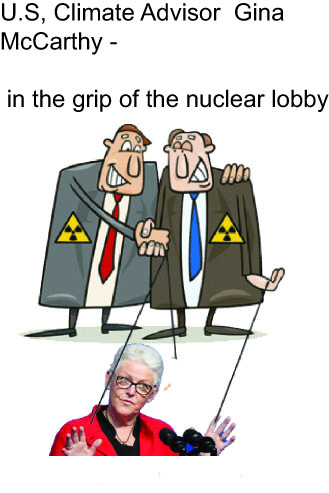
Gina McCarthy, President Joe Biden’s climate adviser, has said existing nuclear plants are “absolutely essential” to hit U.S. goals to decarbonize the electric grid by 2035 and the administration has supported federal incentives for the nuclear in
Illinois could vote Tuesday on bill that aims to save nuclear plants, By Timothy Gardner, Aug 31 (Reuters) – The Illinois legislature is edging closer to a vote as soon as Tuesday on a bill that aims to prevent two nuclear power plants from shutting, as the owner moves to close the first plant next month unless the state acts.
The legislature could vote in a special session on a compromise of a wide-ranging energy bill, introduced Monday, or a narrow version of it that would allow nuclear plants to earn carbon mitigation credits for generating virtually emissions-free power [not really emissions-free, considering the whole nuclear fuel chain]. Tuesday’s session is on legislative mapping, but could include the energy bill vote………..
Lawmakers were set to meet on Tuesday to consider a measure on the bill.
Exelon Corp (EXC.O) has said it will close the Byron nuclear plant in mid September and the Dresden plant in November if a state or federal program does not come to the rescue.
Gina McCarthy, President Joe Biden’s climate adviser, has said existing nuclear plants are “absolutely essential” to hit U.S. goals to decarbonize the electric grid by 2035 and the administration has supported federal incentives for the nuclear industry.
Not Seeing the Contaminated Forest for the Decontaminated Trees in Fukushima
Abstract: This article explores how the models of medical risk from radiation established in the aftermath of the nuclear attacks on Hiroshima and Nagasaki are insufficient for understanding the risks faced by people in contaminated environments like Fukushima. These models focus exclusively on levels of external radiation, while the risk faced by people in areas affected by radioactive fallout comes from internalizing fallout particles. These models have helped to obscure the health impacts over the last 76 years of those exposed to fallout, from the people who experienced the Black Rain in Hiroshima, to the global hibakusha exposed through nuclear testing, production and accidents, and now to those living where the plumes deposited radiation in Fukushima.
When nuclear disasters happen, we look to past incidents to help us predict what human health impacts may follow, but not all radiological disasters are alike. The Three Mile Island, Chernobyl and Fukushima nuclear accidents were highly publicized and loom large in the public imagination, but these disasters are mere data points on a graph of nuclear incidents that have exposed the public to radiological harm. The “global hibakusha,” human beings that have been exposed to ionizing radiation, have suffered those exposures in multiple ways. The people of Hiroshima and Nagasaki are the only people to have been directly attacked by nuclear weapons. However, since then there have been more than 2,000 nuclear weapons detonated in tests. The communities downwind from those test sites did not suffer direct attack, but rather, were exposed to radioactive fallout from the mushroom clouds as they drifted. Besides the above listed nuclear meltdowns, multiple accidents have befallen nuclear reactors. Additionally, many people have been exposed to radiation through nuclear production at uranium mines, or plutonium production sites like Hanford. The disease toll from radiological exposure depends on the type of exposure. The most important distinction is between being exposed to radioactive waves that pass through your whole body, and radioactive particles that get inside your body and remain there. The biological routes are different and so the health outcomes also differ.
For the last 12 years I have been working on the Global Hibakusha Project, conducting field work in radiologically contaminated communities and populations all around the world (Broderick and Jacobs, 2018).1 As a historian, it is natural for me to think that looking to the past can help us imagine and anticipate the future. In April of 2015, four years after the Fukushima disaster, I gave a talk as part of the “4.11 International Symposium: From Hiroshima and Bikini to Fukushima and the World,” in Fukushima City. My lecture was titled, “Pretending Fukushima is New: How Studying Sites of Radiological Contamination Around the World Can Help Us to Understand the Present and Future in Fukushima.” The primary health risk that people in Fukushima face is from internalizing alpha-emitting or beta particles through inhalation, swallowing or abrasions. Yet predictions of their risks are almost entirely modeled on data from Hiroshima and Nagasaki where the exposures were predominantly from external gamma waves. This disconnect is visibly reflected to us in the maps of danger that always accompany discussions of the radiological legacy of Fukushima, maps like the one below. This application of data about external exposures to dismiss the health concerns of people immersed in a landscape dense with long-lived radioactive particles is not unique to Fukushima, it is elemental to how the majority of the millions of global hibakusha have remained invisible—have been rendered invisible.

radiating out from the site of the Fukushima Dai’ichi Nuclear Power Plants (Kyodo)
My chapter in Legacies of Fukushima: 3.11 in Context, “Fukushima Radiation Inside/Out,” argues that the maps of contamination we use to understand the risks downwind from the Fukushima Daiichi plant are flawed. They model a pattern of danger and safety that works as hard to obscure certain dynamics as it does to delineate others. These broken maps reflect health models about harm from radiation that are limited yet invariably presented as inclusive and comprehensive.
As mentioned above, we biologically encounter radiation in two distinctly different manners. Our whole bodies are exposed to radioactive rays when we are immersed in high levels of radiation that are external to our bodies, as happened in Hiroshima and Nagasaki. The detonations of those weapons released high-energy gamma and neutron waves that were similar to a single giant x-ray that penetrated entire bodies and extended out several kilometers from the hypocenter. Separately from this form of exposure is when we encounter radionuclides, individual radioactive particles that remain after nuclear detonations, either as beta particles or alpha-emitting particles. We often refer to radiation in this form as “radioactive fallout” since it usually deposits into our ecosystems by “falling out” of clouds drifting from radiological explosions or fires. Once the particles have dispersed into the ecosystem, they are harder to locate. These are primarily dangerous to us if we internalize them inside of our bodies. If they remain inside of our bodies, they emit their very small amounts of radiation to nearby cells 24 hours a day for however long the specific particle remains radioactive. For some particles that is days, for many it’s centuries or longer. Cesium-137, a particle that spread in large amounts after both Chernobyl and Fukushima, remains dangerous to living creatures for 300 years. These two forms of exposure (external whole body vs. internalized in a specific bodily organ) present distinctly different risks to human health (for a primer on these forms of radiation see here).
The risks that people downwind from the Fukushima plants face is primarily from fallout. Large amounts of fallout can also present danger from their collective external radiation when they first deposit, however, now, 10 years later, those particles have distributed into the ecosystem. Settling into soil, moving with rainwater and groundwater, being taken up by plants and animals: they are embedding and migrating. As they spread out, our ability to detect them degrades. Since Geiger Counters measure the external energy that the particles radiate, we usually find them when they are present in large amounts. Now that they are widely dispersed, many have migrated far from the color-coded maps of risk we see of Fukushima. Those maps are snapshots of external readings at a specific moment that has passed.
In Fukushima, relatively few people are being exposed to high levels of external radiation except for the cohorts of onsite workers at the nuclear plant site, those involved in decontamination efforts, and those who lived where the fallout deposited in large amounts. People living in most (but not all) of the areas where heavy fallout deposited were evacuated fairly quickly. For those who continue to live in, or are being returned to areas of lower contamination, we still measure the external levels of gamma radiation to predict the risks they face. However, just as with the Marshallese after US thermonuclear testing, just as the Kazakhs after Soviet testing, and just as with those living in contaminated areas downwind from the Chernobyl plant in Ukraine and Belarus, the primary risk to the public health is not the external radiation, the primary risk is that one may internalize radioactive particles and retain them inside the body. Telling someone that the external levels of radiation are not high is not actually saying that they are not at risk, it is just a way of saying that we only have models that delineate risks from the external levels. And if those are low, we declare, health agencies declare, UN public health bodies declare: there is no significant risk. Yet there is. Those living in contaminated regions of Fukushima join a long list of people whose homes and communities have received significant deposits of radionuclides through fallout. All have invariably had their levels of risk minimalized. Many have had their anxieties cited as irrational and pathologized as “radiophobia.”2 Almost none have received any compensation for their health problems and the loss of value of their lands and businesses.3
In Fukushima, as downwind from nuclear test sites, communities experienced large deposits of radioactive fallout, yet the model that has always been used to predict health outcomes is based on studies of Hiroshima and Nagasaki: this is the wrong model for these disasters. In Hiroshima and Nagasaki there was a massive burst of external radioactive gamma and neutron waves at the moment the nuclear weapons detonated, lasting less than a minute. This was followed by radioactive fallout as the mushroom clouds deposited radioactive particles (beta and alpha-emitters) and drifted.4 The health models built out of Hiroshima and Nagasaki only assessed the harm from the external exposures. These models emerged from studies done at the Atomic Bomb Casualty Commission in Hiroshima and Nagasaki since 1946 (reformed in 1975 as the Radiation Effects Research Foundation), especially the Life Span Study (LSS) which began in 1950. This study establishes a large database, corelating radiation exposures to subsequent health outcomes and early mortality. The study is rigorous, yet its use in the years since Hiroshima and Nagasaki has frequently been careless. The LSS assesses only external radiation exposures, it explicitly excludes consideration of the health effects of internal radiation exposures from living with fallout. There is nothing wrong with this methodological choice. Hiroshima and Nagasaki were events in which a large cohort of people were exposed to a single large dose of external gamma radiation. It would have been very difficult at the time to determine who had internalized a radionuclide and who hadn’t. In the early years of the Cold War, it was assumed that future wars would involve the use of nuclear weaponry and the exposure of many people to large bursts of gamma rays as were the people near the hypocenter of Hiroshima and Nagasaki. But that was not what happened; instead, over 2,000 nuclear weapons were tested, and millions of people were exposed to radioactive fallout. We did not have a robust database on the health consequences that might result from these exposures—so we used the tool we did have, the LSS. The LSS tells us little about the risks faced by people living with large depositions of fallout.
The Cold War period, and beyond, are periods in which the invisibility of the health consequences of exposures of internalized radiation was made invisible, and the misapplication of the LSS was elemental to this cloaking. A key reason that the LSS has been weaponized to obscure the health effects of internalized radiation exposures is that since the exposures did not happen as acts of war, but rather as weapon development, those exposed should be entitled to compensation for their health problems, and the loss of value to contaminated land. This would likely have restricted nuclear weapon testing. These dynamics have been extended to obscure and shield compensation obligations in other historical instances of large-scale radiological contaminations such as waste dumping and nuclear accidents.
All of us have been dealing with the horrors and the terrors of the COVID-19 pandemic since early 2020. Viscerally, we feel the anxieties and fears that accompany uncertainty about dire risks to our lives and loved ones. Being cautious about our public activities in the age of COVID makes intuitive sense. We navigate our potential exposures, work to mitigate our potential contaminations, and worry endlessly about loved ones with health concerns. Each small, unrelated medical symptom a family member exhibits is met with anxiety. This is a reality for people worldwide. Those who live in areas dense with radionuclides face similar anxieties: the locations of the risk are indeterminable; who is being exposed and who is safe is unclear, even while the damage is inflicted; daily life is rife with anxiety. But in radiologically contaminated communities it is not conspiracy theorists on social media dismissing them as irrational, it is state health officials. They draw maps, based entirely on externally measured levels of radiation, and use those maps to tell people to move back to villages where the levels of contamination are “acceptable,” to send their children to schools and move back to towns where the presence of radioactive particles is not dense enough to register on Geiger counters placed high above the ground.

Imagine a map of COVID cases that shows high levels in one city and low levels in the adjoining city, and being told that therefore there is no risk at all once you enter the city with lower levels. We would all continue to be cautious. That is common sense, not (radiophobic) irrationality. If a group of 10 people were to stand downwind from someone coughing out COVID microbes, some may get sick and some may not. Who has inhaled a microbe and who hasn’t will not be visible until the disease presents. This is what it is like to live in an ecosystem with migrating radionuclides. Even if their presence is not significant enough to make a Geiger counter ping, caution is rational. However, the history of fallout contamination is a history of dismissing the health concerns and worries of the populations living in the areas where fallout came down.
A clear way to visualize how the reliance on external measurements to determine risk is problematic is to examine the scientific literature on Fukushima. Biologist Timothy Mousseau, with colleague Anders Møller, has conducted field work in the Zone of Exclusion in Chernobyl for decades (primarily on birds and small insects for whom multiple generations of inheritance have passed), and have sought to conduct corollary field studies in the evacuation zones of Fukushima. Speaking to an IPPNW symposium on the 10th anniversary of Fukushima, Mousseau examined the top 500 articles in the Web of Science database. He found that only 10 out of the top 500 papers (2%) were based on actual biological fieldwork assessing the impacts of radiation on living organisms. Almost all of the other 98% were studies of “calculated doses and the possible link to health impairments rather than any sort of directly measured biological consequences” (Mousseau, 2021).5 Most of the scientific literature around Fukushima, and Chernobyl, are based on estimates of health impacts utilizing externally measured radiation and applying statistical models such as the Life Span Study. These estimates are not observed findings, but predictions of the numbers of cancers and early mortality that may be expected in the future among the exposed population.
This model of utilizing measurements of external radiation and statistical databases of disease probabilities has been a critical component of how the global hibakusha have been ignored since the advent of nuclear weaponry. As radioactive fallout blanketed communities downwind from the Nevada Test Site, and other nuclear test sites around the world, such assessments were routinely used to dismiss the health concerns of downwinders. Now, many of those same individuals (in America) whose health concerns were dismissed are recipients of Radiation Exposure Compensation Act funds from the US government. Ignored and dismissed for decades because of the use of external modeling and statistical correlation of that modeling to the LSS, select members of these communities were only able to obtain recognition and some small compensation late in their lives because they were full citizens with access to legal remedies in a wealthy nation.
As I detail in my forthcoming book Nuclear Bodies, nuclear test sites are not chosen because of their scientific properties, rather, communities are selected to be irradiated because of their political inability to resist such treatment. Nuclear test sites are built upwind of these communities. Hence, most of the exposures of global hibakusha were in colonial or postcolonial spaces, or were citizens of poor or developing nations and have not been recognized or awarded compensation for their suffering.6 Their subaltern political status was fundamental to their communities being chosen as radiologically disposable. For example, the British and French never tested nuclear weapons within their own national borders. Along with the United States, the British and French tested all of their thermonuclear weapons (hydrogen bombs that yield vastly larger fallout clouds) in Pacific nations either directly under their control, or of actual colonial status (specifically, the Marshall Islands, Kiribati and French Polynesia). Keeping these big fallout clouds outside of their own borders was national policy to protect their own populations, and conversely, put them inside the borders of other nations and subjected their populations to risk. This has never been accidental. Nuclear power plants are not sited inside of the urban areas where their electricity is consumed, but in the rural areas at a distance so that if there is a radiological release it exposes less people, but also less politically powerful people. Kate Brown has cited how the Soviet government purposefully seeded clouds from Chernobyl to rainout their particles in Belarus rather than over the large Russian cities they were drifting towards.7
Relying exclusively on maps of externally measurable radiation and medical models based solely on the harm caused by external exposures extends this invisibility for further generations and will continue to legitimize dismissing and ignoring both the health and emotional impacts of radiation exposures into the future. Fukushima is part of a continuum of the dismissal of the harm endured by those who suffer from internal exposures to radioactive particles from nuclear tests, nuclear accidents and nuclear production worldwide. Looking at the broken maps works to obscure the real risks in Fukushima.
Many of the particles embedded in the ecosystem of Fukushima will remain dangerous to living creatures for hundreds, or even thousands of years. During this period, they will not stay put. As I point out in my chapter in Legacies of Fukushima: 3.11 in Context, this reveals the decontamination theater of soil removal in Fukushima. The years since 3.11 have seen a continual media presentation of crews removing radioactive topsoil from towns, schoolyards and homes in Fukushima.

Almost certainly the particles in the forest canopy and on the trees will re-contaminate this roadside within a year.
The reduction in radiation levels is the predicate for declaring towns safe for return. The particles themselves remain radioactive; the fields filled with plastic bags of particles stacked around the region are now nuclear waste sites that must be managed for generations. The theatrical aspect is in pretending that by removing the radioactive particles from the towns they are now “clean.” Since the towns are themselves situated in larger ecosystems full of radionuclides, this “decontamination” cannot last: wind, rain, typhoons will all strip particles down from the forests and mountains surrounding the towns and re-contaminate them. Similar to how the Tokyo 2020 Olympics were meant to produce the impression that Fukushima has recovered, all theater requires the willing suspension of disbelief. When we placed a containment dome over the melted core of Chernobyl reactor unit #4 people assumed that the Chernobyl disaster was clearly over, only to be surprised to read in the papers about ongoing criticalities in the subterranean core that threatened ongoing releases. Long-lived particles create ongoing and fluctuating realities. Fukushima is not simply something that happened, it is something that is still happening.
References
Broderick, M. and Robert J. (2018) ‘The Global Hibakusha Project: Nuclear post-Colonialism and Its Intergenerational Legacy’, Unlikely: Journal for the Creative Arts, 5 [online]. (Accessed: June 5, 2021).
Brown, K. (2019) Manual for Survival: A Chernobyl Guide to the Future. London: Allen Lane.
Jacobs, R. (2013) ‘Nuclear Conquistadors: Military Colonialism in Nuclear Test Site Selection During the Cold War’, Asian Journal of Peacebuilding, 1(2), pp. 157-177.
Mousseau, T. 2021. “Ecology in Fukushima: What Does a Decade Tell Us?” [Online video]. (Accessed June 5, 2021).
Petryna, A. (2013) Life Exposed: Biological Citizenship after Chernobyl. Princeton: Princeton University Press.
Stawkowski, M. (2017) ‘Radiophobia Had to be Reinvented’, Culture, Theory and Critique, 58(4), pp. 357-374.
Notes
The outcomes of this research will be published next year in, Robert Jacobs, Nuclear Bodies: The Global Hibakusha (New Haven: Yale University Press, 2022), forthcoming. Also, see my blog Global Hibakusha.2
Stawkowski, 2017.3
Petryna, 2013.4
The areas where fallout came down most heavily downwind of Hiroshima is referred to as being affected by “black rain,” this is because rain strips fallout particles from the air and brings them down in large quantities, and the black soot from the fires in Hiroshima made the rain black and sticky. The rights of those who suffered illness from exposure to black rain, and also from exposures resulting from entering the city in the weeks after the nuclear attack, are still being litigated and contested in Japanese courts today.5
Mousseau, 2021.6
Jacobs, 2013.7
Brown, 2019, p. 42.
Illinois Senate passes bill to save nuclear plants
Illinois Senate passes bill to save nuclear plants, sends to House, By Timothy Gardner Sept 1 (Reuters) – The Illinois Senate passed a bill early on Wednesday that aims to prevent two nuclear power plants from shutting this autumn, sending the legislation to the House where it was uncertain if the chamber would bring the legislation to a vote.
The Senate voted 39-16 to pass a wide-ranging energy bill, with two senators voting “present.” The bill contains more than $600 million in carbon mitigation credits for nuclear plants which generate virtually emissions-free electricity. [that’s as long as you ignore the full nuclear fuel chain]
U.S. nuclear plants have been struggling to compete with wind and solar farms and plants that burn low-cost natural gas. Exelon Corp has said it will close its Byron nuclear plant in mid-September and its Dresden plant in November if a state or federal program does not come to the rescue.
It was uncertain whether the House would move fast enough to pass the legislation to prevent the shutting of the first plant, located in Byron, Illinois…….. https://www.reuters.com/article/usa-nuclearpower-illinois-idUSL1N2Q31QZ—
Iran’s new foreign minister Warns Tehran May Not Return to Nuclear Talks Until November
New Iranian FM Warns Tehran May Not Return to Nuclear Talks Until November . by Sharon Wrobel, 1 Sept 21,
Iran’s new foreign minister hinted that a resumption of talks on the revival of the 2015 Joint Comprehensive Plan of Action (JCPOA) deal could take up to two to three months.
“The other side understands that it will take two or three months for the new government to be established in Iran and plan for any sort of decision on this topic,” Foreign Minister Hossein Amir-Abdollahian told state TV in an interview on Monday night.
Last week, Iran’s parliament approved most of the hardline nominees put forward by newly elected President Ebrahim Raisi………… https://www.algemeiner.com/2021/08/31/new-iranian-fm-warns-tehran-may-not-return-to-nuclear-talks-until-november/
China’s nuclear missile silo expansion: From minimum deterrence to medium deterrence
China’s nuclear missile silo expansion: From minimum deterrence to medium deterrence, Bulletin of the Atomic Scientists , By Hans M. Kristensen, Matt Korda | September 1, 2021 US defense officials have claimed for several years that China is planning to at least double its nuclear warhead stockpile over the next decade, but without providing the public any details to back up their claim. That changed this summer, when two nongovernmental organizations—our own included—disclosed construction of what appears to be hundreds of new missile silos in central China.
Not surprisingly, reactions from defense hawks and arms controllers to this development span a wide range. Some claim that China is becoming an even greater nuclear threat that requires the United States and its allies to beef up their militaries even more. Others claim that China is responding to US provocations, and that arms control is the only way forward.
Most will probably use the disclosure to reaffirm existing beliefs. But that would be a mistake. The development requires all sides to think hard about what it means for Chinese nuclear policy, how it plans to operate its nuclear forces, how other nuclear-armed states will or should respond, and what the international nuclear nonproliferation and arms control community can and should do to reduce nuclear risks.
How many silos are under construction? The Chinese government has made no official public announcement about what it is building, and the nature, scale, and role of the suspected missile silos remains uncertain. (Some have even suggested they are not silos, but windmills.) But the satellite imagery that we have analyzed, combined with US government officials issuing apparent confirmations (here, here, and here), indicate that the construction involves hundreds of missile silos.
The first missile silo field near Yumen was disclosed by the Middlebury Institute in late-June. The second field near Hami was disclosed by the Federation of American Scientists in late-July. The third field near Ordos (Hanggin Banner) was disclosed by a military research unit at Air University in mid-August.
The three sites are in different stages of construction. The Yumen field began construction in March 2020 and appears to include 120 silos. Construction of the Hami field began in February 2021 and might eventually include 110 silos. The Ordos field, which began construction in April or May 2021, has a different layout and so far only appears to include about 40 silos (it could potentially grow later). Each missile silo field appears to include a number of other facilities that might be launch-control centers, bases, and support facilities.
Construction of the Yumen, Hami, and Ordos missile silo fields follow shortly after construction began of half a dozen silos that we discovered at the PLARF training site near Jilantai in Inner Mongolia, initially described in September 2019 and reported expanding further in February 2021.
In addition to these four projects, open-source researchers noted in 2020 that China might also be building a small number of silos near its traditional missile silo area near Checunzhen (Sundian) in the Henan Province.
All told, these discoveries indicate that China might be constructing nearly 300 new missile silos.
Why is China building so many silos? Missile silos are nothing new for China, which has deployed intercontinental ballistic missiles (ICBMs) in silos since the early 1980s. It is estimated that China currently has about 20 silos for the old (but modified) liquid-fuel DF-5 ICBM. However, building nearly 300 silos is certainly new. The decision to do so has probably not been caused by a single issue but by a combination of factors. In all these cases, it is important to remember that Chinese planning is not solely occupied with the United States, but also what Russia and increasingly India are doing:
Reducing the vulnerability of China’s ICBMs to a first strike: China is concerned that its nuclear deterrent is too vulnerable to a US (or Russian) surprise attack. The previous small number of fixed silos have long been seen as particularly vulnerable. According to the US Central Intelligence Agency, China’s decision to develop the modern road-mobile ICBMs we see today was a reaction to the US Navy’s deployment of Ohio-class Trident ballistic missile submarines in the Pacific. Road-mobile launchers are less vulnerable, but they’re not invulnerable. By increasing the number of silos, more ICBMs could potentially survive a surprise attack and be able to launch their missiles in retaliation. This action-reaction dynamic is most likely a factor in China’s current modernization.
Overcoming potential effects of missile defenses: Chinese planners are likely concerned that increasingly capable missile defenses could undermine China’s retaliatory capability. The US Sentinel (and particularly the Safeguard) missile defense systems in the 1960s and 1970s were partly intended to defend against Chinese ICBMs. Chinese officials reacted to the US withdrawal from the Anti-Ballistic Missile (ABM) Treaty in 2002 by saying that they would compensate as necessary. Part of that reaction might have been the decision to equip the DF-5B ICBM with multiple independently targetable reentry vehicles (MIRVs). The new DF-41 ICBM is also MIRV-capable and the future JL-3 SLBM will be capable of carrying multiple warheads. By increasing the number of silo-based, solid-fuel missiles and the number of warheads that they can carry, Chinese planners might be seeking to ensure that a sufficient number of warheads will be able to penetrate missile defense systems…………….
Increasing China’s nuclear strike capability: China’s “minimum deterrence” posture has historically kept the number of nuclear launchers at a relatively low level. But the Chinese leadership might have decided that it needs more missiles with more warheads to hold more adversary facilities at risk. This is not just about targeting the United States and its facilities in the Pacific. Russia is also increasing its military forces, and India is developing several types of longer-range missiles that appear to be explicitly intended to target China. All of these adversaries influence China’s decision on how many and what types of nuclear weapons it needs…………..
China now appears to be moving from a “minimum deterrent” to a “medium deterrent” that will position China between the smaller nuclear-armed states (France, Britain, Pakistan, India, Israel, and North Korea) and the two big ones (Russia and the United States)…………….
The Biden administration is now preparing its Nuclear Posture Review (NPR) that will outline the role and structure of the US nuclear posture for the next decade. When he was vice president and again during his presidential election campaign, Joe Biden spoke in favor of reducing the numbers and role of nuclear weapons. But Admiral Richard has publicly been making it quite clear that he opposes US significant changes: …………. https://thebulletin.org/2021/09/chinas-nuclear-missile-silo-expansion-from-minimum-deterrence-to-medium-deterrence/
Germany calls on Iran to resume nuclear talks
Germany calls on Iran to resume nuclear talks, DW, 2 Sep, 21
Informal negotiations stalled after Iran’s new hardline president was elected in June. Tehran has caused an international outcry in recent months over the broadening scope of its nuclear program.
The German Foreign Ministry on Wednesday said it “vehemently” urged Iran to restart negotiations aimed at reviving a defunct nuclear deal.
“We are ready to do so, but the time window won’t be open indefinitely,” a ministry spokesman said.
The French foreign ministry made a similar statement later on Wednesday………
Iran disputes accusations
On Tuesday evening, Iranian Foreign Minister Hossein Amirabdollahian said the “other parties” should be well aware that a new administration requires a few months to get set up. He rejected the notion that Iran was “walking away from the negotiating table.”
US President Joe Biden has signaled his eagerness to resume direct talks, but Iranian officials have yet to do the same.
Since 2018, Iran has enriched uranium far beyond the restrictions set in place by the JCPOA, prompting Germany, France, and the UK to voice “grave concerns” about the news. However, the government has consistently denied that they are seeking to make atomic weapons. https://www.dw.com/en/germany-calls-on-iran-to-resume-nuclear-talks/a-59053930
Greta Thunberg, critical of governments, may not attend COP26
Ahead of the COP26 conference in Glasgow in November, Ms Thunberg added
that some politicians were “less worse” than others when commenting on
the Scottish Greens’ deal to enter government. The Swedish campaigner
told BBC Scotland she recognised some countries “do a bit more than others”
but that none were coming close to what is necessary to properly tackle the
climate crisis.
Ms Thunberg also said she was “not 100% sure” that she
would attend the COP26 talks later this year, adding that her decision
would be based on whether the event was “safe and democratic”.
Scotsman 31st Aug 2021
Two Billionaires Join Forces in Poland’s Nuclear Energy Push
Two Billionaires Join Forces in Poland’s Nuclear Energy Push, Bloomberg Wealth, By Maciej Martewicz. 31 August 2021, ”’….. Michal Solowow, who controls chemicals producer Synthos SA, and Zygmunt Solorz, the main owner of media and telecommunications giant Cyfrowy Polsat SA, plan to build four to six nuclear reactors, each with a capacity of 300 megawatts. ……. Synthos’ green energy unit, which has exclusive rights in the country for GE Hitachi Nuclear Energy’s small nuclear reactors, will provide the technology, the companies said in a statement, without specifying the project’s timeline or cost.
…….. The companies said that their private project isn’t competing with the state’s plan to build as much as 9 gigawatts of nuclear power using large reactors of more than 1 gigawatt capacity each. https://www.bloomberg.com/news/articles/2021-08-31/two-billionaires-join-forces-in-poland-s-nuclear-energy-push
Chaotic discussion on nuclear waste proposal for UK’s Allerdale region
A fortnight is a long time in politics, to slightly misquote former Prime
Minister Harold Wilson. Allerdale Working Group came out of the shadows to
meet a Stakeholder group on 17 August. That was the beginning of a chaotic
fortnight. At that meeting, Andy Ross, the individual who volunteered the
whole of Allerdale excluding the Lake District (where he lives) as a site
to bury the nation’s nuclear waste, was questioned.
He was asked why he
had chosen to exclude the Lake District National Park (LDNP), but not to
exclude the Solway Coast AONB. He said that he had chosen to exclude the
LDNP as Copeland had done the same, but that it may become part of the
search area again in the next stage of the process, known as the Community
Partnership.
This was a hugely controversial statement. It went against
everything said previously, but the rest of Allerdale Working Group did not
seek to correct it, they all listened and accepted the statement without
comment.
The next week, members of Cumbria Trust questioned the Chair of
Allerdale Working Group, Jocelyn Manners-Armstrong about the possible
re-inclusion of the LDNP. Rather than seek to correct this, she complained
that Cumbria Trust were not respecting the privacy of that earlier meeting,
which in itself was an absurd comment.
You cannot announce a major change
in policy – the re-inclusion of the LDNP as a potential site to bury
nuclear waste, and expect that to remain a secret.
RWM set about
fabricating an excuse for what was said. RWM’s response was entirely
disingenuous and intentionally misleading. Eddie Martin, former Leader of
Cumbria County Council has written to RWM to challenge their behaviour.
Here is the text of that letter:
“We were frequently promised an ’open
and transparent’ process by RWM and I’m afraid your email to me on 27
August falls a long way short of that goal, as do the responses from others
in your organisation to Colin Wales and your emails to the Allerdale
Stakeholder Group … This may be a 20 year search process. For it to
succeed, the public has to develop and maintain a high level of trust and
yet RWM have fallen at the first hurdle.”
Cumbria Trust 31st Aug 2021
What will Britain’s coastline look like in 2100? — The Earthbound Report

This summer I spent some time on the coast with the family. One of the places we stayed was Harlech in Wales, which is most famous for its castle. It dominates the landscape, looking down from the hilltop across the beaches and the golf course. On closer inspection though, the castle seems out of place. […]
What will Britain’s coastline look like in 2100? — The Earthbound Report
What are the Prospects For Peace: an Interview with Noam Chomsky — Rise Up Times

“According to the Constitution, Article I, Congress has the sole right to declare war. But that provision has long been dispatched to the ashcan, along with other inconvenient provisions of the document that we are taught to revere.”
What are the Prospects For Peace: an Interview with Noam Chomsky — Rise Up Times
Westinghouse Electric Co has paid $21bn and will co-operate with federal investigators over South Carolina nuclear fraud.

Failed nuclear contractor signs $21M deal, working with feds, https://abcnews.go.com/US/wireStory/failed-nuclear-contractor-signs-21m-deal-working-feds-79721520
The chief contractor at a failed multibillion-dollar project to build two nuclear reactors in South Carolina has agreed to pay more than $20 million as part of a cooperation agreement with federal authorities probing the fiasco, By MEG KINNARD Associated Press31 August 2021 COLUMBIA, S.C.
The chief contractor at a failed multibillion-dollar project to build two nuclear reactors in South Carolina has agreed to pay more than $20 million as part of a cooperation agreement with federal authorities probing the fiasco.
Under an agreement announced Monday by Acting U.S. Attorney Rhett DeHart, Westinghouse Electric Co. will contribute $5 million to a program intended to assist low-income ratepayers affected by the project’s failure. Another payment of $16.25 million will be due before July 1, 2022.
The company will also be required to cooperate with federal investigators still probing the company’s role in the 2017 debacle, which cost ratepayers and investors billions and left nearly 6,000 people jobless.
Westinghouse was the lead contractor on the construction of two new reactors at the V.C. Summer Nuclear Station in Jenkinsville, about 30 miles (48 kilometers) north of Columbia. South Carolina Electric & Gas Co. parent company SCANA Corp. and state-owned utility company Santee Cooper spent nearly $10 billion on the project before halting construction in 2017 following Westinghouse’s bankruptcy.
The collapse of the V.C. Summer project spawned multiple lawsuits, some by ratepayers who said company executives knew the project was doomed and misled consumers and regulators as they petitioned for a series of rate hikes. Three top-level executives have already pleaded guilty in the multi-year federal fraud investigation. A fourth has been charged and is expected in federal court Tuesday.
Earlier this year, a federal judge signed off on a plan to disperse $192 million among former SCANA shareholders, a settlement that attorneys for the investors said was the largest securities class action recovery obtained in South Carolina when a judge approved it last year.
On Monday, DeHart said Westinghouse has given federal investigators more than three million pages of documents, data and correspondences and made employee witnesses available for interviews. Through its former parent company Toshiba, Westinghouse has also made more than $2 billion in settlement payments related to the project.
Since the failure, Westinghouse has removed, reassigned or retrained its senior management, elected a new board and implemented new financial controls, according to DeHart.
“Our office continues to seek justice for the victims of the V.C. Summer Project failure,” DeHart said in a news release. “Westinghouse’s cooperation is vital to our ongoing efforts to hold accountable the individuals most responsible for this debacle.”
U.S. says North Korea nuclear report shows “urgent need for dialogue” -official
U.S. says North Korea nuclear report shows “urgent need for dialogue” -official WASHINGTON, Aug 30 (Reuters) Reporting by Doina Chiacu; Editing by Nick Macfie, 31 Aug 21, – A U.N. watchdog report that North Korea appears to have restarted a nuclear reactor reflects an urgent need for dialogue and the United States is seeking to address the issue with Pyongyang, a senior administration official said on Monday.
The International Atomic Energy Agency said in its report dated Friday that the signs of operation at the 5-megawatt (MW) reactor, which is seen as capable of producing weapons-grade plutonium, were the first to be spotted since late 2018.
“This report underscores the urgent need for dialogue and diplomacy so we can achieve the complete denuclearization of the Korean peninsula,” the senior administration official said on customary condition of anonymity.
“We continue to seek dialogue with the DPRK (Democratic People’s Republic of Korea) so we can address this reported activity and the full range of issues related to denuclearization.”……….
Biden’s administration has said it will explore diplomacy to achieve North Korean denuclearization, but shown no willingness to ease sanctions. https://www.reuters.com/world/china/us-says-north-korea-nuclear-report-shows-urgent-need-dialogue-official-2021-08-30/
As South Africa restarts nuclear plan, critics and advocates clash over its clean energy credentials
As SA restarts nuclear plan, critics and advocates clash over its clean energy credentials, Fin 24, Jan Cronje 30 August 21, As South Africa’s revived nuclear power plan moves forward, questions over the green credentials of atomic power have added another dimension to an already fraught debate between critics and proponents of nuclear energy.
The debate mirrors one taking place internationally about where, if at all, nuclear power should fit into the battle against climate change…… (Subscribers only) https://www.news24.com/fin24/economy/as-sa-restarts-nuclear-plan-critics-and-advocates-clash-over-its-clean-energy-credentials-20210830
1 This Month
Tell Congress: Prevent Nuclear Catastrophe in Iran

Tell Congress: Prevent Nuclear Catastrophe in Iran

Read the Public Inquiry Report, the Commissioners’ report, Surrendering Australia: The AUKUS Deception is available to download for free at aukuspublicinquiry.com. Or just watch the replay of the National Press Club Luncheon.


Shut down the radiation-damaged Heysham nuclear reactors now
To see nuclear-related stories in greater depth and intensity – go to https://nuclearinformation.wordpress.com

Say No to NASA’s Reckless Nuclear Reactor on the Moon
Say No to NASA’s Reckless Nuclear Reactor on the Moon
-
Archives
- November 2026 (246)
- October 2026 (302)
- September 2026 (339)
- August 2026 (330)
- July 2026 (355)
- June 2026 (287)
- May 2026 (306)
- April 2026 (356)
- March 2026 (251)
- February 2026 (267)
- January 2026 (308)
- December 2025 (358)
-
Categories
- 1
- 1 NUCLEAR ISSUES
- business and costs
- climate change
- culture and arts
- ENERGY
- environment
- health
- history
- indigenous issues
- Legal
- marketing of nuclear
- media
- opposition to nuclear
- PERSONAL STORIES
- politics
- politics international
- Religion and ethics
- safety
- secrets,lies and civil liberties
- spinbuster
- technology
- Uranium
- wastes
- weapons and war
- Women
- 2 WORLD
- ACTION
- AFRICA
- Atrocities
- AUSTRALIA
- Christina's notes
- Christina's themes
- culture and arts
- Events
- Fuk 2022
- Fuk 2023
- Fukushima 2017
- Fukushima 2018
- fukushima 2019
- Fukushima 2020
- Fukushima 2021
- general
- global warming
- Humour (God we need it)
- Nuclear
- RARE EARTHS
- Reference
- resources – print
- Resources -audiovicual
- Weekly Newsletter
- World
- World Nuclear
- YouTube
-
RSS
Entries RSS
Comments RSS

