An incompetent threesome – Morrison, Biden; Johnson – out of their depth on nuclear submarine decision

How to lose friends and infuriate people, SMH, Niki Savva 22 Sept 21 Scott Morrison’s momentous national security announcement last week should have been a turning point for him and the government. Instead, because he delayed making one tough call, leaving himself open to accusations of backstabbing and deception from a great friend and ally, he robbed himself of a much-needed reset.
A few days later he again squibbed what should have been a straightforward decision involving a senior colleague, on a matter which goes to the heart of transparency and probity.
Both were about trust. Both provided insights into the most troubling aspects of Morrison’s character and management style. Both have left a very bad smell.
The first was the big-bang unveiling of the new Anglospheric alliance – upending decades of diplomatic endeavours in Asia – which included the planned acquisition of nuclear submarines from the US or the UK.
By waiting until the night before the announcement to advise President Emmanuel Macron (Morrison’s office refuses to answer when asked if they actually spoke) he was torpedoing the $90-billion contract with France for conventional submarines, he guaranteed they went nuclear.
The second sounded like a transmission from a parallel universe. Morrison presented Christian Porter’s resignation from Cabinet as industry minister after refusing to disclose names of anonymous donors as the action of a man upholding standards………………….
Over breakfast, Australians watched Morrison standing beside a man who could not remember his name, who looked like he should have stayed in bed, and another man who looked like he had just got out of bed.
Sleepy Joe Biden, fresh from the Afghanistan withdrawal disaster, and Boris Johnson, who has had trouble counting the number of children he has, desperately seeking to create a place for Britain in the world post-Brexit.
One of Australia’s most senior and most respected former diplomats, John McCarthy, who chafes at the overhyping of the deal while not dismissing its importance, is still mulling over its implications. But he seems sure about one thing: none of those three leaders is up to the challenges which lie ahead.
McCarthy says Morrison has limited experience and probably lacks the smarts. Biden is not a bad man but is mediocre, and if Lord North, prime minister from 1770 to 1782 during most of the American War of Independence, is the worst the UK has ever produced, then Johnson is right up there with him.
McCarthy names two leaders he believes would be capable. One, Angela Merkel, has just retired and the other – cue the French horn – is Macron. https://www.smh.com.au/national/how-to-lose-friends-and-infuriate-people-20210922-p58toz.html
French ambassador says Scott Morrison gave no warning on the nuclear submarine deal
‘Maybe we’re not friends’: French Ambassador claims ScoMo offered no warning about AUKUS deal A powerful French official has slammed Scott Morrison, accusing the Prime Minister of one thing to do with the submarine deal. news.com.au , Helena Burke, 20 Sep 21
The former French Ambassador to Australia has ripped into Scott Morrison for his defence of the AUKUS submarine deal, claiming the Prime Minister lied about warning France about it.
Jean-Pierre Thebault, who had been the French Ambassador in Canberra since 2020, was recalled last week after France expressed outrage at being left out of the new nuclear submarine deal between the US, UK, and Australia.
Speaking to Radio National on Monday, Mr Thebault said France had been completely blindsided by Mr Morrison’s decision to accept the new deal.
“We discover(ed) through the press that the most important person in the Australian government kept us in the dark intentionally until the last minute and was not willing to at least have the decency to enter conversation about the alternative,” Mr Thebault said.
“This is not an Australian attitude towards friends.”
Maybe we’re not friends.”
Mr Morrison had previously rejected that he had not warned France about the new deal, insisting he told French President Emmanuel Macron in June that Australia might scrap its original submarine agreement,,,,
But the French Ambassador insisted France had never been warned about the potential for a new deal which would exclude them. https://www.news.com.au/national/politics/maybe-were-not-friends-french-ambassador-claims-scomo-offered-no-warning-about-aukus-deal/news-story/467293b479eca4741c116ba5ced54751
Former submarines boss blasts ‘hocus pocus’ nuclear deal
Ohff described the centrepiece of the new AUKUS security pact as effectively “spur of the moment between Biden, Johnson and Morrison”, saying: “In the end we won’t get the subs the Government wants to procure – it’s all hocus pocus.”
In the end, the US military is unlikely to agree to the transfer of technology,” he said.
“It’s almost comical – if it wasn’t so serious.”
Former subs boss blasts ‘hocus pocus’ nuclear deal
A former head of ASC has blasted Australia’s “insane deal” with the US and the UK to build nuclear-powered submarines in Adelaide, deriding a “hocus pocus” announcement he says raises major issues about nuclear and defence capability. https://indaily.com.au/news/2021/09/20/former-subs-boss-blasts-hocus-pocus-nuclear-deal/ Tom Richardson @tomrichardson
Hans Ohff, who was managing director and CEO of the then-Australian Submarine Corporation from 1993 to 2002, says he does not believe the mooted submarine deal will materialise as planned for Australia, saying: “I believe it will be stymied because the US military establishment will not underwrite the tacit agreement made between the US President, the British and Australian PMs.”
Ohff insists “there will be no transfer of technical know-how to Australia”, arguing “the submarine propulsion train – not just the reactor – will be a black box accessible only to the US”.
In an emailed statement sent to InDaily’s Your Views, Ohff, who is also a research fellow at Adelaide University, said it was incumbent on the federal government “to inform the Australian people on the strategic, environmental, commercial, and political ramifications and consequences before deciding on the acquisition of nuclear-powered attack submarines”.
“We need to fully appreciate the issues and complexities associated with the design, assembly, operation and maintenance of nuclear submarines powered with highly enriched… weapons-grade uranium,” he said.
“We need to understand that the acquisition of HEU [Highly Enriched Uranium]-235 fissile material would challenge the spirit if not the letter of the Treaty of Non- Proliferation of Nuclear Weapons.”
Speaking to InDaily, he went further, saying the plan would have “unbelievable consequences, both here and in Europe” as well as “massive consequences for Outer Harbor”.It’s almost comical – if it wasn’t so serious… Prime Minister Morrison and his Defence Minister have blown up the bridge behind them
“There are big issues with putting highly enriched uranium reactors anywhere in Australia, let alone Outer Harbor,” he said.
Continue readingNew push on to expand nuclear radiation compensation in US
New push on to expand nuclear radiation compensation in US https://www.seattletimes.com/seattle-news/health/new-push-on-to-expand-nuclear-radiation-compensation-in-us/, Sep. 22, 2021 By SUSAN MONTOYA BRYAN, The Associated Press
ALBUQUERQUE, N.M. (AP) — A bipartisan group of lawmakers is renewing a push to expand a U.S. compensation program for people who were exposed to radiation following uranium mining and nuclear testing carried out during the Cold War.
Advocates have been trying for years to bring awareness to the lingering effects of nuclear fallout surrounding the Trinity Site in southern New Mexico, where the U.S. military detonated the first atomic bomb, and on the Navajo Nation, where more than 30 million tons of uranium ore were extracted over decades to support U.S. nuclear activities.
Under legislation introduced Wednesday by U.S. Sens. Ben Ray Luján, a Democrat from New Mexico, and Mike Crapo, a Republican from Idaho, other sites across the American West would be added to the list of places affected by fallout and radiation exposure. Eligibility also would be expanded to include certain workers in the industry after 1971, such as miners.
The legislation also would increase the amount of compensation someone can receive to $150,000 and provide coverage for additional forms of cancer.
A multibillion-dollar defense spending package approved last year included an apology to New Mexico, Nevada, Utah and other states affected by radiation from nuclear testing, but no action was taken on legislation that sought to change and broaden the compensation program.
Advocates, including those who testified before Congress earlier this year, say it’s time to do so, especially because the existing provisions are set to expire next July. The legislation would extend the Radiation Exposure Compensation Act, or RECA, another 19 years.
Tina Cordova, a cancer survivor and co-founder of the Tularosa Basin Downwinders Consortium, said she has been working on the legislation for months with other residents of places affected by radiation, from Indigenous communities in New Mexico to Gaum.
Continue readingAlready the ”nuclear for climate for COP26 ” deceitful propaganda is underway, with a ”clean energy certificate”

The scheme provides an accreditation system based on internationally recognised standards and lays the foundations for a market for trading renewable and nuclear energy attributes.
Abu Dhabi launches clean energy certificate scheme, WNN, 22 September 2021
The Abu Dhabi Department of Energy (DoE) has issued a regulatory policy for implementing a clean energy certificates scheme it says will cater to a growing appetite among businesses and consumers to contribute to the fight against climate change. The scheme provides an accreditation system based on internationally recognised standards and lays the foundations for a market for trading renewable and nuclear energy attributes.
The Regulatory Policy for Clean Energy Certificates, which was announced by the department on 29 August, is part of its commitment to drive the transition to a sustainable decarbonised energy sector. ……………………….. https://world-nuclear-news.org/Articles/Abu-Dhabi-launches-clean-energy-certificate-scheme
North Korea returns to its missile diplomacy
Pushing the nuclear envelope’: North Korea’s missile diplomacy Guardian,
Analysis: Fear and uncertainty of the Obama years could return as Kim Jong-un revives nuclear ambitions Reuters. Justin McCurry in Tokyo, Wed 22 Sep 2021
North Korea’s recent missile launches signal that the regime has reverted to familiar tactics to attract the attention of the US. Although the rest of the world will take little comfort from this return to “normality”, after a six-month pause Pyongyang last weekend launched what it claimed were new long-range cruise missiles capable of hitting Japan, followed hours later by the test launch of two ballistic missiles into the sea, apparently from a train.
Then came the clearest sign since its last nuclear test in 2017 that the North is not about to abandon its project to build a viable deterrent, with satellite images showing it was expanding a uranium enrichment plant at its main Yongbyon nuclear complex……….. (registered readers only) https://www.theguardian.com/world/2021/sep/22/pushing-the-nuclear-envelope-north-koreas-missile-diplomacy
Interaction of Nuclear Waste With the Environment More Complicated Than Previously Thought

Interaction of Nuclear Waste With the Environment May Be More Complicated Than Previously Thought, https://www.technologynetworks.com/applied-sciences/news/interaction-of-nuclear-waste-with-the-environment-may-be-more-complicated-than-previously-thought-353879, September 22 2021
| Original story from the Lawrence Livermore National Laboratory Lawrence Livermore National Laboratory (LLNL) scientists and collaborators have proposed a new mechanism by which nuclear waste could spread in the environment.
The new findings, which involve researchers at Penn State and Harvard Medical School, have implications for nuclear waste management and environmental chemistry. The research is published in the Journal of the American Chemical Society.
“This study relates to the fate of nuclear materials in nature, and we stumbled upon a previously unknown mechanism by which certain radioactive elements could spread in the environment,” said LLNL scientist and lead author Gauthier Deblonde. “We show that there are molecules in nature that were not considered before, notably proteins like ‘lanmodulin’ that could have a strong impact on radioelements that are problematic for nuclear waste management, such as americium, curium, etc.”
Past and present nuclear activities (e.g., for energy, research or weapon tests) have increased the urgency to understand the behavior of radioactive materials in the environment. Nuclear wastes containing actinides (e.g. plutonium, americium, curium and neptunium) are particularly problematic, as they remain radioactive and toxic for thousands of years.
However, very little is known about the chemical form of these elements in the environment, forcing scientists and engineers to use models to predict their long-term behavior and migration patterns. Thus far, these models have only considered interactions with small natural compounds, mineral phases and colloids, and the impact of more complex compounds like proteins has been largely ignored. The new study demonstrates that a type of protein that is abundant in nature vastly outcompetes molecules that scientists previously considered as the most problematic in terms of actinide migration in the environment.
“The recent discovery that some bacteria specifically use rare-earth elements has opened new areas of biochemistry with important technological applications and potential implications for actinide geochemistry, because of chemical similarities between the rare-earths and actinides,” said Joseph Cotruvo Jr., Penn State assistant professor and co-corresponding author on the paper.
The protein called lanmodulin is a small and abundant protein in many rare-earth-utilizing bacteria. It was discovered by the Penn State members of the team in 2018. While the Penn State and LLNL team has studied in detail how this remarkable protein works and how it can be applied to extract rare-earths, the protein’s relevance to radioactive contaminants in the environment was previously unexplored.
“Our results suggest that lanmodulin, and similar compounds, play a more important role in the chemistry of actinides in the environment than we could have imagined,” said LLNL scientist Annie Kersting. “Our study also points to the important role that selective biological molecules can play in the differential migration patterns of synthetic radioisotopes in the environment.”
“The study also shows for the first time that lanmodulin prefers the actinide elements over any other metals, including the rare-earth elements, an interesting property than could be used for novel separation processes,” said LLNL scientist Mavrik Zavarin.
Rare-earth element biochemistry is a very recent field that Penn State and LLNL have helped to pioneer, and the new work is the first to explore how the environmental chemistry of actinides may be linked to nature’s use of rare-earth elements. Lanmodulin’s higher affinity for actinides might even mean that rare-earth-utilizing organisms that are ubiquitous in nature may preferentially incorporate certain actinides into their biochemistry, according to Deblonde.
Reference
Deblonde GJ-P, Mattocks JA, Wang H, et al. Characterization of Americium and Curium Complexes with the Protein Lanmodulin: A Potential Macromolecular Mechanism for Actinide Mobility in the Environment. J Am Chem Soc. Published online September 20, 2021. doi:10.1021/jacs.1c07103
Vatican concerned over deal for Australian nuclear-powered subs
Vatican’s Cardinal Parolin concerned over deal for Australian nuclear-powered subs, Sep 22, 2021 by Catholic News Service ROME — Plans by the United States and Great Britain to give Australia the technology needed for nuclear-powered submarines go counter to global disarmament efforts, said Cardinal Pietro Parolin, Vatican secretary of state…….
“One cannot but be concerned” by the announcement made in mid-September by U.S. President Joe Biden, British Prime Minister Boris Johnson and Australian Prime Minister Scott Morrison, the cardinal said.
Parolin, Cardinal Jean-Claude Hollerich of Luxembourg, president of the Commission of Bishops’ Conferences of the European Union and Cardinal Peter Turkson, president of the Dicastery for Promoting Integral Human Development, were speaking Sept. 22 at a conference on “Christian Values and the Future of Europe” sponsored by the European People’s Party………….. https://www.ncronline.org/news/politics/vaticans-cardinal-parolin-concerned-over-deal-australian-nuclear-powered-subs
Iran clearly wants to return to nuclear talks
‘Very clear intent’ by Iran to return to nuclear talks, Ireland says, By Michelle Nichols UNITED NATIONS, Sept 22 (Reuters) – Iran’s foreign minister expressed a “very clear intent” to return to nuclear talks in Vienna, Ireland’s foreign minister said on Wednesday after meeting with his Iranian counterpart on the sidelines of the United Nations General Assembly.
“That may not happen for a number of weeks, as the new Iranian government finalizes their approach towards those negotiations. But certainly, he expressed a very clear intent to return to those negotiations,” Simon Coveney, Ireland’s foreign minister, told reporters.
Ireland is currently a member of the U.N. Security Council and coordinates the 15-member body’s work on a 2015 Iran nuclear deal between Tehran, Britain, China, France, Germany and Russia………
In a video statement, Raisi told the annual gathering of world leaders at the United Nations on Tuesday that Tehran wants to resume nuclear talks with world powers that would lead to removal of U.S. sanctions. https://www.reuters.com/world/europe/iran-minister-expressed-very-clear-intent-return-nuclear-talks-ireland-2021-09-22/
U.S. Militarism’s Toxic Impact on Climate Policy
Biden told the UN General Assembly that “…as we close this period of relentless war, we’re opening a new era of relentless diplomacy.” But his exclusive new military alliance with the U.K. and Australia, and his request for a further increase in military spending to escalate a dangerous arms race with China that the United States started in the first place, reveal just how far Biden has to go to live up to his own rhetoric, on diplomacy as well as on climate change
U.S. Militarism’s Toxic Impact on Climate Policy, Medea Benjamin and Nicolas J. S. Davies LA Progressive 22 Sept 21, President Biden addressed the UN General Assembly on September 21 with a warning that the climate crisis is fast approaching a “point of no return,” and a promise that the United States would rally the world to action. “We will lead not just with the example of our power but, God willing, with the power of our example,” he said.
But the U.S. is not a leader when it comes to saving our planet. Yahoo News recently published a report titled “Why the U.S. Lags Behind Europe on Climate Goals by 10 or 15 years.” The article was a rare acknowledgment in the U.S. corporate media that the United States has not only failed to lead the world on the climate crisis, but has actually been the main culprit blocking timely collective action to head off a global existential crisis.
The anniversary of September 11th and the U.S. defeat in Afghanistan should be ringing alarm bells inside the head of every American, warning us that we have allowed our government to spend trillions of dollars waging war, chasing shadows, selling arms and fueling conflict all over the world, while ignoring real existential dangers to our civilization and all of humanity.
The world’s youth are dismayed by their parents’ failures to tackle the climate crisis. A new survey of 10,000 people between the ages of 16 and 25 in ten countries around the world found that many of them think humanity is doomed and that they have no future.
Three quarters of the young people surveyed said they are afraid of what the future will bring, and 40% say the crisis makes them hesitant to have children. They are also frightened, confused and angered by the failure of governments to respond to the crisis. As the BBC reported, “They feel betrayed, ignored and abandoned by politicians and adults.”
Young people in the U.S. have even more reason to feel betrayed than their European counterparts. America lags far behind Europe on renewable energy. European countries started fulfilling their climate commitments under the Kyoto Protocol in the 1990s and now get 40% of their electricity from renewable sources, while renewables provide only 20% of electric power in America. ………..
the enormous amount of money the U.S. spends on militarism. Since 2001, the United States has allocated $15 trillion (in FY2022 dollars) to its military budget, outspending its 20 closest military competitors combined. The U.S. spends far more of its GDP (the total value of goods produced and services) on the military than any of the other 29 Nato countries—3.7% in 2020 compared to 1.77%. And while the U.S. has been putting intense pressure on NATO countries to spend at least 2% of their GDP on their militaries, only ten of them have done so. Unlike in the U.S., the military establishment in Europe has to contend with significant opposition from liberal politicians and a more educated and mobilized public. ………
On climate change, the infrastructure bill includes only $10 billion per year for conversion to green energy, an important but small step that will not reverse our current course toward a catastrophic future. Investments in a Green New Deal must be bookended by corresponding reductions in the military budget if we are to correct our government’s perverted and destructive priorities in any lasting way. This means standing up to the weapons industry and military contractors, which the Biden administration has so far failed to do.
The reality of America’s 20-year arms race with itself makes complete nonsense of the administration’s claims that the recent arms build-up by China now requires the U.S. to spend even more. China spends only a third of what the U.S. spends, and what is driving China’s increased military spending is its need to defend itself against the ever-growing U.S. war machine that has been “pivoting” to the waters, skies and islands surrounding its shores since the Obama administration.
Biden told the UN General Assembly that “…as we close this period of relentless war, we’re opening a new era of relentless diplomacy.” But his exclusive new military alliance with the U.K. and Australia, and his request for a further increase in military spending to escalate a dangerous arms race with China that the United States started in the first place, reveal just how far Biden has to go to live up to his own rhetoric, on diplomacy as well as on climate change
The United States must go to the UN Climate Summit in Glasgow in November ready to sign on to the kind of radical steps that the UN and less developed countries are calling for. It must make a real commitment to leaving fossil fuels in the ground; quickly convert to a net-zero renewable energy economy; and help developing countries to do the same. As UN Secretary General Antonio Guterres says, the summit in Glasgow “must be the turning point” in the climate crisis.
That will require the United States to seriously reduce the military budget and commit to peaceful, practical diplomacy with China and Russia. Genuinely moving on from our self-inflicted military failures and the militarism that led to them would free up the U.S. to enact programs that address the real existential crisis our planet faces – a crisis against which warships, bombs and missiles are worse than useless. https://www.laprogressive.com/toxic-impact-on-climate-policy/
Going nuclear: the secret submarine deal to challenge China, PODCAST
Going nuclear: the secret submarine deal to challenge China, PODCAST Guardian, 22 Sept 21, It came out of the blue – but the new military pact between Australia, the UK and the US could transform international relations for a generation. The Guardian’s defence and security editor, Dan Sabbagh, explains the Aukus deal that has enraged Beijing.
When Boris Johnson, Joe Biden and Scott Morrison announced a new deal that would provide Australia with the technology to run silent nuclear submarines as part of its navy, one phrase kept coming up: “stability in the Indo-Pacific”. The word the leaders of the UK, the US and Australia did not use may be more important: China. By striking the Aukus deal, an unprecedented agreement on defence cooperation between the three countries, the governments have moved to counter what they view as Beijing’s aggression – and prompted questions about whether the move is an ominous sign of a new ‘cold war’ mentality………it has raised a series of questions about whether it signals a shift in international alliances: what happens if China invades Taiwan? What are the knock-on consequences of adding to the club of countries with nuclear-powered submarines? And will any of it make those who live in the Aukus countries – or their neighbours – any safer?
In this episode, Michael Safi is joined by the Guardian’s defence and security editor, Dan Sabbagh, to unpack the ramifications of the deal and ask what it means for the UK and Australia to be tied to American foreign policy for decades to come. https://www.theguardian.com/news/audio/2021/sep/21/going-nuclear-the-secret-submarine-deal-to-challenge-china
Guest post: 5 reasons to talk about adaptation — The Earthbound Report

By Dr. Morgan Phillips – Co-Director, The Glacier Trust Many in the environmental and climate movement remain reluctant to talk about climate change adaptation. This is slowly changing, but if you are still sceptical, it pays to remember that the adaptation story is not, and does not have to be, in opposition to the mitigation […]
Guest post: 5 reasons to talk about adaptation — The Earthbound Report
September 22 Energy News — geoharvey

Opinion: ¶ “Honest Australian Government Ads And The Great Australian Coverup” • Here is a series of ads created to show the truth about the Australian government’s approach to climate change. Don’t watch them if you are easily offended. They are intelligent and honest, but full of Aussie bawdy humor and satire. Each ad is […]
September 22 Energy News — geoharvey
Proposed US/UK nuclear-powered submarines for Australia: jeopardising health and fueling an arms race — IPPNW peace and health blog
Summary of joint statement by IPPNW and its affiliates in Australia, UK and US Health professionals in Australia, the UK and the US have expressed their deep concerns at Australia’s proposed acquisition of nuclear-powered submarines with UK and US assistance, stating that the plan will jeopardise global health and security. Their concerns are set out […]
Proposed US/UK nuclear-powered submarines for Australia: jeopardising health and fueling an arms race — IPPNW peace and health blog
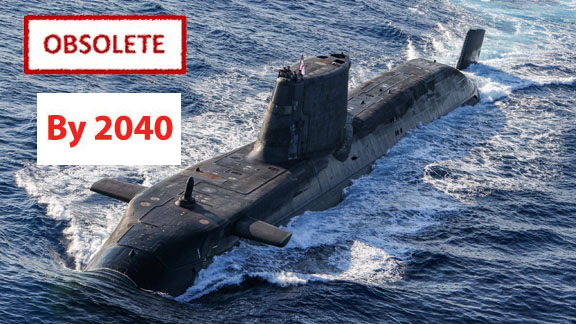
Australia’s nuclear submarines will be obsolete before they are ever in use
Why will they be obsolete?

Because of the rapid advances in artificial intelligence (AI), detection systems and signal processing, combined with swarming autonomous unmanned systems – by 2040 these present USA and UK models will probably be too easily detectable, and so, effectively useless.
Why does Australia want nuclear submarines?

Other reasons – helping the USA by buying these very costly submarines which are not particularly useful for monitoring our coastline, but good for long distance. Helping Scott Morrison to look important on the world stage.
1 This Month
Tell Congress: Prevent Nuclear Catastrophe in Iran

Tell Congress: Prevent Nuclear Catastrophe in Iran

Read the Public Inquiry Report, the Commissioners’ report, Surrendering Australia: The AUKUS Deception is available to download for free at aukuspublicinquiry.com. Or just watch the replay of the National Press Club Luncheon.


Shut down the radiation-damaged Heysham nuclear reactors now
To see nuclear-related stories in greater depth and intensity – go to https://nuclearinformation.wordpress.com

Say No to NASA’s Reckless Nuclear Reactor on the Moon
Say No to NASA’s Reckless Nuclear Reactor on the Moon
-
Archives
- November 2026 (246)
- October 2026 (302)
- September 2026 (339)
- August 2026 (330)
- July 2026 (355)
- June 2026 (287)
- May 2026 (306)
- April 2026 (356)
- March 2026 (251)
- February 2026 (267)
- January 2026 (308)
- December 2025 (358)
-
Categories
- 1
- 1 NUCLEAR ISSUES
- business and costs
- climate change
- culture and arts
- ENERGY
- environment
- health
- history
- indigenous issues
- Legal
- marketing of nuclear
- media
- opposition to nuclear
- PERSONAL STORIES
- politics
- politics international
- Religion and ethics
- safety
- secrets,lies and civil liberties
- spinbuster
- technology
- Uranium
- wastes
- weapons and war
- Women
- 2 WORLD
- ACTION
- AFRICA
- Atrocities
- AUSTRALIA
- Christina's notes
- Christina's themes
- culture and arts
- Events
- Fuk 2022
- Fuk 2023
- Fukushima 2017
- Fukushima 2018
- fukushima 2019
- Fukushima 2020
- Fukushima 2021
- general
- global warming
- Humour (God we need it)
- Nuclear
- RARE EARTHS
- Reference
- resources – print
- Resources -audiovicual
- Weekly Newsletter
- World
- World Nuclear
- YouTube
-
RSS
Entries RSS
Comments RSS

