The “No Militarization of Space Act” has been introduced in the U.S. Congress.
No Militarization of Space Act, CounterPunch BY KARL GROSSMAN, 6 Oct 21,
Finally, there’s some good news about the U.S. push to turn space into a war zone. The “No Militarization of Space Act” has been introduced in the U.S. Congress. It would abolish the new U.S. Space Force.
It is being sponsored by five members of the House of Representatives led by Representative Jared Huffman. In a statement announcing the September 22nd introduction of the measure, Huffman called the U.S. Space Force “costly and unnecessary.”
The arms and aerospace industries, which have a central role in U.S. space military activities, will no doubt be super-active in coming weeks working to stop movement of the legislation.
Representative Huffman, with a background as a consumer attorney specializing in public interest cases, was elected in 2012 to represent the 2nd Congressional District in California which covers the state’s North Coast up to the Oregon border. He resides in San Rafael.
In his statement announcing the introduction of the bill, Huffman said the “long-standing neutrality of space has fostered a competitive, non-militarized age of exploration every nation and generation has valued since the first days of space travel. But since its creation under the former Trump administration, the Space Force has threatened longstanding peace and flagrantly wasted billions of taxpayer dollars.” And, he continued: “It’s time we turn our attention back to where it belongs: addressing urgent domestic and international priorities like battling COVID-19, climate change, and growing economic inequality. Our mission must be to support the American people, not spend billions on the militarization of space.”
Co-sponsors of the “No Militarization of Space Act” are Representatives Mark Pocan of Wisconsin, chair of the Congressional Progressive Caucus; Maxine Waters of California; Rashida Tlaib of Michigan; and Jesus Garcia of Illinois. All are Democrats.
Alice Slater, a board member of the organization World BEYOND War, commented that Trump, “in his besotted hunkering for hegemonic glory,” established the Space Force as “a brand new branch of the already gargantuan military juggernaut….Sadly, the new U.S. President Biden has done nothing to ratchet down the warmongering. Fortunately, help is on the way with a group of five sane members of Congress.”
But not only has Joe Biden stuck with the U.S. Space Force, but most Democrats in both the House of Representatives and Senate voted for its creation as championed by Trump. All Republicans in Congress voted for it…………….https://www.counterpunch.org/2021/10/06/no-militarization-of-space-act/
Organised crime highly active in the nuclear industry
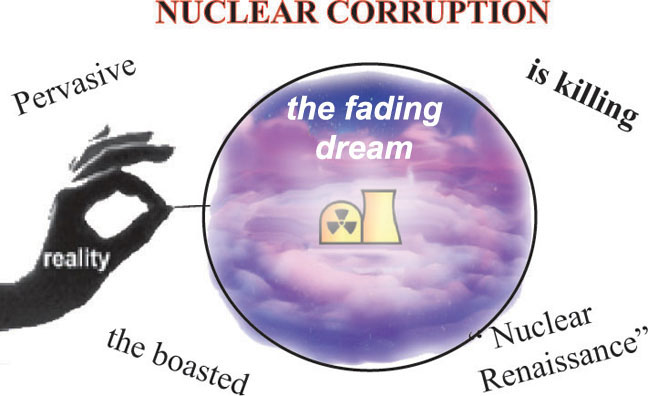
“A stunning number of revelations in recent years on irregularities, fraud, counterfeiting, bribery, corruption, sabotage, theft, and other criminal activities in the nuclear industry in various countries suggest that there is a systemic issue of ‘criminal energy’ in the sector. …
Organised crime goes nuclear Ecologist, Creative Commons , Dr Jim Green , 4th October 2021 Fraud, counterfeiting, bribery, corruption, sabotage, theft, and other criminal activities are rife in global nuclear industry.
“As prime minister of Japan at the time of the [Fukushima] disaster, I now believe that the time has come for Japan and the world to end its reliance on nuclear power,” Naoto Kan writes in the introduction of the World Nuclear Industry Status Report 2021 (WNISR).
“Around once a year, I still visit the remains of the Fukushima Daiichi site. Even though ten years have passed, progress in the decommissioning process remains frustratingly slow, driving home to me the importance of avoiding any repeat of such an event.
“The large quantities of radioactive debris that remain within the stricken reactors continue to release alarming levels of radiation. We already know from the example of Chernobyl that the timescale needed for this nuclear waste to drop to safe radioactivity levels will be measured in terms of centuries.”
Stagnation
This year’s WNISR is the work of 13 interdisciplinary experts from across the world. For nearly 30 years, these annual reports have provided important factual antidotes to industry promotion and obfuscation.
In broad terms, nuclear power has been stagnant for 30 years. WNISR notes that the world’s fleet of 415 power reactors is 23 fewer than the 2002 peak of 438, but nuclear capacity and generation have marginally increased due to uprating and larger reactors being built.
There is one big difference with the situation 30 years ago: the reactor fleet was young then, now it is old.
The ageing of the reactor fleet is a huge problem for the industry, as is the ageing of the nuclear workforce ‒ the silver tsunami. The average age of the world’s reactor fleet continues to rise, and by mid-2021 reached 30.9 years. The mean age of the 23 reactors shut down between 2016 and 2020 was 42.6 years.
The International Atomic Energy Agency anticipates the closure of around 10 reactors or 10 gigawatts (GW) per year over the next three decades. Reactor construction starts need to match closures just for the industry to maintain its 30-year pattern of stagnation.
Renewables………… Nuclear power’s contribution to global electricity supply has fallen from a peak of 17.5 percent in 1996 to 10.1 percent in 2020 – a 4.3 percent share of global commercial primary energy consumption.
Renewables reached an estimated 29 percent share of global electricity generation in 2020, a record share. Non-hydro renewables at 10.7 percent in 2020 overtook nuclear in 2019 and the gap grew in 2020 with non-hydro renewables generating 16.5 percent more electricity than nuclear reactors.
Total investment in new renewable electricity exceeded US$300 billion in 2020, including US$142 billion investment in wind and US$149 billion in solar. Investment in renewables was 17 times greater than nuclear investment of around US$18 billion.
Solar
In 2020, a record 256 GW of renewable capacity were added to the world’s power grids, including 111 GW of wind and 127 GW of solar. There was a net gain of 0.4 GW of nuclear capacity in 2020.
Despite the marginal increase in nuclear capacity in 2020, nuclear generation fell by 3.9 percent. That compares to a 21 percent increase in solar generation, and 12 percent for wind power……….
Vulnerabilities
In the European Union, renewable power generation at 38 percent overtook fossil fuels at 37 percent in 2020 while nuclear power accounted for 25 percent. Last year was the first year that non-hydro renewables generated more power than nuclear in the EU……………..
Crime
WNISR details the slow and unsteady progress of small modular reactors. The report notes that “so-called advanced reactors of various designs, including so-called Small Modular Reactors (SMRs), make a lot of noise in the media but their promoters have provided little evidence for any implementation scheme before a decade at the very least.”
WNISR notes that previous reports have covered irregularities, fraud, counterfeiting, corruption, and other criminal activities in the nuclear sector. This year’s report dedicates a chapter to nuclear criminality and includes 14 case studies with serious implications – including safety and public governance – that came to trial in the period 2010-2020.
The report states: “A stunning number of revelations in recent years on irregularities, fraud, counterfeiting, bribery, corruption, sabotage, theft, and other criminal activities in the nuclear industry in various countries suggest that there is a systemic issue of ‘criminal energy’ in the sector. …
“Although not comprehensive, this analysis offers several noteworthy insights: Criminal activities in the nuclear sector are not new. Some major scandals date back decades or have been ongoing for decades.
“Organized crime organizations have been supplying workers to nuclear sites – e.g. the Yakuza in Japan – for over a decade.
Corruption
“Serious insider sabotage has hit major nuclear countries in recent years – like a Belgian nuclear power plant – without ever leading to arrests.
“There is no systematic, comprehensive, public database on the issue. In 2019, the IAEA released a report on cases of counterfeit or fraudulent items in at least seven countries since at least the 1990s.
“In Transparency International’s 2020 Corruption Perceptions Index about half of the 35 countries operating or constructing nuclear power plants on their territory rate under 50 out of 100.
“In the Bribery Payers Index (BPI, last published in 2011), seven out of the ten worst rated countries operate or are building nuclear power plants on their territory.”
The discussion about whether safe nuclear power can be generated in the right circumstances remains white hot. However, we clearly do not live under the right circumstances. The risks from nuclear – both energy and weapons – remains existential.
This Author
Dr Jim Green is the national nuclear campaigner with Friends of the Earth Australia and an organiser of a global NGO statement on nuclear power and climate change to be released ahead of COP26. https://theecologist.org/2021/oct/04/organised-crime-goes-nuclear
Rolls Royce wants to supply data centres with their massive energy needs, by small nuclear reactors

Rolls-Royce said to be pitching small nuclear reactors to power data centers … while Boris Johnson proposes more big nuclear power stations for the UK, October 05, 2021 By Peter Judge
Rolls-Royce is planning to offer small nuclear reactors to US-based cloud operators so their hyperscale data centers can have net zero emissions and be independent of the electric grid, according to media reports.
Small modular reactors (SMRs) are under development by a consortium led by Rolls-Royce, and could potentially power data centers or other infrastructure that needs a steady supply of low-carbon energy, which may not be available from the local electricity grid. However, they will not be available until at least 2030…………. https://www.datacenterdynamics.com/en/news/rolls-royce-said-to-be-pitching-small-nuclear-reactors-to-power-data-centers/
A-bomb survivor Setsuko Thurlow hopes Japan’s new PM can lead nuclear disarmament debate
A-bomb survivor Setsuko Thurlow hopes Japan’s new PM can lead nuclear disarmament debate, October 6, 2021 (Mainichi Japan) Japanese original by Isamu Gari, Hiroshima Bureau) HIROSHIMA — The ruling Liberal Democratic Party’s (LDP) Fumio Kishida was elected prime minister on Oct. 4, the first time in 30 years a politician from a Hiroshima Prefecture constituency has assumed the office.
In a telephone interview with the Mainichi Shimbun, Setsuko Thurlow, 89, welcomed the appointment of a prime minister from Hiroshima and shared a message for Kishida, who is a distant relative. Now a resident of Canada, Thurlow was exposed to the atomic bombing in Hiroshima, devoted herself to the campaign for nuclear abolition for many years, and was the first A-bomb survivor to deliver a speech at the Nobel Peace Prize ceremony in 2017.
Thurlow has engaged in activism with the International Campaign to Abolish Nuclear Weapons (ICAN), an international NGO that won the Nobel Peace Prize in 2017, and has continued to relay her experience of the atomic bombing. She was invited along with ICAN’s executive director to the Nobel Prize ceremony, where they received a medal and certificate.
In December 2018, Thurlow went to LDP headquarters in Tokyo to meet with Kishida for the first time, when he was chair of the party’s Policy Research Council. On her impressions of him, she said, “I was worried he might have a politician’s arrogance, but when I met him, we were able to talk openly.”
The Japanese government does not participate in the Treaty on the Prohibition of Nuclear Weapons (TPNW), which bans the possession and use of nuclear weapons and came into force in January 2021. It does however consider it its duty to be a bridge between nuclear-weapon and non-nuclear-weapon states.
Thurlow dismissed this stance, saying, “There’s no explanation as to how this role will be accomplished, it’s just an excuse.” From her overseas vantage on the Japanese government’s response to nuclear issues, she said, “Japan has lacked a leader who can lead the discussion. This has prevented the voices of the people and A-bomb survivors from being heard, and stopped discussion of important issues such as nuclear disarmament and nuclear abolition.”
As a politician from Hiroshima, Kishida has a strong commitment to nuclear disarmament and nuclear non-proliferation. During his tenure as foreign minister starting in 2012, he established the “Group of Eminent Persons,” a group of experts from both nuclear-weapon states and non-nuclear-weapon states, and has worked on nuclear disarmament. In 2016, when then President Barack Obama became the first sitting U.S. president to visit Hiroshima, Kishida provided explanations to the president at Peace Memorial Park.
Thurlow does not believe that just because Kishida has become prime minister, the Japanese government’s stance on the TPNW and other issues will easily change. But she noted that “the fact he is a prime minister from Hiroshima means the world will watch him more closely than ever.”………….https://mainichi.jp/english/articles/20211006/p2a/00m/0na/030000c
Terrorists trying to get secrets on production of nuclear weapons
Terrorists try to get secrets on production of nuclear weapons — Security Council Russian Security Council Deputy Secretary Yuri Kokov pointed out that Russia registered terrorists’ attempts to gain access to information on the production of means of nuclear, chemical and biological damage, MOSCOW, October 6. /TASS/. Terrorists are trying to obtain information on the production of nuclear, chemical and biological weapons, Russian Security Council Deputy Secretary Yuri Kokov said in an interview Wednesday.”We register terrorists’ attempts to gain access to information on the production of means of nuclear, chemical and biological damage, as well as their heightened attention to possible use of biological agents and toxic chemicals. To that extent, they deliberately recruit industry specialists, including professors and students of chemical and biological universities,” Kokov said……… https://tass.com/defense/1346507 |
Nuclear executive to go to prison for fraud
Former exec readies for 2 years in prison in nuclear debacle, abc, By Jeffrey Collins, Oct 5, 2021 Associated Press COLUMBIA, S.C. (AP) — An executive who spent billions of dollars on two South Carolina nuclear plants that never generated a watt of power, lying and deceiving regulators about their progress, is ready to go to prison.
Former SCANA Corp. CEO Kevin Marsh has agreed with prosecutors that he should spend two years in prison. He goes before a federal judge Thursday who will decide whether to accept that deal…..
Marsh is the first executive to go to prison for the nuclear debacle. A second former SCANA executive and an official at Westinghouse Electric Co., the lead contractor to build two new reactors at the V.C. Summer plant, have also pleaded guilty. A second Westinghouse executive has been indicted and is awaiting trial.
Marsh in February pleaded guilty to conspiracy to commit wire and mail fraud in federal court, and obtaining property by false pretenses in state court. Prosecutors agreed to his request to serve his entire sentence on both sets of charges in a federal prison.
Marsh already paid $5 million in restitution. SCANA had paid Marsh $5 million in 2017, the year the utility abandoned the hopelessly behind-schedule project in Fairfield County
Marsh lied and presented rosy projections on the progress of the reactors that he knew was false in earning calls, presentations and press releases. The CEO wanted to keep investors pumping money into the project and the company’s stock price up, prosecutors said.
His actions took more than $1 billion from the pockets of ratepayers and investors, authorities said in an 87-page Securities and Exchange Commission lawsuit filed against them in 2020………….. https://www.abccolumbia.com/2021/10/05/former-exec-readies-for-2-years-in-prison-in-nuclear-debacle/
Call the U.S. Defense Budget what it is – the War Budget

Stop Calling the Military Budget a ‘Defense’ Budget, https://www.commondreams.org/views/2021/10/05/stop-calling-military-budget-defense-budget To call the Pentagon’s massive and escalating budget a “defense” budget is nothing less than internalized corruption of language that undermines our capacities to think clearly and talk straight.
NORMAN SOLOMON, October 5, 2021 It’s bad enough that mainstream news outlets routinely call the Pentagon budget a “defense” budget. But the fact that progressives in Congress and even many antiwar activists also do the same is an indication of how deeply the mindsets of the nation’s warfare state are embedded in the political culture of the United States.
The misleading first name of the Defense Department doesn’t justify using “defense” as an adjective for its budget. On the contrary, the ubiquitous use of phrases like “defense budget” and “defense spending”—virtually always written with a lower-case “d”—reinforces the false notion that equates the USA’s humongous military operations with defense.
In the real world, the United States spends more money on its military than the next 10 countries all together. And most of those countries are military allies.
What about military bases in foreign countries? The U.S. currently has 750, while Russia has about two dozen and China has one. The author of the landmark book “Base Nation,” American University professor David Vine, just co-wrote a report that points out “the United States has at least three times as many overseas bases as all other countries combined.” Those U.S. bases abroad “cost taxpayers an estimated $55 billion annually.”
As this autumn began, Vine noted that President Biden is “perpetuating the United States’ endless wars” in nations including “Iraq, Syria, Somalia and Yemen” while escalating “war-like tensions with China with a military buildup with Australia and the UK.”
All this is being funded via a “defense” budget?
Calling George Orwell.
As Orwell wrote in a 1946 essay, political language “is designed to make lies sound truthful and murder respectable, and to give an appearance of solidity to pure wind.” In 2021, the hot air blowing at gale force through U.S. mass media is so continuous that we’re apt to scarcely give it a second thought. But the euphemisms would hardly mean anything to those in faraway countries for whom terrifying and lethal drone attacks and other components of U.S. air wars are about life and death rather than political language.
You might consider the Pentagon’s Aug. 29 killing of 10 Afghan civilians including seven children with a drone attack to be a case of “respectable” murder, or negligent homicide, or mere “collateral damage.” Likewise, you could look at numbers like 244,124—a credible low-end estimate of the number of civilians directly killed during the “war on terror” in Afghanistan, Pakistan and Iraq—and consider them to be mere data points or representing individuals whose lives are as precious as yours.
But at any rate, from the vantage point of the United States, it’s farfetched to claim that the billions of dollars expended for ongoing warfare in several countries are in a budget that can be legitimately called “defense.”
Until 1947, the official name of the U.S. government’s central military agency was the War Department. After a two-year interim brand (with the clunky name National Military Establishment), it was renamed the Department of Defense in 1949. As it happened, that was the same year when Orwell’s dystopian novel “1984” appeared, telling of an always-at-war totalitarian regime with doublespeak slogans that included “War Is Peace.”
Today, the Department of Defense remains an appropriately capitalized proper noun. But the department’s official name doesn’t make it true. To call its massive and escalating budget a “defense” budget is nothing less than internalized corruption of language that undermines our capacities to think clearly and talk straight. While such corroded language can’t be blamed for the existence of sloppy thinking and degraded discourse, it regularly facilitates sloppy thinking and degraded discourse.
Let’s blow away the linguistic fog. The Pentagon budget is not a “defense” budget.
Norman Solomon is co-founder and national coordinator of RootsAction.org. His books include “War Made Easy: How Presidents and Pundits Keep Spinning Us to Death“ (2006) and “Made Love, Got War: Close Encounters with America’s Warfare State” (2007).
The risks of a catastrophic spent nuclear fuel fire near the Persian Gulf.
How to reduce the risk of a catastrophic spent nuclear fuel fire near the Persian Gulf, Bulletin, By Tara Burchmore, Tom Spence, Ali Ahmad | October 6, 2021 The 2021 operational launch of two reactors at the Barakah power plant in Abu Dhabi, United Arab Emirates (UAE) demonstrates the growth of nuclear energy in the Middle East. Over the next two years, there will be five reactors operating in the Persian Gulf—four reactors at Barakah and Iran’s Bushehr reactor, which has been running since 2013. If Iran and Saudi Arabia fulfill their proposed plans to build new nuclear reactors, the number will rise to at least eight reactors in the gulf by 2030.
There are many reasons for concern about the safety of nuclear facilities in the gulf. Particularly in the region where Bushehr is located, Iran is prone to seismic activity. The UAE has limited experience in operating nuclear facilities. And terrorist groups have identified energy infrastructure as a key target—and even attacked nuclear installations.
It is in this context we raise an alarm about the possibility of a severe nuclear accident in the gulf, driven by a fire in one of the spent nuclear fuel pools of the Bushehr or Barakah power plants. As we explain in detail in our recent paper in Science and Global Security, the local and possibly global economic implications of such an accident are huge.
Since the Fukushima Daiichi disaster more than a decade ago and the “near miss” catastrophe of a fire at the unit 4 spent fuel pool, higher attention has been given to the long-overlooked risks of such densely packed pools, which typically have less fortified containment than a reactor core but may contain much larger amounts of radioactivity. Frank von Hippel and his colleagues have since produced important analyses revising the risks of spent nuclear fuel fires and highlighting their human and economic costs.
Cities at risk. In our paper, we modelled what might happen if a spent nuclear fuel fire was to start at either the Barakah or Bushehr nuclear power plants, using an atmospheric modeling program to simulate how the plume of radioactive smoke from the fire would spread over the gulf region based on probable weather patterns.
Based on thousands of dispersion simulations using real historical weather data, the results show that several major cities in the gulf region could be contaminated by cesium 137 fallout if a spent fuel fire occurred at Barakah or Bushehr. The cities at the highest risk from fires at Barakah are those centered around the Gulf of Bahrain: Doha, Manama, Dammam, and al-Hofuf…………………………
Recommendations. The safest way to mitigate the risk of spent nuclear fuel fires in the Persian Gulf region would be to end the deployment of nuclear energy in the Middle East and rely instead on the region’s natural gas and renewable energy resources. This, of course, will not happen.
However, risks can be reduced by not adding new nuclear capacity beyond what is currently built. Additionally, governments could reduce risks by timely transfer of spent fuel into dry cask storage and ultimately into geological storage, limiting the dense packing of spent fuel pools. Iran has agreed to transfer Bushehr’s spent nuclear fuel to Russia and could seek to do so as soon as it has cooled sufficiently. States also should work to prevent attacks on nuclear facilities. One model could be a multilateral arrangement similar to the bilateral one reached between India and Pakistan. Finally, gulf states should bolster their emergency preparedness and management plans for nuclear accidents and incidents involving potential radiation release in the region. https://thebulletin.org/2021/10/how-to-reduce-the-risk-of-a-catastrophic-spent-nuclear-fuel-fire-near-the-persian-gulf/
2022 French Presidential candidates divided over nuclear energy
2022 French Presidential candidates divided over nuclear energy, Candidates on the left and right have spoken out about the future of energy in France, and whether nuclear energy should still be used. Connexion, By Joanna York, 6 Oct 21
Six months ahead of the French Presidential elections, and with energy prices rising steeply this month, the future of nuclear energy in France is becoming a key issue.
President Emmanuel Macron has previously spoken out in favour of using nuclear energy, saying during a 2019 European summit that use of nuclear power would help France transition towards carbon neutral energy sources.
In mid-October the president is expected to announce the creation of small-scale nuclear plants, or SMRs, which are said to be affordable, safer and to produce emission-free, carbon-free energy.
According to EDF, nuclear energy is the primary source of electricity production in France.
There are 56 nuclear reactors of varying sizes located throughout France, with those in l’Auvergne-Rhône-Alpes, Grand Est, Centre val-de-Loire and Normandie providing 80% of electricity produced by nuclear power.
Candidates on the right for increasing nuclear production
Candidates on the right have so far said they support expanding use of nuclear energy in France
Xavier Bertrand, current regional president of Hauts-de-France, told FranceInfo on October 4 he was in favour “of laws bringing nuclear energy back to producing 50% of energy” in order for France to remain an “independent” energy producer.
Diverse opinions from candidates on the left
In contrast, some candidates on the left have spoken out strongly against continued use of nuclear energy.
EELV (centre-left, green) candidates Yannick Jadot and Sandrine Rousseau have both said that they wish to see an end to the use of nuclear energy.
Paris Mayor and Parti Socialiste (centre-left) candidate Anne Hidalgo agrees. In her recently-released book she wrote: “we need to stop using nuclear energy as soon as the development of renewable energy allows it.”
However, Olivier Faure, also from the Parti Socialiste, told FranceInfo he “did not believe” in ending use of nuclear power in France by 2030, because “as long as we have not fully developed renewable energies, we have to continue using nuclear plants”.
As in previous presidential campaigns in 2012 and 2017, Mr Mélenchon has said that use of nuclear energy should be stopped before 2023, in favour of 100% renewable energies.
He has previously campaigned for abandoning nuclear plants, the burial of nuclear waste and the closure of France’s oldest nuclear power station Fessenheim, which happened in June 2020.
Parti Communiste (far left) candidate, Fabien Roussel, spoke out against the closure of the power station at the time.
In an interview with Le Point in May 2021 he said he was “in favour of maintaining use of nuclear power in France”. https://www.connexionfrance.com/French-news/2022-French
US Reveals Nuclear Bomb Numbers After Trump Blackout
US Reveals Nuclear Bomb Numbers After Trump Blackout
Last week, Russian and US diplomats held talks in Geneva to determine controls on conventional weapons. The Defense Post, 6 Oct 21, The US State Department published on Tuesday the number of nuclear warheads the country stockpiles for the first time in four years, after former president Donald Trump placed a blackout on the data.
As of September 30, 2020, the US military maintained 3,750 active and inactive nuclear warheads, down by 55 from a year earlier and by 72 from the same date in 2017.
The figure was also the lowest level since the US nuclear stockpile peaked at the height of the Cold War with Russia in 1967, when the total was 31,255 warheads.
The numbers were released Tuesday amid an effort by the administration of President Joe Biden to restart arms controls talks with Russia after they stalled under Trump………….
Biden, who came in to office on January 20, immediately proposed a five-year extension to New Start, which Russian President Vladimir Putin quickly agreed to.
The deal caps at 1,550 the number of nuclear warheads that can be deployed by Moscow and Washington.
Last week, Russian and US diplomats held talks behind closed doors in Geneva to begin discussions on a successor to New Start and also controls on conventional weapons.
A US official called the talks “productive,” but both sides said the mere fact of holding the talks was positive.
According to a January 2021 tally by the Stockholm International Peace Research Institute, which includes retired warheads — not counted in the State Department’s numbers — the United States had 5,550 warheads, compared to 6,255 in Russia, 350 in China, 225 in Britain, and 290 in France.
India, Pakistan, Israel, and North Korea have together around 460 nuclear warheads, according to the institute. https://www.thedefensepost.com/2021/10/06/us-nuclear-bomb-numbers/
Rep. Burgess Owens and Rep. Chris Stewart sponsor a Bill to ensure compensation for health effects of nuclear bomb testing
Too many ‘downwinders’ are still suffering https://www.deseret.com/2021/10/4/22709221/utah-nuclear-testing-downwinders-congress-compensation-health-effects We are sponsoring a bill that would make sure the government’s responsibility to those who were harmed by nuclear testing does not get swept under the rug. By Burgess Owens and Chris Stewart Oct 4, 2021, ‘ Any objective study of American history brings us to the realization that there are many Americans who quietly made, and continue to make, great sacrifices for our national security. Many of these women and men willingly give of themselves to ensure that our country remains free.
Tragically, under the banner of national security the United States government exposed Americans to radioactive uranium ore and radioactive dust — subjecting them to lung cancer and other respiratory illnesses.
On July 16, we marked the 76th anniversary of the detonation of the first nuclear weapon — code-named Trinity — in the desert of New Mexico’s Tularosa Basin. Three weeks after the Trinity detonation, the United States exploded the Little Boy bomb over Hiroshima and, three days later, the Fat Man bomb over Nagasaki. Six days later, Japan surrendered. In the aftermath of World War II, a nuclear arms race began that reached its zenith with over 60,000 nuclear weapons worldwide in 1986.
Many lives were lost or severely altered by the nuclear weapons program. Thankfully, the world stockpile of nuclear weapons has steadily declined since 1986 and will, hopefully, continue to do so in the future. Yet, the effects of detonating over 1,100 nuclear weapons since the Trinity test in 1945 continue to mar the lives of Americans to this day.
Through atmospheric weapons tests, as well as mining, transporting and milling of uranium ore, many Americans have been slowly killed by radiation exposure. Thousands of Utahns were infected by radiation exposure simply by living “downwind” of the federal government’s nuclear weapons testing sites. Additional Utahn miners were affected as they worked the uranium necessary for these weapons. These “downwinders” and miners and their families friends, and communities often suffered excruciating illness, loss and devastation.
In response to this malfeasance, Congress rightly enacted (and later amended in 2000) the Radiation Exposure Compensation Act (RECA) in 1990. This legislation was a good first step in making recompense to those who mined and hauled uranium ore and those who processed the ore at a mill. The RECA legislation also addresses those exposed to radiation downwind from nuclear test sites.
It has been more than 20 years since any meaningful reform to RECA has been made for those whose lives have been taken or irreversibly altered by our foray into the arms race. Several classifications of workers such as core drillers and ground workers have been denied justice by being excluded completely from the process.
Some diseases that should have been compensable have been excluded. Numerous geographical locations exposed to downwind radiation have been left out. Uranium miners continued to mine after the United States stopped buying uranium for its nuclear weapons programs in 1971. These so-called post-1971 workers were excluded from accessing benefits since the original RECA legislation had an arbitrary cutoff date of Dec. 31, 1971 — even though the federal government continued to regulate uranium mines long after 1971. To make matters worse, RECA is scheduled to sunset in July 2022 — potentially leaving all classifications of exposure victims without redress.
We are honored to represent some of these “downwinders” and their family members and want them to know their suffering — and the sacrifices they made for our nation — are not forgotten.
That is why we are pleased to be the lead Republican members of the House of Representatives on the “RECA Amendments Act of 2021,” legislation that will reauthorize RECA for those still suffering the consequences of nuclear testing.
The tragic consequences of the nuclear arms race cannot be swept under the rug of history. We urge our colleagues in Congress to support the “RECA Amendments Act of 2021.” Our country must act now to address the injustices of those who have been forgotten by their own government.
Rep. Burgess Owens represents Utah’s 4th Congressional District. Rep. Chris Stewart represents Utah’s 2nd Congressional District.
Russia withdraws offer to freeze nuclear warhead production
Russia withdraws offer to freeze nuclear warhead production, Yahoo News, Joel Gehrke, Sat, October 2, 2021 Russian President Vladimir Putin is no longer interested in a joint freeze of nuclear weapons production with the United States, according to a senior Russian envoy who protested American inspections requests and a recent agreement to provide nuclear-powered submarines to Australia.
“No, it was a one-time offer, and it was said so to the U.S. They missed the opportunity,” Russian Deputy Foreign Minister Sergei Ryabkov told the Geneva Center for Security Policy, per state media. “They didn’t want a freeze on all warheads — they wanted an extremely intrusive verification and control at all our nuclear-related facilities.”
Ryabkov aired the withdrawal of that proposal following a meeting with Deputy Secretary of State Wendy Sherman for what both sides described as “intensive and substantive” arms control talks. He complained about the U.S. and United Kingdom’s decision to partner with Australia on a submarine deal widely perceived as directed at China, and both Russian and American officials underscored that the negotiations are unlikely to produce a deal anytime soon………………….. https://news.yahoo.com/russia-withdraws-offer-freeze-nuclear-110000900.html?utm_source=AM%20Nukes%20Roundup&utm_campaign=98d6a39486-EMAIL_CAMPAIGN_2018_07_25_12_19_COPY_01&utm_medium=email&utm_term=0_547ee518ec-98d6a39486-244432186&guccounter=1&guce_referrer=aH
UK government to generate a colossal public sector loss in building more nuclear power station at Sizewell C
Drunk on the latest fossil fuel energy crisis, the UK Government has handed
the British public a giant nuclear hangover that will leave the country
scrabbling for renewable energy solutions. Boris Johnson has promised 40 GW
of offshore wind by the end of the decade, which, when added to other
renewable energy sources, will generate over three-quarters of current
levels of UK electricity consumption.
But this growth could be threatened
by the nuked-up knee jerk reaction to the current natural gas price crisis
that will plunge the energy budget into a massive deficit and leave the
electricity system dangerously unbalanced. After fossil fuel prices subside
back towards their more usual levels, this will constitute a giant
hangover.
The last time we had an energy crisis, in 2008 and 2011 when oil
prices spiked, the UK ended up with what was regarded as a bad deal to pay
(in today’s money) over £110 per MWh for Hinkley C over 35 years. That
was the hangover after the last crisis. This time it is likely to be worse
as the Government recycles its own half-truths to generate a colossal
public sector loss in building more nuclear power plant at Sizewell C and,
then, it hopes, at Wylfa. These plans would, eventually, ensure that around
20 percent of UK electricity comes from nuclear power, but also ensure that
efforts to balance the much cheaper renewable energy will be poorly
developed at best, and ignored at worst.
100% Renewables 4th Oct 2021
https://100percentrenewableuk.org/how-the-governments-drunken-nuclear-binge-will-threaten-renewables
Allerdale GDF Working Group’s map of area considered for UK’s nuclear waste dump includes areas already declared unsuitable.
Allerdale GDF Working Group have finally released a map of their search
area today, illustrating where they would like to consider burying the
UK’s vast nuclear waste inventory. However, what they haven’t mentioned
is that a significant proportion of the chosen area has previously been
declared as unsuitable by the British Geological Survey (BGS). Here [on original] is a
map produced by the BGS in 2010 which identifies areas unsuitable for
geological disposal, largely due to the presence of coal and coal-bed
methane.
Cumbria Trust 6th Oct 2021
The Wretched Atom book release — Jacob Darwin Hamblin

I am pleased to announce that my book, The Wretched Atom, was published this summer by Oxford University Press. I will post review snippets and other relevant information on this site. Head over to Amazon, Goodreads, or the OUP site to see more about the book. Here is a description: A groundbreaking narrative of how […]
The Wretched Atom book release — Jacob Darwin Hamblin
1 This Month
Tell Congress: Prevent Nuclear Catastrophe in Iran

Tell Congress: Prevent Nuclear Catastrophe in Iran

Read the Public Inquiry Report, the Commissioners’ report, Surrendering Australia: The AUKUS Deception is available to download for free at aukuspublicinquiry.com. Or just watch the replay of the National Press Club Luncheon.


Shut down the radiation-damaged Heysham nuclear reactors now
To see nuclear-related stories in greater depth and intensity – go to https://nuclearinformation.wordpress.com

Say No to NASA’s Reckless Nuclear Reactor on the Moon
Say No to NASA’s Reckless Nuclear Reactor on the Moon
-
Archives
- November 2026 (238)
- October 2026 (302)
- September 2026 (339)
- August 2026 (330)
- July 2026 (355)
- June 2026 (287)
- May 2026 (306)
- April 2026 (356)
- March 2026 (251)
- February 2026 (267)
- January 2026 (308)
- December 2025 (358)
-
Categories
- 1
- 1 NUCLEAR ISSUES
- business and costs
- climate change
- culture and arts
- ENERGY
- environment
- health
- history
- indigenous issues
- Legal
- marketing of nuclear
- media
- opposition to nuclear
- PERSONAL STORIES
- politics
- politics international
- Religion and ethics
- safety
- secrets,lies and civil liberties
- spinbuster
- technology
- Uranium
- wastes
- weapons and war
- Women
- 2 WORLD
- ACTION
- AFRICA
- Atrocities
- AUSTRALIA
- Christina's notes
- Christina's themes
- culture and arts
- Events
- Fuk 2022
- Fuk 2023
- Fukushima 2017
- Fukushima 2018
- fukushima 2019
- Fukushima 2020
- Fukushima 2021
- general
- global warming
- Humour (God we need it)
- Nuclear
- RARE EARTHS
- Reference
- resources – print
- Resources -audiovicual
- Weekly Newsletter
- World
- World Nuclear
- YouTube
-
RSS
Entries RSS
Comments RSS

