India Launches Nuclear Submarine With ‘Vertical Launch System’
Boosting Indian Navy’s Firepower, DRDO Launches Nuclear Submarine With ‘Vertical Launch System’ Eurasian Times, By Shreya Mundhra January 2, 2022
Amid geopolitical tensions in the Indo-Pacific region, India has quietly launched its third Arihant-class nuclear-powered ballistic missile submarine — the S4 SSBN — at a secretive ship-building center in Visakhapatnam. The development was reported by Janes Defence Weekly, citing satellite imagery.
Arihant-Class Submarines
The Arihant-class, named after the country’s first nuclear-powered submarine — INS Arihant — is a class of Indian nuclear-powered ballistic missile submarines that are being built for the Indian Navy.
It was launched at the Indian Navy’s dockyard located in Visakhapatnam, the headquarters of Eastern Naval Command. The project, earlier called the advanced technology vessel (ATV), has been under development since 1998………
Russia’s Role In Indian Project
INS Arihant, which cost $2.9bn, was jointly developed by the Indian Navy, Bhabha Atomic Research Centre (BARC), and Defence Research and Development Organisation (DRDO) at the naval dockyard……………………….
Arihant And Arighat
INS Arihant was launched on July 26, 2009, by then-Prime Minister Manmohan Singh. Four years later, in August 2013, the submarine’s atomic reactor was activated. Three more years down the line, in August 2016, Prime Minister Narendra Modi inducted the submarine into the Navy………………………..
The Latest Addition — S4 SSBN
In its December 29 report, Janes noted that the S4 SSBN was launched on November 23 and had been ‘relocated’ close to the ‘fitting-out wharf’ that was previously occupied by INS Arighat.
According to Janes, satellite imagery had confirmed that the ship being talked about stood at 7,000-tonnes, “slightly larger” than the lead ship in the Arihant class, INS Arihant.
……. The magazine went on to infer that the satellite imagery indicated that the newly launched boats’ increased length “accommodates expansion of the submarine’s vertical launch system”. This system can support eight missile launch tubes, as planned.
This would enable the SSBN to carry eight K-4 SLBMs, or alternately, 24 K-15 SLBMs. The K-4 SLBM is currently under development. https://eurasiantimes.com/indian-navy-launches-3rd-arihant-class-nuclear-submarine/
Hard to swallow the manipulations going on in nuclear waste decisions on UK’s Geological Disposal Facility
‘GDF flies in face of past decisions on storing nuclear waste’ https://www.newsandstar.co.uk/news/19816090.gdf-flies-face-past-decisions-storing-nuclear-waste/ David Kirkwood, 2 Jan 22,
Penrith ON December 20, I received an email informing me that Allerdale Borough Council leadership had held a meeting on November 24 and voted in favour of progressing the nuclear Geological Disposal Facility in Allerdale.
This statement was released amid the Omicron virus and Christmas festivities simply to bury the controversial news. It flies in the face of the two previous decisions rejecting the burying of nuclear waste material anywhere in Cumbria.
One of the main reasons was that the geology in Cumbria was unsuitable for a repository. Secondly, the most important reason was the population did not want it.
It is obvious why this decision has been reached, quite simply the local government reorganisation was engineered to try and invalidate the previous decisions taken by the soon-to-be-dismantled County Council.
Perhaps, someone from the Radioactive Waste Management can explain why a company called Genr8 North Ltd can be involved with both Allerdale Borough Council and Copeland Borough Council, if as they say they have no commercial interest in a nuclear geological disposal facility being built?
I find this very hard to believe.
This is just an attempt by a few individuals to brainwash the majority into acceptance. I’m certain in years to come the radioactive nuclear waste will be buried in Cumbria irrespective of the wishes of the resident population.
Threat of nuclear war: Not a thing of the past

Threat of nuclear war: Not a thing of the past, Daily Star, António Guterres, Sun Jan 2, 2022 ”……………………. the existential threat that cast a shadow over the first half of my life no longer receives the attention it should. Nuclear weapons have faded from headlines and Hollywood scripts. But the danger they pose remains as high as ever, and is growing by the year. Nuclear annihilation is just one misunderstanding or miscalculation away—a sword of Damocles that threatens not only suffering and death on a horrific scale, but the end of all life on earth.
Through a combination of luck and judgement, nuclear weapons have not been used since they incinerated Hiroshima and Nagasaki in 1945. But with more than 13,000 nuclear weapons held in arsenals around the world, how long can our luck hold? The Covid-19 pandemic has brought a new awareness of the catastrophic impact of a low-probability event.
Following the end of the Cold War, nuclear arsenals were dramatically reduced and even eliminated. Entire regions declared themselves nuclear-weapons free zones. A deep and widespread repudiation of nuclear testing took hold. As the prime minister of my country, I ordered Portugal to vote for the first time against the resumption of nuclear testing in the Pacific.
But the end of the Cold War also left us with a dangerous falsehood: that the threat of nuclear war was a thing of the past.
Nothing could be more mistaken. These weapons are not yesterday’s problem. They remain today’s growing threat.
The risk that nuclear weapons will be used is higher now than at any point since the duck-and-cover drills and fallout shelters of the Cold War…………
The nuclear landscape is a tinderbox. One accident or miscalculation could set it alight.
Our main hope to reverse course and steer our world away from nuclear cataclysm is the Treaty on the Non-Proliferation of Nuclear Weapons—better known as the NPT—which dates from the height of the Cold War in 1970.
The NPT is one of the main reasons why nuclear weapons have not been used since 1945. It contains legally binding commitments to achieve nuclear disarmament, including by the five largest nuclear-armed countries. It is also a catalyst for disarmament—the only way to eliminate these horrendous weapons once and for all…………..
We must seize the opportunity of January’s NPT Review Conference to reverse dangerous and growing trends and escape the long shadow cast by these inhumane weapons.
The review conference must take bold action on six fronts: 1) Chart a path forward on nuclear disarmament; 2) Agree new measures of transparency and dialogue, to reduce the risk of nuclear war; 3) Address simmering nuclear crises in the Middle East and Asia; 4) Work to strengthen the global frameworks that support non-proliferation, including the IAEA; 5) Promote the peaceful use of nuclear technology for medical and other uses – one reason why the NPT has won the adherence of non-nuclear-weapons states; 6) And remind the world’s people—especially its young people—that eliminating nuclear weapons is the only way to guarantee they will never be used.
I urge governments to approach the conference in a spirit of solidarity, frank dialogue, and flexibility.
What happens in the NPT negotiating rooms in January matters to everyone—because any use of nuclear weapons will affect everyone.
The fragility of our world has never been clearer.
I hope people everywhere will push governments to step back from the abyss and create a safer, more secure world for all: a world free of nuclear weapons.
Antonio Guterres is the secretary-general of the United Nations. https://www.thedailystar.net/views/opinion/news/threat-nuclear-war-not-thing-the-past-2930251
Protesters call for abolition of nuclear weapons
Protesters call for abolition of nuclear weapons, https://www3.nhk.or.jp/nhkworld/en/news/20220102_02/ Protesters in the Japanese city of Nagasaki took part in a sit-in on New Year’s Day and called for the abolition of nuclear weapons. A sit-in is held in the city every year on January 1. Nagasaki was hit by an atomic bomb during World War Two.
More than 60 people participated in the protest in the city’s Peace Park on Saturday.
The protesters observed a moment of silence at 11:02 a.m. The atomic bomb exploded in Nagasaki at that time on August 9, 1945. The participants held up pieces of paper with the word “peace” written on them in Japanese.
Atomic bomb survivor Tanaka Yasujiro said 2022 will be an important year. He said he wants non-nuclear countries to surround nuclear states, so that the number of nuclear warheads can be reduced.
The states, which signed the UN treaty that bans nuclear weapons, are scheduled to meet for the first time in March 2022.
The Review Conference of the Treaty on the Non-Proliferation of Nuclear Weapons may be held in August.
Parties to the NPT meet every five years to review the accord. A meeting was scheduled to take place in January. But the participants agreed to postpone it for the fourth time, due to the coronavirus pandemic. Various options are now being considered. A gathering in August is a possibility.
WATCH: Galloway & Lauria on What to Expect in 2022
Editor-in-Chief Joe Lauria spoke to George and Gayatri Galloway about what the year 2022 might bring. January 1, 2022
Will the European Commission buy into the lie that nuclear power is clean and green?
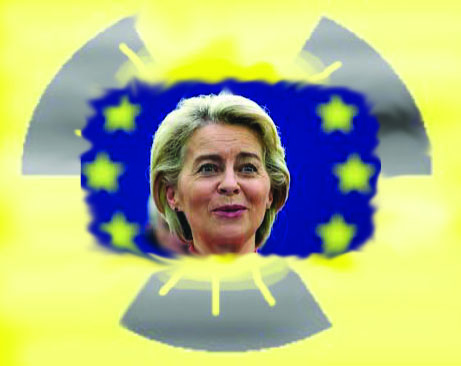
Just who will be making this decision? The global nuclear lobby is desperate to get tax-payer funding , to keep its expensive, dirty, dangerous product going.
Pro nuclear stooges, like Ursula von der Leyen (at left) are keen to get Europe to decide that nuclear power is necessary for climate change.
They keep calling nuclear “zero’ or ”low carbon” – ignoring the full chain of carbon-emiitting processes involved in nuclear structures and in fuelling rectors.
Also ignored , the delays in gettting the industry going – too late to be of any use.
nuclear: Fate of EU green taxonomy ‘now in the hands of von der Leyen’.
The taxonomy text will need approval from a majority of EU member states and members of the European Parliament.
Brussels proposes green label for nuclear and natural gas
European Commission paves way for investments despite concerns over waste and CO2 emissions , Ft.com, Mehreen Khan in Brussels, 1 January 2022.
Brussels wants to recognise nuclear power and forms of natural gas as “green” activity as part of a landmark EU classification scheme to help financial markets decide what counts as sustainable investment. In long-awaited plans, the European Commission has paved the way for investment in new nuclear power plants for at least the next two decades and natural gas for at least a decade, under a green labelling system known as the “taxonomy for sustainable finance”. The labelling system, which will cover industries that generate about 80 per cent of all greenhouse gas emissions in the EU, is the first attempt by a major global regulator to decide what counts as truly sustainable economic activity and help stamp out so-called greenwashing in the financial sector.
A draft legal text, seen by the Financial Times, says the EU’s green label should be awarded to controversial energy sources including nuclear power and natural gas under certain circumstances. The decision was taken after a vocal group of pro-nuclear countries, led by France, and pro-gas governments in southern and eastern Europe, demanded the taxonomy should not punish energy sources that provide a bulk of their power generation….
The draft taxonomy text says nuclear power should be considered a sustainable economic activity as long as EU countries that host power stations can safely dispose of toxic waste and meet a criteria to cause “no significant harm” to the environment. The construction of new nuclear plants will be recognised as green for permits granted until 2045, says the text. ……….
https://www.ft.com/content/7872a05f-9e38-4740-9b1b-4efc69ca316c
Why a U.S.-Russia War Would Inevitably Be a Globe-Annihilating Nuclear War
https://moderndiplomacy.eu/2021/12/31/why-a-u-s-russia-war-would-inevitably-be-a-globe-annihilating-nuclear-war/ December 31, 2021, By Eric Zuesse Even Russia acknowledges that any conventional war between the U.S. and Russia would destroy Russia but not destroy the U.S. Consequently, for Russia, any such war will not be waged. Only idiots would choose to engage in a war that they are certain to lose, and which would utterly destroy themselves. This means that if the U.S. strikes Russia by a conventional (i.e., non-nuclear) invasion, then Russia has only two options: (1) to respond with conventional weapons and assuredly be destroyed while achieving nothing; or, else (2) promptly release at least enough of its 6,255 nuclear warheads so as to maximally weaken the U.S.A.-and-allied retaliatory capability so as to be able then to go into a “Round Two” nuclear attack against the U.S.-and-allied side by having a much stronger military position than all of its many enemies (America and its allies) do.
That second option would leave BOTH SIDES, and (because of the then-inevitable nuclear winter) actually the entire planet, either doomed or else being close to being so. However, the U.S. and its many allies would be in far worse condition than Russia would be (because they’d have been greatly weakened by Russia’s nuclear first-strike); and then, MAYBE, Russians could survive that war by having lives that might be worth living.
The second option, for Russia, would be enormously less horrible than the first option; and here is why:
First of all: Russia would still retain its sovereign independence, not become a slave-nation (which the survivors in any U.S.-and-allied nation would then be: slaves, then, to Russia).
Secondly: Russia wouldn’t need to worry any longer whether the U.S.-and-allied side would be the first to go nuclear. Instead, the war would be over.
This is the reason why, ever since at least 2006, the U.S. has been planning and building its war against Russia for the U.S. side to be the first to go nuclear. (That plan is called “Nuclear Primacy,” and it replaces the previous system, which still continued on in Russia, and which was called “M.A.D” for “Mutually Assured Destruction.”)
Consequently: any idea that Russia would likely respond to a non-nuclear invasion of Russia without promptly going nuclear against the invading powers is stupid. Russia now knows how voracious America’s rulers (America’s billionaires) are. Ever since 24 February 1990, the U.S. had been secretly informing its allies that though the Soviet Union would soon end, and Soviet communism would soon end, and the Soviets’ Warsaw-Pact that they had built up in response to America’s NATO military alliance would also soon end, the U.S. side of the Cold War was to be secretly continued against Russia, until Russia itself becomes conquered and swallowed-up by the U.S. side, and the U.S. thereby becomes the unchallengeable dictator over the entire world.
Russia’s recent demand that all U.S.-and-allied weaponry that is less than a ten-minute flying-distance from Moscow be removed, and that NATO expansion be permanently halted, is a desperate attempt by Russia to avoid becoming yet-another slave-country to the U.S. regime. Russia doesn’t have good options. But, given the insatiably voracious appetite for expanding yet further America’s power that America’s rulers have, neither does any other country. And even Russia’s enormous nuclear force can’t protect Russians against so evil an enemy. But, perhaps, Russia’s nuclear force will be able to prevent Russians from becoming slaves to the U.S. regime. And that would be something worthy of achieving.
This entire matter was brought to a head because Barack Obama perpetrated in 2014 a coup-takeover of Ukraine, which has the longest European border with Russia. He had planned to seize Russia’s largest naval base, which was (and remained) on Crimea, but Russia was able to block that part of Obama’s plan. (Obama’s team had started by no later than 23 June 2011 to plan that coup.)Attachments areaPreview YouTube video Ukraine Crisis – What You’re Not Being ToldUkraine Crisis – What You’re Not Being Told

 | |||

Our Oceans Are Not Sewers

Our Oceans Are Not Sewers https://www.fairewinds.org/demystify/our-oceans-are-not-sewers
December 26, 2021
Reckless endangerment of the world’s oceans and seas by governmental agencies and industry continues, By The Fairewinds Crew
Whether it’s plastic, mercury, or radioactivity, the entire world has treated our planet’s oceans as its sewage dump. As if we need more proof that Radioactivity Knows No Borders, three recent events discussed below prove the reality of our statements. The global authorities that regulate atomic power and nuclear waste often assure us that there are no significant risks to communities near radioactive disasters and operating facilities. Yet, communities must determine the actual dangers themselves.
Demystifying Nuclear Power
in 2015, Arnie Gundersen traveled to Cumbria, adjacent to the Irish Sea in the UK. Fairewinds went to the UK to work with citizen scientists collecting local samples. When Fairewinds testified at the House of Commons, Arnie detailed radioactive contamination emanating from the Sellafield reprocessing plant, Chernobyl, and the 1957 Windscale nuclear disaster. He was sampling in the summer resort community of Seascale near the
Sellafield Nuclear Site along the Irish Sea, where the beaches are frequented by families with children.
Unfortunately, the nuclear power and weapons industries have continued to use the Irish Sea as a dumping ground for British atomic waste since the 1950s.
Thanks to the Unfriending the Atomorganization and program, we recently found out that Arnie’s winter coat has plutonium in its pockets – even after being dry cleaned from travel abroad. While working with citizen scientists, he wore this coat to collect samples on public open-space estuary-land. Also, view the whole Unfriending the Atom Zoofor more images of “exotic data from mundane objects”.
Arnie’s time sampling near Sellafield is part of our worldwide campaign to protect families and communities from the devasting and lasting impact of radiation exposure. Currently, we have begun the process of researching and documenting our Irish Sea data for another peer-reviewed journal article. When this paper has been accepted by a publisher, we will share this open and accessible data for our community-volunteer citizen-scientists and the public.
The International Atomic Energy Agency (IAEA) back in 1999. As you will see in the map [on original], the IAEA identified that our planet’s oceans have been used as a sewer for radioactive waste. BTW (By the Way), for our readers today who do not know this, the IAEA (International Atomic Energy Agency) was created by the United Nations. And, when it was founded, the IAEA was charted to regulate and promote nuclear power! Imagine regulating AND promoting.
Secondly, this week, there was more breaking news of additional radioactive dumps into the world’s oceans. A ship bound from India was detained last week in Kenya when authorities uncovered a large cargo of radioactive waste (Red alert as nuclear ship docks in Mombasa). Authorities believe that the toxic radioactive waste was destined for illegal dumping in the Atlantic Ocean! You must be wondering, as Fairewinds is, how long this has been going on? Once again, atomic regulators have failed to protect our Earth and its people. Unfortunately, dumping in the Atlantic Ocean is not a new issue, and the United States is far from blameless. Read about the U.S. Atomic Sailors here!
Third, we have more to discuss with you about Japan’s Tokyo Electric Power Company (TEPCO), where the infamous Japanese nuclear meltdown occurred. Once again, TEPCO is seeking permission from Japan’s Nuclear Regulation Authority (NRA) to discharge hundreds of thousands of tons of highly-toxic radioactive wastewater into the Pacific.
Organizations and individuals worldwide have publicly and privately criticized TEPCO’s plan and the apparent approval of the NRA and the International Atomic Energy Agency (IAEA). Representatives from South Korea, China, and the Marshall Islands have been particularly vocal about this disaster-in-waiting. They are requesting much greater transparency in their dialog with Japan. However, Japanese regulators are still not cooperating with the neighboring communities, severely impacted by these releases.
Moreover, Greenpeace submitted a damning public comment to TEPCO. Three days after the public comment period was officially closed, TEPCO announced it filed for approval to discharge nuclear waste into the sea. They plan to release this toxic liquid radioactivity directly into the ocean via a pipe they are preparing to construct.
- Where is the accountability?
- When will regulators get serious about preventing the dumping of radioactive nuclear waste by the nuclear industry, its contractors, and the military, who has radioactive waste from weapons manufacturing?
Treaties, conventions, and laws are not enough to prevent the illegal dumping of highly toxic waste of any kind into our communities. However, since firm statutory regulations are already in place, the enforcement of these laws is key to protecting our oceans worldwide. This is why Fairewinds community-based citizen-science is so critical.
Fairewinds will keep you informed in 2022. As we have said over and over again, Radiation Knows No Borders.
Why nuclear power is a bad way to balance renewable energy
Why nuclear power is a bad way to balance renewable energy https://100percentrenewableuk.org/why-nuclear-power-is-a-bad-way-to-balance-renewable-energy
David Toke, Ian Fairlie and Herbert Eppel from 100percentrenewableuk discuss how nuclear power effectively switches off wind and solar power and how a 100percent renewable energy system is much better for the UK than one involving nuclear power.
The Government, backed by a lot of public policy reports paid for by pro-nuclear interests, constantly pushes out the view that nuclear power is ‘essential’ to balancing wind and solar power. But what they never mention is the massive waste of renewables that occurs in such a scenario. Under the scenarios planned by the Government nuclear power is paid very high prices to generate power even when there is excess electricity, which pushes renewables to close down. The Government also refuses to undertake serious investigations of how a system that uses excess renewables to create short and long term storage is a much better way of organising our energy needs rather than wasting more money on building nuclear power stations.
Look at our video which, drawing upon research on the role of nuclear and renewables, discusses these issues.
If you agree the aims of 100percentrenewableuk please join the discussion via our email group.
State of New Mexico demands federal investigation into Waste Isolation Pilot Plant (WIPP) and federal nuclear programs.
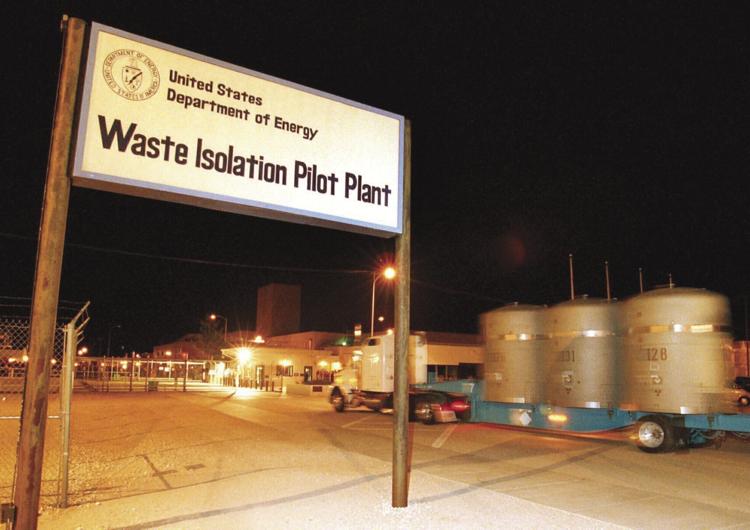
State of New Mexico demands feds investigate WIPP, federal nuclear programs
New Mexico Environment Department joins call from Congress for oversight, Adrian Hedden, Carlsbad Current-Argus , 31 Dec 21,
State concerned out-of-state waste prioritized over New Mexico’s
WIPP officials says waste shipments prioritized by availability
Congressional committee worried for ongoing “challenges” at DOE
Stronger oversight of the Waste Isolation Pilot Plant could be coming as the federal government was called on by New Mexico officials and members of Congress to address alleged problems with the U.S. Department of Energy’s environmental cleanup operations.
New Mexico Secretary of the Environment James Kenney expressed concerns for operations at WIPP in a letter to the federal Government Accountability Office (GAO), calling for the federal office to increase its oversight of the nuclear waste repository near Carlsbad.
Low-level transuranic (TRU) waste from around the country is disposed of at WIPP via burial in an underground salt deposit about 2,000 feet underground. It is owned and operated by the DOE and its Office of Environmental Management (EM) but is permitted and regulated by the New Mexico Environment Department (NMED) headed by Kenney.
In his Dec. 22 letter to the GAO, Kenney said the Office should review nuclear programs in New Mexico, including the prioritization of nuclear waste shipments to WIPP from facilities outside New Mexico.
He said first priority should be given to waste from Los Alamos National Laboratory (LANL) in northern New Mexico as the DOE intends to increase the production of plutonium pits.
“The WIPP is subject to an NMED operating permit and must adhere to the requirements of the permit in order to remain operable in New Mexico and in service to the nation,” Kenney wrote. “Yet, the DOE EM has entered into legally binding settlement agreements with states to prioritize waste shipments to WIPP at the expense of shipments from other states, including New Mexico.
“This is problematic for both the clean-up of legacy waste at LANL and new waste from pit production at LANL.”
Before the DOE entered into such agreements, as it had with the State of Idaho for cleanup at Idaho National Laboratory (INL) in 1995, Kenney said the agency should have first engaged with New Mexico stakeholders he said would bear the impacts of moving out-of-state nuclear waste into their state……………
“The practice of DOE EM solely managing waste shipments to WIPP from around the U.S. without first discussing with New Mexico stakeholders – including NMED as its regulator – now merits immediate congressional oversight,” Kenney wrote…………..
Kenney also voiced reservations about DOE officials allegedly seeking to “expand” the kinds of waste accepted at WIPP.
A recent DOE proposal sought to redefine high-level waste to consider the radiation level as opposed to the current method that considers where the waste was generated, potentially leading to more waste coming to WIPP, Kenney said.
Another concern, Kenney wrote, was a DOE-proposed “dilute and dispose” program that would see high-level plutonium processed to lower its radioactivity so it could meet WIPP requirements for TRU waste. https://www.currentargus.com/story/news/local/2021/12/30/state-new-mexico-demands-feds-investigate-wipp-doe-nuclear-programs/9034953002/
UK’s fossil fuel use at an all-time low , as renewables generate 67% of Britain’s electricity

Fossil fuel use on the UK’s power grid dropped to an all-time low this week, in a sign analysts say is further evidence of the “renewables revolution” under way on the British electricity generation.
Just before midnight on Wednesday evening coal and gas were providing just six per cent
of electricity, according to Drax Electric Insights. “Renewables generated 24.19 GW – 65 per cent of the country’s entire electricity needs – while fossil fuels were at a new record low,” the analysts said
in statement on Thursday.
iNews 30th Dec 2021
https://inews.co.uk/news/fossil-fuels-power-wind-renewable-1375827
South Korea presidential contender vows to seek nuclear-powered submarines, months after Australia’s Aukus deal.

South Korea presidential contender vows to seek nuclear-powered submarines, months after Australia’s Aukus deal, Guardian, 31 Dec 21,
Lee Jae-myung aims to counter North Korea threats and pledges to restart stalled talks between Pyongyang and Washington
South Korea’s ruling party presidential candidate said he will seek US support to build nuclear-powered submarines to better counter threats from North Korea and proactively seek to reopen stalled denuclearisation talks between Pyongyang and Washington.
In an interview with Reuters and two other media outlets, Lee Jae-myung also pledged to put aside “strategic ambiguity” in the face of intensifying Sino-US rivalry, vowing pragmatic diplomacy would avoid South Korea being forced to choose between the two countries………………
Lee said he will persuade the US to win diplomatic and technology aid to launch nuclear-powered submarines, which can operate more quietly for longer periods, amid renewed calls for building one in the military and parliament after North Korea test-fired a new missile from a submarine in October.
Lee cited the deal Australia struck under a trilateral security partnership with the US and Britain in September to build its own nuclear-powered submarines…………………………… https://www.theguardian.com/world/2021/dec/30/south-korea-presidential-contender-vows-to-seek-nuclear-powered-submarines-months-after-australias-aukus-deal
Nuclear authorities dismiss a massive tritium leak from nuclear reactor as unimportant. But should they?
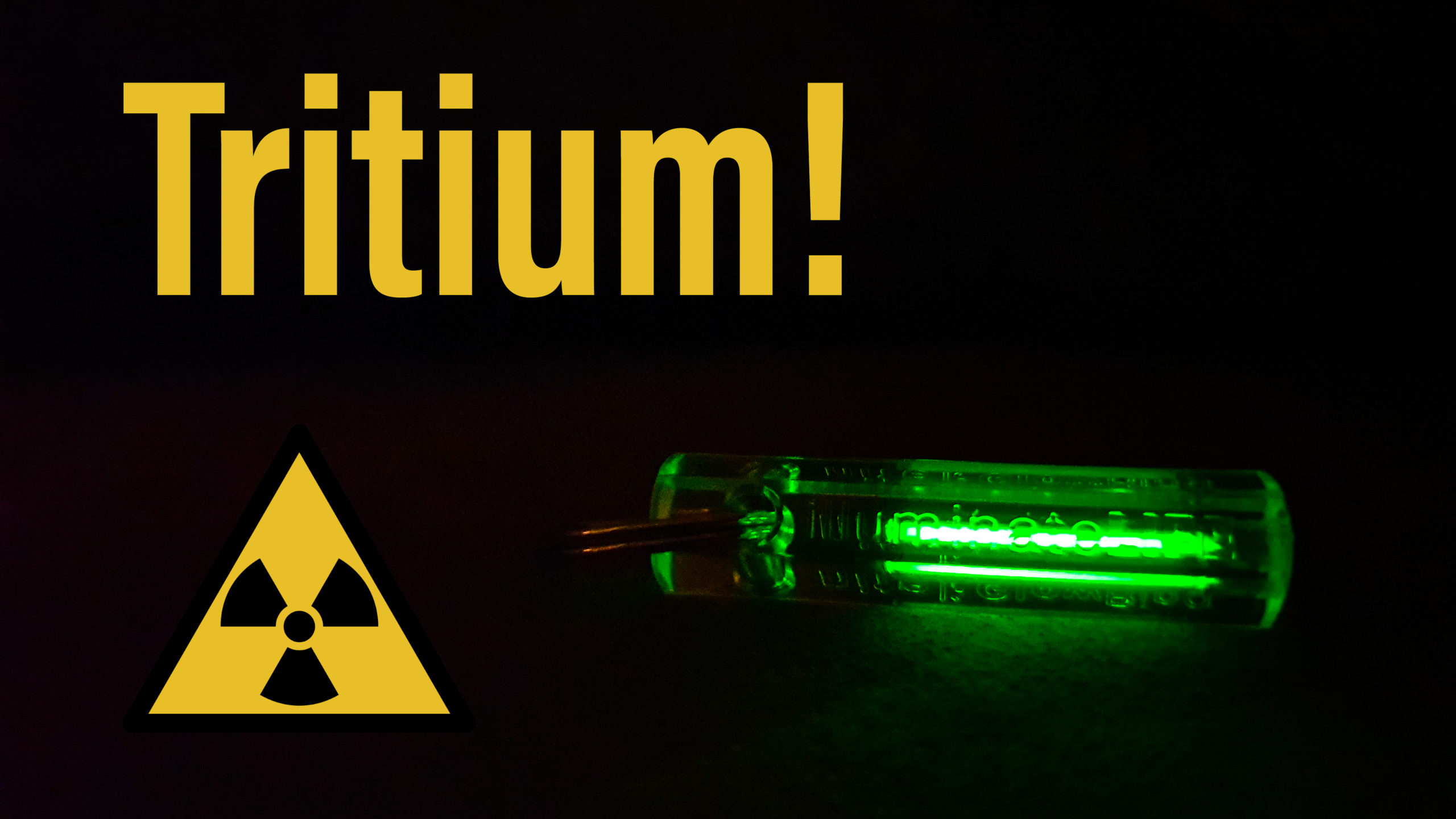
Nuclear: do our power plants release too much tritium? This fission residue is not very radiotoxic. But the discharge standards in waterways are more permissive in France than in Japan. With the holiday season and the covid epidemic, the event has gone almost unnoticed. But it is reported in detail on the site of the Nuclear Safety Authority (ASN). Between November 25 and December 8, 2021, at the Tricastin site, around 900 liters of effluents containing tritium infiltrated the soil, causing “abnormal radiological activity”. More precisely, the measurements carried out on site made it possible to detect a peak in radioactivity of 28,900 Becquerels per liter on December 12. Taking up this information, the Mediapart site mentions a major radioactive leak. After ASN inspection, the event was nevertheless classified at level 0 on the international nuclear events scale. How to explain this difference in perception? L’Express 28th Dec 2021 https://www.lexpress.fr/actualite/sciences/nucleaire-nos-centrales-rejettent-elles-trop-de-tritium_2165111.html |
Land and water ecosystems, ‘stressed to a critical point’

| Entitled, State of the World’s Land and Water Resources for Food and Agriculture – Systems at breaking point (SOLAW 2021), the report highlights the challenges that lie ahead in feeding a global population that should near ten billion by 2050. At the launch of the publication, FAO Director-General, QU Dongyu, said that “current patterns of agrifood production are not proving sustainable.” Yet, he added, these systems “can play a major role in alleviating these pressures and contributing positively to climate and development goals.” Main findings: If the world keeps to the current trajectory, producing the additional 50 per cent more food needed, could mean an increase of 35 per cent, in the water withdrawals needed for farming. That could create environmental disasters, increase competition for resources, and fuel new social challenges and conflicts. Currently, human-induced soil degradation affects 34 per cent (around 1,660 million hectares), of agricultural land. Even though more than 95 per cent of all food is produced on land, there is little room for expanding the area that can be made more productive. In fact, urban areas occupy less than 0.5 per cent of the Earth’s land surface, but the rapid growth of cities has significantly reduced resources, polluting and encroaching on prime agricultural land. In only 17 years, between 2000 and 2017, land use per capita declined by 20 per cent. UN News 9th Dec 2021 https://news.un.org/en/story/2021/12/110753 |
In Germany, coal-produced electricity has dropped, along with nuclear, while renewable-provided electricity continues to increase

Paul Dorfman: I disagree with Lord Howell of Guildford’s assertion (letter, Dec 29) that the decline of nuclear power in Germany has been accompanied by an increase in coal burning. Electricity generation
from coal in Germany dropped nearly 40TWh in 2020 as nuclear generation fell by 11TWh the same year.
The growth in renewables has outstripped the drop in nuclear power by almost double. Since 2011, nuclear in the German electricity mix halved from 22 per cent to 11 per cent, while the share of renewables increased from 17 per cent to 45 per cent.
Not only that, but Germany regularly has the lowest wholesale electricity prices in Europe after Scandinavia. The simple fact is that nuclear power plants are by far the most expensive technology for generating electricity.
Times 29th Dec 2021
1 This Month
Tell Congress: Prevent Nuclear Catastrophe in Iran

Tell Congress: Prevent Nuclear Catastrophe in Iran

Read the Public Inquiry Report, the Commissioners’ report, Surrendering Australia: The AUKUS Deception is available to download for free at aukuspublicinquiry.com. Or just watch the replay of the National Press Club Luncheon.


Shut down the radiation-damaged Heysham nuclear reactors now
To see nuclear-related stories in greater depth and intensity – go to https://nuclearinformation.wordpress.com

Say No to NASA’s Reckless Nuclear Reactor on the Moon
Say No to NASA’s Reckless Nuclear Reactor on the Moon
-
Archives
- November 2026 (238)
- October 2026 (302)
- September 2026 (339)
- August 2026 (330)
- July 2026 (355)
- June 2026 (287)
- May 2026 (306)
- April 2026 (356)
- March 2026 (251)
- February 2026 (267)
- January 2026 (308)
- December 2025 (358)
-
Categories
- 1
- 1 NUCLEAR ISSUES
- business and costs
- climate change
- culture and arts
- ENERGY
- environment
- health
- history
- indigenous issues
- Legal
- marketing of nuclear
- media
- opposition to nuclear
- PERSONAL STORIES
- politics
- politics international
- Religion and ethics
- safety
- secrets,lies and civil liberties
- spinbuster
- technology
- Uranium
- wastes
- weapons and war
- Women
- 2 WORLD
- ACTION
- AFRICA
- Atrocities
- AUSTRALIA
- Christina's notes
- Christina's themes
- culture and arts
- Events
- Fuk 2022
- Fuk 2023
- Fukushima 2017
- Fukushima 2018
- fukushima 2019
- Fukushima 2020
- Fukushima 2021
- general
- global warming
- Humour (God we need it)
- Nuclear
- RARE EARTHS
- Reference
- resources – print
- Resources -audiovicual
- Weekly Newsletter
- World
- World Nuclear
- YouTube
-
RSS
Entries RSS
Comments RSS

