Britain’s National Infrastructure Commission (NIC) advises government against new nuclear power projects.
UK NIC backs alternatives to nuclear, Renew Extra Weekly, 2 Jan 21, The UK Government asked the National Infrastructure Commission (NIC) for its advice on whether an additional new nuclear plant, beyond the proposed Sizewell C project, was needed to deliver the UK’s sixth Carbon (reduction) Budget, due in 2035. In response, the NIC said no, it was not needed or viable for 2035, since new nuclear was slow to deploy. It asserted that ‘it is highly unlikely that a new large scale nuclear plant is deliverable in the next 15 years; trying and failing would jeopardise delivery of the sixth Carbon Budget’. Instead it backed renewables, hydrogen and low/negative carbon technology- which is said could be deployed faster.
It noted that ‘since 1990, nuclear projects have faced significant delays all around the world. Even just in Europe around half of all plants have faced at least a 50% delay in construction, and 1 in 4 plants have faced at least a 90% delay in construction’. So it said that ‘any nuclear project schedule estimate should be expected to take at least 50% longer than planned. If a new project began development next year and took the same amount of time as the Hinkley Point C project is expected to take to complete, it would not come online until at least the mid 2040s’. So that put it well outside the 2035 timeframe.

Small Modular/advanced reactors might be a faster option, but the NIC said ‘relying on significant capacity being deployed before 2035 would be risky’. It pointed out that ‘no SMR has gone through the Generic Design Assessment process and some developer proposals are conditional on government support to progress project development. There are no SMRs in operation in countries similar to the UK.
To fill the same capacity gap illustrated in the BEIS modelling, at least six SMRs would be needed by 2035, if not more. This would require compressing the normal delivery timeline and doing things in parallel rather than in sequence, significantly increasing the risk of delays. Delivery success will also be dependent on the capability of the developer.’
Alternatives likely to be faster
Instead of these nuclear options, for delivery within the timeframe to 2035, it backed ‘renewables with a combination of gas power plants with carbon capture and storage, hydrogen fired gas plants and bioenergy with carbon capture & storage’. It said ‘these alternatives are more likely to be deliverable at scale in the next 15 years’. …………………..
even without costing analysis, it said its analysis clearly demonstrated ‘that a third new nuclear plant is not necessary to reach the 2035 emissions target and that more gas CCS, hydrogen powered gas plants, and BECCS could be deployed instead. Whilst these technologies are yet to be deployed at scale, the Commission considers them to be a lower delivery risk than nuclear.’ And it claimed that its proposed alternative technology mix was supported by analysis previously conducted for the Commission and by other bodies such as National Grid ESO & the Climate Change Committee. …………………
It’s odd that the NIC plunge into CCS and Hydrogen, rather than talking about renewables more. Maybe they are taken for granted. But if, led by wind and solar, they could be expanded much faster than BEIS and NIC envisage, then maybe we could forget about fossil CCS, BECCS and also Sizewell C. That might be helped if tidal stream technology could also get going- with CfD help, it ought to be able to by 2030. Geothermal too, for heat and power. All NIC says is that, from the BEIS analysis, it’s clear that ‘significant volumes of renewables are needed to deliver a low carbon power system by 2035. This is supported by previous analysis for the Commission and others. Rapid cost reductions and short and reliable build profiles mean that renewables will be the backbone of any future GB power system’. OK, fine, but we need details & plans now for faster expansion, along with a much improved commitment to energy saving! https://renewextraweekly.blogspot.com/2022/01/uk-nic-backs-alternatives-to-nuclear.html
German Greens fight plan to funnel billions of euros into the nuclear industry via deceptive taxonomy ”sustainable” label

German Greens lead attack on EU plan to label nuclear power ‘sustainable’. Brussels’ proposal is central to European goal of channelling billions of euros into green investments, Ft.com, Mehreen Khan in Brussels and Joe Miller in Frankfurt 3 Jan 21,
Germany, Austria and Luxembourg have hit out at Brussels’ plans to classify nuclear power as a sustainable technology in the EU’s landmark labelling system for green investment, which is central to Europe’s plans to decarbonise the bloc’s economy. German economy minister Robert Habeck, who is a member of the Green party in the country’s governing coalition, said: “It is questionable whether this greenwashing will even find acceptance on the financial market.” He told German press agency DPA on Saturday: “In our view, there was no need for this addition to the taxonomy rules.”
Brussels’ proposal is part of a so-called “taxonomy” list, which aims to help channel billions of euros of investment needed to decarbonise the bloc’s economy. The plan, the first attempt by a leading regulator to bring clarity to investors seeking to put private capital into sustainable economic activity, covers about 80 per cent of the bloc’s emissions and is intended to be a “gold standard” for markets to decide what is truly green or not. But the process has been beset by fierce political infighting inside the European Commission and its member states.
Leonore Gewessler, Austria’s minister for climate and energy, said on Saturday that Vienna would consider suing the European Commission if the classification of nuclear power as green went ahead. Claude Turmes, Luxembourg’s energy minister, meanwhile called the inclusion of nuclear power a “provocation”. The inclusion of nuclear power is widely seen as a victory for the French government which has urged Brussels to ensure the new rules do not punish a technology that provides almost two-thirds of French electricity. Nuclear reactors do not generate CO2 emissions but produce highly toxic waste…………..
The Brussels draft text will form part of a consultation with EU countries and independent experts that will run until January 12. However, anti-nuclear EU governments do not have the power to veto the taxonomy, which diplomats say is likely to win majority support in the EU Council. Astrid Matthey, one of the independent experts who advises the commission on the rules, criticised the draft for “contradicting the very purpose of the taxonomy”.
“The conditions under which both technologies are to be included are far from ensuring that we reach the Paris climate targets and do-no-significant-harm to the environment. There is still a long way to go for this draft to become aligned with the Green Deal and the EU’s environmental targets”, said Matthey. https://www.ft.com/content/92ab113f-ab17-4492-be65-56c9173cfc53
Biden’s First Year Foreign Policy Record May Be Worse than Trump’s
In many ways, Biden has actually been worse than Trump, for example, in his expansion of Special Forces operations in Africa, his aggressive stance on war in Ukraine, and in his use of human rights as a weapon to try to rally public opinion against China and Russia.
Biden has also been more dishonest—as in Syria, for example, where Trump admitted that the U.S. military was there to control the oil, while Biden deceptively claimed they were there to help the Syrian people.
The next three years could be very dangerous if tensions between the U.S., Russia and China continue to escalate. Deteriorating domestic conditions—evident in skyrocketing inflation and a rising cost of living—may also lead to greater domestic unrest, which the Biden administration could try to circumvent by trying to mobilize people against a foreign enemy.
Biden’s First Year Foreign Policy Record May Be Worse than Trump’s Covert Action By Jeremy Kuzmarov – December 31, 2021 His administration has escalated dangerous conflicts with Russia and China while increasing the military budget, expanding deadly sanctions and sustaining forever wars.
AM endorsed Biden for president as a lesser evil to the neofascism of Donald J. Trump and the modern-day GOP. At the same time, we warned readers about Biden’s past and long record as a Cold Warrior and hawk.
Biden’s first year in office has shown that the past was indeed a prologue to the future.
Continue readingMore fusion folly — Beyond Nuclear International

Fusion reactors present unsolved risks and still produce nuclear waste
More fusion folly — Beyond Nuclear International Nuclear fusion has been a long-held ambition of the nuclear industry and
governments who support nuclear power for decades. Since the end of the
Second World War, governments around the world, backed by elements of their
scientific communities, have always lauded fusion power as the ‘next
step’ above and beyond fission that is almost within reach, yet many
billions has so far been spent over the past seven decades on what has
often been called by its critics an ‘energy pipedream’.
Nuclear Free Local Authorities (NFLA) has rarely commented on nuclear fusion, given such
energy projects have yet to be commercially realised. All have foundered
around the complex challenges in developing such technology, many of which
in the third decade of the 21st century remain unsolved. In summary, to
date, none of the experimental reactors in operation have produced more
energy than was put into them.
Beyond Nuclear 2nd Jan 2022
https://beyondnuclearinternational.org/2022/01/02/more-fusion-folly/
Bitcoin miners in Kazakhstan will rely on government building new nuclear power plant
Kazakhstan bitcoin miners could use nuclear energy as gov’t might build power plant, Kazakhstan’s government is discussing a plan to build a nuclear power plant, which might boost the country’s Bitcoin (BTC) and crypto mining industries in the long run. Micky.com By Jet Encila -January 2, 2022…….. construction might take up to 10 years……..
Since September’s crackdown, an estimated 88,000 mining rigs have been smuggled across the border from China, increasing electricity demand in many places, based on multiple sources.
Not only in Central Asia, but also in the United States and Europe, the cooperation between mining and nuclear energy providers is deepening.
In the United States, a handful of miners have already begun getting power from nuclear reactors, while in Ukraine, the national nuclear energy supplier has been collaborating with miners at Europe’s largest nuclear plants in an attempt to mitigate financial losses.
—https://micky.com.au/kazakhstan-bitcoin-miners-could-use-nuclear-energy-as-govt-might-build-power-plant/
France’s electricity consumers face curbs as EDF struggles with problems and shutdowns
French electricity consumers face curbs on their electricity supplies following shutdowns at four of EDF’s nuclear power plant. France is highly reliant on its nuclear power plants, obtaining around 70 per cent of its electricity from nuclear on an annual basis. This, along with other various examples of nuclear unreliability, must seriously question the British Government’s determination to plough on with its programme of new nuclear power plant. The four nuclear plants have been shut down ‘after the detection of anomalies in the emergency injection circuits‘. France’s Grid Operator, RTE, has warned consumers that limitations on supplies may be necessary soon. France has been struggling with its nuclear sector and EDF’s efforts to build another nuclear plant at Flamanville have been hobbled by very long construction delays and massive cost overruns. 100% Renewables 31st Dec 2021 https://100percentrenewableuk.org/french-electricity-consumers-face-brownouts-and-even-power-cuts-after-nuclear-power-plant-shutdowns |
Risky for UK to plan for small and advanced nuclear reactors
New nuclear technologies, such as small and advanced nuclear reactors, may
have a role to play in the long term. But relying on significant capacity
being deployed before 2035 would be risky. They will face both the
challenges of being first of a kind plants and being a nuclear technology.
National Infrastructure Commission (Accessed) 1st Jan 2022
European Commission drafts plan to label gas and nuclear investments as ”green”

EU drafts plan to label gas and nuclear investments as green, Reuters, By Kate Abnett and Simon JessopSummary
EU drafts plan to label gas and nuclear investments as green Reuters, By Kate Abnett and Simon JessopSummary
EU drafts plan to label gas and nuclear investments as green Reuters, By Kate Abnett and Simon JessopSummary 2 Jan 22
- European Commission drawing up green investment rules
- Draft proposal labels nuclear, some gas plants as green
- Countries disagree on the fuels’ green credentials
- EU advisors said gas not compatible with climate goals
Jan 1 (Reuters) – The European Union has drawn up plans to label some natural gas and nuclear energy projects as “green” investments after a year-long battle between governments over which investments are truly climate-friendly.
EU countries and a panel of experts will scrutinise the draft proposal, which could change before it is due to be published later in January. Once published, it could be vetoed by a majority of EU countries or the European Parliament.
Brussels has also made moves to apply the system to some EU funding, meaning the rules could decide which projects are eligible for certain public finance.
A draft of the Commission’s proposal, seen by Reuters, would label nuclear power plant investments as green if the project has a plan, funds and a site to safely dispose of radioactive waste. To be deemed green, new nuclear plants must receive construction permits before 2045.
…………………. Gas and nuclear power generation would be labelled green on the grounds that they are “transitional” activities – defined as those that are not fully sustainable, but which have emissions below industry average and do not lock in polluting assets.
…………….. The policy has been mired in lobbying from governments for more than a year and EU countries disagree on which fuels are truly sustainable.
……………. Some environmental campaigners and Green EU lawmakers criticised the leaked proposal on gas and nuclear.
“By including them… the Commission risks jeopardising the credibility of the EU’s role as a leading marketplace for sustainable finance,” Greens president Philippe Lamberts said………. https://www.reuters.com/markets/commodities/eu-drafts-plan-label-gas-nuclear-investments-green-2022-01-01/
EU Commission’s draft taxonomy plan – ”a licence to greenwash”

 |
EU Commission’s taxonomy plan is “licence to greenwash” Greenpeace European Unit
https://www.greenpeace.org/eu-unit/issues/climate-energy/45988/nuclear-gas-eu-taxonomy-licence-to-greenwash/ 01/01/2022 Brussels – The European Commission intends to label certain fossil gas and nuclear activities as “sustainable” investments in the EU’s taxonomy of green economic activities, according to a draft communication released late on 31 December 2021.
According to the Commission document, nuclear projects with a construction permit issued by 2045 would be eligible for private investments, as long as they can provide plans for the management of radioactive waste and for decommissioning.
Gas projects with permits issued until 2030 would also be eligible, provided they fulfil a series of conditions, including emissions under 270g CO₂e/kWh. These provisions would deal a significant blow to the EU’s climate and environment action.
Nuclear power generates high-level radioactive waste, and a commercially viable long-term solution has yet to be found. Fossil gas is already the leading source of greenhouse gas emissions from power generation in Europe. Encouraging investments in fossil gas by giving it a green label will only exacerbate its devastating climate impact, warned Greenpeace.
In both cases, renewables are cheaper and faster to deploy, meaning that sending the wrong signal to private investors could disrupt the energy transition towards 100% renewables and delay the EU’s progress on its climate commitments.
The development comes after the EU had already severely undermined the taxonomy last year by labelling the burning of trees for energy as another sustainable activity.
Greenpeace EU programme director Magda Stoczkiewicz said: “The Commission’s taxonomy is a licence to greenwash. Polluting companies will be delighted to have the EU’s seal of approval to attract cash and keep wrecking the planet by burning fossil gas and producing radioactive waste. Promoting these toxic and expensive forms of energy for decades to come is a real threat to Europe’s energy transition. The Commission has shown a shocking disregard for the climate crisis, nature and the people of Europe. The European Parliament and governments need to stop this plan.”
Next steps
Following feedback from government representatives and experts, the Commission will present the final text later in January.
National governments and the European Parliament have the power to reject the proposal to stop it from automatically entering into force.
Contacts:Magda Stoczkiewicz – Greenpeace EU programme director: +32 (0)495 290028, magda.stoczkiewicz@greenpeace.orgGreenpeace EU press desk: +32 (0)2 274 1911, pressdesk.eu@greenpeace.org
Japan to help build Bill Gates’ high-tech Natrium nuclear reactor in Wyoming
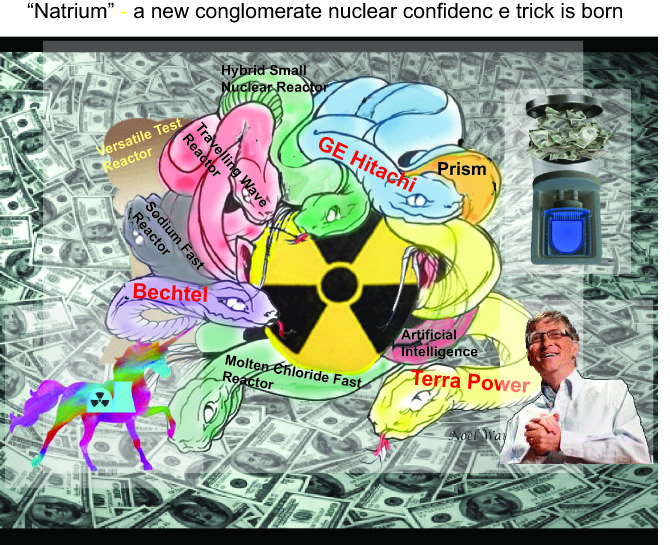
Japan to help build Bill Gates’ high-tech nuclear reactor in Wyoming -Yomiuri https://www.reuters.com/markets/commodities/japan-help-build-bill-gates-high-tech-nuclear-reactor-wyoming-yomiuri-2022-01-01/Reuters TOKYO. Reporting by Sakura Murakami; Editing by Kim Coghill- The Japan Atomic Energy Agency (JAEA) and Mitsubishi Heavy Industries Ltd (7011.T) are set to cooperate with the United States and Bill Gates’ venture company to build a high-tech nuclear reactor in Wyoming, the daily Yomiuri reported on Saturday.
The parties will sign an agreement as early as January for JAEA and Mitsubishi Heavy Industries to provide technical support and data from Japan’s own advanced reactors, the report said citing multiple unidentified sources.
TerraPower, an advanced nuclear power venture founded by Gates, is set to open its Natrium plant in Wyoming in 2028. The U.S. government will provide funding to cover half of the $4 billion project. read more
Terrapower had initially explored the prospect of building an experimental nuclear plant with state-owned China National Nuclear Corp, until it was forced to seek new partners after the administration of Donald Trump restricted nuclear deals with China.
The United States has been competing with China and Russia which also hope to build and export advanced reactors.
Japan, on the other hand, has a bitter history of decommissioning its Monju prototype advanced reactor in 2016, a project which cost $8.5 billion but provided little results and years of controversy.
The Monju facility saw accidents, regulatory breaches, and cover-ups since its conception, and was closed following public distrust of nuclear energy after the 2011 Fukushima nuclear disaster.
Both JAEA and Mitsubishi Heavy Industries could not be reached for comment, as their offices were closed for the New Year holidays.
COP 27 – the risk of climate summit becoming a stalemate
The UN climate summit to be held this November in Sharm el-Sheikh in Egypt
will be a crunch moment. As hosts of COP26, the UK holds the presidency of
COP for the next year, so over the next 11 months it will be Alok
Sharma’s job to persuade weary nations that they need to draw up fresh
climate plans once more. The COP president faces an uphill struggle:
Australia, New Zealand and the EU have already signalled they are unlikely
to play ball, and without concessions from richer countries, developing
nations such as China and India will be reluctant to deliver more. The risk
of COP27 resulting in a climate stalemate, while the world watches 1.5°C
slip out of reach, is high.
iNews 1st Jan 2022
https://inews.co.uk/news/2022-climate-change-preview-crunch-time-1377754
India, Pakistan exchange list of nuclear power installations
India, Pakistan exchange list of nuclear power installations, https://energy.economictimes.indiatimes.com/news/power/india-pakistan-exchange-list-of-nuclear-power-installations/88642567 India and Pakistan exchanged lists of nuclear installations and facilities…….
A technology that leaves behind hazardous wastes ”cannot be sustainable”
Federal government calls EU nuclear push “greenwashing”. Environment
Minister Lemke and Economics Minister Habeck sharply criticize the EU
Commission’s nuclear proposal. A technology that leaves behind hazardous
waste “cannot be sustainable”., Spiegel 1st Jan 2022
Yucca Mountain remains in debate over nuclear waste storage

The Government Accountability Office report said most experts agree that building Yucca Mountain is neither socially nor politically viable
Yucca Mountain remains in debate over nuclear waste storage, By GARY MARTIN – Las Vegas Review-Journal, Jan 1, 2022
LAS VEGAS (AP) — Mounting opposition to proposed nuclear waste storage sites in Texas and New Mexico has kept Yucca Mountain in Nevada in the national debate over what to do with the growing stockpile of radioactive material scattered around the country.
The Biden administration is opposed to Yucca Mountain and announced plans this month to send waste to places where state, local and tribal governments agree to accept it. That stance is shared by Nevada elected officials, tribal leaders and business and environmental groups.
But until the 1987 Nuclear Waste Policy Act is changed by Congress, the proposed radioactive waste repository 90 miles north of Las Vegas remains the designated permanent storage site for spent fuel rods from commercial nuclear plants.
”That’s what worries me. Until you get a policy in place, it will always be something you have to watch,” U.S. Rep. Dina Titus, D-Nevada, told the Las Vegas Review-Journal.
An expert on atomic testing and American politics, Titus as a professor at the University of Nevada, Las Vegas wrote a 1986 book on Nevada’s nuclear past.
As an elected state and congressional lawmaker, she has opposed a permanent storage facility at Yucca Mountain.
Titus introduced legislation in past sessions of Congress that adopts recommendations by a 2012 Blue Ribbon Commission under the Obama administration to send the waste to states that want it.
Similar legislation has been filed in the Senate by Catherine Cortez Masto, D-Nevada, a former state attorney general who also has fought federal efforts to build a repository at Yucca Mountain.
The legislation has failed to pass, as lawmakers from both parties who represent states with nuclear power plants seek a quick solution to waste disposal.
“I’ve always fought misguided efforts to deposit nuclear waste in Nevada, and I’ll keep working with the Nevada delegation to pass my consent-based siting bill that would ensure these dangerous materials are never dumped on our state,” Cortez Masto said.
WASTES PILING UP
The Biden administration has since proposed to fund interim storage in light of the 30-year stalemate over Yucca Mountain, due to growing need to address stockpiles of radioactive waste at decommissioned and operating plants across the country.
As of 2019, about 86,000 metric tons of spent nuclear fuel was being stored at 119 sites, according to the Department of Energy.
There are about 95 power plants operating in 29 states, currently, generating 2,900 metric tons a year. And, there are 38 reactors in 30 states in various stages of decommissioning. The waste is stored in casks, a former Energy Department adviser, Robert Alvarez, told an Environmental and Energy Study Institute briefing last year.
The Government Accountability Office, the investigative arm of Congress, issued a report in September recommending storing the waste in places where local and state officials would agree to accept it. The reporting cited the dangerous characteristics of nuclear waste and need for safe disposal.
Energy Secretary Jen Granholm announced this month that the department was seeking recommendations from states, cities, industry officials and others on locations where officials were willing to accept spent fuel and materials.
The plan announced by Granholm is expected to take up to two years to research and determine costs.
The plan announced by the Department of Energy essentially restarts a process that began under the Obama administration with a recommendation from a Blue Ribbon Commission that suggested “consent-based siting” with local input as the most effective way to develop storage sites.
That did not occur in Nevada.
LONG HISTORY
Yucca Mountain was designated by Congress as the sole site for permanent storage in 1987 after other sites in Kansas, Tennessee and Utah were rejected. Since that time, more than $15 billion has been spent on research and exploration at Yucca Mountain.
Local opposition in Nevada, led by Democratic former Sen. Harry Reid and other state elected officials blocked development of the project, until President George W. Bush directed the Department of Energy to seek a construction license from the Nuclear Regulatory Commission.
The licensing process, however, was halted by President Barack Obama and by Reid, who as Senate majority leader pulled funding for the application. A federal court allowed funds already earmarked for licensing to continue to be spent.
President Donald Trump’s election brought a new push for licensing by Energy Secretary Rick Perry, who like Bush was a former Texas governor. Despite political opposition from former Nevada Republican Gov. Brian Sandoval and the entire state congressional delegation, the Trump administration pushed to develop Yucca Mountain.
Perry repeatedly told Congress that he was following the 1987 law as he moved forward on licensing for nuclear storage at the designated Yucca Mountain site.
But Trump later flip-flopped on Yucca Mountain as he sought re-election with Nevada a part of his campaign strategy.
After the election, the Biden administration budgeted funding for commercial operators to take control of some waste at interim sites.
ALTERNATIVES FACE OPPOSITION……………..
YUCCA NOT VIABLE
The Government Accountability Office report said most experts agree that building Yucca Mountain is neither socially nor politically viable……………https://www.coloradopolitics.com/yucca-mountain-remains-in-debate-over-nuclear-waste-storage/article_fbaf9e12-ea43-5bf1-82ab-c115bee4f770.html
Vermont nuclear decommissioning committee drafting advisory opinion on nuclear waste policy
Vermont nuclear decommissioning committee drafting advisory opinion on nuclear waste policy, WAMC Northeast Public Radio | By Pat Bradley December 31, 2021 The Department of Energy is taking suggestions on how to “site Federal facilities for the temporary, consolidated storage of spent nuclear fuel using a consent-based approach.” A committee of the Vermont Nuclear Decommissioning Citizens Advisory Panel is drafting an advisory opinion for the full panel to submit to the DOE.
At its latest meeting, Vermont Nuclear Waste Policy Committee Vice Chair Lissa Weinmann reviewed the status of the draft resolution that will be forwarded to the state’s full Nuclear Decommissioning Citizens Advisory Panel.
“The primary matter right now from what I can see with this language is that there’s a lot of concern that the Nuclear Waste Policy Act very explicitly outlines the requirement that a permanent repository be licensed before a consolidated interim storage facility be named or started,” Weinmann said. “So that is a point here. The DOE has asked for information regarding consent based siting for a consolidated interim storage facility.”
The Vermont Yankee Nuclear Power Plant, which began operating in 1972, shut down on December 29, 2014. According to the Nuclear Regulatory Commission all of the spent nuclear fuel was placed into dry cask storage. Decommissioning of the plant is expected to be completed by 2030.
Some committee members wondered if the national nuclear waste fund should be addressed in the state’s resolution. Citizens Awareness Network Vermont organizer Chris Williams raised concerns about references in the document to financing a waste repository.
“The nuclear waste fund was collected from ratepayers of record for the express purpose of building a repository,” Williams said. “To be without that money or operate without that cash in these times when we’re looking to build a repository would be very problematic. The language just doesn’t work for me.”……………
Advisory opinions on consent based siting must be submitted electronically to the Department of Energy by March 4, 2022. https://www.wamc.org/news/2021-12-31/vermont-nuclear-decommissioning-committee-drafting-advisory-opinion-on-nuclear-waste-policy
1 This Month
Tell Congress: Prevent Nuclear Catastrophe in Iran

Tell Congress: Prevent Nuclear Catastrophe in Iran

Read the Public Inquiry Report, the Commissioners’ report, Surrendering Australia: The AUKUS Deception is available to download for free at aukuspublicinquiry.com. Or just watch the replay of the National Press Club Luncheon.


Shut down the radiation-damaged Heysham nuclear reactors now
To see nuclear-related stories in greater depth and intensity – go to https://nuclearinformation.wordpress.com

Say No to NASA’s Reckless Nuclear Reactor on the Moon
Say No to NASA’s Reckless Nuclear Reactor on the Moon
-
Archives
- November 2026 (238)
- October 2026 (302)
- September 2026 (339)
- August 2026 (330)
- July 2026 (355)
- June 2026 (287)
- May 2026 (306)
- April 2026 (356)
- March 2026 (251)
- February 2026 (267)
- January 2026 (308)
- December 2025 (358)
-
Categories
- 1
- 1 NUCLEAR ISSUES
- business and costs
- climate change
- culture and arts
- ENERGY
- environment
- health
- history
- indigenous issues
- Legal
- marketing of nuclear
- media
- opposition to nuclear
- PERSONAL STORIES
- politics
- politics international
- Religion and ethics
- safety
- secrets,lies and civil liberties
- spinbuster
- technology
- Uranium
- wastes
- weapons and war
- Women
- 2 WORLD
- ACTION
- AFRICA
- Atrocities
- AUSTRALIA
- Christina's notes
- Christina's themes
- culture and arts
- Events
- Fuk 2022
- Fuk 2023
- Fukushima 2017
- Fukushima 2018
- fukushima 2019
- Fukushima 2020
- Fukushima 2021
- general
- global warming
- Humour (God we need it)
- Nuclear
- RARE EARTHS
- Reference
- resources – print
- Resources -audiovicual
- Weekly Newsletter
- World
- World Nuclear
- YouTube
-
RSS
Entries RSS
Comments RSS

