President Macron’s plan for electricity price cut could cost EDF €8 billion
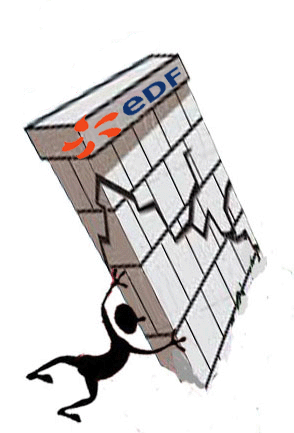
President Macron’s plan to avoid a politically explosive electricity price rise in France could cost EDF €8 billion, the French state-controlled energy group warned yesterday. The alert prompted a sharp sell-off in shares of EDF, which tumbled by 14.6 per cent, or €1.51, to close at €8.84 last night, as investors reacted with dismay to an order from the French government that the company must increase the amount of
cut-price electricity it sells to rivals to hold down prices for consumers.
EDF further spooked the markets by saying that it was extending the shutdowns of five nuclear reactors because of safety concerns, leading to a fresh cut to its electricity production forecasts. The group, which is leading the project to build Britain’s only new nuclear plant at Hinkley Point in Somerset, said that it was unable to calculate the exact financial consequences of the last salvo of bad news and withdrew its profit guidance for the year. It said that it would “consider appropriate measures to strengthen its balance sheet structure and any measure to protect its interests”.
Times 15th Jan 2022
A hopeless pursuit? National efforts to promote small modular nuclear reactors and revive nuclear power.
This article examines national efforts
in three countries, Canada, the UK, and the United States, which are
pursuing SMRs vigorously and where the government has funded their
development generously.
We compare the different strategies and foci of
these national strategies, analyzing the various forms of support offered
by the separate agencies of the government, and the private companies that
are trying to develop SMRs.
We also offer an overview of the different
types of reactor technologies being pursued in these different countries.
Following these, we outline the main challenge confronting SMR
technologies: their ability to generate electricity in an economically
competitive manner, highlighting the problems resulting from economies of
scale being lost. By examining the experience so far, we find that even
designs based on well-tested technology cannot be deployed till after 2030
and the more radical designs might never be.
Wires Energy & Environment 12th Jan 2022
https://wires.onlinelibrary.wiley.com/doi/epdf/10.1002/wene.429
Global heating linked to early birth and damage to babies’ health, scientists find
Global heating linked to early birth and damage to babies’ health, scientists find
Studies show high temperatures and air pollution during pregnancy can cause lifelong health effects
Labour tries to curb cost overruns from Sizewell C development
Bill Bordass, Research and Policy Adviser for the Usable Buildings Trust said: ‘Surely the only sensible way to curb Sizewell C is to scrap it entirely? It is just good money after bad.’
Labour bids to curb cost overruns from Sizewell C development, https://100percentrenewableuk.org/labour-bids-to-curb-cost-overruns-from-sizewell-c-development, David Toke, 16 Jan 22, The Labour frontbench has put down an amendment to the Nuclear Financing Bill which would stop the automatic reimbursement of EDF for excess construction costs of the planned Sizewell C nuclear power plant. The amendment, put forward by Shadow Green New Deal and Energy Minister Alan Whitehead, has been defeated by the Conservative majority in the Commons, but will soon come up for a vote in the House of Lords.
The Nuclear Financing Bill sets up a so-called Regulated Asset Base (RAB) means of funding nuclear power. This means the constructors would be be paid for the construction costs before the plant was generating anything. It would save the constructors money whilst making the project a lot more expensive for the energy consumer in the (most likely) event that the project experienced considerable cost overruns.
Although the SNP has also put down useful amendments to make the Government publish details of the costs of the project, Labour’s proposed amendment is potentially significant in that it could, if taken literally, dissuade EDF from moving ahead with any deal to build Sizewell C. As Whitehead told the Commons, analysis of historical experience of building nuclear power plant it is a near certainty that there will be cost overruns on the project.
In fact Whitehead implied he was not trying to stop the project, but merely argued that cost overruns should not automatically be added to consumer bills. If there were cost overruns then the Government could find the extra money to pay for the project from some other source.
Amongst other things, the SNP amendments asked that the Government should have to make public whether Sizewell C was being given a guarantee that its generation would be paid a minimum price for each MWh produced. Labour also sought to block nuclear power plant being owned by foreign companies, although it was argued this would not affect Sizewell C.
Labour joined forces with the Conservatives to vote through the Bill on the Third Reading, with the SNP, the Liberal Democrats and the Green Party whipping against the Bill.
It ought to seem strange that at the very time there is concern about increased energy bills and strident calls to cut back on green levies from some Tory MPs, the very same MPs are unquestioningly voting through a piece of legislation that will add substantial sums onto consumer bills. EDF has said that Sizewell C will cost £20 billion. Considering that interest charges and also cost overruns will have to be added to this sum the total cost may very plausibly amount to £30 billion or more – and that represents more than £1000 for each household in the UK.
The amount of energy generated by Sizewell C will only be of the order of the next tranche of renewable energy projects (to be issued in the coming moths) that will cost the consumer effectively nothing. By contrast Sizewell C will likely not even be seriously begun until Hinkley C is completed (2027?) which means a 2035 or later start. The UK could have deployed a lot more renewable energy by then of course at much lower cost. The current nuclear crisis in France demonstrates how unreliable nuclear power can be.
Bill Bordass, Research and Policy Adviser for the Usable Buildings Trust said: ‘Surely the only sensible way to curb Sizewell C is to scrap it entirely? It is just good money after bad.’
The Commons debate details can be seen here. The House of Lords is due to vote on the Bill in the coming days.
10 out of 56 French nuclear reactors are currently shut down
“They are very anxious”: EDF in the face of nuclear reactor
breakdowns. Ten reactors out of 56 are shut down, i.e. 20% of French
nuclear production capacity. “In winter, the availability of the nuclear
fleet has never been so low”, observes RTE, the manager of the high voltage
network.
The black series continues for EDF. Thursday, January 13, the
group announced that a fourth nuclear reactor, Penly 1, in Seine-Maritime,
was affected by a corrosion problem on its safety injection system – a
device of capital importance in the event of a accident. His shutdown has
been extended until the end of May. Reporterre takes stock of the
situation.
Reporterre 15th Jan 2022
https://reporterre.net/Ils-sont-tres-angoisses-EDF-face-aux-pannes-de-reacteurs-nucleaires
https://nuclearinformation.wordpress.com/
AUKUS an unwelcome guest at the table of nuclear disarmament.

AUKUS is emblematic of a belligerence that is at odds with moral and ethical demands for the future. It posits a vision of military aggression and confrontation that increase the risk of war and war turning nuclear; and concedes authoritarianism and lack of debate as defining principles for the present
AUKUS an unwelcome guest at the table of nuclear disarmament, Pearls and Irritations,
By Sanjay BarboraJan 16, 2022 Despite many shortcomings, the Non-Proliferation Treaty remains a symbol of an inconsistent effort to ensure a world without threats of nuclear war.
The 2022 Review Conference (RevCon) of the Parties to the Nuclear Non-Proliferation Treaty (NPT) which was to meet from January 4 to 28 in New York has been postponed because of the resurgent virus. Consultations are under way to set a new meeting time.
………………As governments and civil society consider their priorities for the review conference, what then are we to expect? This question assumes greater significance for Australia, as the country’s leaders respond to the changing climate following the hastily announced AUKUS trilateral pact for the supply of nuclear-powered submarines to Australia in 2021.
Three closely related aspects ought to be considered by the country’s decision makers as they address the review conference. They are (a) Australia’s commitment to international obligations, (b) security implications of the proposed AUKUS submarines, and (c) reactions within civil society, either as they exist now or as may be anticipated in the future.
………………. In the past, Australia’s stated position was to aim for greater accountability from the Nuclear Weapons States (NWS), while widening the scope of non-nuclear weapons states (NNWS) to pursue the development of domestic nuclear energy. However, this position was undermined by its active opposition to and attempts to derail the Treaty on the Prohibition of Nuclear Weapons (TPNW) adopted by the UN General Assembly in 2017.
A decision to acquire nuclear-powered submarines under the AUKUS partnership would threaten this fraught history with further uncertainties. It would offer the United States an even greater say in Australian foreign policy in the Asia-Pacific-Indian Ocean region.
The specious defence that eight-nuclear propelled submarines do not constitute a breach of Australia’s commitment to nuclear disarmament and non-proliferation has two obvious problems.
Firstly, politicians and political commentators have made it clear that current tensions with China have played a substantial role in the current government’s decision to override earlier agreements for creating domestic capacities to build submarines with French support.
Secondly, this dystopian vision of a future world of nuclear showdowns could encourage governments of other NNWS in the region and elsewhere to follow a similar disingenuous narrative for nuclear militarisation.
In any case, the pathway from civil use to military weaponisation remains an issue of concern, that any sovereign country might follow. This could undo several decades of Australian diplomacy that sought to place the country as a reliable partner for securing peaceful policies and development in the Asia-Pacific-Indian Ocean region.
AUKUS is emblematic of a belligerence that is at odds with moral and ethical demands for the future. It posits a vision of military aggression and confrontation that increase the risk of war and war turning nuclear; and concedes authoritarianism and lack of debate as defining principles for the present…………..
The NPT Review Conference, therefore offers an opportunity to revive Australian civil society’s responsibility to reiterate its commitment to regional and global peace and a world free of nuclear weapons.
Professor Sanjay Barbora, Tata Institute of Social Sciences, India, is a Research Affiliate with the University of Melbourne’s Initiative for Peacebuilding. This article was stimulated by a closed-door roundtable discussion, “Would AUKUS undermine the NPT?” hosted by the Initiative for Peacebuilding on December 10. https://johnmenadue.com/aukus-an-unwelcome-guest-at-the-table-of-nuclear-disarmament/
Swedish police hunt for drone seen flying over Forsmark nuclear station.

Police in Sweden deployed patrols and helicopters to the Forsmark nuclear
plant to hunt for a large drone seen flying over the site late on Friday,
but were unable to catch the unmanned vehicle, they said on Saturday. The
incident came a day after Sweden’s military started patrolling the main
town on the Baltic Sea island of Gotland amid increased tensions between
NATO and Russia and a recent deployment of Russian landing craft in the
Baltic.
Reuters 15th Jan 2022
Horrors of Hiroshima, a reminder nuclear weapons remain global threat

UN News, 15 January 2022, Peace and Security, Despite the annihilation of two major Japanese cities in 1945, atomic bombs have not been relegated to the pages of history books, but continue to be developed today – with increasingly more power to destroy than they had when unleashed on Hiroshima and Nagasaki back in 1945.
Those first nuclear weapons deployed by the United States, indiscriminately killed tens of thousands of non-combatants but also left indelible scars for the immediate survivors, that they, their children and grandchildren still carry today.
“The Red Cross hospital was full of dead bodies. The death of a human is a solemn and sad thing, but I didn’t have the time to think about it because I had to collect their bones and dispose of their bodies”, a then 25-year-old woman said in a recorded testimony, 1.5 km from Hiroshima’s ground zero.
“This was truly a living hell, I thought, and the cruel sights still stay in my mind”
To highlight the tireless work of the survivors, known in Japanese as the hibakusha, the UN’s Office for Disarmament Affairs, created an exhibition at UN Headquarters in New York which has just come to a close, entitled: Three Quarters of a Century After Hiroshima and Nagasaki: The Hibakusha—Brave Survivors Working for a Nuclear-Free World.
It vividly brings to life the devastation and havoc wreaked by those first atomic bombs (A-bombs), and their successor weapons, the more powerful hydrogen bombs (H-bombs) which began testing in the 1950s
Quest to save humanity
In the aftermath of the bombings in Japan, the hibakusha, conducted intense investigations with the aim of preventing history from repeating itself.
With an average age of 83 today, the dwindling band continue to share their stories and findings with supporters at home and abroad, “to sav[ing] humanity…through the lessons learned from our experiences, while at the same time saving ourselves”, they say, in the booklet No More Hibakusha -Message to the World, which accompanies the exhibit.
Recounting the day in Hiroshima that 11 members of her family slept together in an air raid shelter, a then 19-year-old woman spoke of how three small children died during the night, while calling for water.
“The next morning, we carried their bodies out of the shelter, but their faces were so swollen and black that we couldn’t tell them apart, so laid them out on the ground according to height and decided their identities according to their size”.
These brave survivors testify that peace cannot be achieved ever, through the use of nuclear weapons.
‘Absolute evil’
A group of elderly hibakusha, called Nihon Hidankyo, have dedicated their lives to achieving a non-proliferation treaty, which they hope will ultimately lead to a total ban on nuclear weapons.
“On an overcrowded train on the Hakushima line, I fainted for a while, holding in my arms my eldest daughter of one year and six months. I regained my senses at her cries and found no-one else was on the train”, a 34-year-old woman testifies in the booklet. She was located just two kilometres from the Hiroshima epicentre.
Fleeing to her relatives in Hesaka, at age 24 another woman remembers that “people, with the skin dangling down, were stumbling along. They fell down with a thud and died one after another”, adding, “still now I often have nightmares about this, and people say, ‘it’s neurosis’”.
One man who entered Hiroshima after the bomb recalled in the exhibition, “that dreadful scene – I cannot forget even after many decades”.
A woman who was 25 years-old at the time, said, “when I went outside, it was dark as night. Then it got brighter and brighter, and I could see burnt people crying and running about in utter confusion. It was hell…I found my neighbour trapped under a fallen concrete wall…Only half of his face was showing. He was burned alive”.Uniting for peace
The steadfast conviction of the Hidankyo remains: “Nuclear weapons are absolute evil that cannot coexist with humans. There is no choice but to abolish them”.
In August 1956, the survivors of the 1945 atomic bombs in Hiroshima on 6 August and Nagasaki three days later, formed the “Japan Confederation of A and H-Bomb Sufferers Organizations”.
Encouraged by the movement to ban the atomic bomb that was triggered by the Daigo Fukuryu Maru disaster – when 23 men in a Japanese tuna fishing boat were contaminated by nuclear fallout from a hydrogen bomb test at Bikini Atoll in 1954 – they have not wavered in their efforts to prevent others from becoming nuclear victims.
“We have reassured our will to save humanity from its crisis through the lessons learned from our experiences, while at the same time saving ourselves”, they declared at the formation meeting.
The spirit of the declaration, in which their own sufferings are linked to the task of preventing the hardship that they continue to carry, resonates still in the movement today…………………………………………….
The hibakusha became more and more vocal in the suffering that was inflicted upon them, hoping that it could help create a road map towards the abolition of nuclear weapons.
In oral testimonies, they shared their experiences both during and after the bombings and sent written messages to the NPT Review Conference in 2010 appealing to the world.
In July 2017, the Treaty on the Prohibition of Nuclear Weapons (TPNW), which complements the NPT, was adopted and came into force last year on 22 January……………………
the UN is committed to ensuring their testimonies live on, as a warning to each new generation.
The Hibakusha are a living reminder that nuclear weapons pose an existential threat and that the only guarantee against their use is their total elimination”, Mr. Guterres stated. “This goal continues to be the highest disarmament priority of the United Nations, as it has been since the first resolution adopted by the General Assembly in 1946”.
While the Tenth Review Conference of the NPT, which had been scheduled for January, has been postponed on account of the COVID-19 pandemic, he continued to urge world leaders to “draw on the spirit of the Hibakusha” by putting aside their differences and taking “bold steps towards achieving the collective goal of the elimination of nuclear weapons”. https://news.un.org/en/story/2022/01/1109602
The US and China Could Soon Be In Race For Nuclear-Powered Satellites.
The US and China Could Soon Be In Race For Nuclear-Powered Satellites, Defense One, 16 Jan 22,
An idea from the 1960s has found new backers., If future U.S. satellites are to dodge incoming Russian or Chinese fire, they’ll need better ways to move around than today’s fuel-intensive thrusters. That’s why the Pentagon is looking into nuclear-powered propulsion.
While leaders at the Space Force and the Pentagon Research and Development office remain publicly quiet about the idea of putting nuclear-powered spacecraft in orbit, the Mitchell Institute for Aerospace studies released a new report that argues for more focused work on it.
It isn’t a new concept. NASA and the Atomic Energy Commission were working toward a flight test for their nuclear rocket until the Vietnam War sapped the program’s funding. It was cancelled in 1973, and safety concerns have since scuttled further efforts………….
If future U.S. satellites are to dodge incoming Russian or Chinese fire, they’ll need better ways to move around than today’s fuel-intensive thrusters. That’s why the Pentagon is looking into nuclear-powered propulsion.
While leaders at the Space Force and the Pentagon Research and Development office remain publicly quiet about the idea of putting nuclear-powered spacecraft in orbit, the Mitchell Institute for Aerospace studies released a new report that argues for more focused work on it.
It isn’t a new concept. NASA and the Atomic Energy Commission were working toward a flight test for their nuclear rocket until the Vietnam War sapped the program’s funding. It was cancelled in 1973, and safety concerns have since scuttled further efforts……….
But one DARPA official, at least, suggests looking at the idea afresh. A 2020 policy change from the Trump White House has clearing the way for new research into nuclear propulsion, Micheal Leahy, the director of the tactical technology office at DARPA, told a virtual audience on Friday. Leahy’s office runs the DARPA Demonstration Rocket for Agile Cislunar Operations, or DRACO, program. Last April, DARPA awarded General Atomics a contract for a preliminary design of a reactor and propulsion subsystem, and gave Lockheed Martin and Blue Origin a contract for a spacecraft design.
But the bigger factor is thatChina is working along similar lines with planes to field its own nuclear-powered satellites by 2040. The lessons from the current gap in hypersonic missile technology should provide a cautionary tale, Leahy said.
“We had the lead in hypersonics, only to watch it go away. Right?… Now I’m in a tail chase,” he said. https://www.defenseone.com/technology/2022/01/us-and-china-could-soon-be-race-nuclear-powered-satellites/360792/
Cracks on safety-critical pipes in France’s nuclear reactors
Cracks on safety-critical pipes: the list of nuclear reactors concerned is
growing! At the beginning of the year, the four most powerful reactors in
the fleet, Chooz and Civaux, are shut down following the detection of a
worrying generic anomaly (cracks in a pipe of the safety injection system)
which concerns at least three of them.
On January 13, the Institute for
Radiation Protection and Nuclear Safety announced that reactor No. 1 of the
Penly nuclear power plant (Seine-Maritime) was also affected by this
defect, information confirmed by EDF. This discovery calls for a
questioning of safety control and French energy choices, based on nuclear
power whose supposed reliability is not there.
Sortir du Nucleaire 14th Jan 2022
https://www.sortirdunucleaire.org/Fissures-sur-des-tuyauteries-cruciales-pour-la
Can Santa Fe survive as a nuclear weapons suburb?
 | |||


Will Santa Fe “fold up,” democratically and spiritually, when this new “Manhattan” fully appears? Is the faith of that man of peace, St. Francis — the very name of this city — obsolete to political leaders in the city and the state?
Can Santa Fe survive as a nuclear weapons suburb? https://www.santafenewmexican.com/opinion/my_view/can-santa-fe-survive-as-a-nuclear-weapons-suburb/article_b6ab8ce8-7556-11ec-b47a-57273af4ebbc.html, By Greg Mello, 16 Jan 22,
Many Santa Feans understand that Los Alamos National Laboratory, the most lavishly funded nuclear weapons facility in the world, has embarked on a new mission: making plutonium warhead cores (“pits”) on an industrial scale, to involve 4,000 full-time personnel and 24/7 operations.
It’s among the dirtiest and most dangerous missions in the nuclear weapons complex, not seen at LANL since the 1940s. It’s centered in an old facility built for research and development, now to be driven far beyond its original capacity.
LANL predicts it will spend $18 billion to start up production over this decade. In constant dollars, this is 15-fold what the Manhattan Project spent in New Mexico — indeed it dwarfs the cost of every other project in New Mexico history.
The pits will cost at least $50 million apiece, 200 times their weight in gold. A single LANL pit, assuming all goes well, will cost as much as the combined annual salaries of 1,000 New Mexico teachers, or the equipment for 5,000 residential solar systems. A major reason our society is failing is because it is kept on a war footing.
This huge program has nothing to do with national security, except in the negative sense. It is not needed to maintain any stockpile weapon. As military planners say, it’s (very) “early to need” and there are now perfectly sound, cheaper plans to do without LANL’s production should something go wrong. Why wait?
After extensive analysis under both the Obama and Trump administrations, the National Nuclear Security Administration in 2017 firmly rejected what is now LANL’s pit plan. The New Mexico delegation fought back, enlisting congressional hawks to help blackmail the Trump administration into building an unheard-of two pit factories. Up to now, a barely functioning Congress has gone along with the game. Time will tell just how long this scam holds up.
LANL’s pit production, for all its cost and danger, just isn’t enough to support any foreseeable U.S. stockpile. If LANL is a pit factory, there will be two.
What about Santa Fe, then?
On July 18, 1945, Harry Truman wrote in his diary, “Believe [Japan] will fold up before Russia comes in. I am sure they will when Manhattan appears over their homeland.”
Will Santa Fe “fold up,” democratically and spiritually, when this new “Manhattan” fully appears? Is the faith of that man of peace, St. Francis — the very name of this city — obsolete to political leaders in the city and the state?
What exactly would Santa Fe stand for or mean if nuclear weapons — the ultimate in human disposability — became its main tangible product? When our schools and community colleges direct our young people into LANL’s “pipeline” of plutonium minions? Or do you suppose their potential for creativity, compassion and wisdom could be better developed in other ways, as the region faces the towering crises of the 21st century?
Can Santa Fe survive as a nuclear weapons suburb? It certainly can, as a kind of nuclear “Pottersville” — a sprawling, increasingly ugly “city” with growing inequality, a vacuum where shared ideals should be, with no real urban center or shared human purposes, its most cherished traditions washed away by too much money given to too few people doing “work” society doesn’t need or want. It would be a city divided against itself to be sure, with plenty of poverty, human tragedy and crime.
Santa Fe could be a city that aims for justice and peace, where the obligation of respect binding us together is fostered, where the potential of every child is honored. Those political values are incompatible with manufacturing more nuclear weapons.
Greg Mello is executive director of the Los Alamos Study Group.
Large drone observed over Forsmark nuclear station in Sweden
A large drone has been observed over the Forsmark nuclear power plant in
eastern Sweden. The police moved out but could not follow it. The drone at
Forsmark was observed at around 8 PM on Friday. At the same time, flying
objects were reported over the Ringhals nuclear power plants on the west
coast and Oskarshamn in the southeast of the country, and, eventually, a
possible drone was also reported at the decommissioned Barsebäck nuclear
power plant in Skåne.
Norway Today 15th Jan 2022
Luxembourg’s Energy Minister denounces France’s actions on promoting nuclear to Europe
Climate: “We are ten years old. In ten years, no new nuclear reactor
will be ready”. Luxembourg’s energy minister denounces France’s “double
game” and the lack of European democracy regarding the Commission’s project
to classify energies according to their contribution to the objectives of
“climate neutrality”. In an interview with Mediapart, Claude Turmes points
to “a major political error”.
Mediapart 15th Jan 2022
Finland: no plans for new nuclear , and Fennovoima project hampered by the Ukraine crisis
Nuclear energy gains support, but current producers plan no new reactors, Finland: Finland’s nuclear power producers do not plan to build more reactors, although support for nuclear is at record levels. Meanwhile plans for an entirely new plant could be hampered by the Ukraine crisis.YLE NEWS, 16 Jan 22,
Finland’s current nuclear power producers have no plans to build more reactors, even though support for nuclear energy is at higher than at any time in the past three decades.
Teollisuuden Voima (TVO), which operates the Olkiluoto power plant in Eurajoki, southwest Finland, is concentrating on powering up its long-awaited third reactor (OL3), which was started up on 21 December. The company has abandoned plans for a fourth reactor at the site after extensive cost overruns and delays with the OL3 project, which was to have been completed in 2009.
Majority-state-owned Fortum, meanwhile, is looking toward a possible decision to extend the life of its two reactors in Loviisa, southeast Finland.
The operating licences for the Loviisa units will expire in 2027 and 2030. But if Fortum applies for and obtains a continuing license, the reactors, completed in 1978 and 1980 with Soviet technology, could be operational until the late 2040s.
On Friday the Ministry of Economic Affairs and Employment gave a preliminary green light to extending the licenses by up to 20 years…………. A final decision could come later this year, pending consideration by the Environment Ministry and other official bodies.
………… However nuclear remained less popular than many other forms of energy, including solar power, which 87 percent said should be used more. That was followed by wind power (81 percent), hydroelectric (52 percent) and wood and other biofuel (52 percent).
The ET survey of 1,000 adults in Finland was carried out in October by IROResearch, which estimated the margin of error at 3.2 percentage points.
Ukraine crisis could affect Fennovoima project
Meanwhile plans to build Finland’s first entirely new nuclear power plant on the west coast remain up in the air. The Fennovoima consortium, which includes Fortum, hopes to build the plant on the Hanhikivi peninsula in Pyhäjoki as a turnkey delivery supplied by the Russian state-owned Rosatom Group. The plant has not been granted a construction license.
It was originally to have begun operations in 2020, but last year the company has set a target date of 2029 for commercial operations.
The Radiation and Nuclear Safety Authority (Stuk) said in August that Fennovoima had not yet handed over all of the requested documentation to proceed with an evaluation of its preliminary safety report.
“No actual plans have been presented to Stuk regarding the safety arrangements for the power plant itself and its operating environment,” it said in late August, adding that there had been “little progress” in the project’s construction readiness.
On Friday the business daily Kauppalehti reported that the Ukraine crisis could further complicate the Fennovoima venture. It noted that the plant’s reactor pressure vessel is to be manufactured in eastern Ukraine, 40-50km from a combat zone.
Fighting in the area could make it impossible for Stuk to carry out required inspection visits to the factory site. The plant is partly owned by Rosatom, which could be hit by western sanctions if Russia attacks Ukraine……. https://yle.fi/news/3-12272789
France’s nuclear company EDF in trouble, and with election looming
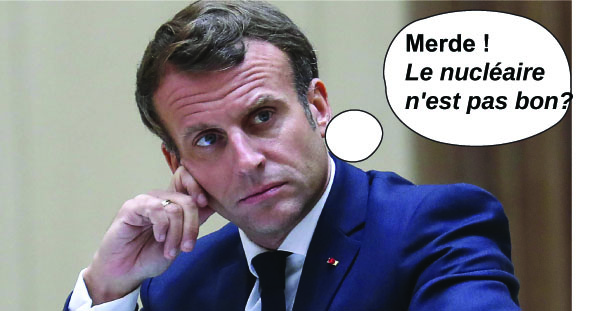
Emmanuel Macron facing the EDF and energy bomb. With the blocking of
regulated tariffs, to limit price increases to 4%. EDF will have to sell a
larger quantity of cheap nuclear electricity to its competitors. Panic wins
the company whose stock price has collapsed.
CEO Jean-Bernard Lévy has
just convened for Monday the “top 200”, the 200 highest executives of EDF.
We are already talking about a necessary recapitalization of EDF. Will the
state back to pot again? Or does the executive imagine calling on outside
investors? The question will be explosive three months before the
presidential election.
La Tribune 14th Jan 2022
1 This Month
Tell Congress: Prevent Nuclear Catastrophe in Iran

Tell Congress: Prevent Nuclear Catastrophe in Iran

Read the Public Inquiry Report, the Commissioners’ report, Surrendering Australia: The AUKUS Deception is available to download for free at aukuspublicinquiry.com. Or just watch the replay of the National Press Club Luncheon.


Shut down the radiation-damaged Heysham nuclear reactors now
To see nuclear-related stories in greater depth and intensity – go to https://nuclearinformation.wordpress.com

Say No to NASA’s Reckless Nuclear Reactor on the Moon
Say No to NASA’s Reckless Nuclear Reactor on the Moon
-
Archives
- November 2026 (238)
- October 2026 (302)
- September 2026 (339)
- August 2026 (330)
- July 2026 (355)
- June 2026 (287)
- May 2026 (306)
- April 2026 (356)
- March 2026 (251)
- February 2026 (267)
- January 2026 (308)
- December 2025 (358)
-
Categories
- 1
- 1 NUCLEAR ISSUES
- business and costs
- climate change
- culture and arts
- ENERGY
- environment
- health
- history
- indigenous issues
- Legal
- marketing of nuclear
- media
- opposition to nuclear
- PERSONAL STORIES
- politics
- politics international
- Religion and ethics
- safety
- secrets,lies and civil liberties
- spinbuster
- technology
- Uranium
- wastes
- weapons and war
- Women
- 2 WORLD
- ACTION
- AFRICA
- Atrocities
- AUSTRALIA
- Christina's notes
- Christina's themes
- culture and arts
- Events
- Fuk 2022
- Fuk 2023
- Fukushima 2017
- Fukushima 2018
- fukushima 2019
- Fukushima 2020
- Fukushima 2021
- general
- global warming
- Humour (God we need it)
- Nuclear
- RARE EARTHS
- Reference
- resources – print
- Resources -audiovicual
- Weekly Newsletter
- World
- World Nuclear
- YouTube
-
RSS
Entries RSS
Comments RSS

