European Union lawmakers move to reject inclusion of nuclear energy as ‘green’

EU lawmakers move to reject green gas and nuclear investment rules, Reuters, By Kate Abnett and Simon Jessop
- Summary
- Greens, Socialists and Democrats oppose proposed rules
- Parliament vote on taxonomy proposal due by July
- EU advisers launch report on other environmental criteria
BRUSSELS, March 30 (Reuters) – At least two groups of European Union lawmakers have confirmed they will reject an EU proposal to label gas and nuclear energy as sustainable investments, officials said on Wednesday.
Reporting by Kate Abnett, Simon Jessop, editing by Ed Osmond………… (registered readers only) https://www.reuters.com/business/sustainable-business/eu-lawmakers-move-reject-green-gas-nuclear-investment-rules-2022-03-30/
War in Ukraine has produced a new energy crisis. Energy efficiency is the fastest way to address this.

| Vladimir Putin’s war in Ukraine is good reason to “crank with wartime urgency” the mass insulation of buildings and deployment of renewables, energy conservation pioneer Amory Lovins declares in an interview with the Guardian. “We have a new energy crisis, and efficiency is the largest, cheapest, safest, cleanest, and fastest way to address it,” said Lovins, chair emeritus of the Snowmass, Colorado-based Rocky Mountain Institute (RMI) and adjunct professor of civil and environmental engineering at Stanford University. While new renewable technology usually gets more attention, he added, the time has come to focus on the energy efficiency measures that Lovins and others have been advocating for the last 50 years. Lovins also happens to be the grandchild of 20th century Jewish immigrants. from small villages in Ukraine. Most of his Ukrainian ancestors were murdered by the Nazis in the infamous 1941 massacre of Tarashcha, which resulted in the deaths of 14,000 Jewish Ukrainians. Eighty years later, fossil fuels are underwriting further vicious loss of life. But in the first two weeks of the war, western countries paid out €8 billion for oil and gas purchases from Russia, he told the Guardian. The Energy Mix 27th March 2022 https://www.theenergymix.com/2022/03/27/shift-to-energy-efficiency-could-pressure-putin-says-conservation-pioneer-lovins/ |
UN nuclear watchdog chief in Ukraine for safety talks

 | |||
UN nuclear watchdog chief in Ukraine for safety talks https://bellona.org/news/nuclear-issues/2022-03-un-nuclear-watchdog-chief-in-ukraine-for-safety-talks
The United Nations nuclear watchdog chief Rafael Grossi visited Ukraine on Tuesday unannounced to start providing assistance including experts and equipment aimed at keeping nuclear facilities there safe in the midst of war, apparently without Russia’s blessing. March 30, 2022 by Charles Digges
The United Nations nuclear watchdog chief Rafael Grossi visited Ukraine on Tuesday unannounced to start providing assistance including experts and equipment aimed at keeping nuclear facilities there safe in the midst of war, apparently without Russia’s blessing.

Grossi’s visit comes as seasonal wildfires are ripping unchecked through the irradiated area surrounding Chernobyl, the defunct nuclear power plant that was seized by Russian troops on February 24. Ukrainian officials have said the blazes within the 2,600 square kilometer exclusion zone around the disaster site could bear radiation aloft to surrounding territories and across borders.
Since Russia invaded Ukraine last month, Grossi has called on both countries to agree a framework to ensure nuclear facilities, including spent nuclear fuel storage facilities at Chernobyl and Europe’s biggest nuclear power plant at Zaporizhzhya, are kept safe and secure.
International Atomic Energy Agency chief Grossi has so far failed to obtain such an agreement or even a three-way meeting with Ukraine and Russia. He had hoped to convene one at Chernobyl, which like Zaporizhzhya continues to be held under Russian control. He met the Ukrainian and Russian foreign ministers separately in Turkey almost three weeks ago.
On Wednesday Grossi appeared to make some progress, posting on Twitter that he had met with Ukraine’s energy minister and the head of Energoatom, the state company that oversees the country’s nuclear industry.
IAEA’s on-site presence will help prevent the danger of a nuclear accident that could have severe public health and environmental consequences in Ukraine and beyond,” Grossi wrote.
On Monday, Lyudmila Denisova, commissioner of the Verkhovna Rada of Ukraine for human rights said the wildfires around Chernobyl have led to an increased level of radioactive air pollution that could threaten neighboring European countries.
She attributed the fires to Russian combat in the region, saying 31 blazes have been recorded, and she called on the IAEA to send firefighters and equipment to help tackle them.
“Control and suppression of fires is impossible due to the capture of the exclusion zone by Russian troops,” Denisova wrote in a Facebook post Sunday. “As a result of combustion, radionuclides are released into the atmosphere, which are transported by wind over long distances.”
The IAEA’s Grossi has not yet commented on the blazes, but their presence contributed to fears of yet more mishaps as Ukraine’s nuclear infrastructure falls under Russian fire.
Since the Chernobyl plant fell into Russian hands, nearby combat has cut power to the site twice, jeopardizing cooling processes for 22,000 spent nuclear fuel rods stores on plant territory. Ventilation is also required to tamp down radiation levels below the New Safe Confinement, a giant steel dome that was installed over the sarcophagus of Chernobyl’s Unit Four reactor, which exploded in 1986.
Power has since been restored, but the IAEA has reported it no longer has access to data transmitted by radiation sensors at the site.
At the Zaporizhzhya plant, a March 4 rocket strike destroyed a training laboratory. Like Chernobyl, the Zaproizhzhya’s plant’s staff is now essentially hostage to invading Russian forces – a situation that worries the IAEA. Since then, the Russian military has detonated ordinance at the plant that remained unexploded during its attack. The IAEA said that both the reactors and radiation levels remained safe after that incident.
Russians have also twice shelled the site of a US funded research reactor and nuclear research facility in the northeastern city of Kharkiv. The reactor’s fuel had reportedly been withdrawn prior to the onset of war and the IAEA said chances for an uncontrolled chain reaction at the site are low.
He also visited the South Ukraine nuclear power plant, whose three reactors are thought to be in the crosshairs of advancing Russian troops.
Those yearning for regime change in Russia rarely consider what might come next
George Kennan and the Russian future The late US diplomat saw that those yearning for regime change in Russia rarely considered what might come next, Asia Times, By JAMES CARDEN, MARCH 29, 2022

US President Joe Biden’s ill-advised and reportedly ad-libbed call for regime change in Russia last week implicitly raised the question what kind of government Washington has in mind should President Vladimir Putin be deposed or voluntary step down ahead of Russia’s 2024 presidential election.
Biden’s line of what might charitably be called “thinking” has long tempted American policymakers. Writing in 1951, the diplomat George F Kennan observed:
“The very virulence with which Americans reject the outlook and practice of those who now hold power in the Kremlin implies in the strongest possible way the belief in, and desire for, an alternative – for some other Russian outlook and some other set of practices in Russia to take the place of those we know today.
“Yet it may be permitted to ask whether there is any clear image in our minds of what that outlook and those practices might be and of the ways by which Americans might promote progress toward them.”
These are the opening lines to Kennan’s Foreign Affairs essay “America and the Russian Future,” an indispensable corrective to the kinds of magical thinking that mark Washington’s current approach toward Russia and the world.
The planning for regime change in Russia has been under way for at least a decade. In an e-mail congratulating a State Department aide on her promotion to the White House national security staff, then-secretary of state Hillary Clinton wrote, “… we need you at the White House to help plan and execute our Russian strategy post-Putin.”
Biden’s speech last weekend at the Warsaw Castle gave a clue as to what he and the US foreign-policy establishment have in mind “post-Putin.” In Biden’s telling, “Over the last 30 years, the forces of autocracy have revived all across the globe.” And Russia, which “has strangled democracy” at home, now seeks to do so elsewhere.
Biden’s speech attempted to recast the war in Ukraine as part of a larger battle “between democracy and autocracy, between liberty and repression, between a rules-based order and one governed by brute force.”………………………………………………….
Washington’s attempt to remake Russia socially, economically and politically in the 1990s quite inadvertently resulted in the Russia we are confronted with today.
So why does Washington insist on believing that its attempts to reshape Russia from the outside will somehow, someday work out?
Kennan himself was under no such illusions:
“Of one thing we may be sure: No great and enduring change in the spirit and practice of government in Russia will ever come about primarily through foreign inspiration or advice. To be genuine, to be enduring and to be worth the hopeful welcome of other peoples such a change would have to flow from the initiative and efforts of the Russians themselves.”
The sooner President Biden and his advisers come around to the late George Kennan’s way of thinking regarding the desirability of regime change, the better. https://asiatimes.com/2022/03/george-kennan-and-the-russian-future/
7 wildfires in Chernobyl Exclusion zone exceed Ukraine’s emergency classification tenfold.

Seven wildfires have broken out in the exclusion zone surrounding the
Chernobyl Nuclear Power Plant, the site of the world’s worst nuclear
disaster, according to a statement by Ukraine’s Parliament. The fires,
which were observed via satellite, exceed Ukraine’s emergency
classification criteria tenfold.
Ukrainian officials stated that the fires
were caused by “the armed aggression of the Russian Federation, namely
the shelling or arson,” though this has not been independently verified.
Wildfires risk mobilizing and dispersing radioactive contaminants left over
from the 1986 nuclear accident at Chernobyl.
Bulletin of Atomic Scientists 23rd March 2022
Wildfires break out in Chernobyl amid a non-functioning radiation-monitoring system
Ukraine’s Ministry of Defense warns on radioactivity danger from the Chernobyl Excusion Zone
Ukraine’s Ministry of Defense warned yesterday that the Russian
occupation of the Chornobyl Exclusion Zone dramatically increases the risk
of the release of significant amounts of radioactive dust into the
atmosphere that could contaminate not only Ukraine but nearby European
countries.
According to the Ministry, Russian military transport, rockets,
artillery shells, and substandard mortar ammunition stored a few hundred
meters from the nuclear power plant run a high risk of detonation. The
Chornobyl Nuclear Power Plant and facilities in the Exclusion Zone have
been under the control of the Russian military since 24 February, the first
day of the Russian invasion of Ukraine. Regulatory control over the state
of nuclear and radiation safety at the site is impossible.
Byline Times 28th March 2022
UK’s energy security strategy delayed, as Cabinet split on nuclear power, and the Regulated Asset Base plan to pay for it.
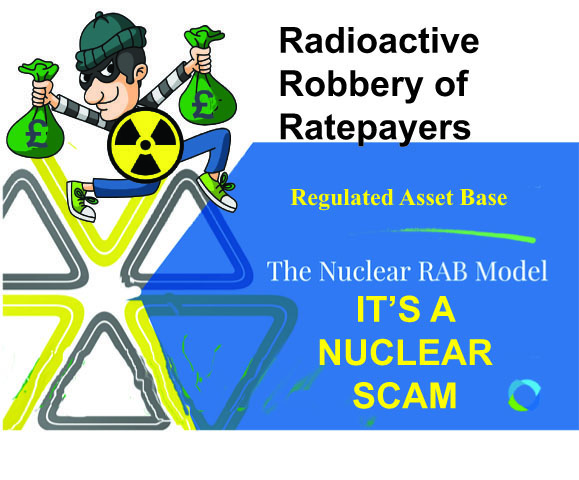
| Disagreements between Boris Johnson and Rishi Sunak over the cost of investment in new nuclear power stations have forced the government to again delay its energy security strategy. The prime minister promised to publish the strategy this month after Russia invaded Ukraine. Its publication has been repeatedly put back amid cabinet disagreements over fracking, onshore wind and the extent of government support for energy efficiency projects. Senior sources told The Times that while most issues had been settled, disagreements between No 10 and the Treasury over the extent to which new nuclear power should feature in the plan caused the latest delay. Last week Johnson told nuclear industry bosses that the government wanted the UK to get 25 per cent of its electricity from nuclear power, requiring up to six new large-scale stations. Sunak is understood to be concerned at the cost of such a commitment, arguing it represents poor value and would lead to substantial long-term increases in energy bills. He is thought to be pushing Johnson to limit the government’s commitment to two plants on top of one being built at Hinkley Point. The Treasury’s argument has been boosted by the National Infrastructure Commission that has warned large-scale nuclear power plants are “incredibly difficult to deliver on short timescales”. It has pointed out that even if the government gave the go-ahead for more nuclear power stations and they took as long as the Hinkley Point C project is expected to take, they would not come online until the mid-2040s. They have urged ministers to look at “alternatives” that are more likely to be deliverable at scale in the next 15 years. Ministers are legislating for a new model to fund nuclear power plants to make them attractive to investors. But critics say the regulated asset system would place the burden for delays and cost overruns on consumers and increase energy bills. Supporters of new nuclear power, including Johnson and Kwasi Kwarteng, the business secretary, argue that investing now is a “no regret” policy as demand for electricity is forecast to double in the transition to net zero. It is understood the strategy is now due next week. If that slips, the Easter recess and rules on what the government can say before the May elections could push it beyond the Queen’s Speech. Times 29th March 2022 https://www.thetimes.co.uk/article/cabinet-split-on-nuclear-power-delays-uk-energy-strategy-nmfznj377 |
UK’s Treasury and Chancellor of the Exchequer srongly resisting Boris Johnson’s push for costly nuclear power.
Boris Johnson and Rishi Sunak’s nuclear fallout sparks fresh delays to
UK energy security strategy. The Prime Minister is pushing for six to seven
new large nuclear power stations, but the Chancellor is concerned about the
massive cost. The proposals are being strongly resisted by the Treasury,
with the Chancellor concerned that the vast investment in nuclear would not
provide the taxpayer with value for money.
It has meant that the energy
package has been kicked further down the road, despite Mr Johnson having
previously pledged to publish the proposals at the start of the month. The
plans are also expected to include ways to produce more energy from
renewables, and increase North Sea oil and gas production. The Prime
Minister’s spokesman denied that they were being delayed because of a
disagreement, instead stating that it was “important we get these things
right”.
iNews 28th March 2022
Promoting nuclear risks to reduce greenhouse emissions is the classic jump from the frying pan into the fire!
Nuclear Reaction , City Weekly By Katharine Biele @kathybiele 30 Mar 22,
”…….state Auditor John Dougall wondered on KCPW 88.3 FM about the “really green” option of nuclear power. Why they call it green is curious because nothing grows from nuclear energy, Public Citizen makes that really clear. There’s the mining of uranium and, of course, the waste issue. “Promoting nuclear risks to reduce greenhouse emissions is the classic jump from the frying pan into the fire!” Public Citizen says. https://www.cityweekly.net/utah/nuclear-reaction/Content?oid=18146456
Spending £4bn on a new nuclear station at Sizewell will not solve the government’s energy problems
Spending £4bn on a new nuclear station at Sizewell will not solve the government’s energy problems
Instead of sensible short-term measures to help those facing energy poverty, the government is focusing on a technology with a track record of failure Prospect Magazine
ByNick Butler March 30, 2022In the face of surging energy prices and the prospect of more problems as Europe turns off Russian gas supplies, the UK government is struggling to find a coherent energy policy. The latest move, a £4bn investment in the proposed new nuclear station at Sizewell, is both a mistake and an irrelevance. Private investors who are being asked to stump up the majority of the £20bn total cost should politely decline the offer
……………………………………………………………..There are no instant solutions but on and offshore wind and solar power could be increased relatively quickly at a reasonable cost. The government could also accelerate its investment in developing the crucial technology for energy storage. This would capture more of the power produced by every wind turbine and limit the need for back-up plants (usually requiring more gas) to deal with the times when the wind is not blowing. On top of this, direct support for simple measures to enable people to use energy more efficiently would limit demand and cut bills.
Instead of such sensible short-term measures, ministers have chosen to focus on a technology which has a track record of failure and which, even if it could be made to work, will take at least a decade to provide any new electricity supplies………….
Of all the available options, however, the choice of EDF’s European Pressurised Reactor (EPR) technology is the worst from any perspective.
In 2009, EDF promised investors and the government at the time that the EPR to be built at Hinkley would produce power at a cost of less than £50 per MWhr. By Christmas 2017, we were told Hinkley would be onstream and providing the power to cook our Christmas turkeys. We were the turkeys for believing such claims.
Hinkley is still being built and 2027 now looks like the earliest date for production to begin. In France, the comparable EPR development at Flamanville—which was due onstream in 2013—is still unfinished, having experienced a series of crucial technical problems. In both cases the costs have overrun the original budgets by many billions.
Hinkley, if it ever comes onstream, will charge consumers £92.50 per MWhr index linked from 2013 when the deal was agreed. While the costs of renewables such as offshore wind have fallen dramatically over the last decade, the costs of nuclear power from Hinkley have continued to rise. After almost a decade of inflation, that price has already risen to around £110. Who knows what it will be in 2027?………….. https://www.prospectmagazine.co.uk/science-and-technology/spending-4bn-on-a-new-nuclear-station-at-sizewell-will-not-solve-the-governments-energy-problems
How would a nuclear winter impact food production?
How would a nuclear winter impact food production? Phys Org by Jeff Mulhollem, Pennsylvania State Univers 30 Mar 22, ” ………………………………………………………………. The research acknowledges what has been widely agreed upon for decades: In higher latitude countries—such as nuclear powers the U.S. and Russia—there would be no agricultural production and little food gathering possible in a nuclear winter after an all-out conflagration. If warring countries unleashed large portions of their nuclear arsenals, the resulting global, sun-blocking cloud would turn the ground to permafrost.
” ………………………………………………………………. The research acknowledges what has been widely agreed upon for decades: In higher latitude countries—such as nuclear powers the U.S. and Russia—there would be no agricultural production and little food gathering possible in a nuclear winter after an all-out conflagration. If warring countries unleashed large portions of their nuclear arsenals, the resulting global, sun-blocking cloud would turn the ground to permafrost.
A nuclear war would cause global blockage of the sun for several years due to injections of black carbon soot into the upper atmosphere, covering most of the planet with black clouds, the researchers said. Computer models predict that a large nuclear war, primarily between Russia and the U.S., could inject upwards of 165 million tons of soot into the upper atmosphere from more than 4,000 nuclear bomb explosions and ensuing wildfires.
Such a nuclear war could result in less than 40% of normal light levels near the equator and less than 5% normal light levels near the poles, with freezing temperatures in most temperate regions and severe precipitation reductions—just half of the worldwide average—according to the study. Post-catastrophe conditions, which could last 15 years in some wet tropical forests such as those in the Congo and Amazon basins, could cause a 90% reduction in precipitation for several years after such an event.
But tropical forests would offer an opportunity for limited food production and gathering by local inhabitants because, despite the dense soot clouds, the region would be warmer. In the study, researchers classified wild, edible plants into seven main categories, augmented by forest insects: fruits, leafy vegetables, seeds/nuts, roots, spices, sweets and protein.
In a nuclear winter, the study shows, the following foods would be available in varying degrees in tropical forests: konjac, cassava, wild oyster mushroom, safou, wild spinaches, vegetable amaranths, palms, mopane worm, dilo, tamarind, baobab, enset, acacias, yam and palm weevil.
The researchers chose 33 wild, edible plants from a list of 247 and considered their potential for cultivation in tropical forests in post-nuclear war conditions. Their selections were complicated by the fact that in the tropics there are relatively few food-bearing plants that are both drought tolerant and shade or low-light tolerant.
Post-catastrophe conditions would be unlivable for humans in many areas around the world, and agriculture may not be possible, the researchers concluded. This study shows how just a few of the many tropical wild, edible plants and insects could be used for short-term emergency food cultivation and foraging after an atmospheric soot injection from a catastrophic event such as a nuclear war……………… https://phys.org/news/2022-03-nuclear-winter-impact-food-production.html
EDF announces another delay and cost overruns to Hinkley Point C nuclear project
French energy giant EDF has revealed it will have to announce new delays
and cost overruns for its Hinkley Point C nuclear plant project in the UK.
The latest setback follows conflict in Ukraine, supply chain disruption and
inflationary pressures.
EDF last updated its construction schedule in
January 2021, when it said the UK’s first new nuclear plant to be built
in decades would be delayed by six months to June 2026. It revealed costs
would rise by an additional £500m to £23bn.
Originally, the plant was
expected to open in 2025 and had a construction budget of £18bn. However,
like similar nuclear new-build projects in Flamanville, France and
Olkiluoto, Finland, it has been subject to repeated delays and spiralling
costs. In a note to its 2021 annual report, EDF arued risks to schedule and
cost at completion targets had increased. The energy firm cited the ongoing
impact of the pandemic, Brexit, lower-than-expected civil performance and
tensions in global building materials markets.
22 Mar 22, https://www.cityam.com/edf-announces-another-delay-to-hinkley-point-c-nuclear-plant/
City AM 28th March 2022
Boris Johnson beholden to the nuclear industry. That’s going to cost UK bigtime – Chancellor Sunak not happy.
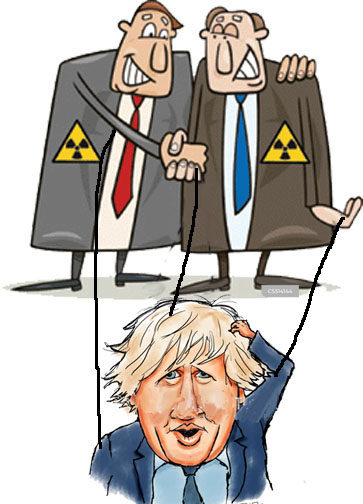
Boris Johnson’s flagship energy strategy has been held up over a row
with Rishi Sunak about funding a new generation of up to eight nuclear
power stations costing the public more than £13bn.
The strategy, which has
been delayed for a month, was due to be published this week but has now
been pencilled for 5 April after disagreement about the multibillion-pound
cost of new nuclear plants and amid ongoing tensions between the prime
minister and his chancellor, as well as the wider cabinet.
Johnson has told the nuclear industry that he wants 25% of electricity generation to come
from nuclear power by 2050, up from 16% now. Whitehall sources told the
Guardian this shift could require the building of about eight new nuclear
power stations. Draft targets suggest ministers are looking at 30GW of
nuclear power capacity, meaning a huge building programme would be needed,
as capacity is due to fall to 3.6GW as plants are decommissioned.
Of the eight UK plants currently in operation, all but one are due to be switched
off by 2030. Each new plant would require the government to take a minority
stake in the project to reduce the risk to developers, and substantial cash
outlay to encourage investment.
Despite Johnson’s keenness for new
nuclear power, Sunak is concerned about the cost to the taxpayer, or extra
costs added to soaring energy bills. The Treasury has already promised
£1.7bn of direct cash for a single large-scale nuclear project – the
£20bn Sizewell C – as well as £120m for a new Future Nuclear Enabling
Fund, which aims to address barriers to entering the sector.
Building eight plants could cost more than £13bn in initial investment costs from the
government if the same amount of investment were to be put in, according to
a Whitehall source. However, the government is also pushing for the nuclear
industry to reduce its build costs.
Guardian 28th March 2022
Climate crisis worsened by population and economic growth
Climate crisis worsened by population and economic growth
David Shearman
Existing climate change issues are being exacerbated by increasing population and dwindling resources.
Frenzy for selling bunkers, but they might not be much use, really.
‘Our top search term is nuclear’: US bunker sales soar as anxiety over Russia rises, Guardian, Bradley Garrett, 31 Mar 2022
Gary Lynch is the CEO of Rising S Company in Texas. When I first visited his warehouse in 2018, I watched his crew assemble, deliver, and bury a handful of bunkers in people’s backyards every month. The bunkers are thick plate steel boxes that are welded together like a giant Lego set – the size of the bunker limited only by a client’s resources.
Sales, he says, have spiked 1,000% since that time as anxieties around the pandemic, civil unrest, climate change and war have driven more buyers to his company………………………………………..
Business has never been so good. My inbox has been flooded in recent weeks by emails from preppers sensing an opportunity. One from the California-based Vivos Group, cautioned “…with all hell now breaking loose in Ukraine, and the beginning of what may be WW3, you are probably wishing you had secured a Vivos bunker”…………………………………………………………
bunkers fail to keep out many other threats.
Larry Hall, the developer who built Survival Condo, the most expensive and lavish private bunker in the world, almost died last year after contracting the Delta variant. A bunker doesn’t act as an effective bulwark against disease, and he never ended up pulling residents in and shutting the blast doors in any case, given the incremental and unpredictable spread of the virus.
It’s also the case that many of those who sell bunkers meant to assuage our anxiety are shysters. A few of the bunkers I have tried to visit never existed. The Oppidum in the Czech Republic and Vivos Europa One in Germany, for instance, turned out to be little more than a CGI pipe dreams. (The latter, offering $2m apartments in “shell condition” is described on the company’s website as “operational” but “ready for improvements”.) Some of these places had collected deposits from clients and never finished building. In one case, at Trident Lakes in Texas, the founder, John Eckerd, was arrested by federal agents after accepting a $200,000 wire transfer for the build-out that he thought was coming from a Colombian drug cartel. Eckherd was sentenced to 15 months in federal prison.
That’s why many of the preppers I’ve met are moving away from purchasing bunkers and towards a simpler model for resilience that mitigates almost all threats: they’ve sought rural properties where long-term stability could be achieved in off-grid communities, ranches and rural redoubts, where they learned to grow food away from (mostly urban) areas that are both geopolitical targets and sites for social friction……………………………..
1 This Month
Tell Congress: Prevent Nuclear Catastrophe in Iran

Tell Congress: Prevent Nuclear Catastrophe in Iran

Read the Public Inquiry Report, the Commissioners’ report, Surrendering Australia: The AUKUS Deception is available to download for free at aukuspublicinquiry.com. Or just watch the replay of the National Press Club Luncheon.


Shut down the radiation-damaged Heysham nuclear reactors now
To see nuclear-related stories in greater depth and intensity – go to https://nuclearinformation.wordpress.com

Say No to NASA’s Reckless Nuclear Reactor on the Moon
Say No to NASA’s Reckless Nuclear Reactor on the Moon
-
Archives
- November 2026 (224)
- October 2026 (302)
- September 2026 (339)
- August 2026 (330)
- July 2026 (355)
- June 2026 (287)
- May 2026 (306)
- April 2026 (356)
- March 2026 (251)
- February 2026 (267)
- January 2026 (308)
- December 2025 (358)
-
Categories
- 1
- 1 NUCLEAR ISSUES
- business and costs
- climate change
- culture and arts
- ENERGY
- environment
- health
- history
- indigenous issues
- Legal
- marketing of nuclear
- media
- opposition to nuclear
- PERSONAL STORIES
- politics
- politics international
- Religion and ethics
- safety
- secrets,lies and civil liberties
- spinbuster
- technology
- Uranium
- wastes
- weapons and war
- Women
- 2 WORLD
- ACTION
- AFRICA
- Atrocities
- AUSTRALIA
- Christina's notes
- Christina's themes
- culture and arts
- Events
- Fuk 2022
- Fuk 2023
- Fukushima 2017
- Fukushima 2018
- fukushima 2019
- Fukushima 2020
- Fukushima 2021
- general
- global warming
- Humour (God we need it)
- Nuclear
- RARE EARTHS
- Reference
- resources – print
- Resources -audiovicual
- Weekly Newsletter
- World
- World Nuclear
- YouTube
-
RSS
Entries RSS
Comments RSS

