Unusually high temperatures to hit western Europe this week
Unusually high temperatures to hit western Europe this week
Although nowhere near as extreme as in India and Pakistan, anomalous warmth will be affecting large portions of western Europe in the first significant heat of spring
Beaches near Sellafield contaminated with radioactive particles.
Radiation Free Lakeland has written to Cumbria Wildlife Trust asking them
to cancel the “Sea-Coastal Foraging Evening” at St Bees on 18th May.
Who doesn’t love to forage for food on the beach? The problem with
beaches near Sellafield (and not so near) is that radioactive particles are
routinely washed onto the beaches and into the abundant wild food found on
our beaches. Sellafield has blighted our coasts and continues to do so with
impunity thanks to the criminal nonchalance promoted by events like the one
organised by Cumbria Wildlife Trust. The risk to health is very real,
especially to the young and the pregnant.
Radiation Free Lakeland 15th May 2022
Strong community protest against planned Sizewell C nuclear plant for Suffolk

Sizewell C: Hundreds march against nuclear power plant after Government
decision delay. About 200 people turned up to protest against plans for a
£20bn nuclear plant on the east coast of England. A final decision on
Sizewell C in Suffolk has been delayed until July after the government said
it needed more time to look at new information.
Protesters marched to Sizewell beach, saying the delay was a “recognition of the project’s
problems”. A Sizewell C spokeswoman said the delay was “understandable
given the breadth of information after consultation”. Protesters from Stop
Sizewell C and Together Against Sizewell C, carried banners reading “chaos
coast coming soon”, “EDF-off” and “we don’t want to be beside the C”.
Alison Downes of Stop Sizewell C, said: “A decision to go ahead with
Sizewell C would be a wrong decision. “
EDF has clearly not taken this
community with them, and the government has totally betrayed the faith of
local people in due process by repeated commitments to Sizewell C when it
doesn’t have planning consent, let alone a final investment decision.”
Green Party co-leader Adrian Ramsay, who was at the rally, said:
“Renewably-generated electricity is now far, far cheaper and will deliver
far more sustainable jobs for Suffolk people and its independent businesses
than this expensive white elephant.”
BBC 15th May 2022
https://www.bbc.co.uk/news/uk-england-suffolk-61457234
Independent 15th May 2022
https://www.independent.co.uk/news/uk/sizewell-c-edf-suffolk-government-protesters-b2079466.html
Evening Standard 15th May 2022
https://www.standard.co.uk/news/uk/edf-suffolk-government-boris-johnson-french-b1000127.html
May 16 Energy News — geoharvey

Opinion: ¶ “The East Coast Diesel Crisis Highlights The Urgency For Widespread EV Adoption” • News on availability of diesel oil has some trucking companies worried, according to a report from FreightWaves. There are solutions that would help both truckers and everyone else. One critical solution is switching from diesel vehicles to EVs. [CleanTechnica] Tesla […]
May 16 Energy News — geoharvey
New IPCC Report: Addressing Climate Change Is Now About Damage Control — Mother Jones — Barbara Crane Navarro

This story was originally published by Grist and is reproduced here as part of the Climate Desk collaboration. Scientists have long warned that time is of the essence to stop emitting greenhouse gases into the atmosphere. 1,006 more words New IPCC Report: Addressing Climate Change Is Now About Damage Control — Mother Jones
New IPCC Report: Addressing Climate Change Is Now About Damage Control — Mother Jones — Barbara Crane Navarro
U.S.’s first Minister of Disinformation — Anti-bellum
Prior to her Fulbright grant in Ukraine, Ms. Jankowicz managed democracy assistance programs to Russia and Belarus at the National Democratic Institute for International Affairs [National Endowment for Democracy]. She received her MA in Russian, Eurasian, and East European Studies from Georgetown University’s School of Foreign Service, and her BA from Bryn Mawr College. Yaël […]
U.S.’s first Minister of Disinformation — Anti-bellum
Switzerland: NATO swallowing Europe’s few remaining former neutrals — Anti-bellum
ReutersMay 16, 2022 Analysis-Neutral Switzerland leans closer to NATO in response to Russia Switzerland’s fabled neutral status is about to face its biggest test in decades, with the defence ministry tilting closer to Western military powers…. The defence ministry is drawing up a report on security options that include joint military exercises with NATO countries […]
Switzerland: NATO swallowing Europe’s few remaining former neutrals — Anti-bellum
NATO doubles members since 1999, completes sweep of Nordic nations — Anti-bellum
Helsingin SanomatMay 16, 2022 Sweden applies for NATO membership, aiming to submit an application at the same time as Finland On Sunday, Finland made the decision to apply for membership of the military alliance NATO. Sweden made the same decision on Monday. Haavisto on Sweden’s NATO decision: “Feels very good” Minister of Foreign Affairs Pekka […]
NATO doubles members since 1999, completes sweep of Nordic nations — Anti-bellum
The week that has been , in nuclear news

Some bits of good news – Removal of over 200 dams in Europe has restored free flowing streams and migratory fish. Norway turns its back on gas and oil to become a renewable superpower.
Curiouser and curiouser. In Australia, and presumably in other ”developed” countries, the focus on squabbling political personalities, and on sporting celebrities, pretty much dominates the news, except for the continued coverage of Ukraine, seen through an American filter. Meanwhile, strangely lost in the background is the pandemic story, with new case numbers rocketing world-wide. Then there’s global heating – noted effects in California and Northern Australia – but what about India, Pakistan, Kenya, Bangladesh?
It is strange, and worrying, that the pandemic, climate change, and the heightened nuclear dangers have somehow slipped below the radar of public consciousness – but those threats are still there, even if it’s not nice to talk about them.
The Danger of Ignoring Julian Assange https://www.youtube.com/watch?v=P6bVl47kdNk
Ending the War of Attrition in Ukraine. Forgetting the apocalypse: why our nuclear fears faded – and why that’s dangerous.
Strategic partnership: U.S. pushes ASEAN to join crusade against Russia, China, Myanmar.
The Insanity Of Expanding Nuclear Energy. Poisoned legacy: why the future of power can’t be nuclear.
John Kerry warns a long Ukraine war would threaten climate efforts
Underwater drones could be the end of nuclear submarines. Underwater drones herald sea change in Pacific warfare.
UKRAINE. The horrible dangers of pushing a US proxy war in Ukraine – Atomic energy chief: Ukraine’s nuclear safety situation ‘far from being resolved‘. UN: There is ‘credible’ information Ukrainian forces are torturing Russian POWs .
EUROPE. GT: NATO’s northward expansion risks turning Europe into powder keg — Anti-bellum
NATO activating Black Sea battle groups — Anti-bellum
USA,
- Tulsi Gabbard Says Biden Is Risking Nuclear War With Russia Over Ukraine. Pentagon-Funded Think Tank Simulates War With China On NBC. The Export and Proliferation of Nuclear Technology . https://www.youtube.com/watch?v=L4nqUg3TOo0 $6 Billion to Keep Uncompetitive Nuclear Plants Alive.
- Anti- Russian hysteria. Alaska: U.S. revamps army for Arctic war with Russia, China. U.S. leads NATO war games in the Balkans .
- US military wants nuclear rocket ideas for missions near the moon. .
- Devious nuclear zealots at it again in Ohio – new Bill to lead to subsidising ”next-generation nuclear reactors’‘.
- COST OVERRUNS AT GEORGIA NUCLEAR REACTORS OFFER CAUTIONARY TALE Westinghouse Electric’s parent company wants to put the nuclear company on the market. Talen Energy subsidiary files for bankruptcy, company still plans nuclear data center, Company says.
- Company Agrees to Further Tests of Nuke Plant’s Wastewater.
- US House passes extension of Radiation Exposure Compensation Act.
- Meet the nuclear booster who could unseat an energy appropriator.
- Timely release of Netflix documentary on Three Mile Island nuclear accident.
UK.
- Drones seized at UK nuclear bases after a ‘swarm’ and reports of ‘red lights’.
- The future of nuclear waste: what’s the plan and can it be safe?
- Kwasi Kwarteng: Nuclear push may increase energy bills, minister admits. Regulated Asset Base system will transfer nuclear’s financial risks to the UK public, rather than the nuclear companies. Uncertain funding for Britain’s plans for new nuclear reactors. Boris Johnson’s UK ”nuclear renaissance” – now desperate for funding, pleads to USA. Cost of living: Ministers consider delaying nuclear power decommissioning to help ease crisis.
- Energy saving and renewables to create many more jobs than nuclear could.
- ‘Criminalising our right to protest’: UK green groups’ anger over public order bill
RUSSIA. Putin could use nuclear weapon if he felt war being lost – US intelligence chief.
FRANCE. French nuclear output down 20.2% in April.
ISRAEL. Yes, Israel Has Submarines Armed With Nuclear Weapons (We Think).
AUSTRALIA. Radioactive: Inside the top-secret AUKUS nuclear submarines deal. AUKUS nuclear submarine fallout: double-dealing and deception came at a diplomatic cost.nnnAustralian readers condemn the Morrison government’s AUKUS deal
The horrible dangers of pushing a US proxy war in Ukraine

If there is indeed a shift in strategy to another level of confrontation with Russia, we need to know what we’re getting into.
Responsible Stateccraft APRIL 27, 2022, Anatol Lieven,
To judge by its latest statements, the Biden administration is increasingly committed to using the conflict in Ukraine to wage a proxy war against Russia, with as its goal the weakening or even destruction of the Russian state.
This would mean America adopting a strategy that every U.S. president during the Cold War took great pains to avoid: the sponsorship of war in Europe, bringing with it the acute risk of escalation towards direct military confrontation between Russia and NATO, possibly ending in nuclear catastrophe. The U.S. and NATO refusal to support armed rebellions against Soviet rule in eastern Europe was obviously not based on any kind of recognition of the legitimacy of Communist rule and Soviet domination, but simply on a hard-headed calculation of the appalling risks involved to America, Europe and humanity in general.
……………………………… Lavrov compared the situation in terms of nuclear danger to the Cuban missile crisis. We might do well to remember in this context how very close humanity came to nuclear annihilation in the fall of 1962. At one point, the fate of the world depended on the wisdom and caution of just one Soviet naval officer on board a nuclear attack submarine: Commander (later Admiral) Vassily Arkhipov………..

Two of Lloyd Austin’s remarks are especially worth examining in some detail. The first is that weakening Russia is necessary in order to prevent it repeating its invasion of Ukraine elsewhere. This statement is either meaningless, hypocritical, or both. There is no sign that Russia wants to or indeed could invade any other countries. As far as an attack on NATO is concerned, the miserable performance of the Russian military in Ukraine should have made absolutely clear that this is a fatuous chimera. If Russia cannot capture cities less than 20 miles from Russia’s own border, the idea of an attack on NATO is ludicrous.
As far as Georgia, Moldova and Belarus are concerned, it already holds the positions it needs in these countries. Russia’s military presence in Armenia and Nagorno Karabakh is at the request of the Armenians themselves, and is indeed essential to protect them against Turkey and Azerbaijan. When it comes to combating Islamist extremism in Central Asia and elsewhere, Russia’s interests and those of the West are in fact aligned.
Lloyd Austin also stated that U.S. officials believe that Ukraine can “win” the war with Russia given the right equipment and support from the West. The question is what “winning” means. If it means preserving Ukrainian independence, freedom to join the European Union, and sovereignty over the great majority of Ukrainian territory, then this is a legitimate and necessary goal. Indeed, thanks to Ukrainian courage and Western weaponry, it has already to a great extent been achieved.
Moscow’s original goal of overthrowing the Ukrainian government and subjugating the whole of Ukraine failed utterly. Given the losses that the Russian military has suffered, it seems highly unlikely that Russia can capture any more large Ukrainian cities, let alone conquer the whole of Ukraine.
If however what is meant by victory is Ukrainian reconquest — with Western help — of all the areas lost to Russia and Russian-backed separatists since 2014, then this is a recipe for perpetual war, and monstrous losses and suffering for Ukrainians. The Ukrainian army has fought magnificently in defense of its urban areas, but attacking entrenched Russian defensive positions across open country would be a very different matter.
Moreover, since Russia has annexed Crimea and the vast majority of the Russian people believe that this is Russian national territory, no future Russian government could possibly agree to give it up. A goal of complete Ukrainian victory therefore does indeed imply the destruction of the Russian state — something that Russia’s nuclear arsenal exists to prevent.
There is however a fatal ambiguity involved in such statements. For if what they suggest is a U.S. commitment to help Ukraine to go on fighting until Ukraine has reconquered all of the territory taken by Russia since 2014, including Crimea, then this implies a permanent war with the destruction of the Russian state as its goal; for short of the collapse of the Russian state, no Russian government will surrender Crimea, and for geographical reasons, no Ukrainian victory on the ground can bring this about. Furthermore, while China has so far been very restrained in its support for Russia over Ukraine, Beijing could not possibly tolerate a U.S. strategy aimed at the destruction of the Russian state and the consequent complete isolation of China. https://responsiblestatecraft.org/2022/04/27/the-horrible-dangers-in-pushing-a-us-proxy-war-in-ukraine/
Poisoned legacy: why the future of power can’t be nuclear

Warfare, economic collapse, climate change itself – all of these increasingly real risks make nuclear sites potentially perilous places. Even without them, the dangers of atomic fission remain, and we must ask ourselves: are they really worth the cost?

the reactors promised by Gates’s TerraPower company are still at the computer-simulation stage and years away from construction. But his claim that in such reactors “accidents would literally be prevented by the laws of physics” must be taken with a pinch of salt, as there are no laws of war protecting either old or new reactors from attack. There is also serious concern that the rapid expansion in the number of plants, advocated as a way of dealing with climate change, will increase the probability of accidents. While new technology will help to avoid some of the old pitfalls, it will also bring new risks associated with untried reactors and systems. Responsibility for dealing with such risks is currently being passed on to future generations.
This is the second great risk from nuclear power: even if a reactor runs for its lifetime without incident, you still have a lot of dangerous material left at the end of it. Fuel from nuclear power plants will present a threat to human life and the environment for generations to come
The problem is that the underground store will still be contaminated in 300,000 years, and no one can predict what language our descendants will read or speak at that time, or what messages might convince them not to dig
Billions that would otherwise go to new nuclear infrastructure, with all the attendant costs of cleanup that continue for decades and beyond, should be pumped instead into clean energy.
Guardian, Serhii Plokhy, Sat 14 May 2022
On 10 October 1957, Harold Macmillan sent a letter to President Dwight Eisenhower. The question he asked his US counterpart was: “What are we going to do about these Russians?” The launch of the Sputnik satellite six days earlier had carried with it the threat that Soviet military technology would eclipse that of the west. The prime minister was hoping to boost British nuclear capabilities, and was desperate for US cooperation.
On that same day, however, the UK’s most advanced nuclear project went up in flames – putting the knowledge and bravery of its best scientists to the test, and threatening England’s peaceful countryside with a radiological disaster.
Britain’s first atomic establishment had been hurriedly put together after the second world war. It had turned the small village of Seascale, on the Cumbrian coast, into one of Britain’s most highly educated places, brimming with nuclear scientists and engineers. At the centre of this rarified new world were two buildings: Windscale piles No 1 and No 2. They were Britain’s first nuclear reactors, on a campus that for decades afterwards would be used to produce energy for the grid, but their primary purpose was to produce the material for a British bomb.
One atomic energy official would later refer to the piles as “monuments to our initial ignorance”, and it was ignorance about one particular nuclear phenomenon that almost led to disaster. “Wigner energy” is the energy that accumulates in the graphite blocks that make up the main body of the reactor while the fission reaction is taking place. If it’s not released in time, the energy can build up to such an extent that it ignites the graphite. Periodically, a special operation called “annealing” has to be undertaken in order to release the excess energy.
Macmillan wanted Windscale to produce more plutonium and tritium for a hydrogen bomb as quickly as possible. But annealing required stopping the reactor. The Windscale Technical Evaluation Committee decided it would be safe to do it less often. Managers had scheduled the annealing of Pile No 1 for early October 1957, but it was long overdue.
It began at 11.45am on 7 October, under the supervision of physicist Ian Robertson. Everything seemed to go according to plan, ……………… Robertson was back at the pile for 9am the following day. …..The temperature in the pile was not behaving as predicted and it was a challenge to keep things stable. The operators managed to maintain control for the rest of the day and night, but on 9 October the temperature began to rise again. As the situation became critical, no one could tell what was going on inside the pile…………there it was – a fire at the face of the reactor.” Normally it was dark, but now the channels were glowing bright red from the soaring temperature.
Aratcheting up of tensions with Russia, a global pandemic and a scramble for nuclear energy with potentially deadly consequences. The echoes of 1957 are powerful, and though much has changed, we would do well to heed them.
When Russia launched its missiles at targets deep inside Ukrainian territory on 24 February, 2022, the shockwaves were felt far beyond that country’s borders. Outside politics, nowhere was the impact stronger than in the energy markets.. Prices that were already hitting historical highs jumped even higher. European countries immediately saw the need to wean themselves off dependence on Russian gas.
………… Nuclear energy – which, after all, provides France with 70% of its electricity – was quickly touted as a solution. In fact, a few weeks before the start of the war, President Emmanuel Macron had already announced a programme to construct 14 new nuclear reactors. In neighbouring Belgium, which had originally planned to phase out nuclear energy by 2025, a decision was made to extend the life of two reactors by an additional 10 years.
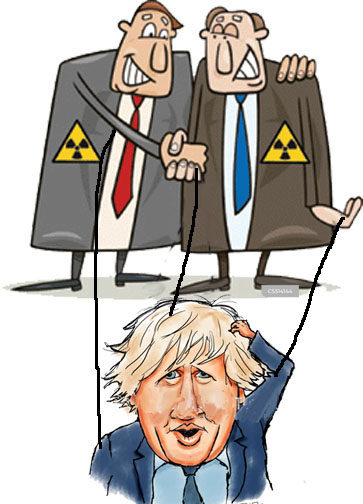
In the UK, Boris Johnson’s rhetoric extended even further. He announced “nuclear is coming home” (Calder Hall, right next to Windscale, was among the first civilian nuclear reactors in the world) and pledged to make it 25% of the nation’s electricity mix by 2050.
On the surface, the switch to nuclear makes sense. ………..
But the invasion also provided a chilling reminder of just why so many governments have treated nuclear power with great caution over the years. On the first day, Russian troops in unmarked uniforms took control of the Chernobyl nuclear power plant, the site of the worst ever nuclear disaster. On the following day, electronic monitors in the Chernobyl exclusion zone indicated sharp spikes in radiation levels as heavy equipment and trench-digging by Russian soldiers threw up contaminated dust.
The world woke up to an even more nightmarish reality a week later, when news arrived from the Zaporizhzhia nuclear power plant in southern Ukraine. Reports suggested that Russian forces had shelled the plant and set one of its buildings on fire. Russian troops left Chernobyl once they lost the battle for Kyiv, but they remained in Zaporizhzhia, further endangering the operation of Europe’s largest nuclear power station. On 26 April, Ukraine’s state-run atomic energy company reported that Russian missiles aimed at the town of Zaporizhzhia flew at low altitude over the reactor buildings.
What the Russian takeover of these nuclear facilities exposed is a hazard inherent in all nuclear power. In order for this method of producing electricity to be safe, everything else in society has to be functioning perfectly. Warfare, economic collapse, climate change itself – all of these increasingly real risks make nuclear sites potentially perilous places. Even without them, the dangers of atomic fission remain, and we must ask ourselves: are they really worth the cost?
The Windscale fire was eventually brought under control through a combination of scientific guesswork and sheer luck. Had it not been, the consequences could have been devastating. As it was, in 1982, the British National Radiological Protection Board estimated the death toll at 32 and attributed more than 260 cases of cancer to the fire. Windscale workers and engineers directly involved in the accident were more likely to die of circulatory system diseases and heart disease than the population of England and Wales as a whole. But there was virtually no difference in the disease rates of workers and their immediate neighbours in northwestern England, suggesting that the fire and other accidents at the complex affected not just the nuclear personnel but many who never crossed the threshold of the nuclear plant.
Continue readingThe dangers of atomic fission remain, and we must ask ourselves: are they really worth the cost?
Boris Johnson’s UK ”nuclear renaissance” – now desperate for funding, pleads to USA
| Kwasi Kwarteng seeks US investment for UK nuclear plants to end reliance on China. There are plans for expansion of nuclear power in Britain as part of a new energy security strategy following the invasion of Ukraine. The Business Secretary is to fly to the US this week to drum up American investment in new nuclear plants amid concerns that the UK is too reliant on China for help building reactors in Britain. Kwasi Kwarteng is expected to hold talks with Jennifer Granholm, the US energy secretary, in Washington DC, where a Whitehall source said the minister was “keen to strengthen cooperation with the Americans on energy security”. Last month Boris Johnson and Mr Kwarteng announced plans for a massive expansion of nuclear energy in Britain as part of the country’s new energy security strategy that followed Vladimir Putin’s invasion of Ukraine. Mr Kwarteng is said to be concerned that Britain has become too reliant on two major players in the nuclear market – China General Nuclear, a Chinese state-owned energy giant, and EDF, which is owned by the French state. Ministers are hoping to raise more than £10 billion in private capital to fund the new Sizewell C nuclear power station in Suffolk. The Government is expected to take a 20 per cent equity stake in the project, with a further 20 per cent for EDF and the final 60 per cent coming from private investors. A Whitehall source said: “We’ve become too reliant on a handful of companies to develop new nuclear. Britain split the atom and built the world’s first full-scale nuclear power station, but we’ve fallen so far behind after three decades of drift. “We want British and American companies to pile in the cash to get our nuclear renaissance off the ground. The Business Secretary is keen to work with safe and reliable investors from like-minded countries and hug them close.” Telegraph 14th May 2022 https://www.telegraph.co.uk/politics/2022/05/14/kwasi-kwarteng-seeks-boost-us-investment-nuclear-end-reliance/ |
Pentagon-Funded Think Tank Simulates War With China On NBC

https://caitlinjohnstone.com/2022/05/16/pentagon-funded-think-tank-simulates-war-with-china-on-nbc/ 16 May 22
the mass media are now openly teaming up with war machine think tanks to begin seeding the normalization of a hot war with China into the minds of the public
As we’ve discussed previously, citing war machine-funded think tanks as expert analysis without even disclosing their financial conflict of interest is plainly journalistic malpractice. But it happens all the time in the mass media anyway, because the mass media exist to circulate propaganda, not journalism.
This is getting so, so crazy. That the mass media are now openly teaming up with war machine think tanks to begin seeding the normalization of a hot war with China into the minds of the public indicates that the propaganda campaign to manufacture consent for the US-centralized empire’s final Hail Mary grab at unipolar domination is escalating even further. The mass-scale psychological manipulation is getting more and more overt and more and more shameless.
This is headed somewhere very, very bad. Hopefully humanity wakes up in time to stop these lunatics from driving us off a precipice from which there is no return.
NBC’s Meet the Press just aired an absolutely freakish segment in which the influential narrative management firm Center for a New American Security (CNAS) ran war games simulating a direct US hot war with China.
CNAS is funded by the Pentagon and by military-industrial complex corporations Northrop Grumman, Raytheon, and Lockheed Martin, as well as the Taipei Economic and Cultural Representative Office, which Antiwar’s Dave DeCamp has described as the de facto US embassy in Taiwan.
The war game simulates a conflict over Taiwan which we are informed is set in the year 2027, in which China launches strikes on the US military in order to open the way to an invasion of the island. We are not told why there needs to be a specific year inserted into mainstream American consciousness about when we can expect such a conflict, but then we are also not told why NBC is platforming a war machine think tank’s simulation of a military conflict with China at all.
It happens that the Center for a New American Security was the home of the man assigned by the Biden administration to lead the Pentagon task force responsible for re-evaluating the administration’s posture toward China. That man, Ely Ratner, is on record saying that the Trump administration was insufficiently hawkish toward China. Ratner is now the Assistant Secretary of Defense for Indo-Pacific Security Affairs in the Biden administration.
It also happens that the Center for a New American Security has openly boasted about the great many of its other “experts and alumni” who have assumed senior leadership positions within the Biden administration.
It also happens that CNAS co-founder Michele Flournoy, who appeared in the Meet the Press war games segment and was at one time a heavy favorite to become Biden’s Pentagon chief, wrote a Foreign Affairs op-ed in 2020 arguing that the US needed to develop “the capability to credibly threaten to sink all of China’s military vessels, submarines, and merchant ships in the South China Sea within 72 hours.”
It also happens that CNAS CEO Richard Fontaine has been featured all over the mass media pushing empire narratives about Russia and China, telling Bloomberg just the other day that the war in Ukraine could serve the empire’s long-term interests against China.
“The war in Ukraine could end up being bad for the pivot in the short-term, but good in the long-term,” Fontaine said. “If Russia emerges from this conflict as a weakened version of itself and Germany makes good on its defense spending pledges, both trends could allow the US to focus more on the Indo-Pacific in the long run.”
It also happens that CNAS is routinely cited by the mass media as an authoritative source on all things China and Russia, with no mention ever made of the conflict of interest arising from their war machine funding. Just in the last few days here’s a recent NPR interview about NATO expansion with CNAS senior fellow Andrea Kendall-Taylor, a Washington Post quote from CNAS fellow Jacob Stokes about the Chinese threat to Taiwan, a Financial Times quote from CNAS “Indo-Pacific expert” Lisa Curtis (who I’ve previously noted was cited by the mass media for her “expert” opposition to the US Afghanistan withdrawal), and a Foreign Policy citation of the aforementioned Richard Fontaine saying “The aim of U.S. policy toward China should be to ensure that Beijing is either unwilling or unable to overturn the regional and global order.”
As we’ve discussed previously, citing war machine-funded think tanks as expert analysis without even disclosing their financial conflict of interest is plainly journalistic malpractice. But it happens all the time in the mass media anyway, because the mass media exist to circulate propaganda, not journalism.
This is getting so, so crazy. That the mass media are now openly teaming up with war machine think tanks to begin seeding the normalization of a hot war with China into the minds of the public indicates that the propaganda campaign to manufacture consent for the US-centralized empire’s final Hail Mary grab at unipolar domination is escalating even further. The mass-scale psychological manipulation is getting more and more overt and more and more shameless.
This is headed somewhere very, very bad. Hopefully humanity wakes up in time to stop these lunatics from driving us off a precipice from which there is no return.
Uncertain funding for Britain’s plans for new nuclear reactors
China General Nuclear has provided substantial investment for Britain’s
nuclear power stations alongside France’s EDF. The two companies are
funding Hinkley Point C in Somerset but the project has been beset by cost
overruns and delays.
EDF is expected to announce more delays to Hinkley C
within weeks and will have to raise billions in extra finance for the
project. The company has warned CGN is not likely to increase its funding
for the plant.
Ministers have drawn up a so-called Regulated Asset Base
funding model to replace Chinese investment for nuclear plants in future
and incentivise other private investors to put forward funding. The RAB
model would see consumers start paying indirectly towards the costs of a
new power project during the construction phase. They would fund the
project through a small rise in their energy bills.
The model replaces the current Contracts for Difference scheme used for Hinkley Point C whereby
the developer finances the construction phase and only receives revenue
when the plant generates electricity.
EDF has also warned that separate
plans to build the Bradwell nuclear power plant in Essex are likely to fall
through because of political opposition to Chinese investment. In its
annual report, EDF said: “There is great uncertainty around the
development perspectives of the Bradwell Project, mainly related to the
political opposition to a Chinese company leading a critical UK
infrastructure project and from the lack of local stakeholder support.
““The risks of not being in a position to carry out the Bradwell project
are high and have increased in 2021.”
The government is also exploring
options for squeezing China out of the plans to build the Sizewell C plant
in Suffolk.
Telegraph 13th May 2022
https://www.telegraph.co.uk/business/2022/05/13/energy-bills-rise-pay-nuclear-plants-says-kwarteng/
Australia’s AUKUS nuclear submarine double-dealing and deception .

When this masthead’s then Europe correspondent Bevan Shields asked Macron if he thought Morrison had lied to him, the French leader replied: “I don’t think, I know.”
In the White House, everyone who’d worked on the deal felt let down by the Australians. Biden felt blindsided
AUKUS fallout: double-dealing and deception came at a diplomatic cost, Scott Morrison’s efforts by stealth to secure the AUKUS deal had global ramifications, with the French president enraged and the US president blindsided. SMH, By Peter Hartcher, MAY 15, 2022
While Scott Morrison was secretly pursuing the AUKUS deal with Washington and London, the French ambassador in Canberra was starting to fret. President Emmanuel Macron had charged him to act with “ambition” in expanding the relationship with Australia, yet Jean-Pierre Thebault was finding it impossible to get access to cabinet ministers except for fleeting handshakes and “how-do-you-dos” at cocktail parties.
Foreign Affairs Minister Marise Payne would not agree to see him, nor would then defence minister Linda Reynolds. Yet the nations were supposed to be strategic partners on a high-stakes, $90 billion “Future Submarine” project. As 2020 became 2021, Thebault was feeling stonewalled. What was going on?
Morrison was confidentially exploring the prospect of nuclear-propelled submarines with the US and Britain. Yet a Defence Department official says: “The PM was still telling us, ‘I’m not cancelling anything ……… The Defence Department handled the duality – or perhaps duplicity – of the two projects by setting up compartmentalised working groups.
One, led by former submarine skipper Rear-Admiral Greg Sammut, continued working with the French towards the delivery of 12 French “Shortfin Barracuda” subs.

Sammut had no knowledge of the other project, led by one-time clearance diver Rear-Admiral Jonathan Mead, who was pursuing the idea of nuclear-powered subs with the Americans and the British.
The two were kept in strict separation. Both reported to defence secretary Greg Moriarty and the Chief of the Defence Force, General Angus Campbell…………..
Morrison saw an opportunity. US President Joe Biden and British Prime Minister Boris Johnson would be at a G7 summit in the quaint English seaside resort of Carbis Bay in Cornwall in June. Australia, not a member of the G7, was invited as a guest, along with India and South Korea.
Morrison used the meeting of 10 democracies to highlight the China threat………..
Morrison organised a smaller meeting with Biden and Johnson to drive his submarine ambition. Biden and Johnson had been briefed.
Morrison pitched two ideas. One was the request for the two countries to help Australia get nuclear-propelled subs. The other was a wider project for the three nations to develop other, cutting-edge technologies crucial to future warfare, such as quantum computing, artificial intelligence and other undersea capabilities…..
Morrison wanted a commitment; he didn’t get it. Biden’s big concerns remained. He said that he needed to be satisfied that the three countries would meet their obligations under the Nuclear Non-Proliferation Treaty. He wanted more work done on this in the White House.
The British were keen to proceed. Johnson even told Morrison that the UK would be prepared to build nuclear-propelled subs for Australia….. Johnson also saw it as an opportunity for British industry.
Morrison started to think of a British sub – smaller than the American nuclear-powered subs (SSNs) – as the working model for Australia’s fleet………
But the nuclear-propulsion technology was American and veto power rested with Washington…………
After Carbis Bay, Morrison had a dinner date with Macron at the Elysee Palace in Paris. ……… he might have been honest, but not fully so…………….. He left open the prospect of walking away. Deliberately.
That gate was three months away. Morrison pushed hard to get the assurances Biden needed. He had a vital friend at court: Kurt Campbell, the White House’s Indo-Pacific Co-ordinator and the man the Lowy Institute’s head, Michael Fullilove, calls “Mr Australia in Washington”.
Agreement had to be reached between the three countries, but, just as importantly, within the US group. The director of the US Naval Nuclear Propulsion Program, Admiral Frank Caldwell, custodian of the late Hyman Rickover’s crown jewels, had to be thoroughly satisfied. It took four consecutive full-day sessions to complete the work.
The nuclear Navy, once committed, committed fully………
Each government sent a team of 15 to 20 people drawn from multiple agencies. They were told to set aside eight to 10 business days.
Secrecy was paramount. The naval officers, led by Mead in Australia’s case, were told to wear civilian clothes so as not to draw attention to themselves in the streets of Washington.
………..They met at the Pentagon in August………………
The delegations initially sat in national groups around the room, co-chaired by Campbell, Mead and Vanessa Nicholls, the British government’s Director General Nuclear.
One by one, Biden’s four big concerns were met. Experts on the Nuclear Non-Proliferation Treaty were consulted. They agreed that if the reactors on the submarines were run as sealed units, installed and later removed by the US or UK at the end of their 30-year life, then the treaty would not be breached. Australia may have use of, but not access to, the nuclear technology and materials. “The Australians will never have to handle any of this material, it can’t be lost or stolen,” a US official explained…………..
The second concern was China’s reaction. “We assessed with our intelligence community that blowback from China would be manageable,” says a White House official……..
Third was Australia’s capacity. There were questions about Australia’s ability to recruit, train and retain the talent needed to maintain SSNs. However, the Americans’ biggest reservations were over Australia’s finances and politics.
The US wanted to avoid being entangled in any local budgetary disasters. A preliminary guess at the price of acquiring the nuclear subs ranges from $116 billion to $171 billion, including anticipated inflation, according to the Australian Strategic Policy Institute. Incidental extras would include the $10 billion cost of a new subs base on the east coast, as flagged by Morrison in March. The cost of training, crewing, operating and maintaining the boats would not be small
………. Ultimately, Washington decided that Australia could manage the cost, but it was an act of faith in Australia’s future economic strength.
Of the hot potatoes tossed around by the US administration, Australia’s political commitment was the hottest of all. The Americans had tested their own political support. The White House confidentially consulted Trump-aligned Republican senators. They found them supportive, even enthusiastic.
But Biden’s people had reservations about Australia’s political stability. There were concerns about the Labor Party, about the churn of prime ministers in both parties in the last decade, and about the Coalition’s serial dumping of submarine agreements, first with Japan and now with France.
The cone of silence prevented direct US contact with Labor. They called on a National Security Council staffer who’d been posted to Australia, Edgard Kagan, for his view. He consulted the US embassy in Canberra and observed that the Australian government seemed confident that Labor would support such a deal when they were eventually informed.
The Americans could see that if Labor baulked, Morrison would use it as a wedge against opposition leader Anthony Albanese in the approach to an election, to frame him as weak on national security……………
That just left Paris. The White House had pressed the Australians on the need to consult closely with the French. To satisfy the Americans, Canberra went so far as to give the NSC a list of all dealings the Australian government had had with the French on the submarines.
In the end, France’s Naval Group gave Morrison no excuse for detonating the deal. It delivered all its contracted work on time. Australia’s Admiral “Greg Sammut reported that we’d received the report from the French and it met our requirements,” a department official said. “The reply was, ‘very good, the government will be advised’.”
……….. Macron felt set up nonetheless. Payne and new Defence Minister Peter Dutton had met their French counterparts just two weeks earlier and given no sign of what was to come. Admiral Morio de l’Isle had been in Canberra just a week earlier to make sure that Naval Group was delivering as agreed, and the Australians had certified that they were. It was scant comfort that Moriarty confirmed that “the program was terminated for convenience, not for fault”.
It was a harsh blow to French pride and to Macron personally. He felt the US had connived with Australia against France. He withdrew his ambassadors from both countries in protest. When this masthead’s then Europe correspondent Bevan Shields asked Macron if he thought Morrison had lied to him, the French leader replied: “I don’t think, I know.”
In the White House, everyone who’d worked on the deal felt let down by the Australians. Biden felt blindsided. He mollified Macron. It was “clumsy, it was not done with a lot of grace,” Biden said. “I was under the impression that France had been informed long before that the [French] deal was not going through.”
Macron relented with the Americans. Morrison could not bring himself to show remorse. Macron has not yet forgiven him……. https://www.smh.com.au/national/aukus-fallout-double-dealing-and-deception-came-at-a-diplomatic-cost-20220513-p5al95.html
1 This Month
Tell Congress: Prevent Nuclear Catastrophe in Iran

Tell Congress: Prevent Nuclear Catastrophe in Iran

Read the Public Inquiry Report, the Commissioners’ report, Surrendering Australia: The AUKUS Deception is available to download for free at aukuspublicinquiry.com. Or just watch the replay of the National Press Club Luncheon.


Shut down the radiation-damaged Heysham nuclear reactors now
To see nuclear-related stories in greater depth and intensity – go to https://nuclearinformation.wordpress.com

Say No to NASA’s Reckless Nuclear Reactor on the Moon
Say No to NASA’s Reckless Nuclear Reactor on the Moon
-
Archives
- November 2026 (190)
- October 2026 (302)
- September 2026 (339)
- August 2026 (330)
- July 2026 (355)
- June 2026 (287)
- May 2026 (306)
- April 2026 (356)
- March 2026 (251)
- February 2026 (267)
- January 2026 (308)
- December 2025 (358)
-
Categories
- 1
- 1 NUCLEAR ISSUES
- business and costs
- climate change
- culture and arts
- ENERGY
- environment
- health
- history
- indigenous issues
- Legal
- marketing of nuclear
- media
- opposition to nuclear
- PERSONAL STORIES
- politics
- politics international
- Religion and ethics
- safety
- secrets,lies and civil liberties
- spinbuster
- technology
- Uranium
- wastes
- weapons and war
- Women
- 2 WORLD
- ACTION
- AFRICA
- Atrocities
- AUSTRALIA
- Christina's notes
- Christina's themes
- culture and arts
- Events
- Fuk 2022
- Fuk 2023
- Fukushima 2017
- Fukushima 2018
- fukushima 2019
- Fukushima 2020
- Fukushima 2021
- general
- global warming
- Humour (God we need it)
- Nuclear
- RARE EARTHS
- Reference
- resources – print
- Resources -audiovicual
- Weekly Newsletter
- World
- World Nuclear
- YouTube
-
RSS
Entries RSS
Comments RSS

