Nuclear powered shipping – a golden future or unrealistic claims?

There was little in the way of caution at the conference, save for the odd nod to safety, seemingly when someone remembered there were members of the press in the room. But is atomic energy really the answer to decarbonising shipping? Underneath it all there was an undertone of not really believing what they were saying, and an element of ‘will they find out what we’re not saying’.
Nuclear scientists are split on the ability of fourth generation nuclear reactors to decarbonise shipping, but the drive for funds is leading to ever greater claims
Nick Savvides, Europe correspondent
Keeping politicians and politics away from the technical decisions necessary to develop nuclear power was how one professor described the path to nuclear nirvana.
Jan Emblemsvåg, a professor, speaker and organiser for a recent meeting on Nuclear Power for Shipping, at the Technical University of Norway (NTNU), believes that politicians will stymie the work of engineers.
But professor Emblemsvåg was, like his fellow delegates, very optimistic about the future of nuclear ships, as long as politicians kept their noses out of the technicians’ business. That gave the conference room an upbeat feel.
There was little in the way of caution at the conference, save for the odd nod to safety, seemingly when someone remembered there were members of the press in the room. But is atomic energy really the answer to decarbonising shipping? Underneath it all there was an undertone of not really believing what they were saying, and an element of ‘will they find out what we’re not saying’.
As it happened, a quick chat with Dr Edwin Lyman, director of nuclear power safety at the Union of Concerned Scientists in Washington, DC, and author of the April 2024 paper, “Five Things the ‘Nuclear Bros’ Don’t Want You to Know About Small Modular Reactors,” was certainly fuel for thought.
The paper outlined what the protagonists for nuclear energy, and in particular small modular reactors (SMR), didn’t want you to know. An SMR is defined as producing 300MW of power or less.
Unsurprisingly, Dr Lyman said: “Nothing has changed since 2024, the same challenges outlined then remain in the reactors of today.”
Dr Lyman’s report was written about land-based reactors, but he says it is just as pertinent for ship-based SMRs.
The report discusses the five major claims made for SMR technology; that they are more economical than larger reactors; they are safer; that they reduce radioactive waste; they are more reliable and resilient; and are more efficient than large reactors.
Economies of scale
Building SMRs should in theory be cheaper with lower capital costs, but that doesn’t mean they are more economical, argues Dr Lyman: “What matters more when comparing the economics of different power sources is the cost to produce a kilowatt-hour of electricity, and that depends on the capital cost per kilowatt of generating capacity, as well as the costs of operations, maintenance, fuel, and other factors.”
Economies of scale can also mean that larger units are more economical than smaller ones and SMR developers claim up to 80% cost reductions through the mass production of SMRs. Dr Lyman, however, cites a 2018 University of Cambridge, department of engineering study, that put cost savings due to mass production at 30% at most.
Safety
Safety is said to be a major advantage of SMR technology, they are smaller, have less radioactive material and generate less heat than their larger pressurised water cousins.
Not so, said Dr Lyman: “The so-called passive safety features that SMR proponents like to cite may not always work, especially during extreme events such as large earthquakes, major flooding, or wildfires that can degrade the environmental conditions under which they are designed to operate.”
Lack of testing
None of these reactors have been tested on land or at sea, but Dr Lyman told Seatrade Maritime News: ”The complex, issues associated with fluid flow, and heat transfer and heat distribution in these reactors, they have absolutely no idea that they would be able to operate safely on land, much less on a ship.”
He added: “I would not be comfortable with deploying SMR’s on ships, there are many more challenges at sea than on land.”
Moreover, some molten salt reactors can generate significant quantities of tritium, a radioactive isotope of hydrogen, which cannot be contained within the reactor and could “diffuse throughout your entire ship,” putting crew at risk and contaminating the cargo.
Early attempts to develop a molten salt reactor used charcoal absorption beds in an attempt to capture the tritium, which eventually led to the abandonment of the technology. The used charcoal had to be treated as nuclear waste and disposed of appropriately.
Waste, however, was an issue that was brushed aside as irrelevant by panellists at NTNU, who considered the costs associated with radioactive waste as “minimal”.
Radioactive waste disposal, “is something the nuclear industry promised they could solve 80 years ago, and it hasn’t happened yet,” noted Dr Lyman.
Finland is the one country where there has been “progress toward a geologic repository for very small amounts of fuel,” said Dr Lyman, but no other country has achieved that. In fact Finland has consent to build the Onkalo repository a geologic repository on Olkiluoto Island.
It has a capacity for 6,500 tonnes, stored in copper canisters for 100,000 years at a depth of 400-450m. After 100 years the repository will be permanently sealed.
Storing radioactive waste
No other country has the capacity to sustainably store radioactive waste, “Is stored where it’s being generated,” explained Dr Lyman, “So it’s unrealistic for them to brush off the issue of waste. Any shipping company that is going to start using nuclear reactors is going to have to have a plan and a programme for the long-term management of waste.”
Moreover, some fuel types, such as TRISO will generate as much as 10 times the volume of waste compared to a light water reactor.
“Any shipping company that claims it’s going down this path without having the parallel commitment for management and storage of waste, which would generally require a license, in whatever country that storage facility is going to be, is just, they’re living in fantasy land,” claimed Dr Lyman.
Neither could those costs be mitigated by leasing a reactor as some industry figures have suggested, companies might be suggesting that they will collect spent fuel and handle the waste, but unless they have a credible plan for dealing with that waste it is not a realistic option.
Dr Lyman pointed out that spent fuels are initially stored in “swimming pool type structures” where the waste is cooled, this is expensive and can take five to 10 years to cool. Following that the costs for dry storage are comparatively small, but monitoring will continue indefinitely, so the expense will be ongoing.
Eventually the cost of storage will likely fall on the taxpayer, but even there it is uncertain whether governments are willing to take on the cost of storage.
“In the United States, the law requires the federal government to take title of spent nuclear fuel after a certain period of time. And, you know, the US government famously reneged on its commitment to take over [waste management] in 1998.It has not happened yet.”
Ultimately, the utility companies that continue to store spent fuel have sought damages from the federal government for the hundreds of millions of dollars that they have spent over nearly three decades in storing nuclear waste.
Reactor designs are yet to be proven
None of the proposed SMR designs have yet been tested and proven, though the US Department of Energy launched a Reactor Pilot Program that is meant to “Expedite the testing of advanced reactor designs”.
Launched in 2025 the programme that aims to test three designs which will go critical outside the Idaho National Laboratory on 4 July this year.
To achieve the aim of going critical Dr Lyman points out that no company has built a reactor.
“These aren’t actual power producing machines. They’re just really an array of fuel in an experimental apparatus,” explained Dr Lyman, but that’s not the hard part.
“The hard part is the engineering, the power conversion system, understanding the thermal hydraulics and all the other effects, all those take time, and if you’re trying to do that quickly, especially with novel concepts and materials, it’s a recipe for failure,” he concluded.
According to Lyman the Reactor Pilot Program is a rushed job that the Trump administration is pushing, but he says it lacks durability.
Moreover, the high-assay low-enriched uranium, known as HALEU, is uranium enriched to contain between 5% and 20% of the fissile isotope U-235, these fuels need more mined uranium to produce the fuel.
Uranium mining uses in situ leaching methods where a solution of water, sulphuric acid and hydrogen peroxide is used to dissolve uranium, before purifying and drying the fuel into a concentrated powder known as yellowcake.
More conventional mining methods crush uranium ore into a slurry before dissolving the uranium with sulphuric acid.
Uranium mining is ecologically unsustainable, and costly, particularly in lives lost with some 7,800 uranium miners dying of lung cancer according to data from the Pooled Uranium Miners Analysis.
Effectively, from mine to wake to waste nuclear energy must clean up its act, and it needs to take safety and security seriously too if it is to achieve the kind of break through its proponents claim.
Currently, added Dr Lyman, “There’s no path between the situation today and what you would need to do to have an international safety and security regime for shipboard SMRs and commerce,” noted Dr Lyman.
No modern SMR has been built or tested, there is no regulatory regime and issues such as safety and security remain open, with International Atomic Energy Agency monitoring needed to make certain that nuclear fuels “are not diverted”.
Existing SMR companies, “Need to attract capital to be able to actually build their reactors. And now you have this multiplicity of vendors who are all competing, and that’s compelling them to make more and more unrealistic claims to try to attract attention and making promises and ambitions that are not realistic,” claimed Dr Lyman.
Responding to professor Emblemsvåg’s claim that politicians were the roadblock for developing nuclear powered ships Dr Lyman argued that politicians were critical to the future of nuclear-powered ships. “The only way nuclear is going to get accepted is if politics drives the process, which is what we’re seeing now [with the Reactor Pilot Program]….There has to be massive government support, that’s the only way some of these plans are going to happen.”
In Historic First, Congress Passes Concurrent War Powers Resolution To End Iran War

The bill passed the Senate in a vote of 50-48 after it was advanced by the House
by Dave DeCamp | June 23, 2026, https://news.antiwar.com/2026/06/23/in-historic-first-congress-passes-concurrent-war-powers-resolution-to-end-iran-war/
The Senate on Tuesday approved a House-passed concurrent War Powers Resolution directing President Trump to end hostilities against Iran, marking the first time Congress has approved a concurrent resolution under the 1973 War Powers Act directing the termination of an unauthorized war.
In previous years, Congress has passed joint resolutions directing the president to end wars, such as the 2019 bill to end US support for the Saudi war in Yemen, which President Trump vetoed at the time, but a concurrent resolution doesn’t require the president’s signature.
Section 5(c) of the 1973 War Powers Act states that “at any time that United States Armed Forces are engaged in hostilities outside the territory of the United States, its possessions and territories without a declaration of war or specific statutory authorization, such forces shall be removed by the President if the Congress so directs by concurrent resolution.”
The bill passed the Senate on Tuesday by a 50-48 vote, with four Republicans — Senators Rand Paul (KY), Lisa Murkowski (AK), Susan Collins (ME), and Bill Cassidy (LA) — voting in favor. Senator Jon Fetterman (PA) was the only Democrat to oppose the effort, and Republican Senators Mitch McConnell (KY) and Dave McCormick (PA) were not present for the vote.
Trump administration officials will likely claim that the vote is meaningless since there is currently a ceasefire between the US and Iran as they negotiate a deal under the Memorandum of Understanding, but proponents of the War Powers effort say the passage of the concurrent resolution means the administration is now legally bound not to restart the war without congressional authorization.
Rep. Ro Khanna (D-CA), who sponsored the legislation in the House, told The Lever earlier this month that if the resolution passed the Senate, he would work with “House counsel to urge leadership to bring a court case to enforce the Iran War Powers Resolution.”
While the US and Iran have been engaged in negotiations, President Trump has continued issuing threats against Iran and has maintained forces in the region to potentially re-impose the blockade or restart the bombing campaign.
Radioactive cesium from 2011 Fukushima nuclear disaster spread over wide area: study
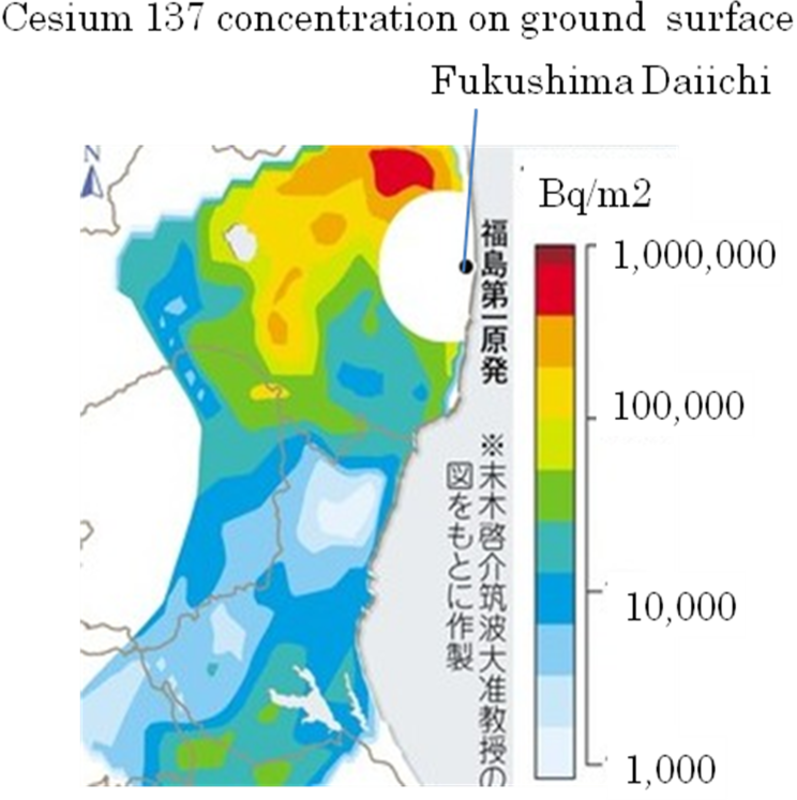
June 26, 2026 (Mainichi Japan), https://mainichi.jp/english/articles/20260626/p2a/00m/0na/004000c
TOKYO — A research team including members of the University of Tsukuba and National Taiwan University has clarified the dispersal routes of highly radioactive “cesium-rich microparticles” (CsMPs) released in the Fukushima nuclear disaster.
In the accident at Tokyo Electric Power Company Holdings Inc. (TEPCO)’s Fukushima Daiichi Nuclear Power Station in 2011, radioactive materials mainly contaminated areas to the plant’s northwest, but CsMPs were carried across a wide area of Fukushima Prefecture. The team also found that they were generated in large quantities four days after the March 11 Great East Japan Earthquake that year.
Actual extent of dispersal had remained unclear
CsMPs are spherical microparticles several micrometers in diameter. In the Fukushima Daiichi accident, they were formed when high-temperature nuclear fuel melted through to the floor and components of the melted concrete turned glasslike, encasing radioactive materials. The microparticles do not dissolve easily in water, and there are concerns that if inhaled they can remain lodged in the lungs, but the reality of how they spread had not been well understood.
The research team developed a method to examine the number of CsMPs contained in soil and analyzed soil samples taken from 100 locations in Fukushima Prefecture immediately after the accident. As a result, large numbers of CsMPs were found to the northwest and southwest of the plant, with as many as 52 particles per gram of soil. At some locations, 60% of the radioactivity in the soil was due to CsMPs.
The team then examined the dispersal process together with simulations of radioactive plumes, or air flows, and found that large-scale releases had begun in the early hours of March 15, 2011. A radioactive plume containing as many as 4,700 CsMPs per cubic meter was carried clockwise over a wide area of the prefecture, starting at the plant and moving from south to southwest and then northwest. It also reached Tokyo, the team said.
On the other hand, radioactive plumes released from 12 a.m. on March 16 onward contained no CsMPs. Instead, they are believed to have contained cesium in a form that easily dissolves in water.
‘Highly significant’ for future responses
Satoshi Utsunomiya, a National Taiwan University professor of environmental science on the team, said, “It is highly significant that we have clarified the process of when CsMPs were generated inside the plant and when their formation ceased.” The findings are expected to lead to decontamination efforts that better reflect actual conditions and to guidelines for responding to nuclear disasters.
Shinya Yamasaki, an associate professor of analytical chemistry at the University of Tsukuba, commented, “It has been shown that radiation maps and the distribution of CsMPs are different.”
The findings were published in the Journal of Hazardous Materials.
(Japanese original by Yurika Tarumi, Lifestyle, Science & Environment News Department)
Iran deal grants access to nuclear inspectors, IAEA chief says
By Reuters, June 26, 2026, Reporting by Tim Kelly; Editing by Thomas Derpinghaus and David Dolan,
https://www.reuters.com/world/middle-east/iran-deal-grants-access-nuclear-inspectors-iaea-chief-says-2026-06-26/
TOKYO, June 26 (Reuters) – The interim U.S.-Iran peace accord gives U.N. nuclear inspectors access to Iran, the watchdog’s top official said on Friday, after Tehran indicated key sites would remain off-limits until a final deal with Washington was reached and sanctions lifted.
The U.S. and Iran last week signed a memorandum of understanding paving the way for 60 days of talks to resolve thornier issues, including those related to Iran’s nuclear programme. Iran’s deputy foreign minister Kazem Gharibabadi said on Wednesday there were no plans to grant access to inspectors.
But International Atomic Energy Agency boss Rafael Grossi said on Friday that inspections had to happen.
“There is an agreement and to comply with that agreement, the IAEA will have to have access and inspect,” he told a press conference in Japan. “We hope to be there soon.”
U.N. inspectors have already held an initial exchange with Iranian officials to discuss technical issues, Grossi said. The first goal of any visit to Iran would be to check whether IAEA seals on previously inspected material remained intact and whether any material was missing, he said.
“Intentions are not enough. We have to have a very strong verification system in place,” he said.
Iran has not informed the watchdog how much of its enriched uranium survived U.S. and Israeli attacks or where it is.
The IAEA estimates Iran had 440.9 kg of uranium enriched to up to 60% before the conflict began. If enriched further, that would be enough for 10 nuclear weapons, according to an IAEA yardstick.
‘Extreme’ weather having ‘significant impact’ on Kent’s nuclear power stations

Mary Harris Senior Reporter, Kent Live, 26 Jun 2026
“Extreme” weather is hitting Kent’s two nuclear power stations, but the Government said it was “not an issue for nuclear safety”. Dungeness has two power stations, next to the coast on Romney Marsh, and the committee on radioactive waste management spent a day there.
The visit was part of the committee’s scrutiny of such facilities across the UK. After its visit, the committee has said today (June 26): “Both reactor facilities are highly exposed to weather conditions, and it is an area where these conditions can be extreme.”
Dungeness, Romney Marsh and Rye Bay have the designation of a special protection area, and the area is of international importance, for its topography, i.e. the area’s physical features, along with its plant and invertebrates, the latter being animals without a backbone or skeleton, such as spiders, worms, snails, lobsters, crabs and insects like butterflies.
The power stations here are rather unimaginatively called Dungeness A and Dungeness B, with A connected to the grid in 1965. It had two reactors which stopped operation on December 31, 2006.
The reactors were designed to operate for 25 years but lasted far beyond this. For those after more detail, it was a “legacy Magnox” power station.
And B also had two reactors which started operating in 1983 and 1985. They were closed for maintenance in 2018, with an announcement three years later they would be moved to their “defueling phase”.
This one was an Advanced Gas-cooled Reactor (AGR), operated by EDF Energy. But their coastal location is having an effect on the structures, said the committee following its tour.
In feedback just published today, it said: “Both reactor facilities are highly exposed to weather conditions, and it is an area where these conditions can be extreme. Whilst it is not an issue for nuclear safety and security, during the tour, it was clear that the combination of high winds and its coastal location meant that salt-water was a particular challenge, with corrosion having a significant impact on infrastructure.”…………………………………..https://www.kentlive.news/news/kent-news/extreme-weather-having-significant-impact-11032284
The NDAA Proposed Merger of the U.S. and Israeli Military is Strategically Unwise and Inherently Unconstitutional

Section 219 creates a framework for permanent military integration that weakens American sovereignty, blurs constitutional accountability, and places the nation’s independent decision making at risk.
Dennis Kucinich and Elizabeth Kucinich, June 26, 2026
This article is Part 2 in a three part series on the proposed merger of U.S and Israeli intelligence, military and biotechnology. Read Part 1 here
Prior to the American Revolution being fought on battlefields, it was fought as an argument about sovereignty.
Who decides the fate of a nation? Who commands its armies? Who determines when its citizens go to war and when they remain at peace?
The Founders answered those questions with remarkable clarity. In a republic, sovereignty belongs to the people and is exercised through constitutional institutions accountable to them. Section 219 of the National Defense Authorization Act of 2027 threatens to undermine the foundational principles of our republic and our constitutional democracy.
Advocates for Section 219 describe it as a strategic partnership, a modernization of military cooperation between the United States and Israel. Yet the language of the provision reaches far beyond cooperation. It calls for the integration of military planning, intelligence sharing, technological development, procurement systems, research capabilities, and strategic operations in ways that blur the distinction between two sovereign nations.
This is not merely a policy question, it is a constitutional one.
America has alliances with many nations. We cooperate with allies. We conduct joint exercises. We share intelligence. However, there is a profound difference between cooperation and integration.
Cooperation preserves independent decision making.
Integration creates pressure toward shared decision making and shared consequences.
The Constitution was deliberately designed to prevent precisely this type of entanglement.
The President serves as Commander in Chief of the Armed Forces of the United States. Congress possesses the authority to declare war. Together these provisions were meant to ensure that decisions involving American lives, American treasure, and American military power remain accountable to the American people.
Section 219 moves the nation in the opposite direction. It creates permanent structures through which military, intelligence, technological, and strategic functions become increasingly intertwined with those of another government. Even if no formal transfer of command occurs, the practical effect is to make American decision making dependent upon relationships and commitments that exist far beyond the reach of American voters.
There are at least nine reasons why Congress should reject Section 219 of the NDAA:.
- IT VIOLATES THE COMMANDER IN CHIEF CLAUSE
Article II, Section 2 of the U.S. Constitution designates the President as Commander in Chief of the Armed Forces of the United States.
Congress cannot constitutionally dilute, share, or transfer command responsibilities through ordinary legislation. The armed forces of the United States must remain exclusively accountable to constitutional authority established by the American people.
- IT BYPASSES THE TREATY PROCESS
The Constitution provides a mechanism for creating major international commitments: treaties ratified by two thirds of the Senate.
If Congress believes permanent military integration with any foreign nation is necessary, it should present that proposal openly and subject it to the scrutiny required by the Constitution.
Congress cannot use a spending bill to accomplish what the Constitution requires to be debated and approved through the treaty process.
- IT CREATES PROBLEMS OF AUTHORITY AND ACCOUNTABILITY
Foreign officials do not swear an oath to defend the Constitution of the United States.
Yet military integration creates circumstances in which foreign officers, planners, intelligence officials, and strategic personnel may influence decisions affecting American troops, intelligence assets, military technologies, operational planning and decisions to use military force.
The Framers established safeguards to ensure that authority over American military power remained accountable to American institutions and American voters.
Section 219 weakens those safeguards.
- IT VIOLATES THE PRINCIPLE OF NATIONAL SOVEREIGNTY
Congress cannot delegate core sovereign responsibilities to another government.
The defense of the nation, decisions involving military force, intelligence operations, and national security policy are among the most important powers entrusted to the federal government.
A nation that cannot independently determine matters of war and peace cannot truly be considered sovereign.
- IT INCREASES THE RISK OF FUTURE WARS
The Founders understood the danger.
In his Farewell Address, George Washington warned against permanent foreign attachments that could pull the United States into conflicts not of its own choosing. His concern was not isolationism. It was independence.
Our first president understood that foreign entanglements have a way of creating obligations that gradually supersede national interests.
That warning has particular relevance today.
The recent escalation with Iran demonstrates how rapidly regional conflicts can draw the United States toward broader military commitments. Every new layer of institutional integration increases the likelihood that future conflicts involving Israel become, in practical terms, American conflicts as well.
- IT RISKS SUBORDINATING AMERICAN INTERESTS TO FOREIGN PRIORITIES
The issue is not whether one supports Israel.
The issue is whether any foreign nation should be granted a permanent place within executive, military, intelligence, technological, and strategic structures that are constitutionally intended to serve the United States alone.
The first responsibility of the United States government is to protect the security and wellbeing of the American people. Foreign policy should be guided by American interests, American laws, and American constitutional principles.
- IT THREATENS DEMOCRATIC ACCOUNTABILITY
When sovereignty is diluted, accountability disappears.
Citizens can no longer identify who is responsible for decisions. Power becomes dispersed through networks, agreements, and institutions beyond public control.
Democracy weakens because the connection between the voter and the decision maker is broken.
The Constitution deliberately places decisions involving war and national defense within institutions accountable to the American people. Section 219 weakens that connection.
- IT IMPOSES ENORMOUS FINANCIAL COSTS
The United States has spent decades engaged in costly military interventions throughout the Middle East.
Trillions of dollars have been spent. Thousands of American lives have been lost. Countless civilians have perished. Yet the pressure for deeper involvement continues.
This is especially troubling at a moment when the national debt exceeds forty trillion dollars. Every additional military commitment carries a financial cost. Every escalation requires resources that must ultimately be borrowed, taxed, or diverted from domestic priorities.
Americans struggling with inflation, housing costs, healthcare expenses, and declining infrastructure deserve a government focused first on their security and prosperity.
- IT BETRAYS THE SPIRIT OF AMERICAN INDEPENDENCE
The timing could not be more ironic.
As America marks the 250th anniversary of its independence, Congress is considering legislation that undermines our independence.
The Revolution was fought to secure self government. The Constitution was written to preserve it.
Sovereignty is not an outdated concept. It is the foundation of democratic accountability.
The question before us is larger than Israel. Larger than any single administration. Larger than any current conflict.
It is whether the United States will remain a nation whose military power is directed exclusively by constitutional institutions accountable to the American people, or whether we will gradually surrender that independence through permanent foreign integration that the Constitution neither contemplated nor authorizes.
A nation that cannot control its own military decisions cannot claim to be sovereign – and that is a core reason why Section 219 should be rejected.
TAKE ACTION………………………………. https://scheerpost.com/2026/06/26/the-ndaa-proposed-merger-of-the-u-s-and-israeli-military-is-strategically-unwise-and-inherently-unconstitutional/
Sweden has agreed first financing package for new nuclear reactors, PM says

By Reuters, June 25, 2026, https://www.reuters.com/business/energy/sweden-has-agreed-first-financing-package-new-nuclear-reactors-pm-says-2026-06-25/
STOCKHOLM, June 25 (Reuters) – Sweden’s government has agreed on the details of a first financing package to build new nuclear power reactors with developer Videberg Kraft, Swedish Prime Minister Ulf Kristersson said on Thursday.
“The state will also go in as an owner in this project,” Kristersson told reporters.
Kristersson gave no details of the financing package, which has to be approved by the European Commission.
The government said in a statement it will take a 60% stake in Videberg Kraft, currently 80% owned by state utility Vattenfall and 20% by a consortium of industrial companies. Vattenfall’s stake will drop to 20%, the government added.
Sweden’s parliament last year passed legislation to finance a new generation of reactors, the first built in Sweden for more than 40 years and which the government says is necessary for energy security and achieving net zero emissions by 2045.
Earlier this month, Vattenfall selected Rolls-Royce SMR (RR.L), opens new tab to supply small modular nuclear reactors, choosing the British company over U.S. rival GE Vernova (GEV.N), opens new tab, in a deal worth several billion pounds.
Reporting by Simon Johnson, editing by Louise Rasmussen
UN Experts Condemn US Attack on Iran Nuclear Facilities
June, 27, 2026 – https://www.tasnimnews.ir/en/news/2026/06/27/3626914/un-experts-condemn-us-attack-on-iran-nuclear-facilities
TEHRAN (Tasnim) – The United Nations experts on June 26 unequivocally condemned the US military attack against three nuclear facilities in Iran last year.
“These attacks violate the most fundamental rules of world order since 1945 – the prohibition on the aggressive use of military force and the duties to respect sovereignty and not to coercively intervene in another country,” the experts said.
“The responsible US political and military leaders may also be liable for the international crime of aggression,” they added, according to the website of the Office of the United Nations High Commissioner for Human Rights.
“The attacks also seriously threatened human rights, including the rights to life, security of the person, health, a clean environment and self-determination of the people of Iran,” they said.
The US launched 75 munitions by air and sea against the facilities at Fordo, Natanz and Isfahan, causing extensive damage.
Article 2(4) of the Charter of the United Nations prohibits the threat or use of force against any state, except in self-defense or if the Security Council approves. Self-defense is only available in response to an actual or imminent armed attack by another country.
“Iran has not attacked the US or Israel with a nuclear weapon. There is no evidence whatsoever that Iran intends to imminently attack the US or Israel with a nuclear weapon.”
“Preventive” or “anticipatory” self-defense against speculative future threats, such as nuclear proliferation or terrorism, has not been permitted by international law since the United Nations Charter was adopted 80 years ago.
Accepting preventive self-defense would unleash a catastrophic era of ‘might is right’, where powerful countries could bomb others to advance their security or foreign policy interests. This would fuel corrosive suspicion, ‘arms races’ and destabilizing ‘balance of power’ alliances – precisely what the post-1945 order, out of the ashes of a world war, aimed to avoid,” they said. “It would further destabilize the Middle East region and increase the risk to human rights everywhere.”
The experts affirmed the view of the International Atomic Energy Agency (IAEA) that nuclear facilities must never be attacked as doing so could cause the release of radioactive material with devastating impacts on the environment and human rights, including the rights to life, personal security, health, protection against arbitrary displacement and the rights of the most vulnerable and marginalized communities. International humanitarian law generally prohibits attacks on nuclear facilities.
“We urge all parties to refrain from further uses of force and to commit to the peaceful settlement of international disputes in accordance with the United Nations Charter, including through the framework of the Nuclear Non-Proliferation Treaty and the IAEA and with respect for the human rights of all people,” they said. “The timing of the strikes undermined peaceful diplomatic efforts to revive the Joint Comprehensive Plan of Action as well as peace and security in the region and beyond,” the experts noted.
“In a world experiencing deep economic crisis, and as members of an international community that is committed to peace, we believe that financial resources mobilized for military aggression should be utilized to foster peace-making and development,” they said.
“These attacks by the US, a permanent member of the Security Council responsible for maintaining international peace and security, normalizes violent aggression and ‘gunboat diplomacy’ as a tool of statecraft and severely undermines the international rule of law,” the experts warned.
At a time of crisis for multilateralism, all countries should oppose such lawlessness and pressure the U.S. and Israel to respect the universal rules of humanity, they emphasized.
UK Tests Long-Range Missile for Ukraine

by Kyle Anzalone | Jun 22, 2026, https://libertarianinstitute.org/news/uk-tests-long-range-missile-for-ukraine/
The UK tested a missile with a range of 300 miles, with plans to send the munitions to Ukraine. The platform will allow Ukraine to deliver 500-pound warheads to Moscow.
The missiles tested by the UK military last week were developed under Project Brakestop. The goal of the project is to design a long-range weapon that can be produced for under half a million dollars and within 20 months.
UK Armed Forces Minister Louise Sandher-Jones said the new missiles will “complement” the Storm Shadow cruise missiles London sends to Kiev. “The UK stands shoulder-to-shoulder with Ukraine, and we will continue to provide the support it needs to defend itself against Russian aggression,” she added. “Project Brakestop shows what happens when we combine that commitment with the talent and ingenuity of British industry.”
The range of the missiles will allow Ukraine to target the Russian capital.
Ukraine has increased the large-scale drone strikes targeting Moscow and other Russian cities in recent months. Russian Foreign Minister Sergei Lavrov said Moscow would respond by “massive group strikes” against Ukrainian targets on a “on a regular basis.”
Russia reported downing over 300 Ukrainian drones overnight Sunday, including 80 in the Moscow region. While Moscow often does not discuss strikes that cause damage in Moscow, videos on social media appear. to show damage caused by Ukrainian attacks.
US federal loan to jumpstart AP1000 reactor supply chain, with initial $17.5 billion

Last year, the US government – through the Department of Commerce – announced a strategic partnership with Westinghouse’s owners, Cameco Corporation and Brookfield Asset Management, centred on the construction of at least USD80 billion of new reactors across the USA using Westinghouse nuclear reactor technology.
.WNN, 24 June 2026
The US Department of Energy has conditionally committed to USD17.5 billion in loans to finance the purchase of long-lead items for up to 10 Westinghouse AP1000 reactors.
The loans, through the Department of Energy’s (DOE) Office of Energy Dominance Financing, advance last year’s Executive Order on Reinvigorating the Nuclear Industrial Base by supporting the objective of having 10 new large nuclear reactors with complete designs under construction by 2030, the department said.
Long-lead items are typically thought of as heavy forgings and castings for pressure vessels, steam turbines and generators. With a limited number of heavy engineering plants able to make to make such components, these – and other engineered components in the reactor supply chain, as well as items such as control software – often need to be ordered many years in advance of installation work.
Advance purchase of long-lead items is expected to accelerate project deployment timelines by up to three years and create significant supply chain efficiencies, Westinghouse said.
The DOE financing will support up to five loans, each supporting two reactors at a project site. Westinghouse will partner with up to five eligible utilities and energy companies nationwide to procure the long-lead items at a fixed price. Each project will be jointly owned by Westinghouse and a utility or energy company partner, with both required to fully commit USD500 million of project equity – USD1 billion total per project – upfront prior to accessing DOE loan funds. Purchasing for each project will be staggered based on the timing of equity commitments and other relevant factors, DOE said.
US Energy Secretary Chris Wright said: “These conditional loans will play an important role in reviving the supply chain needed for America to once again build large-scale commercial reactors. They will also help accelerate the timeline of building those large-scale reactors by up to three years, lowering construction costs and ensuring the United States is able to deliver on President Trump’s bold and ambitious energy addition agenda.”
Last year, the US government – through the Department of Commerce – announced a strategic partnership with Westinghouse’s owners, Cameco Corporation and Brookfield Asset Management, centred on the construction of at least USD80 billion of new reactors across the USA using Westinghouse nuclear reactor technology………………….. https://www.world-nuclear-news.org/articles/us-federal-loan-to-jumpstart-ap1000-reactor-supply-chain
Nuclear reactors taken offline in France, as extreme heat pushes river temperatures into danger zone

Sophie Vorrat, Jun 26, 2026, https://reneweconomy.com.au/nuclear-reactors-taken-offline-in-france-as-extreme-heat-pushes-river-temperatures-into-danger-zone/
As Pauline Hanson seizes a moment of winter dunkelflaute to wax philosophical on the folly of weather-dependent energy, French utility EDF is busy explaining what happens to nuclear power – Hanson’s preferred power generation source – when record-breaking heatwaves, intensified by climate change, just won’t let up.
EDF has taken a series of its 57 nuclear reactors offline this week – around EDF has taken a series of its 57 nuclear reactors offline this week – around 6.2 gigawatts in total, and nearly 10 per cent of its total fleet – in response to the heatwave gripping France, part of a weather system described as an Omega block which allows temperatures to build over an area, without relief.
EDF has taken this action because its nuclear plants are subject to strict environmental regulations limiting the use of rivers to cool the plants if the river water passes a certain temperature threshold.
The nuclear shutdowns included two reactors at the Nogent-sur-Seine plant on the Seine river, north of Paris, “to limit the temperature increase between the water withdrawn from the Seine and the water discharged back into it, thereby protecting aquatic plant and animal life,” EDF said.
According to Reuters, the heat has also reduced output at the Saint-Alban 2 and Bugey 3 reactors on the Rhône river in eastern France, and the Nogent 2 reactor on the Seine southeast of Paris. The Golfech 2 reactor on the Garonne river in southwest France went offline late Monday due to the heat.
As AAP reports, much of France has been under severe heat alert this week, with temperatures hitting 40°C on Tuesday, and up to 43°C in some parts of western France.
The country recorded its hottest afternoon and night since records began in 1947, and 54 departments are under red alert in what forecasters said was unprecedented.
Météo-France said conditions were comparable to the August 2003 heatwave, which lasted 16 days and led to an estimated 80,000 excess deaths across Europe, according to the EU.
According to Reuters, wholesale spot power prices in France this week reached their highest level since mid-January 2025, while exports dropped to around 3 GW during the afternoon on Wednesday compared to 10-12 GW a week earier, reducing the cheap supply for neighbours.
“Climate change is demonstrating how extreme heat can be as disruptive as the (price spikes from cold weather and low renewables) witnessed during winter,” Kpler analyst Alessandro Armenia said.
“We are surprised now, but we should expect next summer to exhibit similar dynamics, as climate change is undeniable.”
Three nuclear reactors are shut down in France due to the heatwave

After the Golfech power plant (Tarn-et-Garonne), two other nuclear reactors were shut down, in Bugey (Ain) and in Nogent-sur-Seine (Aube).
25/06/2026 franceinfo with AFP, https://www.franceinfo.fr/environnement/evenements-meteorologiques-extremes/vagues-de-chaleur-canicules/trois-reacteurs-nucleaires-sont-a-l-arret-en-france-en-raison-des-fortes-chaleurs_8079206.html
The heatwave is impacting energy production. EDF shut down two
nuclear reactors on Thursday, June 25th.
(New window), at Bugey (Ain) and Nogent-sur-Seine (Aube), bringing to three the number of reactors shut down in France due to the high temperatures, after that of Golfech (Tarn-et-Garonne), while a unit at Saint-Alban must also reduce its production, according to a situation report sent to AFP.
Reactor number 3 at the Bugey nuclear power plant, located on the banks of the Rhône River, has been shut down since 9:00 AM, as has unit number 1 at Nogent-sur-Seine since 9:15 AM, due to
“external environmental factors” and in order to comply with the temperature limits for the Rhône and Seine rivers, EDF explains on its regulatory information website. The shutdowns or production reductions decided by EDF aim to meet environmental obligations to protect the flora and fauna of the rivers and streams that are used to cool the nuclear facilities.
Do not further warm the waterways
In the event of extreme heat, the rising temperature of these waterways can force EDF to reduce or even halt its production to avoid further heating them with its discharges of cooling water that is a few tenths of a degree to a few degrees warmer, depending on the site. The operation of France’s 57 reactors is subject to strict limits on the temperature increase of these waterways.
In the case of Golfech, which has been shut down since Monday, the river temperature must not exceed 28°C after discharges from the power plant. In Nogent-sur-Seine, “regulations stipulate that the temperature rise of the Seine must not exceed 3°C between upstream and downstream of the site, and that the average temperature must not exceed 28°C downstream.”
The IAEA Faces a New Nuclear Puzzle Inside Iran
By RFE/RL staff – Jun 26, 2026, https://oilprice.com/Energy/Energy-General/The-IAEA-Faces-a-New-Nuclear-Puzzle-Inside-Iran.html
- Experts say effective IAEA inspections require broad access to verify Iran’s enriched uranium stockpiles, enrichment activities, and nuclear infrastructure.
- A key challenge will be locating Iran’s roughly 450 kilograms of highly enriched uranium and ensuring it is properly downblended and cannot be re-enriched.
- Former officials argue that restoring the IAEA’s “continuity of knowledge” after recent military strikes and restricted access will be one of the agency’s toughest tasks.
Amid an ongoing row between Washington and Tehran over whether international monitors can verify Iranian compliance with its nuclear nonproliferation commitments, former officials have told RFE/RL that the scale, scope, and degree of access are crucial to the success of inspections.
Details on those have yet to be determined, though Raffael Grossi, head of the International Atomic Energy Agency (IAEA) said the UN body “will be working on the modalities — dates, procedures, places — very soon.”
That doesn’t mean, according to experts, that the organization hasn’t already drawn up a wish list for any eventual inspections
They almost certainly have a plan for when they go back in, what the priorities are, where they would want to go first, second, third,” Laura Rockwood, a former IAEA negotiator on Iran, told RFE/RL.
“The key thing is to find out where in particular the enriched uranium is…. I’d be willing to bet you that they have in place a plan for the day they need to go back in,” added Rockwood, who took part in high-level negotiations on Iran during a 28-year career at the IAEA before retiring in 2013.
Downblending Uranium
While US President Donald Trump has said that Iran has agreed to the highest level of nuclear inspections and Iran says it has no plans to allow the inspections, point No. 8 of the US-Iranian memorandum of understanding (MOU) states the two sides have agreed on a “minimum methodology” that Iran’s stocks of highly enriched uranium (HEU) will be “downblended on site under the supervision of the IAEA.”
But the details of this could also prove contentious.
“If IAEA inspectors were able to measure and characterize both the high and low enriched material before the downblending, then simple arithmetic gives a good sense of what the product is. They’d then want to measure to confirm and seal that product for future accountability,” Matthew Sharp, who served as director for Iran nuclear issues on the US National Security Council (NSC) from 2021-2022, told RFE/RL.
“If, on the other hand, Iran does the downblending itself and then provides the product to inspectors, it would be much more difficult to know how much HEU Iran started with, which could create uncertainties as to whether all of the 60 percent or other enriched material had been downblended or if some remained out of our awareness,” said Sharp, now a senior nuclear fellow at the MIT Center for International Studies.
Right now, the location of Iran’s roughly 450 kilograms of HEU is unclear. After the US and Israeli air strikes, it could be buried under rubble in a bunker beneath a mountain, or the Iranian authorities may have moved some or all of it elsewhere to hide it.
But if it can be successfully located and downblended, the next step is stopping Iran from re-enriching it again at a later date.
Monitoring Enrichment
The MOU says the two parties agreed “to discuss the issue of enrichment and other mutually agreed matters related to the Islamic Republic of Iran’s nuclear needs, based on a satisfactory framework being agreed upon in the final deal.”
Experts told RFE/RL that verifying this must include a role for the IAEA.
“Any suspension on uranium enrichment is relatively meaningless if it cannot be verified and if the IAEA does not have the access to ensure that there are no covert nuclear activities related to enrichment going on elsewhere in the country,” said Kelsey Davenport, director of nonproliferation policy at the Arms Control Association.
“The level of access, the provision of information to the International Atomic Energy Agency, how quickly Iran has to comply with IAEA requests for access — all of that is going to be crucial,” she told RFE/RL.
“Once the enrichment level is low, below 5 percent, it’s much safer to ship out that material. It could be stored under an international fuel bank in Kazakhstan,” Davenport added.
The idea of shipping the downblended uranium out of Iran is something US officials appear keen on. At a recent background call with reporters, one official said dilution within Iran was “the floor” but that “we will push for more than that.”
A senior US official said Washington would rely heavily on the UN nuclear watchdog and US technical teams for verification. “We’re not in the trusting business,” the official said.
The IAEA has previously verified Iran’s compliance with its commitments to the Nuclear Non-Proliferation Treaty, which it ratified in 1970, and the 2015 Joint Comprehensive Plan of Action (JCPOA).
Lessons From The Past
Experts say many lessons have been learned from these experiences. They point to the importance of the IAEA’s Model Additional Protocol, which provides additional tools for verification.
Rockwood, now a senior fellow at the Vienna Center for Disarmament and Non-Proliferation, was the principal author of the protocol.
Under the additional protocol, instead of just routinely being limited to nuclear material and nuclear facilities, we have access to information and locations concerning the entire nuclear fuel cycle, including the production of centrifuges,” she said. “So, if you know roughly how many centrifuges they are capable of making, you want to know where they are, and we can ask for that kind of access with an additional protocol.”
Iran signed the Additional Protocol in 2003 but has not sent an official letter to the IAEA that would bring it into force.
Iran provisionally implemented its provisions between 2003 and 2006 and for a period under the JCPOA. However, noted Rockwood, “there were lots of indications of noncompliance by Iran” during this time.
This, she said, could be expected to continue — with added complications.
Substation damage delaying operation of repaired Zaporizhzhia power line, says IAEA

Friday, 26 June 2026, https://www.world-nuclear-news.org/articles/substation-damage-stopping-zaporizhzhia-power-line-reconnection-says-iaea
After months of ceasefire negotiations, planning and complex repairs, the main external power line to Zaporizhzhia Nuclear Power Plant has been fixed – but it can’t be put back into operation because of damage to a substation 100 kilometres away, the International Atomic Energy Agency has said.
IAEA Director General Rafael Mariano Grossi said: “Of the six temporary ceasefires that we have negotiated since late last year to help protect nuclear safety … this was the most challenging to implement. It required several months of delicate negotiations, followed by mine clearance and repairs on high pylons across the Dnipro River. The IAEA monitored these activities on the ground to confirm they were carried out as agreed.
“Both sides worked constructively with us to enable the repairs to proceed. Despite the many military and technical challenges, this demonstrates that concrete progress remains possible, even during a large-scale war. We will continue our efforts to reduce the ever-present danger of a nuclear accident.”
The IAEA team based at the Zaporizhzhia plant monitored the repair work on the plant side of the frontline, with a separate IAEA team monitoring the repair work on the other side of the Dnipro River.
However the 750 kV Dniprovska external power line is not back in operation yet, because of damage sustained in May at an electrical substation 100 kilometres northwest of the plant, Grossi said.
“Repeated damage to the electrical infrastructure on which nuclear power plants depend continues to create serious nuclear safety and security risks. I once again call for maximum military restraint around all nuclear facilities and the power infrastructure they require,” he said.
Since the main Dniprovska line was disconnected in March, the six-unit nuclear power plant, which has been under Russian military control since early March 2022, has been relying on its sole remaining 330 kV Ferosplavna-1 backup power line.
During the war there have been a number of occasions when all external power has been lost to the plant. Last week the back-up power line was reconnected after the 19th such loss of power. As with the previous occasions, the plant had to rely on power from its emergency diesel generators for the power required by the plant, including for various safety functions.
Why X-Energy Stock Collapsed 19.2% This Week
COMMENT. Another dud Small Modular Nuclear Reactor fantasy?

Delays and downgrades are hurting X-Energy’s stock price this week.
By Brett Schafer – Jun 26, 2026 , https://www.fool.com/investing/2026/06/26/why-x-energy-stock-collapsed-192-this-week/
Key Points
- X-Energy does not have a reactor design approved today.
- Its construction projects keep getting delayed, causing an analyst downgrade.
- The company does not generate much in revenue today.
Shares of X-Energy (XE+2.17%) fell 19% this week, according to data from S&P Global Market Intelligence. The nuclear energy start-up saw a delay in its construction timeline and an analyst downgrade, which has dragged down the stock since its April IPO.
Delayed projects
X-Energy is designing advanced nuclear reactors, partnering with Amazon for future reactor builds. Amazon is also a shareholder in X-Energy, providing upfront capital to build projects to power Amazon data centers.
The roadblock to development stems from the United States government’s lack of official approval for any X-Energy reactor, which has delayed the breaking ground of X-Energy’s first project with Amazon until 2027. On top of this, Jeffries downgraded the stock this week, from $30 to $22, sending shares sharply lower.
Should you buy the dip?
Modern nuclear reactors can be a valuable source of electricity for powering the AI revolution. However, today, X-Energy does not have much of an actual business and will need to spend massive amounts of money upfront in order to get its reactor designs approved and its manufacturing facilities built.
Even after this drawdown, X-Energy stock trades at a market cap of $7.7 billion with barely any revenue. That should keep all investors away from the stock today.
1 This Month
Tell Congress: Prevent Nuclear Catastrophe in Iran

Tell Congress: Prevent Nuclear Catastrophe in Iran

Read the Public Inquiry Report, the Commissioners’ report, Surrendering Australia: The AUKUS Deception is available to download for free at aukuspublicinquiry.com. Or just watch the replay of the National Press Club Luncheon.


Shut down the radiation-damaged Heysham nuclear reactors now
To see nuclear-related stories in greater depth and intensity – go to https://nuclearinformation.wordpress.com

Say No to NASA’s Reckless Nuclear Reactor on the Moon
Say No to NASA’s Reckless Nuclear Reactor on the Moon
-
Archives
- November 2026 (246)
- October 2026 (302)
- September 2026 (339)
- August 2026 (330)
- July 2026 (355)
- June 2026 (287)
- May 2026 (306)
- April 2026 (356)
- March 2026 (251)
- February 2026 (267)
- January 2026 (308)
- December 2025 (358)
-
Categories
- 1
- 1 NUCLEAR ISSUES
- business and costs
- climate change
- culture and arts
- ENERGY
- environment
- health
- history
- indigenous issues
- Legal
- marketing of nuclear
- media
- opposition to nuclear
- PERSONAL STORIES
- politics
- politics international
- Religion and ethics
- safety
- secrets,lies and civil liberties
- spinbuster
- technology
- Uranium
- wastes
- weapons and war
- Women
- 2 WORLD
- ACTION
- AFRICA
- Atrocities
- AUSTRALIA
- Christina's notes
- Christina's themes
- culture and arts
- Events
- Fuk 2022
- Fuk 2023
- Fukushima 2017
- Fukushima 2018
- fukushima 2019
- Fukushima 2020
- Fukushima 2021
- general
- global warming
- Humour (God we need it)
- Nuclear
- RARE EARTHS
- Reference
- resources – print
- Resources -audiovicual
- Weekly Newsletter
- World
- World Nuclear
- YouTube
-
RSS
Entries RSS
Comments RSS

