Radioactive cesium from 2011 Fukushima nuclear disaster spread over wide area: study
June 26, 2026 (Mainichi Japan), https://mainichi.jp/english/articles/20260626/p2a/00m/0na/004000c
TOKYO — A research team including members of the University of Tsukuba and National Taiwan University has clarified the dispersal routes of highly radioactive “cesium-rich microparticles” (CsMPs) released in the Fukushima nuclear disaster.
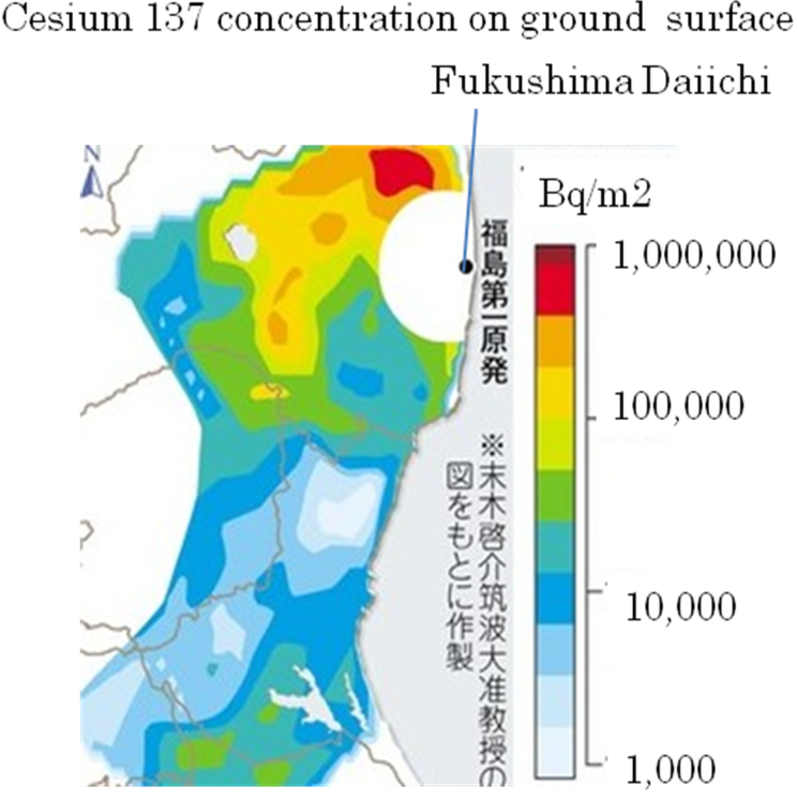
In the accident at Tokyo Electric Power Company Holdings Inc. (TEPCO)’s Fukushima Daiichi Nuclear Power Station in 2011, radioactive materials mainly contaminated areas to the plant’s northwest, but CsMPs were carried across a wide area of Fukushima Prefecture. The team also found that they were generated in large quantities four days after the March 11 Great East Japan Earthquake that year.
Actual extent of dispersal had remained unclear
CsMPs are spherical microparticles several micrometers in diameter. In the Fukushima Daiichi accident, they were formed when high-temperature nuclear fuel melted through to the floor and components of the melted concrete turned glasslike, encasing radioactive materials. The microparticles do not dissolve easily in water, and there are concerns that if inhaled they can remain lodged in the lungs, but the reality of how they spread had not been well understood.
The research team developed a method to examine the number of CsMPs contained in soil and analyzed soil samples taken from 100 locations in Fukushima Prefecture immediately after the accident. As a result, large numbers of CsMPs were found to the northwest and southwest of the plant, with as many as 52 particles per gram of soil. At some locations, 60% of the radioactivity in the soil was due to CsMPs.
The team then examined the dispersal process together with simulations of radioactive plumes, or air flows, and found that large-scale releases had begun in the early hours of March 15, 2011. A radioactive plume containing as many as 4,700 CsMPs per cubic meter was carried clockwise over a wide area of the prefecture, starting at the plant and moving from south to southwest and then northwest. It also reached Tokyo, the team said.
On the other hand, radioactive plumes released from 12 a.m. on March 16 onward contained no CsMPs. Instead, they are believed to have contained cesium in a form that easily dissolves in water.
‘Highly significant’ for future responses
Satoshi Utsunomiya, a National Taiwan University professor of environmental science on the team, said, “It is highly significant that we have clarified the process of when CsMPs were generated inside the plant and when their formation ceased.” The findings are expected to lead to decontamination efforts that better reflect actual conditions and to guidelines for responding to nuclear disasters.
Shinya Yamasaki, an associate professor of analytical chemistry at the University of Tsukuba, commented, “It has been shown that radiation maps and the distribution of CsMPs are different.”
The findings were published in the Journal of Hazardous Materials.
(Japanese original by Yurika Tarumi, Lifestyle, Science & Environment News Department)
No comments yet.
-
Archives
- October 2026 (129)
- September 2026 (339)
- August 2026 (330)
- July 2026 (355)
- June 2026 (287)
- May 2026 (306)
- April 2026 (356)
- March 2026 (251)
- February 2026 (267)
- January 2026 (308)
- December 2025 (358)
- November 2025 (359)
-
Categories
- 1
- 1 NUCLEAR ISSUES
- business and costs
- climate change
- culture and arts
- ENERGY
- environment
- health
- history
- indigenous issues
- Legal
- marketing of nuclear
- media
- opposition to nuclear
- PERSONAL STORIES
- politics
- politics international
- Religion and ethics
- safety
- secrets,lies and civil liberties
- spinbuster
- technology
- Uranium
- wastes
- weapons and war
- Women
- 2 WORLD
- ACTION
- AFRICA
- Atrocities
- AUSTRALIA
- Christina's notes
- Christina's themes
- culture and arts
- Events
- Fuk 2022
- Fuk 2023
- Fukushima 2017
- Fukushima 2018
- fukushima 2019
- Fukushima 2020
- Fukushima 2021
- general
- global warming
- Humour (God we need it)
- Nuclear
- RARE EARTHS
- Reference
- resources – print
- Resources -audiovicual
- Weekly Newsletter
- World
- World Nuclear
- YouTube
-
RSS
Entries RSS
Comments RSS


Leave a Reply