The compensation standards for voluntary evacuees from the nuclear power plant accident will finally be reviewed on May 5, and there are concerns about whether the standards will be commensurate with the actual situation.

Members of the Nuclear Damage Dispute Review Committee (front) interviewing victims in the evacuation zone (back) at the town hall of Okuma Town, Fukushima Prefecture, in August.
December 4, 2022
The government’s Dispute Coordination Committee for Nuclear Damage (CALI) will discuss compensation for “areas subject to voluntary evacuation,” which are defined by the guidelines as areas within 30-100 km of the nuclear power plant, at its meeting on December 5. While some victims have voiced their appreciation for the review, others have criticized the slow response and inadequate relief. (Natsuko Katayama)
The trigger for the review was a judicial decision. In March, the Supreme Court rejected TEPCO’s appeal in seven class action lawsuits filed by victims of the nuclear accident against the government and TEPCO, ordering TEPCO to pay damages that exceeded the guidelines. The final ruling in the Fukushima lawsuit, which was contested by approximately 3,650 people in and outside of Fukushima Prefecture, approved an additional maximum of 3 million yen per person.
In response, the CALI finally decided on November 10 to review the guidelines. New compensation targets, such as “severe evacuation conditions” in evacuation-directed zones, will be added. On the other hand, the review of voluntary evacuation zones and other areas is likely to be limited to a very small portion.

Guntaro Managi, a lawyer representing the plaintiffs in the Fukushima lawsuit, commented, “The fact that there has been a move to review the lawsuit is a result of the class action lawsuit, but it is too late to wait for the Supreme Court decision. The review is too late,” said Ittaro Managi, a lawyer for the plaintiffs in the Fukushima lawsuits.
◆Discrimination and bullying at evacuation centers, and many times “I want to die
In the review of the “interim guidelines” for compensation standards by the CALI, one of the issues presented so far is the focus on “areas subject to voluntary evacuation, etc.” The court made a partial judicial decision on children and pregnant women. This is because the CALI Board is cautious about reviewing the guidelines for children and pregnant women, even though some judicial decisions have approved compensation amounts higher than the guidelines. The review for adults is also inadequate, and some of the victims are concerned about whether the amount of compensation will be commensurate with the damage.
We want them to listen to us, who were children at the time of the accident, even now,” said one victim. A female student at a vocational school, 18, who evacuated to another prefecture from the voluntary evacuation zone, said, “I would like you to listen to our stories, even now.
She was in the first grade at the time of the accident. She suffered discrimination and bullying at the evacuation site. Radiation” and “Fukushima is dirty. Her father worked in Fukushima and commuted to the evacuation site on weekends, while her mother was busy raising their young children. Not wanting to cause worry to her parents, she kept to herself, unable to confide in them. I wanted to die” she thought many times.
Before deciding on the review policy, the CALI committee members heard from residents in the evacuation zone, but only asked the head of the municipality for his opinion on the voluntary evacuation zone. The committee members said, “We don’t want you to make a decision as if you knew about the damage we have suffered without hearing from the people involved. We are concerned that the review will be far removed from the actual situation.
In several court decisions, children and pregnant women in the voluntary evacuation zone have been awarded compensation that exceeds the guidelines, but the CALI is cautious about a review. If the guidelines had been reviewed at the most difficult time, I would have felt that they recognized my suffering and saved my life…” he said.

In its review of the issue, the CALI Board stated that adults in the voluntary evacuation zone are not considered to be more sensitive to radiation than children and pregnant women, and that fear of exposure alone is not sufficient to warrant compensation. On the other hand, the court acknowledged the combined fear of continued accidents and further spread of radioactive contamination, and considered extending the period of compensation.
The plaintiffs in the class action lawsuit in Niigata Prefecture, who had been suing the government for damages for the accident, said that the Supreme Court’s decision was too late to review the case. Masashi Kanno, 48, a plaintiff in the class action lawsuit in Niigata Prefecture, evacuated from Koriyama City, Fukushima Prefecture, which is in the voluntary evacuation zone, to Niigata City, where he still lives with his family. He said, “I can’t imagine how much fear and heartache the parents must have felt worrying about their children without any knowledge of radiation. I don’t care if the compensation period is extended without hearing from the people involved and without a proper acknowledgement of the damage.
Although the CALI tribunal has ruled that damages other than those covered by the guidelines can be compensated through alternative dispute resolution (ADR), there have been a number of cases where TEPCO has rejected settlement proposals because of the gap between the guidelines and the CALI tribunal. Mr. Kanno said, “The guidelines are supposed to be the ‘minimum standards for compensation,’ but TEPCO has set them as the ‘upper limit’ for compensation. Why didn’t TEPCO investigate the actual situation and take action sooner?
Regardless of the outcome of the trial, he believes that the government itself should have reviewed the guidelines. I hope that this time, the government will seriously review the damage, rather than just saying that it has reviewed the situation.
Concrete melted off ‘pedestal’ for damaged reactor in Fukushima
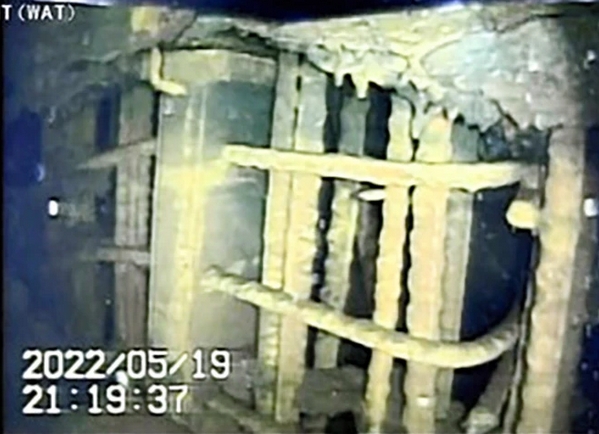
Rebars in the pedestal, which are normally covered with concrete, are seen exposed inside the No. 1 reactor at the Fukushima No. 1 nuclear power plant. (Provided by the International Research Institute for Nuclear Decommissioning and Hitachi-GE Nuclear Energy Ltd.)
November 30, 2022
The concrete support foundation for a reactor whose core melted down at the Fukushima No. 1 nuclear power plant has deteriorated so much that reinforcing bars (rebars) are now exposed.
Masao Uchibori, governor of Fukushima Prefecture, has expressed concerns about the earthquake resistance of the “pedestal” for the No. 1 reactor at the crippled plant operated by Tokyo Electric Power Co. (TEPCO).
Strong quakes struck off the coast of the prefecture in 2021 and 2022.
“There have been events that caused anxieties among residents of our prefecture, including damage to the foundation supporting the No. 1 reactor’s pressure vessel,” Uchibori told a prefectural assembly session in September. “We will check up on TEPCO’s efforts so the decommissioning work will proceed safely and steadily.”
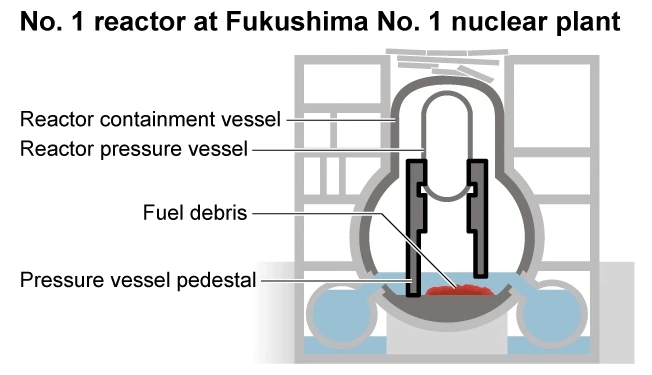
The cylindrical pedestal, whose wall is 1.2 meters thick, is 6 meters in diameter. It supports the reactor’s 440-ton pressure vessel.
The interior of the No. 1 reactor’s containment vessel was inspected in May for TEPCO’s eventual plans to retrieve the melted nuclear fuel that dropped to the bottom of the vessel during the 2011 nuclear disaster.
The study found that the normally concrete-encased rebars were bare and the upper parts were covered in sediment that could be nuclear fuel debris.
The concrete likely melted off under the high temperature of the debris.
The International Research Institute for Nuclear Decommissioning (IRID), an entity set up by power utilities and nuclear reactor manufacturers, conducted a simulation in fiscal 2016.
IRID said seismic resistance would remain uncompromised even if about one-quarter of the pedestal was damaged.
However, only a part of the pedestal was inspected during the May study, and only from the outside.
The pedestal’s inside remains a mystery.
“The pedestal’s soundness is of foremost concern,” said Kiyoshi Takasaka, a former engineer with Toshiba Corp. who is now an adviser to the Fukushima prefectural government on nuclear safety issues. “It is important to first inspect the pedestal from the inside.”
TEPCO has prepared six types of robots to detect the fuel debris and perform other tasks in a series of inspections at the No. 1 reactor.
An internal study of the pedestal is planned toward the March end of the fiscal year as the final mission during the inspections. The task carries the risk of the robot hitting the sediment or other obstacles and being unable to return.
“We understand people’s concerns very well,” Akira Ono, president of TEPCO’s Fukushima Daiichi Decontamination & Decommissioning Engineering Co., told a news conference in October. “We hope to finish studies inside the pedestal by the end of this fiscal year.”
He said his company will scrutinize whether the previous assessment of seismic resistance is still applicable.

Haruo Morishige, who has been studying the Fukushima nuclear disaster, called for immediate emergency safety measures, such infusing concrete to reinforce the pedestal.
“There is a critical defect in terms of quake resistance,” said Morishige, based on a photo showing the interior of the No. 1 reactor.
Morishige studied aseismic structural design for nuclear reactors when he worked for Mitsubishi Heavy Industries Ltd.
He also served as an on-site manager for the No. 3 reactor at the Ikata nuclear plant operated by Shikoku Electric Power Co., including when the reactor was being built.
The photo, released following the May inspection, shows how concrete covering the cylindrical “inner skirt” of the pedestal had melted off, laying bare part of the steel frame and rebars from the bottom to the top.
The inner skirt’s functions connect the reactor pressure vessel with the containment vessel. But the melting of the concrete has separated the pressure vessel from the containment vessel, and weakened the structure’s quake resistance, Morishige said.
The loss of concrete has also decoupled the pedetal’s walls from the floor, making it more prone to sway during seismic events, he added.
Morishige said that all concrete around the rebars inside the pedestal has likely melted away.
He also said fuel debris that flowed out from an aperture likely melted concrete around rebars over about a quarter of the outside circumference of the pedestal.
His simulation has shown that the support capability of the pedestal is now about three-eighths of the original level.
“In such a state, the reactor could topple over in an earthquake of upper 6 on the Japanese seismic intensity scale (of 7),” Morishige said.
He added that repeated exposure to seismic shocks could cause cracks in the remaining concrete, further undermining quake resistance.
“The very fact there are chances of the reactor toppling is unacceptable,” he said. “Officials should proceed with safety measures and inspections at the same time.”
(This article was written by Keitaro Fukuchi and Tetsuya Kasai.)
Ministry’s action plan drops nuclear policies set after 3/11
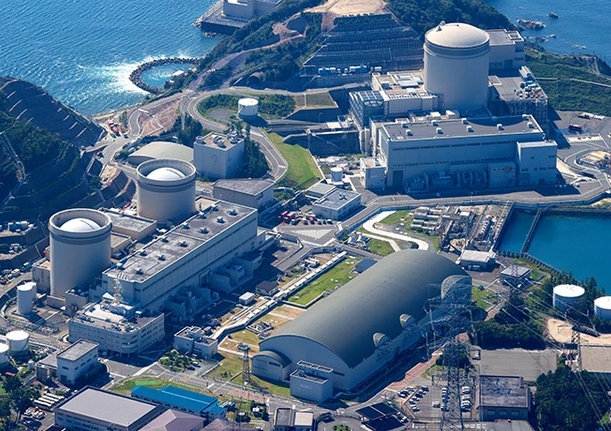
Local officials want new reactors to replace the two retired units at the front of Kansai Electric Power Co.’s Mihama nuclear plant in Fukui Prefecture.
November 29, 2022
The industry ministry proposed building new nuclear reactors to replace retired ones and effectively extending their operating lives beyond 60 years, a reversal of policies set after the 2011 Fukushima nuclear disaster.
The proposals were presented to the ministry’s advisory council, the Nuclear Energy Subcommittee, at a meeting on Nov. 28 as a draft action plan for the Kishida administration’s slogan to “make maximum use of nuclear energy.”
Although many subcommittee members endorsed the proposals, some members said not enough time was spent on discussing such a major change in energy policy.
Prime Minister Fumio Kishida in August issued a directive to a special government panel tasked with decarbonizing Japan to review the current nuclear energy policy.
The government has maintained that “for now,” it does not expect construction of new nuclear plants or a replacement of any reactor.
Because of opposition expected from local governments, the plan also did not propose building nuclear plants in areas that have never hosted such facilities or adding new reactors to existing plants.
But under the action plan, the Ministry of Economy, Trade and Industry states that construction of new reactors “will begin with those replacing retired ones,” giving utilities the green light to build reactors to take the place of those being decommissioned.
The ministry is also seeking “advanced light water reactors” as replacement units, expecting them to start operating in the 2030s. They will each come with an estimated price tag of at least 500 billion yen ($3.57 billion).
Such reactors have enhanced safety features and are an extension of current nuclear technologies, the ministry said.
The action plan also pushes for a system that will effectively extend the life cycle of reactors beyond the maximum of 60 years set under rules adopted after the 2011 triple meltdown.
It suggests that often lengthy periods when reactors are offline for examinations by the Nuclear Regulation Authority on whether they meet standards for restarts be excluded from the 60-year limit.
In addition, the time frame should not include periods when reactor operations are suspended because of lawsuits, the ministry said.
Under those proposals, a reactor that has been idle for 10 years for those reasons could operate for up to 70 years since it first went into service.
The proposed exclusions from the 60-year limit have been criticized as “taking the teeth from” the rigorous reactor regulations set in 2013.
One subcommittee member said the exclusions are “akin to ditching the lessons learned from the Fukushima accident.”
The action plan also called for a new system to provide grants to local governments that promote the use of recycled nuclear fuel at facilities in their jurisdictions.
This is meant to give some leverage to the nation’s trouble-plagued nuclear fuel cycle policy.
Although the action plan represents a sweeping policy change, it does not directly deal with a slew of challenges that have remained unsolved for decades.
For example, it is unclear when the nuclear fuel reprocessing plant under construction in Rokkasho, Aomori Prefecture, a key component in the nuclear fuel cycle program, will go into operations.
Under the program, plutonium retrieved from spent nuclear fuel from across Japan will be recycled as fuel for use at nuclear plants.
The completion date of the reprocessing plant has been pushed back 26 times so far. Around 14 trillion yen has been invested in the project.
Another big headache for the central government is securing a final disposal site for highly radioactive nuclear waste from nuclear power plants across the country.
Two small municipalities in Hokkaido have shown an interest in hosting such a storage facility in exchange for generous grants.
But the Hokkaido governor is opposed to the plan. And no other local governments in Japan have come forward as potential final disposal sites.
The ministry’s action plan did not list any specific proposals to resolve these issues. It merely said: “The state should bolster efforts to gain the understanding” of the public to the nuclear policy.
Plaintiffs claim that the wide-area evacuation plan is ineffective.

November 28, 2022
On November 28, a lawsuit filed by residents of the Onagawa Nuclear Power Plant seeking an injunction against the restart of the No. 2 reactor at Tohoku Electric Power Company’s Onagawa Nuclear Power Plant was concluded. The verdict will be handed down in May next year.
On the 28th, the plaintiffs made their final statements in oral arguments at the Sendai District Court. The plaintiffs again argued that the “wide-area evacuation plan” formulated by the prefectural government and others is ineffective because it does not include specific details about the inspection sites that would be set up along evacuation routes in the event of an accident to check residents’ radiation exposure, including the securing of personnel and materials and equipment.
Mr. Nobuo Hara, leader of the plaintiffs: “How ineffective is the wide-area evacuation plan?
Mr. Nobuo Hara, leader of the plaintiffs’ group: “We have shown how ineffective the wide-area evacuation plan is. The most realistic way to stop the restart of nuclear power plants is to obtain a ruling that nuclear power plants must not be restarted under the evacuation plan. It is the firm belief of the plaintiffs that such a ruling will be reached.”

The trial will conclude on May 28, and the verdict will be handed down on May 24 next year. Tohoku Electric Power aims to restart the Onagawa Unit 2 reactor in February 2024.

Japan studies plan to extend life of 60-year-old nuclear plants

Nov 28, 2022
Japan will consider keeping some nuclear reactors operating beyond a current 60-year limit as the country focuses increasingly on atomic power as a solution to an ongoing squeeze on energy supply.
Officials are studying a plan to exclude periods when reactors were offline from an existing limit on their lifespan, which would allow some facilities to operate for longer, according to a document released Monday by a trade ministry panel. Reactors are often halted for years to allow the nation’s nuclear watchdog to perform inspections, or as a result of legal challenges.
Following the 2011 Fukushima nuclear disaster, which was triggered by a massive earthquake and tsunami, Japan introduced stricter safety standards limiting the operation of nuclear reactors to 40 years in principle.
But operation for an additional 20 years is possible if safety upgrades are made and a reactor passes screening by regulators.
The proposal to allow operations beyond the 60-year limit comes as Japan’s public and government shift back in favor of nuclear power, despite experiencing one of the worst atomic meltdown disasters. The import-dependent country has this year grappled with more expensive fossil fuel prices as a result of Russia’s war in Ukraine, along with a weak yen, and seen its stretched power grid put under severe pressure.
The government has repeatedly asked people to take steps to limit their electricity consumption, by using fewer appliances or cutting back on heating.
In August, Prime Minister Fumio Kishida said the government will explore developing and constructing new reactors, and that it will also aim to restart seven more idled reactors from next summer.
The trade ministry proposals also call for new, next-generation nuclear reactors to be built at sites where existing units will be decommissioned.
Japanese manufacturers have announced plans to develop next-generation reactors this year. Mitsubishi Heavy Industries is jointly developing an advanced light water reactor with four other Japanese power producers, while a venture between Hitachi and General Electric is also reported to be developing a new reactor model.
https://www.japantimes.co.jp/news/2022/11/28/national/nuclear-plant-extension/
Evacuation of Iitate Village’s Nagadori District, Fukushima Prefecture, to be lifted in May.

November 21, 2022
Iitate Village, Fukushima Prefecture, has begun coordinating with the national government to lift the evacuation order for a specific restoration base area (restoration base) in the Nagadori administrative district, a hard-to-return zone following the TEPCO’s Fukushima Daiichi nuclear power plant accident, by the major holidays in May of next year. The government plans to lift the evacuation order for a part of the area outside the restoration center as a park area to check the reduction of radiation levels in the air at the same time as the area inside the restoration center. This is the first time that the government has announced the lifting of evacuation orders for areas outside of the restoration centers in the difficult-to-return zones established by the nuclear accident.
On March 20, after a briefing session for residents of the Nagadori area in Fukushima City, Village Mayor Makoto Sugioka made the announcement to the press. The village has been saying that it aims to lift the restrictions next spring. The village is expected to decide on a specific date after the final report by the village’s decontamination verification committee scheduled for January next year and after the end of March.
The difficult-to-return zone in the village covers approximately 1080 hectares, of which about 186 hectares are restoration sites. The village plans to construct a meeting place for short-term stays and exchanges, a multipurpose ground, and public restrooms.
According to the village, the park area covers about 0.64 hectares of land in the Kyakuta district. No playground equipment is planned. The village will continue to measure radiation levels to see how they decrease.
https://www.minpo.jp/news/moredetail/20221121102625?fbclid=IwAR39qL5sRkcgxB2AM316-9b4dN7hSEF3mMYfdlmfKMLHG4_5njXQagUlsAQ
Expert panel full of proponents of nuclear power plants to discuss direction on March 28th, extending operation period and developing next-generation models, rushing to conclusion on “Prime Minister’s directive.

Basic policy subcommittee discusses extending the operational period of nuclear power plants in Kasumigaseki, Tokyo.
November 27, 2022
The Ministry of Economy, Trade, and Industry (METI) will present its direction on measures to utilize nuclear power plants, including the extension of the operating period of nuclear power plants, which is stipulated as “40 years in principle, with a maximum of 60 years,” and the development and construction of next-generation nuclear power plants, at the “Nuclear Energy Subcommittee,” a meeting of experts on November 28. Discussions will reach their final stage about three months after Prime Minister Fumio Kishida ordered the committee to study the issue in August. However, the committee did not solicit opinions from the public before reaching a conclusion, and its deliberations were noticeably more hasty than past energy policy debates. (The discussion has been held in a very slow pace compared to past energy policy debates.)
◆Draft government policy at several subcommittee meetings
Of the 21 members of the Atomic Energy Subcommittee, which discusses nuclear energy policy, only two, including Hajime Matsukubo, executive director of the NPO Nuclear Data and Information Office, have made negative statements about nuclear power at recent meetings. In the discussion on extending the operating period, many committee members called for removing the maximum 60-year limit, and at the meeting on March 28, METI is expected to push for a proposal to exclude from the number of years of operation the period during which a nuclear power plant is shut down to undergo a review before it can be restarted, without removing the limit in consideration of public outcry.
The contents of the Nuclear Energy Subcommittee’s deliberations will be discussed by the Basic Policy Subcommittee, which brings together expert panels on energy policy, and the conclusions of the subcommittee will serve as a draft of the government policy.
At the meeting on March 15, Ms. Chisato Murakami, an advisor on consumer affairs, commented, “The use of nuclear power plants will not directly lead to an end to the tight power supply and demand situation. I would like to propose that we take time to deepen the national debate.” She objected to the way the discussion was proceeding, but no other opinions were expressed calling for a reconsideration.
The subcommittee has met twice so far. The committee is expected to hold one or two more meetings before the end of the year to reach a conclusion, after which public comments will be sought.
◆Energy Basic Plan to be discussed 17 times and opinions solicited via the Internet
The previous energy policy discussions were different.
In the discussion of the “Sixth Basic Energy Plan,” a medium- to long-term guideline for energy policy formulated last October, subcommittee meetings were held 17 times over a period of 10 months. In addition, an opinion box was set up on the website during the discussions in order to listen to the opinions of the public at large. The opinions received were submitted as materials to each of the subcommittee meetings for consideration. In total, about 640 opinions were collected, with about 300 calling for a nuclear power phase-out, while about 80 supported the promotion of nuclear power.
At that time, members of the subcommittee expressed the opinion that extending the operational period of nuclear power plants and building new plants were necessary to realize a decarbonized society by 2050, but this was not explicitly stated in the basic plan. The policy of “reducing dependence on nuclear power plants as much as possible,” which came to be stated after the Fukushima accident, was also maintained.
◆Ministry of Economy, Trade, and Industry (METI) official: “The directive to reach a conclusion by the end of the year cannot take too much time.
The government has been stressing the use of nuclear power plants against the backdrop of the recent tight power supply and demand and soaring fuel prices. However, the development of next-generation nuclear power plants, for example, will take a long time and will not be a quick fix, so there is no need to reach a hasty conclusion. Even after Murakami pointed out this contradiction at the subcommittee meeting, a METI official told the interviewer, “We cannot take too much time because [Prime Minister Kishida] has instructed us to reach a conclusion by the end of the year. We will come up with a direction as soon as possible.
Mr. Matsukubo commented, “This is a heavy-handed way of proceeding, not listening to the public and having the Council of Eminent Persons decide what the government wants to do. The government’s policy of making nuclear power a given may narrow the scope for the introduction of renewable energies in the future.
https://www.tokyo-np.co.jp/article/216285?fbclid=IwAR1q4FkmUf5IMHwP2VfT5TG3LA6wvwN1V1CU7vRueWSFSkMq6upQHAuxkG4
Tohoku Electric Applies for 32.94% Increase in Electricity Rates for Households, Effective Next April

President Higuchi announces application to raise electricity rates for households.
November 24, 2022
On November 24, Tohoku Electric Power applied to the government for a 32.94% average increase in regulated electricity rates for households. This is the first time since February 2013 that the company has applied for a price increase to revise basic rates and electricity unit prices. The increase is the third largest in history. The free electricity rates for households, which do not require government approval, will also be raised by an average of 7.69%, both of which are scheduled to go into effect on April 1 next year. This is the first time that a major electric power company has applied for a price hike due to soaring fuel costs caused by Russia’s invasion of Ukraine and other factors.
At a press conference held in Sendai City on April 24, President Kojiro Higuchi said, “The current electricity revenues will not be sufficient to cover fixed costs, and if this situation continues, we will not be able to procure fuel stably or invest sufficiently in power facilities. We are deeply sorry that we are applying for a large price increase, but we hope you will understand.
The regulated rates will increase both the basic rate and the unit price of electricity. The amount of electricity used is divided into three levels, and the more electricity is used, the larger the increase. In the case of the model case (contract type: “metered electric light B,” contract current: 30 amperes, electricity consumption: 260 kWh), the monthly fee will increase by 2,717 yen to 11,282 yen.
The total cost of fuel, labor, and other costs calculated for the application averaged 2.1636 trillion yen over the 23-25 year period, an increase of 1.4 times the 1.5067 trillion yen from 13-15, the basis for the current rate setting. Rising fuel costs and the cost of procuring electricity through markets and other means account for most of this increase.
The restart of Onagawa Nuclear Power Plant Unit 2 (Onagawa Town, Miyagi Prefecture, and Ishinomaki City), scheduled for February 2012, was also factored into the cost calculation. The plant will be able to reduce the amount of fuel it buys, which will lead to an annual cost reduction of about 100 billion yen, and Higuchi said that the price increase will be curbed by about 5%.
In order to compress the price increase, the plan also included 115.9 billion yen in management efficiency improvements. In addition to the initiatives already undertaken, such as more efficient fuel procurement, the company will reduce the number of employees by curtailing new hiring and extend the periodic inspection cycle of thermal power plants.
The METI’s expert panel will review the application. In Tohoku Electric’s previous application, the actual price increase was reduced after discussions on whether the calculation of the total cost was appropriate.
The average increase in free rates for households is smaller than the regulated rates because the system was changed in December to reflect fuel price fluctuations without a cap, based on the fuel cost adjustment system.
President Higuchi’s Painful Decision to Ensure a Stable Supply
The following is a question-and-answer session with Tohoku Electric Power President Kojiro Higuchi, who announced the application for an increase in electricity rates for households.
-The increase will place a heavy burden on households.
With not only electricity rates but also prices rising, it is distressing to see the increase. I hope you understand that this is a difficult decision to make in order to ensure a stable supply of electricity.
-How do you plan to improve management efficiency?
We will reduce repair costs by extending the inspection cycle for thermal power plants and reduce fuel costs by reducing spot procurement as much as possible. In terms of personnel reduction, we will consider consolidating our sales offices.
We have already reduced executive compensation by up to 20% linked to performance and voluntarily returned up to 10% of corporate rates.
-Other major electric power companies are also planning to apply for price increases.
The biggest difference between us and other companies is the two earthquakes that occurred off the coast of Fukushima Prefecture last year and this year. (The biggest difference between us and other companies is the two earthquakes off the coast of Fukushima Prefecture last year and this year, which knocked out power (from several thermal power plants) and increased the cost of restoration.
-The deregulation of the electric power industry was supposed to lower electricity prices through competition.
However, the unexpected rise in fuel costs, such as this one, cannot be absorbed through friendly competition among power providers. Tohoku Electric is expensive, but new power companies are not cheap, and we believe that we are now in a state of emergency.
https://kahoku.news/articles/20221124khn000028.html?fbclid=IwAR2eR9Xvf8z8dHCRnRuz1G-1YCLcMlSnk2HTMs6rZzN8vy5eRV-ATnDwbOE
TODAY. Australia looks like being really ground under by America

First of all, there’s the Julian Assange horror persecution.
Does anyone think for a moment that Joe Biden, or any other U.S. President would give in to an Australian Prime Minister’s request to free Assange?
Decades ago, the USA made sure that another journalist, Wilfred Burchett, became an international leper, because Burchett went to Hiroshima in the days immediately after the atomic bombing, and photographed and documented what he saw.
That is the fate of anyone who publicly reveals American military atrocities.

At the same time, the USA Space Force now visits Australia – and can’t wait to use Australia for its War in Space aims.
Of course the USA military wankers are also thrilled with the idea of launching attacks on China from Australia.
Ukraine is good practise for waging war “safely” from another country. Taiwan will be next, but it’s nice to have Australia in the fray too – keep the targets well out of the home country. Australia’s military wankers haven’t really thought of that – they’re NRB (Not Real Bright)
I suppose some might think that releasing Julian Assange in exchange for getting Australia to be a U.S. military base like Guam, might be a fair deal. But why do a deal, when you know that you can both persecute Assange and set up Australia as a target , without any deal?
The Australian media can be relied on to (a) ignore it all, or (b) just scream “jobs jobs” – their standard response to any military or nuclear development.
Will USA take any notice at all, as Australia’s Prime Minister and world media call for Julian Assange’s release?
The telling question here is whether Albanese will get any purchase with the Washington set. While enjoying a reputation as a pragmatic negotiator able to reach agreements in tight circumstances, the pull of the US national security establishment may prove too strong. “We now get to see Australia’s standing in Washington, valued ally or not,” was the guarded response of Assange’s father John Shipton.
Julian Assange and Albanese’s Intervention https://theaimn.com/julian-assange-and-albaneses-intervention/ December 1, 2022, by: Dr Binoy Kampmark
The unflinching US effort to extradite and prosecute Julian Assange for 18 charges, 17 of which are chillingly based upon the Espionage Act of 1917, has not always stirred much interest in the publisher’s home country. Previous governments have been lukewarm at best, preferring to mention little in terms of what was being done to convince Washington to change course in dealing with Assange.
Before coming to power, Australia’s current Prime Minister Anthony Albanese had made mention of wishing to conclude the Assange affair. In December 2019, before a gathering at the Chifley Research Centre, he described the publisher as a journalist, accepting that such figures should not be prosecuted for “doing their job”. The following year, he also expressed the view that the “ongoing pursuit of Mr Assange” served no evident “purpose” – “enough is enough”.
The same point has been reiterated by a number of crossbenchers in Australia’s parliament, represented with much distinction by the independent MP from Tasmania, Andrew Wilkie. In a speech given earlier this year to a gathering outside Parliament House, the Member for Clark wondered if the UK and Australia had placed their relations with Washington at a premium so high as to doom Assange. “The US wants to get even and for so long the UK and Australia have been happy to go along for the ride because they’ve put bilateral relationships with Washington ahead of the rights of a decent man.”
The new Australian government initially gave troubling indications that a tardy, wait-and-see approach had been adopted. “My position,” Albanese told journalists soon after assuming office, “is that not all foreign affairs is best done with the loudhailer.”
Documents obtained under freedom of information also showed an acknowledgment by the Albanese government of assurances made by the United States that the WikiLeaks founder would have the chance to serve the balance of any prison sentence in Australia. But anybody half-versed in the wiles and ways of realpolitik should know that the international prisoner transfer scheme is subordinate to the wishes of the relevant department granting it. The US Department of Justice can receive the request from Assange, but there is nothing to say, as history shows, that the request will be agreed to.
Amidst all this, the campaign favouring Assange would not stall. Human rights and press organisations globally have persistently urged his release from captivity and the cessation of the prosecution. On November 28, The New York Times, the Guardian, Le Monde, El País and Der Spiegel published a joint open letter titled, “Publishing is not a Crime.”
The five outlets who initially worked closely with WikiLeaks in publishing US State Department cables 12 years ago have not always been sympathetic to Assange. Indeed, they admit to having criticised him for releasing the unredacted trove in 2011 and even expressed concern about his “attempt to aid in computer intrusion of a classified database.”
Had the editors bothered to follow daily trial proceedings of the extradition case in 2020, they would have noted that the Guardian’s own journalists muddied matters by publishing the key to the encrypted files in a book on WikiLeaks. A mortified Assange warned the State Department of this fact. Cryptome duly uploaded the cables before WikiLeaks did. The computer intrusion charge also withers before scrutiny, given that Chelsea Manning already had prior authorisation to access military servers without the need to hack the system.
But on this occasion, the publishers and editors were clear. “Cablegate”, with its 251,000 State Department cables, “disclosed corruption, diplomatic scandals and spy affairs on an international scale.” They had “come together now to express [their] grave concerns about the continued prosecution of Julian Assange for obtaining and publishing classified materials.”
Very mindful of their own circumstances, the media outlets expressed their grave concerns about the use of the Espionage Act “which has never been used to prosecute a publisher or broadcaster.” Such an indictment set “a dangerous precedent, and threatens to undermine America’s First Amendment and the freedom of the press.”
The same day of the letter’s publication, Brazil’s President-elect Lula da Silva also added his voice to the encouraging chorus. He did so on the occasion of meeting the WikiLeaks editor-in-chief Kristinn Hrafnsson and Joseph Farrell, an associate of the organisation, and expressed wishes that “Assange will be freed from his unjust imprisonment.”
The stage was now set for Albanese to make his intervention. In addressing parliament on November 30 in response to a question from independent MP Monique Ryan, Albanese publicly revealed that he had, in fact, been lobbying the Biden administration for a cessation of proceedings against Assange. “I have raised this personally with the representatives of the US government.”
The Australian PM was hardly going to muck in on the issue of the WikiLeaks agenda. Australia remains one of the most secretive of liberal democracies, and agents of radical transparency are hardly appreciated. (Witness, at present, a number of venal prosecutions against whistleblowers that have not been abandoned even with a change of government in May.)
Albanese drew a parallel with Chelsea Manning, the key figure who furnished WikiLeaks with classified military documents, received a stiff sentence for doing so, but had her sentence commuted by President Barack Obama. “She is now able to participate freely in society.” He openly questioned “the point of continuing this legal action, which could be caught up now for many years, into the future.”
For some years now, the plight of Assange could only be resolved politically. In her address to the National Press Club in Canberra delivered in October this year, Assange’s lawyer Jennifer Robinson acknowledged as much. “This case needs an urgent political solution. Julian does not have another decade to wait for a legal fix.” This point was reiterated by Ryan in her remarks addressed to the prime minister.
The telling question here is whether Albanese will get any purchase with the Washington set. While enjoying a reputation as a pragmatic negotiator able to reach agreements in tight circumstances, the pull of the US national security establishment may prove too strong. “We now get to see Australia’s standing in Washington, valued ally or not,” was the guarded response of Assange’s father John Shipton.
Australia a”pot of gold” for America’s military section to wage war in space

US Space Force eyes ‘prime’ Australian real estate for future warfare operations, ABC News, By defence correspondent Andrew Greene 3 Dec 22
Visiting senior US military officers believe Australia is a “pot of gold at the end of the rainbow”, as they eye off this continent’s “prime” geography for future space operations.
Key points:
- US military officials visiting Australia say conflict in space in the next few years is a very real prospect
- They believe the war in Ukraine is demonstrating the growing importance of space as a new war-fighting domain
- Australia’s southern location and potential launch sites near the equator make it an attractive prospect for future operations
Top-ranking members of the US Space Force are warning of China’s growing capability in the emerging military domain as they meet defence counterparts and local industry representatives.
“I’m visiting my allies and we’re talking about future partnerships that we can have,” US Space Force Lieutenant-General Nina Armagno told reporters in Canberra.
“This is prime country for space domain awareness,” the director of staff of the US Space Force added while speaking at the Australian Strategic Policy Institute.
The three-star general has travelled to Canberra along with Lieutenant-General John Shaw, the deputy commander of the US Space Command who is responsible for America’s combat capabilities above Earth……………………………..
Both of the visiting military officers believe the war in Ukraine is demonstrating the growing importance of space as a new war-fighting domain…………………………..
Australia’s own Defence Space Command was only formally stood up in March, but General Armagno says this country already has the natural advantage of its southern-hemisphere geography and potential launch sites close to the equator.
“It seems as [if] Australia is sitting on a pot of gold at the end of the rainbow, really, for our common national security interests,” she said. https://www.abc.net.au/news/2022-12-02/us-space-force-eyes-australian-real-estate-future-warfare/101724368
NATO Narratives and Corporate Media Are Leading to ‘Doorstep of Doom’
The number of countries now signed onto the treaty to end nuclear arms has risen to 91. That most of the world is not on the side of the US is information that is absent from big journalism’s reporting. The many entreaties from governments across the globe to negotiate an end to the war in Ukraine are not on corporate news agenda.
The fact that 30 progressive politicians felt compelled to pull back a letter requesting negotiations to end the war in Ukraine the day after it was delivered to President Biden indicates the severity of the lockdown on public debate about war in the US.
FAIR ROBIN ANDERSEN 2 Dec 22
A popular cartoon aptly expresses the political angst provoked by media pundits today as they chatter on about nuclear war: Two people, both a little hunched over, burdened with the world, are walking down a city street. The woman says to the man, “My desire to be well-informed is currently at odds with my desire to remain sane.”
As we slide closer to what was once considered the ultimate insanity—nuclear Armageddon—corporate media seem to be egging on reckless leaders as they make thinly veiled threats across an imaginary nuclear line. On 60 Minutes (9/18/22), in response to the question, “What [would you] say to [Vladimir Putin] if he is considering using chemical or tactical nuclear weapons?” Joe Biden said, “Don’t. Don’t. Don’t. You will change the face of war unlike anything since World War II.” The president was, of course, referencing the US bombing of Hiroshima and Nagasaki.
Biden also reiterated the US’s goal of total victory: “Winning the war in Ukraine is to get Russia out of Ukraine completely.” Interviewer Scott Pelley did not point out that this would mean driving Russia out of Crimea—territory that Russia has long promised to defend with nuclear weapons (Diplomat, 7/11/14).
Two months into the war in Ukraine, the Wall Street Journal (4/27/22) proclaimed, “The US Should Show It Can Win a Nuclear War.” Gone are the days of rational deterrence and Mutually Assured Destruction (MAD), a doctrine based on knowledge of the deadly consequences of nuclear war: Just the threat of using such awesome destruction against an enemy would prevent the enemy’s use of those same weapons.
‘Dangerous’ peace deals
In a moment of sanity, the LA Times (8/15/22) admitted that a nuclear exchange involving only 3% of the world’s stockpiles would kill a third of the global population within two years. And The Nation (10/18/22) admonished the US and Russia both for what it called “playacting nuclear war,” each with its own nuclear games. Consortium News (10/31/22) warned that the US deploying nuclear-capable B-52s to Australia, presumably to threaten China, is “military madness.”
But other media have engaged in strained linguistic maneuvering to promote the murder of billions of people. One pretzeled headline from Insider (10/15/22): “Putin’s Nuclear Threats Are Pushing People Like Trump and Elon Musk to Press for a Ukraine Peace Deal. A Nuclear Expert Warns That’s ‘Dangerous.’” The article began, “An understandable desire to avoid a nuclear war could actually make the world more dangerous if it means rushing to implement a ‘peace.’”
Seeking to explain how we’re learning to love to bomb and give up our engagement with reasoned thought, sports writer Robert Lipsyte (TomDispatch, 10/18/22) noted that we’ve been trained to look for something huge, like a big bang or grand slam:
The dream of the game-changing home run has shaped our approach to so much, from sports to geopolitics. Most significantly, it’s damaged our ability to solve problems through reason and diplomacy.
When the Bomb is treated as the ultimate home run, the loss of reason and diplomacy lies directly at the feet of war censorship and propaganda, which have permeated corporate news since World War I. The domination of NATO narratives has followed this lead, even as the stakes have become existentially higher.
Demonize the enemy
There has been no better villain than Vladimir Putin…………………………………………………………
Beyond redemption
While rape and sexual assault are indeed military strategies in war, tales of raping and killing babies have also long served to foster outrage toward official enemies, from World War I German soldiers bayoneting babies to Kuwaiti babies yanked out of their incubators in the first Persian Gulf War.
But most Americans, especially young people, don’t recognize propaganda, because even when it is exposed at the time, it is not incorporated into the broader narratives of war. Debunked tales have gone down the Orwellian memory hole, and most of the true history of war goes down the same hole.
As Bryce Greene pointed out on Counterspin (2/24/22), the roots of the escalations leading up to the war in Ukraine were “completely omitted from the Western media.”
Because the evil enemy is always solely responsible and beyond redemption, there is no need to include an accurate history, or correct the false claims, or include the reasons for war. As FAIR (3/4/22) pointed out, the Russian invasion of Ukraine is frequently described as “unprovoked.” The explanation for war is simple: It’s good vs evil.
And the US is always good, even though the country has perpetrated a senseless, expensive and brutal war in the Middle East for the entire 21st century. When corporate media did “explain” the war in Ukraine, it “almost universally gave a pro-Western view of US/Russia relations and the history behind them” (FAIR.org, 1/28/22). Common Dreams (3/18/22) observed that journalists were more hawkish at news conferences than Biden’s press secretary, often “cheerleading for US escalation in Ukraine,” with more weapons and no-fly zones.
Getting to the edge of doom
Foreign Affairs (9–10/22), citing US officials, reported that in April 2022, two months into the war, “Russian and Ukrainian negotiators appeared to have tentatively agreed on the outlines of a negotiated interim settlement,” in a deal worked out in Turkey. This deal was scuttled, however, reportedly after British Prime Minister Boris Johnson went to Kiev and told President Volodymyr Zelenskyy that the West wasn’t ready for a deal, and that there would be no Western security for Ukraine if he signed the accord (Ukrainska Pravda, 5/5/22; see ScheerPost.com, 9/1/22).………………………………
The US has likewise continually refused to negotiate the end to the war. The Real News Network (10/28/22) reported that before the war started, the Kremlin told Biden that Russia was interested in “legally fixed guarantees that rule out NATO expansion eastward and the deployment of offensive strike weapons systems in states adjacent to Russia.” The talks were not pursued—in the context of US establishment media offering opinions that a war would hurt Russia, and would therefore be a good thing for the US (FAIR.org, 1/15/22).
Protests across the country, organized by Code Pink and the Peace in Ukraine Coalition, hit the streets in September to call for an end to the war. The organizers interrogated the ahistorical, one-sided, distorted NATO narrative that leaves out NATO’s role in the conflict. Led by the US, NATO has now expanded from 12 countries to 30. The inclusion of Latvia, Estonia, Poland and Lithuania pushed right up to Russia’s borders (Common Dreams, 9/20/22).
On a long Twitter thread (2/28/22), commentator Arnaud Bertrand cited over a dozen “top strategic thinkers” who had warned what was coming if NATO continued on the path it was taking. In 1998, George Kennan said NATO expansion would be a “tragic mistake” that would certainly provoke a “bad reaction from Russia.” John Mearsheimer, a leading US geopolitical scholar, warned in 2015 that the West was leading Ukraine down a “primrose path,” and it would result in Ukraine getting “wrecked.” Russia scholar Stephen Cohen told Democracy Now! (4/17/14) that moving NATO toward Russia’s borders would militarize the situation. These arguments are rarely included in corporate news reporting on the Ukraine War.
Further, the US supported the 2014 coup in Ukraine, and has loaded Ukraine with arms to undermine the 2015 Minsk II peace agreement. Russia and Ukraine signed the accord to end the civil war that followed the coup and left an estimated 14,000 people dead in Ukraine’s industrial Donbas region. Corporate media habitually omit Minsk II, and actively deny the documented history of fighting between the neo-Nazi Azov Battalion and Russian separatists.
‘This isn’t a card game’
Without context and accuracy, reasoned discourse and the ability to find solutions or engage in diplomacy are beyond our reach as we approach nuclear Armageddon. Corporate newsframes regularly exclude alternative voices of peace and those who call for an end to war, leaving out an entire discourse that has animated global discussions about conflict resolution for decades.
Karl Grossman (FAIR.org, 8/5/22) reported that talk of nuclear weapons proliferated in US newspapers this year—mentioned 5,243 times between February 24 and August 4, 2022—but calls for an end to the nuclear threat were rare. The Treaty on the Prohibition of Nuclear Weapons, which went into effect in 2021, was mentioned only 43 times, mostly in letters to the editor or opinion columns.
There is a reason that threatening war, and threatening violence against another state, are violations of Article 2.4 of the UN Charter. As Chris Hedges says, war itself is the greatest evil. War itself causes the ultimate humanitarian disasters.
Speaking at an event to commemorate the International Day for the Total Elimination of Nuclear Weapons, UN Secretary-General António Guterres (Axios, 9/26/22) said:
The era of nuclear blackmail must end. The idea that any country could fight and win a nuclear war is deranged. Any use of a nuclear weapon would incite a humanitarian Armageddon.
And the International Campaign to Abolish Nuclear Weapons (ICAN) observed:
This isn’t a card game, the risk of nuclear war is increasing with every threat. Using nuclear weapons or threatening to use nuclear weapons is unacceptable and this must stop now.
The number of countries now signed onto the treaty to end nuclear arms has risen to 91. That most of the world is not on the side of the US is information that is absent from big journalism’s reporting. The many entreaties from governments across the globe to negotiate an end to the war in Ukraine are not on corporate news agenda.
Choosing planet over war
Journalists and peace activists alike have argued that war in general, and the war in Ukraine exacerbate the climate crisis………………………………
The fact that 30 progressive politicians felt compelled to pull back a letter requesting negotiations to end the war in Ukraine the day after it was delivered to President Biden indicates the severity of the lockdown on public debate about war in the US………………………………………………………………….
Declassified Australia (9/22/22) detailed a “covert online propaganda operation” promoting “pro-Western narratives” for two decades, operating mostly out of the United States. Declassified Australia (11/3/22) further revealed that a team of researchers at the University of Adelaide unearthed millions of tweets by fake “bot” accounts pushing disinformation on the Ukraine war. The “anti-Russia propaganda campaign” of automated Twitter accounts flooded the internet at the start of the war. Of the more than 5 million tweets studied (both bot and non-bot), 90% came from accounts that were pro-Ukraine.
Every day we move closer
Navy Adm. Charles Richard (DoD News, 11/3/22; AntiWar.com, 11/6/22), the commander of US Strategic Command, stated that so far in Ukraine, it’s been “just the warmup.” He warned: “The big one is coming…. We’re going to get tested in ways that we haven’t been tested [in] a long time.”
Recently the US released the 2022 Nuclear Posture Review (NPR), which reported that “arms control has been subdued by military rivalry.” The position document affirmed the US doctrine allowing for the first use of nuclear weapons, and identified one use of nuclear weapons as to “achieve US objectives if deterrence fails.”
As journalist and war critic Ben Norton put it on Twitter (11/6/22), “The US empire really is threatening all life on Earth with potential nuclear apocalypse.”
Even in the face of the lack of reasoned nuclear war reporting in corporate media, nearly 60% of Americans support diplomatic efforts to end the war in Ukraine “as soon as possible,” even if that means Ukraine having to make concessions to Russia.
As Alfred de Zaya, former UN independent expert on the promotion of a democratic and equitable international order, tweeted:
If the US were a functioning democracy, US citizens would be asked whether they want billions of dollars to be given to Ukraine for war, or whether they would prefer promoting mediation with a view to a ceasefire and sustainable peace.
Corporate media are failing democracy, and failing to disclose our current, stark choice between war on the one hand and life and the planet on the other. They speak in a loud voice that shouts for more war. In doing so, they censor and poison public discourse and position Americans as targets of propaganda—the denizens of empire—instead of citizen participants in a democracy who determine their own fates.
The Bulletin of Atomic Scientists (1/20/22) warned, “The doorstep of doom is no place to loiter.” The sane alternative to war—and the humane thing to d0—would be to close the door on war, lock it, and throw away the key. https://fair.org/home/nato-narratives-and-corporate-media-are-leading-to-doorstep-of-doom/
USA trying to use Philippines as a guinea pig for its unviable small nuclear reactors – and for military purposes.

“With recent plans by the US Department of Defense to build an advanced mobile nuclear microreactor prototype in Idaho, Manila should not allow Washington to use Philippine military bases as prototype areas for these reactors.
Save the country from the perils of nuclear reactors, NAKED THOUGHT
By Charlie V. Manalo, December 3, 2022
AS the United States government, invoking provisions of the Enhanced Defense Cooperation Agreement (EDCA), requests for additional military bases, five on the island of Luzon alone, the idea of the country playing host to mobile nuclear reactors is not far-fetched.
This is for the simple reason that whoever crafted the agreement made it so vague, it did not provide for any restrictions on the type of facilities and materials the US would be using in constructing its bases in the Philippines.
And this has been aggravated further by the enactment of the Public Service Law which opens the country’s airports to foreign ownership, giving the US all the resources needed to construct its own airports which it could use as military bases under the guise of a commercial airport.
Anyway, former congressman Terry Ridon, convenor of Infrawatch Philippines, sent me a copy of an article he wrote on the subject, explaining clearly its implications. It’s entitled, “Reject mobile nuclear reactors in PH bases-Infrawatch Philippines,” which I’m publishing in its entirety.
“With recent plans by the US Department of Defense to build an advanced mobile nuclear microreactor prototype in Idaho, Manila should not allow Washington to use Philippine military bases as prototype areas for these reactors.
According to an April report by The Associated Press, the US DoD ‘signed off on the Project Pele plan to build the reactor and reactor fuel outside of Idaho and then assemble and operate the reactor at the lab.’
As this is a project initiated by the US defense department, its military objectives had been disclosed by Jeff Waksman, project manager for Project Pele, saying, “Advanced nuclear power has the potential to be a strategic game-changer for the United States, both for the (Department of Defense) and for the commercial sector.”
The US DoD further said that the reactor designs are ‘high-temperature gas-cooled reactors using enriched uranium for fuel.’
PH microreactor deployment
Under the Enhanced Defense Cooperation Agreement between the Philippines and the United States, there are no restrictions to Washington on the type of facilities and materials it will construct and install in Philippine military bases, except a specific restriction against installing nuclear weapons.
However, Philippine authorities should be reminded that this restriction does not assuage fears that the country will not be involved in regional military conflicts because EDCA allows the installation of conventional military weapons which may approximate the breadth and fatal impact of nuclear weapons.
More importantly, in the event that nuclear microreactors are produced by the US DoD at scale, these small nuclear plants can, in fact, be installed in EDCA locations in different parts of the country.
This is alarming because the country has yet to decide and implement its national policy on nuclear development based on the policy direction of President Ferdinand Marcos Jr.
In fact, it needs to be made clear that nuclear microreactors in EDCA locations in the country will not be used for civilian purposes but for military objectives by the United States in the Indo-Pacific.
This distinction alone should give the current government pause on allowing nuclear microreactors to be deployed in EDCA locations in the future.
More importantly, military nuclear microreactors will allow Washington to deploy different kinds of weapons to influence the security arrangement in the South China Sea and the greater Indo-Pacific.
Military purposes
Further, as nuclear microreactors in EDCA areas will certainly be used for military purposes, this might prompt other regional actors to accuse Manila of violating the Bangkok Treaty, the treaty declaring Southeast Asia as a nuclear weapons-free zone and other weapons of mass destruction.
With a military nuclear microreactor in Philippine soil, Washington may be able to operate high-powered conventional military weapons which may be equivalent to weapons of mass destruction.
Certainly, Manila should follow its treaty obligations in the region, particularly as other strong powers are also looking at Manila to temper its pivot toward Washington.
Finally, allowing this kind of deployment in EDCA areas diminishes the current call of President Marcos to carefully proceed with nuclear research and development for civilian purposes.
The focus of the government should be considering whether nuclear energy should be part of the current energy mix and whether the Bataan Nuclear Power Plant should be revived.
It should also consider developing other aspects of nuclear technology, which can benefit health care and other critically important sectors.
As such, allowing nuclear microreactors in EDCA areas or anywhere in the Philippines should not be on the agenda.”
Weapons company Raytheon continues to be the winner in the Ukraine war, with new $1.2 billion surface-to-air missile contract .

Raytheon wins $1.2 billion surface-to-air missile order for Ukraine, By Jen Judson, Defense News, 1 Dec 22
WASHINGTON — The U.S. Army awarded Raytheon Missiles and Defense a contract worth as much as $1.2 billion to deliver six National Advanced Surface to Air Missile System batteries for Ukraine.
The contract is part of the fifth Ukraine Security Assistance Initiative package and includes training and logistical support to Ukraine’s military and security forces, the Army said in a a Nov. 30 statement.
Raytheon, the world’s second-largest defense contractor, won a contract in August to deliver to NASAMS batteries to Ukraine as part of the third USAI package. The new contract is a follow-on…………………
The work to award Raytheon a contract was led by the Army’s Program Executive Office for Missiles and Space, along with others across the Defense Department.
Ukraine has requested an integrated air and missile defense system that the U.S. and other allies are striving to fulfill. The system would be made up of short-range, low-altitude systems; medium-range, medium-altitude systems; and long-range, high-altitude systems that together would neutralize the threat of Russian aircraft and missiles.
Ukrainian forces had been using Russian-made SA-6 and SA-8 air defenses. In addition to NASAMS, the country also asked for Cold War-era Hawk systems – a medium-range, medium-altitude system, that’s considered to still be effective. https://www.defensenews.com/land/2022/12/01/raytheon-wins-12-billion-surface-to-air-missile-order-for-ukraine
‘Deliberate ambiguity’: Israel’s nuclear weapons are greatest threat to Middle East
https://peoplesworld.org/article/deliberate-ambiguity-israels-nuclear-weapons-are-greatest-threat-to-middle-east/ December 2, 2022 11:06 AM CST BY RAMZY BAROUD
As Western countries are floating the theory that Russia could escalate its conflict with Ukraine to a nuclear war, many of those governments continue to turn a blind eye to Israel’s nuclear weapons capabilities. Luckily, many other countries around the world do not subscribe to this endemic hypocrisy.
The Conference on the Establishment of a Middle East Zone Free of Nuclear Weapons and Other Weapons of Mass Destruction was held between Nov. 14-18, with the sole purpose of creating new standards of accountability that, as should always have been the case, would apply equally to all Middle Eastern countries.
The debate regarding nuclear weapons in the Middle East could not possibly be any more pertinent or urgent. International observers rightly note that the period following the Russia-Ukraine war is likely to accelerate the quest for nuclear weapons throughout the world. Considering the seemingly perpetual state of conflict in the Middle East, the region is likely to witness nuclear rivalry as well.
For years, Arab and other countries attempted to raise the issue that accountability regarding the development and acquisition of nuclear weapons cannot be confined to states that are perceived to be enemies of Israel and the West.
The latest of these efforts was a United Nations resolution that called on Israel to dispose of its nuclear weapons, and to place its nuclear facilities under the monitoring of the International Atomic Energy Agency (IAEA). Resolution number A/C.1/77/L.2, which was drafted by Egypt with the support of other Arab countries, passed with an initial vote of 152-5. Unsurprisingly, among the five countries that voted against the draft were the United States, Canada and, of course, Israel itself.
U.S. and Canadian blind support of Israel notwithstanding, what compels Washington and Ottawa to vote against a draft entitled “The risk of nuclear proliferation in the Middle East?” Keeping in mind the successive right-wing extremist governments that have ruled over Israel for many years, Washington must understand that the risk of using nuclear weapons under the guise of fending off an “existential threat” is a real possibility.
Since its inception, Israel has resorted to, and utilized the phrase “existential threat” countless times. Various Arab governments, later Iran and even individual Palestinian resistance movements, were accused of endangering Israel’s existence per se. Even the non-violent Palestinian civil society-led Boycott, Divestment and Sanctions (BDS) Movement was accused by then-Prime Minister Benjamin Netanyahu in 2015 of being an existential threat to Israel. Netanyahu claimed that the boycott movement was “not connected to our actions; it is connected to our very existence.”
This should worry everyone, not just in the Middle East, but the whole world. A country with such hyped sensitivity about imagined “existential threats” should not be allowed to acquire the kinds of weapons that could destroy the entire Middle East several times over.
Some may argue that Israel’s nuclear arsenal was intrinsically linked to real fears resulting from its historical conflict with the Arabs. However, this is not the case. As soon as Israel completed Stage 1 of its ethnic cleansing of Palestinians from their historic homeland, and long before any serious Arab or Palestinian resistance was carried out in response, Israel was already on the lookout for nuclear weapons.
As early as 1949, the Israeli army had found uranium deposits in the Negev Desert, leading to the establishment, in 1952, of the highly secretive Israel Atomic Energy Commission (IAEC).
In 1955, the U.S. government sold Israel a nuclear research reactor. But that was not enough. Eager to become a full nuclear power, Tel Aviv resorted to Paris in 1957. The latter became a major partner in Israel’s secretive nuclear activities when it helped the Israeli government construct a clandestine nuclear reactor near Dimona in the Negev Desert.
The father of the Israeli nuclear program at the time was none other than Shimon Peres who, ironically, was awarded the Nobel Peace Prize in 1994. The Dimona Nuclear Reactor is now named “Shimon Peres Nuclear Research Center-Negev.”
With no international monitoring whatsoever, thus with zero legal accountability, Israel’s nuclear quest continues to this day. In 1963, Israel purchased 100 tons of uranium ore from Argentina, and it is strongly believed that during the October 1973 Israel-Arab war, Israel “came close to making a nuclear preemptive strike,” according to Richard Sale, writing for United Press International (UPI).
Currently, Israel is believed to have “enough fissionable material to fabricate 60-300 nuclear weapons,” according to former U.S. Army Officer Edwin S. Cochran.
Estimates vary, but the facts about Israel’s weapons of mass destruction (WMDs) are hardly contested. Israel itself practices what is known as “deliberate ambiguity,” so as to send a message of its lethal power to its enemies, without revealing anything that may hold it accountable to international inspection.
shows what now is known as the Shimon Peres Negev Nuclear Research Center near the city of Dimona, Israel. A long-secretive Israeli nuclear facility that gave birth to its undeclared atomic weapons program appeared to be undergoing its biggest construction project in decades recently, according to newly taken satellite photos analyzed by The Associated Press. | U.S. Center for Earth Resources Observation and Science / U.S. Geological Survey | via AP
Estimates vary, but the facts about Israel’s weapons of mass destruction (WMDs) are hardly contested. Israel itself practices what is known as “deliberate ambiguity,” so as to send a message of its lethal power to its enemies, without revealing anything that may hold it accountable to international inspection.
What we know about Israel’s nuclear weapons has been made possible partly because of the bravery of former Israeli nuclear technician Mordechai Vanunu, a whistleblower who was held in solitary confinement for a decade due to his courage in exposing Israel’s darkest secrets.
Still, Israel refuses to sign the Treaty on the Non-Proliferation of Nuclear Weapons (NPT), endorsed by 191 countries.
Israeli leaders adhere to what is known as the “Begin Doctrine,” in reference to Menachem Begin, the rightwing Israeli prime minister who invaded Lebanon in 1982, resulting in the killing of thousands. The doctrine is formulated around the idea that, while Israel gives itself the right to own nuclear weapons, its enemies in the Middle East must not. This belief continues to direct Israeli actions to this day.
U.S. support for Israel is not confined to ensuring the latter has “military edge” over its neighbors in terms of traditional weapons, but also to ensure Israel remains the region’s only superpower, even if that entails escaping international accountability for the development of WMDs.
The collective efforts by Arab and other countries at the UN General Assembly to create a Middle East Zone Free of Nuclear Weapons are welcomed initiatives. It behooves everyone, Washington included, to join the rest of the world in finally forcing Israel to join the Non-Proliferation Treaty, a first but critical step toward long delayed accountability.
1 This Month

Tell Congress: Prevent Nuclear Catastrophe in Iran

Tell Congress: Prevent Nuclear Catastrophe in Iran

Read the Public Inquiry Report, the Commissioners’ report, Surrendering Australia: The AUKUS Deception is available to download for free at aukuspublicinquiry.com. Or just watch the replay of the National Press Club Luncheon.

19 November – Webinar – The Reality of Reprocessing
Time: 11:00 AM Pacific Time (US & Canada) / 2:00 PM Eastern / 7:00 PM UK / 8:00 PM CET
Register for the Zoom Event Here


Shut down the radiation-damaged Heysham nuclear reactors now
To see nuclear-related stories in greater depth and intensity – go to https://nuclearinformation.wordpress.com

Say No to NASA’s Reckless Nuclear Reactor on the Moon
Say No to NASA’s Reckless Nuclear Reactor on the Moon
-
Archives
- November 2026 (147)
- October 2026 (302)
- September 2026 (339)
- August 2026 (330)
- July 2026 (355)
- June 2026 (287)
- May 2026 (306)
- April 2026 (356)
- March 2026 (251)
- February 2026 (267)
- January 2026 (308)
- December 2025 (358)
-
Categories
- 1
- 1 NUCLEAR ISSUES
- business and costs
- climate change
- culture and arts
- ENERGY
- environment
- health
- history
- indigenous issues
- Legal
- marketing of nuclear
- media
- opposition to nuclear
- PERSONAL STORIES
- politics
- politics international
- Religion and ethics
- safety
- secrets,lies and civil liberties
- spinbuster
- technology
- Uranium
- wastes
- weapons and war
- Women
- 2 WORLD
- ACTION
- AFRICA
- Atrocities
- AUSTRALIA
- Christina's notes
- Christina's themes
- culture and arts
- Events
- Fuk 2022
- Fuk 2023
- Fukushima 2017
- Fukushima 2018
- fukushima 2019
- Fukushima 2020
- Fukushima 2021
- general
- global warming
- Humour (God we need it)
- Nuclear
- RARE EARTHS
- Reference
- resources – print
- Resources -audiovicual
- Weekly Newsletter
- World
- World Nuclear
- YouTube
-
RSS
Entries RSS
Comments RSS

