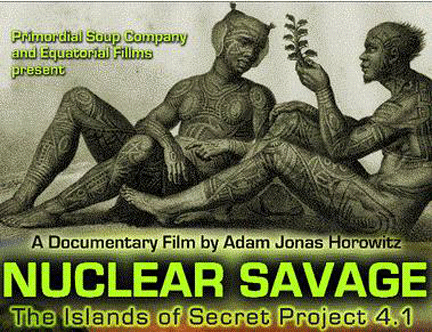
“Nuclear Savage: The Islands of Secret Project 4.1” and “Atomic Artist” Pasatiempo, Michael Abatemarco
Oct 12, 2018
NUCLEAR SAVAGE: THE ISLANDS
OF SECRET PROJECT 4.1
Documentary, not rated, 87 minutes
ATOMIC ARTIST Short documentary, not rated, 27 minutes
Santa Fe’s own Adam Horowitz, producer, writer, and director of Nuclear Savage, begins this unsettling documentary on secret radiation experiments conducted on Pacific Islanders with a brief history of the Marshall Islands, from the first European contact there to the devastating tests on Bikini Atoll starting in 1946. Early in the film, footage is shown of the Castle Bravo detonation over the atoll, a 15-megaton hydrogen blast that, in addition to its deleterious impact on the environment, took an immediate and lasting toll on the health of human populations. In the 12 years after that first test, the U.S. government detonated nearly two dozen such devices in the area. That number increased to 67 by the end of the Cold War. The race to remain ahead of the Soviets in the development of nuclear weapons became the justification for denying the islanders the privilege of their humanity, with government officials choosing instead to regard them as simple savages.
Parts of the islands remain uninhabitable, their residents unable to return to their homes due to high levels of radiation. They live in squalor on other islands, displaced by the thousands. The Marshallese government official in charge of foreign affairs from 2008 to 2009, when the film was in production, calls for greater scrutiny of U.S. documents that were declassified in 1993. These files lend weight to suspicions of cover-ups on the part of the American government concerning the deliberate radiation poisoning of island inhabitants. Horowitz presents credible evidence and does a fine job tying information that’s been available to the public for years with new information gleaned from the government’s Project 4.1, strongly implicating it as a top-secret operation to study radiation effects on unwitting subjects.
It’s hard to refute the eyewitness testimony recounted in the documentary. One islander, a middle-aged woman, states plainly and wistfully, “They wanted to find out what would happen to us from the bomb. They used us as human experiments.” Video footage is shown of islanders from Rongelap Atoll who were exposed to heavy fallout from the Bravo blast and suffered severe radiation burns. No action was taken to see that the several hundred inhabitants of Rongelap were evacuated before the test. Young children were born with deformities or cancer, people’s hair fell out, and islanders began dying of cancer at alarming rates.
Nuclear Savage is compelling, disturbing, thought-provoking filmmaking, in which Horowitz contrasts the idyllic music and customs of the islanders with footage of horrific events. Funded by Pacific Islanders in Communications, a public broadcasting company that provides programming to PBS, Nuclear Savage is a damning look at America’s presence in the Marshall Islands, and is an important, timely documentary. The film has won numerous awards at international festivals, including several jury prizes, and was an official selection at the Film Society of Lincoln Center in New York. An official screening was sponsored by the United Nations in 2015 in conjunction with nuclear nonproliferation hearings…………
Public Senat 22nd Sept 2018 By 2028, 34 of the 58 reactors will be celebrating their fortieth
anniversary, the maximum operating age set during the construction of the
park. EDF over-indebted does not have the means to replace these reactors
at the end of their life.
This film tells how France, by political choice,
became totally dependent on nuclear energy until it got into a dangerous
impasse. This film also shows that, at the same time as the aging of
nuclear power plants, several strategic dams at EDF are showing some
worrying signs of weakness.
Who were the players in this nuclear power
strategy? How was it imposed behind the scenes of the State, what were the
key moments? What are the real reasons and risks today for extending the
life of the fleet in operation? A rigorous investigation at the heart of
the French nuclear machine with the testimonies of the various actors of
the sector. https://www.publicsenat.fr/emission/documentaires/nucleaire-la-fin-d-un-mythe-132557
Liberation 21st Sept 2018, [Machine Translation] The utopia of French nuclear energy dismantled, from
the “Messmer plan” to the EPR. Public Senate broadcasts this Saturday night
“Nuclear, the end of a myth”, a new docu supported on the flaws of the atom
industry. A useful light at a time when the government must decide on the
future of its reactors. The demolition of the French nuclear “model” and
its national narrative has become a popular subject. After the Big Lie seen
on Arte (who attacked the taboo of an attack on power plants) and Impasse
broadcast by France 5 (which told how the damn shipyard EPR reactor is
“sinking” EDF), here is Nuclear, the end of a myth, that we can discover
this Saturday at 9 pm on Public Senate. https://www.liberation.fr/france/2018/09/21/l-utopie-du-nucleaire-francais-demantelee-du-plan-messmer-a-l-epr_1680417
THE INTERNATIONAL URANIUM FILM FESTIVAL RETURNS TO THE DINÉ NATION WITH ADDITIONAL SCREENINGS THROUGHOUT ARIZONA & NEW MEXICO
The issue of nuclear power is not only an issue of the Navajo Nation, who suffered for decades because of uranium mining. All people should be informed about the risks of uranium, nuclear weapons and the whole nuclear fuel chain, states International Uranium Film Festival’s Director Norbert G. Suchanek. In an effort to keep people informed and aware, particularly during this critical time of escalating nuclear threats, the International Uranium Film Festival returns to the U.S. Southwest.
Following screenings in Berlin Germany, the U.S. Southwest tour of the 2018 International Uranium Film Festival will begin at the Navajo Nation Museum on November 29th with screenings in Window Rock, Navajo Nation, USA scheduled for November 29th and 30th and December 1st. The Festival travels to Flagstaff, AZ for December 2nd screenings, then on to Albuquerque, NM for December 6th screenings. Grants, NM will host December 7th screenings with the Festival’s touring closing in Santa Fe on December 9th.
We are currently selecting the films which will comprise the International Uranium Film Festival. We encourage especially Native American and women filmmakers to send their films about uranium mining or any nuclear issue to the Festival. The selected films will be shown not only in the Navajo Nation Museum but also in venues in Flagstaff, Albuquerque, Grants and Santa Fe. The best productions will receive the Uranium Film Festival´s award in Window Rock.
We extend our most sincere gratitude to the Levinson Foundation for their support, making this Festival possible. Festival partners and co-organizers of the Uranium Film Festival in the American Southwest are the New Mexico Social Justice and Equity Institute, the SW Indigenous Uranium Forum and the Multicultural Alliance for a Safe Environment (MASE).
The schedule for the U.S. Southwest tour of the 2018 International Uranium Film Festival is as follows:
November 29th and 30th and December 1st, Navajo Nation Museum, Hwy 264 & Post Office Loop, Window Rock, Navajo Nation, AZ
December 2nd, Flagstaff, AZ
December 6th, Guild Cinema, 3405 Central Ave, Albuquerque, NM
December 7th, Grants, NM
December 9th, Jean Cocteau Cinema, 418 Montezuma Ave, Santa Fe, NM
The Fukushima Prefectural Government and the Reconstruction Agency are looking to take legal action over the video over concerns it will stoke “unreasonable” fears of radiation in the Fukushima Prefecture, the Japan Times reports.
A senior official from the prefecture said they were “examining the video content”.
In the episode, Farrier is filmed taking a tour of areas affected by the 2011 meltdown of a nuclear plant in Fukushima where he suspects a meal served from a restaurant in Namie, a town in Fukushima Prefecture, has been contaminated by radiation.
It also shows the journalist enter a no-go zone around the Fukushima Daiichi nuclear power plant without permission from authorities, reporting from an abandoned game arcade, and tourists on a bus becoming distressed over rising radiation levels without information about the vehicle’s location.
The show has the journalist travel to different locations around the world associated with grim historical events, including the footsteps of serial killer Jeffrey Dahmer in Milwaukee, and voodoo rituals in Benin, West Africa.
Fukuleaks 27th May 2018 , NHK’s new documentary, Meltdown: Cooling Water Crisis provides new
insight into a series of less known events in the Fukushima disaster.
Between March 18 – 21 of the 2011 disaster, white and black smoke was
seen leaving the unit 3 reactor well in significant quantities. At the time
TEPCO claimed they didn’t know a reason. At the time a few radiation
readings outside the plant caused concern that the two things were related.
All of this was mostly ignored by TEPCO and the press. New investigative
research supported by NHK TV found a series of significant events that shed
light on what happened during these later days of the disaster http://www.fukuleaks.org/web/?p=16683
The Breaking the Waves stars have boarded the five-part miniseries about the 1986 nuclear disaster in Ukraine with Mad Men star Jared Harris, the Hollywood Reporter has confirmed.
Chernobyl will see Watson play the role of a Soviet nuclear physicist looking to solve the mystery beyond the natural disaster, while Skarsgard will perform the role of a Soviet-era bureaucrat in the energy ministry. Watson and Skarsgard co-starred in Lars Von Trier’s 1996 drama Breaking the Waves, which earned Watson a best actress Oscar nomination.
Harris was earlier announced to star as Valery Legasov, the Soviet scientist chosen by the Kremlin to investigate the accident. The Chernobyl project dramatizes the true story of one of the worst man-made catastrophes in history, and tells of the brave men and women who sacrificed to save Europe from unimaginable disaster.
The limited series is described as a “a tale of lies and cowardice, of courage and conviction, of human failure and human nobility,” that will look closely at how and why the nuclear disaster happened as well as the heroes who fought and fell during that time.
Craig Mazin (The Huntsman: Winter’s War) will write and Johan Renck (Breaking Bad, The Walking Dead), will direct.Mazin will exec produce with Carolyn Strauss (Game of Thrones) and Jane Featherstone (Broadchurch), with Renck and Chris Fry (Humans) attached to co-exec produce.
The project continues HBO’s investing in miniseries and limited series, and comes several months after the cabler struck a $250 million production partnership with Sky. The two had previously worked together on the Jude Law-starrer The Young Pope, which has been renewed for a second season.
Watson is repped by UTA and Independent Talent Group, while Skarsgard is repped by ICM Partners and Curtis Brown Group.
The City of St. Louis has a little known nuclear past as a uranium-processing center for the Atomic bomb. Government and corporate negligence led to the dumping of Manhattan Project uranium, thorium, and radium, thus contaminating North St. Louis suburbs, specifically in two communities: those nestled along Coldwater Creek – and in Bridgeton, Missouri adjacent to the West Lake-Bridgeton landfill. Another tragic and bizarre occurrence has been unfolding in Bridgeton, Missouri. In 1973, approximately 47,000 tons of the same legacy radioactive waste was moved from Latty Avenue and was illegally dumped into a neighborhood landfill named West Lake. This landfill became an EPA Superfund site in 1990. For the last seven years, an uncontrolled, subsurface fire has been moving towards an area where the radioactive waste was buried. Atomic Homefront is a case study of how citizens are confronting state and federal agencies for the truth about the extent of the contamination and are fighting to keep their families safe.
USA, 2016, Director: Justin Clifton, Documentary, 12 min, English
In southeastern Utah, not far from many of America’s famed national parks, lies America’s last remaining uranium mill. After more than 36 years in operation, the leaders of the nearby Ute Mountain Ute Tribe’s White Mesa community worry that lax regulations and aging infrastructure are putting their water supply, and their way of life, at risk. Trailer: https://vimeo.com/161080821(link is external)
India, 2017, Director Shri Prakash, Documentary, English, 66 min
The American Southwest—especially the sovereign Indigenous nations of Acoma, Laguna, and the Diné or Navajo Nation—has a long history of uranium mining. Once home to a booming economy and proudly called the Uranium Capital of the World, these Indian reservations and poor White communities are now littered with old mines, tailings dams, and other uranium contamination, which is the legacy of this deadly industry. On the Navajo Nation alone, there are more than 500 abandoned uranium mine sites that need to be addressed. This film explores how colonialism, which came to the Southwest with Spanish conquest, has changed face in modern time, as it is played out in a new quest for mineral resources. Contaminated land, water, and air have left these poor communities helpless. Their efforts to gain justice have failed. Indigenous and poverty-stricken communities who suffered the most are trapped and exploited, as new mining companies continue to disregard the health and environment of these people with the lure of a better economy, jobs and new In Situ Leach uranium mining methods. Unfortunately, this is the same sad story repeated in other parts of the world including India, but in India it is the government itself undertaking the enterprise and repeating the same degradation in Jadugoda (Jharkhand).
SHRI PRAKASH is the first filmmaker from Jharkhand to bring a National Award in 2008 for his film ‘Buru Gara’ also his regional language fiction film ‘Baha’ received first international award for the state 2010. Using audio visual medium as a tool for social transformation and empowerment, National Award winner film maker, teaching film studies in St. Xavier’s College, Ranchi. https://www.facebook.com/Shriprakash23(link is external)
USA, 2018, Director Louis Berry, Producer Louis Berry, Documentary, 12:30 min, English
Tale of a Toxic Nation is the story of a nation rich in resources but weak in political influence. The Navajo Reservation has been left with over 500 abandoned uranium mines, toxic surroundings and an impossible clean up. The story has never been more relevant under an administration threatening to reinstate uranium mining in the area. https://vimeo.com/258337365(link is external)
Australia, 2015, Produced and Directed by Kim Mavromatis and Quenten Agius, MAV Media
in Association with NITV (National Indigenous TV Australia). Documentary, 5 min, Australian English and Australian Aboriginal (Antikirrinya), English subtitles Trailer: https://vimeo.com/119231410(link is external)
In the 1950’s and 1960’s the Australian government authorised British Nuclear testing at Emu Field and Maralinga in Outback South Australia. We journey with Antikirrinya Elder, Ingkama Bobby Brown to his homelands in outback South Australia where he explains the legacy of living with British Nuclear testing – how he witnessed the first tests on the Australian mainland at Emu Field (1953) and experienced the devastating affects of radioactive fallout on his family, people and country. This is the first time Bobby has spoken out about what he witnessed when he was a boy – what happened to his family and country and the people who went missing – during British Nuclear testing. British Nuclear testing was a breach of the King’s Letters Patent, the founding document that established the state of South Australia (1836), which granted Aboriginal people the legal right to occupy and enjoy their land for always. How could they occupy and enjoy their land when their land was being blown up and irradiated by nuclear fallout. www.kingsseal.cosm.au (link is external)
UK, 2017, Directors Joshua Portway and Lise Autogena, Producer Lise Autogena, Documentary, 30 min, Danish and Greenlandic with English subtitles, Trailer: https://vimeo.com/214697146(link is external)
Lise Autogena and Joshua Portway’s film Kuannersuit / Kvanefjeld is a work in-progress, forming the first part of the artists’ long-term investigation into the conflicts facing the small, mostly indigenous, community of Narsaq in southern Greenland. Narsaq is located next to the pristine Kvanefjeld mountain; site of one of the richest rare earth mineral resources deposits in the world, and one of the largest sources of uranium. Greenland is a former colony of Denmark, which is now recognised as an “autonomous administrative division” of Denmark, supported economically by the Danish state. Many people see exploitation of mineral deposits as the only viable route to full independence. For generations the farming near Kvanefjeld has been Greenland’s only agricultural industry. This way of life may soon be threatened, as Greenland considers an open pit mine proposed by Greenland Minerals and Energy, an Australian company. The mine would be the fifth-largest uranium mine and second-biggest rare earth extraction operation in the world. Autogena and Portway’s film portrays a community divided on the issue of uranium mining. It explores the difficult decisions and trade-offs faced by a culture seeking to escape a colonial past and define its own identity in a globalised world.
‘Atomic Homefront’ unboxes the cruel consequences of Missouri’s radioactive landfill, The Daily Dot Kahron Spearman—Feb 18
The film takes a human look into a St. Louis-area radioactive landfill that dates back to the Manhattan Project. Cammisa runs down the intertwining and harrowing paths of Bridgeton, Missouri, residents, and those living near the Coldwater Creek floodplain, which flows downstream from the nuclear landfill……..
Because there isn’t any official evidence—or any that the government will admit to—supporting a causal relationship between the radiation and the extraordinary rates of various cancers, pulmonary di – wepons before peopleseases, and multiple sclerosis, the residents exist on a shifting plate, tottering white-hot anger and unparalleled astonishment toward the federal authorities. The film is well-researched given that there’s an open, yet silent antagonism toward those seeking purpose by pushing back on the government’s “science” about the radiation exposure. …..
In the end, the critical takeaway remains the government’s dark submission to weapons. The human impact in the film is maddening and undeniable, begging for some exploration into the awful self-evidence of our defense apparatus: We need these weapons, so whatever collateral damage arises is for the good of the country. Yes, even your cancer.
The Uranium Film Festival & The Perils of Nuclear Power, Clean Tecnica, December 27th, 2017, by Carolyn Fortuna , “……..The International Uranium Film Festival is dedicated to all films about nuclear power and its associated risks of radioactivity. This educational event merges art, ecology, environmentalism, and environmental justice as it informs the public about uranium mining and milling, nuclear power issues, nuclear weapons, and the nuclear fuel cycle. The dynamic media of film and video allow organizers and festival participants to educate and activate the international public as it brings together cultures and generations around the effects of radioactivity and radioactive materials.
Founded in 2010 in Rio de Janeiro by Norbert Suchanek and Marcia Gomes de Oliveira, the visual exhibition has traveled to nine countries around the world and has successfully organized about 60 Uranium Film Festivals. The films typically have content that critiques and analyzes uranium mining, milling, and use and the effects those processes have on land, water, and human health. The dialogue that results, hopefully, can lead to a more peaceful, healthy future and hold promise to promote a safe, sustainable future without nuclear risks……..
Uranium is radioactive and can therefore increase the likelihood of cancer in exposed individuals.
Uranium is a heavy metal that can have toxic effects (primarily on the kidneys) if it enters the bloodstream through ingestion or inhalation.
Depleted uranium hexafluoride (depleted UF6). UF6 can react with moisture in the air to produce HF, a corrosive gas that can damage the lungs if inhaled.
In addition to the radiological and chemical health risks associated with depleted UF6 cylinders, there are also risks of industrial accidents and transportation-related accidents during handling, storage, or transport of depleted UF6.
In addition to the radiological and chemical health risks associated with depleted UF6 cylinders, there are also risks of industrial accidents and transportation-related accidents during handling, storage, or transport of depleted UF6.
The Atomic Age nuclear world has produced millions of metric tons of high-level, low-level, and intermediate-level radioactive waste during the past sixty years. This waste will remain hazardous for over 100,000 years. The Union of Concerned Scientists reminds us that the 2011 accident at Fukushima was a wake-up call about the vulnerability of nuclear power plants to natural disasters such as earthquakes and floods.
We are at a turning point in which many investors are shying away from fossil fuels as energy sources due to their imminent status as stranded assets because of the serious risk they pose to our health and our environment. Shockingly, however, nuclear power is gaining appeal for investors looking for a fast return. Nuclear power is being pitched by some financial planners as “necessary” and — are you ready for it? — “actually good for the environment.”
Solar power, wind power, geothermal power, hybrid and electric cars, and aggressive energy efficiency are climate solutions that are safer, cheaper, faster, more secure, and less wasteful than nuclear power. The Uranium Film Festival can help people around the world to understand how our transition from fossil fuels to an equally dangerous source is not a climate solution.
The Uranium Film Festival honors the best and most important films about uranium with trophies produced by Brazilian waste-material-artist Getúlio Damado, who lives and works in Santa Teresa, Rio de Janeiro.
Submissions to the Next Uranium Film Festival
The upcoming International Uranium Film Festivals planned for 2018 are in Rio de Janeiro (May/June 2018) and in Berlin (October 2018). If you’re interested in submitting an entry to the 2018 Uranium Film Festival, be sure that you restrict your narrative to productions dealing with nuclear power, radioactivity, and the use of radioactive elements like uranium.
Sample subjects are:……..
The Thinking Behind the Uranium Film Festival
The Festival’s must-see documentaries and movies that are rarely shown in TV or in film theaters give nuclear filmmakers a global audience. A further important achievement of the Festival is a first-ever film archive and documentation center dedicated to all films about the nuclear fuel chain and radioactivity: the Atomic Cinematheque, or the Yellow Archive.
Every year, the Festival receives new invitations from all over the world to introduce its films to other cities and countries like Australia, Greenland, Tanzania, Spain, or Scotland. This is only possible through the kindness of donations from like-minded concerned individuals and other non-profit organizations. The organizers do kindly ask for your support, welcoming any donation and distribution.
The Uranium Film Festival is a project against forgetting and ignoring. The horror of atomic bombs and uranium weapons, and nuclear accidents like Three Mile Island, Chernobyl, Goiânia, or now Fukushima, should never be forgotten — nor repeated. https://cleantechnica.com/2017/12/27/uranium-film-festival-perils-nuclear-power/
A Star Psychiatrist Swerves From Nuclear Armageddon To Climate Change,Robert Jay Lifton studied Nazi doctors and the threat of nuclear annihilation. But global warming changed everything. Huffington Post , Alexander C. KaufmanBusiness & Environment Reporter, HuffPost 27/11/2017 NEW YORK ― Robert Jay Lifton has spent his life trying to understand some of the most unfathomable milestones of the 20th century.
The famed psychiatrist and author started his career in the mid-1950s studying Chinese government-sponsored brainwashing, or “thought reform.” In the ’60s, he began interviewing survivors of the atomic bombs dropped on Japan, becoming obsessed with how the human mind copes with the possibility of nuclear annihilation. By the late ’70s, he turned his focus to the doctors responsible for the Nazi regime’s human experiments, men who occupy a uniquely revolting niche in popular culture.
At 91 years old, he has arrived at his most daunting subject yet: climate change. In his latest book, The Climate Swerve, Lifton examines humanity’s struggle to understand what’s happening, how to deal with it, and why powerful people and institutions sabotage attempts to avoid destruction of the planet.
“The climate threat is the most all-encompassing threat that we human beings face,” Lifton said in an interview last month. He walks hunched with a cane now, but sports a mop of long, wavy white hair. He peered through dark, thick-rimmed glasses out the window of a book-stacked office in his modest Upper West Side apartment, located just blocks from Trump Tower. “The nuclear threat is parallel to it in many ways … but the climate threat includes everything.”
In other parts of the world, little doubt exists over the similarities between nuclear weapons and climate change, which Lifton calls the “apocalyptic twins.” The Marshall Islands served as a U.S. testing site for atomic weapons throughout the 20th century. The Pacific archipelago nation bears the scars of that experience today, with entire islands vaporized in hydrogen bomb blasts and high rates of cancer linked to radioactive contamination. Now the country struggles with rapidly rising sea levels, which swallow large habitable areas, make storms more destructive, and salinate freshwater supplies necessary to farm breadfruit, a staple crop.
The phrase “climate swerve” gives name to the increasingly ubiquitous sense of awareness that global warming is happening, and humans have something to do with it……..
“I consider the climate serve a movement toward the recognition of climate danger and what I call species awareness ― awareness of ourselves as a single species in deep trouble,” Lifton said. “The swerve is toward that recognition, that consciousness.”………
I came upon the idea of malignant normality in studying Nazi doctors. If a Nazi doctor was assigned to Auschwitz, it was normal, it was expected of him that he would do the selections of Jews for the gas chamber. Take a leading role in the killing process in a reversal of healing.
With climate change and nuclear weapons, there is also a malignant normality. With nuclear weapons, it’s that the weapons should be stockpiled, maybe even used if necessary because that’s the way you carry through deterrence. Deterrence always carries a willingness to use them in certain conditions. So therefore we should be ready with our duck-and-cover drills to carry out a nuclear war, survive it, win it and carry on with life. These are absurdities that became part of nuclear normality…….
With climate, climate normality was in the everyday practice. We were born into climate normality. This is the world which we entered and in which we live now and which continues. If we allow it to continue as it is now, it will result in the end of human civilization within the present century. I came to the idea of malignant normality that has to be exposed for its malignancy. Intellectuals and professionals have a particular role, what I call witnessing professionals, bear witness to the malignancy, the danger, of what’s being put forward to us as normal and as the only way to behave. That’s happening more but we need a lot of additional expression of resistance on the part of intellectuals in protest and activism.
‘It’s heartbreaking to see how people fled and left all their belongings behind,’ says Bob Thissen
Jon Sharman A film team that specialises in surreptitiously accessing abandoned places has produced new footage showing the ghost towns left behind after the Fukushima nuclear disaster.
The trailer for “Abandoned Fukushima”, a new series by the Exploring the Unbeaten Path group, shows cobweb-covered supermarkets still filled with 2011-era products and classrooms where children’s bags and coats are still hanging.
The area was ravaged by a huge 9.0-magnitude earthquake in March of that year, which led to successive meltdowns at the Fukushima Daiichi nuclear power station. Thousands of residents were forced to evacuate and exclusion zones remain in place.
In the most dangerous areas access is restricted and people travelling through are not allowed to stay overnight.
But the film crew, led by Dutchman Bob Thissen, captured handheld and drone footage of the abandoned, irradiated areas while dodging police and constantly measuring contamination levels.
“It’s heartbreaking to see how people fled and left all their belongings behind,” Mr Thissen told RT. New episodes in the Fukushima series will be posted to YouTube.
Mr Thissen has previously made headlines for sneaking into the Baikonur Cosmodrome in Kazakhstan and filming the rusting hulks of abandoned Buran space shuttles created by the Soviet Union.
Off Country: A Multimedia Documentary Feature, KICK STARTER
A multimedia oral history project examining landscapes of nuclear weapons testing and anti-nuclear activism in the American Southwest.
About this project
For the past two years we have traveled throughout Colorado and New Mexico, interviewing activists and community members whose lives have been impacted by the nuclear weapons industry. We have listened to stories both heartbreaking and inspiring. We have heard about calling into work sick to go on a Backcountry Action in Nevada to stop an underground nuclear weapons test, about quitting your job to dedicate your life full-time to shutting down Rocky Flats, and we have heard about sickness, death, and imprisonment. In the face of both adversity and triumph, these are stories about solidarity, community and a profound commitment to environmental and racial justice.
Our project is a feature-length experimental documentary and multimedia oral history archive that examines three regions in the west, the former Rocky Flats Plant, the White Sands Missile Range and the Nevada Test Site. Off Country investigates the environmental consequences of the nuclear weapons industry as well as racist and classist policies inherent in the storage, mining, and production of radioactive material. We have driven more than 8000 miles, shot over two and a half hours of 16mm film and collected nearly twenty hours of interviews and field recordings.
The film was started with a small grant from CU Boulder, this grant allowed us to perform field work for 4 weeks in the summer of 2016. We shot over 2000 feet of film during this period. Since then we have traveled to New Mexico numerous times and have spent $8,000 on our own conducting fieldwork. Thanks to a small grant from The Puffin Foundation we were able to process and transfer about half of our footage. At bare minimum, we need an additional $10,000 to process the remaining film and transfer it to video.
In order to continue our work we have started a Kickstarter campaign and invite you to help. We are fiscally sponsored by Basement Films so all donations are tax deductible. www.off-country.com
Why Now?
In 1992 the closing of the Rocky Flats Plant outside of Boulder Colorado halted the industrial production of nuclear weapons. There are currently plans underway to construct a plutonium pit production facility at Los Alamos National Labs in New Mexico, in order to modernize the U.S. nuclear stockpile for the 21st Century, despite lingering environmental contamination left by the legacy of the 20th century.
In the 1940s, New Mexico was chosen as the site for the Manhattan Project and the world’s first atomicweapons test because of its remoteness and the military’s perception that “no one” lived there. However, the Mescalero Indian reservation was established just seven miles from ground zero, and Hispanic families had been ranching in the area for generations. What the military meant by “no one” was that no Anglo-Americans lived in the area.
The film will be bilingual and focus on nuclear weapons testing, manufacturing, and storage, with an emphasis on social justice and environmental restoration. Additionally, the archive will document and catalog a diverse chorus of voices whom history has neglected. This archive will be a tool for researchers, historians, and activists, to learn not only about history but the human stories of people resisting environmental contamination and political oppression……..https://www.kickstarter.com/projects/578520099/off-country-a-multimedia-documentary-feature
Nuclear Power: Caveats for Energy Policy, Speaker: Prof. Derek Abbott, University of Adelaide, 1st Sept 2017. Is nuclear power globally scaleable? World energy consumption is 15TW. Energy efficiency could save perhaps 13TW. Consider 10 billion light bulbs in the world and replacing them with LEDs.
This could save 50GW – the output of 50 nuclear plants. Just the IEA countries alone in 2015 saved energy equivalent to the power consumption of the whole of Japan. If we were to seriously scale up to 15,000 nuclear stations we would only have 25 years worth of uranium left.
Netflix is now streaming a film about nuclear weapons that puts you inside humanity’s worst nightmare, Business Insider,DAVE MOSHER, AUG 2, 2017,
Netflix is now streaming an experimental documentary film about nuclear weapons.
“The Bomb” debuted in April 2016 at the Tribeca Film Festival as an immersive experience with 30-foot-tall screens and live music.
The filmmakers hope their movie inspires viewers to speak up about the existential threat of nuclear weapons.
The year before I was born, the world almost ended. Twice.
In September 1983, sunlight reflected off a patch of clouds, fooling a Soviet missile-warning system into detecting five US intercontinental ballistic missiles that were never launched. A colonel in a bunker ignored the alarm on a 50/50 hunch, narrowly averting a nuclear holocaust.
Two months later, US forces staged “Able Archer 83” — a massive nuclear-strike drill on the doorstep of the USSR. Soviet commanders panicked at the show of force and nearly bathed America in thermonuclear energy. Once again, an act of human doubt saved the planet.
Today these and other chilling tales seem like dusty history to the population born after the Cold War and those too young to remember the conflict’s many close calls.
But the grave nuclear threat persists. Ageing weapons systems, evolving terrorist threats, and a worryingly hackable digital infrastructure make the danger perhaps even greater today. That’s the message that the makers of “The Bomb” — an ambitious, experimental documentary that Netflix began streaming on August 1 — have tried to make breathtakingly real.
“Nine countries have 15,000 nuclear weapons. That’s an existential threat to mankind,” said filmmaker Eric Schlosser. Schlosser is the author of “Command and Control,” an investigation into nuclear weapons accidents that was a finalist for the Pulitzer Prize. To write the book, he spent more than six years steeped in declassified government materials and interviewed military experts, scientists, and “broken arrow” eyewitnesses.
“The Bomb” is an unnarrated, non-linear film that riffs on the major themes in Schlosser’s book. It leans heavily on archival nuclear weapons footage, roughly a third of which the public had never seen before the movie came out. Cold War-era documents and blueprints are also brought to life with eye-catching animations, and everything is synced to a trippy electro-rock musical score by The Acid.
Co-directors Smriti Keshari, Kevin Ford, and Schlosser told Business Insider in April 2016 that their ultimate goal is to get people to feel something they will never forget — and then do something about it.
Not your father’s nuclear weapons documentary
When “The Bomb” premiered at the Tribeca Film Festival, it was formatted as an immersive, 360-degree experience. The film now playing on Netflix is a “flat” version edited for a high-definition screen.
The original version continues to travel the world, however — it was recently shown in Berlin and Glasgow — and projects the footage onto eight huge screens while “The Acid” jams out a live score.
Keshari, Ford, and Schlosser said this experience is what makes “The Bomb” unique. “Being surrounded by 30-foot-high screens upon which nuclear explosions are being projected, while really loud music plays,” Schlosser said, “I think that’s going to be a memorable life experience for anyone who sees it.”
Keshari likened it to a form of “shock treatment,” meant to help people feel something about nuclear weapons instead of dismissing their existence.
“These weapons are literally buried underground. They’re out of sight, out of consciousness,” Keshari said. “It’s shocking how many we have, the countries that have them, how powerful these are, how much money is spent on them. And yet we’re in complete denial of it.”
They have a point.
The so-called Millennial generation has never experienced the dread of imminent thermonuclear war. For me, the existential threat of nuclear weapons didn’t really click until a few years ago, when I wrote a story about a byproduct of the nuclear arms race.
Today’s nuclear arsenals are packed with a variety of exceptionally deadly weapons.
Enhanced warheads, for example, are dozens of times more powerful than the relatively crude bombs that destroyed Hiroshima and Nagasaki. Fusion bombs are also on alert and ready to launch, and they are thousands of times more powerful than any nuclear weapons detonated during World War II.
The US and Russia together harbour roughly 90% of the world’s supply of more than 14,900 nuclear weapons, and they’re maintained under tight systems of control. The US is also spending $US1 trillion to upgrade its devices. Nuclear terrorism continues to be a major point of concern, too.
But the central thesis of “The Bomb” — one Schlosser made strongly in “Command and Control” as well — is that mortifying accidents have happened and will happen again, because people are human, and nuclear weapons aren’t foolproof…….
e filmmakers don’t want the film to simply bum people out.
“There’s no point in that. For me, this sort of knowledge should be empowering. Because to live in denial is a much greater danger than to have your eyes open and have the ability to do something about it,” Schlosser said. “It helps you enjoy the day. It puts a lot of bulls**t worries into perspective and helps you not take anything or anyone for granted.”
Text at end of the film drives home this sentiment with a call to action.
“A nuclear war anywhere in the world would affect everyone in the world. These weapons pose an existential threat. The widespread lack of knowledge about them, the lack of public debate about them, makes the danger even worse,” it reads. “Our silence is a form of consent.”https://www.businessinsider.com.au/netflix-the-bomb-nuclear-weapons-film-2017-8?r=US&IR=T
For years, the local population has suffered from the extensive environmental degradation caused by mining operations, responsible for the high frequency of radiation related sicknesses and developmental disorders found in the area. Increases in miscarriages, impotency, infant mortality, Down’s syndrome, skeletal deformities, thalassemia have been reported. With raw radioactive ‘yellow-cake’ production to increase and more than 100,000 tons of radio-active waste stored at Jadugoda the threat to the local tribal communities is set to continue.