Chernobyl: horrifying, masterly television that sears on to your brain. This breathtaking series throws us right into the hellish chaos of the nuclear disaster – and its terrors are unflinching and unforgettable, Guardian, Rebecca Nicholson, 29 May 2019 After three of its five episodes aired, the miniseries Chernobyl found its way to the top of IMDB’s top 250 TV shows in history list. While the fan-voted chart might seem hyperbolic, given that the drama had only just crossed the halfway point, it is not undeserving of the honour. Chernobyl is masterful television, as stunning as it is gripping, and it is relentless in its awful tension, refusing to let go even for a second. That old ‘don’t spoil the ending’ joke about Titanic will inevitably be rebooted here, but it is confident enough to withstand any familiarity with the story.
From the opening moments, it conjured up panic and despair, beginning with the suicide of Jared Harris’ nuclear physicist Valery Legasov (Harris must have “harrowing departure” on his CV), then throwing us right back into the hellish disorientation of the disaster itself, two years earlier …..
Chernobyl is a disaster movie, a spy movie, a horror movie, a political thriller, and a human drama, and it spins each plate expertly. The terror is unflinching and explicit, and its images of burned bodies collapsing into putrid decay are impossible to forget. Yet it never feels shocking for the sake of it, only as haunting and horrible as its subject matter demands. It manages to navigate the perilous path of having its characters speak in jargon, and largely refusing to explain it, while keeping viewers on top of what is happening…..
Often prestige television like this – expansive, expensive and ambitious – falls back on its wordiness, and Chernobyl is certainly well-written enough to justify that. But it is as cinematic as it is reliant on dialogue, and it has the patience to let images do the heavy lifting when it is called for. ……
The obfuscation of truth is rampant and catastrophic. We may not be living under the threat of the KGB, but the menace of constant surveillance does not feel far away. The rejection of scientific knowledge, of experts, has terrible consequences. It makes sense that modern audiences would take to Chernobyl; the contemporary resonance is plain.
An intense new HBO miniseries about the world’s worst nuclear accident turns the Chernobyl Soviet scientists into unlikely heroes in its portrayal of a world superpower approaching meltdown, 3 May 2019 By Fred Pearce
Fifteen minutes into the second episode of HBO’s gripping saga of the 1986 Chernobyl nuclear disaster, we are treated to an idiot’s guide to how a nuclear power plant works.
It is delivered by a top Soviet nuclear scientist, Valery Legasov, to a hapless, senior Soviet apparatchik as they fly to the unfolding disaster. As a plot device, it helps the viewer understand events as much as the politburo hack.
But it also does something more interesting: it helps establish the nuclear scientist as the unlikely hero of the story. And give us some interesting insights into a pre-collapse Soviet Union.
In a disaster movie about a nuclear accident, told over five hour-long episodes, you might expect the scientists who designed the plant to be the bad guys. But, at least in the first two episodes available for preview, they come out smelling of roses.
For the producers have bigger fish to fry – the entire edifice of communist rule in the Soviet Union, which was then only three years from toppling. It makes for a great story, but also has the ring of truth.
The central human narrative is the tension between boffins and bureaucrats. Legasov, based at the Kurchatov Institute, Moscow, the Soviet Union’s main atomic research institute, is the man who first understood the scale of the disaster.
He devised a way to douse the inferno by pouring thousands of tonnes of sand and boron into the stricken reactor from helicopters, and was also the first to insist on the evacuation of 50,000 local inhabitants who had been left to suffer the fallout by officials intent on covering up the entire disaster.
In later episodes, however, we can expect to see him blamed by politicos, who disliked his appetite for speaking truth to the incompetents in power. So much so that he ends up hanging himself in the stairwell of his apartment on the second anniversary of the accident, shortly after telling his story to Pravda.
This mini-series is brilliant and pointed storytelling, with gruesome early scenes of radiation sickness among the fire crews intercut with the local officials in their bunker, unwilling and unable to comprehend what was happening above them. Again, on the basis of the first two episodes, the story is told without taking too many liberties with the historical truth.
Its main take is that the accident exposed as never before the callousness and dysfunction of the Soviet elite. And that by making this finally visible to Soviet citizens, it undermined the best of Communism, a sense of common purpose.
It is a view shared by academics such as Kate Brown in her recent study of Chernobyl and its aftermath, Manual for Survival (Allen Lane, 2018). The dozens of plants workers, firefighters and helicopter pilots who died putting out the Chernobyl inferno, would never sacrifice themselves in that way again.
The disaster replaced the common purpose with a sense of betrayal. It did not just symbolise the failings of communist rule, but precipitated its collapse.
Early on, the series has Soviet leader Mikhail Gorbachev declaring angrily that the accident had to be kept secret because “our power comes from the perception of our power”. Chernobyl incinerated that perception, and their power was over. As he strung himself up, one imagines that Legasov already knew the truth.
Chernobyl, starring Jared Harris, Stellan Skarsgård and Emily Watson, premieres 6 May on HBO.
Fred Pearce is a New Scientist consultant and the author of Fallout: A journey through the nuclear age(Granta Books).
Irish Times 30th April 2019 A new five-part miniseries dramatising the 1986 Chernobyl nuclear explosion will bring “fresh eyes” to the disaster and its subsequent cover-up,
Chernobyl activist Adi Roche said at a screening of the drama in Dublin on
Tuesday.
Ms Roche said she hoped the series, named Chernobyl and made by
Sky in association with US broadcaster HBO, “wins every award going”
for its portrayal of the tragedy and those caught up in it. “Disasters
like Chernobyl can fade from the headlines, can fade from societal
consciousness, can fade from the memories of ordinary people,” Ms Roche
said.
“This series will reveal to a new global TV audience the ignominy,
the betrayal and the heroism behind the deadliest nuclear accident in human
history.”
APRIL 29, 2019 BY A PUBLIC AFFAIRThirty-three years ago, on April 26, 1986, the Chernobyl Nuclear Power Plant in northern Ukraine experienced two explosions and a fire that released deadly levels of radioactive gas and ash. This event is widely considered the most disastrous nuclear power plant accident in history.
Historian Kate Brown says that “much of what we’re told about the Chernobyl disaster and its after-effects is incomplete or incorrect.” Today, she joins us on the show to share her research of Chernobyl and nuclear history and to discuss her latest book, Manual for Survival: A Chernobyl Guide to the Future. Along the way, she and Patty consider what happens when atomic energy is released; the impact of radiation on the landscape, on animal bodies, and on human bodies; and the environmental and public health consequences of large-scale technological disasters.
U.S. film shines light on Japan boat crew exposed to 1954 nuke test, By Miya Tanaka, KYODO NEWS – Mar 14, 2019– For many Americans, the story of the Japanese fishing crew who were exposed to a U.S. hydrogen bomb test in the Pacific Ocean 65 years ago may be a footnote in history easy to overlook.
But Keith Reimink, a 40-year-old American documentary filmmaker, reacted differently when he came across in 2014 a tiny paragraph mentioning the incident in a nearly 500-page book criticizing the U.S. management of nuclear weapons.
Little was mentioned except for the fact that the 23 Japanese men aboard the tuna fishing vessel Fukuryu Maru No. 5 suffered radiation poisoning and that one of them died. But the Pittsburgh-based movie director was intrigued, and by the end of the year, his group was already in Japan to film interviews with three of the former fishermen.
Four years on, Reimink’s indie film company released last September in the United States a 75-minute documentary called “Day of the Western Sunrise” that depicts the horror of nuclear weapons through the vivid accounts of the fishermen and flashbacks of the incident presented as animation.
“The vast majority of Americans have not heard about any suffering related to nuclear tests after World War II ended…People need to learn about the legacy of nuclear testing in America so that it doesn’t happen again,” Reimink, who made his debut as a film director in 2012, told Kyodo News when he recently came to Japan for the film’s first public screening in the country……….
The film opens by noting that most people believe that Japan’s experience of nuclear weapons ended with the U.S. atomic bombings of Hiroshima and Nagasaki in August 1945.
But another tragedy occurred on March 1, 1954, when the United States conducted its largest-ever nuclear weapons test, code-named Castle Bravo, at the Bikini Atoll in the Marshall Islands. The explosion brought higher levels of fallout than predicted, contaminating the islands and boats sailing in the vicinity.
The three former Fukuryu Maru members recall in the film the moment of the blast that forever changed their lives. As a flash lit up the western sky, one of them shouted, “The sun rises in the west!”
A total of 22 crew members survived the initial illness, but further hardships awaited them. They were shunned by the local community amid rumors that radiation sickness was communicable, sometimes rejected when seeking marriage partners and haunted by fears that the exposure might still affect their health and their offspring as well.
Matashichi Oishi, 85, who has been the most active among the survivors in recounting his experiences in public, talks in the film about his first child being stillborn and deformed, which he kept a secret for a long time. “It could happen to anyone who is exposed to radiation,” he warns………
The footage revealed “personal and intimate” accounts of the fishermen, leading Reimink to think that the film should be “a Japanese story” and that there is “no room for an American opinion.”
As well as insisting on the narrator speaking in Japanese against the advice of many people, Reimink adopted an animation style inspired by Japanese traditional “kamishibai” storytelling that combines hand-drawn visuals with engaging narration.
bySkro35at February 16, 2019 Ralph spends the entire hour with physicist and former Chairman of the Nuclear Regulatory Commission, Dr. Gregory Jaczko, talking about his book “Confessions of a Rogue Nuclear Regulator.”
Dr. Gregory Jaczko served as Chairman of the U.S. Nuclear Regulatory Commission from 2009-2012, and as a commissioner from 2005-2009. As Chairman, he played a lead role in the American government’s response to the Fukushima nuclear accident in Japan. Dr. Jaczko is now an adjunct professor at Princeton University and Georgetown University, and an entrepreneur with a clean energy development company. He is the author of Confessions of a Rogue Nuclear Regulator.
“There are a lot of people running around, talking about how nuclear is the only way we’re going to solve climate change. And it just reminds me of these predictions back in the ‘60s of how we were going to have an entire country powered by nuclear power. A generation has forgotten those promises, and now they’re latching onto nuclear as some kind of solution to climate change. That, to me, is a real mistake.” Dr. Gregory Jaczko, former Chairman of the Nuclear Regulatory Commission and author of “Confessions of a Rogue Nuclear Regulator”
News.com.au 23rd Feb 2019 ,Eerie photographs taken recently show how nature is reclaiming an abandoned
town 33 years after the nuclear disaster at Chernobyl. The harrowing
pictures show what is left of the towns of Chernobyl and Pripyat in
Ukraine, with gasmasks scattered about and dolls left abandoned in a day
care centre. Other captivating photos show an abandoned supermarket with a
shopping trolley outside and a rusting bumper car. Dutch photographer Erwin
Zwaan, 47, travelled to the 28-kilometre exclusion zone around Chernobyl in
Northern Ukraine in 2016 and 2018 to photograph the ghostly ruins for his
book Chernobyl – 30+ Years Without Humans. The power plant and nearby town
Pripyat — once home to 50,000 people — remain more or less untouched
three decades after they were evacuated in 1986.
The made-for-TV movie The Day After had an enormous impact on America’s national conversation about nuclear weapons in 1983. Resuming that conversation today is essential, and the movie holds some lessons about what that would take. The Nation, By Dawn Stover– 14 Dec 18 This article originally appeared as part of a special section on The Day After at the Bulletin of the Atomic Scientists “…….The television movie The Day After depicted a full-scale nuclear war and its impacts on people living in and around Kansas City.
It became something of a community project in picturesque Lawrence, 40 miles west of Kansas City, where much of the movie was filmed. Thousands of local residents—including students and faculty from the University of Kansas—were recruited as extras for the movie; about 65 of the 80 speaking parts were cast locally. The use of locals was intentional, because the moviemakers wanted to show the grim consequences of a nuclear war for real Middle Americans, living in the real middle of the country. By the time the movie ends, almost all of the main characters are dead or dying.
ABC broadcast The Day After on November 20, 1983, with no commercial breaks during the final hour. More than 100 million people saw it—nearly two-thirds of the total viewing audience. It remains one of the most-watched television programs of all time. Brandon Stoddard, then-president of ABC’s motion picture division, called it “the most important movie we’ve ever done.” The Washington Post later described it as “a profound TV moment.” It was arguably the most effective public-service announcement in history.
It was also a turning point for foreign policy. Thirty-five years ago, the United States and the Soviet Union were in a nuclear arms race that had taken them to the brink of war. The Day After was a piercing wake-up shriek, not just for the general public but also for then-President Ronald Reagan. Shortly after he saw the film, Reagan gave a speech saying that he, too, had a dream: that nuclear weapons would be “banished from the face of the Earth.” A few years later, Reagan and Soviet leader Mikhail Gorbachev signed the Intermediate-Range Nuclear Forces (INF) Treaty, the first agreement that provided for the elimination of an entire category of nuclear weapons. By the late 1990s, American and Russian leaders had created a stable, treaty-based arms-control infrastructure and expected it to continue improving over time.
Now, however, a long era of nuclear restraint appears to be nearing an end. Tensions between the United States and Russia have risen to levels not seen in decades. . Alleging treaty violations by Russia, the White House has announced plans to withdraw from the INF Treaty. Both countries are moving forward with the enormously expensive refurbishment of old and development of new nuclear weapons—a process euphemized as “nuclear modernization.” Leaders on both sides have made inflammatory statements, and no serious negotiations have taken place in recent years.
There are striking parallels between the security situations today and 35 years ago, with one major discordance: Today, nuclear weapons are seldom a front-burner concern, largely being forgotten, underestimated, or ignored by the American public. The United States desperately needs a fresh national conversation about the born-again nuclear-arms race—a conversation loud enough to catch the attention of the White House and the Kremlin and lead to resumed dialogue. A look back at The Day After and the role played by ordinary citizens in a small Midwestern city shows how the risk of nuclear war took center stage in 1983, and what it would take for that to happen again in 2018.
[Article goes on to detail the story]……
It is no coincidence that nuclear war begins in The Day After with a gradually escalating conflict in Europe. In one scene, viewers hear a Soviet official mention the “coordinated movement of the Pershing II launchers.”
The Intermediate-Range Nuclear Forces Treaty that Reagan and Gorbachev signed in 1987 resolved that conflict, banning all ground-launched and air-launched nuclear and conventional missiles (and their launchers) with ranges between 500 and 5,500 kilometers, or 310 to 3,420 miles. However, Trump said in October that he plans to withdraw from the treaty, and on December 4 Secretary of State Mike Pompeo said the United States would withdraw in 60 days if Russia continues its alleged non-compliance. Gorbachev and Shultz, in a Washington Post op-ed published that day, warned that “[a]bandoning the INF Treaty would be a step toward a new arms race, undermining strategic stability and increasing the threat of miscalculation or technical failure leading to an immensely destructive war.”………
A BRIGHT TOMORROW?
In one scene in The Day After, a pregnant woman who has taken shelter in the Lawrence hospital along with fallout victims tells her doctor that her overdue baby doesn’t want to be born. You’re holding back hope, he says.
“Hope for what?” she asks. “We knew the score. We knew all about bombs. We knew all about fallout. We knew this could happen for 40 years. Nobody was interested.”
It won’t be long before another 40 years have passed. Americans have not yet perished in a nuclear war or its aftermath, but a new arms race is beginning and the potential for an intentional or accidental nuclear war seems to be rising…….. https://www.thenation.com/article/nuclear-weapons-bulletin-atomic-scientists/
Renowned public intellectual calls out Democrats and Republicans for escalating nuclear dangers and decries Republican Party “dedicated to the destruction of life” NEWS PROVIDED BY ChomskySpeaks.org
Nov 02, 2018 BOSTON, Nov. 2, 2018 /PRNewswire/— Executive Producer Randall Wallace and Director Patrick Jerome launch the online documentary, “Noam Chomsky: Internationalism or Extinction” on the website: http://ChomskySpeaks.org. Based on a lecture by the public intellectual who is often described as the “most quoted living intellectual,” the documentary brings both the activist energy and desperate concerns of climate change and nuclear escalation that are causing mass extinctions.
Against these dire realities, Noam Chomsky surveys “the internationalism” of inter-state cooperation and social movements as solutions. He notes the complicity of both Democratic and Republican parties in escalating nuclear tensions and nuclear proliferation. At the same time, he condemns the Republican Party for profit-driven policies leading to climate-altering, carbon pollution. The documentary is a compelling and urgent warning explaining such ideas and tools as “the Anthropocene,” “the Doomsday Clock,” “species extinction,” “internationalism,” “denialism,” “non-proliferation,” “NATO expansion,” “climate accords,” and “climate debt” among many others.
Many non-partisan organizations collaborated in organizing the original lecture upon which the documentary is based; several also supported the production of the documentary as a starting point for further analysis. These included peace movement organizations in collaboration with the Boston-based movement-building center, encuentro5 (http://encuentro5.org) and the democracy movement’s Liberty Tree Foundation for the Democratic Revolution (http://LibertyTreeFoundation.org). The video adds to their efforts at expanding the public conversation about vital issues of the day. A grant from the Wallace Action Fund supported the documentary.
Chomsky concludes his lecture with sober reflection on the urgent challenges facing humanity: “The tasks ahead are daunting and they cannot be deferred.” Media Contact:
Rik Garfit-Mottram 26th Aug 2018 The Low Level Radiation and Health Conference was set up in 1985 by members
of the public keen to find out more about these issues. Since its
inception, the conference has invited those carrying out research to
present their findings in an accessible way to members of the public and
those with an interest.
Thanks to Professor Carmel Mothersill we were able
to run on our event from one she organised for the International Union of
Radioecologists and kindly some of the IUR speakers stayed on to present.
In addition, Rik offered to film the entire event.
The first video has links to another 9:
Wildlife impacts: Recent findings concerning germline
mutations in bugs and humans, Prof Tim Mousseau, University of South;
Biological effects of long-term chronic exposure: a case study on Scots
pine populations around Chernobyl, Prof Stanislav Geras’kin, Head of
Laboratory of Plant Radiobiology and Ecotoxicology from the Russian
Institute of Radiology and Agroecology;
Organ damage from exposure to
infrasound, Prof. Mariana Alves Pereira. She worked with the chief medical
officer for the Portuguese Aeronautical Industry;
Gender Matters in the
Atomic Age, Mary Olson, US Nuclear Information + Resource Service, NIRS.
Update on the situation with nuclear power in the USA. Mary Olsen, Nuclear
Information and Resource Service.
Radiation Monitoring in the USA. Tim
Mousseau, University of South Carolina. The Welsh Connection. John
Urquhart. The ARGUS Monitoring Project. Graham Denman
Fracking and Waste
Water Treatment in the UK. John Busby, Dr Ian Fairlie, given by Jill
Sutcliffe.
Video 1 Chair: Prof David Copplestone, University of Stirling
Alice Stewart1 Lecture, Biophotons. Prof. Carmel Mothersill, McMaster
University, Canada.https://youtu.be/K2mmfiXpM6s
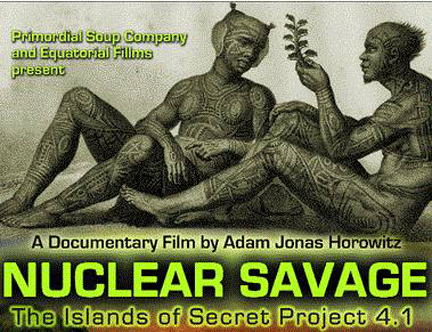
“Nuclear Savage: The Islands of Secret Project 4.1” and “Atomic Artist” Pasatiempo, Michael Abatemarco
Oct 12, 2018
NUCLEAR SAVAGE: THE ISLANDS
OF SECRET PROJECT 4.1
Documentary, not rated, 87 minutes
ATOMIC ARTIST Short documentary, not rated, 27 minutes
Santa Fe’s own Adam Horowitz, producer, writer, and director of Nuclear Savage, begins this unsettling documentary on secret radiation experiments conducted on Pacific Islanders with a brief history of the Marshall Islands, from the first European contact there to the devastating tests on Bikini Atoll starting in 1946. Early in the film, footage is shown of the Castle Bravo detonation over the atoll, a 15-megaton hydrogen blast that, in addition to its deleterious impact on the environment, took an immediate and lasting toll on the health of human populations. In the 12 years after that first test, the U.S. government detonated nearly two dozen such devices in the area. That number increased to 67 by the end of the Cold War. The race to remain ahead of the Soviets in the development of nuclear weapons became the justification for denying the islanders the privilege of their humanity, with government officials choosing instead to regard them as simple savages.
Parts of the islands remain uninhabitable, their residents unable to return to their homes due to high levels of radiation. They live in squalor on other islands, displaced by the thousands. The Marshallese government official in charge of foreign affairs from 2008 to 2009, when the film was in production, calls for greater scrutiny of U.S. documents that were declassified in 1993. These files lend weight to suspicions of cover-ups on the part of the American government concerning the deliberate radiation poisoning of island inhabitants. Horowitz presents credible evidence and does a fine job tying information that’s been available to the public for years with new information gleaned from the government’s Project 4.1, strongly implicating it as a top-secret operation to study radiation effects on unwitting subjects.
It’s hard to refute the eyewitness testimony recounted in the documentary. One islander, a middle-aged woman, states plainly and wistfully, “They wanted to find out what would happen to us from the bomb. They used us as human experiments.” Video footage is shown of islanders from Rongelap Atoll who were exposed to heavy fallout from the Bravo blast and suffered severe radiation burns. No action was taken to see that the several hundred inhabitants of Rongelap were evacuated before the test. Young children were born with deformities or cancer, people’s hair fell out, and islanders began dying of cancer at alarming rates.
Nuclear Savage is compelling, disturbing, thought-provoking filmmaking, in which Horowitz contrasts the idyllic music and customs of the islanders with footage of horrific events. Funded by Pacific Islanders in Communications, a public broadcasting company that provides programming to PBS, Nuclear Savage is a damning look at America’s presence in the Marshall Islands, and is an important, timely documentary. The film has won numerous awards at international festivals, including several jury prizes, and was an official selection at the Film Society of Lincoln Center in New York. An official screening was sponsored by the United Nations in 2015 in conjunction with nuclear nonproliferation hearings…………
Public Senat 22nd Sept 2018 By 2028, 34 of the 58 reactors will be celebrating their fortieth
anniversary, the maximum operating age set during the construction of the
park. EDF over-indebted does not have the means to replace these reactors
at the end of their life.
This film tells how France, by political choice,
became totally dependent on nuclear energy until it got into a dangerous
impasse. This film also shows that, at the same time as the aging of
nuclear power plants, several strategic dams at EDF are showing some
worrying signs of weakness.
Who were the players in this nuclear power
strategy? How was it imposed behind the scenes of the State, what were the
key moments? What are the real reasons and risks today for extending the
life of the fleet in operation? A rigorous investigation at the heart of
the French nuclear machine with the testimonies of the various actors of
the sector. https://www.publicsenat.fr/emission/documentaires/nucleaire-la-fin-d-un-mythe-132557
Liberation 21st Sept 2018, [Machine Translation] The utopia of French nuclear energy dismantled, from
the “Messmer plan” to the EPR. Public Senate broadcasts this Saturday night
“Nuclear, the end of a myth”, a new docu supported on the flaws of the atom
industry. A useful light at a time when the government must decide on the
future of its reactors. The demolition of the French nuclear “model” and
its national narrative has become a popular subject. After the Big Lie seen
on Arte (who attacked the taboo of an attack on power plants) and Impasse
broadcast by France 5 (which told how the damn shipyard EPR reactor is
“sinking” EDF), here is Nuclear, the end of a myth, that we can discover
this Saturday at 9 pm on Public Senate. https://www.liberation.fr/france/2018/09/21/l-utopie-du-nucleaire-francais-demantelee-du-plan-messmer-a-l-epr_1680417
THE INTERNATIONAL URANIUM FILM FESTIVAL RETURNS TO THE DINÉ NATION WITH ADDITIONAL SCREENINGS THROUGHOUT ARIZONA & NEW MEXICO
The issue of nuclear power is not only an issue of the Navajo Nation, who suffered for decades because of uranium mining. All people should be informed about the risks of uranium, nuclear weapons and the whole nuclear fuel chain, states International Uranium Film Festival’s Director Norbert G. Suchanek. In an effort to keep people informed and aware, particularly during this critical time of escalating nuclear threats, the International Uranium Film Festival returns to the U.S. Southwest.
Following screenings in Berlin Germany, the U.S. Southwest tour of the 2018 International Uranium Film Festival will begin at the Navajo Nation Museum on November 29th with screenings in Window Rock, Navajo Nation, USA scheduled for November 29th and 30th and December 1st. The Festival travels to Flagstaff, AZ for December 2nd screenings, then on to Albuquerque, NM for December 6th screenings. Grants, NM will host December 7th screenings with the Festival’s touring closing in Santa Fe on December 9th.
We are currently selecting the films which will comprise the International Uranium Film Festival. We encourage especially Native American and women filmmakers to send their films about uranium mining or any nuclear issue to the Festival. The selected films will be shown not only in the Navajo Nation Museum but also in venues in Flagstaff, Albuquerque, Grants and Santa Fe. The best productions will receive the Uranium Film Festival´s award in Window Rock.
We extend our most sincere gratitude to the Levinson Foundation for their support, making this Festival possible. Festival partners and co-organizers of the Uranium Film Festival in the American Southwest are the New Mexico Social Justice and Equity Institute, the SW Indigenous Uranium Forum and the Multicultural Alliance for a Safe Environment (MASE).
The schedule for the U.S. Southwest tour of the 2018 International Uranium Film Festival is as follows:
November 29th and 30th and December 1st, Navajo Nation Museum, Hwy 264 & Post Office Loop, Window Rock, Navajo Nation, AZ
December 2nd, Flagstaff, AZ
December 6th, Guild Cinema, 3405 Central Ave, Albuquerque, NM
December 7th, Grants, NM
December 9th, Jean Cocteau Cinema, 418 Montezuma Ave, Santa Fe, NM
The Fukushima Prefectural Government and the Reconstruction Agency are looking to take legal action over the video over concerns it will stoke “unreasonable” fears of radiation in the Fukushima Prefecture, the Japan Times reports.
A senior official from the prefecture said they were “examining the video content”.
In the episode, Farrier is filmed taking a tour of areas affected by the 2011 meltdown of a nuclear plant in Fukushima where he suspects a meal served from a restaurant in Namie, a town in Fukushima Prefecture, has been contaminated by radiation.
It also shows the journalist enter a no-go zone around the Fukushima Daiichi nuclear power plant without permission from authorities, reporting from an abandoned game arcade, and tourists on a bus becoming distressed over rising radiation levels without information about the vehicle’s location.
The show has the journalist travel to different locations around the world associated with grim historical events, including the footsteps of serial killer Jeffrey Dahmer in Milwaukee, and voodoo rituals in Benin, West Africa.








 nuclear-news