National Day of Remembrance for Victims of Nuclear Weapons Testing,
 http://kcpw.org/blog/local-news/2012-01-27/victims-of-nuclear-testing-radiation-remembered/ Victims of Nuclear Testing Radiation Remembered, 01.27.2012 by Jeff Robinson (KCPW News) It was 61 years ago today that nuclear testing began on the Nevada Test Site, as many residents of Salt Lake Cityand more rural areas like Kane County know too well. That’s why local leaders are marking a National Day of Remembrance for Victims of Nuclear Weapons Testing, which was designated by the U.S. Senate, to commemorate the lives of downwinders, those who were exposed to the radiation. Local resident Mary Dickson is one of them. She shared her downwinder story with KCPW’s Jeff Robinson.
Film exposes “regulatory capture” of USA’s NRC by the nuclear industry
 Sundance Diary: “The Atomic States of America” Turns the Lens on Nuclear Power ONEARTH, BY BRUCE BARCOTT January 26, 2012 “……. The Atomic States of America, a film based partly upon her memoir, Welcome to Shirley.
McMasters’ book chronicled her childhood growing up in a blue-collar Long Island town next to the Brookhaven National Lab, one of the federal government’s leading nuclear research stations. In the 1990s, news broke (thanks to citizen activists and a local newspaper reporter) that Brookhaven’s three reactors regularly leaked deadly nuclear materials into the local water supply.
McMasters didn’t realize what was going on until college, when a roommate asked her, “Why are you always going home to all these funerals? What’s going on there?” The answer: Cancer, cancer, and more cancer.
Atomic States directors Sheena Joyce and Don Argott, who made the documentary Rock School in 2005, expand on McMasters’ material, looking at other nuclear power plant-adjacent communities and their chillingly similar experiences with radioactive leaks.
“At one of the documentary filmmakers forums over the weekend, we talked about this recurring theme of regulatory capture,” McMasters told me. “Again and again, we’re seeing the corporations that are supposed to be regulated take over the regulatory agency through money and politics.”
Three Japanese films about Fukushima nuclear disaster
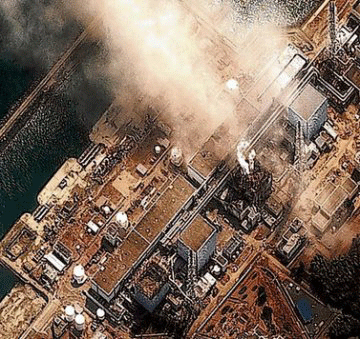 Japanese filmmakers tackle the 3/11 tragedy, SBS 23 January 2012 – By World Movies Three films focusing on Japan’s nuclear plant meltdown and the aftermath will be unveiled next month. “If one was to be poisoned by radiation, if he or she did so out of their own will and conviction I believe it to be perfectly fine. But you can’t force that onto the children. The children, you must distance them from the poisoned areas.”
Also being unveiled at the festival are two other Japanese films dealing with the March 11, 2011 meltdown at the Fukushima nuclear power station and ensuing tsunami. Continue reading
World’s groundwater being depleted
since the year 1900 up to the year 2008, something in the order of 4,500 cubic kilometres of depletion; most of that occurring in the last 50 years. That’s how much less water is in the ground today than 108 years ago.
 Audio http://www.abc.net.au/pm/content/2012/s3413882.htm Is the world facing a groundwater crisis? ABC Rural radio Dubravka Voloder reported this story on January 23, 2012 MARK COLVIN: Water is not just a sensitive subject in Australia. In a crowded world of seven billion people, water is an increasing source of friction and the lack of it could have damaging results.
International water researchers say that water shortages could affect world food production in the next few decades unless something’s done about it. The scientists are meeting in Sydney to discuss whether there’ll be a groundwater crisis.
Dubravka Voloder reports. Continue reading
Films show effects of uranium mining on indigenous peoples
Two films show effects of uranium mining Friday Film Pick: Don’t Mine Me & Uranium Art Threat, by EZRA WINTON JANUARY 20, 2012 a doc looking at the history of uranium mining on a Navajo Indian Reservation in the US. Since you can only watch the trailer for this film and read about it as it continues production (with generous donations from supporters), I’m including a second film from 1990 that looks at uranium mining in Canada, called Uranium (trailers after jump).
Don’t Mine Me is a documentary about the history of uranium mining on the Navajo Indian Reservation in the Southwest United States. At the end of WWII, the United States encouraged uranium mining production. Several large uranium deposits were found on the Navajo Reservation and many Navajo men were employed to work these mines. Disregarding the known health risks resulting from exposure to uranium, the United States failed to inform the Navajo workers about the dangers and to regulate the mining to minimize contamination. Several mine workers and families on the reservation have suffered with numerous amounts of health problems, some even fatal, from environmental contamination. For decades the government failed to improve conditions and to inform workers of the dangers. Continue reading
Israel will not pre-emptively strike Iran
http://www.abc.net.au/news/2012-01-19/israel-defence-minister-denies-jewish-state-about/3782256?section=world Israel Defence Minister denies Jewish state about to strike Iran ABC Radio News, January 19, 2012 Israel’s Defence Minister Ehud Barak has denied that his country is close to carrying out a pre-emptive strike on Iran’s nuclear facilities. He was speaking on the eve of a visit to Israel by the chairman of the US Joint Chiefs of Staff General Martin Dempsey who is reportedly on a mission urging Israel to show restraint.
Source: AM | TONY EASTLEY: Israel’s defence minister Ehud Barak has denied that his country is close to carrying out a pre-emptive strike on Iran’s nuclear facilities.
He was speaking on the eve of a visit to Israel by the chairman of the US Joint Chiefs of Staff General Martin Dempsey who is reportedly there on a mission urging Israel to show restraint.
Foreign affairs editor Peter Cave reports from Jerusalem….. http://www.abc.net.au/news/2012-01-19/israel-defence-minister-denies-jewish-state-about/3782256?section=world
Independent inquiry: did earthquake first damage Fukushima’s nuclear reactors?
The panel includes legal, nuclear and medical experts. Seismologist Katsuhiko Ishibashi has long warned of tsunami risks in the earthquake-prone country where all 54 nuclear reactors are built on the coastline. Engineer Mitsuhiko Tanaka designed nuclear reactors at Babcock-Hitachi K.K. and has suggested the March quake damaged the Fukushima reactors before the tsunami.
New probe to cut deeper in Japan nuclear crisis17 JAN 2012 3 News New Zealand, By Mari Yamaguchi
http://www.3news.co.nz/New-probe-to-cut-deeper-in-Japan-nuclear-crisis/tabid/417/articleID/239500/Default.aspx A newly formed investigative panel on Japan’s nuclear disaster will use its subpoena powers wisely and cut deeper into the accident than the government’s probe, according to the leader of the independent commission.
The panel appointed by parliament last month has gained attention here because its 10 members include outspoken critics of Japan’s nuclear policy who long ago questioned the seismic risks to the country’s 54 nuclear reactors.
It is expected to examine the extent to which the 9.0-magnitude earthquake contributed to the crisis at the Fukushima Dai-ichi power plant, as well as the ensuing tsunami and radiation alert system. Continue reading
Satellite pictures of North Korea’s nuclear plants
 Satellite Snaps Show North Korea’s Nuclear Progress, Wired.com By Adam Rawnsley January 13, 2012 Kim Jong Il may be dead, but his legacy in North Korea lives on through the nuclear program he left behind. New satellite images now offer a more detailed view of the work that went into North Korea’s nuclear facilities in Kim’s final years.
The satellite pictures and the simulated models based on them show that North Korea has made notable progress building out its uranium enrichment facilities and accompanying experimental light water reactor since 2009. That progress is noted in a new article by Siegfried Hecker, Robert Carlin and Niko Milonopoulos in the Bulletin of the Atomic Scientists……. http://www.wired.com/dangerroom/2012/01/sat-snaps-north-koreas-nukes/
A historic video that exposes the crooked nuclear power industry
“We discovered that our theoretical calculations didn’t have a strong correlation with reality. But we just couldn’t admit to the public that all these safety systems we told you about might not do any good”
 http://www.bbc.co.uk/blogs/adamcurtis/2011/03/a_is_for_atom.html VIDEO A IS FOR ATOM Adam Curtis , 16 March 2011As a background to the ongoing crisis at the Fukushima Daiichi nuclear plant I am putting up a film I made a while ago called A is for Atom. It was part of a series about politics and science called Pandora’s Box.
The film shows that from very early on – as early as 1964 – US government officials knew that there were serious potential dangers with the design of the type of reactor that was used to build the Fukushima Daiichi plant. But that their warnings were repeatedly ignored.
The film tells the story of the rise of nuclear power in America, Britain and the Soviet Union. It shows how the way the technologies were developed was shaped by the political and business forces of the time. And how that led directly to inherent dangers in the design of the containment of many of the early plants. Continue reading
USA city Ithaca goes 100% renewable energy
 Ithaca Moves to 100% Renewable Energy (VIDEO)
  http://www.weny.com/News-Local.asp?ARTICLE3864=9163128 Joe Melillo December 29, 2011 Ithaca (WENY) – The city of Ithaca will now be powered completely by renewable energy and moving the community one step closer to its goal of reducing the carbon footprint 20 percent by 2016. Nothing will change for people living in the city. From now on all the electricity used by the city will be from a renewable energy source. Continue reading
Cancer from Fukushima radiation – the Japanese are the guinea pigs
The bottom line is that no one really knows how much this ongoing exposure is going to raise our risk of cancer. The true impact is still unknown, yet to be learned as the world watches. The legacy of 3/11 is to turn us all into a nation of guinea pigs.
. http://www.npr.org/2011/12/24/144194589/in-japan-radiation-fears-reshape-lives Radio In Japan, Radiation Fears Reshape Lives NPR.by LUCY CRAFT, December 24, 2011 Nine months after Japan’s nuclear accident, life in Tokyo seems to have snapped back to normal, with a vengeance. The talk shows are back to their usual mindless trivia about pop stars and baseball contracts. The date of the tsunami and nuclear accident, March 11 — known here as just 3/11 — has faded into the background.
But while the horror has receded, for many of us, particularly women with families, things will never be the same.
There’s no getting past the fact that the nuclear accident dumped radioactive particles into the atmosphere, soil and sea. Continue reading
The coming cancer cost from Fukushma ionising radiation
 Nuclear Expert: 1,000,000 cancers from Fukushima in Japan over next 20 years ENE News — First thyroid, then lung, organ, brain, leukemia (VIDEO) Title: Fukushima – Total Cost http://enenews.com/nuclear-expert-forecasts-1000000-cancers-from-fukushima-in-japan-first-thyroid-then-lung-organ-brain-leukemia-vide0 Dec 21, 2011
Description: Arnie Gundersen of Fairwinds Associates (a leading nuclear expert) and Warren Pollock (http://www.wepollock.com ) redefine the Fukushima nuclear incidents (meltdowns and explosions) in terms of human and total cost. […]
I think the 20 year cost from Fukushima will be about one million cancers
- Based on Three Mile Island studies
- About a 20% increase in lung cancer 3-5 years after TMI
- And that was small compared to Fukushima
- And in a much lower population density
- First thyroid cancer
- Then lung cancer
- Then organ cancer, leukemia, brain cancer, things like that
India: 10,000 peaceful anti nuclear protestors march, and promise further action
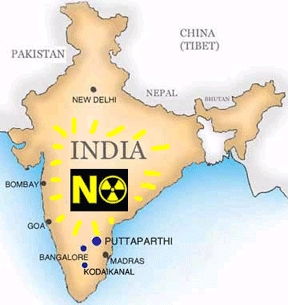 Anti-nuclear protestors take out rally, stage peaceful demo Radhapuram (TN) Dec 18 (PTI) About 10,000 anti-nuclear protestors today took out a procession from a temple at nearby Koodankulam to this town and staged a peaceful demonstration, condemning Prime Minister Manmohan Singh’s statement that the Nuclear Power project would be operationalised in a couple of weeks and resolved to picket the plant if work resumed.
Pushparayan, Convenor of People’s Movement Against Nuclear Energy (PMANE), which is spearheading the stir, said the organisation would intensify its agitation from January 1 if their demand for removing the fuel rods loaded into the reactor were not removed by that date.
Police said the procession and the demonstration passed off peacefully and that adequate security had been deployed to ensure no untoward incidents took place. Earlier in the day, PMANE condemned Singh’s ‘anti-people’ and ‘autocratic’ statement on KNPP, saying it betrayed the fact that the state government’s resolution to
halt work was never honoured earnestly or implemented effectively.
http://ibnlive.in.com/generalnewsfeed/news/antinuclear-protestors-take-out-rally-stage-peaceful-demo/935954.html
VIDEO Huge protest planned in Kudankulam over PM’s statement by ndtv on Dec 18, 2011 With the Prime Minister announcing that the Kudankulam plant will be operationalised in a couple of weeks, at Ground Zero, villagers have called for a huge protest rally today, from Kudankulam to nearby Radhapuram in Tamil Nadu. “If the Nuclear Power Corporation of India or the Department of Atomic Energy tries to restart the work at the Kudankulam nuclear plant, we will lay a siege with thousands of people and their families immediately at the site, and number two in order to protest against PM’s statement made in Russia we are going to hold a rally from Kudankulam to Radhapuram,” said SP Udhayakumar, Convenor, People’s Movement against Nuclear Energy. http://www.youtube.com/watch?v=lPPlEavM3VE
Arnie Gundersen on the state of the Fukushima nuclear fuel cores
Fukushima – Could it Have a China Syndrome? FAIREWINDS ASSOCIATES, Arnie Gundersen, 14 Dec 11 “…….the good news is I do not think a China Syndrome can happen. I do not think this core can keep melting into the bottom of the earth. And I do not think there will be a steam explosion either. That is the good news.
Here is the bad news.
That nuclear core is in direct contact with tons of water. And that containment, while not leaking down, is leaking out the sides. That contaminated water is going into every other building on site. And there is literally thousands and thousands of tons of water in other buildings. That water contains radioactive cesium, radioactive strontium, and it also contains nuclear fuel. There will be uranium in that water and plutonium in that water as well. We know for sure that that water is leaking into the ground water and into the Pacific Ocean. So while it is important to know that we are not going to release the nuclear core directly into the center of the earth, the problem is not over. And as a matter of fact, the problem will last for tens, perhaps even as long as 30 years because this contaminated water is in the basements of all the buildings on site. And not only does it contain cesium (that hangs around for 300 years), strontium (hangs around for 300 years), but it also contains plutonium and uranium and they have half lives of tens of thousands of years.
So the problem is, what do we do with all that water that is contaminated? It is already leaking into the groundwater. It is already leaking into the ocean. TEPCO is frantically catching it and putting it into tanks. But just today, TEPCO announced that they are running out of tank space on site, and eventually they are going to have to release those tanks into the Pacific Ocean. Now they will try to clean up some of the isotopes like cesium. But they have been unable to capture all the strontium. Strontium is a bone seeker that causes leukemia… http://fairewinds.com/content/fukushima-could-it-have-china-syndrome
Photographs of Germany’s nuclear waste train protest
Following a nuclear train Reuters Photographers’ Blog By  Fabrizio Bensch, 2 Dec 11 126 hours from La Hague to Gorleben; the longest ever nuclear waste transport from Germany to France
This is a retrospective on the past 10 years, during which I have covered the nuclear waste transportation from France to Germany many times. The German nuclear waste from power plants is transported in Castor (Cask for Storage and Transport of Radioactive material) containers by train to the northern German interim storage facility of Gorleben…….Nuclear waste from German nuclear power plants was reprocessed at the French plant at La Hague. The train used to transport it was protected in Germany by up to 20,000 policemen. Each transportation was different, but the pictures each year were very similar. There were blockades on the railway tracks, activists chaining themselves to the tracks, peaceful and violent protests along the route and the waiting patiently for hours for the train to move further along….
Nowhere in the world are anti-nuclear protest so symbolic and visible as in Gorleben. But in the end even in this agricultural region the last castor container still reached its final destination after 126 hours and 1200 kilometers (745 miles). http://blogs.reuters.com/photographers-blog/2011/12/01/following-a-nuclear-train/
1 This Month


10 March A LIVE WEBINAR THE REAL EFFECTS OF NUCLEAR POWER
What the Industry Isn’t Telling Us
1:00 PM Mountain, 2 pm Central, 3 pm Eastern. Live on the Keepers of the Water Facebook page

18 March Webinar @ 1 PM EST: An Assessment of SMR Projects: The Case of Canada
register for the zoom:
https://us02web.zoom.us/webinar/register/WN_o8BIIOUvQ2ONJR1nta65DQ#/registration


of the week – STOP SMALL MODULAR REACTORS IN CANADA
To see nuclear-related stories in greater depth and intensity – go to https://nuclearinformation.wordpress.com
-
Archives
- March 2026 (62)
- February 2026 (268)
- January 2026 (308)
- December 2025 (358)
- November 2025 (359)
- October 2025 (376)
- September 2025 (258)
- August 2025 (319)
- July 2025 (230)
- June 2025 (348)
- May 2025 (261)
- April 2025 (305)
-
Categories
- 1
- 1 NUCLEAR ISSUES
- business and costs
- climate change
- culture and arts
- ENERGY
- environment
- health
- history
- indigenous issues
- Legal
- marketing of nuclear
- media
- opposition to nuclear
- PERSONAL STORIES
- politics
- politics international
- Religion and ethics
- safety
- secrets,lies and civil liberties
- spinbuster
- technology
- Uranium
- wastes
- weapons and war
- Women
- 2 WORLD
- ACTION
- AFRICA
- Atrocities
- AUSTRALIA
- Christina's notes
- Christina's themes
- culture and arts
- Events
- Fuk 2022
- Fuk 2023
- Fukushima 2017
- Fukushima 2018
- fukushima 2019
- Fukushima 2020
- Fukushima 2021
- general
- global warming
- Humour (God we need it)
- Nuclear
- RARE EARTHS
- Reference
- resources – print
- Resources -audiovicual
- Weekly Newsletter
- World
- World Nuclear
- YouTube
-
RSS
Entries RSS
Comments RSS
 nuclear-news