Creative accounting by Japanese govt makes nuclear power LOOK cheap
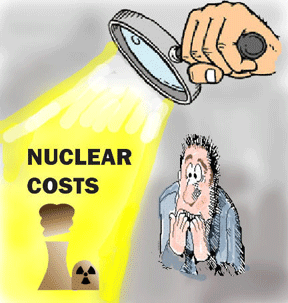 The online magazine Business Journal recently explained the matter in bookkeeping terms. Kansai Electric and other power companies plan to decommission at least five superannuated reactors rather than apply for extensions because their respective output isn’t enough to pay for the government’s new safety measures, which cost about ¥10 billion per reactor. The problem is that once a reactor is shut down permanently, in addition to the cost of decommissioning, the company’s revenue for that plant drops to zero, thus hurting its bottom line even more and making it difficult to borrow money or issue bonds. Consequently, METI is thinking of changing the accounting system so that companies can spread this loss over 10 years, during which they can add a surcharge to every customer’s bill for decommissioning.
Obviously, when METI says nuclear is the cheapest form of energy, they’re not thinking about the user.
 Lowball nuclear pitch is fooling no one http://www.japantimes.co.jp/news/2015/05/23/national/media-national/lowball-nuclear-pitch-fooling-one/#.VWJCRtKqpHx BY PHILIP BRASOR Earlier this month, the Ministry of Economy, Trade and Industry (METI) announced the results of a review of energy production costs, which concluded that nuclear will remain the cheapest alternative for Japan over the next 15 years while pointing out that the calculations took into consideration the government’s new safety measures. By 2030, the cost of producing a kilowatt hour of electricity in a nuclear plant is expected to increase from ¥8.9 to ¥10.1. This estimate also incorporates the presumed savings resulting from those new safety measures, which, METI assumes, will reduce the “frequency” of reactor accidents.
In comparison, energy derived from coal will cost ¥12.9 per kilowatt hour and from LNG ¥13.4, though these figures are based on price increases predicted in 2011. More significantly, the cost of solar will rise from ¥12.4 to ¥16, and wind from ¥13.9 to ¥33.1. Geothermal comes in at ¥19.2. METI said these high costs will “affect development” of renewables, implying that there isn’t much of a future for them.
A few days later, Shukan Asahi ran an article assessing these calculations, pointing out that the figure of ¥10.1 per kW/hour for nuclear is, in the ministry’s statement, followed by the word ijō, meaning “at least,” while figures for other energy sources are not.
The Asahi suggests that METI is trying to assure deniability because it’s almost certain that nuclear-related costs will increase in the future. According to Kenichi Oshima, professor of environmental economics at Ritsumeikan University, the ¥9.1 trillion needed to clean up the crippled Fukushima No. 1 nuclear plant and pay compensation to locals affected by the accident was not factored into the estimate; nor was the cost of decommissioning not only Fukushima No. 1 but other reactors scheduled to go out of service in the next 15 years, and Tokyo Electric Power Co. hasn’t even set a budget for decommissioning Fukushima, a separate procedure from the cleanup. To put matters into perspective, the estimated amount of radioactive material at Fukushima that needs to be processed is equivalent to the amount of radioactive material that would need to be processed from the normal decommissioning of 54 nuclear reactors. Continue reading
The deceptive hype about nuclear reprocessing
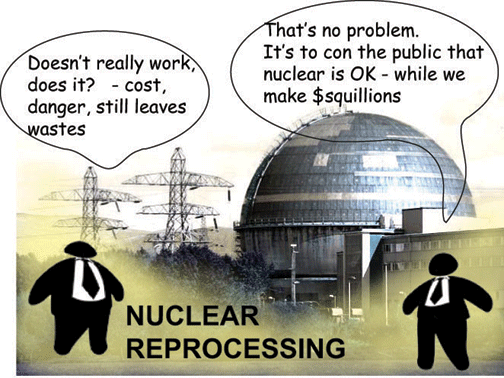
Nuclear Reprocessing Pay more, risk more, get little,
Bulletin of the Atomic Scientists 21 May 15 Hui Zhang“…… Lately, advocates for fast neutron reactors have been arguing that breeders and reprocessing can reduce the long-term hazards associated with burial of high-level waste. But these long-term benefits are offset by short-term risks and costs.
For example, breeder advocates argue that the risks surrounding leakage in geological repositories could be reduced if all the long-lived isotopes of plutonium and other transuranics contained in spent fuel were transmuted (or fissioned), thus significantly reducing the doses of radioactivity that could escape due to any leakage. But studies show that long-lived fission and activation products in spent fuel—not isotopes that could be fissioned through breeders and reprocessing—dominate the radioactivity doses that leakage could release.
Plutonium, in fact, is quite insoluble in deep underground water. So, reprocessing delivers no obvious long-term benefits in reducing leaked doses of radioactivity—but it does involve routine releases of long-lived radioactive gases from spent fuel. Reprocessing also increases the risk that tanks for high-level liquid waste might explode.
(In a similar vein, advocates for fast neutron reactors argue that reprocessing, by reducing the need to mine uranium, can reduce human radiation exposure. But any such benefit is canceled out because plutonium reprocessing and recycling themselves expose workers and the public to radiation. In short, the net effects may well be negative.)
Meanwhile, all reprocessing and fast neutron reactor programs currently under consideration significantly increase the economic costs of nuclear energy. This means that nuclear decision makers must choose between achieving rather insignificant reductions in the long-term hazards associated with nuclear waste—and achieving short-term gains in the areas of safety, security, human health, and the environment.
The choice seems rather clear-cut. The US National Academy of Sciences concluded in 1996, based on a review of the costs and benefits of reprocessing and fast neutron reactor programs, that “none of the dose reductions seem large enough to warrant the expense and additional operational risk of transmutation.” That assessment remains valid today…….http://thebulletin.org/reprocessing-poised-growth-or-deaths-door/pay-more-risk-more-get-little
Radioactive iodine – the forgotten nuclear danger
The nuclear danger of iodine , Chemistry world, 21 May 15
In both the Fukushima and the 1986 Chernobyl accidents, volatile iodine species were released into the environment with tellurium. Of all the fission products, iodine poses a special threat to public health because it has a high fission yield, it can spread as volatile species and in mammals it accumulates readily in the thyroid, a small but vital organ. While the vast majority of iodine radioactivity is short-lived, it can have life-changing effects. A thyroid cancer patient who has lost their thyroid function as a result of surgery or 131I treatment, will require hormone replacement medication for life.
Transport properties
The problem of radioactive iodine is complicated by the variety of different species it can form. Each has different transport properties in the environment. For example, most of the airborne 131I from Chernobyl that reached Japan was in the form of organic iodine compounds.1 Furthermore, some iodine-containing compounds will pass through some accident mitigation systems. A water-filled scrubber will capture iodine oxide aerosols or other iodine-containing solids. Meanwhile, the sodium thiosulfate in the large scrubbers used in Swedish nuclear power plants will capture elemental iodine. However, although alkyl iodides will react with sodium thiosulfate to form Bunte salts, the reaction can be slow, allowing some proportion to escape. It is also important to note that, depending on the species, it is possible for some older sampling methods to underestimate the amount of radioactive iodine released in an accident.
20 May 2015Chemistry WorldOnce in the environment, the potential for human exposure increases with dangerous consequences. Research with 132I has shown that humans retain a large fraction of the iodine in inhaled methyl and ethyl iodide. But iodine can take part in lots of reactions before it even leaves the reactor. During normal operation, the temperature gradients in nuclear fuel pellets cause the iodine and caesium to migrate into the gap between the fuel and the cladding.2 The fission process forms 133Xe, which, with a half-life of 5.2 days, has plenty of time to diffuse into the cooler parts of the fuel. There, the xenon decays to form caesium, which reacts with iodine to form caesium iodide. If the fuel is overheated and damaged, caesium iodide aerosols can be delivered into the containment space.The caesium iodide can be converted by redox reactions into iodine, even without available oxygen gas: as an accident starts, the irradiation of water generates oxidants such as hydroxyl radicals and hydrogen peroxide…..http://www.rsc.org/chemistryworld/2015/05/fukushima-iodine-nuclear-accident
Finland pulls out of building Olkiluoto 4 nuclear reactor
Finland cancels – is the EPR finished?, The Ecologist, Dr Jim Green & Oliver Tickell 15 May 15
This week Finland cancelled its option for a second European Pressurised Reactor as the existing EPR project sinks into a abyss of cost over-runs, delays and litigation, writes Jim Green. It now looks like the EPR is a failed technology and its owner, French nuclear giant Areva, is fast running out of both money and orders as its ‘hot prospects’ evaporate.
There’s been plenty of bad news recently for the European Pressurised Reactor (EPR) nuclear power station design.
And now there’s more. The Finnish electricity company TVO announced this week that it had cancelled plans to build a second EPR at Olkiluoto in western Finland because of delays and problems with the first EPR on the site currently being built by Areva and Siemens.
That plant, Olkiluoto 3, is running severely over time and budget. Construction began in 2005 and it is not expected to commence operating until 2018, nine years late.
The estimated cost has risen from €3.2 billion (US$3.6b) to €8.5 billion (US$9.5b). Areva has already made provision for a €2.7 billion (US$3.0b) writedown on the project, with further losses expected. FTVO and Areva / Siemens are locked ina €10 billion legal battleover the cost overruns.
Finland’s government had given TVO a deadline of 30th June to request a building permit for its planned Olkiluoto 4 plant. TVO said it would not pursue the project due to “the delay of the start-up of Olkiluoto 3 plant unit.”
It added: “In this situation it is impossible to make significant Olkiluoto 4 related decisions necessary for the construction license application.” Continue reading
Nuclear power link to breast cancer
 Breast cancer and nuclear power – statistics reveal the link ‘they’ wanted to hide, Ecologist Chris Busby 18th May 2015 The link between nuclear power and cancer is real, writes Chris Busby, and revealed in the UK’s cancer statistics – if only you look for it. Previous approaches have focused on rare cancers over large, poorly selected populations. But look at common cancers among those most exposed to nuclear radiation, and the statistical evidence is overwhelming.
Do nuclear sites cause increases in cancer in those living nearby? This is the question which has always been the key to stopping the development of nuclear energy.
For if the answer is Yes, the laws would cut in; human rights would cut in. Check Mate. The nuclear industry and its supporters have always known this, just as the cigarette companies and the asbestos makers recognised their own specific nemesis.
You can argue about the economics of nuclear till you are blue in the face, but they can always move the goalposts, global warming, future security of supply, special new safe thorium reactors and so forth. But killing people with your radioactive discharges: that’s it. The End.
This week saw the publication in a peer-reviewed journal – Jacobs Journal of Epidemiology and Preventive Medicine – of a study which I carried out in 2003 of breast cancer mortality 1995-2002 near Bradwell nuclear power station in Essex. Continue reading
No new Generation IV Nuclear design will be ready for build before 2050
 NuClear News May 15 The Generation IV International Forum (GIF) is a co-operative international endeavour which was set up to carry out the research and development needed to establish the feasibility and performance capabilities of the next generation nuclear reactors.
Six reactor types have been selected for further development. These include: the Gas-cooled Fast Reactor (GFR), the Leadcooled Fast Reactor (LFR), the Molten Salt Reactor (MSR), the Supercritical Water-cooled Reactor (SCWR), the Sodium-cooled Fast Reactor (SFR) and the Very High Temperature Reactor (VHTR). (1)
The French Radiological Protection Agency (IRSN) has carried out a review of these systems from the point of view of safety and radiation protection. On the basis of its examination, IRSN considers the SFR system to be the only one of the six to have reached a degree of maturity compatible with the construction of a Generation IV reactor prototype during the first half of the 21st century.
Even then this will depend on further studies. (2) This is hardly a ringing endorsement, let alone anything like a quickly deployable climate solution – ie the SFR is the best possibility depending on further studies leading to a prototype before 2050!
DECC estimate in their 2013 Nuclear Energy Research and Development Roadmap (3) that the first commercial Generation IV reactors should be operating by 2040. That is still years away considering the timescale for dealing with the climate change threat.
Yet pro-nuclear environmentalists still promote these new fast reactors as if they are just around the corner. (“It may take ten years for these reactors to prove their potential” according to Kirsty Gogan writing in Nuclear Engineering International.)(4) http://www.no2nuclearpower.org.uk/nuclearnews/NuClearNewsNo74.pdf
Neuropathy in Navajo children almost certainly caused by uranium mining pollution
fragile communities continue to live amid the poisoned wells and contaminated earth, and the uranium riddled sagebrush flats are home for the next generation of Navajo children.
Abandoned Uranium Mines Plague Navajo Nation, Earth Island Journal BY SONIA LUOKKALA – MAY 5, 2015 Mining companies left behind a legacy of poisoned wells and contaminated earth
We are in Diné Bikéyah, land of the Navajo. “………The incidence of Navajo neuropathy is five times
higher on the western side of the Navajo reservation than on the eastern side. Some researchers believe this discrepancy is linked to the land: On the western side, the mines were mostly tunnels, whereas in the west they were primarily open pits. After the uranium companies left, the unfilled pits started to fill with water. Some, as deep as 130 feet, eventually formed into small lakes. Unsuspecting Navajos and their livestock use the contaminated water for drinking.
A 1990 study of Navajo neuropathy ruled out water contamination as a possible cause of the disease………As the Los Angeles Times also reported, in 1986, Thomas Payne an environmental health officer for Indian Health Services, along with a National Park Service ranger, took water samples at 48 sites surrounding Cameron, AZ, a town in Navajo Nation. These samples revealed uranium levels in wells as high as 139 picocuries per liter. In abandoned pits, the levels were as high as 4,024 pinocuries. The EPA limit for safe drinking water is 20 picocuries per liter. ….. Continue reading
more intensive medical examinations needed – for Fukushima’s children
74% chance of lymph node metastasis Not only is the number of thyroid cancers large, but also the symptoms are serious. Last year Fukushima Medical University published 55 cases of thyroid cancer in Fukushima: 2 of them were anaplastic carcinoma, and 74% of them lymph node metastasis. Normally, the prognosis of thyroid cancer among adults is good: little metastasis and slow progression. But this is not true of thyroid cancer found in Fukushima.
The Government Must Expand Medical Examinations for Victims of the Fukushima Nuclear Disaster http://www.foejapan.org/en/energy/doc/150310.html 10 March 2015
 117 children in Fukushima have been suspected of having thyroid cancer: the second round of medical examination found 8 children. On February 12, 2015, the Oversight Committee for Fukushima Prefecture Health Management Survey held a meeting. According to the committee, the total number of children suspected of thyroid cancer reached 117. Of them, 86 already went through surgery and were confirmed to have suffered thyroid cancer. Since April 2014, the second round of medical examination has been conducted on 75,311 children. 8 of them had shown “no abnormality” at the first round, but they were newly suspected of thyroid cancer after the second round. One of them went through surgery and indeed had thyroid cancer.Every time a child in Fukushima was diagnosed with thyroid cancer, Fukushima Medical University and the Japanese government insisted on “screening effects” – namely, an early ultrasound scan simply detected thyroid cancer that would have been otherwise found much later. The university and the government also argue that thyroid cancer develops slowly: Since the number of paediatric thyroid cancers began to increase only five years after the Chernobyl Nuclear Disaster, the cases of paediatric thyroid cancers in Fukushima so far are unlikely to have be caused by the Fukushima Daiichi Nuclear Disaster. But if their argument had been correct, they would not have found any thyroid cancer after the second round of medical examination. Nonetheless, Hokuto Hoshi, chairman of the oversight committee, stated, “Of course, we cannot completely preclude the possibility of causal relationship between the nuclear disaster and thyroid cancer. But, given the results of medical examinations, we don’t think it’s necessary to change our position, that is, the causal relationship is unlikely.”
74% chance of lymph node metastasis Not only is the number of thyroid cancers large, but also the symptoms are serious. Last year Fukushima Medical University published 55 cases of thyroid cancer in Fukushima: 2 of them were anaplastic carcinoma, and 74% of them lymph node metastasis. Normally, the prognosis of thyroid cancer among adults is good: little metastasis and slow progression. But this is not true of thyroid cancer found in Fukushima. Moreover, the nuclear fallout contaminated not only Fukushima but also adjacent prefectures, as suggested by UNSCEAR’s report. In light of the real extent of nuclear pollution, the government must expand the coverage of medical examinations for areas outside of Fukushima Prefecture.
Treatment for other diseases than thyroid cancer
While we tend to focus on thyroid cancer, we also should keep in mind the necessity of systematic medical examinations for thyroid malfunction and other illnesses. According to longitudinal surveys on A-bomb survivors, radiation dose exceeding 1 mSv (with regard to a particular organ) is statistically correlated with the increased likelihood of uterine fibroid, thyroid diseases, cataract, kidney and ureteral stones (among men), hypertension, and heart attack. The national report, published by the Ukraine government 25 years after the Chernobyl disaster, also describes thyroid malfunction and many other illnesses related to immune, respiratory, and digestive systems.
Problems with MOE’s “Expert Committee” and “Current Policy”
Victims of the nuclear disaster and NGOs demanded the government to (1) improve medical examinations and (2) extend them to municipalities outside of Fukushima Prefecture. The Ministry of Environment (MOE), responsible for the health of disaster victims, established the “Expert Committee” in November 2013. The committee is chaired by Shigenobu Nagataki, emeritus professor at Nagasaki University, one of the longstanding defenders of the “radioactivity-is-safe” ideology who helped to underestimate health effects of the Chernobyl disaster. The committee also includes members who received monetary contributions from the Federation of Electric Power Companies of Japan, sit on radioactivity, nuclear safety, and emergency response commissions, and are responsible for the failures to distribute potassium iodine tablets and use SPEEDI in the aftermath of the nuclear disaster. Put another way, those who helped to create disaster victims deliberated on policy for victims’ health management.
The selection of committee members, as well as the way the committee’s deliberation was framed, was therefore meant to defend the foregone conclusion, not to expand the current medical examinations for disaster victims. Indeed, the mid-term report published by the expert committee in December 2014 not only failed to offer epidemiological analysis of thyroid cancer and other illnesses in Fukushima Prefecture, not to mention case studies, but also concluded that the level of radiation exposure outside the prefecture is too low to warrant any medical examination. Given this report, MOE announced its “current policy” on February 28, 2015, to promote “nationwide cancer registration” as well as “risk-communication projects” to educate citizens with “accurate” information about health effects of radioactivity, instead of expanding medical examinations for disaster victims inside and outside of Fukushima.
Conclusion
Article 13.2 in the Act on the Protection and Support for the Children and other Victims of the TEPCO Disaster guarantees lifelong medical examinations for victims residing in areas where radiation doses are estimated to exceed a certain level, whereas Article 13.3 promises to subsidize medical expenses for illnesses related to the nuclear disaster. However, these measures are yet to be implemented. At this rate, we are concerned that adequate investigation and prevention of thyroid cancer and other illnesses, both inside and outside of Fukushima, will not take place. We therefore demand that the government effectively implement the Act, given that our knowledge of health effects of radioactivity is very much incomplete at present.
| Details of the 8 children suspected of thyroid cancer after the second roundSex: 4 boys and 4 girls Age: 6 to 17 at the time of the disaster Size of tumour: 6-17.3 mm Residence: Namie, Date, Tamura, Ōkuma, Fukushima Estimated dose: less than 1 mSv (2), 2.1 mSv maximum, unknown (2) First-round results: A1 (5), A2 (3) |
Contact:
Friends of the Earth Japan
1-21-9 Komone Itabashi-ku Tokyo 173-0037
TEL: (+81)3-6909-5983
FAX: (+81)3-6909-5986
E-mail: info@foejapan.org
Israel has 400 nuclear weapons – Iran claims
Iran’s claim that Israel has 400 nuclear weapons, WP By Glenn Kessler May 1 “It’s laughable that [Israeli Prime Minister Benjamin] Netanyahu has become everybody’s nonproliferation guru. He is sitting on 400 nuclear warheads, nuclear warheads that have been acquired in violation of the NPT [Nuclear Non-Proliferation Treaty].”–Iranian Foreign Minister Mohammad Javad Zarif, speaking in New York, April 29, 2015
In the debate over Iran’s nuclear ambitions, the unacknowledged nuclear stockpile of Israel often comes up.
In the 1950s and 1960s, Israel secretly acquired the technology and material to build nuclear weapons, frequently misleading the U.S. government about its intentions. (France was Israel’s partner in the building of the Dimona reactor in the Negev desert, while South Africa is believed by some to have assisted Israel in conducting at least one nuclear test in the 1970s.)
Zarif quickly noted that Israel (unlike Iran) is not a member of the NPT, but added: “Those who provided them with the technology were members of the NPT and violated the NPT to provide them with the technology, and we know who they were. And now they are the proponents of nonproliferation.” (Actually, France’s cooperation with Israel ended in 1966, before the NPT went into effect in 1970.)
Zarif’s estimate of Israel’s stockpile seemed rather large. Does Israel really have 400 nuclear weapons?
The Facts For a secret and unacknowledged program, the history of Israel’s quest for nuclear weapons is relatively well-documented. Our colleague Walter Pincus recently recounted how Israel misled the Kennedy and Johnson administrations about the facility in the Negev, describing it at one point as “a textile plant” and later as “a metallurgical research installation.”
Requested inspections by U.S. experts were cursory and often postponed — Israel refused to accept visits from the International Atomic Energy Agency – and later it was learned that the Israelis had built fake walls around the elevators that led to an underground reprocessing plant, according to a 2014 account in The Guardian newspaper.
By 1968, the CIA was convinced Israel had nuclear weapons – just as negotiations on the NPT were completed and the treaty designed to thwart the spread of nuclear weapons was opened for signature by members of the United Nations. U.S. officials concluded it was too late to turn back the clock and make Israel abandon its nuclear capability………….
Given that some 50 years have passed, how many nuclear weapons does Israel have?
Since Israel has never officially admitted having weapons, the answer relies on a bit of guesswork, principally how much plutonium might have been produced in Dimona. A key factor is the power level of the reactor, which (according to satellite imagery) does not appear to have increased much over time.
A leaked 1999 intelligence assessment by the Defense Intelligence Agency, published in Rowan Scarborough’s 2004 book “Rumsfeld’s War,” estimated that Israel had 60 to 80 weapons at the time, and would have 65 to 85 by 2020. (The report also said Iran would have 10 to 20 nukes by 2020.)……..
In 2014, the Bulletin of Atomic Scientists echoed that estimate. “We conclude that many of the public claims about the size of the Israeli nuclear arsenal are exaggerated,” a comprehensive report declared. “We estimate that Israel has a stockpile of approximately 80 nuclear warheads for delivery by two dozen missiles, a couple of squadrons of aircraft, and perhaps a small number of sea-launched cruise missiles.”
Other analysts believe that the number is closer to 100, and possibly a bit higher. In 2007, the Federation of American Scientists said the estimates range from 70 to 400 warheads………http://www.washingtonpost.com/blogs/fact-checker/wp/2015/05/01/irans-claim-that-israel-has-400-nuclear-weapons/
Cheap, efficient deep bore waste disposal would abort nuclear reprocessing
successfully developing deep-hole disposal techniques would be a great development for society
it could be devastating for next-generation nuclear developers attempting to utilize existing used nuclear fuel stockpiles
Why Sending Nuclear Waste to the Center of the Earth is Bad News for General Electric,Motley Fool By Maxx Chatsko April 30, 2015 “………the U.S. Department of Energy is set to experiment with a technique to dispose of nuclear wastes by drilling 3-mile boreholes into the Earth’s crust and then, well, dropping radioactive materials into their geological tombs. For good
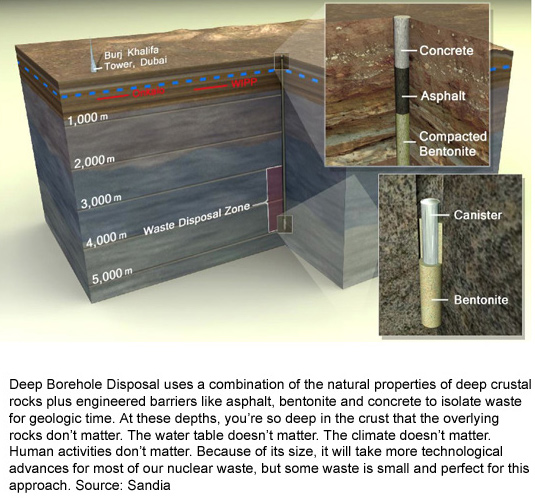
………Fergus Gibb, the technique’s pioneer, told The Engineer that each bore hole, measuring roughly 3 miles deep and 2 feet wide, would cost just a few tens of millions of dollars to drill. …
Wide spread of radiation could result from smoke from fires in Chernobyl exclusion zone
Smoke from Chernobyl fire could spread radiation far and wide – experts Rt.com April 29, 2015 Smoke from burning forests in the  is capable of spreading contaminants across great distances, even after the fire has been stopped, ecology experts told RT.
The forest fire near the crippled Chernobyl nuclear power plant started on Tuesday and triggered an emergency alert, with police and National Guard mobilized to bring the flames under control……
Although the sarcophagus remains untouched by the fire, decades-old contaminants could still be released and travel far and wide, borne aloft by the smoke, nuclear safety expert John H. Large told RT:
“Brush fires and forest fires were the greatest concern in terms of the means by which you can disperse a secondary radiological impact from the original dissipation that occurred in 1986,” he said. John went to Chernobyl in 2006 to assess the situation there and spoke to dozens of scientists working on containing the contamination.
“In the exclusion zone and further away you have an area that has been abandoned for farming, abandoned for man management,” John says. “That means you’ve got lots of brush and young wood growing out of control, and that means there’s a big fuel load to have a fire.”
He says the high temperatures and volumes of smoke produced in a forest fire can take contaminants hundreds of kilometers away from the exclusion zone: “Radiation really doesn’t respect any international boundaries.”
Forest fires have happened in the area before, but have never been so serious, Timothy Mousseau, biology professor at the University of South Carolina, told RT:
“Previous forest fires had re-released about eight percent of the radiation from the original catastrophe. The fire that we’re seeing today seems to be on a much larger scale, and so we could see a re-dispersion of a very significant component of the original radiation.”
Another problem is that as the trees that have absorbed contaminants burn up and release smoke, this turns radioactive particles into a much more dangerous form than if they simply lie in the ground….http://rt.com/news/254193-chernobyl-fire-radiation-spread/
Generation IV Nuclear Reactors no better than the current ones
Future Of Nuclear Industry Takes Yet Another Hit http://oilprice.com/Alternative-Energy/Nuclear-Power/Future-Of-Nuclear-Industry-Takes-Yet-Another-Hit.html By Charles Kennedy, 28 April 2015
Despite the rough patch that the nuclear industry has experienced in recent years, its future remains bright, the industry insists. That is because the next generation of nuclear reactors will provide significant safety and economic benefits over current reactors.
But what if the new designs are actually not all that much better than the current fleet?
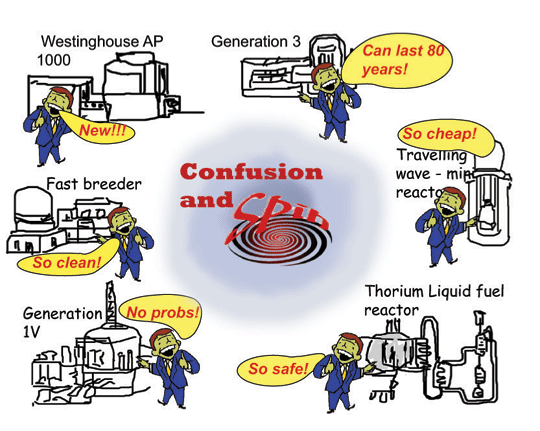
That is the provocative conclusion that France’s nuclear watchdog came to in a new report. Published on April 27, the IRSN said that the so-called “generation IV” reactors of the future may not be able to offer major upgrades in safety (most of the reactors running today are generation II – built in the 1960’s and 1970’s – and the newer designs that are currently under construction today are considered to be generation III).
The IRSN report reviewed six of the most promising generation IV reactor designs: sodium-cooled fast reactors (SFR); very high-temperature reactors (VHTR); gas-cooled fast reactors (GFR); lead-cooled fast reactors (LFR); molten salt reactors (MSR); and SuperCritical water reactors (SCWR).
Out of all of those, ISRN found that only the sodium-cooled fast reactor is close enough to maturity. SFRs have been trumpeted as an exciting concept – they can burn nuclear waste, reducing the need to build long-term spent fuel storage.
But after looking into the technology ISRN says it’s hard to say whether or not SFRs would be better. “While it seems possible for SFR technology to guarantee a safety level at least equivalent” to generation III reactors, “IRSN is unable to determine whether it could significantly exceed this level,” the report concluded. That is because liquid sodium can explode if exposed to water. IRSN also questioned the extent to which SFRs could actually burn through dangerous nuclear waste.
The report amounts to a big rebuke for generation IV reactors, the first significant criticism of a nuclear dream that has been hailed as the key to solving energy and climate change challenges.
However, ISRN also ultimately said that the devil will be in the details. The reactor designs could solve some of their drawbacks as the specifics are fleshed out. But unless generation IV designs can prove to be much safer than generation III designs, the nuclear renaissance may not be as bright as many had hoped.
NUCLEAR TECHNOLOGY CHALLENGES
The decline of the nuclear industry poses huge challenges – nuclear experts need not fear unemployment.
RADIOACTIVE WASTE DISPOSAL. If all nuclear reactors stopped today, and all nuclear weapons were “turned off”, the world would still be left with a massive unsolved problem of disposing of the wastes.
BURYING THE CORPSES of nuclear reactors – (they prefer that nice word “decommissioning”) – a huge part of the unsolved waste problem.
ALTERNATIVE TECHNOLOGIES
Renewable energy is taking over – it is supposed to be “clean and green”. And digital communications are also taking over the world.
But at present, both of these require “rare earths”
 RARE EARTHS On the one hand, these play a part in the renewable energy future, for example in making wind turbines, and in electric car batteries. Rare earths are a group of 17 chemical elements ( yttrium and the 15 lanthanide elements (lanthanum, cerium, praseodymium, neodymium, promethium, samarium, europium, gadolinium, terbium, dysprosium, holmium, erbium, thulium, ytterbium, and lutetium) Rare earth metals and alloys that contain them are used in many devices that people use every day such as: computer memory, DVD’s, rechargeable batteries, cell phones, car catalytic converters, magnets, fluorescent lighting and much more. http://geology.com/articles/rare-earth-elements/
On the other hand, – the downside of rare earths – in the mining and processing of these rare earth minerals, radioactive wastes are produced.
Tritium is a major radioactive pollutant from Canada’s CANDU nuclear power reactors.
 Tritium Traffic: Deadly Dividends for Nuclear Industry, Peace Magazine By David H MartinIn February, 1934, the British journal, New Scientist, published an article by Tom Wilkie, “Old Age Can Kill the Bomb.” It was an ingenious solution to the arms control nightmare of verification; controlling not only the number of weapons, but the strategic materials that fuel them — mainly plutonium, enriched uranium and tritium. Wilkie focused on tritium, because it turns into non-radioactive helium at a rate of 5.5 per cent per year. A halt of tritium production would rapidly cripple all nuclear arsenals. Thus, attention was rivetted on Ontario Hydro’s plan to produce about 57 kilograms of tritium by 2006. A one megaton thermonuclear warhead (equivalent to one million tons of TN”) may contain as little as one gram of tritium.
Tritium (H3) (a form of hydrogen that emits beta radiation), is a major radioactive pollutant from Canada’s CANDU nuclear power reactors. Unlike American reactor systems, the CANDU uses heavy water as a moderator and coolant. The moderator and the heavy water coolant slows down the neutron release from the uranium fuel in the reactor so that a chain reaction can take place. The active ingredient in heavy water is deuterium, another form of hydrogen. When the deuterium picks up a neutron, some of it is transformed into tritium. The concentration of tritium in the heavy water increases with the age of the reactor.
The CANDU reactor system produces 2400 times as much tritium as the American light water reactor. Continue reading
Danger of nuclear reactors as explained by Alvin Weinberg
 Top US Nuclear Physicist: “Iodine-131 will be lethal after ingestion of 30 billionths of a gram” — Main worry is not a Chernobyl-type accident, rather it’s a melt-through of containment vessel — “Not possible to disprove China Syndrome” http://enenews.com/top-nuclear-physicist-iodine-131-will-be-lethal-after-ingestion-30-billionths-gram-main-worry-chernobyl-type-accident-melt-containment-vessel-possible-disprove-china-syndrome?utm_source=feedburner&utm_medium=email&utm_campaign=Feed%3A+ENENews+%28Energy+News%29 The hazards of nuclear power plants and the related nuclear industries are reviewed
Alvin M. Weinberg, nuclear physicist (Director of Oak Ridge National Lab and pioneered the pressurized water reactors and boiling water reactors used in nuclear power plants, worked on the Manhattan Project, appointed to President’s Science Advisory Committee during the Eisenhower and Kennedy administrations), 1973:
- [A]re there concerns regarding the possibility that these systems may malfunction and cause hazard to people and to the environment? This is a perfectly legitimate question that deserves serious and thoughtful consideration; and it is this aspect of the matter that I shall address… The potential hazard of a nuclear system arises from the toxicity both of the materials that keep the system burning and from the fission product ashes. Plutonium-239… is lethal to man in doses of about 16 thousandths of a gram if ingested in the lungs; Strontium-90, with a half-life of 30 years, will be lethal if about 70 millionths of a gram is ingested; Iodine-131, with a half-life of eight days, will be lethal after ingestion of only about 30 billionths of a gram.
- As I have said, even during the Manhattan Project, we realized that a nuclear reactor could undergo what is known as an excursion [see Chernobyl] – that is, if too many control rods were removed, the reactor power could surge to dangerous levels. This, however, is not the main worry, for such excursions are inherently self-limiting both in time and magnitude.
- Rather, the worry is that in a very high-powered reactor, immediately after the chain reaction has stopped, the fission products at least momentarily continue to generate 7% as much energy… Thus a high-powered chain reactor must continue to be cooled for a considerable time after shutdown if fuel meltdowns are to be avoided. It was Edward Teller who some 25 years ago insisted with great prescience that in these respects nuclear reactors were potentially dangerous, and therefore they should be subjected to the most searching kind of technical scrutiny… The response of the engineer… was to build a… containment vessel around every reactor; the second [was] various back-up safety systems… to prevent the reactor core from melting. Why bother with the back-up cooling systems if the containment vessel in final analysis will catch whatever radioactive debris might be created in an accident and thus prevent harm befalling the public? And indeed this was the attitude in the earliest days… As long as reactors were relatively small we could prove by calculation that even if the coolant system and its back-up failed, the molten fuel could not generate enough heat to melt itself through the containment However, when reactors exceeded a certain size, then it was no longer possible to prove by calculation that an uncooled reactor fuel charge would not melt through its containment vessel. This hypothetical meltthrough is referred to as the China Syndrome for obvious reasons. Since we could not prove that a molten fuel puddle wouldn’t reach the basement of a power reactor, we also couldn’t prove whether it would continue to bore itself deeper into the ground. Whether or not the China Syndrome is a real possibility is moot. The point is, however, that it is not possible to disprove its existence. Thus, for these very large reactors, it is no longer possible to claim that the containment shell, which for smaller reactors could be relied upon to prevent radioactivity from reaching the public, was sufficient by itself. In consequence, the secondary back-up cooling systems… must now be viewed as the ultimate emergency protection against the China Syndrome… if one is trying to be practically 100 percent sure of always being able to cope with a reactor meltdown, then one must… be absolutely certain that the engineered safety features, particularly the emergency core cooling system, will work as planned.
1 This Month



26 September – International Day for the Total Elimination of Nuclear Weapons


PLEASE OPPOSE HR 8255 AND S.3639 – bills would accelerate satellite deployment, with no environmental review or safeguards – https://ncstd5li.quorum.us/campaign/169331/
To see nuclear-related stories in greater depth and intensity – go to https://nuclearinformation.wordpress.com
-
Archives
- September 2026 (245)
- August 2026 (330)
- July 2026 (355)
- June 2026 (287)
- May 2026 (306)
- April 2026 (356)
- March 2026 (251)
- February 2026 (267)
- January 2026 (308)
- December 2025 (358)
- November 2025 (359)
- October 2025 (375)
-
Categories
- 1
- 1 NUCLEAR ISSUES
- business and costs
- climate change
- culture and arts
- ENERGY
- environment
- health
- history
- indigenous issues
- Legal
- marketing of nuclear
- media
- opposition to nuclear
- PERSONAL STORIES
- politics
- politics international
- Religion and ethics
- safety
- secrets,lies and civil liberties
- spinbuster
- technology
- Uranium
- wastes
- weapons and war
- Women
- 2 WORLD
- ACTION
- AFRICA
- Atrocities
- AUSTRALIA
- Christina's notes
- Christina's themes
- culture and arts
- Events
- Fuk 2022
- Fuk 2023
- Fukushima 2017
- Fukushima 2018
- fukushima 2019
- Fukushima 2020
- Fukushima 2021
- general
- global warming
- Humour (God we need it)
- Nuclear
- RARE EARTHS
- Reference
- resources – print
- Resources -audiovicual
- Weekly Newsletter
- World
- World Nuclear
- YouTube
-
RSS
Entries RSS
Comments RSS
 nuclear-news
