Nuclear industry survived only because of ‘liability cap’
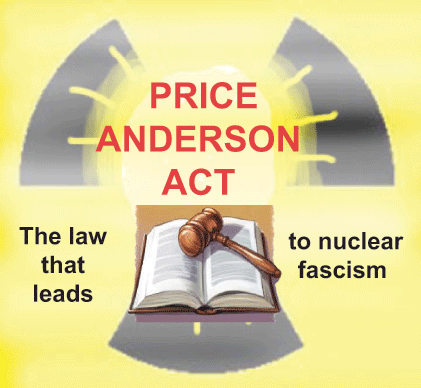
After 60 years of nuclear power, the industry survives only on stupendous subsidies, Ecologist, Pete Dolack 4th January 2016 Without ‘liability caps’ the industry would have been dead long ago
The British government, for instance, currently foots more than three-quarters of the bill for radioactive waste management and decommissioning, and for nuclear legacy sites. A report prepared for Parliament estimates that total public liability to date just for this program is around £50 billion, with tens of billions more to come.
Liability caps for accidents are also routine. In the US the Price-Anderson Act, in force since 1957, caps the total liability of nuclear operators in the event of a serious accident or attack to $10.5 billion. If the total is higher, as it surely would be, taxpayers would be on the hook for the rest.
As a further sweetener, the Bush II / Cheney administration, in 2005, signed into law new nuclear subsidies and tax breaks worth $13 billion. The Obama administration, attempting its own nuclear push, has offered an additional $36 billion in federal loan guarantees to underwrite new reactor construction, again putting the risk on taxpayers, not investors.
The Vermont Law School paper aptly sums up this picture with this conclusion: [page 69]
“If the owners and operators of nuclear reactors had to face the full liability of a nuclear accident and meet the alternatives in competition that is unfettered by subsidies, no one would have built a nuclear reactor in the past, no one would build a reactor today, and anyone who owned one would exit the nuclear business as quickly as they could.”
If we had a rational economic system, they surely would.http://www.theecologist.org/News/news_analysis/2986749/after_60_years_of_nuclear_power_the_industry_survives_only_on_stupendous_subsidies.html
Nuclear power: high costs, massive subsidies – some details
 After 60 years of nuclear power, the industry survives only on stupendous subsidies, Ecologist, Pete Dolack 4th January 2016 It’s a global phenomenon
“………….Numerous research papers paint a fuller picture. A Congressional Research Service report found that nuclear power had received $74 billion for research and developmentby the US government for the period 1948 to 1998, more than all such money given for fossil fuels, renewables and energy efficiency combined.
A report by the venture-capital firm DBL Investors, Ask Saint Onofrio, reports that nuclear energy cumulatively has received four times more subsidies than solar energy in California, and that nuclear subsidies were higher than solar in 2011 and all previous years. Nuclear has received $8.2 billion in subsidies in California, while providing the state with 3% of its power in 2012.
The uneconomical state of nuclear power is a global phenomenon, not limited to any one place. A comprehensive study prepared for the Green Party of Germany’s Heinrich Böll Stiftung, The Economics of Nuclear Power: An Update, reports:
“Up to now, nuclear power plants have been funded by massive public subsidies. For Germany the calculations roughly add up to over €100 billion and this preferential treatment is still going on today. As a result the billions set aside for the disposal of nuclear waste and the dismantling of nuclear power plants represent a tax-free manoeuvre for the companies.
“In addition the liability of the operators is limited to €2.5 billion – a tiny proportion of the costs that would result from a medium-sized nuclear accident.”
The paper later says: “Successive studies by the British government in 1989, 1995, and 2002 came to the conclusion that in a liberalised electricity market, electric utilities would not build nuclear power plants without government subsidies and government guarantees that cap costs. In most countries where the monopoly status of the generating companies has been removed, similar considerations would apply.”
Yet new plants are being built, with new subsidies
Significant cost overruns are the norm in building nuclear power plants, and it isn’t investors who are on the hook for them. Three nuclear projects are under construction in the United States and two in Western Europe, a group that features an assortment of cost overruns and generous guarantees:
- The two new Vogtle reactors in Georgia are already $3 billion over budget although their completion date is three and a half years away. The largest owner, Southern Company, has received $8.3 billion in federal loan guarantees. Overruns at this plant are not unprecedented; the two existing reactors cost $8.7 billion instead of the promised $600 million, resulting in higher electricity rates.
- The Watts Bar 2 nuclear reactor in Tennessee, which received its license to operate in October, has seen its cost rise to $6.1 billion from $2.5 billion. (This is technically a restart of a unit on which construction was suspended in 1985.) The existing reactor at this site has a history of safety problems.
- The Summer 2 and 3 reactors being built in South Carolina have already caused rate payers there to endure a series of rate increases. Cost overruns just since 2012 havetotaled almost $2 billion.
- In October 2013, British authorities approved a new nuclear reactor at Hinkley Point, England, that features subsidies designed to give the owner, Électricité de France, aguaranteed 10% rate of return on the project. Power from the plant will be sold at a fixed price, indexed to the consumer inflation rate.
In other words, The Independent reports, “should the market price fall below that [agreed-upon] level the Government would make up the difference.” The agreed-upon fixed price set by the Cameron government at the time was double the wholesale pricefor electricity. Since then the gap has only widened. - Olkiluoto-3 in Finland was supposed to have cost €3 billion, but is 10 years behind schedule and €5 billion over budget.
High costs despite high subsidies
There would at least be a small silver lining in this dark picture if the electricity produced were cheap. But that’s not the case. From the mid-1970s to the mid-1990s, the cost of producing electricity from nuclear power in France tripled and in the United States the cost increased fivefold, according to the Vermont Law School paper [page 46].
Then there are the costs of nuclear that are not imposed by any other energy source: What to do with all the radioactive waste? Regardless of who ultimately shoulders these costs, the environmental dangers will last for tens of thousands of years.
In the United States, there is the fiasco of the Yucca Mountain nuclear waste dump in Nevada. The US government has collected $35 billion from energy companies to finance the dump, which is the subject of fierce local opposition and appears to have no chance of being built.
Presumably, the energy companies have passed on these costs to their consumers but nonetheless are demanding the government take the radioactive waste they are storing at their plants or compensate them. As part of this deal, the US government made itself legally responsible for finding a permanent nuclear waste storage facility.
And, eventually, plants come to the end of their lives and must be decommissioned, another big expense that energy companies would like to be borne by someone else.
As the Heinrich Böll Stiftung study says, [page 17], “there is a significant mismatch between the interests of commercial concerns and society in general. Huge costs that will only be incurred far in the future have little weight in commercial decisions because such costs are ‘discounted’. This means that waste disposal costs and decommissioning costs, which are at present no more than ill-supported guesses, are of little interest to commercial companies.
“From a moral point of view, the current generation should be extremely wary of leaving such an uncertain, expensive, and potentially dangerous legacy to a future generation to deal with when there are no ways of reliably ensuring that the current generation can bequeath the funds to deal with them, much less bear the physical risk. Similarly, the accident risk also plays no part in decision-making because the companies are absolved of this risk by international treaties that shift the risk to taxpayers.” http://www.theecologist.org/News/news_analysis/2986749/after_60_years_of_nuclear_power_the_industry_survives_only_on_stupendous_subsidies.html
Anniversary of a nuclear disaster in Spain
 The day America dropped 4 nuclear bombs on Spain, [excellent photos] Daily Mail, 19 Jan 18 … but the disaster, 50 years ago, has been forgotten by all but its surviving victims
- On January 16 1966, a U.S. B-52 Stratofortress took off from Seymour Johnson Air Force base in North Carolina
- Bombers were continually flown on 24-hour missions across the Atlantic, to provide the States’ nuclear capability
- It was a routine mission for the crew but then disaster struck over Palomares, Andalucia, as the aircraft refuelled
- Four hydrogen bombs plummeted to earth at horrific speeds, which would have killed millions had they exploded
By GUY WALTERS FOR THE DAILY MAIL18 January 2016 “……the B-52 had overshot and the boom had missed the fuel nozzle in the top of the plane. Instead, the boom had smashed into the bomber with such force that its left wing was ripped off.
Fire quickly spread up the fuel-filled boom and ignited all 30,000 gallons of the tanker’s kerosene, causing it to plummet to the ground. Meanwhile, the bomber started to break up, and the crew did their best to get out of the plane using parachutes.
As for the hydrogen bombs, there was nothing that could be done. In less than two minutes, they would be crashing into the Earth at an enormous speed — potentially destroying much of the regions of Andalucia and Murcia.
Hundreds of thousands of people could be about to die, and the nuclear fallout would have the capacity to kill millions more all over Europe — not just from radiation poisoning but from cancers for decades to come……..
The nuclear payloads of the four American B28 hydrogen bombs mercifully did not detonate when they landed, even though the conventional explosives in two of the bombs did explode, showering some 500 acres around the fishing village of Palomares with three kilograms of highly radioactive plutonium-239. Continue reading
Nuclear Waste Isolation Pilot Plant (WIPP)- what needs to be done?
Analyses of the accidents by the DOE have documented a lack of a ‘safety culture’ at WIPP.
The current regulatory period of 10,000 years is short relative to the 24,100-year half-life of plutonium-239, let alone that of uranium-235, which has a half-life of 700 million years.
Policy: Reassess New Mexico’s nuclear-waste repository, Nature Cameron L. Tracy, Megan K. Dustin & Rodney C. Ewing 13 January 2016
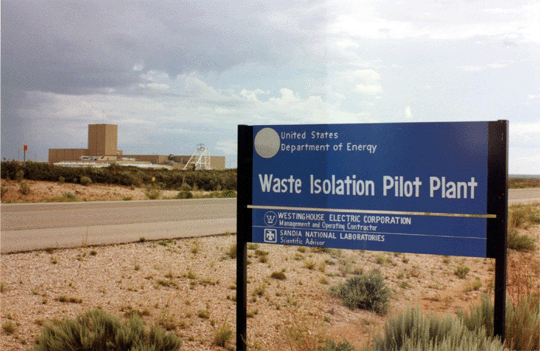
Proposals to bury plutonium from nuclear weapons must address chemical interactions and intrusion risks. More than 600 metres below ground near Carlsbad, New Mexico, is the world’s only operating deep geological repository currently accepting transuranic nuclear waste: that contaminated by elements heavier than uranium. The Waste Isolation Pilot Plant (WIPP), run by the US Department of Energy (DOE), is used to dispose of laboratory equipment, clothing and residues from the nation’s nuclear-defence programme. In the past 15 years, around 91,000 cubic metres (equivalent to covering a soccer field to a depth of about 13 metres) of such transuranic waste, mostly of relatively low radiation levels, has been placed there.
The main contaminants are long-lived isotopes of plutonium (mainly plutonium-239, with a half-life of 24,100 years, and plutonium-240, with a half-life of 6,560 years) and shorter-lived isotopes of americium and curium. In rooms carved out of a 250-million-year-old salt bed, the waste is stored in hundreds of thousands of plastic-lined steel drums. The repository is now at about half of its planned capacity and is to be sealed in 2033.
The DOE is responsible for performing safety assessments to ensure that WIPP will not exceed limits on exposure to radioactivity, as set by the US Environmental Protection Agency (EPA), for 10,000 years.
But new demands are emerging. An arms-control agreement with Russia made in 2000 obliges the United States to dispose of 34 tonnes of plutonium from dismantled nuclear weapons1. Following the terms of the agreement, the United States planned to convert the material into a fuel — mixed (uranium and plutonium) oxide, or MOX — to burn in commercial nuclear-power plants. But faced with soaring construction costs for a MOX fabrication facility at the Savannah River Site in South Carolina, the DOE has commissioned evaluations of alternatives2.
The most recent report3, published in August 2015, recommends burying the weapons’ plutonium at WIPP. Judging the repository’s performance to have been “successfully demonstrated”, the DOE’s Red Team expert panel proposes that the 34 tonnes of weapons plutonium can be added to WIPP once it has been diluted to low concentrations comparable to that of the transuranic waste at WIPP.
In fact, WIPP’s safety record is mixed. Continue reading
Cyber attack: Nuclear Threat Initiative finds 20 countries vulnerable
 20 Nations’ Nuclear Facilities Said to Be Vulnerable to Cyberattack, NYT By DAVID E. SANGER JAN. 14, 2016 WASHINGTON — Twenty nations with significant atomic stockpiles or nuclear power plants have no government regulations requiring minimal protection of those facilities against cyberattacks, according to a study by the Nuclear Threat Initiative.
The findings build on growing concerns that a cyberattack could be the easiest and most effective way to take over a nuclear power plant and sabotage it, or to disable defenses that are used to protect nuclear material from theft. The countries on the list include Argentina, China, Egypt, Israel, Mexico and North Korea.
The survey, by one of the nation’s leading nuclear nonproliferation watchdogs, was based on a nation-by-nation review of basic, publicly available data, and some of the countries may claim they have classified protections in place.
But the list is damning. The group looked, for example, at whether any cyberprotections are required by law or regulation at nuclear facilities, and whether cyberattacks are included in the assessments of potential threats to the security of those installations. One question asked whether there were mandated drills and tests to assess responses to a cyberassault, rather than just a physical attack on the facilities.
“Twenty countries failed on all the indicators,” said Page Stoutland, one of the authors of the report. Because of the secrecy surrounding military nuclear facilities, it was impossible to determine the levels of cyberprotection used to protect nuclear weapons in the nine countries known to possess them.
The report also concludes that President Obama’s global initiative to sweep up loose nuclear material, which will be the subject of his third and final nuclear security summit meeting this March, has slowed substantially…….
The Nuclear Threat Initiative, which publishes an annual index of nuclear security around the world, notes that a dozen countries have eliminated all weapons-usable nuclear materials since the summit meetings began. Many more have greatly improved the security surrounding lightly guarded materials, which are stored every place from hospitals to research reactors on university campuses.
But at the very moment that the black market in nuclear materials remains active, the report found that 24 nations still have more than 2.2 pounds of weapons-usable nuclear material, “much of it still too vulnerable to theft,” and many have just begun to think about their vulnerability to cyberthreats that could enable an attacker to sabotage a site without breaking through fences or risk setting off perimeter alarms.
The most famous cyberattack on a nuclear facility was done by the United States and Israel: the effort to destroy and disable nuclear centrifuges at the Natanz nuclear enrichment plant in Iran. That program, code-named Olympic Games, used a worm that was later named Stuxnet to knock the centrifuges out of operation. It did not release radioactive material into the atmosphere, but it was a vivid demonstration of the vulnerability of nuclear facilities to cyberattack. Iran had completely isolated the Natanz facility from the Internet, but the originators of the program found ways to insert it.
The lesson of Stuxnet, however, has apparently been lost on many nations that have yet to develop requirements that nuclear facilities have cyber protections in place before they can operate.
“Too many states require virtually no effective security measures at nuclear facilities to address the threat posed by hackers,” the study, in which the Economist Intelligence Unit also participated, concluded. Of the two dozen nations with weapons-usable material, nine got the maximum score for cyberindicators, and seven got a score of zero.
In 23 nations that possessed no weapons-usable materials, but had nuclear power plants or other nuclear facilities that contain fuel that could be converted to weapons use, 13 got a zero score.
More than 80 percent of all nuclear stockpiles are classified as military material, meaning they are largely used in weapons programs, and all of those are outside international security review, including the guidelines issued by the International Atomic Energy Agency for the protection of civilian nuclear stocks. http://www.nytimes.com/2016/01/15/world/nuclear-threat-initiative-cyberattack-study.html?_r=0
Global nuclear security system has major gaps – Nuclear Threat Initiative (NTI) Nuclear Security Index
 As Final Head-of-State Nuclear Security Summit Approaches, Nunn and NTI Warn of Slowing Progress on Preventing Nuclear Terrorism 2016 http://news.sys-con.com/node/3634523 NTI Nuclear Security Index finds countries unprepared for cyber attacks on nuclear facilities; introduces new “sabotage ranking” JANUARY 14, 2016 WASHINGTON, Jan. 14, 2016 /PRNewswire-USNewswire/ –– At a time of escalating threats and as world leaders prepare to gather for the final Nuclear Security Summit, the third edition of the Nuclear Threat Initiative (NTI) Nuclear Security Index finds that progress on reducing the threat of catastrophic nuclear terrorism has slowed and major gaps remain in the global nuclear security system. The 2016 NTI Index, which has become a critical resource and tool for assessing the security of the world’s deadliest materials, also finds troubling shortfalls in areas assessed for the first time: how well countries are protecting nuclear facilities against sabotage, as well as the emerging threat of cyber attacks. Continue reading
James Hansen is so wrong about “new nuclear” as saviour of the world’s climate

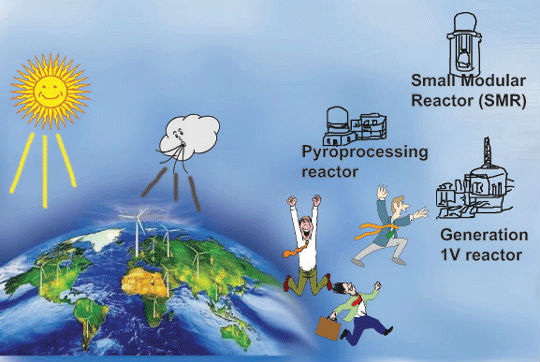 Stanford University engineering professor, Mark Z. Jacobson’s response to Hansen points out that it takes around 10-19 years from the start of planning for new reactors to the start of operation compared with 2-5 years for wind or solar. Nuclear is just too slow to help solve climate problems. (8) Bill Gates also made a lot of headlines with his “Breakthrough Energy Coalition” fund to come up with new energy solutions, including “advanced” nuclear reactors. It’s not that innovation isn’t welcome, but what the climate really needs right now is the large-scale deployment of existing technologies which, according to investment bank Goldman Sachs, are already cost-effective and climate-effective. The problem is, an Apollo-style push for what Gates has called “Energy Miracles” is not only a misguided strategy for mitigating climate change, it could also distract funders with the enticing idea that invention is going to rescue us from climate change. They really should be distributing funds to empower communities, and incentivize the massive deployment of energy efficiency and existing renewable technology now rather waiting for miracles which might never happen, or will happen too late to make a difference. (9) ……http://www.no2nuclearpower.org.uk/nuclearnews/NuClearNewsNo81.pdf
Injecting dogs with plutonium – to prove what?
Nuclear radiation, Kierkegaard, and the philosophy of denial, The Ecologist, Chris Busby 8th January 2016 “……….Injecting dogs with plutonium – to prove what?
 Some years ago I was up against one of these hormesis geezers, a certain Dr Otto Raabe, in a court case in America. He was the expert for the defence. Raabe was in charge of the Beagle dog studies in New Mexico.
They injected these poor creatures with Plutonium, Radium or Strontium-90 and watched them develop bone cancer and leukemia. The doses were enormous, the number of dogs was small (cost). The whole place was contaminated with Plutonium, the particles hanging in the air like fairy dust. The burial site for the dogs is so radioactive it is fenced off as a US superfund site for decontamination.
Raabe’s thing was that he had mathematically converted beagle dogs into humans: you should just see his amazing three dimensional graphs (these guys love all that stuff). Well you can probably find them somewhere on the internet.
The best thing was that in one of his papers he discussed how difficult it was to do these beagle studies. He wrote that 12 (yes 12) of his control dogs (no injections of Plutonium) had unfortunately died of lung cancer and had to be removed from the analysis. What!!?
I checked out the rates of lung cancer in dogs (you can find everything on the web) and that was the end of Raabe. Low dose, you see. Fairy dust………..http://www.theecologist.org/essays/2986384/nuclear_radiation_kierkegaard_and_the_philosophy_of_denial.html
Was North Korea’s nuclear test really and H-Bomb: Science can tell

 SCIENCE CAN TELL IF NORTH KOREA’S TEST WAS REALLY AN H-BOMB, Wired, 7 Jan 16, “……North Korea has a history of exaggerating its military claims to achieve its political ends. (South Korea, the US, and Japan are typically named…… because North Korea’s leader Kim Jong Un is unlikely to let international inspectors anywhere near the test site, the only real way to tell whether North Korea’s big boom was the big H is by analyzing data collected from a suite of global sensors……
Hydrogen bombs, on the other hand, use nuclear fusion—melding atoms together—to release way more explosive energy. These “thermonuclear” weapons are so powerful that they actually need atomic fission to kickstart the fusion process. That’s right, H-bombs use an A-bomb just to get going. American scientists detonated the first H-bomb in 1952, on a Pacific atoll. It was over 500 times more powerful than the bomb the US dropped on Nagasaki. Modern H-bombs are at least twice as powerful. Which is why everyone is so freaked out about whether North Korea, the world’s most famous renegade nation, has a hydrogen bomb…….
why seismologists take recordings from multiple sensors. The agency responsible for monitoring atomic blasts, the Comprehensive Nuclear-Test-Ban Treaty Organization, currently has 42 certified seismic stations distributed around the globe (plus over 100 auxiliary stations). Because seismic signals bounce through the Earth, not only did Russia and Japan pick up North Korea’s event, but so did the US……….
The smoking gun can only really come by detecting radioactive material. To that end, CTBTO has radionuclide detection stations scattered throughout the globe. These come in two flavors. The first looks for radioactive dust—fallout. These systems use suction pumps to pull air through a filter, which then goes through a radiation counter. The types of particles present, and their radioactivity, would give a lot of clues as to the bomb’s type. Let’s say you have a typical atom bomb: Its fallout particles would be decayed bits of uranium or plutonium.
A hydrogen bomb also uses those materials, but they’d be mostly burned away by the super hot fusion reaction. According to this 1991 analysis of a Chinese explosionpublished in Science and Global Security, an H-bomb’s radioactive particulate signature would have a lot less decayed plutonium and uranium, and also different ratios of their various decayed isotopes. But if someone knew the exact particles found after an H-bomb went off, they could use that knowledge to build their own H-bomb (that’s probably one of the ways the Soviets copied the US’s weapon). Which is why Wallace told me the details of the analysis are secret. But if the blast is underground, as this one seems to have been, radionuclide detection is little help—the particles get contained.
The other type of detector looks for radioactive gases, rather than particles. Xenon gas is the most potent of these, partly because it is a noble gas that doesn’t interact with other substances. Xenon can, however, decay. And the rate of decay tells scientists the gas atoms’ exact age. For instance, after North Korea’s 2013 test, a Japanese sensor picked up xenon isotopes that scientists deduced were exactly 55 days old. The exact same day as North Korea’s test…….
it matters not just what kind of bomb North Korea detonated, but that the country detonated one at all. http://www.wired.com/2016/01/science-can-tell-if-north-koreas-test-was-really-an-h-bomb/
Underground nuclear testing – the stages
Stages of an underground nuclear test, BBC News [excellent diagrams] 6 January 2016 Nuclear devices are often tested underground to prevent radioactive material released in the explosion reaching the surface and contaminating the environment.
This method also ensures a degree of secrecy.
The release of radiation from an underground nuclear explosion – an effect known as “venting” – would give away clues to the technical composition and size of a country’s device, and therefore its nuclear capability.
The test site is carefully geologically surveyed to ensure suitability. Such tests usually take place well away from population centres.
The nuclear device is placed into a drilled hole or tunnel usually between 200-800m (650-2,600ft) below the surface, and several metres wide.
A lead-lined canister containing monitoring equipment is lowered into the shaft above the chamber. The hole is then plugged with gravel, sand, gypsum and other fine materials to contain the explosion and fallout underground.
The device is remotely detonated from a surface control bunker. The nuclear explosion vaporises subterranean rock, creating an underground chamber filled with superheated radioactive gas.
As this cools, a pool of molten rock collects at the bottom of the chamber.
Minutes or hours after the blast, as the pressure falls, the chamber collapses in on itself causing subsidence and a crater to appear on the surface. North Korea’s test……http://www.bbc.com/news/world-asia-35244474
China’s state-owned nuclear companies get together in export marketing drive
 State-owned enterprises eye overseas power projects, Nikkei Asian Review TETSUYA ABE, Nikkei staff writer BEIJING 5 Jan 16, — The global nuclear industry is likely to be another area where China’s growing presence will be keenly felt, as the government and state-owned corporations are working hand in hand to win overseas contracts. This development worries critics who are concerned about nuclear safety issues, as well as Beijing’s seeming lack of commitment to nuclear nonproliferation.United front In their meeting on Dec. 30, Sun Qin, chairman of China National Nuclear Corp., and He Yu, his counterpart at CGN, agreed to join hands to better compete with Western rivals in their pursuit to cultivate overseas nuclear power plant markets.
The two came to the National Development and Reform Commission’s building in Beijing on that day to sign an agreement to set up a joint venture. The new company, to be capitalized at 500 million yuan ($76.5 million), will handle export of Hualong One, a pressurized water reactor model that China claims to have developed on its own.
CNNC and CGN, each of which is a major player that ranks within the top three in the Chinese nuclear industry, are coming together with an eye toward increasing the chance of winning orders in Central Asia and Eastern Europe. Continue reading
Timeline of major incidents at Los Alamos National Laboratory
2013: A waste container at the lab is packaged with a volatile mix of nitrate salts and organic kitty litter and is shipped to WIPP.
Feb. 14, 2014: The container ruptures in the underground WIPP facility, leaking radiation. Several workers are exposed, although levels are not considered a health hazard. WIPP is closed indefinitely.
March-December 2014: Federal investigators issue scathing reports finding multiple problems with how waste is handled at the lab. One report finds workers who tried to alert supervisors to problems with waste containers were ignored.

Chronology of major incidents marking Los Alamos National Laboratory’s management history, Local News, Santa Fe, New Mexico , 4 Jan 16 The New Mexican
Jan. 1, 1943: A secret national laboratory is set up in Los Alamos to design a nuclear bomb during World War II. The University of California is named the official lab manager and is paid $5 million for a one-year contract. The U.S. Department of Energy oversees the lab’s operations. J. Robert Oppenheimer is the lab’s director.
1945: An atomic bomb is tested at the Trinity Site in Southern New Mexico on July 16, ushering in the nuclear age………
1988: A new federal law gives the Department of Energy more leverage over lab contractors. The University of California at Los Alamos National Laboratory is exempted from the law. Continue reading
America’s secret plutonium experiments on humans
Then there is the horrifying reality that these experiments were taking place in the shadow of Nazi Germany; some of the scientists involved in the radiation experiments were the very men whose earlier experimental designs had tormented prisoners of concentration camps. Welsome describes Operation Paperclip, conducted under the auspices of the U.S. government. Paperclip imported Nazi scientists and supported their work, helping to confer, in the words of scientist Joseph G. Hamilton, “a little of the Buchenwald touch” on American medicine.
This valuable work represents an elegy to lost ideals, lost health, and lost trust. One can only hope it will serve as a cautionary tale.
 The Plutonium Files: America’s secret medical experiments in the Cold War N Engl J Med 1999; 341:1941-1942 December 16, 1999 Harriet A. Washington
The Plutonium Files: America’s secret medical experiments in the Cold WarBy Eileen Welsome. 580 pp. New York, Dial Press, 1999. $26.95. ISBN: 0-385-31402-7
Amid the embarrassments of Monicamania and of multiple public mea culpas, the past few years have not been exemplary ones for American journalism. This fact makes the triumph of The Plutonium Files all the sweeter, because this superlative book is a reminder of the purpose of investigative journalism.
This richly detailed, subtly nuanced history of government-engineered radiation experiments on unwitting Americans is based on the Pulitzer-prize–winning series Eileen Welsome wrote for the Albuquerque Tribune. Welsome’s tenacious and resourceful detective work has unveiled the saga of a sordid, tragic, yet fascinating chapter in the history of American medical science. The book succeeds on many levels. It is a gripping exposé of governmental exploitation and of medicine’s moral failures in an era in which blind trust defined the normal relationship between physicians and patients.
Between April 1945, scant months before the bombing of Hiroshima, and July 1947, the scientists of the Manhattan Project followed the construction of the atomic bomb with a chilling second act: medical experimentation on hundreds of unsuspecting Americans. Continue reading
Secret radiation experiments carried out on people
Some of the classified government experiments included:
 * Exposing more than 100 Alaskan villagers to radioactive iodine during the 1960s.
* Feeding 49 retarded and institutionalised teenagers radioactive iron and calcium in their cereal during the years 1946-1954.
* Exposing about 800 pregnant women in the late 1940s to radioactive iron to determine the effect on the fetus.
* Injecting 7 newborns (six were Black) with radioactive iodine.
* Exposing the testicles of more than 100 prisoners to cancer-causing doses of radiation. This experimentation continued into the early 1970s.
* Exposing almost 200 cancer patients to high levels of radiation from cesium and cobalt. The AEC finally stopped this experiment in 1974.
* Administering radioactive material to psychiatric patients in San Francisco and to prisoners in San Quentin.
* Administering massive doses of full body radiation to cancer patients hospitalised at the General Hospital in Cincinnati, Baylor College in Houston, Memorial Sloan-Kettering in New York City, and the US Naval Hospital in Bethesda, during the 1950s and 1960s. The experiment provided data to the military concerning how a nuclear attack might affect its troops.
* Exposing 29 patients, some with rheumatoid arthritis, to total body irradiation (100-300 rad dose) to obtain data for the military. This was conducted at the University of California Hospital in San Francisco.

—In preparing America for nuclear attack during the Cold War years following World War II, thousands of US citizens became the innocent victims of over 4,000 secret and classified radiation experiments conducted by the Atomic Energy Commission (AEC) and other government agencies, such as the Department of Defense, the Department of Health, Education and Welfare, the Public Health Service (now the CDC), the National Institutes of Health, the Veterans Administration (VA), the CIA, and NASA.
Millions of people were exposed to radioactive fallout from the continental testing of more than 200 atmospheric and underground nuclear weapons, and from the hundreds of secret releases of radiation into the environment. Over 200,000 “atomic vets” who worked closely with nuclear detonations at the Nevada test site during the 1950s and 1960s were especially vulnerable to radiation fallout.
Also affected were the thousands of so-called “downwinders”, who lived in nearby small towns in Nevada, Utah, Colorado and New Mexico. These downwinders (along with the animal populations) suffered the worst cumulative radioactive effects of fallout, along with a contaminated environment teeming with radioactive food and farm products. The plight of these poor country people exposed to government-induced radiation sickness has been recorded in Carole Gallagher’s remarkable photo-essay American Ground Zero: The Secret Nuclear War (The Free Press, 1993).
In reviewing declassified AEC records (now the Department of Energy) from the 1950s, Gallagher was shocked to discover one document that described the people downwind of the Nevada Test Site as “a low use segment of the population.” Her shock at such callous bigotry caused her to eventually move West to research, investigate and document those who lived closest to the Test Site, as well as workers at the site, and soldiers repeatedly exposed to nuclear bombs during the military tests.
Disinformation and Nuclear Fallout
In the nuclear arms race, government doctors and scientists brainwashed the public into believing low dose radiation was not harmful. Some officials even tried to convince people that “a little radiation is good for you.” Totally ignored was the knowledge that the radiation from nuclear fallout could lead to an increased risk of cancer, heart disease, neurological disorders, immune system disease, reproductive abnormalities, sterility, birth defects, and genetic mutations which could be passed on from generation to generation. The full extent of this radiation damage to the American public during the Cold War years will never be known. Continue reading
How plutonium infiltrates the body’s cells
 Plutonium Trojan Horse in the Body , Mining Awareness Plus, 26 Feb 15 Plutonium shares some important similarities with biologically important trivalent transition metals, especially iron. This could have importance from a material science point of view, as well.
“Plutonium tricks cells by ‘pretending’ to be iron
By Jared Sagoff July 8, 2011
Plutonium gets taken up by our cells much as iron does,…
Researchers at the U.S. Department of Energy’s Argonne National Laboratory and Northwestern University have identified a new biological pathway by which plutonium finds its way into mammalian cells. The researchers learned that, to get into cells, plutonium acts like a ‘Trojan horse,’ duping a special membrane protein that is typically responsible for taking up iron.
This discovery may help enhance the safety of workers who deal with plutonium, as well as show the way to new ‘bio-inspired’ approaches for separating radioactive elements from other metals in used nuclear fuel.
Because the bodies of mammals have evolved no natural ability to recognize plutonium—the element was first produced in 1941—scientists were curious to know the cellular mechanisms responsible for its retention in the body. The researchers exposed adrenal cells from rats to minute quantities of plutonium to see how the cells accumulated the radioactive material.
Using the high-energy X-rays provided by Argonne’s Advanced Photon Source, the researchers were able to characterize a particular protein known as “transferrin,” which is responsible for bringing iron into cells. Each transferrin is made up of two subunits, known as N and C, that normally bind iron. When another protein—the transferrin receptor—recognizes both the N and C subunits, it admits the molecule to the cell. However, when both the N and C subunits contain plutonium, the transferrin receptor doesn’t recognize the protein and keeps it out.
Contrary to their expectations, the researchers discovered that in one of the mixed states—when an iron-containing N-subunit is combined with a plutonium-containing C-subunit—the resulting hybrid so closely resembles the normal iron protein that the uptake pathway is ‘tricked’ into allowing plutonium to enter the cell.
‘Although the interaction between plutonium and bodily tissues has been studied for a long time, this is the first conclusive identification of a specific pathway that allows for the introduction of plutonium into cells,’ said Mark Jensen, an Argonne chemist who led the research.
… The research was funded by the U.S. Department of Energy’s Office of Science as well as by the National Institutes of Health.”http://www.anl.gov/articles/plutonium-tricks-cells-pretending-be-iron Author manuscript found here: “An iron-dependent and transferrin-mediated cellular uptake pathway for plutonium“, Mark P. Jensen et. al. (http://www.ncbi.nlm.nih.gov/pmc/articles/PMC3462652/)
From the Jensen et. al. author manuscript: “… Pu is radiotoxic and is strongly retained by organisms1, Pu uptake from an accident, environmental contamination, or a nuclear or radiological attack can pose significant health risks. Plutonium localizes principally in the liver and skeleton in humans where it remains for decades2. It associates in vivo with the iron-containing proteins serum transferrin and ferritin3,4, but despite the danger of plutonium poisoning, the specific molecular-level pathways Pu travels to enter and localize in cells have never been identified2,5…”………. https://miningawareness.wordpress.com/2015/02/26/plutonium-trojan-horse-in-the-body/
1 This Month



26 September – International Day for the Total Elimination of Nuclear Weapons


PLEASE OPPOSE HR 8255 AND S.3639 – bills would accelerate satellite deployment, with no environmental review or safeguards – https://ncstd5li.quorum.us/campaign/169331/
To see nuclear-related stories in greater depth and intensity – go to https://nuclearinformation.wordpress.com
-
Archives
- September 2026 (245)
- August 2026 (330)
- July 2026 (355)
- June 2026 (287)
- May 2026 (306)
- April 2026 (356)
- March 2026 (251)
- February 2026 (267)
- January 2026 (308)
- December 2025 (358)
- November 2025 (359)
- October 2025 (375)
-
Categories
- 1
- 1 NUCLEAR ISSUES
- business and costs
- climate change
- culture and arts
- ENERGY
- environment
- health
- history
- indigenous issues
- Legal
- marketing of nuclear
- media
- opposition to nuclear
- PERSONAL STORIES
- politics
- politics international
- Religion and ethics
- safety
- secrets,lies and civil liberties
- spinbuster
- technology
- Uranium
- wastes
- weapons and war
- Women
- 2 WORLD
- ACTION
- AFRICA
- Atrocities
- AUSTRALIA
- Christina's notes
- Christina's themes
- culture and arts
- Events
- Fuk 2022
- Fuk 2023
- Fukushima 2017
- Fukushima 2018
- fukushima 2019
- Fukushima 2020
- Fukushima 2021
- general
- global warming
- Humour (God we need it)
- Nuclear
- RARE EARTHS
- Reference
- resources – print
- Resources -audiovicual
- Weekly Newsletter
- World
- World Nuclear
- YouTube
-
RSS
Entries RSS
Comments RSS
 nuclear-news