Are the prospects for Small Modular Reactors being exaggerated? Five key characteristics examined
June 11, 2024 by Ed Lyman, Ed Lyman is Director, Nuclear Power Safety, at the Union of Concerned Scientists
Small Modular Reactors (SMRs) are being presented as the next generation of nuclear technology. While traditional plants face cost overruns and safety issues, SMRs are seen by their champions as cheaper, safer, and faster to deploy. But Ed Lyman at UCS cites evidence that cast these claims into doubt.
In five sections of this article, he lists the reasons why. SMRs are not more economical than large reactors. SMRs are not generally safer or more secure than traditional large light-water reactors. SMRs will not reduce the problem of disposal of radioactive waste. SMRs cannot be counted on to provide reliable and resilient off-the-grid power (for facilities like data centres, bitcoin mining, hydrogen or petrochemical production). SMRs do not use fuel more efficiently than large reactors.
And where problems might be ironed out over time, the learning cycle of such technology is measured in decades during which costs will remain very high. SMRs may have a role to play in our energy future, says Lyman, but only if they are sufficiently safe and secure, along with a realistic understanding of their costs and risks.
Even casual followers of energy and climate issues have probably heard about the alleged wonders of small modular nuclear reactors (SMRs). This is due in no small part to the “nuclear bros”: an active and seemingly tireless group of nuclear power advocates who dominate social media discussions on energy by promoting SMRs and other “advanced” nuclear technologies as the only real solution for the climate crisis. But as I showed in my 2013 and 2021 reports, the hype surrounding SMRs is way overblown, and my conclusions remain valid today.
Unfortunately, much of this SMR happy talk is rooted in misinformation, which always brings me back to the same question: if the nuclear bros have such a great SMR story to tell, why do they have to exaggerate so much?
What are SMRs?
SMRs are nuclear reactors that are “small” (defined as 300 megawatts of electrical power or less), can be largely assembled in a centralised facility, and would be installed in a modular fashion at power generation sites. Some proposed SMRs are so tiny (20 megawatts or less) that they are called “micro” reactors. SMRs are distinct from today’s conventional nuclear plants, which are typically around 1,000 megawatts and were largely custom-built. Some SMR designs, such as NuScale, are modified versions of operating water-cooled reactors, while others are radically different designs that use coolants other than water, such as liquid sodium, helium gas, or even molten salts.
To date, however, theoretical interest in SMRs has not translated into many actual reactor orders. The only SMR currently under construction is in China. And in the United States, only one company — TerraPower, founded by Microsoft’s Bill Gates — has applied to the Nuclear Regulatory Commission (NRC) for a permit to build a power reactor (but at 345 megawatts, it technically isn’t even an SMR).
The nuclear industry has pinned its hopes on SMRs primarily because some recent large reactor projects, including Vogtle units 3 and 4 in the state of Georgia, have taken far longer to build and cost far more than originally projected. The failure of these projects to come in on time and under budget undermines arguments that modern nuclear power plants can overcome the problems that have plagued the nuclear industry in the past.
Developers in the industry and the US Department of Energy say that SMRs can be less costly and quicker to build than large reactors and that their modular nature makes it easier to balance power supply and demand. They also argue that reactors in a variety of sizes would be useful for a range of applications beyond grid-scale electrical power, including providing process heat to industrial plants and power to data centres, cryptocurrency mining operations, petrochemical production, and even electrical vehicle charging station
Here are five facts about SMRs that the nuclear industry and the “nuclear bros” who push its message don’t want you, the public, to know.
1. SMRs are not more economical than large reactors. 2. SMRs are not generally safer or more secure than large light-water reactors. 3. SMRs will not reduce the problem of what to do with radioactive waste. 4. SMRs cannot be counted on to provide reliable and resilient off-the-grid power for facilities, such as data centers, bitcoin mining, hydrogen or petrochemical production. 5. SMRs do not use fuel more efficiently than large reactors
Continue readingGaza has become a humanitarian catastrophe and Israel will have to answer tough questions
By global affairs editor John Lyons, https://www.abc.net.au/news/2024-06-10/israel-tough-questions-war-in-gaza/103956848?utm_campaign=abc_news_web&utm_content=twitter&utm_medium=content_shared&utm_source=abc_news_web
“Frozen“ children — it’s an unusual description of an appalling reality.
They’re the words Sydney clinical psychologist Scarlett Wong used after a recent trip to Gaza with Doctors Without Borders.
“When you see a starving child, they are apathetic, they have no response,” she told SBS News. “This is the kind of thing we were seeing from a medical view … children have become frozen, with no emotion, and apathetic.”
The situation, Dr Wong said, was “the worst humanitarian disaster I have ever seen”.
Gaza has become one of the worst humanitarian catastrophes of our time. The UN’s World Food Programme has said parts of Gaza are now gripped by “a full-blown famine”.
One of the few countries denying this is Israel. Not only is there not a famine, said Ron Dermer, a member of Israel’s war cabinet, but there is an abundance of food.
He told a startled Yalda Hakim on Sky UK recently that there were in fact “bustling markets” with fruit and vegetables.
Dermer’s claim defies all available evidence. Given the Israeli army has drones flying constantly across the tiny enclave, Dermer could have provided photographs of the “bustling markets”. Where are the photos?
According to Foreign Policy magazine, 30 of Gaza’s 36 hospitals have been bombed — many repeatedly — even while medical staff, patients and civilians seeking shelter remained inside. Satellite imagery shows vast sections of Gaza in rubble.
The Wall Street Journal reported that from October 7 to December 15, Israel dropped 29,000 bombs, munitions and shells on Gaza. This means that, on average, Israel hit every square kilometre of Gaza with 79 bombs, munitions or shells.
After just nine weeks of the war, the newspaper said the destruction of homes, schools and other buildings resembled “some of the most devastating campaigns in modern history”.
When the war does finish, the rebuilding of Gaza could take a generation. The Washington Post reported that the head of the UN’s Mine Action Program, Mungo Birch, said the number of unexploded missiles and bombs lying under the rubble was “unprecedented” since World War II and that Gaza was now the site of about 37 million tons of rubble — more than what had been generated across all of Ukraine during Russia’s war — and 800,000 tons of asbestos and other contaminants.
Has the response been proportional?
Over the weekend, Israel rescued four hostages captured on October 7 from a heavily populated refugee camp. Gazan authorities said at least 210 Palestinians were killed and 400 wounded during the rescue, which involved heavy bombardment.
Hamas has had its day of reckoning; the videos from October 7 would be, for any reasonable observer, proof of atrocities and war crimes. The videos and photos not released to the public are even more appalling. Hamas has kept hostages for more than eight months.
But Israel’s day of reckoning for its eight-month-long response is still to come. The question is, has its response been proportional?
Every country that engages in war has a day, or years, of reckoning. America had such a day after the Vietnam and Iraq wars. Australia has had — and continues to have — days of reckoning after its involvement in Afghanistan, with continuing investigations into possible war crimes.
Israel will argue that for self-defence it needed to ensure that Hamas was never again in a position to commit an attack. They will argue that throughout the war, Hamas has used civilians as human shields and that, therefore, a large number of civilians were killed.
But there will be very specific allegations that Israel will be under pressure to answer. Human Rights Watch (HRW) reported this week that the Israeli military has been using white phosphorous in Gaza and south Lebanon. HRW noted that white phosphorous causes severe burns, often down to the bone, and burns to only 10 per cent of the body are often fatal. It said it can cause respiratory damage and organ failure.
“Using airburst white phosphorous is unlawfully indiscriminate in populated areas and otherwise does not meet this legal requirement to take all feasible precautions to avoid civilian harm,” the group said.
The HRW report also referenced the Israel-Lebanon border. It said Israel had engaged in “widespread” use of white phosphorous since October, including at least five municipalities where white phosphorous munitions were unlawfully airburst over populated residential areas. It said Lebanon should turn to the International Criminal Court and enable the prosecution of grave international crimes.
The ABC put these allegations to the Israel Defense Forces (IDF), who said that like many western militaries, the IDF possesses “smoke-screen shells that include white phosphorous that are legal under international law”.
“These shells are used by the IDF for creating smoke screens and not for targeting or causing fires and are not defined under law as incendiary weapons.”
Tough questions are being asked
As the war drags on, some media outlets are increasingly asking difficult questions of Israel.
CNN has conducted a major investigation of one of Israel’s “black site” prison facilities, where they claimed systemic torture of hundreds of Palestinians taken from Gaza is occurring.
The US media outlet spoke to three Israeli whistleblowers from the facility who revealed atrocities ranging from doctors amputating prisoners’ limbs due to injuries sustained from constant handcuffing and medical procedures sometimes performed by underqualified medics, which earned the facility a reputation for being “a paradise for interns” and a place “where the air is filled with the smell of neglected wounds left to rot”.
One medic from the facility said beatings of Palestinians were not done to gather intelligence but out of revenge for the October 7 attack.
He said he was ordered to perform medical procedures on Palestinians for which he was not qualified: “I was asked to learn how to do things on the patients, performing minor medical procedures that are totally outside my expertise.”
Jeremy Corbyn was smeared for rejecting the use of nuclear weapons – but he was right,


 Corbyn was smeared for rejecting the use of nuclear weapons – but he was right https://leftfootforward.org/2020/01/corbyn-was-smeared-for-rejecting-the-use-of-nuclear-weapons-but-he-was-right/, Kate Hudson
– It’s time to smash the narrative that using nuclear weapons is ‘patriotic,
|
A recurrent trope in the post-election analysis has been Jeremy Corbyn’s supposed lack of patriotism. It’s worth examining. Rather than arriving at this conclusion by demonstrating that Corbyn doesn’t love his country – for which there is no evidence whatsoever – it seems largely to be based on his unwillingness to commit to killing millions of innocent civilians at the touch of a button. The media seemed hell-bent on pushing this approach during the election (and it’s resurfacing in the leadership debate). Fortunately others in the public eye, footballer Gary Lineker for one, have more common sense. ‘Nuclear thing is bonkers’ he tweeted, ‘We’re all f**ked if they’re ever used.’ Quite so. And he went on to say – in a twitter debate with TV presenter Piers Morgan – that Trident should be scrapped. Morgan tried to assert the strange logic that because we had them they hadn’t been used. Lineker quite sensibly pointed out that nuclear weapons would not have been used if there were no nuclear weapons. This is a point we have been making for some time. It reminds me of a debating point made by some pro-nuclear advocates that ‘we have them in order not to use them’. Clearly a silly approach – we could save ourselves £205 billion by not having them in order not to use them! But having blighted the election with a knee-jerk prime ministerial virility test this is now resurfacing during the Labour leadership contest. Candidates – most notably and recently, Rebecca Long Bailey on Tuesday’s Today programme – are again being asked their position on the use of nukes. Because willingness to press the button has come to falsely symbolise strong leadership, patriotism and a commitment to Britain’s status in the world, who is going to say no? Nothing could show more clearly the urgent need to have a genuine debate about nuclear weapons, what they are and what their use would mean. We also need politicians to realise that nuclear weapons are not something to posture wildly about – they are indeed weapons of mass destruction. There will be no life worthy of the name after their use. Survivors will envy the dead. Most concerning is the fact that unquestioning attachment to a totemic but anachronistic weapons system prevents a real assessment of what is needed to meet our security needs in the 21st century – and what we need to spend our defence budget on. It is an open secret that the MoD is overcommitted on ‘big ticket’ projects. Yet no one seems to dare to question Trident, presumably on the grounds that they would be immediately characterised as a lily-livered traitor. National security strategies since 2010 have identified cyber warfare, terrorism, climate change, pandemics and organised crime as some of the key contemporary threats we face. Nuclear threats have actually been downgraded in risk level but nevertheless Trident replacement is proceeding – with significant opportunity cost to other higher level defence priorities. Even former advocates of nuclear weapons, like Lord Des Browne, are speaking out. He was the Defence Secretary who pushed the decision on Trident replacement through parliament in the Blair years. Now he has raised serious concerns about the impact of new technology on Trident and its replacement. When Trident was launched in the 1990s it was the gold standard of nuclear weapons, undetectable under the waters, 24/7. Now, he states, the replacement will be obsolete before it’s launched: the rapid development of underwater drone technology will render subs fully detectable and advanced hacking skills will jeopardise the security of targeting and missile use. So this is the problem with reducing serious questions about our national security to the level of a ‘will they/won’t they press the button?’ game show, trapping politicians in a ridiculous zero-sum game where actually everyone loses. Our real security needs are ignored and underfunded. It’s time for change – rethinking our security is well overdue. Kate Hudson is General Secretary of the Campaign for Nuclear Disarmament. |
|
Senior U.S. Diplomats, Journalists, Academics and Secretaries of Defense Say: the U.S. Provoked Russia in Ukraine
Progressive Memes, by Donald A. Smith, PhD 3 June 24
It took some years for Americans to realize they’d been lied to about the war in Vietnam. Thanks to the publication of the Pentagon Papers, and thanks to the antiwar movement, Americans eventually learned about the injustices and failures of that war.
Likewise, it took several years after the starts of the wars in Iraq and Afghanistan for Americans to realize they’d been lied to about those wars as well.
Americans are just now starting to realize that they’ve been lied to about the war in Ukraine. (The propaganda effort has been quite effective, with the New York Times, in particular, acting as a mouthpiece for the government’s position.) More and more mainstream publications are exposing the lies, and a majority of Americans now oppose further arming of Ukraine.
This essay is a summary of what the U.S. government has been hiding about the war in Ukraine, with links to sources for further information.
According to Brown University’s Costs of War project, U.S. military actions since 9/11 directly killed over 900,000 people, with an additional 3.5 million people dying from indirect effects. The wars cost Americans at least $8 trillion and displaced over 38 million people from their homes. The U.S. spends over a trillion dollars a year on its military, if you count all expenditures.
If we go back to the 1960s, the number killed by U.S. wars includes the several million killed in the Vietnam war, the approximately 1 million killed by U.S. support for Indonesian military’s attacks on left wing groups, and the hundreds of thousands, at least, killed in proxy wars and government overthrows in Latin America.
The wars, overthrows, and associated sanctions caused mass migrations worldwide — particularly in Europe and at the southern U.S. border — and destabilized politics. Yet almost nobody (except for whistleblowers) was held accountable for these disasters; indeed, many of the same people are in Congress or work for the government or the weapons industry.
Moreover, the U.S. government lied about almost all the wars — in particular, about the wars in Vietnam, Iraq, and Afghanistan, but also about the war in Yugoslovia, as documented in Harper’s Magazine and here. (In short, the Kosovo Liberation Army that the U.S. supported was, basically, a terrorist organization funded by the CIA, and U.S. propaganda greatly overstated the nobility of the U.S. intervention.)
So, it should come as no surprise that our government is lying now about the war in Ukraine. Specifically, claims by President Biden and others that the Russian invasion was “unprovoked” are greatly exaggerated.
Read what these diplomats, secretaries of Defense, journalists, academics, and politicians have to say:
Former U.S. Ambassador to the USSR Jack Matlock says in Ukraine: Tragedy of a Nation Divided:
“Interference by the United States and its NATO allies in Ukraine’s civil struggle has exacerbated the crisis within Ukraine, undermined the possibility of bringing the two easternmost provinces back under Kyiv’s control, and raised the specter of possible conflict between nuclear-armed powers. Furthermore, in denying that Russia has a ‘right’ to oppose extension of a hostile military alliance to its national borders, the United States ignores its own history of declaring and enforcing for two centuries a sphere of influence in the Western hemisphere.”
Diplomat and historian George Kennan, quoted in Thomas Friedman’s This Is Putin’s War. But America and NATO Aren’t Innocent Bystanders, discussing NATO expansion:
“I think it is the beginning of a new cold war. I think the Russians will gradually react quite adversely and it will affect their policies. I think it is a tragic mistake. There was no reason for this whatsoever. No one was threatening anybody else. This expansion would make the founding fathers of this country turn over in their graves.”
William J. Perry, Secretary of Defense under President Bill Clinton, wrote How the US Lost Russia – and How We Can Restore Relations in Sept. of 2022:
“Many have pointed to the expansion of NATO in the mid-1990s as a critical provocation. At the time, I opposed that expansion, in part for fear of the effect on Russian-U.S. relations….Still, the first step in finding a solution [to the war in Ukraine] is acknowledging the problem and recognizing that our actions have contributed to that hostility.”
Robert Gates, Secretary of Defense under George W. Bush, in We Always Knew the Dangers of NATO Expansion:
“[T]rying to bring Georgia and Ukraine into NATO was truly overreaching, … recklessly ignoring what the Russians considered their own vital national interests.”
Ambassador Michael Gfoeller and David H. Rundell: in Newsweek‘s Lessons From the US Civil War Show Why Ukraine Can’t Win:
“Before the war, far right Ukrainian nationalist groups like the Azov Brigade were soundly condemned by the US Congress. Kiev’s determined campaign against the Russian language is analogous to the Canadian government trying to ban French in Quebec. Ukrainian shells have killed hundreds of civilians in the Donbas and there are emerging reports of Ukrainian war crimes. The truly moral course of action would be to end this war with negotiations rather than prolong the suffering of the Ukrainian people in a conflict they are unlikely to win without risking American lives.”
Christopher Caldwell: in the New York Times‘ The War in Ukraine May Be Impossible to Stop. And the US Deserves Much of the Blame:
“In 2014 the United States backed an uprising – in its final stages a violent uprising – against the legitimately elected Ukrainian government of Viktor Yanukovych, which was pro-Russian.”
Chas W. Freeman, former U.S. Ambassador to Saudi Arabia and a Lifetime Director of the Atlantic Council, says in The Many Lessons of the War in Ukraine: “Less than a day after the US-engineered coup that installed an anti-Russian regime in Kyiv in 2014, Washington formally recognized the new regime… The United States and NATO began a multi-billion-dollar effort to reorganize, retrain, and re-equip Kyiv’s armed forces. The avowed purpose was to enable Kyiv to reconquer the Donbas and eventually Crimea…. Crimea was Russian-speaking and had several times voted not to be part of Ukraine.” And: “From 2014 to 2022, the civil war in Donbas took nearly 15,000 lives.” Freeman says that the U.S. undermined several possible peace deals. “Ukraine is being eviscerated on the altar of Russophobia” but Russia has not, after all, been weakened. See this.
William J. Burns, then Ambassador to Russia, current director of the CIA, wrote in a 2008 cable, as revealed by Wikileaks:
Foreign Minister Lavrov and other senior officials have reiterated strong opposition, stressing that Russia would view further eastward expansion as a potential military threat. NATO enlargement, particularly to Ukraine, remains “an emotional and neuralgic” issue for Russia, but strategic policy considerations also underlie strong opposition to NATO membership for Ukraine and Georgia. In Ukraine, these include fears that the issue could potentially split the country in two, leading to violence or even, some claim, civil war, which would force Russia to decide whether to intervene.
MFA: NATO Enlargement “Potential Military Threat to Russia”
Thomas Friedman: in the New York Times‘ This Is Putin’s War. But America and NATO Aren’t Innocent Bystanders:
“The mystery was why the US – which throughout the Cold War dreamed that Russia might one day have a democratic revolution and a leader who, however haltingly, would try to make Russia into a democracy and join the West – would choose to quickly push NATO into Russia’s face when it was weak. A very small group of officials and policy wonks at that time, myself included, asked that same question, but we were drowned out.”America and NATO Aren’t Innocent Bystanders [from the title]
U.S. Senator Chris Murphy said in an interview in 2014:
“With respect to Ukraine, we have not sat on the sidelines. We have been very much involved. Members of the Senate have been there, members of the State Department who have been on the square …. I really think that the clear position of the United States has been in part what has helped lead to this change in regime…. I think it was our role, including sanctions and threats of sanctions, that forced, in part, Yanukovich from office.”
Henry Kissinger in an interview with The Wall Street Journal:
“We are at the edge of war with Russia and China on issues which we partly created, without any concept of how this is going to end or what it’s supposed to lead to.”
Neoconservative Robert Kagan writes in an otherwise hawkish Foreign Affairs essay from May, 2022, The Price of Hegemony: Can America Learn to Use its Power?:
“Although it is obscene to blame the United States for Putin’ inhumane attack on Ukraine, to insist that the invasion was entirely unprovoked is misleading. …. the invasion of Ukraine is taking place in a historical and geopolitical context in which the United States has played and still plays the principal role, and Americans must grapple with this fact.”
Fiona Hill, former official at the U.S. National Security Council during the administration of George W. Bush, in the New York Times’ Putin has the U.S. right where he wants it:
“At the time, I was the national intelligence officer for Russia and Eurasia, part of a team briefing Mr. Bush. We warned him that Mr. Putin would view steps to bring Ukraine and Georgia closer to NATO as a provocative move that would likely provoke pre-emptive Russian military action. But ultimately, our warnings weren’t heeded.”
Pope Francis in Yahoo News’ Pope Francis Says NATO Started War in Ukraine by “Barking at Putin’s Door”:
The real “scandal” of Putin’s war is NATO “barking at Putin’s door.”
James W. Carden, journalist and former adviser to the US-Russia Bilateral Presidential Commission at the U.S. Department of State, in Simone Weil Center’s America’ Crisis of Reality and Realism: A Symposium (Part I):
“The de facto alliance of Ukrainian westernizing liberals and the fascist Ukrainian far-Right which together drove the so-called Revolution of Dignity in 2013-14 ignored their obligation to respect the democratic process.”
John J. Mearsheimer, University of Chicago
“The West is leading Ukraine down the primrose path, and the end result is that Ukraine is going to be wrecked.” (2015)
Former Ambassador Thomas Graham, who served under six U.S. presidents and is a member of the Council on Foreign Relations, wrote in Was the Collapse of US-Russia Relations Inevitable?: “US hubris and Russian paranoia undermined partnership.” After the collapse of the Soviet Union, a weakened Russia sought closer ties to the West and even helped George W. Bush fight the war on terror. But instead of helping Russia fight Chechen rebels, which Russia considered to be terrorists, the U.S. lent support to those rebels. The U.S. pressed its advantage, aggressively expanding NATO, instigating regime change operations in countries friendly to Russia, and undermining Russian energy exports.
Finally, in light of the growing problems with Russia in the former Soviet bloc, the US push in 2008 to bring Georgia and Ukraine into NATO was ill-advised at best. It tied together the two strands of the Bush administration’s hedging policy—NATO expansion and Eurasian geopolitical pluralism—in a way guaranteed to provoke a powerful Russian backlash. Key allies, notably France and Germany, were adamantly opposed. Bush’s own ambassador in Moscow warned that extending an invitation to Ukraine would cross the “brightest of red lines” and elicit sharp condemnation across the political spectrum.
NATO Secretary Jens Stoltenberg, in Opening remarks at the joint meeting of the European Parliament’s Committee on Foreign Affairs (AFET) and the Subcommittee on Security and Defence (SEDE):
Putin “went to war to prevent NATO, more NATO, close to his borders.”
Stephen M. Walt, professor at Harvard University’s Kennedy School, in an essay in Foreign Policy:
“This war would have been far less likely if the United States had adopted a strategy of foreign-policy restraint…. The Biden Administration and its predecessors are far from blameless.”
Michael Brenner, professor at University of Pittsburgh, in How to Think about the Ukraine War after 18 Months:
“[T]he provocations as you enumerated them were very great. And whether there was any alternative for Russia other than this recourse to a military solution, is a difficult question.”
Richard Sakwa, Professor at Univ. of Kent and author of multiple books on Russia and Ukraine in Book Talk: The Lost Peace:
“The argument that the invasion was unprovoked is completely false.”
“The global north, once again, it’s got this obsession, obsessive tendency to fall into war, endlessly. So the global north clearly is shooting itself in the foot. Blowback is going to be massive.”
Ted Galen Carpenter of the Cato Institute in The US and NATO Helped Trigger the Ukraine War. It’s Not ‘Siding With Putin’ to Admit It:
“One can readily imagine how Americans would react if Russia, China, India, or another peer competitor admitted countries from Central America and the Caribbean to a security alliance that it led – and then sought to add Canada as an official or de facto military ally. It is highly probable that the United States would have responded by going to war years ago. Yet even though Ukraine has an importance to Russia comparable to Canada’s importance to the United States, our leaders expected Moscow to respond passively to the growing encroachment.They have been proven disastrously wrong, and thanks to their ineptitude, the world is now a far more dangerous place.”
Alfred de Zayas, a former senior lawyer with the Office of the UN High Commissioner for Human Rights, says in The Ukraine War in the Light of the UN Charter:
“The war in Ukraine did not start on 24 February 2022, but already in February 2014. The civilian population of the Donbas has endured continued shelling from Ukrainian forces since 2014, notwithstanding the Minsk Agreements. These attacks on Lugansk and Donetsk significantly increased in January-February 2022, as reported by the OSCE Special Monitoring Mission to Ukraine.”
George Beebe, former director of the CIA’s Russia analysis group and former advisor to Dick Cheney, writes in When does NATO actually promote US interests?:
“NATO’s eastward expansion exacerbated the threat of Russian aggression that the alliance was originally intended to prevent. …. While not the sole cause of Medvedev’s invasion of Georgia in 2008 and Putin’s invasion of Ukraine in 2022, the desire to block a Western military presence in these key states was a fundamental Kremlin motivation.”
Beebe said that NATO was unwilling to “respect Russia’s concerns.”……………………………………………………………………………………………………………………………………………..
………………………………………………………….For copious detail about U.S. provocations see How the U.S. provoked Russia in Ukraine: A Compendium.
The propagandists who continue to push for arming Ukraine say that the people of Ukraine were eager to join the West and that the Maidan Revolution was a grassroots expression of pro-Western sentiment. Instead, there is evidence that the revolution was largely the creation of U.S. regime change meddling, aided by the so-called National Endowment for Democracy (a CIA offshoot); see the Compendium above for documentation. Certainly, most of the people in Eastern Ukraine and Crimea did not want closer ties with the West. (Carnegie Endowment for Peace and Foreign Affairs documented that a majority of the people of Crimea welcomed Russia’s annexation of their territory in 2014: Denis Volkov and Andrei Kolesnikov’s My Country, Right or Wrong: Russian Public Opinion on Ukraine (Carnegie Endowment for International Peace, September 7, 2022); John O’Loughlin, Gerad Toal and Kristin M. Bakke’s To Russia With Love: A Majority of Crimeans are Still Glad for Their Annexation (Foreign Affairs, April 3, 2020).) Likewise, in Afghanistan, Yugoslavia, Syria, Libya, Chechnya and elsewhere, the U.S. instigated military and interference operations to bring down pro-Russian governments.
So, the U.S. intervened to aid “liberation” movements against Russian allies in Afghanistan, Yugoslavia, Libya, and Syria — allying with Muslim extremists to do so — but the U.S. condemns Russia for intervening to aid Russian-speaking people along Russia’s own borders, in a conflict against Nazi militias supported by the U.S. and driven by aggressive NATO expansion.
Moreover, the U.S. occupies one third of the sovereign nation of Syria, with help from its proxy army, the Syrian Defense Forces. In fact, the U.S. allied with al Qaeda and other extremist groups in Syria, as reported here, here and here.
Likewise, U.S. troops remain in Iraq, despite the opposition of the Iraqi government. So, it’s quite hypocritical for the U.S. to reject a ceasefire which allows Russia to occupy Russian-speaking areas of Ukraine which voted overwhelmingly for closer ties with Russia.
These facts and opinions do not justify Russia’s brutal invasion, but they certainly give the lie to statements by President Biden and others that the invasion was “unprovoked.” Even the Russian occupation of Crimea in 2014 was provoked: it occurred after, and partially in response to, the U.S.-backed overthrow of the pro-Russian government of Ukraine.
And the facts expose amazing hyprocrisy. The U.S. launched numerous unjustified wars and proxy wars; surrounded Russia and China with pro-US allies and military bases (about 800 worldwide); exited multiple arms treaties; and increased military spending to about $1 trillion a year despite $34 trillion in debt and dire domestic needs. Yet we accuse Russia and China of being the aggressors.
Both sides can be at fault in a conflict. The U.S. too has blood on its hands.
Finally, the facts are strong reasons why the U.S. should not be arming Ukraine to the teeth, pushing it to fight to the last Ukrainian and risking a nuclear war. Instead, it should push for a negotiated end to the war.
https://progressivememes.org/senior-US-diplomats-academics-journalists-and-secretaries-of-defense-say-the-US-provoked-Russia-in-Ukraine.html
38 Years After Chernobyl Disaster, 12% of Belarus’s Territory Is Still Contaminated
Belarus is not communicating anything about Chernobyl to other countries.
May 26, 2024 by Global Voices, By Daria Dergacheva, https://goodmenproject.com/featured-content/38-years-after-chernobyl-disaster-12-of-belaruss-territory-is-still-contaminated/
On April 26, 1986, a catastrophic accident occurred at the Chernobyl Nuclear Power Plant. A planned shutdown of the reactor, lasting 20 seconds, seemed like a routine check of electrical equipment. However, a few seconds later, a chemical explosion released about 520 types of dangerous radionuclides into the atmosphere. Thirty-eight years later, Belarusian officials say 12 percent of the country’s territory is still contaminated.
The Chernobyl Nuclear Power Plant was located near the city of Pripyat in northern Ukraine, then part of the Ukrainian SSR, close to the border with the Byelorussian SSR. Pripyat has been abandoned since the year of the accident, and an exclusion zone was created with a radius of 30 km around the plant. Over 100,000 people were evacuated from the zone
To the north of the Ukrainian part of the Exclusion Zone is the Polesie State Radiation-Ecological Reserve, which belongs to the territory of the Republic of Belarus. There are 96 abandoned settlements in the area, where more than 22,000 residents lived before the accident and evacuation in 1986.
According to Belarus state media, in the end of April 2024, the first deputy head of the State Atomic Inspectorate in Belarus Leonid Dedul said during a press-conference:
As a result of explosions and fires, about 200 types of radionuclides with half-lives ranging from a few hours to hundreds of thousands of years were released into the atmosphere, with Belarus taking the main blow. For example, if we consider the radionuclide cesium-137, 35 percent of the total amount that fell down landed in our country. This radionuclide accounts for about 90 percent of the radiation dose load on the population. Since the post-accident period, the area of contaminated territory in Belarus by cesium-137 has decreased by almost half and now amounts to about 25.5 thousand square kilometers, or 12 percent of the country’s total area.
Today, more than 2,000 populated areas are located in radioactive contamination zones, with approximately 930,000 people (185,000 of whom are children) living in them.
Although the state media reports on the success of Belarusian state-sponsored Chernobyl program that deals with economic, social and environmental consequences of the disaster, those outside the country are skeptical about it.
Alyaksandr Lukashenka, who has been the leader of Belarus for 30 years now, said that the program worked so well that it has “beaten Chernobyl in the face.”
However, Belarusian historian Alexander Fridman thinks that Lukashenka’s regime, through propaganda, is manipulating public memory and opinion around the tragedy. Economic goals, he says, and the ability to use contaminated territories for them, were the driver of Lukashenka’s Chernobyl program. In his opinion piece for DW, he says the people were overlooked, and research that showed grave consequences of using the land even after years have passed was repressed.
One of the researchers was Yury Bandazhevsky, former director of the Medical Institute in Gomel, a scientist working on the consequences of the Chernobyl disaster. He was sentenced to eight years imprisonment in Belarus in 2001. According to many human rights groups Dr. Bandazhevsky was a prisoner of conscience. His arrest came soon after he published reports critical of the official research being conducted into the Chernobyl incident.
He was released on parole in 2005, and is now working in Ukraine. Bandazhevsky said in one of his interviews to the DW 30 years after the disaster:
I believe that even three decades after the Chernobyl disaster, the situation hasn’t changed enough to allow for safe living and agricultural activities in these territories. Yes, the radiation levels of cesium-137 and strontium-90, which have a half-life of about 30 years, have indeed decreased. However, cesium’s half-life product is barium, which hardly exits cells.
Radionuclides have migrated into the soil, entering biological chains into plants, animals, and humans, affecting the cells of vital organs. This is ignored by those [officials] who speak of safe living in areas affected by the nuclear power plant accident.
We began to study the changes occurring in the human body under the influence of radioactive elements in the fifth year after the explosion. At that time, we recorded serious pathologies of internal organs — brain, heart, and endocrine system — that could be assessed as a result of direct radiotoxic exposure. But [Belarusian] officials didn’t want to connect cause and effect. Meanwhile, in the Vetka district of Belarus, many of the children we observed in 1993–1995 have died.
We must consider that victims can also include those who live far from the Chernobyl area but consume products from there. In Belarus, after the Chernobyl accident, some “smart” individuals came up with the idea to mix “clean” products with “dirty” ones. In the Gomel region, contaminated lands were initially secretly, then openly, used to produce agricultural products, with livestock being fed grain from there. Products from the region continue to be distributed throughout the republic. Now, the situation has reached the point where these territories are reclassified as “clean,” saving on social payments.
In October 2023, as the media reported, an NGO, Children of Chernobyl, which had helped thousands of kids from contaminated areas to visit European countries in order to receive health and psychological support, was shut down by a Belarusian court as part of ongoing crack down on Belarusian civil society. In addition, for over two years since the Russian full-scale invasion of Ukraine started (supported by Lukashenka), Belarus is not communicating any research or other issues about Chernobyl to other countries, apart from rare meetings of IAEA, Belarusian state media reports. Thus, it is impossible to conduct an independent evaluation of what is going on in contaminated areas of Belarus. It is safe to suggest that, until Lukashenka’s regime fails, the public within and outside the country will not know the real cost of the 1986 Chernobyl disaster for Belarus.
In 1939 the Soviet Union ‘planned to send a million troops to stop Hitler if Britain and France agreed pact’
Nick Holdsworth in Moscow, The Telegraph, Sat, 18 Oct 2008 https://www.sott.net/article/491642-Stalin-planned-to-send-a-million-troops-to-stop-Hitler-if-Britain-and-France-agreed-pact
Stalin was ‘prepared to move more than a million Soviet troops to the German border to deter Hitler’s aggression just before the Second World War’
Papers which were kept secret for almost 70 years show that the Soviet Union proposed sending a powerful military force in an effort to entice Britain and France into an anti-Nazi alliance.
Such an agreement could have changed the course of 20th century history, preventing Hitler’s pact with Stalin which gave him free rein to go to war with Germany’s other neighbours.
The offer of a military force to help contain Hitler was made by a senior Soviet military delegation at a Kremlin meeting with senior British and French officers, two weeks before war broke out in 1939.
The new documents, copies of which have been seen by The Sunday Telegraph, show the vast numbers of infantry, artillery and airborne forces which Stalin’s generals said could be dispatched, if Polish objections to the Red Army crossing its territory could first be overcome.
But the British and French side – briefed by their governments to talk, but not authorised to commit to binding deals – did not respond to the Soviet offer, made on August 15, 1939. Instead, Stalin turned to Germany, signing the notorious non-aggression treaty with Hitler barely a week later.
The Molotov-Ribbentrop Pact, named after the foreign secretaries of the two countries, came on August 23 – just a week before Nazi Germany attacked Poland, thereby sparking the outbreak of the war. But it would never have happened if Stalin’s offer of a western alliance had been accepted, according to retired Russian foreign intelligence service Major General Lev Sotskov, who sorted the 700 pages of declassified documents.
“This was the final chance to slay the wolf, even after [British Conservative prime minister Neville] Chamberlain and the French had given up Czechoslovakia to German aggression the previous year in the Munich Agreement,” said Gen Sotskov, 75.
The Soviet offer – made by war minister Marshall Klementi Voroshilov and Red Army chief of general staff Boris Shaposhnikov – would have put up to 120 infantry divisions (each with some 19,000 troops), 16 cavalry divisions, 5,000 heavy artillery pieces, 9,500 tanks and up to 5,500 fighter aircraft and bombers on Germany’s borders in the event of war in the west, declassified minutes of the meeting show.
But Admiral Sir Reginald Drax, who lead the British delegation, told his Soviet counterparts that he authorised only to talk, not to make deals.
“Had the British, French and their European ally Poland, taken this offer seriously then together we could have put some 300 or more divisions into the field on two fronts against Germany – double the number Hitler had at the time,” said Gen Sotskov, who joined the Soviet intelligence service in 1956. “This was a chance to save the world or at least stop the wolf in its tracks.”
When asked what forces Britain itself could deploy in the west against possible Nazi aggression, Admiral Drax said there were just 16 combat ready divisions, leaving the Soviets bewildered by Britain’s lack of preparation for the looming conflict.
The Soviet attempt to secure an anti-Nazi alliance involving the British and the French is well known. But the extent to which Moscow was prepared to go has never before been revealed.
Simon Sebag Montefiore, best selling author of Young Stalin and Stalin: The Court of The Red Tsar, said it was apparent there were details in the declassified documents that were not known to western historians.
“The detail of Stalin’s offer underlines what is known; that the British and French may have lost a colossal opportunity in 1939 to prevent the German aggression which unleashed the Second World War. It shows that Stalin may have been more serious than we realised in offering this alliance.”
Professor Donald Cameron Watt, author of How War Came – widely seen as the definitive account of the last 12 months before war began – said the details were new, but said he was sceptical about the claim that they were spelled out during the meetings.
“There was no mention of this in any of the three contemporaneous diaries, two British and one French – including that of Drax,” he said. “I don’t myself believe the Russians were serious.”
The declassified archives – which cover the period from early 1938 until the outbreak of war in September 1939 – reveal that the Kremlin had known of the unprecedented pressure Britain and France put on Czechoslovakia to appease Hitler by surrendering the ethnic German Sudetenland region in 1938.
“At every stage of the appeasement process, from the earliest top secret meetings between the British and French, we understood exactly and in detail what was going on,” Gen Sotskov said.
“It was clear that appeasement would not stop with Czechoslovakia’s surrender of the Sudetenland and that neither the British nor the French would lift a finger when Hitler dismembered the rest of the country.”
Stalin’s sources, Gen Sotskov says, were Soviet foreign intelligence agents in Europe, but not London. “The documents do not reveal precisely who the agents were, but they were probably in Paris or Rome.”
Shortly before the notorious Munich Agreement of 1938 – in which Neville Chamberlain, the British prime minister, effectively gave Hitler the go-ahead to annexe the Sudetenland – Czechoslovakia’s President Eduard Benes was told in no uncertain terms not to invoke his country’s military treaty with the Soviet Union in the face of further German aggression.
“Chamberlain knew that Czechoslovakia had been given up for lost the day he returned from Munich in September 1938 waving a piece of paper with Hitler’s signature on it,” Gen Sotksov said.
The top secret discussions between the Anglo-French military delegation and the Soviets in August 1939 – five months after the Nazis marched into Czechoslovakia – suggest both desperation and impotence of the western powers in the face of Nazi aggression.
Poland, whose territory the vast Russian army would have had to cross to confront Germany, was firmly against such an alliance. Britain was doubtful about the efficacy of any Soviet forces because only the previous year, Stalin had purged thousands of top Red Army commanders.
The documents will be used by Russian historians to help explain and justify Stalin’s controversial pact with Hitler, which remains infamous as an example of diplomatic expediency.
“It was clear that the Soviet Union stood alone and had to turn to Germany and sign a non-aggression pact to gain some time to prepare ourselves for the conflict that was clearly coming,” said Gen Sotskov.
A desperate attempt by the French on August 21 to revive the talks was rebuffed, as secret Soviet-Nazi talks were already well advanced.
It was only two years later, following Hitler’s Blitzkreig attack on Russia in June 1941, that the alliance with the West which Stalin had sought finally came about – by which time France, Poland and much of the rest of Europe were already under German occupation.
The longer-term consequences of nuclear war
Bulletin of the Atomic Scientists OCTOBER 20, 2022, By François Diaz-Maurin [Excellent simulations and graphics]
In recent years, in some US military and policy circles, there has been a growing perception that a limited nuclear war can be fought and won. Many experts believe, however, that a limited nuclear war is unlikely to remain limited. What starts with one tactical nuclear strike or a tit-for-tat nuclear exchange between two countries could escalate to an all-out nuclear war ending with the immediate and utter destruction of both countries.
But the catastrophe will not be limited to those two belligerents and their allies.
The long-term regional and global effects of nuclear explosions have been overshadowed in public discussions by the horrific, obvious, local consequences of nuclear explosions. Military planners have also focused on the short-term effects of nuclear explosions because they are tasked with estimating the capabilities of nuclear forces on civilian and military targets. Blast, local radiation fallout, and electromagnetic pulse (an intense burst of radio waves that can damage electronic equipment) are all desired outcomes of the use of nuclear weapons—from a military perspective.
But widespread fires and other global climatic changes resulting from many nuclear explosions may not be accounted for in war plans and nuclear doctrines. These collateral effects are difficult to predict; assessing them requires scientific knowledge that most military planners don’t possess or take into account. Yet, in the few years following a nuclear war, such collateral damage may be responsible for the death of more than half of the human population on Earth.
Global climatic changes
Since the 1980s, as the threat of nuclear war reached new heights, scientists have investigated the long-term, widespread effects of nuclear war on Earth systems. Using a radiative-convective climate model that simulates the vertical profile of atmospheric temperatures, American scientists first showed that a nuclear winter could occur from the smoke produced by the massive forest fires ignited by nuclear weapons after a nuclear war. Two Russian scientists later conducted the first three-dimensional climate modeling showing that global temperatures would drop lower on land than on oceans, potentially causing an agricultural collapse worldwide. Initially contested for its imprecise results due to uncertainties in the scenarios and physical parameters involved, nuclear winter theory is now supported by more sophisticated climate models. While the basic mechanisms of nuclear winter described in the early studies still hold today, most recent calculations have shown that the effects of nuclear war would be more long-lasting and worse than previously thought.
Stratospheric soot injection
The heat and blast from a thermonuclear explosion are so powerful they can initiate large-scale fires in both urban and rural settings. A 300-kiloton detonation in a city like New York or Washington DC could cause a mass fire with a radius of at least 5.6 kilometers (3.5 miles), not altered by any weather conditions. Air in that area would be turned into dust, fire, and smoke.
But a nuclear war will set not just one city on fire, but hundreds of them, all but simultaneously. Even a regional nuclear war—say between India and Pakistan—could lead to widespread firestorms in cities and industrial areas that would have the potential to cause global climatic change, disrupting every form of life on Earth for decades.
Smoke from mass fires after a nuclear war could inject massive amounts of soot into the stratosphere, the Earth’s upper atmosphere. An all-out nuclear war between India and Pakistan, with both countries launching a total of 100 nuclear warheads of an average yield of 15 kilotons, could produce a stratospheric loading of some 5 million tons (or teragrams, Tg) of soot. This is about the mass of the Great Pyramid of Giza, pulverized and turned into superheated dust.
But these lower-end estimates date back to the late 2000s. Since then, India and Pakistan have significantly expanded their nuclear arsenals, both in the number of nuclear warheads and yield. By 2025, India and Pakistan could have up to 250 nuclear weapons each, with yields of 12 kilotons on the low end, up to a few hundred kilotons. A nuclear war between India and Pakistan with such arsenals could send up to 47 Tg of soot into the stratosphere.
For comparison, the recent catastrophic forest fires in Canada in 2017 and Australia in 2019 and 2020 produced 0.3 Tg and 1 Tg of smoke respectively. Chemical analysis showed, however, that only a small percentage of the smoke from these fires was pure soot—0.006 and 0.02 Tg respectively. This is because only wood was burning. Urban fires following a nuclear war would produce more smoke, and a higher fraction would be soot. But these two episodes of massive forest fires demonstrated that when smoke is injected into the lower stratosphere, it is heated by sunlight and lofted at high altitudes—10 to 20 kilometers (33,000 to 66,000 feet)—prolonging the time it stays in the stratosphere. This is precisely the mechanism that now allows scientists to better simulate the long-term impacts of nuclear war. With their models, researchers were able to accurately simulate the smoke from these large forest fires, further supporting the mechanisms that cause nuclear winter.
The climatic response from volcanic eruptions also continues to serve as a basis for understanding the long-term impacts of nuclear war. Volcanic blasts typically send ash and dust up into the stratosphere where it reflects sunlight back into space, resulting in the temporary cooling of the Earth’s surface. Likewise, in the theory of nuclear winter, the climatic effects of a massive injection of soot aerosols into the stratosphere from fires following a nuclear war would lead to the heating of the stratosphere, ozone depletion, and cooling at the surface under this cloud. Volcanic eruptions are also useful because their magnitude can match—or even surpass—the level of nuclear explosions. For instance, the 2022 Hunga Tonga’s underwater volcano released an explosive energy of 61 megatons of TNT equivalent—more than the Tsar Bomba, the largest human-made explosion in history with 50 Mt. Its plume reached altitudes up to about 56 kilometers (35 miles), injecting well over 50 Tg—even up to 146 Tg—of water vapor into the stratosphere where it will stay for years. Such a massive injection of stratospheric water could temporarily impact the climate—although differently than soot.
Since Russia’s war in Ukraine started, President Putin and other Russian officials have made repeated nuclear threats, in an apparent attempt to deter Western countries from any direct military intervention. If Russia were to ever start—voluntarily or accidentally—nuclear war with the United States and other NATO countries, the number of devastating nuclear explosions involved in a full exchange could waft more than 150 Tg of soot into the stratosphere, leading to a nuclear winter that would disrupt virtually all forms of life on Earth over several decades.
Stratospheric soot injections associated with different nuclear war scenarios would lead to a wide variety of major climatic and biogeochemical changes, including transformations of the atmosphere, oceans, and land. Such global climate changes will be more long-lasting than previously thought because models of the 1980s did not adequately represent the stratospheric plume rise. It is now understood that soot from nuclear firestorms would rise much higher into the stratosphere than once imagined, where soot removal mechanisms in the form of “black rains” are slow. Once the smoke is heated by sunlight it can self-loft to altitudes as high as 80 kilometers (50 miles), penetrating the mesosphere.
Changes in the atmosphere
After soot is injected into the upper atmosphere, it can stay there for months to years, blocking some direct sunlight from reaching the Earth’s surface and decreasing temperatures. At high altitudes—20 kilometers (12 miles) and above near the equator and 7 kilometers (4.3 miles) at the poles—the smoke injected by nuclear firestorms would also absorb more radiation from the sun, heating the stratosphere and perturbing stratospheric circulation.
In the stratosphere, the presence of highly absorptive black carbon aerosols would result in considerably enhanced stratospheric temperatures. For instance, in a regional nuclear war scenario that leads to a 5-Tg injection of soot, stratospheric temperatures would remain elevated by 30 degrees Celsius after four years.
The extreme heating observed in the stratosphere would increase the global average loss of the ozone layer—which protects humans and other life on Earth from the severe health and environmental effects of ultraviolet radiation—for the first few years after a nuclear war. Simulations have shown that a regional nuclear war that lasted three days and injected 5 Tg of soot into the stratosphere would reduce the ozone layer by 25 percent globally; recovery would take 12 years. A global nuclear war injecting 150 Tg of stratospheric smoke would cause a 75 percent global ozone loss, with the depletion lasting 15 years.
Changes on land
Soot injection in the stratosphere will lead to changes on the Earth’s surface, including the amount of solar radiation that is received, air temperature, and precipitation.
The loss of the Earth’s protective ozone layer would result in several years of extremely high ultraviolet (UV) light at the surface, a hazard to human health and food production. Most recent estimates indicate that the ozone loss after a global nuclear war would lead to a tropical UV index above 35, starting three years after the war and lasting for four years. The US Environmental Protection Agency considers a UV index of 11 to pose an “extreme” danger; 15 minutes of exposure to a UV index of 12 causes unprotected human skin to experience sunburn. Globally, the average sunlight in the UV-B range would increase by 20 percent. High levels of UV-B radiation are known to cause sunburn, photoaging, skin cancer, and cataracts in humans. They also inhibit the photolysis reaction required for leaf expansion and plant growth.
Smoke lofted into the stratosphere would reduce the amount of solar radiation making it to Earth’s surface, reducing global surface temperatures and precipitation dramatically.
Even a nuclear exchange between India and Pakistan—causing a relatively modest stratospheric loading of 5 Tg of soot—could produce the lowest temperatures on Earth in the past 1,000 years—temperatures below the post-medieval Little Ice Age. A regional nuclear war with 5-Tg stratospheric soot injection would have the potential to make global average temperatures drop by 1 degree Celsius.
Even though their nuclear arsenals have been cut in size and average yield since the end of the Cold War, a nuclear exchange between the United States and Russia would still likely initiate a much more severe nuclear winter, with much of the northern hemisphere facing below-freezing temperatures even during the summer. A global nuclear war that injected 150 Tg of soot into the stratosphere could make temperatures drop by 8 degrees Celsius—3 degrees lower than Ice Age values.
In any nuclear war scenario, the temperature changes would have their greatest effect on mid- and high-latitude agriculture, by reducing the length of the crop season and the temperature even during that season. Below-freezing temperatures could also lead to a significant expansion of sea ice and terrestrial snowpack, causing food shortages and affecting shipping to crucial ports where sea ice is not now a factor.
Global average precipitation after a nuclear war would also drop significantly because the lower amounts of solar radiation reaching the surface would reduce temperatures and water evaporation rates. The precipitation decrease would be the greatest in the tropics. For instance, even a 5-Tg soot injection would lead to a 40 percent precipitation decrease in the Asian monsoon region. South America and Africa would also experience large drops in rainfall.
Changes in the ocean
The longest-lasting consequences of any nuclear war would involve oceans. Regardless of the location and magnitude of a nuclear war, the smoke from the resulting firestorms would quickly reach the stratosphere and be dispersed globally, where it would absorb sunlight and reduce the solar radiation to the ocean surface. The ocean surface would respond more slowly to changes in radiation than the atmosphere and land due to its higher specific heat capacity (i.e., the quantity of heat needed to raise the temperature per unit of mass).
Global ocean temperature decrease will be the greatest starting three to four years after a nuclear war, dropping by approximately 3.5 degrees Celsius for an India-Pakistan war (that injected 47 Tg of smoke into the stratosphere) and six degrees Celsius for a global US-Russia war (150 Tg). Once cooled, the ocean will take even more time to return to its pre-war temperatures, even after the soot has disappeared from the stratosphere and solar radiation returns to normal levels. The delay and duration of the changes will increase linearly with depth. Abnormally low temperatures are likely to persist for decades near the surface, and hundreds of years or longer at depth. For a global nuclear war (150 Tg), changes in ocean temperature to the Arctic sea-ice are likely to last thousands of years—so long that researchers talk of a “nuclear Little Ice Age.”
Because of the dropping solar radiation and temperature on the ocean surface, marine ecosystems would be highly disrupted both by the initial perturbation and by the new, long-lasting ocean state. This will result in global impacts on ecosystem services, such as fisheries. For instance, the marine net primary production (a measure of the new growth of marine algae, which makes up the base of the marine food web) would decline sharply after any nuclear war. In a US-Russia scenario (150 Tg), the global marine net primary production would be cut almost by half in the months after the war and would remain reduced by 20 to 40 percent for over 4 years, with the largest decreases being in the North Atlantic and North Pacific oceans.
Impacts on food production
Changes in the atmosphere, surface, and oceans following a nuclear war will have massive and long-term consequences on global agricultural production and food availability. Agriculture responds to the length of growing seasons, the temperature during the growing season, light levels, precipitation, and other factors. A nuclear war will significantly alter all of those factors, on a global scale for years to decades.
Using new climate, crop, and fishery models, researchers have now demonstrated that soot injections larger than 5 Tg would lead to mass food shortages in almost all countries, although some will be at greater risk of famine than others. Globally, livestock production and fishing would be unable to compensate for reduced crop output. After a nuclear war, and after stored food is consumed, the total food calories available in each nation will drop dramatically, putting millions at risk of starvation or undernourishment. Mitigation measures—shifts in production and consumption of livestock food and crops, for example—would not be sufficient to compensate for the global loss of available calories.
The aforementioned food production impacts do not account for the long-term direct impacts of radioactivity on humans or the widespread radioactive contamination of food that could follow a nuclear war. International trade of food products could be greatly reduced or halted as countries hoard domestic supplies. But even assuming a heroic action of altruism by countries whose food systems are less affected, trade could be disrupted by another effect of the war: sea ice.
Cooling of the ocean’s surface would lead to an expansion of sea ice in the first years after a nuclear war, when food shortages would be highest. This expansion would affect shipping into crucial ports in regions where sea ice is not currently experienced, such as the Yellow Sea.
Post-nuclear famine
Number of people and percentage of the population who could die from starvation two years after a nuclear war. Regional nuclear war scenario corresponds to 5Tg of soot produced by 100 15-kiloton nuclear weapons launched between India and Pakistan. Large-scale nuclear war scenario corresponds to 150Tg of soot produced by 4,400 100-kiloton nuclear weapons launched between Russia and the United States. (Source: Xia et al. Nature Food 3, no. 8 (2022): 586-596.)
Nowhere to hide
The impacts of nuclear war on agricultural food systems would have dire consequences for most humans who survive the war and its immediate effects.
The overall global consequences of nuclear war—including both short-term and long-term impacts—would be even more horrific causing hundreds of millions—even billions—of people to starve to death……………………………… more https://thebulletin.org/2022/10/nowhere-to-hide-how-a-nuclear-war-would-kill-you-and-almost-everyone-else/#post-heading
ALL reactor-produced plutonium is usable in nuclear weapons.

Gordon Edwards 19 May 4
Whenever plutonium is created in a nuclear reactor, it is always mostly plutonium-239. The higher isotopes – plutonium-240, plutonium-241, plutonium-242 – are always present in diminishing order of importance.
A lighter “burnup” (a shorter residence time in the reactor) will reduce the opportunity for the heavier isotopes to be created (by repeated neutron captures), and so the relative percentage of plutonium-239 will be that much greater.
The important thing to know is that ALL reactor-produced plutonium is usable in nuclear weapons, including the even-numbered isotopes.
See www.ccnr.org/plute_for_bombs_GE_2024.pdf
Plutonium-238 is only a very small fraction of the plutonium in used reactor fuel. By itself, plutonium-238 is the only isotope of plutonium that probably cannot be used for bomb-making, simply because it generates too much spontaneous heat for the bomb to be stable (i.e. the concentniopnal explosive=s needed for detonation will likely melt.)
However the presence of very small amounts of plutonium-238, as in any plutonium extracted from used nuclear fuel, is not a serious problem..
Mini-Nukes, Big Bucks: The Interests Behind the Small Modular Reactor Push

Scandal-ridden SNC-Lavalin is playing a major role in the push for SMRs.
Then there’s Terrestrial Energy
the Breakthrough Energy Coalition (BEC) no longer makes its membership public, the original coalition included such familiar names as Jeff Bezos (Amazon), Marc Benioff (Salesforce), Michael Bloomberg, Richard Branson, Jack Ma (Alibaba), David Rubenstein (Carlyle Group), Tom Steyer, George Soros, and Mark Zuckerberg. Many of those names (and others) can now be found on the “Board and Investors” page of Breakthrough Energy’s website.
Why Canada is now poised to pour billions of tax dollars into developing Small Modular Reactors as a “clean energy” climate solution
by Joyce Nelson, January 14, 2021
https://watershedsentinel.ca/articles/mini-nukes-big-bucks-the-money-behind-small-modular-reactors/—
Back in 2018, the Watershed Sentinel ran an article warning that “unless Canadians speak out,” a huge amount of taxpayer dollars would be spent on small modular nuclear reactors (SMRs), which author D. S. Geary called “risky, retro, uncompetitive, expensive, and completely unnecessary.” Now here we are in 2021 with the Trudeau government and four provinces (Saskatchewan, Ontario, New Brunswick, and Alberta) poised to pour billions of dollars into SMRs as a supposed “clean energy” solution to climate change.
It’s remarkable that only five years ago, the National Energy Board predicted: “No new nuclear units are anticipated to be built in any province” by 2040.
So what happened?
The answer involves looking at some of the key influencers at work behind the scenes, lobbying for government funding for SMRs.
The Carney factor
When the first three provinces jumped on the SMR bandwagon in 2019 at an estimated price tag of $27 billion, the Green Party called the plan “absurd” – especially noting that SMRs don’t even exist yet as viable technologies but only as designs on paper.
According to the BBC (March 9, 2020), some of the biggest names in the nuclear industry gave up on SMRs for various reasons: Babcock & Wilcox in 2017, Transatomic Power in 2018, and Westinghouse (after a decade of work on its project) in 2014.
But in 2018, the private equity arm of Canada’s Brookfield Asset Management Inc. announced that it was buying Westinghouse’s global nuclear business (Westinghouse Electric Co.) for $4.6 billion.
Two years later, in August 2020, Brookfield announced that Mark Carney, former Bank of England and Bank of Canada governor, would be joining the company as its vice-chair and head of ESG (environmental, social, and governance) and impact fund investing, while remaining as UN Special Envoy for Climate Action and Finance.
“We are not going to solve climate change without the private sector,” Carney told the press, calling the climate crisis “one of the greatest commercial opportunities of our time.” He considers Canada “an energy superpower,” with nuclear a key asset.
Carney is an informal advisor to PM Trudeau and to British PM Boris Johnson. In November, Johnson announced £525 million (CAD$909.6 million) for “large and small-scale nuclear plants.”
SNC-Lavalin
Scandal-ridden SNC-Lavalin is playing a major role in the push for SMRs. In her mid-December 2020 newsletter, Elizabeth May, the Parliamentary Leader of the Green Party, focused on SNC-Lavalin, reminding readers that in 2015, then-PM Stephen Harper sold the commercial reactor division of Atomic Energy of Canada Ltd. (AECL) “to SNC-Lavalin for the sweetheart deal price of $15 million
May explained, “SNC-Lavalin formed a consortium called the Canadian National Energy Alliance (CNEA) to run some of the broken-apart bits of AECL. CNEA has been the big booster of what sounds like some sort of warm and cuddly version of nuclear energy – Small Modular Reactors. Do not be fooled. Not only do we not need new nuclear, not only does it have the same risks as previous nuclear reactors and creates long-lived nuclear wastes, it is more tied to the U.S. military-industrial complex than ever before. That’s because SNC-Lavalin’s partners in the CNEA are US companies Fluor and Jacobs,” who both have contracts with US Department of Energy nuclear-weapons facilities.”
But, states May, “Natural Resources Minister Seamus O’Regan has been sucked into the latest nuclear propaganda – that ‘there is no pathway to Net Zero [carbon emissions] without nuclear’.”
Terrestrial Energy
Then there’s Terrestrial Energy, which in mid-October 2020 received a $20 million grant for SMR development from NRCan’s O’Regan and Navdeep Bains (Minister of Innovation, Science and Industry). The announcement prompted more than 30 Canadian NGOs to call SMRs “dirty, dangerous, and distracting” from real, available solutions to climate change.
The Connecticut-based company has a subsidiary in Oakville, Ontario. Its advisory board includes Stephen Harper; Michael Binder, the former president and CEO of the Canadian Nuclear Safety Commission; and (as of October) Dr. Ian Duncan, the former UK Minister of Climate Change in the Dept. of Business Energy and Industrial Strategy (BEIS).
Perhaps more important, Terrestrial Energy’s advisory board includes Dr. Ernest Moniz, the former US Secretary of the Dept. of Energy (2013-2017) who provided more than $12 billion in loan guarantees to the nuclear industry. Moniz has been a key advisor to the Biden-Harris transition team, which has come out in favour of SMRs, calling them “game-changing technologies” at “half the construction cost of today’s reactors.”

In 2015, while the COP 21 Paris Climate Agreement was being finalized, Moniz told reporters that SMRs could lead to “better financing terms” than traditional nuclear plants because they would change the scale of capital at risk. For years, banks and financial institutions have been reluctant to invest in money-losing nuclear projects, so now the goal is to get governments to invest, especially in SMRs.
That has been the agenda of a powerful lobby group that has been working closely with NRCan for several years.
The “billionaires’ nuclear club”
The 2015 Paris climate talks featured what cleantechnica.com called a “splashy press conference” by Bill Gates to announce the launch of the Breakthrough Energy Coalition (BEC) – a group of (originally) 28 high net-worth investors, aiming “to provide early-stage capital for technologies that offer promise in bringing affordable clean energy to billions.”
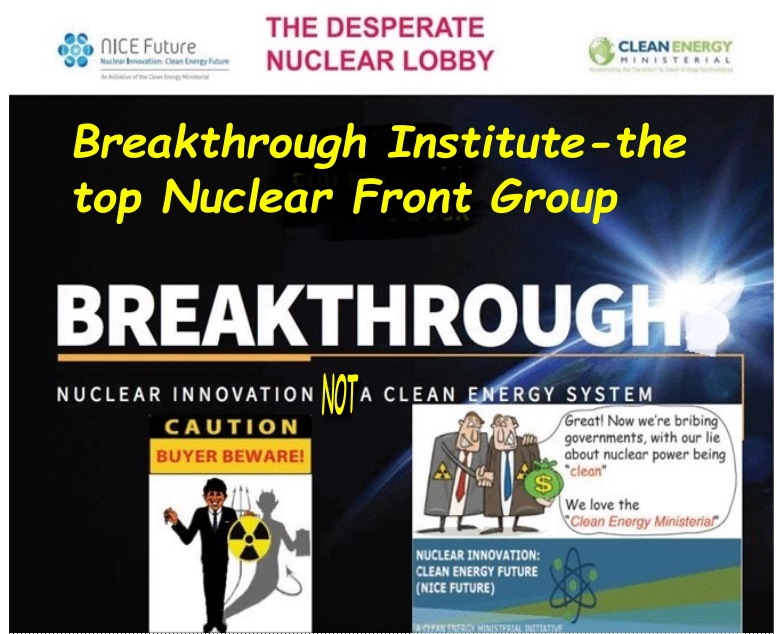
Though BEC no longer makes its membership public, the original coalition included such familiar names as Jeff Bezos (Amazon), Marc Benioff (Salesforce), Michael Bloomberg, Richard Branson, Jack Ma (Alibaba), David Rubenstein (Carlyle Group), Tom Steyer, George Soros, and Mark Zuckerberg. Many of those names (and others) can now be found on the “Board and Investors” page of Breakthrough Energy’s website.
Writing in Counterpunch (Dec. 4, 2015) shortly after BEC’s launch, Linda Pentz Gunter noted that many of those 28 BEC billionaires (collectively worth some $350 billion at the time) are pro-nuclear and Gates himself “is already squandering part of his wealth on Terra Power LLC, a nuclear design and engineering company seeking an elusive, expensive and futile so-called Generation IV traveling wave reactor” for SMRs. (In 2016, Terra Power, based in Bellevue, Washington, received a $40 million grant from Ernest Moniz’s Department of Energy.)
According to cleantechnica.com, the Breakthrough Energy Coalition “does have a particular focus on nuclear energy.” Think of BEC as the billionaires’ nuclear club.
By 2017, BEC was launching Breakthrough Energy Ventures (BEV), a $1 billion fund to provide start-up capital to clean-tech companies in several countries.
Going after the public purse
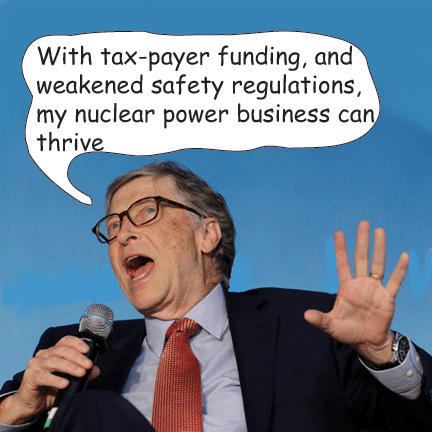
Bill Gates was apparently very busy during the 2015 Paris climate talks. He also went on stage during the talks to announce a collaboration among 24 countries and the EU on something called Mission Innovation – an attempt to “accelerate global clean energy innovation” and “increase government support” for the technologies. Mission Innovation’s key private sector partners include the Breakthrough Energy Coalition, the World Economic Forum, the International Energy Agency, and the World Bank.
An employee at Natural Resources Canada, Amanda Wilson, was appointed as one of the 12 international members of the Mission Innovation Steering Committee.
In December 2017, Bill Gates announced that the Breakthrough Energy Coalition was partnering with Mission Innovation members Canada, UK, France, Mexico, and the European Commission in a “public-private collaboration” to “double public investment in clean energy innovation.”
Canada’s Minister of Natural Resources at the time, Jim Carr, said the partnership with BEC “will greatly benefit the environment and the economy. Working side by side with innovators like Bill Gates can only serve to enhance our purpose and inspire others.”
Dr. M.V. Ramana, an expert on nuclear energy and a professor at the School of Public Policy and Global Affairs at UBC, told me by email: “As long as Bill Gates is wasting his own money or that of other billionaires, it is not so much of an issue. The problem is that he is lobbying hard for government investment.”
Dr. Ramana explained that because SMRs only exist on paper, “the scale of investment needed to move these paper designs to a level of detail that would satisfy any reasonable nuclear safety regulator that the design is safe” would be in the billions of dollars. “I don’t see Gates and others being willing to invest anything of that scale. Instead, they invest a relatively small amount of money (compared to what they are worth financially) and then ask for government handouts for the vast majority of the investment that is needed.”
Kevin Kamps, Radioactive Waste Specialist at Beyond Nuclear, told me by email that the companies involved in SMRs “don’t care” if the technology is actually workable, “so long as they get paid more subsidies from the unsuspecting public. It’s not a question of it working, necessarily,” he noted.
Gordon Edwards, President of the Canadian Coalition for Nuclear Responsibility, says governments “are being suckers. Because if Wall Street and the banks will not finance this, why should it be the role of the government to engage in venture capitalism of this kind?”
“Roadmap” to a NICE future
By 2018, NRCan was pouring money into a 10-month, pan-Canadian “conversation” about SMRs that brought together some 180 individuals from First Nations and northern communities, provincial and territorial governments, industry, utilities, and “stakeholders.” The resulting November 2018 report, A Call to Action: A Canadian Roadmap for Small Modular Reactors, enthusiastically noted that “Canada’s nuclear industry is poised to be a leader in an emerging global market estimated at $150 billion a year by 2040.”
At the same time, Bill Gates announced the launch of Breakthrough Energy Europe, a collaboration with the European Commission (one of BEC’s five Mission Innovation partners) in the amount of 100 million euros for clean-tech innovation.
Gates’ PR tactic is effective: provide a bit of capital to create an SMR “bandwagon,” with governments fearing their economies would be left behind unless they massively fund such innovations.
NRCan’s SMR Roadmap was just in time for Canada’s hosting of the Clean Energy Ministerial/Mission Innovation summit in Vancouver in May 2019 to “accelerate progress toward a clean energy future.” Canada invested $30 million in Breakthrough Energy Solutions Canada to fund start-up companies.
A particular focus of the CEM/MI summit was a CEM initiative called “Nuclear Innovation: Clean Energy (NICE) Future,” with all participants receiving a book highlighting SMRs. As Tanya Glafanheim and M.V. Ramana warned in thetyee.ca (May 27, 2019) in advance of the summit, “Note to Ministers from 25 countries: Prepare to be dangerously greenwashed.”
Greenwash vs public backlash
While releasing the federal SMR Action Plan on December 18, O’Regan called it “the next great opportunity for Canada.”
Bizarrely, the Action Plan states that by developing SMRs, our governments would be “supporting reconciliation with Indigenous peoples” – but a Special Chiefs Assembly of the Assembly of First Nations passed a unanimous 2018 resolution demanding that “the Government of Canada cease funding and support” of SMRs. And in June 2019, the Anishinabek Chiefs-in-Assembly (representing 40 First Nations across Ontario) unanimously opposed “any effort to situate SMRs within our territory.”
Some 70 NGOs across Canada are opposed to SMRs, which are being pushed as a replacement for diesel in remote communities, for use in off-grid mining, tar-sands development, and heavy industry, and as exportable expertise in a global market.
On December 7, the Hill Times published an open letter to the Treasury Board of Canada from more than 100 women leaders across Canada, stating: “We urge you to say ‘no’ to the nuclear industry that is asking for billions of dollars in taxpayer funds to subsidize a dangerous, highly-polluting and expensive technology that we don’t need. Instead, put more money into renewables, energy efficiency and energy conservation.”
No new money for SMRs was announced in the Action Plan, but in her Fall Economic Statement, Finance Minister Chrystia Freeland touted SMRs and noted that “targeted action by the government to mobilize private capital will better position Canadian firms to bring their technologies to market.” That suggests the Canada Infrastructure Bank will use its $35 billion for such projects.
It will take a Herculean effort from the public to defeat this NICE Future, but along with the Assembly of First Nations, three political parties – the NDP, the Bloc Quebecois, and the Green Party – have now come out against SMRs.
Award-winning author Joyce Nelson’s latest book, Bypassing Dystopia, is published by Watershed Sentinel Books. She can be reached via www.joycenelson.ca.
NATO Spreads Nuclear Weapons, Energy, and Risk
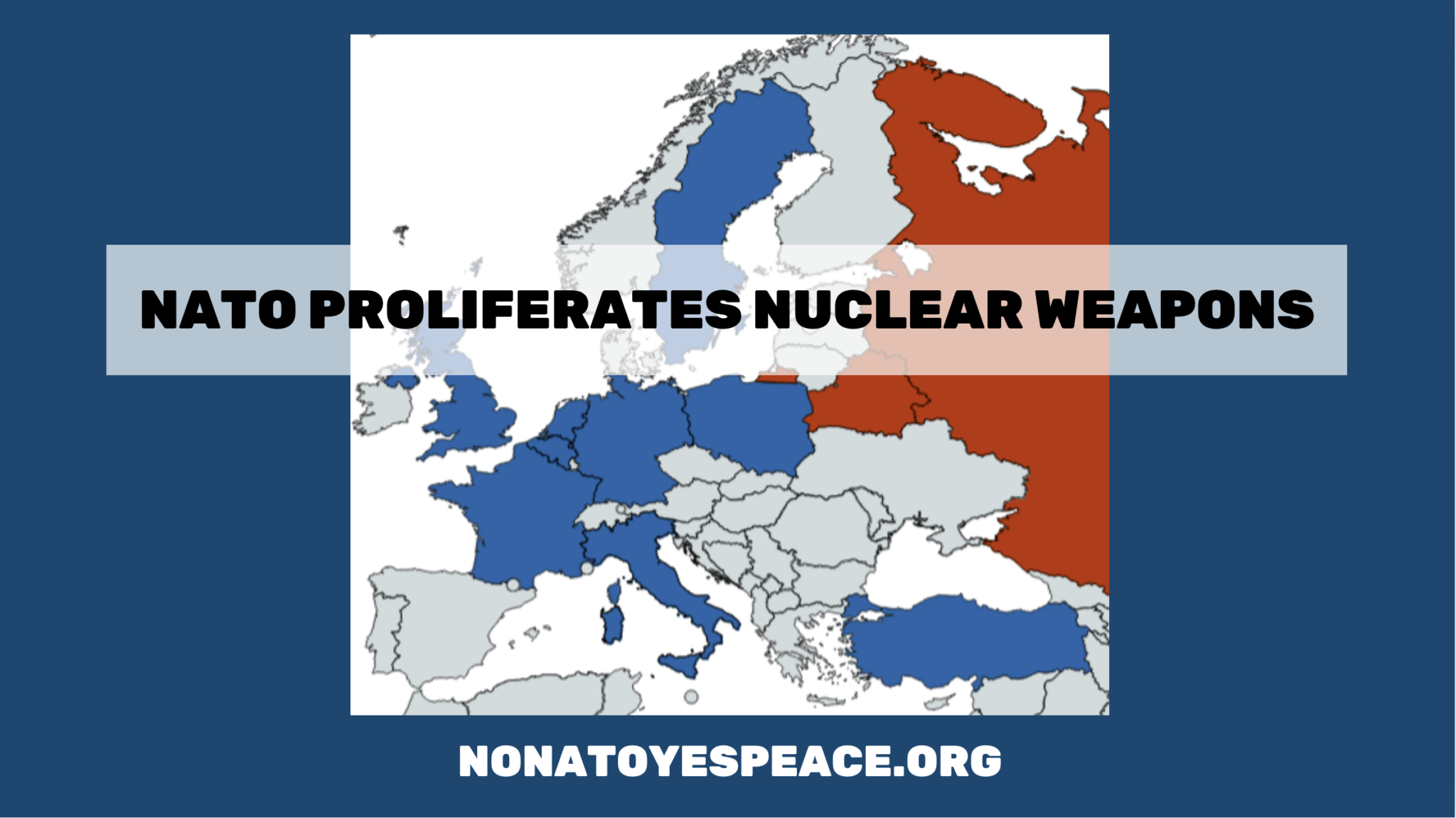
By David Swanson, World BEYOND War, May 15, 2024, https://worldbeyondwar.org/nato-spreads-nuclear-weapons-energy-and-risk/
Article 5 of the North Atlantic Treaty declares that NATO members will assist another member if attacked by “taking action as it deems necessary, including the use of armed force.” But the UN Charter does not say anywhere that warmaking is authorized for whoever jumps in on the appropriate side.
The North Atlantic Treaty’s authors may have been aware that they were on dubious legal ground because they went on twice to claim otherwise, first adding the words “Any such armed attack and all measures taken as a result thereof shall immediately be reported to the Security Council. Such measures shall be terminated when the Security Council has taken the measures necessary to restore and maintain international peace and security.” But shouldn’t the United Nations be the one to decide when it has taken necessary measures and when it has not?
The North Atlantic Treaty adds a second bit of sham obsequiousness with the words “This Treaty does not affect, and shall not be interpreted as affecting in any way the rights and obligations under the Charter of the Parties which are members of the United Nations, or the primary responsibility of the Security Council for the maintenance of international peace and security.” So the treaty that created NATO seeks to obscure the fact that it is, indeed, authorizing warmaking outside of the United Nations — as has now played out in Yugoslavia, Afghanistan, and Libya.
While the UN Charter itself replaced the blanket ban on all warmaking that had existed in the Kellogg-Briand Pact with a porous ban plagued by loopholes imagined to apply far more than they actually do — in particular that of “defensive” war — it is NATO that creates, in violation of the UN Charter, the idea of numerous nations going to war together of their own initiative and by prior agreement to all join in any other member’s war. Because NATO has numerous members, as does also your typical street gang, there is a tendency to imagine NATO not as an illegal enterprise but rather as just the reverse, as a legitimizer and sanctioner of warmaking.
The Nuclear Nonproliferation Treaty forbids transferring nuclear weapons to other nations. It contains no NATO exception. Yet NATO proliferates nuclear weapons, and this is widely imagined as law enforcement or crime prevention. The prime minister of Sweden said this week that NATO ought to be able to put nuclear weapons in Sweden as long as somebody has determined it to be “war time.” The Nonproliferation Treaty says otherwise, and the people who plan the insanity of nuclear war say “What the heck for? We’ve got them on long-range missiles and stealth airplanes and submarines?” The people of Sweden seem, at least in large part, to also want to say No Nukes — but when were people ever asked to play a role in “defending democracy”? The purpose of bringing nukes into Sweden, for those in the Swedish government who favor it, may in fact be purely a show of subservience to U.S. empire, driven by fear of its obliging partner in the arms race, the militarists in Russia.
Poland’s president says his country would be happy to have “NATO” nuclear weapons there, “war time” or not, and this proposal is reported in U.S. corporate media with no mention of any legal concerns and with the claim that it comes as a response to the Russian placement of nuclear weapons in Belarus. Last year I asked the Russian ambassador to the United States why putting nuclear weapons into Belarus wasn’t a blatant violation of the Nonproliferation Treaty, and he said, oh no, it was perfectly fine, because the United States does it all the time.
In fact, NATO itself owns and controls no nuclear weapons. Three NATO members own and control nuclear weapons. We cannot be certain how many weapons they have, since nuclear weapons are both justified with the dubious alchemy of “deterrence” and, contradictorily, cloaked in secrecy. The United States has an estimated 5,344 nuclear weapons, France an estimated 290, and Great Britain an estimated 240.
NATO calls itself a “nuclear alliance” and maintains a “Nuclear Planning Group” for all of its members — those with and those without nuclear weapons — to discuss the launching of the sort of war that puts all life on Earth at risk, and to coordinate rehearsals or “war games” practicing for the use of nuclear weapons in Europe. NATO partners Israel and Pakistan are estimated to possess 170 nuclear weapons each.
Five NATO members have U.S. nuclear weapons stored and controlled by the U.S. military within their borders: Belgium, Germany, Italy, the Netherlands, and Turkey. These are estimated at 35 nuclear weapons at Aviano and Ghedi Air Bases in Italy, 20 at Incirlik in Turkey, and 15 each at Kleine Brogel in Belgium, Volkel Air Base in the Netherlands, and Büchel Air Base in Germany. The United States is reportedly also moving its own nuclear weapons into RAF Lakenheath in the UK, where it has stored them in the past. The people of each of these countries routinely protest the presence of nuclear weapons and have never been asked to vote on the matter. The notion that the nuclear weapons in a European country are still U.S. nuclear weapons and thus haven’t been proliferated is an odd fit with the general understanding of international treaties, which are conceived and written as if there were no such thing as empire.
With so-called U.S. or NATO nuclear weapons in potentially eight nations in Europe — and perhaps South Korea as well, at least on U.S. submarines docked there to please certain war-crazed South Koreans — there could soon be more nations in the world with “U.S.” nuclear weapons than nations with anybody else’s.
In recent years, the United States has been replacing its nuclear bombs stored in European nations with a newer model (the B61-12), while NATO members have been buying new U.S.-made airplanes with which to drop them. Turkey has had U.S. nukes stored in it even while U.S.-backed and Turkish-backed troops have fought each other in Syria, and even during a non-U.S.-backed coup attempt at the very base where the nuclear weapons are stored.
Seven other NATO members are said to support “nuclear missions” using their non-nuclear militaries: The Czech Republic, Denmark, Greece, Hungary, Norway, Poland, and Romania.
Poland and Romania also host new U.S./NATO missile bases that could launch missiles into Russia from very short distances, leaving the Russian government mere moments to decide whether the weapons are nuclear, or to decide whether to launch missiles of its own. The U.S. and NATO claim the bases are purely defensive, and various supporters of the bases have even claimed they had nothing to do with Russia—that they were either focused on Iran (then-U.S. President Barack Obama) or purely functioned as jobs programs for U.S. workers (former U.S. Ambassador Jack Matlock).
Meanwhile, the U.S. has been manufacturing what many of its officials describe as “more usable” or “tactical” nuclear weapons (merely several times the destructive power of what was used on Hiroshima). At the same time, the U.S. military is aware that, in its war game scenarios, the use of a single so-called “tactical” nuclear weapon tends to lead to all-out nuclear war. Or, as then-Secretary of Defense Jim Mattis told the House Armed Services Committee in 2018, “I don’t think there is any such thing as a ‘tactical nuclear weapon.’ Any nuclear weapon used any time is a strategic game-changer.”
The U.S.-made, disaster-prone F-35 is the first “stealth” airplane designed to carry nuclear bombs, meaning that it can in theory drop a nuclear bomb on a city with no warning from radar at all. The U.S./NATO have managed to sell F-35s to the U.S., UK, Italy, Netherlands, Norway, Denmark, Belgium, Poland, Israel, Australia, Japan, South Korea, and Singapore, with efforts under way to spread them to more nations, eventually perhaps creating a general need for them on the grounds of “interoperability.” The F-35 is currently being demonstrated on the people of Gaza.
The U.S. military has enough nuclear weapons in each of the following three forms to threaten all life on our planet: missiles on U.S. submarines in oceans around the world; bombs on U.S. airplanes circling the globe; and missiles in the ground in the United States. So why also keep nuclear bombs in European countries, where they would have to be loaded onto airplanes and flown (presumably to Russia) on missions either so “stealth” that they avoid all warning or so risky that they would have to be preceded by massive efforts to destroy air defenses?
If the decision to “go nuclear” were up to NATO, all members would have to reach a consensus on it. However, NATO has not always easily reached a consensus. For example, the U.S. attempted to bring NATO into its plans for a war on Iraq in 2003 but failed, in part because of huge public pressure against that war in NATO nations. Nuclear war is one of the least popular ideas ever, so the launch of a nuclear weapon might have to be “stealth” not only in relation to Russia but also in relation to the Western public. If the U.S. decides to use nuclear weapons, it almost certainly will not bother trying to use the ones it keeps stored in Europe. For that matter, were U.S. officials intent on reaching secret bunkers under hills some distance from Washington, D.C., they would need significant warning that a nuclear war had been secretly scheduled — a problematic concept for both the idea of deterrence and the idea of democracy.
The purpose of NATO in the North Atlantic Treaty is supposed to be defense against an attack on Europe, not deterrence. But in the event of responding to such an attack, whether the response were nuclear or not, the U.S. bombs stored in Europe would probably not be used. Threats in the name of deterrence have tended to fuel arms races and wars. But keeping U.S. nuclear weapons in Europe seems to fail even by the usual standards of deterrence theory, since their most likely use would be in an unlikely secret attack. Some U.S. officials believe those nuclear bombs serve no “military purpose” but only a “political” one, to reassure the host countries that the U.S. government cares about them.
The argument has also been made that, since Russia would like the nuclear bombs removed from Europe, the U.S. should either keep them there or demand something huge from Russia in exchange for removing them. Another argument is that this is part of making European nations share the burden, along the lines of making them spend more money on weapons. But if the burden serves no purpose, why should anyone share it? European government officials know the bombs are not useful as bombs. They know the bombs are provocative toward Russia. They know, in fact, that Russia is using the U.S. storage of nuclear bombs in European nations as an excuse to put Russian nuclear weapons into Belarus. So a more realistic understanding of the “political” purpose of U.S. nukes in Europe is probably a combination of the idea that the U.S. military will fight for any nation in which it has stored nukes, the perverse prestige that many imagine comes with possessing nukes (even if someone else actually possesses them on your land), and the general U.S. goals of keeping European governments intertwined with the U.S. military, supportive of U.S. military strategies, and willing to spend vast amounts on U.S.-made weapons.
Spreading along with nuclear weapons is nuclear energy — climate-disastrous, slow, expensive, super-dangerous nuclear energy, which creates permanent deadly waste, which poisons those around it, which no insurance company will insure, and the facilities for which constitute nuclear catastrophes waiting for accident or attack. Listen to Harvey Wasserman on what drugs you need to take in order to believe that nuclear energy is good for the climate. Not only are various nations pursuing nuclear energy in order to be closer to developing nuclear weapons, but nuclear NATO countries like the U.S. and UK are promoting this spread of nuclear technology at home and abroad because it is through nuclear energy that they maintain skills, training, and materials they want for nuclear weaponry.
There is a better way, and everyone who cares about avoiding nuclear apocalypse is invited to join in preparations for unwelcoming NATO to its 75th birthday party this July in Washington DC: https://nonatoyespeace.org.
David Swanson is an author, activist, journalist, and radio host. He is executive director of WorldBeyondWar.org and campaign coordinator for RootsAction.org. Swanson’s books include his latest: NATO What You Need to Know with Medea Benjamin. He blogs at DavidSwanson.org. He hosts Talk World Radio. He is a Nobel Peace Prize nominee, and U.S. Peace Prize recipient.
RADIATION. Euratom Treaty requires continuous monitoring radioactive discharges from nuclear facilities

Study on monitoring of radioactive discharges from nuclear facilities in
the EU. Chapter three of Title II of the Euratom Treaty, Article 35 states:
‘Each Member State shall establish the facilities necessary to carry out
continuous monitoring of the level of radioactivity in the air, water and
soil and to ensure compliance with the basic standards’.
This study focuses on the facilities that have the authorisation to discharge a
significant amount of radioactivity in the environment. With this
authorisation, the nuclear facilities are required to have technical
systems in place to carry out continuous or batch-wise monitoring of these
discharges.
During this study, 11 nuclear facilities in nine Member States
(covering nuclear power plants with different technologies, a spent fuel
reprocessing plant, medical isotope production facilities, and a nuclear
plant under dismantling) were visited for a detailed assessment of the
monitoring of liquid and gaseous radioactive discharge systems.
EU (accessed) 15th May 2024
“Nuclear comes last”

the tail-between-legs exit of the Nuclear Summit conferees declared in a headline: “Taxpayers are needed to foot the bill to achieve 2050 targets.”
Banks reject nuclear funding, stocks nosedive and the industry says it should, believe it or not, slow down
By Linda Pentz Gunter https://beyondnuclearinternational.org/2024/03/31/nuclear-comes-last/

NuScale, the company whose small modular reactor project collapsed so spectacularly last November, is “burning cash at the rate of $185 million per year”. On March 22, the company’s CEO, John Hopkins, sold 59,768 of his shares in the company. This is the same CEO who declared NuScale’s SMR project, aptly named VOYGR, “a dead horse.” It’s clearly on a journey to nowhere.

Wells Fargo, with an eye on prudent investments, has declared, “We think investor enthusiasm for SMR is misguided”. As The Motley Fool reported, “NuScale’s VOYGR nuclear power product has ‘no secure customers’ and is ‘not cost competitive’ says the analyst.”
The splashy cheerleading Nuclear Energy Summit organized by the International Atomic Energy Agency in Brussels on March 21 proved to be just that. The participants arrived floating on the hot air of their misplaced enthusiasm but “left humbled by the tepid reaction of bankers assessing the price tag of their ambitions”.
European Investment Bank Vice President Thomas Ostros, told Summit attendees to their face that “The project risks, as we have seen in reality, seem to be very high”. Representatives from the European and Latin American banking worlds said that “their lending priorities lean toward renewables and transmission grids” and that “nuclear comes last”.

Even the US Nuclear Regulatory Commission couldn’t quite bring itself to slam down its rubber stamp on Oklo’s chalet-in-the-woods micro reactor, the Aurora, which remains about as real as its namesake fairy tale princess.
In January 2022, the NRC denied Oklo’s license application outright because it “continues to contain significant information gaps in its description of Aurora’s potential accidents as well as its classification of safety systems and components,” wrote the NRC.
Oklo reapplied nine months later but according to the NRC docket there is “no further action”.
Nevertheless, Oklo brags on its website that it “made history” simply by developing “the first advanced fission combined license application to the U.S. Nuclear Regulatory Commission”, which sums up the second nuclear “renaissance” perfectly: Make a drawing. Hit ‘send’.
Meanwhile, the US military canceled its contract for an Aurora reactor originally intended for the Eielson Air Force Base near Fairbanks, Alaska.
And finally, an executive from the industry that has consistently delivered its latest new reactors decades late and billions over the original budget — in one case $20 billion over — suggested they should all just slow down. Said Ian Edwards, chief executive of Canadian reactor producer, Atkins Realis, “we all become too optimistic. We have this optimism bias towards being able to deliver faster. Really we should probably slow things down a little bit.”
But nuclear power is the answer to our current climate crisis! Ya think?
It’s tempting to ask whether things can get any worse for the nuclear power industry, but they almost certainly will. Unless we end up paying for it all. As the Bloomberg article that related the tail-between-legs exit of the Nuclear Summit conferees declared in a headline: “Taxpayers are needed to foot the bill to achieve 2050 targets.”
At the moment, a majority in the US Congress seem intent on making sure that is exactly what will happen. Because after all, why should multi-billionaire, Bill Gates, be forced to pay for his own nuclear toys when he can milk (read ‘bilk’) US taxpayers instead?
The US government has already pledged $2 billion of our money to Gates for his proliferation-friendly liquid sodium-cooled molten salt fast reactor produced by his company, TerraPower (more properly, TerrorPower). Gates can’t wait to export it the United Arab Emirates. Nuclear weapons anyone?
The strokey-white-beard-named ADVANCE Act, has been passed by the US House with 365 voting in favor and only 36 Democrats-with-a-conscience voting against it. By its own description, the ADVANCE ACT aims to “advance the benefits of nuclear energy by enabling efficient, timely, and predictable licensing, regulation, and deployment of nuclear energy technologies.” In other words, do away with burdensome — and expensive — safety regulations.
Indeed, New Mexico Democrat, Senator Martin Heinrich, told E&E News in January that “These regulatory timelines do not lend themselves to fighting the climate crisis.” Oh those wascally wegulations!
Meanwhile, Democratic senator Joe Manchin of West Virginia doesn’t want to seat any new NRC commissioners who might be “too focused on safety.”
The NRC’s motto is “protecting people and the environment,” a mandate it demonstrably endeavors to avoid already, but even some vestige of interest in safety is probably better than none. Not that safety oversight will be needed of course because, hey, SMRs are “walkaway safe” and “meltdown proof” and any new light water reactors are too “advanced” to be a safety risk.
This makes the insistence by SMR manufacturers that they must be covered by the Price-Anderson Act (PAA) all the more curious. Price-Anderson, due to expire in 2025, was culled out of the ADVANCE ACT, now moving out of Senate committee and working its way through the reconciliation process, and handled separately. The Senate adopted the House version of the PAA, giving it a 40-year extension to 2026, and expanded limited liability for a major accident to just over $16 billion per reactor.
President Biden duly signed it into law, marking another misstep on what is becoming an increasingly problematic presidency.
Ed Lyman, Nuclear Power Safety Director at the Union of Concerned Scientists, told Nuclear Intelligence Weekly that “The nuclear industry’s push for a 40-year Price-Anderson Act extension is a sure sign that it doesn’t believe its own messaging about how safe the next generation of nuclear reactors is going to be.”
But in a joint statement, Senator Shelley Moore Capito (R-W.Va.) and Senator Tom Carper (D-Del.) declared that “The extension of the Price-Anderson Act in the minibus sends a clear message that we are committed to the advancement of this safe and reliable power source.”
The “clear message” this actually sends is that, in the event of a major nuclear accident, US taxpayers will be thrown under that minibus. The $16 billion coverage will be chicken feed and we will all be stuck with the bill. Let’s remember that the Chornobyl and Fukushima nuclear disasters are each racking up costs in the hundreds of billions of dollars and counting. We have been warned.
But a bi-partisan group of Representatives and Senators think it’s perfectly fine for all of us to pay for such an eventuality. Meanwhile, if you own a home and are forced to abandon it in the path of a nuclear accident, you cannot claim a dime off your homeowner’s insurance. It will just be a total loss. Think about that for a moment.
Are we outraged yet?
Linda Pentz Gunter is the international specialist at Beyond Nuclear
Nuclear power and nuclear weapons – two sides of the same coin

In March 2024, Prime Minister Rishi Sunak explicitly linked nuclear weapons production capability with civil nuclear power generation development. This is because nuclear reactors are used to create tritium – the radioactive isotope of hydrogen – necessary for nuclear weapons.
The government has admitted its push for nuclear energy expansion is linked to its strategic military interests
by Peter Wilkinson, 12 May 2024, o https://eastangliabylines.co.uk/nuclear-power-and-nuclear-weapons-two-sides-of-the-same-coin/
The government’s apparent answer to climate change and Russia’s invasion of Ukraine is to triple the amount of nuclear generated electricity in the belief that it generates ‘low carbon’ electricity. But a recent admission by Prime Minister Rishi Sunak suggests there is a strong military component to what looks on the surface to be a civil matter.
The UK review of the energy sector, prompted by the invasion of Ukraine, offered a golden opportunity to address the need to drive down demand for electricity and energy more generally. This could be achieved by retrofitting insulation to the housing stock and buildings, mandating solar panel use for all new homes, investing heavily in renewables, in emerging battery technology and in decentralisation. Instead, the government has focused on a massive expansion of nuclear-generated electricity.
The dual nuclear agenda
Now the reason has finally been openly admitted. Maintaining and improving the supply chain and the knowledge and skills base in the workforce for the UK’s £100bn Trident nuclear weapons renewal programme relies on the civil nuclear sector.
While this claim has been regularly made by anti-nuclear campaigners – and just as regularly denied by minister after minister – it is now openly acknowledged. The Roadmap states quite clearly that it is important to align civil and military nuclear ambitions across government, to strengthen the interconnections between civil and military industries’ research and development, and thereby reduce costs for both the weapons and power sectors.
In March 2024, Prime Minister Rishi Sunak explicitly linked nuclear weapons production capability with civil nuclear power generation development. This is because nuclear reactors are used to create tritium – the radioactive isotope of hydrogen – necessary for nuclear weapons.
The cat which was so carefully and fraudulently hidden for decades is finally out of the bag: ministers now have to acknowledge that the civil nuclear programme owes more to maintaining weapons of mass destruction – weapons that were outlawed by the Treaty on the Prohibition of Nuclear Weapons which entered into force in January 2021 – than it has to do with salvation from the existential crisis that is climate change.
Debunking myths: the truth behind nuclear ambitions
Its brave new world aims for a nuclear sector generating upto 24 Gigawatts of electricity by 2050. That’s comparable to seven new 3.2 Gw capacity Hinkley Point Cs or Sizewell Cs or forty-eight Sizewell A-size reactors at around half a Megawatt output.
The locations for a proposed ‘mix’ of ‘gigawatt-sized reactors’ such as the European Pressurised Reactor (EPR) planned for Sizewell C, and ‘small modular’ and ‘advanced modular’ reactors (SMRs and AMRs respectively) is the subject of the government’s ‘Nuclear Road Map’.
It is, necessarily, largely a work of fiction laced with eulogies to nuclear power and liberally interspersed with admissions of hope over expectations. The truth is that Hinkley Point C is now expected to cost an eye-watering £40+bn from its original £20bn, and Sizewell C has already cost the taxpayer £2.4bn in sweeteners to the private sector.
Commercial SMRs don’t yet exist, and they are not small, unless you consider that Sizewell A falls into that category. AMRs have remained a fantasy for decades and are likely to remain so. Mention them to a nuclear regulator, and you’ll probably get a raised eyebrow in response.
Nuclear revival: promises vs reality
The Sizewell project has yet to be granted multiple construction and operating permits and licences and no final investment decision has been made. Other issues which make Sizewell C a terrible idea include:
- A multi-billion hole existing in its finances
- There is no reliable and guaranteed supply of potable water – of which an average of 2.2 million litres a day are required in the country’s most water-scarce area
- It is situated in a flood zone
- It is in an Area of Outstanding Natural Beauty
- It sits on the fastest-eroding coastline in northern Europe
- An estimated 46 hectares of woodland have already been flattened
- The Environment Agency (EA) has authorised the dumping of 1,590 tonnes of dead and dying fish back into the North Sea each year as a consequence of the Sizewell C cooling water intake (not to mention the 100s of millions of fish, fish larvae and other marine biota)
- In addition, there will be an estimated 171 million sacrificial sand goby, none of which are acknowledged by the EA.
- Radiological discharges from Sizewell C to the sea and air have contested health impacts
EDF ploughs on
The Supreme Court is still considering the merits of a judicial review appeal against the original planning approval. None of these uncertainties and deficiencies have stopped EDF devastating the areas around the development with the sanction of the local planning authority.
The tragedy is that nuclear is now a redundant technology which takes too long to come to our climate-change rescue and is not fit to be in the front-line of defence against climate change. It does not represent a plan of great urgency to meet the accelerating existential threats of climate change.
It has a rapidly narrowing window in which to contribute its electricity to the job of reducing climate change risks. When compared to renewables and conservation measures, nuclear is slow, costly and unreliable in terms of the new technology embodied in the EPR design. The Flamanville project in France, using a Sizewell EPR-type reactor, is still offline, is twelve years late and will cost four times the original budget.
The government has been in thrall to nuclear power for a long time. Perhaps with the admission of its connection to its strategic miliary goals, we can now better understand why that is. But the knowledge only deepens and entrenches the divide between the hawks and the doves.
United States nuclear weapons, 2024
The current strategic nuclear war plan—OPLAN 8010–12—consists of “a family of plans” directed against four identified adversaries: Russia, China, North Korea, and Iran.
Just like previous NPRs, the Biden administration’s NPR said the United States reserved the right to use nuclear weapons under “extreme circumstances to defend the vital interests of the United States or its allies and partners” and rejected policies of nuclear “no-first-use” or “sole purpose” (US Department of Defense 2022a, 9)
Bulletin, By Hans M. Kristensen, Matt Korda, Eliana Johns, Mackenzie Knight | May 7, 2024
The United States has embarked on a wide-ranging nuclear modernization program that will ultimately see every nuclear delivery system replaced with newer versions over the coming decades. In this issue of the Nuclear Notebook, we estimate that the United States maintains a stockpile of approximately 3,708 warheads—an unchanged estimate from the previous year. Of these, only about 1,770 warheads are deployed, while approximately 1,938 are held in reserve. Additionally, approximately 1,336 retired warheads are awaiting dismantlement, giving a total inventory of approximately 5,044 nuclear warheads. Of the approximately 1,770 warheads that are deployed, 400 are on land-based intercontinental ballistic missiles, roughly 970 are on submarine-launched ballistic missiles, 300 are at bomber bases in the United States, and approximately 100 tactical bombs are at European bases. The Nuclear Notebook is researched and written by the staff of the Federation of American Scientists’ Nuclear Information Project: director Hans M. Kristensen, senior research fellow Matt Korda, research associate Eliana Johns, and program associate Mackenzie Knight.
In May 2024, the US Department of Defense maintained an estimated stockpile of approximately 3,708 nuclear warheads for delivery by ballistic missiles and aircraft. Most of the warheads in the stockpile are not deployed but rather stored for potential upload onto missiles and aircraft as necessary. We estimate that approximately 1,770 warheads are currently deployed, of which roughly 1,370 strategic warheads are deployed on ballistic missiles and another 300 at strategic bomber bases in the United States. An additional 100 tactical bombs are deployed at air bases in Europe. The remaining warheads—approximately 1,938—are in storage as a so-called “hedge” against technical or geopolitical surprises. Several hundred of those warheads are scheduled to be retired before 2030 (see Table 1 on original).
While the majority of the United States’ warheads comprises the Department of Defense’s military stockpile, retired warheads under the custody of the Department of Energy awaiting dismantlement constitute a “significant fraction” of the United States’ total warhead inventory (US Department of Energy 2023b). Dismantlement operations include the disassembly of retired weapons into component parts that are then assigned for reuse, storage, surveillance, or for additional disassembly and subsequent disposition (US Department of Energy 2023b, 2–11). The pace of warhead dismantlement has slowed significantly in recent years: While the United States dismantled on average more than 1,000 warheads per year during the 1990s, in 2020 it dismantled only 184 warheads (US State Department 2021). According to the Department of Energy, “[d]ismantlement rates are affected by many factors, including appropriated program funding, logistics, legislation, policy, directives, weapon system complexity, and the availability of qualified personnel, equipment, and facilities” ……………………………………..
…………….. we estimate that the United States possesses approximately 1,336 retired—but still intact—warheads awaiting dismantlement, giving a total estimated US inventory of approximately 5,044 warheads.
Between 2010 and 2018, the US government publicly disclosed the size of the nuclear weapons stockpile; however, in 2019 and 2020, the Trump administration rejected requests from the Federation of American Scientists to declassify the latest stockpile numbers (Aftergood 2019; Kristensen 2019a, 2020b). In 2021, the Biden administration restored the United States’ previous transparency levels by declassifying both numbers for the entire history of the US nuclear arsenal until September 2020—including the missing years of the Trump administration. . This effort revealed that the United States’ nuclear stockpile consisted of 3,750 warheads in September 2020—only 72 warheads fewer than the last number made available in September 2017 before the Trump administration reduced the US government’s transparency efforts (US State Department 2021). We estimate that the stockpile will continue to decline over the next decade as modernization programs consolidate the remaining warheads.
Following the Biden administration’s initial declassification in 2021, it has since denied successive annual requests from the Federation of American Scientists to disclose the stockpile numbers for 2021, 2022, or 2023 (Kristensen 2023d). A decision to no longer declassify these numbers not only contradicts the Biden administration’s own recent practices, but also represents a return to Trump-era levels of nuclear opacity. Such increased nuclear secrecy undermines US calls for Russia and China to increase transparency of their nuclear forces.
The US nuclear weapons are thought to be stored at an estimated 24 geographical locations in 11 US states and five European countries (Kristensen and Korda 2019, 124). The number of locations will increase over the next decade as nuclear storage capacity is added to three bomber bases. The location with the most nuclear weapons by far is the large Kirtland Underground Munitions and Maintenance Storage Complex south of Albuquerque, New Mexico. Most of the weapons in this location are retired weapons awaiting dismantlement at the Pantex Plant in Texas. The state with the second-largest inventory is Washington, which is home to the Strategic Weapons Facility Pacific and the ballistic missile submarines at Naval Submarine Base Kitsap. The submarines operating from this base carry more deployed nuclear weapons than any other base in the United States.
Implementing the New START treaty
The United States appears to be in compliance with the New Strategic Arms Reduction Treaty (New START) limits. Although Russia “suspended” its participation in New START in February 2023, the United States publicly declared in May 2023 that it had 1,419 warheads attributed to 662 deployed ballistic missiles and heavy bombers as of March 1st, 2023 (US State Department 2023a). The United States initially said that it voluntarily released the numbers “[i]n the interest of transparency and the US commitment to responsible nuclear conduct.” However, the United States did not continue this practice beyond that initial exchange and has not published any aggregate numbers since May 2023 (US State Department 2023a)
The United States contends that Russia’s “suspension” of New START implementation is “legally invalid” (US State Department 2023c). In response, the United States adopted four countermeasures in 2023 that it claimed were fully consistent with international law 1) no longer providing biannual data updates to Russia; 2) withholding from Russia notifications regarding treaty-accountable items (i.e. missiles and launchers) required under the treaty; 3) refraining from facilitating inspection activities on US territory; and 4) not providing Russia with telemetric information on US ICBM and SLBM launches (US State Department 2023c).
The New START warhead numbers reported by the US State Department differ from the estimates presented in this Nuclear Notebook, though there are reasons for this. …………………..
Since the treaty entered into force in February 2011, the biannual aggregate data show the United States has cut its arsenal by a total of 324 strategic launchers, reduced deployed launchers by 220 and the warheads attributed to them by 381 (US State Department 2011). The warhead reduction is modest, only equivalent to about 10 percent of the 3,708 warheads remaining in the US stockpile. ………….
As of March 2023, the United States had 38 launchers and 131 warheads less than the treaty limit for deployed strategic weapons but had 119 deployed launchers more than Russia—a significant gap that is just under the size of an entire US Air Force intercontinental ballistic missile (ICBM) wing. So far Russia has not sought to reduce this gap by deploying more strategic launchers but instead has increased the portion of its missiles that can carry multiple warheads.
The New START treaty has proven useful so far in keeping a lid on both countries’ deployed strategic forces. But it expires in February 2026 and if it is not followed by a new agreement, both the United States and Russia could potentially increase their deployed nuclear arsenals by uploading several hundred of stored reserve warheads onto their launchers.
Nuclear Posture Reviews and nuclear modernization programs
The Biden administration’s 2022 Nuclear Posture Review (NPR) was broadly consistent with the Trump administration’s 2018 NPR…………………………………
Just like previous NPRs, the Biden administration’s NPR said the United States reserved the right to use nuclear weapons under “extreme circumstances to defend the vital interests of the United States or its allies and partners” and rejected policies of nuclear “no-first-use” or “sole purpose” (US Department of Defense 2022a, 9)…………………………………………………………………………………………………………………………………………………
In 2023, multiple governmental advisory commissions published reports intended to influence US nuclear posture. The Congressionally-mandated report on “America’s Strategic Posture,” published in October 2023, included a broad range of recommendations for the United States to prepare to increase the number of deployed warheads, as well as to scale up its production capacity of bombers, air-launched cruise missiles, ballistic missile submarines, non-strategic nuclear forces, and warheads (US Strategic Posture Commission 2023). It also called for the United States to deploy multiple warheads on land-based intercontinental ballistic missiles (ICBMs) and consider adding road-mobile ICBMs to its arsenal…………………………………. the Strategic Posture Commission report’s status as a bipartisan document has been particularly useful for nuclear advocates to push for additional nuclear weapons (Heritage 2023; Hudson Institute 2023; Thropp 2023).
While additional modernization programs are being discussed, the National Nuclear Security Administration, or NNSA, delivered in 2023 more than 200 modernized nuclear weapons (B61–12 bombs and W88 Alt 370 warheads) to the Department of Defense (US Department of Energy 2024).
Nuclear planning and nuclear exercises
In addition to the Nuclear Posture Review, the nuclear arsenal and the role it plays is shaped by plans and exercises that create the strike plans and practice how to carry them out.
The current strategic nuclear war plan—OPLAN 8010–12—consists of “a family of plans” directed against four identified adversaries: Russia, China, North Korea, and Iran. Known as “Strategic Deterrence and Force Employment,” OPLAN 8010–12 first entered into effect in July 2012 in response to operational order Global Citadel. ………………………………………………………………….
…………………………………. changes are evident in the types of increasingly provocative bomber operations over Europe, in some cases very close to the Russian border (Kristensen 2022a). In October 2023, for example, a B-52 bomber from Barksdale AFB in Louisiana participated in NATO’s annual nuclear exercise Steadfast Noon, and in March 2023 a nuclear-capable B-52 cut south only a few kilometers from the Russian sea border and then flew south near Kaliningrad (Kristensen 2023a; NATO 2023).
…………………US strategy has changed in response to deteriorating East-West relations and the new “great power competition” and “strategic competition” strategy promoted by the Trump and Biden administrations, respectively. They also illustrate a growing integration of nuclear and conventional capabilities, as reflected in the new strategic war plan. B-52 Bomber Task Force deployments typically include a mix of nuclear-capable aircraft and aircraft that have been converted to conventional-only missions. With Sweden joining NATO, US strategic bombers now routinely operate over Swedish territory: In August 2022, for example, two B-52s—one version that is nuclear-capable and one that is de-nuclearized—overflew Sweden, the first overflight since it applied for NATO membership in May 2022 (Kristensen 2022c)…………………………………………………………………………………………….
Land-based ballistic missiles
The US Air Force (USAF) operates 400 silo-based Minuteman III ICBMs and keeps “warm” another 50 silos to load stored missiles if necessary, for a total of 450 silos. Land-based missile silos are divided into three wings: the 90th Missile Wing at F. E. Warren Air Force Base in Colorado, Nebraska, and Wyoming; the 91st Missile Wing at Minot Air Force Base in North Dakota; and the 341st Missile Wing at Malmstrom Air Force Base in Montana. Each wing has three squadrons, each with 50 Minuteman III silos collectively controlled by five launch control centers. We estimate there are up to 800 warheads assigned to the ICBM force, of which about half are deployed (see Table 1, on original).
The 400 deployed Minuteman IIIs carry one warhead each, either a 300-kiloton W87/Mk21 or a 335-kiloton W78/Mk12A. ICBMs equipped with the W78/Mk12A, however, could technically be uploaded to carry two or three independently targetable warheads each, for a total of 800 warheads available for the ICBM force……………………………………………………………………………………….
Part of the ongoing ICBM modernization program involves upgrades to the Mk21 reentry vehicles’ arming, fuzing, and firing system at a total cost of nearly $1 billion (US Department of Defense 2023c, 32). The publicly stated purpose of this refurbishment is to extend the vehicles’ service lives, but the effort appears to also involve adding a “burst height compensation” to enhance the targeting effectiveness of the warheads (Postol 2014)………………………………………………………………………………. As part of the Mk21A program, Lockheed Martin was awarded a sole source contract in October 2023 amounting to just under $1 billion for the engineering and manufacturing of the new reentry vehicle (US Department of Defense 2023b). These modernization efforts complement a similar fuze upgrade underway to the Navy’s W76–1/Mk4A warhead.
………………………………………………………………………………………………………………….. The Air Force’s FY24 budget for ICBM Reentry Vehicles Research Development, Test & Evaluation Programs increased significantly from the previous President’s Budget……………………………………………………………………………..
…………………………….Non-governmental experts, including those conducting Department of Defense-sponsored research, have questioned the Pentagon’s procurement process and lack of transparency regarding its decision to pursue the Sentinel option over other potential deployment and basing options (Dalton et al. 2022, 4). Moreover, it is unclear why an enhancement of ICBM capabilities would be necessary for the United States. For instance, any such enhancements would not mitigate the inherent challenges associated with launch-on-warning, risky territorial overflights, or silo vulnerabilities to environmental catastrophes or conventional counterforce strikes (Korda 2021). Additionally, even if adversarial missile defenses improved significantly, the ability to evade missile defenses lies with the payload—not the missile itself. ………………………………………..
……………………………………………….The development of the Sentinel has also been marked by a series of controversial industry contracts, starting with the awarding of a $13.3 billion sole-source contract to Northrop Grumman in 2020 to complete the engineering and manufacturing development stage
…………………………………………..in early 2024, the Air Force notified Congress of a two-year delay in the schedule and an estimated 37-percent increase from the current cost target to at least $125 billion (Tirpak 2024). These amounts do not include the costs for the new Sentinel warhead—the W87–1—which is projected to cost up to $14.8 billion, or the plutonium pit production that the US Air Force and US Strategic Command say is needed to build the warheads (Government Accountability Office 2020).
…………………………………………The schedule and extreme cost overruns for the Sentinel program incurred a critical breach of the Nunn-McCurdy Act, which requires the Secretary of Defense to conduct a root-cause analysis and renewed cost assessment before providing a certification to Congress that verifies the necessity and viability of the program no later than 60 days after a Selected Acquisition
…………………………………………………..Andrew Hunter, Assistant Secretary of the Air Force for Acquisition, Technology, and Logistics clarified that while the cost of the missile itself has increased, challenges with supporting infrastructure is the significant driver of schedule overrun, which also further impacts the overall cost (Tirpak 2024). In addition to an entirely new missile, the Sentinel program includes launch facility replacement and modifications (since the Sentinel may require a larger silo), new missile alert facilities, and new command and control facilities and systems—not to mention new training and curriculum for USAF personnel. Many of these delays are results of staffing shortfalls, clearance delays, IT infrastructure challenges, and trouble with supply chains on the part of Northrop Grumman (Government Accountability Office 2023a, 88)………………………………………………………………………………………………………………………………………………………………………..
Nuclear-powered ballistic missile submarines
The US Navy operates a fleet of 14 Ohio-class ballistic missile submarines (SSBNs), of which eight operate in the Pacific from their base near Bangor, Washington, and six operate in the Atlantic from their base at Kings Bay, Georgia……………………………………………………………………………………………..
Each submarine can carry up to 20 Trident II D5 sea-launched ballistic missiles
……………………………………………………………………………………………………………………Design of the next generation of ballistic missile submarines, known as the Columbia-class, is well underway.
………………………………………..the Navy’s fiscal 2024 budget submission estimated the procurement cost of the first Columbia-class SSBN—the USS District of Columbia (SSBN-826)—at approximately $15.2 billion, followed by $9.3 billion for the second boat (Congressional Research Service 2024, 9). A $5.1 billion development contract was awarded to General Dynamics Electric Boat in September 2017, and construction of the first boat began on October 1, 2020—the first day of FY 2021………………………………………………………..
…………………According to a June 2023 report by the Government Accountability Office, “the program remains behind on producing design products—in particular, work instructions that detail how to build the submarine—because of ongoing challenges using a software-based design tool. These, in turn, contributed to delays in construction of the lead submarine” (Government Accountability Office 2023a, 160). The Navy is working to mitigate additional delays, but these constraints mean that the program is at significant risk of cost overgrowth and is very likely to suffer further setbacks………………………………………………………………………………..
Strategic bombers
The US Air Force currently operates a fleet of 20 B-2A bombers (all of which are nuclear-capable) and 76 B-52 H bombers (46 of which are nuclear-capable)……………………………………………………………Each B-2 can carry up to 16 nuclear bombs (the B61–7, B61–11, B61–12, and B83–1 gravity bombs)…………..An estimated 788 nuclear weapons, including approximately 500 air-launched cruise missiles, are assigned to the bombers, but only about 300 weapons are thought to be deployed at bomber bases (see Table 1). The estimated remaining 488 bomber weapons are thought to be in central storage at the large Kirtland Underground Munitions Maintenance and Storage Complex outside Albuquerque, New Mexico.
The United States is modernizing its nuclear bomber force by upgrading nuclear command-and-control capabilities on existing bombers, developing enhanced nuclear weapons (the B61–12, B61–13, and the new AGM-181 Long-Range Standoff Weapon or LRSO), and designing a new heavy bomber (the B-21 Raider).
Upgrades to the nuclear command-and-control systems that the bombers use to plan and conduct nuclear strikes include the Global Aircrew Strategic Network Terminal (ASNT)…………………………………………………………………………………………………………….
The United States was initially expected to produce approximately 480 B61–12 bombs, but in 2023 it announced that a small number of them instead will be produced as the B61–13, a gravity bomb with a much larger yield (US Department of Defense 2023e………………………………………………………………………………………………………………
The Air Force is also developing a new nuclear air-launched cruise missile known as the AGM-181 LRSO……………………………………………………. The LRSO will arm both the 46 nuclear-capable B-52Hs and the new B-21, the first time a US stealth bomber will carry a nuclear cruise missile. A $250 million contract was awarded to Boeing in March 2019
…………………………………………….It is expected that the Air Force will procure at least 100 (possibly as many as 145) of the B-21, with the latest service costs estimated at approximately $203 billion …………………………………………………………………………………………………………………
Nonstrategic nuclear weapons
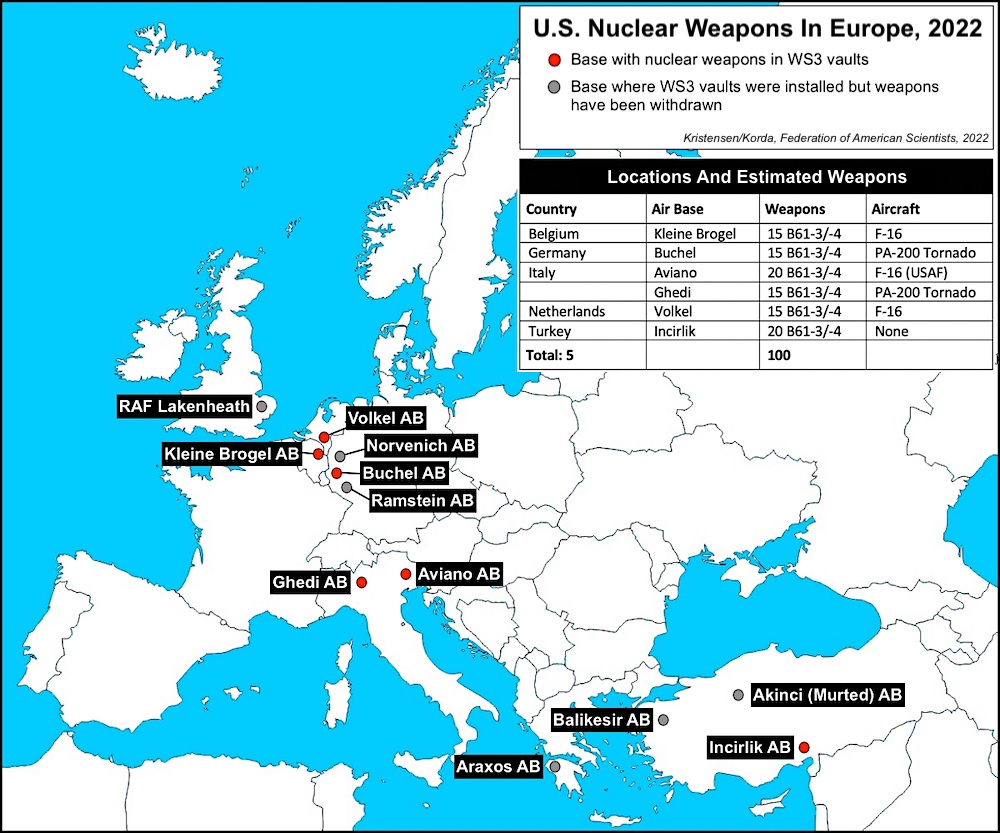
The United States has only one type of nonstrategic nuclear weapon in its stockpile: the B61 gravity bomb. But it exists in several versions: ……………………………………………………. About 100 of these (versions −3 and − 4) are thought to be deployed at six bases in five European countries: Aviano and Ghedi in Italy; Büchel in Germany; Incirlik in Turkey; Kleine Brogel in Belgium; and Volkel in the Netherlands…………………………………………………………………
The Belgian, Dutch, German, and Italian air forces are currently assigned an active nuclear strike role with US nuclear weapons. …………………………………………………………………………………………………………………………..
The United States withdrew nuclear weapons from the United Kingdom around 2007 after storing them at Royal Air Force (RAF) Lakenheath for several decades (Kristensen 2008). But increasing evidence over the past two to three years suggests that the United States may be returning its nuclear mission to UK soil (Korda and Kristensen 2023) (see Figure 3 on original)
……………………………………………………………In addition to the modernization of weapons, aircraft, and bases, NATO also appears to be increasing the profile of the dual-capable aircraft posture. NATO is now publicly announcing its annual Steadfast Noon tactical nuclear weapons exercise. For example, NATO described in 2023 that the exercise involved the participation of 13 countries and 60 aircraft including fighter jets and US B-52 bombers (NATO 2023)………………………………………………………………………………………………
This research was carried out with generous contributions from the New-Land Foundation, the Prospect Hill Foundation, Longview Philanthropy, Ploughshares Fund, and individual donors.
References…………………………………………….. https://thebulletin.org/premium/2024-05/united-states-nuclear-weapons-2024/
1 This Month
10 March A LIVE WEBINAR THE REAL EFFECTS OF NUCLEAR POWER
What the Industry Isn’t Telling Us
1:00 PM Mountain, 2 pm Central, 3 pm Eastern. Live on the Keepers of the Water Facebook page



18 March Webinar @ 1 PM EST: An Assessment of SMR Projects: The Case of Canada
register for the zoom:
https://us02web.zoom.us/webinar/register/WN_o8BIIOUvQ2ONJR1nta65DQ#/registration


of the week – STOP SMALL MODULAR REACTORS IN CANADA
To see nuclear-related stories in greater depth and intensity – go to https://nuclearinformation.wordpress.com
-
Archives
- March 2026 (109)
- February 2026 (268)
- January 2026 (308)
- December 2025 (358)
- November 2025 (359)
- October 2025 (376)
- September 2025 (258)
- August 2025 (319)
- July 2025 (230)
- June 2025 (348)
- May 2025 (261)
- April 2025 (305)
-
Categories
- 1
- 1 NUCLEAR ISSUES
- business and costs
- climate change
- culture and arts
- ENERGY
- environment
- health
- history
- indigenous issues
- Legal
- marketing of nuclear
- media
- opposition to nuclear
- PERSONAL STORIES
- politics
- politics international
- Religion and ethics
- safety
- secrets,lies and civil liberties
- spinbuster
- technology
- Uranium
- wastes
- weapons and war
- Women
- 2 WORLD
- ACTION
- AFRICA
- Atrocities
- AUSTRALIA
- Christina's notes
- Christina's themes
- culture and arts
- Events
- Fuk 2022
- Fuk 2023
- Fukushima 2017
- Fukushima 2018
- fukushima 2019
- Fukushima 2020
- Fukushima 2021
- general
- global warming
- Humour (God we need it)
- Nuclear
- RARE EARTHS
- Reference
- resources – print
- Resources -audiovicual
- Weekly Newsletter
- World
- World Nuclear
- YouTube
-
RSS
Entries RSS
Comments RSS
 nuclear-news